15 Jul 2024
ArticlesThe Theatre of Others’ Co-Artistic Director Budi Miller explores the psychosocial skills that facilitate talent development in actor training.
“An actor is an athlete,” he told an audience at the Leaders Sport Performance Summit at Melbourne’s Glasshouse, while accepting the obvious differences.
“We use our bodies, we use our emotions, we use our intellect, we use our voices – we use everything we can to get you to believe that we are who we say we are.”
Miller took to the stage alongside Kit Wise, the Dean of the School of Art, Design and Social Context at the Royal Melbourne Institute of Technology [RMIT], who shared his own views on the trainable psychosocial skills in talent development in the arts.
Here, we explore Miller’s thoughts on addressing questions of self-awareness, fear and resilience in a learning environment.
Self-awareness: the base for all development
As an actor learns to use their body, emotions, voice and other facets, Miller explained that it “requires a sense of awareness” and “from that awareness we [develop] an authenticity.” This ‘authenticity’ includes the taking of calculated risks as actors stay true to themselves. Miller helps actors to develop a deep awareness of their bodies and actions as well as a healthy attitude towards self-inquiry.
There is also a collective element. “We have an agreement that when we walk through the door we meet each other at our best.” That can be anything on any given day “and then everyone in the room is doing what they’re doing best at this moment; and what happens is they start to work and everyone’s level has increased”.
Fighting fear and constraints
Miller mentioned that fear can get in the way of talent development. In response, he emphasises the role of playfulness and fun in learning environments; that when actors are free of fear, they can stay motivated and free of unnecessary stress and self-consciousness. It’s a process he describes as the “de-socialising of the body”
He also cited the “speed of fun”, which is a concept devised by Miller’s former tutor Christopher Bayes at the David Geffen Yale School of Drama. The concept encourages actors to be present and spontaneous, enhancing their performance by keeping them in a state of flow and playfulness. “Bayes said that ‘fun is faster than worry and louder than the critic’ and it forces you to be on the front of your actions”. It is a primal rhythm that actors use to stay in the moment and maintain a high level of energy and engagement. “As opposed to thinking about the binary of ‘good and bad’ you’re just in. That happened. Get back to the rhythm, get back to the pace.”
Miller also advocates for a “body-first, not psychology” approach. “Psychology is a response to what’s happening in the body,” he said, adding that he will take actors through a series of fear-relieving exercises. “The body is leading me first; so if you have the awareness of understanding your body and how the body works, you can change the pattern that’s getting in the way.”
The role of the coach and collective in building resilience
Miller discussed resilience as it stems from a sense of connection in a supportive environment. The topic was raised in light of the risks posed to actors who chase external validation. “Whenever you use an external stimulus to identify your self-worth you are always secondary,” said Miller, who spoke of actors chasing grades and roles rather than finding internal fulfilment.
It takes an empathetic teacher and Miller made his point by referring to the Hindu faith where the god Shiva told his wife, Parvati, ‘through you I know myself’. Miller sees the struggles of his students and recognises that he was in their shoes once upon a time. “By integrating this empathy you’re able to change them without them even realising they’re being changed just by that energetic connection.” Miller must embody the traits he is training in others if he is to best engage students in their own development. “If I have the courage to have that vulnerability and just allow myself to be present, then we get to look at what the actual problem is, because oftentimes the problem is external.” As with playfulness, there is a collective element. “How can we as a team interact to solve this external problem together without the walls between us?”
The man responsible for ensuring a pipeline of British talent to the upper echelons of world tennis spoke about his role in delivering a programme based on ‘passion and care’.
The Performance Director of the Lawn Tennis Association [LTA] was a guest on the Leaders Performance Podcast in early July, where he discussed his remit.
“I break it down as if we want to deliver performance, then performance equals the talent that you’ve got multiplied by the exposure you can give that talent to them to develop and grow, minus interference.”
When it comes to high performance, tennis has several traits that separate it from other sports and this is reflected in the LTA’s provisions. For example, the organisation offers full-time multidisciplinary support to players from under-10s through to elite level, but player needs vary from individual to individual. They provide coaching too, at camps and competitions, but players tend to have private coaches.
It is a balance and one that he has been trying to strike during his four years in the role, which began during the first year of the pandemic. “It was a huge learning curve for me,” said Bourne, whose non-tennis background has never held him back.
Here, we reflect on his thoughts about his role.
He has a firm focus on the mission
Bourne, who has worked in sports science for organisations including UK Sport, the UK Sports Institute and the England & Wales Cricket Board, has a clear understanding of what the LTA is trying to achieve and why. “Our mission is to be world-class and respected at player development,” he said. “The slightly longer answer to that is that we create a pathway for our most talented players to go on a journey to becoming elite professional players, whether that’s in the tennis game or wheelchair tennis game.” It requires continuous self-evaluation on both his part and the LTA’s as well as acknowledging how the challenges faced evolve. Bourne emphasised a people-first approach. “However you cut it up, we are a performance-based industry and you have to have great people to do great things.” He spoke of “passion and care”. “We have a team of individuals who deeply care about the journey these players are on”. Passion is one of the LTA’s values and the sight of others in service to players is one Bourne finds “very humbling”.

Michael Bourne, Performance Director at the LTA. (Photo by Shane Anthony Sinclair/Getty Images for LTA)
His role in driving change
In addition to being mission-focused and people-centred, Bourne places a premium on critical thinking. He also believes that having great ideas is one thing, but being able to apply them is quite another. “You can have the greatest thinking and the greatest ideas in the world, but if you can’t drive and implement change, then it’s for naught,” he said. “Ultimately, leadership is about being able to drive and support change.” His team bring their tennnis-specific expertise and Bourne ensures everyone is aligned around the work that needs to be done. “It gets the balance between my background and their backgrounds in the right space.”
He does not assume things will happen on their own
Bourne readily admits his expertise is not rooted in tennis. Nevertheless, the necessary traits and skills are made familiar to him through his staff. He has set up a clear chain of direct reports and basic processes, but it needs constant attention. “Don’t just trust that they’re going to happen all the time – make sure that you’re around enough and verifying whether the communication, the connection that’s supposed to be in place, is actually in place; and if you need to step in and just give the person that support or just give that reminder of what we’re trying to do to prevent those dreaded silos developing people ploughing their own furrow”.
He relishes the daily challenges
Bourne feels that his role is inherently challenging; and that’s alright. “I feel like in these types of jobs, if your job is easy, something is wrong – I don’t think they’re meant to be easy,” he said. “If they’re easy, then you’re missing something or you’re not pushing when you need to push. There’s always more.” It feeds into his attitude towards the challenges faced by the LTA. “It should be unacceptable in a high performance environment to know there is a challenge and to take no steps to do anything about it.” There will often be “brutal facts”, as he put it, “then it’s my job to ensure that we’re all leaning into that and in the right way in a professional way and in a safe way; having the right types of conversations that we need to have.”
Listen to the full interview below:
Listen above and subscribe today on iTunes, Spotify, Stitcher and Overcast, or your chosen podcast platform.
In the first episode of our new series, Michael Bourne describes life as the LTA’s Performance Director.
A podcast brought to you by our Main Partners

“It is core to me,” the Performance Director at the Lawn Tennis Association [LTA] tells the Leaders Performance Podcast, which is brought to you today by our Main Partners Keiser.
Critical thinking is a skill that also served him well in roles at UK Sport and the England & Wales Cricket Board amongst others before he took the reins at the LTA in October 2020 (with Covid restrictions still in place).
“But,” he cautions, “leadership for me is about change and progress, and you can have the greatest thinking and the greatest ideas in the world, but if you can’t drive and implement change, then it’s for naught.”
It starts with taking stock. “As a leader, make sure that you are ensuring everybody else is confronting those brutal facts and you’ve got to be ahead of that,” he says, adding that he too must be open to feedback.
“It should be unacceptable in a high-performance environment to know there is a challenge and to take no steps to do anything about it.”
In the first episode of this new series, Michael explains his mission-driven and people-centred approach to helping produce British tennis players with the means to compete with the world’s best [33:10].
During the conversation, we also touch upon the challenges the LTA faces and the benchmarks set [8:30]; his belief in the unique qualities of British tennis [14:30]; why the flow of information cannot be taken for granted at the LTA [38:30]; and the enduring power of the Lion King to move him [48:00].
Henry Breckenridge X | LinkedIn
Listen above and subscribe today on iTunes, Spotify, Stitcher and Overcast, or your chosen podcast platform.
3 Jul 2024
ArticlesMoonshots, how leaders can work on themselves, and the pathway to better collaboration – just some of the topics that featured on the June agenda at the Institute.
It is always wonderful to see the great and the good of the Leaders Performance Institute gathered to discuss the pressing performance challenges of the day.
Speaking of which, the happenings at Red Bull were far from the only opportunities on offer at the Institute in June, with roundtables and community calls packed with members sharing both challenges and best practices on a range of topics.
Many are covered in this month’s Debrief. As ever, do check out our upcoming events and virtual learning sessions, which are designed to help you to connect, learn and share with your fellow members from across the globe.
Right, let’s get into some reflections on June.
What we learned at the Sport Performance Summit in LA
We had a great couple of days with those of you who made the trip; and there was plenty of thought-provoking content for us to get our teeth stuck into (full account here). Below are a few snippets that particularly caught our attention:
Four tips for avoiding the ‘Innovator’s Dilemma’
The Innovator’s Dilemma is a 1997 book by Harvard Professor Clayton Christensen that explores the tension between sustaining existing products and embracing disruptive innovations. It resonated with Jen Allum, from X, the Moonshot Factory and Alphabet, the parent company of Google, who understand they could easily fall prey to the Innovator’s Dilemma. Onstage, Allum shared their four top tips for avoiding this scenario:
Allum added that X, the Moonshot Factory “rewards project shutoffs, dispassionate assessments, and intellectual honesty” in the work they do.
How to optimise your energy as a leader
As a leader, strategic thinking is in your remit, but do you ever include protecting your energy as part of the equation? “An organisation can’t outpace its leaders,” said author Holly Ransom onstage. “So there’s nothing more important than working on ourselves as leaders.” Here are her thoughts on how leaders should show up each day:
The biomarkers of a healthy culture
Back to the myriad insights gleaned from our June Virtual Roundtables, starting off with the latest segment of our series of learning centred around culture and change. The sessions highlight findings from a recent research project by the Premier League’s Edd Vahid titled ‘Cultural Hypothesis’. The project examines the key components of cultures that have been able to sustain themselves.
Vahid posits astute leadership as a ‘super enabler’. Indeed, as Donald and Charles Sull wrote in the MIT Sloane Management Review in 2022: ‘A lack of leadership investment was, by far, the most important obstacle to closing the gap between cultural aspirations and current reality.’
What are some strategies we can consider?
Vahid’s also research reveals that cultural leadership operates on three levels:
Four features of a great debrief
Effective debriefing skills was the top of conversation for our latest Leadership Skills Series session. If you are interested to join roundtable sessions centred around developing your own leadership, there are some great topics coming up around strategy and cohesion you can find on the Member’s Area.
To keep this section punchy, a section of our discussion focused on some top line considerations for what constitutes a great debrief. Are you doing these well in your environments?
The pathway to better collaboration and multidisciplinary working
Finally, we wanted to highlight some interesting insights and perspectives from our topic-led roundtable on functioning more effectively as multidisciplinary teams, which is often a very popular topic of interest across the Institute when speaking to many of you.
Do check out the complete summary. Below are a handful of ideas from members on the call that they feel are currently missing or need to be given more attention in the quest to do this well:
Here we explore why effective debriefing can enable you to squeeze as much as possible out of your athletes, coaches and staff members’ experience.
For learning to take place, people need to both reflect on and make sense of the experience; then they can think through how they will apply the knowledge gained.
Therefore, it follows that one of the most powerful applications of coaching is to facilitate learning through an effective debriefing process; to squeeze as much richness out of the experience as possible.
Done well, it can drive a very steep learning curve, build responsibility and confidence, and increase the focus on results.
In short, the high performance organisations that best sustain success know how to debrief.
What the literature says…
Debriefing was at the heart of the most recent Leadership Skills Series session, where members of the Leaders Performance Institute spent time considering some academic findings on the topic.
A 2008 study in the International Journal of Performance Analysis in Sport found that coaches only recall between 16.8 per cent and 52.9 per cent of events. This underlines the notion that if coaches don’t debrief consistently well, they are missing out on potentially rich conversations and insights.
Here are some further numbers:
The positive effects of good debriefing
What Leaders members are doing well in this space
During the session, members were invited to rate their teams’ debriefing skills on a scale of one to five and the mean was 2.8. Much room for improvement, no question, but there were a list of things that people believe they are doing well:
Six steps towards an effective structure for debriefing
The following is a six-step approach to debriefs. Consider each when designing the structure that works for you and your team:
David Kolb’s learning styles model
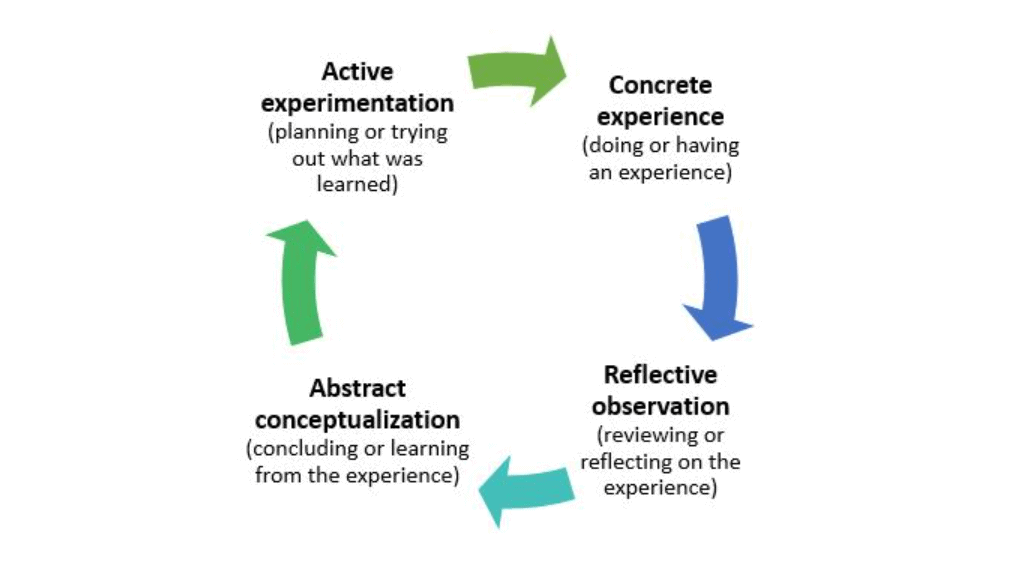
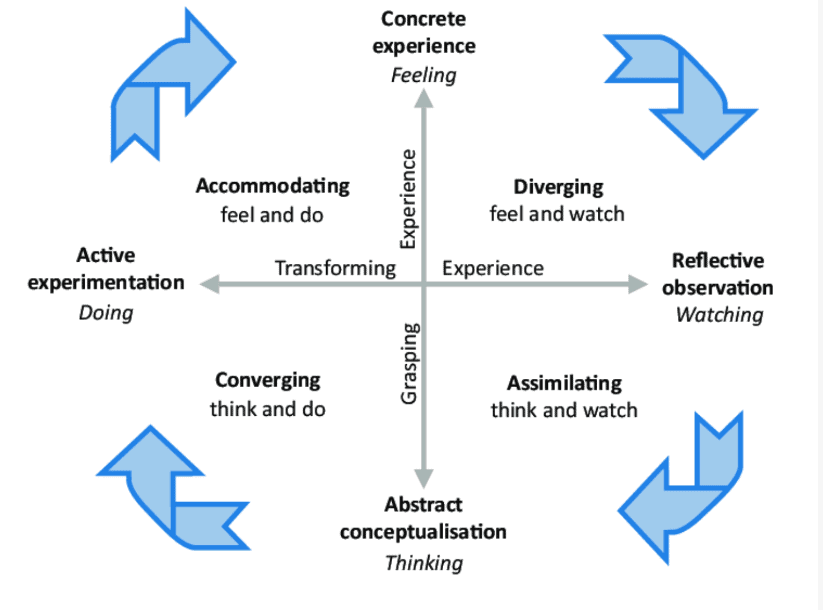
The session explored the work of educational theorist David Kolb, who devised a structured approach to understanding how individuals learn from their experiences. It involves a four-stage cycle and four separate learning styles. Much of Kolb’s theory concerns the learner’s internal cognitive processes, therefore can be a useful model to consider when thinking about both individual and collective debriefs.
The four stages of learning:
1. Concrete experience
The learner encounters a concrete experience. This might be a new experience or situation, or a reinterpretation of existing experience in the light of new concepts.
2. Reflective observation
The learner reflects on the new experience in light of their existing knowledge. Of particular importance are any inconsistencies between experience and understanding.
3. Abstract conceptualization
Reflection gives rise to a new idea or a modification of an existing abstract concept (the person has learned from their experience).
4. Active experimentation
The newly created or modified concepts give rise to experimentation. The learner applies their idea(s) to the world around them to see what happens.
Kolb developed his four learning styles to illustrate different ways people naturally take in information:
1. Diverging (concrete experience/reflective observation)
Learners who prefer the diverging style are best at viewing concrete situations from multiple perspectives. They prefer to watch rather than do, tending to gather information and use imagination to solve problems.
2. Assimilating (abstract conceptualization/reflective observation)
Assimilating learners prefer a concise, logical approach. They require a clear explanation rather than practical opportunity. They excel at understanding wide-ranging information and organising it in a clear logical format.
3. Converging (abstract conceptualization/active experimentation)
Learners with a converging style can solve problems and will use their learning to find practical applications for ideas and theories. They prefer technical tasks, and are less concerned with people and interpersonal aspects.
4. Accommodating (concrete experience/active experimentation)
Accommodating learners are ‘hands-on’, and rely on intuition rather than logic. They use other people’s analysis, and prefer to take a practical, experiential approach. They are attracted to new challenges and experiences.
The STOP model for live debriefs during the event
The session also discussed the STOP model, which is useful for ‘in the moment’ debriefing (sometimes known as ‘hot debriefing’).
Stand back: take a helicopter view of a situation or problem.
Take stock: analyse what is happening in the moment.
Options: explore options around what you can do differently.
Proceed: step back in and take action. Then assess what impact your new approach has.
The features of a great debrief
New Zealand Rugby’s Mike Anthony lays out why the All Blacks and Black Ferns are always ‘restless’, ‘uncomfortable’ and ‘itchy’.
The former first five-eighth (fly-half), who won back to back Rugby World Cups with New Zealand in 2011 and 2015, was one of a “legacy group” of former players invited in August 2023 to observe the team’s preparations and answer any questions the younger players might have ahead of their World Cup campaign.
“It’s a new bunch and you guys know pretty well that when you finish playing, you get invited back into the changing rooms or the team room and it’s quite awkward,” Carter told former England internationals James Haskell and Mike Tindall on The Good, The Bad & The Rugby podcast.
It was a changing room Carter had shared with a number of that All Blacks squad. “I don’t know if you guys feel it but going back into that environment, you kind of feel like a spare wheel.”
At no point was this the perception of the players, coaches or the All Blacks’ high performance team. In fact, two months later Carter, Keven Mealamu, Richie McCaw, Conrad Smith, and Liam Messam were invited to return at the Rugby World Cup in France, which took place in October and November.
“Talking to our team’s leaders, they got the most from the legacy group because the players are the ones who are having to drive along with that in the environment and the playing group would look up to them,” said Mike Anthony, New Zealand’s Head of High Performance, at February’s Leaders Sport Performance Summit at Melbourne’s Glasshouse.
Here were some of the most-esteemed guardians of the All Blacks culture coming back to reinforce the connection between all those who have worn the jersey.
Anthony continued: “That group had been through adversity. They’d lost World Cups and won World Cups. They knew what it took. The legacy piece for us is important.”
Legacy – a word long-associated with the All Blacks – is crucial in bringing to life the ambitions across the ‘teams in black’ i.e. the All Blacks, the Black Ferns (current women’s world champions) and both programmes’ sevens teams.
Their three core ambitions are:
These ambitions help to plot the path towards a performance culture described by Anthony as “unwavering at it’s core, it’s inspiring, it’s empowering, it’s inquisitive, and it’s responsive to change.”
The last point is critical. “How do you bring it to life day to day and how do you refresh it so that’s it’s relevant to your current group?” asked Anthony. “I’ve observed teams being successful and then they continue to run with what worked before as the group changes. It comes down to induction: how do you make sure your vision is relevant for your current group?”
Here, we unpack how the ambitions of the teams in black are brought to life through their behaviours and habits.
The building of a legacy: the All Blacks have won three World Cups; the Black Ferns have won six of the last seven Women’s World Cups. This enduring excellence burnishes their legacy year on year. “We talk of leaving the jersey in a better place,” said Anthony. “You’re the guardian for a short time, so when you leave it to the next person, you hope to add value.”
A team-first attitude: this is a challenge for New Zealand Rugby as a whole, with the growth of individual brands and the often more lucrative opportunities on offer abroad. Yet New Zealand’s best players invariably remain at home during their peak years to pull on the black jersey. The allure runs deep and it requires selflessness. “You’ve got to be selfless,” said Anthony. “You’re an All Black or Black Fern 24/7 and it’s in the little things you do when no one’s watching. You’ve all heard the analogy ‘sweep the sheds’ – it is genuinely something that our guys do. It’s not the job of somebody who’s paid to clean up after us and we take pride in how we do that.”
A player-driven environment: Anthony explains that buy-in is at “100 percent” amongst the players and that some players “never want to leave” New Zealand. This is in part because the team is intentional in its efforts to encourage players to speak up and contribute to the culture (“you have to create something pretty special to keep players here”) but it is also due to the increasingly creative ways that players are incentivised. “We give guys sabbaticals to go away because we know the money’s good; then we bring them back and that’s worked really well,” said Anthony.
Alignment: it is obvious that no two people are alike but that does not necessarily prevent them sharing a common vision. Said Anthony: “For me, ‘alignment’ is when people understand and are deeply connected to your vision.”
It is also a consequence of effective leadership, which he distilled into several traits while adding the caveat that you have to, above all else, play well. “I think we sometimes burden our leaders and they feel cluttered,” he said. “We want the spine of the team playing well first because, generally, they’re your best players. You have to get the balance right there.”
In New Zealand rugby, leaders embody…
Humility. As Anthony said, “you’ve got to be humble and vulnerable because that’ll encourage others to step into that space and contribute.”
Inclusivity. Anthony felt that although teams want everyone to have a voice, there is too little focus on schooling people in how to give and receive feedback. “If we want our players to challenge their peers, we’ve got to give them the tools”.
A growth mindset. There is always a performance gap; always a challenge. “It’s never about ‘we’ve arrived’,” said Anthony. “That gap creates that discomfort and itch that you want in a high performance environment.”
Ownership. Being an All Black or Black Fern is a 24/7 commitment. Anthony described Richie McCaw as the embodiment of that view. “It’s doing the unseen things,” he said. “It’s easy to sweat, but when you go home, what you’re eating, your sleep, how you present around your family – those are key.”
Finally… he tāngata, he tāngata, he tāngata
Anthony wrapped up his presentation with a whakataukī (Māori proverb):
He aha te mea nui? Māku e kii atu, he tāngata, he tāngata, he tāngata.
What is the most important thing in the world? Well, let me tell you, it is people, it is people, it is people.
“The price of entry is technical knowledge,” said Anthony, “but get the people right and hopefully you can build the right environment for a performance culture that supports the athletes.”
As Jen Overbeck explained, we can make people change or we can persuade them to change. We should choose deliberately and we should be clear about what makes people listen to us.
“Here’s the situation,” she said. “You have an idea born out of your expertise; a lightbulb moment. Maybe it’s something that’s developed over time and you bring it to somebody you think is going to benefit, whether that’s an athlete, someone in your organisation or somebody who works with you.
She continued: “You’re explaining it with all your passion and they say ‘yeah, nah, I’m not excited about that at all. I don’t think I want to do that.’ Has that ever happened?”
A few individuals tentatively raised their hands in the audience at Melbourne’s Glasshouse.
“OK, good, because otherwise you should be up here teaching instead of me!”
Overbeck, a Professor of Management at Melbourne Business School, was speaking at February’s Leaders Sport Performance Summit.
Over the course of half an hour she explored the social and psychological elements that affect how people react to requests to change and why, as a leader, that reaction can depend on your power and influence.
Power v influence
Overbeck used the example of Phil Jackson as someone sports coaches and practitioners might aspire to emulate. She lifted a passage from his 2013 book Eleven Rings where he wrote about ‘benching the ego’:
‘After years of experimenting, I discovered that the more I tried to exert power directly, the less powerful I became. I learned to dial back my ego and distribute power as widely as possible without surrendering final authority. Paradoxically, this approach strengthened my effectiveness because it freed me to focus on my job as keeper of the team’s vision.’
Jackson came to recognise that power and influence sit on a spectrum. As such, the NBA’s most-decorated coach, provided the perfect case study for Overbeck to define those terms.
“‘Power’ is your ability to get somebody to do something that they don’t want to do,” she said.
This is set in contrast to ‘influence’. “You could also call it ‘persuasion’,” she added. “This is all about how much credibility and persuasiveness you have to influence people to go where you want them to and they’re going there willingly.”
There are few coaches in the high performance community that would prefer to increase their power at the expense of their influence and Overbeck stressed that you are free to make your choice.
“When you understand the differences and what drives them, you can make those choices deliberately – and that’s generally better for ourselves, our athletes and our organisations.”
How to elicit change
Overbeck explained that there are three types of behavioural strategy:
She says: “That’s when you’re using a great deal of power; you’re not using a great deal of influence. You’re basically trying to make the person change.”
This emerges in a space where a leader has more moderate power and influence. “We’re giving people some choice, but we’re not giving up on our power altogether.”
“This is a very big word,” said Overbeck, “because it means you’re completely leaving it in the other person’s hands; you’re exerting no power whatsoever.”
The best scenario for a leader, as Jackson understood, is to be negotiating. Overbeck posed a series of questions that leaders can ask themselves when moving away from either dominating or supplicating:
The tactics available to a leader
Overbeck ran through some of the tactics available to ‘negotiators’ and asked the audience to raise their hand if they’d employed any of the following:
The six types of capital available to leaders
None of the tactics described above are particularly unusual. “We know a lot about the tactics we’ve been told will be helpful for pursuing change,” said Overbeck, adding, “we don’t know what kind of power and influence we need to have ready and available with us in order for these tactics to succeed.”
She returned to the example of Jackson, who managed to elicit the very best from Michael Jordan during their time together at the Chicago Bulls in the 1990s.
“Phil Jackson may not have led with power but it was in what he did,” she said. “He was using what was available to him.”
He was, in essence, aware of his ‘capital’, as Overbeck put it. “Power comes from the resources that you control.” There are six kinds of resources, or ‘capital’. The first three are easily explained:
The final three must be used carefully because they can be sourced into power:
Social and intellectual capital
Overbeck homed in on social and intellectual capital because while leaders in sport may want to have power in the background, you probably will not want to lead with that power.
Instead, you’ll want to dial up your influence and credibility, which can come from various sources, such as trust and belief in your abilities as a coach due to your track record and reputation; that your place is not a result of political chicanery or nepotism.
“I’m going to talk about it as ‘tribal membership’,” said Overbeck. “When people are deciding whether to accept your influence, the No 1 thing they are assessing is: are you with me? Are you part of my team?” She makes it clear that ‘team’ may not be the literal team but your alignment with an individual’s personal values. Without that, they may reject you out of hand. “The first thing we have to do is make sure that we’re telegraphing to the other person that ‘even if we have those differences in terms of those things that you most cherish and value, I honour those things, and I’m not going to get in the way of them. I’m going to work with them, not against them’.”
Once you loosely establish yourself in the same tribe, you then need to demonstrate how your expertise can be of value – that’s your intellectual capital.
Overbeck said: “When we’re trying to build credibility, it’s our job to build that bridge and make sure that the other person understands.”
She likens it to a credit account. “The higher your credit limit, the more you’re able to go out and spend.” However, it must be kept topped up. “Once we’re good, we always have to be thinking: ‘am I getting over my limit?’” You have to continuously demonstrate your credibility or you will lose people.
Final questions to ask yourself:
25 Jun 2024
ArticlesThere are some persistent challenges but intentional leaders and their teams can find ways to flourish.
The chances are that for all your fine work fostering a collaborative multidisciplinary team there are challenges you still face daily.
At a recent Leaders Virtual Roundtable, we encouraged members to reflect on areas where there is room for improvement and areas where they have made real inroads.
Some responses, such as limited time, busy schedules and the decentralised nature of some programmes were raised by members time and again but, below, we focus on communal challenges.
Common issues that prevent efficient collaboration
Misalignment of needs, expectations and responsibilities: such issues still endure, as evidenced by the number of members who mentioned the lack of alignment within departments and teams. One mentioned a lack of role clarity and, in turn, knowing with they should collaborate or bring into the conversation at the right times. Some cited the challenge of matching the expectations of individual staff and the collective needs of the team. Others noted situations where there are competing objectives and priorities.
Expertise bias: a Leaders member cited ‘discipline protectionism’, which resonated with most attendees. There are enduring examples of intellectual arrogance from some disciplines or an expertise bias that impacts communication, information sharing and can reduce general curiosity. These are all collaboration killers.
Team makeup: there are several elements here. Firstly, when team members are hired in at different stages there is a natural impact on the functionality of the team. There are also different personalities and communication preferences. Several attendees also noted that some environments are geared towards individuals highlighting their own impact and values as opposed to the greater good of the team.
Other considerations: the leader’s ego; a lack of psychological safety; finding the space and time for reflection; a lack of understanding about what optimal multidisciplinary work looks like.
Potential pathways to better collaboration
Centralised communication: can lead to a higher quality of comms between all stakeholders. Perhaps you can profile your team members and better communicate agreed expectations.
Consistent data capturing: when multiple departments are capturing data consistently, instead of sporadically, it can create more alignment around communication and collaboration with other disciplines.
Humble leadership: the leader or leadership team must be humble enough to accept when change or re-organisation is required. They need the humility to step back, evaluate their approach as a leader, as well as the situation, and enact change. This is where clearly defined needs and a common understanding are useful.
Clear standard operating procedures: a well-functioning system promotes better asynchronous information sharing. If you can outline standard operating procedures for communication between platforms it can prevent key information and messages being missed.
Team structure and role clarity: as a team leader, it’s worth considering the effectiveness of your onboarding and offboarding approach to minimise the impact. Diversity of thought is also essential, but it’s worth considering how to feed this into the design and operation of the team. One roundtable attendee suggested hiring an independent auditor to help outline role clarity, the sharing of best practices and, in general, promoting leadership – in essence, they act as a critical friend. Additionally, discipline or team leaders can create networks within their teams to enable such sharing. Another member explained that they have adopted a ‘team of teams’ approach e.g. a structure based on a ‘constellation’ of smaller teams that work together closely. It has yielded some positive results. Finally, in an effort to encourage a team-first approach, consider how you profile team members and communication of expectations.
What’s missing and what are the further opportunities?
Support for new leaders
How are you supporting new leaders in your teams? Often we see those in technical expertise or ‘tactician’ roles move up to a leadership position but lack the requisite skills to lead effectively. The role inevitably changes, so what are you or we doing to help them ‘lead’ their teams and embed true collaboration?
Robust and thoughtful feedback
Be intentional in creating a robust and thoughtful feedback mechanism that allows for variations of approach. Detailed feedback can support team learning on a consistent and ongoing basis. True, it can be a challenge, but therein lies the opportunity.
Psychological safety and empowerment
How can we better empower people more effectively to take targeted risks within their roles, whilst still feeling safe and secure? There needs to be a team-wide understanding of what psychological safety means and what it looks like in your environment.
21 Jun 2024
ArticlesThe NSWL’s Bay FC and the WNBA’s Golden State Valkyries are two expansion teams and both have women GMs. Here, we bring you the views Bay’s Lucy Rushton and the Golden State’s Ohemaa Nyanin.
In March, Bay FC began their inaugural NWSL campaign to great fanfare.
The club was co-founded by former US women’s national team stars Brandi Chastain, Aly Wagner, Danielle Slayton and Leslie Osborne, who propelled the project from an ambitious idea to a grand reality.
They hired Lucy Rushton as General Manager. Rushton, who was the second woman to serve as GM in MLS when she joined DC United in 2021, spoke at this month’s Leaders Sport Performance Summit at Red Bull in Santa Monica.
Rushton is no stranger to the Leaders stage having also spoken during her time at Atlanta United, whom she joined following excellent spells with Watford, Reading and the Football Association in her native England.
She sat next to another trail blazer, Ohemaa Nyanin, the newly appointed GM of WNBA expansion franchise the Golden State Valkyries, who will join the league in 2025.
Nyanin, a Ghanian-American, had been with the New York Liberty for five years, most recently as Assistant GM, jumped at the chance to bring further basketball prestige to this corner of southern California. She previously served as Assistant Director of the US women’s national team and helped Team USA to Olympic gold in 2016 and World Cup gold in 2018.
The duo delivered insights into how they are shaping the cultures of their nascent organisations; how they’re working or planning on working with their athletes; how they’ve chosen to lead; how they’re supporting their staff; as well as how they’re changing the sporting landscape.
Owners must establish the culture and values
The Bay culture was clear well before Rushton had even accepted her position: everything is about the people, from the staff to the players. The owners want everyone to be B-A-Y. That is:
Brave – the ownership want the franchise to be bold in the industry, pushing boundaries, breaking barriers by being innovative.
Accountable – the staff turn up everyday and are responsible for their actions and drive, and push themselves forward.
You – Bay FC also celebrate themselves as individuals and bring their true authentic selves to work every day.
The three concepts have helped shape the mindset each day and give the staff and players something tangible to hold onto. The organisation’s vision is to be a global sport franchise at the head of innovation and change.
How can these be measured? For Rushton, “it’s the feeling when you go to bed or wake up and how you feel about going to work the next day or that morning”. She believes the staff feel good and know they can influence what is happening; they know it’s a positive environment and everyone is striving for the same things.
Women’s sport should not simply replicate men’s sport
Rushton’s experience of men’s football taught her a valuable lesson. “Coming into a women’s franchise, it’s so important that we understand and appreciate the difference to men’s sport and don’t try and replicate it,” she said. The club has been intentional on that since day one and strives to be people-first, player-centric, and celebrates and promotes good female health.
With Bay midway through their first season, Rushton reflected on how the staff live the values every day. They all want to work hard, but care, kindness, and mutual support are just as critical for an expansion team. You need people who want to be there, who have the grit to go through the ups and downs, but support each other when you might not have the same resources as the teams that are 5 or 10 years old.
“How we approach training everyday and present ourselves to the players gives them energy,” she continued. “Which in turn the players buy into and end up energised and galvanised.” The key is how you present yourself and how you turn up and how you live by the standards that have been set, and the biggest factor is togetherness and collaboration of all departments.
Measure success through environment and collective wellbeing
Nyanin left a household name in the New York Liberty, but her goal is not to merely recreate that team in the Bay Area. Nor does she simply want to recreate the Golden State Warriors (Valkyries co-owner Joe Lacob is also the majority owner of the Warriors). Nyanin wants the Golden State Valkyries to stand alone.
She needs to find people that are interested in a vision of winning championships, in alignment with the ownership group. Success will ultimately be measured in trophies. They are the first WNBA expansion team since 2008, so Nyanin is considering what it looks like to build a successful organisation. She said: “We need to find individuals who are interested in being challenged every day, leaning into the team. Do you want to come to work everyday, and serve the athletes everyday in a way that provides for an innovative space, that provides for us to do what we know we can do, and how quickly can we get there?”
With this question in mind, Nyanin reflected on the qualities she seeks out as the Valkyries hire and write job descriptions. “Being an expansion team means you have to be entrepreneurial. By embracing the unknown can you be empathetic too,” she added.
Rushton asked Nyanin about measuring success from a cultural perspective rather than through championships. In response Nyanin said it is about the climate of the people that come in the door. “When we ask how you are doing they might say ‘I’m fine’ or ‘I’m good’, but if you say ‘how are you doing in the terms of a climate?’; so ‘sunny, or ‘cloudy’, or ‘rainy’ – it adds depth. A way of measuring success is how we can collectively come up with our non-results-based success criteria, how do we make it such so that everyone is sunny?”
For Nyanin, ‘sunny’ doesn’t mean super excited, or super extroverted – you can be introverted but still be sunny. Success is ultimately defined by how the Golden State Valkyries create their own definitions of safety in the workplace; it stems from executives to coordinators, to players, and even changing the way agents and external stakeholders engage with the organisation.
A culture born of diversity
We all know the saying about the best-laid plans, so Rushton and Nyanin spoke of the importance of allowing culture to shape itself. For Rushton, the critical moments are when things haven’t gone to plan. “How you react to things not going to plan is how you create culture. Actions taken in those moments show the players and staff what’s acceptable and what’s not,” she said.
Some decisions have been made that may have impacted performance outcomes but certainly reinforced their culture and values. They might have been a “nightmare” at times, but they’re critical. The backing of the ownership and the Head Coach, Albertin Montoya, helped give Rushton the confidence to go ahead. Showing the group that the leaders are aligned was powerful and gave them the confidence that it was the right thing to do and that the leaders had each others’ backs.
For Nyanin, it is important to give newly-hired executives their own blank slate to contribute to the masterpiece. She said: “If everyone has a different background, you have to listen to their ideas as they’re all coming from different spaces. So it’s still being architected from all different walks and types of cultural differences.”
This means that it’s important to Nyanin to have each executive bring their own unique experience. Through these different experiences and backgrounds the culture develops. This will bring challenges and added work, as you have forces leaders out of their comfort zones. It also means that you have to be willing to think differently.
“It’s like explaining basketball to children, who all ask ‘why?’ People from different backgrounds are going to ask why do we need to execute things this way, and will ask good questions, and bring contributions beyond asking ‘why?’”
In return, Nyanin believes that the athlete will benefit, especially the female athlete who comes with different complexities. “If your own staff can challenge you and ask you why before the athlete does, then you’re giving the athlete a space for them to feel safe to be elite at their sport.”
Athlete care is paramount
What about their appeal to female players? Bay spoke with the potential recruits about player-centricity of club and how they were going to elevate player care. From starting from a blank slate, they were able to accelerate mechanisms that can help with impacting the salary cap through player housing for example. The club emphasised treating them like the athlete they are in comparison to some of their poor experiences in other environments.
In Rushton’s experience, the priorities are very different to male athletes, where pay often dictates the direction of negotiations. With females, it’s about living standards and how the organisation will elongate their career. It’s important to give them confidence in the staff who would give them the best care, medical treatment, and infrastructure. Rushton is proud that, as far as she knows, the players have no complaints about the level of care and how the organisation treats them as female athletes.
On a day to day basis it boils down to two things in her mind. Firstly, helping them be in the best position they can be for the longest time possible and, secondly, to help them live a nice lifestyle outside of football.
This focus on player care resonated with Nyanin, who was pleasantly surprised at the rapid expansion of the NWSL given her own experience of the WNBA. Bringing it back to athlete experience is hugely important because, in WNBA, athlete experience tends to focus on ‘how you do get elite talent to come through?’ Nyanin explained that longevity in the sport is different, although is it changing, because the majority of the athletes play six months in the WNBA and then go and play overseas where the conditions are often worse, but they’re getting paid more money. “Understanding the motivations of the athlete prior to them coming to your organisation and engaging in your space is important,” she said.
Attracting elite practitioners from male sport
How might top level practitioners be attracted from historically better-funded male sports? Both Nyanin and Rushton believe that efforts must be based on the vision, culture and concepts the organisations trying to build.
For the Valkyries, as Nyanin explained, the vision is to “build the best, to be the most elite, to build a space where people feel they’re being heard and their ideas being executed in a way that results in excellence. Why wouldn’t you want to come? How can I create an environment for you to thrive, and how can we do that together?”
Rushton agreed. She said: “it shouldn’t be about the gender. It does matter though – many wouldn’t be right for women’s sport. I want to make you the best practitioner in what you do, and give you the platform to excel in your specialisation.”
New franchises means recruiting for those who are willing to challenge themselves and go outside the box with their thinking. It becomes about finding the people who are comfortable with the associated risk in order to better themselves. Rushton believes they have to “believe that they can go there and make a difference.” Rushton also observed that, “a lot of males would find it refreshing to come to a female athlete team because it’s a totally different environment, with totally different feeling and vibe.”
For Rushton herself, when she moved from men’s to women’s football there were two main factors that drew her in:
How fans contribute to a team culture
There remains another crucial component of a team culture: the fans.
The final moments of the session were used to discuss how both Nyanin and Rushton, and their organisations, are forging connections with their fans. As Nyanin said, fans expect communications, but there are times when you can’t share with them. This is a dilemma considering that the fans are also investing in the franchise and so they deserve communication. It becomes about finding the balance around what to do when things aren’t going well. Working on being honest in their communications so that the fans understand that the leaders and everybody involved is working to solve any issues.
Similarly, Rushton and Bay have been deliberate in how they present the organisation to the fans. The Business Operations team at Bay go to the fans and ask them to bring the energy and passion; to be part of their story. They seek to empower the fans and have them be part of the journey. Bay have gone out to the community, had fans come and watch training, and prioritised outward action in the build-up to launch. People now want to be a part of their journey.
Rushton spoke of how Bay deliberately tell the stories of their players. This means that people become invested in the emotional side of who the player is, so if the team lose a game, the fans are more invested in the person than the result. The outcome is one of which she is proud and the Valkyries hope to emulate. “The fans have fallen in love with the team, despite the record.”
Results will surely follow but, here and now, both women are intent on proving that new women’s sports teams are not only viable but can thrive.
Gemini has partnered with professional and college sport teams across the NFL, NCAA, European football and beyond.
A Data & Innovation article brought to you by

QPR soon turned its season around, however, after a change in leadership. The club won 10 times and added five draws over its final 19 matches to secure its spot in the second tier of English football another season. Most estimates suggest that relegation from the Championship to League One is a financial hit of more than $10 million (£7.9 million).
Right around the time of that upset over Leicester, QPR onboarded a new AI-powered predictive modeling tool, Gemini Sports Analytics, to make optimal use of the massive datasets they’ve compiled. Gemini is a “force multiplier,” CEO Jake Schuster has said, by simplifying the process of building machine learning algorithms catered to each club’s specific needs.
“What I really liked about Gemini was they didn’t have an ego in trying to solve every problem,” QPR Director of Performance Ben Williams said. “They created a tool where you can solve your own problems.”
Around the time of QPR’s on-field nadir, CEO Lee Hoos retired from that role, while remaining as chairman, and hired Christian Nourry as the new chief executive. Nourry was 26 and a managing partner at Retexo Intelligence, a data analytics and advisory business that worked with Real Madrid CF, AS Roma and the Mexican national team. (He became the youngest CEO in English soccer, with one European executive describing Nourry as “the Lionel Messi of the football business world,” according to the Independent.)
Nourry wanted to implement market-leading solutions to upgrade the club’s tech stack. QPR asked itself, according to Williams, “Are we able to interrogate that data optimally, to forge outcomes that are positive for the long-term future of the football club? Our answer to that was ‘no.’” That prompted the search that led the club to Gemini.
The very thesis of Gemini is to empower analysts, coaches or “anyone with a dataset,” as Williams put it, to take action with data. He noted that it can be used for everything from tactical match plans to traffic probabilities on bus trips to road matches.
Founded by Schuster, a longtime sport scientist, Gemini leverages the tech infrastructure of cloud and AI partners Snowflake, DataRobot and Databricks with data sources such as StatsBomb, SportRadar, Genius Sports, Sports Info Solutions, SkillCorner and Infinite Athlete.
As an example of what’s possible, Shuster explained that Gemini users can apply clustering algorithms to match stats and tracking data to create passing trees to identify how opponents like to create scoring chances of their own or concede them to others.
“The early lift was certainly centered around pre-match and post-match reports,” Schuster said. “So, opposition analysis — how do we approach this game? And then, post-match, what happened and what are the implications for future events? A big part of the early work with them was helping them automate those reports. And then the next step was approaching the summer transfer window.”
But it also remains an area of exploration, as QPR onboards more staff members over time.
“The power comes from our curiosity,” Williams said. “We’re in a phase of play and learn and discovery.”
Other Gemini clients include the NFL’s Indianapolis Colts, the SEC’s Texas A&M and Italian soccer club Parma Calcio, which just claimed a Serie B title to earn promotion back to Serie A. The Raleigh, North Carolina-based company also raised two investment rounds north of $3 million in the past year. There are now 27 sports franchise owners either directly invested in Gemini or through recent round-leading investor Will Ventures. QPR’s owners individually own minority stakes in two MLS clubs (LAFC and FC Cincinnati) as well as MLB’s Cincinnati Reds.
That financial backing has led to Gemini’s first customer success hire, former Arizona Diamondbacks Director of Operations Sam Eaton, and a budget allocation to hire a CTO, a role Schuster is actively recruiting. The company is also in the testing phase of some new generative AI features it hopes to roll out soon.
“The whole idea behind going with this tool was we can be really broad in our thought process of what we think helps our performance,” Williams said, “rather than be penned in by somebody else’s thought process of what is important to performance because they’ve created a tool that solves a problem that they once had.”
This article was brought to you by SBJ Tech, a Leaders Group company. As a Leaders Performance Institute member, you are able to enjoy exclusive access to SBJ Tech content in the field of athletic performance.
