The latest edition of the Leadership Skills Series explored the concept of Secure Base Leadership and its impact on individual and collective performance.
Within the session, we leant on the work of American psychologist George Kohlrieser, who has identified nine key characteristics of secure base leaders.
What is secure base leadership?
In the words of British psychologist John Bowlby, a secure base is a person, or at its best a collective environment, from which we draw inspiration, security and self-confidence to push the boundaries and perform at our best. A parent that provides a secure base creates a healthy, well-rounded child who can take risks, be separate and independent. As an extension to the work of Bowlby, Kohlrieser suggests that a secure base involves creating a collective environment in which we draw inspiration, security and self-confidence.
‘Secure base leadership’ is a term coined by Kohlrieser to describe the qualities and skills common to leaders who are exceptional in their ability to act as a catalyst to people performing at their best. In his book Dare to Care, Kohlrieser suggests that we need to care personally and in a genuine way to enable people to take risks and push forward in any aspect of life.
We will explore the specific characteristics that arose from the research below, but Kohlrieser suggests that secure base leadership is the ability to bring challenge and support together. Challenge on its own, isn’t enough to push someone forward. First and foremost, a secure base needs to be provided.

Nine characteristics of a secure base leader
Kohlrieser suggests thar we need all nine of the characteristics.
Mapping your team by challenge and support
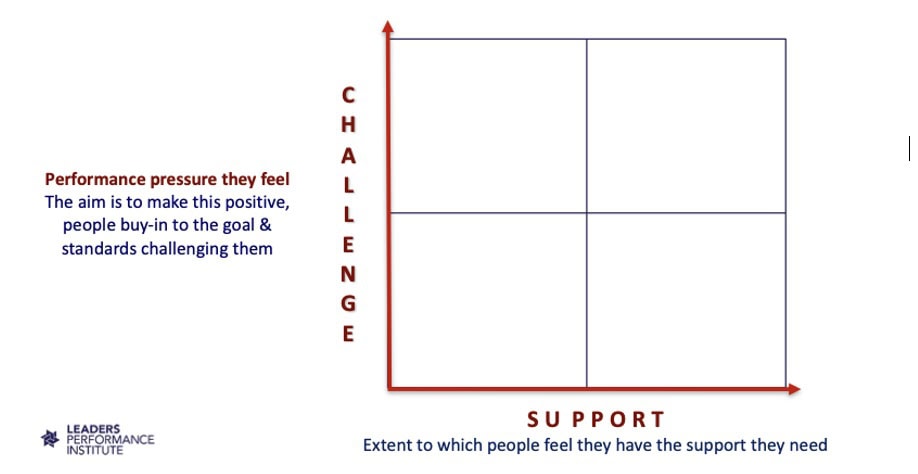
What do others feel about your current level of challenge and support? To bring some of the research to life, there is a simple tool we can all use as leaders to map out the current landscape of your teams, as it pertains to the levels of challenge and support you are currently giving them as a leader. Similarly, you can also ask others how they feel about the challenge and support provided.
Challenge relates to the performance pressure people feel. The aim is to make this positive; people buy-in to the goal and standards challenging them. Support is the extent to which people feel they have the support they need.
30 Jun 2023
PodcastsThe Parisian club’s new Director of Rugby discusses his work at Leinster and what it will take to replicate that success in the European Champions Cup and French Top 14.
A podcast brought to you by our Main Partners

Stuart Lancaster, the new Director of Rugby at Racing 92, agreed to join the Parisian club last September while enjoying his seventh season as Senior Coach at Leinster. It meant a fresh challenge for the man who also coached England at the 2015 Rugby World Cup.
Says Lancaster: “For the first time, really, my head was turned a little bit by the opportunity to try something new in a different country, in a different competition, the Top 14, and to try and build something as successful as Leinster but in a completely different context”.
He discusses his move at length in today’s episode, which is brought to you by our Main Partners Keiser. During the conversation with Henry and John, he also touches upon:
Henry Breckenridge Twitter | LinkedIn
John Portch Twitter | LinkedIn
Listen above and subscribe today on iTunes, Spotify, Stitcher and Overcast, or your chosen podcast platform.
In early June, some of the most respected leaders from across sport in Texas gathered at Global Life Field in Arlington to discuss the pressing performance matters of the day.
It is designed to connect people with responsibility for performance at the highest levels of world sport with each other and the ideas that have served their peers best. The top jobs in elite sport are often lonely places and always comprise unique challenges. The following is a record of the Think Tank meeting that took place on 7 June at Global Life Field in Arlington, Texas. A behind-closed-doors event, the account that follows is a general one and aimed at presenting the lessons learned from the conversation.
Attendees
General Manager, Texas Rangers
Assistant General Manager, Texas Rangers
General Manager, Dallas Mavericks
General Manager, Houston Texans
Chief Executive Officer, San Antonio Spurs
Mental performance can be enhanced
In viewing mental performance as separate from mental health, the group explored the means and ways that cognitive capacity and skill acquisition can be enhanced in athletes. We value our team’s high IQ athletes but what can we do to develop the IQ of those less gifted individuals?
Key points:
Holistic athlete development
The consensus was that holistic approaches to player development provide a competitive advantage – if they are implemented effectively. How can teams remove the barriers to effective implementation?
Key points:
Balancing short term and long term aims
Sustained success may be your aim – and that takes careful planning – but what if there is the window of opportunity to win now? Can the short and long term truly be balanced?
Key points:
The importance of cultural fit
Bound up with the idea of balancing your short and long term visions is your level of commitment to your organisational values. If there is a superstar talent in your ranks who is a poor cultural fit, what should you do?
Key points:
Specialist or generalist?
Often, a general manager can feel like a jack of all trades and a master of none. How can the leader best help when they don’t have the wisdom, expertise and vision to understand what the gold standard is in a specific domain?
Key points:
We explore attitudes to change at Ulster Rugby, the BBC and Royal Military Academy.
What is ‘change’ in your context?
It’s a simple but important question: “What is ‘change’ in and of itself?” asked Dan McFarland, the Head Coach of Ulster Rugby, when talking to the Leaders Performance Institute in 2022. “Firstly, ‘change’ is someone who says ‘this isn’t working, things are terrible, and we need to change’. But change is also growth. If you’re an organisation that wants to grow, develop and learn – by definition that is ‘change’.
“How you conceptualise change and how you use it is interesting, because if you include the idea that ‘growth is change’ then there’s always a need for change, isn’t there? At least in anything that’s competitive. It is important not to box change as merely something that happens to a failing organisation or somebody who’s in trouble. Then it’s just a degree in change and, I suppose, recognising the degree of change is interesting.”
Tim Davie, the Director-General of the BBC, referred to change as a “narrative around jeopardy” when speaking at the 2021 Leaders Sport Business Summit in London. He said: “That’s a pretentious way of phrasing it but people are naturally resistant in well-established organisations. Sometimes, you really need to really believe there is an issue of jeopardy [but] many people in the organisation say ‘we were OK for 99 years, we’ve done alright.’”
What’s timeless in your organisation? And what’s not?
The BBC was on the cusp of its centenary year when Davie spoke onstage. “My personal view is that, first thing, a successful reform comes from a real understanding of history, strength, respect of tradition, really understanding where an organisation comes from, what its core purposes are. What things are valid that are not attached to technology that are timeless?” he told the audience. Davie makes the distinction between what is “important and timeless” and what is not. “I think some people defend their territory or in their silo saying ‘that is something that’s absolutely sacred’. ‘It isn’t. What’s sacred is this’,” he added.
Is the motivation there?
In 2011, behavioural scientists at University College London developed the COM-B framework for behavioural change. It is a diagnostic tool to assess whether the organisation or individual possess the capability (C), opportunity (O) and motivation (M) to perform the desired behaviour. When you have each, it is often the perfect recipe for change but, as Gareth Bloomfield, a psychologist at the Royal Military Academy at Sandhurst, told the Leaders Performance Podcast in 2022, there can be a multitude of things that affect an individual’s motivation. “Do you believe you can do it? Do you believe it’s going to be useful? Most people when they’re given new direction about what they need to do, most people just say ‘that sounds easy, I can do that’ but do they fundamentally believe that it’s going to be useful to the team?” said Bloomfield. “If they don’t understand what the Leader’s vision is, what the leadership team are trying to get to, then maybe there’s a gap there in terms of my motivation because I don’t really understand why it’s going to be useful. Do I fully appreciate the consequences of doing it and not doing it? This becomes an important part of motivation, which is, most of the time, if I’m going about a behaviour that is counter-productive, I’m not necessarily that aware of it because the counter-productive elements of it are long-term.”
The leader must role model change and chart development
McFarland viewed himself as a role model of change at Ulster. “Let’s say you want to create a learning environment,” he said. “You’ve got to model that. If that’s me, I’ve got to be seen to be willing to be wrong and adapt, I’ve also got to be seen to be doing things that are helping my own individual growth, I’ve got to be seen to be celebrating things where people are developing. Then once you’ve modelled those you’ve got to be able to mechanise those. There’s got to be room in the actual programme for doing that kind of stuff. It could be individual development programmes that are up and running and actually have things that you do, there’s got to be time in the schedule for development of certain things or skills, but there’s also got to be time in the programme for sports staff to be able to have personal development. Then, finally, you’ve got to be able to measure that; you’ve got to be able to look at your programme and say ‘have we actually created development? Have we developed as a staff, as a group? Have we developed as players? Have we developed as individuals?’ Modelling, mechanising and measurement are pretty key to that.”
What Leaders Performance Institute members said in a recent Virtual Roundtable about coaching and leading in an inclusive way.
One of the groups on the call used the above as the start of the conversation – a question was asked whether or not Lewin’s equation is a linear relationship around trying to get as much talent and as good an environment as possible to maximise performance. Or is it actually about optimisation? Finding the optimal relationship between talent and the environment. Different talents could be successful in different environments, and vice versa, as opposed to just trying to put as much talent into a particular environment, and then make it as good as it can be. Something to think about.
Reflecting upon psychological safety
When we reflect on experiences of feeling included, often we hear responses such as the feeling of being heard, feeling safe to speak up, challenge and ask questions without a level of self-censorship – this is the essence of psychological safety. If that self-censorship is present, Lewin would say this would really impact the environment. It can create hostility and have an impact on performance. It will also affect the authenticity of the environment. If we feel a level of covering or lack of authenticity, social scientists have found it can actually compromise our ability to think by up to 30%.
There are four levels of psychological safety:
For the purpose of this roundtable discussion, we emphasised the importance of inclusion safety as the first level of this process – it is a precondition for the other levels of safety. Are your athletes or staff comfortable in that coaching or leadership relationship? Social sciences research suggest that in the need to feel valued, there needs to be a sense of belonging first to allow the rest to grow together. If you want to explore some deeper thinking around belonging, consider some of Owen Eastwood’s work.
Finally on this point, in the quest for establishing psychological safety, role-modelling is key, particularly from those at the top of the organisation who have influence. A clear statement of intent can go a long way to increasing psychological safety, and comfort for other stakeholders aligned to the organisation.
Onboarding
Throughout the group conversations, the onboarding process was identified as a crucial component in fostering a strong sense of inclusion safety, and one where we felt thinking around this is currently under developed. The consensus from the conversations is that many environments are often more mature in their thinking around onboarding with players, as opposed to staff. Circling back to Lewin’s equation that was used at the top of the call, staff however, are the ones that are often the biggest shapers of an environment so there’s work to be done here. So what’s working and what can be improved?
Most organisations are striving to be quality learning environments – this often starts with having psychological safety present. Are we making it clear and backing it up with action, that the moment new people walk through the door and are being introduced to the culture, that there’s an intent and commitment to invest in one’s growth? ‘The better you are will make for a better collective’.
Do we need to challenge our thinking in this space? Why do we recruit somebody? Often we think about the technical elements, but are we considering and paying enough attention to the ‘softer’ skills as a key component, and then bringing them up to speed on the environment from there? Specifically to inclusion, some organisations have started to add an inclusion question in their interview processes as well, which has been an interesting addition to see how many people struggle to articulate their position on it.
To create true inclusion safety, the onboarding process can in actual fact begin before an individual is in the building, during the recruitment process itself. It’s important to think about a 360 approach to connect to all elements of the organisation. What are the cultural connections someone will live and see on a daily basis? What does that tangibly look like for specific teams, because we know sub-cultures exist? Then there is the relationship with the athletes themselves – what do they look like? Often it comes back to relationships and how we treat each other was a comment from one of the groups, which is why there is an emphasis on recruiting the right individuals for your environment, and also role-modelling from those that carry influence.
Finally, seek to measure the impact of these processes. We know there is a high turnover in professional sports. Are you surveying your culture in general and also capturing insights into the effectiveness of those best practices that are integrated as part of the onboarding process? Be intentional and frequent in checking if people feel a part of an organisation.
Front loading through education
It’s perhaps not a huge surprise that ‘education or educating’ as a term was frequently used in our conversations, from a variety of different perspectives. As a provocation within the group, the question of what are the behaviours that create inclusion safety is a simple but effective place to start when considering this process.
One environment on the call shared an anecdote of how they front-loaded education around psychological safety with their coaches across a two-year period, with one of the end results being that this could have a positive impact on how they then create environments for players. Those in the organisation felt it was important to respect where coaches and other staff are coming from, respecting those opinions and creating opportunities to ask questions and develop thinking around psychological safety. The safety it created for coaches thus created better safety for the players. There was a clear undertaking of needs analysis with stakeholders (in this case coaches) to support psychological safety.
As an extension to the point above, there were discussions about leading inclusively, and how some traditional coaches may not have experienced this style before – assuming that ‘hero leadership’ (leading from the front, pushing, directing) is the way to achieve success. It is important to help and educate coaches to lead more from the centre, and not to dismiss people if they are less successful at the beginning of their leadership journey.
Transparency and choice of language is important here as well. We discussed high standards and high support environments. To create alignment, there needs to be high support and education resources to accompany the expectations of high standards. There needs to be clarity around expectations on the front end. For example, sharing that a particular training session is going to be really hard, and the failure rate is probably going to be pretty high, and that’s okay. The relationship between transparency and willingness to share information is more important than ever before.
Finally, consider the power of facilitation with those in the environment. Do they have self-awareness of their own biases? How do you work to respect different individuals’ backgrounds through understanding their perspectives and an awareness of where they’ve come from? We are striving to encourage that level of safety so that people can be more open and buy-into the environment. Culture often starts with the identity of the group, so this creates the opportunity to design that culture from safe foundations and the removal of self-imposed thoughts and beliefs.
Respecting differences
Environments have different cultures. Educating players and staff on each other’s background and culture shows respect and awareness. The heritage and lineage of where people are coming from is really important. What we can do to bridge those cultural gaps? The importance of delivering according to need – for example, prayer rooms and certain types of foods.
People want to be expressive. Whether that’s to dress in a certain way as an example. How are we welcoming that? Inclusion can be a combination of belonging and uniqueness working collaboratively with one another. How are we helping somebody simultaneously fit in and stand out?
Empathy is crucial. Create an environment where empathy is on display and can be nurtured. We also have to think about the idea of being comfortable with inclusion looking different to certain groups and people. Do you ask your players and staff ‘how can we include you more’ or ‘what would help you feel more included here?’
Takeaways: Group Reflections & Insights
At the end of the call, attendees were asked to share a key reflection of thoughts from the roundtable that they’d like to take forward:
6 Jun 2023
ArticlesWhy it will still be business as usual at the UKSI, offering the same high calibre performance support services.
An article brought to you by our Partners at the

He is discussing the logistics of the UK Sports Institute [UKSI] changing its name from the English Institute of Sport in April. As part of the process, on the 24 April, the organisation’s website and email addresses changed and its staff entered a short period of downtime to enable those changes to take effect.
“Everything worked like it did across Y2K and nothing dropped out of the sky,” he says, referring to the late-’90s fear across society that digital calendars resetting to ‘00’ on 1 January 2000 might cause havoc. “I did have a flashback on the morning and remembered the millennium,” he adds.
The English Institute of Sport [EIS] was founded shortly after the turn of the millennium, in 2002, to support teams and athletes across the UK’s ‘Home Nations’ – England, Scotland, Wales and Northern Ireland.
“We routinely send hundreds of our people on secondments with teams or sports to the Olympics and Paralympics,” he continues. “What we all aspire to do is support British sports, teams and athletes that go to the Paralympics and Olympics and perform at their best, and they come from all of the Home Nations. For me, it just helps with that.”
The EIS, and now the UKSI, will continue to work closely with the other home nations to ensure all the support offered is aligned.
The reasons behind what Archibald admits was a “misnomer” are “locked up in the mystique that surrounds the genesis of the Institute”.
“Right from the outset, there was a question mark about the name,” he says.
“People who have been with the organisation for 20 years have sent me screenshots of various documents and items of stationery with the name ‘UKSI’ on them”.
For some people, the misnomer was an important issue and they argued for change.
“A number of voices within the system raised the question again and again when others didn’t see it as a priority”.
Of course, the name change was never the priority – the Institute’s commitment throughout the 2024 Paris cycle was and remains the delivery of ‘outstanding support that enables sports and athletes to excel’ – but the case was vigorously made and the name change was approved by all key stakeholders.
The transition was operationalised in the 12 months before it was announced and, through that process, the other Home Nations sports institutes, namely Sportscotland, Sport Wales and Sport Northern Ireland, offered their full support. “They are all 100% behind us and we do not now supersede them. We might be the scale operator, but they will carry on doing the great work they’ve always done”.
While there is some nostalgia for the era of the EIS, there is undoubtedly greater cohesion with the renaming. “UK Sport [the government agency responsible for investing in Olympic and Paralympic sport in the United Kingdom], the UK Sports Institute, British Olympic Association and British Paralympic Association – we feel it more accurately reflects the Institute’s role as a powerhouse of the British sporting system.”
Speaking of which, the changes to the previous EIS logo are minimal. “We haven’t deviated too far because we did feel that if you change both the logo and the name too much at the same time then you do run the risk of becoming somewhat unrecognisable”.
The EIS logo, characterised as it was by a V shape, has been retained with tweaks to the colours used – red, white and blue – to make it more British. “There was no piece of paper that clarified the original colour scheme and there were lots of stories floating around. One was that the colours were, broadly speaking, although not exactly, the five Olympic colours. There was also a view that the V may be the V for ‘victory’ or maybe a butterfly stroke or maybe the ribbon of a medal.
“Following consideration and reflection with our people, we felt that the ribbon concept chimed with more of our people more strongly in the sense that we see ourselves as an organisation that provides the support and the infrastructure to athletes and sports to help them win.”
“We wouldn’t be comfortable putting the medal on the front and we’re in the background, but the ribbon that holds the medal sits well alongside what the UKSI is going to do and what the EIS has done. So we’ve gone back to that history and that may have driven the original logo and we’ve maintained that. We’ve also changed the colour to have a GB-style red, white and blue, and that can be used online and in some of our physical branding as well”.
The UKSI does not expect its rebranding to have any impact on the quality of the services it provides to the UK’s sports teams and athletes. “Fortunately, we’re a business to business institute that does not serve the general public,” says Archibald. “The risk for us in a name change, with a loss of custom or a loss of recognition, is negligible. For example, we supply to British Swimming and they’re not going to get confused by who we are.
“The high standard of support that we offer to sports and athletes will not change, we are as committed as ever to delivering the quality that we have become known for across the board.”
Archibald explains that an internal working group, in tandem with a small group of consultants, ensured the transition was smooth as the branding was brought up to date and rolled out across all UKSI platforms.
“We see this as a significant piece of work but not one that’s so high risk that we needed to follow a particularly well-beaten path. We’ve done it ourselves and we’re confident that we’ve run a good process and taken everyone with us,” he says.
There is optimism for the future too. “We’ll have a little more confidence as there’s no question mark about why we’re called this or why we aren’t called that and it will enable us to be more confident in how we express ourselves.
“We’re not expecting a 20% performance uplift for the sector at Paris on the basis that we’ve changed our name, but we do see it as a long-term strategic adjustment that will hopefully help us to attract the best people from across the country to work for us, people that weren’t as keen to join the English Institute of Sport as they would the UKSI, especially if they come from the other Home Nations.
“We also feel this could apply to athletes having a greater understanding of who we are and what we do and perhaps make them feel more comfortable acknowledging our work externally if they’re not from England.”
Another aspect that remains unchanged is the often recognised black t-shirts sported by EIS staff when working with teams and athletes. This was important to Charlotte Henshaw, who won gold in the Canoe Sprint women’s KL2 event at the 2020 Tokyo Paralympics.
Upon learning of the EIS’s impending name change from UKSI Communications Manager Grace Cullen, she asked: ‘Will you still be wearing the black t-shirts? That’s all that matters because we see people in black t-shirts and we feel reassured because we know those people, they know what they’re doing, they’re there to support us’.
“We’ve changed our name, we’ve slightly changed our logo, and we will still be in our black kits,” says Archibald. “It does stand out as most UK National Governing Bodies tend to wear red, white and blue and our people have always been in black. It’s nice that athletes recognise that and, for them, it will be business as usual.
“It doesn’t matter if our name is changing, they know UKSI people will be of the same high calibre and will still be there to support them.”
1 Jun 2023
ArticlesJatin Patel of the Rugby Football Union discusses his work addressing issues of equality, diversity and inclusion within his organisation.
Jatin Patel, the Inclusion and Diversity Director at the RFU, English rugby union’s governing body, since 2021, was one of a series of individuals who played an instrumental role in devising the Inclusion and Diversity Plan, which is a result of elite game research into racism and classism in the English game.
The project was given added impetus last year when the Newcastle Falcons’ centre Luther Burrell spoke publicly about his experiences of racism and class prejudice.
Patel published a LinkedIn post announcing the plan’s launch. “April went by in a flash. But what a month it was,” he wrote, going on to explain the notable achievements of his “small but mighty team (with a lot of help from our friends!)” managed during the month. In addition to the I&D Plan, they delivered ‘active bystander’ training to RFU Council members, contributed to panel discussions on pride, hate speech and racial equality, and hosted non-governmental bodies and equality, diversity & inclusion leads at Twickenham Stadium during an England women’s international match.
“There is always more to do. But at the heart of everything above is #collaboration. With other colleagues, with passionate leads within the game and with leaders beyond our own sport”.
Patel demonstrated his passion when he came downstairs to speak at the 2022 Leaders Sport Performance Summit at the RFU headquarters in Twickenham Stadium.
He also found time to speak to the Leaders Performance Institute backstage.
What does your role look like on a day-to-day basis?
JP: My role as Inclusion and Diversity Director at the RFU involves looking at all elements of the game. Our strategy has four fundamental pillars and there is no hierarchy. The first I’ll speak about is employees and the board; so what is our organisation? How is it made up? How can we improve, attract, retain and progress diverse talent? The second pillar is around gameplay; community to professional rugby. How do we make the game more inclusive? How do we increase the diversity of players, coaches, officials and people working within the club environment? The third pillar is around our fans, followers and partners. Who are they? What is the content they’re consuming? How are we engaging them in rugby across England? And how are we working better with our partners to understand the efforts they’re making to diversify their own environments but also working with them to scale the impact we want to have and reach more communities? The final piece of that strategy is around our governance. Our volunteer leaders who are elected into positions such as our Council as constituency body reps. Who are they? How do we help them to be more inclusive leaders? And ultimately how do we diversify the talent pool coming into those positions for the future as well?
How does that look on a good day at the office?
JP: On a good day, that means people openly talking about issues around inclusion and diversity. And it might sound simplistic, but sometimes people avoiding talking about diversity because it’s too difficult or the fear of the unknown, certainly the fear of saying the wrong thing, which I can understand to some extent. But on a good day, what you’ll see is people having this conversation in a really open way, showing a bit of vulnerability, being open to the fact that they may not know something and ultimately asking for the guidance, advice and opinions and insights of people who may come from more diverse groups to help them to be better leaders, to make better decisions, to be more inclusive in the way they operate, to make sure that we’re sticking to our ambitions of being more inclusive and diverse.
What are the signs and clues you look for that show that diversity and inclusion is becoming embedded in the fabric of the organisation?
JP: The signs you look for are when leaders at the top of your organisation are building diversity and inclusion into their objectives and their agendas, which is very much the case at the RFU. I think you see it when you start to have clubs within the professional game talking about this on a more regular basis and that’s absolutely happening in rugby right now. Some of those discussions are difficult, but at the same time, talking about them openly and the challenges you are facing. Ultimately, the key indicator everyone’s looking for is: what is the diversity of people participating in the game of rugby? It’s hard to measure that because we haven’t always got the data we want but, ultimately, the day we can do that effectively and we can start to see progress, I guess that’s a really good sign that not only is the game changing to become more diverse, but people are staying in the game. Hopefully that leads to becoming more inclusive as well.
How do you deal with inevitable bumps in the road?
JP: Bumps are always going to occur in this space. It’s a steep learning curve for some. Others are a bit more advanced. There’s probably a big chunk of people in the middle that are still quite new to the inclusion and diversity space but get why it’s important. Bumps; you’ve got to kind of ride them. The more you build inclusion and diversity into your strategic objectives, your strategic thinking, into the commercial plans, the marketing plans you have, the communications plans you have, the performance strategies that you have, the more it becomes normalised and so the bumps become like any other bumps rather than a specific inclusion and diversity bump, one you become more used to riding rather than, at the moment because the fear of the unknown is more heightened. I tend to use bumps also as an opportunity to continue engaging on this topic with many of my colleagues as I possibly can. I think it’s sad to hear stories of discrimination in the game, but if you don’t learn something from them and how to be better as a result of them, it’s not only a missed opportunity, you’re failing the person that experienced that and you might be failing people in the future.
How do you balance long-term and short-term planning in your role?
JP: Balancing the long-term and short-term is probably the biggest challenge in the diversity and inclusion space. I think, depending on public pressure, people, particularly in different positions of influence and leadership, want to see their results overnight. For me, it’s about making sure that all the initiatives we do around the I&D agenda are regular, are digestible, that it can be tangible, not just about raising awareness but what can people do about it. All those short-term activities are designed to increase long-term change and hopefully improve not only the representation of diverse groups in rugby but also the number of inclusive leaders that exist within it as well. Ensuring you make that distinction is really important. Inclusivity, getting it right, and getting inclusive cultures, behaviour and decision-making in place will help diverse groups that are either in the sport today or you’re trying to get into the sport for the future, not only for the sense of belonging but also to flourish and be the best they can in an environment that is being considerate of them. Short-term versus long-term, one automatically leads to the other and it’s just making sure people have the patience and the confidence that they’re going on a journey that will ultimately introduce change.
How important is data in your role?
JP: Data is critical to my role. It’s not always the easiest thing to obtain around the diversity space, primarily because of regulatory issues and also explaining to people why asking for their diversity data is important to their own experience, but also helping the RFU understand the diversity of the game more effectively. It underpins all of the baselines that we have; we have a lot of KPIs and metrics we want to hit over time. Most of them are quite challenging but that’s a good thing. It helps us focus on the issue and we can regularly report on movements in programmes that we’ve got in place or just generally in terms of participation. In that sense, data underpins every good inclusion and diversity strategy and certainly underpins ours here at England Rugby.
Does data help you to identify gaps?
JP: I think it’s more about making sure I use data to demonstrate the impact that we’re having but also to give a picture of the lay of the land, particularly from a diversity perspective. I think it can be used effectively to persuade others as well of the importance of it. For example, participation in rugby is a really key challenge at all levels of the game and making sure that we present data were gaps exist that not only demonstrate the opportunity but also demonstrate the need to act on that. If we’re struggling to get more people engaging and participating in the game and the data says so, we then need to be using that to increase the number particularly from diverse groups going forward and seeing it as an opportunity rather than as an additional project.
27 Apr 2023
ArticlesThe Premier League hosted its first Performance in Practice session for Leaders Performance Institute members at its London HQ. The title given to the afternoon was Leading Innovation & Problem-Solving.
The theme for the afternoon, as indicated by the title, was Leading Innovation & Problem-Solving. The session included a case study and conversation from both inside and outside of sport, as well as exploring the skills and tools to ‘develop the muscle’ of innovation both individually and collectively.
“If the rate of change within an organisation is slower than the pace of change within its external environment – it will die” – Jack Welch, former CEO & Chair of General Electric
Performance in Practice – Part I: Insights on Innovation in Sport
Guest: Scott Drawer, Head of Sport, Millfield School
When do you know you are getting innovation right:
What is creativity, research & innovation?
Creativity:
The science of creativity (Kaufman 2016):
Study: what are some of the commonalities of the most successful scientists in the world?
Innovation = Ideas + Impact
Confusion is often caused by misunderstanding symptoms and causes. Creativity is a symptom of innovation not a cause.
3 necessary (but not sufficient) conditions for innovation:
Designing for innovation:
Failing is your first attempt in learning – celebrate the process vs. the outcome. Closing doors is almost as important as opening them.
Learning from Others’ Failures: The Effectiveness of Failure Stories for Managerial Learning
Research:
Where does research fit in the innovation process?
‘Knowledge alone is not impact.’
Conclusions:
Performance in Practice – Part I: Insights on Innovation, Creativity & Problem-Solving
Guests:
Scott Drawer, Head of Sport, Millfield School
Jonnie Noakes, Director of Teaching & Learning, Eton College
How do we create a culture of learning?
What holds back innovation:
Where to put the resource: find people who are innovative or develop their skills to be innovative?
Session 2: Leading Innovation & Effective Problem-Solving
Can you develop it and, if so, how can you develop it?
Rivers of thought:
Edward de Bono – when we step into an environment, what we do is absorb quickly and begin to form ideas, developing ‘rivers of thought’.
IDEAL Model for Problem-Solving:
Taking us back to a process of innovation. Can be obsessed with creativity as a concept vs. the process of creativity.
Identify problems and opportunities
“The first and most important step towards innovation is identifying the problems you want to try and solve” – James Dyson.
Two types of innovation:
Traps to watch out for…
Define the problem:
Key traps to avoid at this stage:
Exploring possible strategies:
The more options you have, the better your chances of coming up with a game-changing idea.
5 Strategies:
Questions to help us apply these techniques:
Group insights: what are the key qualities of those who are good innovators?
Our recent Leadership Skills Series raised the topic and highlighted some useful tips for Leaders Performance Institute members.
In kicking off this skills session, the group found it useful to revisit definitions of ego: ‘Ego is an individual’s sense of self-esteem or self-worth. The way someone views or perceives themselves – their self-awareness’.
Ego is a spectrum. It’s neither good nor bad per se, it’s a matter of degree or context. Positive aspects include confidence, security of identity and self-belief. Negative aspects are attributed to criticism of self and others, needing approval and the need to feel superior.
With the above in mind, here are some considerations for managing ego, individually and collectively.
Working with your ego
What are some of the ways you can keep your ego in check, healthy and appropriate?
Do you check in on your ego? The ‘Johari Window’ which is a framework for understanding conscious and unconscious bias that can help increase self-awareness and our understanding of others. There are four dimensions of self-knowledge around ego:
Finally, ask people that you trust. What do they know, think about you that you are not self-aware of? Self-disclosure and feedback is the kind of the golden recipe for getting insight into how our ego is manifesting itself, and whether it’s working well for us or not.
What the research says
A piece of research that explored problem players in sports teams with high, inappropriate ego highlights that you can experience the following consequences:
Working with someone else’s ego
Three ways you as an individual can seek to keep it in check:
Working with ego in teams
Three ways the team can seek to keep ego healthy:
13 Apr 2023
PodcastsScott Hann, who coaches Max Whitlock, a three-time Olympic champion for Great Britain in gymnastics, discusses why coaches need greater support with their mental health. He also delves into his approach to athlete feedback and his self-development as a coach.
A podcast brought to you by our Main Partners
“Then, all of a sudden, you get home and you’re hoovering the floor in your living room and it just hit me. What was it all for? What’s happened?” he tells the Leaders Performance Podcast.
Whitlock, who won a further gold at the delayed Tokyo Games to make it six Olympic medals in total (he won two bronzes at London 2012), recently went public with his mental health struggles and, here, Scott explains that his mental health has also suffered as a consequence of his work.
“After the Olympics, nobody’s holding you on a pedestal, no one’s coming around and helping you with anything now. It’s done and you’re on your own. It was really hard.”
Scott’s efforts to safeguard his mental health is just one of several topics on the agenda, which is today brough to you by our Main Partners Keiser.
Also up for discussion are:
Henry Breckenridge Twitter | LinkedIn
John Portch Twitter | LinkedIn
Listen above and subscribe today on iTunes, Spotify, Stitcher and Overcast, or your chosen podcast platform.
