Leaders in Business
  • Membership
  • Events
  • Content
  • Virtual Learning
  • Connections
  • Partners
Login
  • Leaders Meet: Innovation
  • Events
    • Leaders Week London
    • Leaders Sports Awards
    • Leaders Club Events
    • Leaders Performance Institute Events
    • Leaders Meet: Innovation
  • Memberships
    • The Leaders Club
    • Leaders Performance Institute
  • About
    • Careers
    • Contact
I’m a sports leader:
  • Off The Field For those focused on the business of the sport View more
  • On The Field For those working with an athlete or elite team View more
  • Login
    • Leaders ClubThe membership for future sport business leaders
    • Leaders Performance InstituteThe membership for elite performance practitioners
  • Newsletters
Performance Institute Leaders Performance Institute Logo
  • Membership
  • Events
  • Content
  • Virtual Learning
  • Connections
  • Partners
Login

27 Feb 2025

Articles

Soft Skills, AI, and Psychology: the Skills that Will Define the Practitioner of the Future

Category
Coaching & Development, Leadership & Culture
Share
Facebook Twitter Email Copy Link
https://leadersinsport.com/performance-institute/articles/soft-skills-ai-and-psychology-the-skills-that-will-define-the-practitioner-of-the-future/

In this Virtual Roundtable, brought to you in partnership with ESSA, Robin Thorpe and Lyndell Bruce explored four areas where the practitioner of the future will need to excel.

An article brought to you by

By John Portch & Luke Whitworth
Dr Robin Thorpe has instant reservations when performance departments describe themselves as ‘integrated’.

“It’s become a new trend or buzz term in high performance,” said the former Director of Performance at Red Bull. “I’d be really interested to see how many self-proclaimed integrated departments and processes actually are.”

In a truly integrated department, he argued, there has to be “positive and respectful challenge between staff and then between the disciplines” and he is unconvinced that this is always the case in many environments.

“Not to be controversial, but I would think that in some of the areas or places where true integration is preached, there might actually not be any collaboration whatsoever,” Thorpe added. “And so, without collaboration, there might not be any friction points or any challenge, so it might only be perceived as an integrated process.”

Thorpe was speaking at the first session of ‘The Future of Performance Sport’, a three-part Virtual Roundtable series brought to you by the Leaders Performance Institute and Exercise & Sports Science Australia. The first session explored the ‘future practitioner of high performance’.

He was joined on the virtual stage by Deakin University’s Dr Lyndell Bruce, who harbours similar reservations when it comes to integration.

She said: “So often we see with these integrated teams that an athlete has poor performance. So they throw everything that’s been working really well out the window to try and solve why we’re not winning – and that suggests that it’s really not an integrated team.”

The future practitioner will need to find the answers and, here, we detail four considerations, including better integration, that will help to stand them in good stead.

  1. Combined technical knowledge and ‘soft’ skills

Both Bruce and Thorpe believe that the future practitioner will combine technical knowledge and softer skills

“People call them ‘soft’ skills – I like to call them transferable skills, complementary skills,” said Bruce. She also pondered how they might be taught. “It’s challenging because it takes time, it takes effort, and it takes resources. It’s too easy to say students will get that in their work, integrated learning, because we know it’s not the case. They don’t all go to the same environment and we can’t control those environments.”

There are questions to be answered on the technical side too, with Thorpe emphasising the importance of detailed and applied research. “We delve into research articles which might be relevant to what we do, but we also see how they associate with the work that we do,” he said.

Thorpe also believes that generalists will continue to have their place. “Although specialisation will offer a lot more opportunities for younger students and practitioners going forwards, I hope that we don’t lose the more generalist skills that I think are very, very effective currently.”

  1. The impact of AI and technology

Thorpe sees AI as a potential time-saver, but with caveats. “I think we know that AI can certainly support us with is enhancing processing times when it comes to using and working with data that we have,” he said. “We’ve come into this era of plug-and-play technology, which means that our ability to cope with data has become stretched.”

However, he added, “I certainly don’t believe it’ll ever be the silver bullet to a lot of our performance problems or challenges or questions.” It is no surprise that he preaches caution. “I think we still probably need to think about some of the principles of why we’re collecting some of that data in the first place.”

At Deakin, Bruce and her colleagues have gotten used to students using AI to craft responses. She said: “The conversations are leaning towards how we teach students to use this in an advantageous way.”

And, as she observes, “many organisations are using those machine learning models to create outputs, look at different tactical and technical elements of match play, to understand the physiological data that they’re receiving, so I don’t think that’s unique; and I think there’s still a way to go in terms of how we use that and how we implement that more effectively.”

  1. The growth of psychology and mental performance

Wellbeing – and psychology as part of wellbeing – continues to grow in prominence, with all staff members called upon to play their part.

“It’s not a once-off conversation because they flagged on the wellbeing this week and then two weeks later they’re back in their normal range – we continue that conversation and check-in,” said Bruce of her work Deakin. She also noted the growing specialisation in how psychology is used in sport. “We use psychology from a performance perspective and also a clinical perspective.”

Thorpe was responsible for mental performance in his most recent role. “It was very much a pivotal learning opportunity for me; to understand the continuum of how mental performance operates,” he said. This included performance under pressure, helping athletes to deal with increased mental loads in training and competition, and psychological profiling.

  1. Integration

Integration is increasingly difficult in a world of growing specialisation with so many inputs to reconcile, but Thorpe and Bruce both offered some tips.

For his part, Thorpe emphasised objectivity, particularly given the different ‘languages’ that individuals in different fields will speak. He says: “How can we use objectivity as a common language? Good objectivity – not AI-based reams and reams of data – but really solid precision-based objectivity is our vehicle to integrating approaches.”

High performance teams need to understand the desired outcome, then, as he asked, “how do we then fit these experts and specialists to those outcomes rather than coming at it all individually?”

Bruce then argued for consistency. “[The high performance team] operates irrespective of performance, while you might need to innovate and make adjustments along the way,” she said. “But it doesn’t change because of poor performance.”

Further reading:

Sports Science Research: the Strengths, Weaknesses and Opportunities

Members Only

26 Feb 2025

Articles

The Secret to Managing Multi-Generational Teams

Category
Leadership & Culture, Premium
Share
Facebook Twitter Email Copy Link
https://leadersinsport.com/performance-institute/articles/the-secret-to-managing-multi-generational-teams/

In a recent Leaders Virtual Roundtable, we explored five considerations for teams looking to bridge generational gaps in their ranks.

By Luke Whitworth
The generational gap in sport applies to athletes and coaches, but the term just as readily applies to coaching and performance staffs.

It provokes a question that was explored in a recent Leaders Virtual Roundtable: how can senior leaders work to create an environment where different generations can co-exist?

Beyond age, different generations have unique sets of beliefs, values and attitudes, which has implications for their work and the ways they work with others.

The challenge lies in finding the common ground. First, let’s take a look at the general characteristics of different generations:

  • Baby Boomers (c. 1944-1960): This generation often faces challenges in bridging the beliefs, values and attitudes gap with younger generations. These differences can lead to misunderstandings and conflicts.
  • Gen X (c. 1961-1980): This generation shares some similarities with younger generations, such as a culture of immediacy (an expectation for quick responses and rapid results). However, they also value group solidarity, which can differ from the more individualistic approach of younger generations.
  • Gen Y / Millennials (c. 1981-2000): Known for their respect for diversity and a desire to acquire new skills, this generation often has a low commitment to organisations. They seek to be valued and acknowledge.
  • Gen Z (c. 2001-Present): Digital natives; this generation is collaborative, creative, and values honest feedback. They are often impatient and overstimulated, which requires a novel approach to engagement and communication.

By the same token, there are obvious similarities, as the table noted.

“We don’t want to put people into boxes,” said one participant. “We don’t want to make assumptions of groups of people that make you, as a leader, behave in a certain way that’s not appropriate for that person.”

  • A desire for immediacy: younger generations share Generation X’s liking for quick responses and immediate results.
  • Everyone values teamwork: the supposed Generation X trait of valuing teamwork is visible in today’s athletes, even if they lean towards more individual characteristics.
  • Flexible work environments: many staff members, regardless of their generation, seek flexibility in their roles.
  • A liking for feedback: both older and younger generations value feedback, especially when it is honest and transparent. The differences emerge in frequency and manner.

Five key considerations for leaders

Going back to the generational differences, and knowing what we know, the virtual table explored five leadership considerations:

  1. Respect and dialogue: leaders should foster an environment of mutual respect, collaboration and open dialogue.
  2. Understanding the world of work: Leaders need to understand the evolving rules of the world of work and learn from experience to identify and explore common interests.
  3. Inclusive work environments: Creating inclusive work environments that perceive differences as a source of improvement is crucial. This involves leaning into diversity as a strength rather than a challenge.
  4. Reconciling interests and expectations: Leaders should focus on reconciling the interests and expectations of different generations by finding commonalities and leveraging them to foster co-existence. They should encourage continuous learning and adaptation.
  5. Distinct generational traits: Recognise that there has never been such a distinction in traits between generations as there is now, and use this understanding to inform your leadership strategies.

Practical strategies

In the quest for better collaboration and alignment, several participants spoke of practical strategies in their environments.

Try to understand people’s experiences and intentions

One environment, in preparation for the 2026 Commonwealth Games, is asking its athletes and coaches a series of questions as they seek to bridge the generational gaps.

“We’ve been getting athletes into a room and asking: ‘how are you experiencing this environment?’” said the attendee who shared the story. “We ask ‘do you feel like you’re developing?’ And ‘do you feel like you’re successful?’ along with ‘is your wellbeing looked after?’” They ask coaches: “’What is your intention in terms of the environment or the experience that you’re trying to create for athletes?’”

There have been some positive outcomes. “This insight has led to some activities that coaches and athletes can engage in to bridge that gap and make it more likely that people are collaborating efficiently and effectively on the path to get that goal.”

Invite people to share their story

One participant working in the British system spoke of their organisation’s ‘life stories’ project. “We get somebody to share their life story. The benefits are clear: “it highlights the different things that people have experienced, that have contributed to where they are in their life right now. It really helps people to see others’ journeys; and it really connects people because they understand somebody a little bit more.”

Launch a ‘cultural reboot’

It can be difficult to cultivate a unified culture when you are working in the service of ten sports, each with their own culture. One participant, who works for a British university renowned for its sporting heritage, spoke of the school’s efforts to develop that unified culture through an ongoing “cultural reboot”.

They are “asking the student-athletes, and even the academics who may not be involved in terms of sport delivery, but have regular communication and contact with a lot of our students, what they think the culture is of the sports programmes.”

Reverse mentoring

Implementing reverse mentoring and buddy systems can help bridge generational gaps. For example, younger employees can mentor senior staff on digital tools, while senior staff can share their experience and knowledge.

Establish ‘cells’ based on common interests

Some interests are cross-generational – a fact to which one Premier League club is leaning. This club, as your correspondent told the virtual table, identified common interests among their staff and encouraged them to form small groups (cells) to collaborate, share ideas, and learn from each other. These groups would meet regularly to discuss their interests and progress.

Members Only

20 Feb 2025

Articles

Who Is Responsible for Ensuring your Team’s Culture Stays on Track?

Category
Leadership & Culture, Premium
Share
Facebook Twitter Email Copy Link
https://leadersinsport.com/performance-institute/articles/who-is-responsible-for-ensuring-your-teams-culture-stays-on-track/

A recent Leaders Skills Series session explored cultural leadership and how we might improve our cultures one step at a time.

By Luke Whitworth
David Beckham was one of the first athletes in sport to be described as a ‘cultural architect’.

The label was used by sports psychologist Willi Railo, who worked as a consultant in the early 2000s for Sven-Göran Eriksson, the England men’s national team Manager at the time.

“He has grown to become a cultural architect,” said Railo of then England captain Beckham in a BBC documentary titled The England Patient, which was broadcast ahead of the 2002 Fifa World Cup.

“[Beckham] has today a very great influence on the attitudes of the other players and he is thinking along the same lines as Sven-Göran Eriksson. So he’s a very good tool for Sven.”

According to Railo, cultural architects are “people that are able to change the mind-set of other people. They’re able to break barriers, they have visions, they are self-confident and they are able to transfer their own self-confidence to a group of people”.

Present day cultural architects include figures such as the Phoenix Mercury’s Diana Taurasi, Australia men’s cricket captain Pat Cummins, and Chelsea Women captain Millie Bright. The list is endless when you dig down.

Your cultural architects can be coaches or staff members too. They can be anyone who pays enormous attention to culture. Critically, while they are not always the most senior leader, they do have to have the ear of those leading.

The idea that cultural architects can emanate from anywhere gave real impetus to a recent Leadership Skills Series session, where members of the Leaders Performance Institute explored various interventions and the value of adopting a strengths-based approach to building culture.

Current cultural goals

What established goals do you have in your organisations that relate to your wider organisational culture?

One of the trends we’re noticing when it comes to cultural leadership is a focus on one specific aspect of culture at a time. The participants in the session identified a series of culture-strengthening goals that, if achieved, would deliver a competitive advantage:

  • Collaboration across functions
  • Continuous improvement
  • Innovation and creativity
  • Belonging, identity and wellbeing
  • Psychological safety
  • Use of data to inform decisions

When you align behind a goal, progress can be swift.

The six levers needed to lead a cultural change

In the session, we revisited six key levers for leading cultural change.

1. Make the key principles ‘sticky’

A message needs to be heard at least six times for a person to take it in and, if the principles are ‘sticky’, they naturally become easier to remember. Consider your straplines or strategy: do they meet that level of ‘stickiness’? A good example from the Olympic world is the question: ‘will it make the boat go faster?’ Another is the All Blacks’ ‘leave the jersey in a better place’.

2. Role models

This is the classic example of ‘words on the wall’ versus living the values. If the leaders and cultural leaders really model those behaviours, it’s what people will experience and lead by. Research in the field of inclusive leadership shows that leaders can influence the people, the athletes, the organisation around them by up to 70 per cent with their behaviours.

3. Culture conversations

A team must constantly review their organisation and culture and reflect on their current status. Ask yourself: where are our gaps? Where are our strengths? How can we improve? You can use a system rating scale from 1-4 to guide some of these insights. These system rating scales create an opportunity for those culture conversations to emerge and they provide an insight into the health of the culture at a specific moment in time.

4. Develop skills and processes to support intent

Take psychological safety: it is important to enable people to speak up. If you provide such opportunities it supports the intent to make positive change.

5. Feedback

Feedback is critical, yet people do not always deliver skilful feedback. Too often it can feel personal, it provokes defensiveness and is ultimately counterproductive. It is better to create a feedback loop and a culture of ‘skilled candour’ (a twist on Kim Scott’s ‘radical candour’) so that people are able to deliver feedback in a skilful manner.

6. Get the right people on the bus

When engaging in culture change, do you have the right people in your environment? It may come to a time when you have to make a decision about who needs to be on the bus – and who doesn’t.

The power of AI (appreciative inquiry)

Appreciative inquiry is a social constructivist-informed model that seeks to engage people in self-determined change. The model, which was devised in the 1980s by David Cooperrider and Suresh Srivastva, is inherently positive. It focuses on discovering and amplifying the best of what already exists (individually and collectively) within a system or organisation. It stands in contrast to most change models, which tend to identify problems and seek to fix them.

What are some of the benefits of appreciative inquiry?

The model:

  • Leverages existing strengths, requiring less change and new learning.
  • Creates positive energy, building confidence and pride.
  • Taps the experience of those on the frontline and fosters ownership for performance.

How we do it:

  • Identify and share examples where you have been at your best and forensically unpick those.
  • Identify behaviours that stand out and challenge people to be specific.
  • Maintain disciplined focus on positive examples.

Here are some reflective questions you can use within your environments when considering what aspects of your culture you want to develop:

  • Think of at least one example of where you have seen this behaviour at its best in your culture. A subsequent coaching question could then be: ‘what stands out from these examples?’ The key is to be specific.
  • Think of an individual who exemplifies this behaviour in your culture. Here’s an additional coaching question: what specifically do they do? Summarise key behaviours and standards from your discussion within a ‘we are at our best when we…’ framework.

19 Feb 2025

Articles

Six Approaches to Help Set Athletes for Success

Category
Coaching & Development, Leadership & Culture
Share
Facebook Twitter Email Copy Link
https://leadersinsport.com/performance-institute/articles/six-ways-to-help-set-athletes-for-success/

Nurtured and sustained excellence sat at the heart of proceedings at the 2025 Leaders Sport Performance Summit in Melbourne. Below, discover the insights to help propel you to greatness courtesy of the worlds of medicine, academia, the military and, of course, the world of sport.

Brought to you by our Event Partners
By the Leaders Performance Institute team
Collingwood captain Darcy Moore once compared preparing to play Australian rules football to spinning plates.

“There are parts of your game going well at a particular time and other parts of your game that are not going well,” he told Fox’s Face to Face in 2023.

“You’re trying to improve these things without sacrificing the things you’re doing well.”

He and Collingwood span those plates with alacrity during the 2023 season, his first as captain: they won the AFL Grand Final. Today, they remain one of the league’s finest teams; and Moore has been praised for his leadership abilities both on and off the field. It was to great acclaim that we welcomed him to the stage at the 2025 Leaders Sport Performance Summit at The Glasshouse in Melbourne.

“Good player leadership is organic and comes from natural respect based on competency, status and character in alignment to the team’s values,” he told an audience of Leaders Performance Institute members.

In addition to Moore, across two insight-laden days, we hosted a range of speakers from organisations including Melbourne FC, Leinster Rugby, the Royal Melbourne Hospital and Royal Australian Air Force. The overarching theme was the approaches one can adopt to give performers the best chance of success.

There were six approaches that stood out.

  1. Prioritise the athlete-coach relationship

The athlete-coach relationship is pivotal, whether it’s a long-tenured coach setting up a new leader for success or, conversely, a senior athlete taking steps to put a new coach at ease.

Craig McRae, the Senior Coach at Collingwood, demonstrated the former with his public endorsement following Darcy Moore’s appointment as captain in 2023. “Be yourself, forge your own journey, and take a swerve at what that needs to be,” he told Moore. “Lead from the front and lead your way.”

Across town a year later, Rebekah Stott, a hugely experienced New Zealand international defender with more than 100 A-League appearances under her belt, went out of her way as captain of Melbourne City FC to ensure incoming Manager, Michael Matricciani, felt at home.

“From day one when I signed for the club, from the first conversations I’ve had, she’s only welcomed me with open arms,” said Matricciani. “She’s been a great support and she’s an excellent leader off the pitch.”

Neither Moore nor Stott, who spoke onstage together, believe they’re the finished article. Both spoke of their need to work on confronting teammates and having difficult conversations. In that regard, it helps when the on-field leader feels both comfortable and supported.

“It is every player in the team’s job to lead in their own way, however they can do that.”

Rebekah Stott, Melbourne City FC

“What makes a good coach? The coach knowing their players, having good relationships and understanding what they need – this sets you up for success. They also let talented people around them do their jobs. This is particularly important when the pressure comes and you need to remember that everyone is there for a reason.”

Darcy Moore, Collingwood FC
  1. Build trust at pace and communicate with care

Moore and Stott’s concern with confronting people in emotionally charged environments is a daily feature of life at the Royal Melbourne Hospital, where Brian Le serves as Director of Palliative Care at the Peter MacCallum Cancer Centre. “Preparation is really important,” he said. “I formulate what needs to be spoken about and what my agenda is. But once with the patient, I adjust to what I’m hearing and the clues I’ve picked up in relation to their context.”

Timing is critical too. “Not addressing the situation has its own cost,” said Le, adding that delays are regrettable when the patient likely knows that an emotionally-wrought conversation is coming anyway.

“When I started to apply what I had learnt, as I’ve matured in my career, I’ve realised it’s not about me but the person I’m looking after. My job is to apply what I know to help the person, listen more and let them lead more – it’s more effective than leading with knowledge and expertise.”

Brian Le, Royal Melbourne Hospital
  1. Balance disruption and stability

Data-informed decision-making is preferable, but where does the balance sit between objective and subjective sources? Additionally, what of the balance between disruption and stability? The topic was tackled by Kate Hore, the captain of AFLW team Melbourne FC, who spoke alongside Marcus Wagner, the club’s Chief Innovation Officer & General Manager of Football Operations. The Demons have been using Teamworks Performance as they look to strike that balance.

“You can get a flag from your monitoring that helps a discussion, but the impact really comes from your relationship with the athletes,” said Wagner. “Baseline information helps, but understanding the person is most important.”

When you understand the person, you can ask the right questions (either in-person or via questionnaires) and, if something needs to change based on something that happened in training, staff can swiftly make adaptations (supported by data).

As for the balance between disruption and stability. “It’s fine balance,” added Wagner. “You need to ensure you don’t lose your identity by going too far either way. How we measure is by looking at overall performance internally and externally, how we communicate, and the quality of our data.”

“I really like the idea of having a dropdown [list] of someone you may want to speak to as a follow on from completing [the team’s wellness questionnaires]. [As a player] you may value speaking to a different person each time depending on how you are feeling.”

Kate Hore, Melbourne FC
  1. Give a platform to ‘terrible ideas’

Approximately 95 per cent of Nobel Prize-winning scientists emanate from the same cluster of labs or have enjoyed the proximal influence of past winners. Why? It is their higher minimum standards or greater openness to new (and often bad) ideas?

David Burt, the Director of Entrepreneurship at the University of New South Wales, delivered a presentation in which he lauded the value of exploring ‘terrible ideas’. His rationale was sound: it reduces the negative emotions that can cloud creativity and reduces the impact of power dynamics in a team environment.

He recommends an ‘accountability loop’:

  • Build
  • Measure
  • Learn

“Terrible ideas allow you to develop new skills and meet different people in the process. There is a surprising amount of value in implementing a little bit of resource in them to drive another layer of growth.”

David Burt, University of New South Wales
  1. Sustained excellence does not happen by accident

What must we do to sustain excellence? That was at the centre of Dave Walker’s appearance at the summit. The former naval pilot, who works for the Royal Australian Air Force, spoke of PBED:

  • Plan
  • Brief
  • Execute
  • Debrief

PBED, he explained, is a continuous improvement process to table improved error recognition, error reduction or correction, which enables the creation of efficiencies that lead to improved performance. It is an essential tool in an environment where students must learn quickly.

“It’s the quality of interaction in each event that ultimately turns a team of experts into an expert team,” said Walker. “We often find that members do not know how to work or operate as a team – just following a framework does not make a team.”

“We must give people the ‘how’ – it is not enough to say ‘this is what you have to do’ – people will learn at a higher rate when you give them the ‘how’.”

David Walker, Royal Australian Air Force
  1. Proximal role modelling for the next generation

Leinster Rugby, one of Europe’s most prominent teams, has a squad that is 86 per cent homegrown – what is the secret to finding and nurturing supreme talent in your region? As Simon Broughton, the Academy Manager at Leinster, explained, the team benefits from a group that has played and developed together in the youth ranks. They have travelled, won and lost as a collective. “So many experiences that strengthens their connection,” said Broughton.

The club has adopted a variety of approaches, including proximal role modelling, which sees younger players spend 80 per cent of their time integrated with older players. Proximal role modelling is “integrated organically into different aspects of their training week, from walking the pitches, to session design, and into analysis rooms.”

Leinster have also latched onto the ‘goldilocks principle’ as 33 per cent of their players are neurodivergent. “This has led to changes in how messages are delivered,” Broughton added. “There are slides, but also video and walkthroughs, and time for reconnecting and breaking mental circuits.”

“We use proximal role modelling so that less experienced players have social interactions with more experienced players. [This is] to create an environment where learning and development can take place without a coach or a member of staff.”

Simon Broughton, Leinster Rugby


Members Only

7 Feb 2025

Articles

Are you a Team of Experts or an Expert Team?

Catergory
Leadership & Culture, Premium
Share
Facebook Twitter Email Copy Link
https://leadersinsport.com/performance-institute/articles/are-you-a-team-of-experts-or-an-expert-team/

John Wagle of Notre Dame explains how the question of sleep enabled true interdisciplinary work to emerge at the school’s athletic department.

By John Portch
Are you a team of experts or an expert team?

As you reflect on your team or department, you may be moved to ask a question of your own: what’s the difference?

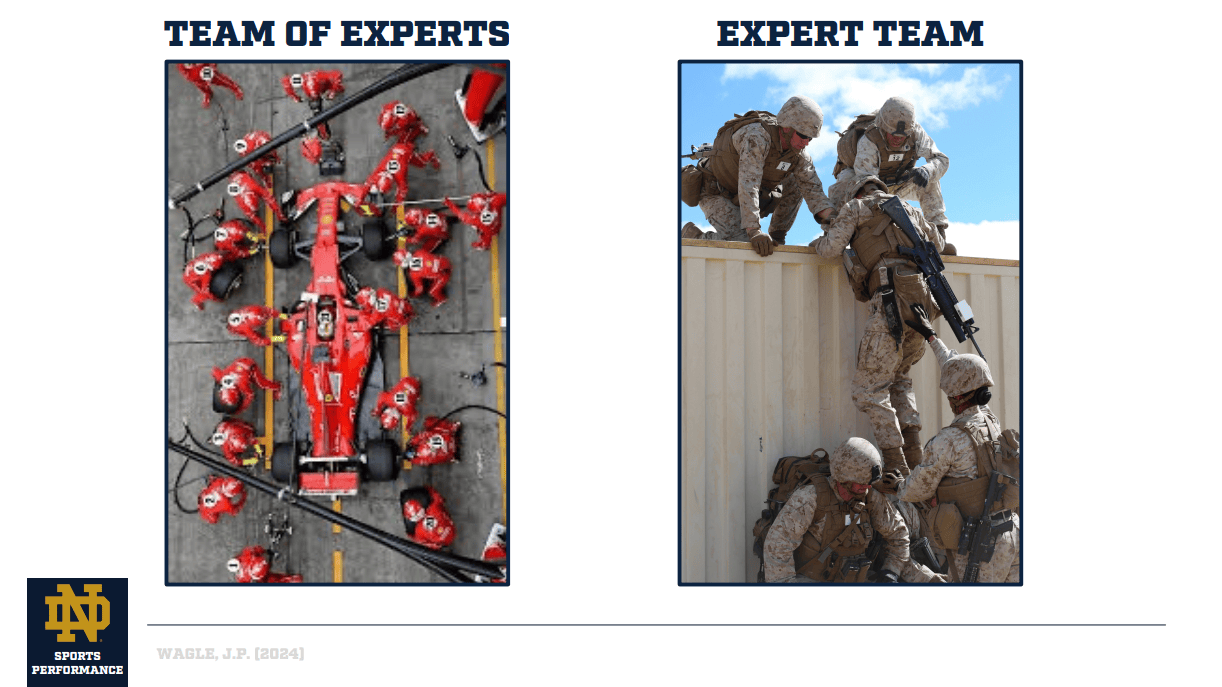
According to John Wagle, in a ‘team of experts’, “everyone has their job, they do it well, and the execution of their role doesn’t directly impact another person”. He cited a Formula 1 pit crew as an example.

An ‘expert team’, on the other hand, refers to groups where “the work of an individual may directly impact that of another person”. Wagle’s example was a US Navy SEALs team.

In illustrating this distinction onstage at November’s Leaders Sport Performance Summit in London, Wagle, the Senior Athletics Director for Sports Performance at the University of Notre Dame, highlighted the distinction between multidisciplinary and interdisciplinary.

Wagle was hired by Notre Dame in 2022 to lead an athletic department that was unable to consistently deliver an interdisciplinary approach despite the best intentions of all staff members.

“We needed a catalyst,” he continued. “The challenge as a performance director is to set the stage to solve a problem at scale in your environment.”
‘Constraints push you into new places’

Student-athletes continuously juggle their sport, academic studies and lives on campus – a situation Wagle described as “suboptimal”.

However, as he said, “these operational constraints push us into new places. They push our boundaries of how we can create solutions and I believe the best way to do that is to bring together two largely opposed ideals: knowledge and belief.”

Knowledge v belief

Knowledge, as Wagle explained, stems from a practitioner’s formal training as well as any external and internal research. He said: “the more common terminology for people in this room is evidence-based practice”.

Belief is different. It is an aggregate of a practitioner’s experiences from working in the field, athlete values and preferences, and the matter of risk tolerance and uncertainty management. “There is an element in belief that you’ve got to harness and steer into uncertainty.”
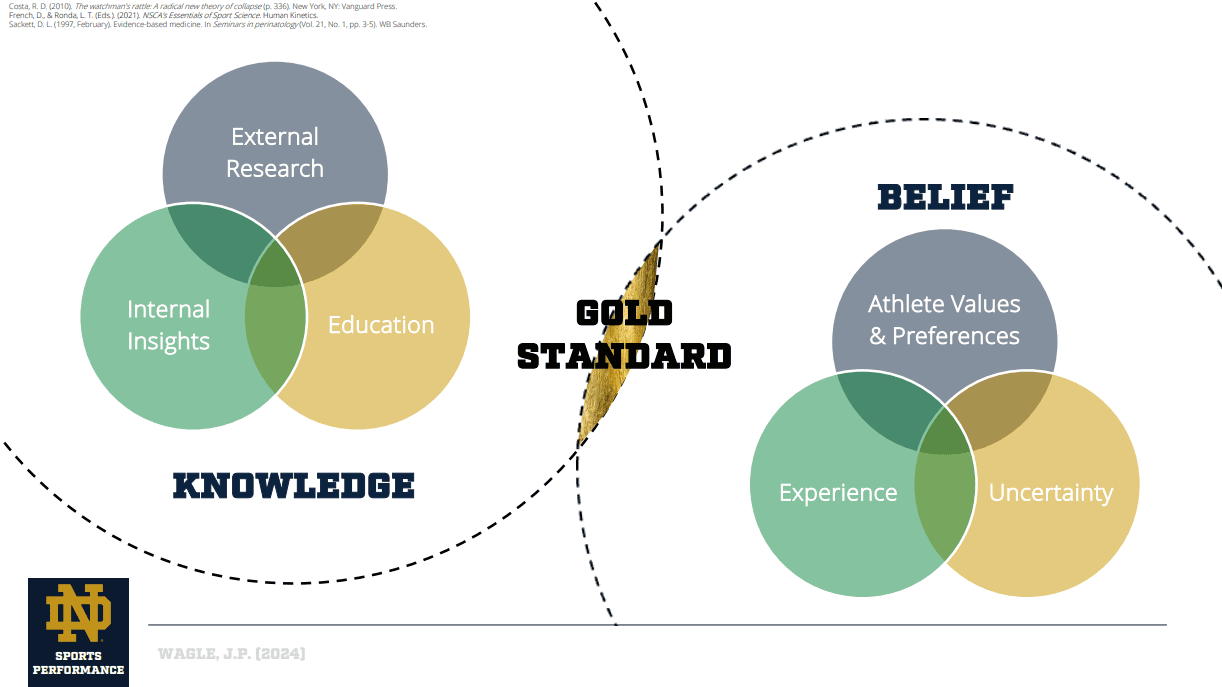
“These don’t need to be opposing viewpoints,” Wagle added, despite admitting that people “gravitate towards their tendency”.

“This is the true power of interdisciplinarity and, if we don’t bring these pieces together, we run the risk of being blind to what a lot of our athletes are experiencing.”

He spoke of the student-athlete being in a “complex adaptive system” where the interaction of different elements leads to either a health or a performance outcome, with the ‘gold standard’ somewhere in the middle.

Sleep = the catalyst

Wagle admitted that Notre Dame’s athletic department oscillated between knowledge and belief despite concerted efforts to bring both together.

“There were members of our team that no matter what the problem was were always on the knowledge side and there were members of our team who were always on the belief side,” he said. “It did not necessarily manifest in conflict – it manifested in avoidance – because I think every problem we tried to solve was inherently biased towards a discipline and it was easier to run away from that problem.”

They needed a catalyst to underline the power of interdisciplinary work and alighted upon sleep.

“We chose sleep because it is inherently lacking a discipline,” Wagle continued. “It can be owned by psychology, by nutrition, by strength & conditioning, by medical. There’s no obvious lead person in that.”

Everyone was able to meet the challenge that Wagle set: to be the best sleep support ecosystem in the whole of college sports. The knowledge people combined their data-driven approaches and devised a sleep screening tool. “We were able to get more granularity on our sleep habits and behaviours.” The belief people “brought to the table the ebbs and flows of the academic year.”

Remember: you could be part of the problem

Notre Dame’s approach to sleep has proven a game-changer in their approach to interdisciplinary work. Staff members recognised their biases, let go when necessary, and committed to collaboration.

Wagle said: “If we don’t acknowledge that ‘we could be part of the problem’, that’s where culture and alignment suffer; and resources fail to be allocated properly.”

3 Feb 2025

Articles

The Debrief – a Snapshot of Powerful Discussions Happening Right Now Across the Leaders Performance Institute

Category
Leadership & Culture
Share
Facebook Twitter Email Copy Link
https://leadersinsport.com/performance-institute/articles/the-debrief-a-snapshot-of-powerful-discussions-happening-right-now-across-the-leaders-performance-institute-11/

This month we touch upon the power of flexibility, relatability and collaboration in leadership and what you need to know to be better in each area.

By John Portch
Did you see January as a time for reflection or a time for pushing on towards your goals?

Ideally, you found time for both and, here, we highlight a selection insights from the first month of 2025 that may help you to consider a problem in a different way or enable you to identify the right people to whom you can turn.

We hope to see some of you in Melbourne later this week for the Leaders Sport Performance Summit.

And, whether or not you can make it to the Glasshouse, here are five thoughts for all leaders to ponder.

  1. Redefine or reframe the problem with alternative goals

If you can find new ways to consider your problems, it can open up new ways of thinking.

In this article, John Bull of Management Futures used the example of an elevator. Perhaps your goal is to make the elevator go faster, but what if your aim was to make the wait less annoying?

“Most hotels will put a mirror beside the elevator,” he said. “That seems to kill time when we’re looking at ourselves in a mirror.”

Bull suggested we “think of at least three different ways we could define our goal, to help open up new ways of thinking about the problem”.

He also share the STOP process for creative problem-solving:

  1. As a leader you’re not bulletproof – don’t try to be

In November, John Longmire called time on his 14 years as Senior Coach of the Sydney Swans. He has taken a new position as the Swans’ Executive Director of Club Performance but, before doing so, he reflected on his tenure as Senior Coach, which brought two AFL flags and four Grand Final appearances in total.

You can read his thoughts here, but here is a snapshot of his desire to remain “connected and relatable” to his players and staff. As he said onstage at November’s Leaders Sport Performance Summit in London, “the coach is no longer looked upon as being bulletproof” whatever their standing may be within the game.

His final speech to the players and staff as Senior Coach attested to that belief. He weaved in personal stories and his voice cracked at times. He wiped away tears too.

It called to mind the weekly ‘storytelling’ sessions that Longmire made a key feature of the Swans’ environment. He told the Leaders audience that players and staff share stories or complete a series of tasks for discussion each week. Recent examples included writing ‘a letter to your 16-year-old self’. These sessions are popular with players and staff alike.

“Sometimes it’s a photo of something that mattered to you and quite often there’s tears involved,” he said. “The way I looked upon coaching 25 years ago is completely different now – these 18, 19, 20-year-olds need to be able to relate to you. If you can show that you’re human, you get a lot more back.”

  1. Performance improves when you match team density, size, and space to the task at hand

The question of team dynamics sits at the heart of The Social Brain: The Psychology of Successful Groups by Tracey Camilleri, Samantha Rockey and Robin Dunbar. The trio has spent decades observing the worlds of academia, business, and government as they look to better understand the workings of high-performing teams.

Camilleri and Rockey came to the summit in London to discuss how their research has its applications in the world of sport. Decision-making was one such area:

For decisions made at speed, you’ll count on five people.

Five is the number of intimate relationships a person can have. Rockey said: “These are the relationships that protect us, make us thrive, and ensure that we go through life in a joyful way. They protect us from ill-health and from some of the psychological challenges that we might have from feeling insecure.” They, of course, occur in intimate spaces.

For more complex decisions, you’ll count on 15 people (including your original five).

The ‘pain’ comes when you look to insert new thinking into complex decision making in a group space. “We spend about 60 per cent of our social time with just 15 people,” said Rockey. “With the 15 in the workplace, they would have built long-term relationships and loyalty to you over time – that’s how we work as humans – so breaking up those people to bring in new thinking is painful.”

According to Dunbar, the upper limit on the number of social relationships we can enjoy is 150

Dunbar suggests that people can have no more than 150 social relationships at any one time. “It’s a very stable number across all societies and cultures,” said Rockey.


From The Social Brain: The Psychology of Successful Groups by Tracey Camilleri, Samantha Rockey, and Robin Dunbar.

  1. Athletes crave individual – and team – development

Young athletes are bolder in stating their desire for belonging and connection than their forebears, but this comes with a paradoxical demand for more personalised training and attention. There are clear implications for the time coaches spend on team dynamics in an era where the power has shifted to the athlete. The topic was discussed on a recent virtual roundtable. “Staff and coaches are more vulnerable,” said one participant, who pondered where the balance needs to sit. “Give the athletes a voice and a choice, give them ownership, have the consultation, but there is a line too.”

Another participant with experience of coaching in European football, highlighted that individual work will mean different things to different people and can be dependent on team selection. They argued that there is room for better management of expectations and, more broadly, a consensus for coaches and athletes alike on what constitutes ‘individual’ training.

  1. The best performance tools are co-designed

In February 2024, the England & Wales Cricket Board launched its Insight 360 platform, which adopts a data-driven approach to athlete and performance management.

Ahead of the launch, the ECB gathered input from practitioners and coaches across the English game. “This means Insight 360 is bespoke for women’s cricket,” said Anna Warren, the Head of England Women’s Science & Medicine. Players, she said in this article, are happy with an app that allows them to review their own data in as much detail as they like. “This is good for player buy-in, which is always a challenge in relation to athlete monitoring.”

There is also the power of a co-designed project. UK Sports Institute have found as much with their Project Minerva. Dr Richard Burden, the UKSI’s Co-Head of Female Athlete Health & Performance, said: “Get the practitioners involved, get athletes, get the teams and bring them along with it because if they’re onboard you get easier access to them and you’re going to produce something that’s more translatable, meaningful and applicable to them.”

Warren is on the same page with Insight 360. “You can link loads of different data sources together and start to answer some key performance questions – we’re not looking at everything in isolation.”

Members Only

29 Jan 2025

Articles

What Do Athletes Want? Four Trends in the Athlete-Coach-Team Dynamic

Category
Coaching & Development, Premium
Share
Facebook Twitter Email Copy Link
https://leadersinsport.com/performance-institute/articles/what-do-athletes-want-four-trends-in-the-athlete-coach-team-dynamic/

A recent Leaders Virtual Roundtable touched on the themes of connection, individual development, and the athlete’s role in decision-making.

By John Portch
Some say young athletes are not as single-minded and dedicated to their craft as earlier generations.

That is not necessarily true, but young athletes today do tend to have more autonomy and wider horizons.

If they decide they do not want to be on this pathway or that programme, others will welcome them with open arms. Even if an athlete does commit to your programme: are you providing the wellbeing, learning and social support they increasingly demand?

This generational shift – and the challenges it poses coaches and staff – set the terms for a virtual roundtable titled ‘What Are our Athletes Telling us?’ where we invited members of the Leaders Performance Institute from across the globe to answer four questions:

  • What are we learning from conversations with athletes?
  • Are there trends in the type of support they need?
  • What topics interest young athletes?
  • How are we adapting our environments to meet their needs?

Their responses pointed to four trends in the athlete-coach-team dynamic.

1. Athletes are increasingly expressing their desire for belonging and connection

Teams should consider the psychosocial elements of an athlete’s development. Emerging athletes wish for meaningful experiences and want a sense of belonging and connection. “It’s about where are they enjoying themselves the most and where they see the opportunities,” said one participant, who spoke of Australia’s women’s rugby sevens.

The programme takes teams of emerging athletes on tour to far flung places. Therein lies the opportunity for community-based activities where players will meet locals, in circumstances often far removed from their own and, in contributing to social and environmental causes, continue to develop a more rounded perspective of their own lives and development.

This builds on the fine work being done in Australia to develop the “whole athlete”, as one participant with knowledge of the environment explained. The Australian system, they said, has prioritised mental health support for Olympic and Paralympic athletes at the behest of the athletes themselves.

2. Athletes crave individual – and team – development

The desire of younger athletes for belonging and connection comes with a paradoxical demand for more personalised training and attention. This has implications for the time coaches spend on team dynamics in an era where the power has shifted to the athlete. “Staff and coaches are more vulnerable,” said one participant, who pondered where the balance needs to sit. “Give the athletes a voice and a choice, give them ownership, have the consultation, but there is a line too.”

Another participant with experience of coaching in European football, highlighted that individual work will mean different things to different people and can be dependent on team selection. They argued that there is room for better management of expectations and, more broadly, a consensus for coaches and athletes alike on what constitutes ‘individual’ training.

3. Athletes want a formal voice in decision-making

Athletes want to have a say in decisions that affect them. A participant working at the Premier League spoke of their members’ club captains being increasingly forthright in their views on league-sponsored initiatives.

They said there need to be clear systems and processes for engaging athletes and ensuring their feedback is considered, with the caveat that any outcomes may be unclear or unformed, depending on the complexity of the issue.

To this latter point, another participant spoke of the athlete advisory committee with whom they work. “We’re trying to provide agency and elevate that athlete voice, which in a lot of ways is really valuable and adds a lot of benefit,” they said. “But there’s risk associated with that. You are letting the ‘good’ in with the ‘bad’ to an extent depending on what topic it relates to, particularly in terms of managing expectations.”

4. Athletes want to explore opportunities beyond the sporting arena

One participant noted that athlete care roles have developed from being “concierge-style to far more hands-on”. That might include helping young overseas athletes settle in a new country with their close family or it might mean supporting leadership development, media skills training, or helping athletes to explore other professional opportunities beyond their sporting careers.

The Australian sports system, for example, is getting better at providing educational and career opportunities of the kind that enable athletes to be more “job-ready”.

However, it is not just those athletes in (typically) lower-income Olympic and Paralympic sports seeking wider professional development: LinkedIn has seen an exponential increase in major league athletes using its platform. As one participant noted, this interest in business and entrepreneurship is not a surprise given the levels of disposable income available to some athletes. It invites the question: how might teams and leagues support players in these endeavours?

Members Only

23 Jan 2025

Articles

‘Where Do I Focus my Attention: on Leadership, Management or Coaching?’

Category
Leadership & Culture, Premium
Share
Facebook Twitter Email Copy Link
https://leadersinsport.com/performance-institute/articles/where-do-i-focus-my-attention-on-leadership-management-or-coaching/

Racing 92 Head Coach Stuart Lancaster weighs up the balance between being systematic and ‘authentic’.

By John Portch
Stuart Lancaster understood the scale of the challenge that awaited him at Racing 92 when he took the reins as Head Coach in July 2023.

Rebuilds take time and, for all his work behind the scenes, Lancaster’s Racing remain a mid-table team in France’s Top 14.

“When things don’t go well it’s very easy to turn around and say, ‘he’s an Anglo-Saxon, he doesn’t fit our culture’,” he told the audience at November’s Leaders Sport Performance Summit in London.

After signing a four-year contact in September 2022, he saw out his last nine months at Leinster; a winning environment he helped to build. Staying was probably an easier option.

“I’ve always had the desire to challenge myself as a coach,” he continued, “and there’s no bigger challenge than going to a French club as a head coach without being fluent in the language.” The Top 14, which is the wealthiest league in rugby, is known for its sink-or-swim nature for players and coaches alike, particularly those arriving from abroad.

A year and a half into his tenure, Lancaster regularly asks himself: “Where do I focus my attention between leadership, management and coaching?”

‘Tiptoe in or smash the door?’

Upon his arrival at the Paris La Défense Arena, Lancaster was mindful that his new boss was his predecessor as Head Coach, Laurent Travers, who had been promoted to President.

Lancaster asked himself: should he “tiptoe in or just smash the door down?” He alighted somewhere in between.

A quirk of the fixture list meant that Racing had played Lancaster’s Leinster twice in the European Champions Cup in the months after he signed his contract. Leinster won both matches, home and away, by a combined 58 points.

He argued that this was to his advantage when being introduced to Racing’s squad. “The players saw what that environment looked like because they had played against it,” he said. “I was pushing on an open door. They were ready for a change and a new working week.”

Out went the long lunches, in came a revamped playbook, but Lancaster has been careful not to separate the club from its roots. On his coaching staff, he inherited former Racing wing Joe Rokocoko (Skills Coach) and former captain and hooker Dimitri Szarzewski (Forwards Coach), both of whom won the league with the club in 2016. He also drafted in former France scrum-half Frédéric Michalak as his Backs Coach.

It was not about replacing Racing’s “DNA” with Leinster’s but laying foundations as the game shifts. “I had to show the players what good looks like and why it’s good.”

The coach’s search for ‘truth’

Lancaster cited Sarah Langslow’s book Do Sweat the Small Stuff: Harness the power of micro-interactions to transform your leadership. It details how one can connect with people and inspire them to perform. The types of ‘micro-interactions’ Langslow discusses are important to Lancaster given his lack of fluency in French (and the inability of some squad members to speak English).

“You can get a sense of the culture in your one to ones,” he said of his individual meetings with players, coaches, and staff. “You’ve got to dedicate time in your working week for one to ones.”

Lancaster revealed that he had made four phone calls to coaches and staff at Racing prior to his appearance onstage. “I was sense-checking the mood in the camp,” he said, adding that coaches and staff have access to information beyond “the manufactured truth that the head coach gets”.

Softening the performance conversation

Key to Lancaster’s approach has been his efforts to galvanise a squad containing French, English, Welsh, Australian, Argentinian, Fijian and Georgian players. Each week, a different player, coach or staff member will share a personal story in front of the group. Once a month, the players organise a themed dinner for the squad, coaches and staff.

Lancaster has also brought with him the psychological profiling tools he used at Leinster. He believes they can help players to better understand their strengths and weaknesses. To kick things off, he initially shared his own profile in a team meeting.

These efforts all help to soften the performance conversation. “You can be both systematic and authentic by using your meetings in a creative way and not just talking about the technical and the tactical. You can talk about life experiences and how you can learn from failure.”

It has been a quick win. “French rugby is an incredible success story but at the same time it’s behind in certain areas.”

Lancaster makes the point that Racing centre Gaël Fickou could win more than 90 caps for France “yet he’d never even thought about what emotional intelligence or leadership looks like.” Until now.

If Racing can raise their performance levels, they will do so while showing their human face; and that also goes for a coach who has been labelled a ‘robot’ in the French media.

“Often the simplest things are the most powerful: admitting your vulnerability, your mistakes, by showing that human face.”

22 Jan 2025

Articles

What Makes a Team More than the Sum of its Parts?

Category
Leadership & Culture
Share
Facebook Twitter Email Copy Link
https://leadersinsport.com/performance-institute/articles/what-makes-a-team-more-than-the-sum-of-its-parts/

Leadership specialists Tracey Camilleri and Samantha Rockey explain how matching team density, size, and space to the task at hand can boost performance.

By John Portch
Kansas City Chiefs Head Coach Andy Reid may be the best in the business, but he is not a one-man coaching ticket.

Reid’s celebrated right-hand men, including Offensive Coordinator Matt Nagy and Defensive Coordinator Steve Spagnuolo, are in demand for newly vacant head coaching roles elsewhere now that the NFL regular season has concluded.

Time will tell whether Nagy or Spagnuolo can assemble winning rosters of the kind that delivered the Chiefs back-to-back Super Bowls (with a third still on the cards), but they will have a better chance of ticking all the right boxes if they can surround themselves with the right people.

On that note, the question of team dynamics sits at the heart of The Social Brain: The Psychology of Successful Groups by Tracey Camilleri, Samantha Rockey and Robin Dunbar. The trio has spent decades observing the worlds of academia, business, and government as they look to better understand the workings of high-performing teams.

“We wrote this book because we were fascinated with the question: what is it that makes a group of people more than the sum of their parts?” said Camilleri when addressing the audience at November’s Leaders Sport Performance Summit in London.

“In our world, the unit of identification is most often the individual – if you think about how we hire, how we promote,” she continued. “Very rarely is the focus the team.”

Camilleri and her co-authors redress that balance in The Social Brain and here we explore how leaders can amplify the collective in the pursuit of better decision making.

‘The rocket fuel for performance impact and innovation’

The Social Brain applies theories of evolutionary biology to groups of high performers.

“We’ve been interested in what doesn’t change,” said Camilleri of this lens of enquiry. “When humans are part of small groups they can take advantage of their collective intelligence as well as a sense of safety, reciprocity and shared obligation.”

Camilleri, Rockey and Dunbar devised their ‘Thrive Model’, which sets out six foundational conditions for high-performing teams that consider social health (in addition to physical and mental health) as a prerequisite of wellbeing.

Onstage, Rockey defined these conditions as “the rocket fuel for performance impact and innovation.”

From The Social Brain: The Psychology of Successful Groups by Tracey Camilleri, Samantha Rockey, and Robin Dunbar.

What do the numbers in the circle mean?

As Rockey explained, it is important for leaders to know where to focus their energy most effectively.

“All of us have the same amount of time in a day and we use it differently, but what doesn’t change for each individual in this room is how many relationships that we can have at any given time,” she said. Our brains are only so big, “so we can’t have endless relationships”.

She used Dunbar’s number, which was devised by her co-author in the 1990s, to illustrate her point:

Dunbar’s number has long been influential across several fields, from government and administration to business and academia.


Five, 15 or 150 people? Performance improves when you match team density, size, and space to the task at hand

For decisions made at speed, you’ll count on five people.

Five is the number of intimate relationships a person can have. Rockey said: “These are the relationships that protect us, make us thrive, and ensure that we go through life in a joyful way. They protect us from ill-health and from some of the psychological challenges that we might have from feeling insecure.” They, of course, occur in intimate spaces.

For more complex decisions, you’ll count on 15 people (including your original five).

The ‘pain’ comes when you look to insert new thinking into complex decision making in a group space. “We spend about 60 per cent of our social time with just 15 people,” said Rockey. “With the 15 in the workplace, they would have built long-term relationships and loyalty to you over time – that’s how we work as humans – so breaking up those people to bring in new thinking is painful.”

According to Dunbar, the upper limit on the number of social relationships we can enjoy is 150

Dunbar suggests that people can have no more than 150 social relationships at any one time. “It’s a very stable number across all societies and cultures,” said Rockey.

From The Social Brain: The Psychology of Successful Groups by Tracey Camilleri, Samantha Rockey, and Robin Dunbar.

Camilleri and Rockey wrapped up their presentation by offering nine ‘social hacks’ for building relationships swiftly:

From The Social Brain: The Psychology of Successful Groups by Tracey Camilleri, Samantha Rockey, and Robin Dunbar.


Rockey then homed in on five…

Synchrony: “Sport has done this brilliantly. The perception of pain is reduced when we’re doing something together. When you’re running with a partner it feels less painful.”

Laughing together: “A fantastic way of finding a group”.

Engaging with strangers: “When we have conversations with people we don’t know, it has a positive effect on us – I encourage you to meet people that you don’t know today.”

Giving and receiving kindness: “A New York-based study saw that when young people were able to engage with strangers and be helpful to them, they saw an uptick in their mental health.”

Eating together: “There’s something very magical about breaking bread together. You have about 30 minutes when you’re having food together in which you have a sense of wellbeing and positive vibes towards your dining partners. So if you want to do something difficult, eat with your group first and then go to the difficult meeting.”

The Social Brain: The Psychology of Successful Groups by Tracey Camilleri, Samantha Rockey, and Robin Dunbar is available now from Penguin.

Members Only

16 Jan 2025

Articles

‘Listen to your Empathetic Players – they’re the Ones that Will Keep you in a Job’

Category
Leadership & Culture, Premium
Share
Facebook Twitter Email Copy Link
https://leadersinsport.com/performance-institute/articles/listen-to-your-empathetic-players-theyre-the-ones-that-will-keep-you-in-a-job/

Four nuggets of wisdom from John Longmire, who recently signed off as Senior Coach of the Sydney Swans after 14 seasons.

By John Portch
John Longmire stood down as Senior Coach of the Sydney Swans in November – fewer than two weeks after his onstage appearance at the Leaders Sport Performance Summit in London.

Having fashioned a reputation as one of the finest coaches in the league during his 14 seasons in charge, Longmire has taken a new position as the Swans’ Executive Director for Club Performance. He handed the coaching reins to his assistant, Dean Cox, as the club’s succession plan swung into action.

“I couldn’t get rid of the feeling that maybe it’s time,” Longmire told his players in a moving farewell speech. He had first discussed the idea of stepping away with the team’s management 18 months earlier and returned to the topic midway through the 2024 AFL season.

Longmire’s 333rd and last game in charge turned out to be October’s Grand Final, which Sydney lost to Brisbane. Overall, he took the Swans to four Grand Finals and won one flag, in 2012.

The Swans’ list and performance infrastructure are the envy of most in the league. In fact, few departing coaches ever leave their successor a team in such good shape.

This may have been on Longmire’s mind at the Kia Oval – a ground where, as a 16-year-old back in 1987, he played in an infamous exhibition game for North Melbourne against Carlton.

“It was labelled the ‘Battle of Britain’,” he said while directing Leaders Performance Institute members towards the YouTube highlights. Those that click through can expect a litany of violent fouls.

“It was my first game, and I was absolutely petrified,” he said with a smile.

Longmire then returned to his time as Senior Coach and we’ve picked out four nuggets of wisdom.

1. Don’t become set in your ways

Injury put paid to Longmire’s playing career in 1999 (he won the AFL flag in his final game for North Melbourne) and, three years later, he became an assistant to Sydney’s then Senior Coach, Paul Roos.

Longmire was 31 years old at the time – still young enough to be a contemporary of the players he was now coaching. By 2024, both he and the sport had changed.

“The older we get, the further we get from that age demographic,” he said, “and the more rigid, the more set we can become in our ways and our beliefs – that’s the real danger.”

Longmire consciously moved with the times, but his wisdom would have counted for little if his players did not pay attention. “I know what it takes for a successful organisation to stay competitive,” he continued, “but I am the one that has to bend and move.”

One example was his gradual shift from focusing on the team’s leadership group to spending more time with the younger players. Longmire would watch and listen to them without judgement and, when necessary, “bring them back to where you know high performance teams like to operate.”

2. Find your truthtellers

“The best cultures are the ones that keep moving and adjusting to the ecosystem,” said Longmire, who emphasised the coach’s role in that process.

“I walk amongst our playing group during our warm-ups and that’s a case of sensing the mood, working out who’s talking to who and what they’re talking about.”

He also leaned heavily on his most empathetic players (“those that don’t just walk past your office – they walk in and say: ‘how are you going, coach?’”). The relationships he shared with those players were “ever more valuable” because they were his best eyes and ears in the changing room.

“Make sure you water those relationships because they’re the ones that will keep you in a job.”

3. You’re not bulletproof – don’t try to be

For all his stature as a coach, Longmire was keen to remain “connected and relatable” to his players and staff. As he said onstage in London, “the coach is no longer looked upon as being bulletproof” whatever their standing may be within the game.

His final speech to the players and staff as Senior Coach attested to that belief. He weaved in personal stories and his voice cracked at times. He wiped away tears too.

It called to mind the weekly ‘storytelling’ sessions that Longmire made a key feature of the Swans’ environment. He told the Leaders audience that players and staff share stories or complete a series of tasks for discussion each week. Recent examples included writing ‘a letter to your 16-year-old self’. These sessions are popular with players and staff alike.

“Sometimes it’s a photo of something that mattered to you and quite often there’s tears involved,” he said. “The way I looked upon coaching 25 years ago is completely different now – these 18, 19, 20-year-olds need to be able to relate to you. If you can show that you’re human, you get a lot more back.”

4. Look beyond winning and losing

Winning cannot be everything, even for a proven winner.

“If we measure ourselves on the ultimate success, there’s a lot of years of being unhappy,” said Longmire. A coach must find other factors, such as the personal development of players or staff. He said it is critical to have more in the ‘plus’ column than the ‘negative’.

“Identify, enjoy, and celebrate those moments. And make sure you get joy out of the journey.”

Go to home
Follow us on Instagram Follow us on LinkedIn Follow us on X

Contact

Leaders UK

Tuition House
27-37 St George's Road
Wimbledon
SW19 4EU
London
United Kingdom

Enquiries Line: +44 (0)207 806 9817
Switchboard Number: +44 (0)207 042 8666

Leaders US

120 W Morehead St # 400
Charlotte
NC 28202
United States

Enquiries Line: +1 646 350 0449

Leaders

  • Contact
  • About
  • Careers
  • News
  • Privacy Policy
  • CA Privacy Rights
  • Cookie Notice
  • Website Terms of Use

Performance Institute

  • Membership
  • Events
  • Content
  • Virtual Learning
  • Connections
  • Partners

Latest

Intelligence Hub
High Performance Future Trends Research Elite Performance Partners continue to drive the potential in high performance forward through renewed Leaders partnership
Your Privacy Choices

© 2026 Leaders. All rights reserved

  • Privacy Policy

Attendees

x