15 Jun 2026
ArticlesIn the third part of his miniseries, Basketball New Zealand GM Paul Downes explains how a peripheral format became a legitimate, strategically prioritised pathway for international success.
Main Image: Basketball New Zealand
More often, it is resisted because proposed change is perceived as threatening what people care most deeply about: identity, legacy, fairness, and standards.
This article uses the evolution of the 3×3 Tall Blacks programme as a case study in applied change leadership, exploring how innovation can be mobilised without destroying trust or fragmenting a system.
Specifically, the article examines how 3×3 Basketball shifted within Basketball New Zealand (BBNZ) from being viewed as a peripheral or competing format to a legitimate, strategically prioritised pathway for international success. Drawing on innovation and change management research, it demonstrates how leadership decisions around pace, protection, communication, and culture shaped the programme’s trajectory. Central to this case is a simple but often neglected principle: organisations can only move at the speed of their people.
What is 3×3 basketball?
3×3 Basketball was formalised by the International Basketball Federation (FIBA) in the late 2000s as a condensed, high‑tempo version of the game designed for urban environments, broadcast appeal, and global accessibility. Played with three athletes per team on a half court, a 12‑second shot clock, and first‑to‑21 scoring, the format demands rapid decision‑making, tactical clarity, athletic versatility, and exceptional individual skill under pressure.
Since its inclusion as an Olympic discipline at the Tokyo 2020 Olympic Games, 3×3 has moved decisively from an alternative format to a mainstream high‑performance sport. It now operates with its own world rankings, qualification pathways, professional circuits, and national team competitions governed by FIBA. Crucially, success in 3×3 is not achieved by lightly adapting 5×5 systems; it requires distinct preparation models, athlete archetypes, and tactical identities.
Who are the 3×3 Tall Blacks?
New Zealand competes in 3×3 Basketball through a clearly defined international competition pathway. The men’s senior programme, known as the 3×3 Tall Blacks and, known on the FIBA circuit since 2025 as #2PointNation, contests major national team events including the FIBA 3×3 Asia Cup, the FIBA 3×3 World Cup, and, where applicable, Olympic or Commonwealth Games qualification tournaments. Athletes may also compete in FIBA‑sanctioned professional events such as World Tour Challengers, World Tour Masters, and selected Pro circuits, which contribute to global ranking points and qualification status.
These competitive realities require BBNZ’s 3×3 programme, across U21, U23, and senior team, to be innovative by necessity. With constrained resources and limited margins for error, the Men’s (and Women’s) programme has had to identify where competitive advantage is possible, how learning can be accelerated, and how athletes can be developed into genuine 3×3 specialists rather than part‑time participants (through also prioritising 5×5).
3×3 as a strategic opportunity, not a threat
Within the New Zealand basketball landscape, historical emphasis has understandably sat with the Tall Blacks (men’s 5×5) and Tall Ferns (women’s 5×5) programmes. These teams carry deep cultural significance, reinforced by landmark performances such as the Tall Blacks’ fourth‑place finish at the 2002 FIBA World Cup and the Tall Ferns’ participation at the 2004 Olympic Games. However, podium finishes at pinnacle 5×5 events, and consistent Olympic qualification, have become increasingly difficult in a global ecosystem shaped by professional leagues, deep talent pools, and significant financial asymmetry.
Within this context, 3×3 has emerged not as a replacement for 5×5, but as a distinct strategic opportunity: a format in which New Zealand can plausibly compete for medals through deliberately creating an identity, strategy and specialisation by targeted coaches and athletes. Yet recognising opportunity was not sufficient. Elevating 3×3 within a 5×5‑dominant system required leaders to manage legitimate fears that resources, attention, or cultural value would be diverted.
As 3×3 Tall Blacks Head Coach Piet Van Hasselt said:
Resistance to 3×3 didn’t mean disloyalty. It often meant people cared deeply about 5×5 and felt responsible for protecting it. 3×3 is still the new kid on the block in basketball terms and is very different to 5×5.
This framing was critical. Resistance was interpreted not as obstruction, but as a signal of attachment and responsibility. That distinction shaped how change was approached: not through mandate, but through dialogue, clarity, and deliberate pacing.
Three roles that support successful innovation in HP environments
Across HP sport and other expert systems, innovation research converges on the importance of leaders occupying multiple complementary roles rather than relying on individual charisma or isolated expertise (1,2,3). Three roles are consistently evident in successful innovation initiatives.
1. The System Architect
The ‘System Architect’ role is grounded in organisational ambidexterity and strategic leadership research. Scholars such as Tushman and O’Reilly (1, 2) demonstrate that breakthrough innovation depends on senior leaders designing separate but integrated systems, protecting exploratory work from short‑term performance pressures while integrating it at the top through strategy, resourcing, and authority. Mintzberg’s work on “designing the organisation” (3) reinforces this view in that effective leaders shape structures, decision rights, and power flows rather than running experiments themselves.
In HP sport terms, the architect decides where innovation sits, how it is protected, and how it is judged. Without this role, innovation becomes personality‑dependent and fragile; with it, innovation becomes institutional.
2. The Technical Champion
The ‘Technical Champion’ is one of the most empirically supported roles in innovation literature. Research by Howell and Higgins (4, 5) shows that innovations outperform when championed by credible insiders who persist under resistance, mobilise informal networks, and translate abstract ideas into legitimate practice. Subsequent work clarifies an important dependency: champions burn out or are marginalised (6) without organisational protection from architects.
In HP sport, champions are domain‑credible leaders for example coaches, senior athletes, or tactically fluent specialists who are willing and able to absorb resistance on behalf of others while legitimising change through performance.
3. The Cultural (Learning) Enabler
The third role of ‘Cultural’ or ‘Learning Enabler’ is supported by Amy Edmondson’s (7) research on psychological safety. Innovation fails less often due to lack of ideas than due to fear. Leaders who frame their strategic initiatives as learning problems, without lowering standards, create environments where experimentation, respectful conflict, and early failure are informational rather than punitive. This role ensures innovation does not collapse into compliance or defensive behaviour, particularly in high‑stakes environments such as elite sport.
The blended roles within BBNZ 3×3
Within the BBNZ 3×3 system, Nikolay Mikhalchuk (High Performance Manager, 3×3 – hereafter HPM) and Piet Van Hasselt (Head Coach, 3×3 Tall Blacks) can be viewed as functioning as deliberate amalgamations of all three innovation roles, in part due to the realities of scale and resource constraint.
Architectural leadership
As system architects, Mikhalchuk and Van Hasselt emphasise structural protection and integration, explicitly designing daily training environments and pathways for learning rather than forcing premature exposure. Mikhalchuk explains:
Decisions are made to take a step back, spend more time… align yourself, the coaching staff, and then prepare, rather than throwing athletes in the deep end before they understand the system and role expectations.
This reflects programme ambidexterity through protecting exploration (learning the 3×3 system) while gradually integrating it into the national pathway across U21, U23, and senior programmes.
Champion and cultural leadership
As technical champions and cultural enablers, both leaders are able to translate strategy into daily training behaviours while safeguarding learning. Van Hasselt captures this when he notes:
We’re trying to find a gap we can exploit based on our strengths… We have forged an identity, with clarity, and our players have bought into it.
He further explains how culture and learning interacted:
Great leadership and athlete ownership has meant we’ve been able to build through younger players, and now these players are becoming specialists.
Through deliberate ‘test and learn’ cycles, particularly in the Under-21 and Under-23 Nations League exposure and targeted senior competition, 3×3 specialists have emerged organically rather than being imposed.
Managing change in a 5×5-dominant culture
At a technical level, the transition from 5×5 to 3×3 can present genuine challenges. Mikhalchuk notes:
There are a lot of nuances and rules around 3×3 which would drive 5×5 players mad… The transition from a 5×5 star to the 3×3 court is close to impossible.
Yet once athletes choose to engage, the experience is often transformative. Van Hasselt observes:
Every time a 5×5 player comes in they absolutely love it… We have found players who are courageous and ready to take a leap of faith to this exciting new challenge.
These insights reinforced a core leadership lesson that people cannot be rushed through change they have not yet made sense of. Progress depended on aligning belief, understanding, and competence. Indeed, moving at the speed of people, not planning cycles.
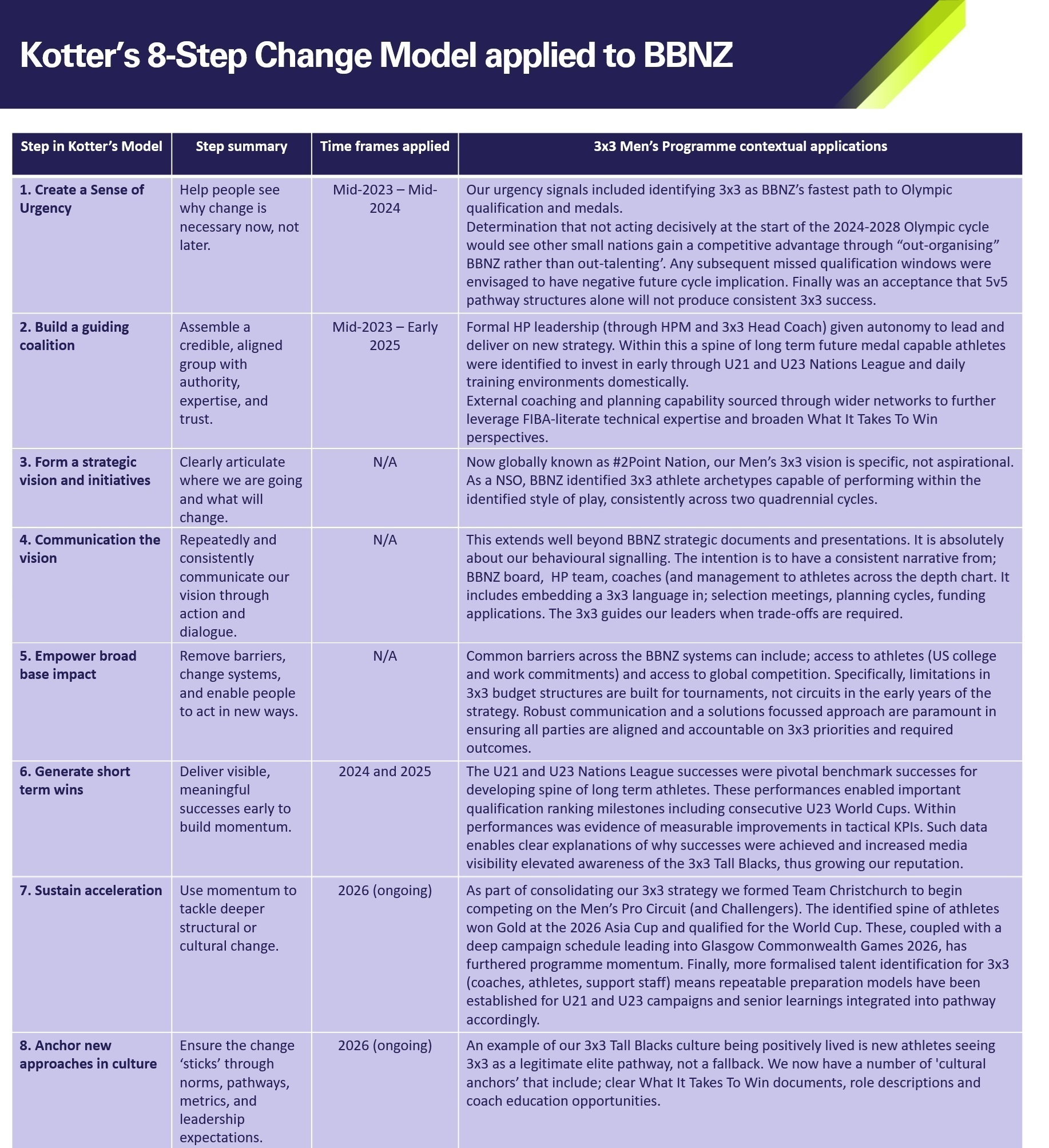
Applying Kotter’s 8‑Step Change Model
Recognising the complexity of this transition, BBNZ have applied Kotter’s 8‑Step Change Model (8) to structure and evaluate progress. A central insight of Kotter’s model is that sustainable change is built deliberately, sequentially, and with reinforcement. This model, and its contextual application is summarised here:
Concluding remarks
Within the global FIBA 3×3 landscape, the 3×3 Tall Blacks’ #2PointNation identity signals strategic clarity and a commitment to playing to New Zealand’s strengths rather than mimicking others. The Men’s programme accelerated once 3×3 was framed, and accepted, not as a format that could rely on occasional 5×5 participation, but as “our game, our way.”
An aligned approach to innovation, grounded in organisational values and supported by deliberate change management, has enabled the programme to become a respected and emerging force internationally. As Van Hasselt reflects:
Our programme and players strong commitment to improvement has helped us perform better game by game. The commentators tell us we can beat anyone in the world… they like us because we’re different.
Mikhalchuk adds:
We’re quick, we’re strong, we’re consistent and tough… We feel we can build those twos, and when opponents adjust, we can drive and create uncontested shots.
Ultimately, what gets funded gets celebrated. With increased High Performance Sport New Zealand (HPSNZ) investment toward the 2028 quadrennial, the Men’s 3×3 programme has moved from experimentation to embedded strategy. As Van Hasselt summarises the ambition:
We’d love to medal at LA 2028… We are continuing our exciting journey and improving every game and event as a team.
The broader lesson is clear. Successful innovation is not a hero story. It is a role system, paced deliberately, anchored culturally, and led with respect for how people actually change.
References
1) Tushman, M. L., & O’Reilly, C. A. (1996). Ambidextrous organizations: Managing evolutionary and revolutionary change. California Management Review, 38(4), 8–29.
2) O’Reilly, C. A., & Tushman, M. L. (2004). The ambidextrous organization. Harvard Business Review, 82(4), 74–81.
3) Mintzberg, H. (1983). Structure in Fives: Designing Effective Organizations. Englewood Cliffs, NJ: Prentice-Hall
4) Howell, J. M., & Higgins, C. A. (1990). Champions of technological innovation. Administrative Science Quarterly, 35(2), 317–341. [jstor.org]
5) Howell, J. M., Shea, C. M., & Higgins, C. A. (2005). Champions of product innovations: Defining, developing, and validating a measure of champion behavior. Journal of Business Venturing, 20(5), 641–661. [researchgate.net]
6) Shea, C. M. (2021). A conceptual model to guide research on the activities and effects of innovation champions. Implementation Research and Practice, 2, 1–13.
7) Edmondson, A. C. (1999). Psychological safety and learning behavior in work teams. Administrative Science Quarterly, 44(2), 350–383
8) Kotter, J. P. (1996). Leading Change. Boston: Harvard Business School Press
What to read next
You Don’t Arrive Strategic: How Leaders Grow Into their Role
12 Jun 2026
ArticlesAs performance specialist Darren Shand explained, teams and leaders must learn when to lean into both outcomes and growth.
Performance specialist Darren Shand, the former General Manager of the New Zealand All Blacks, posed this question at a recent Leaders Virtual Roundtable.
He continued: “I know if you hold a leadership role, it’s probably a conflict that you fight pretty regularly as you go through a season or a campaign because they can sometimes pull against each other, these two competing priorities, and depending on the type of leaders you have within your organisation, it can create a tension.”
The Leaders Performance Institute members in attendance were invited to think about where they sit on the spectrum between performance outcomes and performance growth.
Teams, as Shand explained, tend to oscillate along the spectrum. “Traditionally, early season tends to be growth-focused and, as we get further into campaigns, outcomes tend to take over.”
This presents a series of risks. “If there’s too much focus on outcomes alone it often creates fear, short-term thinking, and sometimes even stagnation caused by that fear. But if you’ve got too much focus on growth only, you start to dilute standards.”
He is in no doubt that “championship environments require both” and, over the course of 30 minutes, delivered a presentation to provide the members in the virtual room with practical ideas to strengthen their approaches to building sustainable, high-performing teams.
Aspire or inspire? Prove or improve?
Shand illustrated what he sees as the distinction between outcomes and growth.
‘Outcomes’ is what one aspires to win or achieve, while ‘growth’ is based on the desire to improve and develop (or “inspiration”, as he put it).
Both are essential. “The best environments don’t choose one – they learn when to lean into each,” said Shand. “They ask what’s the appropriate time and moment in a campaign, a season or an event.”
He posed two questions: “Which philosophy dominates your environment when the pressure increases? As expectation, scrutiny and pressure rises, where do you go?”
Teams under pressure tend to focus more on outcomes and, as such, they risk falling into what Shand called the “outcome trap” i.e. the negative consequences that come with an excessive focus on outcomes.
It usually starts when success is defined by results, trophies and external expectations. He noted a series of signs of which to be cognisant:
At the All Blacks, Shand, his colleagues and the playing group sought to separate outcomes and growth.
Firstly, their ‘why’ (their vision) was a deliberately “uncontrollable aspiration”: to be the most dominant sports team in the world.
Their mission (‘to develop self-reliant athletes’) and purpose (‘to enhance the All Blacks’ legacy’), on the other hand, were determined by their behaviours and their ability to learn and develop. This combination enabled continuous improvement even when under pressure.
Shand then explained that his work is guided by four principles:
1. Winning is never enough
“I often hear the myth that you have to lose to learn, but I don’t agree with that,” he said, adding that the All Blacks would ask themselves: ‘are we still learning or just winning?’. Your environment should incentivise learning because “growth will actually protect your future performance”.
2. Clarity drives alignment
Shand posed a question: “What are you currently not saying clearly because it creates pressure or accountability?” In his experience, “most teams under-communicate ambition because they fear the discomfort, tension and challenge”. This cannot become an excuse. “If there’s ambiguity, it destroys execution in the end.”
3. The more pressure increases, the more simplicity matters
When the pressure mounts, complexity can harm performance. Learning and growth come from simple structures and consistent reflection. The key for the All Blacks was everyone to become what Shand called a “doer” – someone that can make decisions based on available information. “We took this notion of being ‘productively paranoid’ so that by meeting little and often we’d connect, we’d continue our growth, and we could help each other grow too,” he said.
4. Sustainable success requires both outcomes and growth
“We’ve got to have that outcome discipline,” said Shand, “but we’ve got to couple it with a growth mindset.” He added: “The best teams don’t choose between outcomes and growth – they create systems where growth drives outcomes.”
When Shand concluded, the table had the opportunity to share their reflections. The conversation brought several themes to light:
What to read next
Darren Shand’s Three Key Principles for Building Effective Performance Strategies
At a recent Leaders Virtual Roundtable, Dr Robin Thorpe pondered the risk when performance teams are both too independent and overly integrated.
Thorpe, who has worked across multiple elite high-performance environments, recently led a virtual roundtable for performance directors entitled ‘Finding the Balance Between Integration & Excellence’.
He began with a short presentation in which he argued that while integration is often favourable, it is not always the case; there are times when excellence can be achieved without the collaboration of an entire multidisciplinary team.
Thorpe illustrated his point with reference to Ryan King’s research on ‘tame’ and ‘wicked’ problems. He then explained each in turn:
Tame problems can rely on specialist knowledge alone when there are clearer, more defined problems that can be solved by one discipline or a small expert group. These do not require extensive collaboration.
Wicked problems are complex, ambiguous or a consequence of several factors. They represent “challenges where having more specialist perspectives is clearly a positive method to try and answer or come up with the outcomes that we’re looking for”.
A good leader, Thorpe explained, can spot the problem and organise the correct response, with the goal being the optimum rather than maximum integration.
Too often, however, teams adopt the wrong approach; and there are several risks that can emerge as a result of too little or too much integration. Thorpe set out these risks on the following continuum:
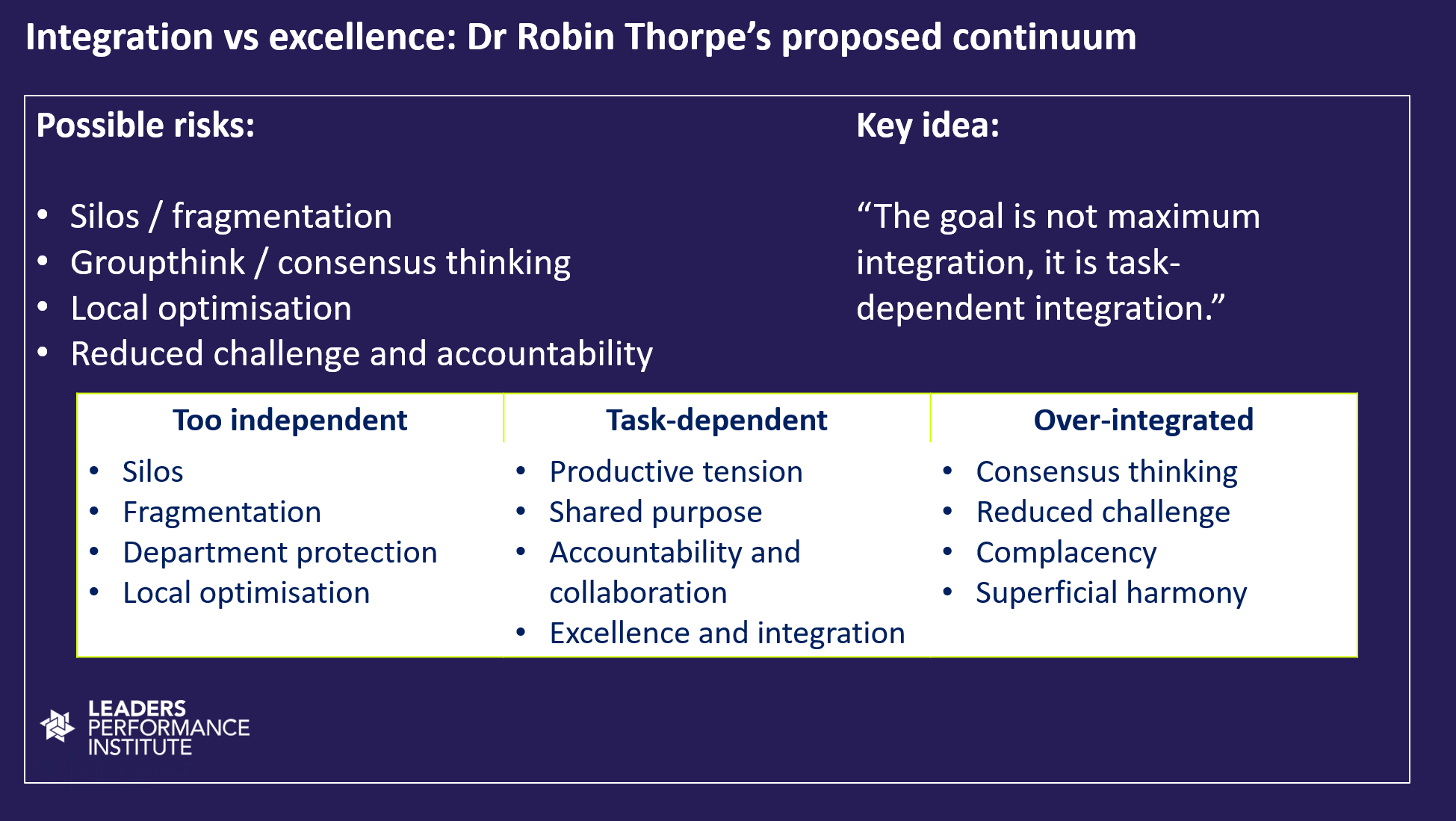
Teams should strive for the ‘optimal’ centre ground.
Thorpe then shared two hypothetical examples of how it might look when organisations occupy the two extremes:
Example 1 – too independent
In this example, integration is not consciously ignored but simply not prioritised; the system defaults to specialist expertise with an added sense of urgency.
Thorpe said: “Generally speaking, such environments can be successful, but things may be left on the table where if there were a more deliberate understanding of how some of these things can integrate there might be even more success going forward.”
Example 2 – over-integrated
Priorities are unclear; and challenge is not always facilitated because it is perceived as a negative. “These characteristics can reduce a culture of excellence within an organisation,” said Thorpe, who emphasised that cultural barriers, whatever their source, can be significant when striving for optimal levels of integration.
That is why the key thing for a leader “is knowing when to say ‘let’s go all in on integration and collaboration’ and when to say ‘okay, this is actually the right moment that we have to focus on excellence and this is a win-at-all-costs moment’.”
Next, the assembled performance directors highlighted five of their most pressing challenges in this area, which we illustrate below in the form of direct, anonymised quotes:
1. Too much collaboration leading to slow, unclear decisions
“We had way too many opinions in the room, way too many meetings and way too many rabbit hole discussions.”
“We had two, three or four-hour meetings that should have taken 30 minutes… at times our leader just needed to make the decision.”
2. Too little collaboration leading to silos and competing agendas
“If you’re in a team where there is a lack of integration and collaboration and people are only seeing the main thing from their own lens, then we’re going to have competing interests immediately.”
3. The absence of or confusion over accountability
“Who’s the decision maker? Who is the one directing the goals for the athlete? We’re constantly sorting through who really needs to lead that. Is it the coach? Is it the strength coach? Is it the physio? There’s sometimes not a lot of clarity.”
“It really made the entire club suffer because at the end of the day, a lot of times decisions were not being made at all because the performance director wanted everyone to come to an agreement.”
4. Finding the ‘right’ balance (because silos are not always negative)
“Is it optimal for everybody to push towards the middle? Or are there scenarios in which we want certain groups to lean one way or the other?”
“I think there are certain areas where collaboration really works well and other areas where I’m still happy enough being in a silo where our job is, say, the physical performance side and we know best.”
5. Cultural and structural barriers
“The majority on this call is still being led from above; how much influence does the [executive / head coaching level] have in where we are on that continuum?”
The performance directors on the call also suggested five solutions, which, as before, we illustrate in the form of direct, anonymised quotes:
1. Introduce decision-making frameworks
“It’s been really impactful having really clear three-step, four-step decision making frameworks to help move groups from that really consensus-driven, high-support, low-challenge environments towards more of that facilitative optimal environment.”
2. Adopt systems thinking
“With a systems focus where you’re planning properly, some of the tension points become non-factors… if someone wants to raise their hand and say, ‘hey, maybe we look at this system’, I think that’s a productive way to approach it; and if nine out of ten people say, ‘well, you’re missing this point’, maybe the complexity is resolved to some extent.”
3. Clear ownership and leadership
“We look across problem-solving type, problem-solving approach and decision-making approach; and that dictates in a lot of cases whether we need to have an expert just making a unilateral decision or we need a group to discuss things.”
4. Selected, purposeful collaboration
“We’ll get to certain points where there are bigger picture discussions or the leadership or certain individuals need to collaborate on this part of this project or this certain segment of the season. As long as it’s spelled out ahead of time and those individuals are aware, it’s been much more successful for us and for me particularly.”
5. Continuous monitoring
“We have gone to a place that has been sticky for a lot of our staff around what’s mission critical for helping to try and find that sweet spot of integration, collaboration and accountability. All of these words that we’re talking about keep coming back to what’s mission critical and being a bit more intentional with the who, the why, the what and the ‘so what?’ of meetings and the people in the room.”
At the session’s end, Thorpe left the table with some questions to ponder:
What to read next

1 Jun 2026
ArticlesIn the second part of his miniseries, Basketball New Zealand GM Paul Downes discusses how his organisation currently operationalises talent ID and development decisions in their decentralised, resource-constrained system.
Main Image: Basketball New Zealand
What I took most from it was the challenge to move beyond static talent identification models and build environments that can respond to developmental reality as it unfolds. In my day-to-day work as a General Manager of High Performance (HP), that distinction matters as we cannot just select ‘talent’ and hope the system does the rest. We have to shape the conditions that help young athletes keep progressing.
In this article, I build on MacNamara’s recent discussion through the lens of the Basketball New Zealand (BBNZ) 5×5 HP pathway. Drawing on my experience in the role, I describe how we currently operationalise talent identification and development decisions in a decentralised, resource‑constrained national system. I will discuss how those decisions collide with ethical responsibility, developmental uncertainty, and the lived reality of athletes and families in the Under 15–19 space.
To clarify, I am not presenting a model to be replicated. Instead, I want to be transparent about the trade‑offs, risks, and responsibilities that sit underneath age‑grade selection and programme design within BBNZ. My aim is to contribute honestly to the HP conversation about what great can look like when resources, time, and certainty are limited – and when decisions still need to stand up to scrutiny.
Framing the context: the BBNZ 5×5 age‑grade HP pathway
The BBNZ age‑grade HP pathway (Under 15–19) operates within a decentralised system that relies heavily on secondary schools and regional associations as the primary environments for daily training, competition, and athlete support. Unlike many international systems, New Zealand does not have a centralised academy structure or fully funded national talent development programme for basketball. Instead, development occurs across a distributed network of environments, each with varying levels of resourcing, expertise, and capacity.
A defining constraint within this system is that the BBNZ age‑grade HP pathway has historically been ‘user-pays’. Families of selected athletes contribute financially to participation in national camps and international FIBA tournaments. While basketball can be considered relatively accessible at an entry level, requiring little more than a ball and a hoop, progression into HP pathways requires regular access to facilities, specialist coaching, competition, and international travel. For many families, this represents a significant financial commitment.
Within a low‑resource, user‑pays environment, BBNZ’s ethical obligation is therefore not to over‑promise outcomes, but to ensure families clearly understand pathway intent, selection meaning, and developmental trade‑offs before engaging. In this way, transparency becomes a safeguard.
For New Zealand athletes, participation in FIBA Under 15–19 events serves a dual purpose. While these tournaments are legitimate international competitions, they also function as the primary global shop window through which US college programmes can assess New Zealand talent. They offer verified age‑grade competition, standardised rules, and direct comparison against major basketball nations which serve as reference points that NCAA recruiters rely on heavily given limited exposure to the New Zealand domestic school and association systems. This reality means that BBNZ age‑grade teams competing in FIBA tournaments are both development environments and exposure platforms that ultimately are significantly influencers regarding almost every strategic decision regarding the HP pathways.
Jackson Ball is a significant example of impact the 5×5 Men’s Pathway is having. Jackson’s pathway illustrates a progressive transition through BBNZ’s age‑grade system, representing New Zealand at U17 and U19 World Cups (2024 and 2025 respectively) before earning Tall Blacks selection as a 16-year-old and consolidating his development through ANBL competition in Australia.
Of his journey, Jackson says:
The NZ age-group pathway was huge for my development. It offered me elite coaching, international experience, the chance to compete against top players, and gave me the exposure required to earn college opportunities. Being part of the Hawks (Hawkes Bay) also showed me the level of physicality and toughness needed to compete at the professional level, and taught me how to balance basketball, school, and other commitments. Both opportunities sharpened my focus and showed me what it would take to continue on this path.
Developing self‑sufficient, coachable athletes
Across BBNZ HP pathway programmes, there is strong alignment with MacNamara’s emphasis on developing psycho‑behavioural skills that enable athletes to cope with the inevitable volatility of development (1). In the New Zealand context, this focus is not optional – it is essential.
In the absence of a fully professional domestic league and given the opportunities currently afforded by US collegiate scholarships, the vast majority of high‑performing youth athletes aspire to secure places in offshore environments. It is currently believed that success in these environments depends as much on self‑regulation and adaptability as on basketball ability.
To this end, BBNZ HP pathway programmes prioritise the development of self‑regulation, goal‑setting and reflective practice through progressive ownership of an Individual Performance Plan (IPP). These competencies are embedded through a combination of remotely, in assembled camps and during performance campaigns. Through conversations with NCAA, and professional coaches, there is a consistent emphasis that international athletes must manage training load, academics, recovery, and behaviour with minimal supervision if they are to thrive. Preparing athletes to meet these expectations is, therefore, a deliberate development outcome, not a by‑product.
Similarly, in preparing athletes to be coached across cultures, playing styles, and evolving on‑court roles, BBNZ places high value on coachability, responsiveness to feedback, and tactical learning capacity. Within both coach recruitment and athlete selection processes, values alignment is considered foundational. Learning behaviours such as; active listening, feedback integration, curiosity, and self‑direction are explicitly discussed, developed and ultimately rewarded.
This emphasis aligns with MacNamara’s advocacy for athlete agency (1) and is reinforced through multiple mechanisms for athlete voice. These mechanisms are not tokenistic; they actively inform IPPs, strengthen connections, and improve decision‑making quality across HP programmes.
Gender specific considerations
Male 5×5 programmes
A uniquely influential accelerator within the New Zealand male pathway is the Sal’s NZNBL and Rapid League. Running from February to August, these semi‑professional environments provide male youth athletes (sometimes as young as 15) with elevated learning opportunities. Examples include; daily exposure to senior level competition, experienced coaching, international imports regarding professional habits, and current Tall Blacks to share top down cultural learnings. Coupled with schools and associations, male athletes are being exposed to multiple coaching voices and styles.
Across these environments, a consistent observation that is emerging is that athletes who integrate performance and behavioural feedback openly, without defensiveness, tend to progress faster and attract greater interest. This is both domestically and offshore.
Female 5×5 programmes
In contrast to the men’s semi‑professional league, the equivalent for the women’s pathway in New Zealand is between October and December and falls after the FIBA tournament windows. An absence of genuine ‘best vs best’ training and competition year round is a constraint for female youth development. As a NSO, BBNZ must continually redesign development and identification processes for young women and cannot simply translate the male templates and processes. Regional ‘hotspots’ have emerged where the majority of selections currently come from however this dilutes the depth of possible talent that is FIBA capable and consequently reduces the number of female athletes capable of progressing through the pathway beyond school.
Some key strategic considerations moving forward include cross‑sport monitoring where BBNZ has the opportunity to engage female athletes currently participating in other sports. Typical sports include netball and volleyball domestically. A cross sport approach would include a perspective shift from output spotting to capacity sensing. Expanding on this there would be a requirement for coaches in the pathway to be able to identify and prioritise indicators of adaptability when looking for potential athletes. These may include; learning speed, response to adversity, competitive curiosity, and self‑regulation as well as direct screening days to observe and measure basketball potential in a variety of positions.
One athlete cited the transferable skills from netball to basketball:
Netball helped me develop decision‑making, competitiveness, and confidence in contact. I wasn’t a natural basketball athlete at first, but the coaches gave me confidence to try and helped me to quickly learned and adapt.
Present challenges
The decentralised model in New Zealand offers reach and diversity of experience but also presents enduring challenges. Some of the most prominent being: inequitable access driven by cost, variable regional quality and capacity, limited national contact time, and tension between long‑term development intent and short‑term performance expectations. Without a central academy, progress depends on alignment, trust, and shared standards across schools, associations, families, and national programmes which makes clarity, transparency, and consistency critical.
Designing selection criteria that withstand scrutiny
BBNZ age‑grade selection criteria for both male and female programmes are deliberately co‑designed across coaching staff spanning the full pathway (Under 15 through to the Tall Blacks and Tall Ferns). This breadth of input ensures decisions are not made in isolation from senior performance realities.
The criteria explicitly balance current performance contribution (“ability to impact a FIBA tournament now”) and projected long‑term potential (“future senior international capability”). This balance guards against over‑reliance on early output alone. BBNZ HP age grade selection decisions draw on multiple evidence streams, including: projected future roles, quality of daily training environment, positional needs and “international superpowers” and a clearly defined set of BBNZ HP character attributes (coachability, preparation, recovery behaviours, competitiveness, and clarity of purpose). The intention is to assess athletes holistically rather than through a single performance lens.
A part of the BBNZ system, transparency is critical. Criteria are communicated early to families, expectations are clearly articulated, and mechanisms exist to sense‑check or challenge alignment before processes are too far progressed. This is essential in a system where selection meaning can easily be misinterpreted as long‑term endorsement. BBNZ is acutely aware that age‑grade selections attract parental scrutiny, media interest, and retrospective evaluation. Robust criteria are therefore designed not to prove decisions “right”, but to ensure they are defensible, consistent, and ethically sound under uncertainty.
Navigating FIBA cycles, maturation, and performance horizons
A unique complexity within youth basketball is the three‑year FIBA competition cycle. Year one requires a top‑two Oceania finish to qualify for the Asia Cup in year two (which requires a top‑four finish to qualify) and in the final third year is the possibility of a World Cup.
When analysed through evidence‑informed What It Takes To Win frameworks, the performance requirements of year‑one competitions are significantly lower than those of Asia Cup and World Cup phases. Without multi‑horizon awareness, the BBNZ HP system would risk rewarding early maturation, or tolerating sub‑optimal psycho‑behavioural behaviours in athletes who initially dominate early levels of training and competition. Current research supports such caution. Mikołajec et al. (2) demonstrates that performance differences among U15–U16 national‑level basketball athletes are heavily influenced by biological maturation, underscoring the need for flexible selection horizons and avoidance of fixed judgements. Similarly, a recent systematic review of youth development manuals from leading FIBA nations (USA, Spain, Australia, Canada, Argentina) found consistent emphasis on long‑term development, technical‑tactical foundations, and diverse experiences over early specialisation (3).
BBNZ HP therefore frames its selection decisions around clarity of pathway position at a point in time, rather than prediction of ultimate success. Athletes and families are supported to understand where an athlete is now and what it will take next. This approach helps manage expectations and protects against the conflation of age‑grade selection with permanent endorsement.
Ethical responsibility in a user‑pays system
Ethics in talent pathways are rarely about perfect solutions. They are about honest framing.
In a user‑pays, low‑resource environment, ethical failure most often occurs when systems promise certainty they cannot deliver. BBNZ’s responsibility is therefore to ensure clarity of intent, informed consent, and realistic understanding of probabilities and trade‑offs.
One family of a former pathway athlete was able to reinforce this perspective, stating:
What we appreciated most was the honesty. No one promised that this pathway guaranteed selection or a future contract, but they were clear about what our child would learn, what the experience would involve, and the probabilities involved. That clarity helped us make a decision we were comfortable with—even knowing there were no certainties.
Another added:
Looking back, the value wasn’t whether our child was selected. It was the development they received while they were in the system. If that quality hadn’t been there, selection alone would have meant very little.
These lived experiences reinforce a central principle that selection without development quality is a false positive.
What are BBNZ HP selecting into?
The previously discussed points raise a critical question for any national system: are we selecting athletes into teams, or into development environments?
If selection confers visibility and pressure but not improved coaching quality, learning support, and behavioural expectations, its value diminishes. Effective pathways must ensure that selection meaningfully enhances development and not merely exposure. Equally important is retrospective evaluation. It is important that HP systems are committed to rigorously examine their processes and at a youth level considerations include; who was missed, who exited and why and who re‑entered later and succeeded. The sentiment of creating continuous learning systems resonates with MacNamara’s (1) recent identification that continuous cycles of reviewing, debriefing and reflection being a characteristic of good pathway environments.
Performance shifts
Over the past two years, the BBNZ HP 5×5 pathways have seen a clear step-change in performance and pathway outcomes across the system. At the performance end, U17 Men delivered back‑to‑back 4th‑place finishes at the 2024 and 2025 FIBA U17 and U19 World Cups, underlining New Zealand’s improved ability to consistently compete with the world’s best in the most demanding age‑group environments. That momentum was reinforced in 2025 with the U17 Men winning New Zealand’s first ever FIBA Oceania Cup gold medal, a significant milestone for the programme.
In parallel, the U17 Women qualified for consecutive FIBA U17 Women’s World Cups (2024 and 2026), reflecting growing depth, continuity, and competitiveness in the female pathway. Equally important, these results are being underpinned by strong off‑court outcomes. The 2025–26 season saw a record number of New Zealand male and female athletes competing in NCAA Division I, demonstrating that the pathway is not only producing teams that compete globally, but individuals trusted to perform and develop in elite daily environments. Taken together, these outcomes point to a system that is converting alignment, selection, development and competition into sustained performance, not one‑off results, and building a broader base of high‑quality athletes capable of succeeding on the world stage.
Concluding reflections
Strong HP pathway systems are not defined by how often they predict perfectly, but by how transparently they operate under uncertainty. Early selection can be complex and require evidence to make the most complete decisions possible. Decisions that influenced by maturation, opportunity, and environment rather than guaranteed trajectory. High‑quality HP systems therefore should prioritise adaptability, multiple pathways, and ethical clarity over certainty.
Consistent with FIBA’s youth strategy, age‑grade international tournaments are best understood as development accelerators, not performance forecasts. In resource‑constrained environments like New Zealand, the real work lies in designing systems that respect developmental variability while maximising opportunity.
That, ultimately, is what it really takes.
References
What to read next
You Don’t Arrive Strategic: How Leaders Grow Into their Role
28 May 2026
ArticlesAt a recent virtual roundtable, members of the Leaders Performance Institute discussed one of sport’s most pressing challenges.
So wrote Arie de Geus in the Harvard Business Review in 1988 while serving as the Head of Strategic Planning at Shell.
This idea was amplified by systems scientist Peter Senge in his seminal 1990 book The Fifth Discipline: The art and practice of the learning organisation.
They both emphasise the idea that learning is not a mere ‘nice to have’; it should be woven into your environment and enable your people to strive for continuous improvement.
They also discuss a problem that persists nearly four decades later: that learning in numerous organisations is inconsistent, unstructured, individualised and event-based.
This idea set the premise for a recent Leaders Virtual Roundtable where members convened to chat through their challenges in this area and potential solutions.
“In some quarters, we get caught up on a single event; you go to a conference or someone comes into your environment and we see that as a learning moment,” said Luke Whitworth, the Sport Performance Team Lead at the Leaders Performance Institute. “Whereas it’s really what we’re going to talk about today, which is how we embed this in what we’re doing.”
Firstly, he shared a selection of eight primers for the session ahead:

The table then conferred on the areas where learning currently breaks down in their systems and the challenges that prevent the creation of effective and impactful learning cultures. They raised a selection of common themes:
Time pressure and competing priorities
This was the most common challenge at the table. The struggle was succinctly captured by three attendees who have all worked in Major League Baseball. “The breakdown is typically the perception that I don’t have time for this,” said one. “The to‑do lists take precedent over the to‑be list.”
“You’re just constantly on to the next day and there’s not a ton of time to pause and reflect,” added another.
“Coaches think learning is getting in the way of getting the job done,” observed the third.
A lack of (the practice of) reflection
This is intertwined with the lack of time.
“The reflection piece is where we see a breakdown a lot,” said the Director of Player Development at an MLB club. “They probably don’t allow themselves enough time to review and reflect,” added an L&D manager at a British sporting organisation.
There is no consensus over “when is the right time to do all of this teaching and learning and, therefore, we simply don’t do it,” said a coaching lead at a British university.
Basic performance pressure
“There is a need for performance in the now rather than the development piece over time,” said a coach working in English football. “The managers are under real pressure.”
That coach was not alone. “The environment praises immediate results,” said another coach from the world of MLB. “There’s this pressure to produce over learning.”
This has engendered fixed mindsets when it comes to learning. “This is how we’ve always done it,” said the coach in English football citing a typical excuse.
A lack of clarity
As the Director of Player Development in MLB explained, “our group really wants to learn but is trying to be a jack of all trades and master of none.”
“It probably confuses coaches,” said the manager working at a British sporting organisation. “What do they want to be learning?”
As a consequence, that learning often happens in silos.
A lack of role modelling from leaders
“If leadership is not only supporting but modelling this, others then feel like they can take the time,” said the NCAA performance specialist, who explained that learning may be on the agenda of the lower ranks but “it stagnates at those middle tier leadership positions.”
Another leader based at a British university asked both the table and himself: “Are we doing enough as a manager to drive that thinking and priority?”
Poor quality teaching or coaching
“A lot of coaches are either overdoing the teaching so there’s not any learning taking place or there are too many missed opportunities for the teaching and learning,” said the head of coaching at a British university. “It’s also changing the perception of the teacher; I’m doing it to you versus facilitating learning.”
Then there is the question of timing. “Do you jump in straight away? Do you wait till the end of the session and reflect? Do you wait till the next day and do some teaching and learning?”
Then Whitworth invited the table to share what they need to do to make learning a competitive advantage in their organisation. As before, there were some common themes:
Space for ‘failure’ and ‘messy’ learning
“Learning is messy,” said a coach working for the NBA. “Learning is not ‘you learn it, you go and execute it, and everything’s beautiful’. If we don’t allow the space for mistakes then learning won’t happen.”
And, as an individual working in MLB, said, “it’s going to be messy, it’s not going to be pretty and we have to be okay with that.”
There also needs to be a shift in tone and content from negative to positive, as another coach working with the NBA noted. “A coach will highlight, ‘okay, you did this wrong’, but there is not too much focus on what you can improve.”
Psychological safety is further built through clear scaffolding. “If I’m dedicating time, how does it apply? How can I put it into play? How does it connect to my role?” asked a performance specialist working at a US college.
Crucially, messy does not mean unplanned. “We need to be more intentional in planning it,” said a nutritionist based at a British university. He was supported by a colleague who added that we need to “put it front and centre in objectives and appraisal meetings.”
Leaders that role model learning behaviours
“You’ve got to create that psychological safety,” said the Director of Player Development in MLB. “It goes back to modelling.”
“Do we give it time?” said the nutritionist. “Do we prioritise it in conversations and in meetings and in one-to-ones? Do we celebrate it when it’s done well? Do we hold people accountable when it’s not done?”
Embedded learning
“What about consistency and integration?” asked a performance specialist from an NCAA college. “Is learning aligned with the daily fabric of the organisation? It cannot be those one-offs. We’ve all been to those workshops, and it gives you a little energy boost, but what’s the lasting impact? What’s the follow up? How do we actually put it into play?”
Self-directed learning
“How can people take accountability for themselves and identify where they need to go?” asked a coach working in the NBA. “How can you create those spaces for self-reflection or guided discovery for them to self-assess against the framework or anything else; to use a reflection-type tool to think about those things so that they can then identify and take ownership themselves?”
Facilitated learning
“Are we really coaching if we’re not teaching or are we just hosting sessions?” asked the coaching lead. “There is that skill of being the facilitator of learning rather than just being the teacher.”
Collective learning
As De Geus and Senge argue, organisations achieve sustained advantage when individuals learn faster together. A performance expert working at a US college echoed their thoughts, noting that “the competitive advantages are the creativity, the collaboration, innovation, and the consistency.”
This reflects Senge’s concept of collective intelligence, where the quality of thinking across the group exceeds that of any one individual. Collaboration enables better shared thinking, faster learning cycles and better decisions, which ultimately allows organisations to adapt more quickly than their competitors.
Balance the short, medium and long term
“What do you need to change now and where can you take a longer view?” It was an important question, that was posed by a coach working in the NBA. “I think it’s being comfortable with the different timelines and knowing what the objective is and then being able to work through that with your staff and in your one-to-ones.”
What to read next
You Don’t Arrive Strategic: How Leaders Grow Into their Role
27 May 2026
ArticlesWinning today is important, but so is development for tomorrow. We explore that balance through the eyes of key personnel at England Rugby, the Netcompany-Ineos Cycling Team, Loughborough University and the Royal Air Force.
That is according to Mark Jarram, the Head of Coaching and Performance Development at Loughborough University.
“There’s such a huge chunk of the coach’s role that takes them away from the on-court or on-pitch coaching,” he told the Leaders Performance Institute in 2023.
However, as he explained, “most of their passion is in the 20%” because the majority “do the job because they like making a difference, they like having a lifetime impact; but, at the end of the day, they also do it because they enjoy competing and winning. Sometimes that creates a lot of friction. You have the element of winning today versus development for tomorrow.”
Where a leader sits on that spectrum between performance outcome and performance growth will depend on the individual. It is worth asking:
There are four further elements where leaders can begin to strike a balance.
Clarity is essential when addressing the tension between outcomes and growth.
When England Head Coach John Mitchell spoke at the 2025 Leaders Sport Performance Summit in London, he did so having just helped the Red Roses win the Women’s Rugby World Cup for the first time in 11 years.
For Mitchell, who took the coaching reins in 2023, it began with a “compelling vision”. “We were very visual about where we wanted to go,” he said. He also shared the three questions he continues to pose to his playing group. “What will earn the right [to retain the World Cup in 2029]? What will we keep and take forward with us? And then, thirdly, is what will we need to start again?”
Never before had their ambition and targets been so clearly articulated, as World Cup-winning centre Emily Scarratt explained onstage with Mitchell. She had lifted the World Cup with the Roses in 2014 but had experienced a series of near-misses in the subsequent decade.
“I think it has to come from the leadership and how important they perceive it to be,” said Scarratt, who has since joined Mitchell’s coaching ticket. “In previous campaigns that hasn’t been the case and therefore inevitably could get a little bit sidetracked or lost along the way.”
Ask yourselves:
When a leader has identified what’s missing, the collective must ensure their values and behaviours enable them to bridge that gap.
This is not easy, as Emma Keith, a Royal Air Force Group Captain and Commandant of the RAF’s Tedder Academy of Leadership, explained at the 2025 Leaders Sport Performance Summit.
She believes the RAF is good at training to execute tasks, but “less good at [managing] the tension between when we need discipline versus ‘I want your diversity of thought, I want you to challenge, and I want you to ask’. I don’t think we’re as good at helping people navigate the nuance of those spaces.”
Keith is trying to address this imbalance; and it begins with setting standards. “They really matter, but what’s important is making sure it’s not the petty ones, the silly ones. If you’re doubling down on standards, it’s because they matter and if you let them go, it will erode performance. It will impact your environment,” she said, adding that “the standard you walk past is the standard that you accept.”
The RAF has a communal document, the prosaically titled Air Document One, which sets out the service’s values and behavioural standards. Crucially, at Keith’s behest, its contents have been shaped by the organisation as a whole. “I really wanted a document that was aspirational for them, that they could believe it, that it was the organisation they wanted to be a part of,” she continued. “We know from all of the different behavioural models of change that actually it only happens when people want to change, not because it’s been forced on them.”
Ask yourselves:
Focus too heavily on the outcome and you risk burnout; focus too heavily on growth and you risk losing accountability or results.
“It seems really simple, but we’re judged by winning bike races ultimately,” Dr Scott Drawer, the Performance Director of the Netcompany-Ineos Cycling Team, told the 2024 Leaders Sport Performance Summit.
In March 2024, he rejoined a team who had enjoyed their greatest successes as Team Sky in the previous decade. The Ineos Grenadiers (as they were then called) were at a low ebb.
“It’s very much an ongoing sensemaking process of just understanding this environment, this sport, this team, the people within it,” said Drawer. “It’s also knowing that there’s this tremendous legacy behind us of what the team had done as a disruptor, but we were no longer there and it was always ‘how do you get back into that mix?’”
Everyone needs to step up, but Drawer recognised that psychological safety was crucial. “We’ll set ourselves up next year in some ways ideally with less constraints and a lot more freedom for our riders to feel like they can just go and race,” he continued. “This is more of an entrepreneurial time for us, the startup mentality. Let’s try stuff. If it doesn’t work, what’s the worst that can happen really?”
Ask yourselves:
Systems provide the structure for balancing outcomes and growth.
“Systemisation allows the opportunity to ask: how can I contribute? What are my deliverables? To therefore have some form of accountability,” Jarram told the Leaders Performance Institute. “I’ve seen it benefit in indicating what it actually takes to win. Systemising helps us to confront brutal facts.”
When something is tracked, it usually gets done. “Are we making a difference? Are we focusing on the right things?” he added “[The answers] can determine opportunities to create collaborative conversations.”
He echoes Keith in stating that a system “should be a living, breathing thing that gets reviewed rather than saying ‘we’re going to create this document, it’s going to be signed off, and then it’s going to sit on the shelf’. It should be co-created by all members of staff; ‘this is what we’re trying to achieve, this is how we’re going to do it, this is how you’re going to contribute to that’; so therefore it should dictate ‘what am I doing today?’ and what you’re doing today should impact winning and performance.”
Ask yourselves:
What to read next
21 May 2026
ArticlesWe asked performance leads at the Philadelphia 76ers, Melbourne Storm, Everton and Rajasthan Royals for their advice on navigating the complexities of sports performance.
Kelley, a partner at global design firm IDEO, was an inspiration for Lachlan Penfold when he was appointed Head of Performance at the Melbourne Storm in 2017. The team were reigning NRL premiers and keen to build on that success.
“That was a challenge that I put forward to all of our football staff, coaches, performance staff, football ops,” Penfold told the Leaders Performance Podcast in 2024. “If we blew this up, what would we keep and what would we change?”
It was a necessary question because, as he explained, “sometimes when you have a lot of success, you don’t want to change things because you think that there’s only one way to do it.” Instead, he is a firm believer that there is “more than one way to skin a cat”, which is central to Kelley’s argument. “That was a really refreshing approach of how to go about it.”
Penfold’s approach both encouraged collaboration across the Storm’s performance team and harnessed the expertise in the room as the group sought to provide the best possible performance support to their players.
Below, we return to a selection of our most insightful conversations with performance directors to discuss their approach to balancing the need for integration with excellence and pose the reader five questions.
Daily meetings are a must, even for those who admit they’re “not a big meetings guy” such as Michael Italiano, the Head of Athletic Performance at the Rajasthan Royals.
For all that, he finds the expanse of a cricket field to be ideal for both formal and informal check-ins, as he told the Leaders Performance Institute last year.
“The walk around the ground is just pure gold,” he says of the deep conversations a lap of the ground can inspire. “When you’re at training there’s something about walking and looking out over the ground that brings a sense of openness rather than being across the table from someone, which at times can feel, maybe subconsciously, quite confronting.”
At daily 9:30am meetings, Italiano attempts to read the room. “I’m almost like ‘OK, who do I need to check-in with? Who do I need to bring more energy to? Who do I need to be more curious with? Maybe there was a player who has been off in training the last two days and I need to be more curious with them, their data and wellness scores.” That curiosity is a must because he cannot see everything.
From the IPL to the NBA, where Simon Rice, the Vice President of Athlete Care at the Philadelphia 76ers, uses structured check-ins to establish communication loops on athlete priorities.
“We want to try and distil it from one to three points in each of those areas. We then meet as a larger group, all of health and performance, so we can go through each player,” he told the Leaders Performance Podcast in 2025. “What the other clinicians are doing is really important in my view. Whatever issues I’ve seen here it is very rare, almost never, that things get missed.”
Shared goals do not mean a dilution of the expertise within a performance team, they merely indicate that specialists are contributors to the holistic performance picture.
As Rice said of the Sixers, “we can have the best strength coaches, the best nutritionist – and that’s really important – we have excellent clinicians, but the context is really what underpins it. It doesn’t really matter how good that rehabilitation plan is if we don’t understand the context”. Once that context is understood, “that allows us to put the pieces around them to support the athlete.”
“I need to think like a football coach,” said Penfold of his work at the Storm. “In my role as a head of performance, often there’s a physical element to what we do but I also need to think like a football coach; how is this going to make them a better football player versus just a fitter, faster, stronger football player?”
It is a shared performance team goal. “Are they prepared to put developing a better football player first and having a growth mindset around that versus just staying in their little bubble and just working on their area?” Penfold continued. “So there’s a lot of parts that that go into making up a successful team or a great team outside of just the wins and losses.”
The pursuit of trade-offs is all about balancing competing tensions in performance.
Jack Nayler, for one, is convinced that control has its limits. ‘The more we try to control the system, the more we leave ourselves open to system errors adversely affecting our progress in the long-term,’ the Head of Sport Science at Everton wrote in an article for the Leaders Performance Institute. He added: ‘we cannot with complete accuracy predict what will happen in the future; all decisions are essentially gambles.’
Penfold is of a similar mindset. “If you’ve got 35 players, they’re 35 different players with different responses,” he said. “There’s always a lot of different decisions you’ve got to make and hopefully you get more right than wrong.”
You certainly don’t want to duplicate the work. “If we have three people doing five lots, all of a sudden we’ve got 15 sets instead of five,” said Rice, before outlining his true concern. “It’s very rarely missing things – it’s everyone trying to do the right thing.”
Simplification is key to Rice’s approach at the Sixers; and he admitted that the team’s small roster size (15 players) helps.
“It allows us to distil the focus areas which become the priorities in each area for each player; and then we have that in a spreadsheet,” he said. “The flow on from there is reasonably straightforward to see what programmes need to be implemented for this player and who’s going to drive them.”
This is easier with a shared mental model, which is also something Nayler explored. ‘The first thing to know is that in a complex environment, performance emerges from between the components an in inter-dependent manner, and not from the summation of the performance of each component in isolation,’ he wrote.
Collaborative structures are critical, but “have you created an environment that encourages people to want to get better, that allows them to thrive?”
The question was posed by Penfold, who described how his department adapted its approach ahead of the 2024 NRL season. “One of the things I believe we did well this year, was to create an environment of joy in which people want to immerse themselves in getting better.”
When there is that level of commitment in a psychologically safe environment, “it becomes the ‘mastery’ environment” that all performance directors crave.
What to read next
You Don’t Arrive Strategic: How Leaders Grow Into their Role
15 May 2026
ArticlesTeena Murray explains that her performance team’s success depends on how quickly it can review, learn and adapt.
“We have grown immensely in high performance sport, especially in the team behind the team,” she tells the Leaders Performance Institute, “but we haven’t really evolved in terms of how we think about the structure and how we organise these teams.”
Murray is ten months into her tenure as the Senior Vice President of Integrated Performance Support at US Soccer, where she oversees the delivery of high-performance services to the 27 national teams that compete under the federation’s banner.
She recently hosted a virtual roundtable where members of the Leaders Performance Institute shared their challenges in this space.
“The common denominator remains the challenges we face around interdisciplinary or transdisciplinary connection,” says Murray, who feels that sport’s organisational designs and structures have “lagged” behind other high-performance domains. “We also talked about how we lead up and get some of the senior stakeholders in the organisation more engaged around advancing the models that we’re working within.”
As long as such disconnects exist, “we can’t build something significant and we can’t have the sustained success until we really take a critical look at how we’re organising these teams.”
She cites other contributory factors, such as ever shorter coaching tenures and even the limitations of a team’s physical space. “There’s environmental challenges in the way some of our buildings are designed, where we might have medical over here and performance over there. And I think we all know that structure drives function.”
To that end, US Soccer has opened its new National Training Center in Fayetteville, Atlanta [the ribbon was cut last week]. “It has been an incredible ride getting this place up and running and getting all of the equipment installed and getting organised for the first camps that will also begin in this building next Monday [18 May],” says Murray. The timing could not be better with the Fifa World Cup on the horizon and the US serving as co-hosts of the tournament.
“It’s been fast and furious at times, but it’s also incredibly rewarding; and just to see the pride. This is the first time US Soccer’s ever had a home, and it’s been a pipe dream for a long time. So to see it truly becoming a reality for so many folks who’ve been part of the federation for a long time is very rewarding and really exciting.”
Murray is the first to admit that US Soccer still has plenty of work to do when it comes to planning, reviewing and delivering sustained improvement, but she was still happy to speak to us about some of the elements she hopes to see come together in the near future.
Alignment: a shared understanding
“The complexity is very real,” says Murray when reflecting on her work. She and her leadership team are “trying to solve for complexity by creating a philosophical foundation and trying to really align mental models around who we are, what we’re here to do, and how we’re going to work together.”
It is often easier said than done and, as she explains, “you can only move at the speed of trust”. “At times, it feels like I’m moving very slowly. At other times, I realise even though it feels slow, it’s still too fast. It’s really toggling between the fast and the slow.”
They ask themselves: “When is there an opportunity to move fairly quickly and get something accomplished and try to get a few wins on the board? And when do we need to slow back down and just stand and have a coffee and continue to get to know folks?”
It points to the search for alignment. “I use the term ‘radically aligned and seamlessly integrated’,” she says. “So everyone involved needs to feel like we’re truly radically aligned, philosophically and operationally, and that the delivery, the execution is meeting the standard.”
Sustained improvement: ‘learning at speed’
Radical alignment and seamless integration are about enabling US Soccer to “learn as fast as we can”, as Murray puts it.
She echoes former New Zealand All Blacks’ GM Darren Shand, who recently cited American systems scientist, Peter Senge, when describing learning as “the only sustainable competitive advantage”.
Murray explains that her team employs a “closed loop process” of “plan, do, review, learn.” She speaks of their daily debriefs (morning and evening) and more formal gatherings held after national team camps.
As a result of these touchpoints, they can tweak their strategies in the pursuit of sustained improvement. It’s a real team effort. “Everybody needs to contribute to that process and align on what we feel are the key learnings and then how we are going to iterate or improve our process together.”
There is also a balance to be struck between consistency and innovation. “We need to find that sweet spot between continuing to do the key things really well and then also starting to elevate or advance and start to integrate maybe some of the new pieces that are now possible for us here at US Soccer.”
She wants her team to “think outside the box” and embrace the opportunities provided by a new facility, but she also knows they “have to be smart about how much new are we going to try to incorporate or how much new are we going to try to adopt.”
Review: multi-level and psychologically safe
“A lot of honesty and a lot of feedback – fast feedback – is critically important if we’re going to learn and adapt quickly,” says Murray. “It’s also about making sure that we have the psychological safety in the room and also the ability to be truly honest with each other when things are not going the way they need to go in figuring out how we’re going to course correct.”
The aforementioned daily huddles are new for a lot of members of staff. “We have people who aren’t used to being at the table with some of the other groups,” she continues. “It’s great to get people in the room, but we’re almost trying to learn together how we want these meetings to go and how we want the debrief to go and how we want to feed some of the learnings back in. So it’s been fun. We’re learning a lot and evolving very quickly in real time.”
The US Soccer Integrated Performance Support team’s goal is clear. “If we have the right processes in place, we’re automating the right things and we’re using dashboards effectively and the tools and technologies that we’re using to gather data, the ability to be effective and successful on the day should be pretty straightforward.” Then, when things inevitably go awry, “we know exactly how we’re going to manage it and bring it back online.”
‘But not everything is collaborative’
When a team has a shared mental model, individuals understand their domain, they know where there’s overlap and where there’s room for collaboration. “But not everything is collaborative,” says Murray. “I think we oftentimes confuse it, but we don’t want collaboration all the time.”
She wants her staff to be able to ask themselves “when am I the leader? When am I working in collaboration with another area, whether it’s nutrition, mental performance or sports science with strength & conditioning?” The answers provide “a clear understanding of who owns what but ultimately knowing what it is that we’re trying to deliver upon and what are the target outcomes that we’re really trying to reverse-engineer with all of our processes.”
What to read next
How the British Red Cross Continuously Adapts While Staying True to its Values
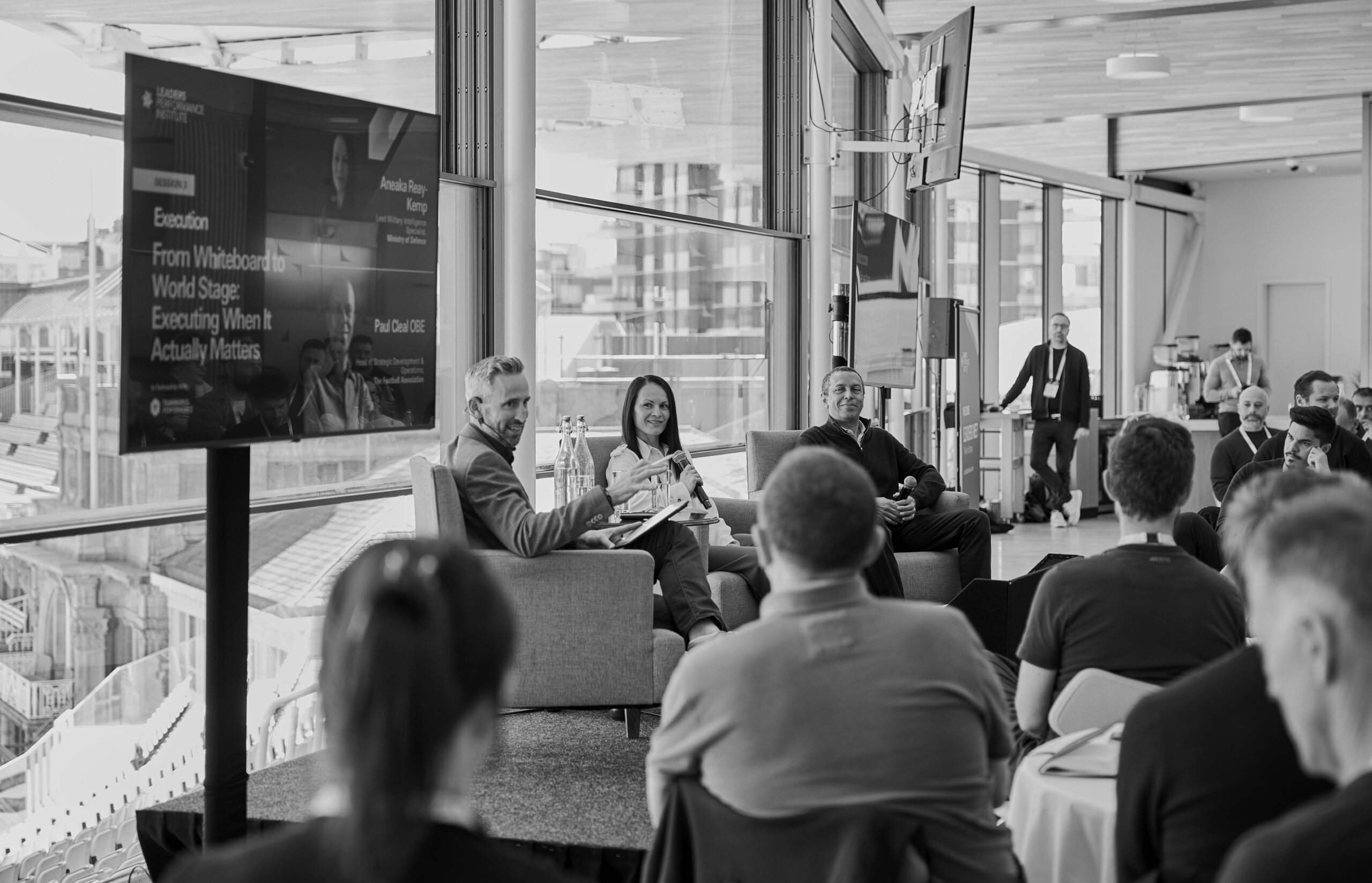
We bring you five factors to consider as discussed at Leaders Meet: the Art of Strategy this year by guests including Michael Bourne of the Lawn Tennis Association, Olympic gold medallist Tabby Stoecker and the UK Ministry of Defence’s Aneaka Reay-Kemp.
Main Image: Robert Obreja / Leaders Performance Institute
“In order to build the right bridge, you need to understand those two things.”
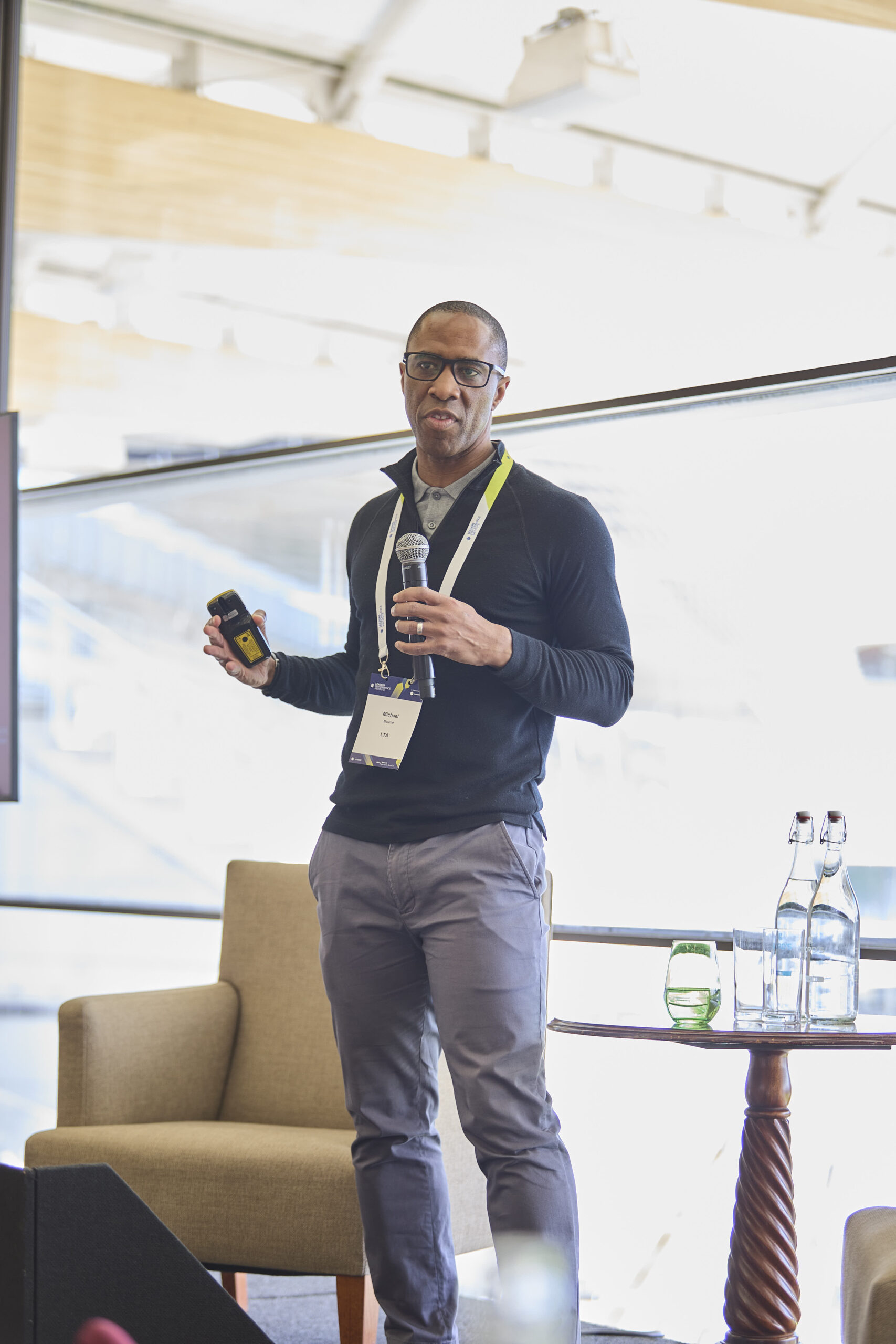
Bourne, the Performance Director at the Lawn Tennis Association [LTA], was the first to speak at Leaders Meet: the Art of Strategy, which took place at Lord’s Cricket Ground in London in late March.
Members of the Leaders Performance Institute travelled from far and wide for a day that challenged assumptions and provoked some of the sharpest minds in the sports industry to rethink how strategies emerge in high-performance environments.
Bourne was joined on the bill by Milano Cortina mixed skeleton gold medallist, Tabby Stoecker, and speakers from organisations including the Football Association, luxury retailer Selfridges, and the UK Ministry of Defence. Together, they explored how strategies are built, stress-tested and executed by the best in the business.
Below is a snapshot of the day’s proceedings; five fresh insights to help strengthen your own planning and execution.
1. A strategy starts with a brutally honest discussion
Bourne joined the LTA in 2018, when they were two years into their ten-year performance strategy designed to tackle the lack of players coming through the British tennis system.
Yes, Andy Murray had won three majors in recent memory, but the sense was that this was “despite the system, not because of it”.
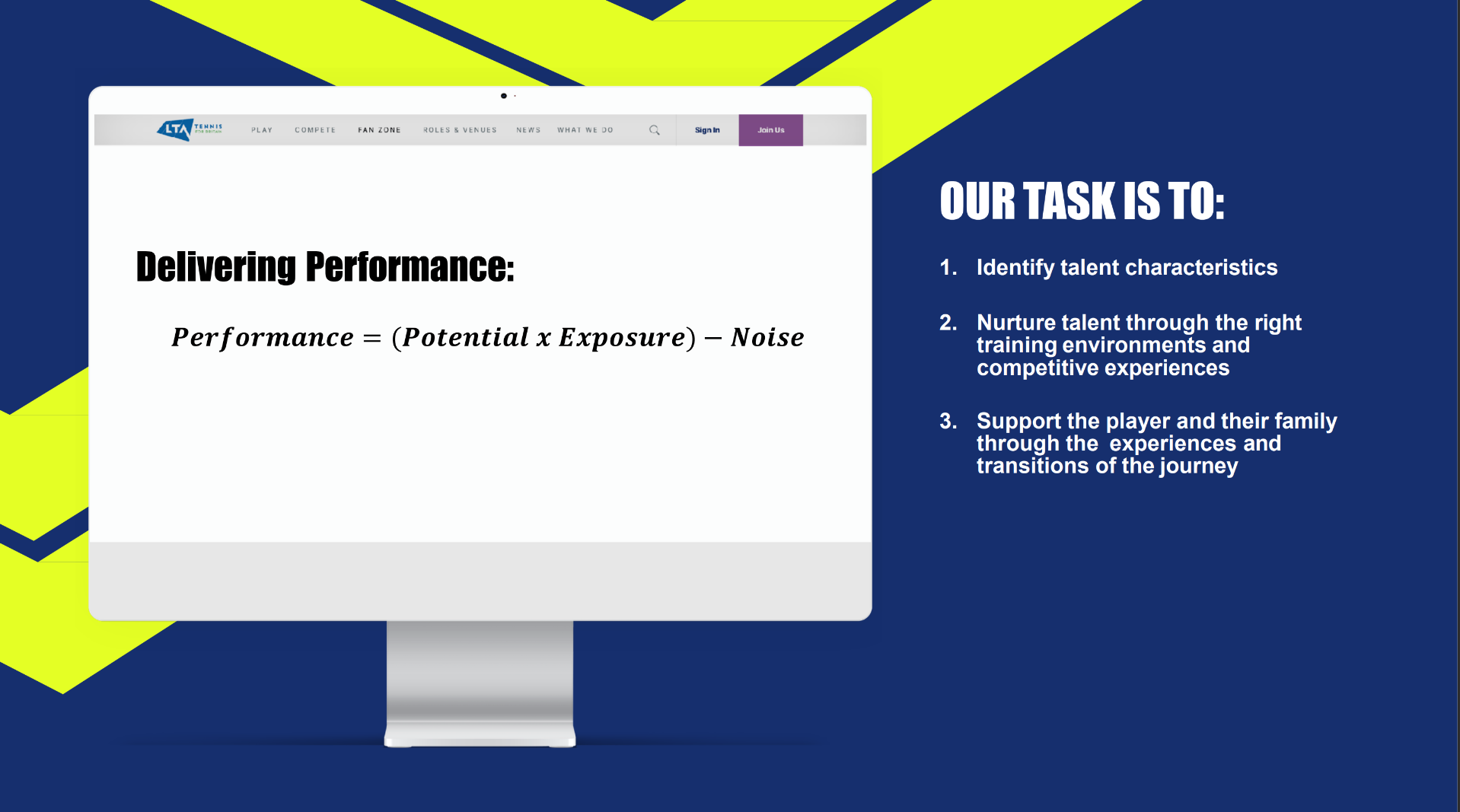
“In essence, between 2016 and 2017, the organisation undertook a diagnosis of the situation,” said Bourne, “and they came up with a number of different issues”.
This diagnosis, which included a lack of coherent pathways, limited programmes for talent ID, and resources spread too thinly, enabled the LTA to have a long, hard look at itself without pointing fingers at individuals. It lowered stakeholder defensiveness and provided the foundations for what they needed to do next.
Bourne was not present for the diagnosis, but he was recruited shortly after to ensure the LTA adopted the right approach and a coordinated set of actions. But they could not jump ahead. As he said:
I believe that you have to have that first element of the diagnosis and your guiding policy right first.

Michael Bourne, Performance Director at the Lawn Tennis Association, spoke first and set out the hard truths confronting British Tennis back in the mid-2010s. Image: Robert Obreja / Leaders Performance Institute
2. Your strategy must be co-created
At luxury retailer Selfridges, Head of DEI, Recruitment & Onboarding, Sharlene John, faced the challenge of trying to tie her work to commercial outcomes while challenging the idea that DEI is “fluffy” and irrelevant.
The result was Selfridges’ award-winning DEI and culture strategy Open to the World. On John’s watch (she joined Selfridges in 2021), female leadership within the organisation has grown from 32% to almost 70%; Selfridges is also an industry leader in ethnic representation.
Open to the World flourished because of John’s efforts to ensure it was a co-created initiative from the start. She said:
Before we even put pen to paper, it was going out and speaking to my teams, but also my leaders, to understand what does DEI or culture mean to you? And where there was that missing voice, it was bringing people into the room. So not just relying on those senior leaders where we don’t have representation, it was ‘OK, we’ll go down a layer’… I was talking to people across our business with a headcount of around three and a half thousand… We’ve got stores in Manchester, Birmingham, a tech suite in Leicester, and then the flagship in London. I went to every site speaking to people from grade 2, which is our junior role, up to our grade 7, which is exec positions, to understand what Open to the World actually means to them.

Sharlene John, the Head of DEI, Recruitment & Onboarding at Selfridges, describes her organisation’s award-winning Open to the World inclusion programme, which was built by a plurality of stakeholders. Image: Robert Obreja / Leaders Performance Institute
3. Evaluation (and re-evaluation) is continuous
“If you don’t get it right when you’re there in the moment, doing a review process at the end is worthless.”
So said Paul Ford, the former Head of Sport at the British Olympic Association [BOA] who recently joined English Championship side Norwich City as Performance Director. He spoke alongside Tabby Stoecker, the mixed team skeleton gold medallist at the Milano Cortina Games alongside her teammate Matt Weston.
When it comes to in-the-moment tweaks, Ford has a point. The BOA must work with national governing bodies, coaches and athletes continuously throughout a four-year cycle. “It’s making sure that we are doing it hand in hand with our sports as frequently as possible,” Ford added.
A macro ‘plan-do-review’ alone is not adequate. Of competition time itself, he said:
It’s on a daily cycle during delivery mode at a Games. [We ask] what are you planning for this day? What are we doing this day? How has this day gone? Because if you don’t make the most of that experience in the moment, it’s not going to happen for another four years.
Stoecker benefited from this approach, as demonstrated by her success. She said:
There wasn’t just the review of that specific race, but also ‘what are you taking from this that you’re going to change or carry forward for three years’ time, two years’ time, six months’ time?’… you can get quite swept up in what you’re doing and you have these extreme highs and lows. So I think staying focused, and when you’re then doing that and being so process-driven, the results just come.

British Olympic gold medallist Tabby Stoecker is deep in conversation with Paul Ford, the former Head of Sport at the British Olympic Association, as they discuss Team GB’s strategic approach to Olympic cycles and, more specifically, Stoecker’s path to gold in the mixed skeleton at the Milano Cortina Games. Image: Robert Obreja / Leaders Performance Institute
4. Be ready to act on incomplete information
You and your team may enjoy clarity and alignment of purpose, but optimal operating conditions are likely to be elusive whatever your efforts.
With this in mind, Aneaka Reay-Kemp, the Lead Military Intelligence Specialist at the UK Ministry of Defence, told the audience how British military operations are primed to perform when personnel do not have even 60% of the desired information. They are trained, as she said, to be “comfortable being uncomfortable”.
Rank, she argued, has limited bearing. In fact, the British military has taken steps to reduce the influence of its own hierarchies in moments of uncertainty. She said:
It doesn’t matter what’s on that person’s chest, it doesn’t matter their background, they still bring value no matter how junior they are. So for me, I find that when you’re operating in an environment where you don’t have all the information, understanding your people, understanding their capability, what they bring to the party can help save someone’s life.

Aneaka Reay-Kemp, the Lead Military Intelligence Specialist at the UK Ministry of Defence (centre), in conversation with moderator Iain Brunnschweiler (left) and Football Association Head of Strategic Development & Operations, Paul Cleal (right) as she explained what it takes for military personnel to act with incomplete information. Image: Robert Obreja / Leaders Performance Institute
5. What are you ready to discard?
New initiatives, new processes and new ways of thinking are great, but what are you prepared to discard?
“One of the things about strategy is making choices,” says Paul Cleal, who spoke alongside Reay-Kemp in his capacity as Head of Strategic Development & Operations at the Football Association. “If you’re trying to change something, it almost always involves stopping doing something else.”
However, as he has experienced, this is often easier said than done. “If things involve stopping doing something for the new thing you need, a lot of organisations struggle with that.”
Evidence, he explained, is critical in making those choices:
When I walked in three years ago, my job was not to throw things in the bin and do them differently. It was to ask: is what we’re doing now meeting the strategic aims and to what extent do we need to get closer to our strategic aims and what is it we can change?

Paul Cleal, the Head of Strategic Development & Operations at the Football Association, explains why it’s important to discard programmes and processes when they no longer serve the collective. Image: Robert Obreja / Leaders Performance Institute
See you at the Sport Performance Summit in New York?
Here are a selection of best practice tips from members of the Leaders Performance Institute.
Former US President Dwight D Eisenhower wrote that line in a letter to a US diplomat in 1950 and repeated the sentiment throughout his eight years in the White House.
The line was quoted by Patrick Mannix, the Sports Science Senior Manager at US Soccer, at a presentation to Leaders Performance Institute members in 2025.
“The idea behind this quote is that high-performance teams don’t necessarily have a static plan,” said Mannix.
“The plan is constantly evolving as new information comes to light, whether that’s in relation to the tournament that we’re playing in, the players that we’re working with, and a variety of other contexts that are relevant to the world of international soccer.”
With a considered plan, a leader can align their people and allocate their resources effectively. With a structured review process, improvements can be sustained.
That is the message at the heart of a forthcoming case study virtual roundtable hosted by Mannix’s US Soccer colleague, Teena Murray, who will speak in her capacity as the organisation’s Director of Performance and from her experience of leading performance programmes at the NBA and NHL.
Here, we foreground Murray’s presentation with a selection of five best practice insights in the realms of planning and reviewing delivered by members of the Leaders Performance Institute.
1. The VMOST framework
‘The organisations that perform most consistently are not those that plan less,’ wrote James Thomas. ‘They are those that build solid foundations, plan with intent, adapt with discipline and continue to stay rooted to the agreed values and behaviours when circumstances change.’
Thomas, the Performance Director at Warwickshire County Cricket Club, wrote these words in February.
He argued that while planning is often perceived as control, he believes it to be the opposite:
When the direction is clear, planning is decentralised. Coaches, athletes and staff can act with confidence because they understand the broader context. When strategy is absent, everything escalates upwards. Decisions slow, responsibility blurs and energy is wasted re-litigating the same conversations week after week.
Thomas then introduced business strategist Rakesh Sondhi’s VMOST (Vision, Mission, Objectives, Strategy and Tactics) framework, which ‘provides a disciplined way of connecting the big picture of the future to the daily actions, tasks and deliverables required to get there’: 
‘The power of VMOST lies in its simplicity,’ Thomas continued. ‘In high-performance environments, complexity is already high. Strategy models must reduce cognitive load, not add to it. VMOST creates line of sight. Individuals can see how their daily work connects all the way through to the long-term vision of the team and/or organisation.’
Finally, ‘when applied well, this kind of structure does not constrain creativity. It enables it. People can feel empowered to adapt, innovate and solve problems within a clear strategic frame’.
2. Find the right time for athlete education
Paul Ford, the outgoing Head of Performance at the British Olympic Association, explained in a recent article that an Olympic Games environment ‘is the worst possible place for trying to get people to peak and perform to the best of their capabilities’. He wrote:
Athletes are compacted into a brand-new village of more than 16,000 people who are all subject to a constrained competition schedule in what amounts to 52 world championships in 17 days, all in the same city.
It’s almost like they are being set up to fail when they’re expected to deliver the best performance of their lives.
The key, he argued, is tapping into the bits of the Olympic experience that build you up and not the elements that can detract from your performance. Athlete education is a critical element of the BOA’s fixed Games plan and comes in the form of discussions. ‘When to land these discussions is the next question,’ wrote Ford, before adding:
[Ahead of the 2028 Los Angeles Olympics] some sports, such as sailing and canoeing, will know their Olympians as early as September 2027; others, such as track and field, won’t select until May 2028. So the education journey we go on with the sailors and canoeists is long; we can plan out and get that right and drip feed it at the right times. Whereas the track and field athletes don’t want to hear anything about the Games because they’re not necessarily going. We must be smart in making the education bespoke and fit for purpose for each sport. Equally, some will want us to sit down and talk it through while others just want those short videos and podcasts. It’s finding out how the different cohort of athletes’ best digest information.
3. It is critical to learn from failure
In October, Everton’s Head of Sport Science, Jack Nayler, penned his thoughts on what it takes to look at a failure and ensure lessons are learned (primarily in the context of complexity in sports high-performance systems).
He shared his reflections on the late Richard Cook of the University of Chicago, specifically his treatise entitled How Complex Systems Fail.
Nayler wrote:
Around this time, I was challenged by a friend in the industry to put together my thoughts on building a performance department for a sports team. I found it challenging just to make an org chart and list positions without giving the background and rationale for why and how the department existed in that structure as well as its philosophical construct. This exercise of transferring ideas from my head on to paper forced me to critically confront my assumptions and crystallised my thoughts on how I believe we need to operate in the complex environment of elite professional team sports (specifically football as this has been my professional experience).
4. Embed review mechanisms
Mannix and his colleagues at US Soccer continually face the club vs country balance. In his aforementioned presentation, he spoke of the process that takes place when American players report for international duty.
“Building rapport and trust with those clubs is massively important because that helps us drive a lot of the exchange of information,” he said. “We need to know when our equipment and staff are arriving and where our players are coming from.”
Some may be in better shape than others, which underlines the need to review ahead of a session. Mannix said:
When a coach is trying to build out the session plan, the right hand is a good sports scientist or a performance coach, and the left hand is the first assistant, and those three individuals are working very closely to ensure that there’s a good plan in place for every training session. There’s good understanding as to what the availability of the players is going to be, particularly in the first two days of training, because what we’ve found through communication with clubs is we sometimes have to be flexible when players are coming into our environment simply because although Europe observes FIFA windows, we have to work with our partners in MLS on when players are released to come and join our environment.
Mannix and his colleagues understand the range of fixed and dynamic constraints they face. They use that understanding to find ‘optimization indicators’:

5. Pursue collaborative planning where possible
Where can you pool your resources with others for the collective good?
In 2024, the UK Sports Institute, US Olympic and Paralympic Committee, Australian Institute of Sport and High Performance Sport New Zealand formed the Global Alliance, which enables them to share sports science research and best practice when it comes to their female athletes.
The Global Alliance is a case study in what can be achieved in time and resource-limited environments when organisations collaborate in areas with little impact on competition itself (they still want to beat each other).
The Alliance’s main objectives, as explained on a Leaders Community Call in November 2024, include…
Additional reporting by Sarah Evans, Rachel Woodland and Lottie Wright.