This year, the league has introduced broader startup criteria and encouraged a series of high-risk, high-reward bets.
Main Photo: Courtesy of the NBA

These companies will be paired with various league properties for six-month pilots culminating in a final Demo Day pitch session at NBA Summer League in Las Vegas.
This year’s batch of startups for NBA Launchpad in 2026 consist of:
For the second year, Launchpad’s selection criteria is loosely based on five league priorities — Future of Officiating, Youth Basketball, Player Health & Wellbeing, Future of Media and Fan Connection — without necessarily adhering to those exact categories. Ryan told SBJ the goal is to find products that live outside the daily core business but could be relevant within the next five years.
“In the first three years of Launchpad, we were really focused on putting out specific, almost DARPA-type of challenges, and then finding companies that map directly to those,” Ryan said. “Where we are in year four and five is just broadening up and always staying true to our big five priority areas around the game and our business, and then really just focusing on finding world-class founders and making sure that the problem they’re solving is a high-risk, high-reward type of bet.”
Alumni from the first four years of the program include seven startups to receive funding from NBA Investments and several who have gone on to work directly with NBA teams, such as insole sensor provider Plantiga, MRI-based muscle scan analysis company Springbok Analytics and broadcast tracking data supplier SkillCorner. Others have collaborated with the league on projects such as nVenue, which creates micro-betting markets, and SportIQ, whose ball sensor is being piloted for automated officiating use cases.
This article was brought to you by SBJ Tech, a Leaders Group company. As a Leaders Performance Institute member, you are able to enjoy exclusive access to SBJ Tech content in the field of athletic performance.
There’s plenty more that can be done but, at a recent Leaders virtual roundtable, members suggested some ideas that have worked for them.
“Take the medical room as an example,” said the former manager of the team in question. “That was a nine-to-six place for booking appointments because we were trying to demonstrate the reality around what life looks like rather than getting the athletes into that mindset of ‘I’ll just ring the physio, I feel like my hamstring needs a little bit of rub at 10 o’clock at night’.”
This, he explained at a recent Leaders virtual roundtable, not only developed the self-reliance of the players, but also served to protect coaches and staff members who were all too ready to put themselves out, whether for out-of-hours appointments or “2am emails”.
It was a simple but important way of addressing the fact that staff wellbeing support tends to lag behind its athlete equivalent, which has its personalised wellbeing plans, dedicated staff and education programmes.
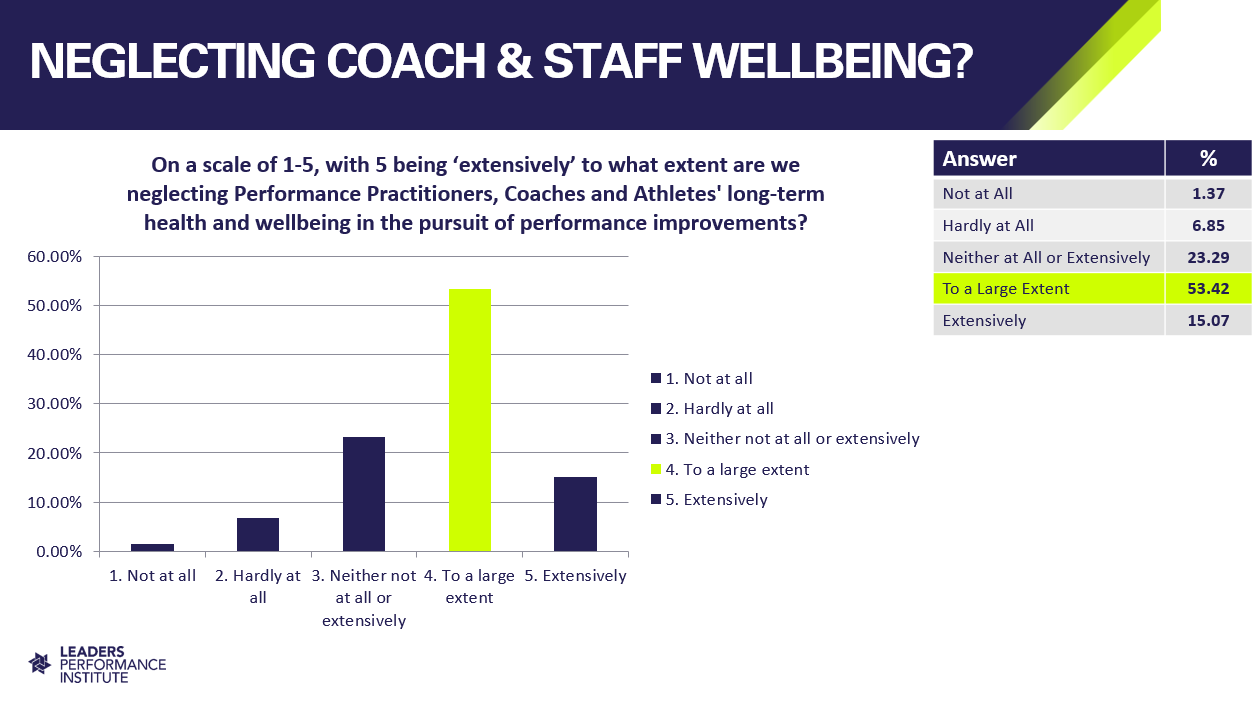
Our 2025 Trend Report painted a vivid picture of how neglected coach and staff wellbeing is across elite sport.
The key is in showing that performance and wellbeing are just as indivisible for coaches and staff as they are for athletes.
“A system wins a championship, and a system is like an ecosystem,” the erstwhile team manager continued. “If we mapped out some of the challenges we face within our environments, how many would relate back to wellbeing?”
The penny has started to drop. Below, we focus on the initiatives that have served Leaders Performance Institute members well, as discussed during the roundtable.
Apply universal principles of wellbeing
This must be the starting point. Consider belonging, identity, balance and thriving (rather than merely surviving) as elements of wellbeing; teams readily apply these to athletes, but they should apply to coaches and other staff too.
As a performance lifestyle manager based at a British university told his fellow members: “if we break down the behaviours that we celebrate, we have to believe that thriving staff who are relaxed and able to sit back and think of the bigger picture are beneficial within our systems.”
Formalised support structures
As mentioned above, in more mature systems, these have long been in place for athletes. “We’re seeing that happening in our coaching space too,” said a wellbeing and engagement manager based in the Australian system, which leads the way along with nations such as the UK. “Our coaching development team has started to look at ways of doing that and having coach development plans in place. I know it’s simple, but that doesn’t happen fundamentally in organisations.”
With prevention built into the system it helps to reduce levels of reactive support for employees, which brings us nicely to good habits.
Healthy routines
“I find you get a lot of people who just see their role as 24/7,” said the former team manager. “We decided as a group to change the paradigm and put the same expectations on the staff as we did on the players. We knew the gold standard was eight hours of sleep a night, so that became the staff expectation.”
The ‘gold standard’ is not just a nice metaphor. Research demonstrates the link between high wellbeing and decision-making quality. It comes back to those elements of wellbeing discussed above.
“It meant that our staff group were consistently operating at a much higher level of performance than previously,” he added.
‘Thrive days’
Again, this comes back to the system and structures. “You have to incentivise some people to take time off,” said an Australia-based wellbeing manager who spoke of what they call “thrive days”. “They have been really successful from an organisational perspective.” An employee will also have personal objectives related to their wellbeing.
Coaches and staff benefit directly, but the system benefits when people can “hold on to their identities outside of work or outside of coaching; and that coaching doesn’t become their primary identity,” as the academy manager noted.
Personalised, flexible work schedules
If you want staff members to prioritise their personal lives – often their greatest source of stress – then you must enable them to do so either through flexible scheduling or rotating duties.
“We’ve got a couple of coaches who this year became new parents,” said a coach working in Australia as an example. “We give them the flexibility to design the training calendar programme for the year so it navigates around their day‑to‑day demands.” The same goes for non-parents too.
Of course, as one member pointed out, rest days, rotation and a reduction in back-office tasks are all easier to propose for teams with greater resources.
A coach that role models the desired behaviours
The coach needs to be a role model in self-care, which is often easier said than done.
“If we can’t get them to shift in their thinking, it’s very hard to get this in place,” said the former team manager. “Influence really comes from the behaviours; what people see, how they’re feeling your leadership, particularly around wellbeing and what you expect of yourself.” But even for well-meaning leaders it is a problem if “you’re asking someone else to prioritise their wellbeing, but you’re not demonstrating that yourself.”
Peer to peer encouragement is invaluable too. “Having a small thing like a peer support group where staff members are connecting with like‑minded people and sharing insights is one way of supporting them,” said the academy manager.
Internal stability
We often talk about consistency in performance, but it is just as important in your internal comms, as a cricket team based in England have found.
“It creates stability throughout the training day so that under pressurised match‑day situations we are already familiar with what the process and structure should be,” said the team’s sport and exercise psychologist. “We know where we can get that information and, actually, it should land on their desk pre‑game.”
The same goes for pre-season plans, weekly updates and even five-year plans. “It links back to the coaches’ levels of stress because it’s less up and down during the day because they know what the action is linked to.”
Clarity also provides a sense of safety. “We have to make sure that all the coaches and staff feel comfortable that they can raise things with myself or with other people because you’re not going to know what the challenges are around people’s wellbeing if they don’t feel comfortable raising that,” said a UK-based academy manager.
What to read next
SBJ Tech explains how the USOPC Performance Innovation Fund is propelling American speedskaters to the Olympic podium in Milano Cortina.
Main Photo: Airo
This article was brought to you by SBJ Tech, a Leaders Group company. As a Leaders Performance Institute member, you are able to enjoy exclusive access to SBJ Tech content in the field of athletic performance.
At a recent virtual roundtable, high-performance specialist Rachel Vickery explained that pressure exposes weaknesses, which is why an ability to manage your arousal state is critical.
Rachel Vickery begins her presentation with these common examples of athletes and coaches buckling under pressure.
“Typically, the cause has less to do with what’s happening in the arena and a lot more to do with what’s happening everywhere else,” she told the Leaders Performance Institute members at a recent virtual roundtable.
Vickery, who hosted the session, is a high-performance specialist helping teams in the worlds of sport, business and the military perform under pressure.
“There’s this belief that no matter what’s happening, I can put my game face on,” added Vickery, “but we can’t compartmentalise our physiology.”
There is also the fact that pressure is, as she explained, “pigeon-holed into the wellness or wellbeing box or shot off to the psychologist”, which ignores the fact that pressure is a daily accumulation that adds to a person’s allostatic load. It is far from being some kind of character flaw despite that perception persisting in some corners.
“We know from the environments that we work in that pressure is actually the constant,” she continued, “but it’s the physiological stress response that is often the variable.”
Indeed, we are all oscillating between arousal states; calm one moment, activated the next.
“We will fluctuate between the two states across a day, across a month, across a year and a season and a career.”
In early human history, a calm state meant time to “rest and digest” and activated meant “flight or fright”. The latter has become the norm. “Given our lifestyle these days, most high achievers run in the high arousal state more of the time.”
This is unsustainable in the long term because it pushes people close to their physiological stress threshold, which is where performance begins to break down.
This, Vickery argued, is why it is important to reduce that allostatic load.
What is allostatic load?
Allostatic load is the cumulative ‘stacking’ of stressors over time that erode the amount of physiological ‘space’ an athlete has between their current arousal level and their personal stress threshold. Vickery refers to this as their “buffer”.
She explained that while competition rarely creates a problem, it can reveal one.
The stressors in question can be personal (e.g. a lack of sleep), organisational (e.g. misalignment), performance-based (e.g. being outside your comfort zone), or physiological (e.g. reduced ability to hear or absorb information).
Crucially, “as long as your arousal state stays below your threshold, your negative performance will not show up.”
Strategies to increase your buffer
Stressors tend to occur across three categories:
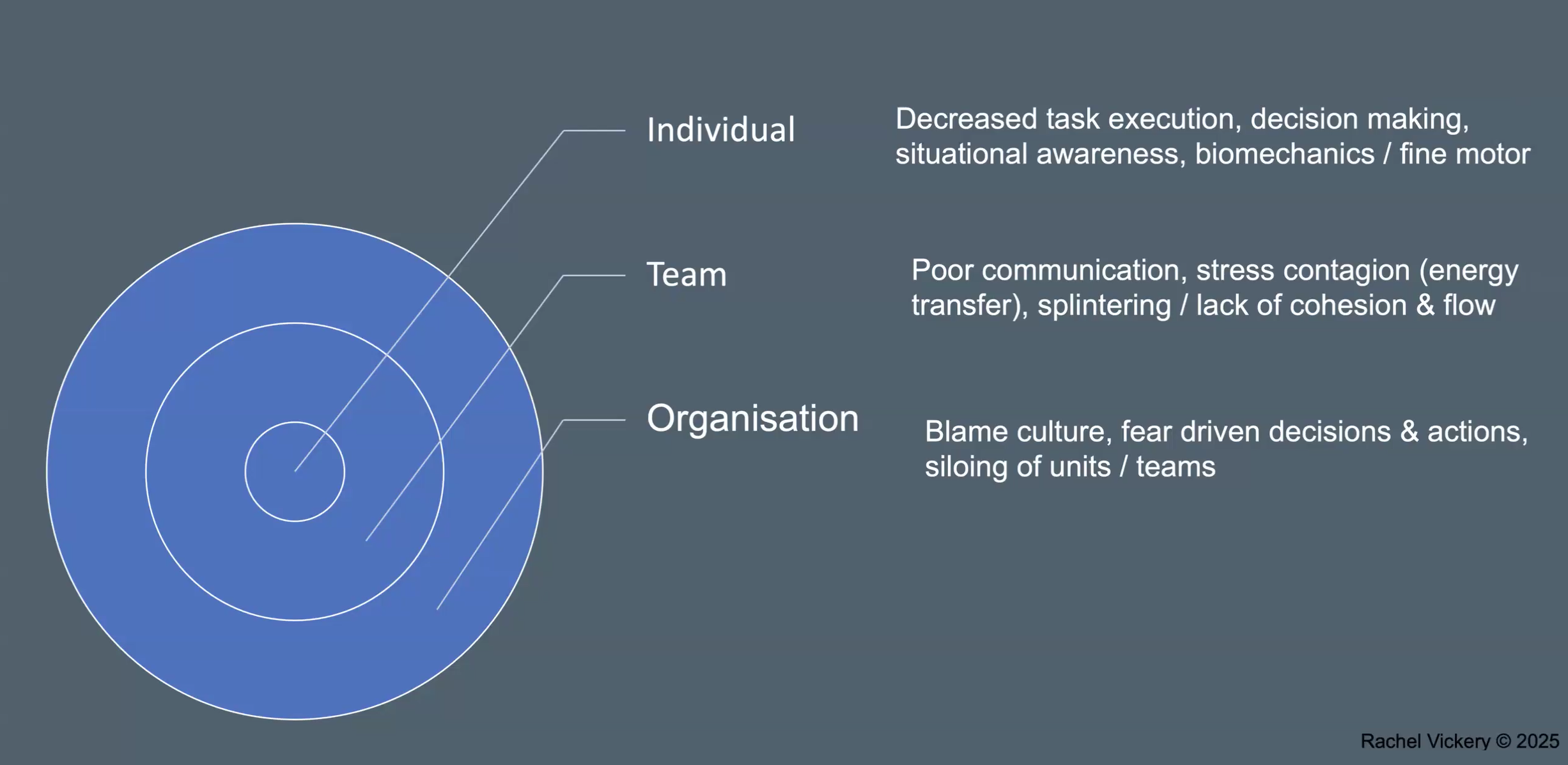
Vickery shared a range of strategies for each:
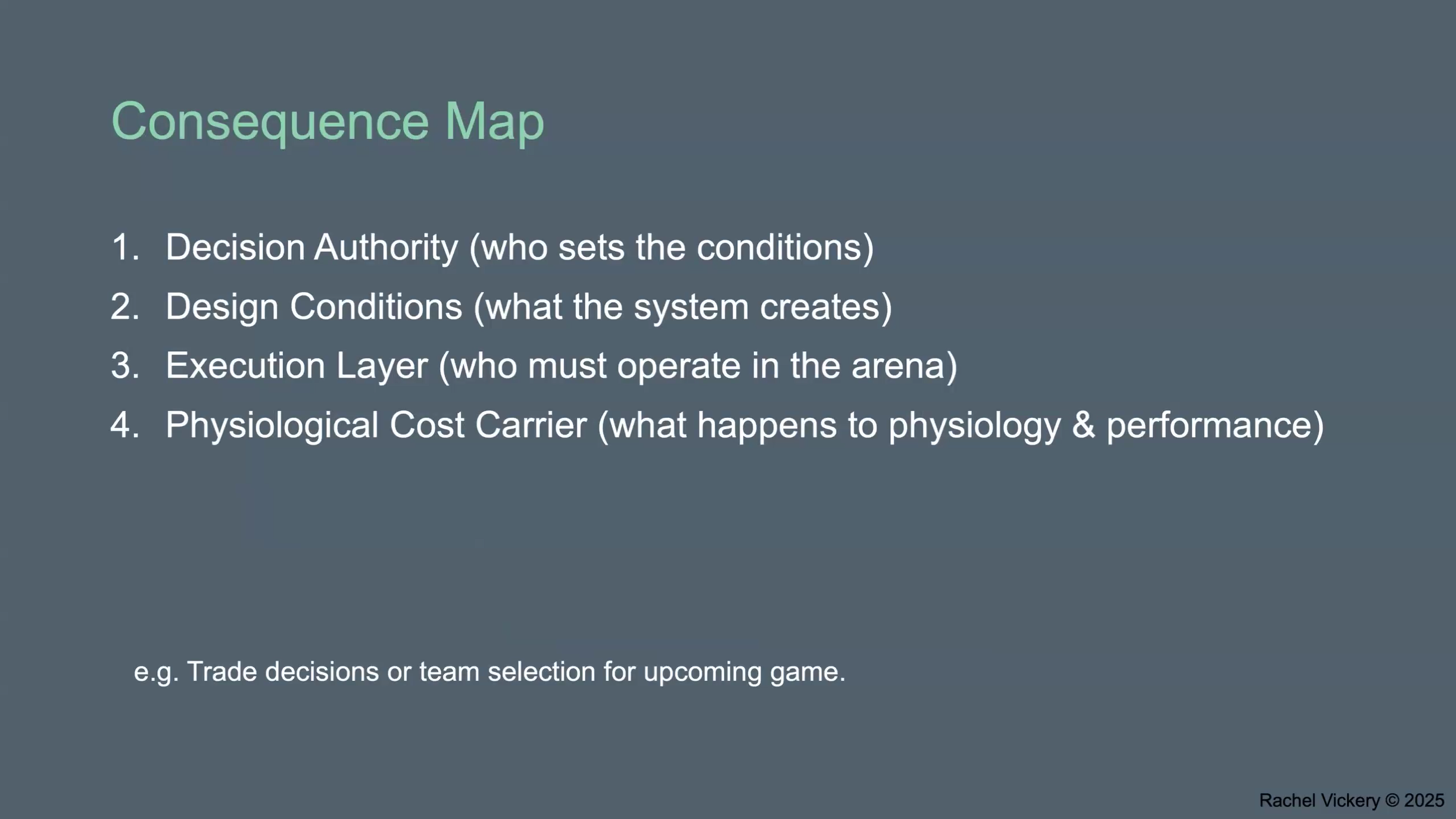
Vickery described organisational strategies as the “missing piece”. She said: “we often see organisations make dysregulating choices and decisions.” She recommends:
“Pressure is an accelerant, not a compass”
With this observation Vickery wrapped up her presentation. “Very seldom do people rise to the occasion,” she said. “What we often see is things are masked until people come under pressure; and that’s when their performance will splinter.”
In other words, pressure will only magnify your existing strengths and weaknesses, which makes preparation – the creation of that buffer – so important.
She struck a chord with members, who shared their own thoughts at the conclusion. Here is a selection of their comments and observations:
“Our mission as a group was how can we make sure our athletes are self‑reliant and capable of making the best decisions under pressure?”
“We moved to a case management situation where we’re rigorously, deliberately, consistently looking at athlete need. If there’s 50 staff, it might only be two staff that will have the greatest impact rather than everybody feeling like they must be involved.”
“We’ve got to take our mind away from trying to perfect exactly what the athlete might face because you will never replicate it. What can we build into their toolbox so that they can be that self‑reliant person in that moment?”
“Could athletes benefit from developing more coping‑based strategies; things they can do in advance in their preparation?”
“It really depends on the perspective that the athlete is taking. So you must understand that first before you can decide what the strategy might be to reduce the allostatic load… You would need a specific strategy to deal with fear of failure versus legitimate contract implications; the financial implications versus their more personal perspective.”
“Digital overload is a huge piece in terms of making our allostatic load worse. It’s an under‑represented space that we probably don’t spend enough time and energy on.”
What to read next
Ben Ashdown and Mustafa Sarkar of Nottingham Trent University are working on a research programme aimed at providing an evidence-informed and objective approach to tracking resilience on the pitch.
Main Image: Thomas Eisenhuth/Getty Images
“Even within the same football academy we’ve seen staff have different views of what resilience is,” Ben Ashdown, a Senior Lecturer in Sport and Exercise Psychology and Lead Researcher at Nottingham Trent University, tells the Leaders Performance Institute on Teams.
“They’ll say ‘resilience is a really important part of our philosophy but actually we don’t really know what it is, we don’t really know how to measure or assess it, we don’t really know how to track it’,” says Dr Mustafa Sarkar, who also joins the call. He is an Associate Professor of Sport and Performance Psychology at Nottingham Trent and Lead Supervisor of the research programme.
Together, alongside Dr Chris Saward, Dr Nathan Cobb, and Dr Julie Johnston at Nottingham Trent University, they are leading a research programme to identify behavioural indicators of resilience in English academy football and develop a resilience behaviours observational tool. As part of the research, they have worked with academy stakeholders including coaches, psychologists, scouts, and analysts. They are also conducting a season-long study at a Category One academy (Derby County Football Club).
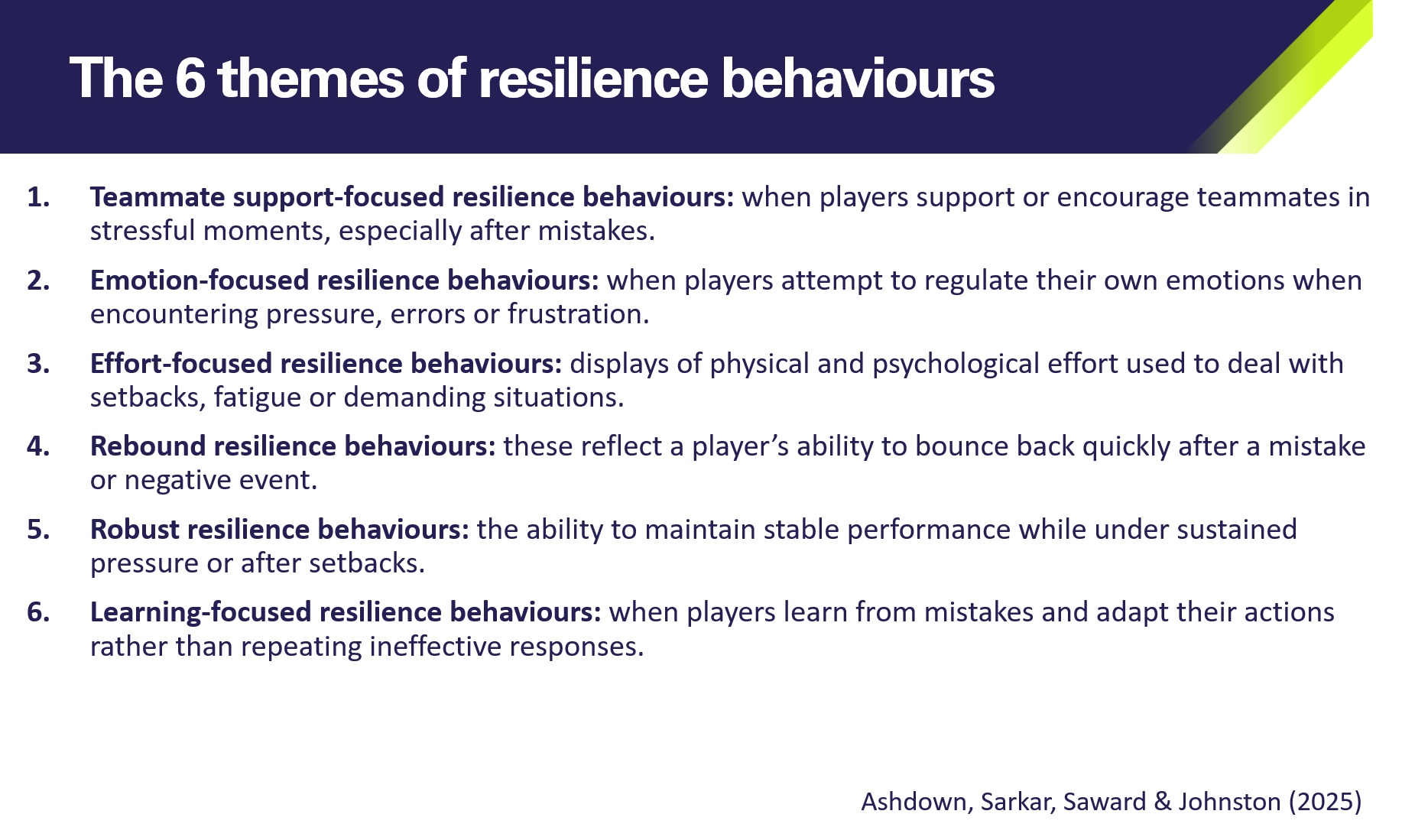
Based on their research, they have found that resilience behaviours can be categorised under six themes:
At the end of this research programme, they hope to have developed a tool for sport psychologists and coaches primarily, with some benefit to analysts who might contribute to the tracking of these behaviours through video-based analysis.
Sarkar says: “We don’t necessarily see it as a tool for identifying talent. I think it would be more as a conversation-starter with a player for player development purposes.”
Resilience: a behavioural response
As the exploration, measurement, and assessment of resilience in sport has tended to rely on self-report alone, myths and misconceptions have emerged (such as resilience being related to endurance and the suppression of emotion), and there is a gap between what resilience truly entails and what practitioners witness on the pitch.
“Coaches and support staff are starting to recognise that both physical and mental rest are critical to sustained resilience over time,” says Sarkar who has spent time with academy stakeholders dispelling those myths and misconceptions. “Part of resilience is about helping individuals to develop their thought and emotional awareness. It is not about encouraging people to hide their emotions”.
Additionally, “resilience requires more nuanced (context-specific) language because a person’s resilience in relation to being injured might be quite different to their resilience in relation to a loss of form”.
The behavioural elements of resilience lay at the heart of their research programme.
“We see resilience as a behavioural response,” says Ashdown, “but, up till now, there hasn’t been any literature that has actually asked what do these behaviours ‘look like’? How do we observe them? I think our work, in a behavioural sense, gives us some directly observable, reliable and valid indicators of resilience in football.”
The appeal for coaches, psychologists, and analysts is clear. “They’ve really bought into this idea that we’ve got something to look for on the pitch, and if we can see it [resilience], then maybe we can then develop it and track it over time,” Ashdown continues.
Their initial 2025 study/paper identified 36 behaviours (across six themes mentioned above), which have since been refined to ten. “We retained at least one across the six themes, which is another indicator that they’re pretty reliable.”
These behaviours include: demonstrating supportive actions during pressure or adversity (support-focused behaviour); positive body language in response to stressors (emotion-focused behaviours); and regaining focus in the face of challenges (robust resilience behaviours).
How might coaches approach these behavioural themes in their resilience development work?
The Leaders Performance Institute asks Ashdown and Sarkar about each of the six themes and they give consideration to each in turn with the caveats that a) they should be viewed collectively in order to develop a holistic view of an athlete; and b) the data collection and analysis of their research programme remains ongoing.
When players support or encourage teammates in stressful moments, especially after mistakes.
Ashdown admits that the relational aspects of resilience are more significant than he initially thought. “At times I probably assumed resilience was an individual capacity that you developed almost by yourself without realising that social support (through your teammates) is really significant,” he says.
“Through the work of Ben and others we’re starting to find that resilience is very much relational,” says Sarkar. “The development of resilience is dependent on cultivating high quality relationships. The interesting bit about social support is that we’ve found that it’s not necessarily about getting social support, but it’s about the perception that that support is available to you. From a resilience perspective, the perception is more important than receiving the actual support itself.”
Ashdown then shares a story of academy training drills, at Derby County FC (work led by academy sport psychologist, Lyle Kirkham, and supported by Ashdown), where players had a “secret support partner”. “We tasked some players with, right, when your teammate experiences some adversity or stressor or when they’re under pressure, find ways of offering them support,” he says, adding that the process raised the players’ awareness of how they’re reacting, responding and interacting with their teammates.
When players attempt to regulate their own emotions when encountering pressure, errors or frustration.
While there isn’t yet the data to support a definitive conclusion that emotion-focused behaviours depend on age and phase, as Ashdown explains, “there’s so many points where the participants said ‘we would expect to see a different response from a 10-year-old than one of our under-18s’.”
Emotional maturity is sure to be a factor. He adds: “How these players react and respond to things, particularly at younger ages, it’s a lot more visible, whereas maybe the older players tend to try and disguise how they’re feeling.”
This is a behavioural theme where interdisciplinarity comes to the fore. “We’re working with performance analysts to try and identify these behaviours through video footage and I think we’ll end up with a bespoke set of behaviours based on the phase [foundation, U9-U11; youth development, U12-U16; professional development, U17-U23].”
Displays of physical and psychological effort used to cope with setbacks, fatigue or demanding situations.
What does making an effort ‘look like’ in any sport? “There’s a danger of making assumptions because every player is different,” says Ashdown with reference to both physical and psychological indicators of effort. Their work has talked of pairing GPS data with observations but, as he admits, “this is where we need to be careful and cautious of not mislabelling players based on a perceived lack of effort and we must be aware of individual differences”.
For Sarkar, again, it is more about setting the terms for a player development conversation. He says: “You might come up with a resilience profile to say one player has got hypothetically high effort-focussed behaviours and lower teammate-focussed behaviours, but we see this observational tool more holistically across all six themes”.
These reflect a player’s ability to bounce back quickly after a mistake or negative event.
These need to be channelled. It is no good if a player makes a mistake and runs around like a headless chicken for the next 10 minutes and is sent off.
“One of the participants in our research mentioned that exact point in relation to effort-focused behaviours,” says Ashdown, before echoing Sarkar’s earlier reflections. “The most value in this behavioural approach is the opportunities that it creates for player-coach or player-psychologist reflection.” This, Sarkar suggests, could be a joint review of game video clips where the coach and/or psychologist says to the player ‘talk us through your thought process. What were you thinking and feeling at the time? How might you react and respond differently?’ or it a series of ‘what-if’ questions and scenarios. ‘What if this were to happen in the future? How would you react and respond?’
Sarkar adds that any intervention should be context-specific. “If a player has done that once are we then making an assumption that they’re doing that all the time – is this a one-off occurrence versus a pattern of occurrences? If it’s a one-off, like Ben said, then it’s probing that player about what they were thinking at that particular point in time. But we have to be careful that we’re not intervening based on a one-off versus a pattern.”
The ability to maintain stable performance while under sustained pressure or after setbacks.
Ashdown and Sarkar make the point that robust resilience behaviours risk being conflated with youthful inconsistency – and all its causes – at academy level.
“One of the participants in our research said it’s not about consistency of performance but the consistency of behavioural responses to things. So performance will fluctuate but is there some consistency in the way they’re behaving, reacting and responding?” says Ashdown. “What some of the coaches are after is a flattening of the curve emotionally and the way the players are managing things on the pitch.”
Sarkar believes coaches may be able to use the resulting observational tool as a means of evaluating the efficacy of pressure training scenarios. “What are you, the coach, actually seeing in terms of their reactions, responses, certainly from a behaviours point of view, and as a result of that pressure training, are you actually seeing an increase in some of the resilience behaviours in relation to these themes?”
When players learn from mistakes and adapt their actions rather than repeating ineffective responses.
Pressure training also presents an opportunity for self-reflection and learning through its video component – this is the ultimate purpose of this resilience behaviours work. “If we’re aware of that, can we support them in navigating those more effectively when they’re inevitably going to come up on the pitch?” says Ashdown.
“We don’t learn from experience, we learn from reflecting on experience,” says Sarkar, paraphrasing the American educational reformer John Dewey. “Pressure training shouldn’t just be about putting people under pressure in training and then automatically assuming somehow that they’re going to develop their resilience to future situations?”
At Derby County, led by Kirkham and supported by Ashdown, they have also introduced a series of gamification principles in delivering education and feedback at the academy through a resilience behaviours lens. This includes FIFA-style cards for players, and a football-specific version of snakes & ladders to mirror the ups and downs of the academy journey.
The future of resilience tracking
When it comes to resilience, coaches are acting on intuition, which is valuable but ultimately has its limitations.
“We’re trying to make that process more objective and systematic; hence this is where the interdisciplinary piece comes in,” says Ashdown. “We wouldn’t expect coaches in the moment in the game to be thinking about necessarily tagging or noting these behaviours. We might ask the analyst, with support from the psychologist, to do live coding or tagging of these behaviours or retrospective tagging based on the recording. That would then lead to conversations with the players. With this work, there’s a big opportunity to bring together coaching, performance analysis, and psychology.”
Sarkar explains that they are using the behavioural data to create a resilience profile for players across the noted behaviours. “That gives you a holistic viewpoint,” he says. “A player might have higher team-focused resilience behaviours and slightly lower effort-focused resilience behaviours and a medium level of learning-focused resilience behaviours. So, it gives you a nice overall resilience profile of an individual.”
The hope is that their work will eventually provide an evidence-informed and objective approach to tracking resilience on the pitch.
“It can also then become part of the everyday conversation with multiple staff. So rather than just a conversation in relation to psychology, it’s a broader conversation about player development.”
What to read next
Playfulness and Resilience: How Ballet and Music Schools Link Them Together to Amplify Both
With the Winter Olympics on the horizon, the organization is pursuing cost-effective and eminently scalable solutions.
Main Photo: US Figure Skating
Now the Chief High Performance Officer for US Figure Skating, Dillon’s affinity for the sport launched a career that reached the senior men’s national level. There was no resource to track progress or compare skating techniques in real time, something that will be much easier to do for skaters with the organization’s partnership with OOFSkate, which provides high-level analysis in an accessible way through an app.
“I was very self-driven, which is a great quality, but it was lonely,” Dillon told me. “So, I think that this also gives you the opportunity to compare your data. It’s almost like skating with a friend, because you can compare your data with athletes that either are similar levels or that you choose to share your data with or athletes at the level.”
The work comes as US Figure Skating looks toward the future, Dillon shared, in discovering how technology can move the sport toward the cutting edge around judging and analytical improvements. That journey is one that many sports and governing bodies find themselves on, with new startups trying to help that pursuit.
Simplifying analysis
OOFSkate is founded by Jerry Lu (the company’s CEO) and Jacob Blindenbach (CTO), a pair with extensive experience in applying innovation to performance and tracking for athletes.
Lu told my SBJ Tech colleague Joe Lemire that the startup’s education around skating has been powered by some significant names in the sport via an NBC connection, like former Olympians and world champions Nathan Chen, Tara Lipinski, and Johnny Weir, as well as the Skating Club of Boston.
With OOFSkate, skaters or coaches can record or upload skater routines to see insights like jump height, spin rotation and landing. It also provides for comparative analysis, where two videos can be analyzed simultaneously to compare multiple jumps from the same athletes or enable a skater to compare with fellow skaters. It only needs a single smartphone camera.
“If a coach records an athlete, they’re not going to carry a big camera connected to a big desktop computer that connects to something in order for them to use it,” Lu said. “So, it is designed to be a system that can be run on your cellphone with minimal lag.”
OOFSkate will support the upcoming Winter Olympics by providing data to boost TV production graphics and commentator analysis. The startup is self-funded. The founding pair met as students at the University of Virginia and have developed similar analytics tech for Olympic swimmers.
Perhaps my favorite detail? The “OOF” in OOFSkate is to replicate the reaction like “oof, that was bad,” but later retrofitted the acronym ‘obsess over form’ thanks to the help of sports scientist (and US Figure Skating Sports Science Manager) Dr Lindsay Slater.
This article was brought to you by SBJ Tech, a Leaders Group company. As a Leaders Performance Institute member, you are able to enjoy exclusive access to SBJ Tech content in the field of athletic performance.
As Jamie Taylor of Dublin City University and the CoEx|Lab explains, the university’s master’s and doctorate programmes are designed to help coaches and other high-performance practitioners embed research into their daily practice – a habit that is sometimes overlooked in sport.
Additionally, one of the key challenges in coaching is that there is a world of evidence that can help practice, but most do not know about it.
At Dublin City University we are trying to subvert that attitude through our online doctorate and MSc programmes, which are aimed specifically at coaches and practitioners in high performance sport.
We have a community of around 100 coaches and practitioners who appreciate the capacity for research to enhance both theirs and their organisation’s practice in ways that have long been transformational in, say, S&C or medical.
In many respects, coaching is a discipline apart, yet sports performance has long-been reliant on other domains to pick up and apply research. More research can and should be done.
Below, I explore – drawing on insights from students across the doctorate and MSc programmes – the common barriers in coaching, before making the case for evidence-informed research that can meaningfully support practice. The programmes are delivered by a team of practitioner-researchers, including Áine MacNamara, Dean Clark, Robin Taylor, Rosie Collins, Stephen Behan and myself.
The common barriers
As a coach, you should be weaving research into your practice – it should not be additional.
“Last Friday, we protected two hours for some internal professional development with a group of practitioners,” says Ian Costello, the General Manager of Munster Rugby. “There’s 20 reasons not to do it, but if it’s important, it’s protecting the time in your diary, no matter how busy you are.”
Ian believes the programme has opened up new career options, potentially even beyond professional rugby union. He has now got into the habit of writing in his diary in three colours: black for operational matters; green for strategic issues; and blue for learning and personal development.
“Someone gave me one of those multicoloured pens – I hate them because of my bad handwriting and these don’t help – but it’s brilliant for my diary,” he continues. “Learning and personal development can be anything from podcasts to light reading or heavy reading. It can be writing too – that was a good life skill and practical skill that a mentor shared with me.”
Additionally, coaches have not often been shown how to critically organise their thinking, even when they thought they were doing so.
Ian has been coaching for more than two decades, but still wouldn’t describe himself as the finished article.
“The first year broke me down in terms of questioning everything I know around critical thinking and reflective practice,” he says. “What the doctorate does is give you more structure to that process. It provides you with a more robust and applicable skillset to be accurate in research terms and then to think critically about the information you’re absorbing. As time goes on, you’re able to transfer that to your practice more readily and with a lot more clarity.”
He is not the only one to find the first year challenging. “It was quite confronting and shocking,” says Jamilon Mülders, the Performance Manager at the Royal Dutch Hockey Association. “You try to present where you’re coming from, what you have achieved, what you have done and why you have done things, and the staff at DCU will pose little questions like ‘where’s the evidence?’”
Jamilon has won Olympic and world championship medals as a coach, and yet, as he says, “I have to acknowledge that nine out of ten things we did worked for whatever reason at that stage, but there was no underlying theory, no evidence. There was nothing you could fall back on where you can explain it or also just make sure that you detect possible mistakes, issues, challenges, hurdles which might have happened or occurred in other areas.”
He sensed that something was absent. “I felt that something was missing in my personal education and growth,” he continues, further reflecting on that induction period at DCU.
Some coaches may never have set foot in an academic setting but, whether it’s our doctorate or MSc programme, we don’t need to simplify course material for coaches. We just need to make sure we are providing the right provocation.
“When we’re asked better questions it causes us to say ‘actually, I took that situation for granted, but I need to peel that back a little bit more’,” says Rachael Mulligan, the Athlete Support Manager at the Federation of Irish Sport. “It forces you to go ‘what is the best question to ask in order to get to a better outcome?’”

The most recent cohort of students on DCU’s professional doctorate and MSc programmes lines up for a group shot at DCU in Dublin.
The case for evidence-informed – not evidence-based – research
I hear all the time that ‘we need to quantify this’. It leads us to measure things that don’t really matter simply because we can count them.
There are different ways of seeing this and my view is that evidence should inform coaching, working alongside professional experience, theory, and context, rather than being treated as something on which coaching can be straightforwardly evidence-based.
“For anybody to be genuinely comfortable about their view of the world or their view on practice, it should be research-informed,” says Scott McNeill, the Head of Coach Development at the Premier League. “The risk and challenge of research is that sometimes things can go out of date very quickly. A body of research can be nearly out of date the day that it’s printed. So to keep that as a consistent and live way of engaging in practice would make sense to me, that suggestion that knowledge isn’t fixed, that these things keep evolving.”
“The first thing I said was my issue with research is I sometimes think researchers are almost in an ivory tower and very much removed from what goes on in the day-to-day field of performance sport,” says Rachael of the topic.
“That perception was completely quashed after a couple of weeks in the programme because there’s so much emphasis in terms of, yes, this is fantastic in the academia space, but how do we move this into real-life practice?”
“I used to always say I was evidence-based and a lot of coaches will pride themselves on that,” says Christoph Wyss, the Lead Physical Performance Coach at Red Bull. “But I think evidence-informed makes more sense because if a research paper comes out, being evidence-informed is taking that research, reading it, critiquing it, seeing what’s good and what’s not, and then applying that to your setting, because every setting is different.”
As he says, “with evidence-based you’re just transplanting it, doing exactly what they did, but then evidence-informed is more translating it.”
“There’s not necessarily one solution,” says Eilish Ward, the Head of Player Development at the Ladies Gaelic Football Association. “There’s no one way to learn anything or to gain experience or expertise.” The key for Eilish in her work is to ensure she and her colleagues are “making as informed decisions as possible when we’re designing learning activities” because “not everything from research may be transferable into a practical environment and, equally, every practical environment is going to be hugely different.”
“Being evidence-informed is probably more aligned with what we do on a day-to-day basis,” says Niall O’Regan, the Head of Education & Development at the Football Association of Ireland (FAI). “It is something that has helped me to understand how to be authentic, how to be creative in adapting what the research is saying is to suit the needs and the context and the environment that you’re in.”
Plus, as Scott says, “people sniff you out pretty quickly whenever there’s a gap between what you’re saying and what might feel real to them. Our job as people that work in this space is to either translate the messaging in a more accessible way or to admit that there probably still is a gap.”
And therein lies the opportunity to ask better questions.
Research should never be far from practice
While the programmes can be intimidating for coaches, we’re here to help in any way we can because it is important that research is not too far from practice. When they are close, the research finds practical application.
“This was a part I enjoyed from day one because you could immediately see the practical implications and make an impact,” says Jamilon of his coaching in field hockey. “So if I were talking with S&Cs about load management around our training, my new way of approaching them and asking questions really helped me to have a clearer view on the team and the environment.”
In some cases, research can help to highlight the current inadequacies in a high performance programme.
Niall, for one, thinks differently these days about coach development structures at the FAI; and it feeds into his practice.
“There are some experienced coaches that have so much knowledge and so much expertise in their fields that they may not need to go systematically through a certain set of steps,” he says. “They may have the ability to effectively communicate, empower others or share knowledge in a way which doesn’t require them to go through a checklist. They can get to the end with the exact same learning and sometimes even more learning.”
Such an approach doesn’t necessarily sit right with the coach and it wouldn’t necessarily sit right with the coach developer. “There’s a grappling effect where those people probably feel like, ‘well, I’m being rigidly pushed into a checklist of things and being asked to do things that I naturally wouldn’t do myself’.”
It comes back to being research-informed. “The person in front of you is the actual start point, and then it’s up to us as the educators and developers to be able to link it into research. The practice comes first and then it’s a matter of layering in what research is out there that can inform the decisions that that person is making.”
If you would like to know more about the professional doctorate and MSc programmes at DCU please email Jamie Taylor at: