With the Winter Olympics on the horizon, the organization is pursuing cost-effective and eminently scalable solutions.
Main Photo: US Figure Skating

Now the Chief High Performance Officer for US Figure Skating, Dillon’s affinity for the sport launched a career that reached the senior men’s national level. There was no resource to track progress or compare skating techniques in real time, something that will be much easier to do for skaters with the organization’s partnership with OOFSkate, which provides high-level analysis in an accessible way through an app.
“I was very self-driven, which is a great quality, but it was lonely,” Dillon told me. “So, I think that this also gives you the opportunity to compare your data. It’s almost like skating with a friend, because you can compare your data with athletes that either are similar levels or that you choose to share your data with or athletes at the level.”
The work comes as US Figure Skating looks toward the future, Dillon shared, in discovering how technology can move the sport toward the cutting edge around judging and analytical improvements. That journey is one that many sports and governing bodies find themselves on, with new startups trying to help that pursuit.
Simplifying analysis
OOFSkate is founded by Jerry Lu (the company’s CEO) and Jacob Blindenbach (CTO), a pair with extensive experience in applying innovation to performance and tracking for athletes.
Lu told my SBJ Tech colleague Joe Lemire that the startup’s education around skating has been powered by some significant names in the sport via an NBC connection, like former Olympians and world champions Nathan Chen, Tara Lipinski, and Johnny Weir, as well as the Skating Club of Boston.
With OOFSkate, skaters or coaches can record or upload skater routines to see insights like jump height, spin rotation and landing. It also provides for comparative analysis, where two videos can be analyzed simultaneously to compare multiple jumps from the same athletes or enable a skater to compare with fellow skaters. It only needs a single smartphone camera.
“If a coach records an athlete, they’re not going to carry a big camera connected to a big desktop computer that connects to something in order for them to use it,” Lu said. “So, it is designed to be a system that can be run on your cellphone with minimal lag.”
OOFSkate will support the upcoming Winter Olympics by providing data to boost TV production graphics and commentator analysis. The startup is self-funded. The founding pair met as students at the University of Virginia and have developed similar analytics tech for Olympic swimmers.
Perhaps my favorite detail? The “OOF” in OOFSkate is to replicate the reaction like “oof, that was bad,” but later retrofitted the acronym ‘obsess over form’ thanks to the help of sports scientist (and US Figure Skating Sports Science Manager) Dr Lindsay Slater.
This article was brought to you by SBJ Tech, a Leaders Group company. As a Leaders Performance Institute member, you are able to enjoy exclusive access to SBJ Tech content in the field of athletic performance.
As Jamie Taylor of Dublin City University and the CoEx|Lab explains, the university’s master’s and doctorate programmes are designed to help coaches and other high-performance practitioners embed research into their daily practice – a habit that is sometimes overlooked in sport.
Additionally, one of the key challenges in coaching is that there is a world of evidence that can help practice, but most do not know about it.
At Dublin City University we are trying to subvert that attitude through our online doctorate and MSc programmes, which are aimed specifically at coaches and practitioners in high performance sport.
We have a community of around 100 coaches and practitioners who appreciate the capacity for research to enhance both theirs and their organisation’s practice in ways that have long been transformational in, say, S&C or medical.
In many respects, coaching is a discipline apart, yet sports performance has long-been reliant on other domains to pick up and apply research. More research can and should be done.
Below, I explore – drawing on insights from students across the doctorate and MSc programmes – the common barriers in coaching, before making the case for evidence-informed research that can meaningfully support practice. The programmes are delivered by a team of practitioner-researchers, including Áine MacNamara, Dean Clark, Robin Taylor, Rosie Collins, Stephen Behan and myself.
The common barriers
As a coach, you should be weaving research into your practice – it should not be additional.
“Last Friday, we protected two hours for some internal professional development with a group of practitioners,” says Ian Costello, the General Manager of Munster Rugby. “There’s 20 reasons not to do it, but if it’s important, it’s protecting the time in your diary, no matter how busy you are.”
Ian believes the programme has opened up new career options, potentially even beyond professional rugby union. He has now got into the habit of writing in his diary in three colours: black for operational matters; green for strategic issues; and blue for learning and personal development.
“Someone gave me one of those multicoloured pens – I hate them because of my bad handwriting and these don’t help – but it’s brilliant for my diary,” he continues. “Learning and personal development can be anything from podcasts to light reading or heavy reading. It can be writing too – that was a good life skill and practical skill that a mentor shared with me.”
Additionally, coaches have not often been shown how to critically organise their thinking, even when they thought they were doing so.
Ian has been coaching for more than two decades, but still wouldn’t describe himself as the finished article.
“The first year broke me down in terms of questioning everything I know around critical thinking and reflective practice,” he says. “What the doctorate does is give you more structure to that process. It provides you with a more robust and applicable skillset to be accurate in research terms and then to think critically about the information you’re absorbing. As time goes on, you’re able to transfer that to your practice more readily and with a lot more clarity.”
He is not the only one to find the first year challenging. “It was quite confronting and shocking,” says Jamilon Mülders, the Performance Manager at the Royal Dutch Hockey Association. “You try to present where you’re coming from, what you have achieved, what you have done and why you have done things, and the staff at DCU will pose little questions like ‘where’s the evidence?’”
Jamilon has won Olympic and world championship medals as a coach, and yet, as he says, “I have to acknowledge that nine out of ten things we did worked for whatever reason at that stage, but there was no underlying theory, no evidence. There was nothing you could fall back on where you can explain it or also just make sure that you detect possible mistakes, issues, challenges, hurdles which might have happened or occurred in other areas.”
He sensed that something was absent. “I felt that something was missing in my personal education and growth,” he continues, further reflecting on that induction period at DCU.
Some coaches may never have set foot in an academic setting but, whether it’s our doctorate or MSc programme, we don’t need to simplify course material for coaches. We just need to make sure we are providing the right provocation.
“When we’re asked better questions it causes us to say ‘actually, I took that situation for granted, but I need to peel that back a little bit more’,” says Rachael Mulligan, the Athlete Support Manager at the Federation of Irish Sport. “It forces you to go ‘what is the best question to ask in order to get to a better outcome?’”

The most recent cohort of students on DCU’s professional doctorate and MSc programmes lines up for a group shot at DCU in Dublin.
The case for evidence-informed – not evidence-based – research
I hear all the time that ‘we need to quantify this’. It leads us to measure things that don’t really matter simply because we can count them.
There are different ways of seeing this and my view is that evidence should inform coaching, working alongside professional experience, theory, and context, rather than being treated as something on which coaching can be straightforwardly evidence-based.
“For anybody to be genuinely comfortable about their view of the world or their view on practice, it should be research-informed,” says Scott McNeill, the Head of Coach Development at the Premier League. “The risk and challenge of research is that sometimes things can go out of date very quickly. A body of research can be nearly out of date the day that it’s printed. So to keep that as a consistent and live way of engaging in practice would make sense to me, that suggestion that knowledge isn’t fixed, that these things keep evolving.”
“The first thing I said was my issue with research is I sometimes think researchers are almost in an ivory tower and very much removed from what goes on in the day-to-day field of performance sport,” says Rachael of the topic.
“That perception was completely quashed after a couple of weeks in the programme because there’s so much emphasis in terms of, yes, this is fantastic in the academia space, but how do we move this into real-life practice?”
“I used to always say I was evidence-based and a lot of coaches will pride themselves on that,” says Christoph Wyss, the Lead Physical Performance Coach at Red Bull. “But I think evidence-informed makes more sense because if a research paper comes out, being evidence-informed is taking that research, reading it, critiquing it, seeing what’s good and what’s not, and then applying that to your setting, because every setting is different.”
As he says, “with evidence-based you’re just transplanting it, doing exactly what they did, but then evidence-informed is more translating it.”
“There’s not necessarily one solution,” says Eilish Ward, the Head of Player Development at the Ladies Gaelic Football Association. “There’s no one way to learn anything or to gain experience or expertise.” The key for Eilish in her work is to ensure she and her colleagues are “making as informed decisions as possible when we’re designing learning activities” because “not everything from research may be transferable into a practical environment and, equally, every practical environment is going to be hugely different.”
“Being evidence-informed is probably more aligned with what we do on a day-to-day basis,” says Niall O’Regan, the Head of Education & Development at the Football Association of Ireland (FAI). “It is something that has helped me to understand how to be authentic, how to be creative in adapting what the research is saying is to suit the needs and the context and the environment that you’re in.”
Plus, as Scott says, “people sniff you out pretty quickly whenever there’s a gap between what you’re saying and what might feel real to them. Our job as people that work in this space is to either translate the messaging in a more accessible way or to admit that there probably still is a gap.”
And therein lies the opportunity to ask better questions.
Research should never be far from practice
While the programmes can be intimidating for coaches, we’re here to help in any way we can because it is important that research is not too far from practice. When they are close, the research finds practical application.
“This was a part I enjoyed from day one because you could immediately see the practical implications and make an impact,” says Jamilon of his coaching in field hockey. “So if I were talking with S&Cs about load management around our training, my new way of approaching them and asking questions really helped me to have a clearer view on the team and the environment.”
In some cases, research can help to highlight the current inadequacies in a high performance programme.
Niall, for one, thinks differently these days about coach development structures at the FAI; and it feeds into his practice.
“There are some experienced coaches that have so much knowledge and so much expertise in their fields that they may not need to go systematically through a certain set of steps,” he says. “They may have the ability to effectively communicate, empower others or share knowledge in a way which doesn’t require them to go through a checklist. They can get to the end with the exact same learning and sometimes even more learning.”
Such an approach doesn’t necessarily sit right with the coach and it wouldn’t necessarily sit right with the coach developer. “There’s a grappling effect where those people probably feel like, ‘well, I’m being rigidly pushed into a checklist of things and being asked to do things that I naturally wouldn’t do myself’.”
It comes back to being research-informed. “The person in front of you is the actual start point, and then it’s up to us as the educators and developers to be able to link it into research. The practice comes first and then it’s a matter of layering in what research is out there that can inform the decisions that that person is making.”
If you would like to know more about the professional doctorate and MSc programmes at DCU please email Jamie Taylor at:
Group Captain Emma Keith took to the stage to outline the RAF’s ever-adapting approach to bringing trainee officers up to speed.
“A lot of people hold up self-awareness as the holy grail. ‘I’m really self-aware.’ Brilliant. But it’s a complete waste of your time if you do nothing with that knowledge,” she said.
“Just imagine that I’m the kind of boss that says: ‘When I’m under pressure I can get really stressed and yell’ – I don’t think I am but let’s say that I am – it doesn’t help my team at all that I have that knowledge. What helps them is that I do something about that, which is the hard part.”
Keith, a Royal Air Force Group Captain, is the Commandant of the Tedder Academy of Leadership at the RAF. In 2015 she became the first woman to run RAF Officer Training.
A decade later, she stepped onto the stage at the 2025 Leaders Sport Performance Summit to run through her organisation’s strategies for effective learning.
The Leaders Performance Institute picked five that stand out.
1. The RAF promotes self-leadership
For the RAF, learning is not just about “absorbing information”, as Keith put it, but in establishing the right habits that enable learning. Self-leadership is at the forefront of their approach. It combines that aforementioned self-awareness with self-management. It also feeds into the idea that everyone in the RAF is a leader in their own right.
“Leadership at all levels really matters,” said Keith, who believes it would be all too easy for personnel in non-command positions to absolve themselves of responsibility. “I really don’t like the term ‘follower’. It needs a word in front of it; an engaged follower, a respected or intelligent follower. Nobody just follows, or at least they shouldn’t, and I don’t want someone in my organisation who isn’t a thinking follower. What we’re really talking about is a leader who’s leading themselves with followership skills.”
Character is critical too. “You can teach skills more easily than you can teach character,” said Keith, who is less interested in what a person has done than how they have approached their opportunities.
“For example, if somebody has an amazing profile but they were dropped off at every fixture at school; they were picked up and everything was handed to them, it’s not to take it away from them but I want to see more from that person. But the kid who got on a bus and travelled 40 minutes under their own steam to make hockey practice – that shows me something about their character.”
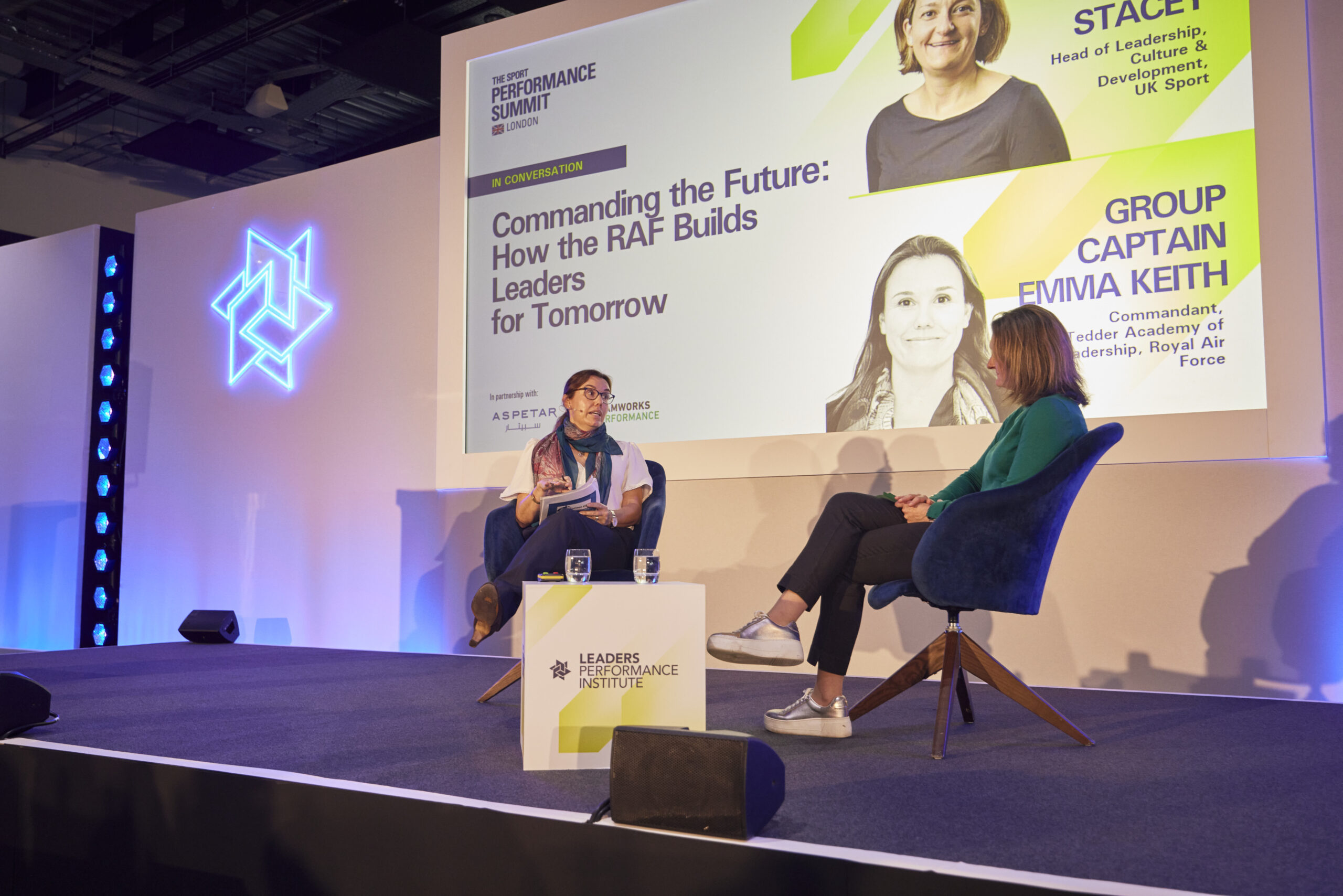
Emma Keith in conversation with Alex Stacey at the 2025 Leaders Sport Performance Summit at the Kia Oval in London.
2. The service positions its values as the ‘carrot’ rather than the ‘stick’
The RAF has a document entitled ‘Air Publication One’. “It’s not a very sexy name, I’m afraid,” said Keith. “Welcome to the military.”
Prosaic title aside, it sets out the RAF’s values of ‘respect’, ‘integrity’, ‘service’ and ‘excellence’. There’s nothing unique in those four – you probably have something similar within your teams – but the devil is in the detail.
Air Publication One is updated from time to time, with the last occasion being in 2019.
“Those updates covered more inclusive imagery and language,” Keith continued. “Thinking about my organisation, that’s probably not that surprising. But another major change that I made to that document, which came from my experience of running officer training, was to shift this from being the stick to the carrot.”
This shift was critical because too often the document was used to browbeat good people. “Actually 99% of my organisation are amazing, they really are, and I wanted a document that was aspirational for them, that they could believe in, that it was the organisation they wanted to be a part of. And we know from all the different behavioural models of change that it only happens when people want to change, not because it’s been forced on them.”
Everyone in the service is asked what these values mean to them. “Even the word ‘discipline’ means something different to me and a 17-year-old who’s just joined up. So, if they feel that they’ve been heard and listened and talked to, I think that’s really important.”
Air Publication One is currently undergoing further revision.
3. They use peer to peer storytelling
As Keith explained, she and her team produced an anthology and a series of videos detailing the stories of RAF personnel. These are not just nice-to-haves but critical learning resources.
She illustrated her point by referring to the ineffectiveness of a top-down approach with a recruit. “With the best will in the world, if I stand up there and tell them all the things they should do, they’re going to look at me and go, ‘thanks very much, Group Captain, you do not live my world, you do not know me and I’m going to switch off. Your lived reality is different to mine’.”
Instead, “if their corporal stands up and says it, someone who’s only a couple years ahead of them, that really is powerful. Who in your organisation can you help sell that message for you?”
4. They accept that learning never ends
The RAF used to approach leadership development for its aspiring officers as something to be taught in one hit. Today, the service adheres to a four-step pathway:
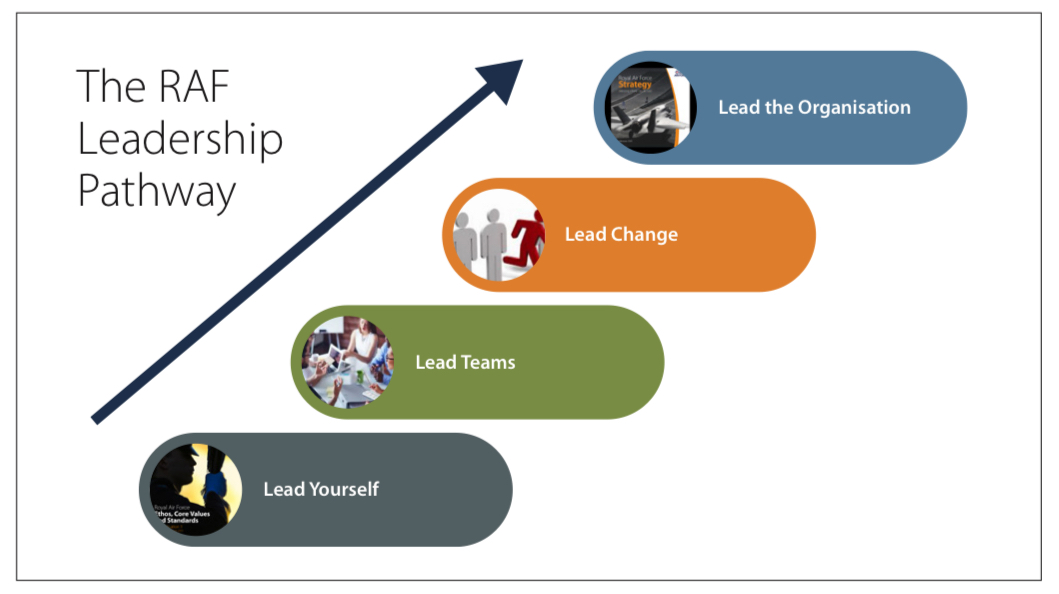
“We’re changing ‘lead teams’ to ‘lead others’ because not everybody has a team, but you lead by role model and example,” said Keith, who also highlighted the pathway’s non-linear nature. “The reality is you will be doing all of these things all of the time. The Chief of the Air Staff is still leading himself. You never stop that.”
She also encourages challenge from younger generations. “It’s about having humility on both sides to have those conversations. That’s where things like mentoring and reverse mentoring can be so powerful. It’s an exchange of ideas that can be so helpful. I mentor a lot of people and, honestly, every time I put the phone down or put the coffee cup down, I’ve learned as much as they have, if not more, I am absolutely sure.”
5. They leave the ‘how’ to their learners
Nestled at the heart of the RAF’s guiding principles is ‘mission command’, which refers to the empowerment of mission leaders.
“In simple terms this is the idea that the leader or whoever’s in charge of the task is set the ‘what’ and the ‘why’, but we really try and keep out of the ‘how’,” said Keith. “What you’re trying to give is as much freedom of manoeuvre for people on the ‘how’ as you can.”
If she needs a team to cross a river to rendezvous with someone on the other side, for example, she will let them decide the ‘how’ so that they are not reliant on returning to her for instruction should things go wrong.
“It allows a speed of decision-making, empowerment for that person. It operates on trust and it crucially frees up headspace for the person in charge. Another wonderful gift you get from that technique is innovation and creativity, because they will probably do things differently to you, which is potentially uncomfortable for you, but also probably helpful.”
More on effective learning strategies
SBJ Tech takes us inside the league’s Situation Room in Toronto, where data can be used to more intricately analyze the sport of hockey.
Main Photo: NHL
“Goal, Boston.”
These pronouncements from video technicians were, for a time, the only interruptions piercing the quiet murmur of the NHL’s Situation Room, the league’s high-tech Toronto facility where every replay challenge is reviewed and ruled on.
Most goals are straightforward, but every one is reviewed by a hockey operations executive to ensure its legality. So long as the puck wasn’t kicked or high-sticked into the net, the game continues. But the technicians, each assigned a single game, watch several angles of each goal to prepare for a possible coach’s challenge — such as whether the offensive team was offside.
“Goal, Pittsburgh. This one’s on us.”
Suddenly, the room stirs to life. The Penguins appeared to net a game-winning goal against the Flyers in overtime, and the Situation Room initiates all challenges in the final minute of regulation or in OT. As the braintrust began reviewing the play — several hockey operations executives and a retired referee — word arrived that the on-ice refs whistled an infraction that nullified the goal.
A few minutes later, the Flyers scored their own apparent game winner, but very quickly, a potentially incriminating view of their entrance into the zone appeared on the screen.
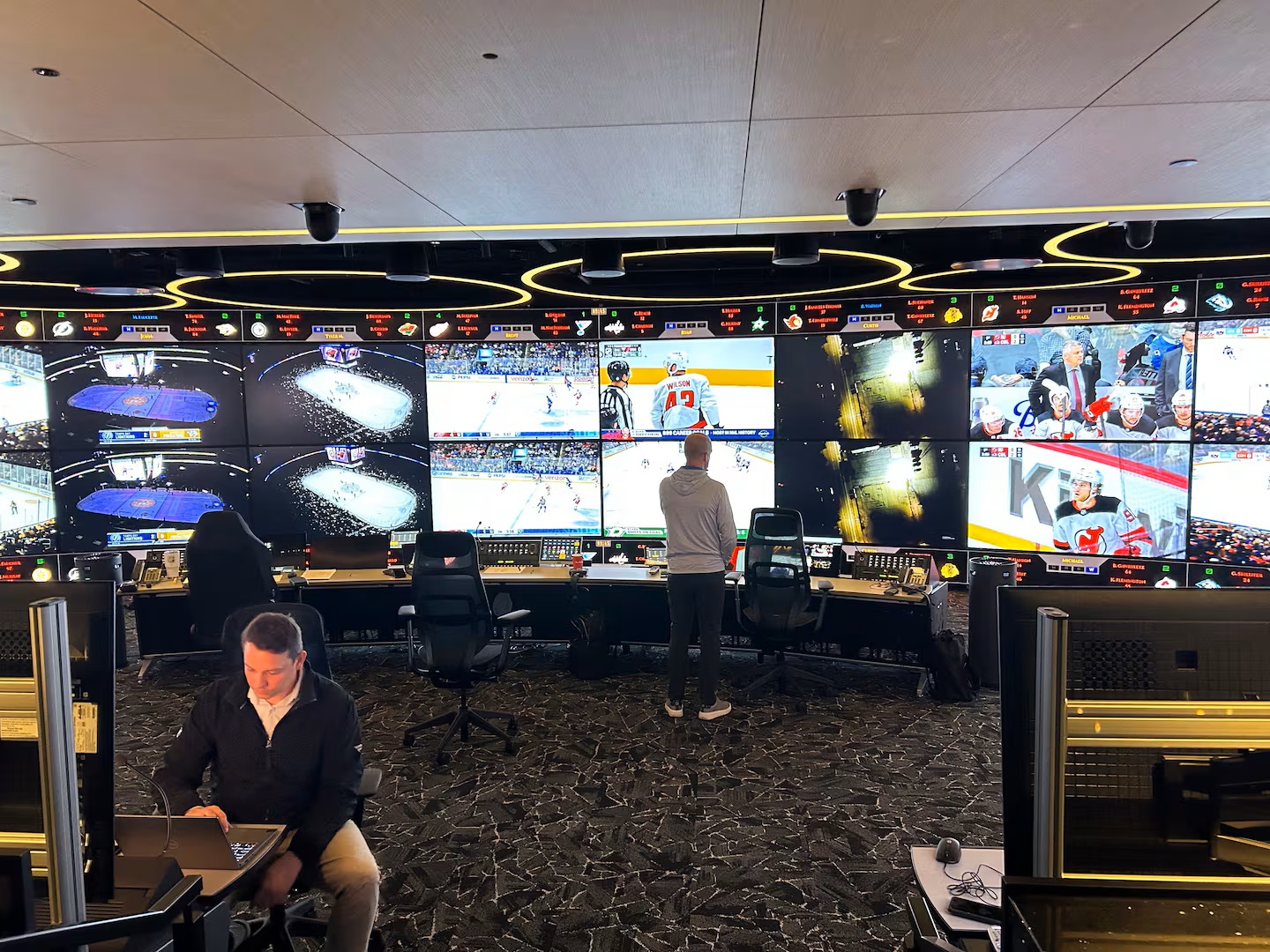
The Situation Room features 16 LED flat screens along the front wall and roughly a dozen workspaces for technicians, each assigned to one game. Photo: NHL
“We’re going to challenge this. Let’s get the linesmen on.”
Word is communicated to the on-ice officials, one of whom informs the crowd that “the previous play is under review by the league to see if the play was offsides prior to the goal” as boos cascade down from Flyers fans.
Situation Room staff pored over several angles, most notably a Sony 4K camera installed right on the blue line for exactly this use. And the final verdict, made by the Situation Room, was close, but clear: Offside. No goal. About 80 seconds after the review began, the ref shared the news in Philadelphia. Even more boos followed.
“We are the keepers of the game,” said Kris King, NHL Executive Vice President of Hockey Operations, the department’s No. 2-ranking official under Colin Campbell.
This is the second year of an upgraded, high-tech Situation Room. There are 16 LED flat screens adorning the front wall, a desk in the middle of the room for executives and roughly a dozen workspaces around the perimeter, where technicians monitor every game. SBJ was one of two news outlets granted behind-the-scenes access on the first night the 10th-floor space was open to media.
“Our job doesn’t really change a lot, but the equipment that we use, and the knowledge that we gain from using better equipment, just gives us a little bit of an upper edge to get to the right answer quicker,” King added.
The NHL was the first professional sports league to centralize its reviews back in 1991, and it has worked with Sony-owned Hawk-Eye’s Synchronized Multi-Angle Replay Technology (SMART) as its video replay provider since 2015.
Separately, the league named Sony a global technology partner earlier this year, and Hawk-Eye’s tracking cameras were installed in every NHL arena prior to last season. That system offers potentially richer data: Whereas NHL Edge, which is powered by SMT sensors on the players and in the puck, tracks a single, center-of-mass location for each player, Hawk-Eye collects data from 29 points on each skater and six points from the hockey stick.
In time, that optical data from Hawk-Eye should inform a richer future of hockey analytics, more immersive fan engagement and, perhaps, data-driven support for officials.
“The NHL are very much innovators in the space — they want to innovate with us to create the future of technology in sport — but I love the fact that it is coupled with patience,” said Dan Cash, Sony Hawk-Eye’s Managing Director for North America. “They know that this is going to be powerful for their game, but they aren’t trying to sprint to the finish line here, which I think with technology can be sometimes a mistake.”
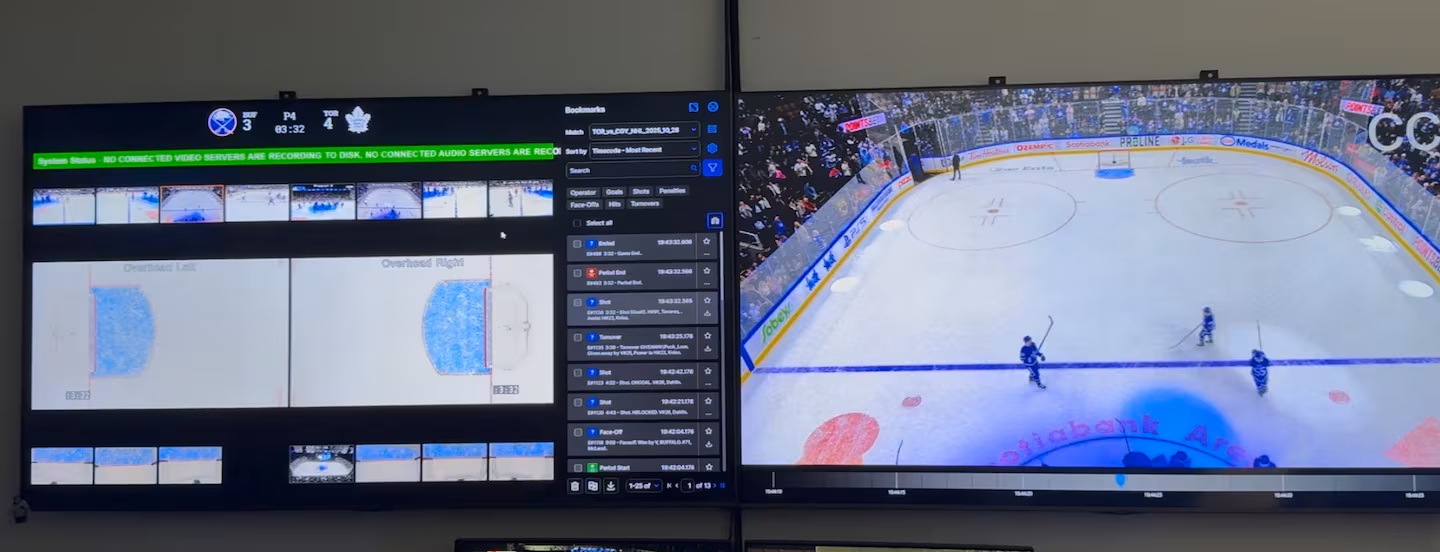
Cameras display a multitude of angles to enable the Situation Room crew to make speedy reviews. Photo: Joe Lemire
When King joined the league office in the early 2000s, the process was dramatically different. When a discipline issue arose, King would need to ferry a VHS tape to Campbell, who lived in Tillsonburg, a two-hour drive from the NHL office in Toronto.
They’d each get in their cars and drive halfway, inevitably connecting at a Tim Horton’s, the most Canadian of meeting points. Campbell would then drive home, review the tape and make a ruling about a possible suspension or fine. Nowadays, that video is transmitted in about 125 milliseconds from arenas to the Situation Room and about as rapidly to Campbell’s house, saving immense time and gas, at only the cost of a fresh coffee.
“How we transport video is the secret sauce, so to speak,” Cash said. “It’s not easy to transport video as quick as we do over a wide area network.”
We are the keepers of the game.
Kris King, NHL Executive Vice President of Hockey Operations
It’s even less for the league’s next-door neighbors. The goal horn from next-door Scotiabank Arena blared concurrently with a Maple Leafs goal scored on the Situation Room monitor. (The horn also later sounded for a Blue Jays home run; the World Series, featuring the local team, was discreetly on a few Situation Room screens.) That immediacy lets the Situation Room prepare video clips and look at questionable calls before even hearing from the on-site staff.
“It definitely is a real-time league now,” said Rod Pasma, NHL Group Vice President of Hockey Operations. “A lot of times we’ll know exactly what’s going on before [the coaches] even call the officials over to challenge a play.”
On that night, the Situation Room scoured replays to prepare a ruling that never materialized, with the on-site coach opting against the review process. “That’s a good non-challenge,” King said, noting the likelihood the call wouldn’t have been reversed.
The NHL continues to add cameras: There are three in each goal, one above, four on the blue lines and an elevated 4K lens to provide the All-12 viewpoint of every skater. Some arenas now have Cosm C360 cameras. The league will soon begin testing an 8K version of the All-12 at the Prudential Center — where the NHL and Verizon also are creating an innovation lab to test new tech, scheduled for full operation early in the new year.
On this particular night in the Toronto Situation Room, as part of ESPN’s Frozen Frenzy, all 32 teams were playing, many of the start times staggered by 15-minute intervals to make the action nonstop. One workstation was solely dedicated to pressing go on a digital dasherboards celebration for Alex Ovechkin’s 900th goal. The NHL didn’t want to chance it flashing live on-air, only for the goal to be overturned on review.
“The technology’s gotten to a point where the only thing we can’t do right now is literally hit the horn in the building,” Pasma said.
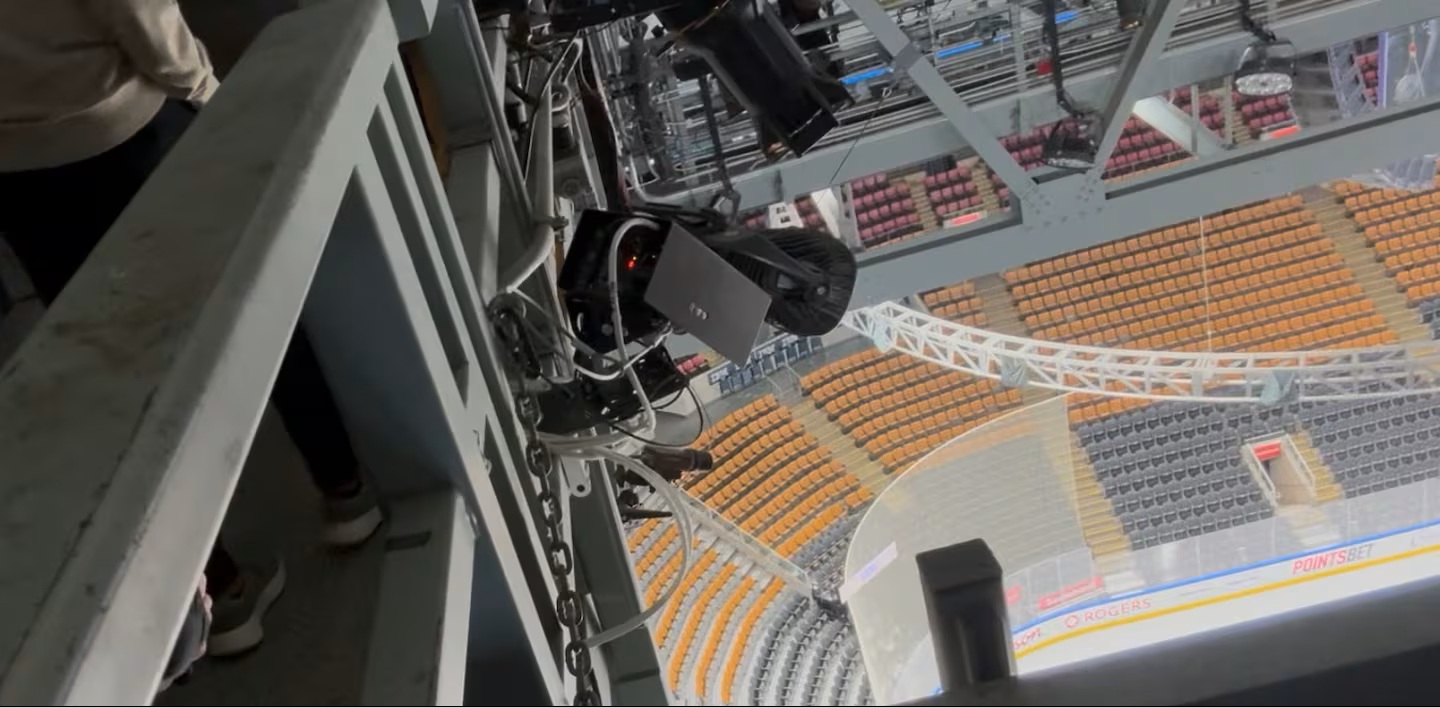
Hawk-Eye’s tracking cameras were installed in every NHL arena prior to last season. Photo: Joe Lemire
High in the rafters above Scotiabank Arena, looking down on the Maple Leafs’ 1960s Stanley Cup banners, are six black, rectangular cameras affixed to the catwalk and helping power the Hawk-Eye tracking system. From up here in the rafters, the ice seems impossibly low, but the 4K, 60-frames-per-second cameras capture granular movement data via images streamed directly to the cloud — Hawk-Eye’s first leaguewide deal to be cloud-native. Another six cameras are placed on lower levels of the arena to avoid obstruction from the center-hung video board.
Those dozen video inputs are triangulated and processed to determine the precise location of every skater and his stick. Hawk-Eye has provided MLB with bat tracking data for a couple seasons, but that’s only one bat in a known location every time — far different than 12 sticks across a 200-foot-by-85-foot ice rink.
For now, the AI models interpreting this data are still going through iterations to reach the confidence threshold for accuracy needed for wider distribution. The NHL has never had stick data, and Hawk-Eye and the league are in the “true development phase in refining the technology,” said Sean Williams, NHL Vice President, Innovation and Technology Partnerships. Williams added that it could soon be used to enhance the existing Edge tracking that teams can access through the data feed.
When Hawk-Eye data does become a part of the NHL Edge repository, it will not only further enrich the data-driven storytelling for fans via broadcast and digital media and help clubs more intricately analyze the sport, it also could provide other inputs for referees, linesmen and Situation Room executives.
“Not currently, but that’s definitely where we’re going,” said Sean Ellis, NHL Vice President of Hockey Operations, of using tracking data for officiating. “We’re not going to roll it out until we’re 100% confident and comfortable that the data that we’re getting is accurate.”
Even then, the potential is more to inform than automate. “We are genuinely looking at all options,” Williams said, “but our fundamental strategy is to keep the call on the ice made by humans.”
This article was brought to you by SBJ Tech, a Leaders Group company. As a Leaders Performance Institute member, you are able to enjoy exclusive access to SBJ Tech content in the field of athletic performance.
In the third and final session of his virtual roundtable series, Professor Fabio Serpiello of Central Queensland University raised the question of decision-making frameworks when choosing or discarding tech solutions.
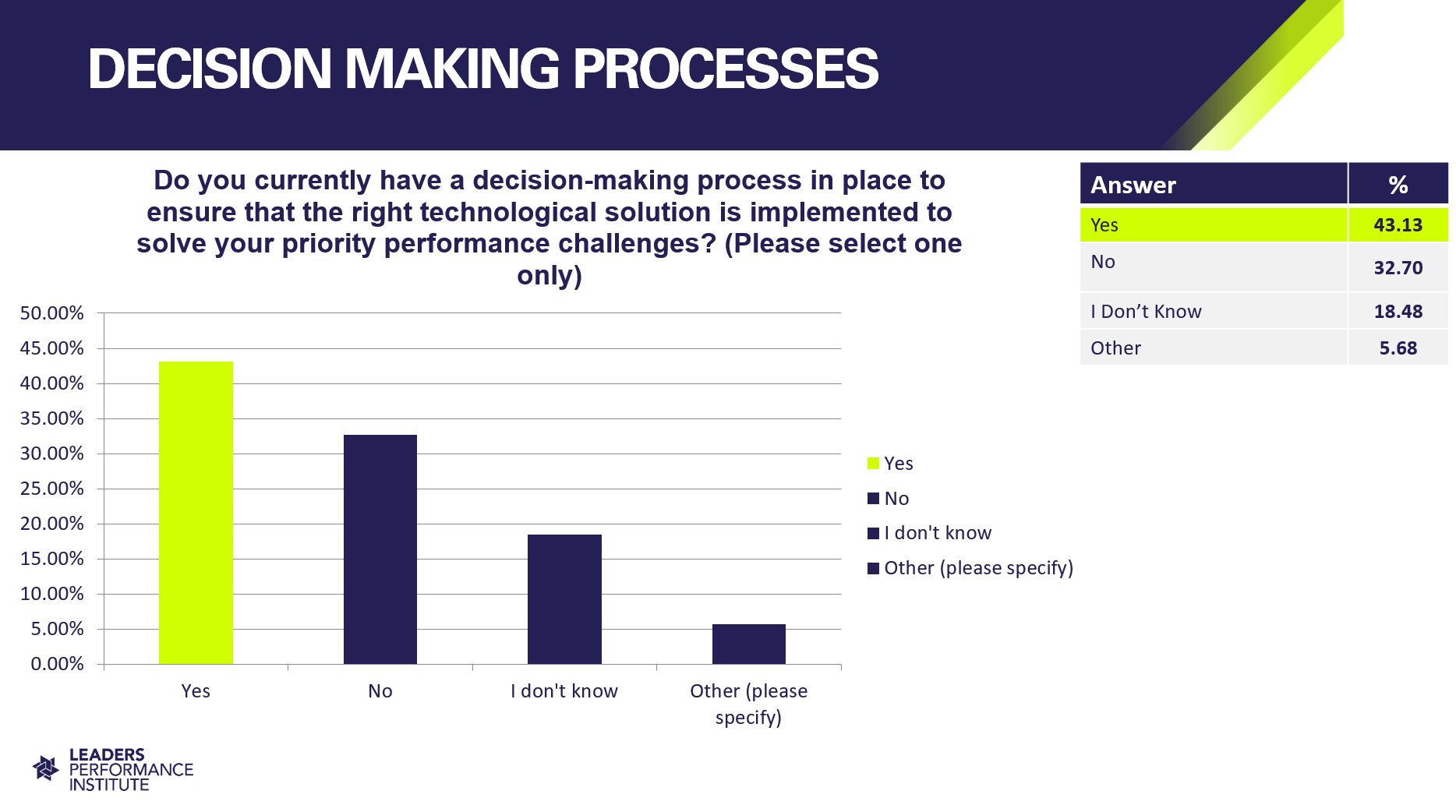
Fabio Serpiello, the Director of Sport Strategy at Central Queensland University, first posed this question to Leaders Performance Institute members as part of the survey that resulted in our Trend Report.
Fewer than half of respondents said ‘yes’, with more than a third saying ‘no’. Curiously, nearly 20 percent said ‘I don’t know’.
“That’s a good chunk,” Serpiello told members of that 20 percent figure while leading a recent Leaders Virtual Roundtable. “It is probably more interesting than the ‘yes’ and ‘no’ given that most of the people that responded are at the ‘head of’, ‘director of’ or ‘vice president of’ level.”
Yet in the same survey, almost 90 percent of respondents believed that a framework was at least ‘somewhat important’:
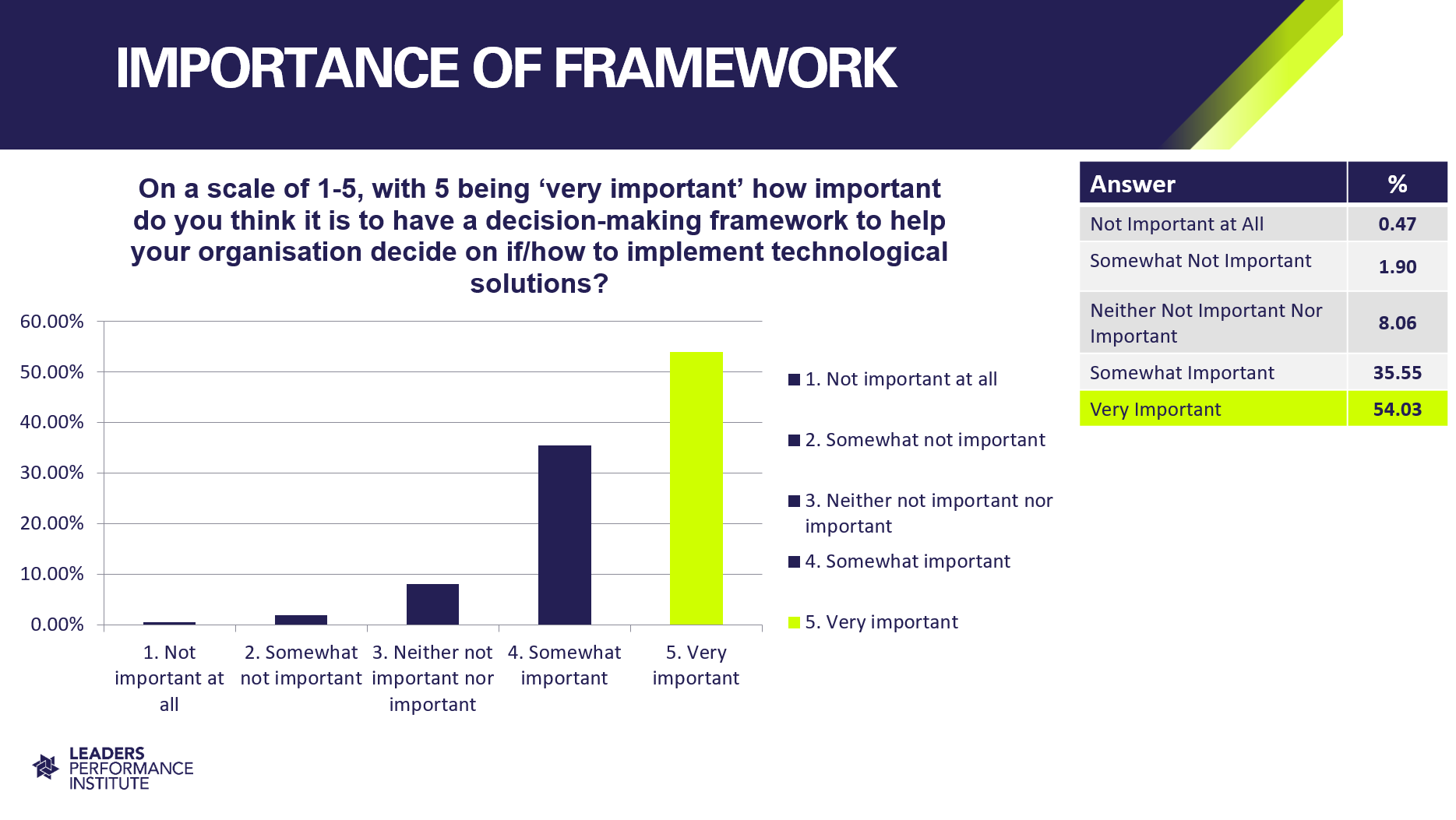
Logically, it seems likely that a good proportion of those respondents face frustrations in their work.
This likelihood set the stage for the third and final instalment of Serpiello’s roundtable series looking at tech-related innovation in sport.
First, the table noted some common problems around making decisions on tech.
A lack of decision-making frameworks: the magnitude of the challenge will depend on to whom you speak. Some markets are more mature than others; some sports resist tech-related innovation. As Serpiello said: “We are experiencing a lot of difference in the maturity of the European context and the Australian context versus the American context in some of these discussions, naturally, because of the way sport works.”
Overzealous vendors: almost every practitioner has heard a misfiring pitch from tech vendors at some point; they’re even more likely to have seen purported tech solutions gathering dust in a cupboard at their practice facility. A senior sports scientist illustrated the reality in his role:
“It’s not always us identifying a gap and reaching out to the best fit to fill that gap. It’s a lot of companies reaching out to us and trying to be ahead of the curve sometimes, which is maybe filling a need that you don’t have.”
Pressure from leadership: in some cases, senior leaders are pushing their high performance teams into finding the latest gadget. The aforementioned sports scientist also feels pressure from above:
“We’re being pushed from the top, even if you don’t know if the suggested tech solution makes sense. They’ll say: ‘just get some fancy toy that people will talk about’.”
The table also pointed to several solutions.
Serpiello spoke of the Sports Tech Research Network, specifically its Quality Framework for Sports Technologies, as a time-saver.
This white paper introduces a standardised, evidence-based framework which can be adopted by sports technology stakeholders to assess the value, usability and quality of technology.
Developed in collaboration with 48 experts across the sports industry by means of a Delphi study design, the framework includes a range of qualities grouped under five overarching pillars:
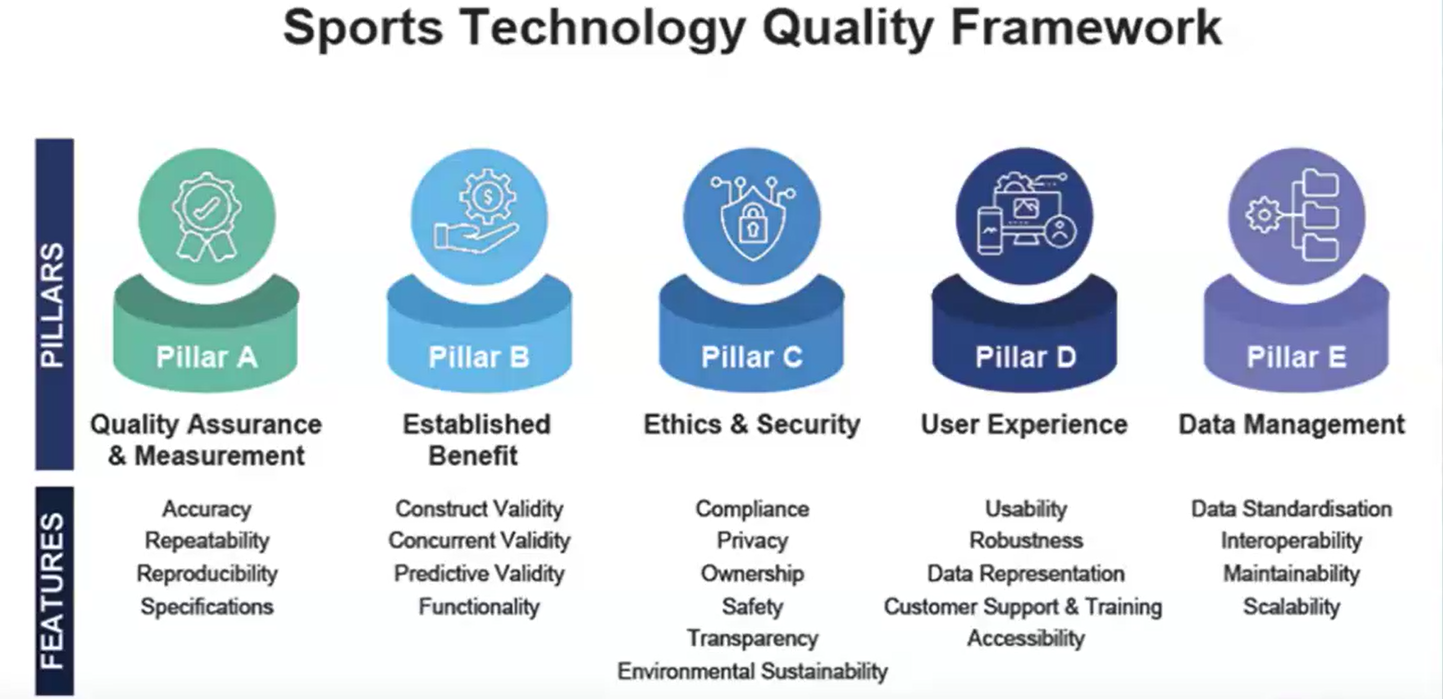
“Some of these pillars lead to more hardcore science questions; accuracy, repeatability, reproducibility, construct validity, or predictive validity; those are very much science-driven,” said Serpiello. “Some of them are more operational such as compliance, data privacy or environmental sustainability; and some are more user experience; how does the customer support and training work? These things are very important for you in sport because they make or break the day-to-day choices and the day-to-day use of technology.”
He then illustrated how the framework might be used to make informed choices:
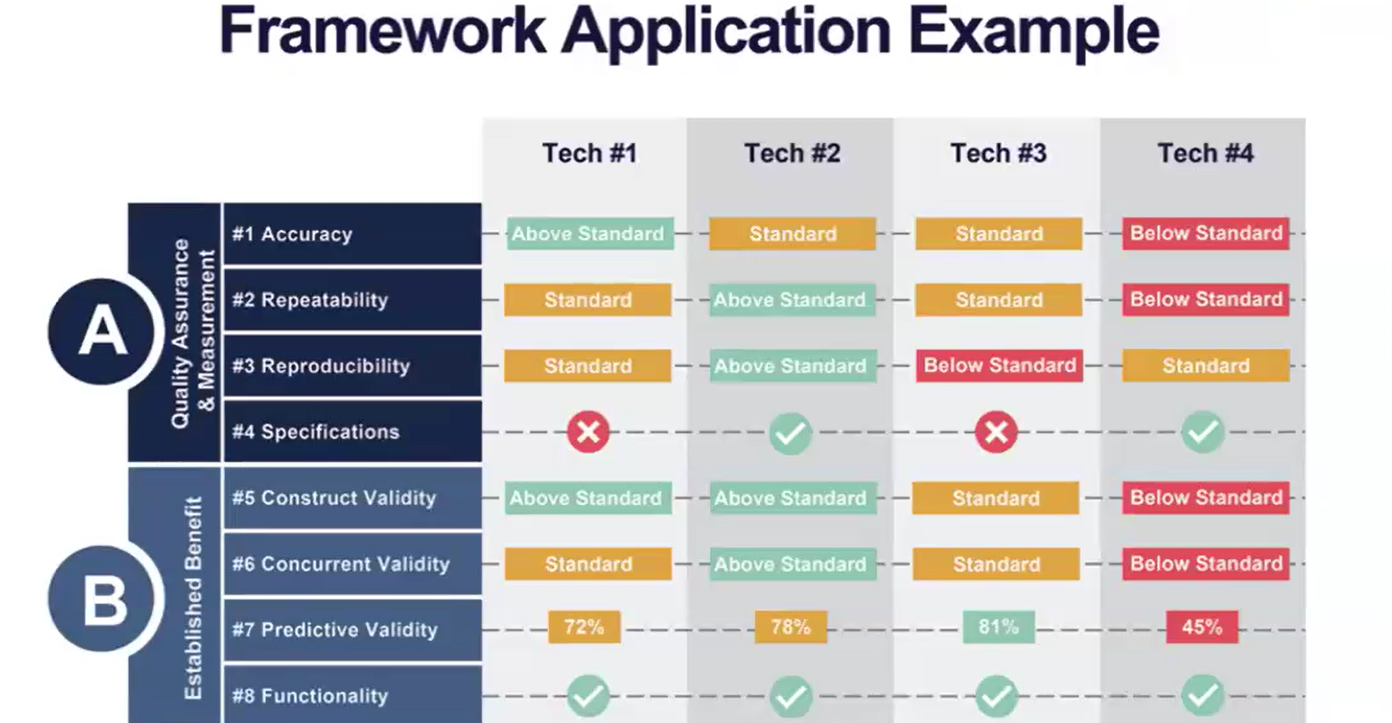
One or two members had already used and adapted the framework to their team, as one sports scientist explained:
“We’ve adopted it when we’re looking at multiple systems for velocity-based training or GPS, just to give our practitioners and stakeholders guidance and have that scoring system to then see how it ends up; and to put in some objectivity to the potential subjectivity of that process. I think it’s helped us a lot because different stakeholders in different departments can come together. We actually added to it as well for things like partnerships and sponsorships and adapted it to our setting, which made it even more useful.”
Governing body mandates
As Serpiello explained, international confederations such as FIFA and FIBA, as well as national governing bodies, such as the Dutch Olympic Committee*Dutch Sports Federation, mandate the format in which data must be produced by companies.
In a similar vein, the AFL has an “internal technology group” for vetting all potential tech solutions. Serpiello said: “It includes coaches, medical, sports science, S&C, commercial, legal personnel and they say ‘we meet once a month and we deal with the approaches this way’. So outside that process, they do not respond to you, they do not engage with you, they say to you as a company ‘this is the process, submit your inquiry, and then we’ll assess it’. I like it because it takes away a lot of that constant having to deal with companies that come and say ‘we’ve got this amazing product’ only for you to then realise that it’s really the same product as before.”
Another example is the NBA Launchpad, which is the league’s initiative to source, evaluate and pilot emerging technologies.
“It’s basically ‘come and show us what you have and we’ll look at it’,” said Serpiello. “That’s slightly different from ‘okay, we’ve got an issue and we’re going to throw it out there’.”
Accuracy and reliability are less important than practicality
Accuracy and reliability are important but they are not everything.
“I’ve slightly changed my mind on this over the years,” said Serpiello. “I’ve seen organisations chasing the product that was one percent more accurate or reliable on some of the main variables, only to then completely disregard the other part, which was does it have API [application programming interface] connections with my other systems? Does it allow me to make quick decisions every morning when the athlete rocks up? Those things are far more valuable than being able to say confidently that high-speed running this week was 1K or 1.1K.”
A programme manager in the Australian system concurred while highlighting the tension between providing broadcast data (where granularity and accuracy are not as important as they might be for a high performance team).
He said:
“I think that’s the healthy tension between something that is returning value, whether it be in the speed of decision making or feedback from experimentation; that’s the inherent tension of scientifically valid and reliable systems versus commercially valuable systems… and just because something’s not valid and reliable doesn’t mean it’s not valuable. You just need a measurement to be able to reduce that accuracy and reliability to a standard that you’re comfortable with.”
What to read next
NewtForce’s streamlined analysis tool enables real-time pitching feedback thanks to its collaboration with motion capture specialists Movrs.
Main Photo: Movrs

The Bulldogs began using the new high-tech pitching tunnels while construction workers were still clearing the space. Photo courtesy of NewtForce.
This article was brought to you by SBJ Tech, a Leaders Group company. As a Leaders Performance Institute member, you are able to enjoy exclusive access to SBJ Tech content in the field of athletic performance.
In a recent Leaders Virtual Roundtable, DCU’s Jamie Taylor led a discussion on the elements that hold back coach development practices.
That is according to Jamie Taylor, who described the state of play.
He said: “It’s unclear how we help coaches to get better and it’s even less clear what methods of coach development are appropriate.”
Then, he added, “it’s very difficult to be able to evaluate and review coach learning.”
Taylor, an Assistant Professor in Elite Performance at Dublin City University [DCU], had set the stage for his virtual roundtable presentation, which explored all facets of the coach development challenge that faces organisations across the world of sport.
Competent or expert?
Taylor, using the graphic below, outlined the tasks (on the left-hand side) that a coach developer needs to be able to fulfil in their role and the questions that each task provokes (on the right): 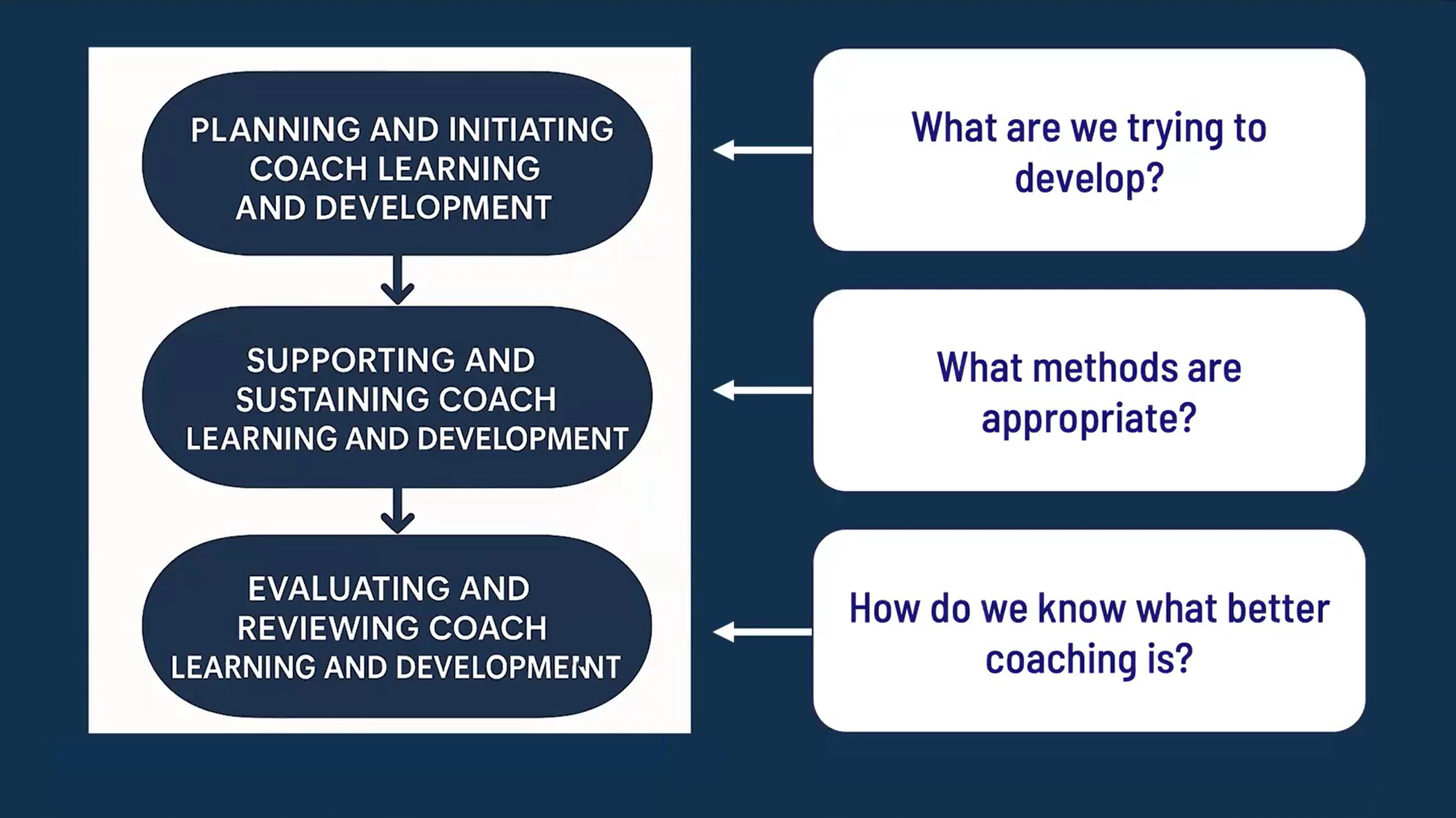
Too often, organisations do not adequately answer these questions.
The Premier League, for one, were struggling when they turned to Taylor and DCU three years ago.
“At the time, the Premier League thought they had a competent academy coaching workforce, but they weren’t happy with just ‘good enough’,” he said.
Together, they worked to identify the qualities of coaches deemed ‘expert’ as part of their Coaching Expertise Project. They co-developed a coach profiling tool to help academy coaches on that pathway from competence to expertise.
“The tool itself is around a half a day’s worth of different simulations that the coach can go through. It presents them with various difficult scenarios,” Taylor continued. “At the end, it generates a profile that says, ‘here’s where a coach might be strong, here’s where a coach might be weaker’.”
The project has yielded demonstrable outcomes. “Coach developers are reporting that it’s much easier to understand what a coach needs and be able to direct them and say, ‘here’s the time we’ve got and this is how we might use this time to influence and enhance your practice’.”
There are, however, still unknowns. “When evaluating and reviewing coach learning and development, we are still unsure what ‘better’ is.”
The project continues and coaches are tracked in their progress.
The ‘messy’ middle
Good coach development work combines both more direct and less direct approaches.
Taylor believes a thorough approach would look something like this:
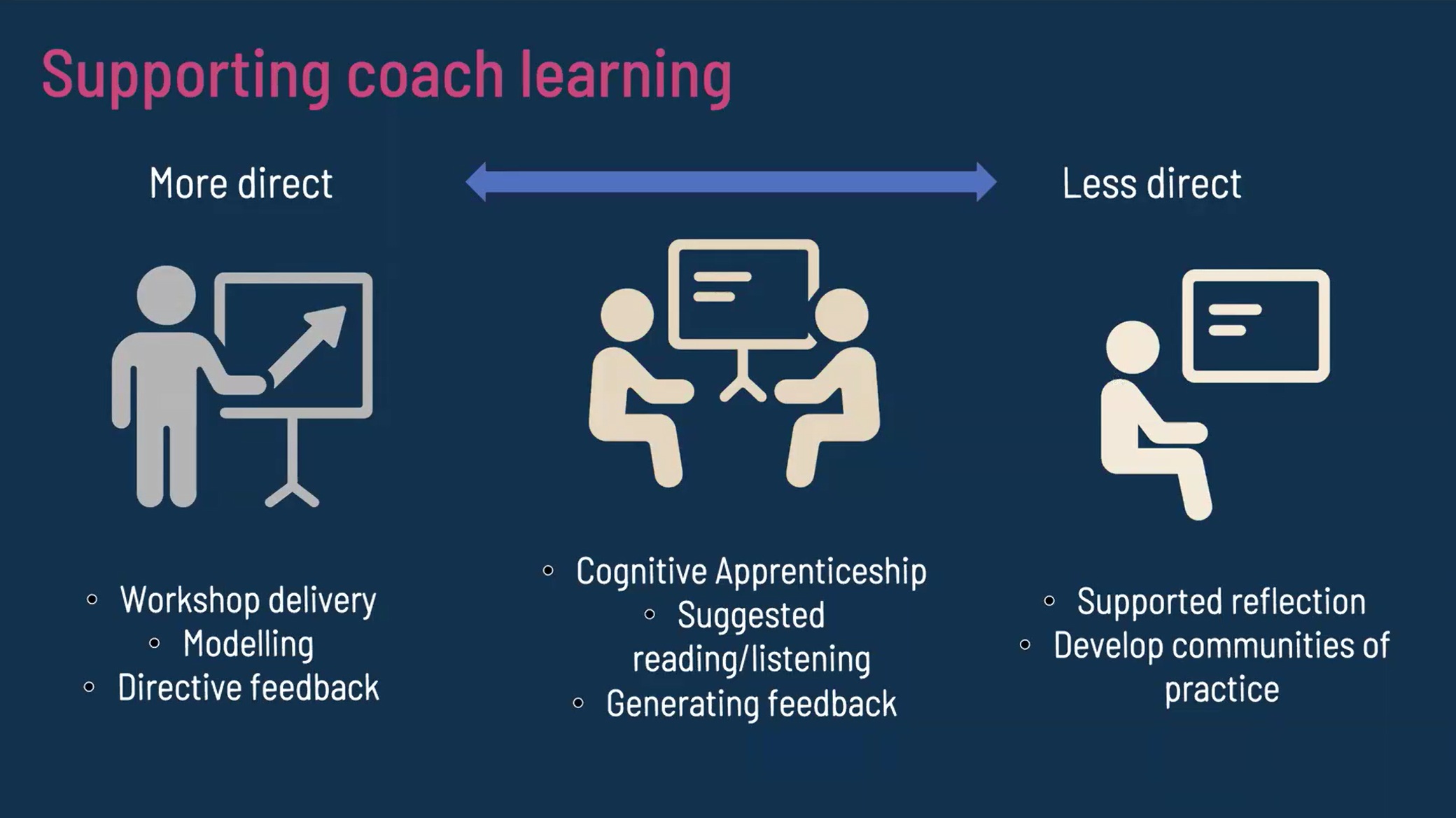
In reality, however, coach development too often veers towards less direct approaches.
“Similar to what we see in coaching, there has been a view that it’s inappropriate to offer more direct pedagogical approaches,” Taylor continued. He believes this is a consequence of sport being influenced by executive coaching practices and adult learning theory. Yet coaching is not C-suite work.
Supported reflection and communities of practice can be useful, but there are limitations. “If the coach hasn’t got the knowledge to reflect, or the coach developer doesn’t have a strong pedagogical capacity, then it can end up being just a nice coffee and a nice chat.”
Between the more direct and less direct approaches illustrated above is what Taylor calls “the messy middle”.
“We haven’t often seen approaches like cognitive apprenticeship, where somebody’s needs are identified, understood, and they’re given tasks that are just beyond their current ability. We haven’t got into directed reading and listening, mostly because lots of the available resources aren’t necessarily coaching-focused. Nor have we paid lots of attention to the ability to generate feedback rather than offer more supported reflection.”
‘The things we might do to generate competence don’t always promote expertise’
As the Premier League and DCU observed, the things that coach developers can do to generate competence do not always lead to expertise.
The notion of ‘best practice’ is a prime example.
“When we say ‘best practice’, I think we’re essentially saying ‘if we do it like this most of the time, it will be better rather than worse’,” said Taylor. “This tends to be more observable. I can see somebody doing ‘this’ and what I’m going to do is encourage somebody to repeat this ‘best practice’. This can be done through auditing processes; it can be done through more directive approaches; and it is significantly easier to leverage and promote than expertise.
“Now, expertise could be associated with good practice, but ultimately that means understanding intentions and context, and it requires us to probe and promote adaptability for coaches; for them to be able to respond to changing contexts. And I see these two things in tension with each other. Lots of the things that we might do to generate competence often don’t promote expertise.”
Taylor then illustrated this point of difference:
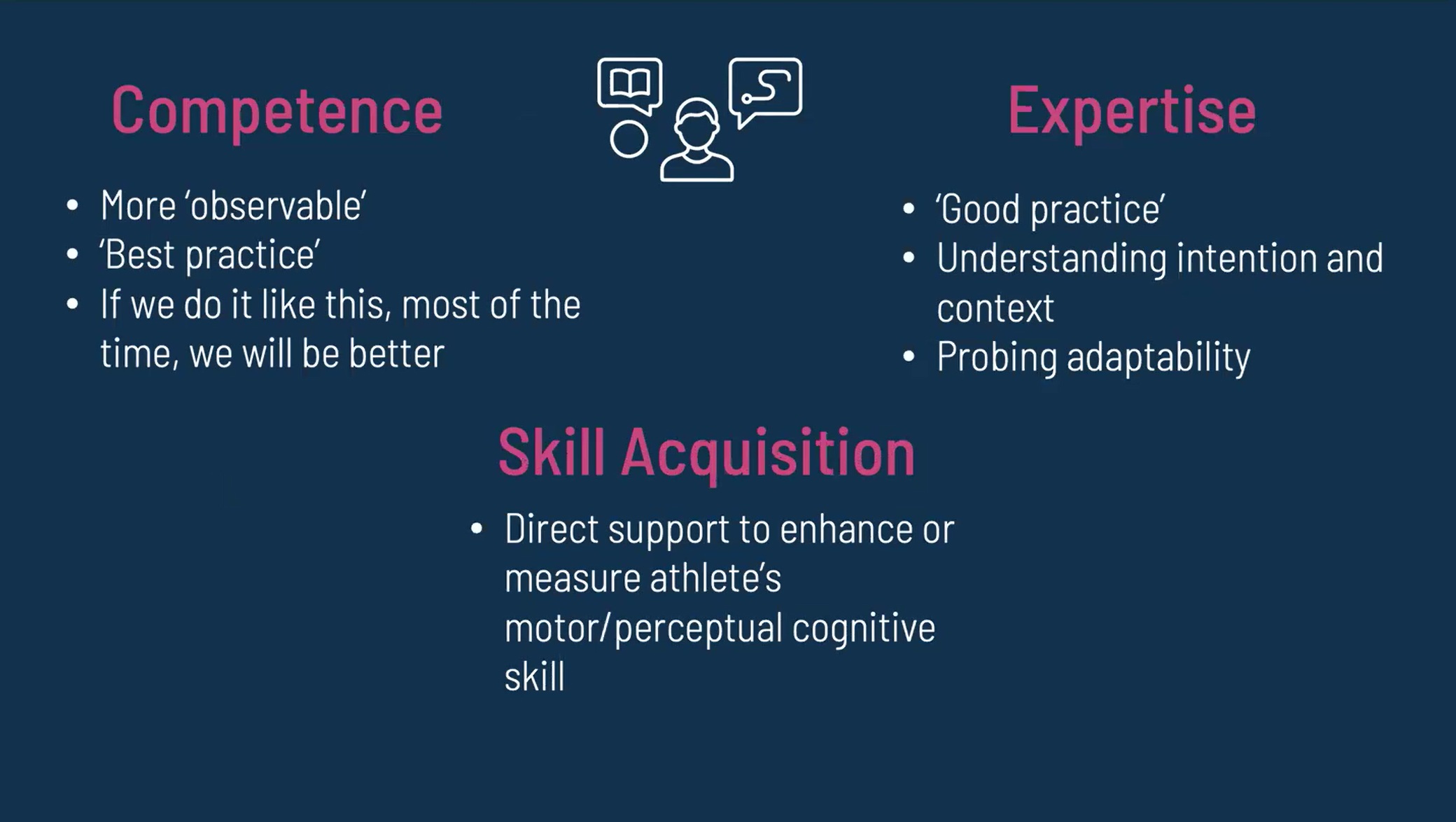
The middle domain – skill acquisition – came to the fore in Taylor’s work last year when the Dublin Gaelic Athletic Association enlisted his support in a coach development capacity.
At the start of his secondment he leant towards expertise, but when three coaches announced their intention to move on at the end of the season he pivoted towards supporting them in skill acquisition for athletes, specifically the planning of sessions and whether performance metrics were being met.
All three elements are key to coach development work, both “systemically and individually”.
Taylor’s hope is that “over the long term, we’re going to start progressing towards a broader and wider reach for coach development practice.”
What to read next
How Do you Develop the Most Expert Coaching Workforce in World Football?