New York City FC’s David Howarth and Technogym’s Damiano Bernacchini explain why even a promising tech solution will be useless without smart implementation.
The Vice President of Performance at New York City FC was speaking at June’s Leaders Sport Performance Summit in New York, where he addressed the gap between the emergence of a promising tool and its performance value.
One reason that gap persists is a lack of understanding on the part of the practitioner. “There’s a depth of education and understanding that needs to happen first for the practitioner,” he continued. Then, the practitioner can act as what he called a “bridgehead”: someone who can bring ideas to coaches, performance staff and senior leaders alike.
Howarth was joined onstage by Damiano Bernacchini, the Sport & Performance Cluster Manager at Technogym, who explained how practitioners inform the company’s product development.
“We organise workshops or focus groups to understand where we are heading, what are the needs for the market from a specific category and how we can actually create priorities and implement the solution,” he said. Feedback from those sessions helps Technogym decide what to develop and where its priorities should lie.
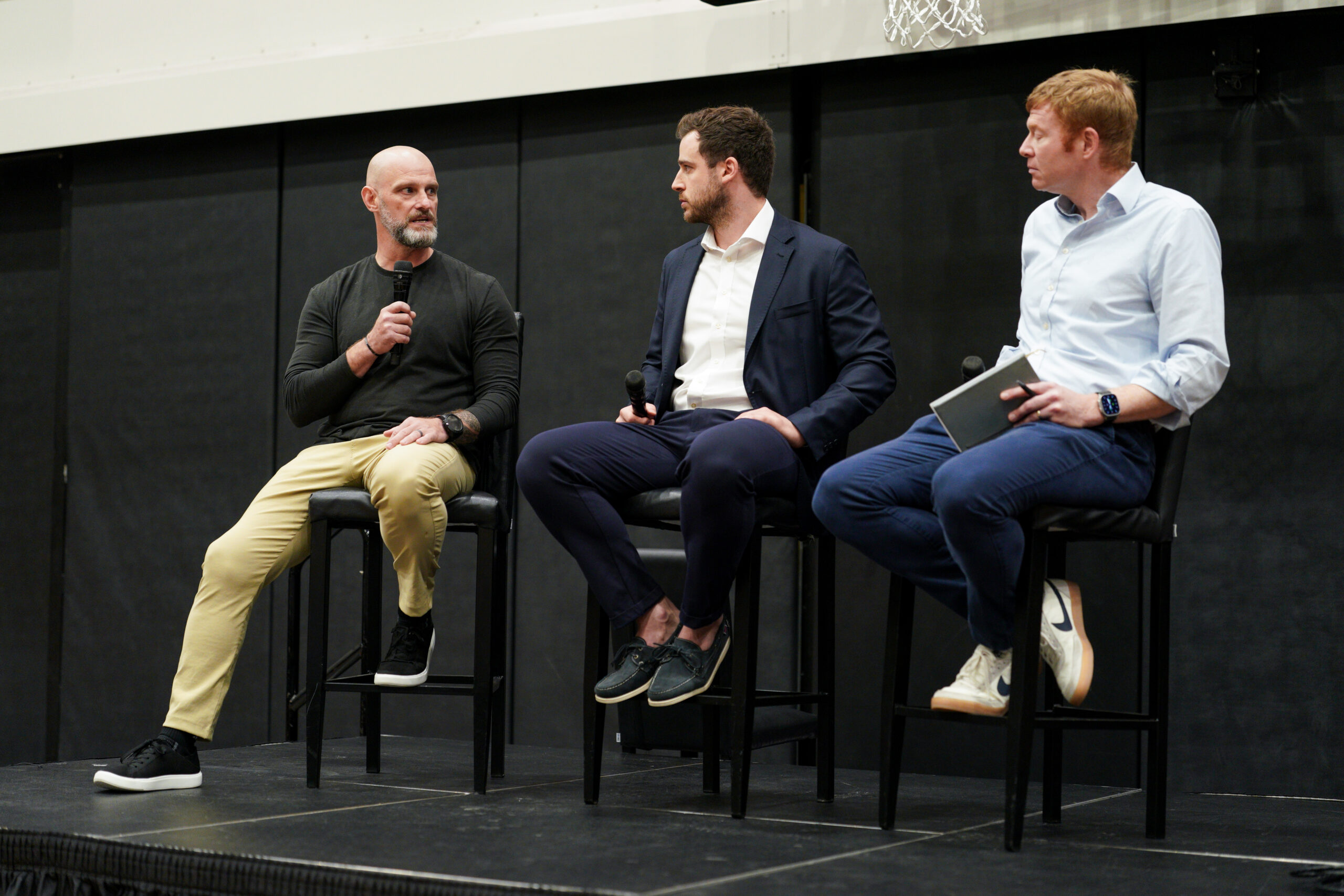
David Howarth (left) speaks alongside Damiano Bernacchini (centre) and session moderator Joe Lemire (right) at the Leaders Sport Performance Summit at the Barclays Center in New York.
For Howarth, the primary question is: “Does it change what the athlete or coach is doing?”
The duo raised five considerations.
This comes back to Howarth’s innovation-to-action conundrum and it means identifying a smaller number of measures that practitioners can depend on. He spoke of the “signal-to-noise ratio”: distinguishing genuine athlete change from normal biological fluctuation, equipment error or inconsistencies in the testing process.
That is where practitioner education becomes important. “The simplest answer is probably the right answer,” he said. “However,” he continued, “to get that simplicity, there’s an element of comprehension and a need to understand it” before a practitioner can explain the findings to athletes and coaches.
Howarth also pushed back against what he called a “black box approach”, where practitioners are expected to accept an output without understanding how it was produced.
“You’re really looking for an early, small winner,” said Howarth. Athletes and coaches need to see why a tool is useful before they are asked to give it more time or change how they work. He called for a “slow but accurate introduction of that tech” because “if it takes me 25 minutes to explain the technology and they switch off after eight seconds, I’ve probably lost”. He argued that organisations need to make room for practitioners to learn. Professional sport offers too few opportunities to test and refine a new tool before it is expected to deliver.
For his part, Bernacchini argued that implementation should not end when a product reaches the market. “Every three months there is a product review, understanding what are the priorities to develop and how we can implement it in the process,” he said of Technogym. These reviews allow them to reassess its development priorities as it receives feedback from clients.
As Howarth said: “Subjective measures are still incredibly valid data points.” He said that any measure is shaped by the quality of the equipment, the way it is collected and the judgement of the person interpreting it.
Bernacchini also stressed the need for human oversight when discussing AI-enabled prescription. He argued that technology should help practitioners process information rather than replace their judgement, because the tech may reveal patterns that an athlete or coach has not noticed, but subjective information can supply the context that the device cannot capture.
Practitioners must also be prepared to drop a tool that is not working. “Removing it can also help build trust,” said Howarth, who made the point that stopping an ineffective intervention shows that the performance team is judging it on results rather than trying to justify its continued use. He imagined a performance team openly saying “we’ve been doing this for six months and it’s shown us nothing”. In his view, that honesty preserves the performance team’s credibility when it next proposes an innovation. The test, he argued, is whether the technology produces a “clear, actionable output”.
“We want to be able to provide a support, not to substitute,” said Bernacchini. Technogym’s aim is to combine functional assessments, wearables and subjective data to create “a living programme that adapts also based on the previous session”. The programme would update a prescription as new information became available, with the practitioner remaining responsible for interpreting its recommendations.
Howarth also pointed to AI’s ability to sift through large amounts of information. In scouting, for example, it can find patterns across dozens of reports. He likened AI to a “digital twin” that can help practitioners “interrogate our own typical answers”.
What to read next
As the USL prepares for promotion and relegation, it is trialing a low-cost alternative to VAR, offering a useful case study in how organisations can improve decision-making as the stakes rise.
Main Image: USL

But that changes when deploying a new support system for said officials, like the USL will be doing with its Football Video Support (FVS) pilot for the final seven games of its interleague competition between Championship and League One teams, the Prinx Tires USL Cup.
“This is a weird thing to say, but I’m hoping we get the opportunity to utilize the technology,” said Luy, chuckling.
While Video Assistant Referee (VAR) is now a household abbreviation, FVS is more a recent addition to soccer. It’s so new that FIFA is still evaluating it as a potential alternative support method for referees (this pilot is part of that larger FIFA effort).
Here are a few key takeaways from my conversation with Luy about FVS and the USL.
How it works, and how the USL will use it
FVS usage is scaled down and clear-cut compared to VAR. It can only be used to review four situations:
A goal scored, Luy explained, will be automatically checked by the fourth official’s review on a field-side tablet. Other situations will require the match’s head coaches to request a review through the fourth official. Coaches will receive two requests per match during this pilot, which starts with quarterfinal knockout matches next month and continues through the Prinx Tires USL Cup title game.
There will be no challenge flags thrown or challenge balls punted on the field, sadly. “A little less ostentatious, I guess, for this footballing world,” Luy said.
FVS’s biggest benefit? Cost savings
Part of FIFA’s drive to test FVS is the desire for more affordable officiating support systems outside of VAR. For the smaller leagues around the world, VAR’s price (which can be in the mid- to high-seven figures for leagues) is a significant investment to make on tighter budgets. FVS is also supportive of venues set up with fewer cameras. Both cases reflect the USL’s needs, which support nearly 300 teams throughout its various levels of men’s and women’s competition.
“Even if we wanted to go that [VAR] route, we wouldn’t have the requisite bandwidth within the ecosystem to be able to accommodate that just from a strictly numbers perspective,” Huy said. “So when you create something like this that eliminates that mitigating factor, I think it’s very positive for the game and something that can be very positive for us as a league.”
An added benefit to this FVS deployment? The USL will get to rely on existing partners Spiideo and NEP Group, which it uses for its camera system and broadcast production.
Why it makes sense for the USL
This move comes as the USL prepares for an impending promotion-relegation setup in 2028, when the USL Premier debuts as the top of a three-tiered pyramid featuring the USL Championship (second division) and USL League One (division three).
Luy sees this as a natural evolution for the USL as officiating decisions could eventually impact clubs moving up or dropping down at the end of the year.
“With promotion-relegation conversations happening and talking about matches of consequence increasing throughout the regular season here and in the not-so-distant future for us, we feel like the time is now,” Luy said. “We’re going to create a dynamic and a paradigm where … you really up the stakes when you’re talking about people going up and down and the fluidity of a pro-rel system.
“Getting as many of those calls right and getting on the front foot here — it felt like the right time to accomplish that task.”
This article was brought to you by SBJ Tech, a Leaders Group company. As a Leaders Performance Institute member, you are able to enjoy exclusive access to SBJ Tech content in the field of athletic performance.
As annoying as some found the World Cup hydration breaks, in some respects such stoppages are insufficient for keeping players suitably fueled.
Main Image: Fifa via Getty Images
After France defeated Sweden 3-0 in the Round of 16, several of the Swedish players indicated that they found the mid-half intermissions beneficial on a day with a game-time temperature of 90 degrees and a heat index of 93 at N.Y. N.J. Stadium.
“It was hot out there, and it’s always nice to get a little bit of a break to fuel up,” Sweden defender Victor Lindelöf said. “Obviously against a team like France, it can be good as well to get a break and talk a little bit.”
Just days later, an apocalyptic-sounding Heat Dome was forecasted through the long holiday [July 4] weekend. Only three of the 16 World Cup venues — Atlanta, Dallas and Houston — were air-conditioned, making this “the World Cup of the sports scientist” for the outsized impact support staff can have, said Douglas Casa, the CEO of the Korey Stringer Institute and a kinesiology professor at UConn. Casa said proper heat mitigation strategies can lead to a 10% gain in performance.
The available modalities on site were personalized sports drinks, high-tech cooling devices that can be worn or held, and sweat-tracking patches, not to mention halftime cold plunges that can be 2-3 times more effective than air conditioning alone, according to Casa. He added that 90% of the benefits can be achieved with targeted heat acclimation in 10 days. The U.S. women’s national team spent that amount of time at the KSI prior to the Tokyo Olympics.
The Powerade-sponsored hydration breaks have been multipurpose for the athletes: consuming sports drinks, applying cooling towels and discussing tactics (and allowing time for fans to refill their beers). But relying on those three-minute pauses alone is not enough.
“Hydration is one of those things that, if you’re in the moment, you’re too late,” said Darcy Norman, the Director of Performance at Chicago Fire FC who previously held similar roles at three World Cups with Germany in 2014 and 2018 and the U.S. in 2022. “It takes time for your body to absorb the water. Typically, you would have more sodium, more salt, and that would draw in more water into the muscle itself. So you’re filling up the stores.”
A plan to beat the heat
Norman said a proper hydration plan starts the night before and should be built on data collected over time. The Fire use Nix Biosensors to build sweat profiles of every player in every condition, monitoring water and electrolyte loss on humid summer days, icy winter evenings and several types in between (Nix worked with one World Cup team but was unable to disclose which one). Perspiration “can vary quite substantially,” added Norman, who said some athletes are metabolically efficient even in intense heat while others sweat “like a fire hose.”
Gatorade has supported the Brazilian national team for a decade, including the use of sweat-tracking wearables from Epicore Biosystems that monitors the water and sodium lost from sweat and also skin temperature. Epicore CEO Roozbeh Ghaffari said longitudinal tracking is critical, noting, “You have to know what’s happening over time to predict forward.” Also, where a player competed in his professional season will affect his baseline.
Heat acclimatization can be objectively monitored through devices such as the Core body sensor, a wearable popular in triathlon and cycling. Core is making its way from endurance pursuits to team sports — it also has worked in and around this World Cup but isn’t at liberty to say whom it’s supporting — to gauge each athlete’s internal temperature and adaptation to the heat.
Core Chief Commercial Officer Ross McGraw said athletes face biomechanical limitations when heat overwhelms their system. “If they’re overheated, they’re not going to be able to run as fast,” McGraw said. “They’re not going to win those individual balls. And the less of those individual battles you win, the more likely you’re not going to do well as a team.”
Even teams that don’t use a sensor have prioritized heat training. Swedish defender Daniel Svensson said the team did heat training in climate-controlled rooms and saunas prior to coming to the U.S., where the Swedes held training camp in sweltering Frisco, Texas.
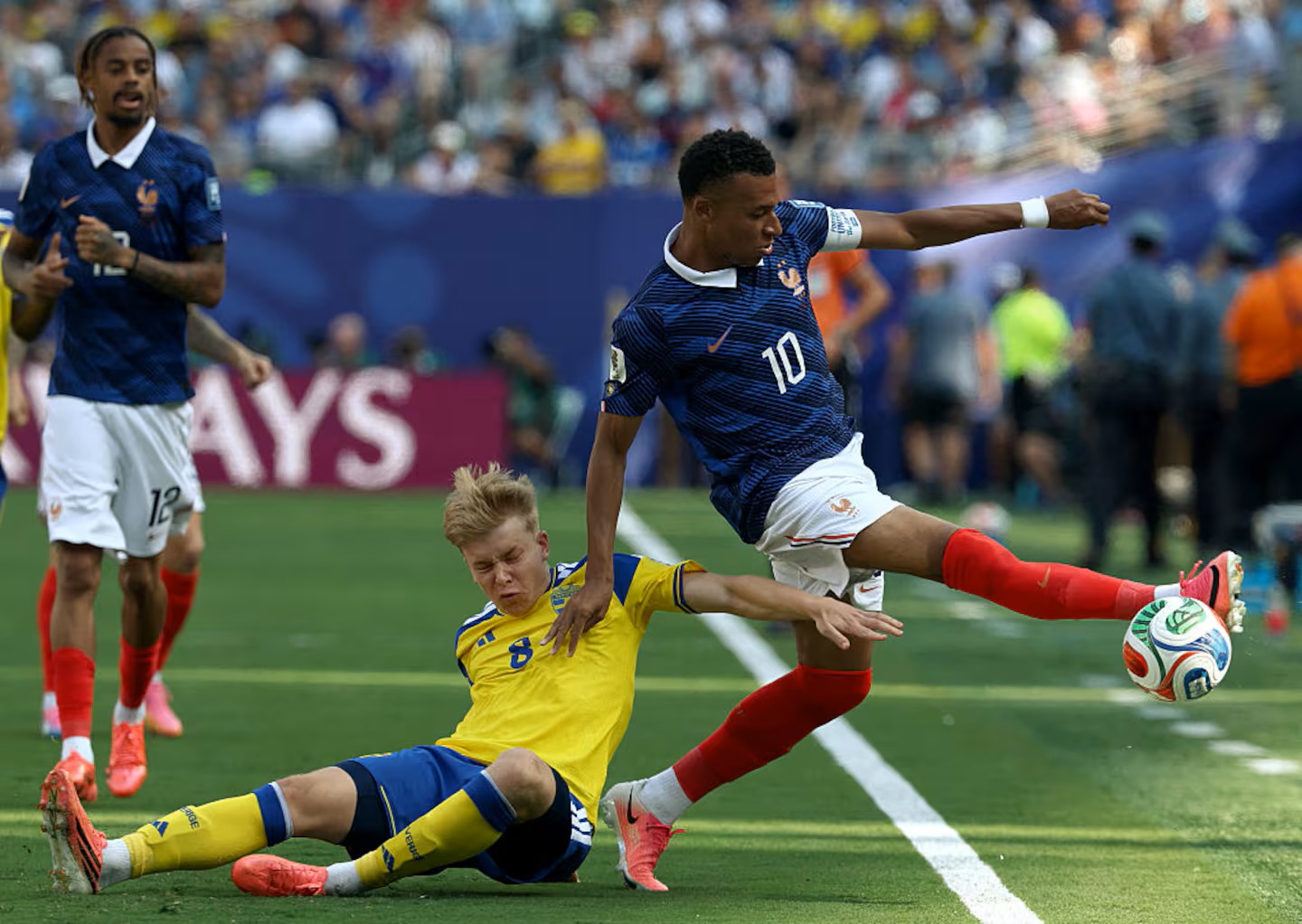
Defender Daniel Svensson and Sweden had to battle the pressure of France’s attack and the New Jersey heat. Photo: AFP via Getty Images
McGraw said Core measures body temperature in tandem with heart rate. When there is a “decoupling” of the metrics — that is, your heart rate continues to rise even when power or speed output remains steady — it can be a sign of heat strain. Some teams, he noticed, warm up the legs while wearing a cooling vest to keep the core temperature lower, calling the practice “counterintuitive” but one that has been effectively implemented by endurance sports.
Adidas outfitted 14 national teams with its new cooling vests and boots at the World Cup, including Argentina, Mexico and Spain. In training, England used Therabody’s new CryoTherm Palms, a handheld device that can lower core temperature. (Several pro sports teams, including MLB’s Cubs, have used a similar product from Apex Cool Labs called the Narwhal.)
Building up heat tolerance can make athletes feel more confident, too. As the Tokyo Games started, Megan Rapinoe posted on Instagram that she never felt better prepared for the conditions. McGraw, who later competed professionally in triathlons, spent childhoods attending weeks of soccer camp in central Pennsylvania where he remembers intense training in the summer sun and, afterwards, feeling “like Superman.” (The camp director, ironically, was a former pro with the aptly named Harrisburg Heat, and his surname is familiar: Mark Pulisic, the father of USMNT star Christian Pulisic.)
No matter how prepared an athlete is and how successful he may perform, the postgame objective is clear. After scoring two goals against Sweden, French superstar Kylian Mbappé told a reporter before leaving the field: “I’m looking forward to the changing room and the AC.”
This article was brought to you by SBJ Tech, a Leaders Group company. As a Leaders Performance Institute member, you are able to enjoy exclusive access to SBJ Tech content in the field of athletic performance.
SBJ Tech’s Joe Lemire was told that his pitching mechanics were a byproduct of his strength and flexibility. Here’s why VeloU may deliver the next evolution in movement diagnostics.
Main Image: VeloU
“Your body is telling you how it wants to move, and you’re ignoring it,” said Nick Serio, the GM of Velo University, near the end of my hourlong session.
The baseball and softball training center regularly works with individual high school, college and pro players, and I had undergone a robust battery of tests: a movement evaluation, multiple force plate drills, an ArmCare assessment and a dozen pitches in front of a TrackMan radar.
This data fuels the training programs and guidance VeloU offers its players, with hybrid options available for on-location and remote training. It developed a custom app, built upon white-label provider Everfi’s foundation, and guarantees responses within 24 hours, although typically VeloU coaches respond within an hour and a half.
“Our big promise — what we feel was the biggest gap in that industry — is our ability to communicate with an athlete,” Serio said. “We were always trying to think what is missing when you’re talking about remote training, and it’s the feeling that you have this connection to a coach.”
Serio, a former college baseball player who later earned a doctorate in sport and performance, had seen me squat comfortably into a deep stance but lack hip-shoulder separation — I have limited upper thoracic spine rotation, meaning I don’t generate much force from the twist of my torso, and my hips aren’t flexible. This much I knew, dating back to a Springbok Analytics scan when I was told in no uncertain terms that my hip flexors were struggling.
This is not my first — or even my second — summer spent chucking baseballs in the pursuit of speed. What VeloU diagnosed is that I try to compensate by over-rotating my trunk to increase the whipping action of my motion in hopes of eking out a few more precious miles per hour. But, as Dir of Pitching Thomas Jankins noted, I didn’t have the pelvic control to benefit from that move.
“To be honest, you are older — you’re just not going to have the same separation as a 19-year-old,” Jankins told me in a comment that was somehow both reassuring and devastating.
The downstream effect of these mechanics is that, when I ultimately pitched the ball, I lowered my left shoulder in an exaggerated fashion, and my right hand came over the top at an extremely high arm slot.
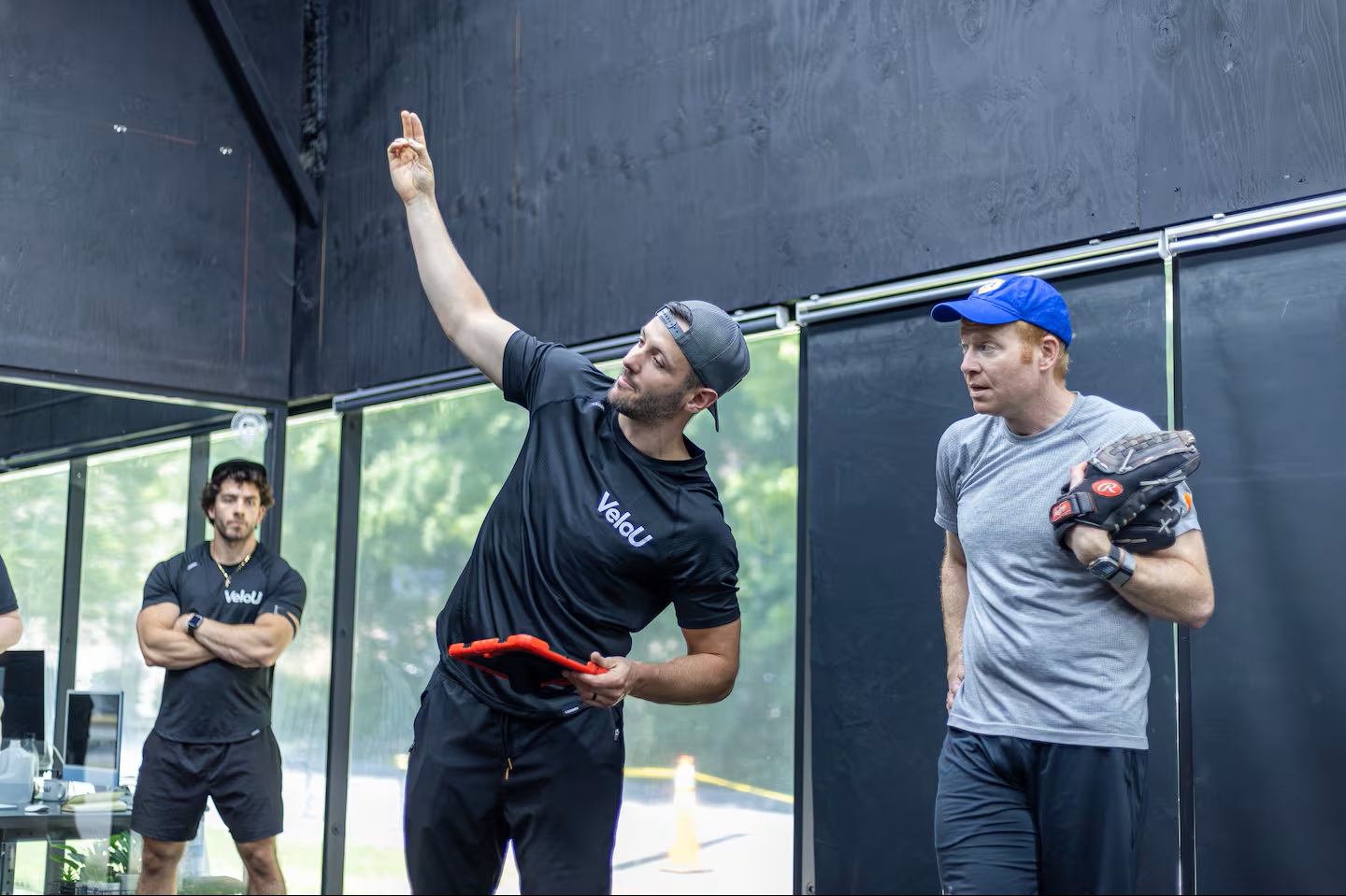
Here’s Jankins demonstrating my exaggerated arm slot for me. Image: VeloU
“Your rotation mechanism right now is basically just pure thoracic extension and tilting,” added Jankins, who rose to Triple-A in the Brewers system, explaining that I bring my arm over the top to create energy because, despite my best efforts, I couldn’t easily whip my torso around, thereby not taking full advantage of my lower half’s ability to generate force.
As Jankins put it, pitching mechanics are a byproduct of the body’s strength and flexibility. The throwing motion is a way to feel comfortable within those limitations. Serio believed I should prioritize generating force from the ground and through my legs because it ought to be more fruitful than whipping my upper body around.
“Most of the time, we don’t worry about the end of a race,” he said, referring to the throwing motion and likening my pitch to the finish and my mobility to the starting line. “We worry about the start of a race. In my opinion, you’re not built to wrap the way you’re wrapping, and that’s throwing everything else off.”
Performance coordinator Paul Franzese chimed in with some helpful weight room tips to emphasize the proper hip position when lifting. Serio noted that my squat during the movement assessment should be better leveraged in my pitching motion.
“You have too good of a squat for somebody that’s your height to not try and work on getting into that [position],” Serio added. “You’re avoiding loading your hip.”
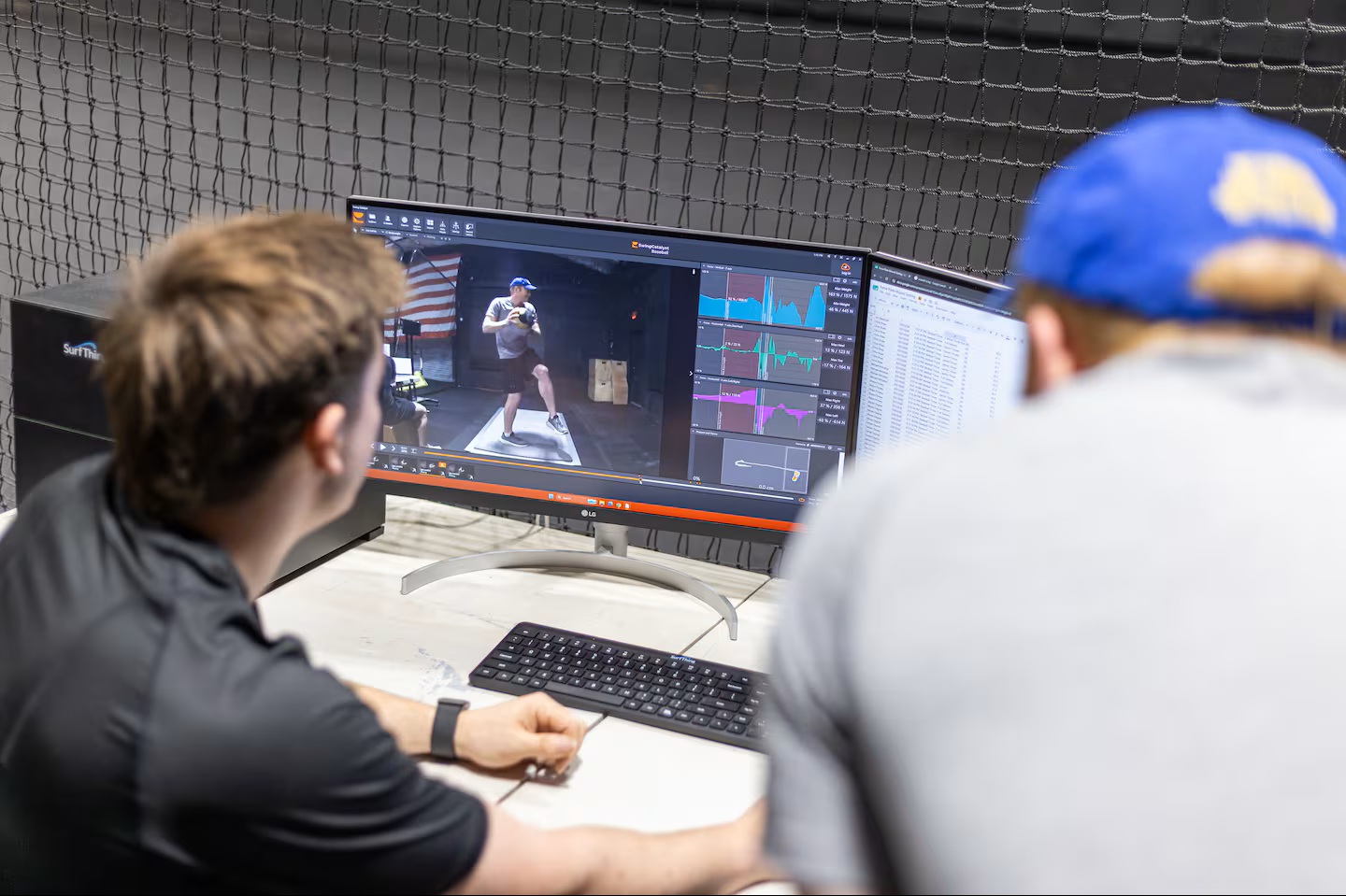
Throwing a med ball on force plates helped isolate my force production and sequencing. Image: VeloU
KinaTrax, the high-end motion capture system, is set to be installed later in the summer as well as a set of Bertec force plates built into a mound. In combination, that’ll give richer data on biomechanics.
Projecting velo for U
VeloU has built its own custom player reports, and Jankins led the creation of a proprietary algorithm predicting an athlete’s capacity for velocity. The end result is a total energy score analogous to the max throwing velocity a body is capable of throwing.
The algorithm, which Serio said will soon be licensed to college programs, is built on four metrics that are all composites of the individual assessments:
My total energy score was 81.8, and that’s right on the nose. A couple summers ago, I touched 82 mph. More recently, I topped out at 81 mph while throwing on a Pocket Radar. The big test, though, would be throwing on VeloU’s TrackMan. I had never thrown on an enterprise device like that; it formerly powered MLB’s Statcast and remains a leading provider in top colleges.
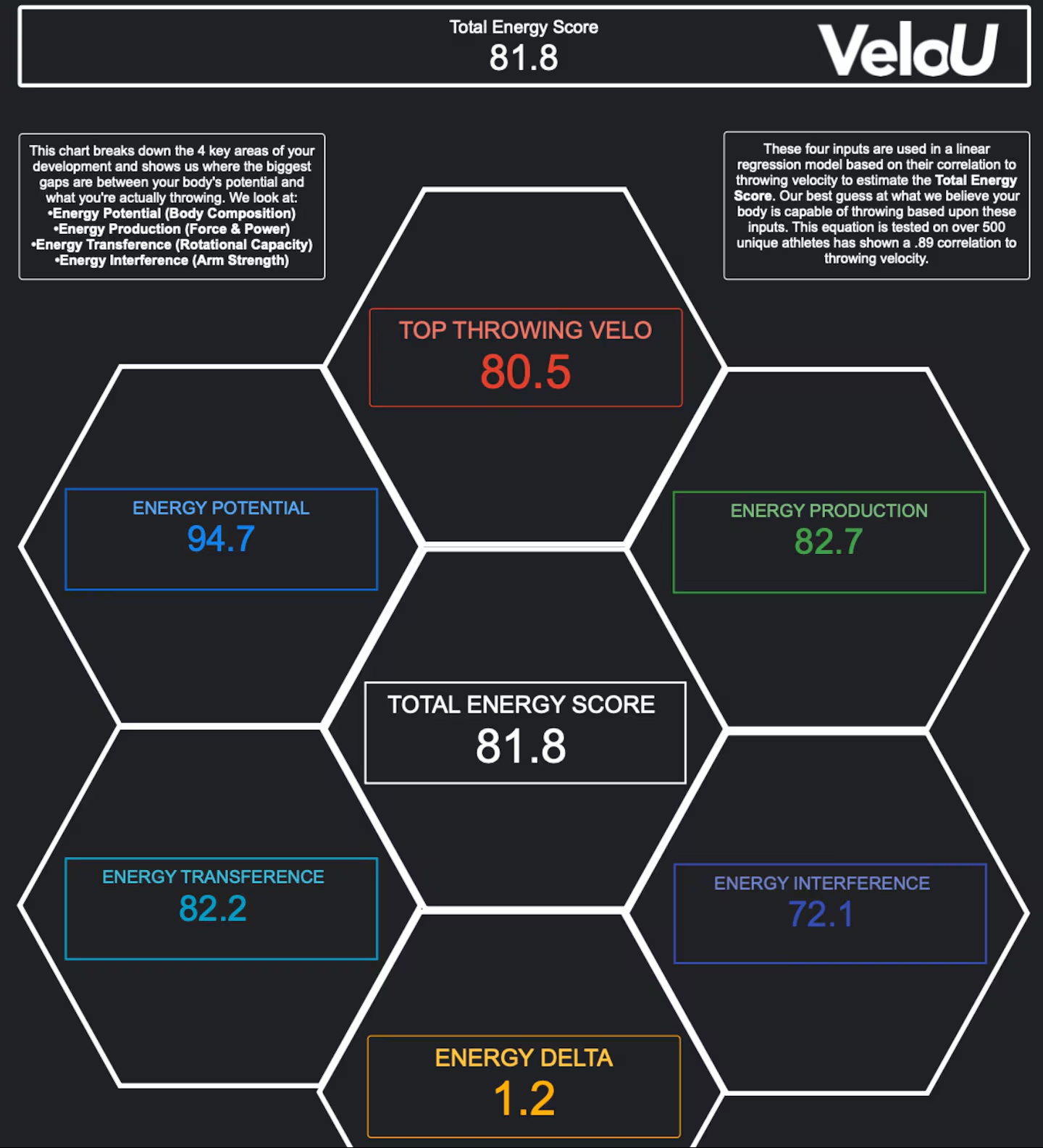
The VeloU reports tells me I’ve got great energy potential and subpar interference, meaning I need to strengthen my arm. Image: VeloU
As I neared the end of my throwing session, I had been maxing out in the upper 70s when Jankins gave me a final charge.
“We’re going to go just one more fastball to finish,” he said. “Give us 80.”
I rocked and fired, the ball sailing well wide of the strike zone as I put far more effort into velocity than command. TrackMan flashes a preliminary speed immediately before taking a few seconds to display the confirmed final number, initially showed 80 mph as the half-dozen VeloU trainers watching me cheered … before settling on 79.3, with the background noise descending into groans.
“One more,” I said, knowing the pressure was on.
This time, TrackMan began north of 80 and stayed there, registering 80.5, a reading met with a sustained cheer around me. Someone in the crowd equated the anticipation to one of their regular trainees trying to hit 98mph for the first time.
It was a supportive comment to show how invested the group was in my success, but it also reinforced for me how far away I was from the elites. I felt very much like a retiree auditing a course at VeloU.
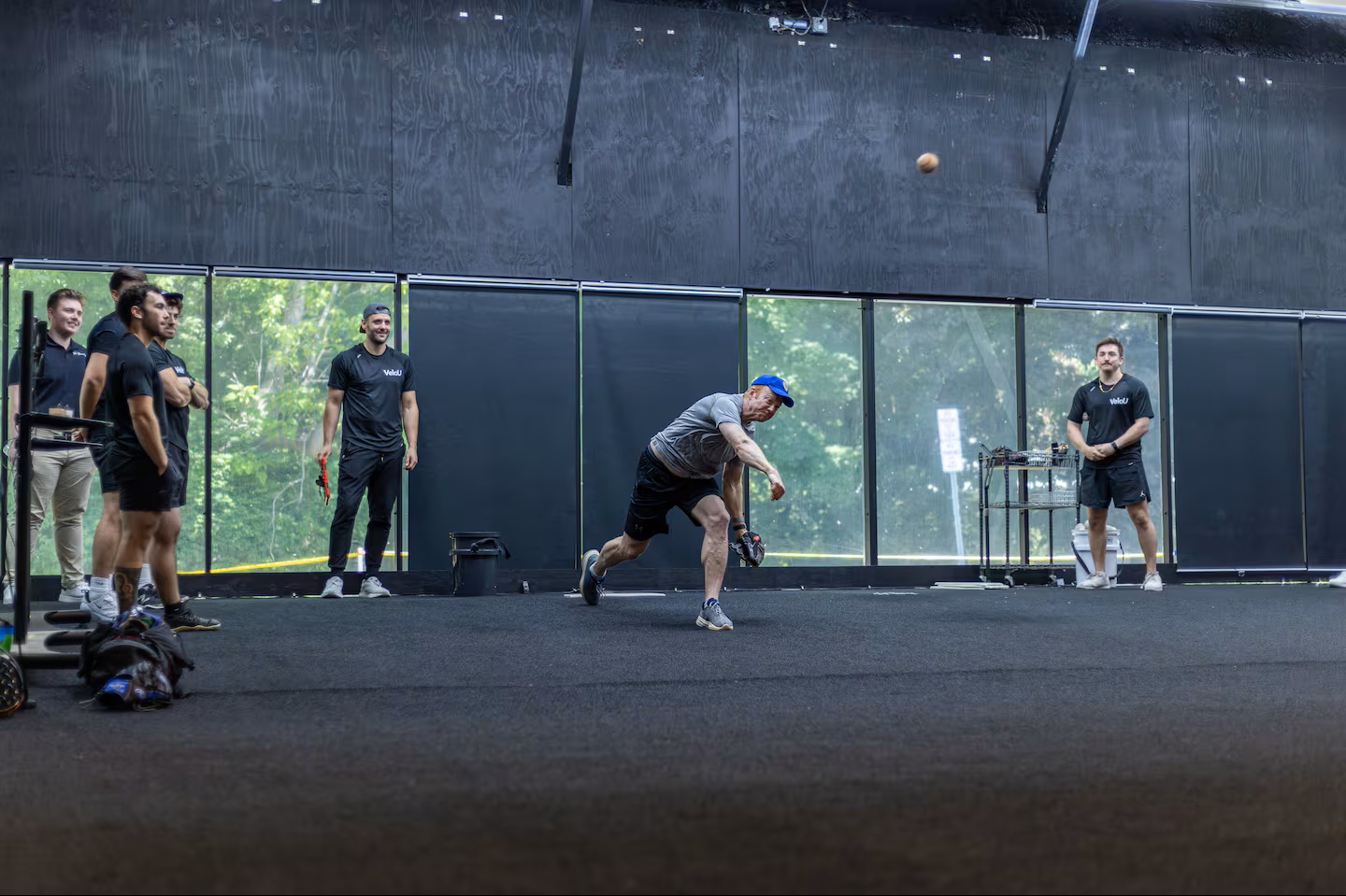
This baseball may look stationary in the photo, but TrackMan told me it was traveling 80.5 mph. Image: VeloU
This article was brought to you by SBJ Tech, a Leaders Group company. As a Leaders Performance Institute member, you are able to enjoy exclusive access to SBJ Tech content in the field of athletic performance.
As they told Leaders Performance Institute members, the Boston Red Sox’s Ben Crockett and Brisbane Broncos’ Troy Thomson believe it is a question of trust, education and collective responsibility.
At the 2025 Leaders Sport Performance Summit in London, he shared a decade-old story about a pitch-tracking technology that had been excitedly introduced by the club’s performance team. “It was a tool to help provide the coaches with more information that would help them in their coaching efforts and provide feedback,” said Crockett, who now serves the Red Sox as a Special Assistant of Basketball Operations.
The project proved to be a flop despite the technology doing exactly what it was supposed to do. Today, Crockett understands where his team went wrong. “We didn’t teach it enough; and we actually installed somebody to help operate it, which we thought would be helpful.” However, “in some ways it actually took away the ownership of our coaches for a solution that was ultimately going to help them.”
The Red Sox pitching coaches carried on doing their own thing; the merits of the technology were irrelevant to them. They didn’t trust, understand or see how it would help. “That was a good lesson in terms of what not to,” added Crockett, who shared the stage with Troy Thomson, the Football Operations Manager at the Brisbane Broncos, who had a cautionary tale of his own.
“Quite often, someone over-promises and under-delivers,” he said. “When you finally get the hardware in, it doesn’t quite have the capabilities you need.” It is no wonder that coaches can be wary of new datasets.
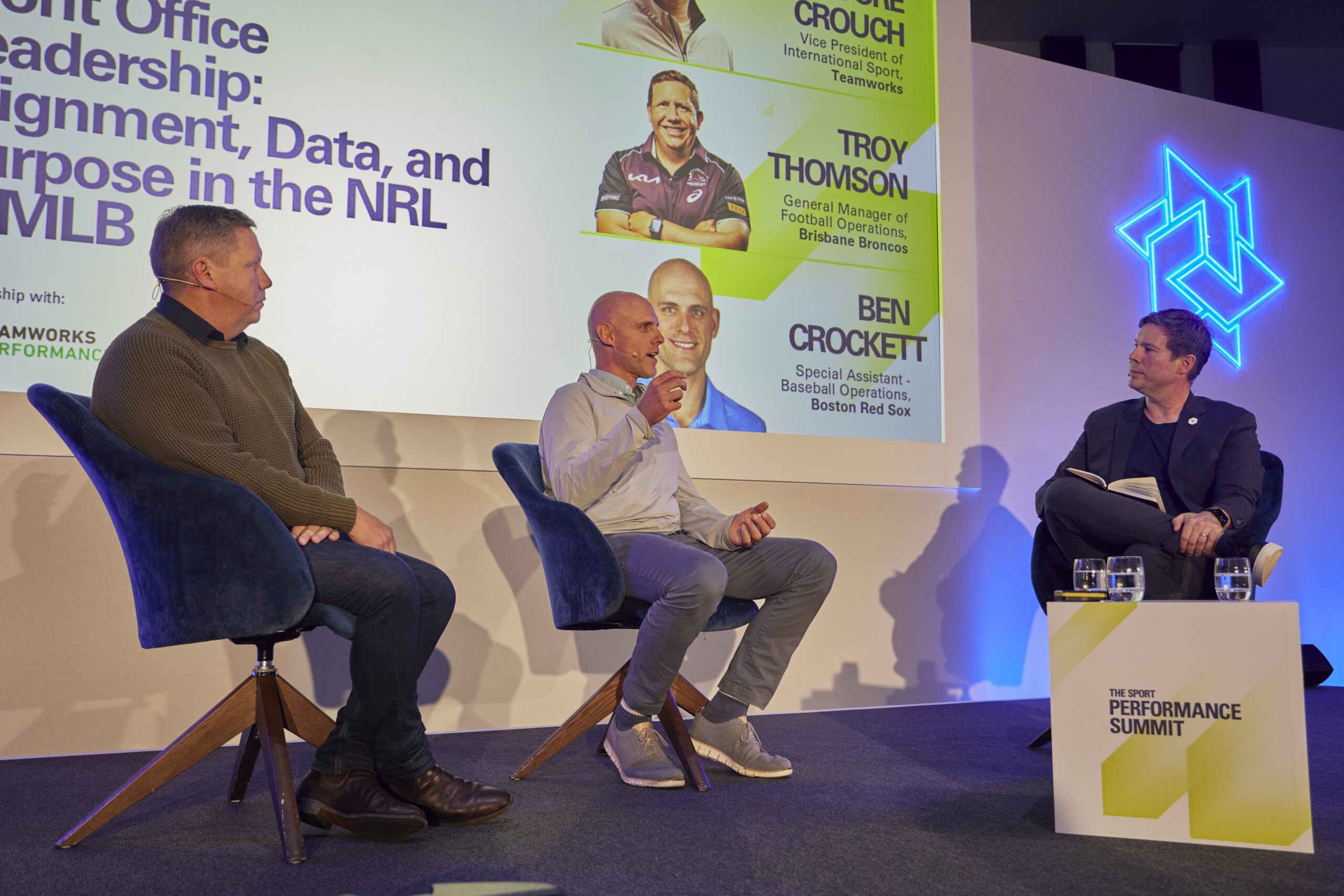
Ben Crockett (centre) speaks onstage at the 2025 Leaders Sport Performance Summit in London alongside Troy Thomson (left).
Over the course of half an hour onstage at the Kia Oval, Crockett and Thomson explained why data is valuable only if it can positively influence decision-making and behaviour. Their efforts to refine their approach point to five common principles: transparency, education, alignment, ownership and storytelling.
Transparency – information only matters if people can see it
Data is most useful when athletes understand the metrics, contribute to the resulting discussion and take responsibility for acting upon the information unearthed.
Transparency at the Red Sox, as Crockett explained, is embedded in a system of “continuous feedback loops within session, after session, after games” between coaches and the players, who develop a “continued understanding of where they stand on chasing specific measurable goals that have been agreed upon between the player and the team.” He added that “the athletes today are much more open to getting that type of information”.
Thomson also noted that Broncos players actively seek feedback on their performance metrics. For example, they now “want to finish the session and come and see what their line speed metrics are,” he said.
Education – data must be understood before it can influence decisions
Data can begin to influence decision-making when people understand both the numbers themselves and the behaviours those numbers are intended to shape. As Crockett noted, “it isn’t a one-time presentation; ‘here’s what everything means’. It’s ongoing.”
At the Broncos, Thomson emphasises the importance of helping players understand what data reveals about their performance. The coaches’ role is one of showing rather than simply telling.
He said: “The coaches also work really hard from a visual point of view as well, so being able to show the players technically how they’ve been working is a really important part of the process.”
Alignment – everyone working towards the same goals
To reach a collective understanding of what success looks like and how it is achieved, teams must first establish what matters most. Data can be a useful tool in that regard.
When Crockett discussed the challenge of coordinating a baseball operation that includes Major League, Minor League and player development programmes, he stressed the importance of “clearly defining key metrics that drive value for us at the Major League level and drive value throughout the industry.” Once those metrics have been identified, the task becomes ensuring everybody is working towards the same outcomes. Crockett described how the Red Sox seek to “help align our player development staff and personnel development staff with the things that were most important to driving that value”.
It is a similar story at the Broncos. “We’ve got a whole heap of different stats that we use; so post-game, there’s some standardised stats that we know if you get those processes right, the result will look after itself,” said Thomson, whose team has put in a lot of work behind the scenes. “To be able to bring the whole collective leadership group on the journey was really important.”
Ownership – data belongs to all stakeholders
Crockett and Thomson both argue that data becomes valuable when the people making decisions feel responsible for using it. Crockett’s pitch-tracking debacle is a prime example of what happens when that ownership is absent. As he recalled: “It ended up becoming a bit more of a ‘well, that’s their information and the pitching coach’s; and I’ll do what I’ve just been doing the whole time’.”
To prevent such scenarios, as Thomson explained, teams must create environments in which practitioners feel comfortable sharing ideas, challenging assumptions and seeking new sources of information. He said: “It’s really important to have a psychologically safe environment where we’re challenging each other on a daily basis to be able to find new metrics or new data sets that can actually enhance the programme.” At the Broncos, the software eventually “became part of a routine for us”.
Storytelling – data is most useful when it explains performance
Behavioural change in a data context depends on the story your numbers tell. Thomson repeatedly stressed the importance of using statistics to tell a story because it “adds to the coaching”.
Not that every stat holds the same weight; coaches have a responsibility to “share the relevant data that tell that story to achieve your outcomes”.
The Broncos’ momentum-tracking software is a case in point, as Thomson explained. While initially unsure how useful it would be, the tool was valued because “it allowed the coaches to be able to present the feel of the game”. By helping coaches explain something they previously struggled to articulate, the data became far more powerful as a catalyst for decision-making.
What to read next
As Keith D’Amelio, the Chief Innovation Officer of the the New York Liberty, explains: technology matters, but culture, communication, systems design and long-term thinking matter more.
Main Image: Getty Images

Ndamukong Suh, who played 13 seasons in the NFL without missing a game due to injury, remains an active investor in athlete performance tech. Photo: Getty Images
This article was brought to you by SBJ Tech, a Leaders Group company. As a Leaders Performance Institute member, you are able to enjoy exclusive access to SBJ Tech content in the field of athletic performance.
As part of SBJ’s Sandbox Series, Ethan Joyce trialed NTangible’s Clutch Factor assessment to examine if the sports industry can quantify what enables athletes to deliver when the stakes are highest.
Main Image: Getty Images
Normally, it’s my colleague Joe Lemire who experiments with new tech for our recurring Sandbox Series. But this week, it was me dipping my toe into the test zone — and I recoiled with a wounded ego.
When it comes to human performance, clutch is still a polarizing topic. Is it even real? The analytical stat heads say no, but anyone who’s seen a game-winning shot or a career-defining performance by a star athlete may beg to differ. So, what if you could evaluate people based on their likelihood to perform in high-pressure situations?
NTangible has figured out how to measure it.
The platform, which provides mental scouting assessments for athletes for multiple sports, was created by President/CEO Dan Connerty. Its testing, which features open-ended and multiple-choice answers, uses AI to analyze things like thought process, perspective and wording.
Connerty has been on this startup adventure full-time since 2024, with NTangible now in use in 40 NCAA programs (including Boston College and Florida Atlantic). Last year, the company became the official mental fitness partner of RFK Racing to evaluate and support its pit crew members.
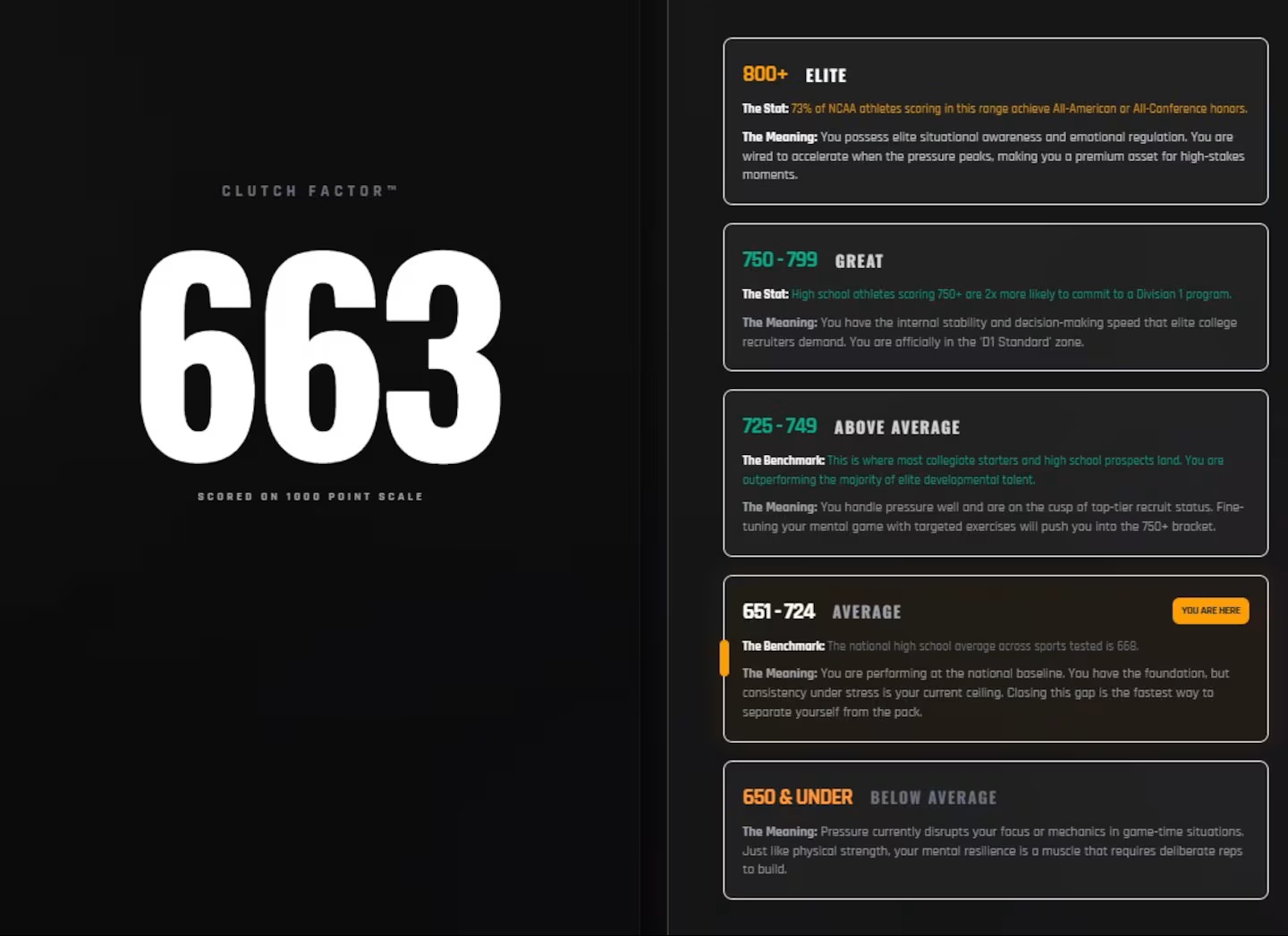
Image: SBJ Tech screenshot
Based in Canada, Connerty spent most of his time in the baseball development space as a former collegiate and pro athlete. He was the principal director of Baseball Development Group from 2017 to 2019, and during that time, he got to know industrial psychologist Ed Levine. And it started this ongoing pursuit.
“At the time I go, ‘We’re going to reach a point where we cap out what we can measure physically — it’s going to happen,’” Connerty recounted to me. “Mental has always been this black box … nobody wants to touch it.”
Enter the Clutch Factor score, which evaluates mental performance in clutch scenarios. In roughly 20 minutes, I ran through a handful of pictures depicting various scenarios. (I did a basketball test since it’s the sport I played the most.) One was an image of a player shooting a free throw, the next was a ball handler staring down a full-court press, and others were similar in-game scenarios. I had a chance to pick my perspective of the play, who I would be and what I’d be planning to do next. I also shared my past experiences of higher-pressure situations.
When I finished the test, I was given a score of 663. That figure is out of 1,000, which placed me in the average category. Connerty said the scores can be quite predictive of college success (NTangible can test athletes as young as 13). The athletes who score in the 750-799 range are twice as likely to play a Division I sport. Above 800? We’re talking a potential all-conference or All-American honoree. Example: Texas freshman P/UT Hannah Wells produced the highest Clutch Factor score in the country. She helped the Longhorns win their second consecutive College World Series softball championship earlier this month.
After sharing my lack of clutchness, I could tell you about my days as a newspaper college football reporter. I was constantly combating the harshest deadlines, filing stories that squeaked in just early enough to make the next day’s edition, some of which I won national awards for. But I won’t do that.
The good news for me (and other users)? Because my clutchness can now be measured, I can also improve it, according to Connerty.
“Our psychologists have said, at minimum, if you wanted to redo it, six months,” he said about retesting. “Usually, this should be an annual test just to see where you are. If you think of the Clutch Factor score as your capacity to perform at your top range, not every day are you going to be there.
“This is something where your score can fluctuate based on experiential parameters.”
That’s totally it! I had an off day. I’m sure of it. Case closed.
This article was brought to you by SBJ Tech, a Leaders Group company. As a Leaders Performance Institute member, you are able to enjoy exclusive access to SBJ Tech content in the field of athletic performance.
