Leaders in Business
  • Membership
  • Events
  • Content
  • Virtual Learning
  • Connections
  • Partners
Login
  • Leaders Meet: Innovation
  • Events
    • Leaders Week London
    • Leaders Sports Awards
    • Leaders Club Events
    • Leaders Performance Institute Events
    • Leaders Meet: Innovation
  • Memberships
    • The Leaders Club
    • Leaders Performance Institute
  • About
    • Careers
    • Contact
I’m a sports leader:
  • Off The Field For those focused on the business of the sport View more
  • On The Field For those working with an athlete or elite team View more
  • Login
    • Leaders ClubThe membership for future sport business leaders
    • Leaders Performance InstituteThe membership for elite performance practitioners
  • Newsletters
Performance Institute Leaders Performance Institute Logo
  • Membership
  • Events
  • Content
  • Virtual Learning
  • Connections
  • Partners
Login

16 Jun 2022

Articles

How Do you Coach Jordan Spieth?

By Sarah Evans

  • Harness the athlete’s internal drive, create a realistic vision.
  • Encourage your athlete to be their own best coach.
  • Create a belief that no matter what happens your athlete will rise from setbacks.

Cultivate a clear vision

Cameron McCormick, who has coached an array of PGA and LPGA players, has been Spieth’s coach since the latter was a 12-year-old dreaming of winning golf’s most prestigious major, the Masters. He saw in Spieth “the drive and determination that fuels the necessary ability to do work,” as he told the 2016 Leaders Sport Performance Summit in New York, and worked to support Spieth’s goal of winning the Masters for almost a decade. Spieth possessed what McCormick called the “internal drive that sees a future reality,” making the link between Spieth’s drive and vision of the future. The youngster set his goal very high from a young age and, with the right support, was able to chase his Masters dream without being afraid to aim high. In 2015, aged 21, Spieth became the youngest player to win at Augusta since a 19-year-old Tiger Woods in 1997.

Self-belief and resilience

McCormick explained that one key way of being able to bounce back from a defeat or bad performance is “a self-belief that no matter what happens I will rise again”. He emphasised the critical importance of self-talk, and “signal-to-noise management”, whereby the noise that exists has a decided advantage, i.e. taking in the jeers from Augusta or playing forward negative situations in your mind versus the signal that you want to control. “Be a creator of the scene in your mind, not a viewer of what you are experiencing,” he said. McCormick is able to measure this with the athletes by reframing the scenario and creating perspective. It is a centring process, and needs to be repeated and cultivated consistently over time.

He then spoke about the round briefings he has with Spieth and how he uses these as an opportunity to “pump his tyres” and how Spieth is then able to build his self-belief. It is all about the principle of reinforcement, the more you think about and talk about something happening, you increase the probability of it taking place, which works, of course, both positively and negatively. Therefore, playing a highlight reel, remembering your strengths and building positive self-talk before competition is paramount.

The Three C’s – Collect, Correlate, Correct

McCormick‘s goal, although it seems counterintuitive, is to make himself redundant to the athlete. He fosters a sense of self sufficiency amongst the players, and sets out to educate them on how to be their own best coach. McCormick only wanted his players to come back to him when they really needed his help. He calls this process the three C’s: collect the clues, attribute a correlation or causation, then close the loop with a correction. This ability for the athletes to figure it out themselves and “dig it out of the dirt” is critical when their contact time is at a minimum.

Get buy-in from key influences

Athletes rely upon a good support system and McCormick understands how important it is to filter his core coaching messages through the key influences in an athlete’s life. Done well, those messages will resonate beyond the coaching session itself. McCormick called it “the rule of 168”. There are 168 hours in a week and he might only get one hour with an athlete. “Therefore that hour needs to be high octane and have longevity over a week or two-week period so when they come back, you’re not in the same place,” he said.

13 Jun 2022

Articles

Self-Regulated Learning: the Route to Better Talent Pathway Transitions?

Category
Coaching & Development
Share
Facebook Twitter Email Copy Link
https://leadersinsport.com/performance-institute/articles/self-regulated-learning-the-route-to-better-talent-pathway-transitions/

By John Portch

  • A holistic approach is essential if students are to have viable exit strategies.
  • Self-regulated learning is better for development.
  • How can you better use parents to support the work of your talent pathways?

Plan exit routes from the off

Much like aspiring athletes striving for elite level, not all students at the Royal Ballet School will forge a career in classical ballet and so it is incumbent on the school to prepare its students for that eventuality. As Christopher Powney, the school’s Artistic Director, told an audience at the 2021 Leaders Sport Performance Summit in London: “We want to make sure that students have the proper education and the proper nurturing to maximise who they are as a person and that ‘success’ is actually anything they can take from the school that they can employ in their future life, whether it be in dance, or if they’re unsuccessful in getting there – because there’s no guarantee at all they will achieve that – of being able to take what they’ve learnt and take that into whatever profession they decide to go into.” The Royal Ballet School’s approach is holistic. “Success for me is that the child is OK coming out of school and they are a good human being who can maximise themselves, they feel confident, they’re curious about life, and they want to develop themselves into whatever field they want to go into,” added Powney.

Build paths towards self-regulated learning

Youngsters in sports academies – and sometimes even accomplished senior athletes – may not be fully cognisant of how to train to attain and sustain their level. It is often a similar scenario with students at the Royal Academy of Music [RCM]. “By the time they get to us they will have already accrued 10,000-15,000 hours of practice and yet some of them say that they don’t know how to [practise] effectively,” said Dr Terry Clark, a Research Fellow for Performance Science at the RCM, who spoke alongside Powney at London’s Twickenham Stadium.

The RCM offers a range of courses based on the theme of effective learning that are designed to enable students to be less teacher-dependent as they transition through the course. Clark continued: “We’re looking at how we might be able to use novel technology to support our students’ development in things like self-regulated learning.” This includes peer support models as well as the RCM’s self-regulated learning framework, which starts with planning. “Being able to identify goals that they want to achieve in a short practice session and strategies for being able to do that. Being able to monitor focus, concentration, self-evaluation in the moment, but then, post-practice, reflecting and debriefing back on that. We have a lot of courses devoted to these things but we also do a lot of one to one work with our students as well, taking them through this process.”

The mental side of training is paramount

Clark, who works at the RCM’s Centre for Performance Science, spoke of the College’s performance simulator as a practice tool. The simulator, which places students in a performance situation with features such as a stage, a backstage and, if desired, even a restless audience, helps students to develop not only their performance but their coping and regulating skills. The simulator is essential for performance reps. “Performance opportunities are not as plentiful as the student might like but they’re also high-pressure events and there may not be opportunities necessarily for our students to learn from and debrief those performances,” said Clark. “It’s a safe space, musicians can try out new things, make mistakes perhaps, but there are no repercussions from that.”

Bring the parents onboard

“The majority of the parent body are fantastic,” said Powney when acknowledging the challenges that parents may pose. Historically, the Royal Ballet School used to keep its students’ parents at arm’s length. Not anymore. “We try to teach parents what’s involved with it,” he continued. “We also encourage the parents to talk to the children and the children to talk to the parents constantly about how they’re feeling, how they’re doing, and to allow them the space to say ‘actually, I’m struggling’. And then we put in place the supporting measures we need to help them with that.”

Members Only

10 Jun 2022

Articles

Why Athlete Trust Needs To Be Earned Away From High Pressure Situations

Category
Coaching & Development, Premium
Share
Facebook Twitter Email Copy Link
https://leadersinsport.com/performance-institute/articles/why-athlete-trust-needs-to-be-earned-away-from-high-pressure-situations/

By Sarah Evans

  • Are you someone who builds others up and brings out the best in them? Or do you let your ‘stuff’ fly out sideways at others?​
  • The athlete needs to know in the critical moment that you have their back
  • Allow the athlete to operate from a place of belonging rather than fear

In May, we held a Member Case Study Virtual Roundtable titled, Communication in High Pressure Environments, which was led by Leaders Performance Advisor Rachel Vickery, who is an expert in high-stakes situations. One of the key takeaways from the discussion was the notion that trust between athlete and leader is built up and earned away from pressure. Here we look to explore the three key areas that underpin this process of building trust.

1. The common factor in all sport is the human stress response

Vickery explained that the human stress response is something that we all have and can hugely affect how we operate within high stake situations. It is a primal response, and something that is survival driven. “We become very ‘me’ focused and combative” when in this state, says Vickery, which is not conducive to success in high performing sport. Therefore, it is so important as leaders to be aware if you yourself enter this state, and also recognise if your athletes respond this way in high pressure moments.

2. Understand what you are ‘bringing’ into every interaction

Vickery stressed that often within teams, “the strongest energy will determine the vibe”. The team will model the behaviour of the coaches and leaders within the team, so it’s so important to recognise the energy leaders are giving out. Emotionally intelligent leaders need to set the energy through their communication, and therefore it is critical to understand the energy you as a leader bring to any interaction. Vickery posed some questions which are incredibly useful to ask yourself as a leader. She said: “If you are stressed, how does this present in your body language? If there is a breakdown in communication, think to yourself, ‘Am I bringing something into this interaction?’” If you can be aware and understand how you show up under pressure, you can learn to adapt, and even practise in low-threat environments how you want to react under real stress.

3. Fear of failure is more likely to elicit mistakes

As Vickery said: “If you are volatile and others don’t know how you are going to act, the athlete might anticipate your reaction and operate from a sense of fear rather than belonging”. If they operate from a place of fear, they are more likely to tense up and make more mistakes. Whereas if you can remain calm and centred, and the athletes trust that you have their best interest at heart, they are more likely to be successful. “The athlete needs to know in the critical moment that you have their back to give them the freedom to perform to their best,” added Vickery. This will take time to be built up, but don’t take for granted the daily interactions you have, and how important these can be in building trust, so that when it comes to the real pressure moments, you and the team will have a much higher chance of success.

Members Only

6 Jun 2022

Articles

‘We Need you to Trust your Coaches More than the Talent that Brought you Here’

Category
Coaching & Development, Premium
Share
Facebook Twitter Email Copy Link
https://leadersinsport.com/performance-institute/articles/we-need-you-to-trust-your-coaches-more-than-the-talent-that-brought-you-here/

By John Portch

  • People are emotional and not necessarily rational – you need a student’s trust more than you need a 10-point plan.
  • Progression is not linear so be sure to have an environment where youngsters feel safe when making mistakes.
  • Life skills – resilience, collaboration, communication – should be baked into your curriculum.

Do your youngsters trust you when setbacks arrive?

The Chicago Academy of the Arts recruits some of the United States’ finest performing arts talents but, much like a gifted child entering a sports academy, their abilities may no longer stand out on campus. There is the potential for friction as teachers and coaches break down and rebuild their performance. “They might not see results today or tomorrow and we’re asking them to take that on faith that this is going to work,” said Jason Patera, the Head of School, when speaking at the 2017 Leaders Sport Performance Summit down the road at Chicago’s Soldier Field. Patera and his colleagues know how to manage bumps in the road that students inevitably encounter and that is where trust can be developed with the young person. “When we as the leaders can get out in front of [setbacks], we know it’s going to happen, when we can set up in their mind to expect that, not only can we help prepare them for that, but when it does happen, they say ‘oh yeah, [you] told me about that thing. What else can you tell me? I am ready to hear you on these other things because you called it and I believe you.’”

Are your young people ready to take a leap of faith?

Patera explained that even if a student tells him they want to be the next Steven Spielberg or a prima ballerina, he knows that deep down kids set personal limits that need breaking down. “The first thing we have to do is help them expand that conception of what it’s possible for you to do,” he said. “We have to take them from thinking about who they are – ‘I am an athlete, I am a dancer, I am a singer’ all these static things – and get them focused on ‘what can you change by the work that you do? What can you change by the training that you do?’ To help them understand that ‘where I go is related to the things that I do’.  That’s the first part. Then the second part is creating that trust. If they don’t trust you in this scary time, they’re going to cower in fear and not take that leap of faith into trying something new.”

Are you preparing your youngsters for plan B?

Chicago School for the Arts alumni includes Grammy winners, Broadway stars and world-renowned ballerinas, but it also includes computer programmers, attorneys and game designers. “There’s so much luck involved that we have to prepare them for the other thing,” said Patera, who defines ‘the other thing’ as those careers beyond the arts. “We have to think in our training of not compromising that dedication to the dream, but it would be enormously irresponsible to say we’re going to spend the next four years of your life preparing you for that Juilliard audition that you have a one in 50 chance of passing, and if you don’t make it, say ‘sorry kid, you’re kind of irrelevant.’” The school’s curriculum is designed to prepare students for plan B, especially if they realise the arts are not for them. Patera added: “When people get a sense of how to collaborate better, when they get a sense of how to lead better, when they get a sense of how to respond to failure better, not only are they going to make the team better – or in my case it’s the ensemble – not only is the main product going to be better, but they’re more useful in whatever path they go on.”

Members Only

2 Jun 2022

Articles

‘It’s the Metrics Below the Headline Stats that we Need to Monitor’

Category
Data & Innovation, Premium
Share
Facebook Twitter Email Copy Link
https://leadersinsport.com/performance-institute/articles/its-the-metrics-below-the-headline-stats-that-we-need-to-monitor/

By John Portch

Kate Burke, the Lead Pathway Analyst at the Rugby Football Union [RFU], agrees that the data analyst is a storyteller, but believes that the idea goes further.

“We’re telling data-supported stories but it’s also data-supported feel,” she tells the Leaders Performance Institute.

“In a presentation, how do you make sure that the data wanted by the coach stands out? We do a lot of work around making presentations look good. We ask ourselves how, if we’re giving a coach one slide of information, we can ensure their eyes are immediately drawn to it? It’s similar with players. There’s lots of tools now where you can draw people’s eyes to what they need to see. Especially when you do review meetings with players, you’ll show a 30-second video clip and I’ll say pretty much every player in that room will be looking at something different because it’s relative to how they see the game, what they’re doing for their position, how they’re trying to see it. So the use of drawing tools on video or arrows means that everyone’s eyes are drawn to the same place. Then everyone’s looking at the same thing.”

The relevant information needs to fly off the page. Burke adds: “If I’ve got a big presentation to do or some key information to put across, I’ll speak to my friends who know nothing about rugby and ask ‘does this make sense? This is the information I want to get across and does it get across?’ The important information will jump off the page and then, whilst we’ve got all the other information in the background, there’s a time and a place for that to come out.”

Burke, who oversees data analysis on the men’s and women’s rugby pathways, has almost 15 years’ experience working in the sport and is well-placed to discuss the role of the analyst in supporting coaches and multidisciplinary teams.

Kate, how important is it for the analyst to work with coaches to establish what their priorities are and how data can support those?

KB: Unless we understand what coaches are trying to do, and have a clear picture, then our job is completely irrelevant. I’ll get all of my new starters to go and sit down with their coach to work out what their coaching philosophy is. There’s a lot of coaches who are top level but everyone’s philosophy around how they see the game is different. There’s no two coaches in the same way that there’s no two players who are the same. But the hard bit for the analyst then is trying to remain objective when you are integrated into a coaching and team philosophy.

In what sense is that hard?

KB: You can become invested in the coach and their philosophy. I did this at the start of my career. You buy into what the coaches are trying to do, what they’re trying to achieve, and you think ‘this is awesome’. However, to have a clear picture of what the coach is trying to do and how they are doing it, you have to remain objective. You need to be able to drop in information that answers questions such as ‘are we doing this right?’ or ‘are we actually achieving this and what are we doing to achieve it?’ Training is a good example. Historically, we as a discipline did not analyse effectively against what we were trying to achieve and what we were trying to do in the match at the weekend. How do you make that a seamless process from an analytical and feedback point of view? If you’re an analyst working with four or five different coaches, trying to understand what each is trying to do to achieve that overall objective is key. It is easier for an analyst to work with a coach that has clear ideas of how they see the game and what they’re trying to do.

Once you have that idea, what does the analyst need to ask themselves?

KB: They need to find the data that support what the coach wants and also the data that may not. For example, lineout win percentage. Your lineout win percentage is fine but it’s just a stat. There are six or seven working parts to it so how do you make sure you’re monitoring all of those as opposed to just the outcome, which will give you a number, but it needs detail and context to add value. It’s often the metrics underneath, those leading to that headline stat, that need our attention. There’s aspects that we have to monitor in the background because if we only monitor the datasets that the coaches want, you’re missing so much more of the game.

How will you approach a coach if you think they’re missing something?

KB: The majority of information we give coaches will be driven towards them, but there’s going to be times when there’s a broader piece around ‘we’re not doing this, we think we’re doing this, but we’re not. This is what we’re actually doing’. It isn’t our job to suggest how we can do things better but to show them what the data is telling us. Having good relationships with the coaching teams allows challenging conversations to take place. These conversations have to be backed up with what the data is telling us.

Pathway players have individual development plans [IDPs], but what about the aspects of their development that are not easily measured?

KB: In the pathway, there is always a mix of objective and subjective data and there is always going to be something you can’t measure but there will be roundtable discussions with everyone involved in the player’s development. They’ll discuss the relevant datapoints and everyone has a different role to play, from our coaches and medics to strength & conditioning and the psychologist. Having those people in the room to talk around everyone’s IDP is key.

What are some of the challenges that have emerged?

KB: Typically, pathway staff have tended to spend time talking about the players that are doing well or the players who are not doing as well. How do we ensure that we are talking about the players who are just staying constant? What do they need for their development? We’ve got a lot of data in this space, but the pathway especially is hugely context-driven around where the player is in a lot of areas – technically, tactically, psychologically and physically. We also need to look at where they are, where they’re playing, what their playing programme looks like in order to monitor and plan for the player effectively. The rugby academies across England are brilliant in the ways in which they work and understand players. They have the most amount of time with them and there are some great pathway and development specialists working at that level.

26 May 2022

Articles

Leaders Meet: Learning & Cultural Development – the Key Takeaways

Category
Coaching & Development, Leadership & Culture
Share
Facebook Twitter Email Copy Link
https://leadersinsport.com/performance-institute/articles/leaders-meet-learning-cultural-development-the-key-takeaways/

By Luke Whitworth

The focus of our first Stateside Leaders Meet of 2022 was centred around the concepts of Learning and cultural development.

Throughout the day, we sought to learn how to apply new thinking and ideas in practice, explored how we are looking to evolve our respective organisational cultures, we even profiled the Blue Jays’ environment after spending time walking around their new Player Development Complex in Dunedin, Florida, and we wrapped up the day by hearing how Jack Easterby, who is responsible for implementing the core themes of the day at the Houston Texans, where he serves as Executive Vice President of Football Operations, puts them into practice.

Across the day, the group discussed concepts such as the application of learning, learner safety, becoming a cultural architect, belonging and much more. Taking these dynamics in mind, here are the choice insights from the day’s proceedings.

Session 1: Application of Learning

Speaker: Dehra Harris, Assistant Director of High Performance Applied Research, Toronto Blue Jays

  • Continuous Learning: one of the best things you can do for yourself is always be learning. If you aren’t learning, how are you going to help others learn better?
  • Ingredients for Applied Learning Model: specificity, support & perspective taking.
  • Perspective Taking: this is the key to applied learning. Activate the right part of the brain through asking questions.
  • Do vs. Reflect: in high performance sport, there is a culture of doing, but in the process of quality applied learning, we need to reflect on how we do things.
  • Create a Sense of Belonging: people do not fail on purpose – belonging is always at stake and is often something that is overlooked. What actually enables someone to take risks? (Safe environment, trust, relationship building, vulnerability.)
  • Be a Power of Support: how willing are you to become the power of support? There can be a culture of outcome in high performance sport, which is often where our language extends to – that language is often based on the outcome we want.
  • Repetition: repetition is a key component of applied learning.
  • Specificity: specificity is your separator. If we are creating environments for athletes, the more we know them, the more we can drive acceptance.
  • All Behaviour Has Meaning: no matter what the athlete is doing, their mindset is that it is their best solution (it is their version of right).
  • Creating Specificity; Adaptive Learning Environments: core questions to consider around adaptive learning are what decisions do your athletes make? What is involved in that decision? In how we design things, what do they need from us?
  • Coaching becomes the reinforcement because the game does not provide reinforcement.
  • Do you address each element of the tasks they need to perform?
  • Repeatability & Adjustability: how are you dialling in and creating a space for repeatability and adjustability? Input variability into the things people do.
  • Understanding Obstacles: do you understand the obstacles they face? Time, understanding, can’t see it, can’t focus, physically can’t move that way, don’t have resources, don’t fit your model, don’t have support, don’t believe in themselves.
  • Support for Repeatability & Adjustability: how do we build for the above? Support for repeatability and support for adjustability.

Session 2: How Are We Developing Our Cultures & Creating Learner Safety?

  • Group 1: feedback and acting on it. Making it a two-way conversation. Something that has to happen consistently.
  • Group 2: clarity of communication. Providing a clear vision, philosophy and approach. Having two-way communication is a great way to learn. Ownership and vulnerability – owning your mistakes. Trying to now drive a philosophy and approach of empowerment, moving away from authoritarian.
  • Group 3: create time and space for conversations and learning. Do you leverage ‘coaches retreats’ where there is time for safety and understanding? Do you create strategic pauses to assess where we are at? It’s important to have context in decisions and situations. Create value in the human relationship and being conscientious.
  • Group 4: meaningful vulnerability, managing your own reactivity and having a safe environment where you need to trial and be patient. Take the emotion out of it, go to the hard areas and explore the root of the problem. Communication vs. confrontation – do they fully understand and grasp the concept? Break things down and take your time. Think about ‘calling people up or in’ – don’t call people out. Remove the stakes and listen.
  • Group 5: collaboration of input and messaging with influential stakeholders – in pursuit of this mission, these voices are collected at the start and then disseminated. Building structures, ensure that they are clear and the expectations have clarity as well. With this approach, it can create a sense of calm around what was expected. In times of change, don’t clean sweep everything, maybe only 25 per cent needs to change to evolve a learning culture.
  • Group 6: create task alignment. People at the top show vulnerability and accountability, which helps everyone else underneath to feal safer. Do you have a consistent feedback loop? It’s great to have them, but make sure you go through that feedback. Go into others environments and be vulnerable – take yourself out of the comfort zone to develop relationships in an environment that is more natural to them.
  • Group 7: what is safety? It is the healthy environment where we learn to understand vulnerability and take risks without repercussions. To help create those environments, set expectations of working (norms, acceptance, collaboration) – this will set clarity on purpose.
  • Group 8: with culture specifically, peel back layers and keep a constant review of how things are going. Get to know each other more. Have deep discussions around deep pain points of the previous year – how can we get ahead of those?
  • Group 9: vulnerability and the admission of mistakes. To improve learner safety you can ask more questions. Ask the learner how they like to learn – help them to lead their own learning.
  • Group 10: generate a community of belonging – easier to learn, make mistakes and have a safety net. Subject matter experts fear making mistakes. Feedback culture – it’s hard to learn and develop without that feedback; set expectations at the start.
  • Group 11: trust is less a thing and more a pattern of behaviour. You have to behave in a way that you have faith for someone to execute. Creating a common language can support learner safety – something that can be understood by people in an environment to drive inclusion and understanding. What do we mean when we say certain things? Feedback – what does this look like? How are we guiding people through that reflection?

Session 3: Levers for Leading Culture

Speaker: John Bull, Director & Lead for High Performance Research, Management Futures

  • Shifting Culture: 80 per cent of organisations have clearly stated ambitions around how they want their culture to be – approximately 20 per cent act upon that vision. If you look at sustained high performing environments, it’s close to 100 per cent.
  • Defining vs. Instilling: the most common mistake is putting too much energy into defining the culture, but not enough in instilling.

6 levers for leading culture:

  1. Define Aspirational Standards and Communicate in a Way That Sticks (leave the jersey in a better place and bone deep preparation are standards utilised by the New Zealand All Blacks). How sticky is your communication?
  2. Unpick Successes to Codify What Works (Appreciative Enquiry) – when we are at our best, what does that look like?
  3. Develop Skills & Or Processes to Support Intent
  4. Involve People in Reviewing Progress (Culture Conversations)
  5. Feedback (Reinforce Positive / Challenge Negative)
  6. Get the Right People on the Bus
  • Appreciative Inquiry: works well in culture change. This approach builds self-awareness and technique. Identify and share examples where you have been at your best and identify behaviours that stand out and be specific.
  • Intent vs. Skills: having an intent for culture is not enough, it takes skill.

 Four Skills of Effective Collaboration:

  1. Build High Trust Relationships at Pace: act as if there is trust immediately. Research across silos. Focus on shared interests. Invest time and energy in building relationships.
  2. Speaking Up: contribute, share knowledge, insights and ideas. Challenge each other.
  3. Listening Up: situational humility (open to what we don’t know). Proactively seek out and be open to other people’s insights and views. Lead with questions.
  4. Situational Awareness: aware of and take responsibility for how the team is performing. Help the team make good use of time (Diamond Thinking).

Three Types of Thinking Environment In Groups

  1. Open Dialogue: thoughtful debate. What they’re thinking, then listening.
  2. ‘Polite’ / Withholding: people not saying what they’re thinking.
  3. Fixed Position: expressing views, but not listening.

Four Types of Psychological Safety

  1. Inclusion Safety: I feel valued and a sense of belonging. Safe to be myself.
  2. Learner Safety: I feel safe to ask questions, seek guidance, ask for help, admit mistakes and be vulnerable.
  3. Contributor Safety: I feel safe to share my ideas, and trusted to act on my initiative.
  4. Challenger Safety: I feel safe to challenge the status quo.
  • Skilled Candour: create safety and show you care.
  • Skilled Candour: driven by Kim Scott’s research.
  • Ruinous Empathy.
  • Skilled Candour (creating psychological safety and speaking directly).
  • Insincerity (we don’t challenge, because we are often protecting ourselves).

Session 4: Learning & Culture in Practice

Speaker: Jack Easterby, Executive Vice President of Football Operations, Houston Texans

  • People vs. Structure: organisational structures are so different. It is important to study people more so than the structures. You either value people or you don’t.
  • Four Buckets Around People Development: Emotional Intelligence / Intellectual or Curiosity Component / Skills They Have Learnt / Gifts They Have Been Given. After researching those who are thriving or diving, these have now become the four buckets that the Texans use in terms of their people development and recruitment.
  • Use People’s Gifts: with the fourth concept of ‘gift’, if we are to have this as a zone of success and contribution, we all win. Build cultures around what people can be outstanding at.
  • What is Your Curriculum: there had historically been a lot of inefficiency. We explored the ‘curriculums’ of each person in-season, during camp and post-season. From here, it allowed the Texans to identify where things overlapped and create more effective workflow.
  • Ask Questions: be curious and ask questions within your environment. Start where the environment is at. Once you understand this, that’s where your philosophy can begin to have an impact.
  • Thriving: when you are evaluating people, you have to be careful to make sure the result is about a person’s ability to thrive. If we take time and space out of the equation, widen the lens and take away the anxiety that is permeated about fear.
  • Re-Delegate Assignments: one of the big leadership lessons Jack highlighted is the ability to reassign assignments and projects if they are taking the life out of someone and they are not thriving. Take it out of their bucket and give them something else that can help them to thrive, not starve.
  • Nameless & Faceless: when you are trying to either evolve culture and reinforce standards and behaviours, going nameless and faceless is an effective approach. Often there is a debate around whether to start with staff or to start with players – it’s best not to prioritise either, but go nameless and faceless.
  • Onboarding: if you are onboarding, you are equipping and inspiring. There is a curriculum that sits within all of these three phases. Highlight how you attach to the greater good of the organisations.

Members Only

25 May 2022

Articles

Executing Under Pressure: What you Need to Know

By Rachel Vickery

In 2016, the Golden State Warriors were on the brink of reclaiming their NBA title. At 3-2 up heading into game six of the final, away to Cleveland and off the back of a record-breaking season, Golden State was one win away from the Championship.

A very different version of Golden State would appear on the court. Instead of the masterclass in group flow, fluidity, risk-taking, and creativity that the team had become known for, passes tightened up, players hesitated, threw air balls and missed routine passes and shots. Cleveland came out dominant, while Golden State made seven significant passing, handling or shot errors in the first three minutes alone. They never recovered, losing the game 101-115. They lost the final game and lost the Championship.

Golden State’s inability to recover when they were in a corner and the pressure came on was devastating but not unique in high performance arenas. How could a team who had the physical skills to execute some of the most creative basketball seen to that point in history not read the court, mishandle the ball, miss shots they could usually take with their eyes closed, and lose all semblance of composure and control?

While some may say they choked, a more objective view would identify negative changes related to the human physiological stress or threat response. When a human crosses their threshold for pressure in a given scenario, they may experience loss of peripheral vision, reduced fine motor skills, biomechanical timing changes, lack of intelligent decision-making, and emotional regulation. The negative consequences of these changes in pressure situations can be devastating yet are highly preventable with strategic awareness and intentional training.

Unfortunately, many high-performing teams misinterpret momentum, past results, and winning streaks, believing this means by default that they can execute under pressure. In many instances, it’s more likely they have just never been tested.

When a lost game does not negatively impact the season’s outcome, a team can afford to be creative, try new things, and take risks because the consequence of failure is not a threat to the season’s result. However, if a team has ignored the critical skill of learning how to work with the changes that occur when the pressure is on, the stakes are high, and the consequence of failure becomes real, the cracks will show.

Most readers are familiar with the difference in play between a team aiming to win and one trying not to lose. A team playing to win exhibits creativity, fluidity, clear communication, confidence and risk-taking. A team focused on not losing plays with a fear-driven approach, tight technique, hesitation, self-doubt, and blaming others – not qualities that result in a high performing organisation.

There is a significant human, financial and reputational cost of not being able to execute in high-pressure moments that impact coaches and athletes, executives, leadership, and support staff. The focus is often on the people in the performance arena being able to execute their roles. But it is imperative for sound governance, intelligent decision making, career longevity, optimal communication, organisational reputation, trust and ethical elite high performance that learning these skills extends to every human in a high performance role. This education must include front office, leadership, support staff and board members.

By not strategically and intentionally setting individuals and teams up with an awareness of:

a) how their bodies and minds physically change in different pressure and threatening situations,

b) skills to acutely deploy in the moment of pressure if needed and

c) front loading strategies to prevent them from getting into that situation in the first place, high performers are set up for failure by “hoping” this skill shows up. To borrow a term from the military, ‘hope is not a course of action’.

The reality of high performance environments is magic happens outside of your comfort zones, not within. You can’t be a world champion by being average. You can’t lead a team through unprecedented times using your old, familiar approaches. You can’t set a personal best anything without pushing past the boundaries of what you’ve previously thought possible for yourself. By definition, being outside one’s comfort zone feels uncomfortable. Unfortunately, humans, by nature, don’t like to be uncomfortable!

In ancient times, being outside one’s comfort zone signalled the possibility of life-threatening danger. In modern times, while the triggers are usually not life-threatening, the response remains the same as some part of our ancient brain remembers or still believes that being out of our comfort zone is ‘unsafe’. If left uncontrolled, this response derails performance in high pressure but potentially magic situations.

Most people recognise their experience when outside their comfort zone, and their ‘fright and flight’ response (sympathetic nervous system) kicks in. Their heart beats faster, their breathing tightens up, they feel tenser, their vision may narrow, they lose fine motor skills, and they can’t think or speak as clearly. These are all consequences of the physiological threat response – a very ancient and normal survival response, hardcoded into every human to prime us for action and protect us from danger.

What is less appreciated is the impact these changes have on performance and execution in critical moments if this response is uncontrolled. Consider players who:

  1. Make technical, tactical and handling errors (due to loss of fine motor skills or biomechanical timing changes through increased muscle tension and breathing changes);
  2. Misread the field of play (loss of peripheral vision);
  3. Don’t hear calls (auditory exclusion);
  4. Forget the game plan (poor memory recall);
  5. Make poor decisions (executive processing goes offline);
  6. Lash out at opponents or referees when calls go against them (loss of emotional sobriety).

However, this physiological response in and of itself does not have to result in poor performance. When a person’s control of their physiological response means their operating state or arousal state stays under their threshold or ‘redline’ in a given situation, they will be aware of the heightened response but without the negative consequences to performance.

To use the threat response advantageously, without misinterpreting it as ‘something bad is about to happen’ or letting it derail performance, requires skill and training. The magic of harnessing this response lies in early identification of when it kicks in, navigating it for optimal performance and preventing it from crossing the threshold where performance is compromised. Achieving this requires a combination of skills to deploy in the critical moment, skills to increase one’s threshold and front-loading strategies to put a buffer in the system in the first place.

There are several misconceptions about performance in high-pressure environments and an individual’s ability to execute or not. These misconceptions can leave significant performance gains on the table and the discard of valuable people too early. However, these misconceptions also point to where teams can make improvements.

1. ‘Performance under pressure is a psychological skill, taught by psychologists’ 

Human neurophysiology, human behaviour, and a physiological threat response thousands of years old drive reactions and responses to high pressure and threat perception. Our ancient and automatic responses can undermine even the best psychological training despite modern technology and awareness. Further, positioning performance under pressure as solely a psychological skill deters many alpha and elite performers from exploring understandings and ways to manage the negative consequences of a heightened operating state for fear of being seen as mentally or emotionally weak.

2. ‘Performing under pressure is determined solely by what you experience and do in the moment of pressure’

There is a cumulative effect to the threat response, with many things that elevate someone’s operating state as having nothing to do with the ‘thing’ itself. Think about your reaction if an idiot cuts you off in traffic on your drive to work. If life is humming and you’re feeling good, you’ll likely respond differently than if you haven’t slept well, argued with your partner, your team has performed poorly all season, you’re running late for an important meeting, and it’s rush hour. If you have a different reaction in these two scenarios, you’re not reacting to the idiot driver; you’re reacting to the accumulation and escalation before the idiot cuts you off. The performance arena works the same way. For most high performers, the performance arena is their relative comfort zone. They love competition and the opportunity to test their abilities. However, pressures related to (as examples) contracts, travel, young families, media and fan feedback, battles with self-worth, value and identity cause many high performers to enter their performance arena in an already elevated operating state. The normal and expected elevation of their operating state by a couple more notches at “go time” can be enough to push them across their threshold, and the cracks show.

Front-loading skills and strategies, rather than solely focusing on learning skills for the critical moment, are crucial to account for this accumulation and put a buffer into the system.

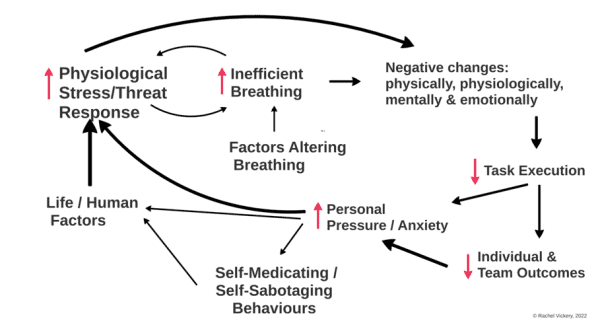
Typically, the problem is brought to awareness or focus in one of three areas (right-hand lower corner of Diagram 1) – the breakdown of task execution and outcomes, the heightened perception of pressure/anxiety, or the self-medicating/self-sabotaging behaviours.

3. ‘If a human fails to perform under pressure, it’s anxiety, and it’s in their head / they are mentally weak’

See the two points above. Irrespective of the performance arena, many high performers have the mental and emotional resilience to handle, excel and thrive in high pressure. But their physiology can still get out of control underneath the surface, leading to the negative consequences outlined previously. If someone can execute skills in lower arousal environments but not under pressure, assuming or labelling the problem as “anxiety” ignores the impact that a myriad of other physiological drivers will have on escalating the threat response that has nothing to do with “anxiety”. And it often has nothing to do with the performance arena, either! Part II of this article series will explain this point in more detail.

4. ‘People can either handle pressure, or they can’t’

Executing under pressure is a highly trainable skill, just like any other sport-specific skill. Unfortunately, it is often omitted in training during early career development, meaning performers get a long way through their careers due to natural talent or early physical development before this gap appears and the problems show. The assumption mistakenly gets made at this point that the operator can’t handle pressure. Most people who falter in high-pressure situations have just not learnt specific skills to prevent or recover from when their operating state crosses their threshold.

Additionally, a person’s threshold will differ between scenarios. An exceptionally qualified black belt martial artist will comfortably face down an opponent in a dark alley but get a dry mouth and sweaty palms at the thought of giving a speech in front of a thousand people. A seasoned firefighter will move confidently into a structural fire with no fear for their safety but momentarily freeze and move forward with heart palpitations and fast breathing when confronted with performing CPR on a young baby.

5. ‘Performance Under Pressure just “shows up’

There is a mistaken belief that operators can do the technical and tactical training, turn up in a big moment, and perform when the pressure and stakes are high simply because of their technical excellence. Coaches and team managers will often bemoan the sub-par performance that falls well short of potential without realising there is a skill gap. Most high performers do not automatically know what to do or expect mentally or physiologically when in high-pressure situations. Without intentionally learning skills to control their state in these situations, they fall victim to the negative performance changes outlined above.

In the most simplistic view, consistent elite performance in high pressure and high stakes moments requires two things:

  1. The ability to execute to one’s physical potential and
  2. The ability to stay in control of one’s operating or arousal state.

Many of the negative consequences of high pressure and high stakes environments, and the strategies employed to overcome them, are linked to the human threat response (particularly the sympathetic nervous or fright or flight system). How an individual breathes when they aren’t thinking about breathing will also impact this response by signalling whether there is a threat or everything is safe. These two areas directly affect the other – either positively when trained strategically and with intent; or negatively when left to chance. Consistent elite performance in high-pressure environments needs both areas to be trained intentionally in a coordinated way and in advance of ‘go time’.

We see the following negative interactions when these two factors are not well controlled.
sport techie

Diagram 1

Typically, the problem is brought to awareness or focus in one of three areas (right-hand lower corner of Diagram 1) – the breakdown of task execution and outcomes, the heightened perception of pressure/anxiety, or the self-medicating/self-sabotaging behaviours.

Some of the changes to task execution and performance for athletes are identified earlier in this article. The same concept applies to coaches, executive teams and support staff in their respective roles, although how it shows up may vary. The subsequent increase in pressure and anxiety for the individual, team, coaches or team management related to poor performance; and the impact of negative media and public criticism leads some individuals to self-medicate or self-sabotage. Any combination of alcohol, drugs, porn, gambling, food, missing training, out-of-arena altercations, excessive work hours, neglecting family, affairs, and unethical decision making may be present. Unsurprisingly poor mental health and suicidal tendencies sit in this mix also.

Teams will often try to fix the problem in one of these three areas. If a player misses kicks – they spend more time on their kicking technique (unfortunately, often in a relatively relaxed, no-pressure state). If a person – particularly coaches and management personnel- struggles with anxiety, they either keep it to themselves, are medicated, or receive insufficient expert guidance. If a person has an addiction or behavioural problems, they are disciplined, sent to rehab or hide it in shame.

This traditional approach is fundamentally flawed. Waiting for performance issues in pressure environments to show up (whilst hoping they don’t) and then reactively fixing them does not result in excellence and consistent high performance. Punishing poor performance under pressure in the absence of a front-loaded strategy of skill acquisition in this area is akin to throwing a bunch of humans who don’t know how to swim into a pool and then yelling at them to stop drowning.

Consistent elite high performance in high stakes and high-pressure environments means going “left of boom”, understanding the situation for what it is, and front-loading strategies to set up for success, thus avoiding a negative response. Normalising the physiological, cognitive and biological reactions that humans have in high-pressure environments and training and optimising for it is far more impactful on performance than just wishing or pretending it wasn’t there or reacting to the fallout after the event.

Part II of this series will dive deeper into how the human stress response works in high-pressure situations, how it disrupts performance and some skills and strategies to thrive in high pressure and high stakes environments.

Rachel is one of six Leaders Performance Advisors, a group of leading performance thinkers providing more subject expertise to our member-only content and learning resources. To find out more about all our Performance Advisors, click here.

Members Only

23 May 2022

Articles

The Royal College of Art: Combining the Radical and the Traditional in Pursuit of Excellence

Category
Leadership & Culture, Premium
Share
Facebook Twitter Email Copy Link
https://leadersinsport.com/performance-institute/articles/the-royal-college-of-art-combining-the-radical-and-the-traditional-in-pursuit-of-excellence/

By John Portch

  • The RCA’s traditional core is complemented by a disruptive edge.
  • The college is proactive in seeking the right students and staff to expand their talent pool and course offerings.
  • Promote casual collisions in social spaces – innovation may follow.

Tradition keeps the RCA on track, but radicalness gives them their momentum

The Royal College of Art [RCA] was founded in 1837 and its alumni include Sir Peter Blake, Tracey Emin and Alan Rickman. As its name suggests, it has received royal patronage since its inception and Princess Louise, daughter of Queen Victoria, chose to study sculpture at the college. “We’ve got lots of tradition and lots of myth – and we play on it,” Paul Thompson, the RCA’s Vice-Chancellor, told an audience at the 2018 Leaders Sport Performance Summit. “But we are also keen and very determined that, because of the forms we’re dealing with, whether it’s architecture or art or engineering, that we’ve got to be radical. We’ve got to be looking at things that are completely ahead of the pack, the curve. We have these disruptive moments where we have moments of jagged radicalness.”

The college ‘shakes the trees’ when recruiting staff

The RCA, according to Thompson, will “shake the trees” to find the right staff. The college spent five years persuading Zowie Broach, their Head of Fashion, to take the role. Thompson also explained that the college has taken the novel approach of appointing head-hunters to seek out new staff members. Allied to this proactivity, which was introduced by Thompson, is a thorough interview process (“a junior tutor’s role will be interviewed by my deputy”). On top of that, 70 per cent of the faculty work part-time as the RCA do not want too many career academics. “We need to have people there as the anchor men and women, but we also bring in people who are part-time faculty,” said Thompson. He cites J Mays, the former Group Vice President of Global Design and Chief Creative Officer at Ford Motor Company and current Chief Design Officer at Whirlpool, who is an RCA visiting professor. Thompson added: “We bring visiting professors in whenever we can, wherever we can – and we don’t pay them a lot of money because we don’t have a lot of money – but they get a kick out of working with the next generation of design leaders. And being in London, you can always find somebody interesting who’s got a stopover.”

They work to expand their talent pool through scouting

Just as the RCA spend time and resource recruiting the right staff, it adopts a similar mindset when it comes to students. At the time of the session, the College was recruiting from 70 different nations. “We’ve always been international and that’s always been one of our USPs,” said Thompson. “As long as you grow the talent pool as you grow your student body, and you make sure the talent pool in which you’re hunting and scouting grows faster than your student body.” He shared one example. “We are scouting now for students in territories we never used to go to. We’re scouting for very particular people in very particular territories – we like Chilean architects at the moment. We’re spending a lot of time going to Chile, looking for undergraduate students, finding scholarships for them to bring them over to London so that they don’t just go straight up to North America.”

The college promotes chance encounters

The RCA decided to put its fashion and architecture students on the same open plan floor. “It drove some of them crazy because the architects didn’t like the sound of the steam irons,” said Thompson. Similarly, they put their computer science students next to their ceramicists. “We hope that something will rub off between the two of them. We make sure that the social spaces we have a very strategically situated so that you can get those chance encounters; the happenstance. ‘Oh my god, I met this guy who was a jeweller, he was telling me about this piece of equipment they’ve got in the metal working space. I really want to go and use that and try to experiment with that.’ We try to set up these chance encounters and it’s quite easy to do if you’re small.”

Members Only

17 May 2022

Articles

Can Athlete and Coach Development Be Synchronised?

Category
Coaching & Development, Premium
Share
Facebook Twitter Email Copy Link
https://leadersinsport.com/performance-institute/articles/can-athlete-and-coach-development-be-synchronised/

By Sarah Evans

Framing the topic

This was session one of our three-part Performance Support Series focusing on the overarching theme of talent development, with the title ‘Synchronising Player & Coach Development’. Across these sessions, which are being hosted by Edd Vahid, Assistant Academy Director at English Premier League club Southampton FC, the aim is to understand the challenges faced during transitions for talent, whether this be players or coaches, and explore a number of interventions to positively influence this in your environments.

Understanding the challenge

  • When we say ‘challenge’ within this session, it means the transition of players through the pathway from academy to seniors.
  • First and foremost its crucial to understand what these challenges are in relation to transition.
  • The challenge of transition is at the heart of most sporting visions.
    • UK Sport – ‘Keep winning and winning well’ places a requirement on young athletes to have an impact on the senior stage.
    • Southampton – ‘Be the Number One Player Developer in Football’

 Aims of the session

  1. Provoke thinking on player/athlete transitions
  2. Create space(s) to reflect on existing approaches and challenges
  3. Explore the utility of several sense-making models
  4. Encourage a commitment to action

Discussion points

How effectively is your club / organisation facilitating the transition of an talented academy player to first-team player? Or in turn, how are you facilitating the transition of talent coaches within your environment?

Pre-Mortem: Your highest potential academy player / coach does not transition into the first team / elite environment. What would have contributed to this outcome?

  • Opportunity: pathway, lack of bumps in the road, long-term injury.
  • Competition: insufficient game time, too much expectation, mentality.
  • Assessment: coaches decisions, selector bias, positional decisions.
  • Differences between professional sport and Olympic sport, and individual vs team sports.
  • Pressure to win games now, focuses on short term rather than a longer term developmental outlook.

Performance = Potential – Interference (Timothy Gallwey)

The reality of transitions is that they’re a zero sum game, meaning that if someone makes the step up into the senior team, someone else will move out of that space.

Challenges in creating effective transitions

  • Recognising the landscape or ecosystem you operate in.
  • The tension that exists between the first team environment, which naturally prioritises a shorter term focus, than a development environment that has a longer term outlook and possibly greater stability.
  • Trust and Empathy: the heart of talent development work is trying to influence the trust that the senior staff have.
  • Vision: the aligned vision between the first team and academy. Club’s vision led by board must have buy-in across the organisation.
  • Individualised element: everyone’s pathway is so different, so it’s important to create a system that acknowledges that individuality.
  • Ensuring there are aligned processes between the various stages of the pathway.

Sense Making Models : Pierre Bourdieu – Habitus, Field, Capital

  • Habitus: ‘The Individual’, a product of their history, influenced by a multitude of factors. Their history will influence how they perceive, how they think and ultimately how they behave moving forwards. Are we preparing these individuals to be a ‘fish in water’ in the senior teams?
  • Field: e.g. The training complex. A social arena where people compete for resources and demonstrate their power. The new ‘field’ establishes the ‘rules of the game’ and the individual must adapt if they want to succeed. This could be their attitude at training, their image, where they sit in the changing room etc. How well are we preparing them to make a good first impression?
  • Capital: The currency that is going to influence success – physical qualities, cultural qualities, reputation you come with.

How well do we know our players’ Habitus? Their History?

How well do we understand the Field, and the Capital required to succeed?

Task: What are the key influences on the First Team ‘Field’? For example, the pressure to win on Saturday?

70% of behaviour is determined by our environment. Therefore if most behaviour is understandable then we need to understand where the behaviour comes from.

Understanding the landscape – O’Sullivan, Bespomoshchnov and Mallett (2021)

  • Microsystem: the immediate environment – e.g. an individual playing in the academy.
  • Mesosystem: the interconnection of settings – e.g. interconnection of academy and senior team. Things that can influence this are the managerial tenure, which in football on average is 18 months, financial incentives, and the average age of players in the senior team.
  • Exosystem: the broader context – e.g. the Premier League, with many players being brought in from overseas, player contract length, and the transfer spend of the club.
  • Macrosystem: cultural elements – e.g. the role of the media and social media.

In summary:

  1. Successful transitions are critical to our talent development aspirations.
  2. Understanding the transition challenge precedes intervention.
  3. The transition challenge is influenced by factors that exist on multiple levels.

9 May 2022

Articles

Designing Experiences of Meaning and Value for Athletes

Category
Coaching & Development
Share
Facebook Twitter Email Copy Link
https://leadersinsport.com/performance-institute/articles/designing-experiences-of-meaning-and-value-for-athletes/

By John Portch
  • The way we feel is the biggest variable in performance – we need to better understand the power of feelings when designing learning and development experiences.
  • Consider: what is it about your experiences that makes you experienced?
  • Look to create uncertainty, learn from performance limitations, begin to bridge those gaps.

Why experiences matter

“All experiences are transformative – they change people and allow them to adapt,” Glenn Hunter, a performance innovation consultant formerly at the English Institute of Sport, told an audience at the 2019 Leaders Sport Performance Summit in London. “The challenge in high-performance sport is to keep designing new experiences that can engage athletes and coaches, turning ordinary into great.”

How we feel – one of the biggest variables in sport

Hunter, whose role involves the assessment of training strategies, believes that understanding how athletes feel, as a consequence of their experiences, is essential. “I will be bold enough to say: that in my research over the years, looking for the big step in performance, this is up there as a contender,” he said. “Our experience changes how we feel, how that changes how we act, and how that changes how we perform. The inconsistency in performance plots very closely to variation in how people feel and the experiences they are having.

“If we could understand this a bit better, make it a discipline that’s central to performance, and do this a little bit better through our understanding, to create better human and performance experiences, I think that would be a really good thing.”

What is it that makes you ‘experienced’?

Defining experience by years on the job is not enough. “The thing we’re talking about here are these two critical aspects of performance that are missed in day to language: something that happens to you that affects how you feel and the way something that happens to you and affects how you feel. To express this a different way: you’re all experienced, but what is it about the experiences you’ve had that makes you experienced? Focusing on that means the end-product, the experience you have, becomes more vivid, fruitful, therefore more rich and valuable.

Authentic experiences that appeal to people’s values

Central to better human and performance experiences are the need for uncertainty, which sits in contradiction to our desire for certainty. “As human beings, we’re most relaxed and comfortable when we have what I might call the ‘illusion of certainty’,” said Hunter, who cited both science and religion in making his point. “Ironically, when we’re most alive as human beings is when we’re in situations of uncertainty.” This is an evolutionary trait in people. “In essence, uncertainty is part of performance.”

Designing meaningful experiences does not necessarily mean happy or joyous moments. Hunter continued: “It can be a failure – meaningful moments are things that move you on, that make you who you are, that you learn from and makes you better even though the experience at the time might not be a great one.”

But it’s not just learning from failures or setbacks. “How might you design your next game? How do you enjoy an experience when you’re in it, and having had the experience, how might you look back on it, learn from it quickly, so that you change the next experience into a better one? The point being that it’s not just when things go wrong, it’s how we can design and shift ordinary into great?” It is much like a designer and a successful design process understands its audience and listens to their world.

“In the dynamic environment of sport, you must continue improvising to create performance experiences that are authentic and appeal to the values of different people. By doing this, you are helping those people to stay ahead of the competition and be true to who they are.”

Go to home
Follow us on Instagram Follow us on LinkedIn Follow us on X

Contact

Leaders UK

Tuition House
27-37 St George's Road
Wimbledon
SW19 4EU
London
United Kingdom

Enquiries Line: +44 (0)207 806 9817
Switchboard Number: +44 (0)207 042 8666

Leaders US

120 W Morehead St # 400
Charlotte
NC 28202
United States

Enquiries Line: +1 646 350 0449

Leaders

  • Contact
  • About
  • Careers
  • News
  • Privacy Policy
  • CA Privacy Rights
  • Cookie Notice
  • Website Terms of Use

Performance Institute

  • Membership
  • Events
  • Content
  • Virtual Learning
  • Connections
  • Partners

Latest

Intelligence Hub
High Performance Future Trends Research Elite Performance Partners continue to drive the potential in high performance forward through renewed Leaders partnership
Your Privacy Choices

© 2026 Leaders. All rights reserved

  • Privacy Policy

Attendees

x