The New Balance Athletics Center is able to cater to the needs of coaches, analysts and talent evaluators alike.
Main Image: Kraft Sports & Entertainment

As the CIO for the Kraft Group, Israel just saw a major tech project reach fruition in the New Balance Athletics Center. The 160,000-square-foot building, which officially opened last month, will be the home for everything Patriots players need.
And with that, Israel has overseen a connective behemoth in that three-story space, spanning facial authentication, biometrics, player-tracking data and a slew of other needs that support coaches, analysts, talent evaluators and the like.
A benefit for the Patriots? A longtime relationship between the Kraft Group and tech integrator NWN, a fellow Massachusetts company. The pair stepped forward with a five-year sponsorship deal last year, with NWN becoming the official technology infrastructure partner with Kraft Group. NWN also works with the Orioles and a handful of NBA teams, and it is the official technology provider for Boston College athletics.
Here were a few things that stood out to me about the project from a conversation with Israel and NWN CMO Andrew Gilman:
Two major pride points
Two of the venue’s greatest assets are the NFL Draft room and the virtual reality room. The draft room, which features 100-inch LED boards from Daktronics, is the “pride and joy” of ownership, Israel said.
The team’s new virtual reality room is a digitally infused next-gen walkthrough space that first originated under former coach Bill Belichick. This version is the width of an NFL field and features 20 yards of hashed turf so the team can run through plays and red-zone drills. Israel said it is a convergence of practice, game tape and player data.
Added Gilman: “To see the players going through drills and having all this running over Michael’s technology innovation — being able to stream and get video, low latency, high throughput — it’s where the technology becomes a real competitive differentiator for the organization.”
Making it seamless across the entire group
The goal for a technology experience is to be standardized and even unnoticed, Israel said. A key component there is filling the space with vendors they’re already familiar with. The Patriots campus has 65 Cisco WebEx rooms, and 31 of those are now in the new facility.
The center also uses facial authentication provided by Wicket, which is the same tech used across all league stadiums for credentialing. Those are two of many examples.
“The same way we do with autonomous purchasing in the stadium — frictionless is across the board,” Israel said. “Making it so that the technology is there, but they don’t even realize that they’re using it.”
(We talk about frictionless fan experiences all the time here — hadn’t thought about it in the player experience, but it makes so much sense).
New creativity with data
Data is such a catch-all, borderline buzzy word. But it can be anything. Case in point: cafeteria food.
Instead of the buffet-style treatment of old, tablets now let players pull up their diet (the Patriots use a precious metal naming system for meal plans like gold, silver and bronze) and get a meal that fits their parameters. It also sets up a system that can monitor consumption of various options for the benefit of operations.
“We’ve also rolled out an AI application that monitors the food that’s being cooked and ties into how much we’re buying, how much we’re prepping, how much gets donated to charity at the end of the day to right-size and be more efficient,” Israel said.
This article was brought to you by SBJ Tech, a Leaders Group company. As a Leaders Performance Institute member, you are able to enjoy exclusive access to SBJ Tech content in the field of athletic performance.
The NFL team believe that those who learn to interpret, question, and integrate AI insights will gain a significant performance advantage.
Main Image: Getty Images
“I call that level one, or horizon one, which is adoption,” Fusillo said, referencing his personal, three-level framework for AI deployment within a company (levels two and three represent deeper levels of workflow automation). “Do we have large business gains from that level one? Not really. But have we changed the culture of the entire front office? Yes. To think AI-first.”
Fusillo projects measurable business results to follow as the Jets step to “level two” of their AI learning curve, which he labels the “workflow automation” stage. There, Fusillo said the Jets are already using AI to aid in areas like sponsor prospecting research, revenue reconciliation and, on the football side, structuring data from physician evaluations of players at the draft combine, among other use cases.
“We have over 20 deployments in level two,” Fusillo said, noting that those are expected to drive double-digit gains in metrics like top-line revenue and productivity. “What many companies don’t realize is if you don’t do level one, those [early adopters] are exactly the right people to identify what level two applications we should be going after.”
Fusillo, who held leadership roles in data and analytics for Pepsico, General Motors, the NFL and American Express before joining the Jets, said his approach to soliciting buy-in from Jets front office members included a listening tour in the team’s cafeteria, speaking with employees about both his and their own AI habits.
He also credited an ongoing partnership with Next League for spearheading the AI education process. Next League Chief AI & Innovation Officer Shripal Shah led a team of six Next League staff — with subject matter expertise ranging from business intelligence to sponsorship to social media marketing — staging AI workshops with Jets employees over several months. The department-level workshops Shah led, Fusillo added, generated more than 60 ideas for AI deployments on the business side and “probably double that” on the football side. Shah used sponsorship prospecting as an example of how Next League looked to foster productive AI dialogue and, ultimately, adoption.
“By using that as the cornerstone example, and you learn how to do that in a fraction of that time, there’s a light bulb — you can see it in people’s body language and faces,” Shah said. “Actually bringing [use-cases] into the workshops was really the accelerator. And the Jets, to their credit, embraced it.”
This article was brought to you by SBJ Tech, a Leaders Group company. As a Leaders Performance Institute member, you are able to enjoy exclusive access to SBJ Tech content in the field of athletic performance.
In the first month of 2026 Leaders Performance Institute members discussed at length strategies for effective learning, the value in evidence-informed practice, and why your values should be the carrot, not the stick.
It was a lesson to all sleeping giants. Here was a team with the most losses in the sport’s history and, over the course of their 16-0 season, had compiled more wins than between 2020 and 2023 in total.
Indiana Head Coach Curt Cignetti spoke of a “paradigm shift” in the aftermath of the Hoosiers’ 27-21 defeat of Miami.
“People can cling to an old way of thinking, categorising teams as this or that or conferences as this or that or they can adjust to the new world, the shift in the power dynamic in college football today,” he said.
Cignetti was brought in ahead of the 2024 season and transformed the mindset of a team that had been treading water for decades.
“There’s got to be a lot of like-minded individuals who come together for a common purpose, and sometimes that belief has to be a little bit irrational,” said Indiana centre Pat Coogan.
“Especially in a place that hasn’t had success like Indiana. I’ve seen it, and I’ve seen the way this place has been characterised, and when Coach Cig got here, he believed, and he got people to believe. Sometimes people laughed at him and thought he was crazy, but that’s irrational belief. You’ve got to get people to buy-in and believe in the mission.”
With a host of senior players set to graduate, success may not be replicable in the short term, but Cignetti is ready for whatever comes next.
“Perfection is impossible to attain on a consistent basis,” he said. “But we’ll continue to take it one day at a time, one meeting at a time, one practice at a time, and just keep improving and committing to the process and showing up prepared, trying to put it on the field, and see where it takes us.”
It was a powerful message to kick off the year in sports performance and one that underlined the importance of the fundamentals while refusing to stand still.
Which brings us nicely to the happenings at the Leaders Performance Institute these past four weeks.
Insight of the month
‘What underpins successful teams across formats is not uniformity, but clarity of individual responsibility within a collective framework. Team performance does not replace individual accountability; it depends on it.’
In a guest column, James Thomas, the Performance Director at Warwickshire CCC, spoke about facilities being a secondary concern until the leaders had created the right environment to enable athletes, whether they’re the Olympic champions with whom he has worked or Premier League and Champions League-winning footballers, being paramount.
Read more about why high performance is not something leaders should demand. It is something they should enable.
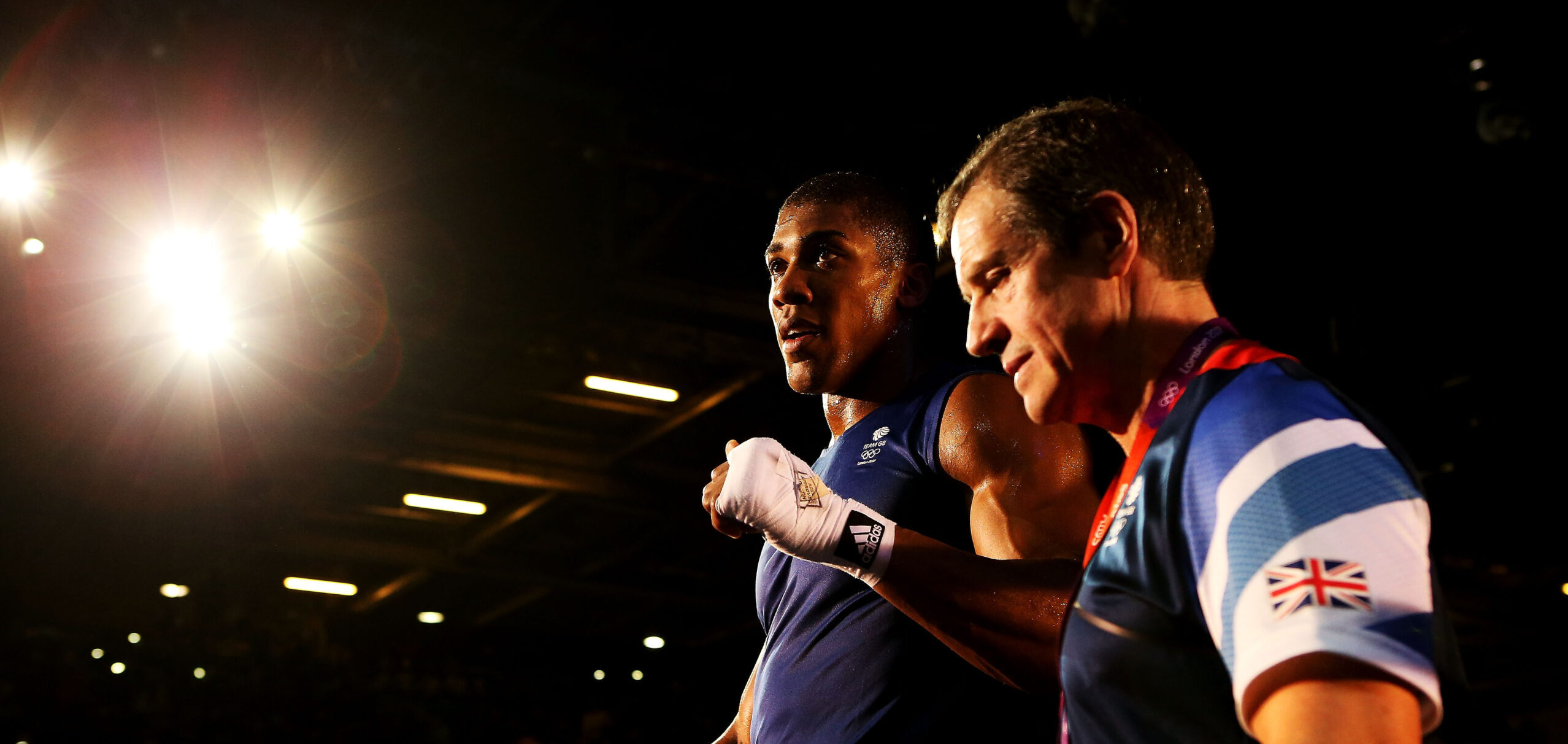
Britain’s Anthony Joshua on his way to winning gold at the 2012 London Olympics. (Scott Heavey/Getty Images)
Surprising insight of the month
Did you know that Team GB built its own hub within the London Olympic Village in 2012. This was very much a “host nation benefit” as Paul Ford MBE called it in another popular guest column last month.
The Head of Sport at the British Olympic Association wrote:
When we finished in London we looked and thought: ‘it’s not home advantage necessarily, we just need to be more creative’.
It provoked a question: how do we create an optimal physical way of uniting the team within the Games environment? Part of it was using our Olympic Village residential space smarter. But you can’t expect this of the local organising committee to do on our behalf, since their brief is so vast. Instead, we decided to take it out of their hands. And for each of the subsequent Summer Olympics we have found an out-of-village space exclusively for our use.
Read more about their approach here.
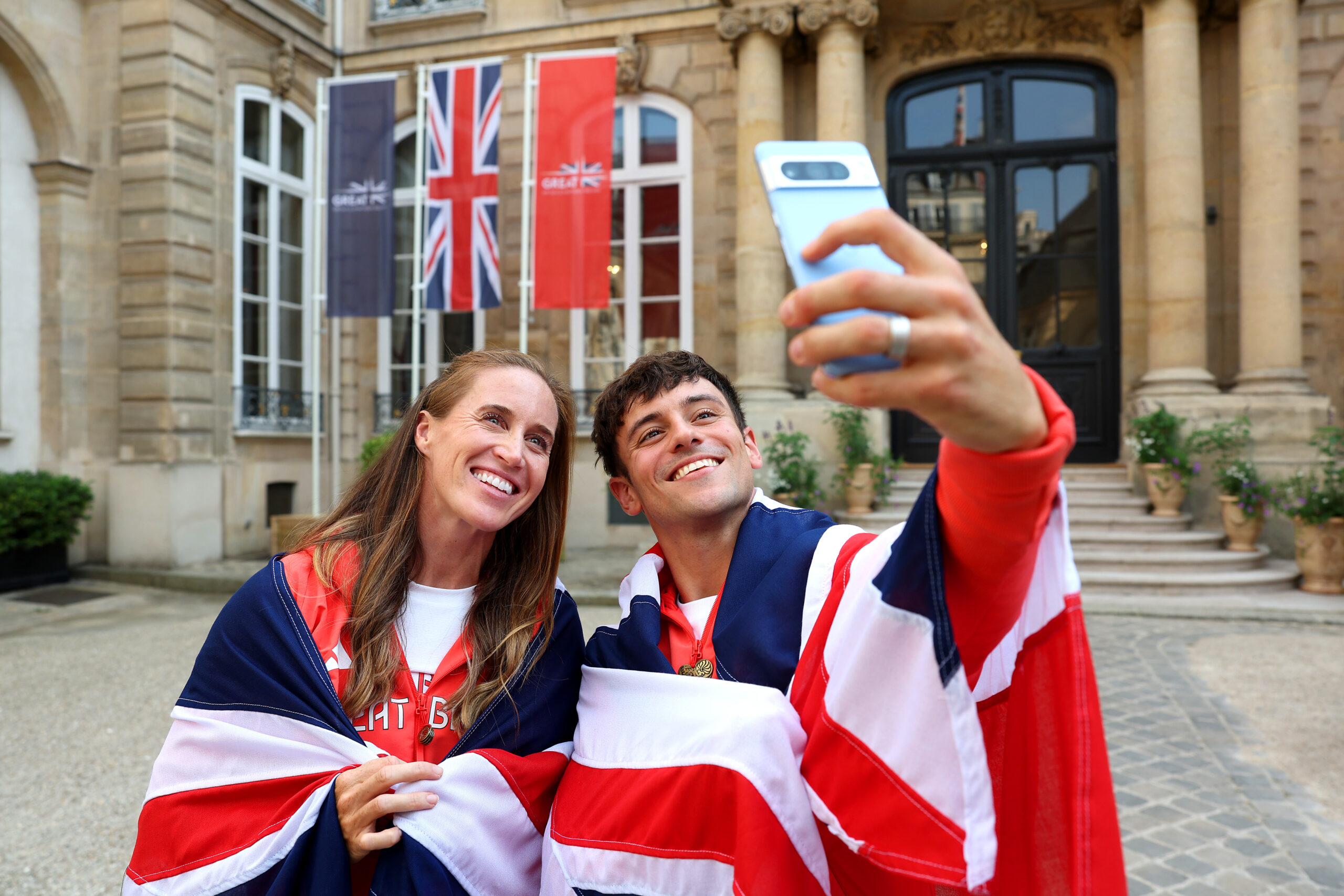
Team GB flag bearers Helen Glover and Tom Daley pose for a selfie outside the residence of the British Ambassador to France ahead of the 2024 Olympic Games in Paris. (Alex Pantling/Getty Images)
Best advice
Leaders Performance Institute members across the globe strive to encourage learning throughout their teams and while it will always be an important feature of any successful team, you should not waste your time on the wrong people.
As performance specialist Iain Brunnschweiler explained at a Leaders Virtual Roundtable:
“There’s definitely some people who, you can try as hard as you like to get them to learn and I think we have to be cognisant of our own energy as someone who’s seeking to help. It’s a bit like athletes, isn’t it? If you’re up for it, I’ll give you 150% of my energy. If you’re not, after a period of time, I’ll just go, ‘look, you crack on’. So I think we have to be accepting of that.”
Over the course of an hour, Brunnschweiler and a band of LPI members noted ten strategies for more effective learning.
One you might have missed
Jamie Taylor of Dublin City University and the CoEx|Lab made the case for evidence-informed as opposed to evidence-based practice.
He enlisted the help of students from DCU’s online doctorate and MSc programmes, which are aimed specifically at coaches and practitioners in high performance sport.
One such student is Eilish Ward, the Head of Player Development at the Ladies Gaelic Football Association.
As she told Taylor, you can’t simply drop research on top of a sports programme. It must be used critically, in conjunction with a coach’s own research, and applied in an informed manner.
“There’s not necessarily one solution,” she said. “There’s no one way to learn anything or to gain experience or expertise.”
The key for Ward in her work is to ensure she and her colleagues are “making as informed decisions as possible when we’re designing learning activities” because “not everything from research may be transferable into a practical environment and, equally, every practical environment is going to be hugely different.”
Read more about DCU’s programmes here.
Quote of the month
“We have to become diplomats, high‑level development people who can manage such diverse groups. Somewhere along the line, we need to start creating those development opportunities for everybody who’s on this call.”
These are the attention-grabbing words of a performance director working in India who spelled out the challenges in talent identification and development.
He and a host of LPI members listed five of the most common trends (and five opportunities) in that space.
Good to know
Organisational values should be your carrot, not your stick.
That’s according to Emma Keith, a Royal Air Force Group Captain, is the Commandant of the Tedder Academy of Leadership at the RAF. In 2015 she became the first woman to run RAF Officer Training.
In her appearance at the 2025 Leaders Sport Performance Summit in London, she spoke about how the RAF’s values, all contained within the prosaically titled Air Publication One document, had been used to browbeat good people.
“Actually 99% of my organisation are amazing, they really are, and I wanted a document that was aspirational for them, that they could believe in, that it was the organisation they wanted to be a part of. And we know from all the different behavioural models of change that it only happens when people want to change, not because it’s been forced on them.”
Again, the focus was learning strategies in an inspiring presentation.
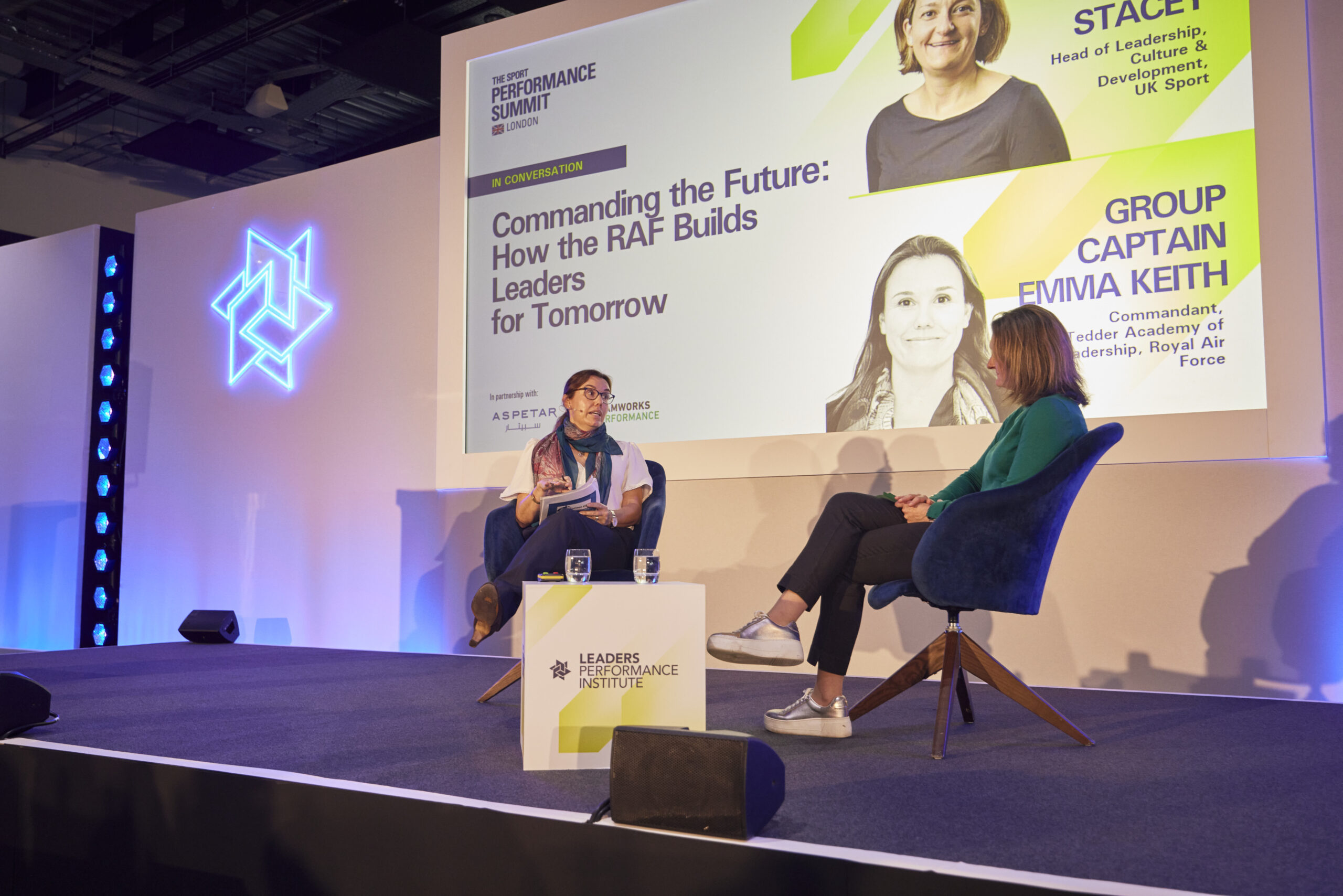
The RAF’s Emma Keith onstage at the 2025 Leaders Sport Performance Summit in London. (Leaders)
What’s coming up for members
Artificial Intelligence could be making key calls in your sport.
Main Photo: Getty Images
Current automation: NASCAR’s Optical Scanning Station maps the exterior of cars to ensure they comply with the rules. Bolt6 cameras also inspect the underbody of cars and operate the Pit Road Officiating system to flag violations.
Possible on the horizon? NASCAR intends to upgrade existing tech.
Current automation: The automated ball-strike challenge system is used throughout minor league baseball. A full ABS system is used by the KBO.
Possible on the horizon? MLB is likely to adopt the ABS challenge system for the 2026 season. It is also in the early stages of low-minors testing whether checked-swing calls can be automated.
Current automation: The NBA provides enhanced replays augmented with tracking data to assist with goaltending and basket interference calls.
Possible on the horizon? Determining who last touched the ball out-of-bounds and whether a shooter was behind the three-point line are under development, as are shot clock and other timed-based violations. The tech will start in the NBA, but it already is being investigated for the WNBA, too.
Current automation: The NFL will measure for first downs with Hawk-Eye cameras this season and contribute to calls about where punts fly out of bounds.
Possible on the horizon? The NFL and its innovation-minded collaborator, the UFL, are looking into whether the ball can be spotted after each play using technology, as well as making determinations on whether the quarterback is in the pocket (for intentional grounding and roughing the passer calls) or whether there are too many men on the field.
Current automation: The AI-powered Judging Support System is used as one input in the total score.
Possible on the horizon? There has been no report to date that gymnastics would consider full automation of scoring.
Current automation: None
Possible on the horizon? The NHL could use tech to determine offside, goal or no goal or whether a player high-sticked the puck.
Current automation: Rugby balls with embedded Sportable sensors were trialed at international youth tournaments to determine whether a ball was thrown forward, where a ball exited the pitch, whether a ball was touched in flight, whether the ball has reached the try-line and whether a lineout throw was straight. A Touchfinder feature helps Six Nations make boundary and ball spotting calls.
Possible on the horizon? Conversations around possible expansion of the tech are ongoing.
Current automation: Goal-line technology determines whether a goal is scored, and enhanced semi-automated offside technology makes all but the closest calls automatically.
Possible on the horizon? FIFA is researching whether technology can identify the player who last touched a ball before it went out of bounds. Detecting hand balls is also possible.
Current automation: All line calls can be called electronically.
Possible on the horizon? Technology could help determine whether there was a second bounce or a let serve. Electronic line calling will continue to move downstream into college and juniors tennis.
Current automation: AI judging will be one input in the total score beginning with the January 2026 X Games.
Possible on the horizon? Full automation of scoring might be possible.
This article was brought to you by SBJ Tech, a Leaders Group company. As a Leaders Performance Institute member, you are able to enjoy exclusive access to SBJ Tech content in the field of athletic performance.
The one clear theme across most sports is that human officials should be supplemented, not replaced, by AI.
Main Photo: Getty Images
There were also 20 4K optical tracking cameras triangulating motion from the players and ball. A few infrared cameras operated lightly in the background. The NBA is building a new R&D lab at the G League home of the Salt Lake City Stars. The lab will feature multiple tracking systems, connected basketballs and more to test a variety of on-court technology “with the top priority being officiating,” said NBA Senior Vice President Tom Ryan.
The NBA has created an automated officiating group within its Basketball Strategy & Growth Department, hiring data scientists and engineers — led by Avinash Bhaskaran, previously of Nvidia and autonomous vehicle company Cruise — to create a new, league-operated technology stack. Its three main purposes are to improve call accuracy and consistency, hasten game flow and enhance transparency and consumer confidence.
“You’re trying to trade off speed versus accuracy versus entertainment.”
Rufus Hack, CEO of Sony’s sports businesses
A recurring refrain from the more than two dozen insiders across sports that Sports Business Journal spoke to was that human officials, referees and umpires are far better at their jobs than fans will ever give them credit for, and few are seeking full automation of officiating; just supplementary aids. But they also have an inherent limitation of using only two eyes from one viewpoint, tracking projectiles that can travel in excess of 100 mph.
“At some point,” said SMT CEO Gerard J Hall, “that technology is more accurate than any human could ever pretend it to be.”
The presence of instant replay is ubiquitous in modern sports, but there’s a newfound emphasis on using technology not to review decisions, but to automate binary calls: ball or strike, in or out, offside or not? Tennis pioneered this practice with its adoption of Hawk-Eye Innovations’ cameras for line calls, first as a challenge system 20 years ago and now often used on every shot.

Automated officiating in baseball and other sports can help bring more accuracy and quicker decisions to games. But there are downsides to removing the human element from decisions. (Photo: Getty Images)
In recent years, that idea has spread downstream — junior tennis tournaments might have an iPhone or two mounted atop chain-link fences to call lines using an app called SwingVision — as well as to other sports. Every NFL stadium now has six Sony-owned, 8K Hawk-Eye cameras to virtually measure first downs and supplant the iconic, but archaic, chain gangs.
The Premier League adopted semi-automated offside technology last spring. MLB is likely to add a new challenge system for calling balls and strikes in 2026. The NHL, X Games, NASCAR and international gymnastics have all begun using or researching automated officiating principles as well.
How, why and even whether to implement such tech is thorny. Sports is approaching a tipping point where it reckons with how much of the human element to preserve, how much technology to deploy and the right balance of the two, putting human and machine in the best positions to succeed.
“All sports are wrestling with the right way to weave technology into the officiating of the game and to get as many calls right without making the game less entertaining and ruining the game’s rhythm and emotion and humanity,” said Morgan Sword, MLB’s Executive Vice president of Baseball Operations. “And it’s tricky. Each of these decisions is fraught with conflicts.”
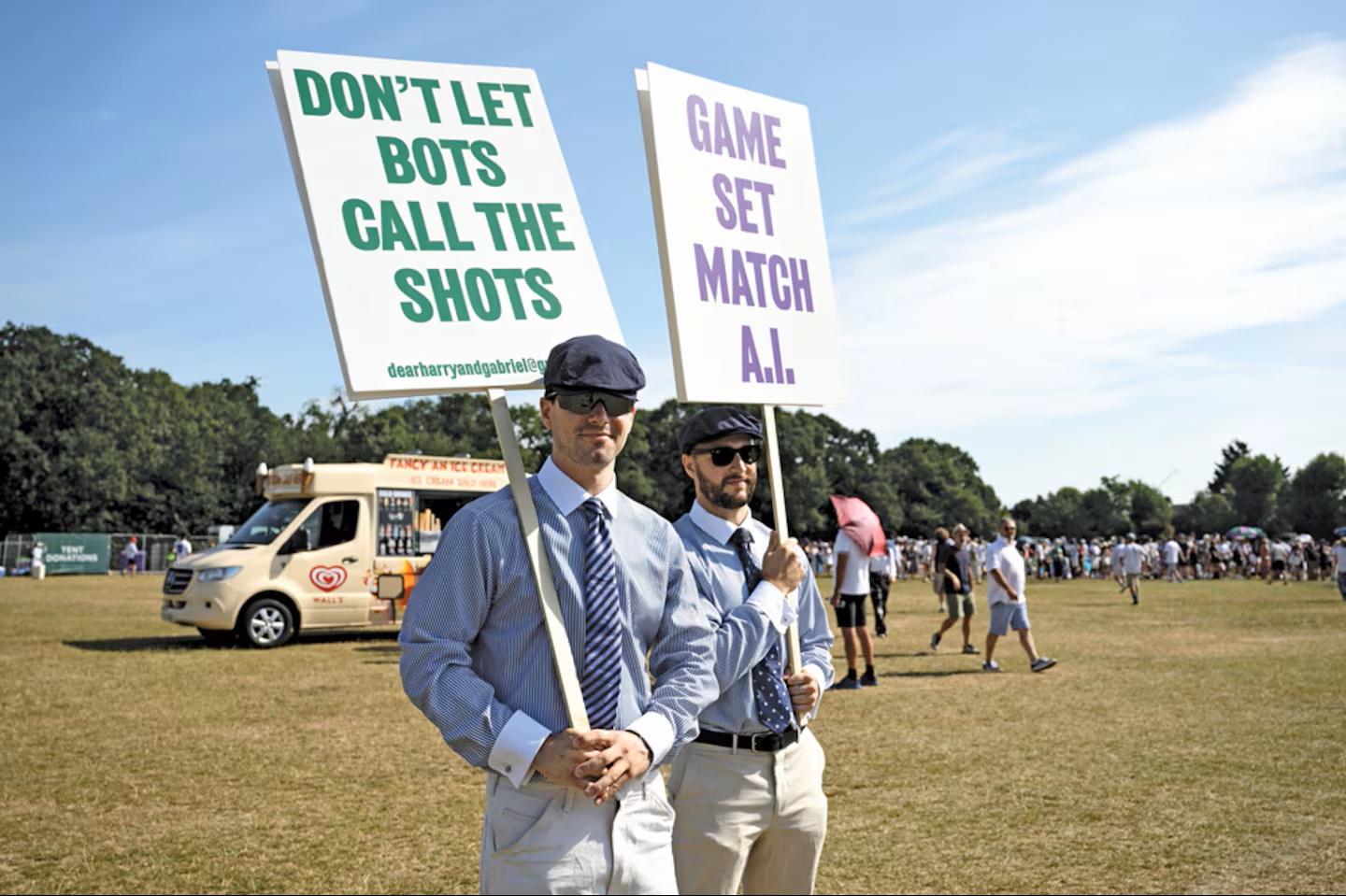
Protestors decried Wimbledon’s move to fully electronic line calls. (Photo: Getty Images)
Hawk-Eye is not only the trailblazer but also the primary provider of these technologies, with its cameras and algorithms able to track balls within one-fifth of an inch. Rufus Hack, the CEO of Sony’s sports businesses, shares a basic rubric for considering officiating tech.
“You’re trying to trade off speed versus accuracy versus entertainment,” Hack said.
The interplay of those three priorities varies by sport and league. He noted, for example, that accuracy is particularly paramount in short-duration tournaments, such as the FIFA World Cup, but perhaps less critical in the early throes of, say, a 162-game baseball season.
The dynamics and culture of a sport need to be considered and rigorously tested, Hack said. “Its implementation needs to be handled incredibly sensitively, and it needs to be empathetic to the values of the game because obviously people are incredibly passionate about their sport.”
The rigidity of technology’s calls also begs the philosophical question: What actually should be called? Is strict adherence to the rules always best or should there be some contextual subjectivity, such as when a police officer has the discretion to decide how tightly to enforce a speed limit?
The goal — and it’s a hard one — is not to let technology change the framework of a sport. As former NFL officiating boss Dean Blandino, who now holds that position with the UFL, said, “It’s just creating that right balance between ‘let’s get it right in those big moments’ but ‘let’s not distort how we do things for the majority of the game.’”
In the multitrillion-dollar asset class of sports, with athletes earning nine-figure salaries to play games with billions at stake in bets and broadcasts, the integrity of the competition has never been more closely scrutinized.
“The stakes are just too high not to try to solve this.”
Jeremy Bloom, X Games
As X Games CEO Jeremy Bloom, a two-time Olympic skier and NFL kick returner, described the gravity from his own playing days, “It didn’t feel like a medal was on the line. It felt like my life was on the line.” He’s now also Founder and Executive Chairman of Owl AI, an officiating tech spinoff run by the former head of AI at Google.
“The stakes,” Bloom said, “are just too high not to try to solve this.”
Here’s how leagues and tech companies are developing solutions that balance accuracy, speed, entertainment and the futures of their sports.
Accuracy
Paul Hawkins is an enthusiastic sportsman who earned a PhD in artificial intelligence in 1999 before developing a computer vision tracking system as a broadcast enhancement for cricket and tennis. Within a few years of it populating TV screens, the sports world started noticing the disconnect between what officials called and what the technology showed.
A 2004 US Open quarterfinal match in which four clearly incorrect calls went against Serena Williams in her loss to Jennifer Capriati ignited interest in a better system; Hawk-Eye was in use by the USA Network for the match.
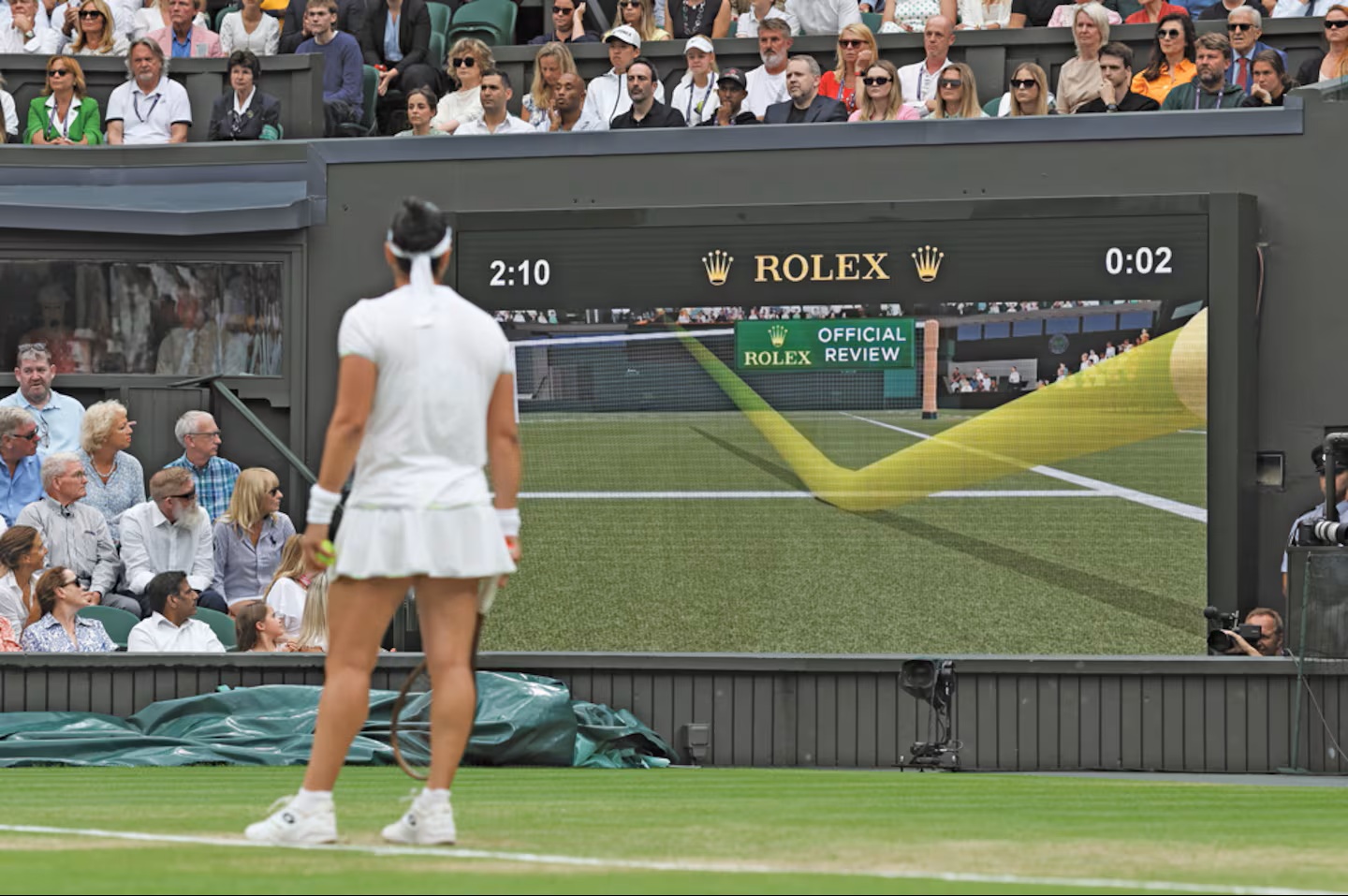
Tennis was the first sport to embrace automated officiating. (Photo: Getty Images)
“It became more and more apparent that the umpire essentially had the worst view out of everyone,” Hawkins recalled.
Hawk-Eye was used as an officiating tool for the first time a year later and, by 2006, was adopted at the US Open. At the outset of its first Grand Slam, USTA Tournament Director Jim Curley approached Hawkins and told him, “If I don’t see you over the next two weeks, you’ve done a great job.”
“You either can deliver what you’ve promised and worked very hard to do, or it can go horribly wrong,” Hawkins said.
“You can forgive or you can understand the human making a mistake and you can get over it,” he added, “but if a computer makes a mistake, that’s then suddenly a bigger controversy.”
Early adoption followed as a reactive step in response to a controversy — Williams’ Open loss in tennis, a disallowed Frank Lampard goal for England in the 2010 World Cup for soccer — but now leagues are making large investments even for incremental upgrades. The collective-bargaining agreement between MLB and its umpires signed in December 2024 codifies the league’s right to implement ABS.
“The real goal for us has always been in the high-leverage situations when it really matters, to have an outlet where you can get a bad call corrected.”
Rob Manfred, MLB Commissioner
Challenges in MLB spring training this year were overturned 52.2% of the time, up slightly from 50.6% during Class AAA games in 2024. With roughly four challenges per game, that translates to two overturned pitches. That might not seem like much, unless one of those calls is in the ninth inning of a tied game.
“We accepted, when we first went to the instant replay system, that you’re not going to get every call right — that’s an aspiration no matter how much you do,” MLB Commissioner Rob Manfred said. “The real goal for us has always been in the high-leverage situations when it really matters, to have an outlet where you can get a bad call corrected.”
ABS can input any strike zone shape, but finding consensus on what that shape should be is trickier than expected for such a fundamental part of the game. The rulebook defines a 3D shape over home plate. The plane facing the pitcher is a rectangle, but what it’s actually called is an oval. What ABS is programmed to call isn’t the same as either.
“Those are three different zones,” Sword said, acknowledging that “the zone that we actually call is dynamic and a little bit different for each umpire, a little bit different depending on the count, a little bit different depending on the pitch type. One of the challenges that has consumed a lot of time with testing ABS has been finding a static zone that will be the same for all pitches that best replicates what’s now a living, breathing thing.”
For now, ABS will adhere to the rectangle outlined in the rulebook but only call it as a flat zone at the plate’s midpoint, specific to each player’s height.
And automation calls it without bias, no matter the sport or stakes.
“You get the consistency because the AI doesn’t care who the player is, it doesn’t care if the fans are going to get upset, it doesn’t care what the money line is on the game,” Owl AI CEO Josh Gwyther said.
Speed
Goal celebrations in soccer are notoriously elaborate affairs, rituals that engage the fans and provide a natural break in the action. For officials, it’s a chance to review whether the goal should be allowed.
Those celebrations last 54 seconds, on average, according to Genius Chief Product Officer Matt Fleckenstein. “If you can actually get to a decision on whether or not someone was offside on a goal before the celebration has completed and they’re lining back, you’ve now not interrupted the fan experience.”
Expediency often helps retain viewers’ interest. “It is conceivable that a really, really hard, really, really clutch close call could be compelling for two minutes of time, but where it gets bad is when you get something that feels pretty routine, and that takes a long time,” said Phil Orlins, ESPN Vice President of Production, Technology and Innovation. “There is a shelf life on how long it feels tolerable before it becomes tedious.”
There’s a clear direction of travel, according to Bill Squadron, an Elon assistant professor of sports management. He previously led Sportvision, which created the first-and-10 yellow line in football and the K-Zone for baseball.
“Technology is now being applied to this element of the game,” he said. “It’s just being done often in clunky ways, with replays and challenges that slow down the pace and take forever.”
FIFA first used goal-line technology at the 2014 men’s World Cup, VAR at the 2018 tournament and SAOT for the 2022 edition. Enhanced SAOT, which is mostly automated, debuted at the FIFA Club World Cup. (A recent FIFA project developed AI that correctly identified 82.5% of last-touch-out-of-bounds calls, a promising start that still needs considerable refinement.)
“We are implementing technology on the field of play not to remove people, but simply to support people,” said Pierluigi Collina, Chairman of the FIFA referees committee, noting rule interpretations “are not given to artificial intelligence.”
“If we can turn a 60-second review into three seconds, and it’s automatically visualized on the broadcast and in an arena, even better.”
Tom Ryan, NBA senior vice president
The Korean Baseball Organization added full ABS for the 2024 season in part to expedite pace of play, and MLB is mindful of not giving back its dramatic gains from the pitch clock. MLB’s ABS saw an average of 13.8 seconds per challenge during 2025 spring training trials.
The NFL’s switch to a virtual first-down measurement system is said to reduce measurement time from 75 seconds for the human-carried chains to 30 seconds for the technology. The league measures about 12 times per week — fewer than once per game — but it adds up to nine minutes of weekly savings.
“Even though there’s a limited number of the virtual measurements, we are planning for what the future could potentially be,” said Kimberly Fields, NFL Senior Vice President of Football Business and Innovation Strategy, adding that the league is “lots of steps” away from using tech to spot the football. (The UFL is investigating a hybrid solution: Bolt6 tracking cameras and Sportable ball sensors; spotting the ball remains the “holy grail of problems to solve in sports tech,” Bolt6 Chief Commercial Officer James Japhet said.)
The NBA is mindful of its end-of-game pace when the strategic benefit of fouls already slows the last two minutes of a game to about seven minutes of real time. Deliberations over which of the 100 extra-long fingers last grazed a basketball heading out of bounds are tricky.
That’s why the league piloted SportIQ to see if its ball sensor might help automate those decisions. Summer League trials were “very successful,” Ryan said, and will continue in the G League.
Game flow is “very much top of mind for everyone at the league office,” Ryan said. “If we can turn a 60-second review into three seconds, and it’s automatically visualized on the broadcast and in an arena, even better.”
Entertainment
The first public demonstration of ABS took place at the 2019 Atlantic League All-Star Game. The proceedings were remarkably unremarkable. The so-called robot umpire only made one visibly jarring call — a low third strike. The hitter started to argue, only for the umpire to point to his right ear-worn AirPod, signaling it was an ABS call, not his, thereby deflating the player’s budding fury.
“I would love to see John McEnroe play with the machines,” retired tennis star Maria Sharapova recently quipped at a Bloomberg event. “He’d still find a cause for argument.”
Such argumentative theatrics are entertaining to some, but disrespectful to others. And they get trumped by what really matters.
“We are in the storytelling and drama business,” ESPN’s Orlins said. “Historically, there are elements of debate and argument over calls that are interesting, but at its core, I think the fans demand the best possible accuracy and, from a broadcast standpoint, we want transparency for the viewers as best we can. We want speed and precision.”
“I would love to see John McEnroe play with the machines. He’d still find a cause for argument.”
Maria Sharapova, retired tennis star
Technology, meanwhile, can generate a different kind of engaging presentation. Tennis fans clap in unison at the sight of a replay, cheering or booing the result. What’s shown on the video board is a conclusive 3D recreation of the ball’s landing. Hawkins explained that a tennis ball can skid along the ground for 8-to-10 centimeters, which is why the animation shows an oval, not a circle. Any single video frame will inherently be incomplete, and it’s the triangulation among several cameras that compounds the accuracy.
“It is very difficult to get video that is definitive,” Hawkins said. “The computer has made the decision, and any presentation is just there to sell the decision the computers made.”
The NBA created a similar graphic for goaltending, which is decided by a series of three discrete events — whether the ball is descending, whether it is over the rim and whether it has touched the backboard — that can be visualized.
Engendering fan support requires some transparency in the process. “You don’t want a black box,” SMT’s Hall said. ”You want to make sure it’s formulaic and it’s algorithmic, and it’s repeatable and explainable as to why this outcome was arrived at.”

The NFL replaced the chain gang with virtual first-down measurements this year, saving time during the game. (Photo: Getty Images)
One of the models underpinning Owl AI’s officiating provides a written explanation for its scoring. An evaluation of snowboarder Yuto Totsuka on the halfpipe mentioned his rotations and vertical height, while also describing his “DARING and powerful approach, all while being exceptionally SMOOTH.”
“The really tricky part was teaching the model what good style was,” Bloom said. “There’s a lot of inputs, of course, but the predominant one is what we describe as good economy of motion.”
While artistic merit would seem subjective, Owl deconstructs components of each trick. That piecemeal approach helps the AI conjure a score even for brand-new tricks — complete with a script saying why.
“We can take the collective input of the actual athletes,” Gwyther noted. “So it’s almost like they’re being judged by their peers versus an individual that has a specific thought process.”
As Hawk-Eye first proliferated sports and met with officials, Hawkins recalled those as “fairly frosty initial meetings” that felt “very much ‘us versus them.’” In time, the contentious dynamic faded, and recently he said, “I think they do see us as all a part of the same team.”
Officials’ early fear of being shown up by technology has, in many cases, evolved into appreciation for the cover. Getting overturned can spare them public criticism.
“One of their biggest problems is the pipeline of referees,” Bloom said. “The people who want to be refs, these guys are getting death threats because there’s so much money in sports betting. Their families are getting harassed.”
Recruitment and retention of officials is already difficult. The National Federation of High Schools has described the shortage as having reached a “crisis level.” When Wimbledon eliminated its line judges, one researcher wondered if it might disincentivize those seeking to reach a Grand Slam.
“That’s no longer an option for those line judges,” said Tom Webb, a Coventry University associate professor and the founder of the Referee and Sports Official Research Network. “What does that mean in terms of enticing people into the sport, in terms of performance and development below that level?”
Technology is typically more aid than replacement. Removing objective calls from the workload of referees could help them focus more on subjective decisions.
While most hockey penalties are judgment calls, NHL Commissioner Gary Bettman said there’s a place for tech: “Something like offsides and high sticking, in terms of where the puck was touched — those are things that we may be able to do better with using, not just the Apple Watch or the Hawk-Eye system, but even using artificial intelligence in terms of recreating situations.”
Players are not permitted to lift their sticks above an opponent’s shoulder to strike the puck to a teammate. Tracking cameras can assess stick height, so the on-ice official only needs to see who gains possession.
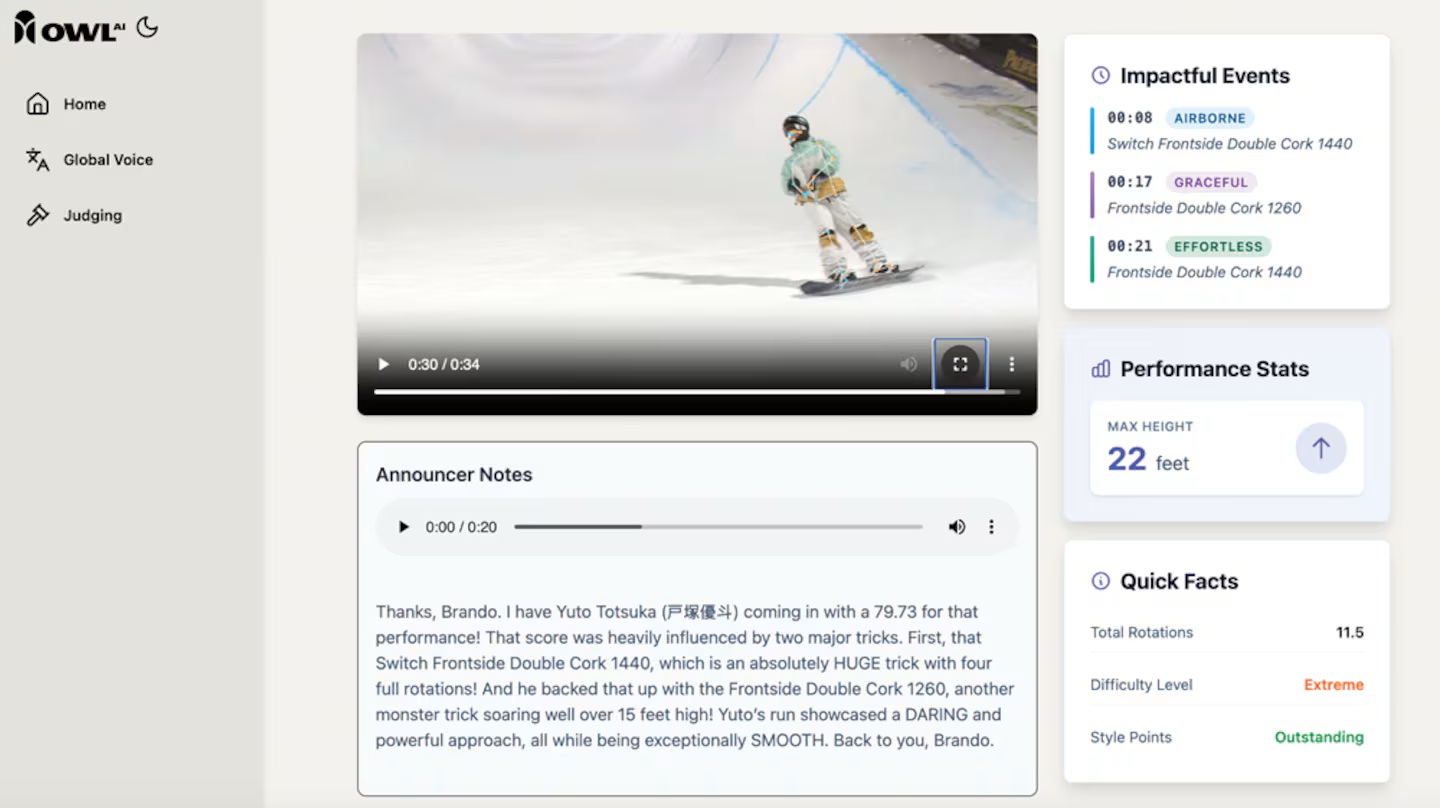
Owl AI’s officiating models create commentary about the action, enabling rare transparency in sports judged by scoring. (Photo courtesy of Owl AI)
“You only have one decision to make instead of two,” said Stephen Walkom, NHL Executive Vice President of Officiating, earlier this year. “Anything that is seamless and serves the game is always best.”
While an enterprise system like Hawk-Eye’s can cost nearly $100,000 for a single tennis court, some products are leaner and more easily democratized. Owl AI runs entirely as a software layer applied to video. It used a single camera for the X Games halfpipe, with the algorithms correctly predicting first, second and third place.
The same concept could be applied to other judged sports. “The goal would be that you get that certified by an Olympic committee, and now all these nonprofessional events — like your kids’ gymnastics — can now have a professional judge behind just a webcam,” Gwyther said.
Tennis is rife with line-call issues at the lower levels, with “hooking” — i.e. deliberate cheating — so rampant it has been cited as the No. 1 reason young players quit. Now, systems such as PlaySight and the USTA-backed PlayReplay are providing results with light installations, while SwingVision operates using only iPhones.
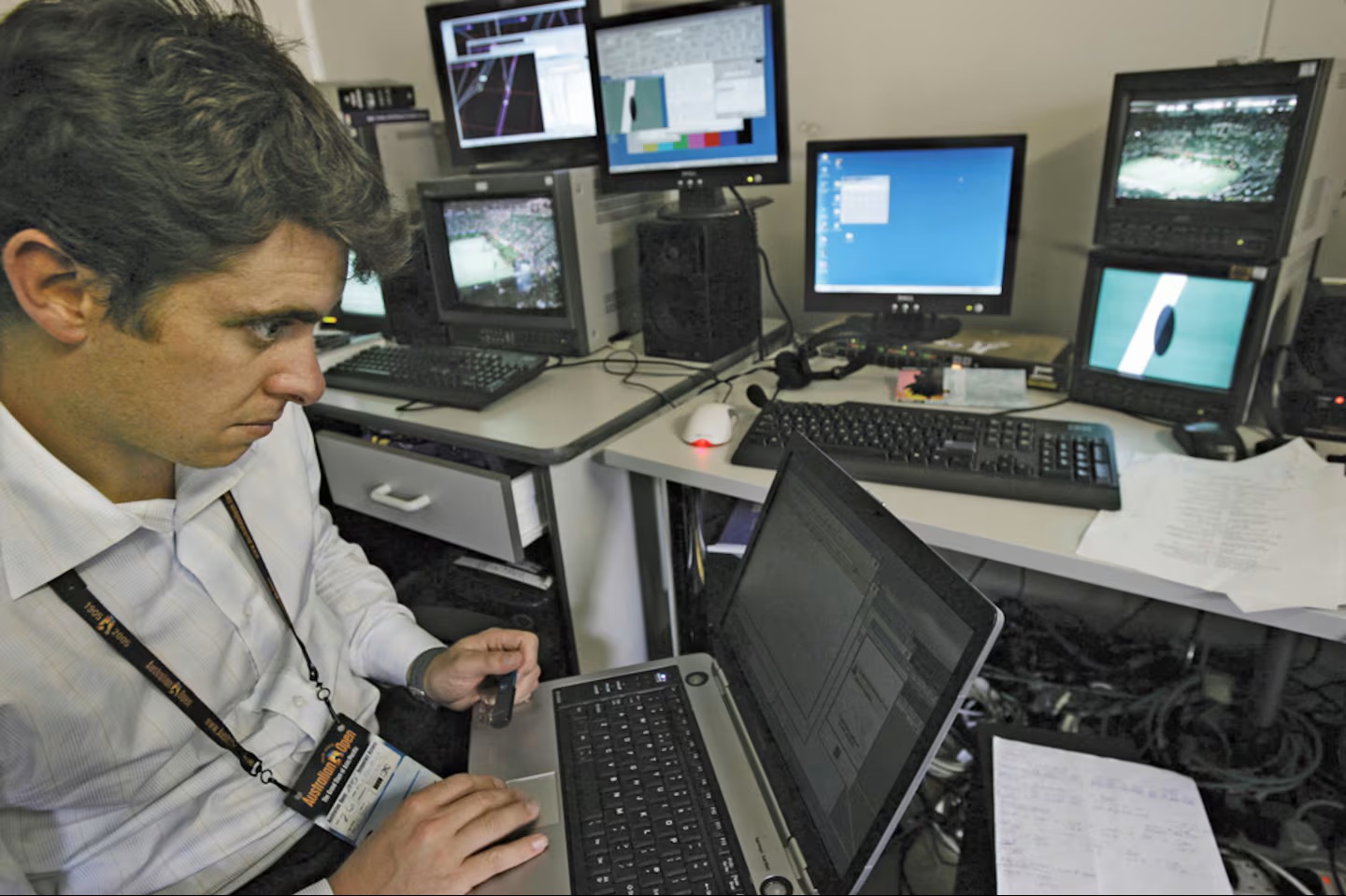
Paul Hawkins, shown at the Australian Open in 2005, founded Hawk-Eye, a camera tracking tech provider for the MLB, NBA, NFL, NHL, FIFA and tennis. (Photo: Getty Images)
SwingVision, financially backed by Tennis Australia, started calling lines at five USTA junior tournaments last summer. “There was one parent we talked to, and he said, ‘This is the first tournament where I was talking to the opponent’s parent, and we were just talking about life and we weren’t arguing about anything,’” CEO Swupnil Sahai said. “He was shocked. He’s like, ‘This is so transformational.’”
By and large, Squadron said, the reluctance to embrace more technology is less about its accuracy and more about people’s attachment to tradition.
“The human element is about the athletes, the unpredictability, the excitement about whether somebody can perform in an incredible, pressured situation,” he said. “Those unexpected errors that are so devastating — that is [part of] sports. The fact that an official doing his or her best misses a call and costs a team that’s trained, worked, performed for a championship? To me, that’s not part of the game.”
This article was brought to you by SBJ Tech, a Leaders Group company. As a Leaders Performance Institute member, you are able to enjoy exclusive access to SBJ Tech content in the field of athletic performance.
The Sony-designed devices are designed to take into account both weather conditions and crowd noise.
The custom-made headsets — developed in less than a year since the NFL and Sony announced their wide-ranging partnership — borrow some features from their high-end consumer headphones while incorporating a new highly-directional mic to isolate the coach’s voice and new water resistance to ensure operability in all conditions.
The new Sony-branded headsets were tested in the background on NFL sidelines last season and were distributed to team coaching staffs late last month in advance of training camps opening this week.
“Sony engineers visited each of the sidelines — they heard feedback from the coaches to make sure that what are some of the points that they should be addressing?” said NFL VP/Football Technology Rama Ravindranathan. “So it’s an iterative development process where Sony engineers partnered with NFL IT, football operations, game operations, to ensure every bit of the feedback was gathered and consolidated.”
That included data collection of hottest and coldest NFL games from the past 20 years, as well as recording crowd noise from a Monday Night Football game at SoFi Stadium where the volume exceeded 100 decibels.
Shunsuke Nakahashi, Product Manager for Audio at Sony, said engineers replicated that noise in a special studio in Tokyo, wore the headsets in the shower and in large refrigerators to test its all-conditions functionality. The belt pack connects to the Verizon private network in use in all stadiums. Ravindranathan said that was tested by the yellow hat-wearing communications technicians last season as “coach proxies.”
“We use the insights and principle from XM6,” Nakahashi said, referring to the top Sony consumer product, “and also we have a deep engineering foundation in precision sound and also vocal clarity.”
The Sony lettering on the headsets is large and unmistakable and becomes some of the most visible on-field signage, said NFL SVP/Sponsorship Tracie Rodburg, noting that Sony joins Nike, Gatorade and Microsoft among the most prominent branding. Sponsorship of the NFL headsets had been vacant for two years since Bose exited its deal after eight seasons of holding that inventory.
“Working with Sony, we’re both committed to innovation,” she said, adding: “We want to make sure everybody knows that we have a trusted partner on the sideline.”
While the new Sony headsets are custom-built for the demands of NFL coaches, some of the newly developed features might eventually trickle their way down to the broader market.
“Right now, we’re just razor-focused on delivering the NFL Coach’s Headset, but once everything is settled, then probably we can foresee what element we can bring to the consumer,” Nakahashi said.
This article was brought to you by SBJ Tech, a Leaders Group company. As a Leaders Performance Institute member, you are able to enjoy exclusive access to SBJ Tech content in the field of athletic performance.
As Dr Robert Cantu and Mike Oliver from the National Operating Committee on Standards for Athletic Equipment explain, their research is helping the sport to understand overall head impact exposure in a more nuanced fashion, while potentially influencing training methods, rules and player development models.
Main Image: courtesy of NOCSAE
The Sports & Fitness Industry Association reported that 758,000 youth ages 6-12 were regularly playing tackle football as of 2023, which is down from 965,000 who consistently played a decade ago in 2015 — a 21% decrease. And those who do play have been wearing helmets certified by a safety standard primarily with adults in mind, not kids.
That is now changing, as the National Operating Committee on Standards for Athletic Equipment, which first established safety guidelines for football helmets in 1973, is introducing its first youth football helmet standard specifically designed to protect players before they reach high school.
While the existing NOCSAE testing standards minimized impact energy in all helmets, from youth to pros, this more targeted measure should offer further protection to those players participating in leagues affiliated with Pop Warner, American Youth Football, USA Football and similar organizations.
“That’s been really very effective in preventing injuries in kids, too,” renowned neurosurgeon and NOCSAE Vice President Dr Robert Cantu said of the standard previously in place, “but we are very well aware of the fact that kids are not miniature adults. They have unique situations. Their brains are not as myelinated. Their necks are quite weak, so their head is a bobblehead doll. Their heads are quite big when they’re young, and quite heavy. And the types of hits that they take in football are not the same as older kids take.”
Peer-reviewed, university-led research more than a decade in the making drove the new youth standard led by NOCSAE’s Scientific Advisory Committee, which Cantu chairs. The most critical change in the new mandate, which goes into effect in March 2027 to give manufacturers time to adapt, is that helmets for the youngest players — facemask included — cannot exceed 3.5 pounds.
Only a few manufacturers already make sufficiently light youth football helmets, such as Light, Riddell and Schutt, but they represent a limited selection in the market. Light CEO Nicholas Esayian explained that heavier helmets typically fare better in lab tests but often don’t serve the needs of players on the field, especially younger players.
While the NFL and NFLPA have led pioneering work to test helmets for that league and NOCSAE has continued to iterate and improve its standards required at the pro, collegiate and high school levels, the youth player had been overlooked.
“Everybody tends to think, well, as long as they’re not going any faster than the [older] guys up above, then the helmet should be OK,” said Mike Oliver, who served as NOCSAE executive director for 20 years before stepping down this spring and remaining as the organization’s general counsel. “But the comment was made that we really don’t know what the risk exposure is. So how likely are you to get hit at some velocity versus hitting the ground versus hitting another player?”
Research funded by NOCSAE and led by professors Steve Rowson (Virginia Tech) and Blaine Hoshizaki (University of Ottawa) investigated head impacts, collecting data from sensors, triangulated cameras and predictive modeling in youth players. Rowson looked at ages 10 through 14, while Hoshizaki focused on ages 5 through 9. The results were surprising, Oliver said, noting that “the younger group actually had the higher head accelerations in games and practices than the older group, and turns out the primary reason is they hit the ground more often.”

New standards for helmets are designed to provide more protection for young players before they reach high school. (Image courtesy of NOCSAE)
While most governmental agencies require only self-certification of compliance, NOCSAE, an independent nonprofit, has required third-party certification since 2015, with manufacturers needing accredited institutions to assess products.
Cantu previously has recommended that there not be any tackle football for children younger than 14, but that’s his personal position. With NOCSAE, he views his role as ensuring best practices.
“If somebody is going to be doing something, I feel very strongly that I would like to be, if I can, helpful in making the activity as safe as absolutely possible,” he said.
There’s a compounding effect with head impacts. There’s greater research and understanding that the accumulation of sub-concussive hits can lead to problems over time, so minimizing that exposure early can pay dividends.
“To the extent we can attenuate the forces the brain sees, even if it’s 10%, that’s meaningful over thousands of hits to the head over a lengthy career playing a sport,” Cantu said.
New NOCSAE Executive Director John Parsons previously served as director of the NCAA Sport Science Institute and indicated the importance of how the college and pro games have taken steps to modify rules to mitigate risk of all head impacts.
“The conversation has shifted a little bit, so we’re not only just talking about concussion, but we’re also talking about head impact exposure,” Parsons said.
To date, NOCSAE has funded roughly $12 million in grants for researching concussions in sports. In addition to the work done by Rowson and Hoshizaki, the SAC reviewed more than 40 other studies related to injury risk in youth football to help inform the new policy. The weight limit is the biggest change, but the youth standard also has a lower threshold for acceptable rotational acceleration, as that type of impact is shown to cause injuries.
What neither the new standard nor the one for older players requires is any particular material or shape.
“Our standards are intentionally design neutral,” Oliver said. “Technology is moving pretty quickly, and if we did that, our standard may specify something today and six months from now, there’s something better, or there’s something new. And so we don’t do that, and it’s one of the reasons why you see such a divergence of engineering approaches to helmet design, whether it’s pro or otherwise.”
This article was brought to you by SBJ Tech, a Leaders Group company. As a Leaders Performance Institute member, you are able to enjoy exclusive access to SBJ Tech content in the field of athletic performance.
In this edition of SBJ Tech’s Athlete’s Voice, the former Baltimore Ravens safety discusses how his new performance center will help to transform gym culture.
Main image: MW Athletix
A native of nearby Eastvale, Williams starred at the University of Utah before the New Orleans Saints drafted him in the second round of the 2017 NFL Draft. The 28-year-old signed with the Ravens prior to the 2022 season. He has 20 career interceptions and has averaged 59 tackles per season.
On why he wanted to build a fitness center…
My first camp that I ever [worked] was Bobby Wagner’s camp at Colony High School. So I went there to help with his camp and help build a legacy for what he was doing. And then it sparked something in me that I want to do the same thing, giving back to the community, giving back to where I came from.
Ultimately, I created a camp. Then after that, I was like, Okay, I want to really help these athletes, young and professional, get to their goals, not just athletically — because athletics is going to come easy for athletes — but it’s all about the mindset, the mentality, the discipline, things that you learn in sport that will help you be a better person. I created this so that we are able to have this culture surrounding these athletes that helps them outside of sport because sport doesn’t last forever.
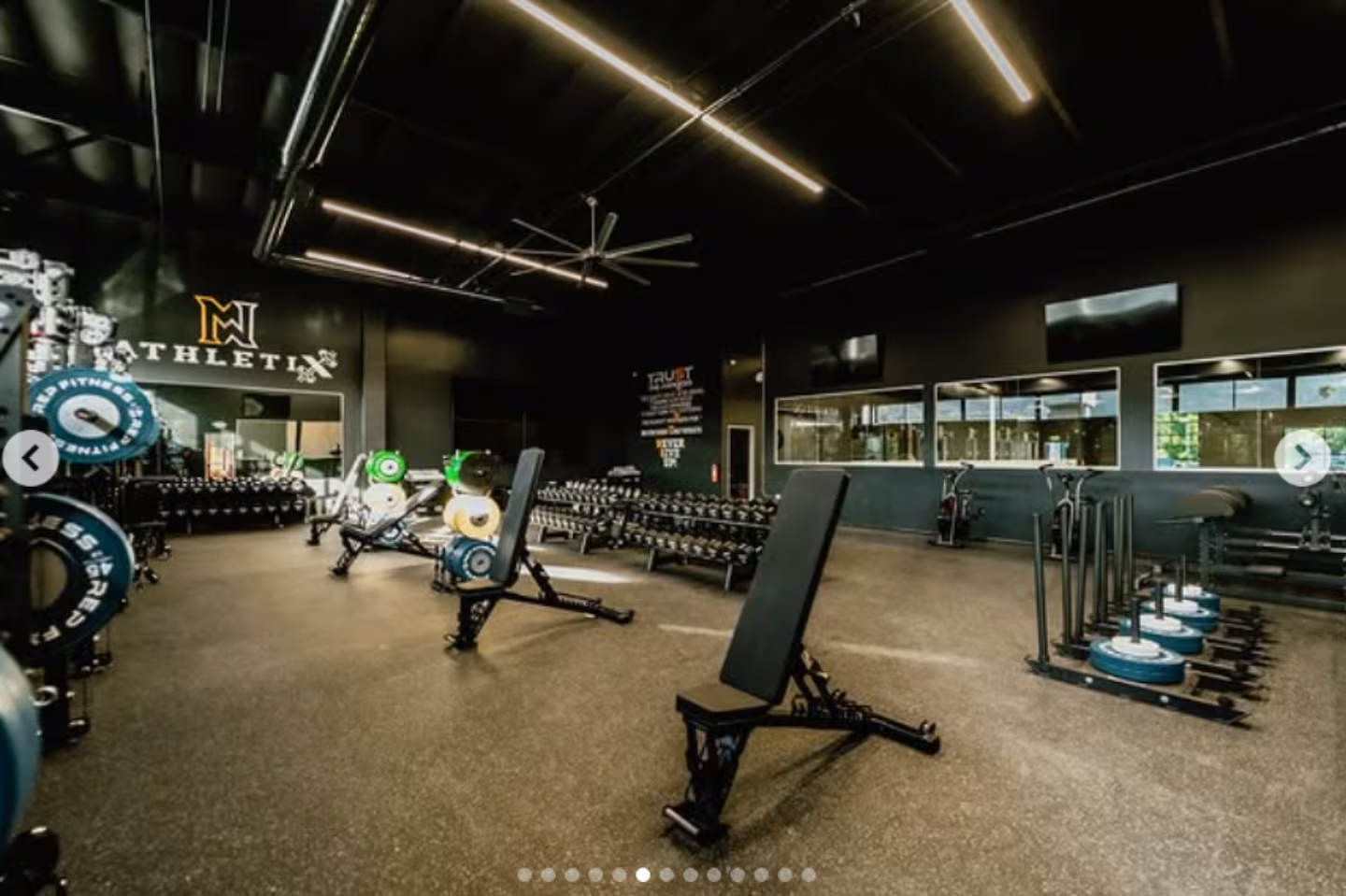
MW Athletix features a 7,800-square-foot exclusive private training environment, 35-yard indoor turf field, massage therapy and recovery services. Image: MW Athletix.
On how he built it…
It was a long design phase. It took us about two years to get this project up and running, but we took our time. We made sure that we detailed every single detail. I think we have the best bathrooms: It’s definitely spa-like. You go in there and you’re like, ‘Do I actually want to leave these bathrooms?’ You have the cold tubs, which are very essential in the recovery process, by Odin. And then we have our weight room — it’s amazing. We’re powered by REP equipment. They have all the tools and gadgets that you need to be able to get the ultimate workout.
And then we have our speed treadmills. These speed treadmills are our pride and joy. We use these treadmills to get these athletes, whatever sport it is, to get them moving in the right direction, moving fast. So these treadmills will get you fast, and it will turn your systems on pretty quick. We have 30 yards of turf, so every athlete can get in there and use their cleats or shoes — it is the same turf that they have at SoFi stadium. Then we have a multi-purpose room. We have massage therapy in there. We’re going to have Normatec boots. We’re going to have a little seating area where the parents can sit down, or people can sit and eat their lunch.
View this post on Instagram
On his vision for the gym culture…
I wanted to create a place where it feels like a team, where people come in and they’re like, ‘OK, I know I’m a part of this team. I’m part of this culture.’ And I wanted to make it almost as a dynasty you come in and it’s where the greats train, where the great athletes come from, where the team is always winning and the team is always working and motivating to be the best that they can. And of course you have to make sure everything is locked in and safe, so that everybody feels welcome.
On a key coaching mentor…
My college [position] coach, Morgan Scalley, took me under his wing. He showed me the ropes of taking that step into being a man. He had me since I was 17 years old, and I still talk to him pretty often. He taught me to never lose your edge, do things the right way, be accountable and make sure you do everything you have to do to be successful. Just never give up and never back down.
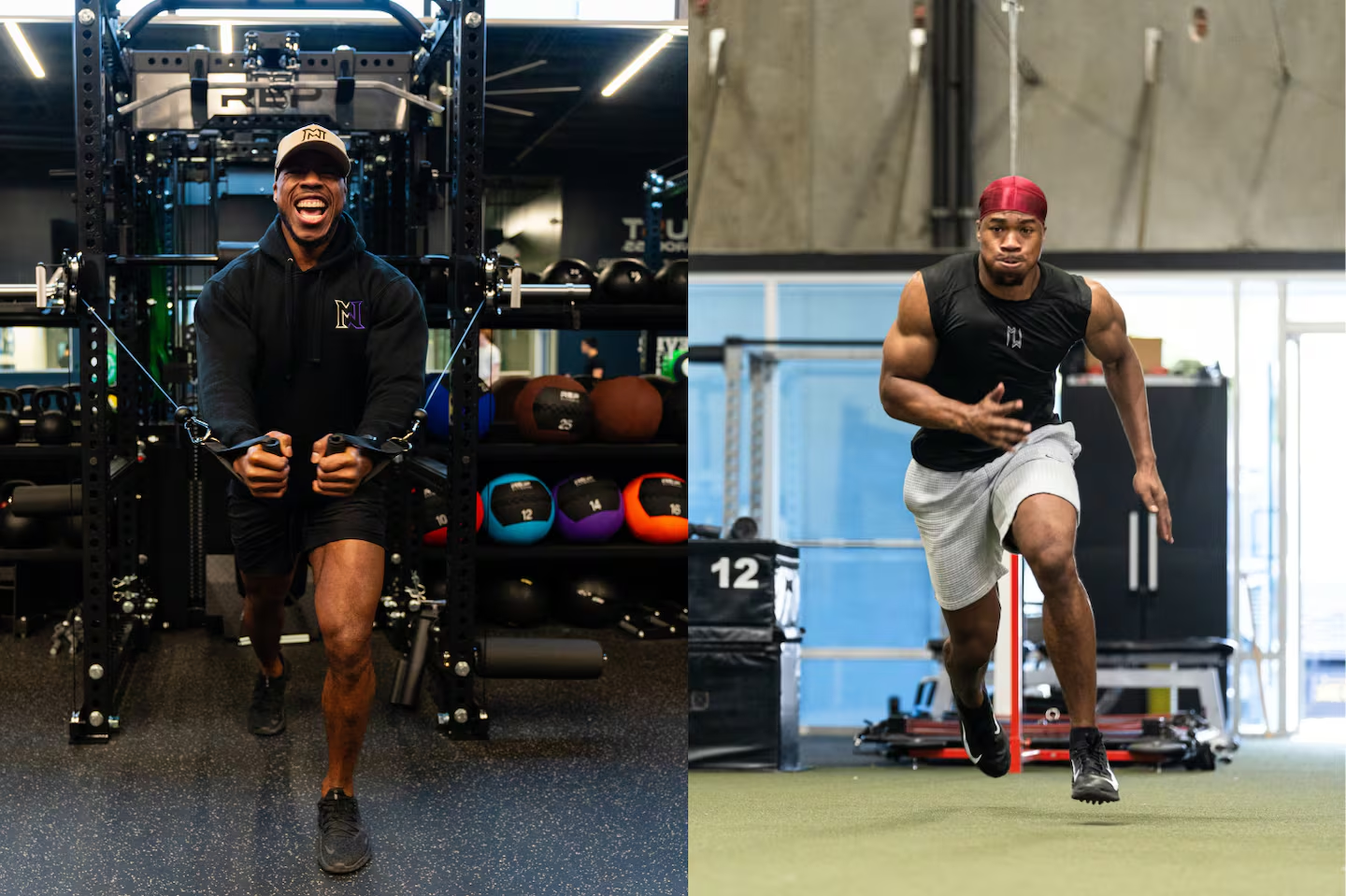
Marcus Williams founded MW Athletix to combine advanced training methods with community support. Image: MW Athletix.
On the tech and data he uses in training…
I don’t really use the Whoops or anything like that, just my Apple Watch. Now that I have this facility, I have the InBody scans, and I have the force plate so that we can see the type of outputs that we’re getting, and then we’re going to have the weight-monitoring system [velocity-based training, VBT] so when the bar is moving, we’re going to be able to track how fast it’s moving because everything is about speed.
On starting his own business…
I’ve always been an entrepreneur. Since I was in ninth grade, I was selling candy out of my backpack. That’s how I was making money in high school, trying to make sure I could provide and help out my parents by not asking for anything. I was able to do that little small business, which is kind of an entrepreneur-style thing, and then I was working at snack bars and things like that. But I’ve always been smart with my money. Taking this next step into a bigger entrepreneur role is definitely good for me because I’ve saved all of my money since I’ve been in the league.
This article was brought to you by SBJ Tech, a Leaders Group company. As a Leaders Performance Institute member, you are able to enjoy exclusive access to SBJ Tech content in the field of athletic performance.
Former NFL hopeful Ryan Rossner turned his attention to science, particularly longevity and gene therapy science
Main image: Minicircle
When he didn’t break through, he returned to school and went on to earn a PhD in molecular aging, studying under University of Washington professors Brian Kennedy and Matt Kaeberlein and pursuing research with Scott Leiser.
Now 42, Rossner is the Director of Longevity at Minicircle, a gene therapy startup in Austin, where he recently met SBJ and spoke about his career.
On his college experience…
I studied philosophy and political science, and I took football very seriously. I 100% wanted an NFL career. I wanted to make enough money to have financial freedom, but the NFL was very hard, and I was probably not mature enough to grind it out at that point.
On returning to school…
I took two years, bounced around the NFL, went right back to school [to complete my degree]. The NFL was that pressure cooker — I learned so many performance and discipline skills. I finished with straight As in school for the first time. I finished in philosophy and poli sci. But while pursuing football, I had the chance to read a lot, and I got exposed to popular science books about the exponential progress of technology through history. This grabbed me like nothing had before. I was like science is the answer to all these philosophical questions. And I can do science forever. It’s inexhaustible. So I got my BA and moved to Seattle to do science.
On his academic interest…
I focused on longevity, probably for two reasons: one, one of the formative events in my life was to watch my mom go through cancer. That’s why I got into philosophy. I wanted to understand why that happened. Philosophy doesn’t really answer that, but science empowers us to change that, specifically molecular biology. The other reason was all the exciting technological developments of the future, we get to experience them more if we’re around — longevity is like the big limiter.
On the start of his research…
I started working under this post-doc, Scott Leiser. He’s a former college football player, and we were studying how low oxygen exposure can increase lifespan in lab animals. Athletes train at altitudes, and then some of the mechanisms that are turned on by low oxygen are also turned on by fasting, which is like the foundational longevity intervention. So I started defining some of those mechanisms that were shared by low-oxygen, low-calorie longevity interventions.
On scientific breakthroughs versus football glory…
Ecstatic — nothing is better than discovering new scientific stuff. It’s the coolest feeling imaginable. At our rivals’ homecoming, [I hit] a clock-expiring, 54-yard field goal to silence the crowd. That was also cool. But science is like you’re seeing the secrets of the universe.
View this post on Instagram
On his next career step…
The Air Force recruited me a few months before I ended my PhD to work on the DARPA biostasis project, which is basically drug-induced human hibernation. I could not pass that up — super interesting. We really were studying extreme metabolism, which applies a lot to sports. So I went and did that in on Lackland Air Force Base in San Antonio for six months post-doc.
On lessons he’s learned and how he’d train differently for football now…
A million. I would train slower and smarter, just roll things out slow. I was always in a rush. I wanted to be Superman in six weeks, so [I had] a lot of overuse injuries. I would have drilled more when I got to the NFL. They made me start drilling instead of just kicking, and that was the first time I became really, really consistent at mid-distance kicks. And then, to be honest, I would have partied less.
On his work now…
This gene therapy basically increases fat free mass, decreases body fat, rewinds cellular epigenetic age, and our method of delivering it is what’s specific to us. So we adopted an irrationally neglected gene therapy mode called plasmid gene therapy. It’s simpler, safer, maybe a little less powerful than viral gene therapy, but our goal is to make something simple and accessible and safe.
On clarifying popular misconceptions…
Longevity science and gene therapy science, in particular, are very real. A lot of people think of them as sci-fi still — they are very real. We figured out how aging works, mostly in the 90s and early 2000s to a great degree. It’s worth learning about.
The other thing is, for athletes, and really just for anybody, data collection is really undervalued. You can have your whole genome sequenced for $400, and most people don’t know that’s possible. And then people are like, what am I going to do with that? You have the rest of your life to figure that out? You can get all 3 billion digits of code that you run on. This is like seeing behind the matrix. Get your code, get all the data you can on yourself to inform your health decisions.
This article was brought to you by SBJ Tech, a Leaders Group company. As a Leaders Performance Institute member, you are able to enjoy exclusive access to SBJ Tech content in the field of athletic performance.
The former NFL defender and Super Bowl winner spoke at SBJ’s Tech Week about how he used tech during his career and the impact of being able to call Warren Buffet and Joe Moglia his mentors.
Main image: Gregory Shamus / Getty Images
Suh, now 38, last played in 2022 and was part of the Sky Sports broadcast team for last month’s Super Bowl. He has invested in more than 30 companies, including Oura, through his family office, House of Spears Management. (Ndamukong means “House of Spears” in the Cameroonian language of Ngemba.) Suh also operates a real estate development company in Portland, Ore.
During SBJ Tech Week, Suh participated in a panel entitled “Tech and Talent: AI’s Impact on Athlete Training and Performance.”

Image: Marc Bryan-Brown
On the datapoints he tracked during his career…
The most consistent one that we’ve always done was, waking up first thing in the morning, I’d use a simple Google Sheet: How do you feel? One to 10. Where’s your energy level? There were four or five questions. That was probably the most consistent, and then we had so many other pieces of sleep data, whether it comes from Oura or, back in the day, we had other programs that we use. Ultimately, it’s a combination of looking at all this.
I’ve always been wired, especially from an athletic perspective, [where] I don’t really care how I feel. I have a job that I want to go and do an accomplish, and so I’m going to push myself through that. And if I chose to go get drunk the night before, I know I have to get up, and I’m going to have to muster through some things because I did that to myself. Vice versa, if I woke up and I just wasn’t feeling well, because traveling, or whatever it is, there’s ways to manipulate the body and manipulate the mind so you can reach your ultimate goals at the end of the day. It’s a combination of knowing when to pull back and when to push forward.
On the growth of data and tech…
Back in 2010 when I started, which is ages ago, it was kind of archaic, but to where we’re at now in 2025, there’s been a transformation. As athletes, we find different nuances and ways to find ways to get that 1% or half a percent to take us to the next level. And so I was always going into the lab. I was fortunate enough to have an amazing performance director I still work with to this day.
And then I had the great lab on the campus of Nike where I got to sit there underneath Phil Knight’s beautiful campus and everything that he has out with innovation. Back then it was the Mia Hamm Building, but now it’s LeBron James Building. So in there every summer finding new ways to tweak and learn different nuances that can advance my playing career.
On not overloading on tech…
Tools are key to have, but we also have to have that human interaction as well. It’s very important. That’s why I mentioned Keith D’Amelio, who’s my Performance Director. To have that human interaction and being able to say, “I can look and feel and see the things that you’re doing and I can teach you about the data.” Because I’m so focused on my craft and what I’m trying to do and accomplish and be the most dominant, but at the same time, I also need to learn those different new aspects of these new data points that are coming out. Some of them may not be relevant to me and that’s okay, but how do we decipher which ones are the best ones for me and which ones are not going to be the best ones for me.
On his interest in engineering…
I was born and raised into it. My father was a mechanical engineer. So as a young kid, as early as probably, second, third, fourth grade, I was riding around in this truck. He owned his own business, and so I was always with him, especially in the summers, when I wasn’t in school. It became a way for me to, one, be exposed to the industry and then falling in love with it, but then also as a kid, wanting toys and bikes and all different stuff — that became a job. Sweeping job sites and carrying duct work and all these particular pieces, and as I got bigger and stronger, I could lift heavy equipment and do that and things like that. Maybe I shouldn’t have been, but I was. So it was something I just easily fell in love with, [being] my dad, being on his hip, being able to watch and do everything, and just seeing it as something cool.
View this post on Instagram
On his studies at Nebraska…
I was a construction manager, so a broader view where, basically, I have the understanding of mechanical, electrical, plumbing, all the different trades that go into developing a building because I have to manage all of it. I have to know enough to be dangerous.
On how he’s put that to use…
I have built apartments, commercial buildings, so I’ve definitely put my degree to use. I have a development company back home in Portland that I do a majority of that through, and then I’ve built single family homes, not for myself, but for others and just different developments with different partners. I first learned by starting to do it, especially when I was in Detroit my first five years playing for the Lions. There was a guy named Gary Shiffman — he runs and started Sun Communities, which is a big publicly traded company centered around manufacturing homes. And so I learned a lot from him. We still work together to this day.
On his investing mentors, Warren Buffet and Joe Moglia…
We share an alma mater, Nebraska, so I first met [Buffet] when I was playing football there and going to school. He was honorary captain my senior year. And so they randomly came to me and were like, ‘You’re one of our top players. We’d love for you to meet him and walk out with you to the coin toss. Do you know who he is?’ And I was like, ‘Of course I know who he is. You’d have to be under a rock if you didn’t.’
So I really started reading up on him, understanding everything that he did. And then, funny enough, there was a defensive assistant that I didn’t really know until later on in my senior year, a guy named Joe Moglia, who was a big finance guy — he was CEO of TD Ameritrade — so everybody knew him as football coach, a silent assistant coach, but nobody really knew why he left in a black car every Thursday night to go to New York. And I had the balls to ask him. So we built a bond, and he became a close mentor of mine, especially after leaving college and even to this day.
On his investments…
I have a broad spectrum — the hospitality space, real estate and tech, depending on what type of technology it is and if I can add value to it and also if it’s just functionally things that I use. Especially on the sports side of things, like Oura Ring. Hyperice — I sold a business to them over the last couple of years for new technology for them to integrate into their organization with Normatec. I’ve been an advisor since the inception.
This article was brought to you by SBJ Tech, a Leaders Group company. As a Leaders Performance Institute member, you are able to enjoy exclusive access to SBJ Tech content in the field of athletic performance.