College teams across the US are starting to consider the mental side as a critical element of player development and are using Pison’s AI-powered solution in their pursuit of answers.
Main image: Pison

Priced annually at $359 per player, the package comes with the same hardware and ENG technology as the company’s Pison Perform product – which encompasses sleep tracking in addition to cognitive assessments – plus access to an online data visualization dashboard and Pison Baseball Pro app with drills specific to the sport.
“As far as this game goes, it’s been known to be 90% mental, but how often do we train the mental part of the game?” said Marc Deschenes, Pison’s VP/Sports Operations and a former professional pitcher. “Us being able to use that information and integrating that into player development for performance and awareness on the baseball field is integral in making this game more complete for our players.”
Pison’s sensors detect electrical signals that emanate from the brain, pass through the nervous system and manifest in muscle movements. Its breakthrough is in coining what it calls ENG (electroneurography), which measures electrical signals in a way that would typically require complex lab testing via a chip pressed to the surface of the skin.
The roots of the company’s technology are in treating degenerative brain illnesses such as ALS, but it broke into sports about one year ago with an eye on performance and evaluation use-cases. Pison’s sensors measure cognitive functions such as reaction time, mental agility and focus through light-based reaction tests that range from 20 seconds to three minutes.
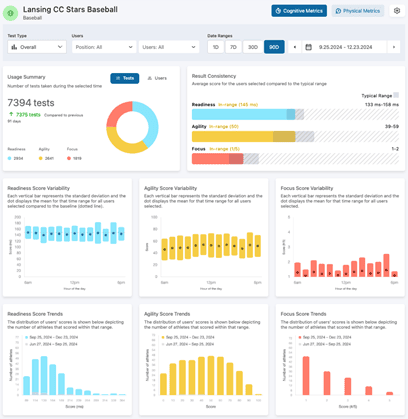
Image: Pison
Pison has public partnerships with the baseball programs at Penn State, Oral Roberts, West Virginia (including use by 2024 No. 7 overall MLB draft pick of the St. Louis Cardinals JJ Wetherholt), and Lansing Community College, which Deschenes calls a “power user” because of feedback they have provided. At the youth level, Pison works with USA Prime New England (which Deschenes owns) and Fort Worth Christian Academy for baseball, as well as the Boston Hockey Academy.
Multiple MLB teams are also evaluating the technology, and the league itself is in the process of testing it for on-field approval.
The new product was formally announced at the American Baseball Coaches Association conference in Washington D.C. this morning. In the future, Pison will look to expand to other sports and potentially integrate its sensors into existing wearable vendors.
“The product, really, is taking a sophisticated technology that has been in the medical world – and kind of out of reach even there because of the cost – and bringing it down to something that everybody can use,” said John Joseph, Pison’s CRO. “When we look at the market, we aren’t just going after the MLB market or college. This is really for anybody that wants to develop that elite mental game.”
This article was brought to you by SBJ Tech, a Leaders Group company. As a Leaders Performance Institute member, you are able to enjoy exclusive access to SBJ Tech content in the field of athletic performance.
A UPenn study found that Lena Blackburne Baseball Rubbing Mud improved friction – and performance – in Major League Baseball
Main photo courtesy of the University of Pennsylvania
Researchers at the University of Pennsylvania have completed the first study demonstrating that the special mud Major League Baseball uses to rub all of its game balls does, in fact, enhance friction and ensure pitchers have a consistent grip.
While questions remain about the compositional qualities of the South Jersey mud that create this effect, the new paper published today in the Proceedings of the National Academy of Sciences concludes that the Lena Blackburne Baseball Rubbing Mud — harvested by the Bintliff family for generations — spreads like skin cream and grips like sandpaper.
“The non-complicated headline, is that, in general, the friction is enhanced with the mud on the ball,” said Douglas Jerolmack, a Penn professor of engineering and environmental sciences, who said the combination was “kind of magical” how it spreads smoothly and still has grit. “The thing, though, that makes it delicate and complicated is that the sliding speed matters.”
The lead author of the paper is Shravan Pradeep, a postdoctoral researcher working in Jerolmack’s lab. He worked closely with a student, Xiangyu Chen, to design the experiments. Jerolmack and Paulo Arratia, a professor of chemical and biomolecular engineering, supervised the work.
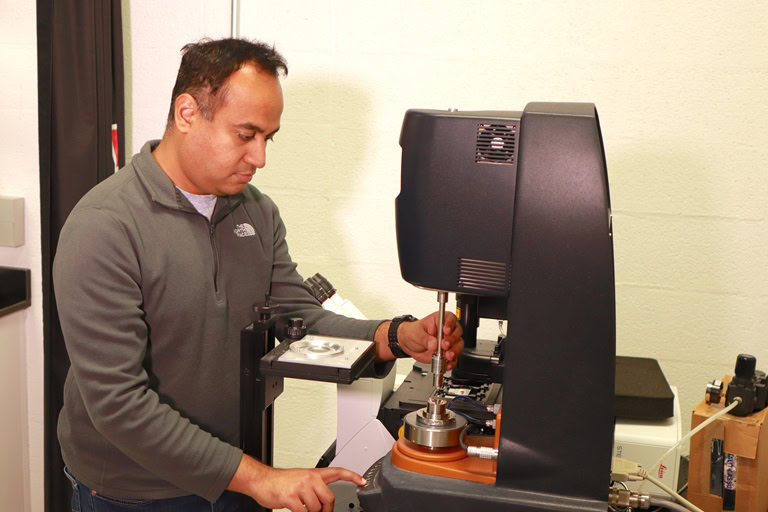
Photo: University of Pennsylvania
Much of their recent, grant-funded work studies the behavior of natural mud in debris flows — “catastrophic landslides,” as Jerolmack put it — but the baseball mud became a passion project after learning of its existence when approached by a journalist for comment in 2019.
The Bintliff’s mud is a quirky but essential part of baseball lore and logistics. It used to prepare every baseball to ensure the proper tack and feel of the ball. MLB has previously contracted with material science giant Dow to create pre-tacked baseballs, which were tried in the minor leagues but didn’t behave the way a traditional baseball does.
Mud procured by the Bintliffs is found along the Delaware River and is unique, even if it initially looks and feels the same, with Pradeep explaining, “When you try to spread it between your fingers, it looked and it felt like a face cream, like these clay masks we have you put on the face.”
“It allows you to spread a very thin and fairly uniform coating because it spreads so well,” Jerolmack added. “It makes this exquisitely thin layer.”
Based on published reports, the Bintliffs do treat the mud some, draining some water out to a certain consistency, sieving it to remove a particular fraction of larger particles and putting in a secret additive. The Penn researchers did some compositional analysis that identified the concentration of elements but not how they are combined. An area for further research is to examine the biological materials. They did note the product included “little bits of twigs and leaves and stuff because it’s actually natural mud from a real creek,” Jerolmack said.
“It behaves like a material that’s been optimized to do this,” he added. “They must have a very good working knowledge of this mud. . . . It appears that the ingredients don’t seem special, but the proportions of these ingredients are dialed in perfectly to make it have this behavior.”
The first of three tests conducted by Penn was the use of a rheometer, which measured its viscosity and found that it behaved similar to commercial skin creams. The second involved an atomic force microscope, which is essential a pin prick that measures the resisting force needed to pull the needle away — it assesses the stickiness of the substance, which Pradeep saying the Lena Blackburne mud-rubbed baseball was twice as sticky as an untreated ball.
The third test was the novel one involving the creation of artificial fingers for consistent force application. Pradeep and Chen used a silicone polymer called PDMS that has the same elasticity as human skin. They then added squalene, a fish oil that replicates what’s naturally found on fingertips. The scientists applied pressure on the baseball with these fingers and then created a shearing force by sliding the ball at various velocities.
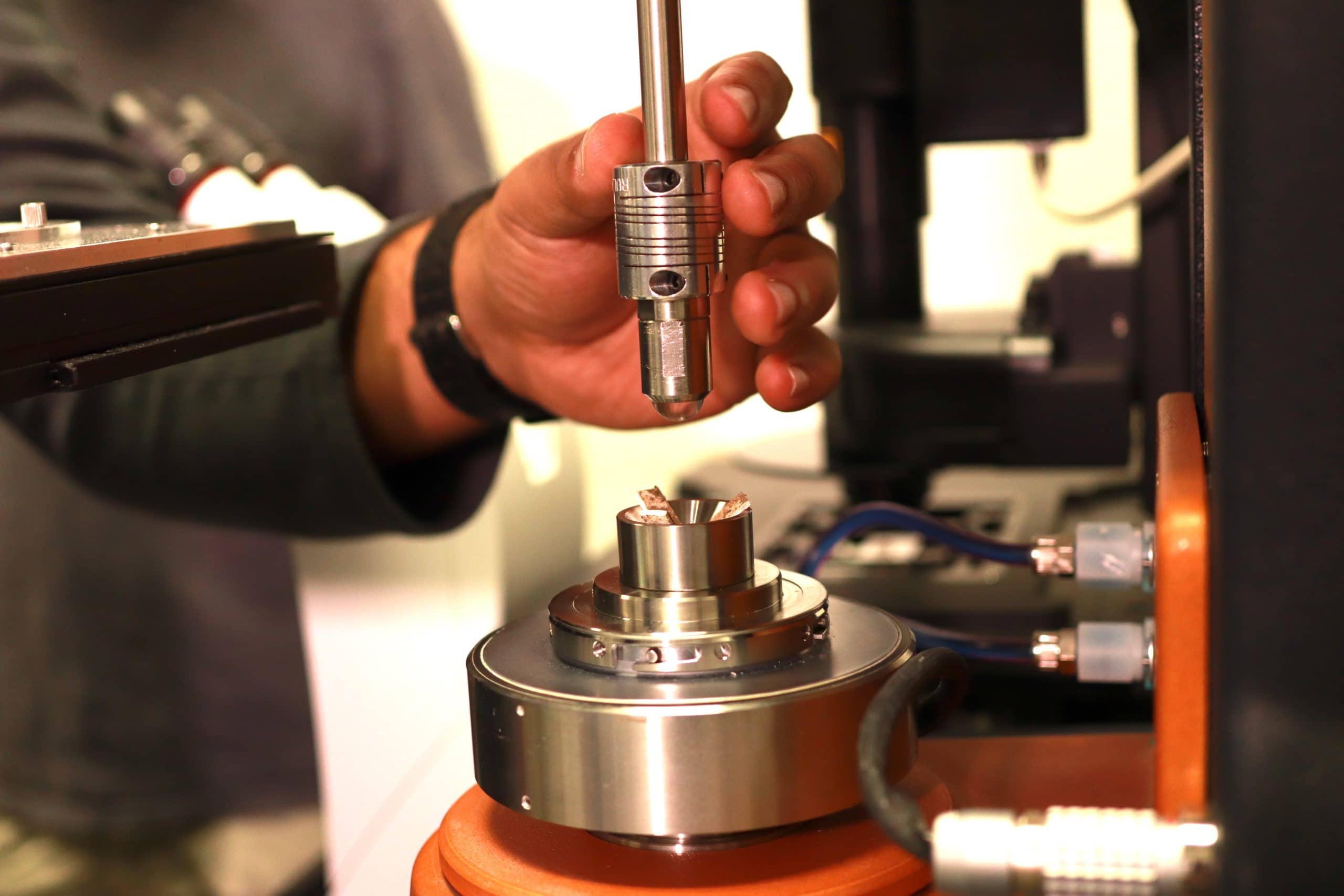
Photo: University of Pennsylvania
What they found was that the mud created only a small amount of friction at slow sliding speeds and that the friction disappears at very fast speeds, presumably because the small sand particles in the mud are knocked off the ball’s cover. But, in the Goldilocks zone in between the extreme speeds, the friction is notably enhanced by the mud.
“Over the past decade, we have worked with many types of cohesive mud, frictional mud, different type of muds that are out there,” Arratia said, “and in our experience, none of them has those properties that we saw with this particular mud.”
The researchers bought the mud and the baseballs on the internet and were not in touch with the Bintliffs to avoid any conflict of interest. They were just keenly interested in how the mud works more than any business implication of how their findings might affect the family business or the progress of a chemically enhanced, tacky ball.
But Jerolmack said his team ultimately did develop a stance — which was to endorse the continuation of the Lena Blackburne Baseball Rubbing Mud.
“It seems like the consistency of this mud has been more consistent than any other aspect of the manufacturing of these balls,” he said. “And our take now is that it’s 2024 and there’s a lot of people in material science and chemistry and other industries that are looking for sustainable and green solutions to replace synthetic and petroleum-based things. And here is a baseball tradition that is a material sustainably harvested, that’s replenished with the tides and takes very little of it to have this desired effect, and it’s a consistency for the pitchers — and I’m like, why would you try to change this?”
This article was brought to you by SBJ Tech, a Leaders Group company. As a Leaders Performance Institute member, you are able to enjoy exclusive access to SBJ Tech content in the field of athletic performance.
In the recent edition of their Startup Series, SBJ Tech spoke to Bat Around, a company seeking to blend sport and entertainment with potential performance edges for athletes and coaches.
Main Image: Bat Around
A Data & Innovation article brought to you by
Our Startups series looks at companies and founders who are innovating in the fields of athlete performance, fan engagement, team/league operations and other high-impact areas in sports.
* * * * *
World’s shortest elevator pitch: “Bat Around is gamifying baseball batting practice.”
Company: Bat Around
Location: New York, N.Y.
Year founded: 2020
Website/App: https://www.letsbataround.com | Apple Store app | Google Play app
Funding round to date: “We are self-funded at this point. Pre-revenue.”
Who are your investors? “The main investor is single-sourced, Steve Zelin of PJT Partners in New York.”
Are you looking for more investment? “Yes.”
Tell us about yourself, CEO Matt Farrell: “I’m a career-long sports marketer with about 30 years working in the sports business. I mainly have worked for leagues and governing bodies – Golf Channel, USA Swimming, the U.S. Olympics and Paralympic Committee, as well as Warner Bros. in the early days of the internet. I started a consulting business in 2020 during the pandemic, and I started out as a contractor working for what is now Bat Around, and that eventually led to this role.”
Who are your co-founders/partners? “Steve Zelin, he’s a partner and the head of restructuring and special situations group at PJT Partners. Ken Byck, he was a co-owner of one of the largest fantasy baseball vacation companies licensed by MLB. Robert Lipps, 20 years of investment banking experience. Clint Hurdle, former manager of the Rockies and Pirates, 1,269 career wins as a manager, National League Manager of the Year in 2013 with the Pirates. He’s really the vision and the soul behind what is Bat Around.”
How does your platform work? “If you think about any type of simulator, most notably in the golf industry, hit the ball and watch the animation take place on the screen – that is essentially what we are for baseball. We’ve created a game out of that. We took a technical player development tool of swing analytics, swing outcome and turned that into a game. We call it “sportainment.” It’s a mixture of sports and entertainment. Hitting the ball with live, on-screen results.”
What problem is your company solving? “When we started this, we saw two things that weren’t necessarily headed in the same path but we thought they could. One is we saw the baseball/softball industry have a lot of really strong player development tools that were very technical, but few that really gamified the experience. That was happening at the same time we certainly saw the explosion of Topgolf, golf simulators generally and, believe it or not, even some activities like axe throwing that were getting people active in something they didn’t really think they could do or they didn’t think the game was available to them. We felt like that was a convergence of where we wanted to be.”
What does your product cost and who is your target customer? “Right now, we’re distributing the product free to batting cages that have a HitTrax system. That’s a product very prevalent in the batting cage world. We’re going to support that with sponsorships and partnerships, but starting this out to grow the user base and get as many people playing this game as possible as we start on this HitTrax platform. We have two target audiences. The first being baseball/softball batting cages with a HitTrax system. The second is more in the entertainment space of baseball stadium concourses, family fun centers or even entertainment locations.”
How are you marketing your product? “It’s a little bit of a combination. We have 12 former MLB players with 29,000 combined hits that are advisors on the project, and they are a great source of introductions, content and giving validation to what the product is all about. We’ve done an on-site activation for two weeks at the College World Series in the summer of 2023. We just finished in (early January) at a baseball conference in Dallas for coaches. We did a demonstration and were invited to be part of the MLB Winter Meetings in a tech innovation expo. We’re really starting to use experiential activations and digital marketing to spread the world about how you can get this in an area near you.”
How do you scale, and what is your targeted level of growth? “The good news about scale with the product being software is it’s really a one-click download to get the product onto your HitTrax system. We came out of our beta mode of three pilot cages in January to release the product. We see starting and building authenticity in the baseball/softball world first, but we really see growth coming in entertainment venues and restaurants. We have signed our first agreement with an MLB team and will be on their concourse as a fan activity starting this season. We will announce the team in the coming weeks.”
Who are your competitors, and what makes you different? “In many ways, we’re at the beginning of this sport and entertainment mixture within baseball and softball. The golf world is very well advanced in this, but baseball/softball has not been as much. Our competitors come in other sources of entertainment for people. Within the baseball world, it’s re-educating people how to take player development tools and turn them into a game. HitTrax is a great example of that. In the future, there are a ton of great player development technology tools in baseball – Diamond Kinetics, Blast Motion, Rapsodo, TrackMan. Really, we just see the universe of gamification in baseball having so much opportunity.”
What’s the unfair advantage that separates your company? “What we think is the special sauce to our game is we’ve created our own specific metric that actually measures your success of the game, it’s called your Bat Around Metric or your BAM Score. Obviously, baseball is a very statistics-driven sport. What we’ve done is taken different strategic hitting skills, strategy of the game, hitting a line drive, moving the ball around the field, moving runners and we’ve taken your overall success rate of all of these different hitting skills, not just hitting the ball hard, which is an over-focused area right now of just exit velocity and how hard you can hit the ball. What we’ve done is taken all of these hitting skills and rolled them into one successful number, where you’re a power hitter and I’m a singles hitter, we can actually score well in this game and maybe just perform well on different skills, roll that up into your BAM, which I describe as a decathlon of hitting. From there, just the other soft advantages are first mover in the gamification space, the advisors we have on the project, like Clint Hurdle, and being that early adopter in the space.”
What milestone have you recently hit or will soon hit? “We just came out of our Beta mode and we are now in 18 cages and adding new ones each day. Our major milestone, our coming-out party as a product, was really this past College World Series in Omaha. Having the feather in the cap of being invited by MLB to display at the Winter Meetings was huge for us as a young company. Another is this MLB team concourse.”
What are the values that are core to your brand? “We have a mission and our guiding principles of the game. Our mission statement is connect with the ball and others, meaning we want you to hit but we want it to be a social activity. That’s the simplicity of our mission, connect with the ball and others. Then, we have three guiding principles. One is everybody hits, which essentially means making the game, swinging a bat, accessible for anyone and everyone. The second guiding principle is what we call baseball with more BAM, which means there’s a fun element to this and also a scoring element that can actually help us – think of a handicap in golf – that can allow us to play different skills with each other. The third, really inspired by Clint Hurdle, is innovation built on tradition. We want to take old school hitting strategy and elements of the game of baseball but have it be packaged with modern technology, and in many ways trick people into learning the strategy of the game and strategy of hitting, versus just trying to hit bombs all day.”
What does success ultimately look like for your company? “It’s making the game of baseball and softball more accessible than ever before. Many people, such as myself, the game retired us. The game retired me at 19-years-old. Outside of adult leagues, I didn’t really feel as if there was much of an outlet for me to play. Now, we’re trying to re-open the door. We want to give the game back to people to enjoy, no matter what their skill level is. I feel like going back to our mission of making that a connected experience of the ball and with others, whether it be a restaurant or a professional stadium concourse or being able to play the game in your garage if you want – make the game more accessible again.”
What should investors or customers know about you — the person, your life experiences — that shows they can believe in you? “The depth and breadth of my experience working in sports and sports business, but not just that, but I’ve always worked for challenger brands in sports. It’s one thing to be a marketer and promote some of the biggest NFL, NBA, MLB teams. My career has been about building brands with Olympic sports, non-traditional golf events. It’s really the love of sports and sports business with being, of knowing the grind of building a brand and especially a challenger brand.”
How much does adding the gaming element of this more appealing across different sects of baseball fans? “In this case, I will make a loose connection to Topgolf and our game. What I love about both is if I stood out on a golf course or stood at home plate and hit a ball, the massive amount of real estate that is comes into reality really quick. When I can be in a more confined setting, then see the animation play out on the screen and see the defenders play my ball, score points, even if I hit a weak ground ball I’m still scoring some experiential points and there’s the phenomenon of seeing some numbers tally, whether they’re small or large, there’s a rush to that. And seeing some success. The same way in Topgolf, if I shank a shot, I can still hit a target and there’s some fun in it. It’s not the same in Bat Around, but we’re showing you constant feedback of you earned 50 experiential points for this hit, you earned 300 points for that hit, so we can give you instant feedback and keep the integrity of competing with someone but have some small wins along the way.”
This article was brought to you by SBJ Tech, a Leaders Group company. As a Leaders Performance Institute member, you are able to enjoy exclusive access to SBJ Tech content in the field of athletic performance.
Ben Baroody, of the World Series-winning Texas Rangers delves into the franchise’s holistic approach to player development, which prioritizes well-being.
A Human Performance article brought you by our Main Partners

“It means a lot to us,” he tells Henry Breckenridge and John Portch on the Leaders Performance Podcast, which is brought to you today by our Main Partners Keiser.
“The aim and approach of all of our programs, processes, and our building blocks, is based on the foundation of the human psyche, the psychology of healthy minds and lives. And we try to take that evidence-based research and build it into baseball frameworks and development for the rest of the organization.”
As the Texas Rangers’ Director of Leadership & Organizational Development, Player Enrichment Programs & Mental Health says, the goal is to unlock player potential versus extracting performance.
“That’s what we’re striving towards. It’s an aspiration that’s ever-evolving,” he says,
Elsewhere in this episode, we cover:
Henry Breckenridge LinkedIn | X
Listen above and subscribe today on iTunes, Spotify, Stitcher and Overcast, or your chosen podcast platform.
Diamond Kinetics and Marucci Sports have have developed the industry’s first smart bat with a fully integrated swing-tracking sensor that never needs to be removed and charged.
Main image: Marucci Sports / Diamond Kinetics
A Data & Innovation article brought to you by
The new product, a limited release from Marucci called the CATX Smart, relies on new battery technology to provide a lifetime charge and is the first to be approved for in-game use by the United States Specialty Sports Association (USSSA), which governs a wide swath of youth baseball.
Users will have access to data, interactive games and content through the DK app. Notably, the Marucci CATX Smart bat retails for the same $299 price as the current CATX bat without the embedded sensor.
“The drive here was a very graceful, magical user experience,” Diamond Kinetics CEO/Co-Founder CJ Handron said, adding, “Overwhelmingly, this is taking the thinking out of it for the user, so the idea of having to thoughtfully say, ‘I need to get a sensor, put it on my bat, make sure it’s charged.’ That entire user experience is very doable — we’ve done that for a long time with lots and lots of people — but this is a completely mindless exercise.”
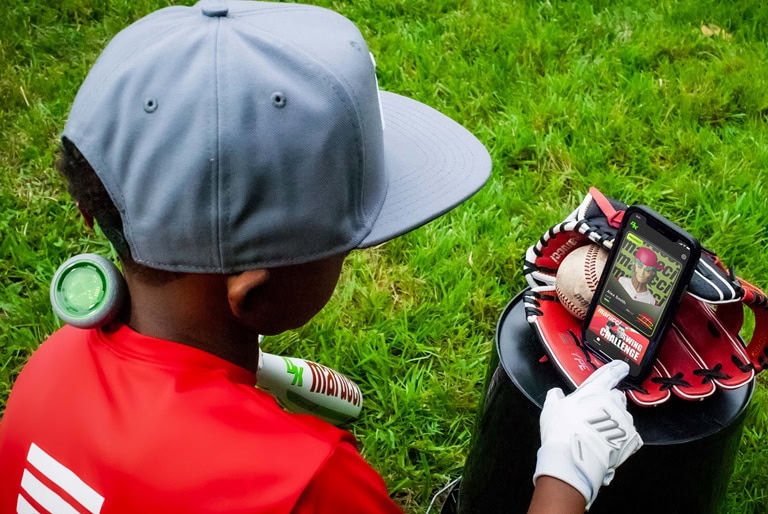
The CATX Smart bat connects via Bluetooth to iOS devices and can record more than 100 swings locally on the hardware when not connected to the app. Image: Marucci Sports / Diamond Kinetics
The CATX Smart bat is a one-piece alloy made from AZR aluminum that has the same weight and shape as its sensor-free counterpart. It connects via Bluetooth to iOS devices and can record more than 100 swings locally on the hardware when not connected to the app.
Marucci and DK first created a smart bat with a sensor embedded in the knob back in 2017, but that was for a wood bat and required extraction to charge the device. Prior to that, all sensors were affixed to the bottom of the knob.
“To be able to create a bat where the sensor is in the bat and it doesn’t need to be charged for the life of the bat was a really big deal for us,” said Marucci CEO/Co-Founder Kurt Ainsworth. “We didn’t really like the one that wrapped over the end — we wanted it in the bat because it’s also better for certifying bodies for it to be inside the bat where the bat can’t be altered. That was a big part of this.”
The USSSA is the first sporting group to certify the bat, but the goal is to complete the process for other leagues, including the BBCOR standard that has been adopted by the NCAA and high schools.
Bat sensors are currently prohibited in MLB but have been permitted in varying forms in the minors since 2017. Initially, only external sensors attached to the knob were allowed but, by 2019, embedded sensors were allowed at all levels of the minor leagues.
Though this new embedded sensor technology is available only in a limited release CATX Smart bat for now, Ainsworth predicted that “you’re going to see this in a lot more bat lines of ours moving forward.” When asked if DK might collaborate with other bat manufacturers for this type of sensor, Handron demurred, saying “we’re really focused on the relationship with Marucci.”
Marucci, whose parent company was sold by private equity firm Compass Diversified to Fox Factory for $572 million earlier this month, intends to produce training bats with the tech for older players who can use the bats in practice, even if they aren’t sanctioned in games, as well as for fastpitch softball.
Ainsworth praised DK’s app for gamifying baseball training while also providing young players the data they need to be successful.
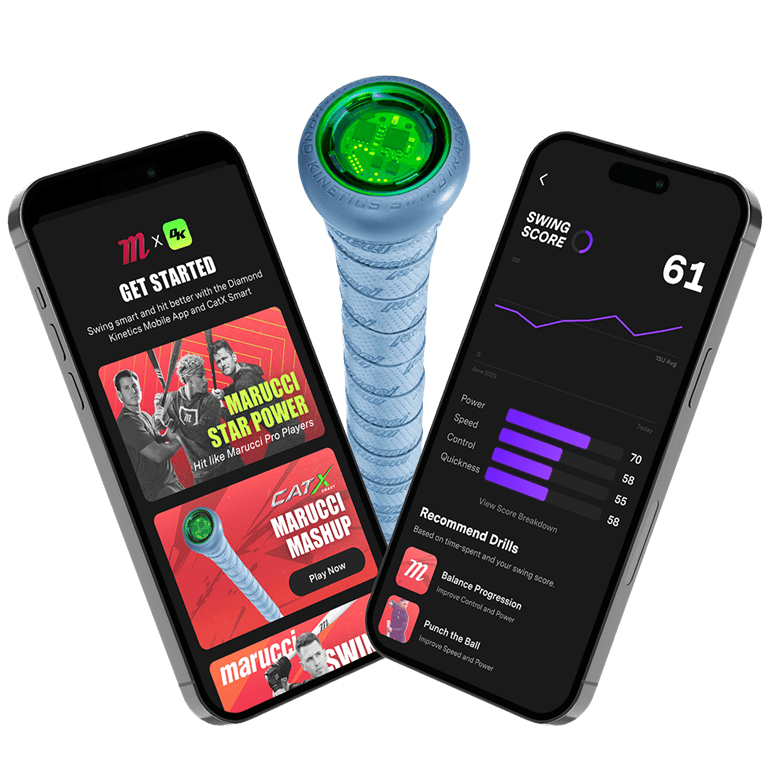
Users will have access to data, interactive games and content through the Diamond Kinetics app. Image: Marucci Sports / Diamond Kinetics
“What can that data do for you?” Handron said. “For us, that’s where it kind of hops and walks over into the app experience that we’ve developed, which is really meeting this generation of kids where they are, which is, What are the interesting and fun social digital experiences that you can marry together with physical play?”
Both men believe this will become universal, as reflected by intentional decision to list the smart bat for the same price as the one without the sensor.
“Why wouldn’t you hit with it if you had access to it?” Ainsworth said. “Why would you use another bat without it?”
“Marucci and DK are aligned on feeling like this can and will be the future of bats,” Handron added.