GameChanger offers as useful case study in collecting data with less human effort, giving different users the level of detail they actually need, and providing personalized outputs.
Main Image: GameChanger

From there, GameChanger has kept building its offerings around basketball, bolstering its future with additional capabilities and adding Brandon Rhodes as SVP and GM for emerging sports in December. Rhodes’ past experiences include nearly eight years at Overtime and, before that, five years at PepsiCo working with the Gatorade brand.
In early September, the company rolled out a slew of enhancements that will be ready ahead of the high school basketball season:
“We want to really become the home of youth sports and to do that, you can’t just be the home of diamond sports,” said Rhodes, part of SBJ’s 2020 New Voices Under 30 cohort. “You’ve got to have other things like basketball, and then in the future, other large team sports. So lots of growth already, but we’re excited to really have this upgrade for this season.”
Rhodes walked me through the new features. Here were my takeaways:
AutoStream upgrades
On top of tracking the action, AutoStream will be able to run while users keep score and stats on the same device. Previously, they had to set up one device for streaming and use another for stats (or keep stats via an old-school scoring book).
President Sameer Ahuja has often mentioned a set-it-and-forget-it mission when it came to GameChanger, enabling coaches and/or parents to position their tablet or smartphone and move on to other things. The future goal for AutoStream will be to automatically track all stats while streaming — which would hit Ahuja’s goal directly on the head.
For now, users will be able to pick the level of stat details they’ll manually track while AutoStream transmits. Coaches and parents can turn on AutoStream and then choose to track just the score and clock, keep score for all players, or even manage tracking of all stats.
Rhodes said this expansion came from significant segmentation work to understand how parents and others tune into streams and what they wanted, from the casual observer to the super-invested follower.
“What we heard from them is one, the scorekeeping was really good, but they wanted optionality,” Rhodes said. “… That was a big unlock that came directly from doing the research and hearing the feedback from the users.”
Content capabilities
The personalization conversation is everywhere, and that’s no different at GameChanger. While the platform has offered auto highlight-clipping since 2024, the company saw an opportunity to do more for athletes and the family members who wanted to follow along.
Later this year, the platform will release its Player Game Story and Player Season Story functions, which Rhodes sees as storytelling that can chronicle any player’s game/season/career, regardless of their skill or how many stats they produce. The highlights pulled to those pages will be formatted to share right away with family and friends or to social media.
“Basketball is highlight-driven,” Rhodes said. “Overtime was very good at highlighting the most elite, the most special kids, but GameChanger has an opportunity to democratize that for every basketball player.”
Communication
While not as sexy as computer vision or AI-produced storytelling, communication can always be better. I understand this pain more closely now as a coach of a U6 soccer team who can feel overwhelmed by my group text with the parents of my players.
Now 10x that (or more) for a club operator who is managing various teams across many age ranges. Basketball is played year-round on the travel circuits, and as the youth sport with the most participants in the U.S., the comm line never cools down. GameChanger’s new capability to house schedules and rosters — and message all of those participants when need be — for an entire club program hopes to ease the operator’s life.
“Directors are trying to have a unified system: You may have 20, 30, 40 teams and you also may have parents with multiple kids at multiple ages,” Rhodes said. “So you want everything streamlined. We’re just giving that capability to club directors and coaches.”
This article was brought to you by SBJ Tech, a Leaders Group company. As a Leaders Performance Institute member, you are able to enjoy exclusive access to SBJ Tech content in the field of athletic performance.
We bring you five insights from Seth Meyers, the Brooklyn Nets, USOPC, US Air Force and Juilliard School – all of whom spoke at the Leaders Sport Performance Summit in New York.
The renowned leadership specialist was speaking just moments before she introduced Seth Meyers to the stage at June’s Leaders Sport Performance Summit at the Barclays Center in Brooklyn, New York City.
Meyers, a comedian, broadcaster and producer, instantly built on the theme, with his tales of watching the likes of Will Ferrell, Kristen Wiig, and Jason Sudeikis produce sketches that died a death during read-through sessions (and all too often live onstage) at Saturday Night Live.
“Watching them succeed is something you can do,” he said, “but watching them fail at the table was the real education.”
Meyers made clear his admiration for the writers and producers of SNL who, as he said, “have seen and heard more sketches than anyone in the history of the world”. “It was a reminder of how hard comedy was,” he added. “To fail at this does not mean you’re not funny.”
Crucially, Meyers and his peers failed in what were ultimately safe spaces. They were all the better – and all the funnier – for it.
And it was not just Meyers’ musings. Across both days, we heard from leaders in high-performance environments as diverse as the US Air Force, Juilliard School and the Brooklyn Nets, who lent us their home for two days. Together they delivered insights on how leaders can cultivate environments in which people fail cheaply, learn quickly and perform sustainably.
Below is a selection of five insights that paint a picture of proceedings.
The Brooklyn Nets have been on an exciting trajectory since the arrival of Sean Marks as General Manager in 2016. His tenure began with a question: “What are we going to stand for?” Marks believed that the Nets needed an identity that meant more than mere wins or losses and he landed upon ‘Brooklyn grit’ – a system of behaviours that extended beyond one, single individual. “It’s really important that you take the responsibility to drive a culture that everybody can observe,” he said.
Marks and the Nets have continually hired the best people, regardless of their professional background. A quick roll call of their staff would reveal people with experience in fields as diverse as soccer, baseball, finance and, of course, basketball. Each is given the platform to perform. He said:
If you give people the opportunity, you empower them to speak up, you empower them that they do have a voice, they’re motivated far more than a group that isn’t empowered to have a voice.
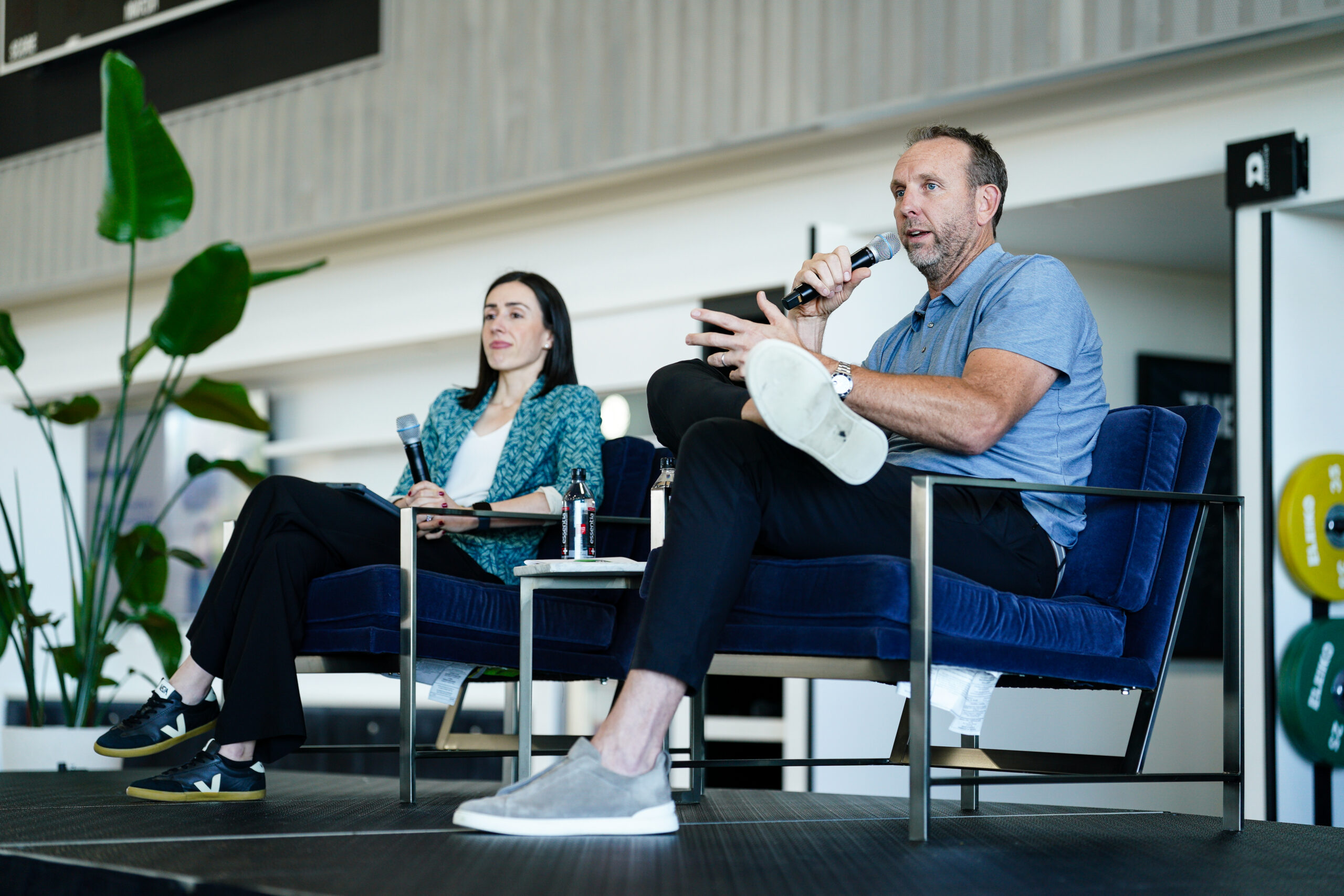
Brooklyn Nets General Manager Sean Marks in coversation with host Holly Ransom. Photo: Leaders Performance Institute / Evan Bernstein
Across both days, listening emerged as an important performance tool. Whether building an NBA franchise, leading a writers’ room or cultivating future performers, the speakers repeatedly stressed that leaders who genuinely listen create environments where trust, challenge and innovation can flourish.
Marks for one said:
I want a diverse train of thought [and] if I’m going to hang my hat on hiring the very, very best, shame on me if I don’t listen to them.
Similarly, Seth Meyers’ beliefs have been shaped by his time in improvisational comedy as well as his time as a talk show host. He said:
One of the first rules with improvising is you have to be a listener. You can’t build something with a person if you’re just thinking about what you’re saying when you’re talking… and don’t ask questions you’re not actually curious about the answers to.
Seth Meyers on a different New York stage. Photo: Leaders Performance Institute / Evan Bernstein
So what actually happened when a sketch died during SNL read-throughs? What would Meyers do? What if the sketch actually died onstage?
“You have to shake it off,” he said. “You can learn lessons from things that don’t go well, but you can’t bring it with you to your next week’s effort.”
As one of the longest-serving head writers in SNL history, Meyers was responsible for managing exceptionally talented people operating under intense deadlines and, if writers carried every disappointment into the next week, their performance would deteriorate. The key was to try ambitious ideas, accept that many would fail, then learn quickly and move on.
Meyers was echoed by Evan Yionoulis, the Director of the Juilliard’s Drama Division. “If we’re worried about fear, we have to foster an environment where you can be brave,” she said. She tells her students:
‘I believe in you, I brought you into the school. You’re going to graduate, and I’m going to take you all the way there, and I’m going to be patient… I’m not judging you, good or bad’. I’m going ‘what’s the next step to take it further? What’s the next step to take it deeper?’
Evan Yianoulis of the Juilliard School. Photo: Leaders Performance Institute / Evan Bernstein
Dr Wendy Walsh is the Chief Learning Officer for the US Air Force, a role in which she oversees education for approximately 700,000 personnel. Her work goes beyond training to the creation of conditions that enable learning across a sprawling, complex system. She argues that high-performance environments are “complex adaptive systems made up of continuously changing people, relationships and influences. She argued that learning starts from observation:
It’s the most important thing that we do is to be present with each other… I might not agree with you, but it’s a requirement for me to understand a different person’s perspective, because that will reveal more possibilities.

Dr Wendy Walsh, the Chief Learning Officer of the US Air Force. Photo: Leaders Performance Institute / Evan Bernstein
Walsh was joined onstage by Andrea Tullos, who explained why the US Air Force pivoted from focusing on factors such as strength, endurance and swimming ability in recruitment. Ultimately, they were alarmed by the numbers of recruits dropping out. They shifted the focus to factors such as resilience, learning agility, tolerance for discomfort and motivation. Tullos said:
We need to know who they are before we understand what they can do… [and] it’s not about assigning blame. It’s about understanding how to get up tomorrow to do it all over again as a team and get better.
Andrea Tullos, former lieutenant general in the US Air Force and Founder and CEO of Outperform IQ. Photo: Leaders Performance Institute / Evan Bernstein
Team USA finished second in both the 2026 Milano Cortina Winter Olympic medals table (behind Norway) and Paralympics medals table (behind China). The United States Olympic and Paralympic Committee wants to be No 1 in both tables in 2030, which means creating the conditions that make future medals possible.
Jen Bryant, the USOPC’s Senior Director of Olympic and Paralympic Performance, told the audience of her organisation’s continuing efforts towards meeting their target. She said:
We couldn’t just focus on what we were going to do at the Games [Milano Cortina]. We needed to spend time building a team that was capable of going and delivering a podium-level performance… We focused on bringing a broader number of athletes through the pipeline… [we asked also ourselves] How are we keeping athletes in sport and then the opportunities to bring new athletes into Olympic sport?
Jen Bryant, the USOPC’s Senior Director of Olympic and Paralympic Performance. Photo: Leaders Performance Institute / Evan Bernstein
What to read next
As Keith D’Amelio, the Chief Innovation Officer of the the New York Liberty, explains: technology matters, but culture, communication, systems design and long-term thinking matter more.
Main Image: Getty Images

Ndamukong Suh, who played 13 seasons in the NFL without missing a game due to injury, remains an active investor in athlete performance tech. Photo: Getty Images
This article was brought to you by SBJ Tech, a Leaders Group company. As a Leaders Performance Institute member, you are able to enjoy exclusive access to SBJ Tech content in the field of athletic performance.
In the final part of his miniseries, Basketball New Zealand GM Paul Downes what kind of leadership works when authority is limited and commitment is discretionary.
In senior 5×5 teams, athletes are commonly not selected from within domestic systems given the time of year for FIBA competitions. Instead, they are selected whilst under contract within professional (and semi-professional) environments across various global leagues. Athletes for FIBA 5×5 age-grade tournaments (Under-15 to Under-19) are typically selected from performances across school, Association and National camp assembly periods.
Supporting the selected athletes are coaches and management that also are operate in decentralised, time‑limited contexts. No role holders are employed full-time and, as such, are operating without the contractual levers that traditional high‑performance (HP) models assume. Across the 5×5 HP pathways, BBNZ runs six age‑group national teams (male and female), plus select teams that provide ‘best vs best’ exposure to support development (on and off court) and prepare for FIBA tournaments.
Within this reality, management team members are asked to balance a number of competing demands. Examples include: short‑term competitiveness versus long‑term system sustainability, respect for professional autonomy versus national‑team standards, and redefining ‘success’ in an international sport increasingly dominated by wealthy, highly resourced nations. These challenges, among others, sit outside of being simply tactical or financial rather the most complex challenges that present are systemic and relational. Therefore, a crucial leadership question what presents itself to the BBNZ HP team is no longer whether leadership is required, but instead what kind of leadership actually works when authority is limited and commitment is discretionary.
The purpose of this article is to apply the research pertaining to Leadership Climate and Followership to the context of the 5×5 National Teams of BBNZ and demonstrate the opportunities that the constraints presented offer HP leaders for generating elevated levels of engagement and commitment to the HP strategy.
What is Leadership Climate and why does it matter?
The National teams of BBNZ can be considered to have compromised formal authority outside of assembled periods due the nature of management composition and contractual status. Without the ability for HP leaders to rely on extrinsic levers such as significant salaries, full-time contracts and formal hierarchies there could be supposed to be high risk regarding team culture and operational effectiveness. Powerful research from Goleman into Leadership Climate (1, 2) supports organisations such as BBNZ to succeed and maximise the opportunities that come from such constrained circumstances.
Goleman (1, 2) describes Leadership Climate as the emotional tone of the working environment created by leaders’ behaviours, which in turn shapes motivation, engagement, wellbeing, and performance outcomes. When HP leaders cannot rely on extrinsic motivation levers or formal hierarchy the notion of Leadership Climate becomes the primary lever for sustaining commitment and discretionary effort.
Unpacking climate further
To make Leadership Climate assessable and actionable, JCA Global (3) developed the Leadership Climate Indicator (LCI) as a behavioural measure of how it feels to be led within a given system. The LCI translates leadership behaviour into four distinct climate quadrants made up of twelve observable scales:
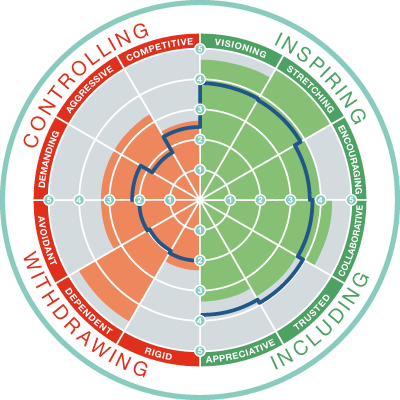
Green climates: the Inspiring and Including quadrants represent green climates – those that build clarity, trust, energy, and commitment through behaviours such as visioning, encouragement, collaboration, reliability, and appreciation.
Red climates: by contrast, the Controlling and Withdrawing quadrants represent red climates which, while sometimes effective in short‑term crises, erode trust and engagement when used habitually through behaviours such as micromanagement, aggression, avoidance, or rigidity.
In decentralised, tour‑assembled environments like BBNZ’s National teams, this framework provides a practical lens for understanding why some campaigns generate ownership, voice, and discretionary effort, while others default to compliance, silence, or disengagement under pressure. In these teams leadership climate can be considered to be the felt experience of being led by the HP team. This spans the experience one has at the recruitment stage, their subsequent onboarding, the connections leading into a camp/tour, tours themselves and the review period after each assembly. They are the conditions created by leaders’ behaviours during both stable and complex, high-pressure context and govern whether people think, speak up, and commit fully, or retreat into compliance and self‑protection.
Defining and contextualising Followership
Contemporary leadership research is explicit that leadership is not delivered one way from leaders to followers but is instead co‑produced through the active judgement, engagement, and agency of followers within relational and contextual systems (4, 5, 6). Within this literature, ‘Followership’ is defined as the behaviours, decisions, and choices individuals make in how they support, challenge, and contribute to collective goals – not simply their positional role or willingness to comply. It is an active function requiring judgement, commitment, and moral courage.
Kelley’s foundational work (6, 7) was pivotal in reframing organisational performance as being driven disproportionately by effective followers. These being followers who think independently and engage actively rather than by compliance‑based execution alone. This reframing shifts attention away from what leaders do to people, and toward the conditions leaders create with others.
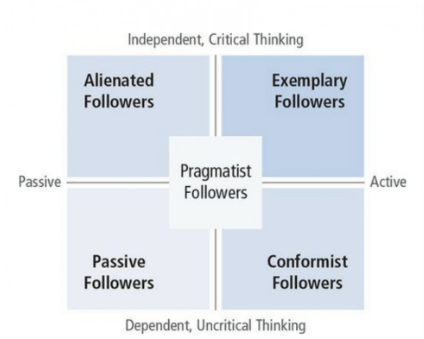
Figure 1. Kelley’s Followership Model (1988)
Figure 1 and Table 1 provide a summary of the five types of followers and what these mean in the context of BBNZ’s HP management teams. For Kelley, the ideal follower was a critical thinking contributor, termed the ‘exemplary follower’. Kelley argues that most leaders prefer ‘conformist followers’ because they are easy to control. ‘Alienated followers’ are critical but do not contribute; and ‘passive followers’ have little to no value other than bring present. A critical thinking follower who is alienated is far more likely to be a negative team member.
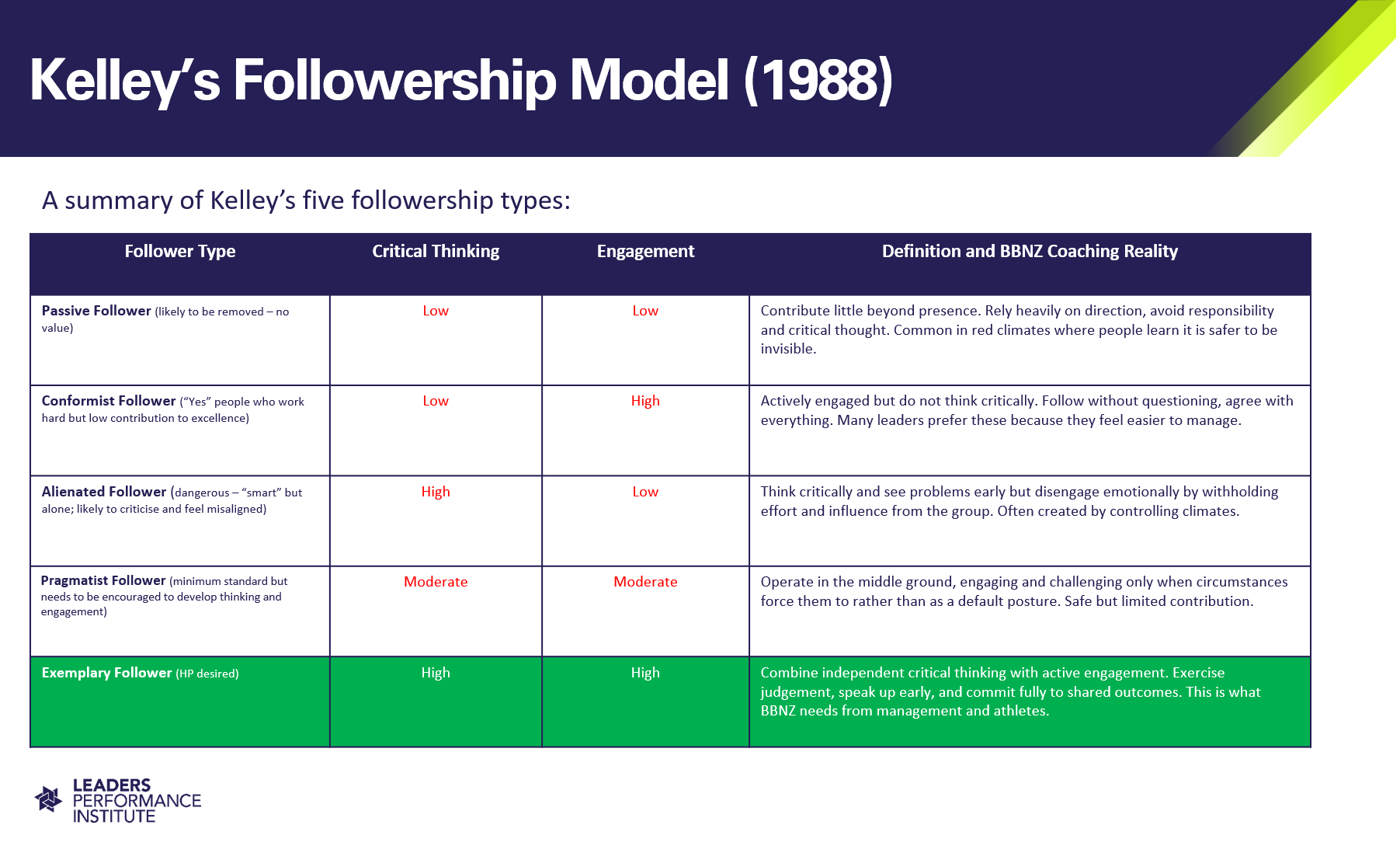
Table 1. A summary of Kelley’s five followership types
A clear understanding of Followership theory and the interaction of critical thinking with active contribution is valuable for organisations like BBNZ, where management teams operate in periodic, decentralised, and contractor‑heavy environments. Once national teams assemble for FIBA events, organisational charts flatten quickly, formal authority as a national sporting organisation (NSO) reduces, and the HP system functions largely through trust, clarity, and discretionary effort. In these contexts, the quality of followership becomes visible in what people do when conditions are uncertain, pressured, or imperfectly resourced.
In tour‑assembled environments, followership quality is a strong determinant of whether standards are sustained, problems are surfaced early, and judgement is exercised when it matters most. Kelley’s insight remains deliberately uncomfortable. Leaders often gravitate toward conformists because they feel easier to manage, yet doing so suppresses the independent thinking and ownership that complex, time‑bound campaigns depend upon.
How Leadership Climate and Followship exist across BBNZ’s national teams
An example of system logic is provided in Figure 2.
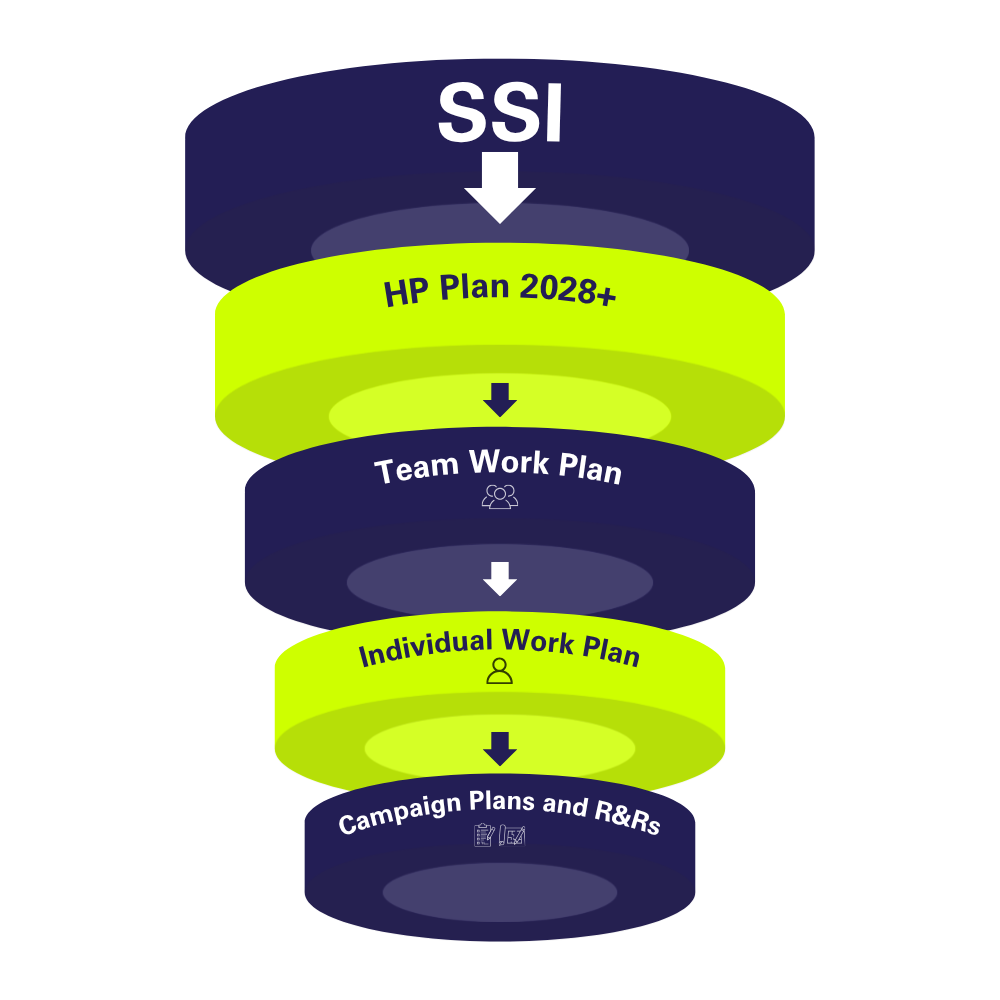
Figure 2. A system logic view of BBNZ HP Strategy spanning the NSO’s Strategic Statement of Intent (SSI) to HP Strategy (HP Plan 2028+) into HP Team Plan that support HP team member’s individual plans that inform how HP constructs and operationalises Campaign Plans and Roles and Responsibilities across various National teams.
In this example, clarity is treated as a primary leadership behaviour. Through making purpose, expectations, roles, and decision rights explicit HP leaders are able to reduce anxiety and guesswork in management teams and create the conditions for Inspiring and Including climates. These favourable climates elevate the quality of followership the HP system produces. Across the HP team’s ways of working there is a deliberate emphasis on a clear, shared purpose, psychological safety, empowerment with accountability, and inclusion.
These act as necessary prerequisites for ‘exemplary followership’ which are characterised by independent thinking and active engagement. Examples of how this is achieved are engaging in collaborative approaches to define ‘What It Takes To Win’ (WITTW), clarifying campaign roles early in a cycle, and making HP expectations visible through Team Charters to allow management and athletes to exercise judgement rather than wait for instruction. When management are recruited and onboarding takes place there is a priority to build early senses of belonging and clarify the conditions for constructive candour and continuous learning. With reference to Leadership Climate terminology, such conditions actively strengthen Visioning, Trusted, Collaborative, and Encouraging behaviours while reducing the likelihood that pressure induces Controlling or Withdrawing patterns.
In the realities of global FIBA tournaments existing in dynamic, uncertain, complex conditions the benefits of positive team climates and exemplary followship are experienced. By making purpose, boundaries, and expectations explicit before and during campaigns, BBNZ increases the probability that touring parties will act as capable followers. Ones who can think ahead, raise issues early, hold standards without being policed, and sustaining discretionary effort under fatigue. The latter is imperative with international travel and compressed recovery windows between competition. In this sense, the HP frameworks developed and communicated are not just management tools, they are deliberate climate interventions that enables leadership and followership to be co‑produced in conditions where formal control is neither realistic nor effective.
At age‑grade level, clarity is what allows people to coach and support with judgement rather than hesitation. When purpose, roles, and decision‑making boundaries are clear early in the cycle, staff don’t wait for permission—they act in the best interests of the athletes. That creates trust, encourages honest challenge, and allows learning to happen quickly. In high‑pressure tournaments, those conditions matter because we need people thinking and contributing together, not just executing instructions.
Mel Bennett (Head Coach of U15-U17 Women and Assistant Coach of 2Degrees Tall Ferns)
From a medical and recovery perspective, clarity changes everything. When roles, decision rights, and expectations are explicit, I don’t have to guess whether to escalate an issue or wait—and neither do the players. It allows us to act early, manage load properly, and hold standards without friction. In the middle of a FIBA campaign, that clarity creates trust, reduces stress, and lets everyone contribute their judgement rather than just follow instructions.
Mikayla Rosieur (2degrees Tall Ferns and U17 Men’s Physiotherapist)
To help better illustrate the interactions of Leadership Climate, the types of climate conditions and Followership, Table 2 maps the JCA Climate Types to Followership Behaviours in the form of ‘touring realities’.
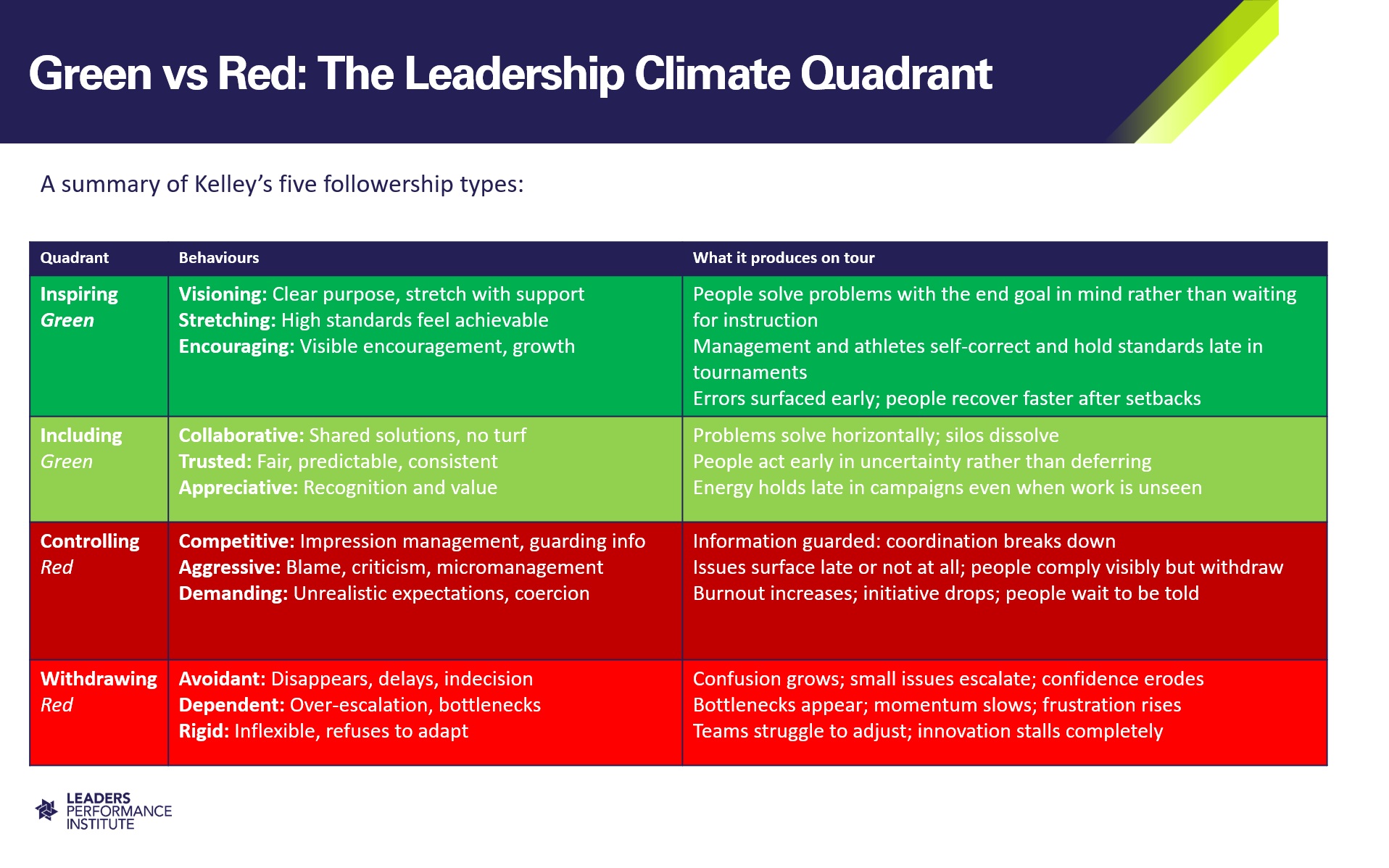
Table 2. The JCA Climate Types mapped to Followership Behaviours in the form of ‘touring realities’.
Recently the BBNZ HP team has constructed Team Charters as an initiative to elevate leadership climate and followership by replacing hierarchy with shared clarity. These charters make purpose, expectations, and behavioural norms explicit so that independent thinking, early voice, and accountable contribution become safe and expected, even under pressure. Through the removal of ambiguity (the primary trigger for anxiety, silence, and defensive followership) the Charters serve to stabilise the emotional climate whilst actively strengthening Inspiring (Visioning, Stretching) and Including (Trusted, Collaborative, Appreciative) climates by ensuring people know what matters, how decisions will be made, and how they are expected to contribute.
Concluding remarks
In decentralised, time‑limited national‑team environments, the decisive leadership task is not to demand compliance but to design the conditions for exemplary followership. That begins with making the why unmistakable for all parties. There needs to be a clear purpose, realistic success markers, and alignment surrounding how each role contributes. These conditions enable the setting of mutual expectations about standards, decision rights, and escalation pathways to hold teams steady under pressure. There is a requirement to create permission for feedback and insights by rewarding early problem‑raising, building trust through reliable follow‑through and predictable communication. HP leaders need to recognise the contributions that sustain standards, energy, and learning throughout campaigns. Create conditions, not compliance because international performance is built on the effort you cannot mandate.
References
In the third part of his miniseries, Basketball New Zealand GM Paul Downes explains how a peripheral format became a legitimate, strategically prioritised pathway for international success.
Main Image: Basketball New Zealand
More often, it is resisted because proposed change is perceived as threatening what people care most deeply about: identity, legacy, fairness, and standards.
This article uses the evolution of the 3×3 Tall Blacks programme as a case study in applied change leadership, exploring how innovation can be mobilised without destroying trust or fragmenting a system.
Specifically, the article examines how 3×3 Basketball shifted within Basketball New Zealand (BBNZ) from being viewed as a peripheral or competing format to a legitimate, strategically prioritised pathway for international success. Drawing on innovation and change management research, it demonstrates how leadership decisions around pace, protection, communication, and culture shaped the programme’s trajectory. Central to this case is a simple but often neglected principle: organisations can only move at the speed of their people.
What is 3×3 basketball?
3×3 Basketball was formalised by the International Basketball Federation (FIBA) in the late 2000s as a condensed, high‑tempo version of the game designed for urban environments, broadcast appeal, and global accessibility. Played with three athletes per team on a half court, a 12‑second shot clock, and first‑to‑21 scoring, the format demands rapid decision‑making, tactical clarity, athletic versatility, and exceptional individual skill under pressure.
Since its inclusion as an Olympic discipline at the Tokyo 2020 Olympic Games, 3×3 has moved decisively from an alternative format to a mainstream high‑performance sport. It now operates with its own world rankings, qualification pathways, professional circuits, and national team competitions governed by FIBA. Crucially, success in 3×3 is not achieved by lightly adapting 5×5 systems; it requires distinct preparation models, athlete archetypes, and tactical identities.
Who are the 3×3 Tall Blacks?
New Zealand competes in 3×3 Basketball through a clearly defined international competition pathway. The men’s senior programme, known as the 3×3 Tall Blacks and, known on the FIBA circuit since 2025 as #2PointNation, contests major national team events including the FIBA 3×3 Asia Cup, the FIBA 3×3 World Cup, and, where applicable, Olympic or Commonwealth Games qualification tournaments. Athletes may also compete in FIBA‑sanctioned professional events such as World Tour Challengers, World Tour Masters, and selected Pro circuits, which contribute to global ranking points and qualification status.
These competitive realities require BBNZ’s 3×3 programme, across U21, U23, and senior team, to be innovative by necessity. With constrained resources and limited margins for error, the Men’s (and Women’s) programme has had to identify where competitive advantage is possible, how learning can be accelerated, and how athletes can be developed into genuine 3×3 specialists rather than part‑time participants (through also prioritising 5×5).
3×3 as a strategic opportunity, not a threat
Within the New Zealand basketball landscape, historical emphasis has understandably sat with the Tall Blacks (men’s 5×5) and Tall Ferns (women’s 5×5) programmes. These teams carry deep cultural significance, reinforced by landmark performances such as the Tall Blacks’ fourth‑place finish at the 2002 FIBA World Cup and the Tall Ferns’ participation at the 2004 Olympic Games. However, podium finishes at pinnacle 5×5 events, and consistent Olympic qualification, have become increasingly difficult in a global ecosystem shaped by professional leagues, deep talent pools, and significant financial asymmetry.
Within this context, 3×3 has emerged not as a replacement for 5×5, but as a distinct strategic opportunity: a format in which New Zealand can plausibly compete for medals through deliberately creating an identity, strategy and specialisation by targeted coaches and athletes. Yet recognising opportunity was not sufficient. Elevating 3×3 within a 5×5‑dominant system required leaders to manage legitimate fears that resources, attention, or cultural value would be diverted.
As 3×3 Tall Blacks Head Coach Piet Van Hasselt said:
Resistance to 3×3 didn’t mean disloyalty. It often meant people cared deeply about 5×5 and felt responsible for protecting it. 3×3 is still the new kid on the block in basketball terms and is very different to 5×5.
This framing was critical. Resistance was interpreted not as obstruction, but as a signal of attachment and responsibility. That distinction shaped how change was approached: not through mandate, but through dialogue, clarity, and deliberate pacing.
Three roles that support successful innovation in HP environments
Across HP sport and other expert systems, innovation research converges on the importance of leaders occupying multiple complementary roles rather than relying on individual charisma or isolated expertise (1,2,3). Three roles are consistently evident in successful innovation initiatives.
1. The System Architect
The ‘System Architect’ role is grounded in organisational ambidexterity and strategic leadership research. Scholars such as Tushman and O’Reilly (1, 2) demonstrate that breakthrough innovation depends on senior leaders designing separate but integrated systems, protecting exploratory work from short‑term performance pressures while integrating it at the top through strategy, resourcing, and authority. Mintzberg’s work on “designing the organisation” (3) reinforces this view in that effective leaders shape structures, decision rights, and power flows rather than running experiments themselves.
In HP sport terms, the architect decides where innovation sits, how it is protected, and how it is judged. Without this role, innovation becomes personality‑dependent and fragile; with it, innovation becomes institutional.
2. The Technical Champion
The ‘Technical Champion’ is one of the most empirically supported roles in innovation literature. Research by Howell and Higgins (4, 5) shows that innovations outperform when championed by credible insiders who persist under resistance, mobilise informal networks, and translate abstract ideas into legitimate practice. Subsequent work clarifies an important dependency: champions burn out or are marginalised (6) without organisational protection from architects.
In HP sport, champions are domain‑credible leaders for example coaches, senior athletes, or tactically fluent specialists who are willing and able to absorb resistance on behalf of others while legitimising change through performance.
3. The Cultural (Learning) Enabler
The third role of ‘Cultural’ or ‘Learning Enabler’ is supported by Amy Edmondson’s (7) research on psychological safety. Innovation fails less often due to lack of ideas than due to fear. Leaders who frame their strategic initiatives as learning problems, without lowering standards, create environments where experimentation, respectful conflict, and early failure are informational rather than punitive. This role ensures innovation does not collapse into compliance or defensive behaviour, particularly in high‑stakes environments such as elite sport.
The blended roles within BBNZ 3×3
Within the BBNZ 3×3 system, Nikolay Mikhalchuk (High Performance Manager, 3×3 – hereafter HPM) and Piet Van Hasselt (Head Coach, 3×3 Tall Blacks) can be viewed as functioning as deliberate amalgamations of all three innovation roles, in part due to the realities of scale and resource constraint.
Architectural leadership
As system architects, Mikhalchuk and Van Hasselt emphasise structural protection and integration, explicitly designing daily training environments and pathways for learning rather than forcing premature exposure. Mikhalchuk explains:
Decisions are made to take a step back, spend more time… align yourself, the coaching staff, and then prepare, rather than throwing athletes in the deep end before they understand the system and role expectations.
This reflects programme ambidexterity through protecting exploration (learning the 3×3 system) while gradually integrating it into the national pathway across U21, U23, and senior programmes.
Champion and cultural leadership
As technical champions and cultural enablers, both leaders are able to translate strategy into daily training behaviours while safeguarding learning. Van Hasselt captures this when he notes:
We’re trying to find a gap we can exploit based on our strengths… We have forged an identity, with clarity, and our players have bought into it.
He further explains how culture and learning interacted:
Great leadership and athlete ownership has meant we’ve been able to build through younger players, and now these players are becoming specialists.
Through deliberate ‘test and learn’ cycles, particularly in the Under-21 and Under-23 Nations League exposure and targeted senior competition, 3×3 specialists have emerged organically rather than being imposed.
Managing change in a 5×5-dominant culture
At a technical level, the transition from 5×5 to 3×3 can present genuine challenges. Mikhalchuk notes:
There are a lot of nuances and rules around 3×3 which would drive 5×5 players mad… The transition from a 5×5 star to the 3×3 court is close to impossible.
Yet once athletes choose to engage, the experience is often transformative. Van Hasselt observes:
Every time a 5×5 player comes in they absolutely love it… We have found players who are courageous and ready to take a leap of faith to this exciting new challenge.
These insights reinforced a core leadership lesson that people cannot be rushed through change they have not yet made sense of. Progress depended on aligning belief, understanding, and competence. Indeed, moving at the speed of people, not planning cycles.
View this post on Instagram
Applying Kotter’s 8‑Step Change Model
Recognising the complexity of this transition, BBNZ have applied Kotter’s 8‑Step Change Model (8) to structure and evaluate progress. A central insight of Kotter’s model is that sustainable change is built deliberately, sequentially, and with reinforcement. This model, and its contextual application is summarised here:
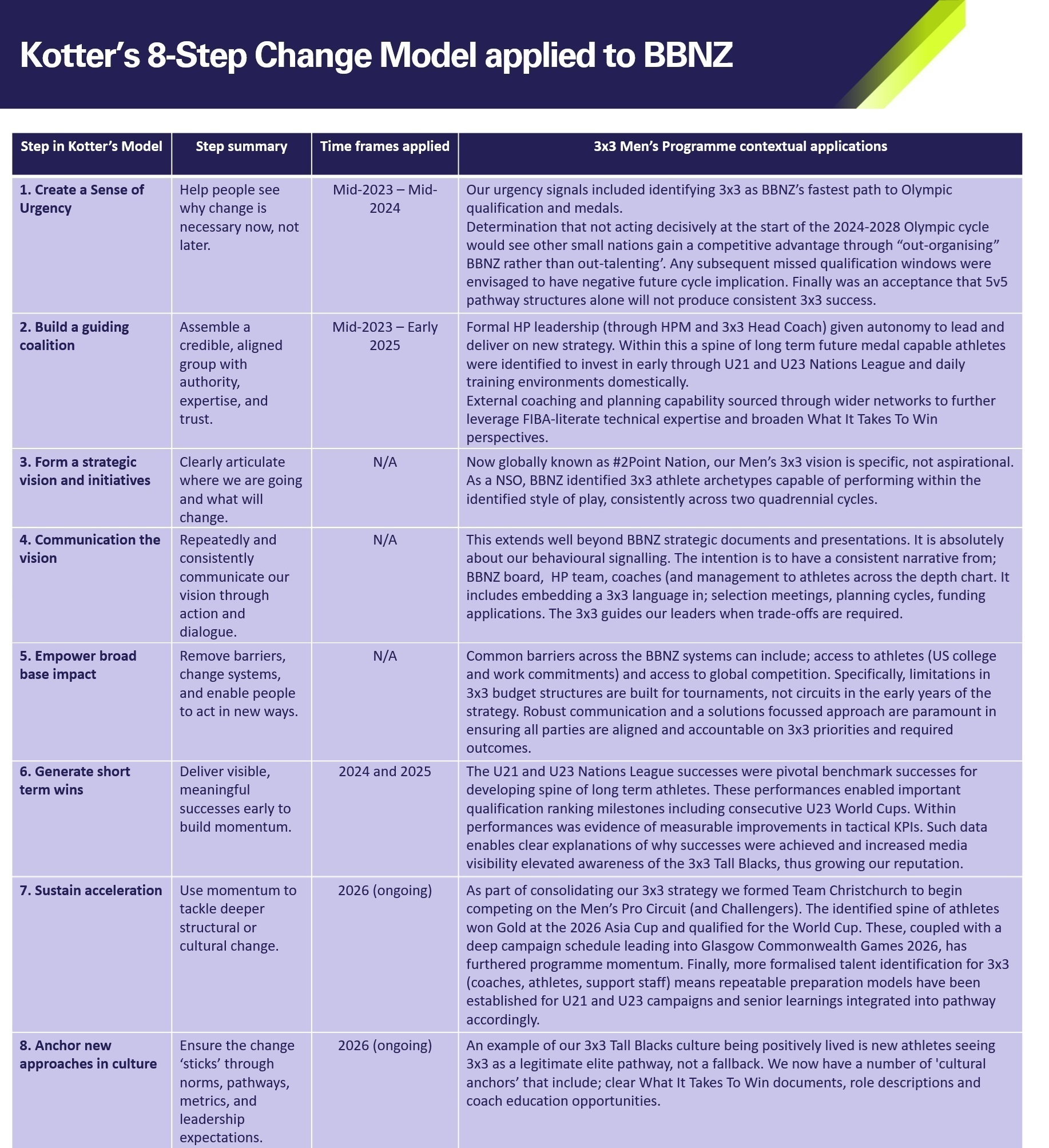
Concluding remarks
Within the global FIBA 3×3 landscape, the 3×3 Tall Blacks’ #2PointNation identity signals strategic clarity and a commitment to playing to New Zealand’s strengths rather than mimicking others. The Men’s programme accelerated once 3×3 was framed, and accepted, not as a format that could rely on occasional 5×5 participation, but as “our game, our way.”
An aligned approach to innovation, grounded in organisational values and supported by deliberate change management, has enabled the programme to become a respected and emerging force internationally. As Van Hasselt reflects:
Our programme and players strong commitment to improvement has helped us perform better game by game. The commentators tell us we can beat anyone in the world… they like us because we’re different.
Mikhalchuk adds:
We’re quick, we’re strong, we’re consistent and tough… We feel we can build those twos, and when opponents adjust, we can drive and create uncontested shots.
Ultimately, what gets funded gets celebrated. With increased High Performance Sport New Zealand (HPSNZ) investment toward the 2028 quadrennial, the Men’s 3×3 programme has moved from experimentation to embedded strategy. As Van Hasselt summarises the ambition:
We’d love to medal at LA 2028… We are continuing our exciting journey and improving every game and event as a team.
The broader lesson is clear. Successful innovation is not a hero story. It is a role system, paced deliberately, anchored culturally, and led with respect for how people actually change.
References
1) Tushman, M. L., & O’Reilly, C. A. (1996). Ambidextrous organizations: Managing evolutionary and revolutionary change. California Management Review, 38(4), 8–29.
2) O’Reilly, C. A., & Tushman, M. L. (2004). The ambidextrous organization. Harvard Business Review, 82(4), 74–81.
3) Mintzberg, H. (1983). Structure in Fives: Designing Effective Organizations. Englewood Cliffs, NJ: Prentice-Hall
4) Howell, J. M., & Higgins, C. A. (1990). Champions of technological innovation. Administrative Science Quarterly, 35(2), 317–341. [jstor.org]
5) Howell, J. M., Shea, C. M., & Higgins, C. A. (2005). Champions of product innovations: Defining, developing, and validating a measure of champion behavior. Journal of Business Venturing, 20(5), 641–661. [researchgate.net]
6) Shea, C. M. (2021). A conceptual model to guide research on the activities and effects of innovation champions. Implementation Research and Practice, 2, 1–13.
7) Edmondson, A. C. (1999). Psychological safety and learning behavior in work teams. Administrative Science Quarterly, 44(2), 350–383
8) Kotter, J. P. (1996). Leading Change. Boston: Harvard Business School Press
What to read next
You Don’t Arrive Strategic: How Leaders Grow Into their Role
As Joe Lemire from SBJ Tech explains, each task has been carefully selected by a collaborative group of NBA and NBPA movement experts to gain insight into individual athlete movement patterns in the pursuit of normative standards that can be used to help prevent injuries and improve performance.
Main Image: NBA / Theia
The SBJ Tech Sandbox series is where we share our experiences testing products, gear, solutions and more in the sports tech space.
Over the next few years, as I got stronger, my vertical inched up further, and I could dunk with a little bit of style — no one was inviting me to dunk contests or narrating my And1 mix tape, but it was still an epic feeling.
You certainly wouldn’t know it now.
The NBA recently invited me to participate in the same quarterly biomechanics screening that all its athletes started doing this season — the first league-wide program in pro sports. It’s a series of jumps and lateral moves, with some closed-eye, one-legged balancing mixed in.
The video may double as my audition for Blue Man Group — the cyan skeleton is part of the Theia software processing to evaluate joint angles and motion. But it also shows my diminished explosiveness as I move along the aging curve.
Each task has been carefully selected by a collaborative group of NBA and NBPA movement experts to gain insight into individual athlete movement patterns and hopefully build normative standards that can be used to help prevent injuries and improve performance.
One note the league makes clear is that biomechanics usually can’t answer questions in isolation — rather, it’s a notable piece of a larger performance puzzle.
“Biomechanics tells you how someone is moving, but it doesn’t tell you why,” said Courtney Chaaban, NBA Sr Manager of biomechanics and engineering. “So I really like to look at it alongside of lots of other information: how strong they are, what their range of motion is, how they’re moving on the court, what their demand is on the court, what their injury history might be.”
I’ve detailed my injury history in these Sandbox stories before — broken bones in my feet, sprains of muscles and ligaments, etc. — and I’ll share that my knees were oddly sore the day of my evaluation. (Of course I have an excuse ready… )
My single-leg jumps were paltry, just 3.7 inches for my left and 3 inches for my right. My two-legged jumps were a bit better. The countermovement jump (CMJ) — in which I started on the force plates, bent down and then leapt straight up — was 11.8 inches, good for 56th percentile in the sample of non-NBA players. My drop vertical jump, in which I step down onto the force plates and immediately spring up, was 13.2 inches, at the 49th percentile.
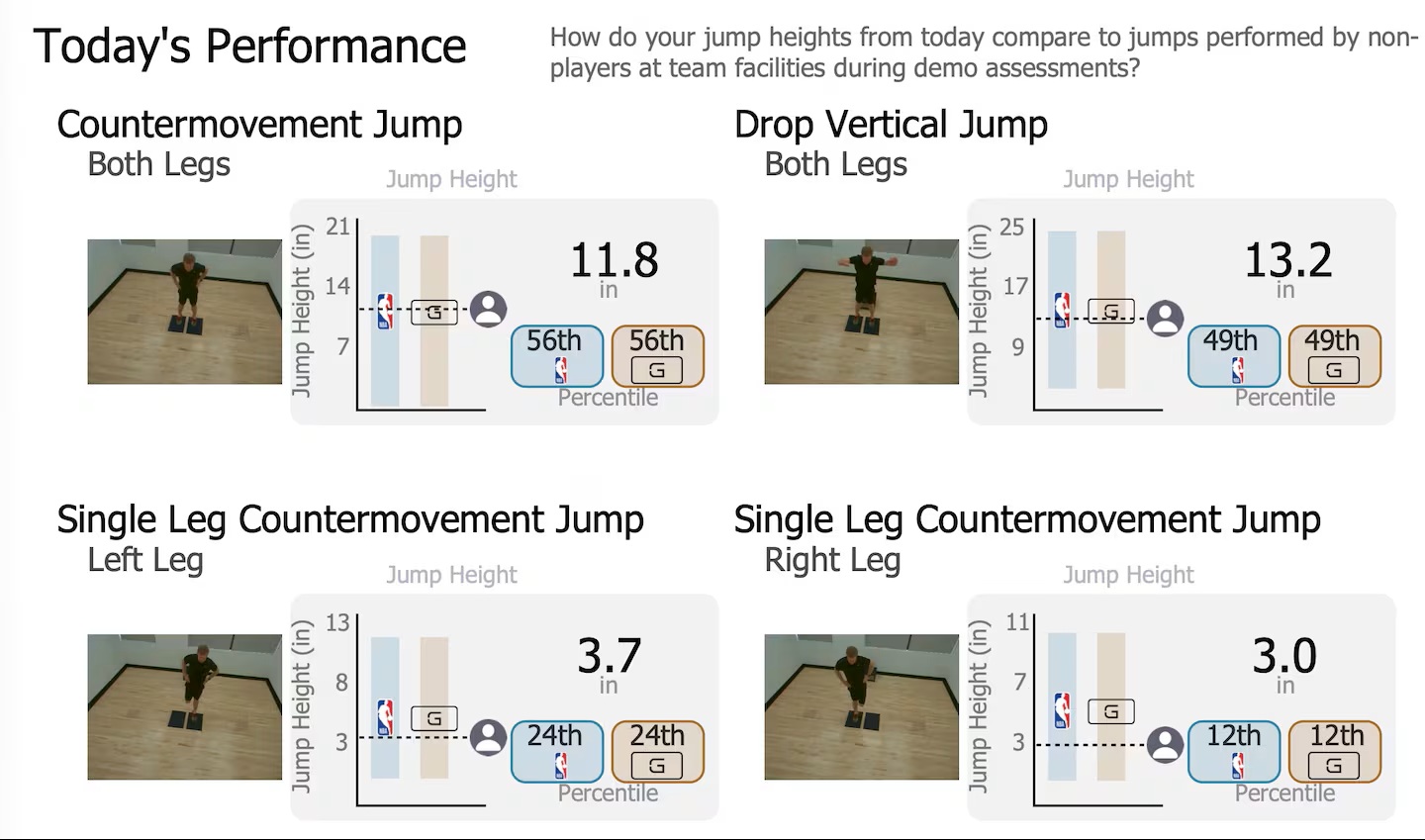
I was hoping for better. Image: NBA
There were diagrams showing how much I use my ankles, knees and hips to absorb forces as I jump or land. Of particular note was my landing strategy: I know my hip flexors are weak due to a previous Springbok Analytics scan, and my knees were achy that day, so it’s little surprise that my ankles worked overtime to mitigate force.
“It’s not to say it’s good or bad,” Chaaban explained. “Maybe that’s just how you move.”
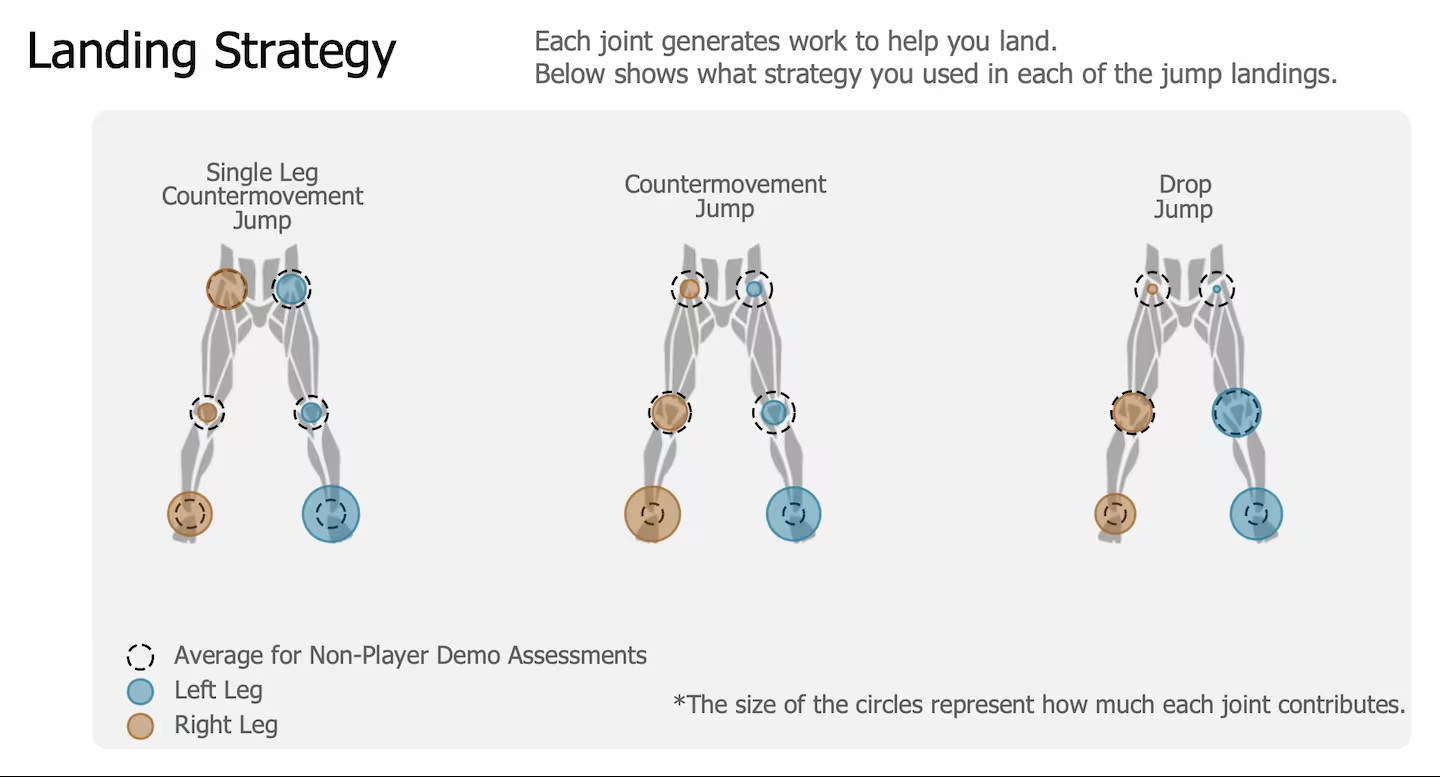
I didn’t skip all of leg day, just the hip and knee lifts. Image: NBA
While recently chatting with Warriors superstar Stephen Curry about a different topic, we started talking about his recovery routine and the notion of career longevity, when I volunteered that I underwent the NBA’s biomechanics protocol.
“You did all the testing?” Curry asked with a bemused smile. I shared the verdict of my data, which is that I’m very much a suburban dad these days. He laughed and then added, “There’s a lot more data available, but the real art is to figure out how to make that useful, right?”
My testing was done at the Nets’ first-rate facility in Brooklyn, but the experience is intentionally universal and would have been the same in Oklahoma City or Sacramento, too. All the same tech vendors are involved: Qualisys motion capture cameras, Bertec force plates, Theia biomechanics software and Breakaway Data for player and team access to the data.
My primary differential: I received a pdf report (rather than the Breakaway Data dashboard) that largely mirrored what the players get but had a few alterations, mostly because I had no historical data from other assessments. My datapoints were compared not to other NBA players but to a handful of team and league staff who underwent the tests.
The reports convey what each metric represents, which is helpful, such as noting that deceleration during the CMJ is “similar to stopping when coming around a screen.”
That CMJ deceleration was my highest asymmetry: my right side produced 20.5% more force than my left. Asymmetry is generally thought to be a problem and a possible injury risk, but there also need to be some allowances for individuals having their own movement signature.
What Curry also told me about applying such high-tech evaluations is the need to surround himself with “as many experts as possible to understand what the data means and then figure out what that is going to do to impact my routine.”
So, kind readers with advanced degrees and extensive pro sports experience, I ask: Who’s going to help me dunk again?
This article was brought to you by SBJ Tech, a Leaders Group company. As a Leaders Performance Institute member, you are able to enjoy exclusive access to SBJ Tech content in the field of athletic performance.
In a significant development for women’s basketball, the new league’s player-first, development-minded vision has led to significant investment in its sports science personnel and resources.
Main Image: Getty Images
Susan King Borchardt, who has been a fitness consultant to Sue Bird, Kelsey Plum and Breanna Stewart, joined Unrivaled as its Director of Performance and Recovery. Borchardt’s first call was to Lindsey Elizondo, an athletic trainer and physical therapist with the Magic, who joined as Director of Medical.
“We crafted this idea — her coming from the NBA, me working with some of the higher-level individuals privately in the WNBA — and just saying, ‘This should be the standard,’” Borchardt said courtside before the semifinals in Brooklyn. Phantom went on to defeat Mist for the championship 84-70 in Florida on March 4.
Their department has a headcount of about 25 and is supported by an extensive array of technologies, such as Plantiga insole sensors, Kinexon wearables, Springbok Analytics MRI scans and VALD devices for the weight room. Katie Buria, Head Athletic Trainer at the Dream, is Unrivaled’s Director of Sports Science managing the relationships with the tech providers.
“What we’ve seen is that will raise the bar everywhere else that we go,” Elizondo said. “So if we set that bar here, that’s going to feed upward into the W, it’s going to feed into the NWSL, it’s going to feed into all of these other sports and force the hand of this is what it takes to perform at this level.”
The athletes have full ownership of their data and can choose whether to share it with their WNBA teams and personal coaches. Unrivaled didn’t have exact figures available but indicated that the majority of players opted into using the tech, with Borchardt calling it “part of our culture.”
“This is a very player-driven league, and they care about player safety and wellness. The treatment has been top of the line,” said Breeze G Paige Bueckers, praising both the staff and the tech, such as “the data and what we look like on the court with our Plantigas or our [Kinexons] or our chips that measure our asymmetries — little stuff like that goes a long way in basketball.”
Plantiga has made women’s sports a priority, with its CEO Quin Sandler saying of the work with Unrivaled, “Together, we’re not just collecting movement — we’re helping build the future of applied sports science for women.”
Her teammate Cameron Brink, who suffered an ACL tear in June 2024, had her first Springbok scan — which uses AI to turn an MRI into 3D muscle data — while rehabbing with Unrivaled last year and then again before this season.
“Once you have a big injury, you want to learn how to optimize everything, so all these tools really help,” Brink said. “It is really reassuring to get MRIs done like that and just a full body scan. From here you can see how you’ve grown and improved and what areas you still need to work on.”
Elizondo noted the unprecedented position Unrivaled is in by collecting all of this data since the league’s inception. By having access to data for every player, the performance group can identify trends and understand the demands of the elite 3-on-3 game, which are different than 5-on-5. That helps them train the players with more specificity and develop more targeted treatment and recovery protocols.
Tracking longitudinal data enables Unrivaled to share baseline metrics for each player, and for rehabbing players, it helps reinforce the value of the hard work. Borchardt saw it firsthand with one athlete recently.
“For that athlete to have those two visual pictures to be like, ‘Wow, this is actually really working’ — that was so motivating,” she said.
Unrivaled CEO Alex Bazzell emphasized the league’s player-first, development-minded vision as a reason why it has invested so deeply in the personnel and products to make the performance team what it is.
“These players are thinking long term, and the expectation is not just your compensation but resources of off the court,” Bazzell said. “Our staff and who we hire, those are the ones that the players need to trust. You have to build trust in a 10-week period, too. That’s not easy.”
This article was brought to you by SBJ Tech, a Leaders Group company. As a Leaders Performance Institute member, you are able to enjoy exclusive access to SBJ Tech content in the field of athletic performance.