With the Winter Olympics on the horizon, the organization is pursuing cost-effective and eminently scalable solutions.
Main Photo: US Figure Skating

Now the Chief High Performance Officer for US Figure Skating, Dillon’s affinity for the sport launched a career that reached the senior men’s national level. There was no resource to track progress or compare skating techniques in real time, something that will be much easier to do for skaters with the organization’s partnership with OOFSkate, which provides high-level analysis in an accessible way through an app.
“I was very self-driven, which is a great quality, but it was lonely,” Dillon told me. “So, I think that this also gives you the opportunity to compare your data. It’s almost like skating with a friend, because you can compare your data with athletes that either are similar levels or that you choose to share your data with or athletes at the level.”
The work comes as US Figure Skating looks toward the future, Dillon shared, in discovering how technology can move the sport toward the cutting edge around judging and analytical improvements. That journey is one that many sports and governing bodies find themselves on, with new startups trying to help that pursuit.
Simplifying analysis
OOFSkate is founded by Jerry Lu (the company’s CEO) and Jacob Blindenbach (CTO), a pair with extensive experience in applying innovation to performance and tracking for athletes.
Lu told my SBJ Tech colleague Joe Lemire that the startup’s education around skating has been powered by some significant names in the sport via an NBC connection, like former Olympians and world champions Nathan Chen, Tara Lipinski, and Johnny Weir, as well as the Skating Club of Boston.
With OOFSkate, skaters or coaches can record or upload skater routines to see insights like jump height, spin rotation and landing. It also provides for comparative analysis, where two videos can be analyzed simultaneously to compare multiple jumps from the same athletes or enable a skater to compare with fellow skaters. It only needs a single smartphone camera.
“If a coach records an athlete, they’re not going to carry a big camera connected to a big desktop computer that connects to something in order for them to use it,” Lu said. “So, it is designed to be a system that can be run on your cellphone with minimal lag.”
OOFSkate will support the upcoming Winter Olympics by providing data to boost TV production graphics and commentator analysis. The startup is self-funded. The founding pair met as students at the University of Virginia and have developed similar analytics tech for Olympic swimmers.
Perhaps my favorite detail? The “OOF” in OOFSkate is to replicate the reaction like “oof, that was bad,” but later retrofitted the acronym ‘obsess over form’ thanks to the help of sports scientist (and US Figure Skating Sports Science Manager) Dr Lindsay Slater.
This article was brought to you by SBJ Tech, a Leaders Group company. As a Leaders Performance Institute member, you are able to enjoy exclusive access to SBJ Tech content in the field of athletic performance.
Lasso Safe’s AI-powered software helps sports teams to assess risk and better care for its athletes.
Photo: Lasso Safe
Founded by a pair of retired professional athletes — endurance cyclist Pamela Minix and figure skater Luis Hernández — Lasso Safe has developed an evidence-based, research-validated survey and software to detect potentially toxic environments and unsafe relationships.
Players Health, a sports insurance group that recently raised a $60 million Series C round, will use it to “create safer, more supportive environments that lead to both healthier athletes and more sustainable businesses,” said Kyle Lubrano, Chief Mission Delivery Officer of Players Health.
Minix said Lasso Safe completed validation of its most updated product in October and described it as “a machine learning software that recognizes athletes’ experiences — specifically the areas are mental, emotional, physical and social wellbeing. We recognize them on spectrum from healthy, happy experiences to harmful and even abusive experiences.”
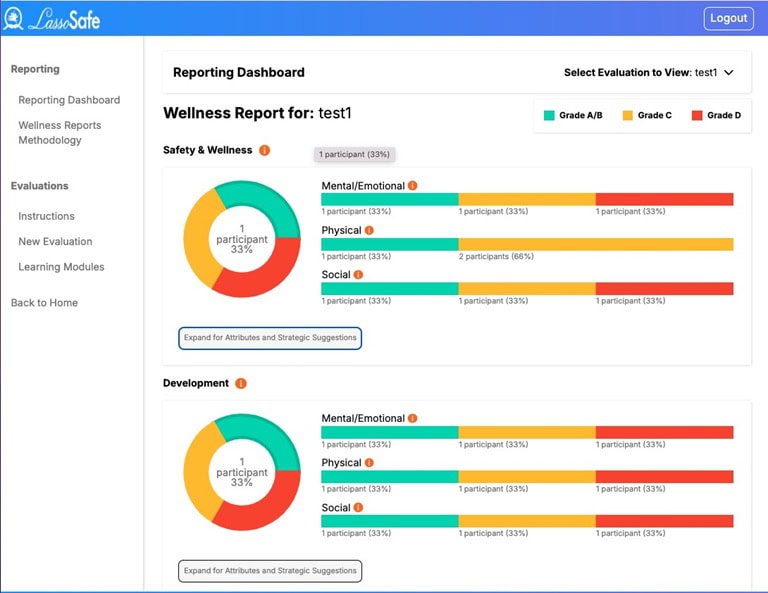
Lasso Safe described the product as “a machine learning software that recognizes athletes’ experiences — specifically the areas are mental, emotional, physical and social wellbeing.” Image: Lasso Safe
It was originally developed for national governing bodies that serve Olympic sports but has been modified for age groups as young as elementary school. Minix noted the increasing pressures at the youth level, in part because of growing expectations from the coaches and the growing financial investment in the space.
“Any level can experience this, not just highly competitive levels, so we focus on youth, but we do all age groups,” Minix said. “The software is designed to recognize even the first step away from that, when maybe those pressures start to come up or any type of misconduct within those wellness pillars.”
The frequency of surveys is at the discretion of each organization. Minix noted that Players Health will typically require them at least once during an application process to the platform, but many groups will administer them periodically or after incidents.
Questions asked of athletes include whether they feel valued by the coach, whether they have adequate access to nutrition and hydration during training sessions and more. Surveys can take anywhere from five to 15 minutes to complete.
Minix said Lasso Safe has run pilots with about 50 universities in the past five years, led by Utah State and Victoria University in Australia. The first adopter of the latest software is Globocol, a case management company based in the UK that offers services for sporting integrity, DEI, health and safety and data governance, among other uses.
This article was brought to you by SBJ Tech, a Leaders Group company. As a Leaders Performance Institute member, you are able to enjoy exclusive access to SBJ Tech content in the field of athletic performance.
