We bring you the views of the International Football Group’s Paul Prescott, Aarhus’ Morten Larsen, who sees one of Denmark’s best academies up close, and Kitman’s own Stephen Smith.
A podcast brought to you by our Partners

It wasn’t always thus. “English clubs were basically funding talent development models in Spain or in Brazil because English talent wasn’t seen to be at the same level as players from those countries,” Paul Prescott, the Managing Director of the International Football Group, told this Kitman Labs podcast.
That situation persisted until recently and is starting to change in part due to the introduction of the Elite Player Performance Plan [EPPP] in 2012.
“We are seeing that some of the decisions that were made maybe 10-12 years ago are beginning to bear fruit,” added Prescott, who was joined by Morten Larsen, the Head of Methodology & Development at Danish Superliga club Arhus, and Stephen Smith, the Founder of Kitman Labs.
Aarhus share the Premier League’s emphasis on talent development, albeit in different circumstances, as Larsen explains [5:30].
“Denmark is a small country and the league is a small league,” he says. “So there’s only one thing we can do to compete with the other clubs in Europe.”
Elsewhere, Smith sets out the differences in approach between leagues and clubs [16:25]; Larsen explains the impact of data on decision-making processes in the Aarhus academy [24:10]; and Prescott ponders whether EPPP was an outcome or a catalyst [36:30].
Listen above and subscribe today on iTunes, Spotify, Stitcher and Overcast, or your chosen podcast platform.
What we learned about turning underperformance into success at the Leaders Sport Performance Summit.
An article brought to you by our Event Partners


A rich seam of answers ran through both days of this month’s Leaders Sport Performance Summit at the Kia Oval in London.
We listened to speakers from various sports organisations discuss their responses to setbacks. Teams including Chelsea, Racing 92, Harlequins and the Sydney Swans laid it all on the table. Several explained how they managed to turn things around.
Stephan Lewies, for example, captained a Quins team to victory over Saracens in October; their 17-10 win ending a miserable run of eight consecutive defeats to their Premiership rivals.
“Coming off a record like that,” said the South African lock, “you often look for answers in the wrong place.” Lewies explained that season after season Quins would change their usual approach when facing Saracens. This season they stuck to their guns and it paid off.
“When the pressure came on in this game, [we turned to] something we’d done for the whole season, for years previously, versus something new in the pressured moment.”
Kudos to Quins, but neither they nor anyone in sport has dealt with the difficulty of landing a probe on Mercury or the conundrum of trying to thaw a microscopic strand of ice on the lens of a space telescope 1.5 million km from Earth.
For Carole Mundell, the Director of Science at the European Space Agency [ESA], such stories represent another day at the office. Crisis after celestial crisis is routinely averted on Mundell’s watch by some of the brightest minds in astrophysics.
Of ESA’s triumphant run-in with the intrusive ice, she said: “Data gives you information. Information gives you knowledge. Knowledge only gives you insight and wisdom for action if you really understand what it’s telling you and how to interpret it with your own experience on top of that.”
Mundell feared impostor syndrome when stepping onto the Oval stage but her words instantly resonated with an audience of coaches and practitioners.
They also lead us nicely back to our original question: how do you turn setbacks into springboards? We bring you six interrelated smart tips from across both days of the summit.
1. Find the right skills to help you in a crisis
How does it feel to be under the cosh in your role? What tools do you lack in those moments? Carole Mundell has allowed herself to be shaped both by the crises she’s confronted and the organisation she leads. Instinctively, she’s a creative scientist, a physicist with the urge to investigate independently. Yet her work at ESA requires her to think like an engineer and commit to the team; these newly acquired skills have proven crucial in moments of crisis.
Carole Mundell
2. Seek key allies above you
Racing 92 were treading water in France’s Top 14 league when they appointed Stuart Lancaster as Director of Rugby. Lancaster, whose tenure began in 2023, was hired to transform their fortunes, but faced considerable obstacles. Language was one, culture another; he also knew he’d be working under his predecessor, Laurent Travers. Nevertheless, Lancaster felt that he was “pushing on an open door” thanks to the quality of his coaching work with England (2011-2015) and, in particular, Leinster (2016-2023).
The big question he asked himself was: should he tiptoe in or smash down the door? As Racing’s revival required more than a cosmetic makeover, he opted for the latter. With the help of his French coaching staff, Lancaster introduced a new working week, a new playbook, and called time on Racing’s long lunch culture. He could disregard those who labelled him an ignorant ‘Anglo-Saxon’ thanks to the relationships he forged with Travers and the Racing board.
Stuart Lancaster
3. Who are your key influencers?
The Sydney Swans had to dust themselves off following their 2022 AFL Grand Final defeat. John Longmire, who this week stepped down as the Swans’ Senior Coach, led them back to the Grand Final again this year. Since leaving London, he has handed the reins to his assistant Dean Cox, who will renew the team’s fight for a first flag since 2012. The factors that propel a team one season will not necessarily apply the next, but Cox is sure to emulate Longmire in learning and applying the lessons from another painful defeat. In dealing with setbacks, Longmire always leaned heavily on the key influencers in his “ecosystem”.
John Longmire
4. Don’t be afraid to let the wrong people walk away
When Chelsea won the Champions League in 2021, the club would not have expected to slump to a 12th-place finish in the Premier League just two years later. Nor would they have predicted the organisation narrowly avoiding oblivion and a subsequent change of ownership. Bryce Cavanagh was hired as Performance Director in the summer of 2023 and, while he has long been considered one of the best in the business, an arduous task awaited him.
He admitted his presence created a sense of risk and vulnerability in some quarters, but he was fair in setting out his stall. Some relished the challenge of staying to help build a fresh performance strategy (a work in progress, he admitted), but others sought roles elsewhere. Cavanagh was willing to let them go.
Bryce Cavanagh
5. Have the difficult conversations quickly
As captain of Harlequins, Stephan Lewies regularly faces difficult conversations. They are of added importance when the chips are down and tempers are frayed. Time and again, as Lewies explained, he has been able to plot a path out of disharmony by being proactive, acting fast and ultimately putting the team first. A leader should also strive to understand multiple points of view without leaping to conclusions.
Stephan Lewies
6. Prioritise your stress and emotional responses
Success and failure both present psychological and emotional challenges. In 2021, the UK Sports Institute introduced its ‘Performance Decompression’ tool to help athletes and support staff transition back to daily life following intense competition periods. The tool consists of four phases: first there’s the post-event ‘hot debrief’ followed by ‘time zero’, which, as the UKSI website explains, focuses on ‘restorative care in a soothing place’; then it’s ‘process the emotion’ and, finally, a ‘performance debrief’.
The tool can be used anywhere. British 1,500m runner Jake Wightman, for example, chose a sofa in a Twickenham café to unpick his underperformance at the Tokyo Olympics. A year later he was world champion and, while there was much more to it, psychologist Sarah Cecil believes the tool helped Wightman to plot his comeback. She and the UKSI’s Head of Performance Psychology, Danielle Adams Norenburg, are also happy to teach their tool to any individual or organisation who may find it useful.
Sarah Cecil
The Leaders Performance Institute reflects on an afternoon of learning at the Tate Modern.
Clancy, a learning and development consultant with the Houston Texans and Director at The Nxt Level Group, was speaking at the October launch of his new book Essential Skills for Physiotherapists: a Personal and Professional Development Framework at London’s Tate Modern Gallery.
“Maybe this day will make you think a little bit more into that question,” he continued.
The gallery’s East Room, with its panoramic views of London, is a suitable backdrop for some of the brightest minds in sports science and medicine. Each of them knows there’s more to their success than talent.
“When we’re in college, we’re taught the technical, clinical, hard skills, but it’s the soft skills that make a difference,” said Clancy.
Essential Skills is an effort to address that reality, bringing together as it does experts who, in some cases, had never previously met in order to collaborate. “That’s the beauty of the book because it shows we can all get better together.”
The book’s proceeds will go to Children’s Health Ireland [CHI], a cause dear to Clancy and his family given the care they have provided to his four-year-old daughter Grace. “This way I can help people like my daughter and her friends.”
Clancy then introduced his roster of speakers – friends, collaborators and mentors – all of whom had wisdom to share.
Here, the Leaders Performance Institute picks out five thinking points to help you reflect on Clancy’s original question: are you doing what you want to be doing?
1. Define the behaviours that will take you from potential to peak
First onstage was James Kerr, the author of the renowned Legacy, who detailed the lessons leaders can take from New Zealand’s All Blacks.
He explained that the right behaviours are the real “force multiplier”. Good behaviours, whether you’re an athlete, coach or practitioner, will “take you from potential to peak more consistently”.
For the All Blacks, that may mean ‘sweeping the sheds’ but how does that look in your environment? What will enable you to show up more often and apply the right behaviours?
2. Seek to understand, find common ground
Behaviours shouldn’t be separated from your values, but how comfortable are you calling out poor behaviours? Any discomfort you feel may be amplified if you’re a woman trying to progress in a male-dominated environment.
Alicia Tang, the Head of Academy Medicine & Physical Performance at Derby County, recognises this “internal battle” well enough and believes the first step is to speak to the relevant stakeholders. “Seek to understand, find common ground, and then work on the resolution,” she said during the second session.
This view is shared by business consultant Michelle Carney, who said, “If you meet people where they are, you’ll find the right people”. They will not only be colleagues but allies.
“I think it’s definitely empowering when you have those people around you,” says Ashar Magoba, the Lead Academy Physiotherapist at Charlton Athletic, who is also starting to work with the club’s first team. “Perhaps those people can see something in you that you don’t quite yet see yet.”
3. Take a look over the fence
Where do you look for insights and inspiration? Jack McCaffrey, a six-time All-Ireland Senior Football champion with Dublin GAA, enjoys himself in his day job as a paediatric doctor at CHI at Temple Street in Dublin. “I get to hang out with kids all day; and kids are just great,” he told performance coach Ronan Conway during their fireside chat in session three.
In some ways, McCaffrey’s medical career is a sanctuary from his Gaelic football (particularly following a bad result). One could say the players of the strictly amateur Gaelic games in Ireland have a natural separation between the athlete and person that can often be lost in professional sports.
During his intercounty career, McCaffrey’s work also gave him lessons to take back to the Dublin panel, where the training environment was, to all intents and purposes, a professional setting.
“Most of my learning of dealing with high-pressure situations has come from work,” he said. “How to remain cool, how to have feedback loops, how to make sure you’re sticking to algorithms.”
4. Find the information in your trauma
In sport, we continually speak of ‘controlling the controllables’ and yet 95% of human brain activity is subconscious. It is a troubling thought for life coach Mark Whittle, the Founder of the Take Flight performance consultancy, as he told us during the fourth session.
His presentation returned to the question of behaviours, which he said are governed by both our drive towards pleasure and wish to avoid pain. Tied up in that avoidance of pain is fear, which can be born of trauma.
Consider a setback you’ve suffered: how can you learn from that event and respond appropriately? “What can you make it mean?” Whittle asked the audience.
5. Identify your gaps
It takes humility to recognise what it takes to excel in a new role. In the final session, Jeff Konin and Trevor Bates warn of the Peter Principle. The concept, devised by psychologist Laurence J Peter, states that people tend to be promoted to their ‘level of respective incompetence’. Think of the supreme technician who, upon promotion, finds themselves overwhelmed as a manager tasked for the first time with leading people.
For Konin, the important thing is finding your ‘where’ when looking five or ten years into the future. “What skills do you need that you don’t currently possess?” said the Clinical Professor from Florida International University.
Similarly, Bates may be the President & CEO of Mercy College in Ohio, but he has no problem with being the “pupil”. He said: “I might be the one who moves a programme forward, but intellectually I might be a pupil in that space.”

Essential Skills for Physiotherapists: a Personal and Professional Development Framework is available now from Elsevier.
Watford, West Brom and Sheffield Wednesday all decamped to St George’s Park in July. We explore five factors that informed their choice.
Main photo: Watford FC/Alan Cozzi

The three Championship clubs held pre-season training camps at St George’s Park in July when a number of their counterparts were visiting foreign climes.
“You can guarantee that the weather isn’t going to impact training loads,” says Watford Head Coach Tom Cleverley, who took his side to SGP between 22 and 27 July. “Sometimes you can go to Spain, Portugal and it’s too hot to get the intensities that you want.”
It was the week of pre-season where Watford started their out-of-possession work and intensity was a must. “You can’t be intense the whole pre-season because you’ll burn them out,” Cleverley tells the Leaders Performance Institute, “but for one week of pre-season, we identified that week where we could work twice a day on the pitch; we could have a meeting every day in the morning about what we’re going after; and then a meeting in the evening about a target that we’ll set for the season.”
Tony Strudwick is of a similar mindset, as he tells the Leaders Performance Institute of SGP. “We’re guaranteed a consistent weather pattern,” says West Brom’s Director of Medical. “We want to try to create that level of consistency in pre-season.”
The 330-acre Staffordshire facility, which includes a Hilton Hotel, boasts 14 state-of-the-art football pitches, which can be configured for a variety of sports, as well as a range of indoor facilities including a full 3G pitch, a multifunctional sports hall, gym, hydrotherapy pools and a cryotherapy chamber. It suited West Brom to a tee. “The one-site solution is perfect for us,” Strudwick adds.
West Brom spent 13 to 20 July at SGP – hot on the tails of Sheffield Wednesday, whose camp took place between 8 and 13 July.
“You literally come off the training pitch, you’re into recovery, lunch, you can maybe get your feet up for an hour or two and be ready for the next session and then it’s the same in the morning,” Neil Thompson, the Assistant Manager at Sheffield Wednesday, tells the Leaders Performance Institute.
Here, we explore three clubs with five similar reasons for choosing SGP for part of their pre-season work.
Monotony was a big issue for Championship clubs in an off-season that for those not involved in the play-offs ran from the last day of the 2023-24 season (4 May) to the opening day of the 2024-25 season (10 August).
The gap led to an extended pre-season. “A seven-week pre-season is longer than usual,” says Cleverley, who explains that the club’s own training ground “can become monotonous if you’re doing double sessions every day for seven weeks”. SGP, on the other hand, is “second to none” in his view.
“It can freshen things up a bit and create an impact,” says Strudwick, adding that it allowed West Brom’s own training pitches a further week to recover. “It doesn’t sound like a long time, six or seven weeks, but given that you’re going to be at the training ground for the next 38 weeks, it does make sense to create something unique and special.”

Tom Cleverley, the Head Coach of Watford, explains tactics to his players. (Photo: Watford FC/Alan Cozzi)
SGP enabled all three teams the opportunity to promote team bonding, which is particularly critical early in pre-season when new players and staff are settling in.
“You’re there and living in each other’s pockets for a week,” says Thompson. “You might speak to an individual who you’ve never spoken to in depth.”
There are nurmeous “breakout areas” around the Hilton too, as Strudwick explains. “There are plenty of opportunities for players and coaches to interact and engage.”
“The team spirit aspect, I really enjoy,” says Cleverley. “So keeping guys together between sessions, they’re not on their digital devices, they’re together in the evenings, they’re eating together, they’re not going straight back to their rooms – they want to be around each other for that week – which really builds something to move forward for the whole season.”

Neil Thompson, the Assistant Manager of Sheffield Wednesday. (Photo: Jacques Feeney/Getty Images)
There is real value in English teams booking camps in southern and central Europe – Sheffield Wednesday also arranged camps in Germany and Austria – but there is something to be said for having everything on hand at one site at a familiar venue. It is instructive that each of Watford, West Brom and Wednesday previously held pre-season camps at SGP.
“I’m keen to go back there,” says Cleverley, who is already onto the Watford team secretary about the idea. “I’ve had a lot of experience of St George’s Park as an international player, as a club player. I’ve played there, done a camp there with Watford, and now, as a coach.”
“We’re looking at doing the same next year,” says Strudwick of West Brom. “We wanted to reduce travel time and maximise the training opportunities. We didn’t have to get on early flights, go through airports, we don’t lose training days, we don’t lose match prep days.
“We’ve had two years of St George’s Park and both experiences have been fantastic.”
The same works in reverse, with overseas teams such as SL Benfica and AS Monaco enjoying similar benefits in the Staffordshire countryside.
Not only is there favourable training weather and pitches at SGP (“the ground staff were putting the sprinklers on at the right times,” says Cleverley), but teams have the full ability to tweak schedules as necessary or make adjustments.
Cleverley, for example, split his Watford squad in two midway through their camp in order to play Scottish Premiership side Hibernian in Edinburgh. The fixture was arranged as part of Ryan Porteous’ move from Hibs to Hertfordshire in 2023. “It was a unique week,” says Cleverley, who was still satisfied with the camp’s outcome.
A team’s plans are subject to “constant iteration” in pre-season, as Strudwick explains. He says: “We’ll have certain priorities that we want to hit, we’ll have certain individual players that need managing, and players coming back into the training process. But I’ve been in football long enough now to understand that the plan you have in early May often changes come mid-July.”
He also discusses the challenge of working in an environment where players employ external practitioners, particularly as there is no firm guidance for clubs. In any case, “it means you can’t switch off. You’ve got to be in constant contact with the players and tracking them outside of the season now.”

Darnell Furlong of West Bromwich Albion is all smiles in the gym during his club’s pre-season training camp day two at St George’s Park on July 16, 2024. (Photo: Adam Fradgley/West Bromwich Albion FC via Getty Images)
As pre-season focuses continue to evolve from conditioning to game-based, there is an increasing need to test ideas out on the grass in realistic conditions. With this in mind, the facilities at SGP can be primed for behind-closed-doors matches, which West Brom used to their advantage this summer.
The Baggies’ first two pre-season friendlies, against Bolton Wanderers and Peterborough United, were held onsite. The team played a further two fixtures behind-closed-doors (versus Blackpool and RCD Mallorca) at their West Bromwich Albion Training Ground.
The matches at SGP ticked many performance boxes for Strudwick and his colleagues. “You don’t want to go into your first game and expose the players to a 70,000 crowd,” he says. “You still have your referees but it allows you to be more flexible in playing minutes.” This is not just in terms of minutes per player, but reducing half lengths to 30 minutes, or even extending them to 60. “It gives you a lot more flexibility to nail down what you want from a team perspective.”
David Clancy and Richard Pullan set out their strategic and intentional approach to network building in a high-performance world of ever-growing complexity.
In today’s fast-paced world, high-performing individuals and teams face increasingly complex cognitive demands. These challenges are not just about processing information but also about managing stress, navigating uncertainty, and maintaining clarity amid competing priorities. This is where the power of strategic and intentional network building comes into play.
There are several means available to help build this network. They include purposeful twinning with others, developing an ecosystem of critical friends and identifying a web of second-opinion teammates. Each of these connections provides leaders with the means to make more informed and rounded decisions, make perspective shifts as well as provide objective feedback.
Twinning
‘Twinning’ refers to the practice of forming reciprocal partnerships with other teams or organisations that share similar goals, challenges, or conundrums – perhaps they might even be competitors, if the context makes sense. This is a huge part of what the Leaders Performance Institute does, in fact, forging ‘partnerships’ with teams and individuals. This is how the Houston Texans of the NFL became professional friends with the Texas Rangers of MLB, as an example. This symbiotic relationship allows for mutual learning and growth, where both parties can share best practices, resources, and insights. A term we often hear is ‘collaboration over competition’ – we can all row the boat faster if we are willing to exchange protocols, philosophies and pain points.
Professional sports teams all face their unique set of struggles but, oftentimes, there are numerous similarities with these. Sharing best practices and ways to approach challenges is a significant benefit downstream of this pairing. By ‘linking’ with another team, leaders can expand their knowledge base, reduce the isolation often felt in high-pressure roles, and benefit from other viewpoints.
In terms of innovation, if teams are open to sharing what they do (to a degree), how they do it, etc, they can draw on the experience and solutions already implemented elsewhere. This save them time, effort, and energy. Food for thought.
Critical friends
Critical friends play a unique role in leadership, deliberation and decision-making. A critical friend is someone who offers candid, constructive feedback and is unafraid to challenge assumptions. This is ideally someone outside the team/ franchise. They are trusted individuals who can act as a sounding board for ideas, provide a second perspective, and offer checkpoints when needed.
Creating and nurturing these ‘friends’ requires energy and effort, but the payoff can be huge. As an example, if you are ideating a new return-to-play system and method, bouncing ideas off someone with exposure to this in another environment could help make your system better. A no-brainer if you ask us!
We have witnessed the benefit in relation to cognitive demand also, as critical friends offer a safe space to validate thinking and refine or rethink ideas. Critical friends help prevent blind spots, biases and assumptions by encouraging the leader to pause and reflect before executing a critical task. The best critical friends strike a balance between support and challenge. They are not afraid to disagree, but they do so with the intention of helping the leader grow.
Second-opinion teammates
Second-opinion teammates (teammates being a crucial word) serve a similar purpose, offering alternative viewpoints to ensure a more well-rounded decision-making process, such as another set of eyes on an MRI report and image for a hamstring injury.
Particularly in high-stakes environments, seeking a second opinion reduces cognitive stress by distributing the weight of responsibility and allowing leaders to feel more confident in their choices. Knowing that a trusted colleague has reviewed the same data or proposal with rigour and objectivity can provide a sense of reassurance and clarity.
Strive to stock a bullpen of second-opinion teammates. It’s a game-changer.
Mentorship
“The delicate balance of mentoring someone is not creating them in your own image, but giving them the opportunity to create themselves”, said Steven Spielberg. To create themselves entails helping one to find their way. Consider giving a project to a more junior member of staff from a senior ‘mentor’, rather than the ‘easier’ option, of giving the project to a ‘middle manager’ who has done the type of project before. That’s an example of what this could look like.
Mentorship is a timeless strategy – one for managing both the emotional, physical and intellectual demands of leadership. This is typically someone with more experience who can offer guidance, advice, and lessons learned from mistakes, and successes. Great mentors provide leaders with the tools to think more effectively for themselves, enabling them, giving them their own toolkit; this helps them navigate complexity, prioritise, and mitigate stresses. They leave breadcrumbs behind.
Mentors can help leaders manage cognitive demands by offering perspective on what truly matters, helping to sift through the noise and focus on the signal i.e. what is essential. They also provide historical insight, showing leaders that many challenges they face are not new and can be tackled using time-tested methods. This reduces the sense of overwhelm that comes with thinking one must always reinvent the wheel. The issue you are facing has been faced and solved before.
Moreover, mentors are invaluable in helping leaders manage their wellbeing, as they can provide reassurance and encouragement when times get tough and they can acknowledge that these times come with the intense world of competitive sport.
Building a network
In high-pressure environments, leaders often find themselves juggling multiple competing priorities, balancing short-term, ‘urgent’ demands with long-term, ‘important’ goals.
Here are five reasons for nurturing a network to help with this:
What makes a good mentor?
The best ones share several key traits that make them invaluable in helping leaders grow and meet the demands of high-performance sport.
Here are five traits we often see:
And let’s not forget that mentors need mentors. This could be your partner at home, as an example.
So, here’s our challenge for you reading this article today – take on a mentorship role in some capacity, to give back…to pass the ladder down, as it were.
Final thoughts
In today’s fast-paced and ever-evolving landscape in high-performance sport, a leader’s success isn’t just defined by individual strength – but by the strength of their network. Jobs these days in sport are complicated and complex. It is now rarely possible for one individual to serve a function fully without seeking support from other disciplines, to deliver the final solution to a given problem.
By cultivating relationships through twinning, critical friends, second-opinion teammates, and mentorship, leaders create a support system that fosters psychological safety, collaboration, and continuous learning. These connections enable leaders to confidently navigate complexities, make incisive decisions, and lead afront with impact. After all, just as every great athlete stands on the shoulders of their team, no leader can truly flourish without a trusted network standing behind them.
David Clancy is a Learning and Development Consultant at the Houston Texans and Director at The Nxt Level Group. He is also the Editor of Essential Skills for Physiotherapists: A Personal and Professional Development Framework, which is available now from Elsevier.
Richard Pullan is a Director at The Nxt Level Group, the Visionary Founder of The Altitude Centre, and leads the training of clients for flash ascents of Everest and other 8,000m peaks, while also preparing professional athletes and elite sports teams. He is formerly of Sporting Health Group.
If you would like to speak to David and Richard, please contact a member of the Leaders Performance Institute team.
TempleOrthotics believe their proprietary compound could be the crucial difference in helping a player return to their peak post-ACL injury.
A Data & Innovation article brought to you by

Temple OrthoBiologics has created a proprietary compound called TX-33 that has shown good results in preventing fibrosis in abdominal and pelvic surgeries and is on track for human trials in knees as part of the FDA approval process in late 2025 or early 2026.
ACL tears rank among the most devastating injuries to athletes, particularly among girls and women, typically requiring a year of rehab and no guarantee of a full return to pre-injury performance. Understanding the mechanism of injury is a growing focus among researchers, with FIFPRO and the Women’s Super League among those who recently commissioned a study.
Temple OrthoBiologics is announcing its formation on International Arthrofibrosis Awareness Day. It has been privately by its co-founders to date.
“We have a technology that can make a difference in the knee,” said Temple OrthoBiologics CEO Sanj Singh. “The scar tissue that forms in the knee does several things. It prohibits proper function. The stiffness leads to pain and also inhibits good rehab.”
Renowned orthopedic surgeon Dr. Riley Williams — who practices at the Hospital for Special Surgery and leads surgical care for the Brooklyn Nets, New York Liberty and New York Red Bulls — is such a strong supporter of the drug’s potential that he joined as a co-founder.
Williams said he completes between 100 and 115 ACL reconstructions annually. The typical post-operative scar rate is 4-5%, but he noted the importance of reducing it further because, among his patients, “that’s four people” who might have that excessive scar response.
“The formation of scar in and around these surgeries is a very poorly understood phenomena, but it has real-life consequences in surgery,” Williams said, adding: “It’s very exciting because that in a very clean and unfettered way can help to dampen that [inflammatory] response without dampening the natural immune response.”
TX-33 can be injected after an injury or at the time of surgery and, by inhibiting excessive scar tissue from forming, healthy tissue can regenerate instead. Williams predicted that, following a successful trial and FDA approval, it will “become standard care very quickly.”
Another orthopedic surgeon backing the Temple drug is Dr. Vinod Dasa, who chairs the orthopedic surgery department at LSU, and has joined the company as an advisor.
“From a sports perspective, reducing scar tissue will definitely enhance return to play and faster recoveries,” Dasa said. “If it’s an issue in terms of scar formation, in terms of that ligament healing after a sports injury, maybe this will allow that natural healing to progress more appropriately.”
Retired Canadian Olympic bobsledder Neville Wright, who now owns and operates Wright Performance & Therapy, is a speed consultant and trainer for the Canadian men’s World Cup team who now advises Temple OrthoBiologics. (Bobsledder Emily Renna is the other athlete advisor.)
“Surgery is always a fear for a lot of athletes.” Wright said, noting the concern of post-traumatic osteoarthritis and its impact on full-fledged return to performance. “If I’m off a degree in regards to flexion of my knee, that can be a difference of running a really fast time to being outside of that high-performing category.”
Interest in sports is acute, but there is broader potential to help the general population, particularly with total knee replacements. “The age demographic of arthritis is slowly moving to the left,” Dasa said, referring to a trend of younger patients needing interventions.
Big Pharma doesn’t typically get involved in orthopedics, he added, noting the large opportunity for a drug like Temple’s. Dasa also noted that “non-surgical management of arthritis has essentially been non-existent. The lack of treatment options has implications on particular demographics, too.
“We see differences in fibrosis based on health disparities, so based on race, socioeconomic status, and a few other things,” Dasa said. “So if we can improve fibrosis, we may actually improve some of the health inequities and disparities that we see as well.”
This article was brought to you by SBJ Tech, a Leaders Group company. As a Leaders Performance Institute member, you are able to enjoy exclusive access to SBJ Tech content in the field of athletic performance.
The NYCFC custodian recently featured in SBJ Tech’s The Athlete’s Voice series where he discussed his career, education and forays into the business world.
A Data & Innovation article brought to you by
You can’t have a discussion about sports technology today without including athletes in that conversation. Their partnerships, investments and endorsements help fuel the space – they have emerged as major stakeholders in the sports tech ecosystem. The Athlete’s Voice series highlights the athletes leading the way and the projects and products they’re putting their influence behind.
* * * * *
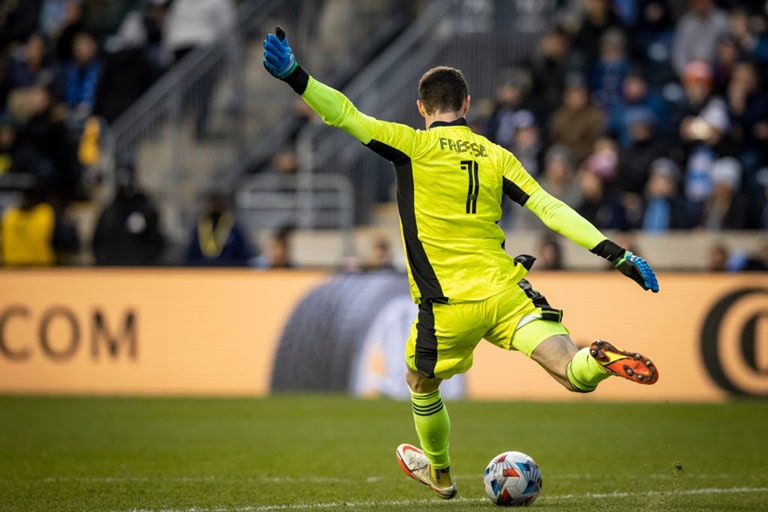
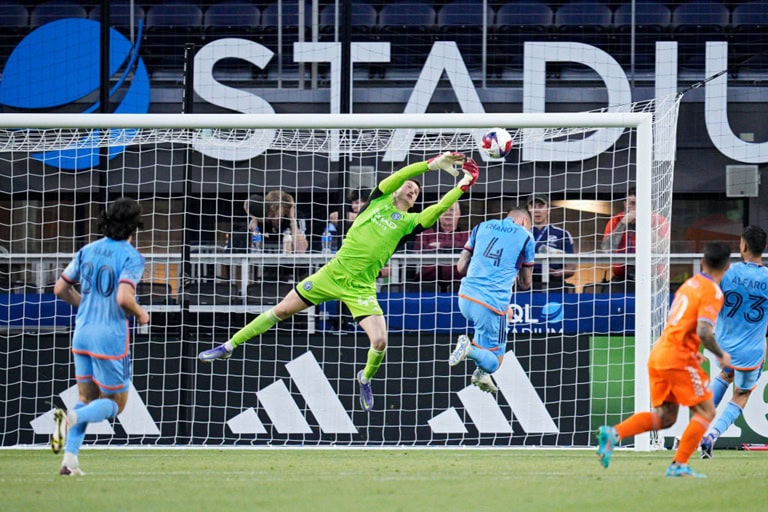
NYCFC goalkeeper Matt Freese has started all 30 of his club’s matches this season in MLS and has a 73% save rate, stopping 102 of the 140 shots he’s faced. This is his second season with NYCFC after beginning his career with the Philadelphia Union. A native of Wayne, Pennsylvania, Freese signed a homegrown contract with the Union and, after two seasons at Harvard, made his MLS debut in 2019.
Freese, now 26, had an opportunity to begin playing pro soccer after graduating from the Episcopal Academy in suburban Philadelphia but elected to attend Harvard first. Though he left early, Freese completed his degree remotely, balancing Ivy League studies with professional soccer, which is something he actually considers an advantage for his athletic career. A curious mind and avid follower of sports business — and a reader of Sports Business Journal, he revealed — Freese wrote independent research projects on MLS franchise valuations and advanced analytics for expected goals.
On opting for college, not pro soccer, right after high school…
The first and most obvious [reason] is just the fact that I wanted to honor my parents’ wishes to go to college. When I got into Harvard, they pushed even harder. I was really fortunate and lucky for that to happen. My dad had gone there, and he really wanted me to make sure I got a degree. The really awesome thing about Harvard, or most colleges at this point, is if you go for a semester or two, you pretty much lock in the ability to go back and finish your degree at some point.
On a more personal level, I don’t know if I was ready to be an adult and live on my own outside of the college setting when I was 17, 18, signing a homegrown contract. Also, goalkeepers usually develop a little bit later, so there wasn’t as much of a rush, if that makes sense. Seeing now the way my career has unfolded and changed, maybe I’d make a different decision and start it earlier, rather than waiting that year.
Ira L Black – Corbis/Getty Images
On balancing school and sports…
I would [attribute] most of my on-field soccer career development to my off-field academic efforts. This was at a time when I was 19, when structure and schedule is so important for a 19, 20-year-old who’s now a professional athlete making good money and getting pulled to do things that that most 19, 20-year-olds are getting pulled to do. Having the structure, having a few hours of work every night after training, making sure I had to be on a good sleep schedule, it all really allowed me to focus on soccer and not get distracted with other things. It really grounds you. It humbles you.
The other thing that I really liked about it was that it gave me a de-stressor off the field. As a 19, 20, 21-year-old, you’re now competing for your career every single day that you’re playing, and it becomes stressful, and as a young guy, you don’t really know how to handle that. So when I got home, and I would be doing work, reading a textbook, doing whatever — my mind was able to get away from soccer, which is super important.
And then the third thing that’s also quite interesting is that there’s a lot of research out there that really supports cognitive development, especially at that age, and your ability to solve problems, lead and organize and be a team leader. A lot of that is correlated with academic and intellectual stimulation. As that was continuing to grow, as my brain was continuing to be pushed and grow, it allowed me to, in my opinion, learn more quickly on the field. Learning quickly, learning on the fly, is completely necessary for a professional athlete.
On writing an undergrad thesis on MLS franchise valuations…
It was my last semester. I had finished all my core requirements, and I was doing everything remotely and then flew up to take exams in the offseason. And so I was able to do two independent research projects as my last credits. The title of one was “The theoretical analysis of the rise of MLS valuations.” Since 2010, they just completely skyrocketed, and the whole point of what I was discussing is that demand was going up. The supply was very limited. It was very constrained for several reasons. The primary one is expansion is limited within the MLS.
Probably the bigger focus was just talking about how demand, from an ownership perspective as well as from a fan engagement perspective, is going up. The academy situation has really changed everything. People want to go see kids or teenagers from their hometown that they knew growing up. They want to go see them play. They want to see them succeed. The US team is obviously getting more and more attention year over year, and that impacts the way fans look at MLS games.
People want to buy into these teams. They’re becoming more and more profitable. Revenues are going up. Operating expenses are also going up, and salaries continue to increase, and transfer fees just always are rising. But in general, they’re just becoming more profitable and easier to operate.
On writing MLS papers while a player for the Union…
I was in my third year. I’d always go to this one coffee shop in Philadelphia and work on that paper. The other independent research project I should probably mention because it’s somewhat related was, I created an expected goals model using data from MLS over the last five, six years, which was also really cool.
Goalkeeper is a weird position [for analytics] because essentially the only one that matters is the post-shot expected goals model and how that relates to the goals conceded. Goalies are a little bit of an anomaly, but in general, yeah, I love looking at data. I love talking to our data analytics team in the organization about these things. I just think it’s really interesting. It can shape a strategy of a team to a degree.
It can’t completely take over what the philosophy of the team is, but it can point you in the right directions or show you what type of cross has the highest percentage of expected goal coming from the end result of, leading you to probably want to look at getting into the cutback scenario more than these long, high crosses. We’re a relatively younger team. Our height and our strength isn’t as much so fighting against these big center backs might not be as successful as getting into that cutback zone, which is something we’ve worked on a lot. This is not me driving that, by the way. [laughs] This is the coach, the data analytics team making those decisions, obviously.
Jeff Dean/Getty Images
On not looking too deeply into his training data…
I am into that, but I just trust our performance director and the medical performance side of things on the team. They handle all that, and they make sure that my dive count is not too high, my explosive [actions] count is not too high. I am hitting the numbers that they want, and I just trust them to do that. They’re very good at their job.
On his interest in sports business when he retires…
I do think about it. The clear priority right now is playing, and I want to play for a very long time and have a good career and get my name into the that top tier of MLS, goalkeepers. But at the same time, I also take a serious interest in what my post-playing career will be. I believe one avenue would be to stay in the sports realm, whether that’s on a business operating side, being on the finance or marketing side of an organization, or the sporting side —GM, Assistant GM, sporting director, that type of thing — is really fascinating as well.
And then there’s also the investing side. I have a background in investing as well. I took several classes and audited some MBA classes at Wharton when I was in Philly. So I’m comfortable and really enjoy that type of stuff. A lot of it also depends on how my playing career goes.
On his game prep…
As a goalkeeper, the routine really is everything. And I’ve become somewhat psychotic about my routine before every game. There’s a lot of research that has indicated that, for an athletic event, your sleep two days prior is actually more important than the sleep one night prior. So my routine really starts two days before the game. I try to get as much sleep, like 9, 10, hours two nights before, and then I usually do a series of meditations leading up to the game. I do the same type of film, just very serious about my routine.
This article was brought to you by SBJ Tech, a Leaders Group company. As a Leaders Performance Institute member, you are able to enjoy exclusive access to SBJ Tech content in the field of athletic performance.