During his time with the INEOS Britannia sailing team, Peter Hodgkinson built an environment that enabled his young staffers to learn and thrive under pressure. As he explains in this exclusive column, intent-based leadership and psychological safety were at the heart of his approach.
Main Image: Getty Images/Fiona Goodall
We achieved a number of national firsts: the first British team to win the Challenger Series, fending off some tough opponents; the first British team to contest the Match itself in 60 years; and the first British team to score points in the Match for 90 years.
There was no shame in eventually losing 7-2 to Team New Zealand, who claimed their third consecutive victory. We gave it a good go against the team our helmsman, Sir Ben Ainslie, described as “the best team ever”.
This is the story of how we put ourselves in contention.
Assembling a functioning team: the hard part
The INEOS Britannia Team was made up of two organisations: Athena Racing and Mercedes GP. It wasn’t always easy – it was a collision of two different workplace cultures – but the common goal bonded the two companies together and we got on with the job.
I learnt a lot about sailing and the maritime industry and while there are similarities to motorsport, where I have made a career for four decades, there are a number of big differences (that’s a topic best saved for another day).
One of the things I really enjoyed about working on the Cup was that we got to recruit a new Build Logistics Team. Basically the Build Logistics Team are parts chasers; in the Cup they looked after ‘goods in’, ‘stores’, stock checks, parts picking, moving parts through inspection, NDT (non-destructive testing), X ray etc. so it is a fluid and dynamic role with lots of pressure.
The team we recruited had very little or no experience in this type of role but we believed it was more important to have the right mindset, practical intelligence and energy than experience. In the Cup, we didn’t have all the structures, systems and processes in place that you have in an F1 team but we had enough to do the basics well, if we used what we had correctly.
I believe if you have relatively fewer parts then you need additional people to manage those parts as they become more critical. Therefore, we ended up with a team of seven people in Build Logistics, which seems a lot, but considering the workload, I think this was the correct number.
Almost all members of the team we assembled would be considered Gen Z, but I didn’t view them in such narrow terms. I didn’t put them in some kind of box with a label. To me they were a new team that we had to get moving as quickly as possible. This was the hard part.
‘Don’t lose any parts’… and ‘no surprises’
The team’s inexperience was difficult to manage at first but as they were all intelligent it didn’t take long to get them up and running. Don’t get me wrong: we had some very difficult moments and some very challenging conversations, but after a few months we started to see improvements and we were going in the right direction. The energy and passion this group displayed was not seen by the whole team as everyone was flat out, but I could see what they were achieving. I applied what I had learnt in my time in HR (I was Head of Employee Engagement at Mercedes F1 between 2019 and 2022) to this group using intent-based leadership and psychological safety.
I gave the Build Logistics team two simple rules: ‘don’t lose any parts’ and ‘no surprises’. Don’t lose parts almost goes without saying, but it was important to articulate as it gave them a mental priority for what they were responsible for. I wanted them to feel that every part was important because, if we lost something, then we could miss an important test or delay a development item hitting the water, therefore delaying the opportunity to learn.
We did lose some parts but also we did learn from this, and I like to think we didn’t blame the person, as the process (or lack of) allowed it to happen. In most cases during my career, the human being was acting as a sticking plaster due to the lack of a robust process or system.
I used ‘no surprises’ as a tool to try to build psychological safety. Surprises are for birthdays and Christmas, in my book. I wanted this young team under pressure to speak up. I wanted them to feel that it was wrong not to say something if they were concerned about a part or a process or were having a problem. I wanted to hear what they had to say, I was desperate to hear what they were thinking, and it was important that I responded productively when they did bring me bad news. As a Build Logistics Team, we needed to know now if there was an issue, as we simply didn’t have time or resources to bury bad news. We needed to hear their voices and, for me, ‘no surprises’ gave them permission to speak.
We had a daily meeting at 11:00am to go over the plan, projects and new parts – similar to what we did in F1 – and it took a while to truly hear everyone’s voice. I would say to them: ‘I woke up at 2:30am and thought about this, when you woke up last night, what did you think about?’ Sometimes nobody had much to say when I asked this question but on many occasions there was a little nugget of information that came to light.
If you are looking to build psychological safety in your team, try using ‘no surprises’. It gives your team permission to speak and it will help your team grow and develop as they feel they have a voice and will be respected for their contributions.
The 2% vs the 98%
Now this might be a bit controversial: one nugget I gave to the young Build Logistics Team on the America’s Cup was “you are only remembered for the 2% you get wrong, not the 98% you get right”.
If you are really honest and park up all the psychology for a moment, this is probably a pretty true statement.
I am sure plenty of cleverer people than me will disagree with this sentiment, but this is how I see it. It is a bit below the line, but it did focus my mind on my own performance. I believe we remember negative moments or threats to help protect ourselves in the future if we see this type of situation happening again, and therefore it remains fresh in our memories.
Others will have some good memories of some of the things we did but they will remember in detail our mistakes and the moments where we did not behave reliably or with competence. In other words, they lost trust in us. As human beings we will make mistakes, this is how we learn, grow and develop.
Intent-based leadership
Leaders of new young teams need to provide a lot of control and support in the early stages of the team’s development while the team members improve their competence and get aligned to the clarity of the intent. As the team’s competence and clarity increases, the amount of leadership control decreases. This is built on the intent-based leadership theory devised by retired United States Navy captain David Marquet.
This is a snapshot:
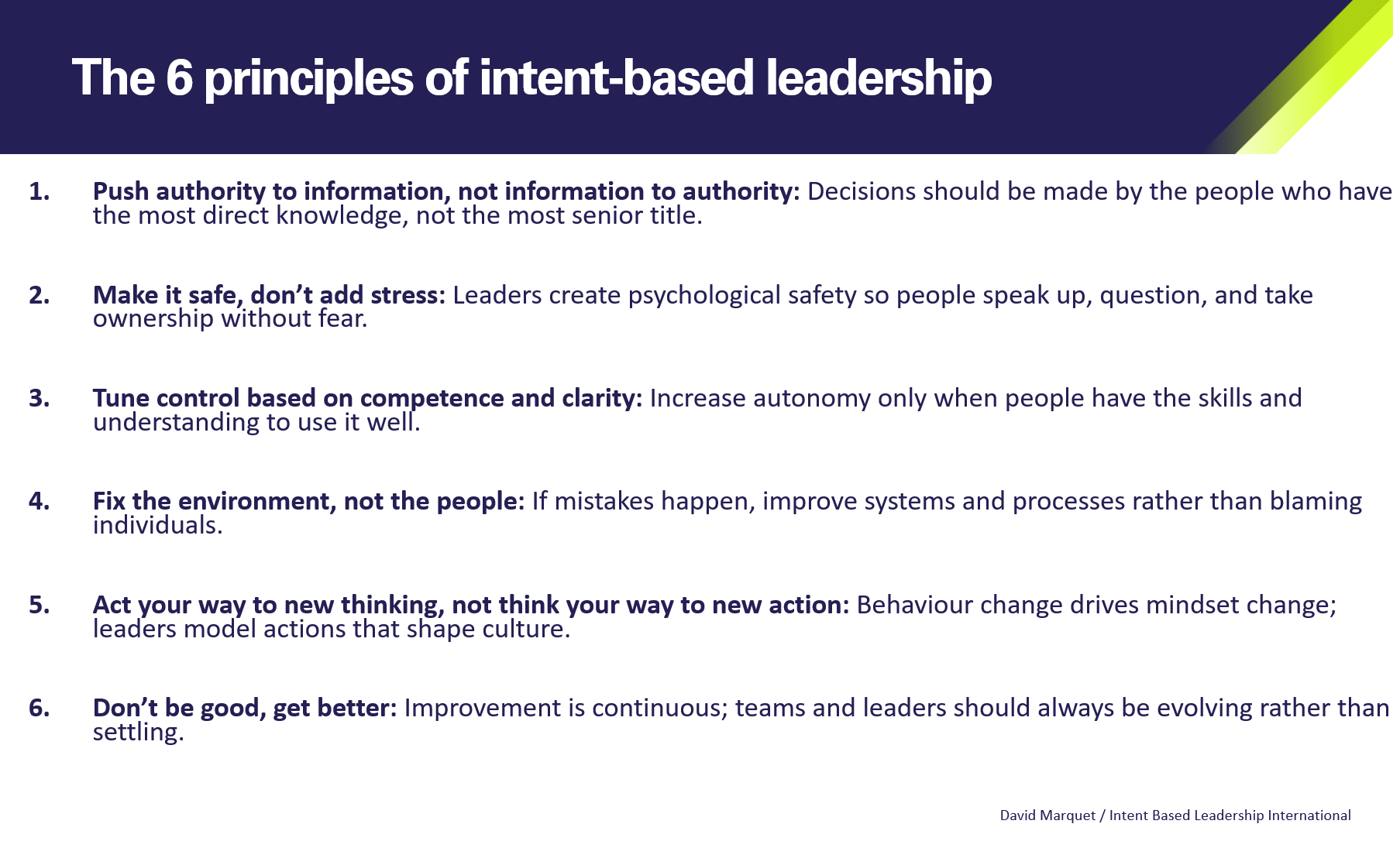
As a leader you are never quite sure what the people around you really think of you or if you have made a difference due to the pace of the world we live in. That said, a former member of the Mercedes F1 Build Logistics Team (and now a successful leader and manager in his own right) recently sent me one of the nicest bits of feedback I have ever received:
Your leadership allowed many young people to grow and now forms a lot of their own leadership and general teamwork skills. The biggest thing I always felt that made you different was your ability to allow others to make mistakes whilst catching them before it was at the detriment of the team. Without that, none of us would have learnt to be independent.
I think the key point from this is: I was catching the mistakes before they hit the 2% category while allowing the team to learn and become independent and responsible.
How is your team learning? Or are you telling them what to do so they don’t make mistakes? You don’t want their mistakes to reflect poorly on you and get you into that 2% category.
I hope this has given you something to think about. I am sure this may go against the grain for some of you but I suppose we can’t all agree on everything.
Peter Hodgkinson is a leadership and performance specialist skilled in helping high-performers become better at what they do. As an accomplished manager and mechanic, Peter has enjoyed almost three decades of success in elite sporting environments. His work in motorsport, as part of winning teams at Le Mans and Daytona, culminated in seven Formula 1 driver’s world championships won at Brawn and Mercedes, where he led car-building operations. Peter was Mercedes’ Head of Build during Lewis Hamilton’s era-defining run of six world titles. After a spell serving as Mercedes’ Head of Employee Engagement, Peter returned to the Factory Floor as Build Operations Manager for the INEOS Britannia sailing team when Mercedes supported their quest for the 37th America’s Cup.
If you would like to speak to Peter, please contact a member of the Leaders Performance Institute team.
CEO Mike Cazer spoke to SBJ Tech about the team’s efforts to bring the ‘Auld Mug’ back to the US.
A Data & Innovation article brought to you by

The defending champion of the America’s Cup is given wide latitude to establish the design parameters for the next competition’s sailing yachts, with strict limits on testing and prototyping. That “can limit your ability to take big technology risks, because you’re going to make sure that you’ve got a boat that works,” said Mike Cazer, CEO of the American Magic, the US entrant in the global regatta.
In order to explore new ideas within those confines, American Magic contacted a dozen engineering firms specializing in AI and simulations and partnered with Altair to build a digital twin of the AC75 yacht to serve as the basis for prediction models on how the boat will perform and how it can be sailed most effectively.
“Coming out of the last America’s Cup, we saw a huge opportunity in the area of advanced simulation, high performance computing and AI,” Cazer said. “We had some experience, particularly on the on the simulation side, but it was really more rudimentary. We thought that this could be a big part of this campaign and especially going forward.”
Altair has deep experience with the America’s Cup, dating back to 1995 — it most recently supported the Italian boat, Luna Rossa Prada Pirelli, in its runner-up finish during the previous competition. Altair technical manager of simulation and design Julien Chaussee said the inputs are “all-encompassing” and include historical data from prior America’s Cups, design tools, fluid dynamics, structural analysis and also digitally-generated simulation data. (Altair has also done significant work in golf manufacturing, among sports ventures.)
Cazer noted the complexity of the challenge with the sailing yachts that must contend with the environmental conditions of both wind and water, which requires pulling from the fields of both aerodynamics and hydrodynamics. The AC75 can hit speeds of 55 mph and briefly become airborne.
American Magic has a simulator at its training site in Barcelona, (where the races began last week), which enables the sailors to test the boat in all conditions. They can complete an entire race in the simulator under the precise details of that day’s weather and that opponent’s typical strategy. The simulations can also help brainstorm new tactics through artificial intelligence.
“When we use the AI bot to sail 24/7, it’ll start exploring areas of data that the sailors may not intuitively go to, and it’ll start recommending, ’In this condition pattern, here’s a way for you to sail the boat differently and potentially better,’” Cazer said. “A lot of times it’s wrong because the algorithm doesn’t quite have it exactly right, but a couple of times it’s pushed their thinking on how to actually control the boat and maneuver differently. And so then we start exploring that on the water, and ultimately it helps us get to be a better sailing team.”
The Preliminary Regatta was last weekend in Barcelona and it will be followed by the Challenger Series and final, best-of-13 series taking place between October 12 and 21.
“From a technical point of view, I always like to say, ‘There’s only one way to find out if you’re the best, and it is to go measure yourself with the best.’ You can’t just hide in an environment like the America’s Cup,” Chaussee said. “It’s really enabled us to push the tools and push the technologies and, in some cases, uncover limitations that we were able to overcome.”
This article was brought to you by SBJ Tech, a Leaders Group company. As a Leaders Performance Institute member, you are able to enjoy exclusive access to SBJ Tech content in the field of athletic performance.
Ben Williams of Ineos talks to James Morton about the true nature of innovation as he perceives it and managing change when people are instinctively reluctant.
An Industry Insight Series Podcast brought to you by our Partners

“One thing I do believe is: to harvest a culture of innovation we need human engagement and we need collaboration.”
Williams, who serves as the Ineos Grenadiers cycling team’s Integrated Performance Lead and the Ineos Britannia sailing team’s Head of Human Performance, is our very special guest on this Science in Sport Industry Insight Series podcast.
He sat down with SiS Director of Performance Solutions, James Morton, to discuss his varied professional background and the approach to innovation he has cultivated in each of his roles in sport and beyond.
Also on the conversational agenda were:
James Morton LinkedIn | Twitter
Ben Williams: Twitter | LinkedIn
Listen above and subscribe today on iTunes, Spotify, Stitcher and Overcast, or your chosen podcast platform.