The two-time Olympic triathlete sat down with SBJ Tech to discuss the impact of technology on his career as he ventures in the world of sports business.

You can’t have a discussion about sports technology today without including athletes in that conversation. Their partnerships, investments and endorsements help fuel the space – they have emerged as major stakeholders in the sports tech ecosystem. The Athlete’s Voice series highlights the athletes leading the way and the projects and products they’re putting their influence behind.
* * * * *
Since announcing his retirement last November, the 37-year-old has grown increasingly immersed in business. He co-founded a nutrition brand, TrueFuels, and has invested in more than 20 startups. Brownlee is an associate partner at Redrice Ventures and a member of the IOC Athletes’ Commission who consults on human performance and emerging technologies. He also leads The Brownlee Foundation, the charitable endeavor he started with his Olympic triathlete brother, Jonny.
On the impact of tech in his career…
Some technology happens in, let’s call it, a relatively linear progression. But the example of a technology that hasn’t happened in a linear progression is shoe tech, which is incredible. Of course, there were small innovations here and there in shoes, using slightly different forms of rubber soles. Then, all of a sudden, we see a steep change in innovation, with using the light, thicker foam and inserting the carbon rods that we started seeing probably 2018, 2019 and really exploded in 2020 and ’21.
The real innovation in terms of technology, for me, is training attitudes and approaches, which isn’t as sexy and obvious. I saw technological progressions on every form, in terms of attitudes, in terms of the scientific approach to training, in terms of the equipment we’re using, whether that is shoes or bikes. I started out with a bike that was all made of metal and your gear-changing happened very manually, and I went to electric gears with a power meter on a bike that was mostly carbon fiber.
Technological innovation is across all those different domains. In terms of tech, like hardcore tech — wearables and monitoring and having an impact on training — I started out in a world where [there was] a stopwatch and you might use a heart rate monitor as your primary training monitoring devices. I remember, as a 16-year-old, using a heart rate monitor and starting to use the first GPS watches to now where there’s all kinds of training monitoring devices, whether that’s internal — heart rate monitoring, HRV, muscle oxygenation — to external: power meters, GPS watches and bike computers.
View this post on Instagram
On his business interests…
I did a finance master’s at university, and so that business approach always interested me. I always had an attitude that I wanted to invest and build value for the long term because I knew that my athletic career won’t last forever, so that was an important aspect to me. Some of my early sponsorship deals had bits of equity in them. So a business like Boardman Bikes, for example, that was a big sponsor of mine from the early days — part of that was an equity deal.
I also had always been interested in businesses that can be a solution to make people perform better in elite sport but also perform better in terms of living healthier, active lifestyles. Obviously, backing great people to make great companies and great solutions is part of the answer. It’s not the whole answer — government plays a role in that, and charities play a role in that — but also great private businesses play a role in that.
On the impact of AI…
AI will affect sport in every different domain, as it’ll have an impact on all our lives in every domain. It will affect how people train. It will affect how people integrate data, use data, interact with data, how they’ll use all that information to prescribe their training going forwards, how it will help people understand more and deeper insights in recovery.
In terms of how we engage fans, obviously, there’s going to be massive changes there — engaging fans on a really personal level to watch events and interact with athletes and teams. Whether that’s camera angles or following a particular player or athlete or learning more about them as the events are happening, or learning more about how you can engage in whatever that sport might be, whether it’s badminton or football or triathlon or whatever.
The IOC are looking at it from an organization point of view as well. How can you use that technology to be more efficient? Use energy better, help people get in and out of stadia better.
On co-founding TrueFuels…
I was always being fascinated by maximizing human performance, and my [approach to] nutrition probably came out of me developing my own fuels in the last few years to race on was a challenge. I’ve got a feeling that the majority of people for whom a marathon or an Ironman or whatever endurance challenge goes wrong, nutrition is the primary reason for that.
View this post on Instagram
I had this idea of, how do you create a brand that is about helping the consumer to understand what they need, to make sure that nutrition isn’t the limiting factor for the event, whatever the event that they’re doing? The combination of that is product and education and community.
On his role with Redrice…
I invested on my own, joined local angel networks and got known to invest in sports businesses. Over the last few years, I only really invested alongside various VC funds, one of those was Redrice. I got to know the team at Redrice over the last couple of years. They’re a consumer VC, but my thesis is that everything is going to become more wellness-based over the next five or 10 years, especially the consumer market. And we see all kinds of evidence of that increasing spend on wellness, especially in the younger demographic who are spending proportionally more on wellness than older people. Health and wellness is becoming a luxury signal.
I started talking about a role with them as they work towards investing more in this space, and we came up with the idea of a sports collective that I’m leading and Andy Murray is a part of it.
This article was brought to you by SBJ Tech, a Leaders Group company. As a Leaders Performance Institute member, you are able to enjoy exclusive access to SBJ Tech content in the field of athletic performance.
In the latest edition of SBJ Tech’s Athlete’s Voice series, champion triathlete Matt Hanson discusses his approach to AI, both as an athlete and a coach, as he prepares for the world championships in Kona in October.
A Data & Innovation article brought to you by
You can’t have a discussion about sports technology today without including athletes in that conversation. Their partnerships, investments and endorsements help fuel the space – they have emerged as major stakeholders in the sports tech ecosystem. The Athlete’s Voice series highlights the athletes leading the way and the projects and products they’re putting their influence behind.
* * * * *
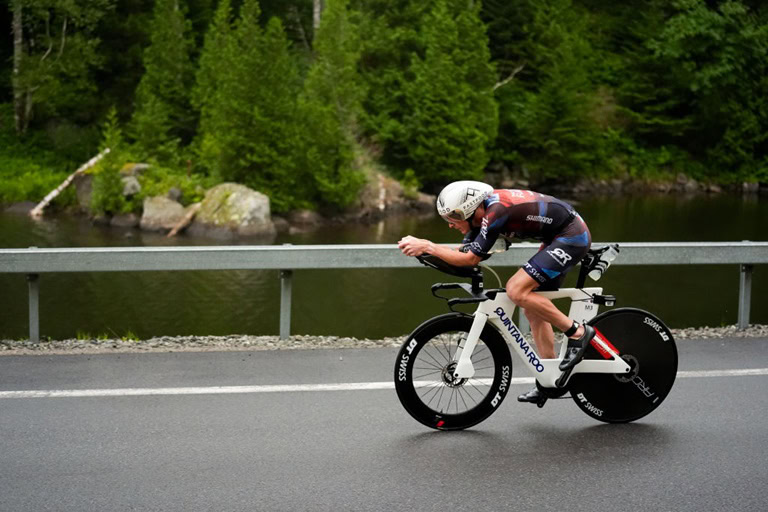
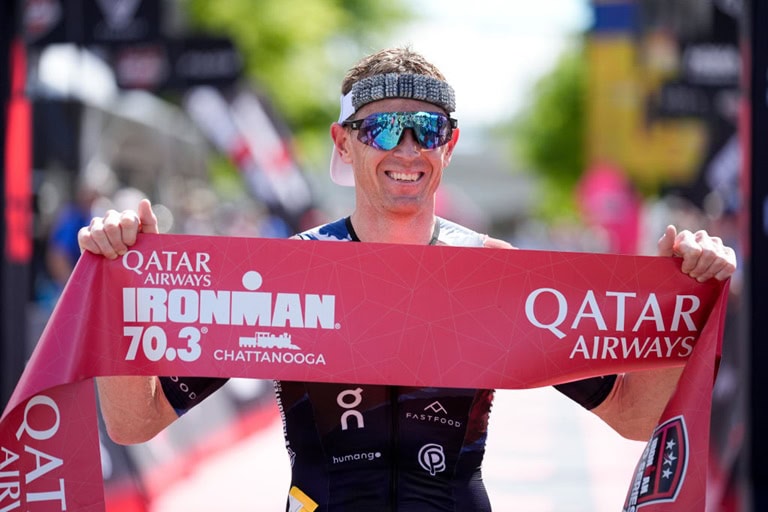
Triathlete Matt Hanson leads the Ironman Pro Series standings as the circuit gears up for the men’s world championship in Kona, Hawaii, on October 26. That’s the full 2.4-mile swim, 112-mile bike and 26.2-mile run in notoriously challenging conditions. Hanson races both full- and half-Ironmans, winning 13 races dating back to 2012, including four North American championships.
Prior to becoming a full-time triathlete, Hanson earned his PhD in exercise science and was a professor of exercise science and the director of the human performance program at Buena Vista University in Storm Lake, Iowa. In addition to his career as a professional athlete, the 39-year-old Hanson also coaches other triathletes. He recently partnered with Humango — an AI coaching platform — to advise on the creation of its algorithms and use the platform to assist his own coaching.
On getting his start in Ironman…
Kind of by accident. I definitely didn’t plan on this being my full-time gig, but that’s how it turned out. I was a college professor, and I was just doing the triathlon thing as a hobby. Then I turned into a quasi-professional, where I was still teaching full time and competing as a pro. Then I started winning some big races and decided to walk away from a tenured position and chase this dream in triathlon.
On his academic background prepared him for his athletic career…
In the early years, I was doing everything myself, so it gave me the information that I needed to know how to write my own programming, even though I knew nothing about triathlon. I knew how the human body adapts to exercise, and that actually formulated a lot of my views in terms of triathlon coaching. Triathlon is a really young sport relative to running, swimming, biking, and especially until very recently, most coaches were treating triathletes as runners, swimmers and bikers — and not triathlon as a sport in itself.
On how he monitors himself…
My role as an athlete is to execute sessions and give qualitative feedback. So I’m giving quantitative data and qualitative feedback and trusting the process of the people that I pay to be in my corner to do that. But obviously we’re monitoring power, heart rate, pace.
I’ve gone back and forth with monitoring HRV — currently, I’m kind of off that bandwagon right now, not really paying too much attention to that. I’m just trying to do things like quarterly blood tests and make sure that nothing’s getting out of whack. I’ve been using a company called BellSant this year, which is a little more of a holistic approach. I’ve definitely used InsideTracker in the past. Both are great companies, just a little different approach to the data. I think that’s an injury prevention thing as much as anything else. And then making sure we’re getting quality sleep with the Coros watch.
Patrick McDermott/Getty Images for IRONMAN
On partnering with Humango…
I’ve always wanted to skate to where the puck is going, instead of just sitting and reacting and trying to chase it. Obviously AI has been a big buzzword lately in all aspects of life, not just triathlon, but there’s definitely been a couple of companies that have come and really spent a lot of money to push what they’re calling AI programming. There were a couple things that were really important to me. One was, if I was going to partner with an AI company, it had to be somebody that was using true AI, or willing to push to use true AI, rather than algorithms and using historical data to set plans.
I felt a lot of the past practices were not treating us as triathletes or treating us as three separate sports, and if the approach of the programming is going to be based on all historical data, then we’re never going to adapt and be relevant and current with research. The first couple of meetings I had with other companies were very much that direction, and so it was just a non-starter.
I met with [CEO Eric Abecassis] a couple times and really appreciated how he wanted to incorporate me in having discussions about what’s current and what’s relevant in research and what the elite athletes are doing now, and how they could write programming to make plans that are based on that, rather than just, ‘Oh, we’ve got 20 years of other people’s Garmin data, so we’re going to make programs based on that.’ That was encouraging me enough to make the leap and start partnering with Humango and start using them as part of my coaching program.
On how he views AI when coaching other athletes…
The way I view it is that AI is a tool, not a crutch, so I can’t just let it do the work for me. I’m on the back end giving it the rules that I want the program to follow, and then I let it push out the program. Then I’ll go in and look at it and tinker with it a little bit and make sure that I’m happy with it. I’m not letting it coach for me at all. There’s definitely some benefits of doing that because obviously a fair amount of time is spent writing programs every week, and so in its current early stages of it, it just improved the access. Where a lot of people might have been searching for a pre-made program to buy online that may or may not be even remotely catered to them, where, for a similar price point, they can now get a program that is made for them.
That’s the no-touch model where I go in, set the rules and answer questions. Then I let Hugo, the Humango bot, take it from there. And then you can do the medium touch where I’m there every couple of weeks to touch base and answer questions, and then I’m still doing full, custom coaching, where I’m driving everything and still writing the plans completely. And so it just increases access, and it’s allowing a lot of people who probably couldn’t afford my previous rate, a way to have access to somebody who’s been around the block a few times.
Patrick McDermott/Getty Images for IRONMAN
On the future of how AI will shape coaching…
I don’t think that I’ll ever lose my job as a coach to AI, but I might lose my job as a coach to somebody who knows how to use AI better than I do. And so I need to be involved and keep my nose on the ground. At some point when I can’t keep up with the young bucks anymore, coaching is going to be my full-time gig. I need to have a good understanding of where AI is now, where it’s going in the future and how to use that appropriately.
On the Ironman world championship in Kona…
If you go in with a target time into Kona, you’re setting yourself up for the potential of a really bad day. You can’t predict the weather there, even the morning of the competition. It’ll look great on hourly weather report, but the winds change there so fast. If you go in there thinking that you know exactly how the wind’s going to respond, maybe you get lucky, but more than likely not. So you just have to really take the conditions as they come and be prepared. It’s having somewhat of a plan, but definitely not being too stubborn to not adjust.
This article was brought to you by SBJ Tech, a Leaders Group company. As a Leaders Performance Institute member, you are able to enjoy exclusive access to SBJ Tech content in the field of athletic performance.
