Leaders in Business
  • Membership
  • Events
  • Content
  • Virtual Learning
  • Connections
  • Partners
Login
  • Leaders Meet: Innovation
  • Events
    • Leaders Week London
    • Leaders Sports Awards
    • Leaders Club Events
    • Leaders Performance Institute Events
    • Leaders Meet: Innovation
  • Memberships
    • The Leaders Club
    • Leaders Performance Institute
  • About
    • Careers
    • Contact
I’m a sports leader:
  • Off The Field For those focused on the business of the sport View more
  • On The Field For those working with an athlete or elite team View more
  • Login
    • Leaders ClubThe membership for future sport business leaders
    • Leaders Performance InstituteThe membership for elite performance practitioners
  • Newsletters
Performance Institute Leaders Performance Institute Logo
  • Membership
  • Events
  • Content
  • Virtual Learning
  • Connections
  • Partners
Login
Members Only

29 Aug 2025

Articles

Challenge & Support: Where Does the Balance Sit?

Category
Coaching & Development, Premium
Share
Facebook Twitter Email Copy Link
https://leadersinsport.com/performance-institute/articles/challenge-support-where-does-the-balance-sit/

That topic was the central theme of a recent virtual roundtable designed to help members better understand that balance.

By John Portch
More than half of coaches and practitioners feel they could be better at balancing challenge and support for their athletes and other personnel.

That is according to a straw poll of Leaders Performance Institute members conducted at the outset of a virtual roundtable we hosted in late-August.

Some members – 42 per cent – rate themselves at four out of five, but everyone in attendance felt there was room for improvement.

With the scene set, members went on to highlight four factors that underpin a good balance of challenge and support, with reflections on how these look in practice in their environments.

1. Psychological safety… or psychological confidence?

The idea of psychological safety was raised several times. Psychological services are a key offering in the provision of safe spaces. A member who works in a senior health and wellness role in a major US league, spoke of their organisation’s success in providing confidential counselling services that support individuals in their pursuit of performance goals.

Psychological safety has long been a performance buzz term, but a team in motorsport is taking it upon itself to reframe its terminology. Their wellbeing lead told the table: “We’re playing around with the idea of creating psychologically confident people. In meetings, we make sure that we give everybody a chance to speak up… there’s also got to be challenge, to get [people] to that psychologically confident point.”

Words clearly matter, as a performance support coach in British varsity sport pointed out. “The language we use when we’re talking to the athletes, it’s not a ‘challenge’, it’s not an ‘adversity’, it’s ‘exploration’, ‘playing’, ‘responsibility’.”

Another idea proffered is to take steps to reduce the fear of (inevitable) failure by creating a low-support, high-challenge environment. “We’re trying to make our training environments more intimidating and challenging than the game would be, so that’s not only going to make those game environments easier and normalise failure, but it also allows them to fail in front of their peers and get more comfortable in that space,” said a coach from American baseball. “Then what the support side looks like to that is not just coach to player but player-to-player; figuring out those challenging environments and finding different solutions with each other.”

2. Set standards and expectations first

This provides clarity and should remove doubts. “The places that do this really well, without exception, spend a fair amount of time at the beginning of a training block or at the beginning of a year discussing what the priorities for that thing are and what the standard is,” said a performance science advisor from the Canadian Olympic system.

With those standards in place you have a framework on which to build trust. “When you get to work with a player that you might not know as well, that’s just going to help you get to the trust piece faster and be able to challenge each other in that way,” the baseball coach added.

“One of the things that I see,” said a performance science advisor based in Canada, “is when it’s not just the coach that’s holding athletes accountable, it’s the athletes holding each other accountable as well. That’s much easier when there’s been some time spent talking about what the expectations for the standard are.”

The idea, as a wellbeing lead in motorsport said, is to create “better challenging conversations because it really is a massive coaching benefit. Just creating that space for challenging conversations, practising it, scripting it, and it becoming a natural part of our every day”.

3. Customised support

An attendee with experience of coaching in English football argued that challenge and support is more about the individual than the environment. They said: “Individuals need different things at different times, so if we understand an individual’s needs, then we, as a group, are best placed to cater to individual needs based on where somebody is.”

This is reflected in the psychological services provided by teams. “We are mainly here to navigate and help them navigate their career progression on an individual level,” said the aforementioned health and wellness lead. These services are increasingly integrated and perceived as a part of a holistic offering. “The fact that we have this space in and of itself is really hitting the nail on the head in terms of how much just caring on an individual level really does impact performance.”

It is also incumbent on coaches and staff to know their athletes. “I was reflecting on an athlete who’s getting three buses in order to just get to training, and is just struggling to feed himself,” said the coach in English football. “Lots of that wouldn’t be known unless we were properly getting to know somebody.”

“It literally is just needs analysis,” a member added. “I think just really understanding the individual, because there’s just so much variety and meeting them where they are in the correct language.”

4. Foster autonomy

This is critical in an era where, as one attendee put it, “we’re observing that student-athletes are almost afraid to try new things.”

“Getting athletes to engage in ‘what does this need to look like in order for us to have success?’ really helps foster autonomy,” said another member whose work brings them into regular contact with younger athletes. “They’re an active part of the process of deciding what’s going to happen next, what went wrong, how do we fix it.”

“Getting them to buy into their own responsibility is critical,” added a race engineer when reflecting on drivers in their motorsport. “They have to be ready to leave here with the ability to be responsible for their own actions.”

Another participant spoke of an idea they had while working in English football: “We put constraints in place that meant that the athlete couldn’t revert to his normal type. He had to go and find a new way to execute the same outcome.”

What to read next

Transparency, Empathy and Empowerment: Five Ways Teams Are Serving their People in 2025


6 Aug 2025

Articles

‘Smart People Make Bad Decisions All the Time’

Category
Leadership & Culture
Share
Facebook Twitter Email Copy Link
https://leadersinsport.com/performance-institute/articles/smart-people-make-bad-decisions-all-the-time/

Greg Shaw of Swimming Australia describes four areas where his team are working to help people make smart decisions and follow hard behaviours.

By John Portch
“The one thing I believe about high performance is that it’s pretty simple but it’s also really hard to do consistently over time.”

The Leaders Performance Institute has just asked Greg Shaw, the High Performance Director at Swimming Australia, for his thoughts on the growing complexity of performance environments.

This complexity is both reflected in and a reaction to what Shaw calls the “growing sophistication” of performance roles. In many respects, as he noted in our Teamworks Special Report earlier this year, Shaw perceives himself as a “project manager”.

Which is not in itself a bad thing. Fields such as sports science have blossomed in elite sport, but consistency of application and outcome, whether locally or at scale, has often proved elusive.

“We all make bad decisions,” adds Shaw, “and a lot of smart people make dumb decisions.”

Here, we highlight four areas where Shaw and Swimming Australia, are trying to give their athletes, coaches and staff every chance to make better choices.

1. Identify the barriers to better decision making

“We heavily invested and remain interested in behavioural science and how we can help our athletes and coaches make smart decisions and follow hard behaviours,” says Shaw. Swimming Australia’s aim is to “help make those decisions easier and those hard performance behaviours more frequent.” They enlisted the help of behavioural design experts to help identify and understand the existing barriers.

Shaw himself has a background in sports nutrition and illustrates his point through the lens of dietetics. “It’s the behavioural component of nutrition,” he continues. “It doesn’t matter what you know in terms of, say, biology, it’s if you can make the right choices and how social and cultural drivers impact those choices.”

2. Manipulate the environment to remove those barriers

The ideal, as Shaw says, is for the athletes to “turn up, do what they need to do, and live a high performance lifestyle”. This, he admits, is easier said than done. Even a disciplined athlete can inadvertently harm their health and performance. “It often leads to concerns around wellbeing, being overloaded, overworked and over-stressed.”

The key is to “manipulate the environment and the process to help the athlete make it simpler and easier.” Shaw continues: “I think the future of high performance is designing things purposefully, not just the training we do but everything that fits outside of that; the life, the social environment, the club culture, the programme culture, the experts around you so you know to make the right choices and adaptations.”

He is clear that it is “more about environment and behaviour than it is about science and the expertise of performance.”

This is in keeping with Swimming Australia’s ‘people-first’ approach. “It’s understanding what’s a good stress and what’s a bad stress,” says Shaw, who explains that there is an increasing empathy for what athletes go through to sustain high performance over extended periods of time.

“An athlete may enter our ecosystem at 15 or 16 and leave our ecosystem at 35, so if we don’t have that ability to understand how we must adapt in how we interact with and support our athletes, then they’ll leave.”

3. Let people refine their processes before looking for scalability

Shaw admits that Swimming Australia, when it comes to system-wide initiatives, has traditionally been an organisation that “scales first and tries to find efficiencies later”. However, the organisation has typically excelled when it comes to individual and group piloting. Shaw has noted the distinction and continues to learn as he goes. “Over the last 18 months I’ve realised it’s not about adding more, it’s subtracting and refining ideas to their simplest and easiest, then letting people add their flavour to it,” he says, warming to the theme.

“Oftentimes, we try to scale and have things fit within boxes, but scalability comes from understanding the fundamentals of an idea or process, making sure that happens, and then giving enough space for others to iterate and develop their own process.”

4. Use AI as a co-pilot

Shaw sees the potential in automation, with caveats. “As we automate, we free up time to interrogate the data more and more, but that puts people behind the screens and offices we’re trying to free them from in the first place,” he says, adding, “automation should free coaches to spend more time on the pool deck and in performance environments”. Doing this will enable coaches to “be compassionate with the athlete, to better understand what they’re going through, or to understand if a piece of information is going to be necessary for them at this point in time.”

As for AI, he sees the benefit as being rooted in “augmented decision-making”. “We want to use AI to help people make good decisions, to help strip away the noise, to make the signal a bit clearer,” he continues.

Such clarity helps to reduce “data hallucinations and noise, which you may not realise for a couple of months”. By that point, “you’ve wasted your time.”

That does not mean outsourcing data interpretation entirely to AI. “We believe in the co-pilot model of AI rather than having the artificial intelligence doing it for people.”

What to read next

Coach and Staff Wellbeing: Five Approaches to Five Common Challenges

Members Only

16 Jul 2025

Articles

How to Transform an Underperforming Environment into a Thriving Hub

Category
Coaching & Development, Leadership & Culture, Premium
Share
Facebook Twitter Email Copy Link
https://leadersinsport.com/performance-institute/articles/how-to-transform-an-underperforming-environment-into-a-thriving-hub/

Rakesh Patel is tasked with helping floundering NHS hospitals in England. He believes the answer lies in cultural transformation, empathetic teaching, and smarter feedback.

By John Portch
Innovation in the NHS can all too easily be stifled by tradition or, in the worst cases, hierarchical cultures rooted in fear. It is no wonder that crises emerge.

Having read that, you may think that just as readily applies to the world of sport.

“How can we transform underperforming environments into thriving ones?”

That is the question Rakesh Patel, a nephrological surgeon who works at Barts Hospital in London, asked the audience at last November’s Leaders Sport Performance Summit.

His remit includes working on the NHS’s Recovery Support Programme [recently renamed the Provider Improvement Programme], which is designed to support underperforming hospitals and medical providers who have been placed in ‘special measures’.

Patel and his colleagues will work with these hospitals to help identify systemic issues that lead to habitual failures. They will implement evidence-based interventions and build local capacity to sustain improvements once they’ve left the building.

Away from clinical practice, Patel is a professor at Queen Mary University, where 2,300 medical students matriculate at any one time.

As such, he has given a lot of thought to learning and failure in the NHS, which is the ‘sacred cow’ of British society.

What does the Recovery Support Programme do?

Its aim is to mitigate crises and enable people to learn from their mistakes. For Patel, it has to start with rethinking underperformance, because jumping to conclusions helps no one.

“We only see the world as we see it, but not how others see it,” he says. “In a performance role, if we’re assessing someone, we often see the world as we think it should be and not actually how it is.”

Underperformance, whether in experienced clinicians or medical students, cannot always be attributed to a lack of skill or effort.

Just as distractions, pressure, poor communication or emotional stress are prevalent in sport, their presence is felt with greater consequence in medical settings.

Take this feedback from medical students when reflecting on video footage of their mistakes:
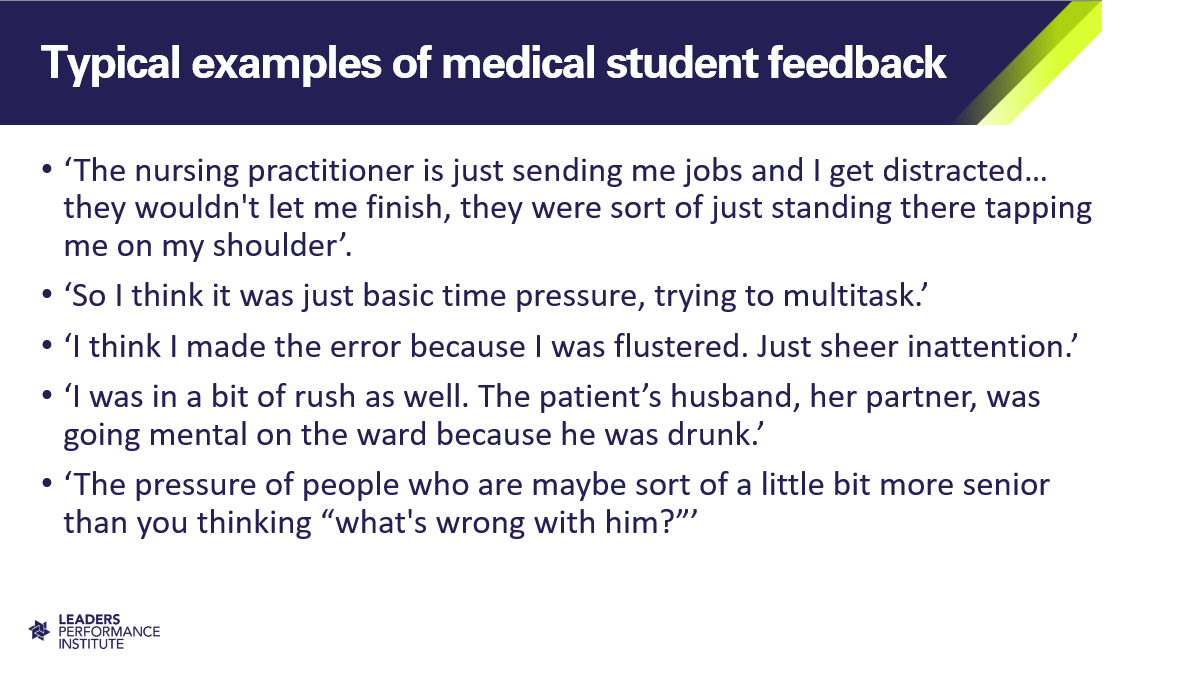
“The last one upset me most as a doctor,” says Patel, who later added that judgement can degenerate into reported cases of outright hostility. “I found it upsetting that these doctors were coming in to do work and we’re being nasty to them and that was why they were underperforming.”

At some level, as Patel explains, these errors point to the human limitations of working memory.

He cites The Magical Number Seven, Plus or Minus Two, the highly regarded 1956 paper by psychologist George A Miller, who said that a person has a working memory capacity for five chunks of information, plus or minus two. That means placing the working memory under too much strain will lead to (often avoidable) errors.

Patel says: “Any threat to working memory will impair performance. If you need your brain and you need to think through things, it’s likely you’re going to have underperformance.”

It follows then that to enable better learning – and prevent avoidable errors – there needs to be less pressure on people’s working memory.

“If you add up all those bits contextual things – inattention, distraction – you can see why memory matters,” says Patel. “You can literally only remember three to seven things and, in that moment, when it hits your eyes and your ears, if you do not do something with it in the first half a second to three seconds, it’s gone. That’s why in high pressure situations when we’re under stress is when our memory gets hit. We can only focus on what we need to.”

That is why medicine values reps and evaluation as much as any team. “When things get complex, you don’t need to think about it.”

With this in mind, it is easier to choose the right form of feedback.

“We all talk about feedback and there’s probably more books on feedback than anything else,” says Patel. “There is an evidence base around how you give it and we wanted to give the best feedback, in the way that it needed to hit and cut through.”

This was tricky to navigate in hospitals placed under special measures. “They weren’t the easiest characters to work with,” he adds, “but it depends on what’s important. If there’s the greater good and we’re going to work together, then even the biggest ego you can get down to your level and work through.

“And we only went into hospitals if we had CEO buy-in and everyone was going to engage. So we taught them how to give feedback better.”

He highlighted four formats favoured in the NHS:

1. Facilitated self-reflection

“One of the most important interventions you can ever do is ask someone ‘how do you think that went?’ And if you do that before they start and you say ‘how well do you think you’re going to do before you start?’ You then get them to calibrate what they think with what you think.”

It was, as Patel says, “the lightbulb moment”. He also underlines the value of sitting with doctors as they watch themselves on video. “It’s not about telling them what they’ve done but asking them; ‘these are your notes, you wrote them, tell me what you were thinking at the table’. You don’t dictate, but get them to reflect.”

2. Revisit video assessments at periodic intervals

Patel and his colleagues test doctors and students from the outset and provide instant feedback. More critically, however, they will also revisit feedback at regular intervals over the following weeks.

“I’ve told you about working memory and fear – they’re going to forget it,” he says of that instant appraisal. “So we videoed everything and we drip fed the feedback over time. Why was that important? Because I don’t know if you’ve ever done it, but watching yourself make a mistake three or four weeks down the line when you know you’ve made that mistake, and being reminded of it, is really powerful.”

3. Peer to peer learning

Sometimes Patel takes himself out of the equation. “We often forget what it’s like to be a novice. That’s why peer-to-peer works really well. So if you’ve got someone new, get someone who’s of a similar age that can explain it better.”

4. Ask them to ‘teach it back’

“We do this when we teach clinical skills,” says Patel, alluding to evidence pointing to the efficacy of this approach to learning. “There’s something about having the confidence plus the competence to be able to explain a skill to someone else.”

The Recovery Support Programme approach is scalable too.

“I couldn’t go into all these hospitals, and this training model needed to be scaled,” says Patel, who explains that pharmacists were uniquely placed within hospitals to deliver the model in his stead. For one, a large proportion of the noted errors were prescription-based.

And it worked. Doctors trained by Patel’s team and those who have taken the training model make fewer mistakes. “We trained them to be resistant to all the trauma and all the nonsense around them, to still focus on the task.”

What to read next

Talent ID and Development: The Race to Deliver Formula 1’s First Female World Champion

24 Jun 2025

Articles

Jacinda Ardern: ‘I Prefer to Describe Impostor Syndrome as a Confidence Gap’

Category
Leadership & Culture
Share
Facebook Twitter Email Copy Link
https://leadersinsport.com/performance-institute/articles/jacinda-ardern-impostor-syndrome-is-just-a-confidence-gap/

As the former New Zealand PM explains, the better question isn’t whether you’ll experience impostor syndrome but how you’ll act when you do.

By John Portch
At the 2017 APEC [Asia-Pacific Economic Cooperation] meeting in Vietnam, the then-Prime Minister of New Zealand, Dame Jacinda Ardern, was physically barred by security from entering the main meeting room.

“It was a leader-only event and they’d decided I was not a leader,” she told an audience during an onstage appearance at Westminster’s Methodist Central Hall earlier in June. “I find myself really holding back from saying ‘I’m the Prime Minister’ as if somehow it’s name-dropping,” she continued.

Within moments, Malcolm Turnbull, the then-Prime Minister of Australia, with whom she had been talking in the corridor, returned, grabbed Ardern’s arm, and walked through with her while indignantly uttering the words ‘she’s the Prime Minister of New Zealand’.

Leaders at that APEC meeting had been given identifying pins to wear, but Ardern’s was covered by her long hair.

Ardern, who served as Prime Minister of New Zealand between 2017 and 2023, has spoken of her impostor syndrome during various public appearances and also in her recent memoir A Different Kind of Power.

The APEC security staff may have perceived her as an impostor due to her gender – she was one of just three female leaders at that meeting – but that was not an issue for Ardern herself. New Zealand has long had women serve in senior governmental posts, including Prime Minister [three], Speaker of the House, and Governor-General [four]. “I didn’t look out at the world and think that a woman couldn’t lead,” said Ardern, “but I didn’t think you could lead with my personality.”

She was 14 when her favourite teacher introduced her to the concept of impostor syndrome, ‘a phrase,’ she writes, ‘I would remember for the rest of my life’. It represented ‘puzzle pieces clicking together’.

Some telltale signs of Ardern’s impostor syndrome

Impostor syndrome is not a recognised psychiatric disorder but it is experienced by a whole range of people regardless of their accomplishments.

Ardern alludes to three areas where her impostor syndrome has tended to manifest.

Her perfectionism: as she explains in her memoir, she was noted as a skilled public speaker and debater at high school. Nevertheless she suffered from debilitating nerves. Even with her exhaustive preparation she ‘could not shake the feeling that something could go terribly wrong. And when it did, it would also be proof that I wasn’t good enough to be there in the first place.’

Unrealistic personal expectations: during her recent appearance on HBR’s IdeaCast, Ardern spoke of the notion in leadership “that confidence is built through absolute knowledge and displaying a sense of the fact that we have all of the answers all of the time.” It is an idea she has come to refute.

Unfavourable personal comparisons: Ardern’s father once protectively described her as ‘too thin-skinned’ for politics. There were times when she concurred. She noted the resilience of Helen Clark when she worked as a researcher in the former New Zealand Prime Minister’s office in the early 2000s. ‘And while Helen Clark had shown me that it was possible to be a woman in politics,’ Ardern wrote, ‘no one had shown me that you could be sensitive and survive’.

How Ardern deals with it

She accepts that impostor syndrome doesn’t go away. “In my experience, it does not,” said Ardern onstage. In any case, “it’s such a broad turn of phrase,” she added. “I would prefer to just describe it as a confidence gap because I think there’s a spectrum and, at any given time, you can be in different places on that.”

She does not accept it as a sign of weakness. When she was asked to go beyond her perceived areas of competence, her instinctive response as PM was “to anticipate risk, to prepare, to bring humility to what you’re doing, to bring in experts, to bring in advisors. And don’t we want that in our leaders?”

She does not believe that impostor syndrome is always bad. “Just remember all that it brings you,” she said. “It doesn’t take everything, it brings you something as well. Just remember that I existed as Prime Minister for five years with my monkey on my shoulder and I do believe it made me better at my job.”

 

A Different Kind of Power: A Memoir by Jacinda Ardern. Available now from Penguin Random House.

Members Only

11 Jun 2025

Articles

Do you Feel your Team Has Plenty of Clarity But Still Suffers from Misalignment?

Category
Leadership & Culture, Premium
Share
Facebook Twitter Email Copy Link
https://leadersinsport.com/performance-institute/articles/do-you-feel-your-team-has-plenty-of-clarity-but-still-suffers-from-misalignment/

Dr Edd Vahid of the Premier League outlines the importance of a unified purpose, regular feedback and carefully chosen words.

By John Portch
John F Kennedy’s 1962 visit to NASA is remembered chiefly for his conversation with the janitor.

The US President asked him what he did for NASA. “I’m helping to put a man on the Moon,” the janitor replied.

The Leaders Performance Institute is reminded of the moment by Edd Vahid.

“The janitor did not talk about his day-to-day tasks,” says the Premier League’s Head of Academy Football Operations, “but his contribution to the overall mission”.

This famous line resonates with Vahid and, in Leaders’ recent Trend Report, clarity and alignment were both cited as major influences on the quality of leadership by coaches and practitioners across the globe.

“We know that alignment often comes down to the clarity of expectations and that comes from a strong, unified purpose,” said Vahid, who noted that even well-meaning individuals can be drawn into silos without a guiding hand.

The report also revealed that sport is obsessed with the topic and, in the grand scheme of things, does alignment quite well: almost 50 per cent of respondents saw their teams as ‘somewhat aligned’.

“It’s worth noting that the figure sits at about 20 per cent in other sectors,” said John Bull, the Director & Lead for High Performance Research at Management Futures, in the report.
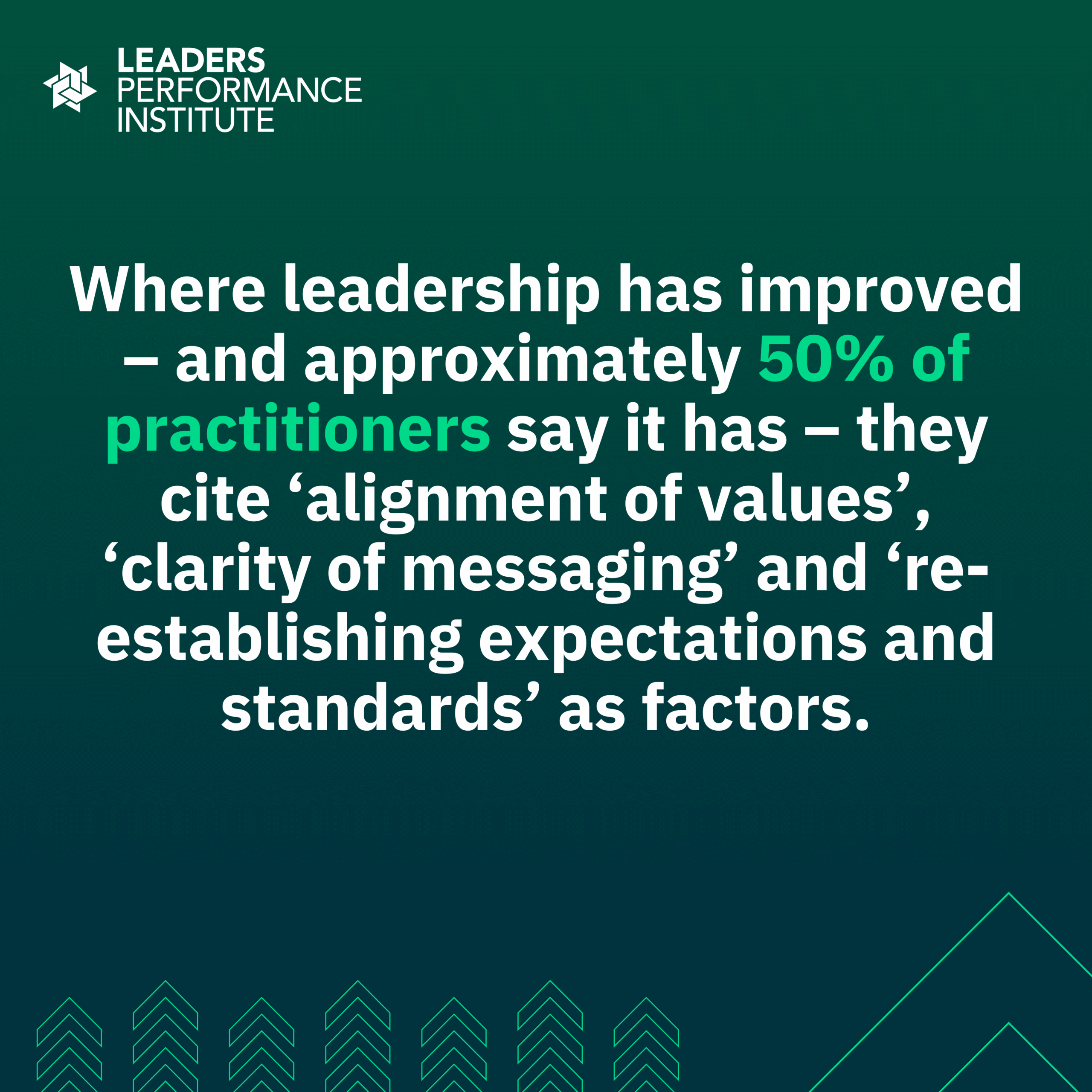
There is still room for improvement: only 12.6 per cent said their organisations are ‘well aligned’.

As Vahid explains, teams could start with the following.

Establish a regular and consistent theme

“Alignment is done best when it’s regular and not just your annual ‘here’s what we’re going after, see you again in 12 months’ time,” says Vahid. “It’s got to be constant. In every meeting there needs to be a regular and consistent theme that people are working towards and, importantly, they know their contribution.”

In 2024, Vahid published A Cultural Hypothesis, which explored the factors that enable a sustained culture of success. One element stood out as a ‘super enabler’ for Vahid: cultural leadership. The term acknowledges that leadership exists on three levels within an organisation:

  1. Sponsors: those working at ownership or board level; they give permission to architects and guardians (who have a more active role) to deliver the culture. They are typically one or two people.
  2. Architects: those responsible for the design of the culture, ensuring it is set up in a way that can allow people to thrive. They are typically a small number.
  3. Guardians: the individuals on the ground, delivering daily, ensuring alignment to the articulated culture which they can translate to individuals working in that space. There can be multiple guardians.

The guardians, Vahid argues, are critical to alignment. “The reality is that if you’re a senior leader, you’re not going to be on the ground, you’re not going to be able to influence every different scenario – that’s where you need your guardians, your foot soldiers on the ground who are able to distil your message and ensure there is direct alignment to the organisation’s aims.”

NASA’s janitor was a cultural guardian in Vahid’s eyes.

Find the right repeatable words

“Language offers you the opportunity for shared understanding,” says Vahid, “and shared understanding is crucial in alignment, so people know what they’re going after. A leader might not necessarily use the word ‘alignment’, but they’ll be talking about their overall purpose.” NASA’s purpose was simple but powerful. “Your language must be repeatable and resonate with people.”

Vahid also says that high-performing organisations tend to have goals that transcend winning. “It’s important to get everyone behind it. Everyone must believe it is attainable, and it must drive them to want to get out of bed in the morning and come to work.”

What if there’s clarity, but still misalignment?

Vahid explains there could be a few factors at play, all of which point to the importance of feedback:

Staff development needs. If a staff member commits an error of execution, it is an opportunity to deliver developmental feedback. Vahid says: “Does everyone understand what we’re going after? If they do and they step outside of that, then feedback is warranted.”

Psychological safety. “It’s a buzz term,” says Vahid of the commonly used phrase, “but it’s crucial for people to feel they are in a feedback culture.” The leader must show that the intent of feedback is to help the individual to progress. “You’re taking time to give them feedback because you care,” he adds. “You’re then seeking to work with the individual to create that development.”

The leader’s behaviour. Leaders must also demonstrate their willingness to listen to feedback. “They need to provide ‘speak up’ signals,” says Vahid with reference to the work of psychologist Megan Reitz. “The leader needs the skill to understand the position they’re in and the power they carry in that dynamic.”

What to read next

The Brisbane Lions Have Turned Female Athlete Health into a Performance Question. Here’s How

4 Jun 2025

Articles

Performance Under Pressure: Four Lessons from a Big Wave Surfer

Category
Coaching & Development
Share
Facebook Twitter Email Copy Link
https://leadersinsport.com/performance-institute/articles/performance-under-pressure-four-lessons-from-a-big-wave-surfer/

Ian Walsh of Red Bull is renowned for his meticulous approach to tackling some of the biggest waves on the planet. Here he shares his wisdom with the wider sporting community.

Main Image: Fred Pompermayer / Red Bull Content Pool

By John Portch
“Time really slows down,” says Red Bull surfer Ian Walsh of the moment he rides a big wave.

“In every other part of my life there’s a million things going on. I feel like I always have ten balls in the air. Did I forget to take the laundry out? Did I put it in the dryer? I have bills to pay, groceries to buy. And surfing is one of the few places in the world where that all just drifts away.”

This level of focus may sound familiar to athletes, but the stakes of big wave surfing are something else entirely. One false move and Walsh risks serious injury every time he mounts his board.

Walsh has built a career on his coolness under pressure, which is why he was invited to share his insights at the Leaders Sport Performance Summit at Red Bull Media House in Santa Monica last year.

Ian Walsh poses for a portrait at the Volcom Pipe Pro on 4 February 2018, on the island of Oahu, Hawaii, USA. [Zak Noyle / Red Bull Content Poo]l

Four factors stand out in his approach.

1. He acknowledges and harnesses his fear

“Those nerves and everything you fear are natural, and you can use that to elevate your performance,” said Walsh. “It commands every ounce of your being and your focus to deal with what’s coming at you and how you want to navigate it to try and finish on your feet.”

This ability comes with “repetitions and time”. Walsh was in town for a training block at Red Bull’s state-of-the-art Athlete Performance Center ahead of the northern hemisphere summer season. “I’m going to take full advantage of having this amount of time in a facility like this,” he added. “It gives me the chance to push myself in a controlled environment.”

2. He keeps his ‘smart brain’ online

Walsh can keep his ‘smart brain’ online under pressure. It is a term often used by high-performance specialist Rachel Vickery. “Have you got enough buffer in the system to absorb that natural increase in arousal state peaking?” she said on the Leaders Performance Podcast in 2023.

“Every human has a threshold that basically says if my arousal stays below my threshold or below my red line, I can perform in a way that I’ve got a lot more control of. If I’ve got more buffer in the system, so to speak, then when I get the normal increase in arousal it’s still under control and it’s not shooting me across the red line.”

In Walsh’s case, he de-escalates and grounds himself through the ‘breathe-up’ technique, which is a cycle of diaphragmatic breathing aimed at lowering his heart rate and preparing his body to stay relaxed underwater for an extended period.

Additionally, thanks to training alongside Red Bull freediver Kirk Krack, Walsh has learned to hold his breath underwater for up to five minutes. “It’s creating situations where I could elevate my heart rate and then get into a breath hold and understand how my body is going to react and eventually adapt to those scenarios.”

“It’s a skill in and of itself to then go, ‘how do I apply that once this physiological threat response kicks in? How well am I able to adapt and adjust and execute when all those changes happen?’” said Vickery, who would no doubt approve of Walsh’s strategies.

3. He already knows what to do when things go wrong

Walsh has long had a firm interest in meteorology and bathymetry [the study of the seabed, lakebeds and riverbeds]. He can pinpoint with reasonable accuracy when and where the most suitable swells will appear during both the northern and southern hemisphere surfing seasons. He said: “The reason it evolved to so much precision is to give myself as much of an opportunity on those special days as I can, because those days are rare and everything can change so fast on those mega swells.

He then readies his equipment and support team. “By having my preparation done, I can get absolutely smoked on a wave, break my board, everything gets washed onto the rocks, but I have everything ready to go again. I can go right to the boat or the jet ski, get my second board, catch my breath, make sure everything’s good and then get back into the lineup within 15-20 minutes.

“If you don’t have that ready, you could spend two hours dealing with it and it could be another month to six weeks or even the next season when you get another opportunity to push yourself in that calibre of surf.”

His meticulousness extends to listing and ranking restaurant menus in different locations. It drives his partner up the wall. “I take it into my normal life and my girlfriend can attest to how annoying those details are.”

Jokes aside, Walsh’s approach calls to mind the words of mountaineer Kenton Cool, who once told an audience at a Leaders Sport Performance Summit: “People often think of extreme adventure athletes as possessing a ridiculous appetite for risk, that we’re reckless, foolhardy and make illogical decisions. In reality, it’s quite the opposite.”

Ian Walsh photo session for The Red Bulletin, Los Angeles, 19 July 2024. [Maria Jose Govea / The Red Bulletin]

 4. He goes for progress over perfection

Walsh’s near-catastrophic failures have taught him to be humble when ironing out creases in his performance. “Letting go of some of your ego will create a lot more latitude for opportunities,” he said. “Maybe I did get annihilated on that wave, but I was also an eighth of an inch from making it.”

Walsh studies film of his efforts. He is also a comprehensive note-taker. “I can go back and be like ‘this swell angle, these winds, these tides are shaping up like January 10, 2004 [a date on which he suffered a severe injury – one of several throughout his career]’.” He can then tell himself “maybe I should have ridden this forward or tried those fins. Maybe our water safety protocol could have been a little more buttoned-up.”

What to read next

Neurodiverse Athletes: Some Key Coaching Considerations

1 Apr 2025

Articles

The Debrief – a Snapshot of Powerful Discussions Happening Right Now Across the Leaders Performance Institute

Category
Leadership & Culture
Share
Facebook Twitter Email Copy Link
https://leadersinsport.com/performance-institute/articles/the-debrief-a-snapshot-of-powerful-discussions-happening-right-now-across-the-leaders-performance-institute-13/

In March, we explored ways to improve and optimise the relationship between coach and practitioner. Here are four elements to consider with your teams.

By John Portch with Luke Whitworth
What are the hallmarks of a good working dynamic between a practitioner and their head coach?

The question came up time and again during March across a range of Virtual Roundtables, whether the primary theme was organisational alignment, sports science, psychology or data usage.

This month we reflect on those roundtables and bring you four practices that have served Leaders Performance Institute members well when working with their head coaches.

  1. Spend time with coaches and athletes

It sounds obvious, but coaches need to know how to apply the insights you deliver as a practitioner. “By always giving information that is contextually useful for that time of the year or by understanding the training cycle, you get more engagement,” said Kenneth Graham, a member of the Australian Institute of Sport’s Research Review Committee, who was speaking at an Exercise & Sports Science Australia roundtable. “You do need that time to build up the credibility and the acceptance of the coach to take on information from you; and over time that becomes a faster process. It can be done over a cup of coffee, you may not need a formal presentation, but being part of the process, seeing the development of the training programmes, being at the training sessions, being at the competitions, looking for the gaps where the information you’re giving is seen as valuable.”

  1. Make accountability the norm

A department should articulate its goals within the team’s wider vision. “We all have a vision of what each department is working towards and who’s going to be responsible for those elements,” said one attendee during a roundtable discussing organisational alignment. A team can also ask, “‘this is what this department is working on – is that getting us to where we want to go?’”

Where your values are on the wall, they can serve as a useful conversation-starter. Another attendee, who works as a director of performance, spoke of approaching a staff member “standing in front of our strategy and saying, ‘where’s the work you’re doing? Where does it fit in our strategy? The acid test is they say, ‘oh, yeah, I work on this, and I know I contribute to that’. If they can’t do it then that’s on me, because we haven’t made it really clear where their work fits.”

Where there’s progress, you can celebrate the wins. “People get the chance to be appreciated. ‘OK, this is what you’re working on, this is how it’s going’” said a participant from a club in the NWSL, “and we can celebrate the victories where we’ve started to move the needle towards that ultimate goal.”

  1. Timing is critical

“Timing is everything with coaches,” said one member during a roundtable that focused on the use of data. “The timing of when you plant the seed or present something new to a coach is really the start of the success or failure of what you’re trying to do.” Another attendee suggested that a practitioner must consider “what is it that you’re going to provide? And what is it you’re going to hold back?” A third offered an example of this in practice: “We’ve introduced not just new technology, like tools and hardware, but also a large number of new datasets and data metrics for the coaches to understand.” An astute practitioner will foster a curious mindset and understand “when it’s OK to give the coach a little bit more to stretch them and when we will hold something back.”

  1. Find ways to track, test and refine your work 

Some people in sport openly lament the perceived lack of metrics in fields such as psychology. This notion frustrates Rich Hampson, the Head of Psychology on the men’s side at the Football Association, as he told a virtual roundtable on the topic of psychological services. He said: “I see psych fall down because it’s not defined well enough early enough.” However, if you are clear at the beginning, “90 per cent of it can be tracked. The broader you are, the less defined you are, it’s harder to ask: ‘is this actually having impact?’”

Benchmarking tends to be an area where sport excels, but not when it comes to psychological services. Hampson said: “I think sports should be more confident in going ‘if we’re clear on what we’re doing, more often than not, we’ll be able to give you an indicator here, whether that has done what we want it to do’; and then, like any science experiment, if your first intervention doesn’t lead to the outcome that you want, it gives you a real good platform to go ‘OK, why did that not work? And what do we need to adapt and change?’

“I think that’s really hard to do in a really objective way when you’re not setting that in the first place.”

And if you missed it…

Our latest Special Report, High Performance Unpacked, is now available.

We’ve gathered insights from some of the sharpest minds in athlete performance: the people and the places that are taking their athletes to the next level.

With expert contributions from Teamworks, Chelsea Football Club, The Ryder Cup, Swimming Australia, NBA, Philadelphia 76ers, and Clube Atlético Mineiro, this report dives into the cutting-edge strategies shaping the future of high performance.

Get an inside look at the methods and breakthroughs driving success at the elite level from some of high performance sport’s best problem-solvers.

Download the report now.

Performance Special Report – High Performance Unpacked

Members Only

26 Sep 2024

Articles

Why the Best Leaders Can Solve Problems in All Contexts

Category
Leadership & Culture, Premium
Share
Facebook Twitter Email Copy Link
https://leadersinsport.com/performance-institute/articles/why-the-best-leaders-can-solve-problems-in-all-contexts/

We discuss the Cynefin framework and how it can help coaches to adapt their behaviour and their decisions.

By John Portch
Most successful coaches and managers began their tenures when their teams were treading water or enduring a crisis.

In time, the coach transforms the fortunes of their team and it sparks a wealth of imitators who try to mimic their winning ‘philosophy’. Think Bill Belichick, Dawn Staley or Pep Guardiola: big personalities whose decisive actions (and coaching talent) have led to sustained success.

In their 2007 Harvard Business Review essay titled ‘A Leader’s Framework for Decision Making’, David J Snowden and Mary E Boone did not discuss sport, nor did they use the word ‘philosophy’, but they did reference leadership ‘recipes’ that tend to ‘arise from examples of good crisis management’. In that sense, sport and business are similar.

Snowden and Boone believed this trend was a mistake and not only because crises are rare. ‘Leaders who are highly successful in chaotic contexts,’ they argued, ‘can develop an overinflated self-image and become legends in their own mind’.

Snowden and Boone’s treatise lodged in the mind of Peter Brown, the Assistant Director of Workforce and Organisational Development at NHS Wales’ Aneurin Bevan University Health Board.

Brown, who spent a decade working in high performance sport, most notably at the UK Sports Institute, came to Leaders Meet: Teaching & Coaching at Millfield School in April to discuss problem-solving in organisational contexts.

As he explained, “the problem with problem solving is this phrase: problem solving”. No two problems are the same; some have solutions, some do not, and the context is different each time.

Instead, Brown advocates moving towards “sense-making”. He said: “Sense-making is about our understanding; everything that’s going on around us; orientating ourselves within that and then moving towards action”. It encompasses analytical thinking which, as he reminded the audience, was listed No 1 in 2023 by the World Economic Forum Future of Jobs report on their list of essential skills for the next five years.

One of Brown’s favoured sense-making tools is Snowden and Boone’s Cynefin framework (outlined in their essay). Cynefin, which is pronounced ‘ku-nev-in’, is a Welsh word that signifies ‘the multiple factors in our environment and our experience that influence us in ways we can never understand’.

The Cynefin framework ‘helps leaders determine the prevailing operative context so they can make appropriate choices’. Snowden and Boone identified five operative contexts – simple, complicated, complex, chaotic and disordered – but argued that few leaders are adept in more than a couple.

‘Many leaders lead effectively – though usually in only one or two domains,’ they wrote, ‘and few, if any, prepare their organisations for diverse contexts’.

Onstage, Brown explored each in turn.

Simple

Simple contexts are stable and one can observe a clear cause-and-effect relationship. The risk with simple problems is that they risk being incorrectly labelled as such due to oversimplification. ‘Leaders who constantly ask for condensed information, regardless of the complexity of the situation, particularly run this risk,’ wrote Snowden and Boone, who also referred to ‘entrained thinking’ when leaders are closed to new perspectives.

Of the risk of bias, Brown said: “If I’ve only got my own experiences to fall back on I’m going to interpret [problems] in a way that is predetermined.”

Things may well be running smoothly, with each and every problem presenting a simple solution, but there is a risk of complacency, a drop-off in performance, and a descent into chaos. “It’s really important to get the voices of others,” added Brown. Belichick, Staley or Guardiola may seem like auteurs, but they all have their trusted assistants.

“We want to make sense of our world and get all these different perspectives; when someone says something to you, what else are they thinking? What else aren’t they telling you? Then multiply that by the people in the room.”

Complicated

Complicated contexts are found in “the realm of good practice” said Brown. “There’s still a right answer but you might not know it at that particular time. There might be better or worse ways of getting the same thing.” He cited altitude training for athletes as an example: you could arrange an alpine camp, set up altitude tents, or use a combination of both.

In their essay, Snowden and Boone explained that entrained thinking is also a risk in complicated contexts but ‘it is the experts (rather than the leaders) who are prone to it, and they tend to dominate the domain’. Sense-making can fall by the wayside. ‘When this problem occurs, innovative suggestions by nonexperts may be overlooked or dismissed.’

Complex

In complex contexts, “the cause-and-effect isn’t knowable except in retrospect,” said Brown. “What works here may not actually work somewhere else because the conditions are different.” It is again incumbent on the leader to create the conditions that enable the team to move forward. ‘Instructive patterns,’ wrote Snowden and Boone, ‘can emerge if the leader conducts experiments that are safe to fail’.

“In this space, you just start putting things in place,” added Brown. “We call them ‘enabling constraints’. A constraint is not always something that stops things.” A coach, he said, might request that a wall be removed in a changing room to reduce the walking distance to the training pitch. “That’s an example of something in complexity to see if it makes a difference; to see if a pattern of behaviour emerges.”

Again, there are risks in complex contexts. Snowden and Boone warned of ‘the temptation to fall back into traditional command-and-control management styles’.

Chaotic and disordered

Chaotic contexts are scenarios where, as Brown said, “all hell has broken loose – here you want to try to take swift action to try to nudge us into something else”. The leader, as Snowden and Boone argued, must strive to find order, work out what is stable and what is not, and work to shift from chaos to complexity as ‘the identification of emerging patterns can both help prevent future crises and discern new opportunities’. Again, they must approach the chaos in an egoless fashion.

Finally, Brown touched upon disordered contexts. These probably require the least explanation. “You just try different things, try to gather information, try to understand where you might be sitting,” he said, adding in jest, “that’s where I tend to be most of the time.”

The key is the leader’s behaviour. As Snowden and Boone wrote: ‘Truly adept leaders will know not only how to identify the context they’re working in at any given time but also how to change their behaviour and their decisions to match their context’.

16 Sep 2024

Articles

Fail to Learn, Prepare to Fail: Why the Pursuit of Knowledge Is as Important as the Pursuit of Success

Category
Coaching & Development, Leadership & Culture
Share
Facebook Twitter Email Copy Link
https://leadersinsport.com/performance-institute/articles/fail-to-learn-prepare-to-fail-why-the-pursuit-of-knowledge-is-as-important-as-the-pursuit-of-success/

In the first edition of a new miniseries, David Clancy makes the case for learning ecosystems as a crucial factor in taking the best teams from good to great.

By David Clancy
‘Tell me and I forget. Teach me and I remember. Involve me and I learn’.
Benjamin Franklin, American statesman and polymath

The motivations behind a learning ecosystem

You must want to create a learning organisation. It needs to be identified as a strategic and cultural pillar, and modelled from the top down. This gives it a chance.

Imagine the locker room of a Super Bowl-winning team: how does this group go from ‘good to great’, to borrow Jim Collins’ words? The answer lies not just in player availability, exceptional talent or game tactics but also in something more subtle: a learning ecosystem.

In environments where the pursuit of knowledge is seen as important as the pursuit of success, teams are not just built, they’re sculpted, layer by layer, through continuous learning, reflection and adaptation. If we want to develop the players to their highest possible level, we need to develop the staff and coaches too.

The drive behind fostering this goes beyond mere survival in a competitive landscape. It’s about thriving, about ensuring that every individual in the team environment feels compelled to grow, not just for their own sake, but for the collective strength of the group. It’s the difference between a team that reacts to change and one that anticipates it, between a team that executes a plan and one that evolves the plan as they go. Some of the reported benefits of nurturing a learning environment include enhanced adaptability, continuous improvement, increased engagement and motivation, better problem-solving, cohesion and innovation.

High-performing teams understand that learning isn’t a box to be ticked; rather, it’s a pursuit of betterment. It’s a culture, an ethos. Simply understanding that when presented with a similar situation, behaviours may change, is a sign of learning. As an example, ‘Plan, Do, Check, Act’, an iterative four-stage management method for the control and continuous improvement of processes would lead to refinement of how behaviours take place in situations. When learning becomes a core value across a team and its various departments, it nudges forward-thinking, fosters resilience, and can contribute to sustained success.

Five key elements of a learning environment

Building a culture of learning is like constructing a well-oiled machine, where every part has a role to play. At the heart of this are a few critical parts:

  1. Psychological safety: The foundation of any learning environment is the assurance that it’s okay to make mistakes, but to learn from them and to not repeat them is the crux. Without this feeling of safety, creativity and collaboration may not take place, and with it, the chance for true innovation. Psychological safety, the term coined by Amy Edmondson of Harvard Business School, encourages one to create a space where ideas are welcomed and failures are treated as opportunities for learning rather than reasons for reprimand.
  2. Shared vision: Learning for the sake of learning can lead to aimless wandering, with no clear path as to what and why to learn. A shared vision and mission align individual learning with the team’s broader goals. As an example, if a sports team suffered numerous hamstring injuries in pre-season, the sports medicine and performance department might review their practice and methods – is there a more efficient or effective way? – a better way of mitigating and managing these injuries? The team behind the team might decide to conduct an analysis of trends to look at patterns; a thinktank involving ‘experts’ from other teams to give inputs and create a cross-discipline task force to examine the cases. This becomes learning for a reason – how to improve the management of this hamstring issue. When everyone understands the ‘why’ behind their efforts, which leads to buy-in, their pursuit of knowledge becomes crystal clear, and laser-focused – and their contributions are more impactful.
  3. Knowledge flow: In a high-performing team that models learning by example, information doesn’t just trickle down from the top – it flows freely in all directions. This flow of learning and development is sustained through mentorship, open communication channels, and a culture that values the sharing of knowledge capital as much as the accumulation of it.
  4. Reflection and feedback: The engine of continuous learning is reflection, both self-reflection and collective, group reflection – call it collective intelligence. Feedback loops with honest and open communication, whether in the form of one-to-one conversations or team retrospectives, provide the insights needed to refine skills, adjust strategies, and become increasingly proactive in the way things are done.
  5. Autonomy and ownership: Empowering people to drive learning at different levels is a game changer. When team members feel they have control over their learning journey to a degree, they are more likely to take initiative and seek out new knowledge that can help them with their task at hand, be that player care in a rehab setting, for example, or the various dimensions of bringing a player from another country into the team. Personal ownership of one’s development fosters a deeper commitment to growth and a stronger alignment with team objectives.

Pause for a moment and reflect on these questions:

  1. Who has a learning environment that you know of?
  2. What does it look like?
  3. Imagine: how would it feel or how does it feel?

A further question:

How do you take these components and breathe life into them?

Five strategies to implement

The following strategies are as much about mindset as they are about action:

  1. Lead by example: Leaders must embody the learning culture they wish to see. This means not only encouraging learning but actively participating in the process, whether through visible personal development efforts (e.g. being present during a learning lab), or by sharing lessons learned from their own mistakes if they feel comfortable doing so, revealing vulnerabilities and admitting that they may not have all the answers.
  2. Encourage curiosity: Curiosity is the lifeblood of a learning culture. Cultivate it by celebrating inquisitiveness and making space for variations and exploration. Whether through dedicated innovation time (e.g. sharing of ideas over a creative breakfast every Monday), cross-functional projects, or learning stipends, give your team the tools and white space to pursue their interests and passions.
  3. Integrate learning into the workflow: Don’t treat learning as something that happens outside of work only, or as a special task, or at the end of the season. Integrate it into the day-to-day when possible, whether through regular knowledge-sharing sessions, peer coaching (e.g. a buddy system), or embedding learning goals into project objectives. It must be seen as important, otherwise urgent tasks will keep encroaching and make it difficult to happen. Allocating time blocked off gives learning the best chance to happen, with little feeling of overwhelm; this is critical especially in environments where there is a feeling of chaos, busyness and intensity in-season.
  4. Embrace cognitive diversity: Some of the best learning environments are those that welcome different perspectives, those ‘rebel ideas’, as author Matthew Syed once wrote. Encourage diversity in hiring, but also in the day-to-day – seek out voices that challenge the status quo and ways things are done. Can you create structures that allow these voices to be heard and valued?
  5. Measure learning: As management consultant Peter Drucker once said, “you can’t manage what you can’t measure”. If you are trying to create ‘buy-in’ to the idea of developing a learning culture, you must articulate how you will measure its impact. Examples could include monitoring relevant key performance indicators (i.e. completing X amount of continuous professional development courses to stay certified), player performance metrics, and injury rates and recovery times. Other areas to appraise could be staff engagement and retention rates, regular assessment and feedback loops – and adjusting tactics based on data and information (e.g. how a learning path has informed a new protocol in the training room). Create a system for housing your knowledge, a learning management system, to use as a repository and index of resources. Use it also for learning initiatives, courses and paths that can be linked to the measurement strategies above.

Three typical obstacles and how to overcome them

No journey of learning is without its hurdles. Here are some common roadblocks and why they may emerge:

  1. Complacency: When teams reach a certain level of success, the hunger for learning can fade. They’ve won; why keep learning at the top of the mountain? This feeling often emerges from a false sense of security, believing that what got them to this point will keep them there. The best way to combat complacency is by constantly raising the bar, setting new challenges, and fostering a mindset that views success as a milestone, not a finish line. Look at the New Zealand All Blacks from 2011 to 2015 and the current South Africa Springboks for exemplars of this worldview; that you must keep raising the bar of standards and execution.
  2. Overwhelm: With the fast pace of modern work, finding time for learning can feel impossible. This challenge emerges when learning is seen as an ‘extra’ activity rather than a core part of roles and responsibilities in a job spec. Integrating learning into the daily routine as a habit and breaking it down into manageable, incremental steps can help overcome this sense of it as a heavy burden.
  3. Siloed knowledge: When knowledge is hoarded rather than shared, the collective intelligence of the team suffers. Oftentimes this leads to groupthink, a practice of thinking or making decisions as a group, resulting usually in unchallenged, poor-quality decision-making. This boxed off and not shared knowledge often stems from competitive environments or unclear incentives. The remedy is a culture that rewards collaboration, connection and transparency, where knowledge sharing is seen as a mark of confidence in knowing your area of expertise, rather than a loss of personal power.

Navigating the obstacles

Resistance to learning initiatives is almost inevitable, but it’s how you respond to this resistance that counts. When faced with pushback, consider the following:

  1. Understand the root cause: Resistance often emanates from fear: fear of change, fear of the unknown, or fear of being exposed as less competent and skilled at your job. Take the time to understand what’s driving the resistance. Is it a lack of confidence? A fear of losing relevance? Job insecurity? Perhaps it’s simply a misunderstanding of the purpose and key initiative? Once you know the root cause, you can tailor your approach to address it.
  2. Reframe the story: Often, resistance comes from a perceived misalignment between the learning initiative and the individual’s or team’s goals. Reframe the narrative to show how learning aligns with personal and professional growth. Highlight success stories, provide clear examples of how learning has led to tangible benefits, and make the value proposition irresistible.
  3. Start small: Change agency can be intimidating, especially if it feels like a massive overhaul. Start with small, manageable initiatives that demonstrate quick and easy wins, like embedding learning into daily activities. These successes build momentum and energy – and make the case for larger changes down the line when needed.
  4. Involve the team in the process: As well as a commitment from senior leadership (signified by protection of time, shaping of intent and the financial commitment to learning and development), people are more likely to buy into a change if they feel they have a stake in it. Involve the particular team in shaping the learning culture; solicit their ideas, incorporate their feedback, and make them co-owners of the process as the system matures.

Final thoughts

Creating a culture of learning for high performing teams is not just about setting up training sessions or mandating workshops. It’s about embedding learning into the fabric of the team’s identity, mission and their values. Potential outputs range from staff skill enhancement and personal impact development to staff retention, less attrition and increased internal promotions. Increased unity around a performance philosophy and its implementation comes from ‘breaking bread’ over learning moments. The potential for opportunities for horizontal working with coaching, player development and scouting departments is another positive by-product.

If you want to do this right, you need to grasp an understanding of the deep motivations that drive people to grow, to build the structures and processes that support that growth, and to navigate the inevitable obstacles with agility, courage and empathy. High-performing teams aren’t just good at what they do, they keep getting better by reviewing what they do, learning from that and finding the right inputs to move forward.

Systems, processes and people development: it begins with a culture of learning.

As Mahatma Gandhi said, ‘Live as if you were to die tomorrow. Learn as if you were to live forever.’

David Clancy is a Learning and Development Consultant at the Houston Texans and Director at The Nxt Level Group. He is also the Editor of Essential Skills for Physiotherapists: A Personal and Professional Development Framework, which is available now from Elsevier.

If you would like to speak to David, please contact a member of the Leaders Performance Institute team.


3 Sep 2024

Articles

The Debrief – a Snapshot of Powerful Discussions Happening Right Now Across the Leaders Performance Institute

Category
Data & Innovation, Leadership & Culture
Share
Facebook Twitter Email Copy Link
https://leadersinsport.com/performance-institute/articles/the-debrief-a-snapshot-of-powerful-discussions-happening-right-now-across-the-leaders-performance-institute-6/

The steps needed to build team cohesion and the perennial problem of getting to grips with performance analytics were chief amongst the challenges faced by Leaders Performance Institute members in August.

By Luke Whitworth
‘Good teams become great ones when the members trust each other enough to surrender the Me for the We.’

This powerful quote from the legendary basketball coach Phil Jackson rings as true today as it did in his 1995 book Sacred Hoops.

Trust is a fundamental component of team cohesion – a topic that formed the basis of August’s Leadership Skills Series session for Leaders Performance Institute members.

That session features prominently in this month’s Debrief but, before we get into it, we wanted to thank those of you who have already completed our Future Trends in High Performance survey.

As members of our Institute and community, we’d love for as many of you as possible to complete the survey and, in doing so, gain access to the insights we unearth. You can complete the survey here.

Without any further ado, let’s reflect on some of the key moments for members at the Leaders Performance Institute.

Growing cohesion, quickly

‘Cohesion’ is defined by Gain Line Analytics as ‘the level of understanding between the component parts of a team system’.

Gain Line – who have worked with elite teams in business and sport for the past decade – contributed to last month’s Leadership Skills Series session, which explored the dynamics of team cohesion and the datapoints that can help you to build that cohesion at speed.

They express their findings through an equation: Skill x Cohesion = Capability. They suggest that even if a team has highly skilled individuals, their overall capability will be limited if they lack cohesion. Conversely, a team with lesser skill levels but high cohesion can outperform more skilled but less cohesive teams.

Leaders Performance Institute members were invited to share ways in which they feel cohesion can improve performance. They suggested:

  • Knowledge of strengths.
  • Communication.
  • Willingness to accept challenge from each other.
  • Empowerment.
  • Shared understanding of strategy.

What works when growing cohesion at pace? Here are five recommendations:

1. Create a strong sense of belonging

Send strong belonging cues from the outset and develop your inclusive leadership skills. In fostering belonging, allow people to share their personal story and cultural background, widening your ‘us’ story to encompass everyone’s unique background. It’s important to not overlook the past, so look at connecting the team to its heritage. Shine a light on key moments and individuals from which we can draw inspiration or lessons. Finally, ensure you create a shared vision together for the legacy this generation want to leave behind.

2. Acknowledge shared responsibility for building high trust relationships

Relationship mapping is a practical way to reflect on your relationships with other members of your team and encourages shared responsibility. Base your score on how well you know each other, your openness to each other’s thinking, and the quality of your collaborations. Where are you areas for opportunity to elevate trust or relationships?

3. Teaming skills: speaking, listening and psychological safety

The fastest way to improve collaboration is to get individuals to think about their part in the process and getting good at the balance between speaking and listening within the group. Are people speaking up? Do we have that level of psychological safety? Are they listening?

4. The use of ‘getting to know each other’ questions

Skilled questioning can be powerful in developing relationships and cohesion. What are some examples of ‘getting to know each other’ questions? Here are some examples:

  • Can you think of something challenging you’ve achieved which you’re proud of?
  • A behaviour you would like to change, which you recognise can frustrate others?
  • A strength you’d like to make more use of in your role or in life?
  • What is something you admire in others that you’d like to make a strength of yours?
  • What is something that has helped shape who you are today? Share how it has shaped you.

5. Increase knowledge of your ‘A-Game’ strengths and weaknesses

What do your athletes and staff do when they are on their ‘A-Game’? When you are bringing you’re A-Game, what is it that they are bringing too? Knowing this allows everyone in the team to know what they are looking for – then the team has a collective responsibility. Equally, when you are not on your A-Game, what do you see?

Addressing the challenges surrounding performance analysis in high performance environments

Nearly three-quarters of practitioners believe that their organisations could be better at using data to make decisions.

That is according to a straw poll of attendees at a recent Virtual Roundtable hosted by the British Association of Sport & Exercise Sciences [BASES] and the Leaders Performance Institute.

We have collaborated with BASES on a three-part series called Advances in Performance Analysis. We then kicked things off with a first session titled ‘The Influence of Performance Analysis on Organisational Strategy’.

Leading the conversation were Natasha Patel, the Director of Sporting Analytics at US Soccer, and Simon Wilson, the Director of Football at League 1 side Stockport County.

They began by leading a discussion of the biggest challenges facing people who use data analysis in sport. There were four that stood out:

  1. Integration: it is difficult to set up efficient datasets that allow different data points to intertwine. One attendee referenced performance analysis and skill acquisition as particular sticking points. The sheer volume of metrics collected can lead to a lack of clarity and inability to prioritise.
  2. Communication of data: data should tell a story but, at present, it is hard to visualise and communicate to athletes in a way that ensures data or analysis is understood and actionable.
  3. Buy-in: as one attendee observed, those in charge of the budget occasionally lack the understanding around the value of performance analysis so won’t invest in it or see value in other disciplines. Similarly, head coaches often call the shots but do they truly buy-in? There is also the question of how you measure impact. Departments are being encouraged to demonstrate the influence of their work.
  4. Data management: it is a time-consuming process to regularly assess data quality, validity and reliability – time many simply don’t have. A participant observed how one can get stuck in a mindset of data collection versus the type of analysis that can truly have a performance impact. In fact, knowledge translation is another sticking point, particularly given the general lack of education around performance analysis.

Go to home
Follow us on Instagram Follow us on LinkedIn Follow us on X

Contact

Leaders UK

Tuition House
27-37 St George's Road
Wimbledon
SW19 4EU
London
United Kingdom

Enquiries Line: +44 (0)207 806 9817
Switchboard Number: +44 (0)207 042 8666

Leaders US

120 W Morehead St # 400
Charlotte
NC 28202
United States

Enquiries Line: +1 646 350 0449

Leaders

  • Contact
  • About
  • Careers
  • News
  • Privacy Policy
  • CA Privacy Rights
  • Cookie Notice
  • Website Terms of Use

Performance Institute

  • Membership
  • Events
  • Content
  • Virtual Learning
  • Connections
  • Partners

Latest

Intelligence Hub
High Performance Future Trends Research Elite Performance Partners continue to drive the potential in high performance forward through renewed Leaders partnership
Your Privacy Choices

© 2026 Leaders. All rights reserved

  • Privacy Policy

Attendees

x