In a recent Leaders Virtual Roundtable, DCU’s Jamie Taylor led a discussion on the elements that hold back coach development practices.
That is according to Jamie Taylor, who described the state of play.
He said: “It’s unclear how we help coaches to get better and it’s even less clear what methods of coach development are appropriate.”
Then, he added, “it’s very difficult to be able to evaluate and review coach learning.”
Taylor, an Assistant Professor in Elite Performance at Dublin City University [DCU], had set the stage for his virtual roundtable presentation, which explored all facets of the coach development challenge that faces organisations across the world of sport.
Competent or expert?
Taylor, using the graphic below, outlined the tasks (on the left-hand side) that a coach developer needs to be able to fulfil in their role and the questions that each task provokes (on the right): 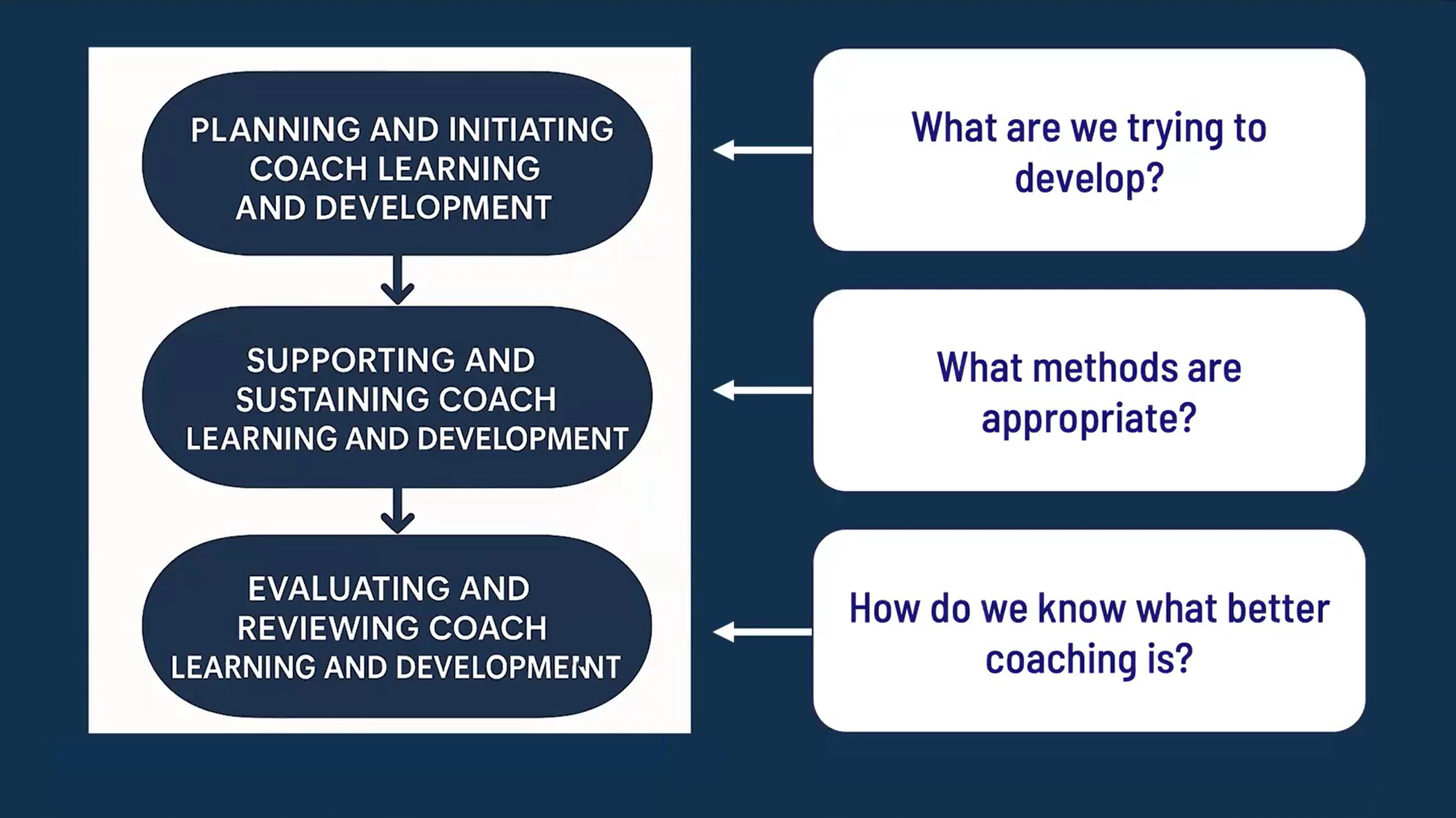
Too often, organisations do not adequately answer these questions.
The Premier League, for one, were struggling when they turned to Taylor and DCU three years ago.
“At the time, the Premier League thought they had a competent academy coaching workforce, but they weren’t happy with just ‘good enough’,” he said.
Together, they worked to identify the qualities of coaches deemed ‘expert’ as part of their Coaching Expertise Project. They co-developed a coach profiling tool to help academy coaches on that pathway from competence to expertise.
“The tool itself is around a half a day’s worth of different simulations that the coach can go through. It presents them with various difficult scenarios,” Taylor continued. “At the end, it generates a profile that says, ‘here’s where a coach might be strong, here’s where a coach might be weaker’.”
The project has yielded demonstrable outcomes. “Coach developers are reporting that it’s much easier to understand what a coach needs and be able to direct them and say, ‘here’s the time we’ve got and this is how we might use this time to influence and enhance your practice’.”
There are, however, still unknowns. “When evaluating and reviewing coach learning and development, we are still unsure what ‘better’ is.”
The project continues and coaches are tracked in their progress.
The ‘messy’ middle
Good coach development work combines both more direct and less direct approaches.
Taylor believes a thorough approach would look something like this:
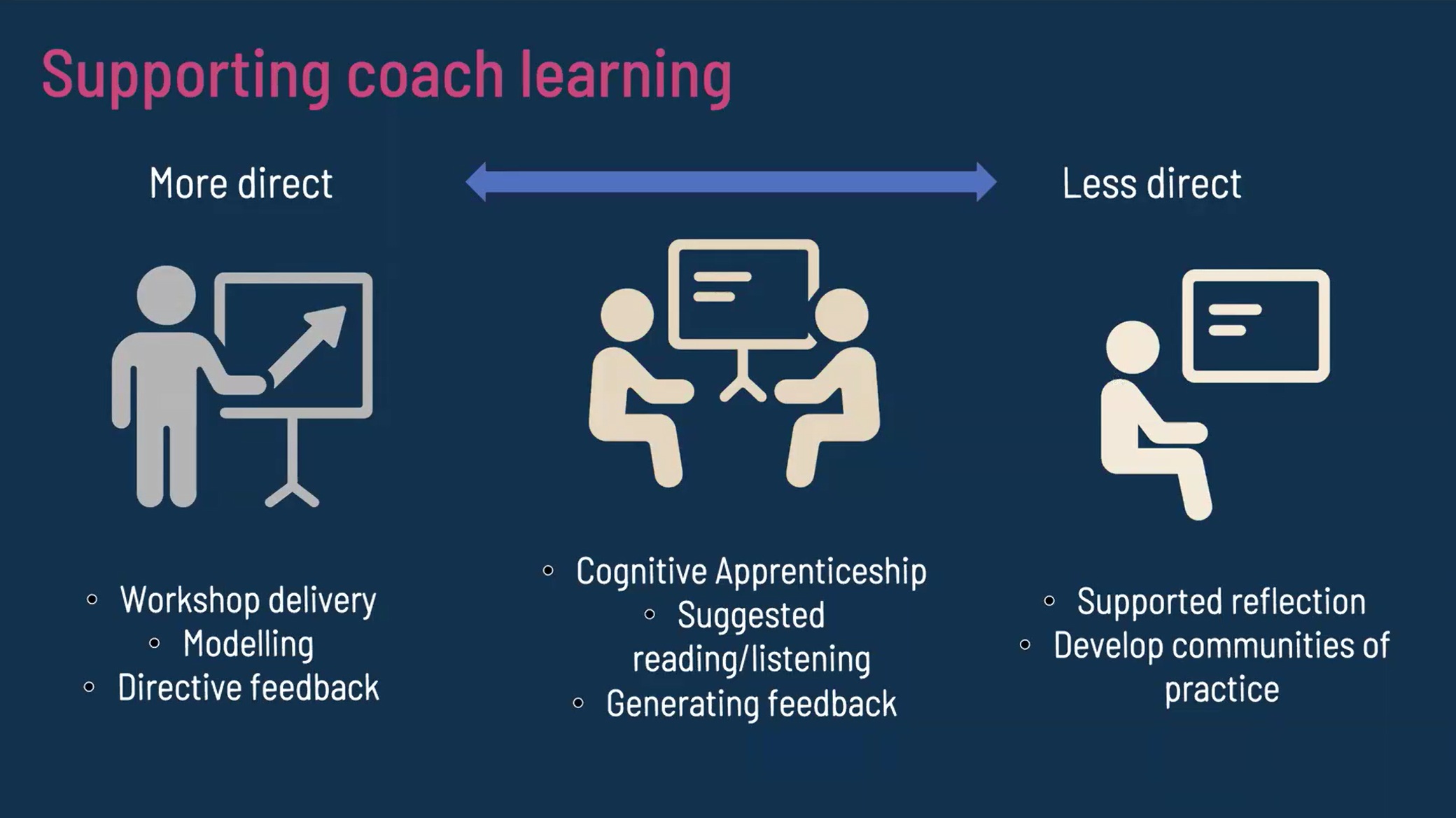
In reality, however, coach development too often veers towards less direct approaches.
“Similar to what we see in coaching, there has been a view that it’s inappropriate to offer more direct pedagogical approaches,” Taylor continued. He believes this is a consequence of sport being influenced by executive coaching practices and adult learning theory. Yet coaching is not C-suite work.
Supported reflection and communities of practice can be useful, but there are limitations. “If the coach hasn’t got the knowledge to reflect, or the coach developer doesn’t have a strong pedagogical capacity, then it can end up being just a nice coffee and a nice chat.”
Between the more direct and less direct approaches illustrated above is what Taylor calls “the messy middle”.
“We haven’t often seen approaches like cognitive apprenticeship, where somebody’s needs are identified, understood, and they’re given tasks that are just beyond their current ability. We haven’t got into directed reading and listening, mostly because lots of the available resources aren’t necessarily coaching-focused. Nor have we paid lots of attention to the ability to generate feedback rather than offer more supported reflection.”
‘The things we might do to generate competence don’t always promote expertise’
As the Premier League and DCU observed, the things that coach developers can do to generate competence do not always lead to expertise.
The notion of ‘best practice’ is a prime example.
“When we say ‘best practice’, I think we’re essentially saying ‘if we do it like this most of the time, it will be better rather than worse’,” said Taylor. “This tends to be more observable. I can see somebody doing ‘this’ and what I’m going to do is encourage somebody to repeat this ‘best practice’. This can be done through auditing processes; it can be done through more directive approaches; and it is significantly easier to leverage and promote than expertise.
“Now, expertise could be associated with good practice, but ultimately that means understanding intentions and context, and it requires us to probe and promote adaptability for coaches; for them to be able to respond to changing contexts. And I see these two things in tension with each other. Lots of the things that we might do to generate competence often don’t promote expertise.”
Taylor then illustrated this point of difference:
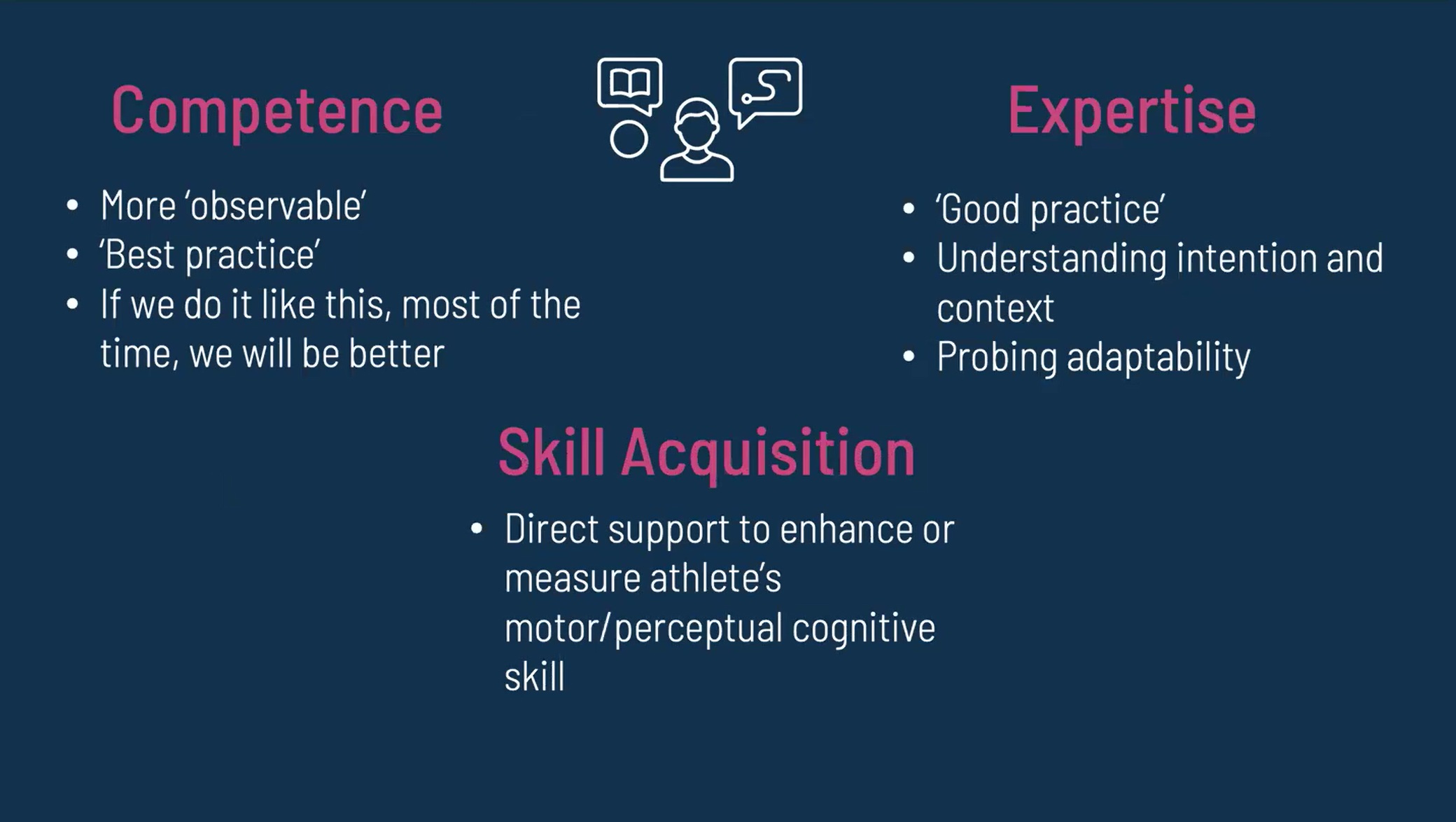
The middle domain – skill acquisition – came to the fore in Taylor’s work last year when the Dublin Gaelic Athletic Association enlisted his support in a coach development capacity.
At the start of his secondment he leant towards expertise, but when three coaches announced their intention to move on at the end of the season he pivoted towards supporting them in skill acquisition for athletes, specifically the planning of sessions and whether performance metrics were being met.
All three elements are key to coach development work, both “systemically and individually”.
Taylor’s hope is that “over the long term, we’re going to start progressing towards a broader and wider reach for coach development practice.”
What to read next
How Do you Develop the Most Expert Coaching Workforce in World Football?
As Jamie Taylor tells us, the Premier League-sponsored Coaching Expertise Project is challenging assumptions and establishing new standards.
Main Image: Phil Greig, courtesy of the Premier League
Yes, a head coach could be an expert, but that team might also be blessed with a highly expert foundation phase coach or an expert professional development phase coach. Each faces different demands and their work as coaches is inevitably different, but each can be expert.
My colleagues and I have been influenced by the adaptive skill model of Paul Ward and his colleagues. We see coaching expertise as the ability for someone to form intentions in their coaching practice and then flexibly and adaptively work towards those intentions – or change those intentions based on the changing context.
This idea is at the heart of the Coaching Expertise Project, which is an ongoing collaboration between the Premier League and Dublin City University and Insight Foundation Ireland. The project was launched in 2023 as part of the Premier League’s efforts to cement its reputation as world-leading in coach development practice.
Most of our data was collected by Mike Ashford, a postdoctoral researcher at the Insight SFI Research Centre for Data Analytics, while at the Premier League, Scott McNeill, the Head of Coach Development, and Danny Newcombe, the Senior Coach Development Manager, have driven the work from their side.
Scott and Danny’s roles have been to ensure the Coaching Expertise Project is anchored in the real demands of coaching practice and closely aligned to both academy and first team environments. They have worked with clubs to identify expert coaches across phases and to shape the project so that it reflects the realities of their day-to-day work. This is important for them because their ambition is to impact the full coaching pathway, supporting ongoing development not only in academies but also in first team settings. More broadly, their main intention is to contribute to the wider football system by enhancing the skill and expertise of both coaches and coach developers. The Premier League sees this as part of a bigger picture as they work alongside their professional game partners.

Photo: Phil Greig, courtesy of the Premier League
At the outset, we identified six coaches per phase across the Premier League, each working at a different development phase in their club’s academy. These coaches were selected from amongst their peers – the only effective means by which we can say one coach is better than another – and invited to undertake an extensive research journey.
Through this process we seek to better identify and understand the coaching demands at different levels. If we can understand those demands then we can be better at identifying expert coaches and helping coaches to reach an expert level.
The coaches involved in the project love it too. They’re constantly trying to find opportunities to learn and develop and it has supported their efforts to step into deep, reflective practice.
And so in shifting that focus from mere competence to true expertise, the Coaching Expertise Project has challenged long-held assumptions and is establishing new industry standards.
The issue with traditional coach development plans
Too often in coach development practice there has been a tendency to focus on coaching behaviour. That’s antithetical to what expertise is because, by definition, expertise is about flexibility, decision-making, and changes to practice that are, frankly, not very observable.
The risk in focusing on behaviour and attempting to change coach behaviour is that we end up reproducing what’s already there.
If there is too much focus on behaviours there is also too much focus on the coach and not their environment. This creates coach development plans divorced from demands. It is important to ask: is a coach development plan based on the demands of practice or on a series of generic capacities that cannot be tracked?
Our project is focused on the interaction between the coach and their context because we cannot identify expertise unless we understand the interaction between a coach and the demands of their role. We’ve identified a series of coaching demands – six or seven per phase – then mapped out the cues and strategies that expert coaches use to navigate those demands. It’s not a list of qualities that says ‘every good coach does this’. The demands are consistent but the coaches are different, and they navigate those demands in reasonably unique ways.
Photo: Phil Greig, courtesy of the Premier League
What ‘expert’ looks like
The Coaching Expertise Project has used this fresh understanding of the demands and coaching context to build a profiling tool that we want to embed in coach development at the Premier League.
It will inform a needs analysis for each coach because we can better understand good practice and the development status of the coach in question.
Capacities are still important. Entry level coaches will still need to show that they’re good enough to enter a role, but the Premier League’s ambitions extend beyond that starting point.
We’re going to be able to provide recommendations for coaches on the different demands of their roles and how they might work to develop themselves against these demands. Ultimately, we hope it’s going to become embedded into coach development practices across Premier League academies and in the daily life of an academy coach.
People have also asked me if we’ve simplified anything for coaches. The answer is no. You’d never say ‘how do you simplify this for a sports scientist or psychologist?’ because we have higher expectations of those professions. Coaches are some of the most expert practitioners in any field so it’s less important that it’s simplified and more that it’s valid and useful for coaches, that it can be integrated into their workflows.

Photo: Phil Greig, courtesy of the Premier League
Evolution not revolution
This remains a fruitful area for research. There are fewer than ten studies that have used expertise as a lens to understand coaching practice – and two of those studies have been mine.
The Premier League remains committed to the ongoing development of coaches across both academy and first team settings. The central intention of the project is to contribute to the wider football system by enhancing the skill and expertise of coaches and coach developers alike. By doing so, we aim to strengthen the overall quality of coaching and create development environments where the very best practitioners can continue to grow and positively impact the game.
We hope that this will eventually have an impact in the wider sporting world, but we are promoting an evolution rather than revolution, and if we can recognise the very best coaches and we’re better able to develop coaches towards expertise, it’ll see those coaches rewarded for good practice and then ultimately every player, when they walk into a club, is on the receiving end of high quality coaching practice.
Dr Jamie Taylor
Jamie is an Assistant Professor in the School of Health and Human Performance at Dublin City University, with a focus on coaching, coach development and coaching research. As a researcher, he supports practitioners on DCU’s MSc and professional doctorate programmes and collaborates with high-performance sports organisations including the Premier League, GAA, IRFU, and Premiership Rugby. As a coach developer, he has worked across a range of high-performance environments. Alongside his academic and development work, Jamie coaches rugby union at Leicester Tigers.
If you would like to speak to Jamie Taylor, Scott McNeill or Danny Newcombe about their work, please contact a member of the Leaders Performance Institute team.
SportAI’s system can be used in conjunction with phone or camera footage to generate overlays that chart swing curves in tennis.
A Data & Innovation article brought to you by

Through the agreement, SportAI’s offerings will be available on the MATCHi TV streaming service, which is underpinned by cameras installed at 2,000 of MATCHi’s tennis and padel courts. The integration lets players access highlights and technical analyses of match footage on their phones. In all, MATCHi has a network of more than 1M users across 2,600 venues and 14,000 courts in 30 countries.
Financial and duration terms were not disclosed.
Oslo-based SportAI was co-founded by Lauren Pedersen, a New Zealand native who is combining passions for sport and technology to democratize access to swing technique analysis – first in racquet sports but with the aim to eventually expand into the likes of cricket, baseball and beyond.

Image: SportAI
“Technique coaching, specifically, is still very subjective and expensive and unscalable,” Pedersen told SBJ in a recent interview at the USTA Billie Jean King National Tennis Center, where she spent time during the U.S. Open pitching prospective clients. “If you have a tennis lesson pretty much anywhere, it’s easily going to cost $100 – and you might have a good coach, but if you had three or four good coaches looking at your technique, they would all say something different, and there would be no data to back up what they’re saying.”
SportAI’s system is hardware agnostic; its algorithms can be applied to phone or camera footage and generate overlays that chart swing curves (and compare those curves to professionals), ball strike timing and other statistics like hip or shoulder rotation and swing velocity. The system also provides textual feedback, which as of now is pulled from a matrix of preset options but could in the future tap into a large language model, Pedersen said.
Here, Pedersen demonstrates the technology analyzing her one-handed backhand.
“To get to technique analysis, the computer vision, the platform itself, has to identify the boundaries of the court, identify different players on the court, be able to pick up all the biometric movement,” Pedersen said. “Before we even get to the technique analysis, we’ve got a lot of the technical data, which provides heat maps and statistics as well. We can deliver all that, and then technique analysis or coaching on top of it.”
Pedersen is charting a B2B model for the company, wherein SportAI licenses access to its software to three key segments: racquet sports clubs and coaches, broadcasters, and equipment manufacturers. She did not disclose pricing but noted it is variable based on which analysis modules businesses subscribe to.
As a coaching tool, Pedersen asserts that SportAI can reinforce instruction with empirical data, expand coaches’ influence outside of traditional lesson hours by making swing analyses accessible remotely, and unlock incremental revenue by creating a premium digital offering coaches or clubs can charge members to use.
For broadcast, Pedersen envisions the potential to improve the less objective niches of common tennis analysis and introduce technique comparisons between players or digital twin visualizations.
Integrating with equipment manufacturers, Pedersen added, would bring the opportunity for increased personalization in matching players with the appropriate racquet for their skill level and play style.
This article was brought to you by SBJ Tech, a Leaders Group company. As a Leaders Performance Institute member, you are able to enjoy exclusive access to SBJ Tech content in the field of athletic performance.
Data Analysts Julia Wells of the UKSI and Mat Pearson of Wolverhampton Wanderers deliver a series of practical tips to help address one of sport’s notorious blind spots.
An article brought to you in collaboration with

That is according to a straw poll of attendees at a recent Virtual Roundtable hosted by the British Association of Sport & Exercise Sciences [BASES] and the Leaders Performance Institute.
The perception is worse when it comes to analysis and recruitment, with over 60 per cent of attendees suggesting that their analytics and recruitment teams do not work closely at all.
Yet 63 per cent also believe that improved data and computer literacy across their staffs would directly impact performance.
The sense that there is room for improvement gave the session its title: ‘Mobilising Performance Analysis in Practice’. It was the second in our three-part collaboration with BASES called Advances in Performance Analysis and centred around two case studies.
The first was delivered by Julia Wells, the Head of Performance Analysis at the UK Sports Institute [UKSI], and the second by Mat Pearson, the Head of Performance Insights & Data Strategy at English Premier League side Wolverhampton Wanderers.
Five areas where data literacy can improve performance
Before Wells and Pearson delivered their insights, attendees were set a further task: ‘as a consequence of improving data or computer literacy, describe what you would see as being the most significant impact on performance’.
The responses were varied but five stood out:
How the UKSI are mobilising performance analysis work-ons in meeting common challenges in data analysis
The first session highlighted the four biggest challenges facing people who use data analysis in sport. To kick off her presentation in the second, Wells explained how the UKSI is trying to tackle those four challenges (plus another).
Challenge 1: integration
Go back to basics. That’s the approach of the UKSI, who have placed an emphasis skill development, support structures and a clear data strategy.
It goes like this: the relevant staff members are upskilled in areas such as collecting the right data, using the correct formats in the right places before the interrogation and analysis even begins. This is then supported by a clear data strategy geared towards performance planning. For example, roles such as the data & insight lead and the performance data lead are embedded within the organisation to better help those leading programmes with the direction and the integration of their data. Thus, the strategy can come to the fore and everyone can better understand what needs collating and why within the team.
Challenge 2: data collation
Wells described how easy it can be to stay on the “hamster wheel” of collecting data without taking the time to critically reflect and pause. Can you, for example, call upon efficient processes for collecting data and wade through the myriad datasets potentially available? She recommended asking “quality questions”: why are we creating the data, what is its purpose, what decisions is it informing, particularly in the coaching process? Teams should do this periodically and continue to plan, do and review. Wells also encouraged engaging in conversations with key leaders in the environment to discuss what to start, continue and stop. It’s important to intentionally carve out those opportunities as part of your performance planning.
Challenge 3: communicating data insights
Wells stressed the critical nature of human engagement in the process and regards communication is a highly technical skill, despite the views of those who might see it as a ‘soft’ skill.
She shared that the different performance departments within the UKSI work closely with the psychology team to help elevate understanding of self and others. Wells said, if we can better understand the people we work with, it will support how people can get the best out of each other. As part of this process, they’ve tapped into better understanding one another’s preferences in order to be more impactful in how they support each other.
Challenge 4: buy-in
It is not uncommon for senior stakeholders to not perceive the value of the work being done. This makes it incumbent on analysts to critically assess their impact and share the meaningfulness of their work. “It’s our job, and it’s our role to be critically analysing why and presenting that back,” as Wells said.
On that note, alignment to the sport’s strategy helps to provide a clearer connection. If this alignment and connection isn’t there, you’ll naturally get disconnection so it will be more challenging to get the buy-in.
In addition, relationships are just as critical when generating buy-in. Wells advocated inviting leaders and key stakeholders into your world and shadowing them. When they immerse themselves in better understanding the process you’ll find that it can quickly lead to them becoming a voice for you in wider conversations.
Challenge 5: data illiteracy
Too often, practitioners can suffer in silence when looking for solutions. In the latest Olympic and Paralympic cycles, Wells and her colleagues are seeking to increase data literacy across the board. They have introduced an internal online data community that provides access to resources, promotes connection, and leads to the sharing of good practice.
Wells’ team also put together a ‘Data Leadership Programme’ which is focused on pulling together the data leaders in the various sports with whom the UKSI work to look at opportunities, challenges and future direction. Courses, with titles including ‘Data Camp’, ‘Project Automate’ and ‘Code School’, were created to improve skills and processes for coaches and practitioners to help them be more efficient. In her mind, this has been crucial to enable people to be upskilled; and all support staff should be able to ask a good question and have the data skills to answer them.
How data analysis is supporting coaching and recruitment at Wolves
Pearson explained that he and his colleagues at Wolves are trying to align the club to ensure there is consistent evidence available and better identification of the trends impacting decision making from a data point of view.
He focused on two key areas: coaching and recruitment.
In the environment, the analysts are part of the multidisciplinary team. They are very much now voices in the room and, with it being a specialised discipline, all analysts must have an impact on decision making.
To that end, Pearson’s team have moved away from leaving the coaches to find the solutions themselves. Instead, analysts are encouraged to go and find solutions, present them to the coach, and then have good conversations to better find the optimal outcome.
Part of the challenge we can face, said Pearson, in particular with performance analysis at first-team level in professional football, is that many environments can be quite coach-led, which is in keeping with the nature of short tenures. The coaches will lean into their viewpoint as a way to exert their control. Therefore, education is important and, in particular, how you communicate with them to ensure the message lands. That said, Pearson observed that coaches in modern day football are more attuned to data and performance analysis and are much more data literate and comfortable with technology.
A key learning when integrating performance analysis and data work with coaching is to make insights as contextual as possible. If you provide insights to a coach that are out of context, you’ll lose them straight away.
Pearson told attendees that some of the biggest strides in performance analysis and the wider data team have been in the field of game modelling, recruitment and selection decisions, with the obvious caveat that subjective input is still valued immensely.
The team have worked to create objective measures against the game model. In better understanding this, it has provided an additional layer of information related to individual player requirements for the game model. These insights are helping to inform both selection for matchday but also the recruitment of new talent. When thinking about the recruitment process in particular, Pearson said this process has helped to educate scouts and other recruitment personnel in the attributes for which they should be looking.
Visuals have played a key role in this process too, particularly in being able to show what it looks like to play in this particular style that the coach or manager wants. They’ve worked to make the playing style more objective.
The Leaders Performance Institute delved into the concept with David Dunne of AI-powered nutrition app Hexis.
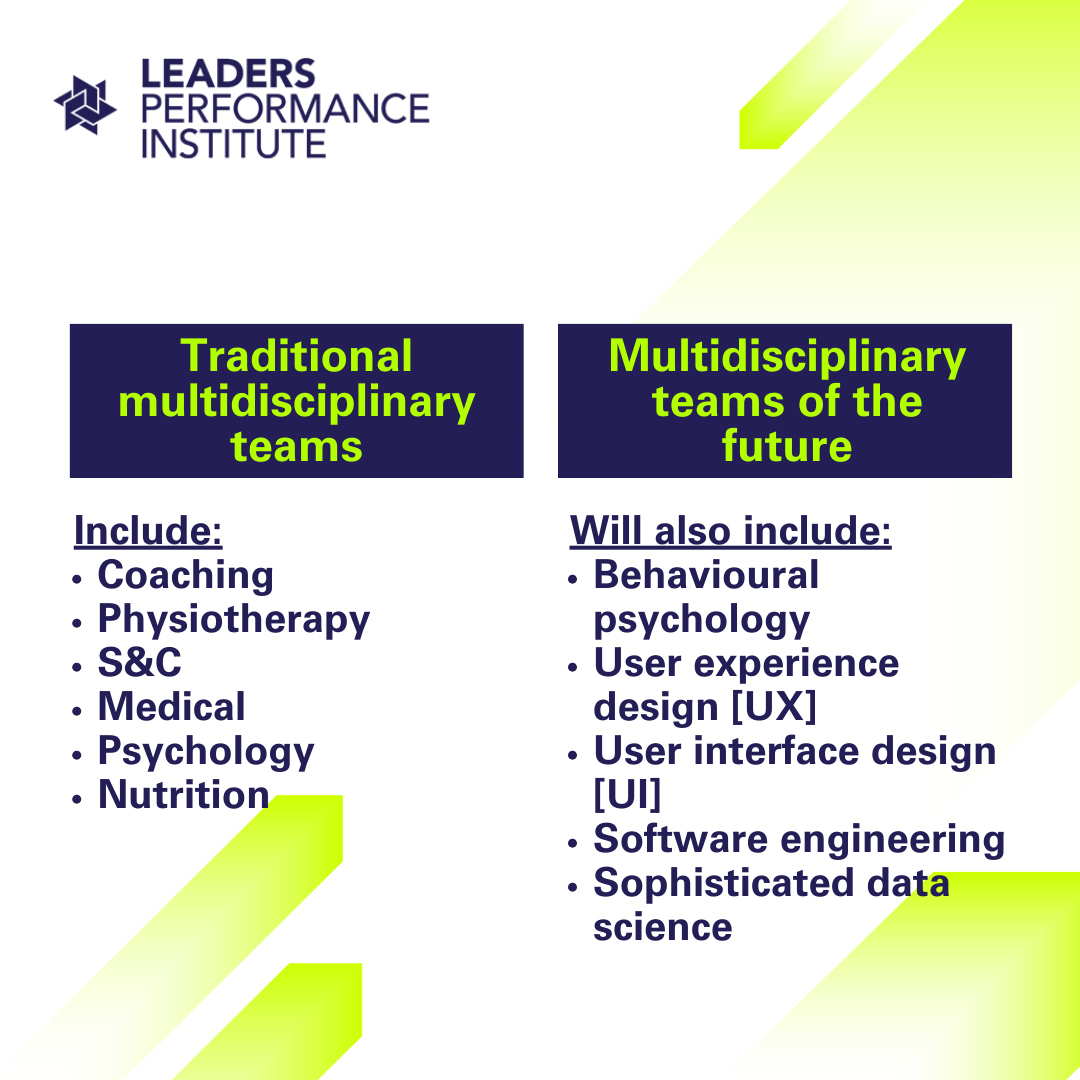
“We expect a nutritionist, coaches, S&C, psych and physio – that’s what we consider a multidisciplinary team,” he told the People Behind the Tech Podcast in April.
“However, now [a multidisciplinary team includes] behavioural psychology, UX [user experience design], UI [user interface design], data science, software engineering, performance science. It’s a whole other world that has opened up new possibilities that we didn’t know were there as a practitioner.”
Dunne, who is the CEO and Co-Founder of Hexis, an AI-powered predictive nutrition service for elite athletes, has made an almost full transition from high performance sport. He previously served as Head of Nutrition at English Premiership rugby club Harlequins and still works in a similar capacity with Ryder Cup Team Europe.
While his assessment of tech’s role in high performance is unsurprising, his views on those “possibilities” now open to practitioners provide some food for thought – and not only for nutritionists or dietitians.
“What we’re going to see is the evolution of the hybrid practitioner,” he continued.
What are the implications for you and your team? Below, we set out a HYBRID framework to illustrate the concept.
H – Haste – “[Going] back to Quins, you spend a lot of time behind the laptop,” said Dunne. “You got bogged down in a spreadsheet. It’s tedious.” However, a hybrid practitioner will “use tech for tasks that can be algorithmically delivered at scale.”
Y – Yield – this can mean being receptive to others; and a hybrid practitioner “uses technology for what it’s good at” while people can focus on what they’re best at, which is “being human”. As Dunne explained: “Humans are good at building relationships, learning how to have conversations, and listening to people and actually helping them change their behaviours and change their beliefs about certain consequences or their own abilities over time.”
B – Balance – Dunne’s Co-Founder at Hexis is Sam Impey. “A brilliant scientist,” as Dunne said. “A far greater academic than I’ll ever be.” Nevertheless, Dunne is aware of his own assets. “My personal strengths have always been on the coaching side – put me in any locker room, put me in any team setting, I love to have conversations, I love to listen.” In truth, a successful practitioner needs both sets of traits. As Dunne put it, “let’s call it practitioner tacit knowledge and actually the application on the frontline.” The best example of this in Hexis’ work is how their app has been influenced by the COM-B model, which is a framework for understanding and changing behaviour – both key factors in performance nutrition. For a behaviour to occur, a person must have the capability, opportunity and motivation to perform it. Practitioners aiming to change behaviour should therefore target one or more of these components.
R – Roadmap – practitioners are too often constrained by tech being restricted to trackers. “It’s retrospective”, said Dunne, specifically of nutrition trackers. But with predictive AI entering the market, the role of the practitioner is likely to be more forward-facing. “We always need to know [and] we always want to help them know what to do next,” he added. This is particularly important in light of Hexis-sponsored research suggesting that most athletes are ‘confirmation seekers’, meaning they want to lead on “making the decision but then they want something to help verify that they’re going in the right direction.” A hybrid practitioner can cater to this need.
I – IT / MI – “I think what we’re going to see more of is a more highly-skilled human practitioner with a lot more software skills and [skills such as] motivational interviewing [MI] on the frontline, and then technology systems that ensure a standard of care across the whole organisation, 24/7, 365 days a year,” said Dunne. Key to that is reducing the “noise” around the athlete. With the right plans and structures, the hybrid practitioner can “deliver impactful value to the athlete.”
D – Data – with apps such as Hexis allowing for data integration – their collaboration with training app TrainingPeaks is a prime example – there is the opportunity for practitioners to make better use of existing data rather than merely seeking the next thing. With the right blend of skills, the hybrid practitioner is well-placed to ask: what can we do with the information we already have?
Listen to the full interview with David Dunne below:
The Co-Founder of Hexis discusses the pinch points for athletes, practitioners and technology.
A Data & Innovation podcast brought to you in collaboration with
“There’s a fundamental mismatch between what practitioners can deliver and what athletes actually want and desire,” he told Joe Lemire and John Portch on the People Behind the Tech podcast.
“So we pivoted towards the COM-B model.”
During this episode we spoke at length about Hexis’ continued growth following a successful seed round, technology’s ability to influence the evolution of the practitioner, and the fundamental union of academic rigour and those so-called softer skills.
COM-B was a major part of that conversation. It has been integral to Hexis’ growth. The company used it in tandem with elements of design thinking which, as Dunne explains, stems from his time working for teams including Harlequins and Ryder Cup Team Europe.
The model is a framework for understanding and changing behaviour. It was developed by Susan Michie, Maartje van Stralen and Robert West in 2011. The model posits that behaviour (B) is a result of an interaction between three components:
Capability (C): this refers to an individual’s psychological and physical capacity to engage in the activity. It includes having the necessary knowledge, skills and abilities.
Opportunity (O): this encompasses all the factors outside the individual that make the behaviour possible, including social and physical environmental factors.
Motivation (M): this includes the brain processes that direct behaviour, such as habits, emotional responses, decision-making and analytical thinking.
Listen to the full conversation:
Listen above and subscribe today on iTunes, Spotify, Stitcher and Overcast, or your chosen podcast platform.
Al, the art of persuasion, and the habits that hinder performance – just some of the topics that filled the air in March.
Leaders Meet: Teaching & Coaching, an in-person member event, is just around the corner so, if you haven’t already, do check it out and register to join us at Millfield School in Somerset. We have some excellent topics on the agenda, including pedagogy & andragogy, non-directive coaching, coaching neurodivergent athletes, the language of coaching, complexity science and much more besides.
The day will be most relevant to anyone working with athletes on a day-to-day basis, whether in a first team environment or within the pathway. There’s just a couple of weeks left to register so don’t miss out.
Our Debriefs are designed to set you up for success. We’ll keep you on the pulse of contemporary thinking across the high performance space and provide members with the inspiration to engage with the variety of opportunities on offer through their membership. Do check out some of our upcoming events and virtual learning sessions to connect, learn and share with fellow members from across the globe.
And now, let’s reflect on the pressing performance issues of the day.
Virtual roundtables
March was a busy month for roundtables. From topic-led conversations around Sustaining Team Culture and the Influence of AI on Performance Programmes, to a Leadership Skills session focused on Building Persuasion and, last but definitely not least, part two in our series of learning around Wellbeing and what is having the most impact.
These are the insights that resonated with us most.
The potential impact of AI
We identified some of the enablers and outlined some of the key questions we still have around the technology.
So, where do we think AI can have a positive impact on our programmes?
All sounds good, doesn’t it? However, we still have some questions that need answering. Have you explored and come up with answers to these in your environments?
Why persuasion is an important skill in modern day leadership
How can you master the art of persuasion? We have some tips for you. Having good ideas is not enough. In order to change thinking and enact change, we need to be able to persuade people.
The Trust Equation
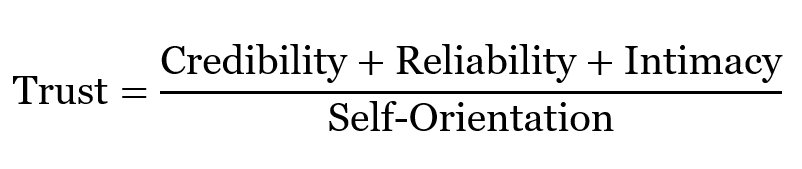
The equation is a conceptual formula used to describe how to build and elevate trust. To go into a big more detail, Credibility speaks to words and credentials and simply put, how authentic are we? Reliability is the perception of someone’s integrity, are your actions connected to your words? Are you credible in how you present yourself? Intimacy refers to the feeling of safety or security in the sharing of information and how safe and secure others feel in sharing with us. Finally, Self-Orientation reflects an individuals focus and where it is directed – is it towards themselves or others?
Essential steps in mastering persuasiveness
There was lots of gold in this skills session but as we reflected on the essential steps to impact the notion of persuasion well, there were four steps to reflect on in developing your persuasion muscle:
Additional reporting by Lottie Wright
Something a little different…
As many of you will know, we at the Leaders Performance Institute pride ourselves in exploring the world of high performance outside of the elite sporting context. With this in mind, we wanted to push your attention to some golden insights from the Royal Academy of Dramatic Art and their Director of Actor Training. To read more on their approach to elevating performance here and also how they’ve worked to redesign their curriculum here.
Skilbeck shared with us five factors that underpin their process to developing their talent. Are yours similar?
Additional reporting by John Portch
Community groups
In March, our Performance Support & Science community group took centre stage.
With 2024 bringing new projects and streams of work, we looked into the pressing questions and topics that are currently occupying the minds of those in this group.
Some of these will look familiar. How are you trying to approach some of these issues in your environment?
Sustaining staff health & energy
A few different people as part of the group discussion alluded to the topic of staff energy and sustainability, from the lens of the performance support and coaching team. Some of the spin off questions referred to how do we best integrate support and what does that look like, particularly due to the intensity of competition and in some environments, where there is uncertainty.
AI is coming, so how do we prepare?
Firstly, we’d recommend revisiting some of the bullet points above on what came out of the conversations of this topic in one of our roundtables. A lot of performance teams are evaluating it’s possible impact and the input it could have into our worlds. Will you be an early or late adopter and do you have a clear strategy in place to ensure there is clarity and preparation for how you will use it when that day comes?
Are you collaborating with external practitioners?
Arguably the most common response from the group when it came to current challenges. Such is the nature of modern day elite sport, performance support networks around our athletes are growing, including independent specialists who are not employed by the organisation. The crux of the conversation was, if we are to work with them, how do we do it best? Or do we not look to collaborate with them at all?
Balancing long-term planning and short-term delivery
This is a constant battle for performance support teams, such is the nature of the work that takes place in this field. The group brought to the table the question of how others are finding the balance to ensure they are moving at the ‘pace of performance’ in the day-to-day environment, but a nod to the future exists when it comes longer-term programme planning. We also discussed how to keep senior and experienced staff growing as it can be very easy to slip back into the short-term mindset, thus stifling longer-term development opportunities.
