Leaders in Business
  • Membership
  • Events
  • Content
  • Virtual Learning
  • Connections
  • Partners
Login
  • Leaders Week London
  • Events
    • Leaders Week London
    • Leaders Sports Awards
    • Leaders Club Events
    • Leaders Performance Institute Events
    • Leaders Meet: Innovation
  • Memberships
    • The Leaders Club
    • Leaders Performance Institute
  • About
    • Careers
    • Contact
I’m a sports leader:
  • Off The Field For those focused on the business of the sport View more
  • On The Field For those working with an athlete or elite team View more
  • Login
    • Leaders ClubThe membership for future sport business leaders
    • Leaders Performance InstituteThe membership for elite performance practitioners
  • Newsletters
Performance Institute Leaders Performance Institute Logo
  • Membership
  • Events
  • Content
  • Virtual Learning
  • Connections
  • Partners
Login

28 Oct 2024

Articles

How to Craft Team Cohesion Amid the Chaos of Sport

Category
Leadership & Culture
Share
Facebook Twitter Email Copy Link
https://leadersinsport.com/performance-institute/articles/how-to-craft-team-cohesion-amid-the-chaos-of-sport/

David Clancy, Richard Kosturczak and Ronan Conway explore the identifiers of team cohesion and the fundamental building blocks that separate the great from the good.

By David Clancy, Richard Kosturczak & Ronan Conway
‘If you want to go fast, go alone. If you want to go far, go together.’
African proverb
Cohesion is an invisible thread that binds high-performing teams together.

Without it, even the most skilled groups falter. As Peter Guber, the CEO of Mandalay Entertainment and Co-Owner of the Golden State Warriors, LA Dodgers and LA FC said, “Without social cohesion, the human race wouldn’t be here. We’re not formidable enough to survive without the tactics, rules, and strategies that allow people to work together.” This principle is as true in modern business organisations and elite sports as it was in our evolutionary history.

High-performing teams aren’t just thrown together without thinking. They are intentionally built through careful design, clear communication, and shared goals. It’s about finding the blend where roles, responsibilities, and diverse perspectives align, allowing every individual to leverage their strengths for the benefit of the collective.

So, how do we achieve that cohesion, especially in environments where team members may not fit neatly into traditional roles? How do we ensure that the whole team operates as a cohesive unit, even when differing opinions and reporting lines exist?

Finding the sweet spot

Cohesive working requires creating an environment where finding the sweet spot means aligning team members’ roles and responsibilities in a way that meets both organisational goals and individual capabilities. It’s about meeting in the middle – ensuring that while everyone contributes their unique expertise, they also respect the collective objective.

Leaders play a pivotal role in facilitating these moments of alignment, ensuring that when opinions or methods differ, the focus stays on finding the most effective solution, rather than reinforcing silos, judgements or personal agendas. In this sense, cohesion is about not just collaboration, but collaboration that works toward shared objectives, adapting as needed to meet challenges in real time.

The building blocks

The foundation of a cohesive team lies in four critical elements:

  1. Clear roles: Every member of the team should have a well-defined role, even if that role isn’t conventional or part of a traditional organisational chart. The key is to align the individual’s expertise with their contributions to the team’s goals, ensuring everyone knows what they’re responsible for – and how they contribute to the big picture.
  2. Adaptability: In a dynamic environment, roles may shift depending on the context or challenge at hand. Leaders must ensure that team members are flexible and willing to step outside their comfort zones, taking on responsibilities that might not align with typical job titles.
  3. Trust: Open lines of communication are mission critical for a team to gel. Trust allows for honest dialogue and ensures that differing opinions or approaches are respected, not dismissed.
  4. Decision-making model: A clearly articulated framework for decision-making provides structure and coherence, thus ensuring that everyone understands not just what decisions need to be made, but who is responsible for making them, and how they are executed.

These building blocks allow for cohesion even in complex or unconventional team structures.

Identifiers of high cohesion

How a team clicks: does it work in harmony? Knowing where to look is essential for identifying how well a team is functioning together. Here are some concepts to look at for indexing this sense of ‘teamwork’.

  • Role clarity: Are team members clear on their own responsibilities and those of others?
  • Conflict resolution: How well does the team resolve differences in opinion, methods or strategy?
  • Collaborative decision-making: Are decisions made through collective input, even when the final call rests with one person?
  • Mutual accountability: Do team members hold themselves and each other accountable for delivering on expectations?

These markers are crucial for evaluating is a team functioning as a tight unit. You could use these identifiers as a means for tracking and measuring how well the team is doing.

When these indicators are robust, the team’s ability to perform at a high level is elevated.

Ensuring that everyone is on the right bus – and in the right seat on that bus

Ensuring that people have the right roles and responsibilities in a team isn’t as simple as matching a title to a task. Often, it requires rethinking traditional organisational designs. Instead of relying on predefined job descriptions, high-performing teams focus on matching skills, expertise, and interest to the actual needs and musts of a team. This flexibility ensures that individuals are positioned to succeed, even if their role falls outside a traditional org chart.

The best approach is to identify the key outcomes the team needs to achieve and then allocate responsibilities based on who is best suited to drive those outcomes. It’s not uncommon for someone to hold responsibilities that cross functional boundaries, but as long as clarity exists, cohesion can still thrive.

The goal is not to fill predefined slots but to build a dynamic, flexible system that adapts to the needs of the moment, such is the demands of elite sport.

Good on paper vs good in reality

It’s easy to assume that a team looks perfect on paper – each role clearly defined, each person seemingly in the right position. But the reality is often far more nuanced. Good on paper might mean that organisational charts, roles, and responsibilities are technically correct, but it doesn’t account for the personal dynamics, communication styles, or agility of the individuals involved.

Good in reality, on the other hand, refers to teams that function well in practice, in the training room, on the field – when it counts, when pressure comes. This requires fluidity, acknowledging that roles may overlap, opinions may diverge, and people may need to step outside of their ‘assigned’ lanes to help the team succeed. Cohesion in the real world demands malleability, trust, and a willingness to change when necessary.

Managing differing opinions

It’s quite common for teams to have two people with different opinions or views reporting to different leaders. This could be shaped by the individual’s personality predisposition, such as are they more Type A and Type B, for example. These differing views, opinions and traits can create friction – but in high-performing teams, this diversity of thought is seen as a strength, something to be amplified, if positioned well. It pushes the team toward innovation and deeper problem-solving. The key is to ensure that these differing opinions don’t lead to disjointed decision-making and fragmentation.

This is where a decision-making model becomes critical. Leaders should establish processes that guide how decisions are made, who gets the final say, and how differing viewpoints are resolved. For instance, a performance director may not need to make the final call on a return to play decision, but having the A-Z flow will make this decision ‘cleaner’. Each professional stays within their expertise, but they collaborate through a framework that aligns with the team’s overarching goals, such as getting the player back on the pitch after an injury.

Overseeing the decision

Who oversees the decision-making model depends on the structure of the team, but it’s crucial that not every decision needs to reach the top. In well-functioning, cohesive teams, there are levels of authority and autonomy, allowing for faster and more efficient decision-making. Sometimes, well-oiled departments have decentralised command structures, often seen in the military. For example, a doctor doesn’t need the performance director’s approval to prescribe treatment, but the doctor and the PD must work within an established system that ensures consistency and alignment with the team’s overall strategy and vision from a sporting director.

The model should be overseen by those who understand both the day-to-day operational needs and the bigger picture. One needs to be able to zoom in, but also out. This is often a middle ground between front-line team members and senior leadership; this ensures that decisions are informed, timely, and strategic.

Cohesion reading

As a leader, you have likely accumulated a bank of time in teams and groups, from school, university, your organisation, etc. Thus, you have experienced a wide spectrum of people dynamics, cultures and environments. Think of the moments where something felt ‘off’. The energy seemed blunted. People were preoccupied with relational issues, toxic rhetoric, or disgruntlements. In these environments, the task at hand sometimes became secondary. On the flip side, when a team felt closer, it felt ‘right’. In these moments, energy flows… it bends… it adapts like a river. People are locked in, focused on the team vision. Why? Because these relationships are grounded on bone-deep trust and mutual respect.

Call it intuition. Gut feel. Emotional intelligence. This is how you gauge how cohesive a team feels, like a barometer for linkages.

The next time you walk into a team meeting or the changing room, allow yourself a moment to take a reading of the room. Pause and step back. Take a breath. Watch your people. Track their body language and eye contact. How do they greet each other and interact? Listen in. Note the intonation, the laughter, the silence. This is all data.

Is the energy flowing or is it stuck? Notice what you are picking up. Trust it. Take note.

Connection is a separator of great teams

If role clarity, conflict resolution, collaborative decision-making and mutual accountability are the bricks in the house, connection is the cement that binds it all. The quality of our team interactions is heightened when we feel psychologically safe with others, valued and respected. We remain open and engaged and are less likely to shut down or retreat into a corner.

So, how do we foster this connection more?

The elite coaches and managers take no chances in this area. Connection must be intentional. It is not something that one assumes will happen in a performance café or at a team-building Christmas party per se. Just as time is allocated in the weights room to build muscle, elite teams dedicate time to strengthen the collective muscle. This can be bridged by facilitating conversations with individuals to enable them to take stock and interact on a meaningful level. In doing so, they reinforce their connections between teammates, the jersey, their why, legacy and their higher purpose.

A great example of this deliberative connection-building comes from Europe’s Ryder Cup win in 2023 at the Marco Simone Golf and Country Club. Post victory, Rory McIlroy reflected on when his team started to take shape, under the leadership of Luke Donald, their team captain at the time, and European Captain for the 2025 Ryder Cup. On a practice trip in the lead-up to the tournament, putting greens, driving ranges and tactics boards were swapped for an ‘amazing experience’ around a fire pit. The team reflected on topics like ‘why they love the Ryder Cup so much’, and ‘having parents that sacrificed a lot for them’. This moment helped galvanise the European team.

Now to The Last Dance. In 1998, Phil Jackson, the Head Coach of the Chicago Bulls, gathered Michael Jordan, Scottie Pippen, Dennis Rodman, and co. He asked them to write about what their Bulls team meant to them before each player read aloud to the group. After they all had their turn, Jackson symbolically lit the tin cup filled with papers on fire, and all the Bulls watched on and felt more connected. “One of the most powerful things I’ve ever seen”, said current Head Coach of the Golden State Warriors and former Chicago Bull, Steve Kerr. The rest is history.

Final thoughts

Building cohesion and connection is about far more than getting the right people in the right roles – it’s about finding that sweet spot where collaboration thrives, even when team structures or opinions don’t fit the mould.

The successful teams of the past, whether this is Manchester United Football Club under Sir Alex Ferguson, the All Blacks of 2011 to 2015, or the Red Sox after they broke the curse, they all built strong foundations of trust, clear communication, and adaptable roles.

Teams can become great, making decisions that are informed by a diverse range of perspectives yet aligned toward shared goals. By implementing robust decision-making systems and processes, and fostering environments where flexibility, connection and trust are prioritised, high-performing teams can unlock their full potential…navigating complexity with confidence, and a higher sense of team.

David Clancy is a Learning and Development Consultant at the Houston Texans and Director at The Nxt Level Group. He is also the Editor of Essential Skills for Physiotherapists: A Personal and Professional Development Framework, which is available now from Elsevier.

Richard Kosturczak is a Market Specialist at The Nxt Level Group and Specialist Physiotherapist.

Ronan Conway is a Team Connection Facilitator, who has worked with teams including the Ireland men’s rugby team and Dublin GAA, Ireland’s most decorated Gaelic football team.

If you would like to speak to David, Richard and Ronan, please contact a member of the Leaders Performance Institute team.


14 Oct 2024

Articles

Why you Should Seek Second-Opinion Teammates, ‘Twins’ and Trusted Mentors

David Clancy and Richard Pullan set out their strategic and intentional approach to network building in a high-performance world of ever-growing complexity.

By David Clancy & Richard Pullan
“Your network is your net worth.”
Porter Gale, former VP of Marketing at Virgin America and a leading business and marketing advisor

In today’s fast-paced world, high-performing individuals and teams face increasingly complex cognitive demands. These challenges are not just about processing information but also about managing stress, navigating uncertainty, and maintaining clarity amid competing priorities. This is where the power of strategic and intentional network building comes into play.

There are several means available to help build this network. They include purposeful twinning with others, developing an ecosystem of critical friends and identifying a web of second-opinion teammates. Each of these connections provides leaders with the means to make more informed and rounded decisions, make perspective shifts as well as provide objective feedback.

Twinning

‘Twinning’ refers to the practice of forming reciprocal partnerships with other teams or organisations that share similar goals, challenges, or conundrums – perhaps they might even be competitors, if the context makes sense. This is a huge part of what the Leaders Performance Institute does, in fact, forging ‘partnerships’ with teams and individuals. This is how the Houston Texans of the NFL became professional friends with the Texas Rangers of MLB, as an example. This symbiotic relationship allows for mutual learning and growth, where both parties can share best practices, resources, and insights. A term we often hear is ‘collaboration over competition’ – we can all row the boat faster if we are willing to exchange protocols, philosophies and pain points.

Professional sports teams all face their unique set of struggles but, oftentimes, there are numerous similarities with these. Sharing best practices and ways to approach challenges is a significant benefit downstream of this pairing. By ‘linking’ with another team, leaders can expand their knowledge base, reduce the isolation often felt in high-pressure roles, and benefit from other viewpoints.

In terms of innovation, if teams are open to sharing what they do (to a degree), how they do it, etc, they can draw on the experience and solutions already implemented elsewhere. This save them time, effort, and energy. Food for thought.

Critical friends

Critical friends play a unique role in leadership, deliberation and decision-making. A critical friend is someone who offers candid, constructive feedback and is unafraid to challenge assumptions. This is ideally someone outside the team/ franchise. They are trusted individuals who can act as a sounding board for ideas, provide a second perspective, and offer checkpoints when needed.

Creating and nurturing these ‘friends’ requires energy and effort, but the payoff can be huge. As an example, if you are ideating a new return-to-play system and method, bouncing ideas off someone with exposure to this in another environment could help make your system better. A no-brainer if you ask us!

We have witnessed the benefit in relation to cognitive demand also, as critical friends offer a safe space to validate thinking and refine or rethink ideas. Critical friends help prevent blind spots, biases and assumptions by encouraging the leader to pause and reflect before executing a critical task. The best critical friends strike a balance between support and challenge. They are not afraid to disagree, but they do so with the intention of helping the leader grow.

Second-opinion teammates

Second-opinion teammates (teammates being a crucial word) serve a similar purpose, offering alternative viewpoints to ensure a more well-rounded decision-making process, such as another set of eyes on an MRI report and image for a hamstring injury.

Particularly in high-stakes environments, seeking a second opinion reduces cognitive stress by distributing the weight of responsibility and allowing leaders to feel more confident in their choices. Knowing that a trusted colleague has reviewed the same data or proposal with rigour and objectivity can provide a sense of reassurance and clarity.

Strive to stock a bullpen of second-opinion teammates. It’s a game-changer.

Mentorship

“The delicate balance of mentoring someone is not creating them in your own image, but giving them the opportunity to create themselves”, said Steven Spielberg. To create themselves entails helping one to find their way. Consider giving a project to a more junior member of staff from a senior ‘mentor’, rather than the ‘easier’ option, of giving the project to a ‘middle manager’ who has done the type of project before. That’s an example of what this could look like.

Mentorship is a timeless strategy – one for managing both the emotional, physical and intellectual demands of leadership. This is typically someone with more experience who can offer guidance, advice, and lessons learned from mistakes, and successes. Great mentors provide leaders with the tools to think more effectively for themselves, enabling them, giving them their own toolkit; this helps them navigate complexity, prioritise, and mitigate stresses. They leave breadcrumbs behind.

Mentors can help leaders manage cognitive demands by offering perspective on what truly matters, helping to sift through the noise and focus on the signal i.e. what is essential. They also provide historical insight, showing leaders that many challenges they face are not new and can be tackled using time-tested methods. This reduces the sense of overwhelm that comes with thinking one must always reinvent the wheel. The issue you are facing has been faced and solved before.

Moreover, mentors are invaluable in helping leaders manage their wellbeing, as they can provide reassurance and encouragement when times get tough and they can acknowledge that these times come with the intense world of competitive sport.

Building a network

In high-pressure environments, leaders often find themselves juggling multiple competing priorities, balancing short-term, ‘urgent’ demands with long-term, ‘important’ goals.

Here are five reasons for nurturing a network to help with this:

  1. Perspective: By offering alternative viewpoints, these individuals help leaders avoid tunnel vision, providing the clarity needed to make more informed decisions. As author John C. Maxwell said: “one of the greatest values of mentors is the ability to see ahead what others cannot see and to help them navigate a course to their destination”.
  2. Stress relief: They provide a safe space to vent frustrations or discuss difficult situations, reducing the emotional and cognitive strain on the leader.
  3. Cognitive load reduction: They help leaders prioritise by distinguishing urgent tasks from important ones, easing decision-making and reducing the burden of figuring everything out on their own.
  4. Feedback loops: They offer real-time feedback, allowing leaders to course-correct early, reducing the mental load associated with second-guessing decisions.
  5. Confidence: With someone experienced offering reassurance or advice, leaders can make decisions with greater confidence, reducing self-doubt, fracturing under duress and mental fatigue.

What makes a good mentor?

The best ones share several key traits that make them invaluable in helping leaders grow and meet the demands of high-performance sport.

Here are five traits we often see:

  1. Trustworthiness: A good mentor must be someone the leader can trust implicitly. This relationship relies on openness and honesty and, without trust, it can’t function effectively. Trust hinges on credibility, reliability and that willingness to be vulnerable. Look up the Trust Equation for more on this.
  2. Empathy with objectivity: They need to be empathetic to understand the leader’s challenges, but objective enough to provide clear, unbiased feedback. A mentor must challenge, but from a place of care, not criticism.
  3. Experience and expertise: Particularly for mentors, having a depth of experience is critical. They need to offer insights that come from having walked the same path or navigated similar challenges.
  4. Active listening skills: The ability to listen without immediately offering solutions is key. Great mentors and critical friends give space for the leader to articulate their thoughts fully before stepping in with advice or feedback. ‘Beware the advice monster’, as Michael Bungay Stanier wrote in The Advice Trap. And, as Stephen R Covey proclaimed in his book The Seven Habits of Effective People, ‘seek first to understand, then be understood’.
  5. Encouragement to reflect: The best mentors help leaders reflect on their own experiences, pushing them toward self-discovery and growth, rather than always offering the answers themselves.

And let’s not forget that mentors need mentors. This could be your partner at home, as an example.

So, here’s our challenge for you reading this article today – take on a mentorship role in some capacity, to give back…to pass the ladder down, as it were.

Final thoughts

In today’s fast-paced and ever-evolving landscape in high-performance sport, a leader’s success isn’t just defined by individual strength – but by the strength of their network. Jobs these days in sport are complicated and complex. It is now rarely possible for one individual to serve a function fully without seeking support from other disciplines, to deliver the final solution to a given problem.

By cultivating relationships through twinning, critical friends, second-opinion teammates, and mentorship, leaders create a support system that fosters psychological safety, collaboration, and continuous learning. These connections enable leaders to confidently navigate complexities, make incisive decisions, and lead afront with impact. After all, just as every great athlete stands on the shoulders of their team, no leader can truly flourish without a trusted network standing behind them.

David Clancy is a Learning and Development Consultant at the Houston Texans and Director at The Nxt Level Group. He is also the Editor of Essential Skills for Physiotherapists: A Personal and Professional Development Framework, which is available now from Elsevier.

Richard Pullan is a Director at The Nxt Level Group, the Visionary Founder of The Altitude Centre, and leads the training of clients for flash ascents of Everest and other 8,000m peaks, while also preparing professional athletes and elite sports teams. He is formerly of Sporting Health Group.

If you would like to speak to David and Richard, please contact a member of the Leaders Performance Institute team.


30 Sep 2024

Articles

Teams Can Go from Good to Great with Interdisciplinarity… Here’s How you Can Master the Secrets of Success

Leadership & Culture
Share
Facebook Twitter Email Copy Link
https://leadersinsport.com/performance-institute/articles/teams-can-go-from-good-to-great-with-interdisciplinarity-heres-how-you-can-master-the-secrets-of-success/

In the second part of this miniseries, David Clancy and Michael Davison explain why there’s more to interdisciplinarity than merely assembling experts. In fact, it requires an environment that lets diverse knowledge flow, interact and coalesce into something far greater than the sum of its parts.

By David Clancy & Michael Davison
“None of us is as smart as all of us.”
Ken Blanchard, business consultant

A story of interdisciplinarity

Let’s start with Jack Draper.

Imagine Draper, who is the currently the No 1 British men’s tennis player (currently ranked 20th on the ATP Tour) seeking that extra edge to stay at the top. His success isn’t just the result of raw talent or relentless training. Behind the scenes, he has a backroom team seemingly working in support of him – a nutritionist optimising food intake and hydration, a sports psychologist fine-tuning performance under pressure, a physiotherapist managing recovery, and a strength coach – pushing physical limits. Each expert has mastery, but what sets this team apart is how they interact and click.

To reach this point, Draper’s coach, James Trotman, didn’t just talk tennis strategy. He collaborated with Draper’s physiotherapist to adapt his game around his body’s capabilities. The psychologist worked closely with the strength coach to ensure mental resilience matched Draper’s physical preparation. Let’s not forget that the player himself was at the centre of this interdisciplinary team, which like most sports is player-focused. Each discipline flowed into the other, creating a holistic approach that made Draper not just a better tennis player, but a stronger, more balanced athlete.

The secret to his rising dominance wasn’t just in individual expertise, it was in the ‘interdisciplinary’ synergy that allowed his team to anticipate challenges, innovate, and help him evolve in a way no single expert could have achieved alone. This ‘collective intelligence’, and high-level teamwork, propelled him to achieve even greater heights, proving that in today’s complex world, true success is a team effort built on the integration of diverse applied knowledge and experience.

So, what is interdisciplinarity and how is it different?

Interdisciplinarity is the fusion of knowledge from multiple fields to tackle complex problems that no single discipline can solve on its own. This differs to a multidisciplinary or transdisciplinary model; the former is when experts from different disciplines work in parallel on a common problem, but each remains within their own disciplinary boundaries. The latter relates to the integration of academic disciplines by involving stakeholders outside of traditional academia (e.g., community members, policymakers) to co-create new knowledge and solutions.

All approaches seek to leverage multiple perspectives and areas of expertise to solve complex problems, but they differ in how deeply the knowledge is integrated and in the level of collaboration. Multidisciplinary maintains strict disciplinary boundaries, interdisciplinary integrates them, while transdisciplinary dissolves these boundaries completely. Multidisciplinary focuses on parallel efforts, interdisciplinary on integrated collaboration among academic disciplines, and transdisciplinary on forming external stakeholder engagement. Multidisciplinary brings together separate expertise, interdisciplinary synthesises it, and transdisciplinary creates frameworks that include non-academic insights, in a nutshell.

Back to interdisciplinarity

In a world where challenges are increasingly multifaceted – spanning biology, psychology, sociology, technology and beyond – interdisciplinary approaches are critical to innovation, creativity and progress. Research shows that teams combining diverse expertise produce more inspired and robust solutions, with improved and more accurate group thinking (Rock & Grant, 2016), leveraging what’s known as collective intelligence. This approach fosters interactional expertise, where individuals, though not specialists in all fields, become adept at understanding and integrating knowledge across domains, enhancing the team’s ability to solve problems from multiple perspectives. This is cross-functional working at its best.

Studies in cognitive science and organisational behaviour confirm that interdisciplinary teams outperform homogeneous ones in problem-solving, originality, and adaptability. By blending insights from different scientific traditions, interdisciplinarity accelerates breakthroughs that shape our future in high performance sport.

The Expert Compass

Visualise a group of elite performers – whether it’s a special operations military unit or an executive leadership team at a multinational – coming together to tackle a complex challenge.

What sets these teams apart from the rest? It’s not just that they each possess individual expertise, it’s that they know how to navigate their combined expertise with precision and ownership. Enter the Expert Compass, a mental map that allows high-performing teams to leverage the unique knowledge of each member while orienting toward a shared, clearly aligned goal.

In an interdisciplinary team, the compass acts as a guide, ensuring that no single expertise is overvalued or sidelined. Instead, the team becomes adept at knowing not just what expertise is needed, but when and how to use it effectively. They know who to turn to for specific knowledge, and more importantly, they understand how to integrate that knowledge seamlessly into the problem-solving or decision-making process.

This is where the power of interdisciplinarity reveals itself. Instead of working in silos, where experts are isolated in their own domains, the team leverages their diverse knowledge bases to create solutions that are more progressive, rigorous, and resilient. It’s a fluid process, navigating complex terrain with the agility of a compass, constantly adjusting and recalibrating based on the input from different fields.

Interactional expertise

But it’s not enough to just assemble a group of experts and hope they collaborate. The secret sauce of interdisciplinary success is interactional expertise: the ability of team members to understand and communicate across disciplines, even if they aren’t trained specialists in those areas.

This form of expertise allows a neuroscientist to engage meaningfully with a software engineer, or a physiotherapist to collaborate with a performance analyst, even if they don’t have deep technical knowledge in each other’s fields. They’ve developed enough fluency in the language, messaging and logic of the other disciplines to ask the right questions, contribute valuable insights, and understand the broader implications of their colleagues’ expertise.

Interactional expertise is what prevents interdisciplinary teams from becoming chaotic, disjointed or fragmented. It creates the connective fascia that holds different domains together, that interwoven fabric of performance, and allows them to produce something greater than the sum of their parts.

Collective intelligence

When interactional expertise is present, a team taps into a powerful phenomenon – this is known as collective intelligence. This is the magic of interdisciplinarity done well. When the team becomes smarter than any individual could be on their own. They think, adapt, and solve problems with a kind of emergent intelligence that draws from the diverse perspectives and knowledge sets within the group.

Collective intelligence doesn’t happen automatically. It’s the product of deliberate design, creating environments where knowledge flows freely, trust and psychological safety is high (Reynolds & Lewis, 2017), and each expert is empowered to contribute. It thrives on a sharing environment and culture, but also articulated shared goals. It relies on individuals having the humility to know the limits of their own expertise, and the curiosity to learn from others by sharing and challenging one another with questions like ‘Why are we doing this?’ and ‘Is there a better way?’.

The secret to success (and why others fail)

So why do some teams excel at interdisciplinarity while other teams flounder? The secret lies in the ability to manage both ego and ego-less collaboration. High-performing interdisciplinary teams have members who are confident in their own expertise but are humble enough to acknowledge when they need input from others…that they do not have all the answers. They’ve mastered the balance of asserting their knowledge without overstepping their lane.

On the other hand, teams that fail at interdisciplinarity often do so because of misaligned priorities or a failure to establish clear lines of open communication. Experts can become territorial, clinging to their domain and shutting out contributions from others. Or, in the absence of interactional expertise, conversations become broken, with different disciplines speaking past each other instead of to each other.

The best teams recognise that interdisciplinarity isn’t just about bringing together experts. It’s about building bridges between those experts and creating a culture where learning from one another is just as important as showcasing your own knowledge.

Acquiring interactional expertise

Developing interactional expertise requires intentional effort and a willingness to engage.

Here are a few keys to acquiring it:

  1. Curiosity over mastery: You don’t need to become an expert in every discipline, but you do need to cultivate a deep curiosity about other fields. Ask questions that help you understand the thought processes, principles, and constraints that guide your colleagues’ work.
  2. Cognitive empathy: Try to see problems from the perspective of other disciplines. This requires cognitive empathy…the ability to imagine how a colleague might approach a situation based on their own expertise and experience.
  3. Structured learning: Make it a priority to attend cross-functional training sessions, workshops, or informal discussions that expose you to the vocabulary and frameworks of other fields. Teams that succeed often set aside time for interdisciplinary learning, so that each member can expand their interactional knowledge.
  4. Reflective practice: After interdisciplinary collaborations, take time to reflect on what you’ve learned about the other disciplines involved. What assumptions did you have going in? What surprised you? What connections did you see between fields that you hadn’t noticed before?

The role of leadership and processes

The leverage in interdisciplinary teams lies in both the individual leader and the processes they put in place. Leaders play a critical role in setting the tone for collaboration, fostering psychological safety, and modelling interactional expertise. Great leaders make a point of being learners themselves. They actively engage with other disciplines and encourage their team members to do the same.

But leadership isn’t enough on its own. There must be systems and incentives in place to support interdisciplinarity. This includes structured opportunities for cross-functional work, regular knowledge-sharing sessions, and mechanisms to ensure that all voices are heard. High-performing teams often use formal frameworks like design thinking, agile methodology, or interdisciplinary reviews to ensure that expertise is integrated, not isolated in silos.

Leadership plays a pivotal role in fostering diverse perspectives that lead to innovative problem-solving and knowledge creation. However, the benefits of the diversity are maximised when coordination is effective, particularly in environments with low task uncertainty (Fang He., et al. 2021).

In short, leadership provides the vision, mission and the encouragement, while systems, processes and team behaviours ensure that the objective is realised in a sustainable and scalable way.

Actions

In the world of sports, athletes often have a team of private practitioners – physiotherapists, nutritionists, psychologists – who work closely with them. When these practitioners interact with a broader team, especially in high-performance settings, the principles of interdisciplinarity become even more important.

The key is to establish a collaborative ecosystem where information flows freely, and each practitioner is seen as an integral part of the athlete’s overall performance.

This requires…

  1. Open lines of communication: Practitioners should regularly communicate with each other to ensure they are aligned on goals and treatments. It’s not enough to work in parallel; there needs to be an intentional sharing of knowledge, progress, and challenges.
  2. Respect for expertise: Each practitioner brings a unique perspective to the table, and the best teams recognise the value of this diversity. Collaboration works best when each professional is trusted to contribute their expertise, without others overstepping into areas they are not qualified to address.
  3. Holistic understanding of the athlete: Successful teams take a holistic view of the athlete, understanding that no single treatment or approach operates in isolation. Physical training affects mental performance, and nutrition impacts recovery. The practitioners must view their roles as part of an integrated system designed to optimise the athlete’s overall wellbeing and performance. Let’s also mention the power of the athlete’s voice in this respect, as they are the CEO in these affairs so it’s critical their points are heard.

Conclusion

Interdisciplinarity in high-performing teams is about more than just assembling experts; it’s about creating an environment where diverse knowledge can flow, interact, and coalesce into something far greater than the sum of its parts. By cultivating interactional expertise, leveraging collective intelligence, and fostering a culture of trust and humility, teams can unlock the true potential of their combined expertise.

And in fields like sports, where collaboration between the team behind the team and broader teams is critical, the principles of interdisciplinarity can be the difference between good performance and greatness. As Matthew Syed, author of ‘Rebel Ideas: The Power of Diverse Thinking’ said, ‘collective intelligence emerges not just from the knowledge of individuals, but also from the differences between them’. 

David Clancy is a Learning and Development Consultant at the Houston Texans and Director at The Nxt Level Group. He is also the Editor of Essential Skills for Physiotherapists: A Personal and Professional Development Framework, which is available now from Elsevier.

Michael Davison is an International Sports Performance Consultant at the Houston Texans and Director at The Nxt Level Group and Board Member of the Football Research Group.

If you would like to speak to David and Michael, please contact a member of the Leaders Performance Institute team.

References

Fang He, V., Krogh, G., and Siren, C. (2021). Expertise Diversity, Informal Leadership Hierarchy, and Team Knowledge Creation: A study of pharmaceutical research collaborations. Volume 43 (6). European Group for Organisational Studies.

Reynolds, A. & Lewis, D. (2017). Teams Solve Problems Faster When They’re More Cognitively Diverse in Collaboration and Teams. Harvard Business Review.

Rock, D. & Grant, H. (2016). Why Diverse Teams Are Smarter in Diversity and Inclusion. Harvard Business Review.

Acknowledgements

Special kudos to Carl Gombrich of the London Interdisciplinary School, who spoke at the 2022 Leaders Sport Performance Summit in London. One of the school’s courses, titled ‘Cross-Functional Leadership’, was very insightful. This article has been influenced by that programme, as well as research on the Expert Compass, requisite knowledge and expertise from Tim Davey and Amelia Peterson.

Gombrich also contributed a chapter to Essential Skills for Physiotherapists: A Personal and Professional Development Framework by Clancy, et al. (2024), about interdisciplinarity and soft skills.

Members Only

2 Sep 2024

Articles

A Blueprint for Rapidly Building Team Cohesion

Category
Leadership & Culture, Premium
Share
Facebook Twitter Email Copy Link
https://leadersinsport.com/performance-institute/articles/a-blueprint-for-rapidly-building-team-cohesion/

Team cohesion can be the key to performance and, ultimately, success. We bring you a collection of considerations from a recent Leadership Skills Series session.

By Luke Whitworth
Mutual understanding and coordination is crucial for sustained success.

That is the view of data consultants Gain Line Analytics, who were co-founded by former Australia rugby international Ben Darwin and Simon Strachan in 2013. They have since worked with numerous clients in both sporting and corporate environments.

The company has developed a concept it calls ‘Cohesion Analytics’ to help measure both understanding and coordination within teams. Its proprietary algorithms can evaluate key metrics that influence team performance, such as communication patterns, trust levels and the effectiveness of a team’s collaborative efforts. The resulting analysis can provide recommendations with a view to improving team cohesion, which may include changes in team structure, training programmes or other strategic adjustments.

Gain Line’s insights into the topic formed the basis of a recent Leadership Skills Series session for members of the Leaders Performance Institute. The outcome was a suite of tricks and tips for swiftly developing team cohesion.

What is ‘cohesion’?

Gain Line defines cohesion as ‘the level of understanding between the component parts of a team system’. They believe that cohesion is made up of:

  • People: understanding each other.
  • Position: understanding of role.
  • Programme: understanding strategy and ways of working.

How does cohesion influence performance?

Attendees at the Leadership Skills Series session identified five ways in which they believe cohesion can improve performance:

  1. Knowledge of strengths.
  2. Communication.
  3. Willingness to accept challenge from each other.
  4. Empowerment.
  5. Shared understanding of strategy.

The Gain Line view on the important role of cohesion in performance can be expressed through the following equation:

Skill x Cohesion = Capability

Ultimately, they suggest that even if a team has highly skilled individuals, their overall capability will be limited if they lack cohesion. Conversely, a team with moderate skill levels but high cohesion can outperform more skilled but less-cohesive teams.

The equation challenges the assumed portability of skill. For example, if you bring talent and skill from one system, how confident can you be they that they will take all of that ability into the next system?

It raises another important consideration for people and teams who are focusing on improving: when a team is constantly adapting to changes, it can detract from their ability to improve and refine their skills and performance.

How can you develop cohesion at pace?

Gain Line makes five recommendations, which include practical tips and considerations:

  1. Create a strong sense of belonging

Send strong belonging cues from the outset and develop your inclusive leadership skills. In fostering belonging, allow people to share their personal story and cultural background, widening your ‘us’ story to encompass everyone’s unique background. It’s important to not overlook the past, so look at connecting the team to its heritage. Shine a light on key moments and individuals from which we can draw inspiration or lessons. Finally, ensure you create a shared vision together for the legacy this generation want to leave behind.

  1. Acknowledge shared responsibility for building high trust relationships

Relationship mapping is a practical way to reflect on your relationships with other members of your team and encourages shared responsibility. Base your score on how well you know each other, your openness to each other’s thinking, and the quality of your collaborations. Where are you areas for opportunity to elevate trust or relationships?

  1. Teaming skills: speaking, listening and psychological safety

The fastest way to improve collaboration is to get individuals to think about their part in the process and getting good at the balance between speaking and listening within the group. Are people speaking up? Do we have that level of psychological safety? Are they listening?

  1. The use of ‘getting to know each other’ questions

Skilled questioning can be powerful in developing relationships and cohesion. What are some examples of ‘getting to know each other’ questions? Here are some examples:

  • Can you think of something challenging you’ve achieved which you’re proud of?
  • A behaviour you would like to change, which you recognise can frustrate others?
  • A strength you’d like to make more use of in your role or in life?
  • What is something you admire in others that you’d like to make a strength of yours?
  • What is something that has helped shape who you are today? Share how it has shaped you.
  1. Increase knowledge of your ‘A game’ strengths and weaknesses

What do your athletes and staff do when they are on their ‘A game’? When you are bringing you’re A game, what is it that they are bringing too? Knowing this allows everyone in the team to know what they are looking for – then the team has a collective responsibility. Equally, when you are not on your A game, what do you see?

6 Aug 2024

Articles

The Debrief – a Snapshot of Powerful Discussions Happening Right Now Across the Leaders Performance Institute

Category
Coaching & Development, Leadership & Culture
Share
Facebook Twitter Email Copy Link
https://leadersinsport.com/performance-institute/articles/the-debrief-a-snapshot-of-powerful-discussions-happening-right-now-across-the-leaders-performance-institute-5/

Female athlete health, cultural leadership and improv – just some of the topics raised, debated and pondered in July.

By Luke Whitworth
The Paris Olympics have made history as the first Games where 50 per cent of the medals will go to women.

On top of that, 11-time Olympic medallist Allyson Felix led an initiative to introduce the first-ever nursery for competing mothers and their children at an Olympic village.

These are steps in the right direction at a time when the Games have shown us there is still much work to do to better support female athletes and their health.

One can look at the world records involving the United States’ women swimmers at La Defense Arena in Paris, to name an example close to Leaders Performance Institute hearts, and wonder what potential could be unleashed if the sporting world adopted more female-focused approaches to training, recovery and mental preparation.

On that front, there is some superb work being done by our friends at Sport Wales, who shared insights with Leaders Performance Institute members in early July, and that’s where we begin this edition of the Debrief.

How to increase education around female athlete health

Our Women’s High Performance Sport community group has proven to be a mainstay for the female members of the Leaders Performance Institute.

The community has made it clear that they believe there is a shortfall in education for staff around female athlete health.

With this in mind, we welcomed Dr Natalie Brown, a Research Fellow working as part of a collaboration between Sport Wales and Swansea University with the Welsh Institute of Performance Science [WIPS].

Brown led a rich conversation about her work and suggested some practical ways in which you can make positive inroads when it comes to female athlete health education:

  • Invite people external from your female health and the performance team to come in and join the conversations, raising different questions.
  • Balance individual needs versus sport specific challenges with whole system support.
  • Specialist areas need to consider the female specifics as ‘normal.
  • If you’re working as a lone ranger in this space, consider how things are being embedded, knowledge is being passed on, and progress to creating a team is happening.
  • Language is a really important area. Don’t exclude anyone, but also correct. Underpinning language with evidence has been effective. Language can also be the key to confidence to talk about the topics and roll it out with athletes.
  • Consider behaviour changes and the role of psychology in female health.
  • Always provide the evidence of why behind knowledge, advice, support. Especially considering the volume of information, including misinformation, being shared around these topics at the moment.

Additional reporting by Rachel Woodland, Lottie Wright and Sarah Evans.

A six-step approach to driving cultural change

Those of you who read last month’s Debrief will know we touched on the theme of cultural leadership courtesy of Dr Edd Vahid, who placed the topic at the heart of his three-part Performance Support Series for Leaders members.

In July, he followed sessions one and two with a specific focus on cultural change and the effective steps that can be taken to create and deliver a new culture. In session three, Vahid shared a six-step approach:

  1. Existing status – where are we? Honour the strengths of the existing culture; combine this with data, intelligence and insights, whether that be critical incident reviews, walking the floor, interviews or focus groups. Finally, check in on people’s experience of the four enablers.
  2. Move into the idea of vision and purpose and being able to inspire and aspire. This means giving a clear articulation of where you’re going; matching this with the culture and the strategy. Communicate the value of change. Why are we changing, and how do you create a level of urgency and commitment to seeking change?
  3. Identify those who align to the target culture. The guardians play a fundamental role. John Cotter talks about the idea of a ‘guiding coalition’ and it has real validity here.
  4. Design. What are the short-term wins? Consider the work around removing barriers and instituting change.
  5. Behaviour. What are the critical behaviour shifts you want to see? What are you going to recognise and celebrate and be explicit about in terms of the culture? Consistency and regularity are important.
  6. Continuously monitor your progress to help reinforce the change.

What role can AI play in coach and people development?

An interesting question was posed in one of our coaching community group conversations: how can or is AI supporting work in the field of coaching and people development?

When it comes to coaching and learning in general, AI can be a divisive topic. It is common to hear that there is an art to coaching that needs to be protected and that a machine or technology can never connect with a human being.

Nevertheless, those on the community call in July agreed that there is value and opportunity for technology to support elements of people development. We tried to establish what those might be, whilst also testing what AI could come up with during the session.

Three things in particular stood out:

  1. Efficiencies – many of you who operate in this space will be aware of the amount of time and resource it takes to collate data and identify the best ways to support efficiencies in your teams. AI can smoothen this process and, in some instances, identify trends you might not have thought about.
  2. Access to content – this point does tie to the above quite closely. AI-powered virtual assistants can support by providing instant access to information, answering queries and aggregating trends.
  3. Personalisation – AI enhances e-learning platforms by personalising the learning experience, adapting content to the learner’s pace and style, and providing interactive and engaging materials.

Why improvisation is an underrated leadership skill

Those of you who have been involved in the Leaders Performance Institute membership for a while and have attended some of our events, you’ll likely remember we have dabbled into the world of comedy to see what we can learn from the likes of the Upright Citizens Brigade who feature in Dan Coyle’s Culture Code and also comedian Stuart Goldsmith who spoke at our London Summit back in 2019.

We returned to the topic of improv comedy in July’s Leaders Skills Series session, which began with a line from renowned improv actor Bob Kulhan: ‘improvisation thrives at the pivotal intersection where planning and strategy meet execution’.

The session used Kulhan’s premise, set out in his 2017 book Getting to ‘Yes, And’ to explore how improvisation can enhance your leadership. Below, we explore some of the elements that emerged during the discourse.

How does the ability to improvise elevate performance in both individuals and teams?

There are three elements:

  1. Improvisation develops collaboration skills by raising an individual’s self-awareness of how they interact with others when there is a need for collaboration.
  2. It can build people’s confidence and personal impact when they are speaking up and sharing ideas.
  3. Listening: improvisation can build people’s openness to different perspectives and strengthen their active listening skills.

Neil Mullarkey is another of the world’s premier improv actors and, in 2023, he released his book In the Moment. In it, he details some practical skills to help leaders demonstrate the behaviours that help create the conditions for teams to be more creative.

We also explored Mullarkey’s LASER model during the session:

  • Listen– be curious, notice what is being said and what is not being said.
  • Accept– accepting is not the same as agreeing, be aware of your own agenda.
  • Send– listen-to-link, build momentum with the other persons idea or perspective.
  • Explore– remain curious and explore your ‘filters’ and assumptions.
  • Reincorporate… an earlier idea and build on it.

Members Only

5 Aug 2024

Articles

Why Listening to Tina Fey Will Make you a Better Leader

Category
Leadership & Culture, Premium
Share
Facebook Twitter Email Copy Link
https://leadersinsport.com/performance-institute/articles/why-listening-to-tina-fey-will-make-you-a-better-leader/

The renowned actor and comedian is a devotee of improvisation, which can enhance your leadership abilities if you can develop an improv mindset.

By Luke Whitworth
It has been more than a decade since writer, actor, producer and comedian Tina Fey compared the world of improv to sport.

‘I became immersed in the cult of improvisation,’ she wrote of her career ascent in Bossypants in 2011. ‘I was like one of those athletes trying to get into the Olympics. It was all about blind focus. I was so sure that I was doing exactly what I’d been put on this earth to do, and I would have done anything to make it onto that stage.’

Fey had a point, and the ability to improvise is also an essential leadership asset.

‘Improvisation thrives at the pivotal intersection where planning and strategy meet execution,’ wrote Bob Kulhan, another highly regarded improv comedian, in his 2017 book Getting to ‘Yes And’.

A recent Leadership Skills Series session used Kulhan’s premise to explore how improvisation can enhance your leadership. Here, we explore some of the elements that emerged during the discourse.

How does the ability to improvise elevate performance in both individuals and teams?

There are three elements:

  1. Improvisation develops collaboration skills by raising an individual’s self-awareness of how they interact with others when there is a need for collaboration.
  2. It can build people’s confidence and personal impact when they are speaking up and sharing ideas.
  3. Listening: improvisation can build people’s openness to different perspectives and strengthen their active listening skills.

How do the principles of improvisation correspond with the skills required for effective leadership?

This is where it is useful to visit The Four C’s of improvisation:

  1. Creativity: this is fundamental when seeking to foster a growth mindset. Improvisation instantly allows you to step into a space of creativity because you can’t really engage in improvisation without thinking in a more playful and open way.
  2. Critical thinking: this encourages you to tune in and listen to what someone is saying without any kind of noise around what you’re hearing. You are able to listen to what someone is saying with an open mind, which allows you to think differently about what they’re saying.
  3. Collaboration: it is essential in improv work to want to work productively with others. ‘We are equal and are going to collaborate around this technique; sharing and building on ideas.’
  4. Communication: be curious when listening to what someone else has to say and do so without judgement.

The role of psychological safety

Google initiated its two-year Project Aristotle in 2012 with a view to better understanding what makes teams successful. The organisation studied 250 attributes in their 180 teams and learned that psychological safety is by far the most important factor in determining a team’s performance.

Psychological safety can be defined as ‘a shared belief that it is OK to speak up candidly with ideas, questions, concerns and even mistakes’. It is a driver of innovation, creativity, engagement and productivity.

Additionally, an improvisation mindset is fundamental to how we might create a psychologically safe environment.

It can allow you to have more open conversations. If there is a feeling of being able to speak up without being judged and critiqued, you are likely to witness a higher level of participation and engagement in your teams.

We know that teams function better when there is a mutual feeling of respect and security.

Psychological safety increases people’s willingness to be open and accountable. This can lead to getting more ideas on the table and increased contributions from across the team.

Common signs of psychological safety:

  • ‘It is safe to ask questions.’
  • ‘I can ask for help.’
  • ‘We all contribute.’
  • ‘I can be myself.’
  • ‘We can make mistakes and talk about it.’
  • ‘Everyone in our group takes responsibility for what we do.’

Tina Fey’s rules of improvisation

In Bossypants, Fey outlined some of the improv principles that have supported her work and career:

  • The first rule of improvisation is to agree. Start from an open-minded place, always agree and say ‘yes’.
  • The second rule is to say ‘yes, and…’. You are supposed to agree and then add something of your own. If you are really listening to understand what the other person is saying, you start to see creativity take place and the building of ideas because you are engaging your brain to think in a more creative way.
  • Make statements. Whatever the problem or challenge might be, your role in this particular communication is to be part of the solution.
  • Remember: there are no mistakes, only opportunities.

Questions to help you become a ‘Yes, And’ leader

Kat Koppett, the author of Training to Imagine and herself an esteemed improv specialist, suggests a series of questions that can help people in sport to reflect on becoming a leader in improvisation:

Firstly, ‘what can I notice here?’ What am I tuning into in terms of what others are communicating? Pay close attention to what others are communicating verbally and non-verbally. What are your senses telling you about how the other person is showing up?

Secondly, ‘what can I accept here?’ This is really important, especially for leaders who are often looked up to as the ones who have the answers. Let go of your personal agenda and allow others to influence your thinking.

Thirdly, ‘how can I build on these ideas or perspectives?’ It’s important to consider that the goal is not to debate competing ideas but to co-create something.

LASER: a five-pillar approach to using improv in the leadership space

Neil Mullarkey is one of the world’s premier improv actors and, in 2023, he released his book In the Moment. In it, he details some practical skills to help leaders demonstrate the behaviours that help create the conditions for teams to be more creative.

There are five:

  1. Listen – be curious, notice what is being said and what is not being said.
  2. Accept – accepting is not the same as agreeing, be aware of your own agenda.
  3. Send – listen-to-link, build momentum with the other persons idea or perspective.
  4. Explore – remain curious and explore your ‘filters’ and assumptions.
  5. Reincorporate… an earlier idea and build on it.

Members Only

22 Jul 2024

Articles

Think Gregg Popovich Is Wrong to Yell at his Players? Consider These Points Before Making up your Mind

Category
Leadership & Culture, Premium
Share
Facebook Twitter Email Copy Link
https://leadersinsport.com/performance-institute/articles/think-gregg-popovich-is-wrong-to-yell-at-his-players-consider-these-points-before-making-up-your-mind/

As the San Antonio Spurs’ Phil Cullen helps to explain, there is much more at play in an environment carefully cultivated by Coach Pop to say ‘this is a safe place to give effort’.

By John Portch
Gregg Popovich confounds contemporary thinking on how a leader should conduct themselves in modern-day elite sport.

The San Antonio Spurs’ Head Coach, a graduate of the US Air Force Academy, is known as an disciplinarian; and he might also be regarded as an anachronism were it not for the fact that he is revered for creating – and sustaining – one of the most harmonious cultures in elite sport.

Some might say Coach Pop’s gruff demeanour and willingness to yell at players would be sub-optimal in any other environment, especially with a roster full of Gen Z players, but his focus on the people and the environment afford him all the leeway he needs to express himself at the Spurs.

Coach Pop, the alchemist

Popovich, having served as an assistant coach at the Spurs between 1988 and 1992, returned to San Antonio as Executive Vice President of Basketball Operations and General Manager in 1994. He added the head coaching role early in the 1996-7 NBA season

He would in time relinquish his other responsibilities but there was no guarantee that Popovich could make a successful step out of the front office, particularly as his coaching resume amounted to little at that stage.

“He said, ‘hey, I want to do this and I probably have one crack at it’,” said Phil Cullen, the Spurs’ Senior Director of Organizational Development & Basketball Operations. Cullen did not join the Spurs until 2016, but this story, like so many featuring Popovich, has long since entered Spurs folklore.

“Pop said, ‘I want to do this and I want to do this with the people I want to be around’.”

This desire shaped the Spurs’ famous ‘pound the rock’ ethos, with its emphasis on persistence, patience and resilience. It helped to create an environment where a previously inconspicuous franchise could claim five NBA Championships between 1999 and 2014.

Cullen, speaking at the Leaders Sport Performance Summit at Melbourne’s Glasshouse in February, talked at length about the Spurs’ culture, which has been emulated across the globe, albeit with varying degrees of success.

Look a little closer at those other teams and it seems that some have been seduced by ‘pound the rock’ without paying full attention to San Antonio’s unique alchemy.

Not a Spur?

Good people are very important to San Antonio. As Cullen explained, their scouting template includes a check box labelled ‘Not a Spur’. It is a short-hand way of saying that a player lacks some of the team’s character-based values such as integrity, accountability or humility. “It’s very difficult to uncheck that box,” added Cullen. “We have to understand that when we do that there’s a reason why.” They do not always get it right, as he admitted, but their success rate is admirable.

All the same, many teams in the NBA and beyond, have adopted a similar approach, so there must be more to the Spurs success story than any notions of character.

Popovich himself is certainly a major factor, particularly at a time when the Spurs have the NBA’s youngest roster, with an average age of 23.52.

“Right now, we’re probably a coach-led team because of the youthfulness of the roster,” said Cullen. “Ideally, you’d have players that are actually holding each other accountable.” That is the end-game but, in the meantime, “the coach is having to manage the game, not coach the game – there’s a big difference.”

So coachable players are important, as is the coach; there are also key environmental factors at play.

Community, casual collisions and fine dining

The primary environmental factor is food. Cullen shared an image of the cafeteria at the Spurs’ new $72 million Victory Capital Performance Center practice facility, which opened in 2023. “This is the most important room in the building,” he said.

Popovich places a premium on team meals; the players’ families are regularly invited to eat with the team and staff . Cullen said: “There is nothing better than sitting across the table from somebody else from a different culture, with a different set of experiences, and just being able to share a meal together. Food and drink is very important to us.”

Mealtimes, they believe, help to develop mutual empathy and promote selflessness. “This job is hard and if it’s going to be all about you, you’re probably not going to reach your max potential,” said Cullen. “We want to be part of something bigger than ourselves – it can’t just be about you.”

Cullen played a significant role in the design of the facility and was influenced by Popovich’s words of advice when the project was green-lighted. “He goes: ‘I’ve got two things for you: protect the culture and protect the people’.” It confirmed Cullen’s belief in human-centred design. “I may never have the conversation directly with the player, but what we can do is design the space so that Coach can have that conversation with that player,” he said, explaining that players spend more time at the new practice facility than they did at the old one. “It’s shocking as you’ll go in there today and the players will be sitting there next to an equipment manager, next to the travel guide, next to your lead physio; and they’re just hanging out.”

Life beyond basketball

Beyond mealtimes, Popovich promotes a wide range of extracurricular learning opportunities. Cullen recounted the time ahead of a road game at the Washington Wizards in 2018 when Popovich took the team to the US Supreme Court. There are numerous examples on his watch of similar site visits and non-basketball focused discussions, with topics ranging from US federal law and international politics to same-sex marriage and social justice.

Again, these are issues far bigger than the individual or the sport of basketball. “It’s so easy to be insulated when you’re a professional athlete,” said RC Buford, the former San Antonio General Manager (2002-2019) and current CEO, in Dan Coyle’s 2018 book The Culture Code. “Pop uses these moments to connect us. He loves that we come from so many different places. That could pull us apart, but he makes sure that everybody feels connected and engaged to something bigger.”

Coyle also explained that Popovich relies on three types of belonging cue and ‘toggles’ between each in an effort to say ‘this is a safe place to give effort’. Those cues involve:

  1. Personal and up close connections: in practice and in warm-ups, Popovich will rove and get almost nose to nose with a player or coach. Such moments, as Coyle wrote, translate as ‘I care about you’.
  2. Performance feedback: Popovich will offer a continuous stream of feedback from ‘the middle distance’ in both practice and games. This translates as ‘We have high standards here.’
  3. The big-picture perspective: as Coyle put it, ‘Life is bigger than basketball’. The team meals, coffee conversations and history lessons are testament to the Spurs’ belief in this approach.

It led to Coyle conclude: ‘Popovich’s yelling works, in part, because it is not just yelling. It is delivered along with a suite of other cues that affirm and strengthen the fabric of the relationships [at the Spurs].’

Consider this the next time you see Popovich raise his voice.

18 Jul 2024

Podcasts

How Lindsay Mintenko Is Setting the Course for USA Swimming

Category
Leadership & Culture
Share
Facebook Twitter Email Copy Link
https://leadersinsport.com/performance-institute/podcasts/how-lindsay-mintenko-is-setting-the-course-for-usa-swimming/

Team USA’s Managing Director tells us what it takes to enable the athletes of one of America’s greatest sporting success stories to thrive in the pressure cooker environment of an Olympic Games.

A podcast brought to you by our Main Partners

“I’ve been told I give really good hugs.”

So says Lindsay Mintenko, the Managing Director of USA Swimming’s National Team, in the second episode of this new series of the Leaders Performance Podcast, which is brought to you by our Main Partners Keiser.

“Just being able to sit with an athlete; sometimes you don’t even have to talk,” she continues, “it’s just so they know you are there.”

It is difficult to imagine many of her predecessors demonstrating such empathy with athletes whether they’re a multi-medal winner like Michael Phelps or Katie Ledecky or a swimmer who came agonisingly close in some of sport’s most competitive trials. The top-two finishers are guaranteed a spot on the roster; those in third – who would likely medal with other nations – are almost certain to miss out.

“After the trials, our main job is to make sure our athletes are focused on Paris, but we don’t always take a step back and look at those who came third by a hundredth of a second. That’s a tough place to be; so we really need to make sure that we do a better job of looking out for those athletes afterwards.”

It is perhaps no surprise that USA Swimming is currently the only national governing body in the US to have an in-house licensed clinician on staff.

This has happened on the watch of Lindsay, a two-time Olympic gold medallist in the 4x200m freestyle.

She is the first former athlete and first woman to serve as Team USA’s Managing Director, but as she tells Henry Breckenridge and John Portch, it is not about her but serving her athletes and their coaches.

Lindsay also spoke about her role being analogous to that of a general manager in the major leagues [8:00] and the importance of providing a challenging but safe environment [17:40].

Elsewhere, she elaborates on the importance of providing mental health support for her athletes [29:50] and explains how her swimming career began when as a six-year-old Lindsay fell out of a tree [5:30].

Henry Breckenridge X | LinkedIn

John Portch X | LinkedIn

Listen above and subscribe today on iTunes, Spotify, Stitcher and Overcast, or your chosen podcast platform.

Members Only

2 Jul 2024

Articles

Remember: We Learn Quickest By Reflecting on and Reinforcing What Works

Category
Coaching & Development, Premium
Share
Facebook Twitter Email Copy Link
https://leadersinsport.com/performance-institute/articles/remember-we-learn-quickest-by-reflecting-on-and-reinforcing-what-works/

Here we explore why effective debriefing can enable you to squeeze as much as possible out of your athletes, coaches and staff members’ experience.

By Luke Whitworth
The old adage that people learn best through experience is not necessarily true – at least not on its own.

For learning to take place, people need to both reflect on and make sense of the experience; then they can think through how they will apply the knowledge gained.

Therefore, it follows that one of the most powerful applications of coaching is to facilitate learning through an effective debriefing process; to squeeze as much richness out of the experience as possible.

Done well, it can drive a very steep learning curve, build responsibility and confidence, and increase the focus on results.

In short, the high performance organisations that best sustain success know how to debrief.

What the literature says…

Debriefing was at the heart of the most recent Leadership Skills Series session, where members of the Leaders Performance Institute spent time considering some academic findings on the topic.

A 2008 study in the International Journal of Performance Analysis in Sport found that coaches only recall between 16.8 per cent and 52.9 per cent of events. This underlines the notion that if coaches don’t debrief consistently well, they are missing out on potentially rich conversations and insights.

Here are some further numbers:

  • Leaders who engaged in reflection and debriefing improved their decision-making skills by 18 per cent, according to a study in the Academy of Management Journal.
  • Reflective practices in leadership were linked to a 25 per cent increase in innovative solutions and problem-solving abilities in organisations, according to a report by the Center for Creative Leadership.
  • Looking through a sport-specific lens, a survey of professional coaches found that 90 per cent believe debriefing is crucial to athlete development, with 85 per cent reporting noticeable improvements in performance and strategy understanding following regular debriefing sessions.

The positive effects of good debriefing

  • The process builds self-awareness and enables ownership of individual and collective learning.
  • Consistent and well thought-through debriefing fosters an openness to feedback.
  • Helps to build relationships and team cohesion.
  • Can decrease negative emotional effects.

What Leaders members are doing well in this space

During the session, members were invited to rate their teams’ debriefing skills on a scale of one to five and the mean was 2.8. Much room for improvement, no question, but there were a list of things that people believe they are doing well:

  • At most teams, there is a genuine honesty and curiosity around enhancing performance.
  • Intelligent framing and consistency.
  • The creation of a safe space.
  • Prioritising the debrief as a crucial source of information about how to get better.
  • Appropriate priming. Differentiating between a ‘hot debrief’ and a post-event review. If it’s a review then sharing content beforehand allows for productive discussions.
  • Taking nothing personally, instead, taking feedback professionally with the goal to be better – detaching from the emotional side of things and sticking to facts.
  • Sensitively-phrased questions that focus on positive outcomes and changes even when asking what could have been better.

Six steps towards an effective structure for debriefing

The following is a six-step approach to debriefs. Consider each when designing the structure that works for you and your team:

  1. A focus on reviewing where you are against your goals.
  2. Dedicate time to draw out the learning around what has gone well.
  3. Explore areas for improvement and insights around what’s not gone well.
  4. Focus on learning, not blame.
  5. Use root cause analysis.
  6. Understand the key lessons and how they inform future actions.

David Kolb’s learning styles model

The session explored the work of educational theorist David Kolb, who devised a structured approach to understanding how individuals learn from their experiences. It involves a four-stage cycle and four separate learning styles. Much of Kolb’s theory concerns the learner’s internal cognitive processes, therefore can be a useful model to consider when thinking about both individual and collective debriefs.

The four stages of learning:
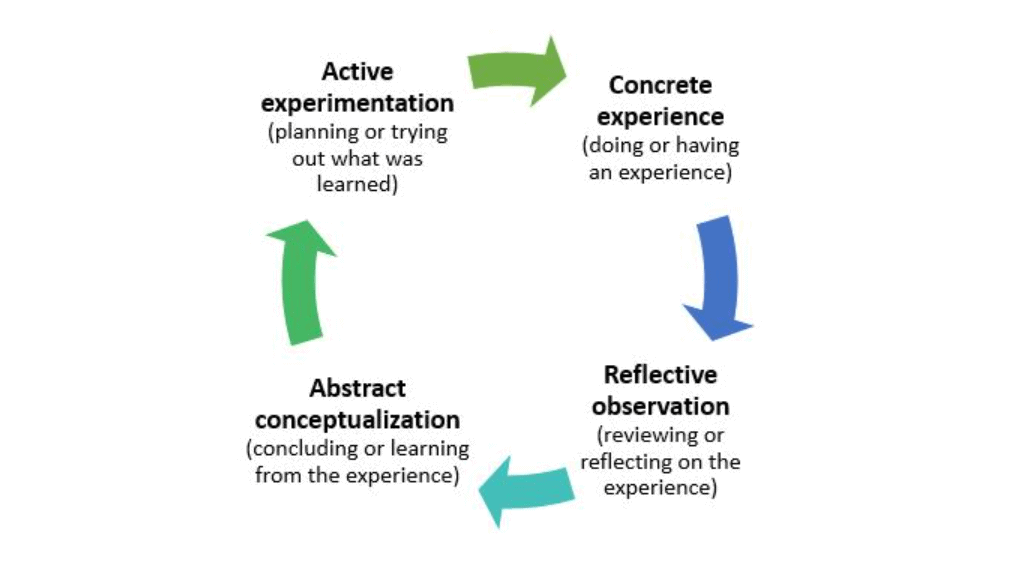
Graphic designed by Educational Technology.

1. Concrete experience

The learner encounters a concrete experience. This might be a new experience or situation, or a reinterpretation of existing experience in the light of new concepts.

2. Reflective observation

The learner reflects on the new experience in light of their existing knowledge. Of particular importance are any inconsistencies between experience and understanding.

3. Abstract conceptualization

Reflection gives rise to a new idea or a modification of an existing abstract concept (the person has learned from their experience).

4. Active experimentation

The newly created or modified concepts give rise to experimentation. The learner applies their idea(s) to the world around them to see what happens.

Kolb developed his four learning styles to illustrate different ways people naturally take in information:
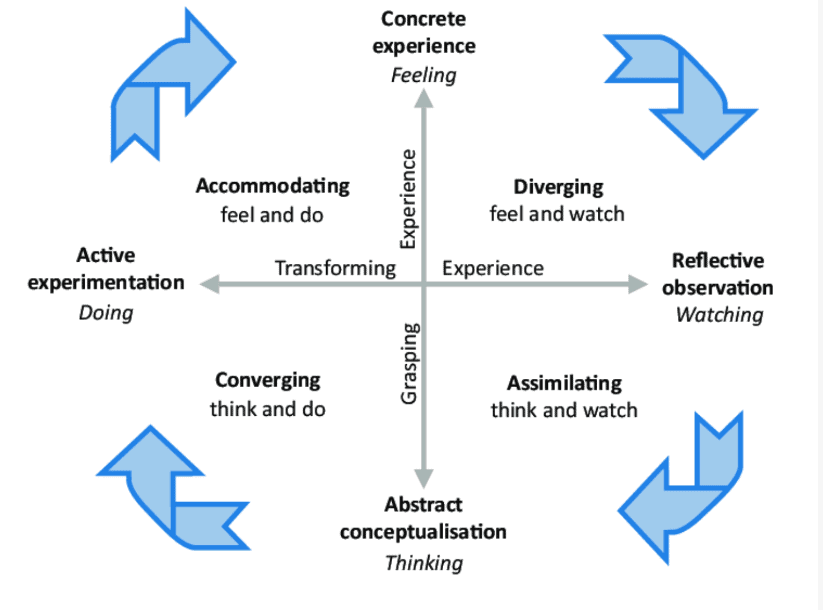
Graphic designed by Educational Technology.

1. Diverging (concrete experience/reflective observation)

Learners who prefer the diverging style are best at viewing concrete situations from multiple perspectives. They prefer to watch rather than do, tending to gather information and use imagination to solve problems.

2. Assimilating (abstract conceptualization/reflective observation)

Assimilating learners prefer a concise, logical approach. They require a clear explanation rather than practical opportunity. They excel at understanding wide-ranging information and organising it in a clear logical format.

3. Converging (abstract conceptualization/active experimentation)

Learners with a converging style can solve problems and will use their learning to find practical applications for ideas and theories. They prefer technical tasks, and are less concerned with people and interpersonal aspects.

4. Accommodating (concrete experience/active experimentation)

Accommodating learners are ‘hands-on’, and rely on intuition rather than logic. They use other people’s analysis, and prefer to take a practical, experiential approach. They are attracted to new challenges and experiences.

The STOP model for live debriefs during the event

The session also discussed the STOP model, which is useful for ‘in the moment’ debriefing (sometimes known as ‘hot debriefing’).

Stand back: take a helicopter view of a situation or problem.

Take stock: analyse what is happening in the moment.

Options: explore options around what you can do differently.

Proceed: step back in and take action. Then assess what impact your new approach has.

The features of a great debrief

  • Psychological safety and the notion of creating a calm, positive and supportive space.
  • An approach that underlines belief in the potential for great performance, that encourages learning and reduces defensiveness.
  • Reduces the impact of power differentials between leaders and those they lead.
  • It involves good questioning. Use open, non judgmental questions and be prepared to follow-up.
  • Focuses more on learning than results and allow time for reflection.
  • Strikes a balance between focusing on the positives and areas for improvement. People learn quickest by reinforcing what works.
  • Pays attention to group dynamics in order to get the best possible contribution from all individuals.

Members Only

25 Jun 2024

Articles

Egos, Arrogance or Vague Expectations – What Is Still Getting in the Way of Multidisciplinary Working at your Team?

Category
Leadership & Culture, Premium
Share
Facebook Twitter Email Copy Link
https://leadersinsport.com/performance-institute/articles/egos-arrogance-or-vague-expectations-what-is-still-getting-in-the-way-of-multidisciplinary-working-at-your-team/

There are some persistent challenges but intentional leaders and their teams can find ways to flourish.

By Luke Whitworth
How efficient is your multidisciplinary team?

The chances are that for all your fine work fostering a collaborative multidisciplinary team there are challenges you still face daily.

At a recent Leaders Virtual Roundtable, we encouraged members to reflect on areas where there is room for improvement and areas where they have made real inroads.

Some responses, such as limited time, busy schedules and the decentralised nature of some programmes were raised by members time and again but, below, we focus on communal challenges.

Common issues that prevent efficient collaboration

Misalignment of needs, expectations and responsibilities: such issues still endure, as evidenced by the number of members who mentioned the lack of alignment within departments and teams. One mentioned a lack of role clarity and, in turn, knowing with they should collaborate or bring into the conversation at the right times. Some cited the challenge of matching the expectations of individual staff and the collective needs of the team. Others noted situations where there are competing objectives and priorities.

Expertise bias: a Leaders member cited ‘discipline protectionism’, which resonated with most attendees. There are enduring examples of intellectual arrogance from some disciplines or an expertise bias that impacts communication, information sharing and can reduce general curiosity. These are all collaboration killers.

Team makeup: there are several elements here. Firstly, when team members are hired in at different stages there is a natural impact on the functionality of the team. There are also different personalities and communication preferences. Several attendees also noted that some environments are geared towards individuals highlighting their own impact and values as opposed to the greater good of the team.

Other considerations: the leader’s ego; a lack of psychological safety; finding the space and time for reflection; a lack of understanding about what optimal multidisciplinary work looks like.

Potential pathways to better collaboration

Centralised communication: can lead to a higher quality of comms between all stakeholders. Perhaps you can profile your team members and better communicate agreed expectations.

Consistent data capturing: when multiple departments are capturing data consistently, instead of sporadically, it can create more alignment around communication and collaboration with other disciplines.

Humble leadership: the leader or leadership team must be humble enough to accept when change or re-organisation is required. They need the humility to step back, evaluate their approach as a leader, as well as the situation, and enact change. This is where clearly defined needs and a common understanding are useful.

Clear standard operating procedures: a well-functioning system promotes better asynchronous information sharing. If you can outline standard operating procedures for communication between platforms it can prevent key information and messages being missed.

Team structure and role clarity: as a team leader, it’s worth considering the effectiveness of your onboarding and offboarding approach to minimise the impact. Diversity of thought is also essential, but it’s worth considering how to feed this into the design and operation of the team. One roundtable attendee suggested hiring an independent auditor to help outline role clarity, the sharing of best practices and, in general, promoting leadership – in essence, they act as a critical friend. Additionally, discipline or team leaders can create networks within their teams to enable such sharing. Another member explained that they have adopted a ‘team of teams’ approach e.g. a structure based on a ‘constellation’ of smaller teams that work together closely. It has yielded some positive results. Finally, in an effort to encourage a team-first approach, consider how you profile team members and communication of expectations.

What’s missing and what are the further opportunities?

Support for new leaders

How are you supporting new leaders in your teams? Often we see those in technical expertise or ‘tactician’ roles move up to a leadership position but lack the requisite skills to lead effectively. The role inevitably changes, so what are you or we doing to help them ‘lead’ their teams and embed true collaboration?

Robust and thoughtful feedback

Be intentional in creating a robust and thoughtful feedback mechanism that allows for variations of approach. Detailed feedback can support team learning on a consistent and ongoing basis. True, it can be a challenge, but therein lies the opportunity.

Psychological safety and empowerment

How can we better empower people more effectively to take targeted risks within their roles, whilst still feeling safe and secure? There needs to be a team-wide understanding of what psychological safety means and what it looks like in your environment.

Go to home
Follow us on Instagram Follow us on LinkedIn Follow us on X

Contact

Leaders UK

Tuition House
27-37 St George's Road
Wimbledon
SW19 4EU
London
United Kingdom

Enquiries Line: +44 (0)207 806 9817
Switchboard Number: +44 (0)207 042 8666

Leaders US

120 W Morehead St # 400
Charlotte
NC 28202
United States

Enquiries Line: +1 646 350 0449

Leaders

  • Contact
  • About
  • Careers
  • News
  • Privacy Policy
  • CA Privacy Rights
  • Cookie Notice
  • Website Terms of Use

Performance Institute

  • Membership
  • Events
  • Content
  • Virtual Learning
  • Connections
  • Partners

Latest

Intelligence Hub
High Performance Future Trends Research Elite Performance Partners continue to drive the potential in high performance forward through renewed Leaders partnership
Your Privacy Choices

© 2026 Leaders. All rights reserved

  • Privacy Policy

Attendees

x