21 Jun 2024
ArticlesThe NSWL’s Bay FC and the WNBA’s Golden State Valkyries are two expansion teams and both have women GMs. Here, we bring you the views Bay’s Lucy Rushton and the Golden State’s Ohemaa Nyanin.
In March, Bay FC began their inaugural NWSL campaign to great fanfare.
The club was co-founded by former US women’s national team stars Brandi Chastain, Aly Wagner, Danielle Slayton and Leslie Osborne, who propelled the project from an ambitious idea to a grand reality.
They hired Lucy Rushton as General Manager. Rushton, who was the second woman to serve as GM in MLS when she joined DC United in 2021, spoke at this month’s Leaders Sport Performance Summit at Red Bull in Santa Monica.
Rushton is no stranger to the Leaders stage having also spoken during her time at Atlanta United, whom she joined following excellent spells with Watford, Reading and the Football Association in her native England.
She sat next to another trail blazer, Ohemaa Nyanin, the newly appointed GM of WNBA expansion franchise the Golden State Valkyries, who will join the league in 2025.
Nyanin, a Ghanian-American, had been with the New York Liberty for five years, most recently as Assistant GM, jumped at the chance to bring further basketball prestige to this corner of southern California. She previously served as Assistant Director of the US women’s national team and helped Team USA to Olympic gold in 2016 and World Cup gold in 2018.
The duo delivered insights into how they are shaping the cultures of their nascent organisations; how they’re working or planning on working with their athletes; how they’ve chosen to lead; how they’re supporting their staff; as well as how they’re changing the sporting landscape.
Owners must establish the culture and values
The Bay culture was clear well before Rushton had even accepted her position: everything is about the people, from the staff to the players. The owners want everyone to be B-A-Y. That is:
Brave – the ownership want the franchise to be bold in the industry, pushing boundaries, breaking barriers by being innovative.
Accountable – the staff turn up everyday and are responsible for their actions and drive, and push themselves forward.
You – Bay FC also celebrate themselves as individuals and bring their true authentic selves to work every day.
The three concepts have helped shape the mindset each day and give the staff and players something tangible to hold onto. The organisation’s vision is to be a global sport franchise at the head of innovation and change.
How can these be measured? For Rushton, “it’s the feeling when you go to bed or wake up and how you feel about going to work the next day or that morning”. She believes the staff feel good and know they can influence what is happening; they know it’s a positive environment and everyone is striving for the same things.
Women’s sport should not simply replicate men’s sport
Rushton’s experience of men’s football taught her a valuable lesson. “Coming into a women’s franchise, it’s so important that we understand and appreciate the difference to men’s sport and don’t try and replicate it,” she said. The club has been intentional on that since day one and strives to be people-first, player-centric, and celebrates and promotes good female health.
With Bay midway through their first season, Rushton reflected on how the staff live the values every day. They all want to work hard, but care, kindness, and mutual support are just as critical for an expansion team. You need people who want to be there, who have the grit to go through the ups and downs, but support each other when you might not have the same resources as the teams that are 5 or 10 years old.
“How we approach training everyday and present ourselves to the players gives them energy,” she continued. “Which in turn the players buy into and end up energised and galvanised.” The key is how you present yourself and how you turn up and how you live by the standards that have been set, and the biggest factor is togetherness and collaboration of all departments.
Measure success through environment and collective wellbeing
Nyanin left a household name in the New York Liberty, but her goal is not to merely recreate that team in the Bay Area. Nor does she simply want to recreate the Golden State Warriors (Valkyries co-owner Joe Lacob is also the majority owner of the Warriors). Nyanin wants the Golden State Valkyries to stand alone.
She needs to find people that are interested in a vision of winning championships, in alignment with the ownership group. Success will ultimately be measured in trophies. They are the first WNBA expansion team since 2008, so Nyanin is considering what it looks like to build a successful organisation. She said: “We need to find individuals who are interested in being challenged every day, leaning into the team. Do you want to come to work everyday, and serve the athletes everyday in a way that provides for an innovative space, that provides for us to do what we know we can do, and how quickly can we get there?”
With this question in mind, Nyanin reflected on the qualities she seeks out as the Valkyries hire and write job descriptions. “Being an expansion team means you have to be entrepreneurial. By embracing the unknown can you be empathetic too,” she added.
Rushton asked Nyanin about measuring success from a cultural perspective rather than through championships. In response Nyanin said it is about the climate of the people that come in the door. “When we ask how you are doing they might say ‘I’m fine’ or ‘I’m good’, but if you say ‘how are you doing in the terms of a climate?’; so ‘sunny, or ‘cloudy’, or ‘rainy’ – it adds depth. A way of measuring success is how we can collectively come up with our non-results-based success criteria, how do we make it such so that everyone is sunny?”
For Nyanin, ‘sunny’ doesn’t mean super excited, or super extroverted – you can be introverted but still be sunny. Success is ultimately defined by how the Golden State Valkyries create their own definitions of safety in the workplace; it stems from executives to coordinators, to players, and even changing the way agents and external stakeholders engage with the organisation.
A culture born of diversity
We all know the saying about the best-laid plans, so Rushton and Nyanin spoke of the importance of allowing culture to shape itself. For Rushton, the critical moments are when things haven’t gone to plan. “How you react to things not going to plan is how you create culture. Actions taken in those moments show the players and staff what’s acceptable and what’s not,” she said.
Some decisions have been made that may have impacted performance outcomes but certainly reinforced their culture and values. They might have been a “nightmare” at times, but they’re critical. The backing of the ownership and the Head Coach, Albertin Montoya, helped give Rushton the confidence to go ahead. Showing the group that the leaders are aligned was powerful and gave them the confidence that it was the right thing to do and that the leaders had each others’ backs.
For Nyanin, it is important to give newly-hired executives their own blank slate to contribute to the masterpiece. She said: “If everyone has a different background, you have to listen to their ideas as they’re all coming from different spaces. So it’s still being architected from all different walks and types of cultural differences.”
This means that it’s important to Nyanin to have each executive bring their own unique experience. Through these different experiences and backgrounds the culture develops. This will bring challenges and added work, as you have forces leaders out of their comfort zones. It also means that you have to be willing to think differently.
“It’s like explaining basketball to children, who all ask ‘why?’ People from different backgrounds are going to ask why do we need to execute things this way, and will ask good questions, and bring contributions beyond asking ‘why?’”
In return, Nyanin believes that the athlete will benefit, especially the female athlete who comes with different complexities. “If your own staff can challenge you and ask you why before the athlete does, then you’re giving the athlete a space for them to feel safe to be elite at their sport.”
Athlete care is paramount
What about their appeal to female players? Bay spoke with the potential recruits about player-centricity of club and how they were going to elevate player care. From starting from a blank slate, they were able to accelerate mechanisms that can help with impacting the salary cap through player housing for example. The club emphasised treating them like the athlete they are in comparison to some of their poor experiences in other environments.
In Rushton’s experience, the priorities are very different to male athletes, where pay often dictates the direction of negotiations. With females, it’s about living standards and how the organisation will elongate their career. It’s important to give them confidence in the staff who would give them the best care, medical treatment, and infrastructure. Rushton is proud that, as far as she knows, the players have no complaints about the level of care and how the organisation treats them as female athletes.
On a day to day basis it boils down to two things in her mind. Firstly, helping them be in the best position they can be for the longest time possible and, secondly, to help them live a nice lifestyle outside of football.
This focus on player care resonated with Nyanin, who was pleasantly surprised at the rapid expansion of the NWSL given her own experience of the WNBA. Bringing it back to athlete experience is hugely important because, in WNBA, athlete experience tends to focus on ‘how you do get elite talent to come through?’ Nyanin explained that longevity in the sport is different, although is it changing, because the majority of the athletes play six months in the WNBA and then go and play overseas where the conditions are often worse, but they’re getting paid more money. “Understanding the motivations of the athlete prior to them coming to your organisation and engaging in your space is important,” she said.
Attracting elite practitioners from male sport
How might top level practitioners be attracted from historically better-funded male sports? Both Nyanin and Rushton believe that efforts must be based on the vision, culture and concepts the organisations trying to build.
For the Valkyries, as Nyanin explained, the vision is to “build the best, to be the most elite, to build a space where people feel they’re being heard and their ideas being executed in a way that results in excellence. Why wouldn’t you want to come? How can I create an environment for you to thrive, and how can we do that together?”
Rushton agreed. She said: “it shouldn’t be about the gender. It does matter though – many wouldn’t be right for women’s sport. I want to make you the best practitioner in what you do, and give you the platform to excel in your specialisation.”
New franchises means recruiting for those who are willing to challenge themselves and go outside the box with their thinking. It becomes about finding the people who are comfortable with the associated risk in order to better themselves. Rushton believes they have to “believe that they can go there and make a difference.” Rushton also observed that, “a lot of males would find it refreshing to come to a female athlete team because it’s a totally different environment, with totally different feeling and vibe.”
For Rushton herself, when she moved from men’s to women’s football there were two main factors that drew her in:
How fans contribute to a team culture
There remains another crucial component of a team culture: the fans.
The final moments of the session were used to discuss how both Nyanin and Rushton, and their organisations, are forging connections with their fans. As Nyanin said, fans expect communications, but there are times when you can’t share with them. This is a dilemma considering that the fans are also investing in the franchise and so they deserve communication. It becomes about finding the balance around what to do when things aren’t going well. Working on being honest in their communications so that the fans understand that the leaders and everybody involved is working to solve any issues.
Similarly, Rushton and Bay have been deliberate in how they present the organisation to the fans. The Business Operations team at Bay go to the fans and ask them to bring the energy and passion; to be part of their story. They seek to empower the fans and have them be part of the journey. Bay have gone out to the community, had fans come and watch training, and prioritised outward action in the build-up to launch. People now want to be a part of their journey.
Rushton spoke of how Bay deliberately tell the stories of their players. This means that people become invested in the emotional side of who the player is, so if the team lose a game, the fans are more invested in the person than the result. The outcome is one of which she is proud and the Valkyries hope to emulate. “The fans have fallen in love with the team, despite the record.”
Results will surely follow but, here and now, both women are intent on proving that new women’s sports teams are not only viable but can thrive.
Some cultural leaders are front and centre, but many work from the wings to deliver the success their teams crave. Here are some steps you can take to ensure your team has its cultural leaders too.
Those leaders can be athletes, such as England captain Harry Kane, who will lead the Three Lions in their Euro 2024 campaign. Or Breanna Stewart, the New York native who returned home in 2022 and led the Liberty to the 2023 WNBA Finals; bagging the league’s MVP in the process.
Kane and Stewart are the embodiment of local heroes who have done well, particularly if you include Kane’s remarkable spell at Tottenham Hotspur.
Then there are coaches who represent an expression of the systems that enable their programmes to excel. On that front, one can point to Kane’s international manager, Gareth Southgate, who has overseen England’s most successful spell since the mid-1960s.
Cultural leaders, however, need not be so high profile. They operate at all levels of an organisation, independent of job title or seniority. Do you recognise the cultural leaders in your team? What steps can you be a better cultural leader?
Cultural leadership – the super enabler
The link between leadership and sustained success is the centrepiece of a research project run by Edd Vahid, the Head of Football Academy Operations at the Premier League.
In June 2022, the business and leadership consultancy commissioned Vahid to undertake a piece of research to discover the ‘secrets of culture’. Two years later, this project, titled ‘Cultural Hypothesis’, is on the cusp of publication.
Ahead of its release, Vahid is leading a three-part Performance Support Series at the Leaders Performance Institute that seeks to explore the enablers in high performing cultures.
The first session, which took place in early May, was a useful way of testing the importance and relevance of the four enablers highlighted by Vahid in the Cultural Hypothesis: purpose, psychological safety, belonging and cultural leadership.
The second, which took place in early June, homed in on cultural leadership, specifically how leaders might change or sustain a culture. The concept is, as Vahid described, a “super enabler” for your sense of purpose, belonging or even psychological safety.
Culture should be an accelerator and energiser
In the session, Vahid observed that organisations are increasingly deliberate and intentional about culture because they see it as a competitive advantage. It is not a one-time annual event – it’s a regular part of ongoing conversations.
This is lost on some organisations, as Jon R Katzenbach, Illona Steffen and Caroline Kronley wrote in the Harvard Business Review in 2012:
‘All too often, leaders see cultural initiatives as a last resort. By the time they get around to culture, they’re convinced that a comprehensive overhaul of the culture is the only way to overcome the company’s resistance to major change. Culture thus becomes an excuse and a diversion rather than an accelerator and energiser’.
Four ways to get to grips with your culture
To understand culture you need keen observation and data collection. Vahid proposed several useful tools:
During the Korean War, John Boyd, an American military strategist and fighter pilot, devised the OODA Loop as a decision-making process designed to emphasise adaptation and agility in four stages:
Organisations can apply the OODA Loop to assess and respond effectively to cultural dynamics.
Vahid also pointed to other efforts to collect data around culture, such as UK Sport’s ‘cultural health check’ or retail giant Selfridges using data to better understand their most culturally-stressed communities.
Vahid also stressed the importance of critical incident reviews to help observe culture during specific moments such as exits, inductions, wins and losses.
Teams can also find their place on the Sigmoid Curve, a common model for tracking organisational growth and decline. At each stage, expectations can change, which affects what we see, hear and feel.
Five Steps Towards Cultural leadership
Vahid explored five steps that can help a team to develop cultural leaders.
5 Jun 2024
ArticlesThe May agenda was dominated by cultural enablers, the fundamentals of communication and the impact of mental skills work.
Those three, different as they are, share a reputation for sustained high performance and, as such, represent the profile we had in mind as we picked May to launch of our latest Performance Support Series.
That series – which has two sessions still to run at the time of writing – was just one of the opportunities on offer to Leaders Performance Institute members through their membership during the course of the month.
There was much more besides and The Debrief is designed to keep you on the pulse of contemporary thinking across the high performance space. Do check out some of our upcoming events and virtual learning sessions to help you to connect, learn and share with your fellow members from across the globe.
Four interconnected cultural enablers
We have all asked ourselves this question at various times but Dr Edd Vahid and Management Futures decided to delve a little deeper.
In June 2022, the business and leadership consultancy commissioned Vahid, the Head of Academy Football Operations at the Premier League, to undertake a piece of research to discover the ‘secrets of culture’. Two years later, this project, titled ‘Cultural Hypothesis’, is on the cusp of publication.
Ahead of its release, Vahid is leading a three-part Performance Support Series at the Leaders Performance Institute that seeks to explore the enablers in high performing cultures.
The first session, which took place in early May, was a useful way of testing the importance and relevance of the four interconnected enablers highlighted by Vahid in the Cultural Hypothesis: purpose, psychological safety, belonging and cultural leadership.
Vahid explored each enabler in turn.
Questions for you to consider in your organisations:
Questions for you to consider in your organisations:
Questions for you to consider in your organisations:
A question for you to consider in your organisations:
Achieving communication nirvana
Win, lose or draw, teams are constantly in transition and, as such, they need different things from their leaders at each stage in their development.
This can be tricky because you can’t shortcut the development of rapport, belonging and trust – all are critical to team development and effective transitions – and yet teams and leaders still face pressure to perform now.
That comes down to good communication, as discussed in a recent Leadership Skills Series session.
In fact, it is worth exploring five levels of communication as experienced in a team setting. It is useful to think of the following as a pyramid. Teams begin at No 1 and work towards No 5, with increasing exposure to risk, vulnerability and criticism at each level.
Five fundamentals when measuring the impact of your mental skills work
In the modern landscape of high performance sport, we often here the phrase ‘everything that is managed is measured’.
Such is the desire to show impact and return on investment, we are indeed measuring much of what can be measured.
Nevertheless, it can be difficult to measure the impact of areas such as coach development work or, as discussed in a recent Virtual Roundtable for Leaders Performance Institute members, mental skills work.
While it is tempting to jump into the measuring process, it is important to first build some pre-requisites.
Nobody said it was easy, but there are steps that all leaders can take to be better prepared.
This can be tricky because you can’t shortcut the development of rapport, belonging and trust – all are critical to team development and effective transitions – and yet teams and leaders still face pressure to perform now.
This topic was at the heart of a recent Leadership Skill Series session, which was attended by Leaders Performance Institute members. All in attendance agreed that for a team to reach its full potential, every individual needs to have a sense that their team has invested in them and they need to be invested in the team too. Everyone needs to buy-in.
What steps can you take to reach that point?
Five levels of communication in teams
Before we delve into the five key transitions for teams, it is worth exploring five levels of communication as experienced in a team setting. It is useful to think of this as a pyramid. Teams begin at No 1 and work towards No 5, with increasing exposure to risk, vulnerability and criticism at each level.
With these in mind, let’s get into those transitions.
There are five key transition scenarios experienced by teams:
These transitions can be both expected and unexpected. Dynamic team environments require adaptability, resilience and a commitment to continuous growth. By navigating these transition points with purpose and intention, teams can cultivate an environment of collaboration, innovation and excellence that propels them towards their collective aspirations.
Start off by building rapport fast. Don’t wait for trust to arrive. In any team development approach, you need to spend a significant amount of time upfront developing rapport and trust before you are ready to do anything else. You can measure this by assessing where everyone is at in the five levels of communication (see above).
Learn quickly about others’ strengths, weaknesses and working styles. Seek to understand from each individual what are they hoping to bring to the team.
Give people a sense of contribution and that everyone has a part to play. As the leader, set a clear, simple vision and specify what part each person has to play in this.
Clarify ‘the rules’ of the team and consider the creation of a team charter around standards, behaviours and values. Remember to involve the team in creating the charter because if there is that ownership, you tend to find the team set higher standards than the leader would, and that in turn raises the bar.
It can be easy to assume that it is the old team plus an additional person. This isn’t the case. When a new person joins or one leaves, this influences the team dynamic. As a leader, you need to be cognisant of this and be prepared to revert to the bottom of the communication pyramid (see above) at first to build back up again with group alignment.
It sounds simple but help create opportunities for the new person to introduce themselves, get to know others and have a sense of belonging in the team.
Closely aligned to this, invite individuals to contribute straight away to heighten that sense of belonging, as well as emphasising their strengths and how they can contribute both individually and across the team.
Beware of the ‘magic helper’ syndrome. There is a tendency in teams for a piling up of jobs the new person can take on. We don’t want to put a heavy load on straight away and hope they are the ‘magic person’ who will solve all the problems. Onboarding cleanly and intentionally is important.
This is arguably one of the more trickier transitions, but one that is also very common.
Beware of ‘Year Zero’ syndrome. As a new leader coming in, show respect to the past. Don’t be dismissive of the past. Some colleagues may have worked there for a long time and have fond memories of the previous leader or team dynamic. Naturally, it will change but it’s important not to disrespect it.
Seek to build rapport. Some social time is useful for the team to learn who you are. The more they know about you the more they are likely to open up about themselves. The leader must support their team in having access to informal networks as well as formal ones.
Arrange one-to-ones as well as team meetings. Develop the relationship.
Allow for some ‘mourning’ of the previous leader. You can’t embrace the new without letting go of the past.
Give people your picture of the future. Give the purpose behind how you see the picture, why you are doing what you are doing. Outline broad plan of action. Be very clear on giving each person in your team clarity about the part they play so they feel connected to the vision.
It’s important to acknowledge disappointments. Don’t shy away from it. Process it as a team. We discuss the use of visual methods such as timeline reviews to show the wider picture and journey.
Review the lessons learned from the disappointment and use these to inform the resetting of the team’s vision and goals. As part of the review process, don’t lose sight of what is still good and what you do well.
As a leader, offer and show thanks to the team. The rapport and relationship within the team will be crucial to getting back on track.
Success is also a significant transition point in teams. It’s a culmination of the great work the team has done, but also a chance to reflect on what next and how to get better.
Ensure you celebrate the success to enhance team cohesion. At the same time, stay humble as the likelihood is that other teams or the competition will have learned from your success.
Just as you should give thanks in disappointment, the same goes for responding to success. Similarly, conducting a lessons-learned review after winning is just as important as when you don’t win.
A very simple but powerful question a leader can ask their team is ‘what percentage of our potential have we actually reached?’ The answer is rarely 100%, therefore it creates an opportunity to engage in high quality conversation around what next and how we improve again.
And when transition messages are unwelcome…
Vulnerability is powerful, especially in candidly telling the team anything that you don’t know.
Don’t act the victim and be aware of your communication to your team.
Be emotionally open and honest, admitting to any discomfort, but also express honest positive emotion.
It doesn’t all have to be perceived negatively. Point out any potential advantages of the transition.
Similarly, emphasise what will stay the same through the transition. We know human beings don’t like change, so this should bring about some comfort.
Create a clear ‘call to action’ with next steps specified to outline the roadmap to moving forwards.
Self-development, difficult conversations and allyship were on the agenda for the latest Women’s High Performance Community call.
We spoke about self, or personal, development, as well as career development, and the place for each before turning our attention towards difficult conversations and allyship.
There is no doubting that those who joined the call are committed to their development. However, no one felt like they have a well-structured development plan that they simply were not following.
Currently, there’s a general sense that a lot of effort is driven by the individual – reflecting upon this, it’s potentially what those guiding us are told to do.
However, there is a request for more structure, confidence, time and opportunity from above to elevate the impact of our development.
It also came across from the call that many have big obvious blocks of learning, through courses or further education, but struggle to have a clear plan if those aren’t in place or if they are between courses. There are also those, who are doing a lot of learning simply by doing their job each day, which is where reflective tools and support from above can be powerful.
The Women’s Community suggested these five ideas as ways to make development as impactful as possible:
Other examples that we’ve seen work too:
Visits to different organisations – and having others visit you. This helps avoid echo chambers and benchmarks our practices against others. This becomes increasingly important if our only working experiences are in a single organisation.
Whole team development on specific skills. Having a whole team approach can help avoid siloed learning and contribute to learnings sticking.
It’s always good to remember that we need to leave space for stretch and being in uncomfortable positions. Again, these moments become more impactful if we can reflect on them and shape our development plans as a consequence. Finally, remember: some people’s development is focusing on saying no.
The Community once again spoke about the importance of our networks and brands to career development and shared the following reflections:
The Community then shared advice for when having difficult conversations:
Difficult conversations can take several forms – they do not necessary involved conflicts or saying no. There’s a range: it could be talking to a new person or even when you are taking steps to change the dynamics and the way things have always been done.
There are stories of female coaches in an otherwise male coaching team stepping out of their comfort zones because their approach to coaching is different. In one particular case, the female coach boosted her confidence by reminding herself that she’s adding to the discourse, providing different inputs and possibilities, and a platform for conversation.
We know that women are different, and that in sport women are often in a minority; so it would be easy to understand why we might doubt ourselves in these moments. However, we can retrain ourselves to not think in this way.
One additional approach that can help us is to have the conversation as part of a regular update session, so it’s not ‘singled out’ as having the need for a difficult conversation.
So what would we want an ally to support us with to enable us to be our most confident selves going into these conversations? These were some of the group’s suggestions:
15 May 2024
ArticlesDr Edd Vahid kicked off his latest Performance Support Series with a discussion of the traits that define cultures at the top of their game.
We have all asked ourselves this question at various times but Dr Edd Vahid and Management Futures decided to delve a little deeper.
In June 2022, the business and leadership consultancy commissioned Vahid, the Head of Academy Football Operations at the Premier League, to undertake a piece of research to discover the ‘secrets of culture’. Two years later, this project, titled ‘Cultural Hypothesis’, is on the cusp of publication.
Ahead of its release, Vahid is leading a three-part Performance Support Series at the Leaders Performance Institute that seeks to explore the enablers in high performing cultures.
The first session, which took place in early May, was a useful way of testing the importance and relevance of the four enablers highlighted by Vahid in the Cultural Hypothesis: purpose, psychological safety, belonging and cultural leadership.
Vahid explored each enabler in turn.
Most sustained high performing cultures have an inspiring purpose. Vahid referred to clothing brand Patagonia, which says ‘we’re in the business to save our home planet’ and its every action is driven by that purpose. This example calls to mind the work of Alex Hill who, in his book Centennials, suggests that organisations that have sustained success over a long period of time have a stable core and a disruptive edge. According to Hill, it is important that your purpose doesn’t fluctuate too much or disappear because its has the power to help your organisation shape society and enable you to effectively engage future talent.
Another aspect of ‘purpose’ is the idea of individual and organisational alignment. Those organisations that are tending to culture regularly are taking the time to consider how their purpose resonates at an individual and organisational level.
Questions to consider:
In The Fearless Organization, psychologist Amy Edmondson suggested that ‘making the environment safe for open communication about challenges, concerns and opportunities is one of the most important leadership responsibilities in the twenty-first century’.
The findings of Vahid’s ‘Cultural Hypothesis’ suggest that cultural leadership plays a fundamental role in an individual’s experience of psychological safety. In the session, he referred to Netflix, which has adapted its in-house feedback mechanisms to ‘lead with context and not control’ (concepts that are highly aligned and loosely coupled).
Questions to consider:
Owen Eastwood, in his seminal book Belonging, wrote that ‘our senses are primed to constantly seek information about belonging from our environment. We are hardwired to quickly and intuitively understand whether or not we are in a safe place with people we can trust’.
Organisational anthropologist Timothy Clark also highlights a bridge between psychological safety and belonging in suggesting that the first level of psychological safety is the idea of inclusion safety – you belong to something.
New Zealand Rugby provide a case study in this area, as the theme of belonging is central to their philosophy. They recognise the diversity of their playing groups. They invest in their inductions, and there’s some literature that highlights the importance of your sense of belonging on entry and the critical process of effective inductions to ensure from the very outset that you feel like you belong in your environment. There is a regular and considered approach to belonging cues and rituals that reinforce the idea that people belong, and that could be as simple as ensuring that people’s voices are heard.
Ultimately, we want to get people to a point of challenge. The most optimal environments where there is a high degree of psychological safety is where individuals feel comfortable to challenge.
A question to consider:
An inspiring purpose is essential, a psychologically safe environment is crucial, and a sense of belonging exists as a fundamental human need. Coupled with exceptional leadership, these elements distinguish cultures that thrive.
Leadership is presented as a crucial and critical part of Vahid’s ‘Cultural Hypothesis’. It feels central in that it is seen as a super enabler, that when you’ve got strong and aligned cultural leadership it will be a precursor, certainly to psychological safety and belonging.
Questions to consider:
The four traits of the ‘Cultural Hypothesis’ ranked by members
Vahid invited attendees to rank their current satisfaction with these enablers. This offers a snapshot of the state of play across elite sport, particularly in North America, Europe and Australasia:
Other reflections on culture
The ‘Iceberg Effect’
The discourse prompted a further question on the nature of ‘culture’. Vahid cited the work of psychologist Edgar Schein on the ‘Iceberg Effect’. Schein’s model likens culture to an iceberg: what we see (artifacts) is just a fraction of what lies beneath (espoused beliefs and assumptions). This is how that may look in a sports organisation:
Culture: a ‘group phenomenon’
The ‘Iceberg Effect’ chimes with the work of business academic Boris Groysberg who in 2018 co-wrote an article in the Harvard Business Review with Jeremiah Lee, Jesse Price, and J Yo-Jud Cheng. They defined culture as:
[1] ‘The Leaders Guide to Corporate Culture’, Harvard Business Review, January-February 2018
If you are interested in joining the second session of this Performance Support Series with Dr Edd Vahid on Thursday 6 June, sign up here.
13 May 2024
ArticlesThe Real Madrid Head Coach is the antidote to the systems-based, top-down coaching approach that is in vogue in some quarters.
The team’s Head Coach, Carlo Ancelotti, who recently signed a contract extension until 2026, has his own record to pursue: a victory over Borussia Dortmund in north-west London would see him claim his fifth Champions League title as a coach.
Last week Ancelotti also eclipsed Sir Alex Ferguson’s record when he coached a Champions League match for a record 203rd time. It comes after a weekend when he won a second La Liga title with Real.
The club paraded that trophy on an open-top bus through the streets of Madrid at the weekend, with Ancelotti living up to his ‘Don Carlo’ nickname by putting on his sunglasses and clenching a cigar between his teeth – a look he first rolled out during similar celebrations after winning the Champions League and La Liga double in 2022.
“I have a dream… to dance with Eduardo Camavinga,” he told the crowd on Sunday (12 May).
Ancelotti is the ultimate establishment figure, yet his relaxed, consensus-based approach to coaching is at odds with many of his contemporaries and marks him out as counter-cultural at the highest level.
What makes Ancelotti so successful? It’s certainly rooted in his zest for life; his love of people, good wine and fine food serve to break down barriers and forge connections. It speaks to his longevity too.
Here, the Leaders Performance Institute explores four of his finest traits.
It is hard to imagine too many of the world’s best football coaches bringing players in at the planning stage. While the final decision lies with Ancelotti, he will often ask the players for their opinion on the match strategy. He knows they will have a better understanding and feel a sense of accountability and buy-in if they’ve been involved in the decision-making process.
“Our biggest strength is that he finds a way to let a lot of the boys play with freedom, that we’re so kind of off the cuff.” Real’s Jude Bellingham told TNT last month. “As a man as well, he fills you with calmness and confidence.” Real have not always been a club noted for their calmness, nor has Madrid as a sporting market, but progress has been serene during his latest tenure.
“There are two types of managers: those that do nothing and those that do a lot of damage,” he said last week. “The game belongs to the players.”
This is a term we’ve used before to describe Ancelotti. It is impossible to pin a style on the only coach to have won national championships in five countries with five different clubs: Milan, Chelsea, Paris St-Germain, Bayern Munich and Real Madrid (across two spells). He has also worked with varying degrees of success at Reggiana, Parma, Juventus, Napoli and Everton.
Some of those spells are remembered more fondly in some quarters than others, but he has always stressed the importance of getting to know the characteristics of players, the culture, and traditions of a club.
Even if something has made him very successful at one club, he won’t just come in and impose that style on another. Ancelotti understands that there are many cultural differences from club to club and within different countries, and he has to adapt his style to get the best out of the players and team.
His time at Chelsea between 2009 and 2011 is a fine example. He discarded the 4-2-3-1 formation that served him so well at Milan for a 4-3-3 that propelled the Blues to the Premier League and FA Cup double in 2010.
“What I really loved about Carlo is his man-management, the way he adapted as well – because he had a way of coaching that probably didn’t suit English football,” John Terry, Ancelotti’s captain at Chelsea, told The Coaches’ Voice in 2020. “But he adapted very quickly when speaking to me, Frank [Lampard], Didier [Drogba].”
There are few coaches for whom it is so hard to find a bad word about them, but Ancelotti is popular with some of the sport’s biggest names.
“He had fun with us,” Cristiano Ronaldo told ESPN in 2015. The duo had won the Champions League together at Real a year earlier. “Mr Ancelotti was an unbelievable surprise. In the beginning, I thought he was more a tough person, more kind of arrogant, and it was the opposite.”
He protects his team from the stressors of elite football by masking the pressure he’s under. Ancelotti takes the situation – but not himself – seriously, and can often be found telling jokes in the changing room before a big game to help diffuse the tension.
Bellingham described a moment prior to the first leg of Real’s Champions League quarter-final with Manchester City. “Before the game, I caught him yawning and asked him ‘Boss, are you tired?’” Bellingham told TNT post-match. “He said ‘you need to go out and excite me’ – that’s the calmness and confidence he brings.”
Few coaches in European football are as equanimous as Ancelotti. He has enjoyed unprecedented success but has also been unceremoniously sacked on more than one occasion. Memorably, he was not Real’s first choice when he returned to Madrid in 2021.
‘[He] understands, probably better than anybody working in the most cut-throat businesses, the transient nature of employment in any talent-dependent industry,’ wrote Chris Brady, in Quiet Leadership, the 2016 book he co-authored with Ancelotti.
He is well aware of the concept of ‘energisers’ and ‘sappers’ too. ‘It is the energisers who are the reference points for everybody, including me,’ Ancelotti wrote in Quiet Leadership.
Ultimately, beyond the white noise, Ancelotti understands that football is not life and death, a point he made at the 2015 Leaders Sport Performance Summit in New York.
“Football is the most important of the less important things in the world.”
As this session of the Leadership Skills Series demonstrated, we can all become better leaders by developing trusting relationships.
For the latest edition of our Leadership Skills Series, we explored the art of persuasion. All leaders in sport have the potential to influence others’ thoughts, feelings or actions through effective communication and interpersonal techniques.
The session highlighted four related areas of focus.
Trust is rightfully acknowledged as the cornerstone of effective leadership and the foundation of relationship-building. To unpack all of that we turned to the Trust Equation. It is a conceptual formula used to describe the components that build trust in professional and personal relationships. It’s often represented as: 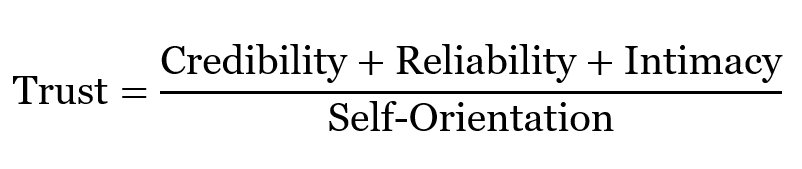
This is what each component means:
Credibility speaks to words and credentials. How authentic are we?
Reliability is the perception of a person’s integrity. Do you do what you say? Are your actions connected to your words?
Intimacy involves the feeling of safety or security when sharing information with someone. How safe or secure does the client or colleague feel in sharing with us?
Self-orientation reflects the degree to which a person’s focus is directed towards themselves as opposed to being focused on others. What are our motives? For our benefit or the benefit of others?
The higher the numerator (credibility, reliability, intimacy), the greater the trust. Conversely, the higher the self-orientation, the lower the trust. Ultimately, the equation serves as a mindful tool to enrich discussions, elevate trust levels, and deepen relationships within our teams.
When leading a team or a department, it matters how you are perceived by others. The ability to self-assess your personal status is another strategic tool wielded by seasoned leaders to convey confidence and authority. It includes an assessment of your:
Such elements can be ranked on a scale from 1 (‘low status’) to 10 (‘high status’) and, when done sincerely, this can be an invaluable guide for navigating various workplace scenarios and can even foster emotional intelligence, which is pivotal in forging genuine connections with athletes and team members. It can also facilitate the development of more impactful leadership skills that inspire and motivate with greater efficiency.
Flows of logic are the pathways our minds create to connect ideas and evidence to reach a reasoned conclusion. They are essential in critical thinking, problem-solving, and, of course, forming persuasive arguments. Flows of logic involve a sequence of statements or steps that follow one another in a rational and coherent manner. These frameworks can take three different forms, depending on your scenario:
These can be indispensable guides when constructing persuasive arguments. By grounding our narratives in these logical flows, we enhance storytelling capabilities and foster deeper connections with our teams. This pragmatic approach ensures proactive, relevant support while avoiding unnecessary complexity, thereby maintaining clarity and engagement, particularly in high-pressure situations where decisive leadership is paramount.
If you can put those three factors together then you can be better at delivering your message. Mindful communication is another tool upon which you can rely. This idea urges leaders to remain present and deliberate when communicating. It can help a person to:
The members in attendance discussed the success and failure of these elements in the context of people that ‘think to speak,’ and those that ‘speak to think’.
Here are some effective mantras to keep in mind:
Final reflections
As members reflected on the transformative potential of incorporating these persuasion techniques into their leadership repertoire, they described the following as essential steps towards mastering persuasiveness in your leadership approach:
In the final Leadership Skills Series Session of 2023, we focused on this increasingly essential skill, from the required mindset to the need to understand your boss.
It is a popular topic of conversation within the Leaders Performance Institute for those overseeing departments or who have direct lines into executive leadership or board level personnel.
Throughout this session we focused on some key concepts for managing up effectively, taking time to discuss and share best practices around:
Your mindset towards the relationship
Before exploring some of the practical examples of effectively managing up, we need to set the tone through ensuring the right mindset is in place to approach this. Leaning on the work of Richard Boston in The Boss Factor, we focused on four different mindsets you could engage with as part of the relationship and process of managing up.
Boston offers a useful framework to reflect on this mindset towards your relationship with your boss. The key insight from Boston’s framework is to consider the impact of this mindset on the relationship, notably your engagement, motivation and ability to manage up. These are the four mindsets on which we focused:
Understanding your boss
We previously explored your mindset towards your relationship with your boss. As an extension to this point, understand their drivers and pressures so you can both support them and understand their point of view will boost you ability to be collaborative in the conversations.
What can you consider about your boss or direct report which will support these conversations?
Understanding yourself
We’ve evaluated the drivers and pressures of the person you are managing up to. As part of this process we also need to increase our self-awareness around our trigger areas. Before engaging in these interactions, do you have a clear understanding of your own thoughts and feeling to the below?
Proactively develop the relationship
Finally, how can we proactively develop the relationship to make managing upwards effective and collaborative? Below are nine considerations for you to reflect upon:
21 Sep 2023
PodcastsIn our latest podcast we catch up with the individuals behind Serial Winning Coaches, Professors Cliff Mallett and Sergio Lara-Bercial as they discuss their new book Learning from Serial Winning Coaches.
“But they know that staying ahead means having healthy relationships of mutual trust and care with the people that they work with.”
Cliff and his colleague Sergio Lara-Bercial join Henry Breckenridge and John Portch for this episode to discuss their new book Learning from Serial Winning Coaches: Caring Determination.
In an extended chat we delve into:
Learning from Serial Winning Coaches: Caring Determination is published by Routledge.
Henry Breckenridge Twitter | LinkedIn
John Portch Twitter | LinkedIn
Listen above and subscribe today on iTunes, Spotify, Stitcher and Overcast, or your chosen podcast platform.