Head Coach Chris Fagan laid the foundations for the Brisbane Lions’ 2024 AFL Grand Final success with three big steps.
Their premiership success was not a bolt from the blue – they had reached the Grand Final a year earlier – but it was a far cry from the 18th place finish the Lions managed in 2017, which was Fagan’s first campaign at the helm.
He appeared at the 2023 Leaders Sport Performance Summit in London – just weeks after Brisbane narrowly lost the Grand Final to Collingwood.
There were no guarantees that they would make the decider again in 2024 but Fagan, who had his doubters in Australia, transmitted confidence from the Oval stage. “Last year [2022], we lost the preliminary final by 71 points. A lot of people said we wouldn’t recover from that,” he said. “This year, we made a Grand Final and lost it by four points. I said to the players, ‘we’re getting better, we’re getting closer. We’ve been the most successful team over the last few years. Be proud of that. The team we played in the Grand Final is older and more experienced, so that’ll be good for us.”
So it was to prove. But the focus here is those early years, when Fagan worked to turnaround a faltering team. It was only in year three, when the team jumped from 15th to 2nd in the AFL ladder, that his methods were vindicated by points and victories.
There were three factors that underpinned Fagan’s approach.
In 2017, Fagan arrived with his vision for a high performance culture. In outline it bore some familiar features:
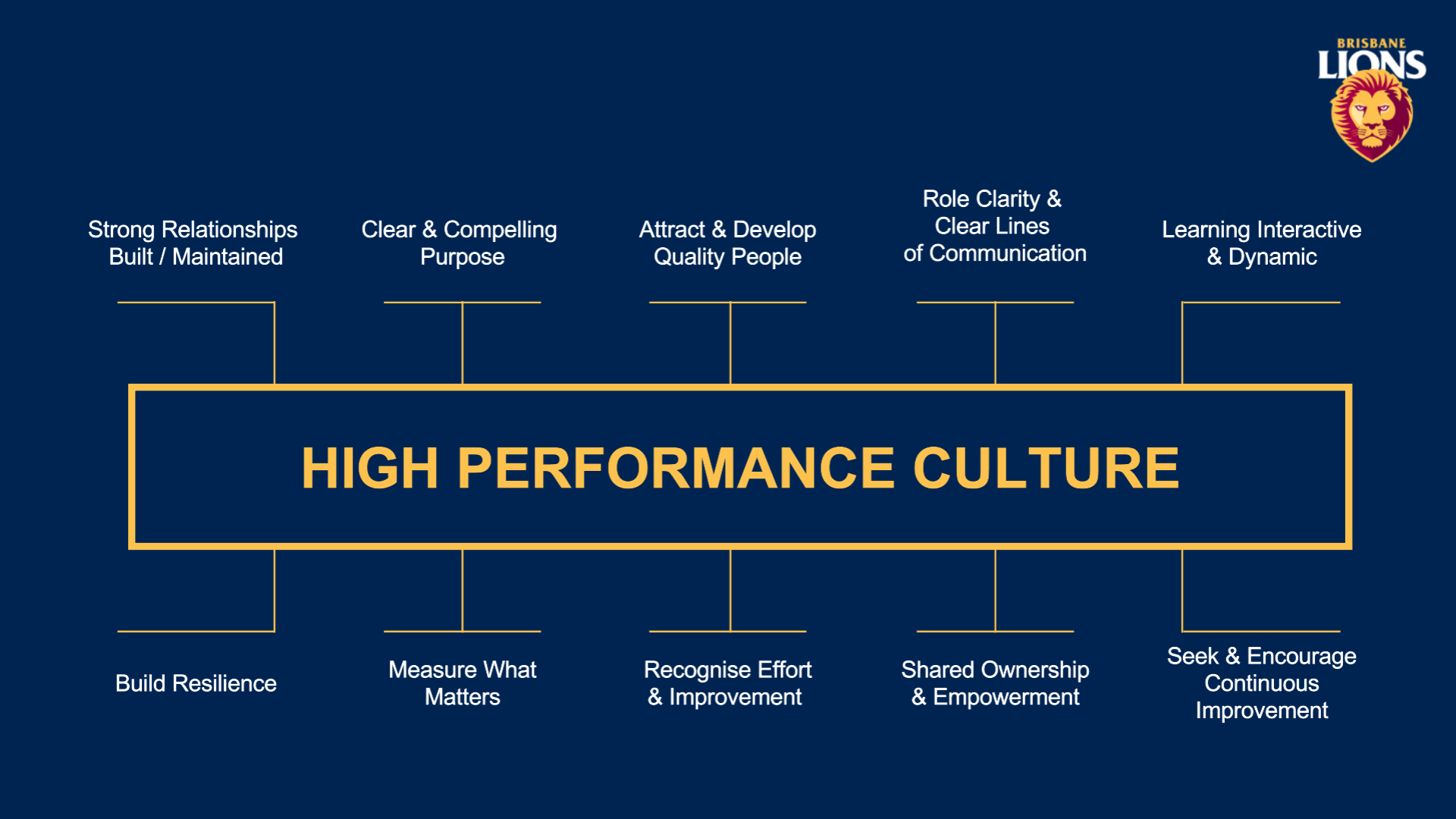
But in order to deliver this through a strategic plan, Fagan needed everyone onside. It wouldn’t be easy in what had become a “poor bugger, me” environment. “I discovered that many of our players preferred to be in rehab than to be actually playing – it was safer there,” he said.
Over the course of four weeks he solicited the views of every player and member of staff. “I wanted to send a message to everyone at the club that they would be listened to, that it wasn’t just me coming in and telling them what was going to happen,” he added. “I wanted to find out what they thought the club needed to do to become better because they needed to be partners with me in the process. I think they appreciated that because they hadn’t had a process for a long time. They’d just been told what to do.”
This brought him trust and credibility during those first two seasons when there was barely a flicker of improvement in scoreboard terms.
Fagan is a big believer in high challenge, high support for players in pursuit of their goals. The challenges were plain to see in 2017, and the first measure of support came from Fagan himself. “I see myself as the chief energy and psychological safety officer,” he said onstage. “I want to build an environment where the players and staff feel trusted and motivated, because that certainly wasn’t the case when I turned up.”
Even as the poor results endured, the team’s morale did not falter. “You’d have said we were the happiest bunch of losers during the early years,” says Damien Austin, the club’s High Performance Manager. “We celebrated everything because we were such a young team.” That included winning quarters of games, strength gains or running PBs in training. “We were always striving for progression,” he continues. “And if there wasn’t progression there’s a reason why, and I think like any young kids today, you’ve got to take them on a journey.”
It chimes with Fagan’s emphasis on growth mindsets and, as a former teacher himself, the importance of learning day in day out. As ever in a Fagan team it comes with a human face. His list has a WhatsApp group chat called ‘Moments of greatness’ where players celebrate examples of their teammates setting new standards.
AFL veteran Luke Hodge joined the Lions’ journey for Fagan’s first two years. The new coach’s first big recruitment decision was to bring in the man he regarded as “the greatest captain to ever play the game” from Hawthorn, the club from which Fagan himself had joined Brisbane.
“He was well and truly at the end of his career,” said Fagan of the four-time premiership player. “But I just wanted somebody to come in and role model great leadership to a young group of players.”
Additionally, Fagan worked with leadership consultant Simon Fletcher to devise a leadership development programme for senior and emerging leaders. “The first thing he did was establish a trademark, which was a reference point for leadership.”
To this day the Lions’ trademark is built around the concepts of ‘brotherhood’, ‘heart’ and ‘selflessness’:

But Fagan knows as well as anyone that these are just words on a wall without the behaviours that drive and sustain these ideas. “The players come up with those and we drive it,” said Fagan of the Lions coaching staff.
“After a game, the players have to send me a text the day after and one of the things they need to rate is their compliance to the trademark for that game.” Usually, the better the result and performance, the higher the rate of compliance. It can go the other way when the team loses. In any case, “we have a vision of it being done well and we also show a vision of when it’s not so good”. Additionally, the Lions hand out a ‘brother of the week’ award, where players are invited to vote via WhatsApp for the player who best demonstrated the trademark behaviours that week.
In summary…
Fagan understands that if your environment is highly demanding then it must also be highly supportive. He has clear ideas on what motivates people that go back to his days as a teacher:
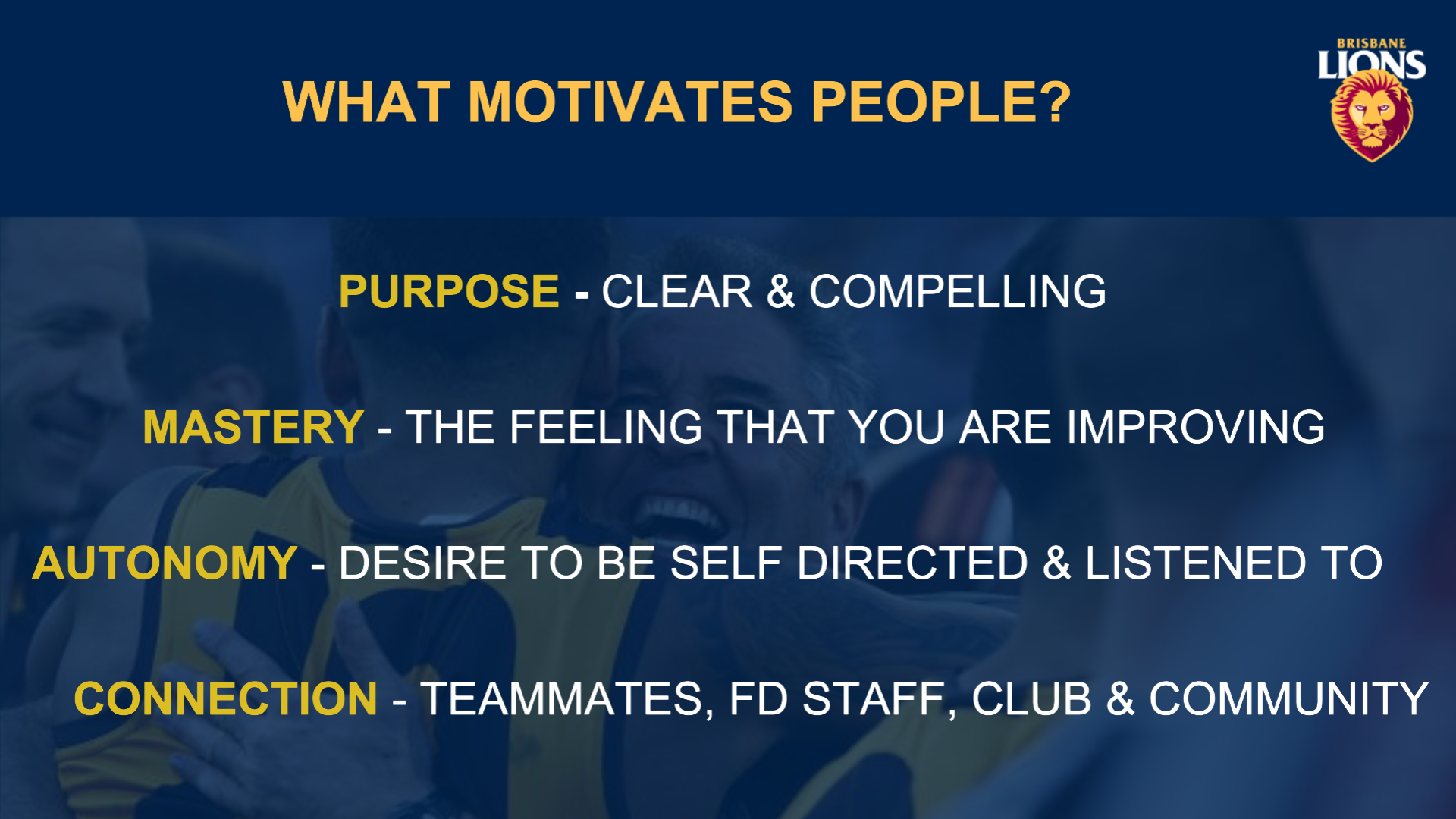
He said: “To be motivated, you have to have a clear purpose, that feeling that you’re improving, which I think our guys hadn’t felt for a long, long time. There is a desire to be listened to and to be a participant in your own growth and development; and that connection with teammates, staff and community.
“I put that model up as areas we would spend a lot of time on over the next few years, trying to grow our culture and team into a better place.”
What to read next
Nurtured and sustained excellence sat at the heart of proceedings at the 2025 Leaders Sport Performance Summit in Melbourne. Below, discover the insights to help propel you to greatness courtesy of the worlds of medicine, academia, the military and, of course, the world of sport.
Brought to you by our Event Partners

“There are parts of your game going well at a particular time and other parts of your game that are not going well,” he told Fox’s Face to Face in 2023.
“You’re trying to improve these things without sacrificing the things you’re doing well.”
He and Collingwood span those plates with alacrity during the 2023 season, his first as captain: they won the AFL Grand Final. Today, they remain one of the league’s finest teams; and Moore has been praised for his leadership abilities both on and off the field. It was to great acclaim that we welcomed him to the stage at the 2025 Leaders Sport Performance Summit at The Glasshouse in Melbourne.
“Good player leadership is organic and comes from natural respect based on competency, status and character in alignment to the team’s values,” he told an audience of Leaders Performance Institute members.
In addition to Moore, across two insight-laden days, we hosted a range of speakers from organisations including Melbourne FC, Leinster Rugby, the Royal Melbourne Hospital and Royal Australian Air Force. The overarching theme was the approaches one can adopt to give performers the best chance of success.
There were six approaches that stood out.
The athlete-coach relationship is pivotal, whether it’s a long-tenured coach setting up a new leader for success or, conversely, a senior athlete taking steps to put a new coach at ease.
Craig McRae, the Senior Coach at Collingwood, demonstrated the former with his public endorsement following Darcy Moore’s appointment as captain in 2023. “Be yourself, forge your own journey, and take a swerve at what that needs to be,” he told Moore. “Lead from the front and lead your way.”
Across town a year later, Rebekah Stott, a hugely experienced New Zealand international defender with more than 100 A-League appearances under her belt, went out of her way as captain of Melbourne City FC to ensure incoming Manager, Michael Matricciani, felt at home.
“From day one when I signed for the club, from the first conversations I’ve had, she’s only welcomed me with open arms,” said Matricciani. “She’s been a great support and she’s an excellent leader off the pitch.”
Neither Moore nor Stott, who spoke onstage together, believe they’re the finished article. Both spoke of their need to work on confronting teammates and having difficult conversations. In that regard, it helps when the on-field leader feels both comfortable and supported.
Rebekah Stott, Melbourne City FC
Darcy Moore, Collingwood FC
Moore and Stott’s concern with confronting people in emotionally charged environments is a daily feature of life at the Royal Melbourne Hospital, where Brian Le serves as Director of Palliative Care at the Peter MacCallum Cancer Centre. “Preparation is really important,” he said. “I formulate what needs to be spoken about and what my agenda is. But once with the patient, I adjust to what I’m hearing and the clues I’ve picked up in relation to their context.”
Timing is critical too. “Not addressing the situation has its own cost,” said Le, adding that delays are regrettable when the patient likely knows that an emotionally-wrought conversation is coming anyway.
Brian Le, Royal Melbourne Hospital
Data-informed decision-making is preferable, but where does the balance sit between objective and subjective sources? Additionally, what of the balance between disruption and stability? The topic was tackled by Kate Hore, the captain of AFLW team Melbourne FC, who spoke alongside Marcus Wagner, the club’s Chief Innovation Officer & General Manager of Football Operations. The Demons have been using Teamworks Performance as they look to strike that balance.
“You can get a flag from your monitoring that helps a discussion, but the impact really comes from your relationship with the athletes,” said Wagner. “Baseline information helps, but understanding the person is most important.”
When you understand the person, you can ask the right questions (either in-person or via questionnaires) and, if something needs to change based on something that happened in training, staff can swiftly make adaptations (supported by data).
As for the balance between disruption and stability. “It’s fine balance,” added Wagner. “You need to ensure you don’t lose your identity by going too far either way. How we measure is by looking at overall performance internally and externally, how we communicate, and the quality of our data.”
Kate Hore, Melbourne FC
Approximately 95 per cent of Nobel Prize-winning scientists emanate from the same cluster of labs or have enjoyed the proximal influence of past winners. Why? It is their higher minimum standards or greater openness to new (and often bad) ideas?
David Burt, the Director of Entrepreneurship at the University of New South Wales, delivered a presentation in which he lauded the value of exploring ‘terrible ideas’. His rationale was sound: it reduces the negative emotions that can cloud creativity and reduces the impact of power dynamics in a team environment.
He recommends an ‘accountability loop’:
David Burt, University of New South Wales
What must we do to sustain excellence? That was at the centre of Dave Walker’s appearance at the summit. The former naval pilot, who works for the Royal Australian Air Force, spoke of PBED:
PBED, he explained, is a continuous improvement process to table improved error recognition, error reduction or correction, which enables the creation of efficiencies that lead to improved performance. It is an essential tool in an environment where students must learn quickly.
“It’s the quality of interaction in each event that ultimately turns a team of experts into an expert team,” said Walker. “We often find that members do not know how to work or operate as a team – just following a framework does not make a team.”
David Walker, Royal Australian Air Force
Leinster Rugby, one of Europe’s most prominent teams, has a squad that is 86 per cent homegrown – what is the secret to finding and nurturing supreme talent in your region? As Simon Broughton, the Academy Manager at Leinster, explained, the team benefits from a group that has played and developed together in the youth ranks. They have travelled, won and lost as a collective. “So many experiences that strengthens their connection,” said Broughton.
The club has adopted a variety of approaches, including proximal role modelling, which sees younger players spend 80 per cent of their time integrated with older players. Proximal role modelling is “integrated organically into different aspects of their training week, from walking the pitches, to session design, and into analysis rooms.”
Leinster have also latched onto the ‘goldilocks principle’ as 33 per cent of their players are neurodivergent. “This has led to changes in how messages are delivered,” Broughton added. “There are slides, but also video and walkthroughs, and time for reconnecting and breaking mental circuits.”
Simon Broughton, Leinster Rugby
Leadership specialists Tracey Camilleri and Samantha Rockey explain how matching team density, size, and space to the task at hand can boost performance.
Reid’s celebrated right-hand men, including Offensive Coordinator Matt Nagy and Defensive Coordinator Steve Spagnuolo, are in demand for newly vacant head coaching roles elsewhere now that the NFL regular season has concluded.
Time will tell whether Nagy or Spagnuolo can assemble winning rosters of the kind that delivered the Chiefs back-to-back Super Bowls (with a third still on the cards), but they will have a better chance of ticking all the right boxes if they can surround themselves with the right people.
On that note, the question of team dynamics sits at the heart of The Social Brain: The Psychology of Successful Groups by Tracey Camilleri, Samantha Rockey and Robin Dunbar. The trio has spent decades observing the worlds of academia, business, and government as they look to better understand the workings of high-performing teams.
“We wrote this book because we were fascinated with the question: what is it that makes a group of people more than the sum of their parts?” said Camilleri when addressing the audience at November’s Leaders Sport Performance Summit in London.
“In our world, the unit of identification is most often the individual – if you think about how we hire, how we promote,” she continued. “Very rarely is the focus the team.”
Camilleri and her co-authors redress that balance in The Social Brain and here we explore how leaders can amplify the collective in the pursuit of better decision making.
‘The rocket fuel for performance impact and innovation’
The Social Brain applies theories of evolutionary biology to groups of high performers.
“We’ve been interested in what doesn’t change,” said Camilleri of this lens of enquiry. “When humans are part of small groups they can take advantage of their collective intelligence as well as a sense of safety, reciprocity and shared obligation.”
Camilleri, Rockey and Dunbar devised their ‘Thrive Model’, which sets out six foundational conditions for high-performing teams that consider social health (in addition to physical and mental health) as a prerequisite of wellbeing.
Onstage, Rockey defined these conditions as “the rocket fuel for performance impact and innovation.”

From The Social Brain: The Psychology of Successful Groups by Tracey Camilleri, Samantha Rockey, and Robin Dunbar.
What do the numbers in the circle mean?
As Rockey explained, it is important for leaders to know where to focus their energy most effectively.
“All of us have the same amount of time in a day and we use it differently, but what doesn’t change for each individual in this room is how many relationships that we can have at any given time,” she said. Our brains are only so big, “so we can’t have endless relationships”.
She used Dunbar’s number, which was devised by her co-author in the 1990s, to illustrate her point:

Dunbar’s number has long been influential across several fields, from government and administration to business and academia.
Five, 15 or 150 people? Performance improves when you match team density, size, and space to the task at hand
For decisions made at speed, you’ll count on five people.
Five is the number of intimate relationships a person can have. Rockey said: “These are the relationships that protect us, make us thrive, and ensure that we go through life in a joyful way. They protect us from ill-health and from some of the psychological challenges that we might have from feeling insecure.” They, of course, occur in intimate spaces.
For more complex decisions, you’ll count on 15 people (including your original five).
The ‘pain’ comes when you look to insert new thinking into complex decision making in a group space. “We spend about 60 per cent of our social time with just 15 people,” said Rockey. “With the 15 in the workplace, they would have built long-term relationships and loyalty to you over time – that’s how we work as humans – so breaking up those people to bring in new thinking is painful.”
According to Dunbar, the upper limit on the number of social relationships we can enjoy is 150
Dunbar suggests that people can have no more than 150 social relationships at any one time. “It’s a very stable number across all societies and cultures,” said Rockey.

From The Social Brain: The Psychology of Successful Groups by Tracey Camilleri, Samantha Rockey, and Robin Dunbar.
Camilleri and Rockey wrapped up their presentation by offering nine ‘social hacks’ for building relationships swiftly:

From The Social Brain: The Psychology of Successful Groups by Tracey Camilleri, Samantha Rockey, and Robin Dunbar.
Rockey then homed in on five…
Synchrony: “Sport has done this brilliantly. The perception of pain is reduced when we’re doing something together. When you’re running with a partner it feels less painful.”
Laughing together: “A fantastic way of finding a group”.
Engaging with strangers: “When we have conversations with people we don’t know, it has a positive effect on us – I encourage you to meet people that you don’t know today.”
Giving and receiving kindness: “A New York-based study saw that when young people were able to engage with strangers and be helpful to them, they saw an uptick in their mental health.”
Eating together: “There’s something very magical about breaking bread together. You have about 30 minutes when you’re having food together in which you have a sense of wellbeing and positive vibes towards your dining partners. So if you want to do something difficult, eat with your group first and then go to the difficult meeting.”
The Social Brain: The Psychology of Successful Groups by Tracey Camilleri, Samantha Rockey, and Robin Dunbar is available now from Penguin.
The Adelaide Football Club’s General Manager of Player Development & Leadership reflects on his journey with the club.
A podcast brought to you by our Main Partners

“I can’t teach leadership,” he tells the Leaders Performance Podcast. “I can help unlock what’s already in there.”
On that note, he is certain that leaders are not born. “Leadership is 100 per cent made, but it’s made from a very young age.”
Beyond the origins of leadership, Dan spoke to Henry Breckenridge and John Portch about the importance of prioritising others [10:40]. “Great sustainable teams are built in environments where everyone’s looking to help someone else out,” he adds. “When you fill someone else’s bucket, it fills yours.”
Also on the agenda were the importance of humour and enjoyment [22:00]; the argument against ‘refreezing’ culture [48:30]; and the practical steps that help leaders to manage team operations [32:00].
Henry Breckenridge | LinkedIn
John Portch | LinkedIn
Listen above and subscribe today on iTunes, Spotify, Stitcher and Overcast, or your chosen podcast platform.
In November, we discussed those elusive leadership skills, the notion of collaborating with your rivals for the greater performance good, and the question of what it takes to deliver an effective mental skills programme.
We definitely saw some of you there but, if you didn’t make it, don’t worry. We were sat in the front row with a notepad and, having deciphered our handwriting, compiled a list of six factors for turning setbacks into springboards. It was one of the main themes across both days.
The summit wasn’t all that was happening at the Leaders Performance Institute during November and we reflect on insights into the fields of leadership, coaching, data and human performance and pose five questions.
Perhaps the answers will provide one or two nuggets to help you with your next project.
Do you have all the skills you need to lead?
Perhaps you’ve heard of the of the Peter Principle. The concept, devised by psychologist Laurence J Peter, states that people tend to be promoted to their ‘level of respective incompetence’. Think of the supreme technician who, upon promotion, finds themselves overwhelmed as a manager tasked for the first time with leading people.
Carole Mundell, the Director of Science at the European Space Agency, told the audience at the Oval that while she viewed herself as a creative and independent scientist, that wasn’t going to cut the mustard in an organisation designed by engineers.
“I’m learning to think like an engineer,” she said. “All of ESA’s structures and processes and how we operate comes from the mind of an engineer… We have a whole quality assurance system where we set our objectives and we say ‘what will we do?’ ‘What did we say we’d do?’ ‘Did we do what we said?’”
Take time to consider the missing element that might make you a better leader.
What is to be done during losing streaks?
David Clancy, a Learning and Development Consultant at the Houston Texans and Director at The Nxt Level Group, wrote that the answer lies in purpose. ‘In elite environments, whether you’re a player, coach, or part of the front office, the pressures and expectations are immense,’ he wrote. ‘But the best leaders, those who guide their teams with purpose, know that long-term success is rooted in meaningful work.
‘This drives individuals to not only execute their tasks but also to find value in how those tasks contribute to the big picture. Leaders who strive to inspire meaningful work allow individuals to not just survive pressure, but thrive under it, empowering them to embrace challenges as part of their career journey.’
Clancy highlighted three principles to cultivate meaningfulness in your teams:
Who are your friends in high performance?
You don’t need us to tell you how competitive things get at a world championships, Olympics or Paralympics, but there are things that transcend rivalry.
One such area is female athlete health, where the UK Sports Institute, US Olympic and Paralympic Committee, Australian Institute of Sport and High Performance Sport New Zealand have clubbed together to form the Global Alliance. This enables them to share resources and insight in this one particular field.
“We are all under-resourced, we’re overstretched in terms of the time that we’re wanting to spend in this space,” said Dr Rachel Harris, the Lead of the Female Performance & Health Initiative at the AIS. “We really wanted to try and allow the people that are working in our sporting organisations to be more proactive.”
Her peers are just as effusive. “I think it’s a natural step to build an international community; and we do have them, but they’ve been a bit ad hoc,” said Dr Helen Fulcher, the HPSNZ Athlete Performance Support Lead. The Global Alliance is, as she added, an opportunity to raise standards across female sport. “The focus is not just on individuals having great connections but what can we collectively do better for this group of athletes that we all care about.”
The Alliance has every expectation that its membership will grow in the near future.
How do you solve a problem like innovation?
Professor Fabio Serpiello, the Director of Sport Strategy at Central Queensland University, told attendees at Leaders Virtual Roundtable that the best way to approach innovation is to start by defining your problem.
To that end, he employs a range of models, including David J Snowden and Mary E Boon’s Cynefin Framework.
‘Cynefin’, which is pronounced ‘ku-nev-in’, is a Welsh word that signifies ‘the multiple factors in our environment and our experience that influence us in ways we can never understand,’ as Snowden and Boon wrote in their 2007 Harvard Business Review essay titled ‘A Leader’s Framework for Decision Making’.
The Cynefin framework, they continued, ‘helps leaders determine the prevailing operative context so they can make appropriate choices’.

Source: HBR
Snowden and Boone identified five operative contexts – simple, complicated, complex, chaotic and disordered. Serpiello touched upon each:
Simple contexts are stable and one can observe a clear cause-and-effect relationship (although there is a risk of oversimplification).
Complicated contexts are the world of known unknowns; multiple right answers exist, but they require analysis.
Here, there are unknown unknowns; and cause-and-effect relationships are only apparent in hindsight.
These are domains of no clear cause-and-effect relationships and high turbulence.
Is your mental skills work simple, relevant and applicable?
Mental skills coach Aaron Walsh wanted to understand the perceived gap between value and impact in his field and embarked on a research project.
It furthered his understanding and, as he wrote in an exclusive column for the Leaders Performance Institute, Walsh alighted on three principles for making mental skills work meaningful:
The Leaders Performance Institute reflects on an afternoon of learning at the Tate Modern.
Clancy, a learning and development consultant with the Houston Texans and Director at The Nxt Level Group, was speaking at the October launch of his new book Essential Skills for Physiotherapists: a Personal and Professional Development Framework at London’s Tate Modern Gallery.
“Maybe this day will make you think a little bit more into that question,” he continued.
The gallery’s East Room, with its panoramic views of London, is a suitable backdrop for some of the brightest minds in sports science and medicine. Each of them knows there’s more to their success than talent.
“When we’re in college, we’re taught the technical, clinical, hard skills, but it’s the soft skills that make a difference,” said Clancy.
Essential Skills is an effort to address that reality, bringing together as it does experts who, in some cases, had never previously met in order to collaborate. “That’s the beauty of the book because it shows we can all get better together.”
The book’s proceeds will go to Children’s Health Ireland [CHI], a cause dear to Clancy and his family given the care they have provided to his four-year-old daughter Grace. “This way I can help people like my daughter and her friends.”
Clancy then introduced his roster of speakers – friends, collaborators and mentors – all of whom had wisdom to share.
Here, the Leaders Performance Institute picks out five thinking points to help you reflect on Clancy’s original question: are you doing what you want to be doing?
1. Define the behaviours that will take you from potential to peak
First onstage was James Kerr, the author of the renowned Legacy, who detailed the lessons leaders can take from New Zealand’s All Blacks.
He explained that the right behaviours are the real “force multiplier”. Good behaviours, whether you’re an athlete, coach or practitioner, will “take you from potential to peak more consistently”.
For the All Blacks, that may mean ‘sweeping the sheds’ but how does that look in your environment? What will enable you to show up more often and apply the right behaviours?
2. Seek to understand, find common ground
Behaviours shouldn’t be separated from your values, but how comfortable are you calling out poor behaviours? Any discomfort you feel may be amplified if you’re a woman trying to progress in a male-dominated environment.
Alicia Tang, the Head of Academy Medicine & Physical Performance at Derby County, recognises this “internal battle” well enough and believes the first step is to speak to the relevant stakeholders. “Seek to understand, find common ground, and then work on the resolution,” she said during the second session.
This view is shared by business consultant Michelle Carney, who said, “If you meet people where they are, you’ll find the right people”. They will not only be colleagues but allies.
“I think it’s definitely empowering when you have those people around you,” says Ashar Magoba, the Lead Academy Physiotherapist at Charlton Athletic, who is also starting to work with the club’s first team. “Perhaps those people can see something in you that you don’t quite yet see yet.”
3. Take a look over the fence
Where do you look for insights and inspiration? Jack McCaffrey, a six-time All-Ireland Senior Football champion with Dublin GAA, enjoys himself in his day job as a paediatric doctor at CHI at Temple Street in Dublin. “I get to hang out with kids all day; and kids are just great,” he told performance coach Ronan Conway during their fireside chat in session three.
In some ways, McCaffrey’s medical career is a sanctuary from his Gaelic football (particularly following a bad result). One could say the players of the strictly amateur Gaelic games in Ireland have a natural separation between the athlete and person that can often be lost in professional sports.
During his intercounty career, McCaffrey’s work also gave him lessons to take back to the Dublin panel, where the training environment was, to all intents and purposes, a professional setting.
“Most of my learning of dealing with high-pressure situations has come from work,” he said. “How to remain cool, how to have feedback loops, how to make sure you’re sticking to algorithms.”
4. Find the information in your trauma
In sport, we continually speak of ‘controlling the controllables’ and yet 95% of human brain activity is subconscious. It is a troubling thought for life coach Mark Whittle, the Founder of the Take Flight performance consultancy, as he told us during the fourth session.
His presentation returned to the question of behaviours, which he said are governed by both our drive towards pleasure and wish to avoid pain. Tied up in that avoidance of pain is fear, which can be born of trauma.
Consider a setback you’ve suffered: how can you learn from that event and respond appropriately? “What can you make it mean?” Whittle asked the audience.
5. Identify your gaps
It takes humility to recognise what it takes to excel in a new role. In the final session, Jeff Konin and Trevor Bates warn of the Peter Principle. The concept, devised by psychologist Laurence J Peter, states that people tend to be promoted to their ‘level of respective incompetence’. Think of the supreme technician who, upon promotion, finds themselves overwhelmed as a manager tasked for the first time with leading people.
For Konin, the important thing is finding your ‘where’ when looking five or ten years into the future. “What skills do you need that you don’t currently possess?” said the Clinical Professor from Florida International University.
Similarly, Bates may be the President & CEO of Mercy College in Ohio, but he has no problem with being the “pupil”. He said: “I might be the one who moves a programme forward, but intellectually I might be a pupil in that space.”

Essential Skills for Physiotherapists: a Personal and Professional Development Framework is available now from Elsevier.
David Clancy and Alexia Sotiropoulou set out strategies for leaders to inspire meaning, fulfilment and belonging in their people.
Purpose is the north star that guides us through adversity, keeps us focused amidst distractions, and fuels our long-term engagement. When leading yourself and others, the power of purpose cannot be understated. It’s about creating an environment where every individual finds meaning in their role, feels fulfilled in their contributions, and experiences a sense of belonging to something greater than themselves.
Purpose-driven leadership is not just about results. It speaks to human connection; when one feels seen and heard. Great leaders cultivate deep relationships with their teams, which comes by empathy, trust, and support. The connection between a true leader and their team hinges on a shared understanding of what motivates everyone on a deeper level. As John C Maxwell puts it, “People don’t care how much you know until they know how much you care.”
It’s more than just retention
Gallup and studies reported in HBR often highlight that employees who find meaning in their work show increased productivity and retention. One well-cited article is ‘Meaning Is More Important than Happiness’ by Emily Esfahani Smith, which explores the impact of meaningful work on wellbeing, productivity and engagement. Deloitte highlighted in their Global Human Capital Trends Report of 2019 how employees who find purpose in their work are more likely to stay with their employer. That makes sense. A great place to work is a great place to work.
As Simon Sinek, leadership expert and author of Start with Why, says: “People don’t buy what you do; they buy why you do it.” This fundamental concept applies not only to customers but also to team members, colleagues, and leaders. By fostering purpose in yourself and others, you align actions with deeper values, creating a culture where high performance and personal fulfilment coexist.
Meaningfulness: a compass in uncertain times
Meaningfulness isn’t just about liking what you do; it’s about understanding why it matters. In elite environments, whether you’re a player, coach, or part of the front office, the pressures and expectations are immense. The need to win, deliver results, and meet expectations often dominates the narrative. But the best leaders, those who guide their teams with purpose, know that long-term success is rooted in meaningful work. This drives individuals to not only execute their tasks but also to find value in how those tasks contribute to the big picture. Leaders who strive to inspire meaningful work allow individuals to not just survive pressure, but thrive under it, empowering them to embrace challenges as part of their career journey.
Three principles to cultivate meaningfulness:
Fulfilment, fuel for high performance
Fulfilment is about finding personal satisfaction in the work you do. It’s that feeling of deep contentment that comes from using your strengths to their fullest potential and knowing that what you do matters. In high-performance sporting environments, the external pressures can sometimes overshadow personal fulfilment, but when fulfilment is present, individuals feel more locked-in and resilient.
Fulfilment creates a ripple effect throughout the entire organisation. When team members feel fulfilled – filled full if you would like – they bring their best selves to work, inspiring those around them to do the same.
Four ways leaders can foster fulfilment:
Case in point, Dennis Rodman. Here is a prime example of where recognition can be seen, by how Head Coach Phil Jackson managed his Chicago Bulls squad during the 1995-96 season. Jackson often recognised Rodman, not just for his defensive prowess, hustle and rebounding, but for his unique role, style and intensity on the court. By publicly acknowledging Rodman’s contributions, Jackson built Rodman’s confidence and reinforced his core value to the team, despite his unconventional approach. This clear recognition played a critical role in fostering trust, thereby maximising Rodman’s performance. The Bulls had a historic 72-win season.
Belongingness, the glue that binds it all
At its core, belongingness is about feeling valued and accepted by the group. High-performing teams that experience a strong sense of belonging operate on a different level.
One of the guiding principles within the All Blacks is the Māori concept of ‘Whānau,’ which means ‘family’, but it extends beyond immediate relatives to include the team as a whole unit. Players are taught to understand that when they put on the famous black jersey with the silver fern, they are not just playing for themselves, but for their teammates, their country, and the generations of players who came before them.
Belonging. Part of something bigger.
It’s a powerful feeling to know that you are a part of something bigger than yourself, like helping to put someone on the moon.
Four strategies to create a sense of belonging:
Final thoughts
Leading yourself and others with purpose is about much more than reaching performance goals. Before you can lead others, you must first lead yourself. Leading with purpose involves setting common value-based goals, staying focused in the choppy seas of collaboration and motivating yourself and your team to stay on track, with eyes on the prize.
To lead yourself with purpose, you need to define your own personal mission, vision and values.
Start there.
These are your guiding principles to help shape decisions and actions aligned with your purpose. You must also set clear goals for yourself and develop a plan to make them happen. This will take discipline and fortitude. Give it a go, starting today.
As with anything in high performance, you need to find what works for you first. So off you go.
David Clancy is a Learning and Development Consultant at the Houston Texans and Director at The Nxt Level Group. He is also the Editor of Essential Skills for Physiotherapists: A Personal and Professional Development Framework, which is available now from Elsevier.
Alexia Sotiropoulou is a Co-Founder & International Markets Specialist at the The Nxt Level Group. She is also a Public Relations & International Sales Specialist at the Isokinetic Medical Group.
If you would like to speak to David and Alexia, please contact a member of the Leaders Performance Institute team.