GameChanger offers as useful case study in collecting data with less human effort, giving different users the level of detail they actually need, and providing personalized outputs.
Main Image: GameChanger

From there, GameChanger has kept building its offerings around basketball, bolstering its future with additional capabilities and adding Brandon Rhodes as SVP and GM for emerging sports in December. Rhodes’ past experiences include nearly eight years at Overtime and, before that, five years at PepsiCo working with the Gatorade brand.
In early September, the company rolled out a slew of enhancements that will be ready ahead of the high school basketball season:
“We want to really become the home of youth sports and to do that, you can’t just be the home of diamond sports,” said Rhodes, part of SBJ’s 2020 New Voices Under 30 cohort. “You’ve got to have other things like basketball, and then in the future, other large team sports. So lots of growth already, but we’re excited to really have this upgrade for this season.”
Rhodes walked me through the new features. Here were my takeaways:
AutoStream upgrades
On top of tracking the action, AutoStream will be able to run while users keep score and stats on the same device. Previously, they had to set up one device for streaming and use another for stats (or keep stats via an old-school scoring book).
President Sameer Ahuja has often mentioned a set-it-and-forget-it mission when it came to GameChanger, enabling coaches and/or parents to position their tablet or smartphone and move on to other things. The future goal for AutoStream will be to automatically track all stats while streaming — which would hit Ahuja’s goal directly on the head.
For now, users will be able to pick the level of stat details they’ll manually track while AutoStream transmits. Coaches and parents can turn on AutoStream and then choose to track just the score and clock, keep score for all players, or even manage tracking of all stats.
Rhodes said this expansion came from significant segmentation work to understand how parents and others tune into streams and what they wanted, from the casual observer to the super-invested follower.
“What we heard from them is one, the scorekeeping was really good, but they wanted optionality,” Rhodes said. “… That was a big unlock that came directly from doing the research and hearing the feedback from the users.”
Content capabilities
The personalization conversation is everywhere, and that’s no different at GameChanger. While the platform has offered auto highlight-clipping since 2024, the company saw an opportunity to do more for athletes and the family members who wanted to follow along.
Later this year, the platform will release its Player Game Story and Player Season Story functions, which Rhodes sees as storytelling that can chronicle any player’s game/season/career, regardless of their skill or how many stats they produce. The highlights pulled to those pages will be formatted to share right away with family and friends or to social media.
“Basketball is highlight-driven,” Rhodes said. “Overtime was very good at highlighting the most elite, the most special kids, but GameChanger has an opportunity to democratize that for every basketball player.”
Communication
While not as sexy as computer vision or AI-produced storytelling, communication can always be better. I understand this pain more closely now as a coach of a U6 soccer team who can feel overwhelmed by my group text with the parents of my players.
Now 10x that (or more) for a club operator who is managing various teams across many age ranges. Basketball is played year-round on the travel circuits, and as the youth sport with the most participants in the U.S., the comm line never cools down. GameChanger’s new capability to house schedules and rosters — and message all of those participants when need be — for an entire club program hopes to ease the operator’s life.
“Directors are trying to have a unified system: You may have 20, 30, 40 teams and you also may have parents with multiple kids at multiple ages,” Rhodes said. “So you want everything streamlined. We’re just giving that capability to club directors and coaches.”
This article was brought to you by SBJ Tech, a Leaders Group company. As a Leaders Performance Institute member, you are able to enjoy exclusive access to SBJ Tech content in the field of athletic performance.
A new mental performance app uses insights from the 1970s book ‘The Inner Game of Tennis’ to impart new lessons in elite tennis today.
Main Image: Getty Images
Lessons learned from the text, which was first published in 1974, followed Sweeney through a Division I college career and later into the business world, where since hanging up his racket he has been an employee at automated speech recognition company Cogi and AI-powered transcription platform Rev.
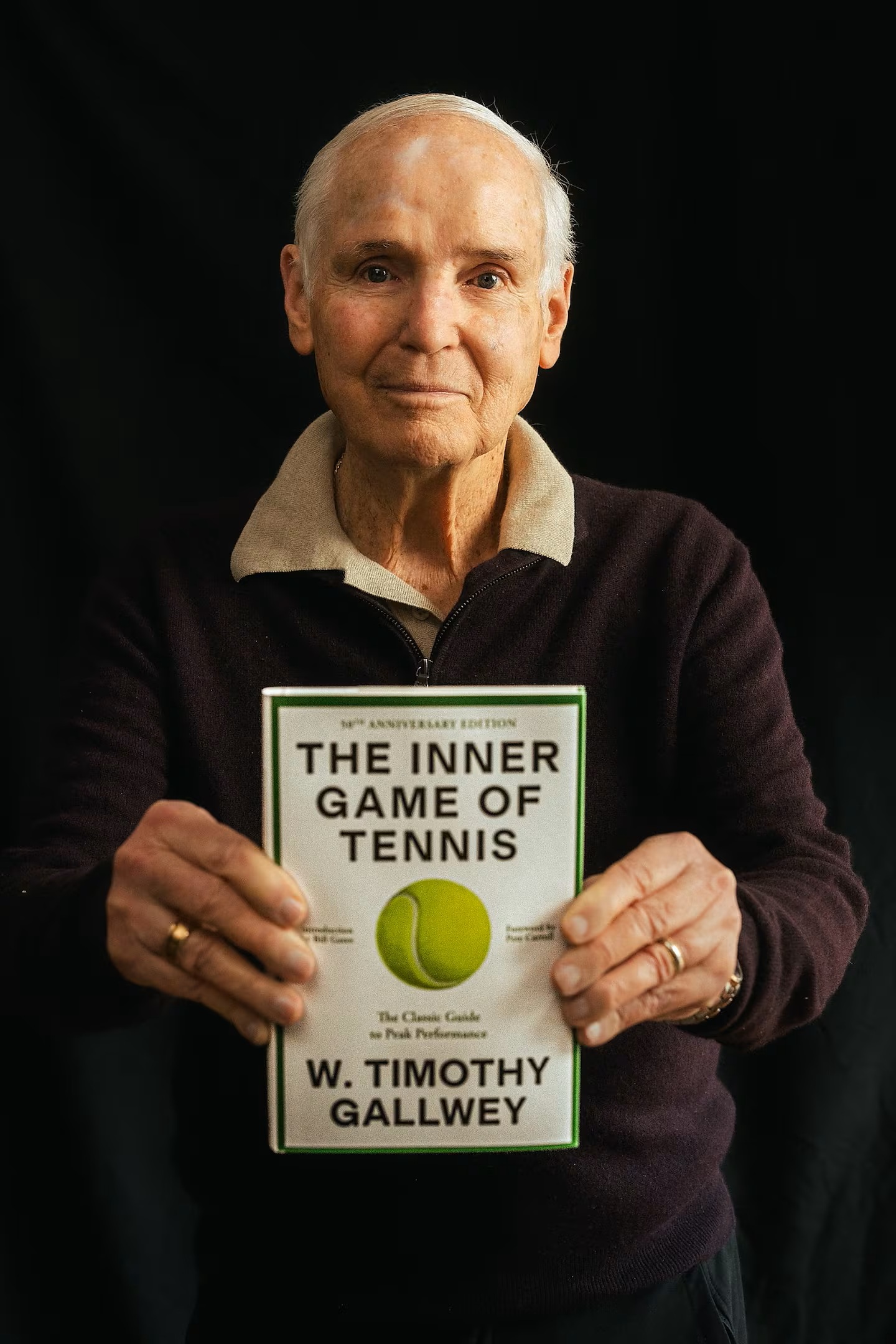
Author Timothy Gallwey is finding a new audience for the book he published in 1974 thanks to a recently launched app. (Photo: Premium Content Agency)
“It changed my perception of performance and ability to trust myself,” Sweeney said of Inner Game. “My story isn’t all that unique when it comes to the impact that book has had from sports into business.”
Sweeney is now working on what you could call a magnum opus, given his experience as a tennis player turned tech entrepreneur: collaborating with Gallwey to bring the book’s teachings into the digital age, with a new mental performance app branded The Inner Game.
Sweeney’s journey to the project began in 2022, when a mutual friend and former colleague of Gallwey’s introduced them. Sweeney said he and Gallwey convened at a storage unit in Thousand Oaks, Calif., that houses Gallwey’s work, including published books, unpublished notes, audio recordings and training manuals, much of which had never been seen.
“He [Gallwey] had this feeling that the Inner Game in book form was limited in its ability to be impactful around the world,” Sweeney said. “One night, I woke up at 2 a.m. and was like, ‘I know what needs to happen.’”
Sweeney built a custom AI model using ChatGPT that could interact with someone nervous about an upcoming match or meeting, using the philosophies of “The Inner Game.” Gallwey was receptive.
Sweeney and Gallwey’s estate have a licensing deal that allows Sweeney and his co-founders to leverage the book’s intellectual property and compensates Gallwey’s family with a licensing fee and equity in the app’s parent company, Peak Performance AI. Sweeney and his team also created an Instagram page with Inner Game branding that is approaching 300,000 followers and plans to launch a podcast later this year.
“The main focus of the company is a subscription-based software product,” Sweeney said, referring to the mobile app. “[The social media and podcast channels are] a modern-day marketing engine. We’re storytelling our way to building upon this already passionate and huge Inner Game community, but we’re adding to it every day.”
The Inner Game app, released in August, is infused with layers of AI models to build personalized mental training programs. Sweeney described it as “like a MasterClass for performance psychology, but with a practical tool to help you apply what you’re learning.”
A morning in the life of Inner Game app users, he continued, could start by telling their “AI coach” how they are feeling, then listening to one of hundreds of three-to-seven-minute audio clips “specific to [their] performance journey,” created using information from the book. The app has a free tier, a three-month membership that prices at $60 and an annual subscription option for $192.
Sweeney said the app already has “thousands” of subscribers. An area of focus moving forward will be partnering with member-based tennis organizations (e.g., Universal Tennis Rating, or UTR) to distribute discounted subscriptions.
He clarified, however, that it is not a meditation app.
“A lot of apps, like Calm or Headspace, are designed to help take you away from the pressure,” he said, referencing two of the more recognizable direct-to-consumer meditation apps. “We built this to help you step into [the pressure].”
This article was brought to you by SBJ Tech, a Leaders Group company. As a Leaders Performance Institute member, you are able to enjoy exclusive access to SBJ Tech content in the field of athletic performance.
The New Balance Athletics Center is able to cater to the needs of coaches, analysts and talent evaluators alike.
Main Image: Kraft Sports & Entertainment
As the CIO for the Kraft Group, Israel just saw a major tech project reach fruition in the New Balance Athletics Center. The 160,000-square-foot building, which officially opened last month, will be the home for everything Patriots players need.
And with that, Israel has overseen a connective behemoth in that three-story space, spanning facial authentication, biometrics, player-tracking data and a slew of other needs that support coaches, analysts, talent evaluators and the like.
A benefit for the Patriots? A longtime relationship between the Kraft Group and tech integrator NWN, a fellow Massachusetts company. The pair stepped forward with a five-year sponsorship deal last year, with NWN becoming the official technology infrastructure partner with Kraft Group. NWN also works with the Orioles and a handful of NBA teams, and it is the official technology provider for Boston College athletics.
Here were a few things that stood out to me about the project from a conversation with Israel and NWN CMO Andrew Gilman:
Two major pride points
Two of the venue’s greatest assets are the NFL Draft room and the virtual reality room. The draft room, which features 100-inch LED boards from Daktronics, is the “pride and joy” of ownership, Israel said.
The team’s new virtual reality room is a digitally infused next-gen walkthrough space that first originated under former coach Bill Belichick. This version is the width of an NFL field and features 20 yards of hashed turf so the team can run through plays and red-zone drills. Israel said it is a convergence of practice, game tape and player data.
Added Gilman: “To see the players going through drills and having all this running over Michael’s technology innovation — being able to stream and get video, low latency, high throughput — it’s where the technology becomes a real competitive differentiator for the organization.”
Making it seamless across the entire group
The goal for a technology experience is to be standardized and even unnoticed, Israel said. A key component there is filling the space with vendors they’re already familiar with. The Patriots campus has 65 Cisco WebEx rooms, and 31 of those are now in the new facility.
The center also uses facial authentication provided by Wicket, which is the same tech used across all league stadiums for credentialing. Those are two of many examples.
“The same way we do with autonomous purchasing in the stadium — frictionless is across the board,” Israel said. “Making it so that the technology is there, but they don’t even realize that they’re using it.”
(We talk about frictionless fan experiences all the time here — hadn’t thought about it in the player experience, but it makes so much sense).
New creativity with data
Data is such a catch-all, borderline buzzy word. But it can be anything. Case in point: cafeteria food.
Instead of the buffet-style treatment of old, tablets now let players pull up their diet (the Patriots use a precious metal naming system for meal plans like gold, silver and bronze) and get a meal that fits their parameters. It also sets up a system that can monitor consumption of various options for the benefit of operations.
“We’ve also rolled out an AI application that monitors the food that’s being cooked and ties into how much we’re buying, how much we’re prepping, how much gets donated to charity at the end of the day to right-size and be more efficient,” Israel said.
This article was brought to you by SBJ Tech, a Leaders Group company. As a Leaders Performance Institute member, you are able to enjoy exclusive access to SBJ Tech content in the field of athletic performance.
Four-time Olympic rowing champion Meghan Musnicki spent her sporting career pursuing marginal performance gains. In retirement, she is using data to improve health and longevity.
Main Image: USL
Musnicki, a graduate of Ithaca College, retired in 2024 and then sought what she called only her second “real job” in the last 15 years. Through a friend of a friend, she was introduced to Biograph, a high-tech preventative health clinic with locations in New York and San Francisco. Musnicki joined as an executive in membership development and partnerships — and also learned some critical insights about her own health. She applied those findings, improved her condition and is now training or a new challenge: Musnicki recently bought a Garmin smartwatch to train for her first marathon.
On the appeal of Biograph:
“The premise behind all of it is something that obviously really resonated with me given the commitment to living the best life you can live for as long as possible. They gave me a shot given my very limited résumé.”
On the growth of data and tech in sport:
“As you can imagine, it’s become more tech- and data-driven in the last four to six years. When I initially started — I made my first team in 2010 — compared to now, there’s all sorts of different metrics and measurements and telemetry that they hook up to the boat that analyze every specific thing. When I started, it was very much your heart rate and your perceived level of exertion.”
On what she applied to her training:
“You learn quickly as an athlete how your body operates best, and you find its limits because it’s a very specific extraction mindset [prioritizing shorter-term gain]. You pick low-hanging fruit at first. We always joke, ‘Show up every day.’ That’s the easiest way, but ‘show up every day’ stops being effective when you’re in it for five, 10, 15 years. Then you have to get more nuanced and look at more detailed, more nitty-gritty things like how’s my nutrition? How’s my recovery? As an aging woman, am I focusing on my muscle mass, my body composition? What am I optimizing in order to ensure that I have longevity in this sport?”
On the surprise results in her Biograph diagnostic:
“You would think that I would be like a textbook picture of health, and I thought that it wasn’t going to be terrible. And don’t get me wrong, it wasn’t terrible, but it flagged a genetic risk for cardiovascular disease, which isn’t terribly surprising: My father passed away from a sudden heart attack when he was 49 when I was a freshman in college. And lo and behold, I have high Lp(a), a genetic predisposition to developing cardiovascular disease.”
“It just makes you pause because no one would look at me and be like, ‘Oh, she for sure has high cholesterol.’ It just goes to show you that if you dig a little bit deeper than surface level, there’s all sorts of things that could be hiding or lurking underneath that you don’t know about. It could be a little scary, but I think of it as more empowering. I empower myself with the knowledge of like, okay, this is my reality. And now what choices am I going to make to address and deal with that?”
On how she applied the findings:
“When I think about Biograph, the value for me wasn’t just discovering that I had the issue. It was having people that could interpret the information and give me tangible things to do to begin to move the needle. More data isn’t always better. It’s what you do with it. I lowered in six months my Lp(a) by 25, 30 points. I lowered my cholesterol by 30. And this was just lifestyle changes. Obviously I could have gone on a statin, that’s one of the options, but they work with you. And I was like, ‘I don’t really want to go on a statin right away. I want to see how I can do it otherwise with more lifestyle interventions.’ And so I worked with the dietician, the exercise physiologist, and it worked for me.”
On how she’s transitioned out of rowing:
“A lot of it is shifting away from more specific training, again, in thinking of that extraction and thinking more long-term. So as an aging woman, I really focus on making sure I’m doing heavy lifting to preserve my muscle mass and my bone density. I keep up my Zone 2 cardio, which has never been an issue for me given that I’m an endurance athlete. More importantly for me, I have to do a lot of sprint work. I do a lot of jump and plyometric training for my bone density and my explosive power. And then, probably not as much as I should, but I’m still a work in progress mobility and making it so when I get up in the morning, it’s not the Tin Man for too long.”
This article was brought to you by SBJ Tech, a Leaders Group company. As a Leaders Performance Institute member, you are able to enjoy exclusive access to SBJ Tech content in the field of athletic performance.
David Clancy of The NXT Level Group and Ivan Peric of Peric & Partners discuss how artificial intelligence can help your performance team to see more clearly, remember more accurately – and learn more quickly.
The morning
At 8:20 on a Monday morning, the sports medicine and performance team gathers around a table. The physio updates the group on a player. The club doctor adds context from the recent scan. The lead S&C coach describe yesterday’s exposure. The sports scientist flags a change in high-speed decelerations. The performance nutritionist has noticed a fuelling issue. The Manager wants a simple answer: Will he train? And when will he be ready to play again?
There is no shortage of expertise in the room. There is no shortage of data either. What is missing is memory. What did the department do the last time this player had this problem? What was expected? What happened? Which decision changed the trajectory? And, with the benefit of hindsight, was it the right one?
Some of that sits in the digital records. Some sits in disconnected files. Much of it lives in the physiotherapist’s memory, or in the conversation that happened beside the treatment table three months ago. Eleven minutes later, a decision is made. By the afternoon, parts of the rationale have already begun to disappear.
That is the real opportunity for AI in elite sport. Not to replace the people around the table. Not to produce an all-knowing injury-risk score. Not to make the return-to-play decision. It is to help the team behind the team see more clearly, remember more accurately – and learn more quickly.
The bill is €3.45 billion, and technology has not moved it
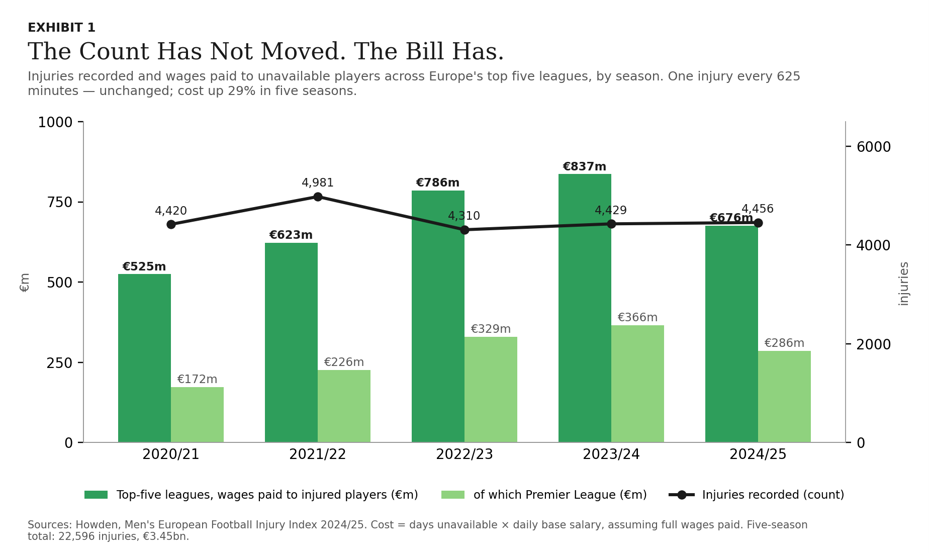
Howden’s Men’s European Football Injury Index counted 22,596 injuries across Europe’s top five leagues over five seasons. The estimated wage cost of players being unavailable was €3.45 billion. The injury rate has barely shifted. One injury every 625 mins. The financial bill has not stood still; it increased by 29% across that five-year period (Exhibit 1).
The injuries are not distributed evenly. Clubs carrying the heaviest fixture demands tend to record more of them. Four clubs sat above the Premier League injury average in every one of the five seasons. Yet the cost of those injuries varies significantly. Manchester City and Liverpool operate with comparable wage commitments, but their estimated injury costs in 2024/25 were €41 million and €15 million respectively (Exhibit 2).
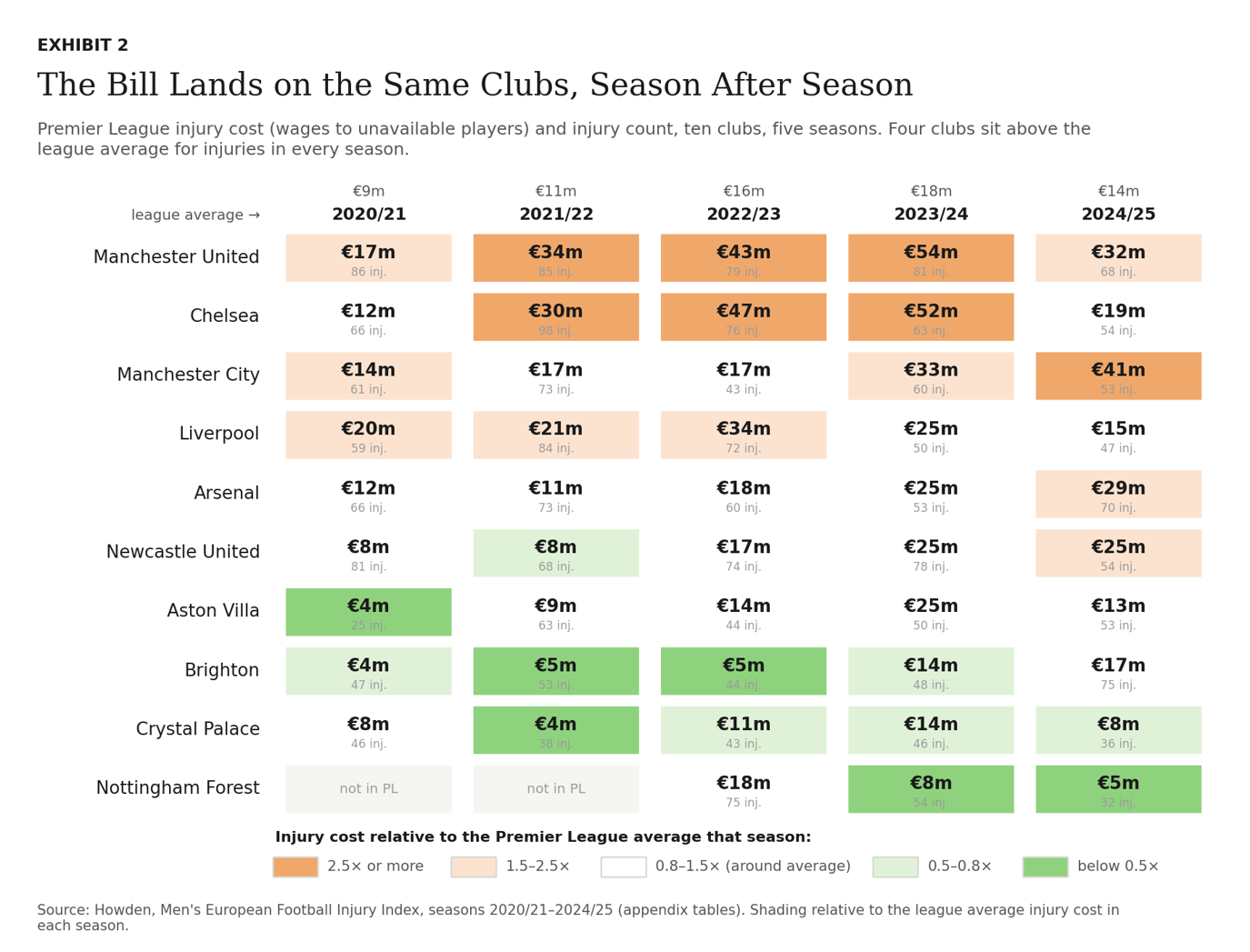
Injury count alone does not explain the difference. Player wage profiles and the type, timing and severity of injuries all matter. But so does the way a department coordinates decisions, progresses rehabilitation phases, manages exposure – and learns from previous cases.
The arithmetic is simple: Cost = days lost × the daily wage of the unavailable player.
The useful question, then, is not whether every injury can be prevented. It is whether a department can reduce avoidable days lost, limit recurrence and prevent a short absence from becoming a long one. Aston Villa halved its injury bill in a year despite recording three more injuries. Average absence fell from 37 days to 15. This is where the conversation becomes uncomfortable.
Elite sport has invested heavily in technology, but that alone has not solved the problem. Teamworks, whose platform sits beneath many elite performance departments, estimates that 75–90% of collected performance data never influences a decision.
More feeds. More dashboards. More alerts. But not necessarily more clarity. And certainly not more organisational memory than the room had a decade ago.
Where AI belongs in the medical / performance department
If injury cost is shaped by human decisions, the strategic question is not simply whether AI can predict an injury. It is where, across the work of the department, AI can improve the conditions in which better decisions are made.
There appear to be approximately seven core stages in a player’s lifecycle, from pre-signing assessment through preparation, availability, rehabilitation, return to play, selection and week-to-week performance (Exhibit 3).
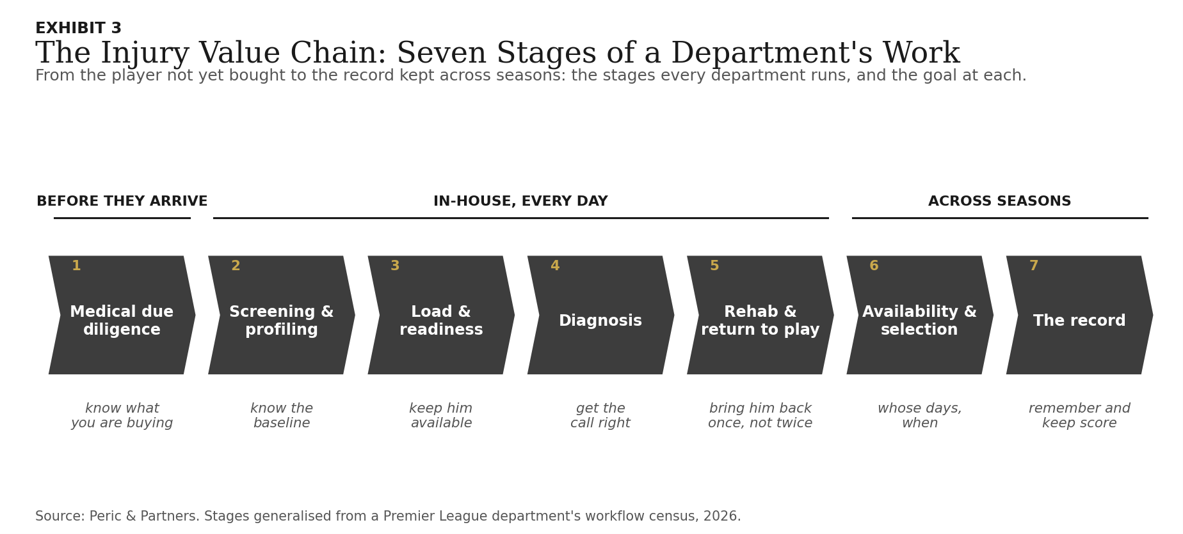
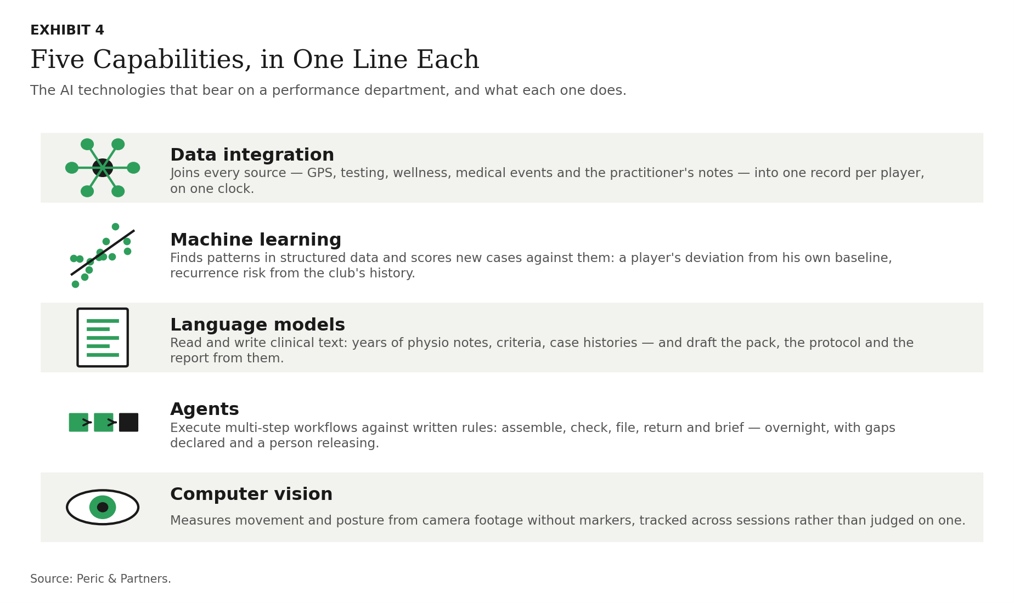
Across that chain, five technology capabilities matter:
They are not interchangeable. They do different jobs, require different controls and carry different risks (Exhibit 4).
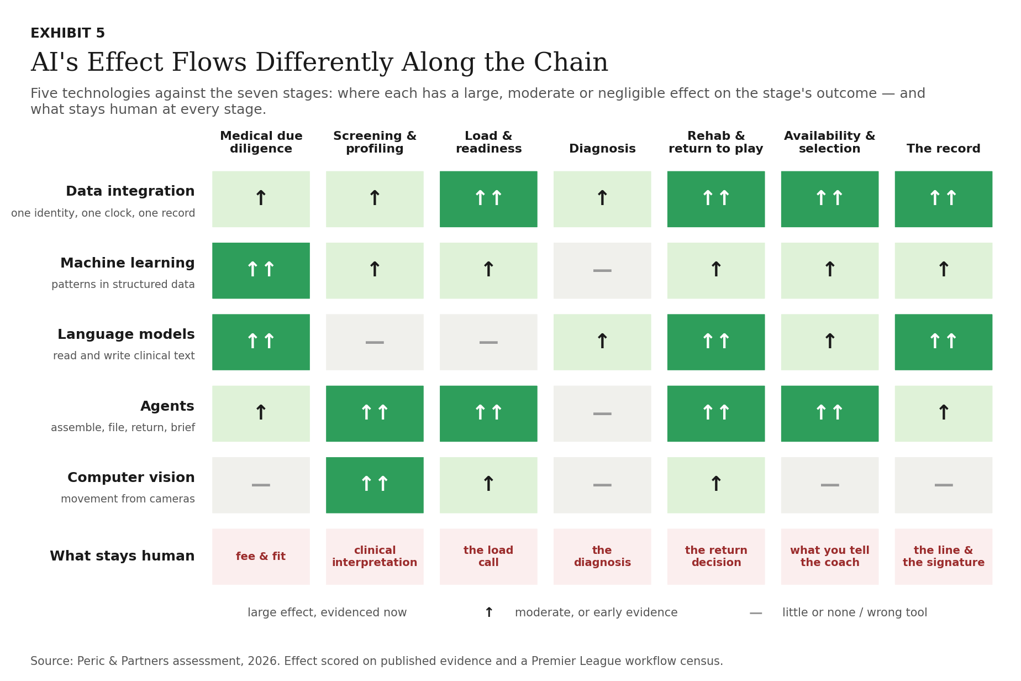
Placed against the seven stages, their value is uneven. That unevenness is the point (Exhibit 5).
Research into AI’s ‘jagged technological frontier’ shows that the same system can improve performance on one task and degrade it on another that appears remarkably similar. In a large field experiment, consultants working with AI completed suitable tasks faster and to a higher standard. Just outside the technology’s capability boundary, however, they were nine percentage points more likely to reach the wrong answer.
In sports medicine, confident error carries a human cost. Summarising a meeting is not interpreting pain. Drafting a case chronology is not diagnosing pathology. Identifying a missing piece of information is not deciding that a player is match ready.
The matrix makes this boundary visible. Data integration, language models and agents have potential around return to play, selection, documentation and organisational memory. Machine-learning injury prediction, the most heavily marketed capability, earns a more cautious place. A first-team squad may experience roughly 50 injuries in a season. That is a small, shifting and highly contextual sample from which to make high-confidence predictions.
AI is often strong in complicated environments where the rules and relationships can be modelled. Injury is complex. The same load does not create the same response in every player, on every day, in every context, at any point of the season. A model can surface a signal and even prompt a better question. It should not make the call. Judgement should never be passed off.
No column in the matrix is empty of people. The technology changes what arrives on the desk – not who carries the decision. Read together, the lifecycle, the capabilities and the matrix point to three opportunities, in ascending order of ambition.
Opportunity one: connect the player’s data to the practitioners
Here is a precondition for everything else. Most clubs have connected parts of the player record: training load, testing, wellness scores, medical events and match exposure. The practitioner record is less connected. Clinical reasoning, return-to-play criteria, changes of plan, and contextual observations are written up in SOAP notes or similar, filed somewhere and maybe surfaced again.
Join both records around one player identity, one timeline and one agreed definition of availability. Then make what has already been written searchable and usable. The challenge is not simply technical. The system needs appropriate consent and permission to read practitioner notes… not merely permission to store them.
Opportunity two: execute the workflows
Once the record is connected, AI agents can complete or prepare routine work. Our task analysis of the rehabilitation stage within a Premier League backroom department identified 22 recurring tasks, consuming roughly 40 hours each week.
Eleven could be produced automatically overnight. Seven could be drafted for a practitioner to review and correct. Two, diagnosis and the return-to-play decisions, should not move from the human. That’s complex terrain.
The prize is not a smaller department. It is approximately a day each week returned to the practitioner. More time with players, more time coaching, more time thinking – and more time discussing the difficult cases.
Opportunity three: reinvent how the department learns
The first two opportunities improve today’s work. The third changes tomorrow’s department.
What if the team recorded what it expected at every major decision point? What if it compared expected against actual at the end of each case? What if similar cases, changes of plan and second opinions could be retrieved in seconds? What if the knowledge of an experienced sports med physician, for example, became part of the department’s memory rather than leaving when that person did?
This is the move from digitising activity to building organisational intelligence and retaining and managing knowledge. It requires more than a new tool or workflow. It requires the will to redesign the week around better systems, not bolt another platform onto an already crowded one.
The importance of strategy
The question most departments ask is, “Which AI tools should we buy?”. What about, “How should our department evolve because AI exists?” That mindset shift matters.
Strategy should begin with a performance problem worth solving. Avoidable games lost to injury, inconsistent return-to-play decisions, excessive admin, or lessons that disappear when a case closes.
It should not begin with a product demonstration. A performance department is a human environment. A wrong call is felt by a player and carried by a practitioner. Adoption must therefore be intentional, governed and connected to the realities of player care and performance.
We recommend five steps, in order, based on recent use case experiences across elite football environments:
Understand how the department works today. Recurring processes, decision points, systems, people, information flows and data gaps.
Compare the department stage by stage against the player lifecycle. Compare its outcomes against an appropriate league and reference set, within the league, and even outside the league/sport.
Decide what to improve first, and which capability is required. Consider the pilot case and how the system will expand once the initial workflow proves useful and gains traction.
Define what AI may produce, what it may only assist and what must remain human-led. Establish the controls around access, consent, review, retention, accountability and escalation. This step is what separates an AI strategy from a technology project.
Track whether the change improves the work. Decide what measures matter, which capabilities the department needs, and how responsibilities, meetings and incentives must evolve.
The jagged frontier must be mapped at task level for each department:
The principle is simple. Automate the task. Augment the practitioner. Never outsource accountability and discernment. That map is not permanent. It should be redrawn frequently, as the tech changes and the department builds its own evidence and relevant use cases.
Five workflows to start with
A credible AI strategy does not need to begin with a moonshot. It can begin with five useful workflows that sit largely inside the frontier, use information the sports med/performance department already holds – and can be piloted within a season.
Produce a concise account of what changed overnight, where each fact came from and what remains unknown. No invented risk score. No automated decision about who trains. Think of this as a shared, sourced starting point for the morning conversation.
Build a living case chronology containing the diagnosis, key milestones, response to loading, changes of plan, criteria, and the rationale behind major decisions.
If the timeline changes, people can see why. If a second opinion is required, the external expert receives a coherent case, not a collection of disconnected files.
Capture decisions, owners, deadlines, unresolved questions and genuine disagreements as the meeting happens. Require the team to review the record before it becomes final. This closes the gap between what the group believes it agreed and what individuals subsequently do.
Draft clinical notes, referrals, rehabilitation updates and other forms of communications at the point of care, with the responsible practitioner reviewing and signing off every record. A 2025 randomised trial found that an ambient AI scribe returned nearly a tenth of documentation time. Across a season, those minutes become hours returned to player-facing care.
Complete an after-action review when a case closes. What did we expect? What happened? Where did the plan change? Which signals mattered? What would we repeat? What would we do differently?
Link similar cases so that a new practitioner can ask, “How have we handled this before?” and receive a sourced answer that will help. That is how knowledge and team IP stops leaking away and starts compounding.
Start small and keep a score
None of this involves pasting player information into a public chatbot. Health data requires approved platforms, appropriate consent, role-based access, retention rules, audit trails and named accountability. Any output capable of affecting care must be traceable to its source and reviewed by a qualified professional.
Start with one workflow. Map the tasks inside it. Define the boundary. Pilot it with the people who do the work. Track time returned, errors caught, and decisions improved. Ask do you trust this. Run an after-action review. Adapt before scaling. This is slow enough to be safe but fast enough to learn.
Remember… AI will not palpate a hamstring. It will not notice the hesitation in a player’s voice. It cannot carry the moral weight of a return-to-play decision. It cannot rebuild trust after a setback. But… it can place the right information in front of the right people. It can preserve why a decision was made. It can return hours to practitioners… give some white space back into a crammed calendar. Free up headspace and offset cognitive load. It can help a department learn from every case rather than simply move on to the next one. Knowledge management.
Several seasons of data suggest the injury count may not change quickly but the days can. The departments that move them will not be those with the most technology and apps. They will be those with the clearest strategy, the strongest judgement, and those constantly monitoring what they are doing.
David Clancy is the CEO of The Nxt Level Group | LinkedIn
Ivan Peric is a Founding Partner of Peric & Partners | LinkedIn
References
Dell’Acqua F, et al. Navigating the Jagged Technological Frontier. Harvard Business School / Organization Science.
Ekstrand J, et al. Hamstring injury rates have increased and now constitute 24% of all injuries: the UEFA Elite Club Injury Study, 2001/02 to 2021/22. British Journal of Sports Medicine, 2022.
Extraction of structured information from clinical notes: International Journal of Medical Informatics, 2025; JMIR Medical Informatics, 2024.
Howden, Men’s European Football Injury Index 2024/25 – five-season review, 2020/21 to 2024/25, including appendix tables by club.
Leckey C, et al. Machine learning approaches to injury risk prediction in sport. British Journal of Sports Medicine, 2025.
Lukac P J, et al. Ambient AI Scribes in Clinical Practice: A Randomized Trial. NEJM AI, 2025.
Task census, chain, matrix and operating-model figures: Peric & Partners analysis of a Premier League performance department, 2026 – estimates, to be corrected against club data.
Teamworks, “The Future of AI in Sports,” citing Dr Robin Thorpe’s survey of elite performance directors.
New York City FC’s David Howarth and Technogym’s Damiano Bernacchini explain why even a promising tech solution will be useless without smart implementation.
The Vice President of Performance at New York City FC was speaking at June’s Leaders Sport Performance Summit in New York, where he addressed the gap between the emergence of a promising tool and its performance value.
One reason that gap persists is a lack of understanding on the part of the practitioner. “There’s a depth of education and understanding that needs to happen first for the practitioner,” he continued. Then, the practitioner can act as what he called a “bridgehead”: someone who can bring ideas to coaches, performance staff and senior leaders alike.
Howarth was joined onstage by Damiano Bernacchini, the Sport & Performance Cluster Manager at Technogym, who explained how practitioners inform the company’s product development.
“We organise workshops or focus groups to understand where we are heading, what are the needs for the market from a specific category and how we can actually create priorities and implement the solution,” he said. Feedback from those sessions helps Technogym decide what to develop and where its priorities should lie.
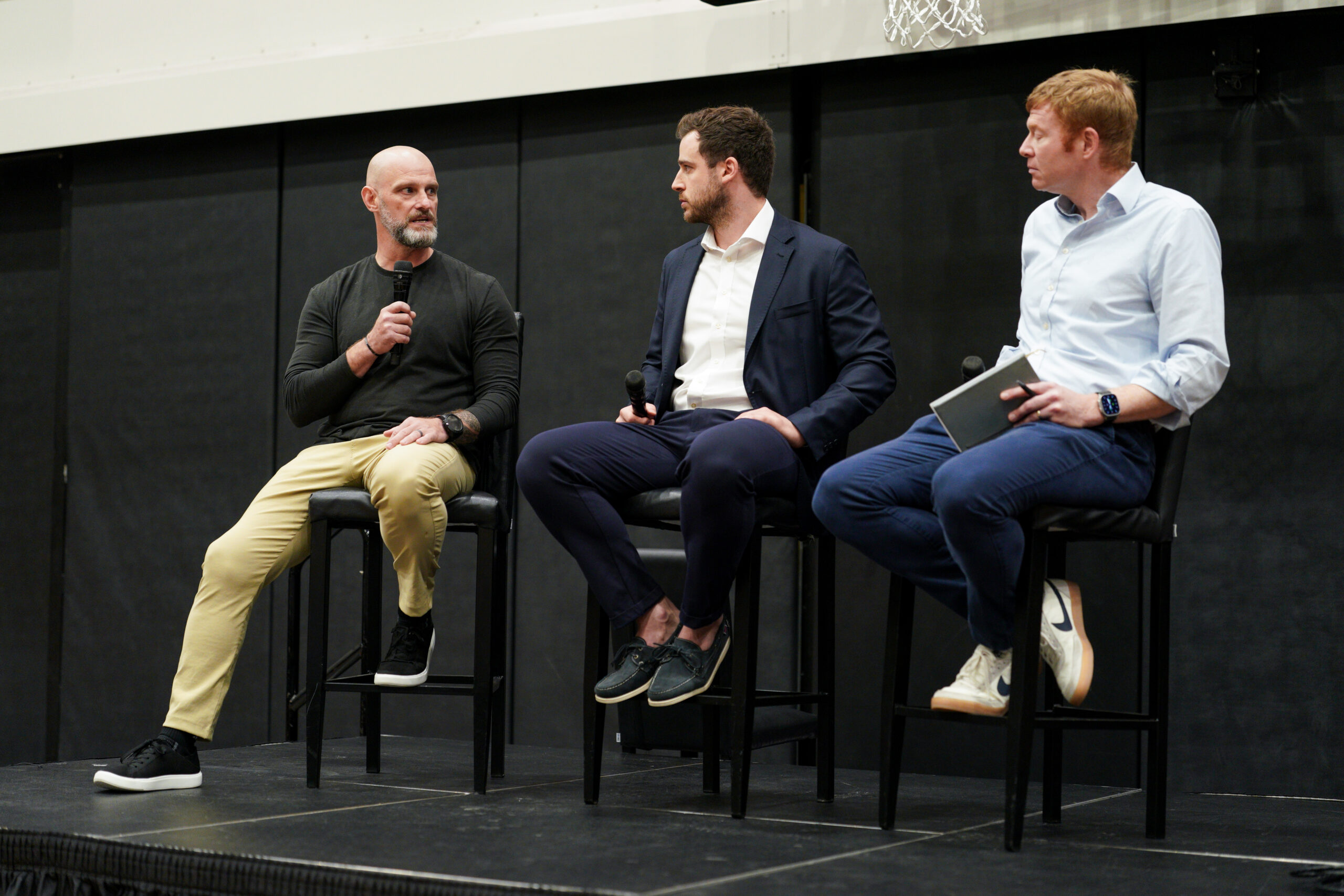
David Howarth (left) speaks alongside Damiano Bernacchini (centre) and session moderator Joe Lemire (right) at the Leaders Sport Performance Summit at the Barclays Center in New York.
For Howarth, the primary question is: “Does it change what the athlete or coach is doing?”
The duo raised five considerations.
This comes back to Howarth’s innovation-to-action conundrum and it means identifying a smaller number of measures that practitioners can depend on. He spoke of the “signal-to-noise ratio”: distinguishing genuine athlete change from normal biological fluctuation, equipment error or inconsistencies in the testing process.
That is where practitioner education becomes important. “The simplest answer is probably the right answer,” he said. “However,” he continued, “to get that simplicity, there’s an element of comprehension and a need to understand it” before a practitioner can explain the findings to athletes and coaches.
Howarth also pushed back against what he called a “black box approach”, where practitioners are expected to accept an output without understanding how it was produced.
“You’re really looking for an early, small winner,” said Howarth. Athletes and coaches need to see why a tool is useful before they are asked to give it more time or change how they work. He called for a “slow but accurate introduction of that tech” because “if it takes me 25 minutes to explain the technology and they switch off after eight seconds, I’ve probably lost”. He argued that organisations need to make room for practitioners to learn. Professional sport offers too few opportunities to test and refine a new tool before it is expected to deliver.
For his part, Bernacchini argued that implementation should not end when a product reaches the market. “Every three months there is a product review, understanding what are the priorities to develop and how we can implement it in the process,” he said of Technogym. These reviews allow them to reassess its development priorities as it receives feedback from clients.
As Howarth said: “Subjective measures are still incredibly valid data points.” He said that any measure is shaped by the quality of the equipment, the way it is collected and the judgement of the person interpreting it.
Bernacchini also stressed the need for human oversight when discussing AI-enabled prescription. He argued that technology should help practitioners process information rather than replace their judgement, because the tech may reveal patterns that an athlete or coach has not noticed, but subjective information can supply the context that the device cannot capture.
Practitioners must also be prepared to drop a tool that is not working. “Removing it can also help build trust,” said Howarth, who made the point that stopping an ineffective intervention shows that the performance team is judging it on results rather than trying to justify its continued use. He imagined a performance team openly saying “we’ve been doing this for six months and it’s shown us nothing”. In his view, that honesty preserves the performance team’s credibility when it next proposes an innovation. The test, he argued, is whether the technology produces a “clear, actionable output”.
“We want to be able to provide a support, not to substitute,” said Bernacchini. Technogym’s aim is to combine functional assessments, wearables and subjective data to create “a living programme that adapts also based on the previous session”. The programme would update a prescription as new information became available, with the practitioner remaining responsible for interpreting its recommendations.
Howarth also pointed to AI’s ability to sift through large amounts of information. In scouting, for example, it can find patterns across dozens of reports. He likened AI to a “digital twin” that can help practitioners “interrogate our own typical answers”.
What to read next
As the USL prepares for promotion and relegation, it is trialing a low-cost alternative to VAR, offering a useful case study in how organisations can improve decision-making as the stakes rise.
Main Image: USL
But that changes when deploying a new support system for said officials, like the USL will be doing with its Football Video Support (FVS) pilot for the final seven games of its interleague competition between Championship and League One teams, the Prinx Tires USL Cup.
“This is a weird thing to say, but I’m hoping we get the opportunity to utilize the technology,” said Luy, chuckling.
While Video Assistant Referee (VAR) is now a household abbreviation, FVS is more a recent addition to soccer. It’s so new that FIFA is still evaluating it as a potential alternative support method for referees (this pilot is part of that larger FIFA effort).
Here are a few key takeaways from my conversation with Luy about FVS and the USL.
How it works, and how the USL will use it
FVS usage is scaled down and clear-cut compared to VAR. It can only be used to review four situations:
A goal scored, Luy explained, will be automatically checked by the fourth official’s review on a field-side tablet. Other situations will require the match’s head coaches to request a review through the fourth official. Coaches will receive two requests per match during this pilot, which starts with quarterfinal knockout matches next month and continues through the Prinx Tires USL Cup title game.
There will be no challenge flags thrown or challenge balls punted on the field, sadly. “A little less ostentatious, I guess, for this footballing world,” Luy said.
FVS’s biggest benefit? Cost savings
Part of FIFA’s drive to test FVS is the desire for more affordable officiating support systems outside of VAR. For the smaller leagues around the world, VAR’s price (which can be in the mid- to high-seven figures for leagues) is a significant investment to make on tighter budgets. FVS is also supportive of venues set up with fewer cameras. Both cases reflect the USL’s needs, which support nearly 300 teams throughout its various levels of men’s and women’s competition.
“Even if we wanted to go that [VAR] route, we wouldn’t have the requisite bandwidth within the ecosystem to be able to accommodate that just from a strictly numbers perspective,” Huy said. “So when you create something like this that eliminates that mitigating factor, I think it’s very positive for the game and something that can be very positive for us as a league.”
An added benefit to this FVS deployment? The USL will get to rely on existing partners Spiideo and NEP Group, which it uses for its camera system and broadcast production.
Why it makes sense for the USL
This move comes as the USL prepares for an impending promotion-relegation setup in 2028, when the USL Premier debuts as the top of a three-tiered pyramid featuring the USL Championship (second division) and USL League One (division three).
Luy sees this as a natural evolution for the USL as officiating decisions could eventually impact clubs moving up or dropping down at the end of the year.
“With promotion-relegation conversations happening and talking about matches of consequence increasing throughout the regular season here and in the not-so-distant future for us, we feel like the time is now,” Luy said. “We’re going to create a dynamic and a paradigm where … you really up the stakes when you’re talking about people going up and down and the fluidity of a pro-rel system.
“Getting as many of those calls right and getting on the front foot here — it felt like the right time to accomplish that task.”
This article was brought to you by SBJ Tech, a Leaders Group company. As a Leaders Performance Institute member, you are able to enjoy exclusive access to SBJ Tech content in the field of athletic performance.
As annoying as some found the World Cup hydration breaks, in some respects such stoppages are insufficient for keeping players suitably fueled.
Main Image: Fifa via Getty Images
After France defeated Sweden 3-0 in the Round of 16, several of the Swedish players indicated that they found the mid-half intermissions beneficial on a day with a game-time temperature of 90 degrees and a heat index of 93 at N.Y. N.J. Stadium.
“It was hot out there, and it’s always nice to get a little bit of a break to fuel up,” Sweden defender Victor Lindelöf said. “Obviously against a team like France, it can be good as well to get a break and talk a little bit.”
Just days later, an apocalyptic-sounding Heat Dome was forecasted through the long holiday [July 4] weekend. Only three of the 16 World Cup venues — Atlanta, Dallas and Houston — were air-conditioned, making this “the World Cup of the sports scientist” for the outsized impact support staff can have, said Douglas Casa, the CEO of the Korey Stringer Institute and a kinesiology professor at UConn. Casa said proper heat mitigation strategies can lead to a 10% gain in performance.
The available modalities on site were personalized sports drinks, high-tech cooling devices that can be worn or held, and sweat-tracking patches, not to mention halftime cold plunges that can be 2-3 times more effective than air conditioning alone, according to Casa. He added that 90% of the benefits can be achieved with targeted heat acclimation in 10 days. The U.S. women’s national team spent that amount of time at the KSI prior to the Tokyo Olympics.
The Powerade-sponsored hydration breaks have been multipurpose for the athletes: consuming sports drinks, applying cooling towels and discussing tactics (and allowing time for fans to refill their beers). But relying on those three-minute pauses alone is not enough.
“Hydration is one of those things that, if you’re in the moment, you’re too late,” said Darcy Norman, the Director of Performance at Chicago Fire FC who previously held similar roles at three World Cups with Germany in 2014 and 2018 and the U.S. in 2022. “It takes time for your body to absorb the water. Typically, you would have more sodium, more salt, and that would draw in more water into the muscle itself. So you’re filling up the stores.”
A plan to beat the heat
Norman said a proper hydration plan starts the night before and should be built on data collected over time. The Fire use Nix Biosensors to build sweat profiles of every player in every condition, monitoring water and electrolyte loss on humid summer days, icy winter evenings and several types in between (Nix worked with one World Cup team but was unable to disclose which one). Perspiration “can vary quite substantially,” added Norman, who said some athletes are metabolically efficient even in intense heat while others sweat “like a fire hose.”
Gatorade has supported the Brazilian national team for a decade, including the use of sweat-tracking wearables from Epicore Biosystems that monitors the water and sodium lost from sweat and also skin temperature. Epicore CEO Roozbeh Ghaffari said longitudinal tracking is critical, noting, “You have to know what’s happening over time to predict forward.” Also, where a player competed in his professional season will affect his baseline.
Heat acclimatization can be objectively monitored through devices such as the Core body sensor, a wearable popular in triathlon and cycling. Core is making its way from endurance pursuits to team sports — it also has worked in and around this World Cup but isn’t at liberty to say whom it’s supporting — to gauge each athlete’s internal temperature and adaptation to the heat.
Core Chief Commercial Officer Ross McGraw said athletes face biomechanical limitations when heat overwhelms their system. “If they’re overheated, they’re not going to be able to run as fast,” McGraw said. “They’re not going to win those individual balls. And the less of those individual battles you win, the more likely you’re not going to do well as a team.”
Even teams that don’t use a sensor have prioritized heat training. Swedish defender Daniel Svensson said the team did heat training in climate-controlled rooms and saunas prior to coming to the U.S., where the Swedes held training camp in sweltering Frisco, Texas.
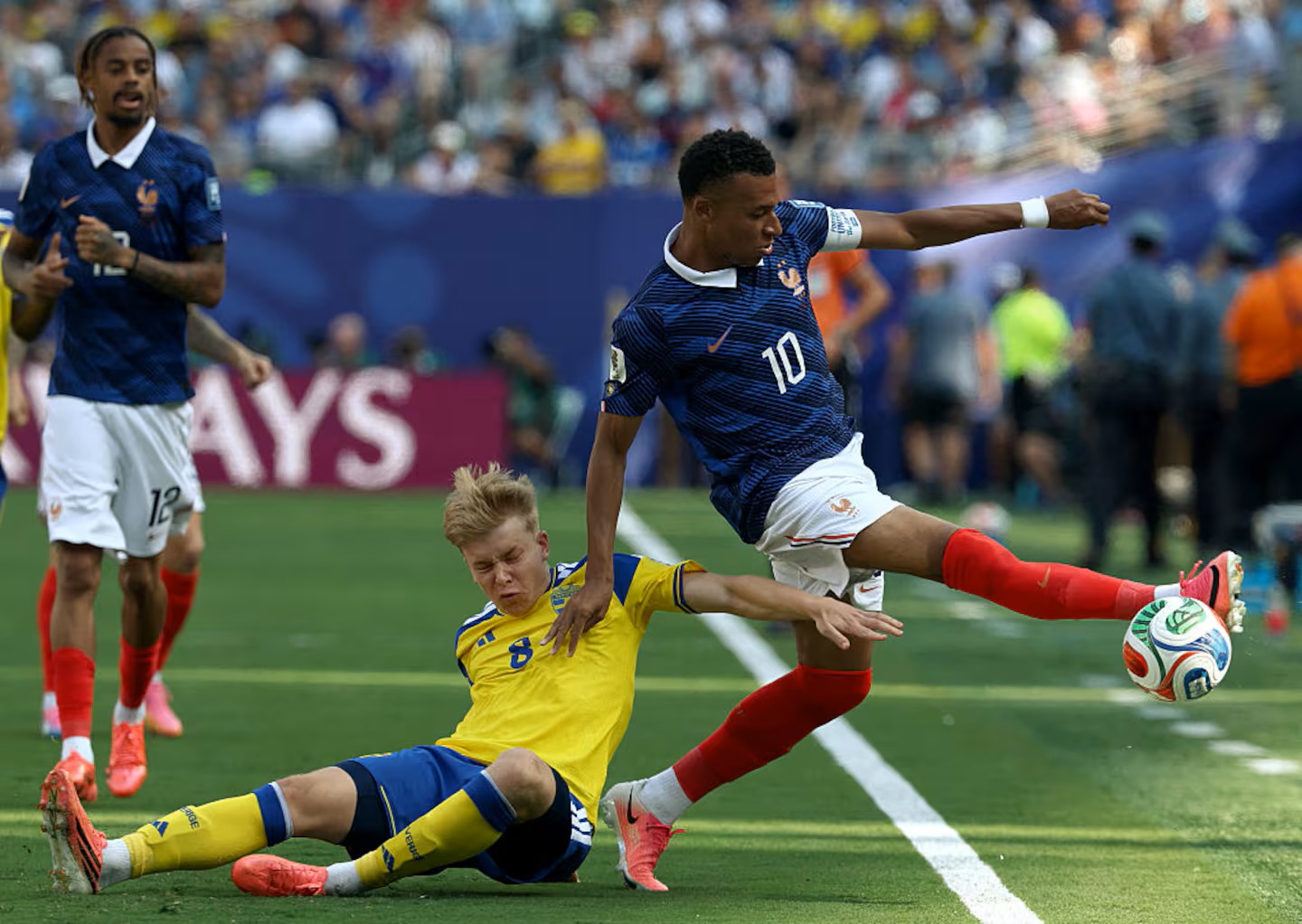
Defender Daniel Svensson and Sweden had to battle the pressure of France’s attack and the New Jersey heat. Photo: AFP via Getty Images
McGraw said Core measures body temperature in tandem with heart rate. When there is a “decoupling” of the metrics — that is, your heart rate continues to rise even when power or speed output remains steady — it can be a sign of heat strain. Some teams, he noticed, warm up the legs while wearing a cooling vest to keep the core temperature lower, calling the practice “counterintuitive” but one that has been effectively implemented by endurance sports.
Adidas outfitted 14 national teams with its new cooling vests and boots at the World Cup, including Argentina, Mexico and Spain. In training, England used Therabody’s new CryoTherm Palms, a handheld device that can lower core temperature. (Several pro sports teams, including MLB’s Cubs, have used a similar product from Apex Cool Labs called the Narwhal.)
Building up heat tolerance can make athletes feel more confident, too. As the Tokyo Games started, Megan Rapinoe posted on Instagram that she never felt better prepared for the conditions. McGraw, who later competed professionally in triathlons, spent childhoods attending weeks of soccer camp in central Pennsylvania where he remembers intense training in the summer sun and, afterwards, feeling “like Superman.” (The camp director, ironically, was a former pro with the aptly named Harrisburg Heat, and his surname is familiar: Mark Pulisic, the father of USMNT star Christian Pulisic.)
No matter how prepared an athlete is and how successful he may perform, the postgame objective is clear. After scoring two goals against Sweden, French superstar Kylian Mbappé told a reporter before leaving the field: “I’m looking forward to the changing room and the AC.”
This article was brought to you by SBJ Tech, a Leaders Group company. As a Leaders Performance Institute member, you are able to enjoy exclusive access to SBJ Tech content in the field of athletic performance.
SBJ Tech’s Joe Lemire was told that his pitching mechanics were a byproduct of his strength and flexibility. Here’s why VeloU may deliver the next evolution in movement diagnostics.
Main Image: VeloU
“Your body is telling you how it wants to move, and you’re ignoring it,” said Nick Serio, the GM of Velo University, near the end of my hourlong session.
The baseball and softball training center regularly works with individual high school, college and pro players, and I had undergone a robust battery of tests: a movement evaluation, multiple force plate drills, an ArmCare assessment and a dozen pitches in front of a TrackMan radar.
This data fuels the training programs and guidance VeloU offers its players, with hybrid options available for on-location and remote training. It developed a custom app, built upon white-label provider Everfi’s foundation, and guarantees responses within 24 hours, although typically VeloU coaches respond within an hour and a half.
“Our big promise — what we feel was the biggest gap in that industry — is our ability to communicate with an athlete,” Serio said. “We were always trying to think what is missing when you’re talking about remote training, and it’s the feeling that you have this connection to a coach.”
Serio, a former college baseball player who later earned a doctorate in sport and performance, had seen me squat comfortably into a deep stance but lack hip-shoulder separation — I have limited upper thoracic spine rotation, meaning I don’t generate much force from the twist of my torso, and my hips aren’t flexible. This much I knew, dating back to a Springbok Analytics scan when I was told in no uncertain terms that my hip flexors were struggling.
This is not my first — or even my second — summer spent chucking baseballs in the pursuit of speed. What VeloU diagnosed is that I try to compensate by over-rotating my trunk to increase the whipping action of my motion in hopes of eking out a few more precious miles per hour. But, as Dir of Pitching Thomas Jankins noted, I didn’t have the pelvic control to benefit from that move.
“To be honest, you are older — you’re just not going to have the same separation as a 19-year-old,” Jankins told me in a comment that was somehow both reassuring and devastating.
The downstream effect of these mechanics is that, when I ultimately pitched the ball, I lowered my left shoulder in an exaggerated fashion, and my right hand came over the top at an extremely high arm slot.
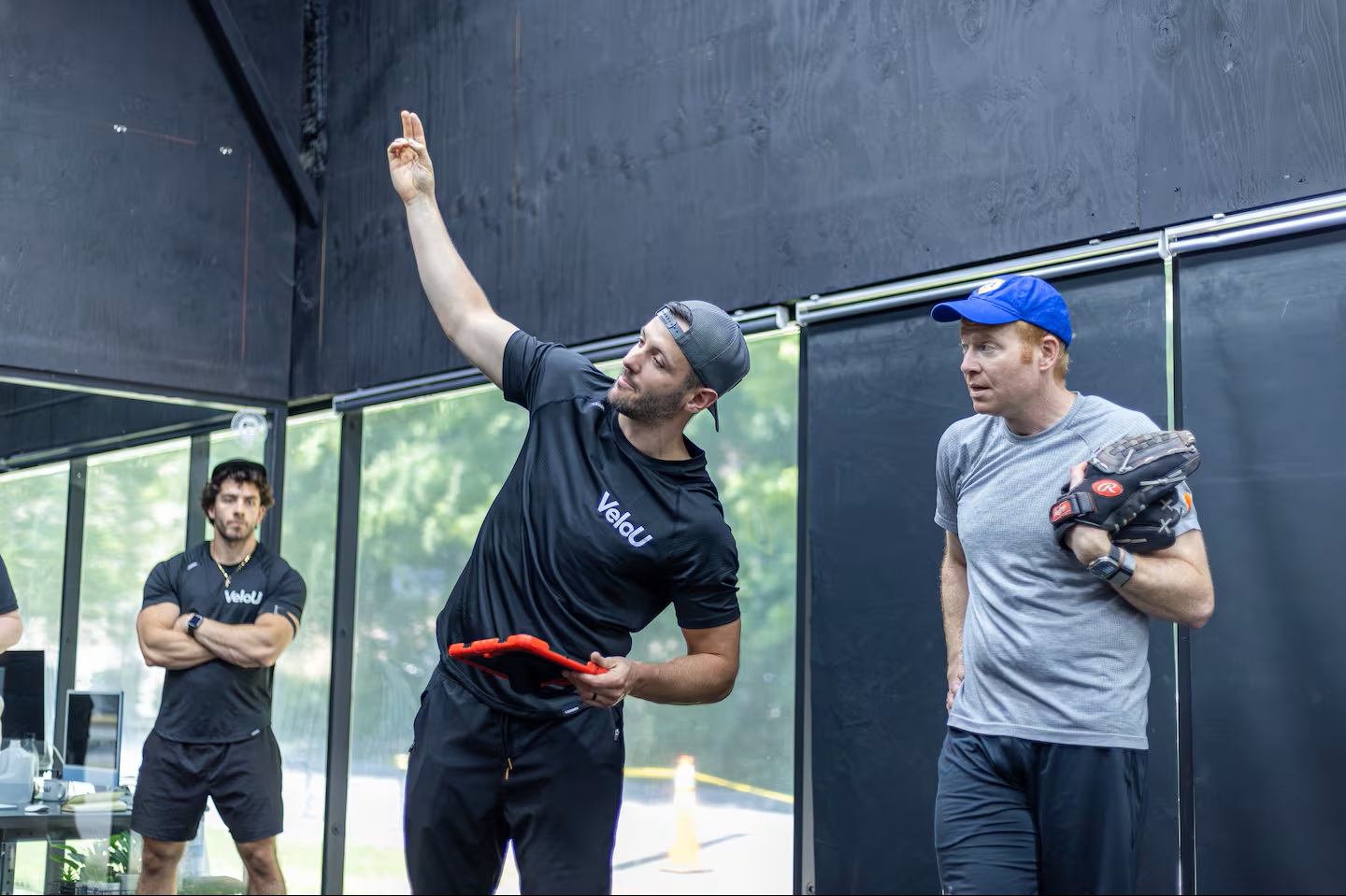
Here’s Jankins demonstrating my exaggerated arm slot for me. Image: VeloU
“Your rotation mechanism right now is basically just pure thoracic extension and tilting,” added Jankins, who rose to Triple-A in the Brewers system, explaining that I bring my arm over the top to create energy because, despite my best efforts, I couldn’t easily whip my torso around, thereby not taking full advantage of my lower half’s ability to generate force.
As Jankins put it, pitching mechanics are a byproduct of the body’s strength and flexibility. The throwing motion is a way to feel comfortable within those limitations. Serio believed I should prioritize generating force from the ground and through my legs because it ought to be more fruitful than whipping my upper body around.
“Most of the time, we don’t worry about the end of a race,” he said, referring to the throwing motion and likening my pitch to the finish and my mobility to the starting line. “We worry about the start of a race. In my opinion, you’re not built to wrap the way you’re wrapping, and that’s throwing everything else off.”
Performance coordinator Paul Franzese chimed in with some helpful weight room tips to emphasize the proper hip position when lifting. Serio noted that my squat during the movement assessment should be better leveraged in my pitching motion.
“You have too good of a squat for somebody that’s your height to not try and work on getting into that [position],” Serio added. “You’re avoiding loading your hip.”
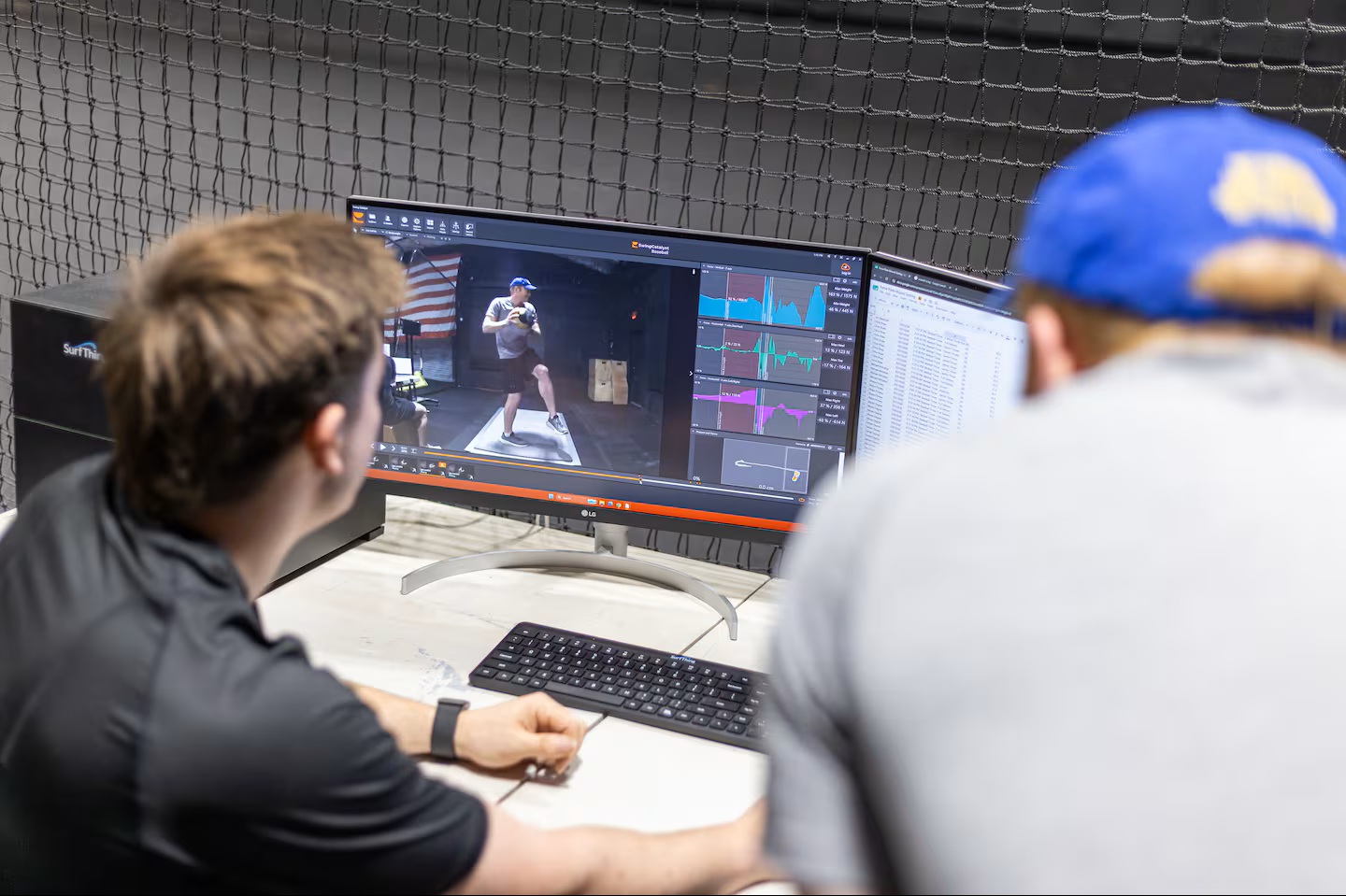
Throwing a med ball on force plates helped isolate my force production and sequencing. Image: VeloU
KinaTrax, the high-end motion capture system, is set to be installed later in the summer as well as a set of Bertec force plates built into a mound. In combination, that’ll give richer data on biomechanics.
Projecting velo for U
VeloU has built its own custom player reports, and Jankins led the creation of a proprietary algorithm predicting an athlete’s capacity for velocity. The end result is a total energy score analogous to the max throwing velocity a body is capable of throwing.
The algorithm, which Serio said will soon be licensed to college programs, is built on four metrics that are all composites of the individual assessments:
My total energy score was 81.8, and that’s right on the nose. A couple summers ago, I touched 82 mph. More recently, I topped out at 81 mph while throwing on a Pocket Radar. The big test, though, would be throwing on VeloU’s TrackMan. I had never thrown on an enterprise device like that; it formerly powered MLB’s Statcast and remains a leading provider in top colleges.
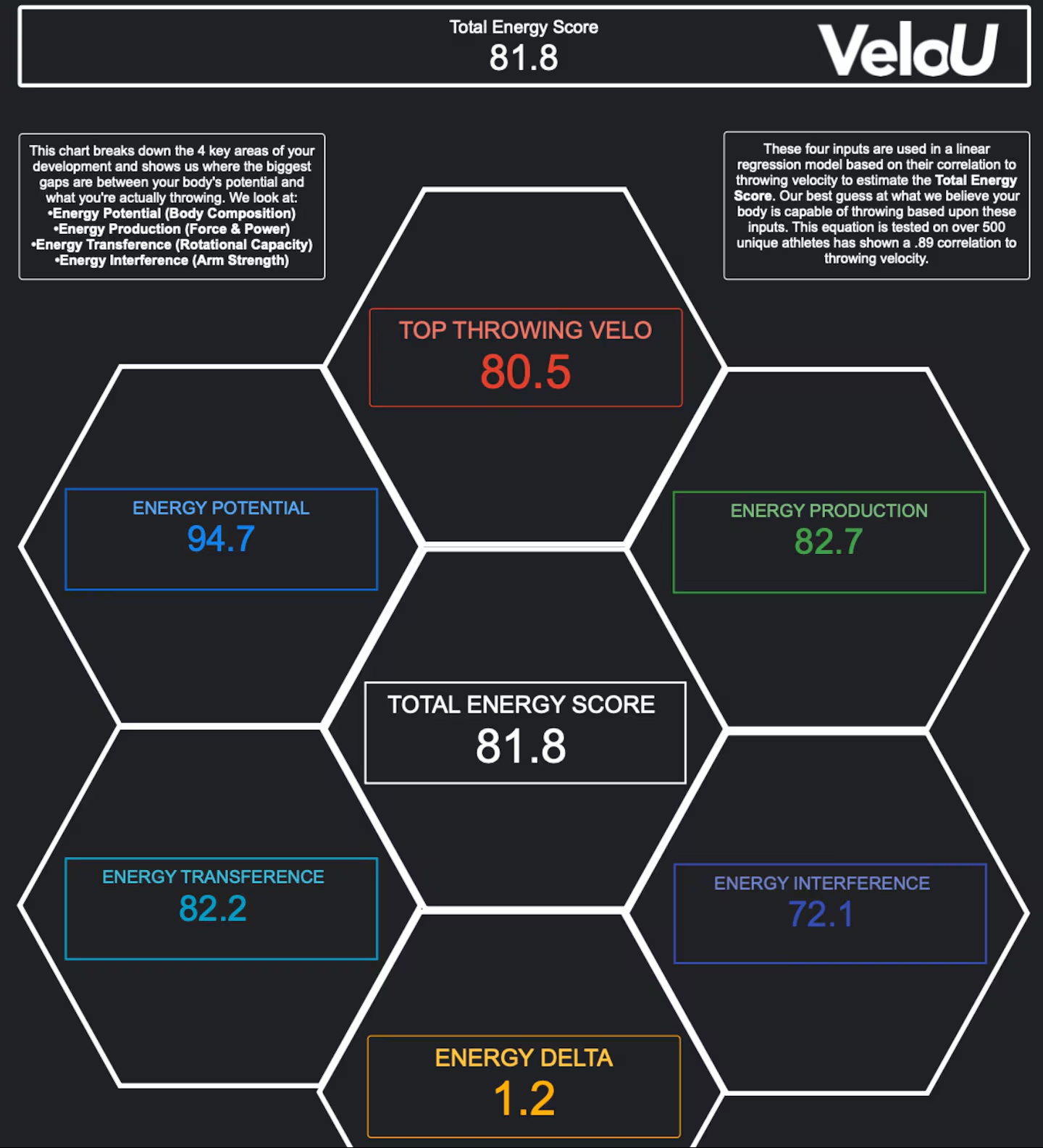
The VeloU reports tells me I’ve got great energy potential and subpar interference, meaning I need to strengthen my arm. Image: VeloU
As I neared the end of my throwing session, I had been maxing out in the upper 70s when Jankins gave me a final charge.
“We’re going to go just one more fastball to finish,” he said. “Give us 80.”
I rocked and fired, the ball sailing well wide of the strike zone as I put far more effort into velocity than command. TrackMan flashes a preliminary speed immediately before taking a few seconds to display the confirmed final number, initially showed 80 mph as the half-dozen VeloU trainers watching me cheered … before settling on 79.3, with the background noise descending into groans.
“One more,” I said, knowing the pressure was on.
This time, TrackMan began north of 80 and stayed there, registering 80.5, a reading met with a sustained cheer around me. Someone in the crowd equated the anticipation to one of their regular trainees trying to hit 98mph for the first time.
It was a supportive comment to show how invested the group was in my success, but it also reinforced for me how far away I was from the elites. I felt very much like a retiree auditing a course at VeloU.
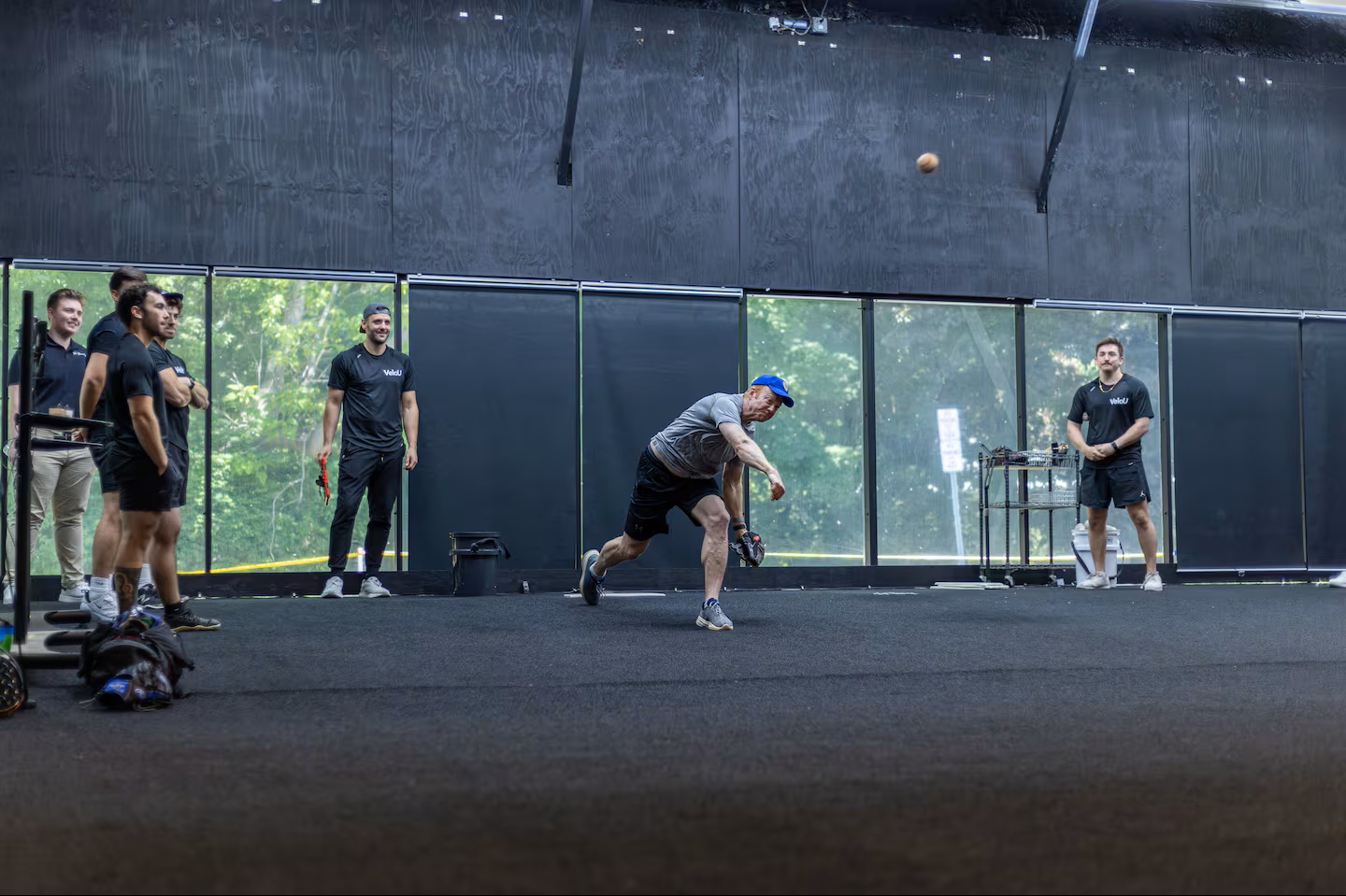
This baseball may look stationary in the photo, but TrackMan told me it was traveling 80.5 mph. Image: VeloU
This article was brought to you by SBJ Tech, a Leaders Group company. As a Leaders Performance Institute member, you are able to enjoy exclusive access to SBJ Tech content in the field of athletic performance.