FlyKitt has been adopted by US Soccer and numerous players traveling to and from Europe during international breaks. It uses algorithms to prescribe a protocol of supplements, blue light-blocking glasses and recommendations on meal and sleep timing to mitigate jet lag from international travel.
Main image: courtesy of FlyKitt

That product, built from the data collection and personal coaching services of what was known as Fount, worked so effectively — better than 90% success rate — that its sales quintupled in a six-month period last year. At that point, CEO Andrew Herr decided to focus more intently on helping people travel, and along with CTO Clayton Kim, developed FlyKitt Fit, an app-based AI tool that generates custom exercise plans for travelers.
With FlyKitt Fit, a user can take photos of a hotel gym — or any fitness center — and the app will automatically identify the available machinery. Someone then needs to enter exercise goals, time available and current muscle soreness, and then FlyKitt Fit will generate a workout program.
“One of the big conclusions from our work was that travel was a top three challenge to people’s health, and no one was addressing it,” Herr said. “With that rapid growth, we just saw the opportunity to really use all of the accumulated data and knowledge to build products to go after travel, and so what we’re doing is we’re building the toolkit to solve every part of the health challenges of travel.”
Over time, FlyKitt Fit will include more domestic travel aid and be more deeply intertwined with the jet lag product with inputs based on one’s circadian adjustment and optimal exertion based on recent rest. “We’re moving towards integrating this more into the FlyKitt program, but right now it’s really focused on getting you the best workout you can get when you’re on the road,” Herr said.
The genesis of FlyKitt originates from Herr’s time as a human performance specialist in the US Army — he was twice honored with a ‘Mad Scientist’ award — and his understanding that flying creates an inflammatory response akin to what divers experience at great depths. Suppressing that underlying inflammation allows circadian rhythms to more easily adjust. The parent company raised a $12 million Series A in 2023.
US Soccer is one of the known sports users of the FlyKitt product, both for team travel to international matches and for shuttling European-based players to and from camps back in the States.
Also on the product roadmap is FlyKitt Food. The tool, which is currently in beta, helps users find healthy meal options while traveling. The technology ingests publicly available menus and can recommend not just a certain restaurant but even a specific dish, complete with modifications such as whether to get the dressing on the side.
“We know from our coaching service both the types of meals that are going to be most effective at powering people when they travel,” Herr said. “It’s a generally healthy protocol, but it’s also really the optimal stuff to be eating when you travel. We know all the food sensitivities and food issues that make it hard not just to find a healthy restaurant, but find a healthy restaurant for you.”
This article was brought to you by SBJ Tech, a Leaders Group company. As a Leaders Performance Institute member, you are able to enjoy exclusive access to SBJ Tech content in the field of athletic performance.
The torpedo bat enhances exit velocity and optimizes swing mechanics. Here its story as told by 16 players, front office executives, batmakers and other insiders.
Main image: Bloomberg via Getty Images
Attached to the message sent to Brad Hillerich, who leads the production of pro products, was a CAD file from an MLB team analyst. It included a 3D-rendered wood baseball bat whose shape was unlike anything either Hillerich had ever seen. Brad called Bobby and they took a look at its bulging barrel and jarring taper.
“Oh, man, it was kind of like looking at a Tesla truck,” Bobby recalled. “[People say] ‘that’s not a truck,’ and we looked at it and said, ‘That’s not a bat.’ But we just said, ‘Listen, these guys are physicists. They’ve done their research, and the least we could do is turn it into a usable product and see what happens with it.’”
A year and a half later, that idea would have a catchy name — the torpedo bat — and a gaudy introduction into the baseball world. Five Yankees started swinging it this season, and they contributed nine home runs in one weekend, including five in one Saturday matinee against the Brewers in which YES Network broadcaster Michael Kay first called attention to the bats.
The cellphones of bat manufacturers were immediately overwhelmed with calls and texts from players and agents, a barrage starting even before the final pitch of that game. The secret was out.
The best ideas are the ones that seem so simple and intuitive in hindsight, and this was no different: increase the mass, and thus the energy and exit velocity at the primary point of contact. Still, by baseball standards, this was a radical innovation in a staid industry that is 150 years old. Its lesson is waiting to be applied across all sports, challenging assumptions and complacency potentially in favor of careful reinvention of even the most basic tools.
“It makes a lot of sense, but it’s like, why hasn’t anyone thought of it in 100-plus years?” said Yankees outfielder Giancarlo Stanton. “Then you try it, and as long as it’s comfortable in your hands — we’re creatures of habit, so the bat’s got to feel kind of like a glove or an extension of your arm.”
Stanton quietly used a torpedo bat from Marucci while slugging seven postseason homers last fall — and, it turns out, he wasn’t the only one to deliver playoff heroics with such a model. Guardians outfielder Lane Thomas adopted a tapered Old Hickory bat and smashed a grand slam off AL Cy Young winner Tarik Skubal in ALDS Game 5.
In interviews with 16 players, front office executives, batmakers and other insiders, Sports Business Journal traced the path of the torpedo bat’s innovation and identified the keys for its disruption with lessons that apply across all sports. Its creation was a race not just in research and development — a formula involving both physics and biology — but also, crucially, in adoption.
“You’re talking about wood baseball bats, so at the end of the day, we’re at the mercy of Mother Nature with most everything we do,” said Travis Copley, Old Hickory Vice President of Sales and Marketing. “This is a huge innovation already. It potentially could be even bigger.”
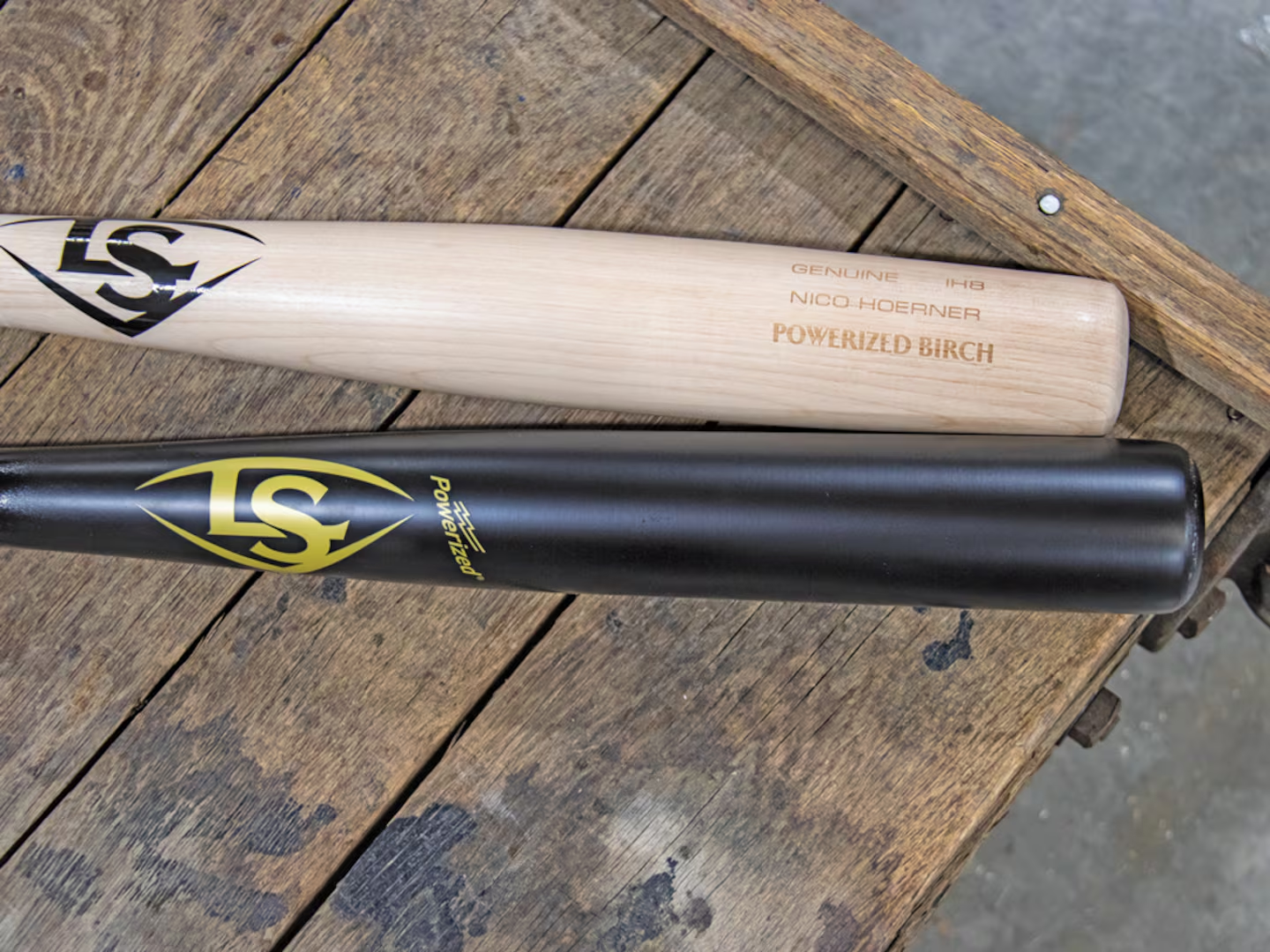
The Louisville Slugger Torpedo Bat (top) compared to a traditional bat shows the difference in the ‘wood budget’. Photo: Getty Images
Now, everyone from industry giants to batmaking boutiques are recognizing the need to do more. Hillerich said Louisville Slugger is “looking at doing more and more research,” and so too will Spoke Bats CEO Scott Pershern, whose founding principle is the use of a modeling engine to personalize each bat (i.e. bespoke, hence the name) and continue to push the boundaries of a product market mired in “institutional inertia.”
“The interesting thing for me,” Pershern said, “is now it has opened up everybody’s minds to what is possible.”
To see where baseball bats — and all stagnant sports equipment is going — it’s instructive to first understand how the sport arrived at this critical tipping point.
—
As an analyst with the Yankees, Aaron Leanhardt asked the players where on the bat they try to strike the ball. Leanhardt is a career-changer — an MIT-educated physicist who conducted NASA-funded research and was a physics professor at Michigan — who said his eureka moment was seeing that the sweet spot the players targeted was not the fattest part of the bat. He recalled to reporters saying, “Well, let’s flip it around. It’s going to look silly, but are we willing to go with it?”
Elsewhere in the AL East, Baltimore Orioles Assistant General Manager Sig Mejdal fielded questions from hitters wondering about the efficacy of bat fitting — that is, the use of advanced data and technology to ensure players are using the best-performing bat for their swing. Mejdal replied, “Sorry, I have no idea,” but he began investigating. Mejdal also has NASA roots, having worked for the agency as a mathematical modeler after earning multiple engineering and operations degrees.
“My background is mechanical engineering, so if you’re a hammer, everything you see is a nail,” said Mejdal, who led a team working on similar designs, including one called a bubble bat. “When you see the bat, it’s impossible not to wonder and not to think about the engineering of it.”
Also operating on a separate strand of development were the Cubs, whose core hitters last year — Cody Bellinger, Ian Happ, Nico Hoerner and Dansby Swanson — all tried variations at least in batting practice. “We had some long discussions with the Cubs this past summer where we talked about tapered-barrel bats a couple different times,” Pershern noted. (The Cubs did not respond to an interview request.)
An exact accounting isn’t possible, given the cloak-and-dagger secrecy of baseball operations, but Louisville Slugger was working with four unspecified teams on the design. Marucci supports eight MLB clubs through its high-tech baseball performance center, though not all were pursuing this shape. Orioles All-Star catcher Adley Rutschman was seen swinging one last year, as was Mets shortstop Francisco Lindor, who finished second in NL MVP voting.
Marucci CEO Kurt Ainsworth said half of his pro players inquired about the bat earlier this month. Louisville Slugger took more than 100 orders.
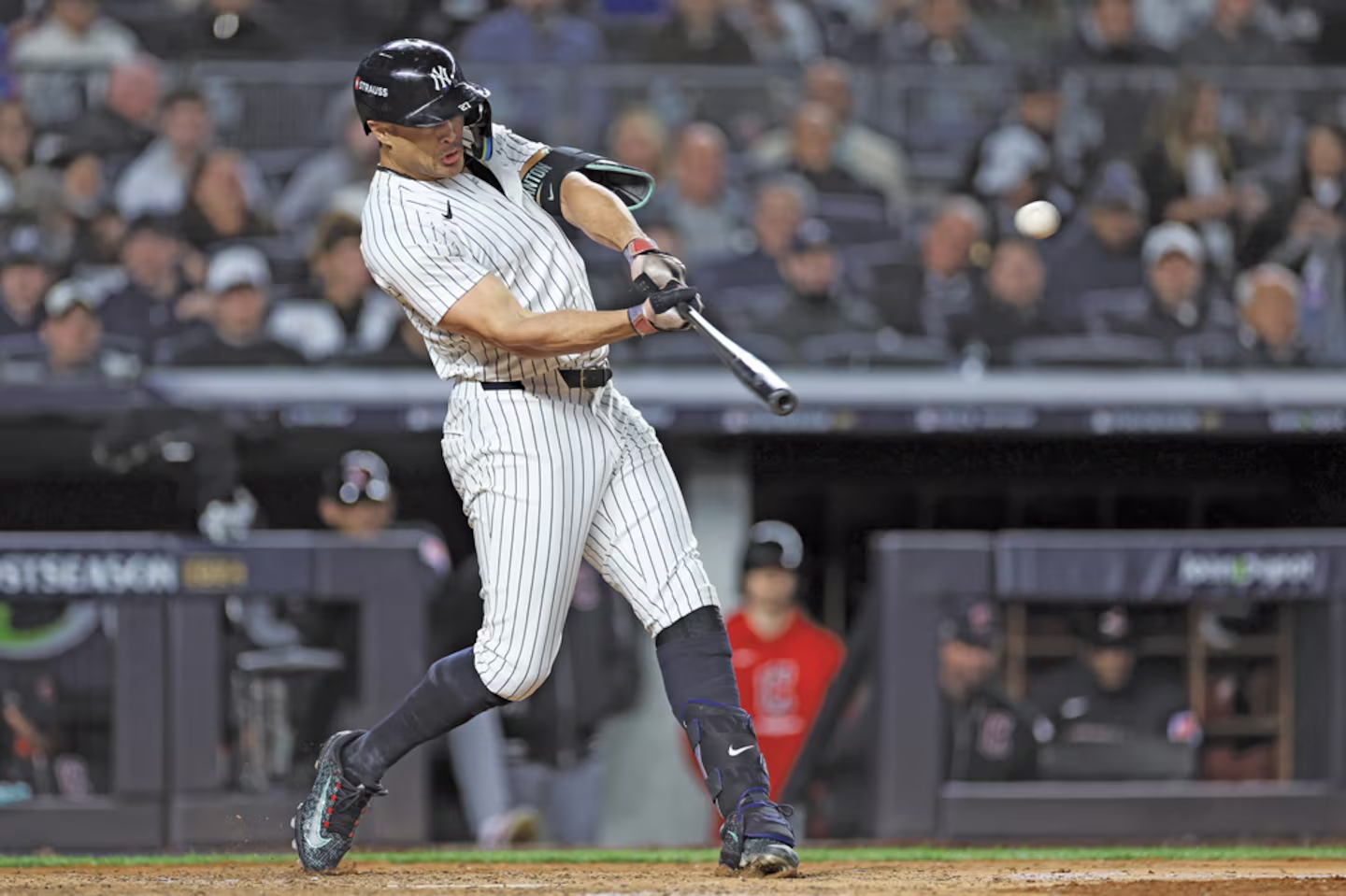
Giancarlo Stanton smashed seven postseason home runs last year with a torpedo bat and won ALCS MVP honors. Photo: Getty Images
The Yankees will be remembered for spearheading this because they fostered a culture in which the players bought in despite the unorthodox shape. The bat change may be a revolution, but the closest antecedent is in evolution. The Yankees are Charles Darwin, and everyone else is Alfred Russel Wallace, the naturalist who independently formulated the theory of natural selection but had his contributions overwhelmed by Darwin’s fame.
Most torpedo bats are the product of advanced personalization. Statcast tracking cameras provide a wealth of data on swing speed and path, as well as contact point. The Cubs made Bellinger a custom bat last season, but he didn’t like the way it felt. After an offseason trade, the Yankees made him a new custom bat, which he also didn’t care for. But Bellinger picked up the generic torpedo the Yankees made as a demo for players in 2023 and immediately took to it.
“I swung other bowling pin models, or torpedo bats — I didn’t like them,” Bellinger told SBJ. “This one just feels good in my hands.”
Big leaguers spend decades swinging bats to reach the sport’s highest level, and they take untold batting practice swings before the highly visible performance on the field, so they understandably can be fickle about change. Superstition and word-of-mouth recommendations can go a long way, and the word “feel” is paramount.
Leanhardt talks about a “wood budget,” a certain weight the player can swing, and redistributing wood needs to be done delicately and in balance. Hillerich said these changes are “to maximize the barrel, to maximize the sweet spot and still feel like the exact same bat that they started with.” In some cases, the torpedo bats move enough weight closer to the hands that they can be swung faster, which bears out in early-season Statcast data.
MLB has affirmed that these bats are legal, with the only real geometric stipulation being that the diameter can’t exceed 2.61 inches. Many torpedo bats now have larger barrels than regular bats, and at least some are at that max diameter. (Most torpedo bats are made of birch because it is a lower-density wood than maple; the latter makes it hard to construct a bat that is sturdy enough overall because the handle would have to be tiny to get the weight right.)
The league has a team of inspectors who periodically visit clubhouses to ensure compliance. The leader of that program is Scott Drake, the CEO of wood product inspection firm PFS-TECO, who first saw the torpedo shape in a MLB clubhouse when he saw Stanton’s bat last season. But even that reminded him of a manufacturer’s tour more than a decade ago when he saw maple bats that had “a very similar shape and design”, though those didn’t meet the density for requirements in MLB.
—
Within a week of the new bats’ public introduction at Yankee Stadium, the website of just about every bat manufacturer underwent a rapid update. “Incoming Torpedo,” touted Old Hickory. “The bat everyone is talking about is here,” promised Marucci. “Get the TPD1 Torpedo Bat Today,” exclaimed Louisville Slugger.
“I love that people are talking about baseball, and my role here is growing the game of baseball,” Marucci’s Ainsworth said. “This is great for our game, all the way down.”
“All the kids now want it,” said Éric Gagné, the former Cy Young-winning closer who is now primary owner of B45 Baseball. The company’s GM, Marie-Pier Gosselin, said it’s been nimble in meeting demand — “We had the wood available to make them rather quickly” — and continuing a tradition of innovation. The Québec-based company was the first to use birch in bats two decades ago, a short time after Barry Bonds and Sam Bats popularized maple.
Consumer demand was immediate, buoyed in part by the catchy torpedo name that has overtaken bowling pin, bubble and tapered barrel for obvious marketing reasons. Louisville Slugger noted that it is even thinking about new ways to shape the barrel of its metal bats. Without the underlying data informing a personalized bat shape, some experts aren’t convinced amateur players will be able to fully maximize its potential. Similarly, Ainsworth noted, younger hitters are less apt to hit the ball off the sweet spot, so the taper at the end of the bat might actually offset some gains.
Experts are clear that the benefits are real, but moderate, likely an increase of a couple miles per hour in exit velocity when connected on the sweet spot. Every mph of EV usually leads to another 5 feet or so of distance, which can quickly turn warning-track flyouts into first-row home runs. As an added benefit, some predict that the tapered barrel tip might turn poor contact (weak grounders or popups) into foul tips that keep the hitter at the plate.
Even Yankees Manager Aaron Boone said it’s more gains on the margin and helping players incrementally. The Orioles’ Mejdal noted that “this isn’t for every hitter.” Chuck Schupp, a 40-year industry veteran with Louisville Slugger, Marucci and now Chandler Bats, said he fielded 100 inquiries that first weekend, but cautioned everyone, “You’ve still got to hit the ball in the sweet spot — it doesn’t matter what the bat looks like. I just don’t think this is going to be an ‘a-ha’ moment to make a guy a better player.”
But, as Old Hickory’s Copley noted, the torpedo may serve as the catalyst for a broader “ideology of redesigning bats.” Just as the 2003 book “Moneyball” spawned the entire baseball analytics industry by making clubs reconsider all forms of player evaluation — and not just the initial realizations about metrics, such as on-base percentage — so, too, might torpedo bats precipitate deeper reevaluations of bats and other sports equipment.

Lane Thomas hit a huge homer for Cleveland with a torpedo bat. Photo: Getty Images
Wood bats are a relatively small but crowded market, with 41 MLB-approved suppliers. Pro models typically retail to consumers for $100 to $200 apiece. “You have the big-name companies, but aside from them, they’re all pretty boutique companies, so obviously it’s hard to have a very big R&D department,” Gosselin said. R&D dollars are typically slated more for the larger amateur market — and colleges, high schools and Little Leagues all swing metal.
Prior wood bat innovations in the past decade have centered on the knob at the end of the bat. Some players began preferring larger puck-sized knobs. Axe Bats pioneered a new sloped handle design. But the area is rife with opportunity.
“I personally feel like there is a bat that can be designed for each player, and we believe that you shouldn’t be using the same bat versus each pitcher anyway,” Ainsworth said. “In golf, you don’t use the same club for every shot.”
An early Marucci investor, former Phillies star Chase Utley, actually tried this prior to the 2009 World Series, ordering a bat with a different shape and length to face the infamous cutter thrown by Yankees Hall of Famer Mariano Rivera. He grounded into a double play his one chance to use it.
Brewers infield prospect Eric Brown Jr., a former first-round pick now in Class AA, ordered a tapered-barrel bat from Spoke late last summer because it felt lighter — “like a toothpick” — as the long season wound down. Brown had previously suffered a hand injury from getting jammed so often, leading Pershern to move the hard knot of the wood closer to his hands.
“Since the knot is moved down the barrel, I don’t feel that I’m getting jammed,” Brown said. “Essentially, it makes the bat harder.”
The torpedo bat’s shape isn’t as polygonal as Tesla’s Cybertruck, and its future seems brighter, despite Hillerich’s first impression. Whereas the president of an automotive design consultancy recently described the Cybertruck to Forbes as “a huge swing and a huge miss,” the torpedo bat seems poised to be exactly the opposite.
This article was brought to you by SBJ Tech, a Leaders Group company. As a Leaders Performance Institute member, you are able to enjoy exclusive access to SBJ Tech content in the field of athletic performance.
Hippos Exoskeleton’s AI-powered solution is akin to a car airbag and has drawn interest from the Premier League, Olympic sports and beyond.
Main image: Hippos Exoskeleton
Hippos Exoskeleton has created prototypes, raised $642,000 and tested its technology with athletes such as American world skiing champion Alex Schlopy and at the Brixton TopCats basketball club. The company is now accepting pre-orders for its yet-to-launch consumer product while drawing interest from elite sports organizations such as UK Athletics, Crystal Palace’s academy and the Chinese Olympic Association.
Its AI-powered knee brace has multiple sensors, a flexible printed circuit board and micro-gas canister to inflate the airbags, all while weighing less than four ounces [13g]. Hippos CEO Kylin Shaw said it can inflate the airbag in 30 milliseconds while ligaments can tear in 60 milliseconds.
“The core technology we invented is not only on the hardware side, but also on the software side: the AI, the data processing capability and the ability to use our AI model, which we designed by ourselves, to personalize the triggering threshold for every single individual, athletes, soldiers, patients,” Shaw said.
Among the early backers is Dr James Brown, the lead sports medicine doctor for UK Athletics, who wrote to SBJ that “a knee sleeve equipped with technology that can predict and prevent harmful movements can significantly reduce the risk of injury, thus avoiding the physical, emotional, and financial costs associated with injury recovery.” Brown added that the device has minimal impact on natural movement and provides the “psychological reassurance” that often translates into better performances.
Shaw and his co-founder, CTO Bhavy Metakar, are 20-year-olds who recently dropped out of university to pursue the startup. Both had injuries in their amateur athletic careers with the 6’5” [1.95m] Shaw tearing his ACL at age 17 and ending what he said was recruitment from a Division I program. He instead went overseas to study at the London School of Economics and played in the British Universities and Colleges Sport.
Metakar was studying at University College London when Shaw entered a lecture in search of an engineer to help him pursue his idea. Following the lead of the automotive industry and a Swedish company, Hövding, that made a cycling helmet with an airbag, Shaw sought to provide the same protection for joints.
Metakar made a crude device in his room as a proof of concept and then sought to understand the market need while adding that it has to look and feel good to gain adoption from most athletes.
“You don’t see many products that people wear for injury prevention because, unless you’ve been injured, you don’t really think about that,” Metakar said, adding it changes when there’s a medical history. “People who had been injured, they said, they would literally do anything not to get re-injured.”
The twofold innovation is the hardware that provides the structural support and the software that will trigger the airbag, intervening only at a potentially injurious moment.
“The first question was, before we make an airbag, we need to detect an injury,” Metakar said. “How do we measure, or how do we know that a person’s injured? How do we how do we tell the difference between someone getting injured versus them running really fast?”
They now believe that the technology can account for different knee structures and knee muscle strengths, with hopes of expanding to other joints and potentially to other smart materials.
“Our vision is an exoskeleton company, and the mission is to help humanity to move in a way where physical injuries cannot be happening,” Shaw said.
As for the company’s name, he explained that it is partly a reference to the Hippocratic oath that all doctors take but also the animal, which in East African culture can symbolize strength, health and rebirth.
This article was brought to you by SBJ Tech, a Leaders Group company. As a Leaders Performance Institute member, you are able to enjoy exclusive access to SBJ Tech content in the field of athletic performance.
In this edition of SBJ Tech’s Athlete’s Voice, the former Baltimore Ravens safety discusses how his new performance center will help to transform gym culture.
Main image: MW Athletix
A native of nearby Eastvale, Williams starred at the University of Utah before the New Orleans Saints drafted him in the second round of the 2017 NFL Draft. The 28-year-old signed with the Ravens prior to the 2022 season. He has 20 career interceptions and has averaged 59 tackles per season.
On why he wanted to build a fitness center…
My first camp that I ever [worked] was Bobby Wagner’s camp at Colony High School. So I went there to help with his camp and help build a legacy for what he was doing. And then it sparked something in me that I want to do the same thing, giving back to the community, giving back to where I came from.
Ultimately, I created a camp. Then after that, I was like, Okay, I want to really help these athletes, young and professional, get to their goals, not just athletically — because athletics is going to come easy for athletes — but it’s all about the mindset, the mentality, the discipline, things that you learn in sport that will help you be a better person. I created this so that we are able to have this culture surrounding these athletes that helps them outside of sport because sport doesn’t last forever.
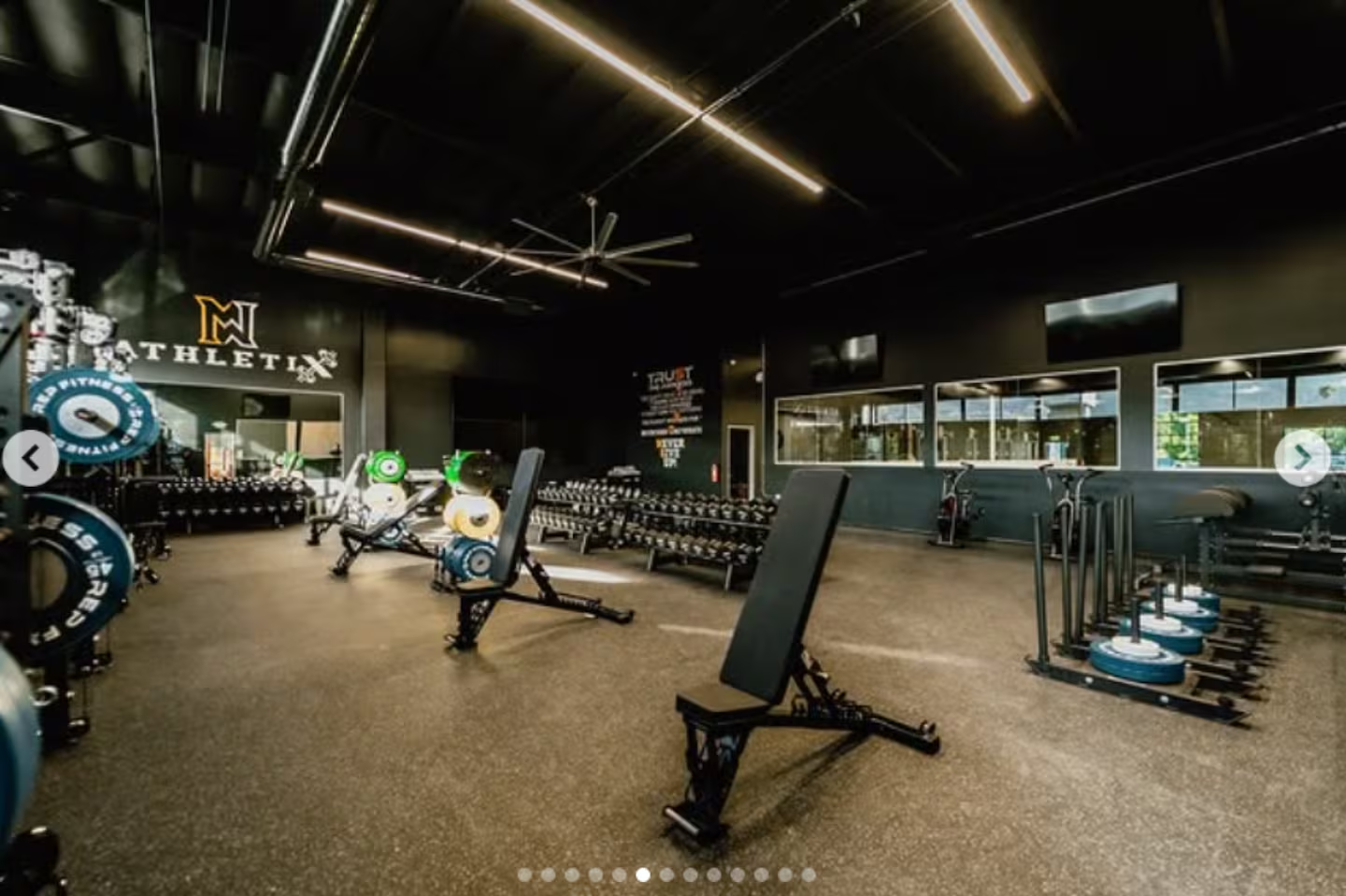
MW Athletix features a 7,800-square-foot exclusive private training environment, 35-yard indoor turf field, massage therapy and recovery services. Image: MW Athletix.
On how he built it…
It was a long design phase. It took us about two years to get this project up and running, but we took our time. We made sure that we detailed every single detail. I think we have the best bathrooms: It’s definitely spa-like. You go in there and you’re like, ‘Do I actually want to leave these bathrooms?’ You have the cold tubs, which are very essential in the recovery process, by Odin. And then we have our weight room — it’s amazing. We’re powered by REP equipment. They have all the tools and gadgets that you need to be able to get the ultimate workout.
And then we have our speed treadmills. These speed treadmills are our pride and joy. We use these treadmills to get these athletes, whatever sport it is, to get them moving in the right direction, moving fast. So these treadmills will get you fast, and it will turn your systems on pretty quick. We have 30 yards of turf, so every athlete can get in there and use their cleats or shoes — it is the same turf that they have at SoFi stadium. Then we have a multi-purpose room. We have massage therapy in there. We’re going to have Normatec boots. We’re going to have a little seating area where the parents can sit down, or people can sit and eat their lunch.
View this post on Instagram
On his vision for the gym culture…
I wanted to create a place where it feels like a team, where people come in and they’re like, ‘OK, I know I’m a part of this team. I’m part of this culture.’ And I wanted to make it almost as a dynasty you come in and it’s where the greats train, where the great athletes come from, where the team is always winning and the team is always working and motivating to be the best that they can. And of course you have to make sure everything is locked in and safe, so that everybody feels welcome.
On a key coaching mentor…
My college [position] coach, Morgan Scalley, took me under his wing. He showed me the ropes of taking that step into being a man. He had me since I was 17 years old, and I still talk to him pretty often. He taught me to never lose your edge, do things the right way, be accountable and make sure you do everything you have to do to be successful. Just never give up and never back down.
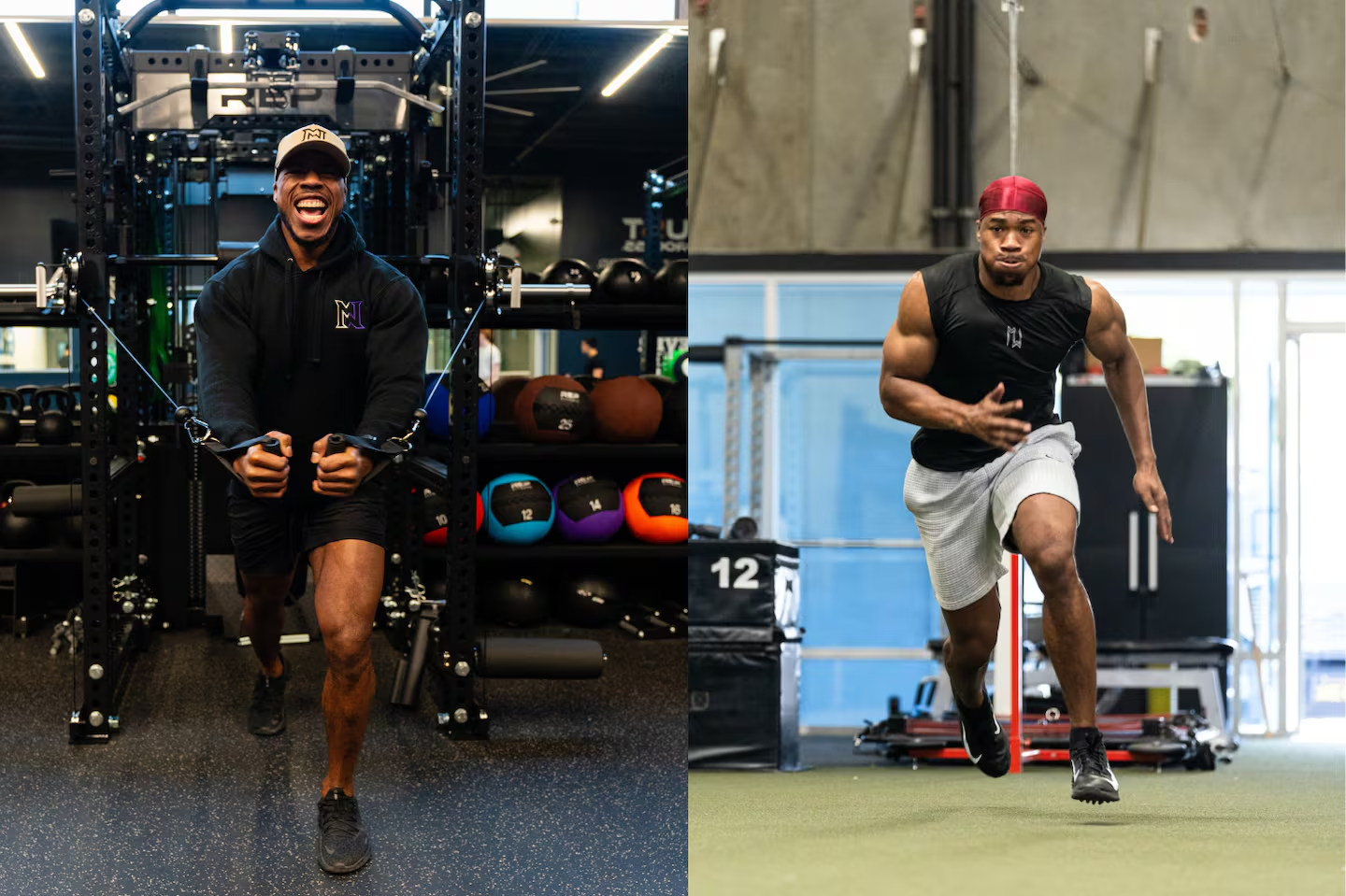
Marcus Williams founded MW Athletix to combine advanced training methods with community support. Image: MW Athletix.
On the tech and data he uses in training…
I don’t really use the Whoops or anything like that, just my Apple Watch. Now that I have this facility, I have the InBody scans, and I have the force plate so that we can see the type of outputs that we’re getting, and then we’re going to have the weight-monitoring system [velocity-based training, VBT] so when the bar is moving, we’re going to be able to track how fast it’s moving because everything is about speed.
On starting his own business…
I’ve always been an entrepreneur. Since I was in ninth grade, I was selling candy out of my backpack. That’s how I was making money in high school, trying to make sure I could provide and help out my parents by not asking for anything. I was able to do that little small business, which is kind of an entrepreneur-style thing, and then I was working at snack bars and things like that. But I’ve always been smart with my money. Taking this next step into a bigger entrepreneur role is definitely good for me because I’ve saved all of my money since I’ve been in the league.
This article was brought to you by SBJ Tech, a Leaders Group company. As a Leaders Performance Institute member, you are able to enjoy exclusive access to SBJ Tech content in the field of athletic performance.
Former NFL hopeful Ryan Rossner turned his attention to science, particularly longevity and gene therapy science
Main image: Minicircle
When he didn’t break through, he returned to school and went on to earn a PhD in molecular aging, studying under University of Washington professors Brian Kennedy and Matt Kaeberlein and pursuing research with Scott Leiser.
Now 42, Rossner is the Director of Longevity at Minicircle, a gene therapy startup in Austin, where he recently met SBJ and spoke about his career.
On his college experience…
I studied philosophy and political science, and I took football very seriously. I 100% wanted an NFL career. I wanted to make enough money to have financial freedom, but the NFL was very hard, and I was probably not mature enough to grind it out at that point.
On returning to school…
I took two years, bounced around the NFL, went right back to school [to complete my degree]. The NFL was that pressure cooker — I learned so many performance and discipline skills. I finished with straight As in school for the first time. I finished in philosophy and poli sci. But while pursuing football, I had the chance to read a lot, and I got exposed to popular science books about the exponential progress of technology through history. This grabbed me like nothing had before. I was like science is the answer to all these philosophical questions. And I can do science forever. It’s inexhaustible. So I got my BA and moved to Seattle to do science.
On his academic interest…
I focused on longevity, probably for two reasons: one, one of the formative events in my life was to watch my mom go through cancer. That’s why I got into philosophy. I wanted to understand why that happened. Philosophy doesn’t really answer that, but science empowers us to change that, specifically molecular biology. The other reason was all the exciting technological developments of the future, we get to experience them more if we’re around — longevity is like the big limiter.
On the start of his research…
I started working under this post-doc, Scott Leiser. He’s a former college football player, and we were studying how low oxygen exposure can increase lifespan in lab animals. Athletes train at altitudes, and then some of the mechanisms that are turned on by low oxygen are also turned on by fasting, which is like the foundational longevity intervention. So I started defining some of those mechanisms that were shared by low-oxygen, low-calorie longevity interventions.
On scientific breakthroughs versus football glory…
Ecstatic — nothing is better than discovering new scientific stuff. It’s the coolest feeling imaginable. At our rivals’ homecoming, [I hit] a clock-expiring, 54-yard field goal to silence the crowd. That was also cool. But science is like you’re seeing the secrets of the universe.
View this post on Instagram
On his next career step…
The Air Force recruited me a few months before I ended my PhD to work on the DARPA biostasis project, which is basically drug-induced human hibernation. I could not pass that up — super interesting. We really were studying extreme metabolism, which applies a lot to sports. So I went and did that in on Lackland Air Force Base in San Antonio for six months post-doc.
On lessons he’s learned and how he’d train differently for football now…
A million. I would train slower and smarter, just roll things out slow. I was always in a rush. I wanted to be Superman in six weeks, so [I had] a lot of overuse injuries. I would have drilled more when I got to the NFL. They made me start drilling instead of just kicking, and that was the first time I became really, really consistent at mid-distance kicks. And then, to be honest, I would have partied less.
On his work now…
This gene therapy basically increases fat free mass, decreases body fat, rewinds cellular epigenetic age, and our method of delivering it is what’s specific to us. So we adopted an irrationally neglected gene therapy mode called plasmid gene therapy. It’s simpler, safer, maybe a little less powerful than viral gene therapy, but our goal is to make something simple and accessible and safe.
On clarifying popular misconceptions…
Longevity science and gene therapy science, in particular, are very real. A lot of people think of them as sci-fi still — they are very real. We figured out how aging works, mostly in the 90s and early 2000s to a great degree. It’s worth learning about.
The other thing is, for athletes, and really just for anybody, data collection is really undervalued. You can have your whole genome sequenced for $400, and most people don’t know that’s possible. And then people are like, what am I going to do with that? You have the rest of your life to figure that out? You can get all 3 billion digits of code that you run on. This is like seeing behind the matrix. Get your code, get all the data you can on yourself to inform your health decisions.
This article was brought to you by SBJ Tech, a Leaders Group company. As a Leaders Performance Institute member, you are able to enjoy exclusive access to SBJ Tech content in the field of athletic performance.
The former NFL defender and Super Bowl winner spoke at SBJ’s Tech Week about how he used tech during his career and the impact of being able to call Warren Buffet and Joe Moglia his mentors.
Main image: Gregory Shamus / Getty Images
Suh, now 38, last played in 2022 and was part of the Sky Sports broadcast team for last month’s Super Bowl. He has invested in more than 30 companies, including Oura, through his family office, House of Spears Management. (Ndamukong means “House of Spears” in the Cameroonian language of Ngemba.) Suh also operates a real estate development company in Portland, Ore.
During SBJ Tech Week, Suh participated in a panel entitled “Tech and Talent: AI’s Impact on Athlete Training and Performance.”

Image: Marc Bryan-Brown
On the datapoints he tracked during his career…
The most consistent one that we’ve always done was, waking up first thing in the morning, I’d use a simple Google Sheet: How do you feel? One to 10. Where’s your energy level? There were four or five questions. That was probably the most consistent, and then we had so many other pieces of sleep data, whether it comes from Oura or, back in the day, we had other programs that we use. Ultimately, it’s a combination of looking at all this.
I’ve always been wired, especially from an athletic perspective, [where] I don’t really care how I feel. I have a job that I want to go and do an accomplish, and so I’m going to push myself through that. And if I chose to go get drunk the night before, I know I have to get up, and I’m going to have to muster through some things because I did that to myself. Vice versa, if I woke up and I just wasn’t feeling well, because traveling, or whatever it is, there’s ways to manipulate the body and manipulate the mind so you can reach your ultimate goals at the end of the day. It’s a combination of knowing when to pull back and when to push forward.
On the growth of data and tech…
Back in 2010 when I started, which is ages ago, it was kind of archaic, but to where we’re at now in 2025, there’s been a transformation. As athletes, we find different nuances and ways to find ways to get that 1% or half a percent to take us to the next level. And so I was always going into the lab. I was fortunate enough to have an amazing performance director I still work with to this day.
And then I had the great lab on the campus of Nike where I got to sit there underneath Phil Knight’s beautiful campus and everything that he has out with innovation. Back then it was the Mia Hamm Building, but now it’s LeBron James Building. So in there every summer finding new ways to tweak and learn different nuances that can advance my playing career.
On not overloading on tech…
Tools are key to have, but we also have to have that human interaction as well. It’s very important. That’s why I mentioned Keith D’Amelio, who’s my Performance Director. To have that human interaction and being able to say, “I can look and feel and see the things that you’re doing and I can teach you about the data.” Because I’m so focused on my craft and what I’m trying to do and accomplish and be the most dominant, but at the same time, I also need to learn those different new aspects of these new data points that are coming out. Some of them may not be relevant to me and that’s okay, but how do we decipher which ones are the best ones for me and which ones are not going to be the best ones for me.
On his interest in engineering…
I was born and raised into it. My father was a mechanical engineer. So as a young kid, as early as probably, second, third, fourth grade, I was riding around in this truck. He owned his own business, and so I was always with him, especially in the summers, when I wasn’t in school. It became a way for me to, one, be exposed to the industry and then falling in love with it, but then also as a kid, wanting toys and bikes and all different stuff — that became a job. Sweeping job sites and carrying duct work and all these particular pieces, and as I got bigger and stronger, I could lift heavy equipment and do that and things like that. Maybe I shouldn’t have been, but I was. So it was something I just easily fell in love with, [being] my dad, being on his hip, being able to watch and do everything, and just seeing it as something cool.
View this post on Instagram
On his studies at Nebraska…
I was a construction manager, so a broader view where, basically, I have the understanding of mechanical, electrical, plumbing, all the different trades that go into developing a building because I have to manage all of it. I have to know enough to be dangerous.
On how he’s put that to use…
I have built apartments, commercial buildings, so I’ve definitely put my degree to use. I have a development company back home in Portland that I do a majority of that through, and then I’ve built single family homes, not for myself, but for others and just different developments with different partners. I first learned by starting to do it, especially when I was in Detroit my first five years playing for the Lions. There was a guy named Gary Shiffman — he runs and started Sun Communities, which is a big publicly traded company centered around manufacturing homes. And so I learned a lot from him. We still work together to this day.
On his investing mentors, Warren Buffet and Joe Moglia…
We share an alma mater, Nebraska, so I first met [Buffet] when I was playing football there and going to school. He was honorary captain my senior year. And so they randomly came to me and were like, ‘You’re one of our top players. We’d love for you to meet him and walk out with you to the coin toss. Do you know who he is?’ And I was like, ‘Of course I know who he is. You’d have to be under a rock if you didn’t.’
So I really started reading up on him, understanding everything that he did. And then, funny enough, there was a defensive assistant that I didn’t really know until later on in my senior year, a guy named Joe Moglia, who was a big finance guy — he was CEO of TD Ameritrade — so everybody knew him as football coach, a silent assistant coach, but nobody really knew why he left in a black car every Thursday night to go to New York. And I had the balls to ask him. So we built a bond, and he became a close mentor of mine, especially after leaving college and even to this day.
On his investments…
I have a broad spectrum — the hospitality space, real estate and tech, depending on what type of technology it is and if I can add value to it and also if it’s just functionally things that I use. Especially on the sports side of things, like Oura Ring. Hyperice — I sold a business to them over the last couple of years for new technology for them to integrate into their organization with Normatec. I’ve been an advisor since the inception.
This article was brought to you by SBJ Tech, a Leaders Group company. As a Leaders Performance Institute member, you are able to enjoy exclusive access to SBJ Tech content in the field of athletic performance.
Last month at SBJ’s Tech Week, Bettman took to the stage to discuss how the NHL continues to embrace technologies that push the boundaries of performance.
Main image: Marc Bryan-Brown
His 32-year tenure has now arrived at a place where the sports industry is infused with tech, and the league is pushing in so many areas to advance its product: NHL Edge player tracking data, the digitally enhanced dasherboards and the alt-cast avenues it uses to reach various sections of its fans.
“The game has got to be good fundamentally,” Bettman said. “And you don’t change the game for the technology. What you do is use technology to enhance the game and to connect people with the game — whether it’s the players, the coaches or our media partners or our fans.”
As the headline speaker for SBJ Tech Week on Wednesday, Bettman rolled through the NHL’s various tech ventures, which continue to grow in both dedication and success. Here are some of his key thoughts on their current and future plans.
Boosting the referee process: One of the league’s recent developments focuses on officials using Apple Watch, which started in September.The hardware is helping officials track the game clock and also alerting them at the end of periods and penalties. Bettman sees the potential for that to expand to notifications that eventually include the players who commit penalties. The pairing of this technology with Hawk-Eye (one of SBJ’s 10 Most Innovative Sports Tech Companies) can help in the various judgment calls in games.
“I’m not sure we want to take all the human elements out of the game,” Bettman said. “However, something like offsides and high-sticking in terms of where the puck was touched, those are things that we may be able to do better of using not just the Apple Watch or the Hawk-Eye system but even using artificial intelligence in terms of re-creating situations.”
NHL Edge tracking data: Bettman pointed to the continued evolution of NHL Edge — which became operational for puck and player tracking in 2021-22 and added fan-facing features in 2023 — as a foundation of its tech mission. It supports the league’s alt-casts, as well as coaching insights. It has the potential to help video reviews, too.
“It took us better than five years and more money than I think I’ve ever told the owners to figure out how you could embed something in the puck that could actually be tracked,” Bettman said. “And then putting the chips on the player was a lot easier.”
A growing presence on Roblox: Roblox has increasingly become a space for the NHL to build and connect with younger fans. The league’s work on the platform started in 2023 with NHL Blast, which has housed All-Star Weekend and Stanley Cup Final deployments.
“It’s a combination of content creation [and data],” Bettman said, “And we now, because of the data we accumulate, we create more content and make it more readily available.”
Cloud-based live game broadcasts: The NHL, along with AWS, were SBA: Tech finalists for Best Technology Collaboration — the first live game broadcast of its kind.
“Producing the game on the cloud is more efficient from an environmental standpoint, a manpower standpoint, a financial standpoint,” Bettman said. “That’s the way of the future. That’s the way everybody’s going to be producing games.”
AI usage league-wide: Bettman mentioned that the NHL has leaned into AI in both fan-facing and back-of-house use cases. AI has streamlined aspects of selling tickets and scheduling games for its 32 teams.
“We schedule over 1,300 regular-season games, looking at building availability, looking at traffic patterns to get people in and out of games,” Bettman said. “These are all things that AI is going to make us better at.”
This article was brought to you by SBJ Tech, a Leaders Group company. As a Leaders Performance Institute member, you are able to enjoy exclusive access to SBJ Tech content in the field of athletic performance.
How haptic feedback helps officials to keep their eyes on the ice during games.
Main image: Getty Images courtesy of the NHL
The league and its officials, in collaboration with Apple and technology innovation partner Presidio, developed the NHL Watch Comms App to track the game clock and signal the imminent end of periods and penalties. But to help the officials focus more on the action around them, the primary function is to provide haptic feedback with vibrations, rather than visual cues.
“The watch doesn’t distract you,” said Stephen Walkom, a former on-ice referee who is now NHL Executive Vice President, Hockey Operations. “It actually informs you. You think you’ve got to see a watch, right? And we feel a watch, but we know what time it is.”
Rollout of the Apple Watches began in September, with the league reporting a 92.5% adoption rate by officials. Saturday’s NHL Stadium Series game, in which the Columbus Blue Jackets are hosting the Detroit Red Wings at Ohio Stadium — the usual football home of the Ohio State Buckeyes — is an important milestone for the technology.
Every arena hangs scoreboards and places LED-ribbon clocks in different places, but over time, the officials grow familiar with their locations for quick time checks. In a one-off location like with the Stadium Series, everything is new, plus the size and typical depth perception is thrown off by the vast size of the venue.
“In that building,” Walkom quipped, “you’d be spinning like a top on the ice looking for a clock.”
Part of the impetus for the technology was a safety concern. There have been collisions and near-misses on the ice when players emerge from the penalty box and an official happens to be skating near the door. Having the haptic reminder that a player is about to emerge can help clear that space.
“We had a really high-level objective: It was an interest to figure out, how can we help the officials keep their eyes on the ice more?” said Dave Lehanski, NHL EVP of Business Development and Innovation. “We can’t understate how important it was to collaborate with the officials and how agreeable they were to participating in this.”
The NHL brought that goal to its tech partners. Apple had previously helped the league by providing iPads for in-game bench use, and Presidio developed applications for the NHL Draft and the league’s streaming operations.
As straightforward as the end result is, there were technical challenges to develop it, not to mention the need for significant input from the officials to ensure the app didn’t disrupt their workflow. Presidio developed the app, extracting about two dozen datapoints from the NHL’s OASIS data feed, rather than pushing notifications to the watch.
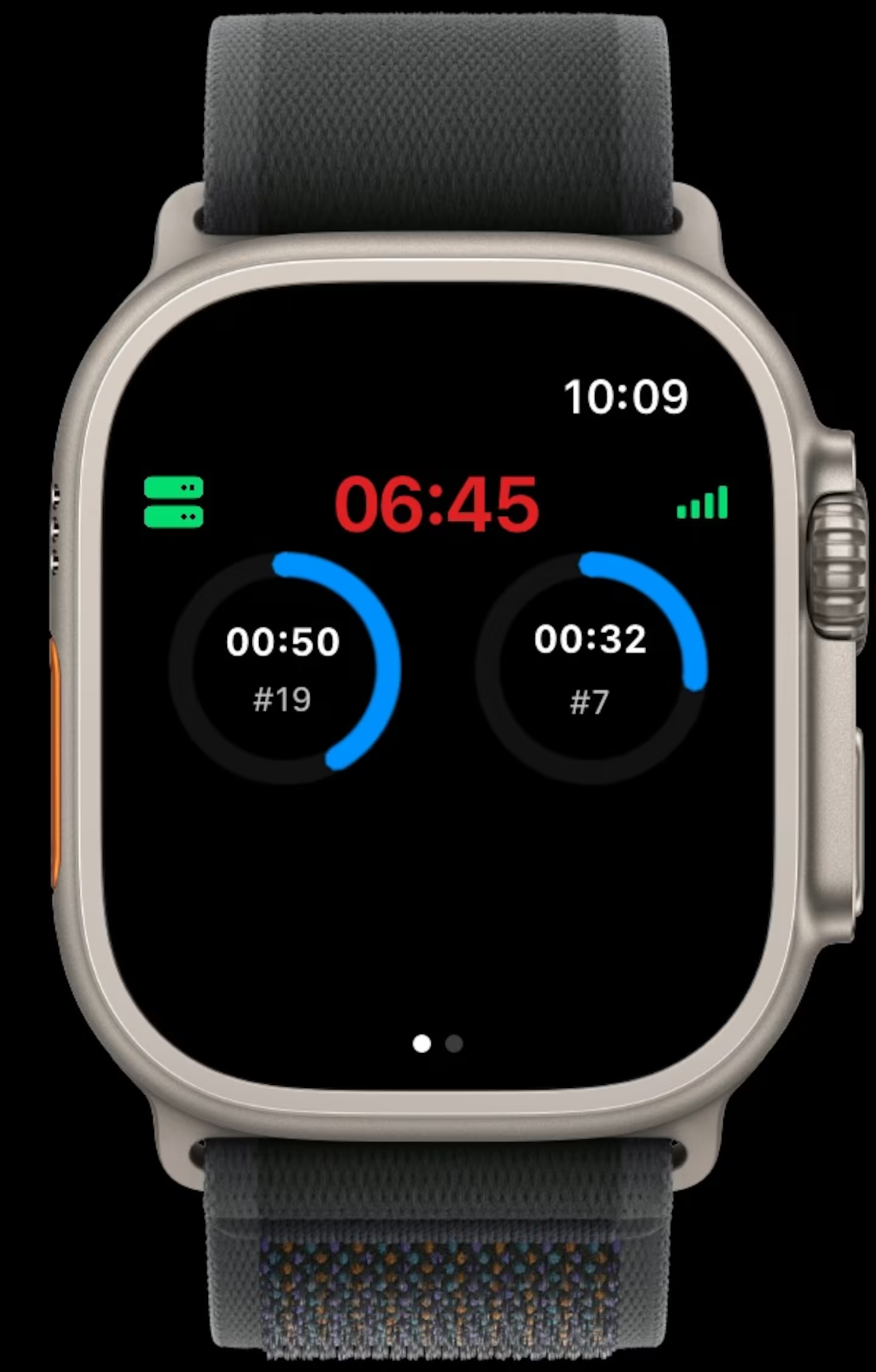
The NHL Watch Comms App showing the imminent end of two penalties (Photo: NHL)
“We had to build, not necessarily a push-based application, but a pull-based application, which was really, really unique, to make sure we had accurate data for the officials,” said Andres de Corral, Presidio VP Digital Services, noting that the timeline required “a series of design thinking sessions and trial and error.”
“The NHL has a real patience about these implementations,” added Scott Brodrick of Apple Worldwide Product Marketing. “The goal is the seamless use of technology to enhance the game, and I think that has materialized over this period of development. Sometimes the simple solution is the most powerful.”
Now, before games, almost every official grabs an Apple Watch as routinely as his shin guards, microphone and striped shirt.
“Guys just came to trust it,” Walkom said, “and we have less and less looking for a clock in the rink.”
This article was brought to you by SBJ Tech, a Leaders Group company. As a Leaders Performance Institute member, you are able to enjoy exclusive access to SBJ Tech content in the field of athletic performance.
In this edition of SBJ Tech’s Athlete’s Voice, British triple jumper Naomi Metzger discusses how data and AI are transforming her recovery.
After narrowly missing the Tokyo and Paris Olympics, Metzger is documenting her goal of qualifying for the LA28 Games on the blockchain. Cudis was founded by UCLA graduate Edison Chen, and it targets Gen Z athletes, having also secured partnerships with UCLA athletics and individuals competing for Lamborghini Racing (Cam Aliabadi), in Ironman (Patrick Schilz) and in Olympic rowing (Kate Knifton, a two-time NCAA champion at Texas who was Big 12 Athlete of the Year in 2023).
On how she learned about Cudis…
I actually found it on X. I was scrolling through, and I’m always having a look at what the next thing in crypto is — and then Cudis popped up. I saw wellness, web, crypto all combined — own your data — all these words that I’m thinking, ‘This sounds really interesting.’ So I shot them a message, and I was like, ‘Hi, I would love to be an athlete ambassador.’ I got talking to Edison, and then they made it happen. So I got sent the ring to test out, and then I got sent the version two ring. For the past six months, I’ve been playing around with the ring and really got to enjoy using it.
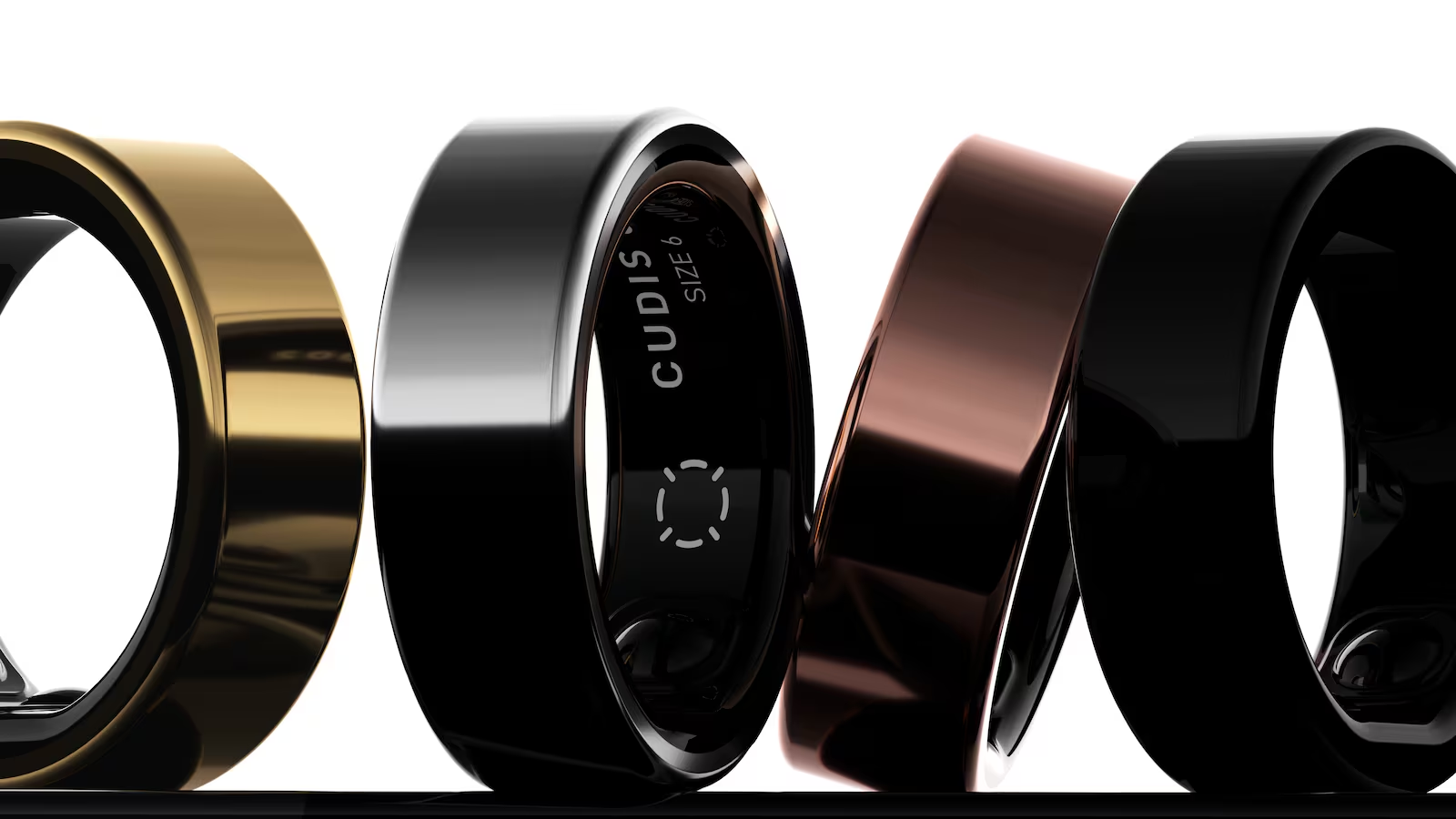
Cudis rings add a new layer to the wearable experience with their Web3 features that can transform real-time data into valuable points redeemable for exclusive rewards. (Image: Cudis)
On her interest in crypto…
Kind of out of desperation because I got dropped by my sponsor in 2021, so I wanted to find a way of how I can fund my athletics. I was on TikTok and stumbled across a Gary Vee video talking about NFTs. He was really passionate. So I was like, OK, let me just see if this works. So I created my own NFT collection in 2021 and stuck around since then.
On her prior use of wearables…
I used the Apple Watch but never to monitor my sleep because the problem I found with the Apple Watch is that you constantly need to charge it, and then when I’m sleeping, I might forget. So I never really tracked my sleep. A lot of athletes were using a Whoop, but they have to pay a monthly or yearly [fee] — it is a subscription-based model.
I don’t really like to pay monthly fees. I’m an ambassador, but I knew Cudis is a one-off payment. And I was like, OK, that appeals a little bit more to me. Since getting the ring, I’ve started to track my sleep as well, and that’s been pretty helpful.
On what she’s learned about her sleep…
I basically learned that I wasn’t getting as good of a sleep as I thought I was because I’m always quite proud of the fact that I get eight hours, but a lot of that was very light sleep. It wasn’t deep sleep, and I realized that once I got more deep sleep, that meant spending longer time actually in bed and trying to aim for a bit more than that eight hours, I felt a lot better, and the more I started tracking that, I realized that training was better when I well rested, my mood felt better. So that’s something that I wouldn’t have learned if I wasn’t really tracking it and looking at the data.
On how she tried improving her deep sleep…
I Googled, and I was asking people, “Do you have any tips?” I went with magnesium before bed, and that seemed to really help. A colder room and weighted bed sheets. I literally tried everything because, even though I was getting those hours, I really wanted to maximize my sleep because I know that’s super important for recovery.
On her analysis of daytime metrics…
It was the stress levels that I found really interesting with the ring. Although I’m pretty in tune with my body and what aches and pains, because I’m at 100% all of the time, whether that’s training or I’m doing the crypto things or making videos, I didn’t realize how stressed that I’m actually becoming when doing that. So when I started to have a look at the ring data and seeing that way the stress levels are pretty high, that told me to maybe rest a little bit, self-care, and prioritize my mental health a little bit more. And it sounds silly that I wasn’t in tune with my own brain, but I feel like the ring almost helped me to figure that out a little bit.

Naomi Metzger is an athlete ambassador for Cudis, a wearable ring technology with a Web3 component. (Photo: Corbis via Getty Images)
On using Cudis’ AI coaching functionality…
It really helped when I was looking at my sleep and looking at that deep sleep. When I first got the data, it was almost so much data, and I didn’t quite know what to make of it, so I asked the AI component, the coach, ‘Can you have a look at my sleep data and let me know what needs to improve and what’s the average and that type of thing?’ It was able to feed back [info] using my data what I should aim for, and I found that really helpful.
I also sometimes just ask for a little bit of advice. It sounds weird to speak to AI for advice, but sometimes I’m like, ‘Hmm, is it okay do you think to have a coffee now? Or do you think I should wait till maybe a bit later?’ And then it would be like, ‘This is the optimal times of having coffee.’ It’s quite cool to use AI in these ways, when I’d normally, I guess, be a bit too embarrassed to ask my actual coach.
On the ring’s Web3 component…
I’m really incentivized by rewards. As athletes, we’re obviously aiming for medals and things like that. The idea that your fitness gives you points, and those points can add up, and soon, I think, it’ll be able to be monetized, which is really cool. It’s a really good way for me to make sure that I’m tracking my workouts, sharing them, to get other people to, I don’t know, give them a bit of a boost — but it also just holds me a little bit more accountable.
You have a vitality score, and I’m always trying to aim for that 100 score. But sometimes I can be like, I don’t really need to do this rep, and I remember I’ve got the ring, it’s tracking me. I’m like, Okay, let me just do it. So I think, especially because I train on my own quite a bit, it’s a good way to hold me accountable.
On how much she continues doing her art…
I actually feel like I don’t have the time but definitely something that I want to get back into a little bit more. That was something that calmed me down. As I said, I’m always at like 100 but drawing was a way of calming me. And when I was doing the NFT collection, I was drawing a lot, and I had a really good athletic season. And also, when I was injured, I was drawing a lot as well because it was keeping my brain active when my body couldn’t move.
This article was brought to you by SBJ Tech, a Leaders Group company. As a Leaders Performance Institute member, you are able to enjoy exclusive access to SBJ Tech content in the field of athletic performance.
