With the Winter Olympics on the horizon, the organization is pursuing cost-effective and eminently scalable solutions.
Main Photo: US Figure Skating

Now the Chief High Performance Officer for US Figure Skating, Dillon’s affinity for the sport launched a career that reached the senior men’s national level. There was no resource to track progress or compare skating techniques in real time, something that will be much easier to do for skaters with the organization’s partnership with OOFSkate, which provides high-level analysis in an accessible way through an app.
“I was very self-driven, which is a great quality, but it was lonely,” Dillon told me. “So, I think that this also gives you the opportunity to compare your data. It’s almost like skating with a friend, because you can compare your data with athletes that either are similar levels or that you choose to share your data with or athletes at the level.”
The work comes as US Figure Skating looks toward the future, Dillon shared, in discovering how technology can move the sport toward the cutting edge around judging and analytical improvements. That journey is one that many sports and governing bodies find themselves on, with new startups trying to help that pursuit.
Simplifying analysis
OOFSkate is founded by Jerry Lu (the company’s CEO) and Jacob Blindenbach (CTO), a pair with extensive experience in applying innovation to performance and tracking for athletes.
Lu told my SBJ Tech colleague Joe Lemire that the startup’s education around skating has been powered by some significant names in the sport via an NBC connection, like former Olympians and world champions Nathan Chen, Tara Lipinski, and Johnny Weir, as well as the Skating Club of Boston.
With OOFSkate, skaters or coaches can record or upload skater routines to see insights like jump height, spin rotation and landing. It also provides for comparative analysis, where two videos can be analyzed simultaneously to compare multiple jumps from the same athletes or enable a skater to compare with fellow skaters. It only needs a single smartphone camera.
“If a coach records an athlete, they’re not going to carry a big camera connected to a big desktop computer that connects to something in order for them to use it,” Lu said. “So, it is designed to be a system that can be run on your cellphone with minimal lag.”
OOFSkate will support the upcoming Winter Olympics by providing data to boost TV production graphics and commentator analysis. The startup is self-funded. The founding pair met as students at the University of Virginia and have developed similar analytics tech for Olympic swimmers.
Perhaps my favorite detail? The “OOF” in OOFSkate is to replicate the reaction like “oof, that was bad,” but later retrofitted the acronym ‘obsess over form’ thanks to the help of sports scientist (and US Figure Skating Sports Science Manager) Dr Lindsay Slater.
This article was brought to you by SBJ Tech, a Leaders Group company. As a Leaders Performance Institute member, you are able to enjoy exclusive access to SBJ Tech content in the field of athletic performance.
SBJ Tech takes us inside the league’s Situation Room in Toronto, where data can be used to more intricately analyze the sport of hockey.
Main Photo: NHL
“Goal, Boston.”
These pronouncements from video technicians were, for a time, the only interruptions piercing the quiet murmur of the NHL’s Situation Room, the league’s high-tech Toronto facility where every replay challenge is reviewed and ruled on.
Most goals are straightforward, but every one is reviewed by a hockey operations executive to ensure its legality. So long as the puck wasn’t kicked or high-sticked into the net, the game continues. But the technicians, each assigned a single game, watch several angles of each goal to prepare for a possible coach’s challenge — such as whether the offensive team was offside.
“Goal, Pittsburgh. This one’s on us.”
Suddenly, the room stirs to life. The Penguins appeared to net a game-winning goal against the Flyers in overtime, and the Situation Room initiates all challenges in the final minute of regulation or in OT. As the braintrust began reviewing the play — several hockey operations executives and a retired referee — word arrived that the on-ice refs whistled an infraction that nullified the goal.
A few minutes later, the Flyers scored their own apparent game winner, but very quickly, a potentially incriminating view of their entrance into the zone appeared on the screen.
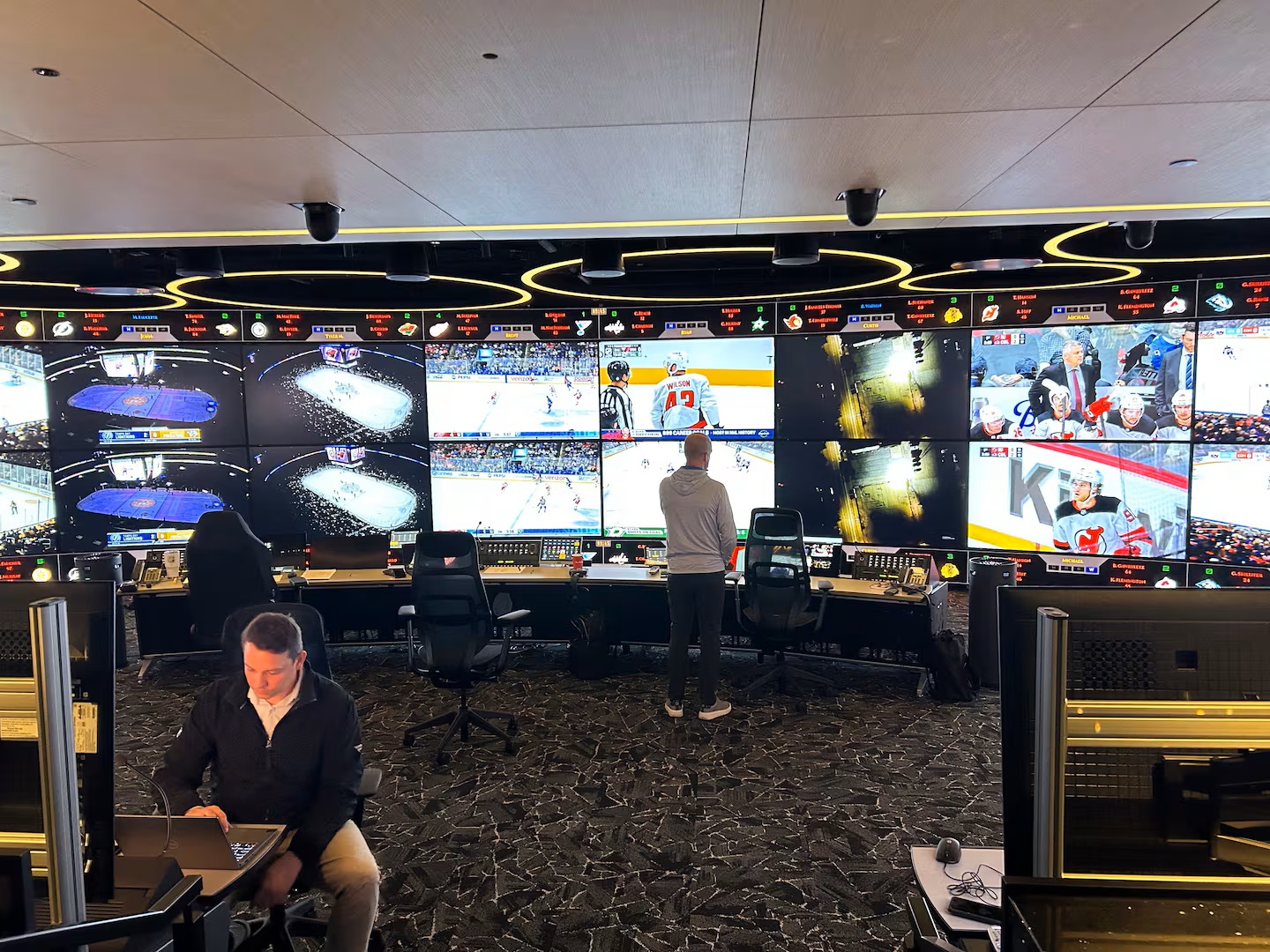
The Situation Room features 16 LED flat screens along the front wall and roughly a dozen workspaces for technicians, each assigned to one game. Photo: NHL
“We’re going to challenge this. Let’s get the linesmen on.”
Word is communicated to the on-ice officials, one of whom informs the crowd that “the previous play is under review by the league to see if the play was offsides prior to the goal” as boos cascade down from Flyers fans.
Situation Room staff pored over several angles, most notably a Sony 4K camera installed right on the blue line for exactly this use. And the final verdict, made by the Situation Room, was close, but clear: Offside. No goal. About 80 seconds after the review began, the ref shared the news in Philadelphia. Even more boos followed.
“We are the keepers of the game,” said Kris King, NHL Executive Vice President of Hockey Operations, the department’s No. 2-ranking official under Colin Campbell.
This is the second year of an upgraded, high-tech Situation Room. There are 16 LED flat screens adorning the front wall, a desk in the middle of the room for executives and roughly a dozen workspaces around the perimeter, where technicians monitor every game. SBJ was one of two news outlets granted behind-the-scenes access on the first night the 10th-floor space was open to media.
“Our job doesn’t really change a lot, but the equipment that we use, and the knowledge that we gain from using better equipment, just gives us a little bit of an upper edge to get to the right answer quicker,” King added.
The NHL was the first professional sports league to centralize its reviews back in 1991, and it has worked with Sony-owned Hawk-Eye’s Synchronized Multi-Angle Replay Technology (SMART) as its video replay provider since 2015.
Separately, the league named Sony a global technology partner earlier this year, and Hawk-Eye’s tracking cameras were installed in every NHL arena prior to last season. That system offers potentially richer data: Whereas NHL Edge, which is powered by SMT sensors on the players and in the puck, tracks a single, center-of-mass location for each player, Hawk-Eye collects data from 29 points on each skater and six points from the hockey stick.
In time, that optical data from Hawk-Eye should inform a richer future of hockey analytics, more immersive fan engagement and, perhaps, data-driven support for officials.
“The NHL are very much innovators in the space — they want to innovate with us to create the future of technology in sport — but I love the fact that it is coupled with patience,” said Dan Cash, Sony Hawk-Eye’s Managing Director for North America. “They know that this is going to be powerful for their game, but they aren’t trying to sprint to the finish line here, which I think with technology can be sometimes a mistake.”
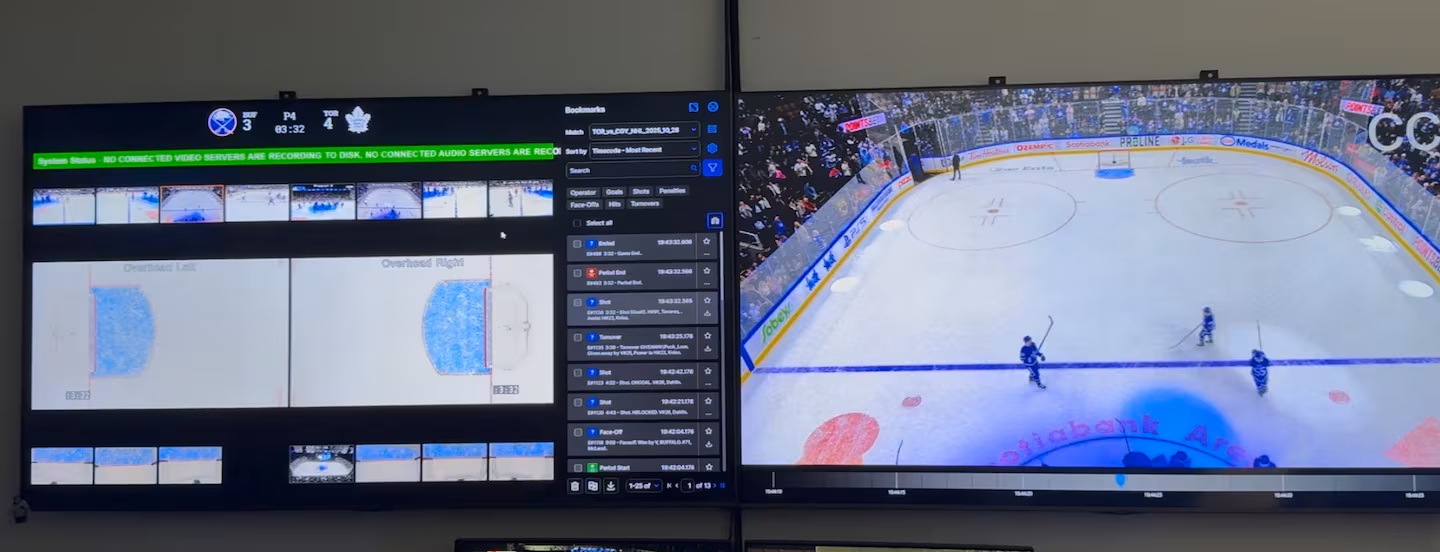
Cameras display a multitude of angles to enable the Situation Room crew to make speedy reviews. Photo: Joe Lemire
When King joined the league office in the early 2000s, the process was dramatically different. When a discipline issue arose, King would need to ferry a VHS tape to Campbell, who lived in Tillsonburg, a two-hour drive from the NHL office in Toronto.
They’d each get in their cars and drive halfway, inevitably connecting at a Tim Horton’s, the most Canadian of meeting points. Campbell would then drive home, review the tape and make a ruling about a possible suspension or fine. Nowadays, that video is transmitted in about 125 milliseconds from arenas to the Situation Room and about as rapidly to Campbell’s house, saving immense time and gas, at only the cost of a fresh coffee.
“How we transport video is the secret sauce, so to speak,” Cash said. “It’s not easy to transport video as quick as we do over a wide area network.”
We are the keepers of the game.
Kris King, NHL Executive Vice President of Hockey Operations
It’s even less for the league’s next-door neighbors. The goal horn from next-door Scotiabank Arena blared concurrently with a Maple Leafs goal scored on the Situation Room monitor. (The horn also later sounded for a Blue Jays home run; the World Series, featuring the local team, was discreetly on a few Situation Room screens.) That immediacy lets the Situation Room prepare video clips and look at questionable calls before even hearing from the on-site staff.
“It definitely is a real-time league now,” said Rod Pasma, NHL Group Vice President of Hockey Operations. “A lot of times we’ll know exactly what’s going on before [the coaches] even call the officials over to challenge a play.”
On that night, the Situation Room scoured replays to prepare a ruling that never materialized, with the on-site coach opting against the review process. “That’s a good non-challenge,” King said, noting the likelihood the call wouldn’t have been reversed.
The NHL continues to add cameras: There are three in each goal, one above, four on the blue lines and an elevated 4K lens to provide the All-12 viewpoint of every skater. Some arenas now have Cosm C360 cameras. The league will soon begin testing an 8K version of the All-12 at the Prudential Center — where the NHL and Verizon also are creating an innovation lab to test new tech, scheduled for full operation early in the new year.
On this particular night in the Toronto Situation Room, as part of ESPN’s Frozen Frenzy, all 32 teams were playing, many of the start times staggered by 15-minute intervals to make the action nonstop. One workstation was solely dedicated to pressing go on a digital dasherboards celebration for Alex Ovechkin’s 900th goal. The NHL didn’t want to chance it flashing live on-air, only for the goal to be overturned on review.
“The technology’s gotten to a point where the only thing we can’t do right now is literally hit the horn in the building,” Pasma said.
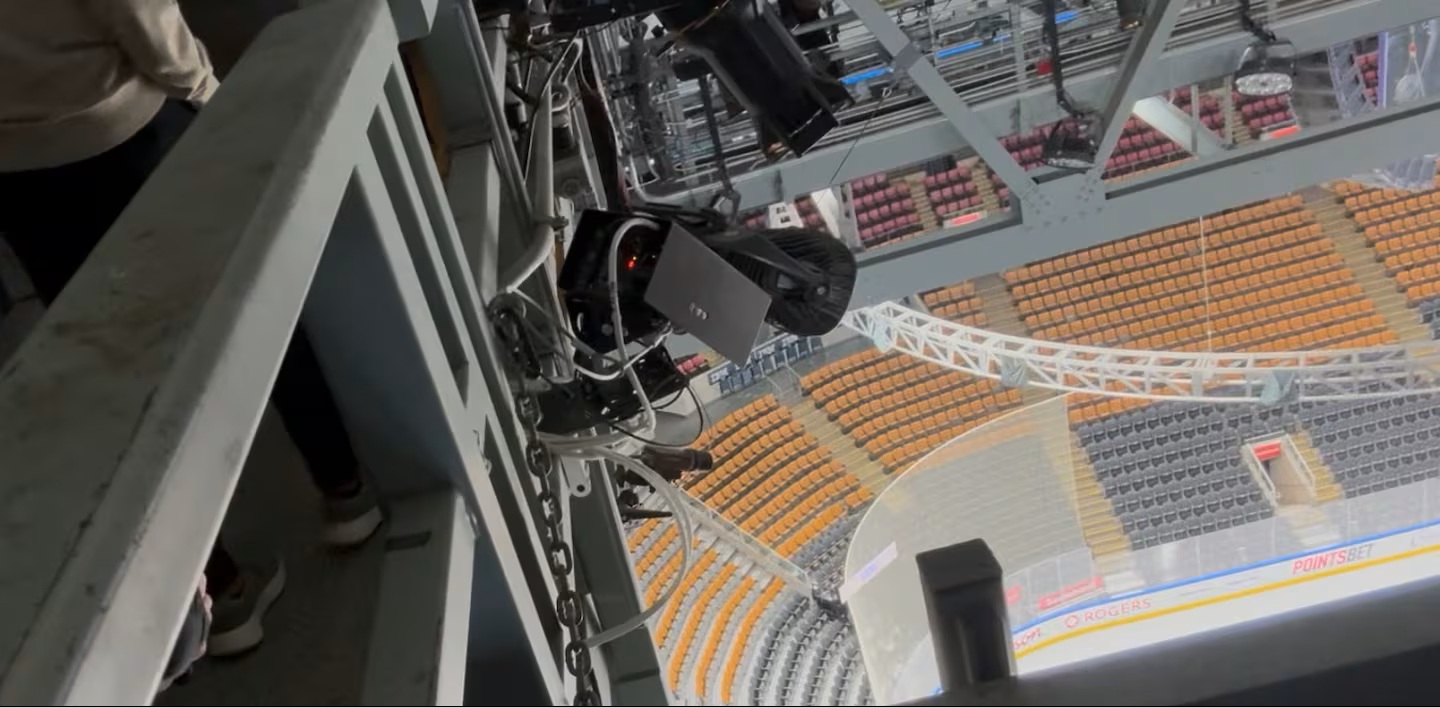
Hawk-Eye’s tracking cameras were installed in every NHL arena prior to last season. Photo: Joe Lemire
High in the rafters above Scotiabank Arena, looking down on the Maple Leafs’ 1960s Stanley Cup banners, are six black, rectangular cameras affixed to the catwalk and helping power the Hawk-Eye tracking system. From up here in the rafters, the ice seems impossibly low, but the 4K, 60-frames-per-second cameras capture granular movement data via images streamed directly to the cloud — Hawk-Eye’s first leaguewide deal to be cloud-native. Another six cameras are placed on lower levels of the arena to avoid obstruction from the center-hung video board.
Those dozen video inputs are triangulated and processed to determine the precise location of every skater and his stick. Hawk-Eye has provided MLB with bat tracking data for a couple seasons, but that’s only one bat in a known location every time — far different than 12 sticks across a 200-foot-by-85-foot ice rink.
For now, the AI models interpreting this data are still going through iterations to reach the confidence threshold for accuracy needed for wider distribution. The NHL has never had stick data, and Hawk-Eye and the league are in the “true development phase in refining the technology,” said Sean Williams, NHL Vice President, Innovation and Technology Partnerships. Williams added that it could soon be used to enhance the existing Edge tracking that teams can access through the data feed.
When Hawk-Eye data does become a part of the NHL Edge repository, it will not only further enrich the data-driven storytelling for fans via broadcast and digital media and help clubs more intricately analyze the sport, it also could provide other inputs for referees, linesmen and Situation Room executives.
“Not currently, but that’s definitely where we’re going,” said Sean Ellis, NHL Vice President of Hockey Operations, of using tracking data for officiating. “We’re not going to roll it out until we’re 100% confident and comfortable that the data that we’re getting is accurate.”
Even then, the potential is more to inform than automate. “We are genuinely looking at all options,” Williams said, “but our fundamental strategy is to keep the call on the ice made by humans.”
This article was brought to you by SBJ Tech, a Leaders Group company. As a Leaders Performance Institute member, you are able to enjoy exclusive access to SBJ Tech content in the field of athletic performance.
In the third and final session of his virtual roundtable series, Professor Fabio Serpiello of Central Queensland University raised the question of decision-making frameworks when choosing or discarding tech solutions.
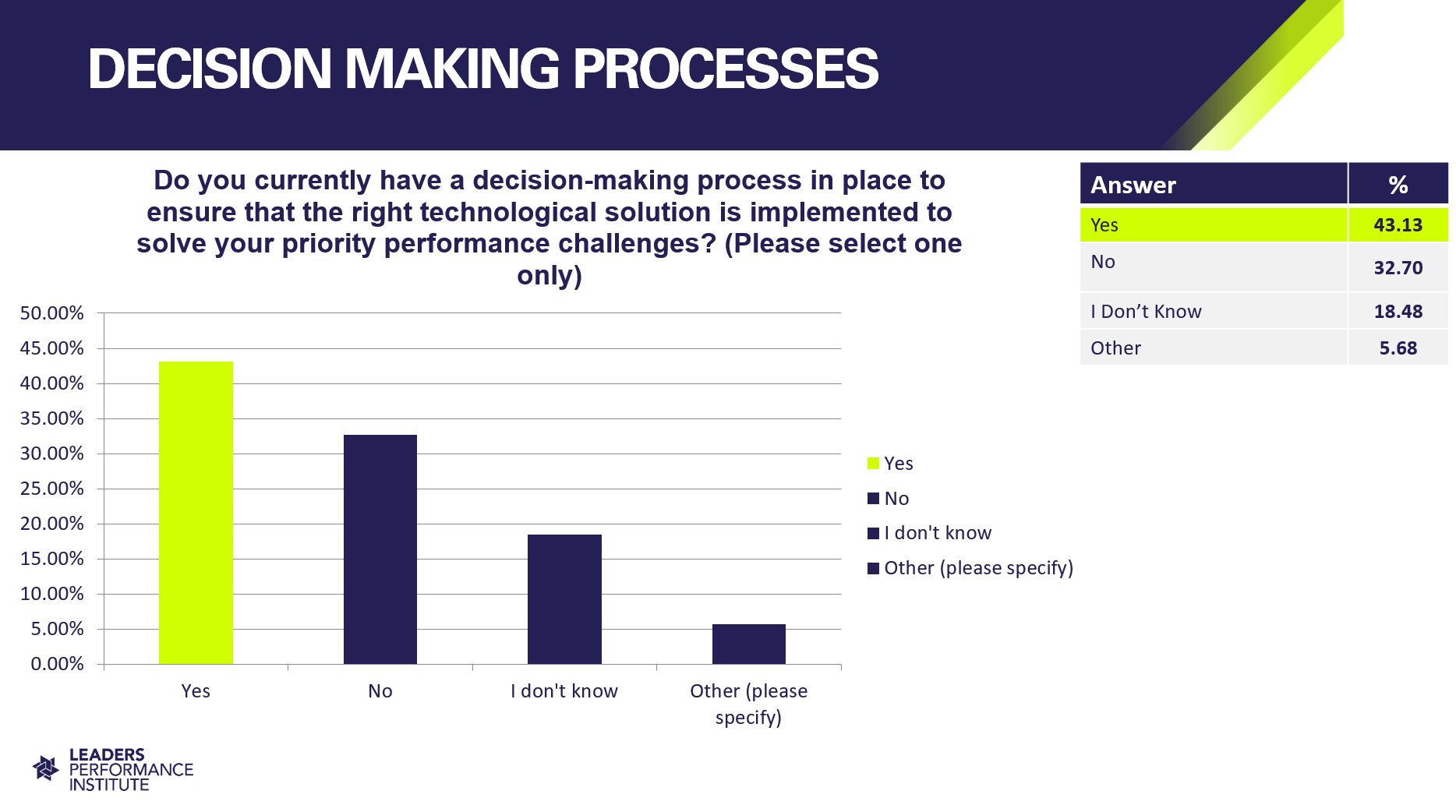
Fabio Serpiello, the Director of Sport Strategy at Central Queensland University, first posed this question to Leaders Performance Institute members as part of the survey that resulted in our Trend Report.
Fewer than half of respondents said ‘yes’, with more than a third saying ‘no’. Curiously, nearly 20 percent said ‘I don’t know’.
“That’s a good chunk,” Serpiello told members of that 20 percent figure while leading a recent Leaders Virtual Roundtable. “It is probably more interesting than the ‘yes’ and ‘no’ given that most of the people that responded are at the ‘head of’, ‘director of’ or ‘vice president of’ level.”
Yet in the same survey, almost 90 percent of respondents believed that a framework was at least ‘somewhat important’:
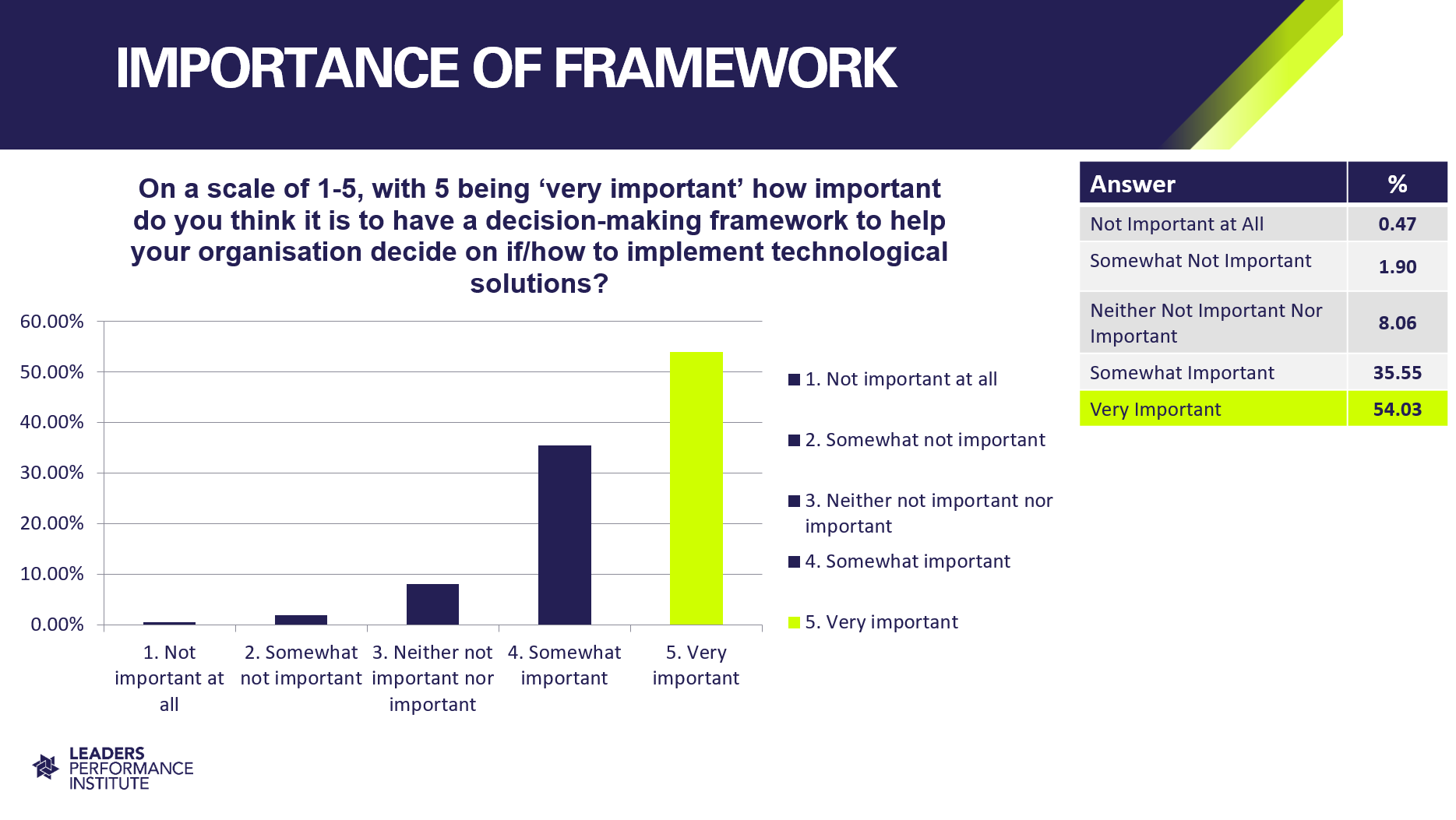
Logically, it seems likely that a good proportion of those respondents face frustrations in their work.
This likelihood set the stage for the third and final instalment of Serpiello’s roundtable series looking at tech-related innovation in sport.
First, the table noted some common problems around making decisions on tech.
A lack of decision-making frameworks: the magnitude of the challenge will depend on to whom you speak. Some markets are more mature than others; some sports resist tech-related innovation. As Serpiello said: “We are experiencing a lot of difference in the maturity of the European context and the Australian context versus the American context in some of these discussions, naturally, because of the way sport works.”
Overzealous vendors: almost every practitioner has heard a misfiring pitch from tech vendors at some point; they’re even more likely to have seen purported tech solutions gathering dust in a cupboard at their practice facility. A senior sports scientist illustrated the reality in his role:
“It’s not always us identifying a gap and reaching out to the best fit to fill that gap. It’s a lot of companies reaching out to us and trying to be ahead of the curve sometimes, which is maybe filling a need that you don’t have.”
Pressure from leadership: in some cases, senior leaders are pushing their high performance teams into finding the latest gadget. The aforementioned sports scientist also feels pressure from above:
“We’re being pushed from the top, even if you don’t know if the suggested tech solution makes sense. They’ll say: ‘just get some fancy toy that people will talk about’.”
The table also pointed to several solutions.
Serpiello spoke of the Sports Tech Research Network, specifically its Quality Framework for Sports Technologies, as a time-saver.
This white paper introduces a standardised, evidence-based framework which can be adopted by sports technology stakeholders to assess the value, usability and quality of technology.
Developed in collaboration with 48 experts across the sports industry by means of a Delphi study design, the framework includes a range of qualities grouped under five overarching pillars:
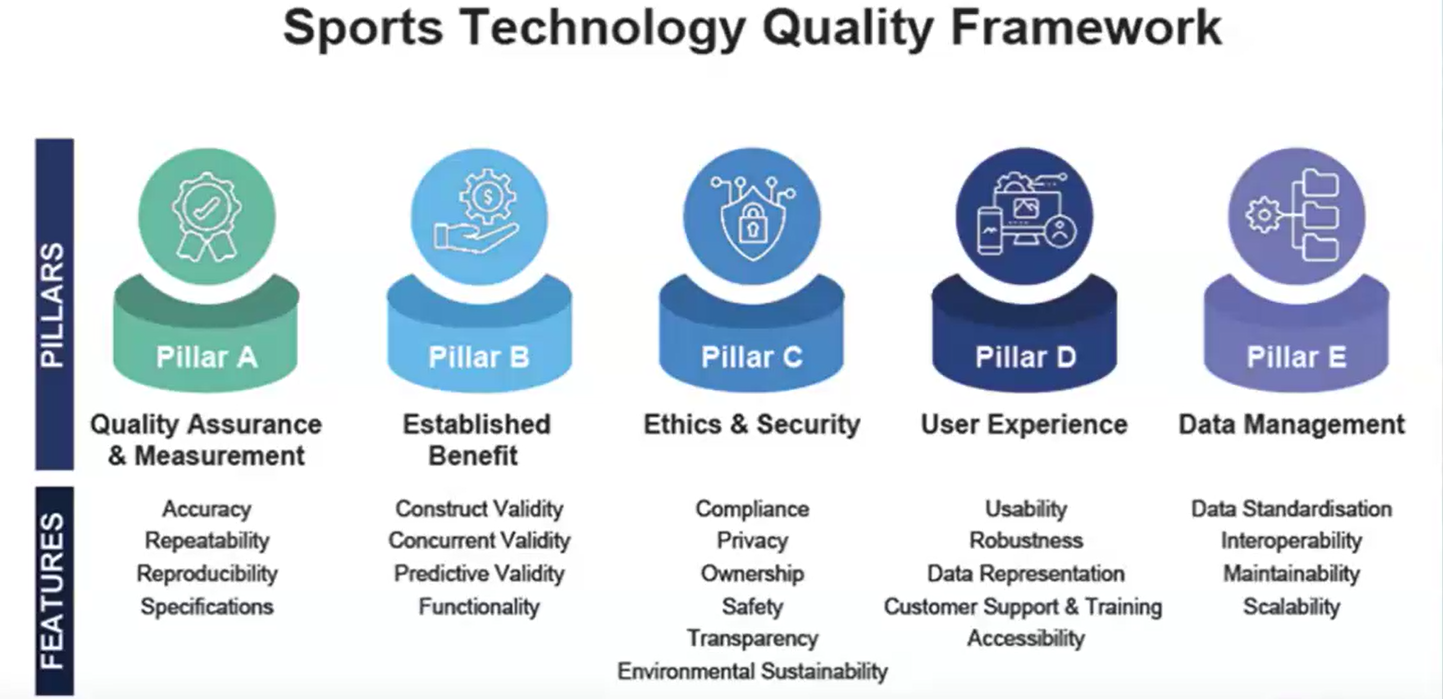
“Some of these pillars lead to more hardcore science questions; accuracy, repeatability, reproducibility, construct validity, or predictive validity; those are very much science-driven,” said Serpiello. “Some of them are more operational such as compliance, data privacy or environmental sustainability; and some are more user experience; how does the customer support and training work? These things are very important for you in sport because they make or break the day-to-day choices and the day-to-day use of technology.”
He then illustrated how the framework might be used to make informed choices:
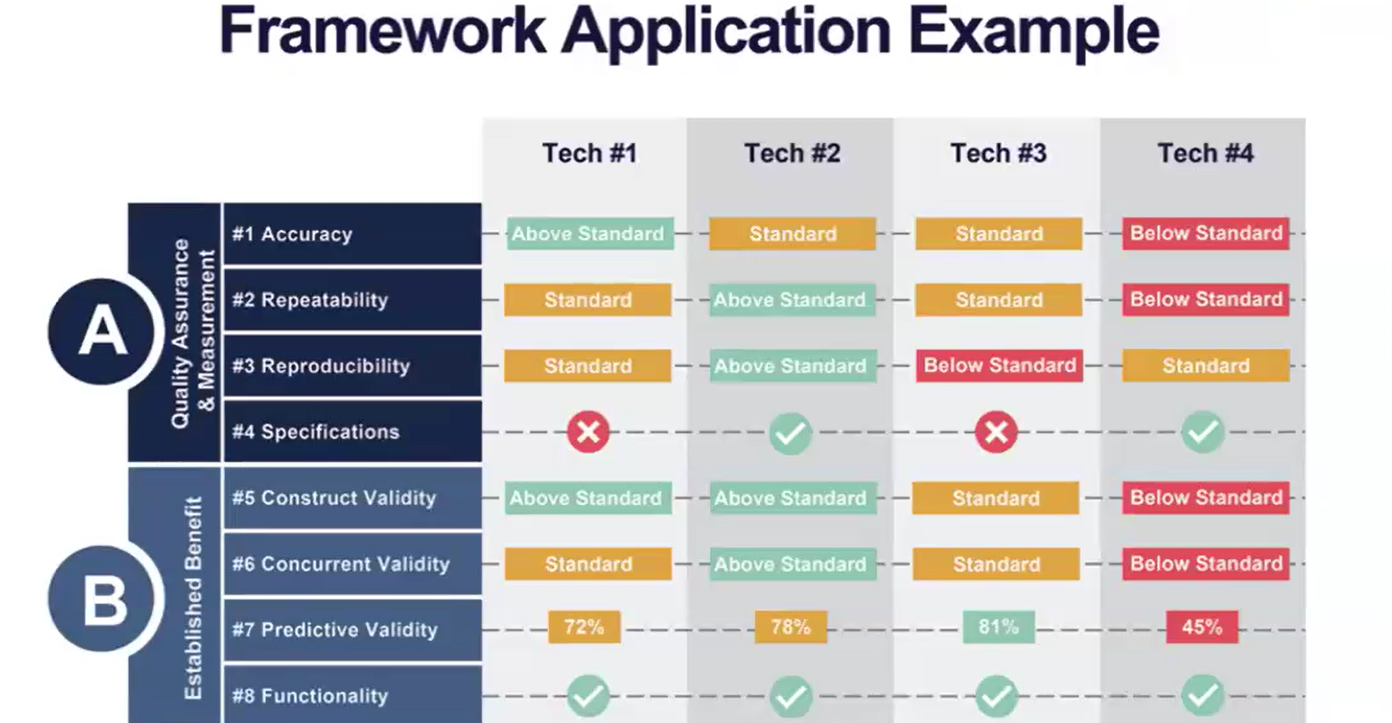
One or two members had already used and adapted the framework to their team, as one sports scientist explained:
“We’ve adopted it when we’re looking at multiple systems for velocity-based training or GPS, just to give our practitioners and stakeholders guidance and have that scoring system to then see how it ends up; and to put in some objectivity to the potential subjectivity of that process. I think it’s helped us a lot because different stakeholders in different departments can come together. We actually added to it as well for things like partnerships and sponsorships and adapted it to our setting, which made it even more useful.”
Governing body mandates
As Serpiello explained, international confederations such as FIFA and FIBA, as well as national governing bodies, such as the Dutch Olympic Committee*Dutch Sports Federation, mandate the format in which data must be produced by companies.
In a similar vein, the AFL has an “internal technology group” for vetting all potential tech solutions. Serpiello said: “It includes coaches, medical, sports science, S&C, commercial, legal personnel and they say ‘we meet once a month and we deal with the approaches this way’. So outside that process, they do not respond to you, they do not engage with you, they say to you as a company ‘this is the process, submit your inquiry, and then we’ll assess it’. I like it because it takes away a lot of that constant having to deal with companies that come and say ‘we’ve got this amazing product’ only for you to then realise that it’s really the same product as before.”
Another example is the NBA Launchpad, which is the league’s initiative to source, evaluate and pilot emerging technologies.
“It’s basically ‘come and show us what you have and we’ll look at it’,” said Serpiello. “That’s slightly different from ‘okay, we’ve got an issue and we’re going to throw it out there’.”
Accuracy and reliability are less important than practicality
Accuracy and reliability are important but they are not everything.
“I’ve slightly changed my mind on this over the years,” said Serpiello. “I’ve seen organisations chasing the product that was one percent more accurate or reliable on some of the main variables, only to then completely disregard the other part, which was does it have API [application programming interface] connections with my other systems? Does it allow me to make quick decisions every morning when the athlete rocks up? Those things are far more valuable than being able to say confidently that high-speed running this week was 1K or 1.1K.”
A programme manager in the Australian system concurred while highlighting the tension between providing broadcast data (where granularity and accuracy are not as important as they might be for a high performance team).
He said:
“I think that’s the healthy tension between something that is returning value, whether it be in the speed of decision making or feedback from experimentation; that’s the inherent tension of scientifically valid and reliable systems versus commercially valuable systems… and just because something’s not valid and reliable doesn’t mean it’s not valuable. You just need a measurement to be able to reduce that accuracy and reliability to a standard that you’re comfortable with.”
What to read next
NewtForce’s streamlined analysis tool enables real-time pitching feedback thanks to its collaboration with motion capture specialists Movrs.
Main Photo: Movrs
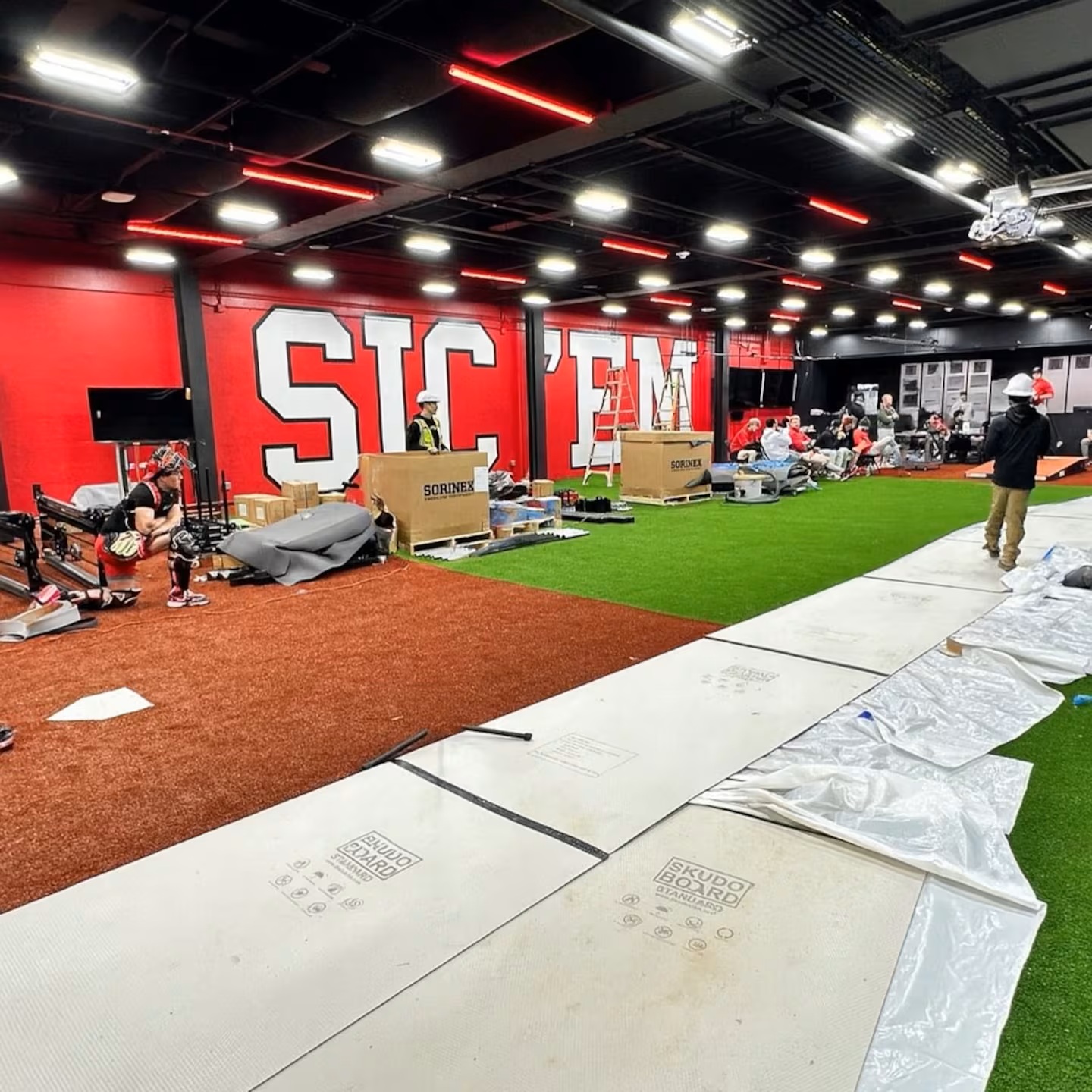
The Bulldogs began using the new high-tech pitching tunnels while construction workers were still clearing the space. Photo courtesy of NewtForce.
This article was brought to you by SBJ Tech, a Leaders Group company. As a Leaders Performance Institute member, you are able to enjoy exclusive access to SBJ Tech content in the field of athletic performance.
In the second part of his virtual roundtable series looking at tech-supported innovation in sport, CQU’s Professor Fabio Serpiello turns the light on the widespread lack of structured decision-making processes in sport.
The Director of Sport Strategy at Central Queensland University led the second instalment of a three-part Leaders Virtual Roundtable series aimed at exploring the dynamics of tech-supported innovation in sport.
As host, Serpiello wanted to “provide frameworks and stimulate discussion on how to select the right technology for performance challenges, ensuring decisions align with strategy and context.”
The Leaders Trend Report earlier this year highlighted that fewer than half of practitioners can point to a structured decision-making process within their organisation. Many have lamented this with Serpiello, which stands to reason as nearly all respondents in the report perceive such a structure as important.
It starts with a clear performance question, as a sports scientist working in European football put it.
She said: “If we’re going to make a decision, we have to have something well-structured. We need to ask what do we want from what we’re collecting or what do we want from what we’re asking the athletes to do.”
Another attendee, with oversight of several sports, recalled their own situation with problem clarification. “The solution looked like the key, but many sports were unclear on the problem.”
Serpiello presented the group with two models to address this issue.
Greg Satell’s Model of Innovation
Innovation, Serpiello argues, comes in several shapes and forms depending on the nature of the problem. To make his point, he introduced renowned change management specialist Greg Satell’s Model of Innovation, which provides a practical framework for introducing innovative practices, encourages strategic thinking about problems and helps to facilitate better collaboration.
He presented a diagram of Satell’s model to the table:
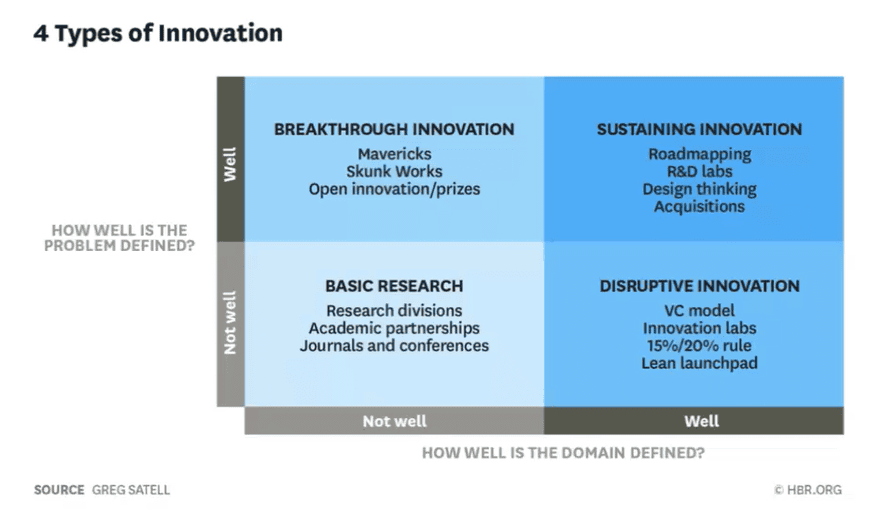
Serpiello had previously shared his thoughts on each quadrant:
Basic research – a low understanding of both domain and problem: “We don’t really know what the problem is and we don’t really know in which field or area it happens.”
Disruptive innovation – a well-understood domain but poorly understood problem: “In this area you may need something like innovation labs or launch pads.”
Breakthrough innovation – a poorly understood domain but well-defined problem: “This is the reverse of disruptive innovation… the classic example of open innovation.”
Sustaining innovation – a well-understood domain and problem: “The most common form in sport [and often the subject of] continuous research, design thinking or road mapping.”
A fuller account can be found here.
A general manager of a successful Paralympic programme gave an example of breakthrough innovation in their work supporting totally blind swimmers:
“We’re working with our institute partners and also reaching out to universities to understand if there’s interest in terms of product development and research in this space.”
There is a clear problem, the domain is less defined, and the organisation is piloting new concepts.
Another attendee working in the Olympic and Paralympic system spoke of an example of disruptive innovation when their team sought coaching tools, primarily:
“The piloting was done with the university [engineering department]… the final year project has to be sponsored, innovative, and they’re graded on the finish of the product and customer satisfaction… they were constantly in touch with us, so in terms of getting clear on the problem and implementing a solution, they were fantastic, these young engineers… The projects that succeeded were embedded into sport, and it was because the engineer was back and forth with the client, with us, and with the athletes.”
The Cynefin Framework
Serpiello then reacquainted the table with the Cynefin Framework.
‘Cynefin’, which is pronounced ‘ku-nev-in’, is a Welsh word that signifies ‘the multiple factors in our environment and our experience that influence us in ways we can never understand,’ as Snowden and Boon wrote in their 2007 Harvard Business Review essay titled ‘A Leader’s Framework for Decision Making’.
The Cynefin Framework, they continued, ‘helps leaders determine the prevailing operative context so they can make appropriate choices’.

Source: HBR
The framework classifies decision-making contexts into five domains:
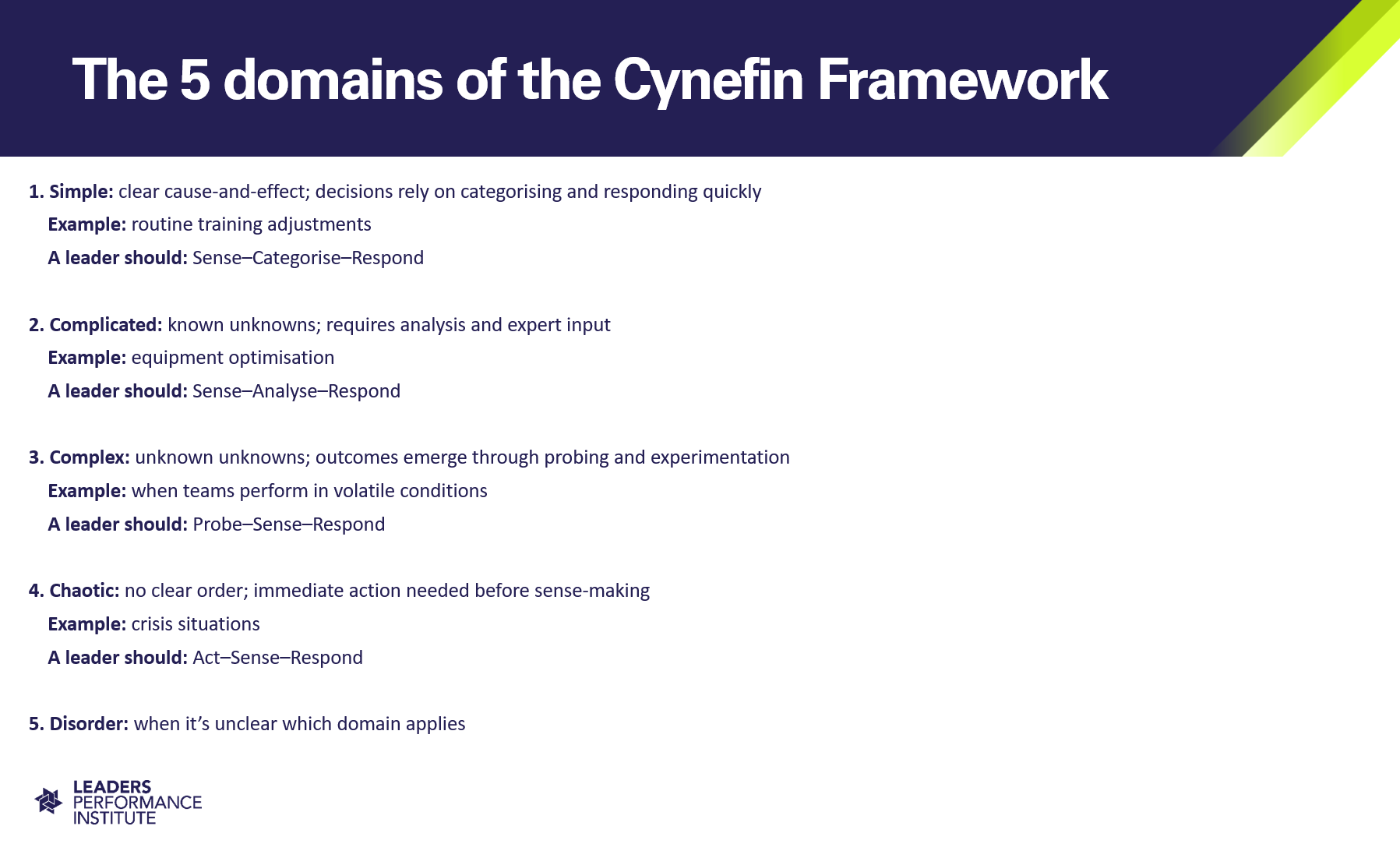 “The Cynefin Framework essentially classifies decision-making on the continuum between order and unordered conditions,” said Serpiello, adding, “because if you make the wrong decision, or if you use the wrong quadrant, you may waste a lot of time without actually getting to the right answer.”
He cited the example of tracking tech companies selling their wares as the answer to complicated and complex problems. “What tracking technology should do really well, in my opinion, is give you the ability to quickly categorise what’s happening in training and then respond properly, whether it is a load management, readiness or a recovery response.”
Other ideas
What to read next
New Zealand’s Ella Wyllie is leaving no stone unturned as she continues her return from injury – tech included – but, as she explains, it has to be matched by effort.
Main Photo: Getty Images
You can’t have a discussion about sports technology today without including athletes in that conversation. Their partnerships, investments and endorsements help fuel the space – they have emerged as major stakeholders in the sports tech ecosystem. The Athlete’s Voice series highlights the athletes leading the way and the projects and products they’re putting their influence behind.
* * * * *
New Zealand cyclist Ella Wyllie competed in her second Tour de France Femmes, which this year expanded to nine stages. After turning pro in 2023, she first participated in that summer’s Tour de France and finished second in the youth classification and later took eighth overall in Australia’s Tour Down Under. Wyllie, who is also studying civil engineering at the University of Auckland, missed last year’s Tour de France with injury but returned this year to finish 80th and pick up two points in the general classification as a member of Liv AlUla Jayco.
We caught up with her ahead of the race.
On preparing for the Tour de France Femmes…
I’m so excited. I did the Tour two years ago, and it was my first big tour. And last year I missed out just because of injury and everything, so it’s really nice to be in a position this year where I’m happy with my form coming into it.
The Tour is getting longer, which is exciting, and, yeah, definitely the last couple stages, I was lucky enough to go on a recon with the team. We’ve checked them out, and they are looking pretty hard so I’ve been doing some training to replicate that. And there’s a hilltop finish, so I’ve been doing a lot of climbing.
View this post on Instagram
On her training plans…
I have a team coach, Marco [Pinotti], so he’s been really helpful because he just plans the training for me, and I discuss how I think things went or maybe my own feelings about things and where I think I’m struggling a bit more. He just looks at all that and the course demands, and we just plan intervals, VO2 efforts, all the fun things, and mix it in with a bit of endurance riding to get a good base. But yeah, it’s really the spicy VO2 efforts that get the race kick in the legs and hopefully will put me in good form.
On the tech she uses…
I have a power meter on my bike, and also heart rate is another big thing in terms of just seeing how you respond on the fatigue and all those kind of metrics. Lactate testing can also be helpful in certain periods of training and everything. Cycling is just getting more and more technically advanced in all those metrics, but also, at the end of the day, you’re not looking at your power meter when someone’s attacking. You might understand, oh yeah, it’s hard, but I’m not going to say to my competitor, ‘Oh sorry, we’re 100 watts over what I should be doing for three minutes. Sorry, I’m just going to wait.’
At the end of the day, that’s just all to help the training, really, because in the race, it’s actually just all on perceived effort. And you just have to go hard when you need to go hard. Especially on long climbs and breakaway efforts, you’re probably more in tune with, Okay, I’m going to try and stick around this watt range because you know exactly how you can handle fatigue. It’s always a useful tool, but you also have to remember that at the end of the day, it’s a race.
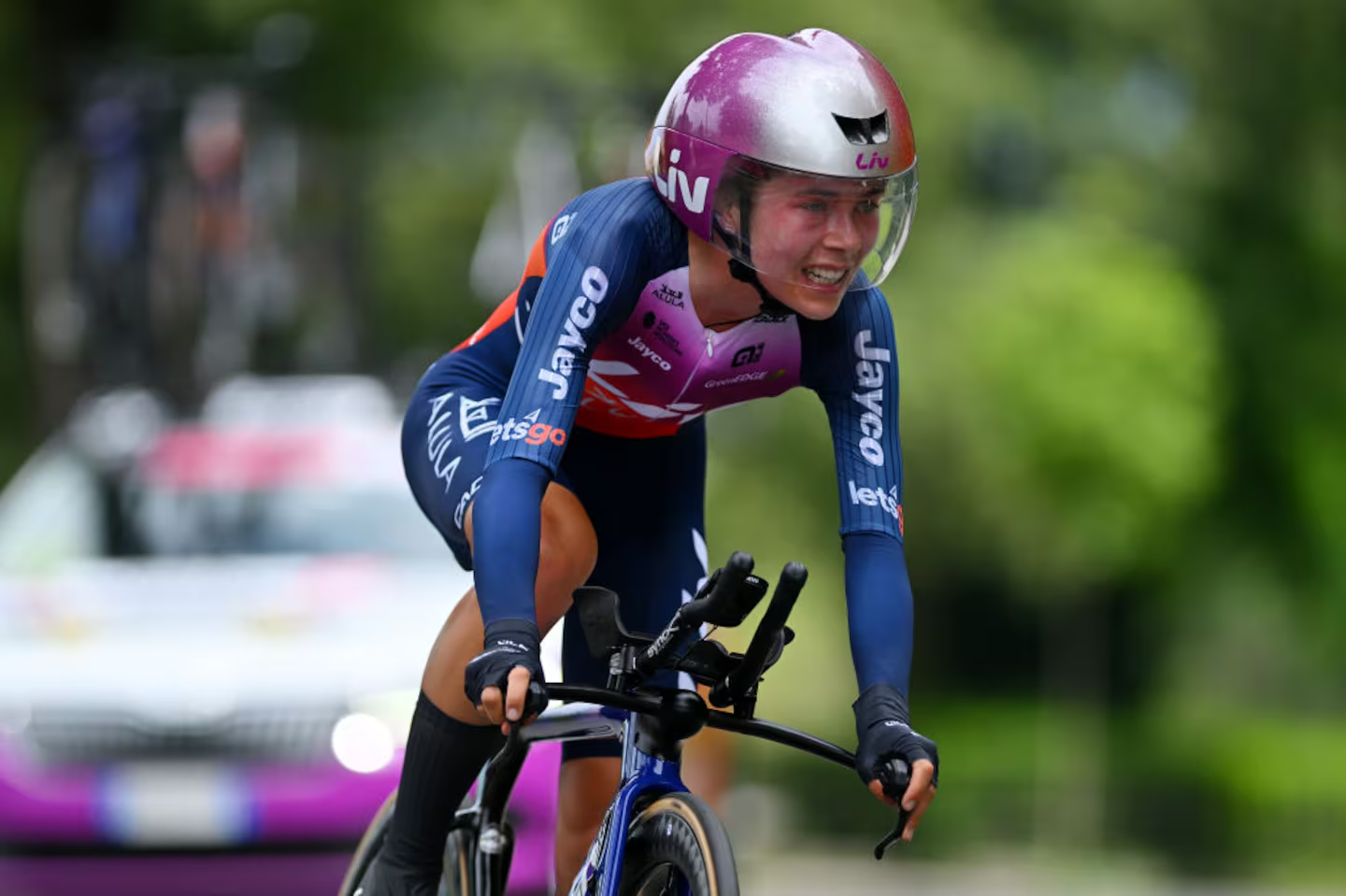
Photo: Getty Images
On what she applies from her engineering studies…
I’m always messaging my coach with, ‘Oh, look, I saw this.’ Yeah, I definitely appreciate all of that stuff. I’m very analytically minded, so if I can notice patterns or see improvements through certain things — I think sometimes it’s not so obvious — but when you do look at all the data, you can pick up the small wins. And to me, that’s motivating too. I’m also known to like Strava.
On evaluating brand deals and supporting her journey in sport…
I’m in probably a bit more of a unique position coming from New Zealand where we didn’t have so much support from our governing body, Cycling New Zealand. They are really great in some areas, and obviously we have the chance to be racing in the world championships, but we don’t have the money, necessarily, to fully fund it. So when I go to a world championships, I’m paying the majority of the fees to go, and it’s expensive because I have to pay the flights, you’ve got to pay towards staff support and accommodation.
So, yeah, I’m definitely reaching out to brands and people that are wanting to invest in my journey and everything. But it has to be the right partnership. I think it has to be mutually beneficial and also things that make sense. I’m not going to go and promote something that’s completely outside of my realm being a professional cyclist.
This article was brought to you by SBJ Tech, a Leaders Group company. As a Leaders Performance Institute member, you are able to enjoy exclusive access to SBJ Tech content in the field of athletic performance.
The Sony-designed devices are designed to take into account both weather conditions and crowd noise.
The custom-made headsets — developed in less than a year since the NFL and Sony announced their wide-ranging partnership — borrow some features from their high-end consumer headphones while incorporating a new highly-directional mic to isolate the coach’s voice and new water resistance to ensure operability in all conditions.
The new Sony-branded headsets were tested in the background on NFL sidelines last season and were distributed to team coaching staffs late last month in advance of training camps opening this week.
“Sony engineers visited each of the sidelines — they heard feedback from the coaches to make sure that what are some of the points that they should be addressing?” said NFL VP/Football Technology Rama Ravindranathan. “So it’s an iterative development process where Sony engineers partnered with NFL IT, football operations, game operations, to ensure every bit of the feedback was gathered and consolidated.”
That included data collection of hottest and coldest NFL games from the past 20 years, as well as recording crowd noise from a Monday Night Football game at SoFi Stadium where the volume exceeded 100 decibels.
Shunsuke Nakahashi, Product Manager for Audio at Sony, said engineers replicated that noise in a special studio in Tokyo, wore the headsets in the shower and in large refrigerators to test its all-conditions functionality. The belt pack connects to the Verizon private network in use in all stadiums. Ravindranathan said that was tested by the yellow hat-wearing communications technicians last season as “coach proxies.”
“We use the insights and principle from XM6,” Nakahashi said, referring to the top Sony consumer product, “and also we have a deep engineering foundation in precision sound and also vocal clarity.”
The Sony lettering on the headsets is large and unmistakable and becomes some of the most visible on-field signage, said NFL SVP/Sponsorship Tracie Rodburg, noting that Sony joins Nike, Gatorade and Microsoft among the most prominent branding. Sponsorship of the NFL headsets had been vacant for two years since Bose exited its deal after eight seasons of holding that inventory.
“Working with Sony, we’re both committed to innovation,” she said, adding: “We want to make sure everybody knows that we have a trusted partner on the sideline.”
While the new Sony headsets are custom-built for the demands of NFL coaches, some of the newly developed features might eventually trickle their way down to the broader market.
“Right now, we’re just razor-focused on delivering the NFL Coach’s Headset, but once everything is settled, then probably we can foresee what element we can bring to the consumer,” Nakahashi said.
This article was brought to you by SBJ Tech, a Leaders Group company. As a Leaders Performance Institute member, you are able to enjoy exclusive access to SBJ Tech content in the field of athletic performance.
The two-time Olympic triathlete sat down with SBJ Tech to discuss the impact of technology on his career as he ventures in the world of sports business.
You can’t have a discussion about sports technology today without including athletes in that conversation. Their partnerships, investments and endorsements help fuel the space – they have emerged as major stakeholders in the sports tech ecosystem. The Athlete’s Voice series highlights the athletes leading the way and the projects and products they’re putting their influence behind.
* * * * *
Since announcing his retirement last November, the 37-year-old has grown increasingly immersed in business. He co-founded a nutrition brand, TrueFuels, and has invested in more than 20 startups. Brownlee is an associate partner at Redrice Ventures and a member of the IOC Athletes’ Commission who consults on human performance and emerging technologies. He also leads The Brownlee Foundation, the charitable endeavor he started with his Olympic triathlete brother, Jonny.
On the impact of tech in his career…
Some technology happens in, let’s call it, a relatively linear progression. But the example of a technology that hasn’t happened in a linear progression is shoe tech, which is incredible. Of course, there were small innovations here and there in shoes, using slightly different forms of rubber soles. Then, all of a sudden, we see a steep change in innovation, with using the light, thicker foam and inserting the carbon rods that we started seeing probably 2018, 2019 and really exploded in 2020 and ’21.
The real innovation in terms of technology, for me, is training attitudes and approaches, which isn’t as sexy and obvious. I saw technological progressions on every form, in terms of attitudes, in terms of the scientific approach to training, in terms of the equipment we’re using, whether that is shoes or bikes. I started out with a bike that was all made of metal and your gear-changing happened very manually, and I went to electric gears with a power meter on a bike that was mostly carbon fiber.
Technological innovation is across all those different domains. In terms of tech, like hardcore tech — wearables and monitoring and having an impact on training — I started out in a world where [there was] a stopwatch and you might use a heart rate monitor as your primary training monitoring devices. I remember, as a 16-year-old, using a heart rate monitor and starting to use the first GPS watches to now where there’s all kinds of training monitoring devices, whether that’s internal — heart rate monitoring, HRV, muscle oxygenation — to external: power meters, GPS watches and bike computers.
View this post on Instagram
On his business interests…
I did a finance master’s at university, and so that business approach always interested me. I always had an attitude that I wanted to invest and build value for the long term because I knew that my athletic career won’t last forever, so that was an important aspect to me. Some of my early sponsorship deals had bits of equity in them. So a business like Boardman Bikes, for example, that was a big sponsor of mine from the early days — part of that was an equity deal.
I also had always been interested in businesses that can be a solution to make people perform better in elite sport but also perform better in terms of living healthier, active lifestyles. Obviously, backing great people to make great companies and great solutions is part of the answer. It’s not the whole answer — government plays a role in that, and charities play a role in that — but also great private businesses play a role in that.
On the impact of AI…
AI will affect sport in every different domain, as it’ll have an impact on all our lives in every domain. It will affect how people train. It will affect how people integrate data, use data, interact with data, how they’ll use all that information to prescribe their training going forwards, how it will help people understand more and deeper insights in recovery.
In terms of how we engage fans, obviously, there’s going to be massive changes there — engaging fans on a really personal level to watch events and interact with athletes and teams. Whether that’s camera angles or following a particular player or athlete or learning more about them as the events are happening, or learning more about how you can engage in whatever that sport might be, whether it’s badminton or football or triathlon or whatever.
The IOC are looking at it from an organization point of view as well. How can you use that technology to be more efficient? Use energy better, help people get in and out of stadia better.
On co-founding TrueFuels…
I was always being fascinated by maximizing human performance, and my [approach to] nutrition probably came out of me developing my own fuels in the last few years to race on was a challenge. I’ve got a feeling that the majority of people for whom a marathon or an Ironman or whatever endurance challenge goes wrong, nutrition is the primary reason for that.
View this post on Instagram
I had this idea of, how do you create a brand that is about helping the consumer to understand what they need, to make sure that nutrition isn’t the limiting factor for the event, whatever the event that they’re doing? The combination of that is product and education and community.
On his role with Redrice…
I invested on my own, joined local angel networks and got known to invest in sports businesses. Over the last few years, I only really invested alongside various VC funds, one of those was Redrice. I got to know the team at Redrice over the last couple of years. They’re a consumer VC, but my thesis is that everything is going to become more wellness-based over the next five or 10 years, especially the consumer market. And we see all kinds of evidence of that increasing spend on wellness, especially in the younger demographic who are spending proportionally more on wellness than older people. Health and wellness is becoming a luxury signal.
I started talking about a role with them as they work towards investing more in this space, and we came up with the idea of a sports collective that I’m leading and Andy Murray is a part of it.
This article was brought to you by SBJ Tech, a Leaders Group company. As a Leaders Performance Institute member, you are able to enjoy exclusive access to SBJ Tech content in the field of athletic performance.
An enhanced version of semi-automated offside technology will make its debut at the tournament, which is set to take place in the US, Canada and Mexico.
That’s the joint venture created last November by FIFA and Hawk-Eye Innovations with an initial charge of assisting referees and automating data collection.
FIFA and Sony-owned Hawk-Eye first debuted Semi-Automated Offsides Technology at the Qatar World Cup in 2022, and now it has created an enhanced version of it. Only calls in which a player is within 10 centimeters of the offsides line require manual oversight from an official. Also at this tournament, the tabulation of event data — everything from shots, passes, corner kicks and the like — has been automated with computer vision algorithms, supplanting what historically had always been a very manual process.
Early feedback has been positive, putting those innovations on track for an appearance at next year’s tournament. The quadrennial World Cup typically serves as a debut for new tech. Goal-line technology first appeared in 2014, VAR in 2018 and SAOT in 2022.
“We recognize that, in order to do stuff which is pretty game-changing, you have to do it on a two-, three-, four-year cycle,” Rufus Hack, the CEO of Sony’s sports businesses, told SBJ. “It doesn’t take a year to develop the technology, to implement it, to refine it, to test it, to introduce it. And so we came on this concept of, let’s do an eight-year joint venture where, effectively, they put in some of their IP, some of their technology, their football expertise. We put in people, our technology expertise, our learnings from other sport.”
The vision of the FTC
The Football Technology Center is based in Zurich, like FIFA, and relies on dedicated personnel from both FIFA and Hawk-Eye. In lieu of a CEO, it is steered by a board of directors, consisting of Hawk-Eye’s Hack and Managing Director Ben Crossing and FIFA’s Dir of Innovation Johannes Holzmüller and Technical Director Steve Martens. There is also a separate joint operational management committee with equal representation from both entities.
“We see this as potentially the Football Technology Center creating new football technologies, assets and IP, which then can potentially be commercialized-slash-distributed to the rest of the sport,” Hack said. “Ultimately, FIFA are very much about looking to democratize sports technology down to the member associations,” referring to the 211 countries and territories across six continents that are represented by FIFA.
“For us, this is less about a significant revenue opportunity of being able to create new products,” he added. “It’s more about being able to be thought leaders and sitting side by side with FIFA, who are effectively the guardians of football technology in the game, to be able to do these new innovations, and then potentially working together to distribute some of that for the rest of the football community.”
Hawk-Eye’s cameras and algorithms capture data from 29 points on the human body, so a player’s limbs, hands and feet are fully tracked. That generates millions of datapoints per game, but FIFA sought practical use of it.
“We have high-quality data available, but at the end of the day, we also want to have valuable information — an outcome, not only for officiating, but also for other areas,” Holzmüller said. “We needed to have some vehicle where we can develop and explore how this data can be used in the future.”
The lead time for many of these projects is long, but there other avenues that can be explored. For instance, Hack said it might be possible in the future to use technology to determine whether that ball has gone out of bounds or whether it struck a player’s hand or other part of the body.
“We believe in these big, long-term strategic partnerships,” Hack said. “We believe it provides a much better opportunity for the rightsholder and partner to co-invest alongside each other and genuinely feels like a partnership, rather than that buyer/supplier relationship.”
This article was brought to you by SBJ Tech, a Leaders Group company. As a Leaders Performance Institute member, you are able to enjoy exclusive access to SBJ Tech content in the field of athletic performance.
As Dr Robert Cantu and Mike Oliver from the National Operating Committee on Standards for Athletic Equipment explain, their research is helping the sport to understand overall head impact exposure in a more nuanced fashion, while potentially influencing training methods, rules and player development models.
Main Image: courtesy of NOCSAE
The Sports & Fitness Industry Association reported that 758,000 youth ages 6-12 were regularly playing tackle football as of 2023, which is down from 965,000 who consistently played a decade ago in 2015 — a 21% decrease. And those who do play have been wearing helmets certified by a safety standard primarily with adults in mind, not kids.
That is now changing, as the National Operating Committee on Standards for Athletic Equipment, which first established safety guidelines for football helmets in 1973, is introducing its first youth football helmet standard specifically designed to protect players before they reach high school.
While the existing NOCSAE testing standards minimized impact energy in all helmets, from youth to pros, this more targeted measure should offer further protection to those players participating in leagues affiliated with Pop Warner, American Youth Football, USA Football and similar organizations.
“That’s been really very effective in preventing injuries in kids, too,” renowned neurosurgeon and NOCSAE Vice President Dr Robert Cantu said of the standard previously in place, “but we are very well aware of the fact that kids are not miniature adults. They have unique situations. Their brains are not as myelinated. Their necks are quite weak, so their head is a bobblehead doll. Their heads are quite big when they’re young, and quite heavy. And the types of hits that they take in football are not the same as older kids take.”
Peer-reviewed, university-led research more than a decade in the making drove the new youth standard led by NOCSAE’s Scientific Advisory Committee, which Cantu chairs. The most critical change in the new mandate, which goes into effect in March 2027 to give manufacturers time to adapt, is that helmets for the youngest players — facemask included — cannot exceed 3.5 pounds.
Only a few manufacturers already make sufficiently light youth football helmets, such as Light, Riddell and Schutt, but they represent a limited selection in the market. Light CEO Nicholas Esayian explained that heavier helmets typically fare better in lab tests but often don’t serve the needs of players on the field, especially younger players.
While the NFL and NFLPA have led pioneering work to test helmets for that league and NOCSAE has continued to iterate and improve its standards required at the pro, collegiate and high school levels, the youth player had been overlooked.
“Everybody tends to think, well, as long as they’re not going any faster than the [older] guys up above, then the helmet should be OK,” said Mike Oliver, who served as NOCSAE executive director for 20 years before stepping down this spring and remaining as the organization’s general counsel. “But the comment was made that we really don’t know what the risk exposure is. So how likely are you to get hit at some velocity versus hitting the ground versus hitting another player?”
Research funded by NOCSAE and led by professors Steve Rowson (Virginia Tech) and Blaine Hoshizaki (University of Ottawa) investigated head impacts, collecting data from sensors, triangulated cameras and predictive modeling in youth players. Rowson looked at ages 10 through 14, while Hoshizaki focused on ages 5 through 9. The results were surprising, Oliver said, noting that “the younger group actually had the higher head accelerations in games and practices than the older group, and turns out the primary reason is they hit the ground more often.”
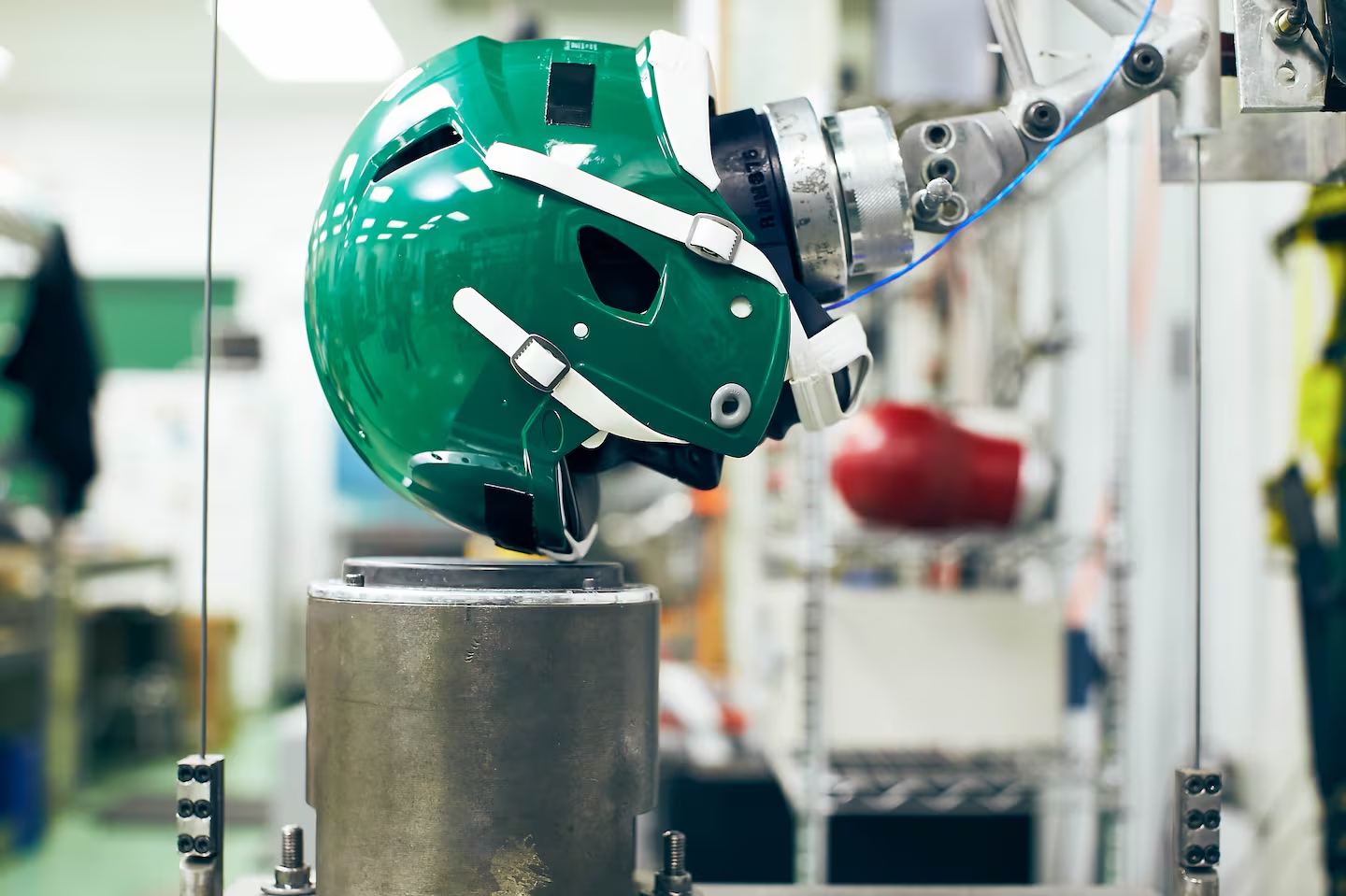
New standards for helmets are designed to provide more protection for young players before they reach high school. (Image courtesy of NOCSAE)
While most governmental agencies require only self-certification of compliance, NOCSAE, an independent nonprofit, has required third-party certification since 2015, with manufacturers needing accredited institutions to assess products.
Cantu previously has recommended that there not be any tackle football for children younger than 14, but that’s his personal position. With NOCSAE, he views his role as ensuring best practices.
“If somebody is going to be doing something, I feel very strongly that I would like to be, if I can, helpful in making the activity as safe as absolutely possible,” he said.
There’s a compounding effect with head impacts. There’s greater research and understanding that the accumulation of sub-concussive hits can lead to problems over time, so minimizing that exposure early can pay dividends.
“To the extent we can attenuate the forces the brain sees, even if it’s 10%, that’s meaningful over thousands of hits to the head over a lengthy career playing a sport,” Cantu said.
New NOCSAE Executive Director John Parsons previously served as director of the NCAA Sport Science Institute and indicated the importance of how the college and pro games have taken steps to modify rules to mitigate risk of all head impacts.
“The conversation has shifted a little bit, so we’re not only just talking about concussion, but we’re also talking about head impact exposure,” Parsons said.
To date, NOCSAE has funded roughly $12 million in grants for researching concussions in sports. In addition to the work done by Rowson and Hoshizaki, the SAC reviewed more than 40 other studies related to injury risk in youth football to help inform the new policy. The weight limit is the biggest change, but the youth standard also has a lower threshold for acceptable rotational acceleration, as that type of impact is shown to cause injuries.
What neither the new standard nor the one for older players requires is any particular material or shape.
“Our standards are intentionally design neutral,” Oliver said. “Technology is moving pretty quickly, and if we did that, our standard may specify something today and six months from now, there’s something better, or there’s something new. And so we don’t do that, and it’s one of the reasons why you see such a divergence of engineering approaches to helmet design, whether it’s pro or otherwise.”
This article was brought to you by SBJ Tech, a Leaders Group company. As a Leaders Performance Institute member, you are able to enjoy exclusive access to SBJ Tech content in the field of athletic performance.