Commissioner Rob Manfred announced that he plans to propose that ABS be implemented for major league regular-season games next season.

But it won’t be the first top league to do so. The Korean Baseball Organization has had ABS in place for two seasons. Its robot umpires call every pitch, as opposed to the two-challenges-per-game system in place in Class AAA and expected in MLB, following a spring training trial.
MLB’s own testing has been rigorous, dating to the MLB-affiliated Atlantic League’s usage back in 2019 and continuing through all levels of the minor leagues. But the KBO represents an opportunity for learnings from the third-most prominent league in the world.
“We have a nice back and forth with KBO and NPB on these rule issues,” Manfred told SBJ, referring to the Korean and Japanese pro leagues. “We pay a lot of attention to those sorts of experiments, how they’ve worked. They were very satisfied with the way it played out in Korea, and we take that as encouraging as well.”
More details emerge on MLB’s robot umpire plan
The KBO uses a camera tracking system from its longtime data and technology provider, Sports2i, just as MLB will utilize Hawk-Eye cameras, the same system that powers Statcast. MLB’s minors have used a two-dimensional plane at the center of home plate, but the KBO ABS requires a pitch to cross through the strike zone at both the middle and back of the plate.
ABS in the KBO uses the corners of the plate and adds 2 centimeters to either side, using a formula based on a player’s height. The zone was lowered roughly 1 centimeter at the top and bottom edges between 2024 and 2025, based on feedback.
Any strike zone can be inputted into the technology, and it may take some iterations to get it just right. The rulebook defines a rectangle but, in practice, most human umpires call an oval — neglecting to call strikes in the upper and lower corners. Human umps also typically widen the zone in blowouts or on 3-0 counts.
The impact of ABS in the KBO: Walks have ticked up slightly, from 9.1% of all plate appearances in 2023 (the last non-ABS season) to 9.4% this year, while strikeouts have increased more dramatically, from 17.7% in 2023 to 19.9% in 2025.
Kwangwon Lee, Sports2i’s team leader for its global business unit, told SBJ, “Our partner, KBO, always makes bold and innovative decisions to develop the league,” and added that its R&D department continues to iterate and improve the tracking system.
Mets designated hitter Jared Young, who starred in a 38-game stint with the Doosan Bears last season, said pitches on the edges were called normally but noted it appeared to be “a very up-and-down strike zone” and that it seemed inconsistent from one stadium to the next. “But,” he added, “you can’t complain. Everyone’s got the same thing.” Having also spent time in Class AAA the past few seasons, Young endorsed the challenge system as his preference.
Daniel Kim, who formerly scouted for MLB clubs and made appearances on ESPN during its 2020 COVID coverage of the Korean league, is now a popular KBO media analyst with 164,000 subscribers to his YouTube channel. Kim said fans, and even many players, were upset with the state of human umpiring.
“Fans love it,” Kim said, adding that all they want is consistency. “From the player side, surprisingly, we got some mixed reaction. Veteran players started complaining quite a bit in the early part of last year, whether pitchers or the hitters. As you know, the older established players had their own strike zone. They got the benefit of the doubt, I guess.”
One KBO team executive, who requested anonymity to speak freely about umpiring, said, “ABS shows no mercy or bias toward either side. It is as objective as it gets, and the machine does not care for any context of the situation at all. In a vacuum, that is how it should be, as the strike zone has been defined by the league of how it should be and the ABS follows the rules.”
Player evaluation is changing as a result of ABS: Pitchers with high velocity and big breaking pitches are being prioritized over pitchers with less dynamic stuff who try to command the outer edges.
“ABS does not care how well a pitcher locates the shadow zone” — referring to a baseball-width addendum on either side of the zone — “or how well a catcher frames a pitch,” the executive explained. “It only cares if a pitch crosses the zone or not. So the pitchers that used to live in the edges of the zone that would often benefit from umpire calls/framing are out of luck.”
ESPN and MLB Network analyst Xavier Scruggs, who hit 61 home runs in two KBO seasons, has kept in touch with old teammates who have shared good feedback about the system. He and Dan Kurtz, who runs the league’s leading English-language media site MyKBO.net, both noted that ABS was a safeguard against gambling improprieties, as it removes the human element. They pointed out the KBO endured some bad headlines — mostly a decade or longer ago — related to allegations of scandal.
“You have something that’s set in stone to where you don’t have umpires affecting the game in such a drastic way that could be concerning,” Scruggs said.
But the KBO even demoted a few umpires to the minors in 2020 for calling inconsistent strike zones, so technology can mitigate that variation.
“KBO looks at ABS as trying to help speed up the games and trying to prevent confrontations,” Kurtz said. He added, “Korea is a very forward-thinking, technology-using country in itself, and so they’re basically, if we have it, why are we not using it?”
Many US baseball fans have asked the same question, but won’t have to wait much longer — at least for a small taste of what the KBO has.
This article was brought to you by SBJ Tech, a Leaders Group company. As a Leaders Performance Institute member, you are able to enjoy exclusive access to SBJ Tech content in the field of athletic performance.
The New York Mets’ starting pitcher, who is enjoying a breakout year, ponders whether tech leads to changes or provides validation.
You can’t have a discussion about sports technology today without including athletes in that conversation. Their partnerships, investments and endorsements help fuel the space – they have emerged as major stakeholders in the sports tech ecosystem. The Athlete’s Voice series highlights the athletes leading the way and the projects and products they’re putting their influence behind.
* * * * *
The 29-year-old Canning, a former second-round pick out of UCLA, has credited the Mets’ pitching lab and its tech-savvy coaches as part of why he signed with the club in the offseason — and why he’s off to a strong start to the season.
On how the Mets’ pitching lab has helped…
Personally, probably the biggest thing has been the KinaTrax. It can show your body, just as a skeleton moving through your delivery. I feel like it’s a little easier to look at just the skeleton, instead of maybe video of yourself to really dissect how you’re moving and maybe where your mechanics are off a little bit. And then obviously every team has the Edgertronic to see how the ball is coming off your hand and be able to tweak your pitches a little bit there and see just how to make them more consistent.
On whether KinaTrax data led to changes or validated what he was doing…
A little bit of both. I can see how my feels match up with some of the numbers and what it looks like. It’s a helpful tool in-season, too. [If you] maybe have an outing where your mechanics feel a little bit off, you can go to that and see, maybe you moved on the rubber a little bit, or you’re not lifting your legs high, or your front side is doing something a little bit different. It’s a tool just to help keep you on track and not let things spiral.

On the tools he uses in the offseason…
I threw some on a force plate mound at Banner Health in Arizona. It’s super helpful to see where you’re at and get some validation for maybe how you’re feeling. It’s easy to go down the rabbit hole of comparing yourself to ‘the hardest throwers have this.’ So I think it’s a double-edged sword of understanding who you are and knowing yourself, and then just trying to maximize that.
On his use of the Oura ring…
Going to bed early is definitely valuable for me. Trying to getting to bed early and then hitting that [lowest heart rate before] the midpoint — those are usually the nights that I get my best sleep. It’s a little harder in-season with different schedules, traveling.
If anything, it’s probably more of a tool to hold you a little bit accountable because you don’t know exactly how accurate it is. Sometimes you wake up feeling great, and your sleep didn’t match all. So I think it’s more of a tool just holding yourself accountable, wanting to see a good score when you wake up in the morning. You don’t want to put too much stock into it because if you wake up on a day that you’re pitching, you don’t want to let that get in your head.
On why he embraces tech…
You’re always trying to find an edge of how you can feel your best consistently every single day, just with how long of a season it is. We’re here every single day. It’s just about checking all the boxes — your nutrition, your sleep, your recovery — just to feel your best and be able to go out there and perform.
This article was brought to you by SBJ Tech, a Leaders Group company. As a Leaders Performance Institute member, you are able to enjoy exclusive access to SBJ Tech content in the field of athletic performance.
In a world where they don’t know ‘what it takes to win’, Fran Longstaff and More Than Equal are ‘building the road as they walk’.
Fran Longstaff, the Head of Research at More Than Equal, reminds the audience at April’s Leaders Meet: The Talent Journey that no woman has competed in a Formula 1 race since the Italian Lella Lombardi in 1976.
This is despite motorsport being one of the few mixed gender sporting domains where men and women can compete on equal footing.
“Our research rates show that females make up ten per cent of participation rates in motorsport,” adds Longstaff. “That goes down to four per cent at the elite level.”
More Than Equal’s mission is certainly bold. The organisation was founded in 2022 by former F1 driver David Coulthard and philanthropist Karel Komárek. The pair recognised that even the most accomplished young female drivers are behind on the development curve compared to their male peers.
Longstaff was drafted in to better “understand the problem behind the problem”. “Research and data runs through our Driver Development Programme like a stick of rock,” she tells the audience at the Royal College of Music. This approach is critical when the end point is still unknown.
The programme itself is divided into four pillars:

Their search began in karting. They trawled through the race results in a sport where it is notoriously hard for girls to take the next leap.
“That sounds like an easy task but karting race results are often stored as PDFs,” says Longstaff. “It is objectively the worst way to store data.” They also had to gender mark race results, which took time.
Additionally, more than 500 young female kart drivers heeded More Than Equal’s call to apply for their Driver Development Programme. The drivers with the most potential were invited to follow-up interviews, which extended to parents and families. “That way we could understand what activity they’d already done to enable them to get the results we were seeing on the track. This is where you could have some interesting conversations and even say the driver was over-performing their level of activity in that sport.”
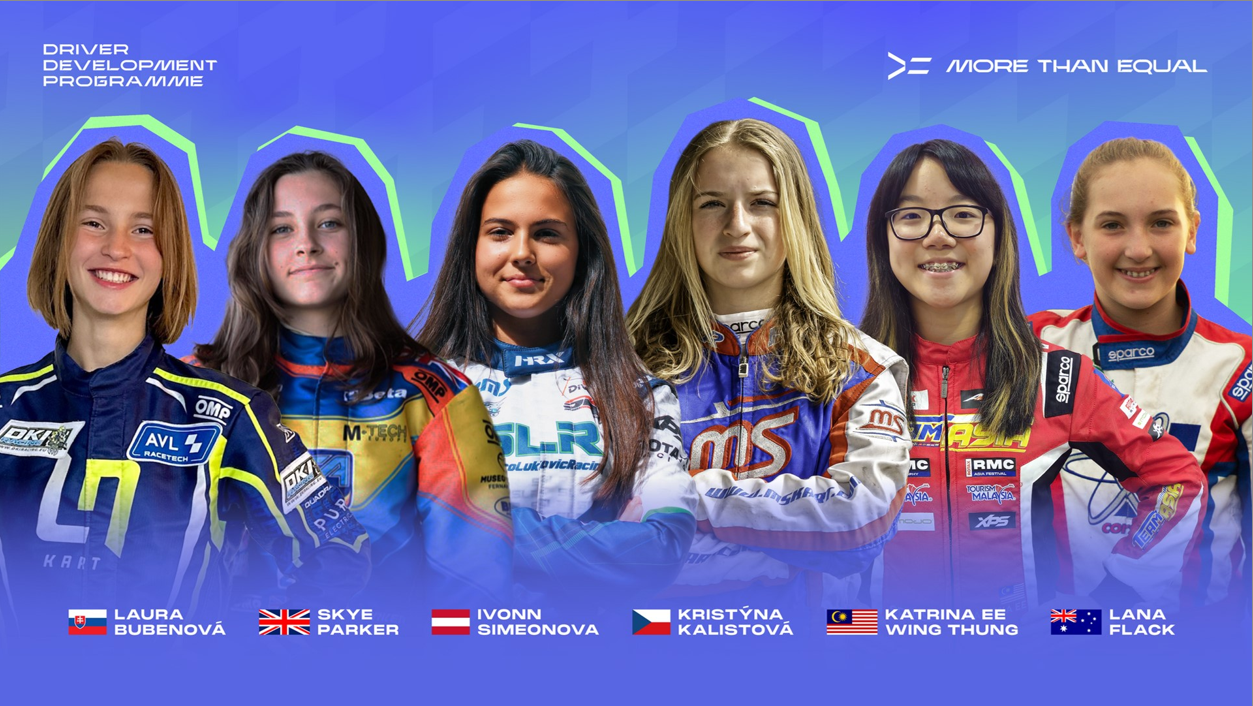
Six drivers, all aged 13-14 years old at the time, made it into More Than Equal’s first cohort:
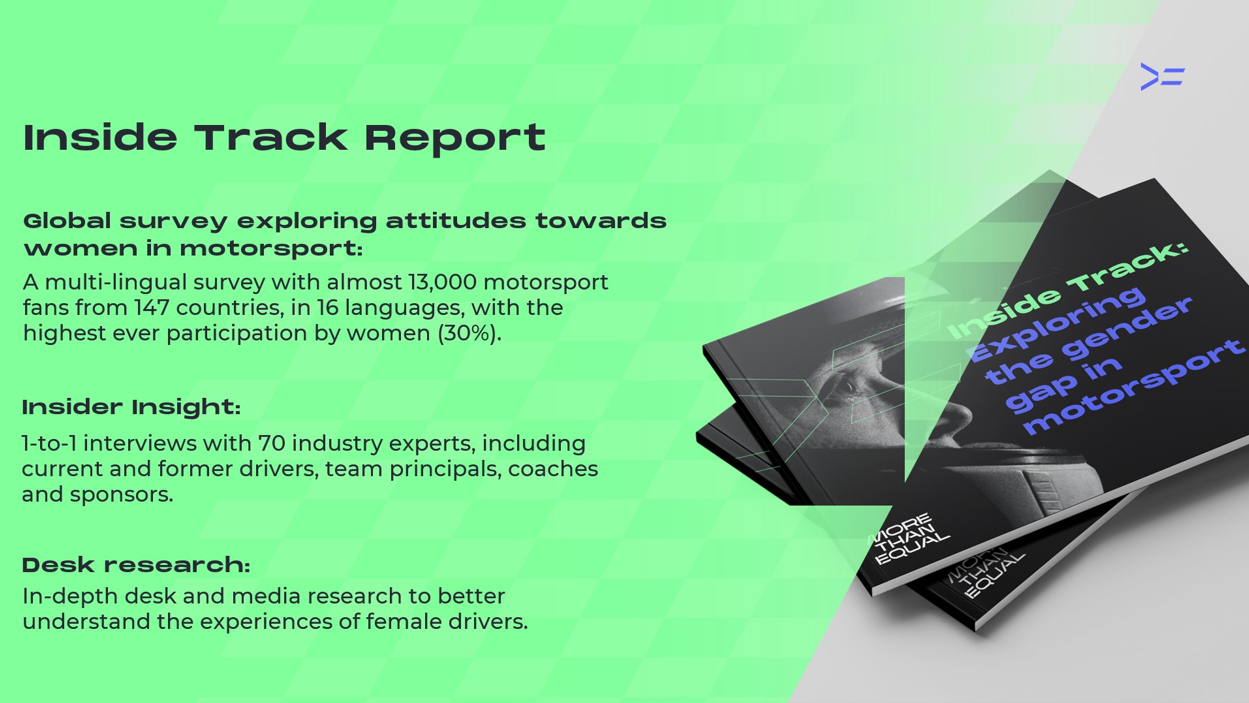
To understand the problem behind the problem, More Than Equal, produced its Inside Track report in 2023:
“There were fewer than 30 research papers on the human factors related to driver performance,” says Longstaff, who explains that they are “building the road as we walk”. Data is even more scant when it comes to female drivers or their experience behind the wheel. “We’re looking at how we can optimise and adjust cars to ensure that females can perform at their best without being hindered.” Longstaff underlines that this will not come at the cost of performance decrements to the car.
Additionally, the Driver Development Programme takes a 360 approach, taking in the physiological, psychological and technical elements of racing in an effort to better address the difficulties young girls face in karting. “We want to make that transition as seamless as possible,” says Longstaff.
There are regular coaching contact points. “We have camps every six to eight weeks where we come together as a community.” The girls recently had the opportunity to spend time with Coulthard at the Red Bull Ring in Austria. “They asked a lot of questions about his experiences and could really start to understand what it is to be an elite racing driver.”
Longstaff also explained that More Than Equal’s research is freely shared with F1 teams, which is a break with the usual secrecy that governs their interactions.
Benchmarks simply don’t exist for female F1 drivers. “We don’t know what a racing car driver should be doing and look like at 16 versus 18,” says Longstaff.
More Than Equal has commissioned two PhD students at Manchester Metropolitan University to help establish those benchmarks. “One student is going to be building physiological, psychological, cognitive training and anthropometric profiles from drivers all the way from karting to F1.”
The research into male and female differences will kick all tired and unfounded assumptions about female drivers into the long grass.
The other PhD student will research how hormones impact performance, particularly when it comes to cognitive function.
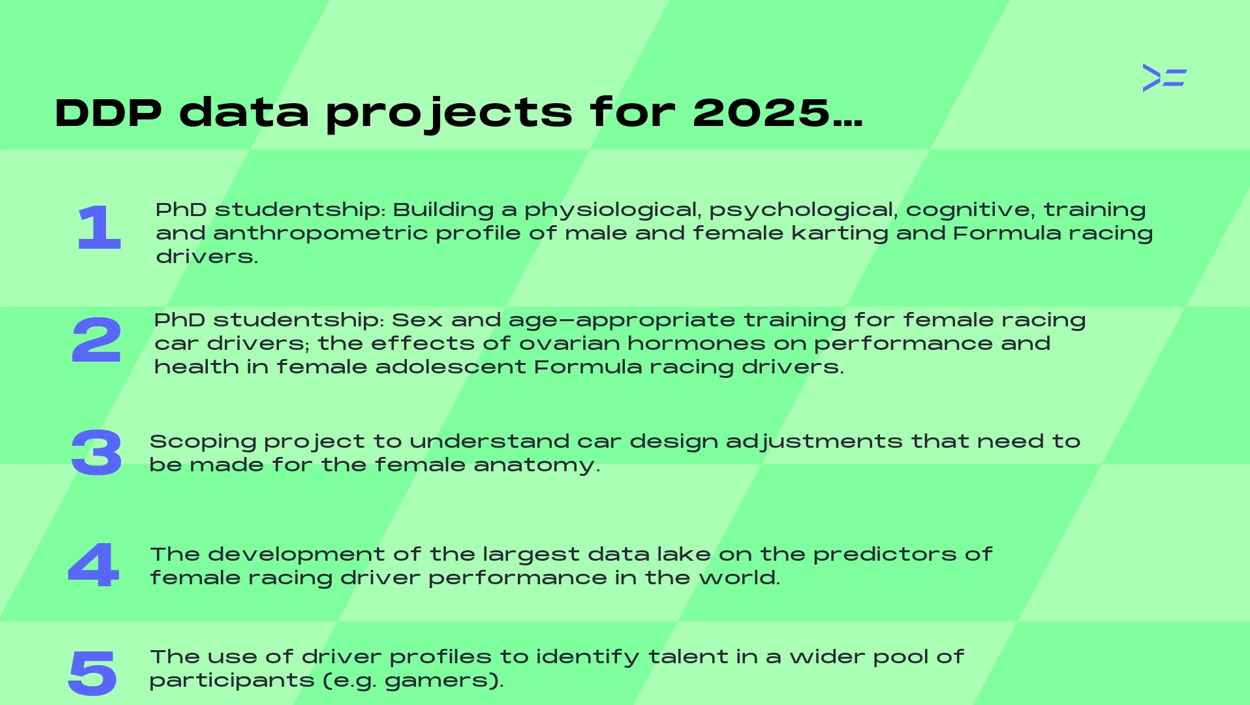
This work will help More Than Equal to build was Longstaff calls “the largest data lake on the planet on the predictors of female racing driver performance”. She adds: “All of those PDF race results get pulled into one central pool and we start to overlay that with the physiological, cognitive and psychological data. Once you have that, you can start to make predictions and we can understand who may have a greater chance of success at the next level of competition.”
It will also help to widen the talent net. “Once we have these driver profiles, we may be able to start to understand whether there are certain populations where we can spot talent.” Longstaff suggests the world of esports. “It’s a 50-50 split in terms of male-female players, so there’s a huge population we might be able to pull from.”
On top of that, digital twinning technology has the potential to enable teams to optimise how they adjust cars to the needs of their drivers with recourse to expensive testing. “You don’t necessarily need to be on the track,” says Longstaff, “but we can only do that by having all those data points in one system.”
What to read next
‘Some Skills of Adaptive Leadership Are Obvious, But That Doesn’t Make them Easier to Learn’
iBrainTech has worked with some of the biggest names in soccer, including Juventus, and now they are seeking to deliver their neurocognitive training tool to the ranks of academy soccer.
Main photo: iBrainTech
Users wear an EEG headset, which monitors brain activity and translates intention into action on the screen. The goal is to help soccer players sharpen their decision making and execution. It has been adopted by clubs in Serie A (Juventus), MLS (Orlando City SC and formerly Atlanta United), LaLiga (Real Sociedad) and the Portuguese Primeira Liga (SL Benfica). Longtime MLS star Jonathan Bornstein was an avid user.
Now, i-BrainTech is seeking to broaden its reach to academy and youth players. It’s a well-trodden path for performance tech to prove themselves with the elite before reaching the larger consumer market. But i-BrainTech has both the advantage of its inherent gamification and the challenge of making complex tech more frictionless.
“All transformative technologies should be ready and willing to become accessible, to validate the impact on the top level of performance and then to allow access of youth,” i-BrainTech Co-Founder/CEO Konstantin Sonkin said. “You need to be ready to cater your value to the young generation, and we are so lucky to be an engaging game at the end of the day.”
Sonkin has been working on this technology for 15 years to balance high signal quality with ease of use. He described a remodeled product as “a top-level, consumer-ready headset.” The goal is not only to improve the performance of younger players but also to encourage more athletic participation and unlock new revenue streams for clubs, such as with a co-branded cap or content.
“We want to drive them from Instagram back to the pitch,” Sonkin said. “Because when you exercise your mind, you’re so eager to execute in the [physical world] because your brain got so excited. It’s called neuro-priming. It has excessive, let’s say, electricity. It wants to utilize that in real-world actions, and that is the connection between their content created by clubs and then a long lifetime value.”
Michita Toda previously used i-BrainTech with rehabbing players as a physical therapist at Orlando City, where he saw value in keeping injured players mentally sharp while physically recovering. He recently joined the North Carolina Courage as its Head Athletic Trainer and is hoping to bring the product there, both for the NWSL club but also for the associated men’s USL team, North Carolina FC, as well as for the large youth academy system in the area.
“Being on the medical side of things, we talk a lot about youth sports specialization and how the more they play at a younger age, that might make them more susceptible to injury,” Toda said. “Well, using technology like this to supplement what they’re already doing, but not overdoing it physically, they still get the mental reps and get the quote-unquote ‘practice’ without having to tax their body.”
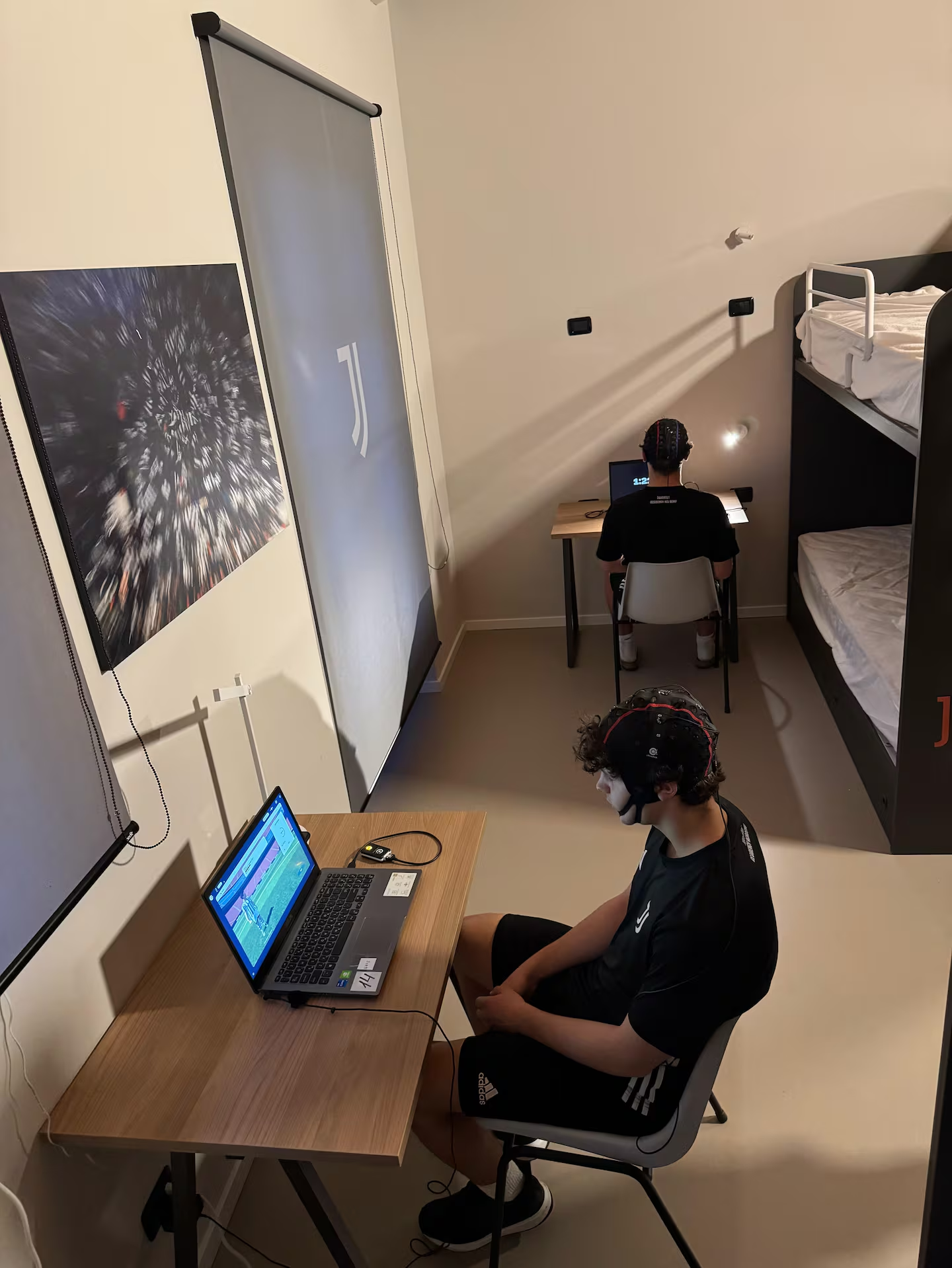
Members of the Juventus Residency Academy train with i-BrainTech. (Photo: iBrainTech)
Limited studies have shown promising results with the transfer of skill from the i-BrainTech product to the pitch. Real Sociedad B — the LaLiga club’s reserve team, which competes in the Spanish third division — completed a 15-player case study that spanned three months and 12,500 visualized actions. Those using i-BrainTech improved 12.4% in the accuracy of long kicks compared to 2.6% in the control group. Five of the eight players using i-BrainTech’s neurofeedback training also reported better concentration in matches.
“When we actually repeat all the actions on the pitch, most of the time we train our mind-body connection,” Sonkin said. “We train our muscle memory. Muscle obviously doesn’t have any memory. Memory lives in the brain.”
This article was brought to you by SBJ Tech, a Leaders Group company. As a Leaders Performance Institute member, you are able to enjoy exclusive access to SBJ Tech content in the field of athletic performance.
In the second episode of our three-part series, the AIS’s Director of National Performance Support Systems discusses how tech can be better used to deliver insights to athletes and coaches.
A vodcast brought to you by our Main Partners

“One of the things we’re trying to figure out, particularly for fresh graduates coming into high performance, is that sense of pressure to utilise technology because that’s what’s seen to be done in high performance,” she tells Teamworks’ Andrew Trimble and Leaders John Portch.
Miranda is the Director of National Performance Support Systems at the Australian Institute of Sport and a practising physiotherapist, which made her an ideal guest on this special Teamworks Vodcast, particularly when it comes to sharing her perspective on the way the Australian sports system uses technology.
“The next step is ensuring practitioners have got the critical thinking skills to understand why I am using this and what is it adding. What is it telling me? It’s getting that ability to analyse.”
Her words bring to mind High Performance Unpacked, the Teamworks Special Report that spoke to the importance of the practitioner optimising a given tech product to the final user.
It resonated with Andrew too. “When you haven’t got a centralised mechanism for presenting and communicating data, it shines a light on how important it is to be done correctly,” he says. “The greatest dataset in the world, if not communicated correctly, is nowhere near as effective and may be detrimental.”
Elsewhere in this episode, Miranda and Andrew discuss the idea of the physio room as the heartbeat of the team; the balance between system and individual performance [29:30]; why the physiotherapist is a ‘life coach’; and bridging the evidence gap in female athlete health.
Check out Episode 1, with Simon Rice, the Vice President of Athlete Care at the Philadelphia 76ers:
Listen above and subscribe today on iTunes, Spotify, Stitcher and Overcast, or your chosen podcast platform.
The MyTOCA app is also helping TOCA Soccer to stay more engaged with their soccer trainees away from the practice facility.
Main photo: TOCA Football Inc
“We’ve been collecting more and more data, but there really became this gap, if you will, from a customer’s perspective,” TOCA Founder Eddie Lewis said. “We had a lot of really powerful training data, but we made it really difficult to consume and collect.”
Lewis said a clear goal emerged to make an app that was engaging, but also one that easily displayed the value of TOCA training session. He told SBJ that the entire process to build the MyTOCA app started with a complete teardown of its existing platform, which struggled to collect data. The re-engineered setup creates more personalization for players but also helps TOCA stay more engaged with their soccer trainees outside of the facility walls.
View this post on Instagram
“The ability to take a player, use the data to not only understand where they are — but also understand insights that would be very difficult to see necessarily from the naked eye unless you spent a ton of time with these players, and then attack those strengths and weaknesses from a training perspective — we think is really valuable,” Lewis said. “And not only that, we want to share that progression along the way. At the end of the day, we believe the higher the training, the higher the customer satisfaction and obviously, the longer retention.”
The app has a trophy room for players to look at their accomplishments, as well as a community leaderboard and internal booking feature. Lewis also mentioned that this is the first phase of MyTOCA, setting the stage for more rollouts like a planned TOCA Score metric.
The deployment coincided with the start of the second annual TOCA Skills Showcase, an event rolled out in partnership with the MLS that spans two months in a competition across 22 TOCA Soccer centers. TOCA Football entered a 10-year partnership with the league at the end of 2022. Lewis added that the pairing has created both “validation and certainly credibility in terms of what we’re doing from a training perspective.”
Regarding the opening of the first TOCA Social site in Dallas, Lewis said there’s no specific date to share yet. But the goal to open ahead of the 2026 World Cup remains in an effort to capitalize on the nationwide interest that will build as kickoffs get closer.
“Everyone’s going to be interested in a in a soccer-related story, or understanding what’s going on with soccer in the US,” Lewis said. “And I think if we’re not ready to step into that spotlight during that window, we miss a once-in-a-generational opportunity.”
This article was brought to you by SBJ Tech, a Leaders Group company. As a Leaders Performance Institute member, you are able to enjoy exclusive access to SBJ Tech content in the field of athletic performance.
In this recent edition of SBJ Tech’s Athlete’s Voice, the veteran Colombian midfielder is using Omorpho’s micro-weighted athletic apparel to maintain his fitness levels.
Main photo: Getty Images
The 39-year-old Colombian ranks in the top-10 in MLS history for games started and minutes played, and as he has gotten older, Chará has made training and recovery more of a priority. He recently became a brand ambassador for Omorpho, which places micro-weights on athletic apparel for training.
An Oregon-based company, Omorpho is a partner of Tracktown USA in Eugene and counts Olympic track and field athletes Michael Johnson and Vashti Cunningham among its other ambassadors. In May, Omorpho also partnered with Orangetheory Fitness.
On his introduction to Omorpho…
Last year I saw one of my teammates, Larrys Mabiala, using one of the G-vests from Omorpho, and I started looking for the shorts. I received a pair of shorts from Omorpho last year and started using them in the preseason. I was talking about the shorts with the fitness coach, and he told me it could be a good opportunity to start using those shorts in preseason. I got used to it, and I really like it because it helps a lot to keep the same fitness level, which is important for me for every game.

Diego Chará joins Olympic track and field athletes Michael Johnson and Vashti Cunningham as ambassadors for Omorpho. (Photo: Getty Images)
On how it feels to wear them…
They have micro-weights so in warmups it really brings that effort. I usually use those short for 30 minutes and warmup session. Once I take them off, I start feeling kind of light and that continues into the practice during the day.
On the effect of wearing them…
I saw they helped me a lot to keep the physical level. Because I play as a midfielder, I have to be a powerful guy, and I feel with the shorts, I find a way to keep the same level in the games as during trainings. At the same time, I noticed the shorts —after using for a period of time — helped me to improve in my bone density. This is trying to prevent injuries, and at the same time that density gives the players [the ability] to do harder loads and work out.
On why he tests new tech…
For me, it’s really important and more in this moment of my career because I just turned 39. It is a little bit harder to keep in the game. And for me using now the technology for Omorpho has been really good, amazing, and that helped me to keep in the game.

Chará, 39, ranks in the top-10 in MLS history for games started and minutes played. (Photo: Getty Images)
What else he has tried…
In my career it is many things right now. It’s not just the technology. It is used getting good health habits — sleeping well, getting diet — and now the team is using the [Oura] ring to [measure] how you sleep and the recovery process. I think that technology helps a lot.
On what he’d tell a younger version of himself about career longevity…
It’s no secret formula, but I think the effort, the discipline, has been crucial in my career. Giving that effort and at the same time be mentally strong that helped to get a long career.
This article was brought to you by SBJ Tech, a Leaders Group company. As a Leaders Performance Institute member, you are able to enjoy exclusive access to SBJ Tech content in the field of athletic performance.
US Olympic Sprint champion Gabby Thomas discusses VAMA, which is a new motion capture tool for helping world-class athletes use biomechanics to fine-tune performance.
Main photo: Getty Images
“Obviously, it’s fine,” Thomas added, “but it really frustrates me because I am a perfectionist, and I want to get better.”
Training used to be done by feel, with some help from video. Now, however, USA Track & Field — in collaboration with the USOPC and the Southwest Research Institute (SwRI) — is able to offer its athletes a markerless motion capture tool called VAMA (Video Automatic Motion Analysis) to analyze athletes’ biomechanics, both at the start and at top speed. Small changes can have big impacts at the boundaries of performance, especially in short sprints.
VAMA has become part of many American sprinters’ weekly routines over the past few years and, by the USOPC’s estimate, directly contributed to nine Olympic medals in Paris — not only by Thomas, but also by men’s 100-meter medalists Noah Lyles and Fred Kerley, women’s long jump winner Tara Davis-Woodhall and more.
Spearheading VAMA’s implementation is Tyler Noble, USATF’s lead sport science and data analyst, who visited Thomas at her final training session before heading to the Paris Olympics. At the time, Thomas said her starts had been “a little wonky.” Noble can use an off-the-shelf GoPro camera that costs about $200 and shoots at 240 frames per second, then run the video through the VAMA algorithms and receive biomechanical feedback.
Noble and Thomas’ coach, Tonja Buford-Bailey, focused on her stride length and the number of steps it took her to reach 10 meters, a measurable cue that helped Thomas focus on performing.
“I always welcome new data, and when you’re trying to be the best and get better by such small margins, all of that counts,” Thomas said. “Working with Tyler and their program is so helpful, because I can see in real time what I’m actually doing, and then take that feedback and make corrections immediately.”
Among the metrics VAMA — a finalist for Best in Athlete Performance Technology at the Sports Business Awards: Tech — is able to collect are joint angles, ground contact times and vertical force production. Essentially every elite American sprinter has undergone at least one assessment, helping build a library to improve the algorithms and the understanding of what matters.
“Because we use VAMA, we’ve got this very rich data set of our best starters, and so we can actually model where the first seven steps for any athlete should really be relative to, say, their height or their leg length,” Noble said. “We take a holistic approach to the demands of the race, given the constraints of the athletes, and then try to model the perfect plan. VAMA plays a huge role in that, because you’ve got to be able to get to those insights quickly.”
The technological origins of VAMA reside in diving — where Phil Cheetham, former USOPC Director of Sport Technology and innovation, first applied motion capture with the SwRI — and also in the expertise of Ralph Mann, a former world record-holding hurdler who later earned his PhD and pioneered biomechanical analysis in sprinting.
Noble described Mann, who passed away at age 75 in January, as “the grandfather of USATF sports science” and added, “He had this beautiful, unique blend of PhD book smarts with ‘I won a silver medal at the Olympic Games.’ He could speak the science and coach the athlete.”
USATF used Mann’s CompuSport technology for years, but during the pandemic, budgets were decimated. Needing an alternative, it repurposed VAMA from diving to running. The analysis helps inform the conversations that “each coach-athlete pairing needs,” Noble said.
USOPC Performance Innovation Lead Elliot Schwartz praised Noble’s combined expertise in data analytics and sport sciences — not to mention that he’s a former college runner — to steer the project. Noble travels regularly to visit coaches and runners, but they can also upload videos for VAMA analysis on their own.
“Having an analysis tool like VAMA means that, one, you get much more accurate measurements, but also you can support so many more athletes,” Schwartz said. “A big part of what this technology is doing is it’s really democratizing who receives performance support.”
Sometimes that support can be a little inadvertent. Noble had two cameras set up to capture data on Olympic silver medal-winning hurdler Daniel Roberts prior to the Games. In the background, long jumper Davis-Woodhall had an absolutely perfect jump that her coach, Travis Geopfert, measured at 7.17 meters, a couple of inches longer than her eventual gold medal-winning distance in Paris.
By a “lucky circumstance,” Noble said, the last eight steps of her approach to the jump were captured by the second GoPro camera. That enabled him to share her step lengths and pattern as a final reinforcement of what Davis-Woodhall should do in competition.
“That was just a quick, off-the-cuff [analysis] that would have been very difficult and time-consuming to do in the past,” Noble said.
Lyles and Kerley won gold and silver in the Olympic 100, but their predictive modeling needed to take into account that Lyles, at 5-foot-11, is four inches shorter than the 6-3 Kerley. When Noble assessed them shortly before the Games, he knew Kerley would reach 10 meters first, but Lyles would get there while moving at a faster speed. Given each race strategy, Noble projected Lyles as a slight favorite — and indeed he won in a photo finish, edging Jamaica’s Kishane Thompson by five-thousandths of a second and Kerley by two-hundredths.
“There’s not much you can really tweak or change a week before the 100 final,” Noble said, “but you can go up and you can show Noah the iPad, or you show Fred the iPad, and say, ‘Look, you are ready to go.’”
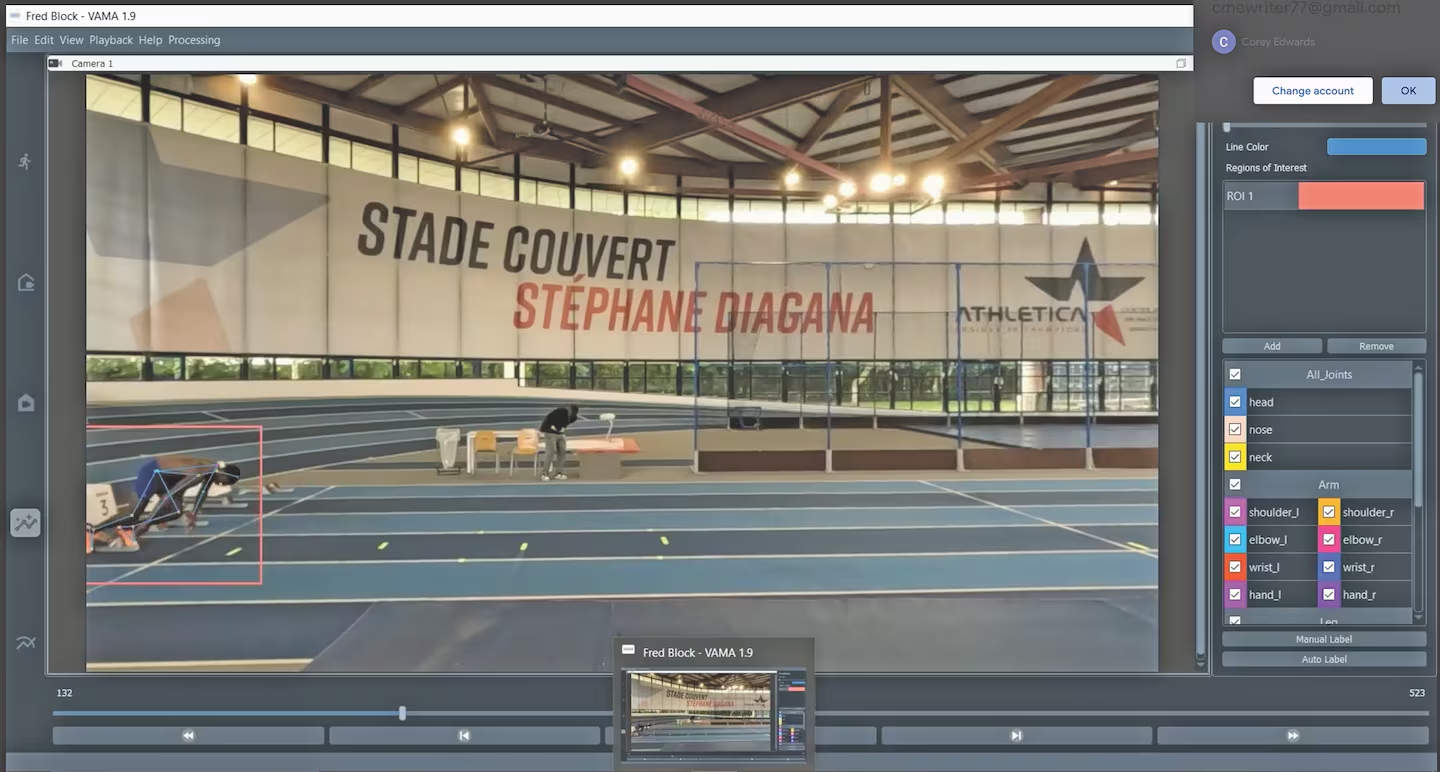
VAMA technology helped the U.S. win nine medals at the Paris Olympics by USOPC estimates (Photo: USPOC).
We take a holistic approach to the demands of the race, given the constraints of the athletes, and then try to model the perfect plan. VAMA plays a huge role in that, because you’ve got to be able to get to those insights quickly.
Tyler Noble, USATF lead sport science and data analyst
This article was brought to you by SBJ Tech, a Leaders Group company. As a Leaders Performance Institute member, you are able to enjoy exclusive access to SBJ Tech content in the field of athletic performance.
FlyKitt has been adopted by US Soccer and numerous players traveling to and from Europe during international breaks. It uses algorithms to prescribe a protocol of supplements, blue light-blocking glasses and recommendations on meal and sleep timing to mitigate jet lag from international travel.
Main image: courtesy of FlyKitt
That product, built from the data collection and personal coaching services of what was known as Fount, worked so effectively — better than 90% success rate — that its sales quintupled in a six-month period last year. At that point, CEO Andrew Herr decided to focus more intently on helping people travel, and along with CTO Clayton Kim, developed FlyKitt Fit, an app-based AI tool that generates custom exercise plans for travelers.
With FlyKitt Fit, a user can take photos of a hotel gym — or any fitness center — and the app will automatically identify the available machinery. Someone then needs to enter exercise goals, time available and current muscle soreness, and then FlyKitt Fit will generate a workout program.
“One of the big conclusions from our work was that travel was a top three challenge to people’s health, and no one was addressing it,” Herr said. “With that rapid growth, we just saw the opportunity to really use all of the accumulated data and knowledge to build products to go after travel, and so what we’re doing is we’re building the toolkit to solve every part of the health challenges of travel.”
Over time, FlyKitt Fit will include more domestic travel aid and be more deeply intertwined with the jet lag product with inputs based on one’s circadian adjustment and optimal exertion based on recent rest. “We’re moving towards integrating this more into the FlyKitt program, but right now it’s really focused on getting you the best workout you can get when you’re on the road,” Herr said.
The genesis of FlyKitt originates from Herr’s time as a human performance specialist in the US Army — he was twice honored with a ‘Mad Scientist’ award — and his understanding that flying creates an inflammatory response akin to what divers experience at great depths. Suppressing that underlying inflammation allows circadian rhythms to more easily adjust. The parent company raised a $12 million Series A in 2023.
US Soccer is one of the known sports users of the FlyKitt product, both for team travel to international matches and for shuttling European-based players to and from camps back in the States.
Also on the product roadmap is FlyKitt Food. The tool, which is currently in beta, helps users find healthy meal options while traveling. The technology ingests publicly available menus and can recommend not just a certain restaurant but even a specific dish, complete with modifications such as whether to get the dressing on the side.
“We know from our coaching service both the types of meals that are going to be most effective at powering people when they travel,” Herr said. “It’s a generally healthy protocol, but it’s also really the optimal stuff to be eating when you travel. We know all the food sensitivities and food issues that make it hard not just to find a healthy restaurant, but find a healthy restaurant for you.”
This article was brought to you by SBJ Tech, a Leaders Group company. As a Leaders Performance Institute member, you are able to enjoy exclusive access to SBJ Tech content in the field of athletic performance.