The seven-weight world champion spoke to SBJ Tech ahead of her second fight with Ireland’s Katie Taylor.

You can’t have a discussion about sports technology today without including athletes in that conversation. Their partnerships, investments and endorsements help fuel the space – they have emerged as major stakeholders in the sports tech ecosystem. The Athlete’s Voice series highlights the athletes leading the way and the projects and products they’re putting their influence behind.
* * * * *
Two of her losses included the tightly fought split decision against Katie Taylor that headlined Madison Square Garden two years ago. Their rematch last month, which Taylor won by a controversial unanimous decision, was as the co-headliner with Jake Paul and Mike Tyson in the Most Valuable Promotions card was held at AT&T Stadium in Texas and streaming live on Netflix.
Also in November, Serrano, 36, partnered with Total Wireless, a no-contract 5G provider that runs on the Verizon network — and received her very first mobile phone. Citing an unwavering, distraction-free focus on boxing, Serrano had resisted owning a phone until now. She will host a meet-and-greet with fans at a Total Wireless store in Brooklyn on Dec. 1.
On not owning a mobile phone…
No, never. It’s going to be my first one. All my communication has been through my trainer, my brother-in-law, which is Jordan Maldonado, and every now and then, I’ll steal my sister’s phone and do everything there. I do have an iPad, but this would be my first phone.
On who she’ll call or text first…
I think it’s going to be my sister, and I’m going to talk. She will be happy that I don’t take her phone anymore. Now I have my own.
On working with Total Wireless…
Total Wireless definitely has a good commitment with the Latino companies, Latino athletes. What really got me was because their plans, and then they’re associated with Verizon. I needed a plan and something that’s not going to slow me down. Because I’m always high pace, and I needed something that’s going to do that for me.
On how she evaluates brand partnerships…
If I truly believe in it, if I’m happy with them, if I see their work and what they’ve done for others, and what they’re doing for in general — yeah, that’s how we partner up. If I believe in it wholeheartedly, then I’m going to go with them. There’s people that we’ve gotten offers from, and I said I don’t agree with what they’re doing, or I don’t get what they their motives are. So I will not represent them.
On being on co-headlining with Jake Paul and Mike Tyson…
Obviously the fans wanted this fight. I believe I won the first fight. So it was really easy when my team came up to me and said, ’It’s going to be on Netflix in a big stadium for 80,000.’ I said, ‘Let’s do it.’ We gave an iconic first fight, headlining Madison Square Garden, selling it out. And I think we’re just going to do a better fight this time. And I think we’re both deserving of this platform to go out there and represent for the women in the sport.
It’s truly an honor. I’m super proud. I have an amazing team that even thought of me to put this fight on. I can’t wait. I know I’m going to put on a show. I’m ready. I know Katie’s ready. And you’re going to witness women’s boxing at its finest.
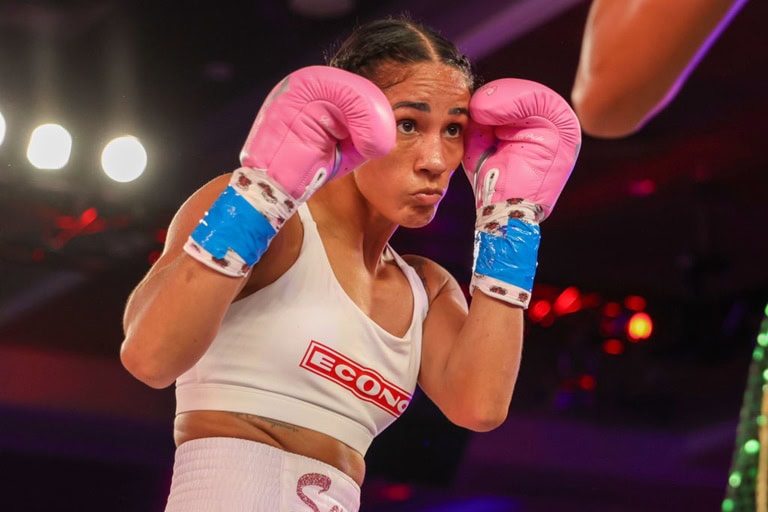
On her training methods…
I’m old school. I have an old school trainer. We’ve been doing it for 16 years this way. It’s been working for me for 16 years. I’m one of the most accomplished female fighters in the world, and that’s only [after] having nine amateur fights. I have 50 pro fights. And if it ain’t broke, why fix it? But we definitely train smarter this camp. I train hard for all my fights. So I’d be lying if I you that I trained harder. No, we just trained smarter. I’m ready to become undisputed champion at 140.
View this post on Instagram
On how she’s evolved…
I never really, in the beginning of my career, thought of recovery as part of training, but that was definitely a plus for this fight. As you get older, your body gets a little more wear and tear, so you definitely have to concentrate on that and just eating good and just going out there and performing, making sure you’re training hard and running the miles you have to run, putting in the work, and you’ll do good at fight time.
On her team…
My team is very small. It has been my brother-in-law [who is] my manager and my trainer, which is Jordan Maldonado; and my sister [Cindy]. We’ve been together. It’s been us three. I do have a pad coach, but he does what my main coach, Jordan, tells him to do. I had a nutritionist, and I learned things from him. So I moved it over to this fight. I try and cook for myself, but I’m I don’t like too much. I don’t like an entourage. I don’t like too many people around me. So it’s been my small team, and I’m happy. They just bring the best out of me.
On what she learned about fighting Katie Taylor…
Katie is definitely a warrior. She’s tough as they come. She’s not going to go down easily, and she’s going to fight every minute, every round, and that’s what I I learned. I gained more confidence after that first fight. I know I hurt her. I’m capable of hurting her again this fight. And that’s what we’re going to try to do.
On the growth of women’s boxing…
It’s been a long journey. Definitely people had their doubts in us, but now that they’ve seen that champions are fighting champions, we’re putting in on great shows — I’m not the type to brag, but when I do express how much money I’m making in my fights, that’s to motivate these young girls and show them, inspire them. There’s a light at the end of the tunnel, like ‘I can make this type of money if I continue to fight, work hard.’ Now, with this type of money, women are coming into the sport more. They’re putting on shows. They’re fighting, they’re getting in shape, and we have amazing talent, amazing champions, and I think it’s only getting better.
This article was brought to you by SBJ Tech, a Leaders Group company. As a Leaders Performance Institute member, you are able to enjoy exclusive access to SBJ Tech content in the field of athletic performance.
Dr Karl-Heinrich Dittmar of German champions Bayer Leverkusen is joined by Yael Averbuch West of Gotham City and Kitman Labs’ Stephen Smith to discuss the power of a data-informed performance strategy.
A podcast brought to you by our Partners

They demonstrated to Dr Karl-Heinrich Dittmar, Leverkusen’s Head of Medical, the optimal range of player availability to top the table during a meet in Dublin, four or five years before Die Werkself actually won the title.
“I kept this data; and last year we did it,” Dr Dittmar told the Kitman Labs podcast with evident pride. It turns out the data scanned almost perfectly across the numbers posted by the club during their unbeaten title-winning campaign.
“They found out what we need from the medical point of view, from player availability, and it was perfect – the data predicted what would happen in the future.”
It demonstrated the value of clean, consistent datasets – something that has given Leverkusen an edge over more celebrated rivals – and something that Yael Averbuch West is trying to build in her role as GM at 2023 NWSL champions Gotham City.
“We’re still in the data collection stage in the women’s game,” she tells the podcast, while also explaining that the work to bridge that gap is well underway in this corner of New York City.
In the third and final episode of this series, West and Dr Dittmar are joined by Kitman Labs Founder Stephen Smith to discuss how data strategies can help teams in their quest for greatness.
Elsewhere, the trio discuss a range of topics, including why learnings tend to emerge as data collection grows ever more sophisticated [17:30]; the importance of a centralised system for consistency [24:15]; the balance between using data to unearth ‘hidden gems’ and jumping on something misleading [33:00].
Episode one is available here and episode two is available here.
Further listening:
Kitman Labs Podcast: ‘Women Players Need to Feel Safe and they Need to Have Access to Support’
Listen above and subscribe today on iTunes, Spotify, Stitcher and Overcast, or your chosen podcast platform.
Former NFL star Greg Olsen discusses the second season of his show with Michael Gervais, Youth Inc., and the apps helping young athletes with their mental health.
You can’t have a discussion about sports technology today without including athletes in that conversation. Their partnerships, investments and endorsements help fuel the space – they have emerged as major stakeholders in the sports tech ecosystem. The Athlete’s Voice series highlights the athletes leading the way and the projects and products they’re putting their influence behind.
* * * * *
Former NFL TE Greg Olsen has stayed busy since retiring from the league after the 2020 season. He made a fresh name for himself as Fox Sports’ lead NFL color commentator over multiple years, and now anchors the network’s No. 2 booth following its addition of Tom Brady. In 2022, he partnered with former Panthers teammate Ryan Kalil, actor Vince Vaughn and LA-based venture firm Powerhouse Capital to launch podcast production house Audiorama, which has since spun off youth-sports-focused interview show Youth Inc. into a media company that is adding a digital commerce platform in 2025 and raised $4.5M earlier this year. On top of it all, he is also a dad and youth football, basketball and baseball coach.
“It’s hard,” Olsen said of juggling those responsibilities in a recent interview. “I try to coach one season per kid.”
The first episode of season two of Olsen’s Youth Inc. Podcast releases today with a new co-host in sports psychologist Dr. Michael Gervais. Earlier this week, SBJ Tech caught up with Olsen to discuss Youth Inc., working with Brady and sports technology trends that interest him.
On what to expect from season two of the Youth Inc. Podcast…
Season one was really almost testing the market. When we approached season one, our plan was, let’s cast a wide net, let’s have a big variety of conversations with all different aspects of the youth sports experience – whether it’s parents, coaches, Olympians, professional athletes, college, sports psychologists, performance coaches. Every aspect of what the landscape looks like, let’s have surface-level conversations, cast a wide net, and let’s test the interest level, let’s test which areas of the system people most gravitate to and respond well to.
It became very evident through those 40-some-odd episodes that there were certain areas that people had strong interest in. Season two is going to be a lot more of hyper-focused episodes that are more of a deep dive into different conversation with guests, but all have the same storylines.
For example, me and Dr. Michael Gervais, who’s one of the leading sports psychologists in sports from the youth level all the way up through professional athletes and Olympians – I met him when I played for the Seahawks and have gotten to know him – we sat down with a bunch of different guests. And while the conversations all covered different sports, different ages, different levels, different detail, they all had common threads around mental health, sports performance anxiety, best practices of parenting youth athletes, best practices for being a youth or college or professional athlete.
View this post on Instagram
On how technology is changing youth sports…
It’s a great question, and obviously [with Youth Inc.’s digital commerce platform] we’re trying to tackle one of the big areas, which is a very complicated and fragmented e-commerce experience. We spend all week very much on our phones or on our computers with the ability to process buying in a seamless one-touch, whether it’s Fanatics, or Amazon, and all these big e-commerce platforms that we’ve all become very accustomed to. And then when it comes to, you know, buying a hoodie for your kid’s middle school football team, it seems like you’re jumping through hoops.
With sports performance and mental health, there’s a lot of good apps and programs that people are investing in that are right on kids’ phones, take them step by step through performance anxiety, best steps to handling pressure, the best steps of handling failure – and they’re almost bringing a mobile sports psychologist into the palm of their hands. There’s scheduling apps that best process how to pick the best baseball tournaments and best volleyball tournaments. [The technologies are] all geared towards – yes, capitalizing on a big market, capitalizing on a big opportunity financially – but more so just trying to make the experience better.
On working with Tom Brady at Fox…
It’s been great. We’ve had a good relationship, and obviously we’ve had a lot of conversations as he’s transitioned to this role. He’s been really good to work with, super humble and open-minded to asking questions and wanting to learn and realizing that when you start anything new – it’s no different than when I first started – you don’t know what you don’t know. I give him a lot of credit. He’s been very upfront and humble and honest about wanting to learn and wanting to get advice from other people. And you’re talking about the best guy who’s ever played the sport. So, it’s a credit to him. I’m sure if you asked him, he feels a lot better now than he did in Week 1, and he’ll feel a lot better in five weeks than he did yesterday, and that process just continues to get more and more comfortable the longer you do it. No different than how it was when we all first came in the [NFL] as players. There is a learning curve and there is a process of getting comfortable as time goes on.
View this post on Instagram
On the keys to his transition from player to broadcaster…
Early on for me, what I tried to remind myself is: there was no learning curve for football. I knew football. The learning curve came through the technical part. The learning curve came through communicating on live broadcasts and communicating with producers in your ear and understanding replay sequencing and all the specific things to a broadcast were where I had to do a bunch of my learning.
To this day, I don’t know exactly all the camera angles, official names. When I ask for a replay, I’m probably calling it the wrong name, but they by now know what I’m talking about… At the end of the day, when you get your 20-second sound bite to get in there, talk about what you know. We’ve lived this sport our whole lives. We know it. We see it. Describe it to someone at home in a way that keeps it interesting, keeps it informative. The complexity of football is what makes it so special. But also you can’t talk like you’re in the locker room. You can’t talk like you’re talking to another 20-year veteran at the position. So, there is a little balance.
To sum it up, keep the football part. That’s the part you know. Don’t let the transition of the technical broadcast component paralyze you. At the end of the day, you’re talking football. Don’t complicate it. Talk what you know. Talk what you see. You can figure out the mechanics of a broadcast, figure out the mechanics of television along the way.
On the NFL’s in-game authorization of Guardian Caps in 2024…
I think anything that can continue to improve the health and safety of players while keeping the game the game is something worth looking into. So, I’ll always be a supporter of any of that.
I think helmet technology has come such a long way. I mean, I look back, I had my rookie year Chicago Bears helmet and when I look on the inside, let alone when I look back at what I wore in high school compared to what I wore at the end of my career, you talk about the technology growing and getting better with time. And then you factor in what the Guardian Caps are able to do and the extra layer. I know everybody wears them in practice. And I’m sure there’s some adjustment getting used to it. But I think everybody has the decision, what helmet they wear, whether they wear the Guardian Cap in practice or also in the games.
I don’t know if I would wear one. Obviously, I’m probably on the older side. By the time it was introduced I was like that ‘can’t teach and old dog new tricks’ kind of person. But for guys who wear it, I’m sure there’s a level of comfort, a level of protection. I wouldn’t be shocked if some of that technology Guardian is developing gets incorporated into some of the helmet design, and one day you get the combination of both things all wrapped up in one.
This article was brought to you by SBJ Tech, a Leaders Group company. As a Leaders Performance Institute member, you are able to enjoy exclusive access to SBJ Tech content in the field of athletic performance.
The former NBA small forward talks to SBJ Tech his new tool, which helps players to shot and offers instant feedback.
Main photo courtesy of Form
You can’t have a discussion about sports technology today without including athletes in that conversation. Their partnerships, investments and endorsements help fuel the space – they have emerged as major stakeholders in the sports tech ecosystem. The Athlete’s Voice series highlights the athletes leading the way and the projects and products they’re putting their influence behind.
* * * * *
Even though he was an above-average shooter — Hayward hit 1,111 career three-pointers at a .370 rate, and his .950 playoff free-throw percentage is No. 1 in NBA history — he kept seeking new ways to improve, which led him to an entrepreneur named Charlie Wallace. Hayward, 34, and his former Butler teammate, Emerson Kampen, acquired most of Wallace’s company, redesigned a few things and rebranded it as Form, which they launched this month.
Form makes a basketball shooting aid. The product is a flat-sided cube whose shape helps encourage proper shooting form and the development of muscle memory. The pro ambassadors for Form are nine-time NBA All-Star Paul George and the WNBA’s Lexie Hull, who’s currently a starter for the Indiana Fever.
On how he got involved with Form . . .
The creator of Form was this guy named Charlie Wallace, who created what was called Qube. I’m somebody that’s kind of a perfectionist, and I was scouring the internet looking for something for hand placement on a basketball and where to position it. And I came across Charlie’s YouTube and saw this device, saw him shooting it, and thought, ‘I might as well try it out.’ So I ordered one for myself. He came across on his sheets that Gordon Hayward bought one, so he messaged, asking if it was the real Gordon Hayward — it was.
I got the product. Then he sent me his number. We talked and chatted about it. Then we decided — my partner and I, Emerson Kampen — that we wanted to push forward with it and rebrand and relaunch the company. We designed a few different things about it and changed some stuff a little bit, and here it is now.
On the target demo for the product…
It was something that I loved using during the last couple years of my career, and I felt like this was a product that could really help a lot of young kids, especially. It’s really a tool that’s geared more towards younger kids that are just [wondering], How do you learn how to shoot? How do you shoot a basketball? You would start with a tool like this. I have young kids myself and felt like it was something that could really help them.
On what interested him originally…
For one, I saw Charlie, who’s this unassuming, middle-aged guy just draining jump shots from almost half-court. And it was like, ‘What is he doing?’ Shooting it straight every time. The ball is rolling back to him.
Now, at this point in time, I obviously still was a good shooter, and it’s not like I wanted to change my shot at all, but certainly felt like I used my left thumb a little bit and wanted to perfect it even more. So I think that’s what initially sold me on it, and then once I got it, just [saw] how simple it was. I used it more shooting around the house than anything. I didn’t really shoot it on a goal. I would warm up with it on a goal, especially during my offseason workouts, but more than anything, it was something that, I could be on the couch and just shoot over and over and over. It just locks in your form.
You can’t be on the basketball court at all times. But you’re sitting around watching TV and you’re just shooting this thing up and down on the couch. If you’re thinking about basketball and thinking about your shot and thinking about your game, it’s something that you can do, like I said, not even on a court. And that was another thing: I know a lot of people don’t have access to courts all the time, and you can use this anywhere and everywhere.
On whether he always wanted to become an entrepreneur…
I honestly didn’t ever think about it. I wanted to be a basketball player, and I was blessed and lucky enough to be able to play in the NBA and have a long career in the NBA. And I was just thinking each year about how I could get better as a basketball player, and this kind of fell into my lap. As I got older and older, you do have to start thinking like, at some point in time, this is going to end. The NBA always has a lot of meetings about that, and they’re trying to help players because your career is usually a lot shorter than you think it will be. And so you’ve got to have something that you can do afterwards.
This was something that fell into my lap, but it’s something that we quickly became passionate about because it allows me to still be around the game and help young kids learn how to shoot and but it’s also the other side of it. It’s the business side of it, and that’s fun. Obviously business is competitive. It gives you a chance to compete.
On his other post-basketball business interests…
My portfolio, in general, I wanted to make sure it had a lot of variety in it. I just also released a movie — I was the producer of a movie. So that’s another thing, and it certainly has helped me. As preseason games get started, I’m kind of missing it a little bit, but this has helped me bridge that gap. They always say retired athletes start to get bored and all this, but this has helped me jump right into it.
On the first film from his production company, Whiskey Creek Productions…
We made the movie [Notice to Quit] in September of ’21, over the course of that year. I was obviously still playing, so I wasn’t extremely involved on a day-to-day standpoint, but as the producer, I was sent dailies. I was able to go to Skywalker Sound and do some editing there, and I think, moving forward in the future, I would love to get more involved with that as well.
On other shooting tech…
I used Noah when it first came out. My shot was actually pretty flat, and we used that for a little bit just to work on the arc of my shot. Noah is good because you want to be consistent in your shot more than anything, and it helps you just realize your arc is not as high as you think it is. And so I used that. We used the gun when I was in high school — the gun is just the thing where you’ve got the nets that go right around the goal, and when you shoot it, the balls drop down, and then it passes it back to you.
On how youth can learn to shoot…
Another thing I thought was really amazing about Form: There’s never been and there’s not really a tool that helps you learn how to shoot. A lot of tools these days are data-driven, and they’re showing you all the data about your shot, the arc, the rotation of the basketball, the depth, how far you’re shooting it. It counts your misses and your makes, and all that stuff is really good, but it doesn’t help you learn how to shoot. It doesn’t tell you about your form.
There’s so many tools in other sports, like golf and baseball, for example, that everyone’s all-in on and learning to do the fundamental part of whatever you’re trying to do. [Basketball tools] show you your data, but they can’t help you fix it. You would have to do that on your own. This, if you don’t shoot it the right way, it’s going to spin because it’s a cube. It’s not going to spin on that singular axis. And so if you do it correctly, you see its instant feedback. You see it right away. It spins beautifully, and if it’s not, it’s going to be wobbly.
This article was brought to you by SBJ Tech, a Leaders Group company. As a Leaders Performance Institute member, you are able to enjoy exclusive access to SBJ Tech content in the field of athletic performance.
The Olympic gold medalist is sits down with the Athlete’s Voice to discuss her new venture with Always Alpha
Main photo: Always Alpha
A Data & Innovation article brought to you by
You can’t have a discussion about sports technology today without including athletes in that conversation. Their partnerships, investments and endorsements help fuel the space – they have emerged as major stakeholders in the sports tech ecosystem. The Athlete’s Voice series highlights the athletes leading the way and the projects and products they’re putting their influence behind.
* * * * *
The Los Angeles native competed in the 100, 200 and 400 meters, with an individual gold at the 2012 London Games in the 200. Felix also won 21 medals in the world championships before retiring at the end of 2022.
Felix has been active across a wide range of interests in recent years, as an advocate for Black maternal health, as the Co-Founder of women’s footwear brand Saysh and, as of today, the Co-Founder of Always Alpha, the first talent management firm exclusively dedicated to women’s sports.
For Always Alpha, Felix partnered with her brother, Wes — a former elite runner who has served as his sister’s agent — as well as former Wasserman executive Cosette Chaput and Dolphin Entertainment CEO Bill O’Dowd. Always Alpha is a subsidiary of the NASDAQ-listed Dolphin and will work with women athletes across all sports and support them in a variety of ways, including brand partnerships, media production and entrepreneurship.
On the motivation to start Always Alpha…
What led to it really was my experience in my career. My brother managed me, and we really had to kind of piece things together. There wasn’t really a cohesive strategy starting out to bring all the things that I was interested in and make all the work seamless. And so we had missteps and struggles, and when other athletes would come to me and ask, ‘How did you do this or that?’ Or how to start a company, or if they were interested in writing a book — whatever the thing is — where do I point them where they can do all the things and show up as themselves?
That was the inspiration — that it didn’t exists — and especially something focused on women’s sports, obviously, with all the momentum that we have now, but I think there’s just a unique way that you show up for a woman, and so we are excited to do that at Always Alpha.
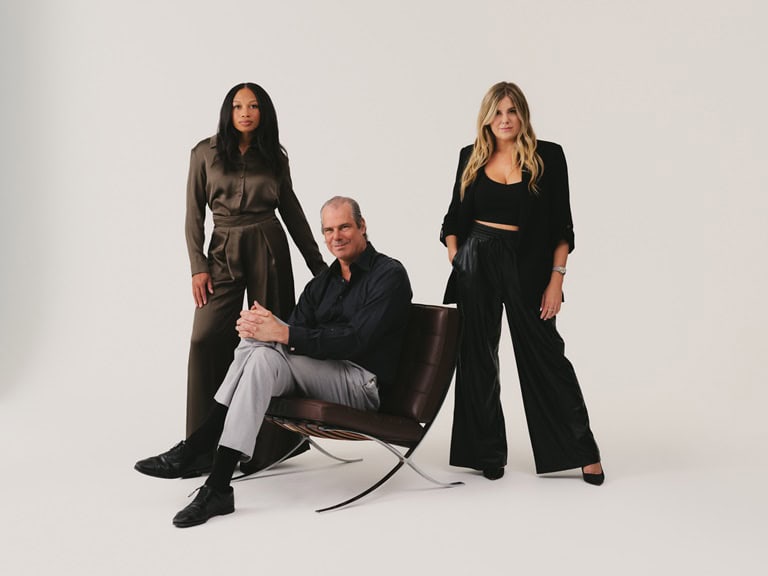
Photo: Always Alpha
On an example of the marketing challenges she faced…
It was an idea of always wanting to get outside of track and field and break through to the mainstream. That was always the big fight. I felt like, through my career, we learned so much, and I always told Wes, ‘I wish we could do it again.’ Now we have all the pieces, and we have the things to take advantage of, the relationships and all of that. That would have made that path so much easier, as I was interested in business, and it just wasn’t there.
Now that I understand things so much clearer, I feel like a big piece of this is this legacy and mentorship. And how do I give back? And I really see this as a vehicle, also, to be able to do that and to say, ‘Let me help you avoid some of the hardships that I went through.’
On connecting with Dolphin to launch Always Alpha…
Cosette and I met working on the LA bid in 2016. Then we met Bill from Dolphin [earlier this year], and he really just shared the vision. He understood that what we were trying to create didn’t exist and that we needed to have something fully focused on women.
It was just being aligned — Wes, myself, Cosette — and talking to Bill. He got it. And that doesn’t always happen. So to be able to bring this into the world at scale, and to be able to have amazing resources that Dolphin provides is a unique experience.
On Allyson’s daily role with the agency…
It’s really that piece of guidance and [having], conversations with athletes and coaches broadcasters about, not only my experience, but what are their goals and what would they like to achieve? Being that piece of it, but also on a personal level, being available, being an open book and transparent about my journey and how I can help others with theirs.
On the roots of her entrepreneurship…
It’s funny — growing up, Wes and I used to collect things around our house, and then we would create a store and actually sell back our family’s items to them. And so we’ve always had that bug. We had a lemonade stand — it was actually a Kool-Aid stand — on our lawn. So we always had that spirit in our family, but we also weren’t really exposed to it in a real way. We didn’t know people close to us who had done it, and so being two kids from the inner city of LA, it didn’t really ever seem like a real possibility.
It wasn’t until right before starting Saysh [that we found] the confidence. I struggled with imposter syndrome, all those things, but getting the courage to just go for it. Launching Saysh was like, ‘OK, we can do this.’ To me, this is the next step in that journey that I’m on, just to make things better for women and make it an easier path.
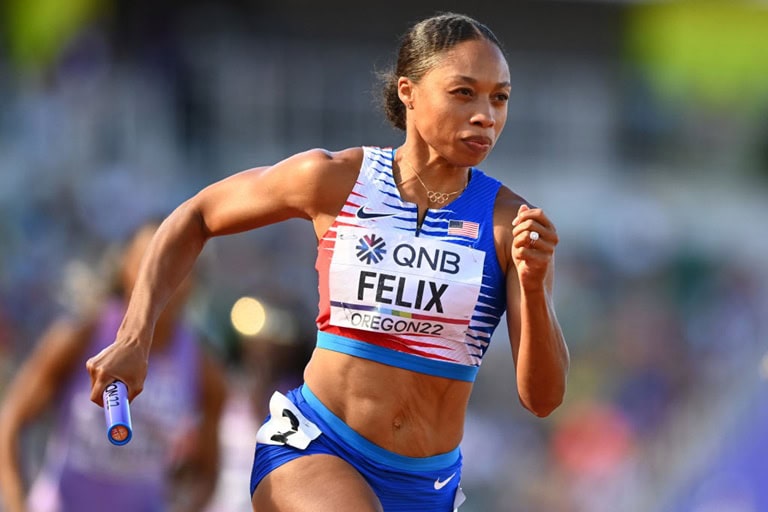
Photo: Hannah Peters/Getty Images for World Athletics
On preparing for a post-competition career…
It was such a natural progression with Saysh because it happened organically. At that point, I wasn’t really focused on what was the next thing. It was, ‘Well, I don’t have shoes, and I need them, and so we’ve got to build this thing.’ Throughout my career, Wes was always really hounding me on, ‘You need to make these connections and these relationships, and we don’t know what it’s for, but it could be useful later on.’ And so I was really heavy into that and into mentorship. I wasn’t sure what the thing was going to be, but I was constantly trying to prepare for my next move.
On her mentors…
Jackie Joyner-Kersee has been my athletic mentor, and she’s been incredible. Mary Erdoes has been someone who has been really just transparent — one of those relationships that I didn’t know where it was going, but she’s provided so much business advice to me through the years, but early on in sport, she’s just shown up for me.
Yesterday, I was speaking at the NASDAQ Forum, and Fawn Weaver was one of the other speakers. Fawn has also been incredible in my life, helping me with that confidence piece, as someone who’s built an incredible business with Uncle Nearest, but just showing up in my real life and being that sounding board for me. I’m huge into mentorship. I think that if you haven’t done something before, talk to someone who has.
On the tech that she and coach Bob Kersee used to help her training…
That’s another one of those ‘I wish that I was at my prime now’ because I think there’s so many more tools, but we used a lot of filming and models — overlaying a model on top of the film that we take. You can set those models to like a world-record pace, and you can look at all of your mechanics. You can learn so much and adjust your [joint] angles and different things from that. So that was a huge piece while I was training that was helpful.
This article was brought to you by SBJ Tech, a Leaders Group company. As a Leaders Performance Institute member, you are able to enjoy exclusive access to SBJ Tech content in the field of athletic performance.
NFL Player Health & Safety Innovation Advisor Jennifer Langton sets out the ways in which AI, AWS and the NFL’s Digital Athlete Program has had a positive impact.
Main Photo: CNBC
A Data & Innovation article brought to you by
Lower-extremity injuries have become a major focus for the league, with the first two weeks of preseason training camp – a period of re-acclimation to the sport – as the period of greatest risk, yet for the first time ever, the NFL saw a reduction in leg injuries in consecutive summers.
NFL Player Health & Safety Innovation Advisor Jennifer Langton shared that finding on stage at CNBC Evolve: AI Opportunity in New York City in October. She attributed that success, as well as changes to the kickoff rule, to the league’s work with AWS on the Digital Athlete, in which data about every rostered player on every team is anonymized and analyzed. Positional benchmarks are shared league-wide to help inform player training and usage.
“When you can integrate and aggregate data across all 32 [teams] for all 53 [players], you have more power in the data that you are generating to model,” said Langton, who for years helped lead player health and safety efforts as an SVP in the league office before leaving her full-time position for personal reasons in August.
Other work Langton highlighted was the use of computer vision triangulated with the Next Gen Stats RFID sensors to calculate the severity of head impacts, which for the first time last year was distributed to offensive and defensive line coaches on a weekly basis so they can “put in injury prevention strategies to get the head out of the game,” she said.
The reformatted kickoff was a direct result of the league’s biomechanical consultants at Biocore collaborating with AWS to run 10,000 seasons’ worth of data on rule variations to determine the best combination of a rule change that would be safe but also encourage on-field excitement.
The NFL has crowdsourced innovations in computer vision and worked with AWS on collecting more accurate tracking data. The investment in data capture is paying dividends and, Langton noted, will expand in the future to full-body limb and joint tracking. It has been a challenge to get the necessary precision for actionable insights, particularly with the high rate of occlusion in a contact sport like football.
“With the new AWS deal, that’s the focus, to build that pose estimation so that we can get to that true Digital Athlete on quantifying body movement,” Langton told SBJ in a post-panel interview.
Much of the efforts to date have been in creating operational efficiencies. A half-dozen years ago, for example, staff would take four days to manually tabulate head impacts through painstaking film review. That’s now done in real-time. Similarly, injuries would be listed in the league’s electronic medial records database as happening only in a particular quarter, so officials would have to review game film to find the specific cause. Now, those injuries are automatically tagged with a clip of the play in question.
“The infrastructure and the data to fuse that together is power,” Langton said of the work with AWS. “If you can standardize them and then synchronize, then we can integrate and aggregate across the league.”
The acclimation period was instituted in 2022, with leg injuries down 27% in 2024 compared to the year prior, in 2021. Langton had noted that the league saw declines in consecutive years for the first time.
“The decrease in the lower extremity injuries that we saw in the preseason last year led to the savings of more than 700 games that players did not miss during the regular season,” Miller said. “And so those benefits of the fewer hamstring strains or soft tissue injuries pull through into the regular season. Those injuries don’t recur as often, and the fact that the players don’t suffer the injuries in the first place mean that they’re healthier for the regular season.”
The new dynamic kickoff helped encourage 70% of kicks to be returned in the preseason, up 15% from last year. The injury rate on those played declined by 32%, with Miller noting that player speeds — which are calculated by the Next Gen Stats RFID chips in players’ shoulder pads — were about 20% lower on average in the reformatted version of the kickoff, in which most players line up 5-to-10 yards away from each other.
“Because we eliminated some of the space and therefore decreased some of the speeds, that led to a substantial decrease in the injury rate,” Miller said. “In fact, we saw zero ACL injuries on the kickoff. We saw zero MCL injuries on the kickoff. And those huge time-loss knee injuries are going to substantially save a lot of players, a lot of time.”
This article was brought to you by SBJ Tech, a Leaders Group company. As a Leaders Performance Institute member, you are able to enjoy exclusive access to SBJ Tech content in the field of athletic performance.
Springbok Analytics uses AI to create a tool with the potential to help all 450 players.
A Data & Innovation article brought to you by
A graduate of the NBA Launchpad, Springbok Analytics has been scanning players for more than three years and has grown its team partner list to 10. To date, performance and medical staffs had used the product to detect muscle asymmetries and fatty infiltrations into the tissue, both of which can be early signs of injury risk.
But teams didn’t gain value from Springbok’s normative database because, even though there is a large proportion of elite athletes to go along with recreational competitors, most NBA players are outliers for their height and ability.
Utah Jazz Director of Performance Science Barnett Frank said the new NBA database “allows us to really be a little more strategic with our information.”
“One of the biggest challenges I have in the space is always getting asked, ‘Well, what does that mean for an NBA player?’” he added. “There’s 450 of them. When we’re comparing them to the general research or what’s out there in the population, it’s really hard to make any specific conclusions for them. So knowing that it’s NBA-specific for us, that really gives me a little more juice, for lack of a better term.”
This feature has been requested by teams for a while, said Matt Brown, Springbok’s Director of Sales & Business Development.
“It’s the first time they’ll really use the comparison mode,” he said. “Now they’re going to have a better pathway forward of team-wide analysis, understanding how strength and development is working for their players, and what metrics that means, and what that looks like, and is there an attainable phenotype that they’re going after in comparison to other players?”
Brown added that other sport-specific databases are in the pipeline. A pro soccer database is next — consisting of players from MLS, the English Premier League and Championship and other European leagues — and slated for this fall. American football would follow that, primarily of college football players who participated in the NFL-funded hamstring injury research study. Similar datasets for women’s soccer and the WNBA are also progressing toward possible 2025 launches.
In 2023, Springbok Analytics was one of SBJ’s 10 Most Innovative Sports Tech Companies and also won Best in Athlete Performance Technology at the Sports Business Awards: Tech. Nominations have opened for this year’s awards, with the nomination window closing on Oct. 21. You can review the categories and make nominations here.
This article was brought to you by SBJ Tech, a Leaders Group company. As a Leaders Performance Institute member, you are able to enjoy exclusive access to SBJ Tech content in the field of athletic performance.
The NYCFC custodian recently featured in SBJ Tech’s The Athlete’s Voice series where he discussed his career, education and forays into the business world.
A Data & Innovation article brought to you by
You can’t have a discussion about sports technology today without including athletes in that conversation. Their partnerships, investments and endorsements help fuel the space – they have emerged as major stakeholders in the sports tech ecosystem. The Athlete’s Voice series highlights the athletes leading the way and the projects and products they’re putting their influence behind.
* * * * *
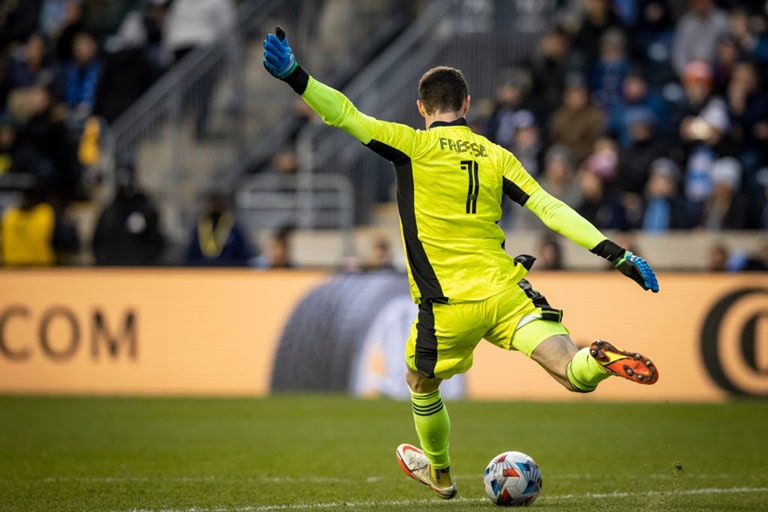
NYCFC goalkeeper Matt Freese has started all 30 of his club’s matches this season in MLS and has a 73% save rate, stopping 102 of the 140 shots he’s faced. This is his second season with NYCFC after beginning his career with the Philadelphia Union. A native of Wayne, Pennsylvania, Freese signed a homegrown contract with the Union and, after two seasons at Harvard, made his MLS debut in 2019.
Freese, now 26, had an opportunity to begin playing pro soccer after graduating from the Episcopal Academy in suburban Philadelphia but elected to attend Harvard first. Though he left early, Freese completed his degree remotely, balancing Ivy League studies with professional soccer, which is something he actually considers an advantage for his athletic career. A curious mind and avid follower of sports business — and a reader of Sports Business Journal, he revealed — Freese wrote independent research projects on MLS franchise valuations and advanced analytics for expected goals.
On opting for college, not pro soccer, right after high school…
The first and most obvious [reason] is just the fact that I wanted to honor my parents’ wishes to go to college. When I got into Harvard, they pushed even harder. I was really fortunate and lucky for that to happen. My dad had gone there, and he really wanted me to make sure I got a degree. The really awesome thing about Harvard, or most colleges at this point, is if you go for a semester or two, you pretty much lock in the ability to go back and finish your degree at some point.
On a more personal level, I don’t know if I was ready to be an adult and live on my own outside of the college setting when I was 17, 18, signing a homegrown contract. Also, goalkeepers usually develop a little bit later, so there wasn’t as much of a rush, if that makes sense. Seeing now the way my career has unfolded and changed, maybe I’d make a different decision and start it earlier, rather than waiting that year.
Ira L Black – Corbis/Getty Images
On balancing school and sports…
I would [attribute] most of my on-field soccer career development to my off-field academic efforts. This was at a time when I was 19, when structure and schedule is so important for a 19, 20-year-old who’s now a professional athlete making good money and getting pulled to do things that that most 19, 20-year-olds are getting pulled to do. Having the structure, having a few hours of work every night after training, making sure I had to be on a good sleep schedule, it all really allowed me to focus on soccer and not get distracted with other things. It really grounds you. It humbles you.
The other thing that I really liked about it was that it gave me a de-stressor off the field. As a 19, 20, 21-year-old, you’re now competing for your career every single day that you’re playing, and it becomes stressful, and as a young guy, you don’t really know how to handle that. So when I got home, and I would be doing work, reading a textbook, doing whatever — my mind was able to get away from soccer, which is super important.
And then the third thing that’s also quite interesting is that there’s a lot of research out there that really supports cognitive development, especially at that age, and your ability to solve problems, lead and organize and be a team leader. A lot of that is correlated with academic and intellectual stimulation. As that was continuing to grow, as my brain was continuing to be pushed and grow, it allowed me to, in my opinion, learn more quickly on the field. Learning quickly, learning on the fly, is completely necessary for a professional athlete.
On writing an undergrad thesis on MLS franchise valuations…
It was my last semester. I had finished all my core requirements, and I was doing everything remotely and then flew up to take exams in the offseason. And so I was able to do two independent research projects as my last credits. The title of one was “The theoretical analysis of the rise of MLS valuations.” Since 2010, they just completely skyrocketed, and the whole point of what I was discussing is that demand was going up. The supply was very limited. It was very constrained for several reasons. The primary one is expansion is limited within the MLS.
Probably the bigger focus was just talking about how demand, from an ownership perspective as well as from a fan engagement perspective, is going up. The academy situation has really changed everything. People want to go see kids or teenagers from their hometown that they knew growing up. They want to go see them play. They want to see them succeed. The US team is obviously getting more and more attention year over year, and that impacts the way fans look at MLS games.
People want to buy into these teams. They’re becoming more and more profitable. Revenues are going up. Operating expenses are also going up, and salaries continue to increase, and transfer fees just always are rising. But in general, they’re just becoming more profitable and easier to operate.
On writing MLS papers while a player for the Union…
I was in my third year. I’d always go to this one coffee shop in Philadelphia and work on that paper. The other independent research project I should probably mention because it’s somewhat related was, I created an expected goals model using data from MLS over the last five, six years, which was also really cool.
Goalkeeper is a weird position [for analytics] because essentially the only one that matters is the post-shot expected goals model and how that relates to the goals conceded. Goalies are a little bit of an anomaly, but in general, yeah, I love looking at data. I love talking to our data analytics team in the organization about these things. I just think it’s really interesting. It can shape a strategy of a team to a degree.
It can’t completely take over what the philosophy of the team is, but it can point you in the right directions or show you what type of cross has the highest percentage of expected goal coming from the end result of, leading you to probably want to look at getting into the cutback scenario more than these long, high crosses. We’re a relatively younger team. Our height and our strength isn’t as much so fighting against these big center backs might not be as successful as getting into that cutback zone, which is something we’ve worked on a lot. This is not me driving that, by the way. [laughs] This is the coach, the data analytics team making those decisions, obviously.

Jeff Dean/Getty Images
On not looking too deeply into his training data…
I am into that, but I just trust our performance director and the medical performance side of things on the team. They handle all that, and they make sure that my dive count is not too high, my explosive [actions] count is not too high. I am hitting the numbers that they want, and I just trust them to do that. They’re very good at their job.
On his interest in sports business when he retires…
I do think about it. The clear priority right now is playing, and I want to play for a very long time and have a good career and get my name into the that top tier of MLS, goalkeepers. But at the same time, I also take a serious interest in what my post-playing career will be. I believe one avenue would be to stay in the sports realm, whether that’s on a business operating side, being on the finance or marketing side of an organization, or the sporting side —GM, Assistant GM, sporting director, that type of thing — is really fascinating as well.
And then there’s also the investing side. I have a background in investing as well. I took several classes and audited some MBA classes at Wharton when I was in Philly. So I’m comfortable and really enjoy that type of stuff. A lot of it also depends on how my playing career goes.
On his game prep…
As a goalkeeper, the routine really is everything. And I’ve become somewhat psychotic about my routine before every game. There’s a lot of research that has indicated that, for an athletic event, your sleep two days prior is actually more important than the sleep one night prior. So my routine really starts two days before the game. I try to get as much sleep, like 9, 10, hours two nights before, and then I usually do a series of meditations leading up to the game. I do the same type of film, just very serious about my routine.
This article was brought to you by SBJ Tech, a Leaders Group company. As a Leaders Performance Institute member, you are able to enjoy exclusive access to SBJ Tech content in the field of athletic performance.
Data Analysts Julia Wells of the UKSI and Mat Pearson of Wolverhampton Wanderers deliver a series of practical tips to help address one of sport’s notorious blind spots.
An article brought to you in collaboration with

That is according to a straw poll of attendees at a recent Virtual Roundtable hosted by the British Association of Sport & Exercise Sciences [BASES] and the Leaders Performance Institute.
The perception is worse when it comes to analysis and recruitment, with over 60 per cent of attendees suggesting that their analytics and recruitment teams do not work closely at all.
Yet 63 per cent also believe that improved data and computer literacy across their staffs would directly impact performance.
The sense that there is room for improvement gave the session its title: ‘Mobilising Performance Analysis in Practice’. It was the second in our three-part collaboration with BASES called Advances in Performance Analysis and centred around two case studies.
The first was delivered by Julia Wells, the Head of Performance Analysis at the UK Sports Institute [UKSI], and the second by Mat Pearson, the Head of Performance Insights & Data Strategy at English Premier League side Wolverhampton Wanderers.
Five areas where data literacy can improve performance
Before Wells and Pearson delivered their insights, attendees were set a further task: ‘as a consequence of improving data or computer literacy, describe what you would see as being the most significant impact on performance’.
The responses were varied but five stood out:
How the UKSI are mobilising performance analysis work-ons in meeting common challenges in data analysis
The first session highlighted the four biggest challenges facing people who use data analysis in sport. To kick off her presentation in the second, Wells explained how the UKSI is trying to tackle those four challenges (plus another).
Challenge 1: integration
Go back to basics. That’s the approach of the UKSI, who have placed an emphasis skill development, support structures and a clear data strategy.
It goes like this: the relevant staff members are upskilled in areas such as collecting the right data, using the correct formats in the right places before the interrogation and analysis even begins. This is then supported by a clear data strategy geared towards performance planning. For example, roles such as the data & insight lead and the performance data lead are embedded within the organisation to better help those leading programmes with the direction and the integration of their data. Thus, the strategy can come to the fore and everyone can better understand what needs collating and why within the team.
Challenge 2: data collation
Wells described how easy it can be to stay on the “hamster wheel” of collecting data without taking the time to critically reflect and pause. Can you, for example, call upon efficient processes for collecting data and wade through the myriad datasets potentially available? She recommended asking “quality questions”: why are we creating the data, what is its purpose, what decisions is it informing, particularly in the coaching process? Teams should do this periodically and continue to plan, do and review. Wells also encouraged engaging in conversations with key leaders in the environment to discuss what to start, continue and stop. It’s important to intentionally carve out those opportunities as part of your performance planning.
Challenge 3: communicating data insights
Wells stressed the critical nature of human engagement in the process and regards communication is a highly technical skill, despite the views of those who might see it as a ‘soft’ skill.
She shared that the different performance departments within the UKSI work closely with the psychology team to help elevate understanding of self and others. Wells said, if we can better understand the people we work with, it will support how people can get the best out of each other. As part of this process, they’ve tapped into better understanding one another’s preferences in order to be more impactful in how they support each other.
Challenge 4: buy-in
It is not uncommon for senior stakeholders to not perceive the value of the work being done. This makes it incumbent on analysts to critically assess their impact and share the meaningfulness of their work. “It’s our job, and it’s our role to be critically analysing why and presenting that back,” as Wells said.
On that note, alignment to the sport’s strategy helps to provide a clearer connection. If this alignment and connection isn’t there, you’ll naturally get disconnection so it will be more challenging to get the buy-in.
In addition, relationships are just as critical when generating buy-in. Wells advocated inviting leaders and key stakeholders into your world and shadowing them. When they immerse themselves in better understanding the process you’ll find that it can quickly lead to them becoming a voice for you in wider conversations.
Challenge 5: data illiteracy
Too often, practitioners can suffer in silence when looking for solutions. In the latest Olympic and Paralympic cycles, Wells and her colleagues are seeking to increase data literacy across the board. They have introduced an internal online data community that provides access to resources, promotes connection, and leads to the sharing of good practice.
Wells’ team also put together a ‘Data Leadership Programme’ which is focused on pulling together the data leaders in the various sports with whom the UKSI work to look at opportunities, challenges and future direction. Courses, with titles including ‘Data Camp’, ‘Project Automate’ and ‘Code School’, were created to improve skills and processes for coaches and practitioners to help them be more efficient. In her mind, this has been crucial to enable people to be upskilled; and all support staff should be able to ask a good question and have the data skills to answer them.
How data analysis is supporting coaching and recruitment at Wolves
Pearson explained that he and his colleagues at Wolves are trying to align the club to ensure there is consistent evidence available and better identification of the trends impacting decision making from a data point of view.
He focused on two key areas: coaching and recruitment.
In the environment, the analysts are part of the multidisciplinary team. They are very much now voices in the room and, with it being a specialised discipline, all analysts must have an impact on decision making.
To that end, Pearson’s team have moved away from leaving the coaches to find the solutions themselves. Instead, analysts are encouraged to go and find solutions, present them to the coach, and then have good conversations to better find the optimal outcome.
Part of the challenge we can face, said Pearson, in particular with performance analysis at first-team level in professional football, is that many environments can be quite coach-led, which is in keeping with the nature of short tenures. The coaches will lean into their viewpoint as a way to exert their control. Therefore, education is important and, in particular, how you communicate with them to ensure the message lands. That said, Pearson observed that coaches in modern day football are more attuned to data and performance analysis and are much more data literate and comfortable with technology.
A key learning when integrating performance analysis and data work with coaching is to make insights as contextual as possible. If you provide insights to a coach that are out of context, you’ll lose them straight away.
Pearson told attendees that some of the biggest strides in performance analysis and the wider data team have been in the field of game modelling, recruitment and selection decisions, with the obvious caveat that subjective input is still valued immensely.
The team have worked to create objective measures against the game model. In better understanding this, it has provided an additional layer of information related to individual player requirements for the game model. These insights are helping to inform both selection for matchday but also the recruitment of new talent. When thinking about the recruitment process in particular, Pearson said this process has helped to educate scouts and other recruitment personnel in the attributes for which they should be looking.
Visuals have played a key role in this process too, particularly in being able to show what it looks like to play in this particular style that the coach or manager wants. They’ve worked to make the playing style more objective.