Natasha Patel of US Soccer and Simon Wilson of Stockport County discuss the influence of performance analysis on organisational strategy.
An article brought to you in collaboration with

That is according to a straw poll of attendees at a recent Virtual Roundtable hosted by the British Association of Sport & Exercise Sciences [BASES] and the Leaders Performance Institute.
We have collaborated with BASES on a three-part series called Advances in Performance Analysis and kicked things off with a first session, titled ‘The Influence of Performance Analysis on Organisational Strategy’.
Leading the conversation were Natasha Patel, the Director of Sporting Analytics at US Soccer, and Simon Wilson, the Director of Football at League 1 side Stockport County.
They began by leading a discussion of the biggest challenges facing people who use data analysis in sport. There were four that stood out:
Patel and Wilson, who began their careers in sport as performance analysts, shared a series of considerations rooted in clear principles, effective communication and strategic benchmarking when leveraging performance analysis to drive organisational success.
Establish key principles
Both Patel and Wilson continually referred to the importance of key principles. These, as Wilson explained, must outline how you are going to work and how data and analysis inform this; this allows for more creativity (and alignment) when you move through the layers. Patel, who worked at Premier League club Southampton across two spells, explained that from the beginning of her first spell, between 2011 and 2019, there was immediate buy-in from the technical director, who valued data and video analysis hugely.
Have a clear game model
A game model – a common requisite in football as well as other sports – can inform everything that follows, including data analysis. Patel said she better understood the coaches’ needs and how they want analysis delivered when there was a game model to follow. She and her colleagues were able to gain the buy-in of coaches when being intentional in spending time with them. This allowed the analyst to shine when they were able to take information from the coaches themselves and the athletes, turning it into digestible data and visuals that could help everyone. Similarly, Wilson explained how Stockport’s game model has informed their squad building and helped to generate a well-filtered target list of players who may improve the team.
Consider the end user
As Patel said, it is important to consider the end user and what performance analysis looks like to them. Once you have identified the end users, you can then work out how to get the best process for them and, subsequently, enable the trickling of information to help influence the end user, whether that be to help support or challenge their way of thinking. She referred to this as ‘stakeholder mapping’. In her second spell at Southampton, between 2022 and June 2024, Patel came to understand that each stakeholder had a unique information threshold and that more education could have been provided in-season for different stakeholders. This was a good reminder to Southampton that as performance analysis teams and departments grow and mature, so does the quantity and depth of insights.
Know the journey
Wilson, who has been with Stockport since 2020, shared that at the beginning of their current seven-year plan, they adopted a version of the Elo Rating System (derived from the world of chess), with support from a third party, to showcase the quality differences between clubs, leagues and countries. Wilson explained that the system provided objective insights into how much better the team needed to be and how they needed to grow to progress through the leagues. Engaging in this benchmarking exercise then informed the business case of how much to invest in players, staff, facilities and other infrastructure.
Patel spoke more specifically about the influence of performance analysis on player and athlete auditing and the amount of impact it has had in this space. When primarily operating in an academy environment, there are also decisions to be made around retaining and transitioning players. These metrics formed a core part of how decisions were made at Southampton, whether they were to challenge opinions and assumptions or to simply create more productive conversations. As a matter of course, Patel’s department collected athlete maturation data, leveraged the Premier League’s game-wide injury data and, finally, garnered insights from character profiling.
BreakAway Data’s new app aggregates health information from clubs, national teams and private consultants.
A Data & Innovation article brought to you by

The new product, BreakAway Pro, aggregates health information from all practitioners — all clubs, national teams, private consultants — through an athlete’s career where it can be displayed and compared against game stats, tracking data and training workload. It is available for all interested leagues and unions, with a custom-build for a first, unnamed partner almost complete.
Since launch, BreakAway has secured deals with the NFLPA, NWSLPA, WNBPA and Athletes Unlimited, among others. Its founders, Dave Anderson and Steve Gera, regularly heard from agents, athletes, investors and other stakeholders that adding EMR capabilities would be a helpful addition to the product.
“We didn’t know we needed to move this mountain in order to give all athletes access to their data, but this was the key piece and the key thing that was missing in sports that we’ve now got,” Anderson said, adding that the topline benefit of this fingertip retrieval is ensuring that what “costs them time, money and effort are now guaranteed and done quickly and swiftly.”
While the data infrastructure was largely in place, meeting the standards for EMR access required significant outlay from BreakAway — a 2023 SBJ 10 Most Innovative Sports Tech company honoree — to add higher levels of insurance, meet HIPAA compliance and build maximum digital security, including a revamp of its AWS storage. Anderson estimated that this project consumed about 75% of the company’s time, money and effort for most of the past year.
Athletes register using multi-factor authentication that is verified by government ID, and all records are stored in a secure server, with none of the information stored locally on a mobile device. Users can manage settings over who has access to what information, toggling permissions on and off as they change teams or seek additional opinions.
“Players have been advocating for better access to their data for a long time, and BreakAway was the first company to build a product specifically tailored for players,” Meghann Burke, NWSLPA Executive Director, wrote to SBJ. “They have set a new standard for what, how, and when information should be delivered. It’s no surprise that they continue to innovate in the digital space, providing players with functional and accessible data solutions.”
Anderson, who had a six-year career as an NFL wide receiver, recounted his own experience attending NFLPA-backed health and wellness testing at the Cleveland Clinic. When he returned to the same facility three years later for an additional checkup, the computer systems had changed, and the doctor couldn’t easily see his past records. Anderson had to bring his own paper copies, making him think, “There’s got to be a better way to do this.”
While that’s an acute pain point in elite sports, it’s also an issue for everyday people who change medical practices.
“We’re the first company that is daring enough to take it on. We built this for players, and let’s see how it works because this really doesn’t even exist in the normal world,” Anderson said. “It’s a huge build, and something hopefully that resonates well beyond just sports.”
Intelligence within the app helps provide context and comparisons to normative datasets. Visual tagging of joints and muscles is one of several ways to filter the information a user is searching for. BreakAway Pro also is agnostic to other EMR providers and supports all types of medical imaging as well.
“We heard from enough leagues and we heard from enough people that we were like, ‘All right, let’s just go all in. Let’s bet the farm on our company on this,’” Anderson said. “We claim to be the athlete data company and to have the app where they put all their information, and if this is the most important piece of information that they want, what are we doing here? It is the core piece that ties everything together.”
This article was brought to you by SBJ Tech, a Leaders Group company. As a Leaders Performance Institute member, you are able to enjoy exclusive access to SBJ Tech content in the field of athletic performance.
Gemini has partnered with professional and college sport teams across the NFL, NCAA, European football and beyond.
A Data & Innovation article brought to you by
QPR soon turned its season around, however, after a change in leadership. The club won 10 times and added five draws over its final 19 matches to secure its spot in the second tier of English football another season. Most estimates suggest that relegation from the Championship to League One is a financial hit of more than $10 million (£7.9 million).
Right around the time of that upset over Leicester, QPR onboarded a new AI-powered predictive modeling tool, Gemini Sports Analytics, to make optimal use of the massive datasets they’ve compiled. Gemini is a “force multiplier,” CEO Jake Schuster has said, by simplifying the process of building machine learning algorithms catered to each club’s specific needs.
“What I really liked about Gemini was they didn’t have an ego in trying to solve every problem,” QPR Director of Performance Ben Williams said. “They created a tool where you can solve your own problems.”
Around the time of QPR’s on-field nadir, CEO Lee Hoos retired from that role, while remaining as chairman, and hired Christian Nourry as the new chief executive. Nourry was 26 and a managing partner at Retexo Intelligence, a data analytics and advisory business that worked with Real Madrid CF, AS Roma and the Mexican national team. (He became the youngest CEO in English soccer, with one European executive describing Nourry as “the Lionel Messi of the football business world,” according to the Independent.)
Nourry wanted to implement market-leading solutions to upgrade the club’s tech stack. QPR asked itself, according to Williams, “Are we able to interrogate that data optimally, to forge outcomes that are positive for the long-term future of the football club? Our answer to that was ‘no.’” That prompted the search that led the club to Gemini.
The very thesis of Gemini is to empower analysts, coaches or “anyone with a dataset,” as Williams put it, to take action with data. He noted that it can be used for everything from tactical match plans to traffic probabilities on bus trips to road matches.
Founded by Schuster, a longtime sport scientist, Gemini leverages the tech infrastructure of cloud and AI partners Snowflake, DataRobot and Databricks with data sources such as StatsBomb, SportRadar, Genius Sports, Sports Info Solutions, SkillCorner and Infinite Athlete.
As an example of what’s possible, Shuster explained that Gemini users can apply clustering algorithms to match stats and tracking data to create passing trees to identify how opponents like to create scoring chances of their own or concede them to others.
“The early lift was certainly centered around pre-match and post-match reports,” Schuster said. “So, opposition analysis — how do we approach this game? And then, post-match, what happened and what are the implications for future events? A big part of the early work with them was helping them automate those reports. And then the next step was approaching the summer transfer window.”
But it also remains an area of exploration, as QPR onboards more staff members over time.
“The power comes from our curiosity,” Williams said. “We’re in a phase of play and learn and discovery.”
Other Gemini clients include the NFL’s Indianapolis Colts, the SEC’s Texas A&M and Italian soccer club Parma Calcio, which just claimed a Serie B title to earn promotion back to Serie A. The Raleigh, North Carolina-based company also raised two investment rounds north of $3 million in the past year. There are now 27 sports franchise owners either directly invested in Gemini or through recent round-leading investor Will Ventures. QPR’s owners individually own minority stakes in two MLS clubs (LAFC and FC Cincinnati) as well as MLB’s Cincinnati Reds.
That financial backing has led to Gemini’s first customer success hire, former Arizona Diamondbacks Director of Operations Sam Eaton, and a budget allocation to hire a CTO, a role Schuster is actively recruiting. The company is also in the testing phase of some new generative AI features it hopes to roll out soon.
“The whole idea behind going with this tool was we can be really broad in our thought process of what we think helps our performance,” Williams said, “rather than be penned in by somebody else’s thought process of what is important to performance because they’ve created a tool that solves a problem that they once had.”
This article was brought to you by SBJ Tech, a Leaders Group company. As a Leaders Performance Institute member, you are able to enjoy exclusive access to SBJ Tech content in the field of athletic performance.
In time, players on the ATP Tour will benefit from benchmarking data and the establishment of definitive norms in tennis high performance.
Main Image: the tests, which highlight the demands of being a professional tennis player, can be used to showcase the attributes of the ATP Tour’s next generation. (ATP Tour)
A Data & Innovation article brought to you by
Before the tournament began, one of the courts at the King Abdullah Sports City was strewn with gadgetry: force plates, cameras, flashing lights. The ATP had organized the first athletic combine in Tour history, called Basecamp, putting the young men through a series of NFL Combine-style drills such as the 10m sprint, vertical jump and a pair of agility tests.
For the actual tennis matches, the players were offered tracking devices — GPS trackers with conjoined heart rate monitors — with two wearing them and five others indicating they were interested to do so in the future after having more time to acclimate. In combination with the existing player and ball tracking from Hawk-Eye, with Kinexon’s data analysis platform, the ATP Tour produced a Physicality Index to measure the athletes’ exertion and effort.
All of the data collected was shared with the players and some of it was published in web stories and social media to tout their athleticism. BreakAway Data’s app was used to grant the athletes easy access to their data from matches, practice and Basecamp while ai.io’s mobile tech unit, aiLabs, provided the testing equipment.
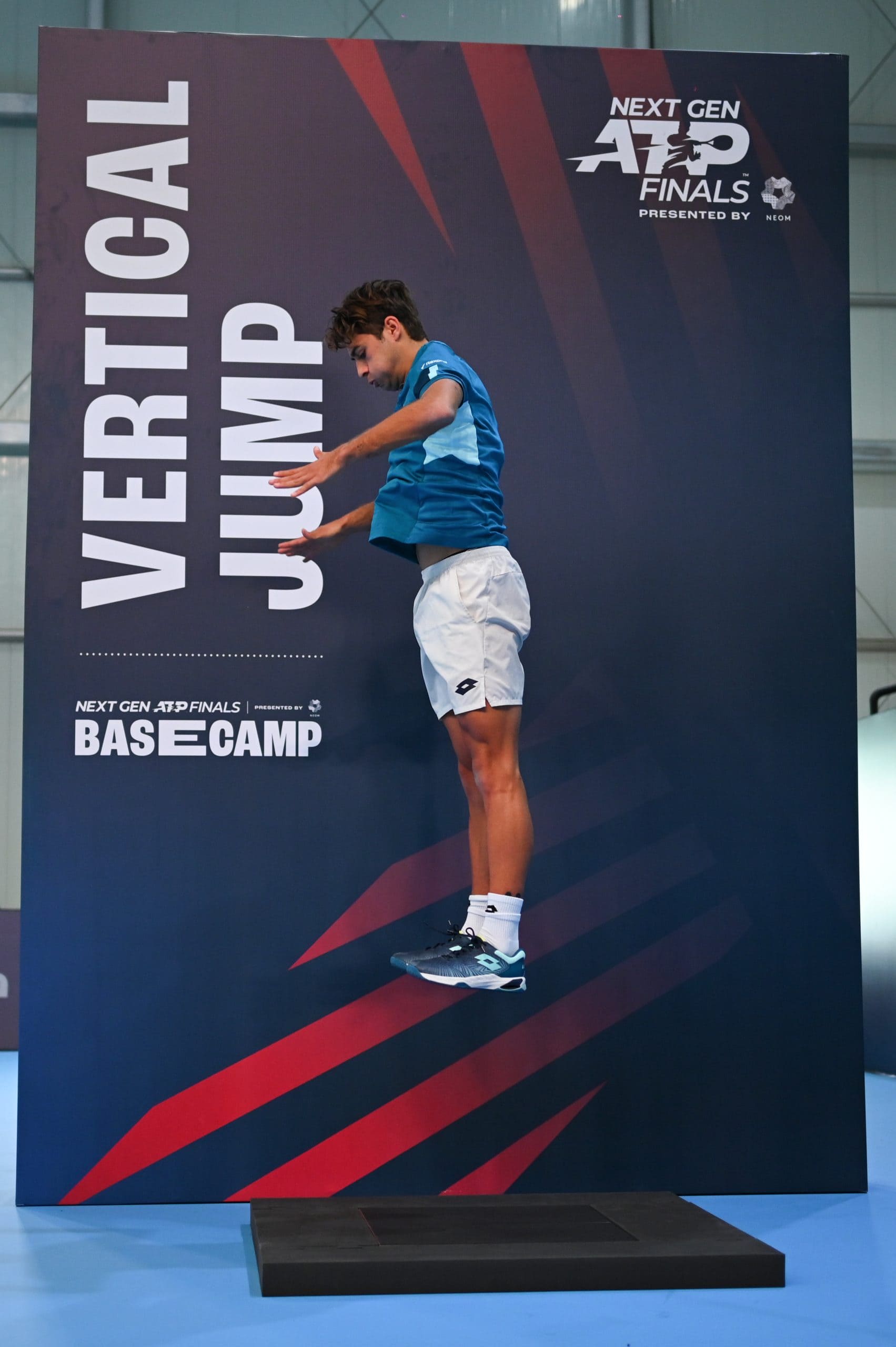
One of the motivations for the adoption of the new tech and data from Basecamp is to support athlete wellness guidelines, such as informing mandatory rest periods between matches. (ATP Tour)
“We really want you to understand yourself a little bit better off the court and tell that story to the fans as well because I think tennis players are great athletes, but we’ve never really had anything to measure that,” said James Marsalek, ATP Tour Senior Manager for Strategic Projects & Event Operations. “All these different metrics will then help us tell a slightly different narrative of, ‘Actually, you know what, they are [great athletes] because they compare X, Y and Z on the scales with basketball, football, whatever it might be.’”
The activations around the Next Gen Final were the most acute example of a broader strategy from the ATP Tour. In 2023, Tennis Data Innovations, which is the joint venture of the ATP and ATP Media, mandated that every tournament court have player and ball tracking. In March, Marsalek said the Tour started offering raw tracking data to all players for free. In September, the ATP and TDI created Tennis IQ, an analytics platform accessible to all ATP Tour players.
Marsalek said the goal is to have video embedded and synced to the data by 2025, with integration and visualization of wearable and other biometric data on the road map as well.
“It’s trying to tell this full story where players have got this one-stop shop that has access to everything,” he said, adding, “We tried to level the playing field and provide access to all our members.”
Though the ITF, the international governing body for the sport, began permitting wearable technology in matches back in 2019, the ATP didn’t sanction it until its most recent board meeting in November. It remains contingent on the Tour platform supporting it, which Marsalek estimated should happen in the first quarter of 2024.
“The ATP have got a hugely ambitious and fantastic opportunity to make data not just relevant but really progressive for the sport,” said BreakAway Data Head of International Business Ben Smith, who formerly led research and innovation at Chelsea FC. “Tennis, with the ATP leading it, have got an opportunity to help the sport progress over the next two, three years in a way that is, I think, hugely exciting and will advance both the physicality and the quality of the sport in a way that fans should be really excited about.”
In a video summary of Next Gen Basecamp produced by the ATP Tour, Arthur Fils — who ranked first in every category — could be seen celebrating his wins, a testament to the competitive spirit even with something brand news.
Just as often, the players asked, “Is that good?” Officials from the ATP Tour, ai.io and BreakAway Data were able to share some benchmarks, but more definitive norms will be established as this combine testing grows. Flavio Cobolli, who finished top-three in three of the four tests, called it a “good experience” and was quoted saying, “I want [Carlos] Alcaraz to do this for sure.”
Alcaraz is perhaps the premier athlete on the men’s Tour right now, whose 2022 US Open title run scored highly on the USTA’s Physicality Index, and would surely be a devastating combine competitor. But while the NFL Combine and team pro days are a rite of passage for all top prospects to improve their draft standing, that incentive doesn’t exist in tennis. To induce the elite players to participate, attaching prize money or other reward is likely necessary. But the accompanying videos and data may well be a new sponsorable asset.
“We ought to be a little bit creative,” Marsalek said. “We don’t have the same sense of jeopardy as the NFL does, where there’s a lot on the line, so we need to make sure that our athletes enjoy doing it. If they don’t, there’s no content.”
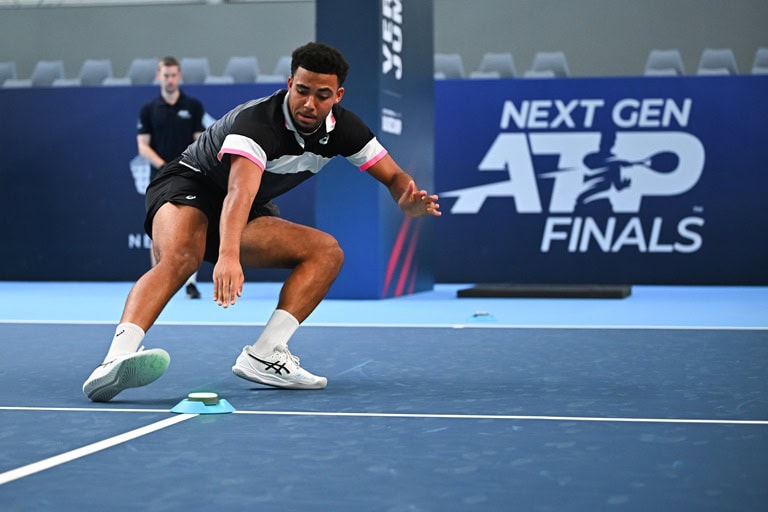
All of the data collected from Basecamp was shared with the players and some of it was published in web stories and social media to tout their athleticism. (ATP Tour)
The other motivation for the adoption of the new tech and data is to support athlete wellness guidelines, such as informing mandatory rest periods between matches. In the ATP’s 48-week season, most players average about 25 tournaments and, with Masters 1000 events all expanding to two weeks, that increases the amount of travel time.
Marsalek emphasized that data will not become the sole determining factor in decisions, but it is intended to provide a balance with an athlete’s feel in a skill-based sport. The goal is to encourage the use of data but have a centralized process to govern it — which should aid all stakeholders in tennis, just as was evident in Basecamp.
“It’s genuine high performance. Yes, it’s really enjoyable and competitive, and so the athletes have a good engaging experience. But there’s also valuable insight that those practitioner teams will take and move into the training environment,” Smith said, before adding about the development of data-driven narratives for fans. “That’s just really good, interesting engagement that, I think, opens up tennis to a slightly wider market.”
This article was brought to you by SBJ Tech, a Leaders Group company. As a Leaders Performance Institute member, you are able to enjoy exclusive access to SBJ Tech content in the field of athletic performance.
In the latest edition of The People Behind the Tech Podcast, Peak AI’s Gary McCoy ponders the impact of artificial intelligence on coaching and performance.
A Data & Innovation podcast brought to you in collaboration with
Gary McCoy is the CEO of Peak AI, which has been shortlisted in Sports Business Journals’ list of the 10 Most Innovative Sports Tech Companies of 2023.
Peak AI uses psycholinguistics to enhance performance and Gary has a firm view on that coach’s comment.
“If you don’t know what they do, go and lead them because they probably don’t know what they’re doing either,” he tells Joe and John on the latest edition of The People Behind the Tech podcast.
“Artificial intelligence and data, as a general staple in sports, needs guidance,” he continues, “it needs transactional guidance to evolve the athlete.”
Gary spoke at length about the need for coaches to fully engage with AI and also dipped into a range of areas, including:
Listen above and subscribe today on iTunes, Spotify, Stitcher and Overcast, or your chosen podcast platform.
The former cornerback chats to SBJ Tech about his Coach Performance Assessment System.
A Data & Innovation article brought to you by
You can’t have a discussion about sports technology today without including athletes in that conversation. Their partnerships, investments and endorsements help fuel the space – they have emerged as major stakeholders in the sports tech ecosystem. The Athlete’s Voice series highlights the athletes leading the way and the projects and products they’re putting their influence behind.
* * * * *
James Hasty was a premier bump-and-run cornerback in the NFL for 14 seasons, mostly split between the New York Jets and Kansas City Chiefs. He received second-team All-Pro honors in 1997 and was named to Pro Bowls that year and again in 1999. A third-round pick out of Washington State, Hasty had 45 career interceptions, 24 fumble recoveries and 10 sacks before retiring after playing one game for the Oakland Raiders in 2001.
Hasty, 58, is now the Founder and Chairman of Eneje’ Consulting Firm that uses data and proprietary algorithms to champion the principles of equity, diversity, and inclusion among NFL coaches. The goal is to evaluate all candidates based on objective information — spurred by an insight from when Hasty coached at the Washington-based Bellevue High — and philosophical compatibility with the owners’ preferences. The hope is to surface more deserving candidates from all backgrounds to improve upon the league’s Rooney Rule.
On the origin of Eneje’…
Eneje’ as an African derivative word, essentially, means willingness to help your fellow man. The goal was to create a tool that allowed folks to grade a coach and his performance.
On what his experience coaching taught him…
I had coached high school football, and we were very competitive. In fact, every year that I coached at Bellevue High School as a defensive coordinator, we won the state championship. In fact, we beat De LaSalle out of California, and they had a 151-game winning streak — for nine years they hadn’t lost. What I struggled to show the kids is that the coach on the sideline didn’t have a game plan in his hand. What that showed me is that he calls plays off the top of his head, based off of what makes him comfortable, right. What I used was data analytics, to teach the kids the percentages of what they want to do in certain situations, and based on those percentages, we were going to set our defense up to stop them.
I realized, as a D-coordinator, I’m doing a lot of the work. I’m spending eight, nine hours a day breaking down film before I go to practice, and so what it said to me is, there’s got to be a way to create a system where we recognize people’s contributions to any organization, not just in sport, but in any organization everybody has a certain level of contribution to that organization. Everyone contributes towards a win, but they’re not all valued the same.
On gaining support for his idea…
That was the genesis of how I created this algorithm. Then I reached out to a friend of mine, Ronnie Lott, and I said, ‘Ronnie, I got this algorithm that I created, and it’s based off of these coaches and their contributions. So what do you think?’ And he’s like, ‘Man, that’s a great idea. I think you should go forward with it.’ I then went and met some folks that he suggested I speak to, and they encouraged me to continue to go.
I reached out to a friend of mine, his name was Dr. Steven Cureton. And Dr. Cureton and I go back to undergrad. He’s the head of the department now at the University of North Carolina-Greensboro, their sociology department. And I said, ‘Hey, I need to sign you to a contract, and I need you to come on board. I need you to go ahead and do the research on the hiring practices of the National Football League over the last 102 years,’ at that time, and he said, ‘I’ll do it.’ With the help of people like John Wooten who played with Jim Brown back in the day with the Cleveland Browns. Woot assisted us with meeting with different people to do the research into what they consider important elements of hiring a head coach or a general manager.
On developing Eneje’s interview protocols…
We talked to current and former coaches, we talked to lawyers, we talked to journalists, we talked to athletic directors, you name it. From that study came the creation of the interview tool that we have. Because some people will say, ‘The game is not just about analytics.’ This interview tool was critical because we were hearing about the whole sham interview deal that was ongoing within the National Football League, and so this tool essentially would work very simply.
Let’s say you’re the owner. We come in, and we say, ‘What are you looking for in your next head coach?’ And you say, ‘Oh, I’m looking for these variables: I’m looking for leadership, I’m looking for understanding of the salary cap, I need you to be a play caller, I need you to be a guy in the locker room that is great with the players.’ You’ve got these certain variables, as an owner, that you want your next head coach to have, whatever that might be.
We would take that same interview tool, and we would document all the stuff that you said you’re looking for. And now we would go and find a candidate that you had recommended to us, and we would interview those candidates separate of you and ask them the same questions. The interview tool would then record and transcribe their answers and grade your answers as it relates to your answers to see how closely they’re aligned to one another. In the heat of the moment, you want somebody that thinks like you. You want somebody that has a similar belief system that you have.
On the company’s qualifications algorithm…
We’ve got a tool that grades your background — high school, college, pro — and who you’ve developed and statistics during that particular year. I reached out to Dr. Filip Saidak, a professor of mathematics at the same school as Dr. Cureton, and Dr. Saidak said, ‘I can show you how you can add other elements to the algorithm.’
As an owner, let’s say you may want a guy that has a defensive background or you may want a guy that has a quarterback background, or whatever those elements may be to you, personnel-wise. You may be strong in some areas, but you may be weak in others. And so you want a head coach to offset those weaknesses. Whatever those variables are important to you, we can add those elements to the algorithm to where those coaches are graded accordingly. And you will find which of those folks, based on the quantitative formula, have the higher grade.
It’s not based on race, it’s all based on performance. And you’ve got the interview tool that looks to match your psychological compatibility with the owner as a coach. And so now you’ve essentially have two options as far as how to identify candidate.
On building an objective coaching network…
When it comes to the CPAS, which is the Coaching Performance Assessment System, we believe there should be a database, whereby we’re able to keep up with all the coaches in our database. We’re able to truly develop a pipeline where the NFL can always have access to knowing where and who and what coaches are available so that there’s never an issue where we’re talking about why are we continually hiring the same people? Because now there’s a there’s a place where you can go and find these coaches, and they have outstanding careers. And you’re not hearing about it through the media. You’re not hearing about it through a network of cliques of different former general managers, or former head coaches or whatever.
On the development timeline for the full platform…
CPAS, the database that we have developed, we put in a few thousand coaches ourselves right now. We believe that this database needs to be available for folks to join, and we want to make this available in the spring. So right now, I’m working with Microsoft to make it available in the marketplace so you can go and download the app. It’s available, but we don’t want it to go live yet — let’s just put it that way. You can go on Google Play, you can go into Apple, and you can find CPAS in there. Because of what we also have to get access to joining the database. But within that it’s also a tool that we call Huddle Up.
Huddle Up is basically [similar to] these podcast platforms like Clubhouse. There are these virtual rooms where people can go in, based on that particular topic, and they can talk about whatever the subject matter is. And in this particular case, we’ve created Huddle Up for coaches to go into these various rooms and talk on a podcast-like platform about their particular sport, any practice or game planning or anything relating to that particular sport. We want to use Huddle Up as a platform for coaches to engage and learn from one another, kind of like a peer-to-peer learning network.
On his vision for CPAS adoption…
Ideally, we’d like to make this a system for the league to use, not just for individual teams. We’d like to see a baseline approach where these owners have a place to start. What we do is we go back to the owner, and we say, ‘Here’s a quantitative grade. Here’s your qualitative compatibility score. Pick from these guys which one you want. It’s your call, obviously.’ We’d give them the information to where now they can go forward and have a better idea who may be the best fit for their organization. But our job is certainly not to tell them who to hire. We’re just providing information on these candidates that we believe in the long run [will succeed], based on the data, based on the research.
The five-time grand slam champion on the evolution of technology in tennis both on and off the court.
A Data & Innovation article brought to you by
You can’t have a discussion about sports technology today without including athletes in that conversation. Their partnerships, investments and endorsements help fuel the space – they have emerged as major stakeholders in the sports tech ecosystem. The Athlete’s Voice series highlights the athletes leading the way and the projects and products they’re putting their influence behind.
* * * * *
Sharapova, now 36, retired from tennis in February 2020 and became a mom in 2022. She also has been active in business, starting her own confectionary brand, Sugarpova, as well as reportedly investing in the UFC, Therabody, Tonal and more. Sharapova recently made an appearance at the US Open on behalf of IBM to discuss its latest innovations and held a small roundtable with a small group of reporters.
On evolution of technology and tactical analysis during her career…
Huge, and also for the teams that are surrounding the player. So imagine you have a coach that looks at the draw, he sees you’re playing against someone and maybe you’ve never faced them before, but he immediately knows how your opponent has performed on the surface against other players. So that analysis is done so much quicker than him having to go out and find videos. ‘What surface did that player play on? OK, well, maybe that doesn’t apply to my player’s match at the US Open.’
Providing tools for your team is also [important]. As a player, you go out there and you play on instinct, and you just become a competitor. When it’s 6-all in the third set, you’re most likely not thinking, ‘Unfortunately, looking back to the analytics, they said I was going to win. It was supposed to be in two sets, and now I’m deep in the third set and we’re in a tiebreaker. This isn’t how I planned my day.’
On key datapoints she sought out…
One stat that was quite good and I was actually very interested in and like to know about: When a player is down breakpoint and they’re serving, what’s their comfortable serve? Are they doing down the T or are they going out wide? And if, down break point, this player goes out wide 80% of the time, as a returner, you take a couple steps to that side to give yourself a chance to not be late to that first serve. So those types of stats really, really helped.
That’s part of the homework that you do with your coach in looking through those tools. But one in particular was second serve percentage. So if an opponent had a weaker serve, you most likely identified it in the stats, so what does that mean? As someone that was quite an aggressive and powerful player, I could maybe take two steps in front and attack that second serve. If a player has a really good second serve, maybe I don’t go for that first ball so much. So there’s absolutely technical aspects [of interest]. It’s one thing to have analytics, but it’s how do you apply to them and what you’re doing that’s most important.
On the timeliness of scouting data…
Recency is really important because the tour is basically cut into almost — I see it, as a former athlete — four parts. You start with the hardcourt season in Australia through Miami, and then you go onto the clay, then you go onto the grass, and then you go back onto the hardcourt. So within those periods, you have sections of success for different types of players based on their weaknesses, based on their preferences. Some players didn’t enjoy playing on clay. They’d skip those four or five weeks of competition and move on to the grass.
It’s a long season, so you have to pick and choose where you believe your game will most likely succeed. So recency, in terms of, what is the surface that this little chunk of time requires you to be on? Are you injured? Have you been competing for the last several weeks? So all that goes into play whereas [the global] ranking most of the time, because it goes back to points on how you performed a year ago, it’s not very relative to today.
On fitness monitoring devices…
I actually didn’t use many wearables. During practice, I would have a heart rate monitor, but [compared to] right now, that’s like nothing. I’d say I was fairly old school in my approach. My team relied on a lot of that — they wanted to know my HRV. But I was more focused on getting out on the court, and that’s why I was emphasizing the team if you can. If you as a player can gain confidence in all these tools for your team, the level of engagement that you will then indirectly have with those tools is significantly positive.
On the growth of fan interest and access…
I remember, the Tour was questioning whether you have fans in the stadium to watch you practice. Right now, as I came to the US Open and I was just flying over here, there was a live feed of the practices. Players are being mic’ed. The evolution of where the game is to where I started — I remember speaking to my manager on whether I needed a social media account.
But there is a part of sport — and then tennis in particular — where it’s down to heritage and tradition. And now I’m on the other side from being a player to being a fan and loving the game so much and wanting more access than just the players playing, the hour-and-a-half or two-hour match. I want more insights, I want to know about their matchups. I don’t see that on a day-to-day basis. So by having these tools in front of me, it’s such a quick way of accessing information and just makes it for a better experience.
On her pre-tournament pick at this year’s US Open…
I hope it’s Coco [Gauff]. If I’m predicting, I think she has an amazing head on her shoulders, I think she has a great vision of the game, and she also has this amazing voice as a young woman for change. She’s created a platform for herself. She’s way above her age in terms of her thoughts and how she speaks, and I find that professionalism so impressive. And that’s hard to find.
On her victory at the US Open in 2006…
The victory here was very special. Besides holding the trophy, in the final I beat Justine Henin, who, when I was growing up, was a huge idol but also the most challenging player that I played against because of her game, just talking about matchups. I think that was my first victory against her was at the finals in the US Open. If IBM was around [with predictions] then, it would have said, ‘Maria has no chance.’
I went into that match just so confident because I was having this great run but also knowing that this opponent in front of me just clearly knew my game so well. And looking across the net and seeing like someone so accomplished, I had only won one Grand Slam, prior to that year’s Open. So there’s a lot going on in your mind. I was only 19 years old. I was still kind of young on Tour, figuring things out. When you are that young — this young success, this fresh success — it is a fresh breath of air because you come from having no experience of these large victories.
[I loved] every little piece of it, I mean, being giddy in the press conference after and like when they offer you champagne, you’re like, ‘Do I drink it?’ When I started, New York was very intimidating. I think for many people, when they arrived in the city, it was overwhelming. And from an athlete’s perspective, when you’re not playing, you’re always recovering, and you’re in a city that never sleeps, so how do I recover? Your mind is always on. And then you just appreciate falling in love with what it brings you, from a fan perspective, from arriving at the US Open and feeling the energy and allowing that to lift you up, especially when you’re having a bad day. As an athlete, it is the best feeling in the world. And there’s no one that does it better than a New York fan.
On the pickleball phenomenon…
I signed up for pickleball, and I’m playing you. You want something? I’m actually I’m playing with John McEnroe in February against Andre Agassi and Steffi Graf. So I have no choice but to get my stuff together. It’s funny how, if you’re a tennis fan, when I mention pickleball, I’m seeing it from the outside because there’s so many racquet sports now. When you’re in Europe, everyone is talking padel. And then you’re in the States, and everyone’s talking pickleball.
So what I like about pickleball is the entry level element of it. Tennis is a very difficult entry level sport. That’s not a secret. For you to feel like you’re competitive, it’s going to take you a few months, so you can get discouraged. Pickleball, you can pick it up and you feel fairly natural soonish. So I love that about it because, thinking from a business perspective with partners and engagement, it’s just easier. It’s also very social.
If I ask my friends to play tennis with me, they’re like, ‘Forget it. Let’s go play pickleball.’ I’m like, ‘I really don’t care [about competition]. I just want to spend time with you.’ They’re like, ‘I’m not going to play tennis with you.’ ‘I’m really not that good anymore.’
Pickleball has become like my entry level with my friends. So yeah, I love the future. I love this future of racquet sports, and it’s another way to engage with the youth. Which when you think about getting children off their screens, and I’m a young mom, so I start thinking about that, how are all the screens impacting my engaging my child to be outdoors and adventurous and having fun and being playful? If that’s pickleball or something else, I’m all for that.
This article was brought to you by SBJ Tech, a Leaders Group company. As a Leaders Performance Institute member, you are able to enjoy exclusive access to SBJ Tech content in the field of athletic performance.
Samford University is winning championships and is being assisted in its efforts by the athletics department’s renewed focus on data.
A Data & Innovation article brought to you by
Now he’s two years into his role at Samford University as Assistant Athletic Director, Sports Performance. Mathers oversees Project SAMson, a universitywide effort to infuse a data-focused approach into the entire athletics department.
In its short life so far, the project has helped to produce the greatest sports season the university has ever seen: a total of 11 championships, counting regular-season and conference tournament crowns. That included the school’s first outright Southern Conference championship in football, an 11-win campaign that set a school record.
In the battle for competitive advantage throughout college athletics, biometrics and sports science have often been treated as an effort to keep up with the Joneses (or in this case, the Sabans and Smarts). A lot of big programs have data. But schools like Samford, which kicked off its football season last week with most of the nation’s programs, show how data digestion could become a new divider between winners and losers.
“I think people are starting to use it in ways that really help them to structure and manage what they’re doing with their athlete loads every day,” said Mathers, a day before Samford’s game with Division II Shorter University. “I would say five years ago, 90% of people had it as a recruiting tool. It was the shiny thing.”
That’s a progression that Matt Bairos has observed as well. Bairos is the Chief Product Officer at Catapult. The sports performance analytics company, notable for its wearable vest that features GPS tracking, works with every Division I school in the country.
Catapult introduced two new products for football teams ahead of this season: Catapult Scout and Catapult Hub. The former allows for the quick generation of scouting and recruiting packages, as well as transfer portal monitoring. The latter improves video creation and sharing abilities to incorporate more teaching and data infusion.
Through Catapult’s partnerships with the likes of Formula One, Bairos points out, rich data sets have become descriptive, prescriptive and predictive. College football may never be that sophisticated analytically, he said, but he sees the room available still to grow for the sport.
“I think there’s a lot more variables as it relates to sports that involve humans running around,” Bairos said. “But the more pieces of data that we put together, it’s almost like we’re putting that map together of what’s going to happen next.”
Samford University has taken that notion and proliferated it. The private university, with a total enrollment of just under 5,700, houses the Center for Sports Analytics. The center has partnered with professional leagues and teams, as well as brands like Nike and Coca-Cola, as an integration into student curriculum that features three focuses: business, statistical analysis and sports science.
According to the center’s Executive Director, Darin White, the idea for Project SAMson originated from former Samford football player and donor Gary Cooney. Between the programs on campus, plus the school’s existing partnerships with Andrews Sports Medicine (the team doctors for Samford) and the American Sports Medicine Institute, the pieces were in place. A $1 million grant to the school supported the tracking of all Samford athletes. “It’s rare to find a team that has no data being collected,” White said. “But I’d also say the vast majority of teams are only utilizing that data in summary fashion.”
Project SAMson enhances the strength training and injury prevention efforts. Phase 1 consisted of a workout equipment overhaul. In total, Mathers estimated, it was roughly $250,000 in total enhancements. Samford uses EliteForm, a motion-camera system, on all of its weight room racks. Those systems track the movement of the bar, measuring how fast the player moves it through a lift. Players can enter login information on a touchscreen and record video for review with strength coaches.
Mathers said they also utilize VALD Performance equipment, mainly the company’s NordBord for hamstring strengthening/testing, ForceDecks for strength and movement testing, and timing gates for sprinting. Catapult is used by the Bulldogs, too. Mathers and his staff can use all these tools as part of their effort to measure player load. The staff can forecast how future adjustments to practices and activities could even affect the energy an athlete has for output.
Soon Project SAMson will take another big step: Samford will start using Smartabase, a platform that houses all performance data from multiple sources in one place. Samford’s sports performance unit has five full-time staffers and two graduate assistants, and also draws upon an intern group of about 35 to 40 students.
Such a drastic, long-term change can be a hard sell in a results-now business, Mathers said. Project SAMson established itself in a time when health monitoring was desperately needed: Samford, along with many other FCS schools, played a spring and fall season in 2021 due to COVID’s postponement of 2020. The team played 18 games in that calendar year, producing data that couldn’t reflect a year with normal preparation and recovery times.
Fortunately, Mathers said, he works with a head football coach in Chris Hatcher who trusted the vision for the project. That trickled throughout the program. “I think the SoCon championship is the result of everybody doing their job really well,” Mathers said. “I think we were able to give objective data to them. It helps the coaches do their jobs better, and it helped the athletes do their jobs better.”
This article was brought to you by SBJ Tech, a Leaders Group company. As a Leaders Performance Institute member, you are able to enjoy exclusive access to SBJ Tech content in the field of athletic performance.