The wellbeing plans available to student-athletes to include connections to mental health professionals, as well as the Zone’s screening tool that monitors athlete wellness.

Outside of just being the right thing to do, there’s a straight line from holistic support of athletes and business success. Wellbeing begats better performance, which begats results, greater fan interest and, ultimately, a product fans will pay for.
Last year, the NCAA released the latest version of its mental health best practices, outlining obligations for all member schools (regardless of division) to create a healthy environment for athletes. Components of that plan included support via resources and connections to mental health professionals, as well as a screening tool to monitor athlete wellness.
The NCAA required D-I members to provide this by last August. And this November will be the first deadline for schools to prove they’re doing so. With that mile-marker approaching, The Zone is gearing up to test a new feature in its athlete wellness platform: the Mental Readiness Score. The metric will provide insight into an athlete’s mental state.
Knowing the score
In a walkthrough with SBJ, The Zone CEO and Co-Founder Ivan Tchatchouwo showed a series of check-in questions that help create the score. Prompts focused on physical essentials like hydration and sleep but also considered ratings for categories such as confidence and energy level. The quick series produces a score (scaled from 0-100) that a coach can see for each player, while the individual student view will show tiered descriptors (such as ‘Fully Ready’ or ‘Needs Attention’) to take away the pressure of potentially seeing a poor numerical score.
Tchatchouwo said the feature, which The Zone will pilot with select schools as part of its premium platform offering before a future rollout, came as an idea from numerous conversations on different campuses since the company was founded in 2021.
The Zone has a client base of roughly 200 teams at various levels of the NCAA, offering three tiers of its platform: basic, premium and enterprise.
“The biggest thing, and we’re seeing this in all sets of industries and technology in college sports, is how do you harmonize this data to drive value for the athlete but also to drive value for the administration?” Tchatchouwo said.
Coaches will be able to see Mental Readiness Scores for each athlete and a collective score for a team, allowing for responses at the individual and group levels in their teaching and preparation. The Zone’s athlete experience also offers support via breathing and visualization exercises that cater to the user’s preference.
One of The Zone’s biggest triumphs of 2024 came through validation from its own data and research. Tchatchouwo said that athletes who used The Zone 15 times saw their moods “significantly” improve, and that was especially true for women who used The Zone’s platforms. He also added that client schools see up to 3X more access to their athletes via The Zone platform, meaning an increased understanding in what their athletes are collectively experiencing on the mental side.
“What we’re seeing is the athletes that are stigmatized, that don’t talk about it, are getting help from The Zone,” Tchatchouwo said.
This article was brought to you by SBJ Tech, a Leaders Group company. As a Leaders Performance Institute member, you are able to enjoy exclusive access to SBJ Tech content in the field of athletic performance.
Tech vendor Receptiviti worked with Senior Bowl partner Tatnuck Group to transcribe interpersonal interviews, then create 52 reports that measured and compared players based on psychological traits.
This year, analyses of those sessions included reports created by language processing technology vendor Receptiviti, which worked with existing Senior Bowl partner Tatnuck Group to ingest and transcribe interviews, then create 52 reports that measured and compared players based on psychological traits.
“We’ve always looked for the most effective and reliable means to objectify what we do from an interview and assessment standpoint,” said AJ Scola, the former Assistant Director/Personnel at the Atlanta Braves who founded Tatnuck Group in 2020 as a sports-focused talent assessment and development firm. “Receptiviti did a great job of delivering on that.”
This was Tatnuck Group’s fourth year supporting Senior Bowl staff, a mandate that includes providing performance coaches for players and interview training to scouts, but its first wrapping Receptiviti’s API into its offering.
Receptiviti’s software, called LIWC, was invented by Dr. James W. Pennebaker on the back of several decades of psychological research. Its thesis is that the propensity with which humans use different categories of words – ranging from the academic (e.g., prepositions, conjunctions) to sentiment-based (positive emotion words) – can correlate to different psychological characteristics.
“Two different people who see the world differently, who see their own place in the world differently, are going to use these different grammatical categories at slightly different rates,” said Kiki Adams, Receptiviti’s Head of Linguistics. “By combining those word categories, we have formulas that give us the probability to which someone is in a certain psychological state or trait; things ranging from personality – like extroversion, agreeableness – to their emotions – fear, sadness, happiness.”
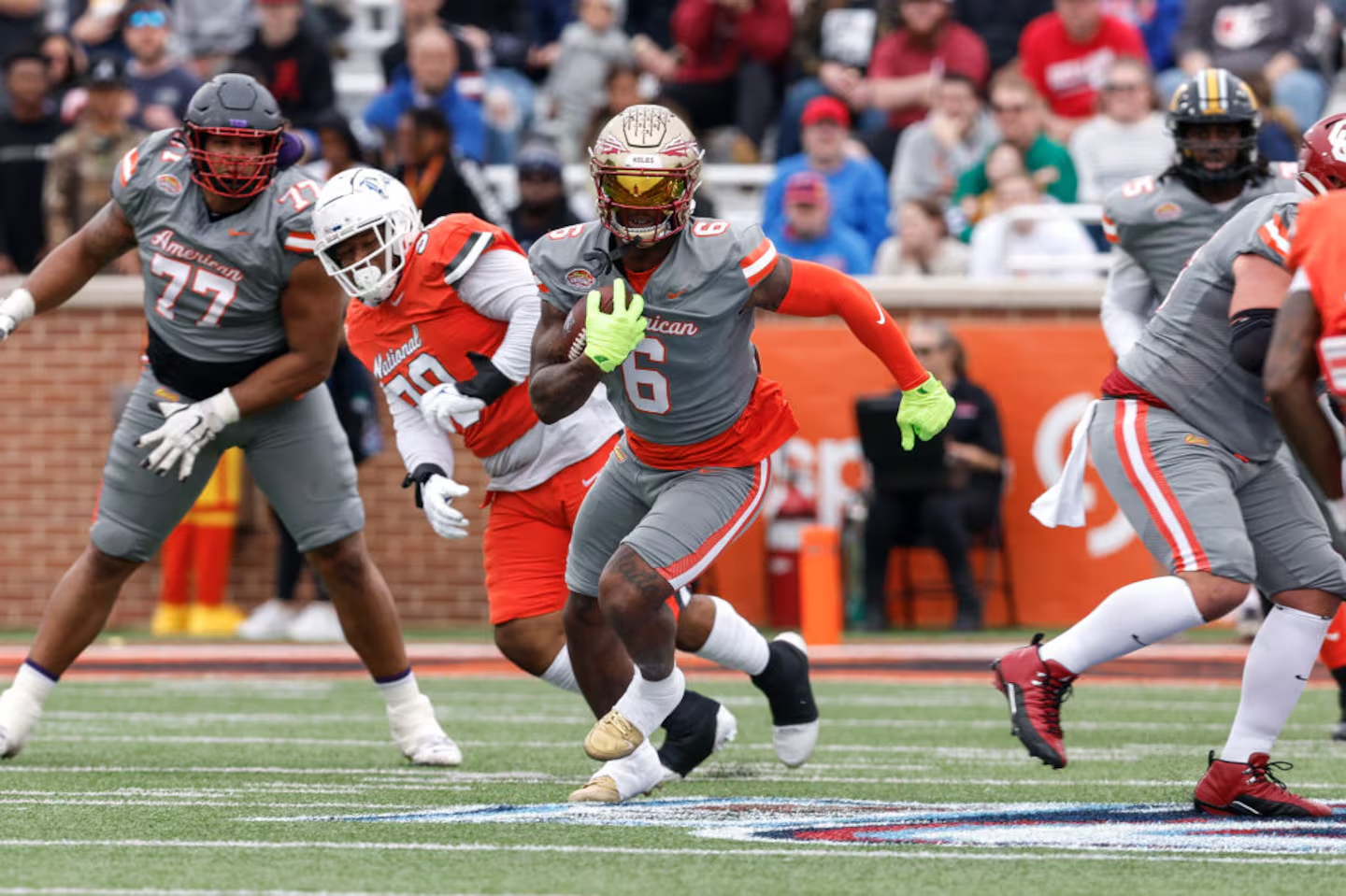
Photo: Don Juan Moore / Getty Images
Receptiviti’s tech analyzes thousands of word categories and subcategories to ultimately score speakers in more than 200 “dimensions,” which include everything from personality type to whether someone is a more intuitive or deliberative decision-maker.
It then feeds that data to large language models, trained on the company’s psychological research, to place that raw data into context.
Receptiviti’s Senior Bowl reports, as one example, charted each quarterback’s standing across the “Big Five” personality traits, with text summaries attached that described what those measures mean and how they apply to football.
“If a player scores higher on a measure like neuroticism, meaning they’re more likely to experience things like anxiety and stress and negative emotionality,” said Jade Marion, Receptiviti’s Senior Manager/Customer Success, “we include information about how a coach might work with a player with that type of disposition.”
Such assessments have a clear use-case in athletics, where optimal performance is table stakes and, on-field talent aside, relationships can make or break a team’s chemistry.
But Jennifer Glista, Receptiviti’s CRO, said the company’s integration engine is used by sports organizations for more than just personnel scouting, including to better inform coach and executive hires.
“Language is so flexible, and so, from our perspective, the more data you have around the entire organization, the more effective you can be,” Glista said. “But it depends on what each customer’s application is setting out to do.”
This article was brought to you by SBJ Tech, a Leaders Group company. As a Leaders Performance Institute member, you are able to enjoy exclusive access to SBJ Tech content in the field of athletic performance.
In this recent edition of The Athlete’s Voice, SBJ Tech catches up with former Olympic badminton player Howard Chu discusses the implications for AI that can deliver real-time feedback and data across racket.
You can’t have a discussion about sports technology today without including athletes in that conversation. Their partnerships, investments and endorsements help fuel the space – they have emerged as major stakeholders in the sports tech ecosystem. The Athlete’s Voice series highlights the athletes leading the way and the projects and products they’re putting their influence behind.
* * * * *
In January, the self-described “tech nerd” appeared at CES to try out a new AI-powered badminton training system developed by Taiwan’s Industrial Technology Research Institute (ITRI). An automatic serve machine fired shuttles, and when Shu returned the serves, cameras using computer vision relayed data such as shot speed and trajectory as well as on his own swinging motion.
Shu, 34, is a UCLA graduate and former EY consultant now working in supply chain logistics as Manager Business Development & Operations for Hizooo Network Technology. He was recently starred in a short film about his athletic career called 10,000 Days of Chasing My Dreams.
On connecting with ITRI before CES…
I didn’t know anything about it, actually, so it was really exciting. They reached out. I did a little bit of quick Google search as well and saw the machine that they had. This was my first time actually seeing it and testing it out. First impression, it’s cool. I think there’s some refinement [to be done], and we weren’t in a perfect, controlled environment, but just running through my head, there’s so many use cases for it already.
On the AI trainer…
Basically, it’s a typical shuttle feeding machine, which we’ve seen already. That’s not new, where it basically shoots a shuttle at you. You see this in tennis as well, if you’re trying to practice by yourself. But what happens is, after I hit the shuttle, it gives me some data output, like speed of my return shot, positioning, height. So those are some of the metrics that it was actually giving me after I hit the shuttle that it fed to me.
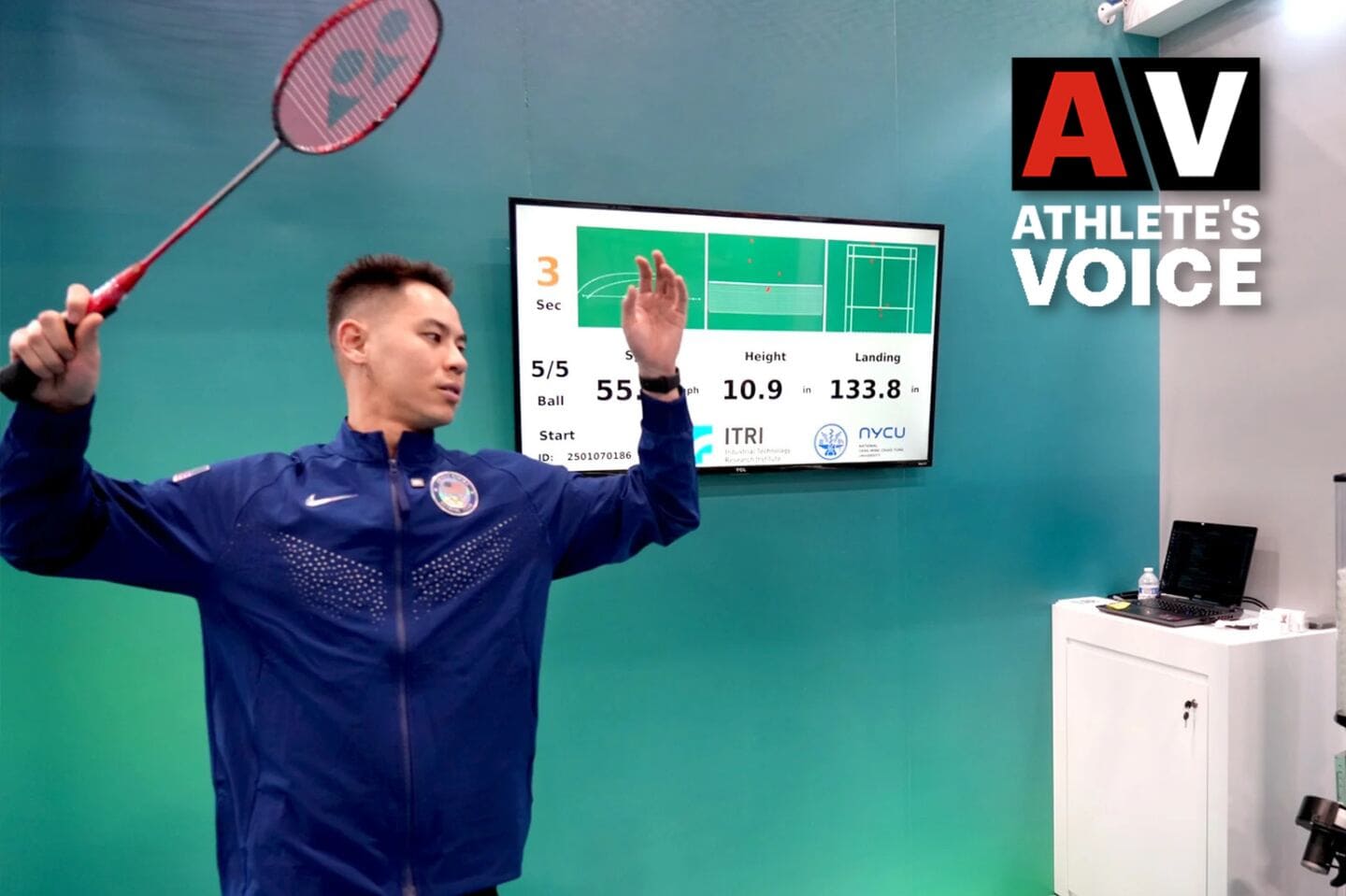
Photo: Getty Images
On whether he typically saw such data…
I haven’t. If we talk about AI or technology in the space with other racket sports like pickleball or padel, we’ve seen some other technologies trying to track number of shots in a rally or where you made the mistake. On tour, we do have metrics like speed, but it’s not to your own use where you can track every shot. Sometimes they’ll track a big smash or something like that, but not [it’s] something in your hands where you can track every single shot of your own.
On the limited data on tour…
If you’re in a big match, you might see, ‘Hey, this player hit a 400-kilometer-an-hour smash once during the match.’ It’s not like I would be able to dial in and say, ‘Hey, during the third match, I was feeling a little bit more tired. I want to know if my smashes were dropping off by 5 per cent or 10 per cent.’ So those are the kind of metrics that you would really be able to act on if you had something like this.
On using this new badminton data for racket fitting…
One of the main use cases that I thought right away is — I follow a lot of other sports like tennis and golf — I think this type of technology would be extremely helpful in customizing or picking out the proper equipment for the athlete. So we see this in golf a lot, right? They use their Foresight [launch monitor]. They track ball speed, ball spin, height, all these details that are really meticulous, right?
And so if I’m an athlete and maybe I’m not optimizing the proper equipment, whether it’s string tension or there’s head light or head heavy. I could go on to a court, test out 10 different models with 10 different variations of strings tensions and figure out which one is giving me the best smash, the best speed, things like that, which otherwise would just right now be going by feeling like, ‘Hey, this racket feels good. That smash felt good, [but] I don’t know exactly what the speed was.’ You’re seeing it in some of these other sports that have a little bit more money, that are already implementing it into a lot of their strategies.
On other tendencies the system could learn…
I’m sure those cameras are capable of [identifying tendencies], whether you put in a match video and it spits out some sort of post-analysis data like, ‘Hey, I made X amount of mistakes in my backhand or X amount of mistakes in my forehand.’ They might even be able to drill down to more meticulous details like, ‘Hey, the height over the net on this shot was five inches or 10 inches, and that’s what led to losing this point.’ It’s obviously a lot of back-end code and different scenarios that they have to run, but there’s definitely a ton of use cases for something like this.
View this post on Instagram
On his own data-driven training…
Very late in my career, at 34 years old, one of the things I’ve done is I’ve laid off of all the impact cardio. So, for example, no more running, whereas in my early 20s, I did a lot of that. But now it’s always low-impact cardio — swimming, biking — but then it’s tracking my heart rate, making sure I’m getting into the right zones to push that cardio.
There’s so much recovery tech out there, whether it’s compression boots, plunge, infrared sauna. These are just all things that I would say were not accessible to the average consumer, five years ago, 10 years ago, and now we’re really seeing companies push the envelope where it is very accessible to consumers. And I don’t know what the timeline is on a machine like this, or a technology like this, but I’m sure it’ll be scalable to one day where it will be in the hands of consumers.
On the surprising speeds of badminton smashes…
The world record now is [565] kilometers an hour. That’s [351] plus miles an hour. That’s obviously at contact because the way the shuttle works is, there’s a cork, right? So as it flips when it lands on the other side, it’s not traveling at 300 miles an hour anymore. It’s impact that they’re tracking. But I’m confident to say I could probably still get it over 240 [mph, I would say. I’ve seen people do challenges where they smash a shuttle into a watermelon or break through cardboard and things like that.
This article was brought to you by SBJ Tech, a Leaders Group company. As a Leaders Performance Institute member, you are able to enjoy exclusive access to SBJ Tech content in the field of athletic performance.
Springbok Analytics’ technology offers the latest develop in preventative health measures for athletes.
Inside, a portable MRI machine needed only 10 minutes to scan the women’s lower bodies, at which point AI algorithms from Springbok Analytics took the 2D imaging and converted them into 3D digital twins that can be used for muscle analysis — establishing baselines that can be used to individualize training and flag latent injury risk.
Unrivaled, the 3-on-3 women’s league that debuted on Jan. 17 in Miami, is the latest league to partner with Springbok Analytics. In the past two years alone, Springbok has collaborated with three of the five biggest North American sports leagues: It graduated from NBA Launchpad; completed data collection on an NFL-funded research project into hamstring injuries; and began the initial phase of an MLB-backed study into pitcher health.
Now boosting Springbok’s rapid growth across pro sports and into broader populations is a newly closed, oversubscribed $5 million Series A led by Transition Equity Partners , which also led a $3 million seed round in 2023. Joining the investment were the NBA, which added to its initial equity stake from Launchpad, and Cartan Capital , a sports tech venture firm led by former pro tennis player CiCi Bellis .
“This is a clear sign that our current and new investors are excited to see us scale all aspects of our business,” Springbok CEO Scott Magargee said, “and from a dollars-in-the-door perspective, it allows us to advance what we believe is our global leadership in the area of muscle analysis for large demographics of athletes and patients across the entire health care landscape.”
The interactive reports Springbok produces are musculoskeletal avatars shaded various hues of red, orange, tan and blue that detail muscle asymmetries, fat infiltration and a proprietary score comparing a person’s muscle size with others of similar sex, size and sport. Springbok recently released sport-specific databases for men’s pro basketball and soccer athletes — a women’s soccer counterpart is planned soon — for more apt comparisons. It received FDA clearance in October on its flagship lower-body scan, and added core and upper-body scans to what previously was lower extremity only.
Such a tool is even more important when the athletes are such physical outliers as in the NBA. More than 100 players are in that database, and in addition to partnering with nearly half the league’s teams, Springbok continues working at the league level during the pre-draft process.
“Their work with us proved that this is a really interesting new dataset in elite sports,” said NBA Senior Vice President Tom Ryan , who oversees Launchpad and all basketball R&D. “Springbok data is starting to become an important piece of the puzzle to help support player health and performance initiatives. That’s really the story: It’s very strategic for us, both at the league and team level.”
The continued strategic relationship helped facilitate the additional funding, NBA Investments Associate Vice President Pat Crouch added. “First and foremost, for companies that come out of the NBA’s Launchpad program, we look for follow-on investment opportunities when there is a continued strategic relationship. We only invest in companies where there’s some type of commercial partnership, at either the league or the team level, that has gained meaningful traction and has upside to continue to grow and expand.”
Notably, Springbok has no true competitor and a 15-year head start on understanding the use of this data, making it “a piece of the puzzle that nobody else is,” said Magargee.
“The fact that our expertise is the technology, but also in human performance and muscle physiology, we know where to keep going with it in a way that’s meaningful,” said Silvia Blemker , Springbok’s chief scientific officer. She added that one recently devised new metric is an objective injury severity score, which can quantitatively assess a strain or sprain rather than rely on a human practitioner to subjectively evaluate it.
Though Springbok Analytics’ work in sports has intensified in recent years, the foundational technology has roots dating back to 2009 and Blemker’s biomedical engineering lab at the University of Virginia. The company’s headquarters remain in Charlottesville, sitting in a nondescript office at one end of its pedestrian-friendly Downtown Mall. Springbok’s dual recognition in 2024 from SBJ Tech — as a Most Innovative Sports Tech company and SBJ Tech Award winner for Best in Athlete Performance — prominently greets visitors.
In those early days, Blemker was working on solutions to aid treatments of cerebral palsy and muscular dystrophy when the lab began developing the machine learning to extrapolate 3D data from MRIs. Those life science use-cases remain a part of Springbok’s mission, while also adding the human performance sector that makes it a highly differentiated product appealing to investors.
“Not only do we really believe in the team, but the technology, we think, is pretty unprecedented, especially with the years of R&D,” Bellis said, “and then the beachhead that they’ve had into the sports market is super interesting, because they can really instantly provide value to these sports teams and instantly give them money back, so to say, by having this preventative health measure for athletes.”
That expediency of the scans — much quicker than what’s needed for traditional MRIs — has helped Springbok amass its large elite athlete databases, including a thousand college and pro American football players, Blemker said. Those were collected to build a hamstring injury predictive index in collaboration with researchers at the University of Wisconsin and Australian Catholic University, and funded by a $4 million grant awarded by the NFL’s Scientific Advisory Board.
It’s that rich dataset, as much as any algorithm or an investment check, that is sparking Springbok’s growth — and the same competitive advantage will only continue to grow the same way it started.
“It’s taken us time,” Magargee said, “and it’s taken us partnerships.”
This article was brought to you by SBJ Tech, a Leaders Group company. As a Leaders Performance Institute member, you are able to enjoy exclusive access to SBJ Tech content in the field of athletic performance.
The pilot program will see biomechanics labs installed at the the Cavaliers, Jazz, Pacers and Suns.
The protocols, as explained in a league-wide memo in January, have been developed in consultation with the NBPA as well as sports medicine and performance experts. Provisions for such a screening program are codified in the current collective bargaining agreement, requiring players to participate in up to four assessments per season.
“It’s one of several major initiatives that we have in the works, including with the Players Association, to try to reduce injuries in the league,” NBA EVP for Operations & Administration David Weiss said, emphasizing its scope and ambition by adding, “We’re not aware of anything quite like this league-wide in the world.”
Planning for this project began long before a perceived uptick in the injury rate over the past year, but it remains set against the backdrop of ongoing conversations around appropriate load management and player participation policies.
The NBA is now in the process of installing biomechanics labs with four pilot teams: the Cavaliers, Jazz, Pacers and Suns. The goal is to have identical setups, with the same technology vendors and the same prescribed athlete motions, to ensure standardized data collection.
The four tech companies that won the league’s RFP are:
P3, a private facility that independently has evaluated the biomechanics of roughly 70% of current NBA players, will work with the league as a consultant to the program. The NBA first hired P3 to assess prospects at the draft combine in 2014. Individual teams can also contract with the firm for additional insights and normative data.
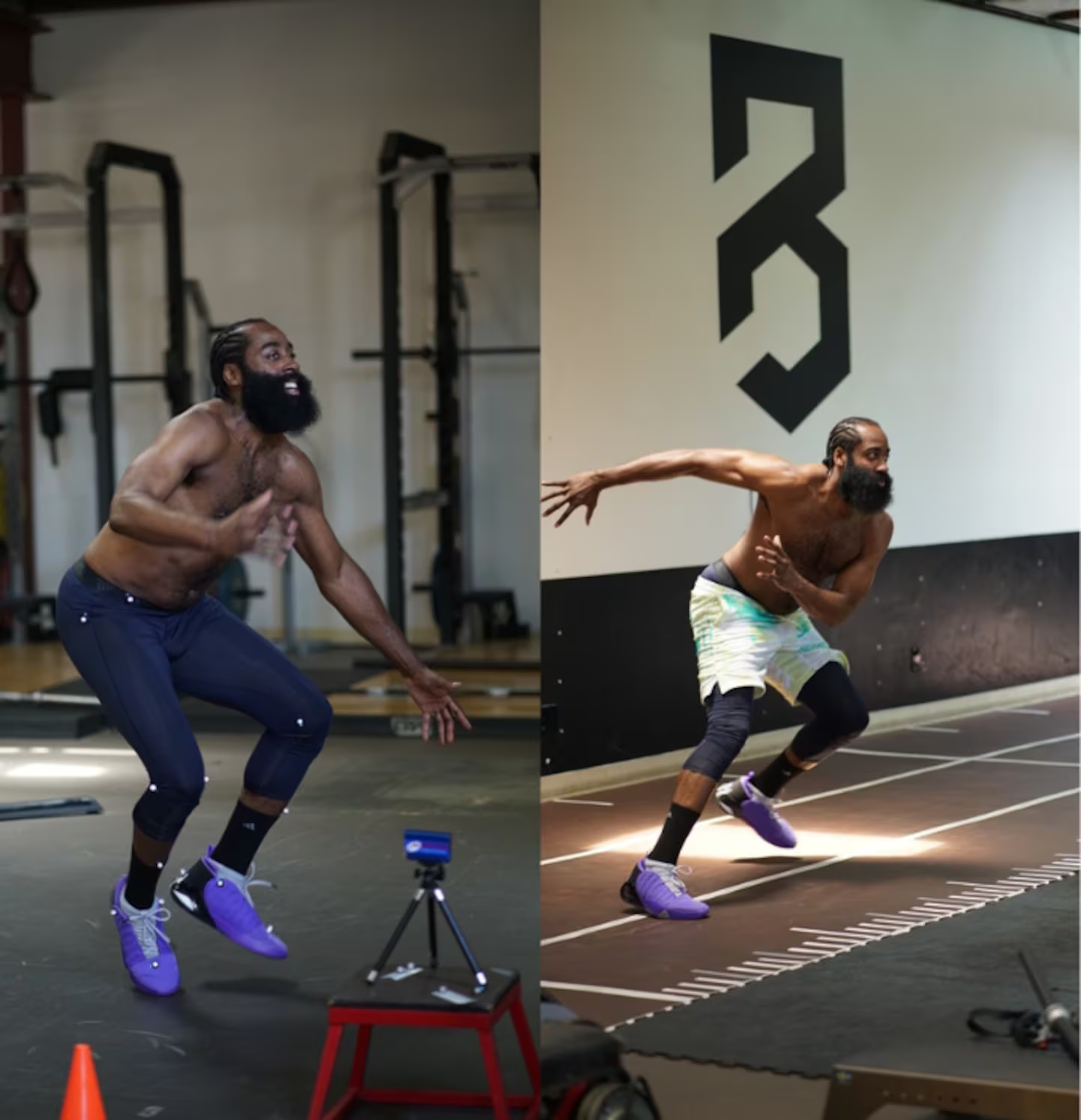
Image courtesy of P3.
“This relationship between how we move and what happens to us is a strong relationship,” P3 founder and director Marcus Elliott said. “It’s stronger than most people realize, which is why we invested all this energy into all of it. And the more we can start actioning that — and not just waiting for bad things to happen — the better it is for everyone: for the players, for the teams, for the league. I’m super bullish on the potential of biomechanics to make lives better and for us to follow these signals.”
Access to the data collected in these biomechanics evaluations will follow similar guidelines to how the NBA handles medical records. Players have full access to their own reports, which they will retain even as they change teams. Coaches, executives and performance staff will be able to see data for players currently on their rosters. Weiss indicated MDs and PhDs conducting vetted research will also be to connect the data with injury information for studies on potential risks.
One source noted a “vast discrepancy” in the way franchises have utilized biomechanics data to date, praising this new program as a way to ensure consistent, efficient and accurate assessments. Some teams have been investing in biomechanics for years while others have yet to allocate any resources toward it. By implementing his program across the league, the NBA can collect in one year as much data as any team could collect in 30 — hastening the pace of understanding what correlations exist between movement and injuries.
Deployment of this program, which is scheduled to last at least through the end of the current CBA in 2030, has been measured to make sure it is properly communicated and rigorous. Evaluating success will take time, too.
“Certainly whether we can reduce injuries long-term or a particular type of injury — that’s going to be one of [the KPIs] — and whether we can connect certain movements or certain changes in the way an individual moves to injury,” Weiss said.
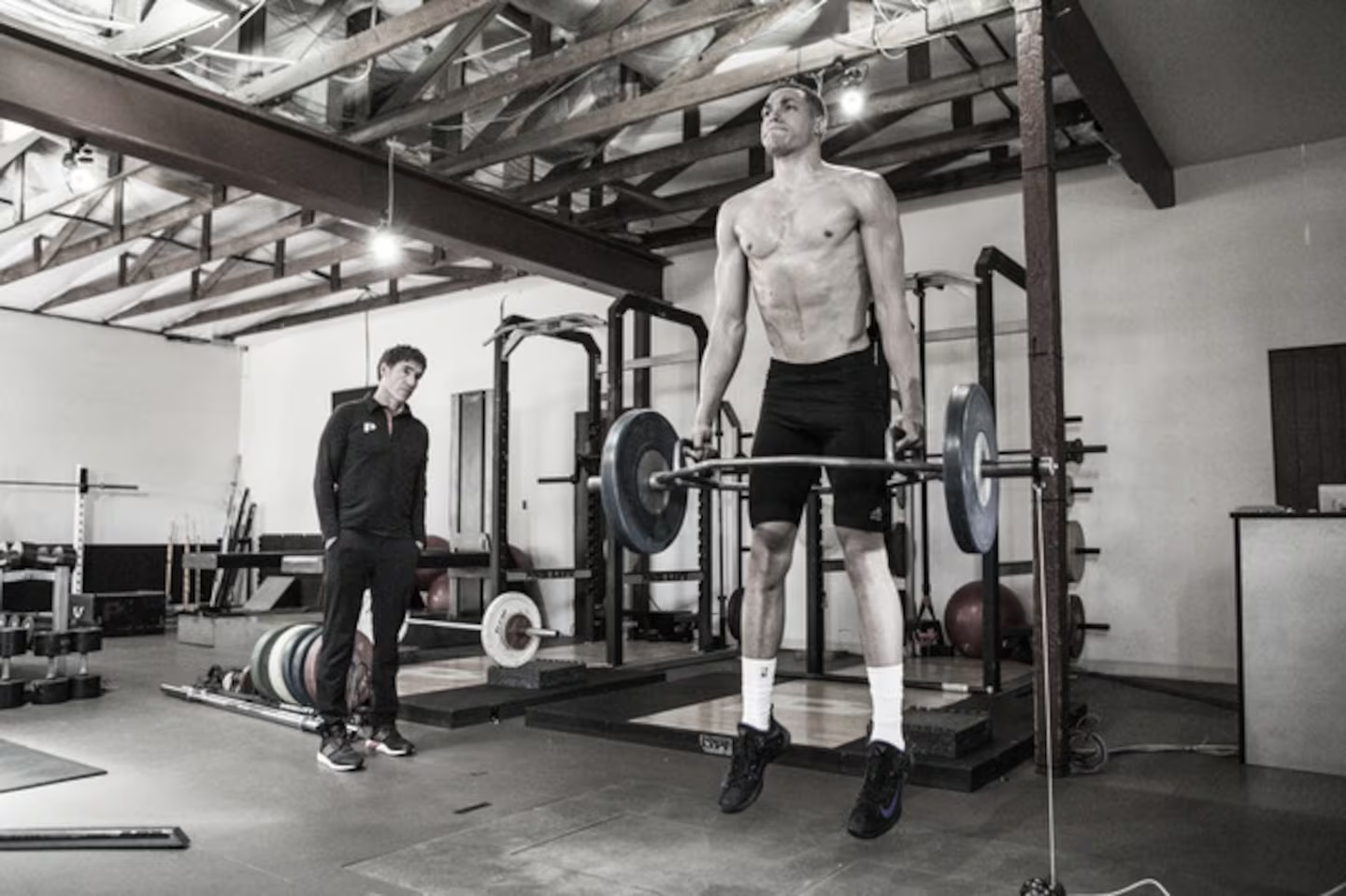
Image courtesy of P3.
Though the NBA’s in-game tracking system — powered by Sony’s Hawk-Eye — is camera-based and collects data on limbs and joint angles, that solution is only nominally a tool for rigorous biomechanics. Sony’s recent acquisition of KinaTrax, the leading baseball biomechanics technology, might help in the long run, but the current in-game tracking system doesn’t have the same fidelity the new lab-based system will provide.
There is a consensus that biomechanics might be an especially helpful tool in a sport like basketball “that certainly requires you to be a pretty impressive, high-flying athlete,” said BreakAway Data CEO Dave Anderson, a former NFL receiver. “The game is played well above the rim in the NBA, so jumping and your ability to land are critical to your career.”
Weiss added that experts with whom the league has conferred, including on its two biomechanics committees, point to “a number of factors — the size of players, the nature of the game, the number of games in the season, the hardcourt surface — that there’s reasons to think about biomechanics could be as helpful in basketball as almost any sport,” he said.
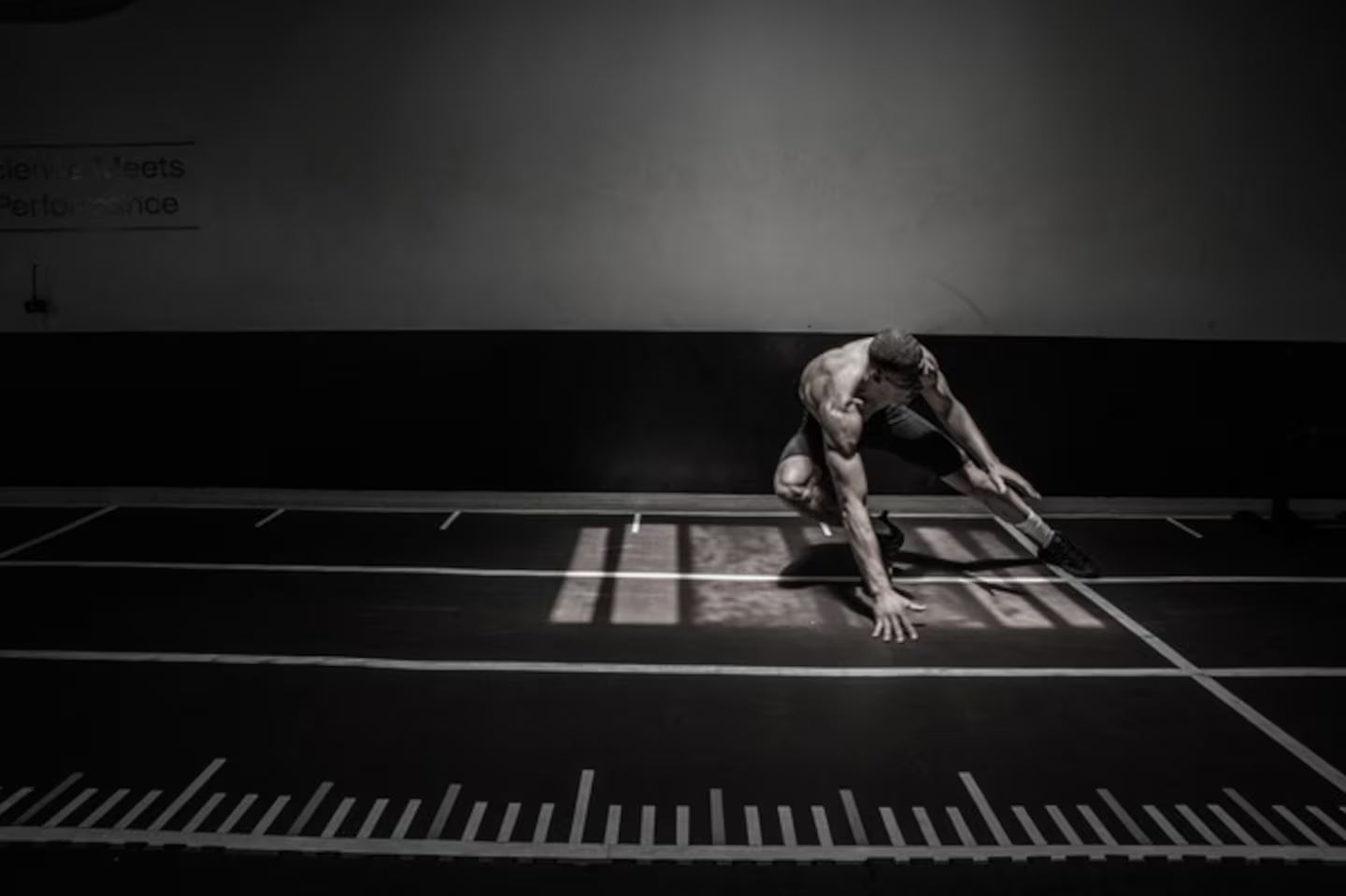
Image courtesy of P3.
These lab assessments are expected to take about 15 minutes, following a pre-scripted set of “motions that are directly applicable to their sport and health,” Theia CEO Marcus Brown said, describing his company’s software as “an accessible tool that also enables standardization within a vast data set. As a generalized neural network, Theia3D doesn’t require additional data for unique movements, environments or outlier athletes.”
It’s a highly technical distinction, but an important one: other motion capture solutions compare movement to various models, which can add to discrepancies when analyzing data from different sources and different seasons. “Having consistency in data collection over a long period of time on a big group of people is just something that I know our customers are looking for,” Qualisys product manager for life sciences Nils Betzler said, praising the “unified approach.”
“They’re really doing a tremendous job trying to better understand player biomechanics, player movement, and overall player health,” added Anderson about the NBA and NBPA. “They’re really trying to use science and numbers and research to make sure that the players are playing at the highest level. And I really appreciate that because a lot of these leagues are just adding games, changing roster sizes, and changing rules, and they just assume the players will figure it out. The NBA is taking this player-first initiative, and that’s just really cool to see.”
This article was brought to you by SBJ Tech, a Leaders Group company. As a Leaders Performance Institute member, you are able to enjoy exclusive access to SBJ Tech content in the field of athletic performance.
Project leads Anna Warren and Tham Wedatilake discuss the factors that enable Insight 360’s data-led approach to athlete management.
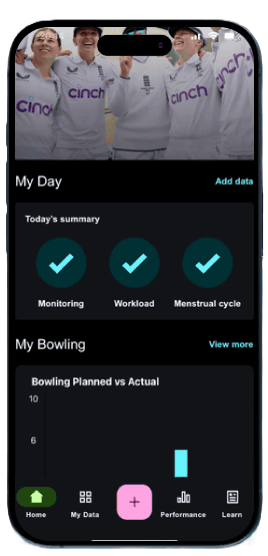
Insight 360 is a data-driven approach to performance management and athlete monitoring. It was launched in February 2024 by the ECB in collaboration with Ascent, their digital services provider, and includes an app for players (to view their data), a dashboard for practitioners (to view data across the board), and a portal that practitioners can use to input data.
“When you see the little research that’s out there, you’ve not got much to hang your hat on,” said Anna Warren, the Head of England Women’s Science & Medicine, at November’s Leaders Sport Performance Summit in London. “We’re using this platform to better understand in depth the female cricketer; what they look like from the academy through to the international cricketer.”
The rollout has been a success and, as the ECB launches phase two (the wider introduction of injury data and more sophisticated use of match data), we highlight the factors that led to its sport-wide take up.
It reflects the concerns of players
Insight 360, as the name suggests, represents a holistic approach to collating athlete data. There is a focus on availability and performance, but there is also a focus their health, home life, and career progression. “Players come to us and discuss their issues quite openly,” said Dr Tham Wedatilake, the Lead Physician for England Women’s Cricket, who joined Warren onstage to discuss the project. “They want to perform without any barriers.”
It is a co-designed platform
Ahead of the launch, the ECB gathered input from practitioners and coaches across the English game. “This means Insight 360 is bespoke for women’s cricket,” said Warren. Players, she said, are happy with an app that allows them to review their own data in as much detail as they like. “This is good for player buy-in, which is always a challenge in relation to athlete monitoring.”
 There is also the power of a co-designed project. UK Sports Institute have found as much with their Project Minerva. Dr Richard Burden, the UKSI’s Co-Head of Female Athlete Health & Performance, said: “Get the practitioners involved, get athletes, get the teams and bring them along with it because if they’re onboard you get easier access to them and you’re going to produce something that’s more translatable, meaningful and applicable to them.”
Warren is on the same page with Insight 360. “You can link loads of different data sources together and start to answer some key performance questions – we’re not looking at everything in isolation.”
It provides a single source of truth
Collaboration can be easier said than done. “When you have so many people pull data together it becomes almost impossible for the human brain to comprehend and then deliver effective, unbiased solutions to players’ needs and expectations,” said Wedatilake.
Insight 360 is the single reference point and it provides continuity. “As soon as one person leaves and another is working with the players, that record gets lost,” said Warren. “We’re really trying to create a joined-up system.”
It is future-proof
Wedatilake explained that Insight 360, as part of its next phase, will include injury data. He said: “It will be a game-changer for us in terms of load and injury risk and other factors such as the menstrual cycle and wellness.” The platform is primed to integrate future sources of data.
He does, however, also temper his excitement with a note of caution. “We didn’t want to get greedy too early,” he added. It was critical to have the right structure and means of integration before adding different elements, whether they are rooted in stats or video.
One of the next steps is further automation, particularly with regards to match data. “That’s the beauty of this system,” said Warren. “It’s so much quicker for people.”
She and Wedatilake wrapped up their presentation by setting out their ambitions for Insight 360:
College teams across the US are starting to consider the mental side as a critical element of player development and are using Pison’s AI-powered solution in their pursuit of answers.
Main image: Pison
Priced annually at $359 per player, the package comes with the same hardware and ENG technology as the company’s Pison Perform product – which encompasses sleep tracking in addition to cognitive assessments – plus access to an online data visualization dashboard and Pison Baseball Pro app with drills specific to the sport.
“As far as this game goes, it’s been known to be 90% mental, but how often do we train the mental part of the game?” said Marc Deschenes, Pison’s VP/Sports Operations and a former professional pitcher. “Us being able to use that information and integrating that into player development for performance and awareness on the baseball field is integral in making this game more complete for our players.”
Pison’s sensors detect electrical signals that emanate from the brain, pass through the nervous system and manifest in muscle movements. Its breakthrough is in coining what it calls ENG (electroneurography), which measures electrical signals in a way that would typically require complex lab testing via a chip pressed to the surface of the skin.
The roots of the company’s technology are in treating degenerative brain illnesses such as ALS, but it broke into sports about one year ago with an eye on performance and evaluation use-cases. Pison’s sensors measure cognitive functions such as reaction time, mental agility and focus through light-based reaction tests that range from 20 seconds to three minutes.
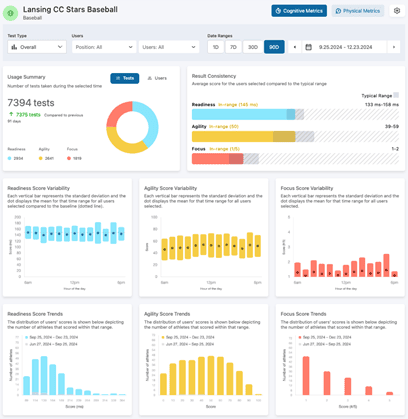
Image: Pison
Pison has public partnerships with the baseball programs at Penn State, Oral Roberts, West Virginia (including use by 2024 No. 7 overall MLB draft pick of the St. Louis Cardinals JJ Wetherholt), and Lansing Community College, which Deschenes calls a “power user” because of feedback they have provided. At the youth level, Pison works with USA Prime New England (which Deschenes owns) and Fort Worth Christian Academy for baseball, as well as the Boston Hockey Academy.
Multiple MLB teams are also evaluating the technology, and the league itself is in the process of testing it for on-field approval.
The new product was formally announced at the American Baseball Coaches Association conference in Washington D.C. this morning. In the future, Pison will look to expand to other sports and potentially integrate its sensors into existing wearable vendors.
“The product, really, is taking a sophisticated technology that has been in the medical world – and kind of out of reach even there because of the cost – and bringing it down to something that everybody can use,” said John Joseph, Pison’s CRO. “When we look at the market, we aren’t just going after the MLB market or college. This is really for anybody that wants to develop that elite mental game.”
This article was brought to you by SBJ Tech, a Leaders Group company. As a Leaders Performance Institute member, you are able to enjoy exclusive access to SBJ Tech content in the field of athletic performance.
For the first time, all players will access to their data and video within 40 minutes of finishing their match.
Main image: ATP Tour
The tour treats the Next Gen Finals as an experimental ground for innovation, whether that be in competition format or technology. At the last edition that meant expanding access to filterable snippets of points within matches, which can be sorted by factors such as point result; shot type, direction or spin; and score, among others.
Metrics such as Shot Quality, developed by ATP partner TennisViz, are accessible within Tennis IQ in real-time to coaches sitting courtside, and supplementary video is typically available within 40 minutes of matches ending.
“What we’ve looked to do is offer the players an enhanced version of Tennis IQ across those two events (the ATP Finals and ATP Next Gen Finals), which actually is a bit of a glimpse into what we expect the future of Tennis IQ to be,” said ATP Director/ATP Events Adam Hogg. “It’s something that’s not currently available for the players on a week-by-week basis through the Tennis IQ platform, but ultimately something that we as the Tour at our own events wanted to offer as a premium service.”
The ATP is planning to roll out the video feature, along with biometric data derived from approved wearable devices, within Tennis IQ for its full schedule of events sometime in 2025, likely between Q1 and Q2. Tennis IQ launched as a match data platform last September.
To derive the metrics available within that platform, TennisViz applies custom-built machine learning algorithms to ball and player-tracking data provided by the ATP and ATP Media’s joint venture, Tennis Data Innovations (through the tour’s work with vendors like Hawk-Eye). TennisViz has collected data from more than 7 million shots dating back to 2004 and identified more than 60 different shot types, according to Head of Performance/Media and Broadcast Tom Corrie, with a shot’s quality determined by an assessment of ball characteristics, including speed, spin, bounce angle, and a shot’s depth and width on the court.
Relative to that process, the video feature is simple.
“What’s advanced is creating the Steal Score or the Shot Quality,” Corrie said, referencing two of the metrics TennisViz has developed. “We’re just attaching a time-stamping process to the [match] video, which we’ve developed the technology to do.”
TennisViz has a similar partnership with Wimbledon that encompasses video-tagging and has also worked with the USTA’s player development department. Corrie said the company is half-staffed by former coaches and half-staffed by engineers and developers, giving them a unique lens on the sport.
“Our vision was, ‘tennis data is dated,’” Corrie said. “All the other sports, particularly American sports, have moved on massively in the last 10 years in terms of different analytics and different fan-facing metrics. Tennis is still using ‘break points won’ as the number one determination of winning.
“This platform (Tennis IQ) rivals any platform in any other sports now, in terms of the fact that is’ live data. If you take the number of matches, the 24-hour nature of tennis, all those things – it’s now as good as any platform in any sport… We’re (tennis) now not behind. But we were.”
This article was brought to you by SBJ Tech, a Leaders Group company. As a Leaders Performance Institute member, you are able to enjoy exclusive access to SBJ Tech content in the field of athletic performance.
Lasso Safe’s AI-powered software helps sports teams to assess risk and better care for its athletes.
Photo: Lasso Safe
Founded by a pair of retired professional athletes — endurance cyclist Pamela Minix and figure skater Luis Hernández — Lasso Safe has developed an evidence-based, research-validated survey and software to detect potentially toxic environments and unsafe relationships.
Players Health, a sports insurance group that recently raised a $60 million Series C round, will use it to “create safer, more supportive environments that lead to both healthier athletes and more sustainable businesses,” said Kyle Lubrano, Chief Mission Delivery Officer of Players Health.
Minix said Lasso Safe completed validation of its most updated product in October and described it as “a machine learning software that recognizes athletes’ experiences — specifically the areas are mental, emotional, physical and social wellbeing. We recognize them on spectrum from healthy, happy experiences to harmful and even abusive experiences.”
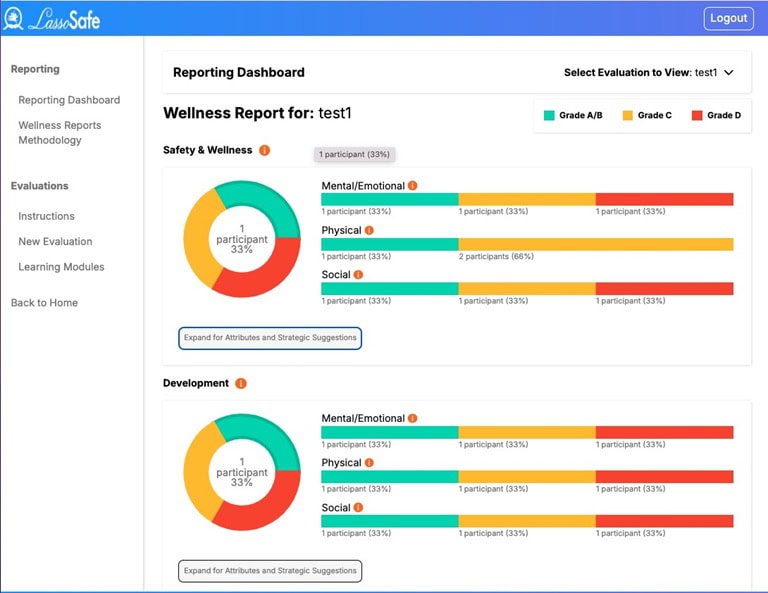
Lasso Safe described the product as “a machine learning software that recognizes athletes’ experiences — specifically the areas are mental, emotional, physical and social wellbeing.” Image: Lasso Safe
It was originally developed for national governing bodies that serve Olympic sports but has been modified for age groups as young as elementary school. Minix noted the increasing pressures at the youth level, in part because of growing expectations from the coaches and the growing financial investment in the space.
“Any level can experience this, not just highly competitive levels, so we focus on youth, but we do all age groups,” Minix said. “The software is designed to recognize even the first step away from that, when maybe those pressures start to come up or any type of misconduct within those wellness pillars.”
The frequency of surveys is at the discretion of each organization. Minix noted that Players Health will typically require them at least once during an application process to the platform, but many groups will administer them periodically or after incidents.
Questions asked of athletes include whether they feel valued by the coach, whether they have adequate access to nutrition and hydration during training sessions and more. Surveys can take anywhere from five to 15 minutes to complete.
Minix said Lasso Safe has run pilots with about 50 universities in the past five years, led by Utah State and Victoria University in Australia. The first adopter of the latest software is Globocol, a case management company based in the UK that offers services for sporting integrity, DEI, health and safety and data governance, among other uses.
This article was brought to you by SBJ Tech, a Leaders Group company. As a Leaders Performance Institute member, you are able to enjoy exclusive access to SBJ Tech content in the field of athletic performance.
The seven-weight world champion spoke to SBJ Tech ahead of her second fight with Ireland’s Katie Taylor.
You can’t have a discussion about sports technology today without including athletes in that conversation. Their partnerships, investments and endorsements help fuel the space – they have emerged as major stakeholders in the sports tech ecosystem. The Athlete’s Voice series highlights the athletes leading the way and the projects and products they’re putting their influence behind.
* * * * *
Two of her losses included the tightly fought split decision against Katie Taylor that headlined Madison Square Garden two years ago. Their rematch last month, which Taylor won by a controversial unanimous decision, was as the co-headliner with Jake Paul and Mike Tyson in the Most Valuable Promotions card was held at AT&T Stadium in Texas and streaming live on Netflix.
Also in November, Serrano, 36, partnered with Total Wireless, a no-contract 5G provider that runs on the Verizon network — and received her very first mobile phone. Citing an unwavering, distraction-free focus on boxing, Serrano had resisted owning a phone until now. She will host a meet-and-greet with fans at a Total Wireless store in Brooklyn on Dec. 1.
On not owning a mobile phone…
No, never. It’s going to be my first one. All my communication has been through my trainer, my brother-in-law, which is Jordan Maldonado, and every now and then, I’ll steal my sister’s phone and do everything there. I do have an iPad, but this would be my first phone.
On who she’ll call or text first…
I think it’s going to be my sister, and I’m going to talk. She will be happy that I don’t take her phone anymore. Now I have my own.
On working with Total Wireless…
Total Wireless definitely has a good commitment with the Latino companies, Latino athletes. What really got me was because their plans, and then they’re associated with Verizon. I needed a plan and something that’s not going to slow me down. Because I’m always high pace, and I needed something that’s going to do that for me.
On how she evaluates brand partnerships…
If I truly believe in it, if I’m happy with them, if I see their work and what they’ve done for others, and what they’re doing for in general — yeah, that’s how we partner up. If I believe in it wholeheartedly, then I’m going to go with them. There’s people that we’ve gotten offers from, and I said I don’t agree with what they’re doing, or I don’t get what they their motives are. So I will not represent them.
On being on co-headlining with Jake Paul and Mike Tyson…
Obviously the fans wanted this fight. I believe I won the first fight. So it was really easy when my team came up to me and said, ’It’s going to be on Netflix in a big stadium for 80,000.’ I said, ‘Let’s do it.’ We gave an iconic first fight, headlining Madison Square Garden, selling it out. And I think we’re just going to do a better fight this time. And I think we’re both deserving of this platform to go out there and represent for the women in the sport.
It’s truly an honor. I’m super proud. I have an amazing team that even thought of me to put this fight on. I can’t wait. I know I’m going to put on a show. I’m ready. I know Katie’s ready. And you’re going to witness women’s boxing at its finest.
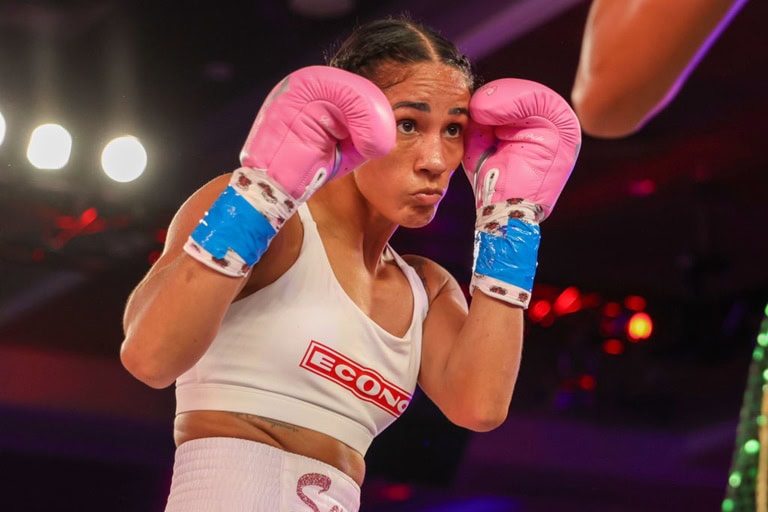
On her training methods…
I’m old school. I have an old school trainer. We’ve been doing it for 16 years this way. It’s been working for me for 16 years. I’m one of the most accomplished female fighters in the world, and that’s only [after] having nine amateur fights. I have 50 pro fights. And if it ain’t broke, why fix it? But we definitely train smarter this camp. I train hard for all my fights. So I’d be lying if I you that I trained harder. No, we just trained smarter. I’m ready to become undisputed champion at 140.
View this post on Instagram
On how she’s evolved…
I never really, in the beginning of my career, thought of recovery as part of training, but that was definitely a plus for this fight. As you get older, your body gets a little more wear and tear, so you definitely have to concentrate on that and just eating good and just going out there and performing, making sure you’re training hard and running the miles you have to run, putting in the work, and you’ll do good at fight time.
On her team…
My team is very small. It has been my brother-in-law [who is] my manager and my trainer, which is Jordan Maldonado; and my sister [Cindy]. We’ve been together. It’s been us three. I do have a pad coach, but he does what my main coach, Jordan, tells him to do. I had a nutritionist, and I learned things from him. So I moved it over to this fight. I try and cook for myself, but I’m I don’t like too much. I don’t like an entourage. I don’t like too many people around me. So it’s been my small team, and I’m happy. They just bring the best out of me.
On what she learned about fighting Katie Taylor…
Katie is definitely a warrior. She’s tough as they come. She’s not going to go down easily, and she’s going to fight every minute, every round, and that’s what I I learned. I gained more confidence after that first fight. I know I hurt her. I’m capable of hurting her again this fight. And that’s what we’re going to try to do.
On the growth of women’s boxing…
It’s been a long journey. Definitely people had their doubts in us, but now that they’ve seen that champions are fighting champions, we’re putting in on great shows — I’m not the type to brag, but when I do express how much money I’m making in my fights, that’s to motivate these young girls and show them, inspire them. There’s a light at the end of the tunnel, like ‘I can make this type of money if I continue to fight, work hard.’ Now, with this type of money, women are coming into the sport more. They’re putting on shows. They’re fighting, they’re getting in shape, and we have amazing talent, amazing champions, and I think it’s only getting better.
This article was brought to you by SBJ Tech, a Leaders Group company. As a Leaders Performance Institute member, you are able to enjoy exclusive access to SBJ Tech content in the field of athletic performance.