In the final part of his miniseries, Basketball New Zealand GM Paul Downes what kind of leadership works when authority is limited and commitment is discretionary.
In senior 5×5 teams, athletes are commonly not selected from within domestic systems given the time of year for FIBA competitions. Instead, they are selected whilst under contract within professional (and semi-professional) environments across various global leagues. Athletes for FIBA 5×5 age-grade tournaments (Under-15 to Under-19) are typically selected from performances across school, Association and National camp assembly periods.
Supporting the selected athletes are coaches and management that also are operate in decentralised, time‑limited contexts. No role holders are employed full-time and, as such, are operating without the contractual levers that traditional high‑performance (HP) models assume. Across the 5×5 HP pathways, BBNZ runs six age‑group national teams (male and female), plus select teams that provide ‘best vs best’ exposure to support development (on and off court) and prepare for FIBA tournaments.
Within this reality, management team members are asked to balance a number of competing demands. Examples include: short‑term competitiveness versus long‑term system sustainability, respect for professional autonomy versus national‑team standards, and redefining ‘success’ in an international sport increasingly dominated by wealthy, highly resourced nations. These challenges, among others, sit outside of being simply tactical or financial rather the most complex challenges that present are systemic and relational. Therefore, a crucial leadership question what presents itself to the BBNZ HP team is no longer whether leadership is required, but instead what kind of leadership actually works when authority is limited and commitment is discretionary.
The purpose of this article is to apply the research pertaining to Leadership Climate and Followership to the context of the 5×5 National Teams of BBNZ and demonstrate the opportunities that the constraints presented offer HP leaders for generating elevated levels of engagement and commitment to the HP strategy.
What is Leadership Climate and why does it matter?
The National teams of BBNZ can be considered to have compromised formal authority outside of assembled periods due the nature of management composition and contractual status. Without the ability for HP leaders to rely on extrinsic levers such as significant salaries, full-time contracts and formal hierarchies there could be supposed to be high risk regarding team culture and operational effectiveness. Powerful research from Goleman into Leadership Climate (1, 2) supports organisations such as BBNZ to succeed and maximise the opportunities that come from such constrained circumstances.
Goleman (1, 2) describes Leadership Climate as the emotional tone of the working environment created by leaders’ behaviours, which in turn shapes motivation, engagement, wellbeing, and performance outcomes. When HP leaders cannot rely on extrinsic motivation levers or formal hierarchy the notion of Leadership Climate becomes the primary lever for sustaining commitment and discretionary effort.
Unpacking climate further
To make Leadership Climate assessable and actionable, JCA Global (3) developed the Leadership Climate Indicator (LCI) as a behavioural measure of how it feels to be led within a given system. The LCI translates leadership behaviour into four distinct climate quadrants made up of twelve observable scales:
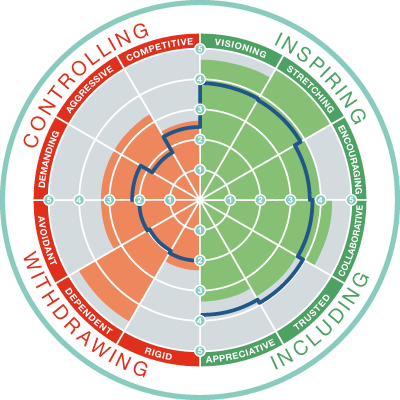
Green climates: the Inspiring and Including quadrants represent green climates – those that build clarity, trust, energy, and commitment through behaviours such as visioning, encouragement, collaboration, reliability, and appreciation.
Red climates: by contrast, the Controlling and Withdrawing quadrants represent red climates which, while sometimes effective in short‑term crises, erode trust and engagement when used habitually through behaviours such as micromanagement, aggression, avoidance, or rigidity.
In decentralised, tour‑assembled environments like BBNZ’s National teams, this framework provides a practical lens for understanding why some campaigns generate ownership, voice, and discretionary effort, while others default to compliance, silence, or disengagement under pressure. In these teams leadership climate can be considered to be the felt experience of being led by the HP team. This spans the experience one has at the recruitment stage, their subsequent onboarding, the connections leading into a camp/tour, tours themselves and the review period after each assembly. They are the conditions created by leaders’ behaviours during both stable and complex, high-pressure context and govern whether people think, speak up, and commit fully, or retreat into compliance and self‑protection.
Defining and contextualising Followership
Contemporary leadership research is explicit that leadership is not delivered one way from leaders to followers but is instead co‑produced through the active judgement, engagement, and agency of followers within relational and contextual systems (4, 5, 6). Within this literature, ‘Followership’ is defined as the behaviours, decisions, and choices individuals make in how they support, challenge, and contribute to collective goals – not simply their positional role or willingness to comply. It is an active function requiring judgement, commitment, and moral courage.
Kelley’s foundational work (6, 7) was pivotal in reframing organisational performance as being driven disproportionately by effective followers. These being followers who think independently and engage actively rather than by compliance‑based execution alone. This reframing shifts attention away from what leaders do to people, and toward the conditions leaders create with others.
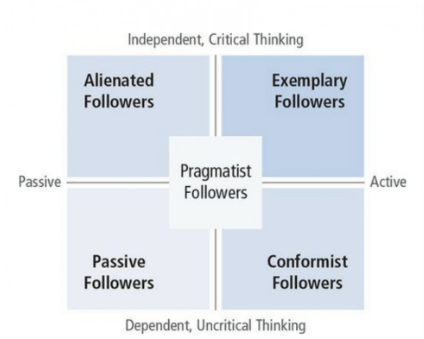
Figure 1. Kelley’s Followership Model (1988)
Figure 1 and Table 1 provide a summary of the five types of followers and what these mean in the context of BBNZ’s HP management teams. For Kelley, the ideal follower was a critical thinking contributor, termed the ‘exemplary follower’. Kelley argues that most leaders prefer ‘conformist followers’ because they are easy to control. ‘Alienated followers’ are critical but do not contribute; and ‘passive followers’ have little to no value other than bring present. A critical thinking follower who is alienated is far more likely to be a negative team member.
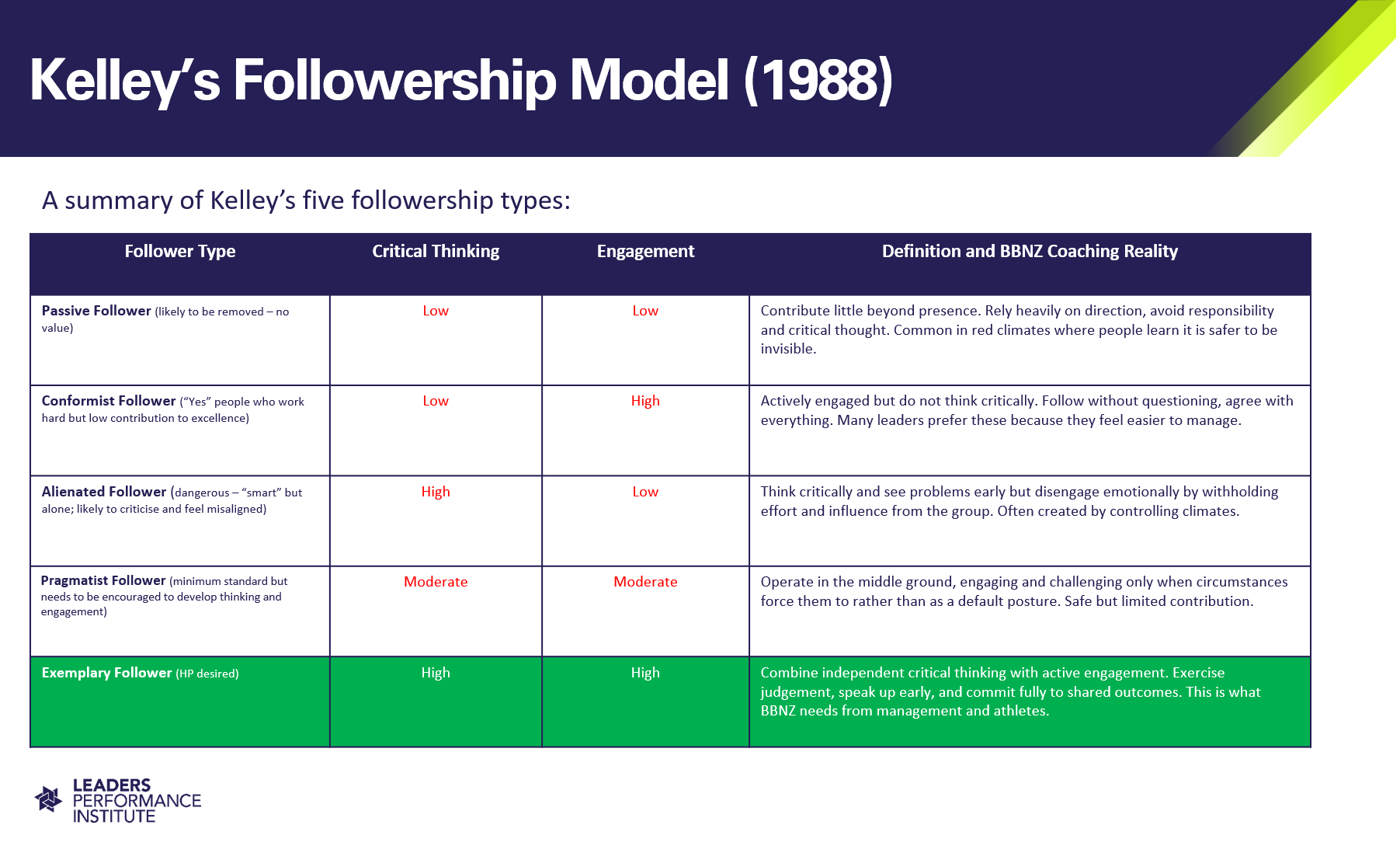
Table 1. A summary of Kelley’s five followership types
A clear understanding of Followership theory and the interaction of critical thinking with active contribution is valuable for organisations like BBNZ, where management teams operate in periodic, decentralised, and contractor‑heavy environments. Once national teams assemble for FIBA events, organisational charts flatten quickly, formal authority as a national sporting organisation (NSO) reduces, and the HP system functions largely through trust, clarity, and discretionary effort. In these contexts, the quality of followership becomes visible in what people do when conditions are uncertain, pressured, or imperfectly resourced.
In tour‑assembled environments, followership quality is a strong determinant of whether standards are sustained, problems are surfaced early, and judgement is exercised when it matters most. Kelley’s insight remains deliberately uncomfortable. Leaders often gravitate toward conformists because they feel easier to manage, yet doing so suppresses the independent thinking and ownership that complex, time‑bound campaigns depend upon.
How Leadership Climate and Followship exist across BBNZ’s national teams
An example of system logic is provided in Figure 2.
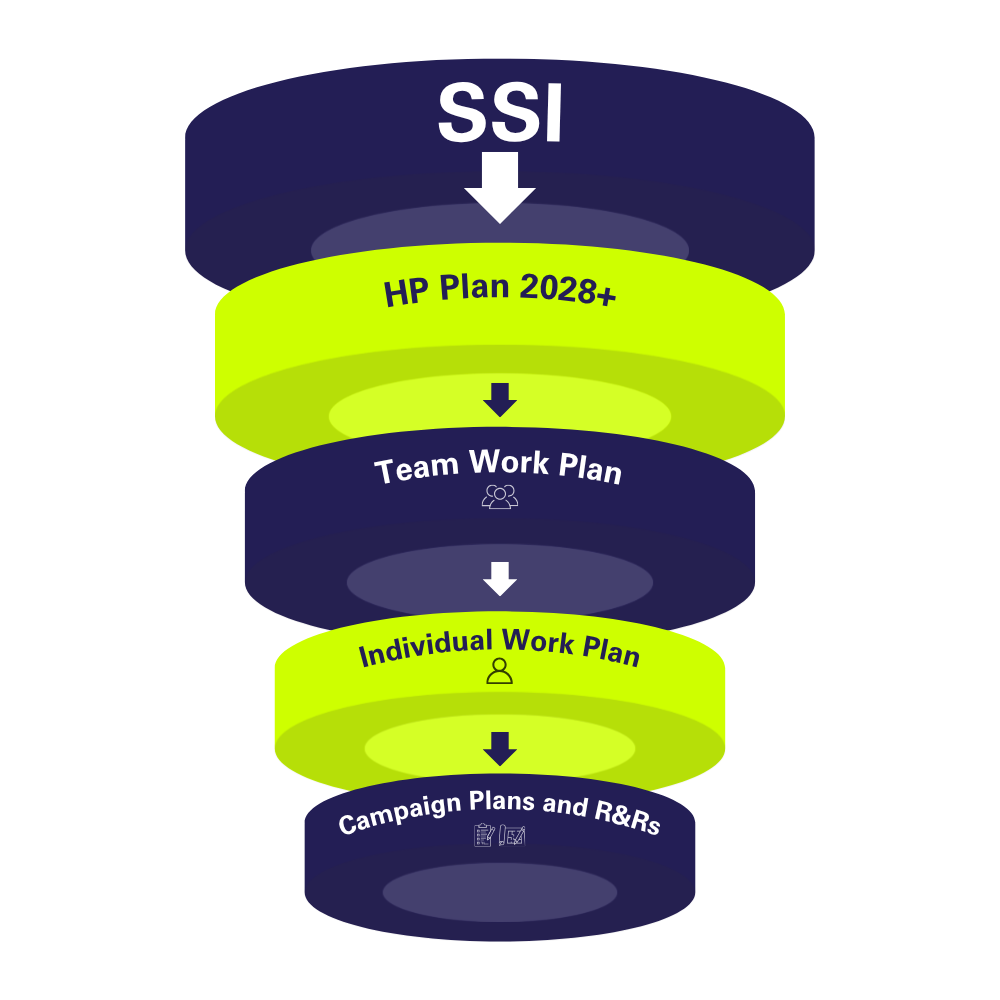
Figure 2. A system logic view of BBNZ HP Strategy spanning the NSO’s Strategic Statement of Intent (SSI) to HP Strategy (HP Plan 2028+) into HP Team Plan that support HP team member’s individual plans that inform how HP constructs and operationalises Campaign Plans and Roles and Responsibilities across various National teams.
In this example, clarity is treated as a primary leadership behaviour. Through making purpose, expectations, roles, and decision rights explicit HP leaders are able to reduce anxiety and guesswork in management teams and create the conditions for Inspiring and Including climates. These favourable climates elevate the quality of followership the HP system produces. Across the HP team’s ways of working there is a deliberate emphasis on a clear, shared purpose, psychological safety, empowerment with accountability, and inclusion.
These act as necessary prerequisites for ‘exemplary followership’ which are characterised by independent thinking and active engagement. Examples of how this is achieved are engaging in collaborative approaches to define ‘What It Takes To Win’ (WITTW), clarifying campaign roles early in a cycle, and making HP expectations visible through Team Charters to allow management and athletes to exercise judgement rather than wait for instruction. When management are recruited and onboarding takes place there is a priority to build early senses of belonging and clarify the conditions for constructive candour and continuous learning. With reference to Leadership Climate terminology, such conditions actively strengthen Visioning, Trusted, Collaborative, and Encouraging behaviours while reducing the likelihood that pressure induces Controlling or Withdrawing patterns.
In the realities of global FIBA tournaments existing in dynamic, uncertain, complex conditions the benefits of positive team climates and exemplary followship are experienced. By making purpose, boundaries, and expectations explicit before and during campaigns, BBNZ increases the probability that touring parties will act as capable followers. Ones who can think ahead, raise issues early, hold standards without being policed, and sustaining discretionary effort under fatigue. The latter is imperative with international travel and compressed recovery windows between competition. In this sense, the HP frameworks developed and communicated are not just management tools, they are deliberate climate interventions that enables leadership and followership to be co‑produced in conditions where formal control is neither realistic nor effective.
At age‑grade level, clarity is what allows people to coach and support with judgement rather than hesitation. When purpose, roles, and decision‑making boundaries are clear early in the cycle, staff don’t wait for permission—they act in the best interests of the athletes. That creates trust, encourages honest challenge, and allows learning to happen quickly. In high‑pressure tournaments, those conditions matter because we need people thinking and contributing together, not just executing instructions.
Mel Bennett (Head Coach of U15-U17 Women and Assistant Coach of 2Degrees Tall Ferns)
From a medical and recovery perspective, clarity changes everything. When roles, decision rights, and expectations are explicit, I don’t have to guess whether to escalate an issue or wait—and neither do the players. It allows us to act early, manage load properly, and hold standards without friction. In the middle of a FIBA campaign, that clarity creates trust, reduces stress, and lets everyone contribute their judgement rather than just follow instructions.
Mikayla Rosieur (2degrees Tall Ferns and U17 Men’s Physiotherapist)
To help better illustrate the interactions of Leadership Climate, the types of climate conditions and Followership, Table 2 maps the JCA Climate Types to Followership Behaviours in the form of ‘touring realities’.
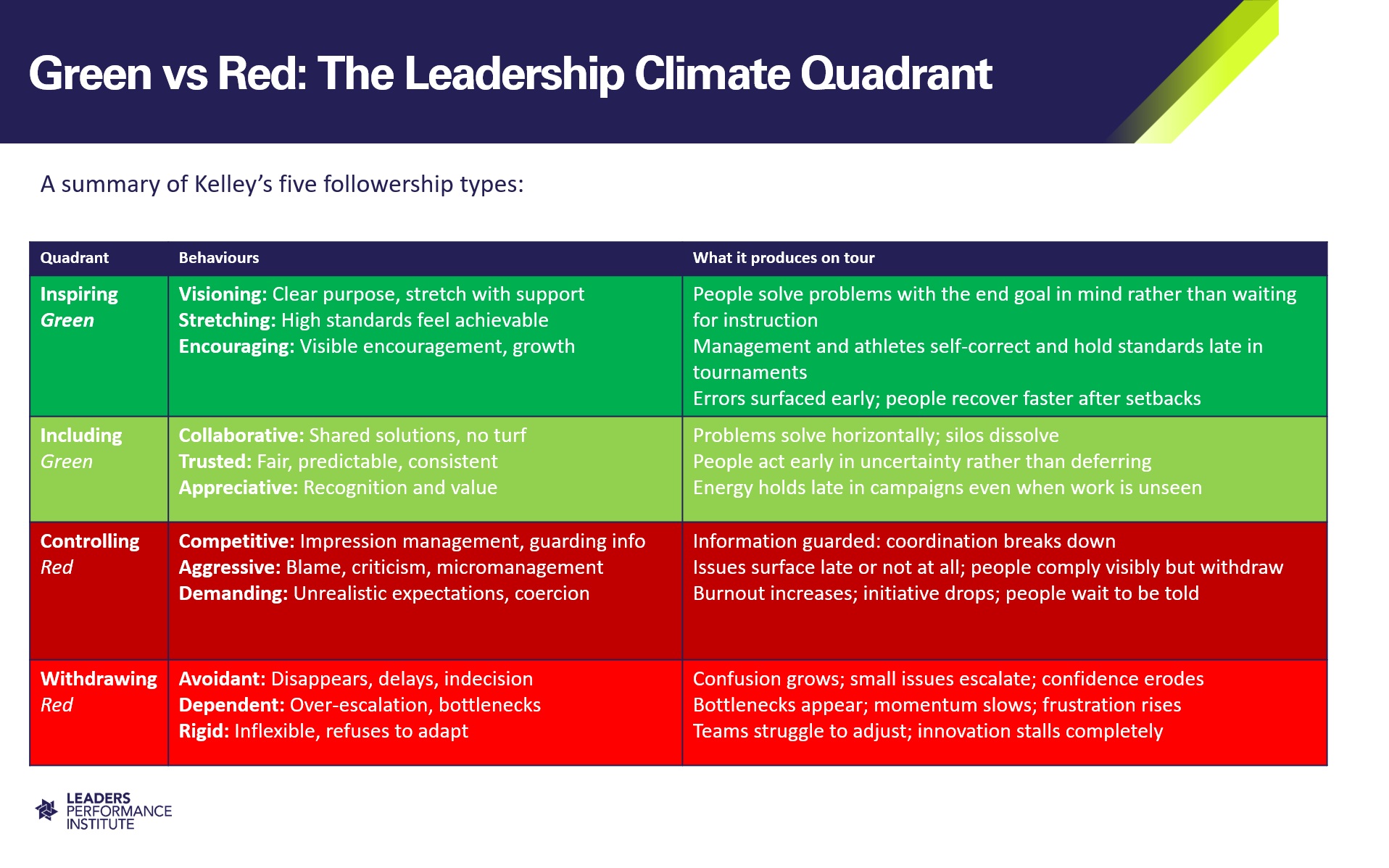
Table 2. The JCA Climate Types mapped to Followership Behaviours in the form of ‘touring realities’.
Recently the BBNZ HP team has constructed Team Charters as an initiative to elevate leadership climate and followership by replacing hierarchy with shared clarity. These charters make purpose, expectations, and behavioural norms explicit so that independent thinking, early voice, and accountable contribution become safe and expected, even under pressure. Through the removal of ambiguity (the primary trigger for anxiety, silence, and defensive followership) the Charters serve to stabilise the emotional climate whilst actively strengthening Inspiring (Visioning, Stretching) and Including (Trusted, Collaborative, Appreciative) climates by ensuring people know what matters, how decisions will be made, and how they are expected to contribute.
Concluding remarks
In decentralised, time‑limited national‑team environments, the decisive leadership task is not to demand compliance but to design the conditions for exemplary followership. That begins with making the why unmistakable for all parties. There needs to be a clear purpose, realistic success markers, and alignment surrounding how each role contributes. These conditions enable the setting of mutual expectations about standards, decision rights, and escalation pathways to hold teams steady under pressure. There is a requirement to create permission for feedback and insights by rewarding early problem‑raising, building trust through reliable follow‑through and predictable communication. HP leaders need to recognise the contributions that sustain standards, energy, and learning throughout campaigns. Create conditions, not compliance because international performance is built on the effort you cannot mandate.
References
At a recent Leaders virtual roundtable, John Bull of Management Futures explained that long-term success depends on preserving what works while embracing challenge and evolution.
He even compared some high-performance environments to a cult.
“Pete didn’t mean that as a negative thing, but he felt there was a cult of personality around figures such as the coach or the GM,” said John Bull, to whom Keen was speaking at the time. “His concern was when they leave; what would happen to performance?”
Bull, the Head of High Performance at Management Futures, recently led a virtual roundtable session for Leaders Performance Institute members that explored the facets of organisations that have sustained their success over a long period.
“Pete challenged us,” added Bull. “He said, ‘it would be great if someone did a piece of research helping us to understand, if you look at sustained environments, what are they doing differently? And what can we learn from that if we want to make a system more sustainable?’”
There are both environmental and leadership dimensions and, as Bull would go on to explain, it is something at which all leaders can work.
“How do you become very good at being a sustained leader within your own organisation? How good are you at balancing adding value for today versus adding value for tomorrow?”
He then posed another question to encourage the table to think about the topic:
If you had to place a single bet on the organisation that will be the most consistently successful over the next 50 years – in any domain you choose – what characteristics would you look for?
In response, the table proposed three characteristics:
With the scene set, Bull turned to a research project titled ‘Radically Traditional’, which was led by Alex Hill, the author of the 2023 book Centennials: the 12 habits of great, enduring organisations. Hill led the project on behalf of UK Sport and the Centre for High Performance.
In 2018, Hill wrote of the project for the Leaders Performance Institute:
Why do some teams sustain success, whilst others stumble and fall? What sets them apart? And how can we learn from them? Well, our findings suggest it’s by becoming Radically Traditional. With a stable core – purpose, stewardship, openness – and a disruptive edge – experts, nervousness, accidents.
Back at the roundtable, Bull attempted to illustrate this idea:
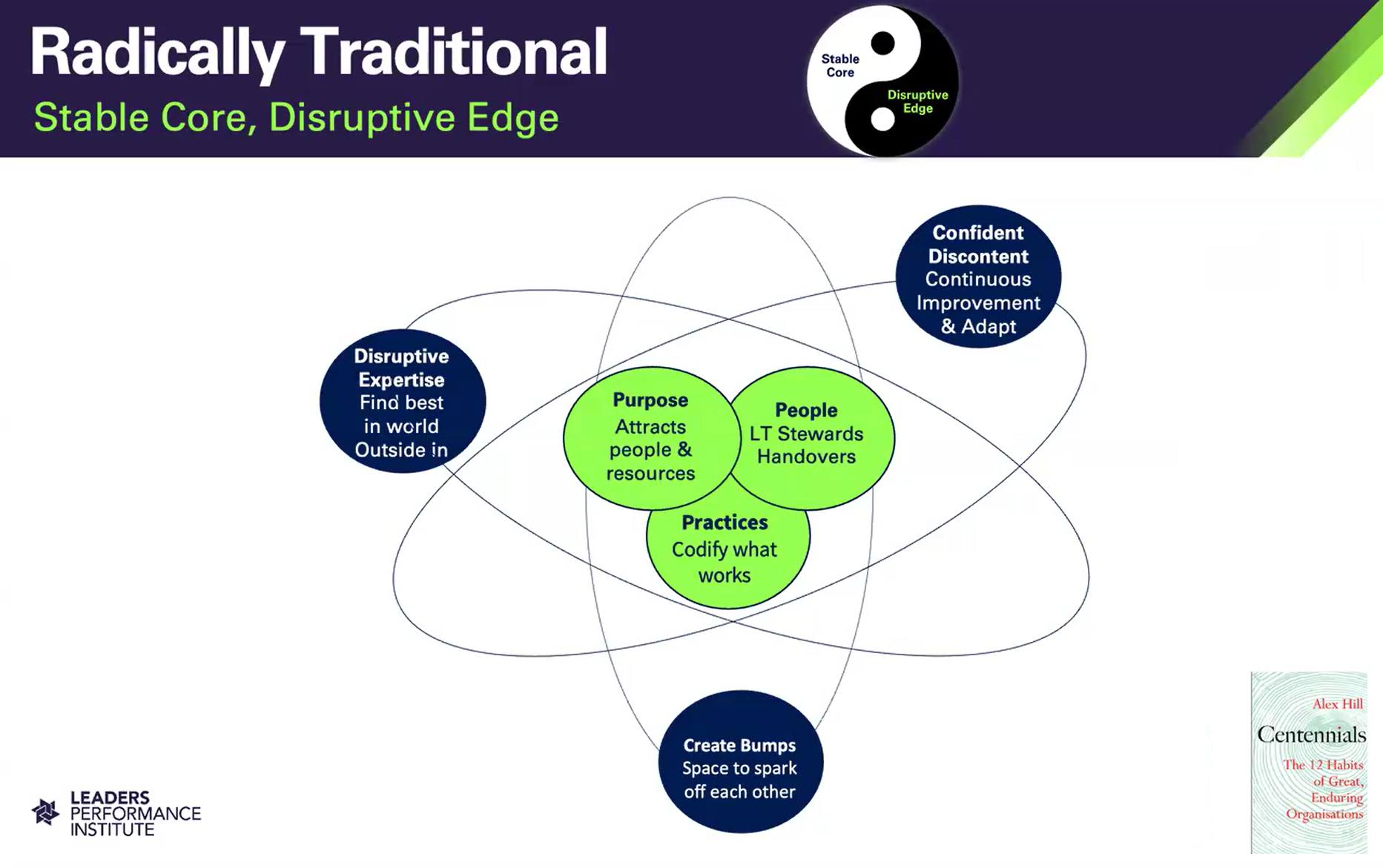
He then explained each element in turn.
The stable core
The disruptive edge
When it comes to finding a disruptive edge, Bull cited two leaders who proved their credentials.
Firstly, Peter Blake, the founder of Emirates Team New Zealand, the perennially successful America’s Cup sailing team.
“His founding principle was we want to combine insights from sailors and the designers,” said Bull, adding that this did not sit well with the team’s designer, Bruce Farr.
“Farr decided he didn’t want to listen to sailors messing with his design and, very courageously, Blake said, ‘well, that’s fine. Then you’re not the designer for our campaign’; given that Farr was the best designer in the world, that was pretty courageous.”
That was in the early 1990s; Team New Zealand has since gone on to win the America’s cup five times, including the last three editions.
Bull’s second example is Gene Kranz, who served as one of NASA’s Flight Controllers during the Apollo Lunar missions of the 1960s and early 1970s. Kranz made sure that his team at the Manned Space Center in Houston regularly ate meals together.
The bonds formed during those mealtimes were likely critical to the Apollo missions, especially during the successful effort to bring home the stricken crew of Apollo 13 after an explosion occurred on their spacecraft 200,000 miles (320,000 km) from Earth.
There is, as Bull explained, power in breaking bread with your peers and colleagues. “Without a doubt, the best problem-solving discussions I ever heard were when the senior team were around a table eating lunch,” he said. “And if you go back to if I were betting on an organisation, one of the things I’d do is walk into the café and I’d want to see if mobiles are out or if people are engaged in conversation and how mixed the tables are across function.”
A member from a military background told the table that he has tried something similar with his team. He said such interactions can generate “something that solves some problems that you as a leader didn’t necessarily foresee”.
He added: “that’s a major organisational decision to be comfortable with maybe a little bit less productivity with a purpose that that is an investment in future productivity based on relationships.”
As the session wound to a close, Bull steered the conversation towards four transitions to which we need to pay attention (and the risks to avoid):
1. Big success: the risk of complacency
“It can be really hard to avoid,” said Bull. However, in environments of sustained success, he has noticed “leaders are slightly paranoid when they get success; and that’s what drives them to go further.”
2. Big failure: the risk of overreaction
“The danger is that we throw the baby out with the bathwater; that we throw out some of the good as well as some of the things that we don’t need to change,” said Bull. “But there’s something about going ‘not all tradition is worth keeping’.”
3. Change in key people: the risk of losing knowledge
“One of the key things is managing handovers,” said Bull. “I think it is also looking to recruit for curiosity and humility. Sure, you want people to bring in some disruption and change, but you also want them to spend some time figuring out what has worked and not change everything.” He returned to Keen’s observation about cultish environments. “How do we make them not cults but a repeatable formula that can pass from generation to generation?”
4. Significant external change: the risk of slow or inadequate adaptation
“What’s interesting in the sustained organisations is they are often not the first to come out with a new innovation, but they are the first to start thinking about it and innovating,” said Bull, who observed that they can be conservative by nature, which does not quell their desire to test and learn. “They’re big believers in evolution rather than revolution in that sense.”
If you have any further questions around how to sustain success with your team, feel free to reach out to Management Futures directly via [email protected]
What to read next
As John Bull of Management Futures explains, change initiatives fail not because the change itself is wrong but because the human transition is misunderstood, ignored or rushed.
John Bull, the Head of High Performance at Management Futures, poses this question at a virtual roundtable for members of the Leaders Performance Institute where the topic of the day was ‘what makes change stick?’
To set up the conversation, he looked at the twin elements that enable sustained change (people taking ownership of the change and the idea of change itself as a habit) before identifying some of the common sources of resistance.
“There are times where we will resist change, we’ll engage less quickly in it, even when we have to; or we waste energy in how we’re responding to change,” said Bull. “But we also have to understand resistance from others and what that requires of us as leaders.”
People, he explained, resist change for two primary reasons: loss (what they perceive they are losing) and uncertainty or ambiguity. It is not enough for a leader to merely sell the change.
He continued: “If we’re just pushing change and we haven’t understood what people perceive they’re losing, then we run the danger of increasing the resistance rather than decreasing it. By understanding where the resistance is coming from and being able to address that, we’re in a much better position to be able to lead it.”
A ‘change’ or a ‘transition’?
In simple terms, as Bull explained, change initiatives fail not because the change itself is wrong but because the human transition is misunderstood, ignored or rushed.
He illustrated this distinction between ‘change’ and ‘transition’ with a slide:
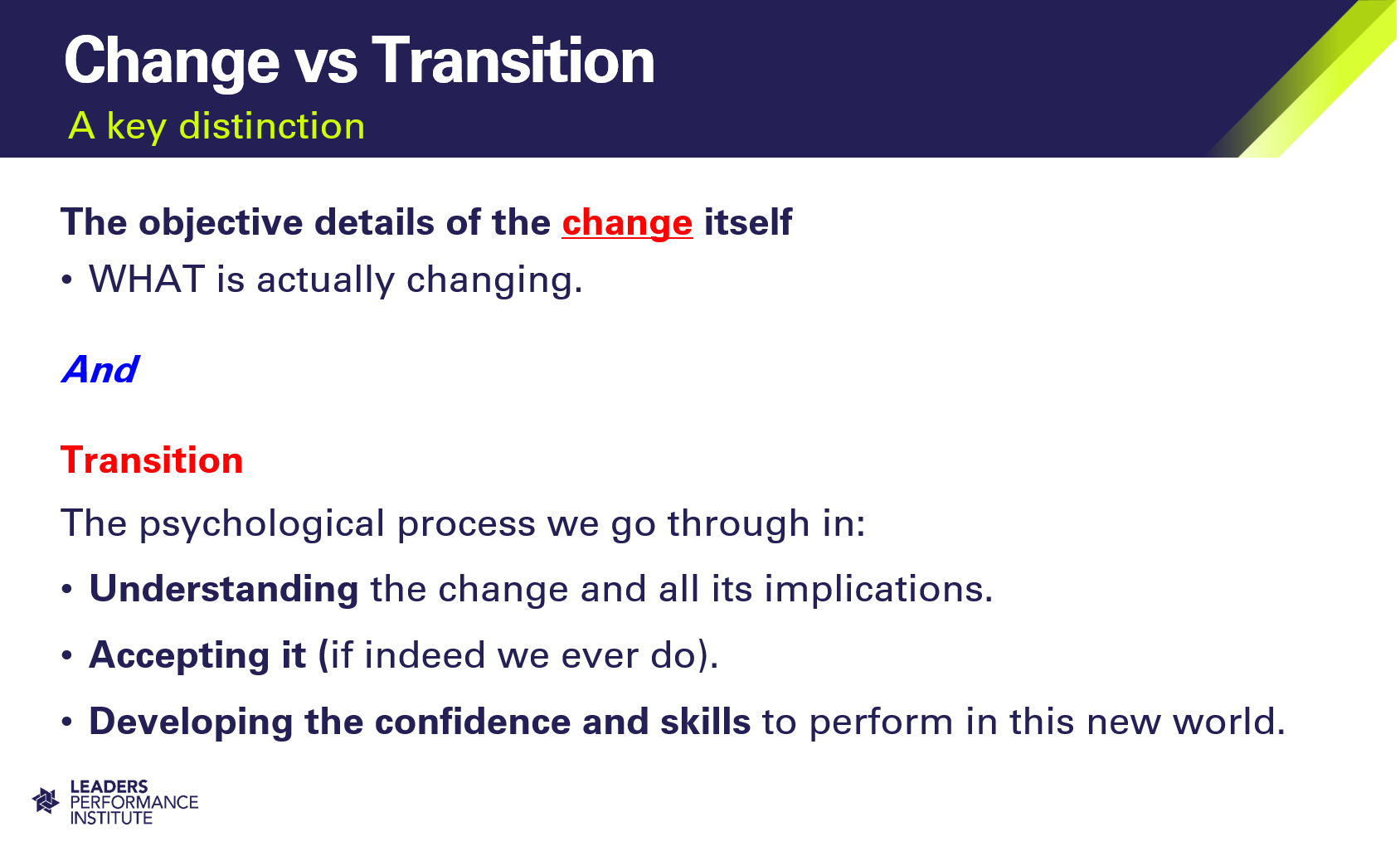
“The object of change is quite straightforward; transition can be super complicated,” he said, “and what we tend to do in organisations is not pay nearly enough attention to managing transition. We forget about that.”
To help the virtual room in this regard, he introduced attendees the three phases of transition:
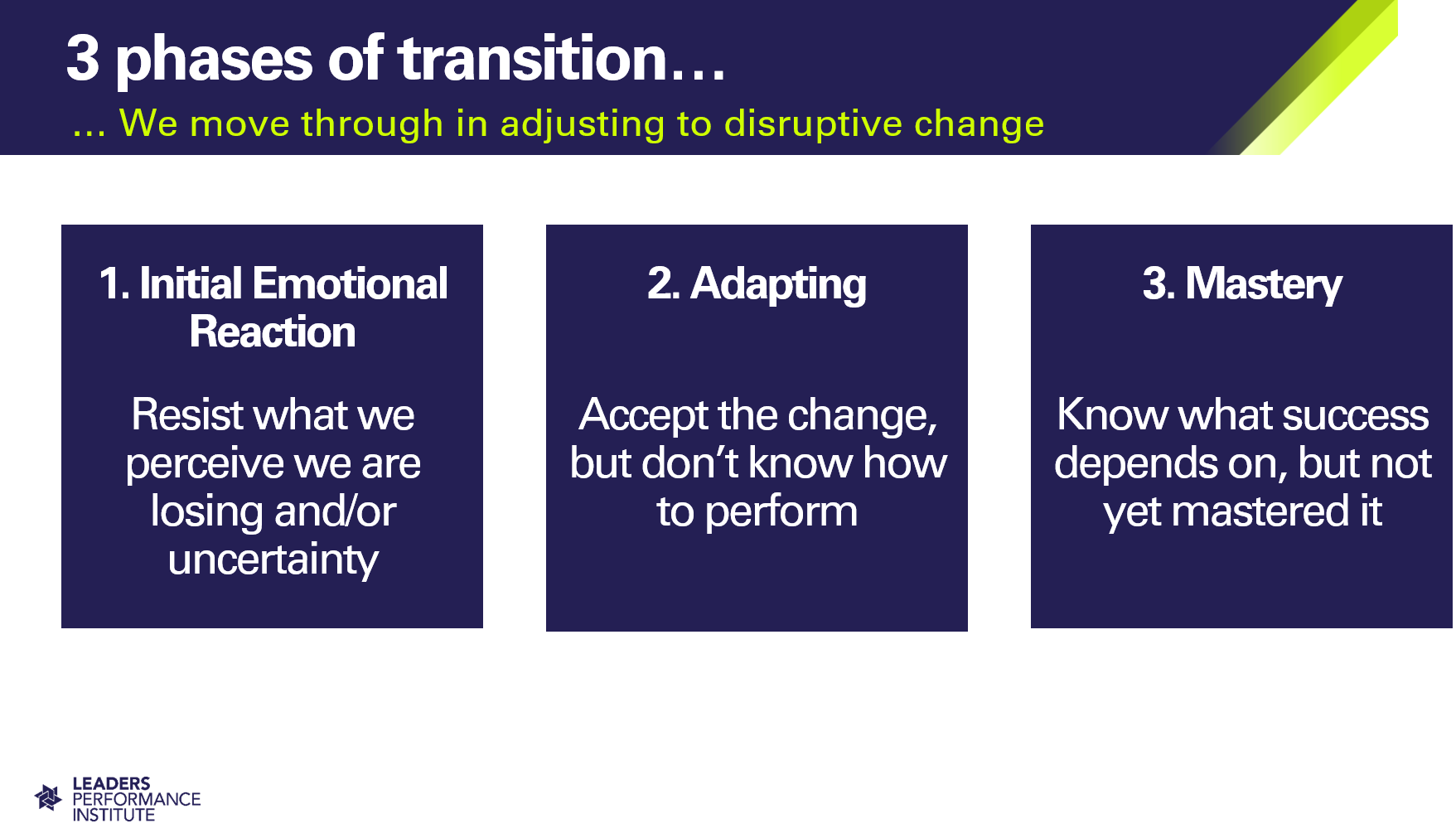
These are an adaptation of the ‘unfreeze-change-refreeze’ model of German-American psychologist Kurt Lewin, who drew attention to the emotional and behavioural elements of change. Modern scholars, including William Bridges (whom Bull also namechecks), place an emphasis on the personal dynamic.
Bull brought these three phases of transition to life by describing how he went through each in response to a postponed work project:
The key thing about stage one is I am still really frustrated and annoyed with certain individuals that have led to that happening. Now, I would say on one level, that’s really understandable. It’s a significant project that we were really excited about; but here’s the key point: it is useless and doesn’t help me one bit. So all the energy that I’m investing in the frustration is not going into the adapting; and what I should be spending much more time on is focusing on what do we need to do to adapt now that change has happened.
With the behavioural elements of transition established, Bull then set out what neuroscience tell us about human resistance to change, with reference to the SCARF model.
This framework, devised by neuroscientist David Rock, sets out five domains that influence human social behaviour and motivation. ‘SCARF’ stands for ‘Status-Certainty-Autonomy-Relatedness (Relationships)-Fairness’. Bull explained each in turn:
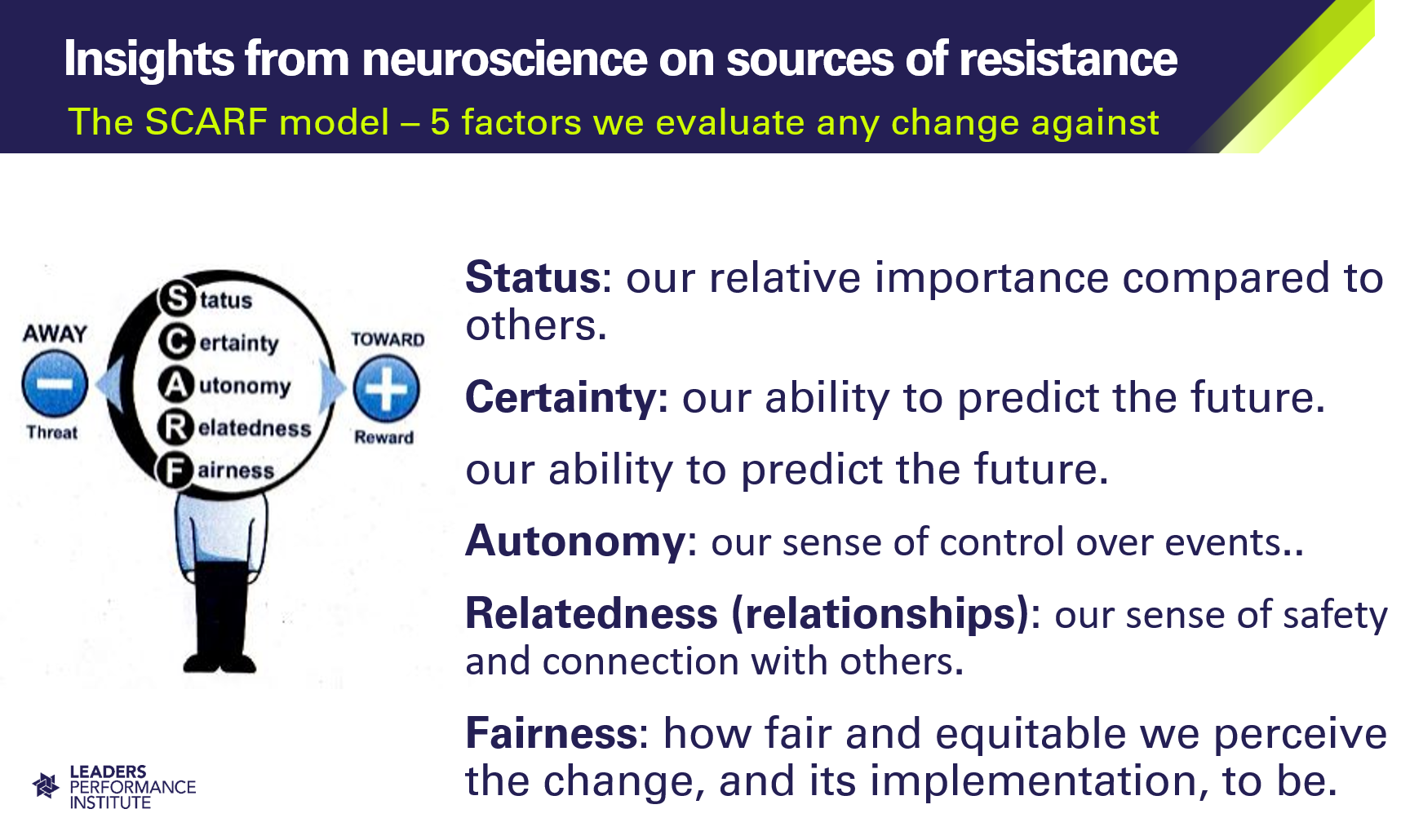
Depending on their circumstances, people can either feel threatened or rewarded in each of these domains.
“I’m not constantly thinking about the SCARF model,” said Bull. “I use it when I get a response from a client that surprises me; then I’ll go back to the SCARF model and go ‘what might I be missing?’ But it’s also a really good model when you’re thinking about how to frame and communicate the change. Because each of these can give a negative hit, but you can also think about ‘how do I promote this change? How do I sell this change in a way that it highlights how it might increase status? How might it increase autonomy?’
He then returned to the three phases of transition and set out the possible traps to be avoided for both individuals and leaders:
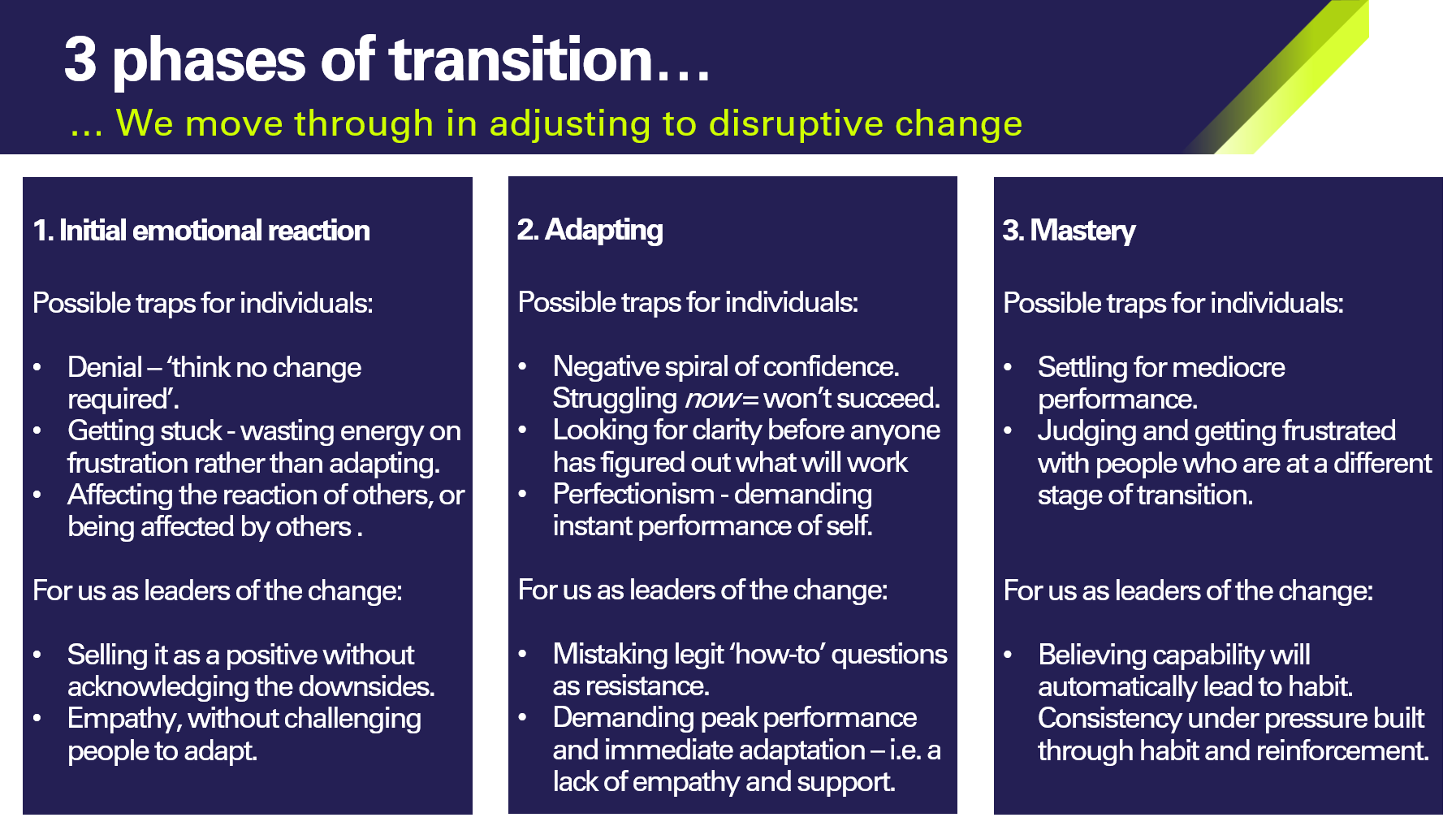
Bull emphasised that these traps reflect predictable human responses when transition is not adroitly led rather than poor intent or capability; and, if anything, leaders often respond with the wrong behaviour at the wrong stage.
He then pivoted towards organisational psychology, specifically the idea of change-curves.
People can respond both positively and negatively to change and these reactions can be plotted on a ‘change curve’. First, he showed the virtual table an example of a negative response to change:
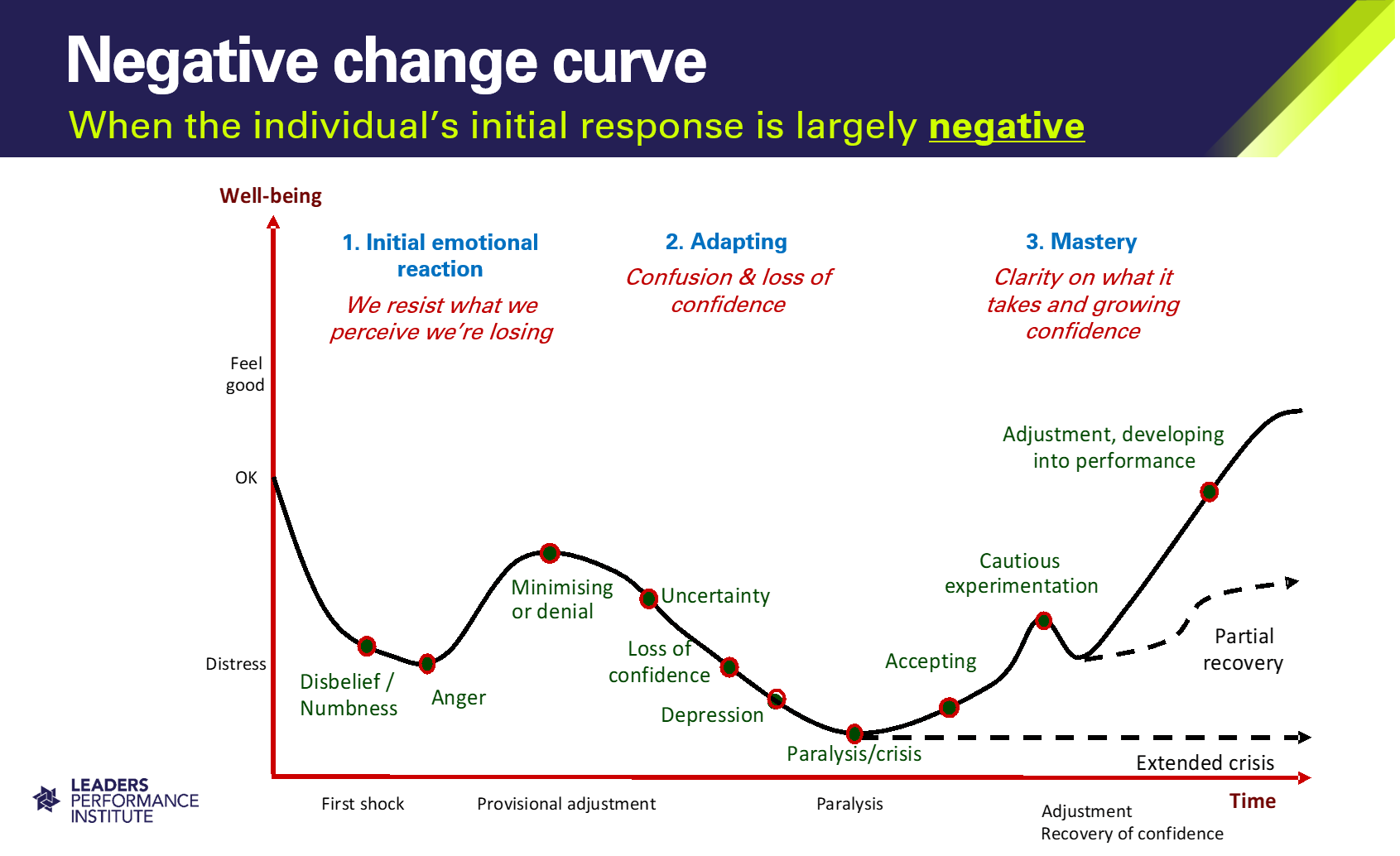
Bull explained the line of trajectory through his own negative experience of discovering that a restaurant in Bath had stopped serving his favourite pizza.
He added: “I just want to make the point: you don’t move linearly through each stage. I think of it more as water sloshing through a container. You will be partly in stage one, partly in stage two. So even though I’m intellectually trying to figure out what am I going to have on the menu, I’m still partly in frustration.”
Bull then shares an example of a positive change curve:
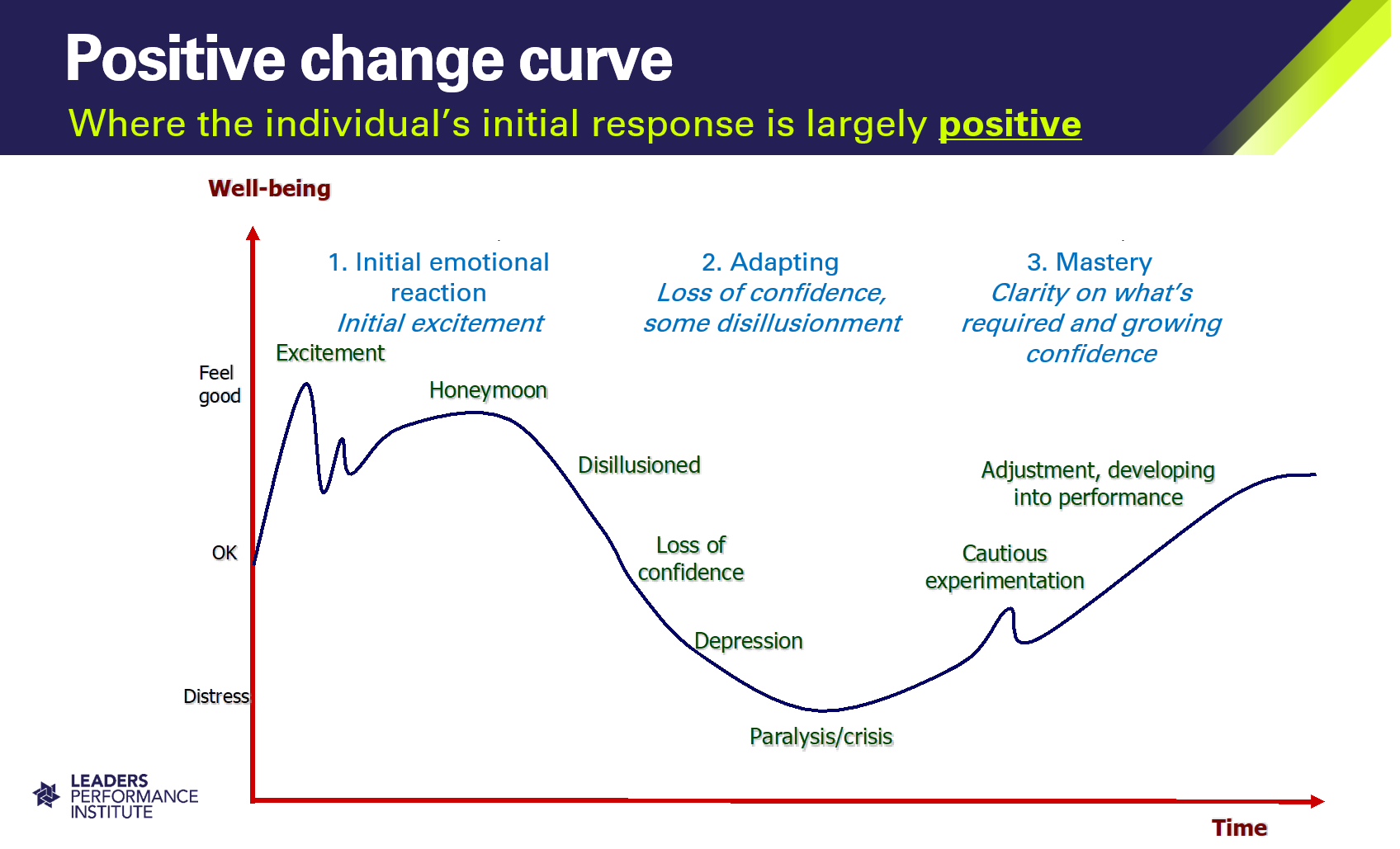
He noted that positive change:
Next, Bull summarised what people need from their leaders at each phase of transition:
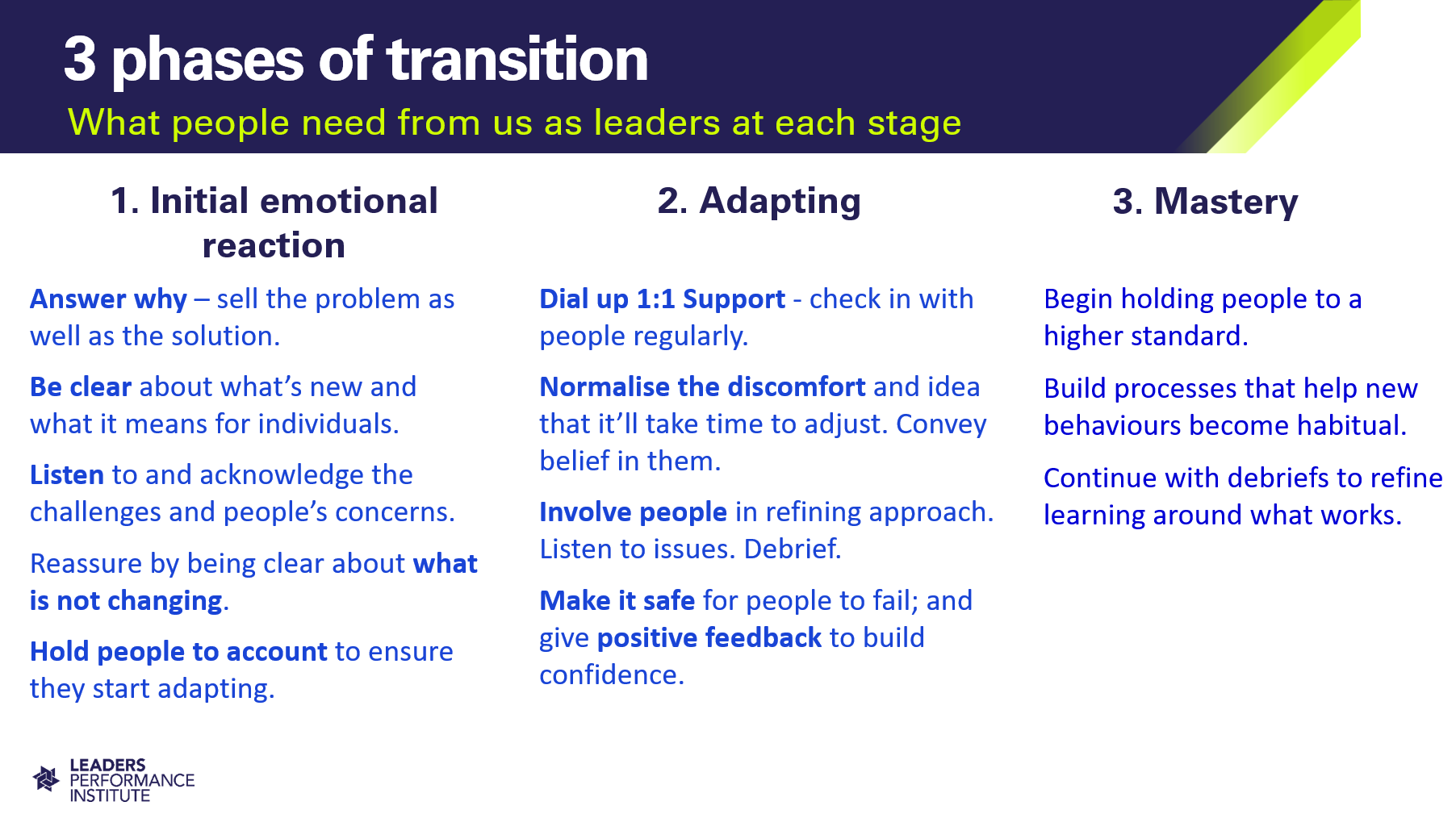
To wrap up his presentation, Bull suggested the ‘Four Ps’ model as a communications tool for members to use in their teams when leading change. It can help hold the process together and ease the psychological demands of transition:
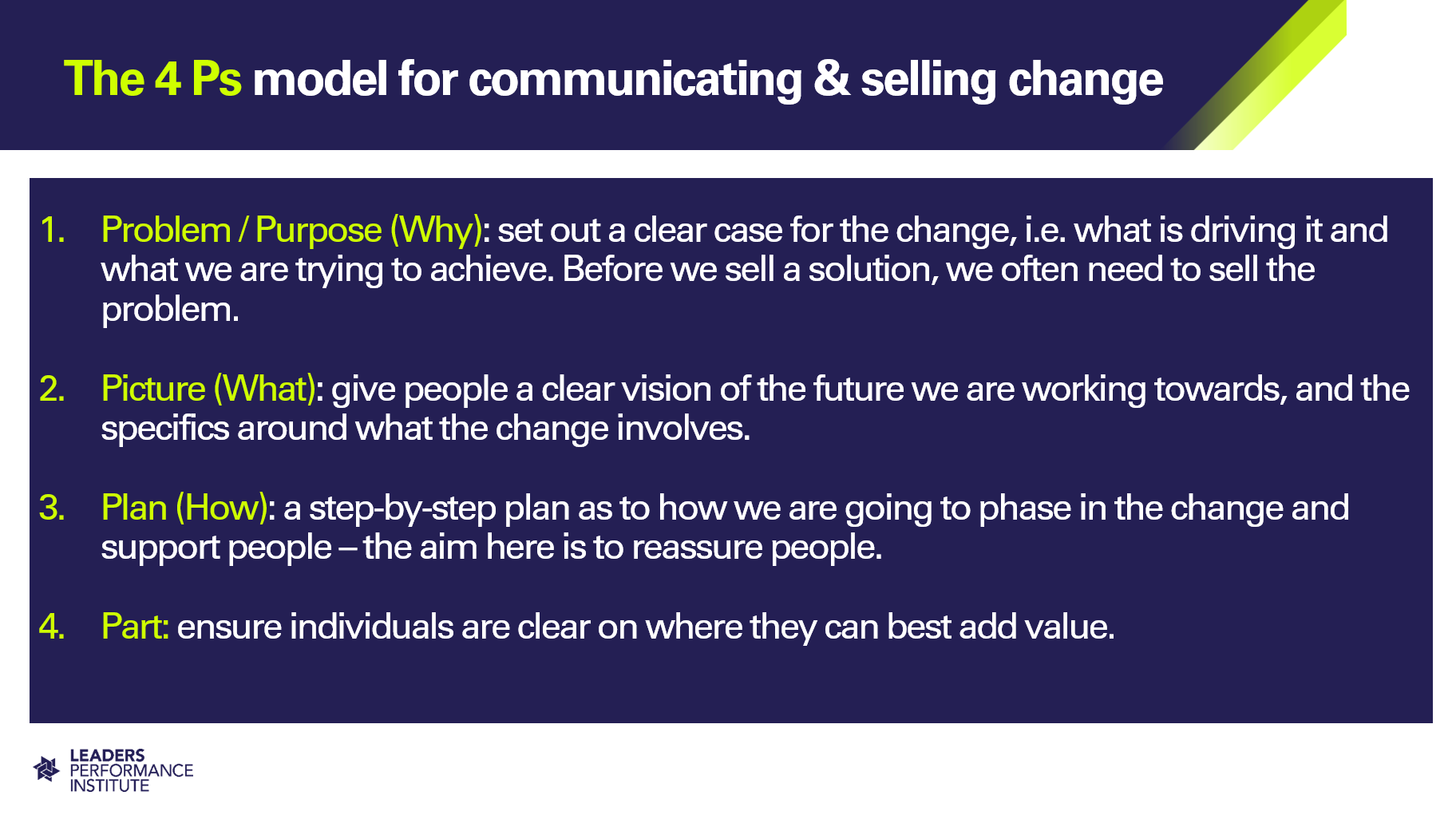
He said: “This isn’t new content, but it’s a new way of presenting it; it tends to be one of the things people remember six months, 12 months later.”
What to read next
Rec Revolution: Does Transformational Leadership Theory Explain Bath Rugby’s Resurgence?
In our latest Leadership Skills session, Jeff Pagliano of Management Futures reframes how organisations should understand, shape and protect their cultures.
Amaechi’s words are shared by Jeff Pagliano, a consultant with Management Futures, who in our latest Leadership Skill Series session, introduced members to tools that will enable them to help shape their team’s culture.
How do cultures develop?
Pagliano began his presentation with a definition:
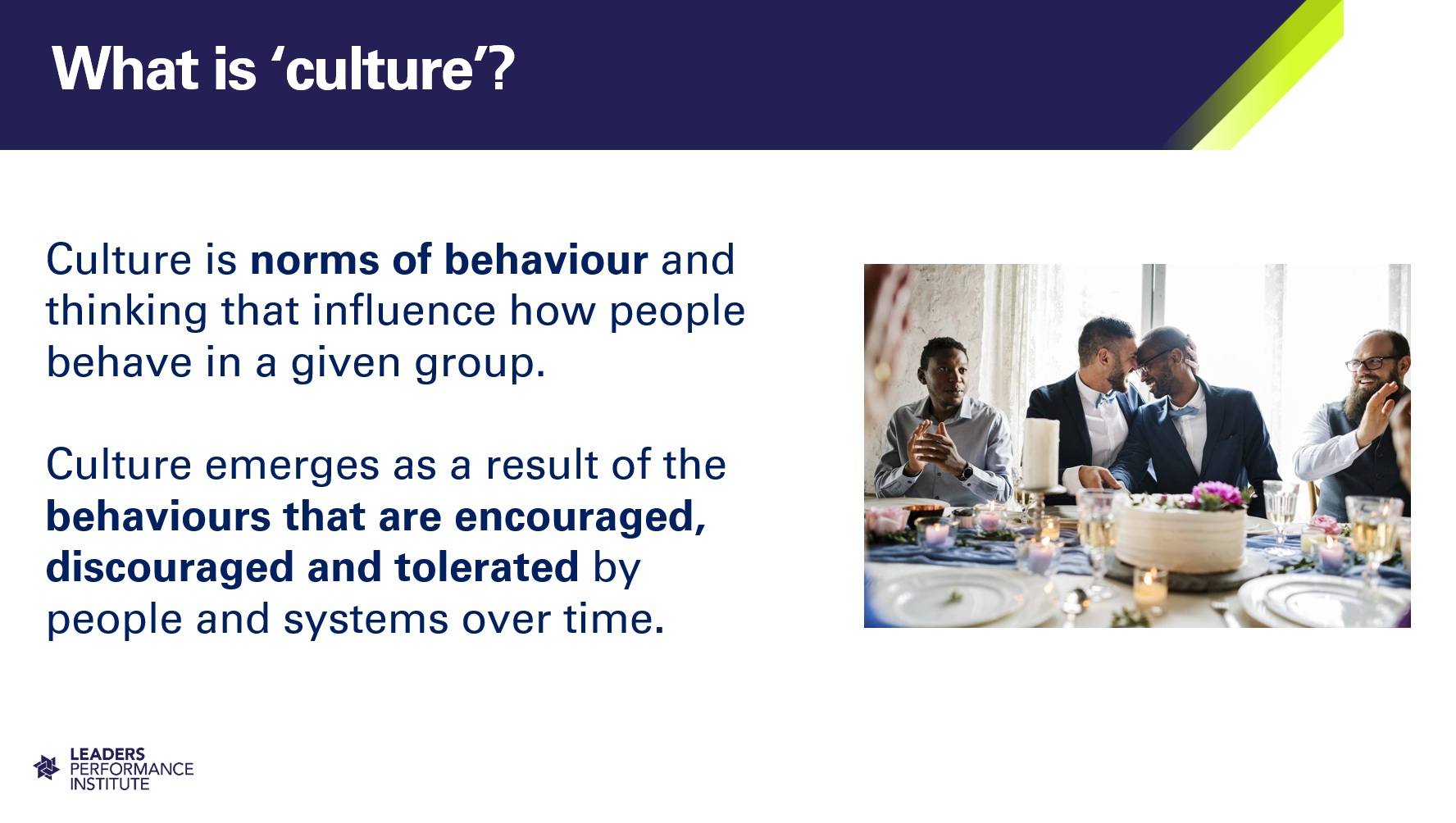
Management Futures uses the analogy of tables at a wedding reception to explain how cultures develop.
“You’ve seen how at a wedding each table develops its own personality,” said Pagliano. “It’s interesting that even in those interactions where some people know each other or some people don’t, a culture begins to form around that table. You can have the rowdy table, the quiet table; some are eager to get up to dance and some are not.”
What we see, what we say, what we believe
Pagliano then shared his ‘cultural iceberg’ model, which has been inspired by Swiss-American psychologist Edgar Schein and his pioneering work on organisational culture:
What we see
“This is literally what we see. So behaviours, systems, and processes,” said Pagliano. This could be how people interact, how leaders comport themselves, what actions are common or repeated. It also includes the physical environment (e.g., office layout or the visibility of team members).
What we say
“These are our goals, values and aspirations.” In other words, the official narrative.
What we believe
“These are the underlying assumptions we have about the organisation.”
The risk of emerging ‘shadow’ values
Underlying assumptions can lead to the emergence of what Pagliano calls ‘shadow’ values – unspoken, unofficial rules.
“Employees are acutely aware of what is rewarded or encouraged in everyday activities,” he said.
Pagliano quoted the British government’s sports funding agency, UK Sport, in making his point.
Therefore, it is important to be able to ‘map’ your team’s cultural influences to better help you understand who shapes your culture and in what ways.
Mapping cultural influences
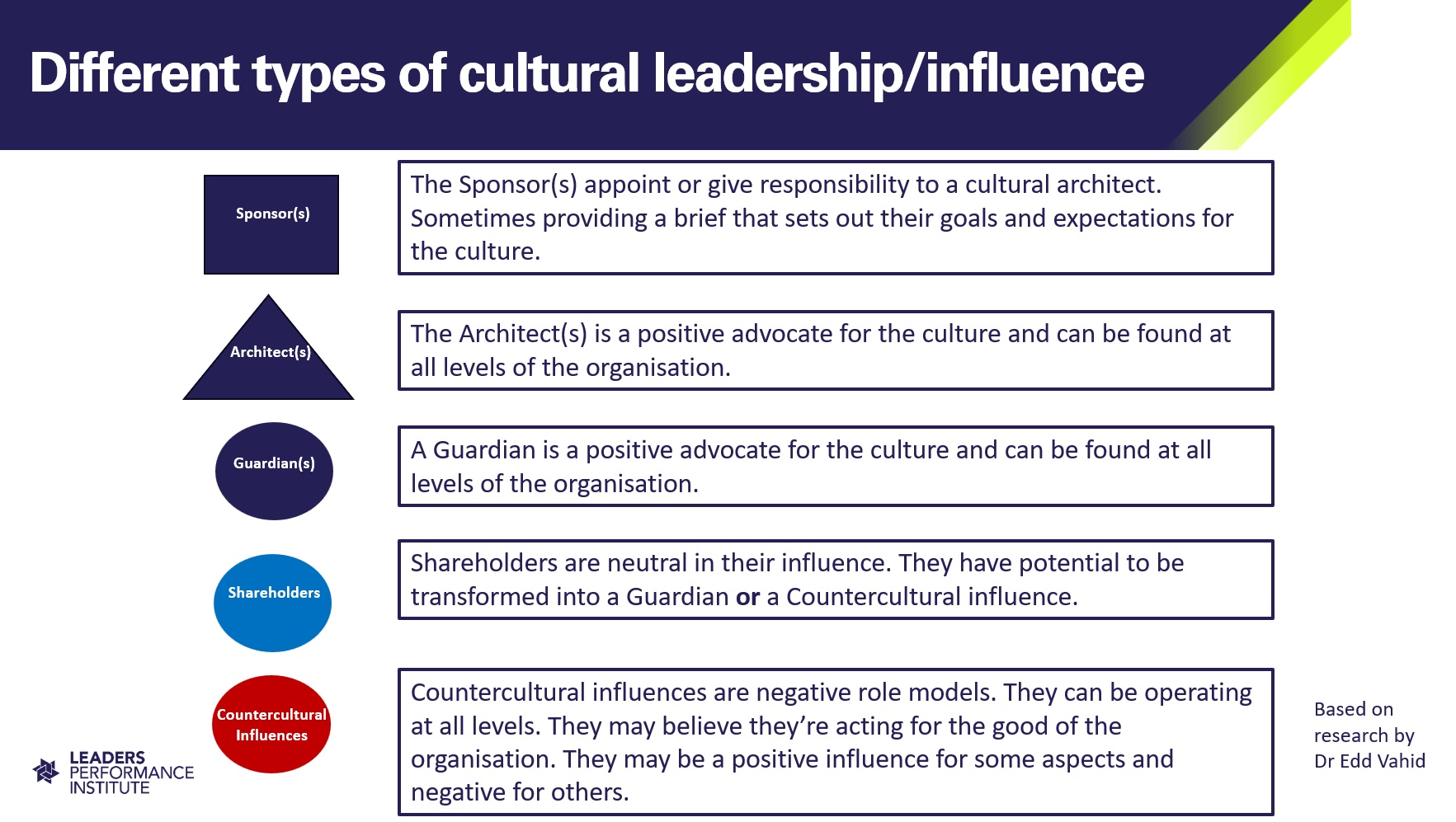
For this part of the session, Pagliano called upon Dr Edd Vahid’s Cultural Hypothesis, in which he spoke of the importance of ‘sponsors’, ‘architects’, and ‘guardians’ in shaping a culture through a combination of leadership and influence.
Pagliano added two further categories: ‘shareholders’ (“I would argue that everybody who works in an organisation is a shareholder”) and ‘countercultural influences’ (“countercultural influences are negative role models that can be operating at all levels”) and presented the following slide:
He then shared a hypothetical example of a cultural map that pulls on these five types. The result is a complex diagram:
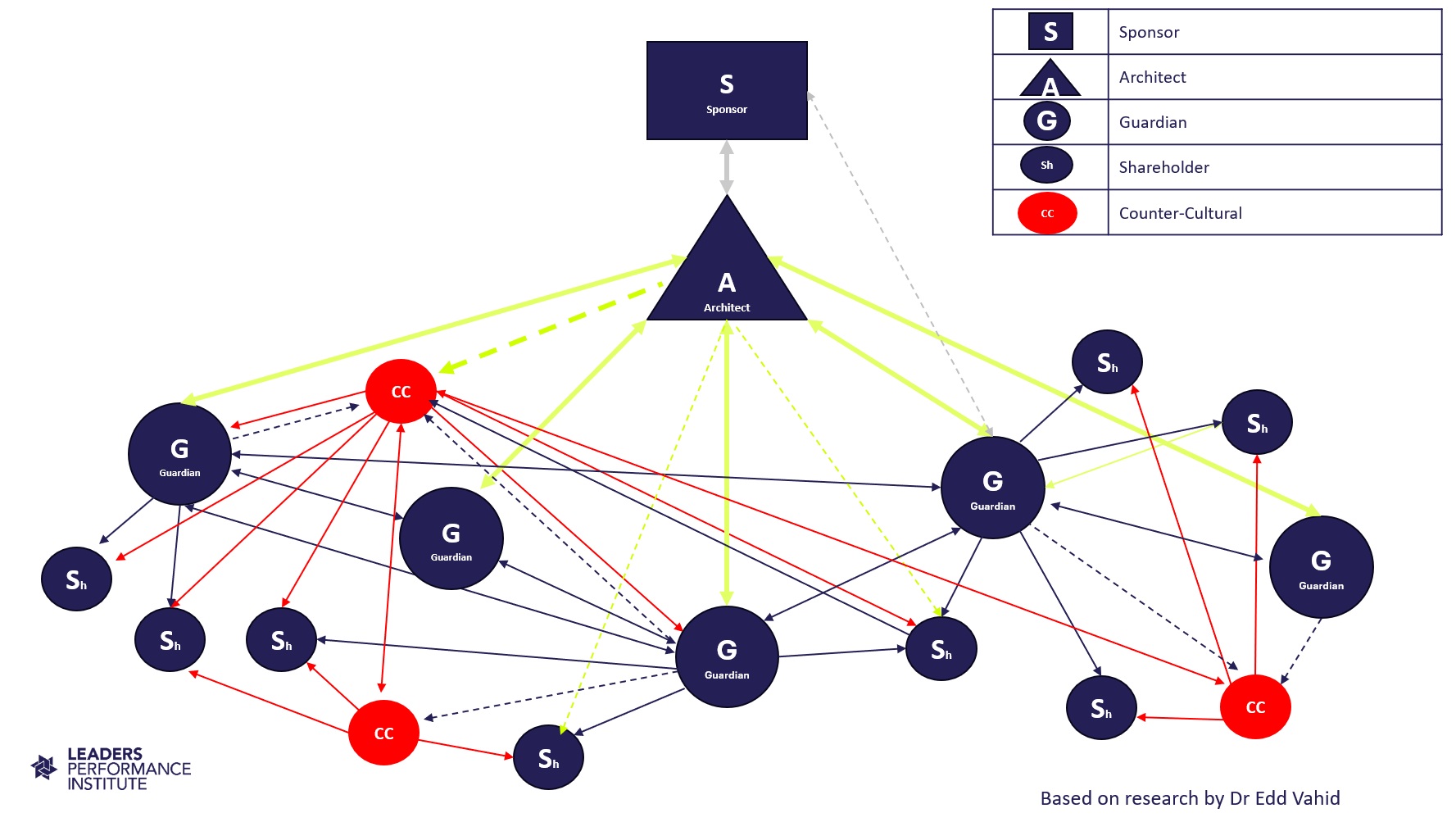
“Your sponsor is at the top,” said Pagliano. “That can be the owner of an organisation, maybe a GM, maybe a coach, but it’s somebody who has the ability to decide whether resources are allocated for building culture.
“Then you have the architect: the one who thinks about ‘see’, ‘say’, and ‘believe’. This is the person who has the ability to influence processes and has decision-making power.
They may or may not be the leader of the organisation, but they certainly have the ear of the leader.
“Then below is where the web gets a little complicated. This is where you can see how certain policies, procedures and aspects of culture can intertwine and be influenced.”
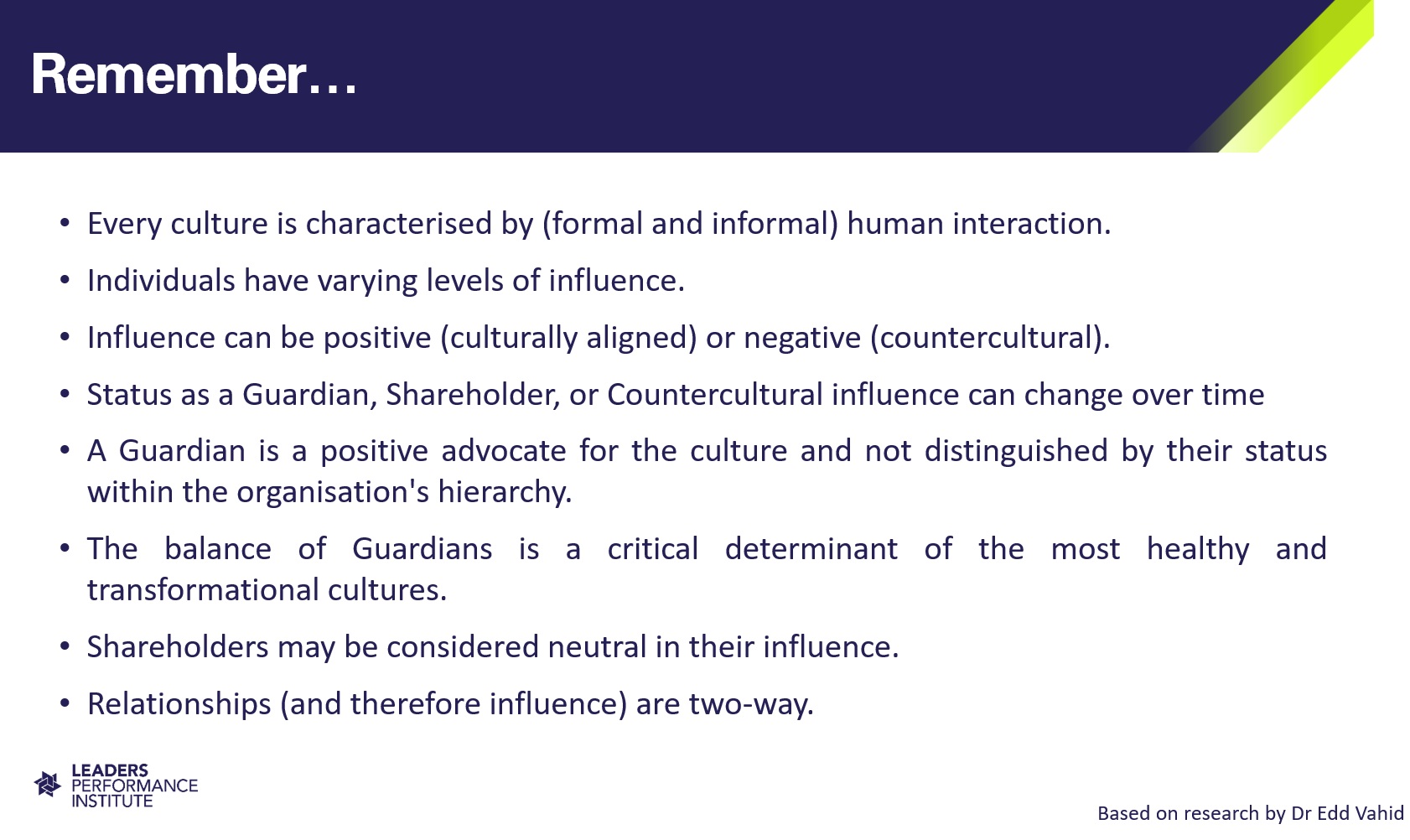
Pagliano concluded this section with a summary:
He concluded his presentation with six cornerstones of cultural leadership.
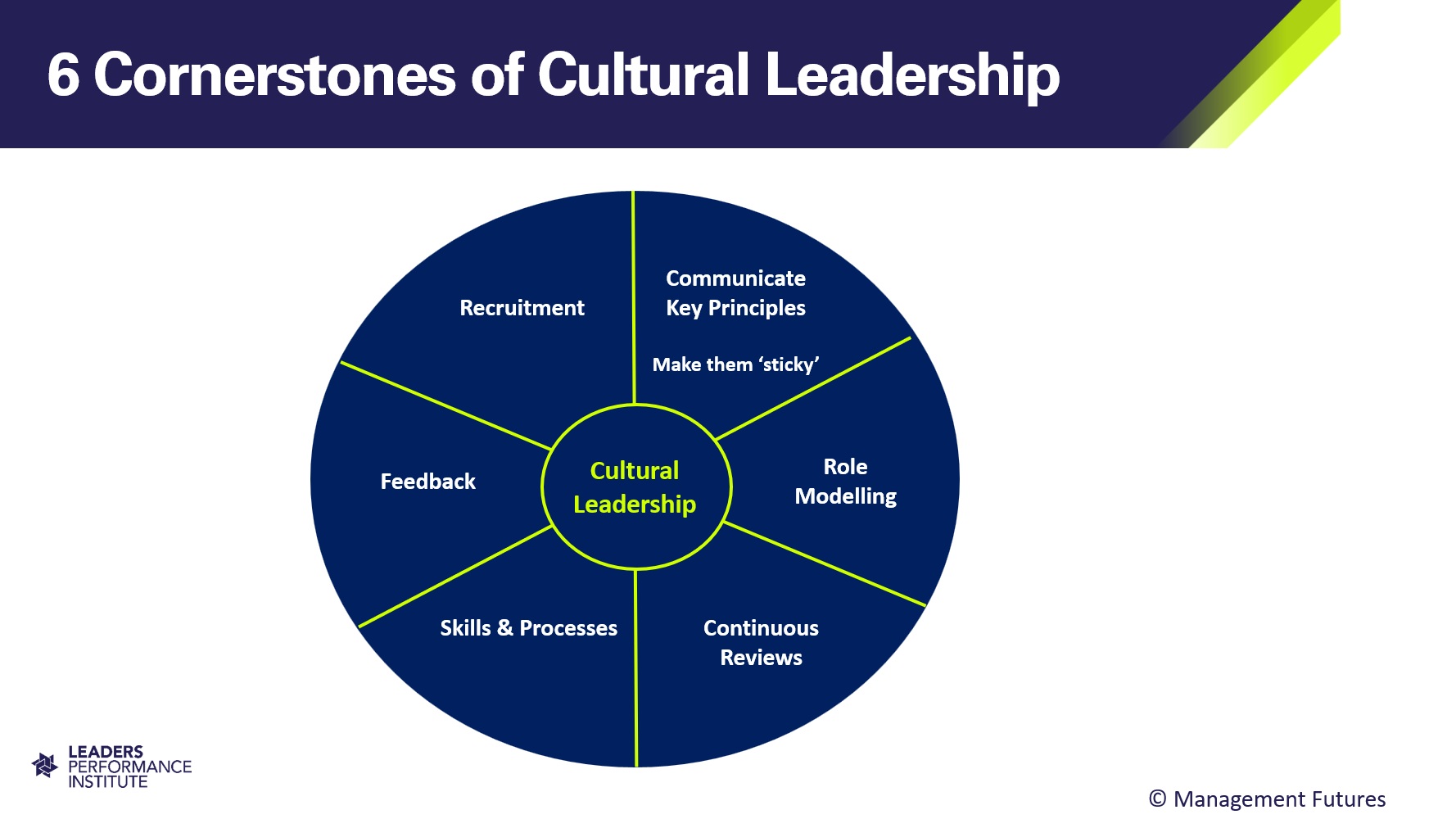
“These are the six levers that any culture leader, whether it’s your sponsor or your architect, can pull to make sure that vision of culture is consistent across your organisation.”
He then gave a real-life example for five of the six.
Communicate key principles – Netflix
“Netflix’s key principle is ‘act in Netflix’s best interests.’ And so their culture of ‘Freedom & Responsibility’ can be captured in these five words,” said Pagliano. “Anytime there’s a decision being made, you can always ask your team, ‘are we acting in Netflix’s best interests?’”
Role modelling – Collingwood FC
Pagliano explained that Collingwood’s Senior Coach, Craig McRae, asks himself daily, “‘to what extent are my day‑to‑day actions equal to our ambition?’” The Melbourne-based club were AFL premiers in 2023.
Continuous reviews – Pixar
“They had this concept of appreciative inquiry,” said Pagliano of Pixar. “It’s all about setting examples of excellence to create a blueprint for future performance.” In testing Toy Story, for example, the relationship between Buzz and Woody wasn’t working. So they went back to the drawing board over the course of six days and created those characters that we know and love today. Further down the line, they would go back and ask, ‘what were we doing right during those six days when we pulled together?’”
Skills and processes – the UK Sports Institute
This example is specifically about their approach to developing their staff members’ “teaming skills”. “This can come down to something as simple as ‘speak up, listen up’ and then a shared responsibility for performance,” said Pagliano. The UKSI wanted to teach “teaming skills across the different groups so that when groups from different parts of the organisation interact with each other, they have a shared language.”
Feedback – Doctors Without Borders/Médecins Sans Frontières
“Their motto is ‘we are intolerant of, but empathetic, when people don’t initially meet our high standards’,” said Pagliano, who explained that employees are given “three strikes”. “Feedback as a continual part of the process is really important to maintaining their culture.”
Recruitment – get the right people on the bus
Pagliano does not give an example for recruitment. Instead, he poses a question: “When you’re looking to hire folks, who do you think is going to buy into your shared cultural values and who is going to be a guardian or an architect of that?”
If you have any further questions around how to understand, shape and protect their cultures, feel free to reach out to Management Futures directly via [email protected]
What to read next
During his time with the INEOS Britannia sailing team, Peter Hodgkinson built an environment that enabled his young staffers to learn and thrive under pressure. As he explains in this exclusive column, intent-based leadership and psychological safety were at the heart of his approach.
Main Image: Getty Images/Fiona Goodall
We achieved a number of national firsts: the first British team to win the Challenger Series, fending off some tough opponents; the first British team to contest the Match itself in 60 years; and the first British team to score points in the Match for 90 years.
There was no shame in eventually losing 7-2 to Team New Zealand, who claimed their third consecutive victory. We gave it a good go against the team our helmsman, Sir Ben Ainslie, described as “the best team ever”.
This is the story of how we put ourselves in contention.
Assembling a functioning team: the hard part
The INEOS Britannia Team was made up of two organisations: Athena Racing and Mercedes GP. It wasn’t always easy – it was a collision of two different workplace cultures – but the common goal bonded the two companies together and we got on with the job.
I learnt a lot about sailing and the maritime industry and while there are similarities to motorsport, where I have made a career for four decades, there are a number of big differences (that’s a topic best saved for another day).
One of the things I really enjoyed about working on the Cup was that we got to recruit a new Build Logistics Team. Basically the Build Logistics Team are parts chasers; in the Cup they looked after ‘goods in’, ‘stores’, stock checks, parts picking, moving parts through inspection, NDT (non-destructive testing), X ray etc. so it is a fluid and dynamic role with lots of pressure.
The team we recruited had very little or no experience in this type of role but we believed it was more important to have the right mindset, practical intelligence and energy than experience. In the Cup, we didn’t have all the structures, systems and processes in place that you have in an F1 team but we had enough to do the basics well, if we used what we had correctly.
I believe if you have relatively fewer parts then you need additional people to manage those parts as they become more critical. Therefore, we ended up with a team of seven people in Build Logistics, which seems a lot, but considering the workload, I think this was the correct number.
Almost all members of the team we assembled would be considered Gen Z, but I didn’t view them in such narrow terms. I didn’t put them in some kind of box with a label. To me they were a new team that we had to get moving as quickly as possible. This was the hard part.
‘Don’t lose any parts’… and ‘no surprises’
The team’s inexperience was difficult to manage at first but as they were all intelligent it didn’t take long to get them up and running. Don’t get me wrong: we had some very difficult moments and some very challenging conversations, but after a few months we started to see improvements and we were going in the right direction. The energy and passion this group displayed was not seen by the whole team as everyone was flat out, but I could see what they were achieving. I applied what I had learnt in my time in HR (I was Head of Employee Engagement at Mercedes F1 between 2019 and 2022) to this group using intent-based leadership and psychological safety.
I gave the Build Logistics team two simple rules: ‘don’t lose any parts’ and ‘no surprises’. Don’t lose parts almost goes without saying, but it was important to articulate as it gave them a mental priority for what they were responsible for. I wanted them to feel that every part was important because, if we lost something, then we could miss an important test or delay a development item hitting the water, therefore delaying the opportunity to learn.
We did lose some parts but also we did learn from this, and I like to think we didn’t blame the person, as the process (or lack of) allowed it to happen. In most cases during my career, the human being was acting as a sticking plaster due to the lack of a robust process or system.
I used ‘no surprises’ as a tool to try to build psychological safety. Surprises are for birthdays and Christmas, in my book. I wanted this young team under pressure to speak up. I wanted them to feel that it was wrong not to say something if they were concerned about a part or a process or were having a problem. I wanted to hear what they had to say, I was desperate to hear what they were thinking, and it was important that I responded productively when they did bring me bad news. As a Build Logistics Team, we needed to know now if there was an issue, as we simply didn’t have time or resources to bury bad news. We needed to hear their voices and, for me, ‘no surprises’ gave them permission to speak.
We had a daily meeting at 11:00am to go over the plan, projects and new parts – similar to what we did in F1 – and it took a while to truly hear everyone’s voice. I would say to them: ‘I woke up at 2:30am and thought about this, when you woke up last night, what did you think about?’ Sometimes nobody had much to say when I asked this question but on many occasions there was a little nugget of information that came to light.
If you are looking to build psychological safety in your team, try using ‘no surprises’. It gives your team permission to speak and it will help your team grow and develop as they feel they have a voice and will be respected for their contributions.
The 2% vs the 98%
Now this might be a bit controversial: one nugget I gave to the young Build Logistics Team on the America’s Cup was “you are only remembered for the 2% you get wrong, not the 98% you get right”.
If you are really honest and park up all the psychology for a moment, this is probably a pretty true statement.
I am sure plenty of cleverer people than me will disagree with this sentiment, but this is how I see it. It is a bit below the line, but it did focus my mind on my own performance. I believe we remember negative moments or threats to help protect ourselves in the future if we see this type of situation happening again, and therefore it remains fresh in our memories.
Others will have some good memories of some of the things we did but they will remember in detail our mistakes and the moments where we did not behave reliably or with competence. In other words, they lost trust in us. As human beings we will make mistakes, this is how we learn, grow and develop.
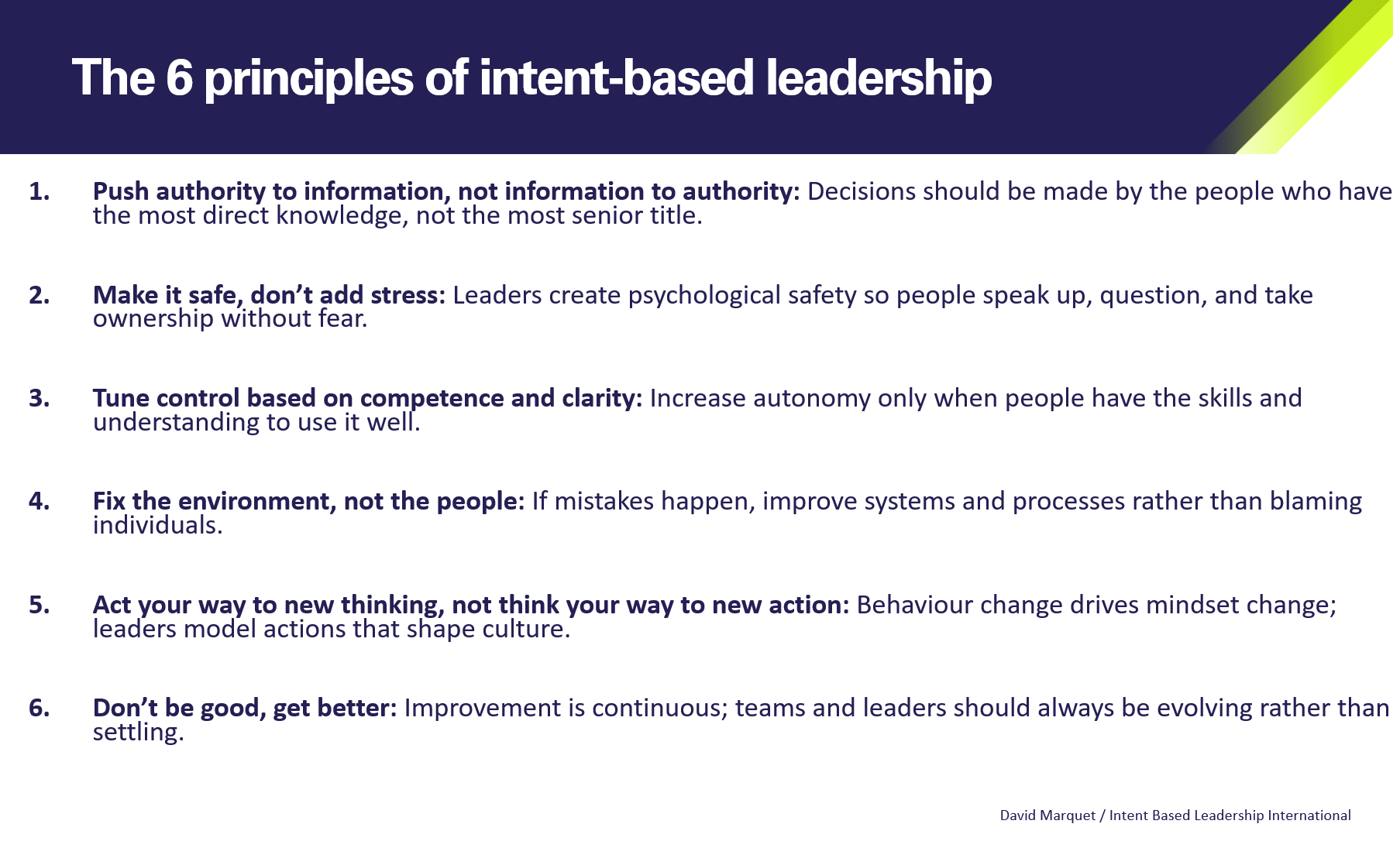
Intent-based leadership
Leaders of new young teams need to provide a lot of control and support in the early stages of the team’s development while the team members improve their competence and get aligned to the clarity of the intent. As the team’s competence and clarity increases, the amount of leadership control decreases. This is built on the intent-based leadership theory devised by retired United States Navy captain David Marquet.
This is a snapshot:
As a leader you are never quite sure what the people around you really think of you or if you have made a difference due to the pace of the world we live in. That said, a former member of the Mercedes F1 Build Logistics Team (and now a successful leader and manager in his own right) recently sent me one of the nicest bits of feedback I have ever received:
Your leadership allowed many young people to grow and now forms a lot of their own leadership and general teamwork skills. The biggest thing I always felt that made you different was your ability to allow others to make mistakes whilst catching them before it was at the detriment of the team. Without that, none of us would have learnt to be independent.
I think the key point from this is: I was catching the mistakes before they hit the 2% category while allowing the team to learn and become independent and responsible.
How is your team learning? Or are you telling them what to do so they don’t make mistakes? You don’t want their mistakes to reflect poorly on you and get you into that 2% category.
I hope this has given you something to think about. I am sure this may go against the grain for some of you but I suppose we can’t all agree on everything.
Peter Hodgkinson is a leadership and performance specialist skilled in helping high-performers become better at what they do. As an accomplished manager and mechanic, Peter has enjoyed almost three decades of success in elite sporting environments. His work in motorsport, as part of winning teams at Le Mans and Daytona, culminated in seven Formula 1 driver’s world championships won at Brawn and Mercedes, where he led car-building operations. Peter was Mercedes’ Head of Build during Lewis Hamilton’s era-defining run of six world titles. After a spell serving as Mercedes’ Head of Employee Engagement, Peter returned to the Factory Floor as Build Operations Manager for the INEOS Britannia sailing team when Mercedes supported their quest for the 37th America’s Cup.
If you would like to speak to Peter, please contact a member of the Leaders Performance Institute team.
Emily Scarratt and John Mitchell knew their England team could be world champions, they just needed the right environment to be able to prove it.
The centre had just competed in her fifth tournament (a joint record in the women’s game), claimed her second winner’s medal, and helped to complete an 11-year quest to bring the World Cup trophy back to England. It was almost the perfect way to bow out after 17 years as an international, 115 caps and a world record 754 points.
Yet she had only played 19 minutes of England’s campaign – all as a second half substitute in the Red Roses’ opening pool match; a 69-7 defeat of the United States in Sunderland.
“I’ve definitely been part of environments before where that kind of non-playing player can become quite negative and toxic,” she told an audience at the 2025 Leaders Sport Performance Summit in London.
“For a large part of my career, I was starting and therefore it’s very easy to say the right things and present in that way when you’re not under the stress of not being selected or not playing as much as you would like.”
Scarratt was joined onstage by England Head Coach John Mitchell, who in early February extended his contract until the 2029 World Cup and added Scarratt to his coaching staff.
The session moderator, Rachel Vickery, asked him what it meant to see Scarratt and her other non-playing teammates (known within the Red Roses setup as “pillar” players) celebrating with such vigour.
“I reflected that we actually hit the sweet spot with the culture,” said Mitchell. “Sometimes you don’t get that sweet spot and we might not get it again.”
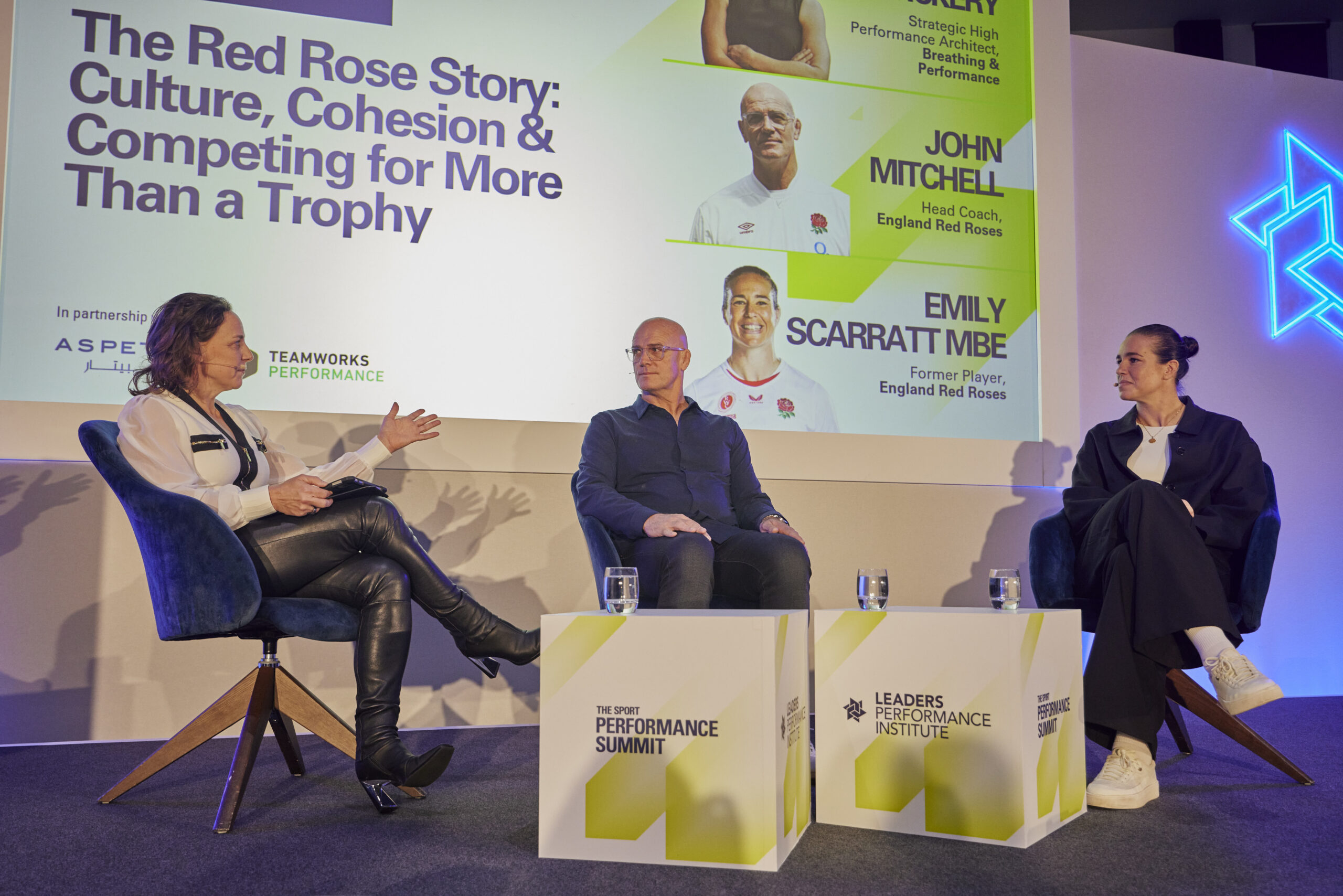
Rachel Vickery (left) talks to John Mitchell (middle) and Emily Scarratt (right) onstage at the 2025 Leaders Sport Performance Summit.
Here we reflect on what Mitchell and the Red Roses got right for 2025.
He spoke up when something wasn’t quite right
When Mitchell signed up to become England Head Coach in 2023, his remit was to win the World Cup. He was a coach with a proven track record in the men’s game who had now been handed the resources and the players to deliver the Women’s World Cup on home soil.
But in 2018 and 2022 England had lost World Cup finals they could, or perhaps should, have won.
“The leading question was how do we get done what we haven’t through the years?” said Mitchell.
It involved integrating young talent (eight players made their World Cup debuts against the US) and tactical tweaks (they had been too reliant on their maul). Both required an environment that enabled the best team on paper to prove they were the best team on grass.
To deliver on that front, Mitchell and the team’s leaders landed on three guiding values: ‘courage’, ‘take the handbrake off’ and ‘be all in’.
These values inspired England’s veterans and new internationals alike. “If the top person genuinely believes that culture is important it makes a difference,” said Scarratt. “Potentially in previous campaigns that hasn’t been the case and culture could get a little bit sidetracked or lost along the way.”
Mitchell even spoke up when he spied a shortcoming in the players’ well-meaning desire to ‘do it for the girls’.
“My thinking was that emphasis might be slightly calibrated towards ‘me’ – not intentionally – but how do I get the girls to calibrate towards ‘we’?” he said. “Because if I inspire you and I’m inspired by you, isn’t that more important, more inspiring to the person next to you? We get the job done and then our voice around our individual ‘why’ will be far greater.”
The cultural tweaking never stopped
“It’s very easy to just pick values, put them somewhere and hope that people live by them,” said Scarratt. “Our values were genuinely threaded through a lot of what we did, whether it was medical presenting or S&C presenting” and, when you witness that, “it’s very easy to buy-in”.
Mitchell held difficult conversations when necessary, but all players and staff, Scarratt said, were expected to speak up when necessary “to nip things in the bud before they became potentially bigger.”
At the suggestion of leadership consultant Patrick Marr, Mitchell would ask his player leadership group and support staff on the eve of each international camp to tell him “who’s going to pull the cart forward? Who’s going to sit on the cart? Who’s going to hold up the cart?”
After an hour he would “come back and I’d see two or three players, plus a couple of staff, where our priority needs to go,” he said, adding “we would then decide on who I would speak to and who they would speak to.” For every player or member of staff, there would be someone who could bridge that gap and “communicate around standards of behaviour”.
Mitchell even danced on TikTok when duty called
If you’re an England supporter, you may have seen the TikTok video of Mitchell dancing with his players.
“I needed to show vulnerability,” he said of such moments, which was not something he considered as a younger coach. “I had to do things that I probably don’t normally do and join in with the girls on certain things.”
Psychological safety may start with players or their head coach dancing in the dressing room, but it ultimately manifests on the pitch during tricky spells or in performance meetings when a staff member has the courage to raise a performance issue.
Mitchell knew he had to lead from the front. “Sometimes you’ve got to be the leader of those actions before somebody else does them.”
That said, his belief in the power of the head coach has been softened (and his self-awareness amplified) by three decades in the sport. “You learn through emotional intelligence that you don’t have to be absolute or right when making decisions. Just use your people. Listen to your people.”
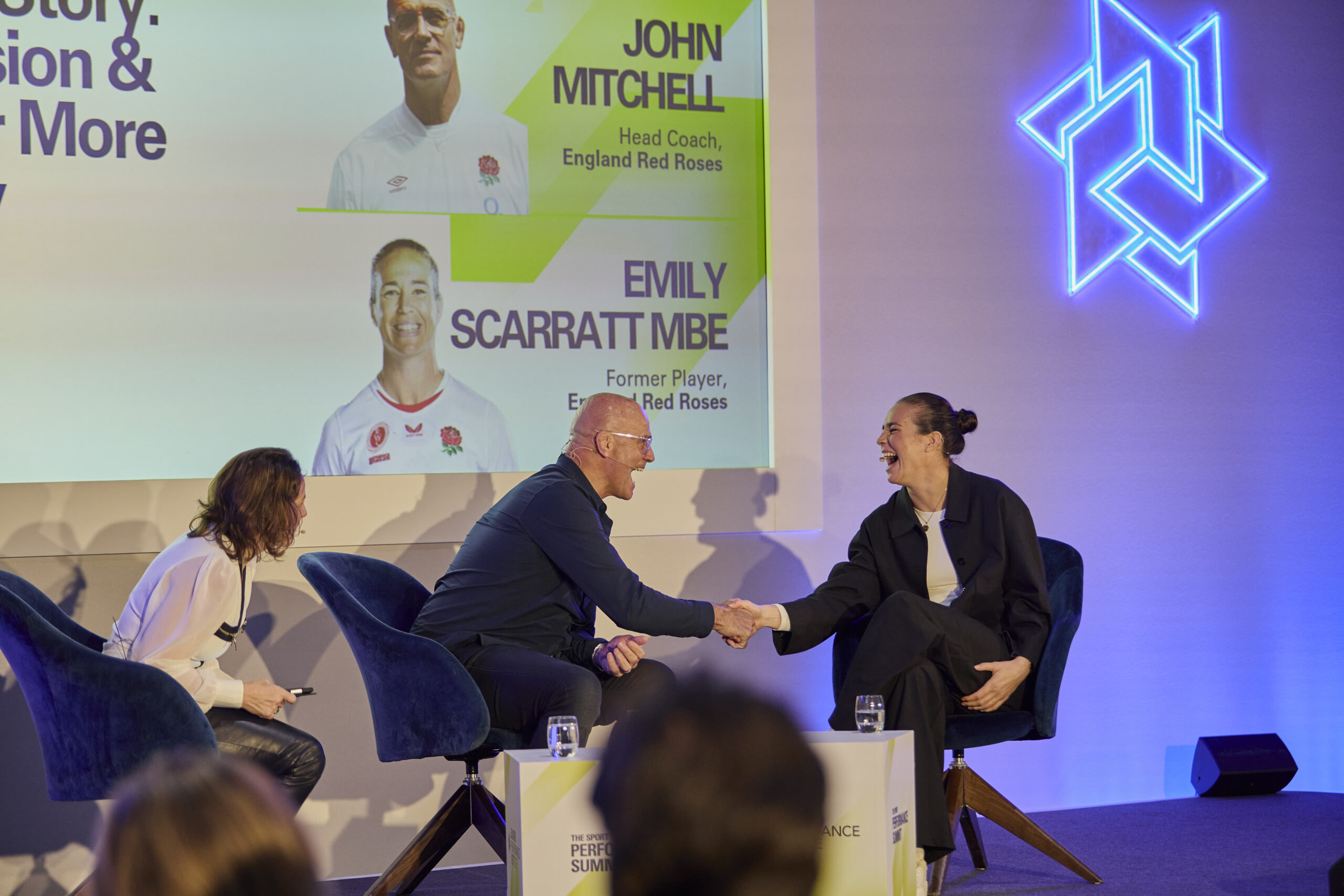
John Mitchell and Emily Scarratt shake hands as their session draws to a close at the 2025 Leaders Sport Performance Summit in London.
The team talked about the pressure they felt
For the first time, England openly spoke about winning the World Cup. It served as a pressure valve and, again, gave voice to their values.
“It might sound a bit silly but we hadn’t done that before,” said Scarratt, implicitly acknowledging how awkward the group felt at first about such an “un-English” sentiment.
As the English media and public latched onto the team ahead of the US match, the pressure grew. The players trained poorly on one occasion but, instead of dismissing it, they discussed it openly.
“I think we did a really good job of dampening it down by not not speaking about it,” Scarratt added. “By actually putting it out there and allowing people to know that other people felt like that.”
And Mitchell’s words after England eased through the gears on the opening night set the tone. He said: “There’s bigger games coming where teams will put even more pressure on us, so let’s take confidence from what we’re building and stacking as we’re going along. Our game doesn’t need to be perfect, it just needs to be effective, and that will win us the tournament.”
He was right and, looking to 2029, their goal is to win back-to-back World Cups, establish a legacy as one of women’s sports greatest teams, and to further grow the women’s game.
These lofty goals provoke three questions that Mitchell and England must answer: “What will earn the right? What will we keep and take forward with us? And then, thirdly, is what we what will we need to start again?”
What to read next
Meaning Does Not Guarantee Medals, But it Strengthens the Behaviours that Make Medals Possible