Leaders in Business
  • Membership
  • Events
  • Content
  • Virtual Learning
  • Connections
  • Partners
Login
  • Leaders Meet: Innovation
  • Events
    • Leaders Week London
    • Leaders Sports Awards
    • Leaders Club Events
    • Leaders Performance Institute Events
    • Leaders Meet: Innovation
  • Memberships
    • The Leaders Club
    • Leaders Performance Institute
  • About
    • Careers
    • Contact
I’m a sports leader:
  • Off The Field For those focused on the business of the sport View more
  • On The Field For those working with an athlete or elite team View more
  • Login
    • Leaders ClubThe membership for future sport business leaders
    • Leaders Performance InstituteThe membership for elite performance practitioners
  • Newsletters
Performance Institute Leaders Performance Institute Logo
  • Membership
  • Events
  • Content
  • Virtual Learning
  • Connections
  • Partners
Login

5 Nov 2024

Articles

The Debrief – a Snapshot of Powerful Discussions Happening Right Now Across the Leaders Performance Institute

Category
Leadership & Culture
Share
Facebook Twitter Email Copy Link
https://leadersinsport.com/performance-institute/articles/the-debrief-a-snapshot-of-powerful-discussions-happening-right-now-across-the-leaders-performance-institute-8/

In October, we discussed ‘energy audits’, female health and wellbeing, mental skills and the methods behind effective learning.

By John Portch
How concerned are you about burnout, both for yourself and for those whom you lead?

It’s an ever-pertinent question, whether you hear whispers within your corridors or not, and it is always worth checking in with your people.

During October, with this in mind, we returned to a memorable presentation delivered by Holly Ransom, author of The Leading Edge, who spoke at our February Melbourne Sport Performance Summit about ‘energy audits’ that we can all perform.

Speaking of Sport Performance Summits, our next London edition is just around the corner – specifically the 13 and 14 November at London’s Kia Oval.

Speakers include Stuart Lancaster, the Head Coach of the Paris-based Racing 92; John Longmire, the Senior Coach of the AFL’s Sydney Swans; and Anna Warren, the Head of Science & Medicine at the ECB.

It promises to be another cracker but, if you are yet to reserve your place, get in touch with the Leaders Performance Institute today – or at least after you’ve perused October’s Debrief.

This time we posed a series of questions, starting with energy audits, progressing to wellbeing and mental skills, before alighting on learning, performance analysis, and, in a left-field turn, the weather.

What is an ‘energy audit’?

They probably sound grander than they actually are, which is not to diminish their importance.

When Holly Ransom spoke at Melbourne’s Glasshouse in February, she suggested three questions we should all ask ourselves:

  1. What are your natural high energy moments?
  2. What are your natural low energy moments?
  3. How are you currently employing those moments?

Ransom believes people should tackle their most important tasks when their energy is at its highest so that they “get the return on energy they deserve”.

She also explained that leaders set the tone for the organisation. She said: “The most powerful thing that you could actually do for that group of people that you lead is think about how we influence that energy in that moment so we don’t get the contagion of that negative energy running through more of the day or more of the week.”

Do you feel guilty for focusing on your wellbeing?

You probably have felt guilty at some point and you’re not alone.

Emily Downes, the General Manager of Wellbeing & Leadership at High Performance Sport New Zealand, admitted as much onstage at the Glasshouse.

“We all probably struggle with that at one point in time or another,” she said. “Who else do you need to have on your support crew that helps give you that permission?”

Part of the solution is systems and processes that enable people to step away from their desks.

“The challenge around this is: are you asking for it?” said Downes. “Are you communicating to your manager what support looks like for you or what you might need to be at your best?”

She addressed the leaders in the room directly. “Have you set up systems within your environment to enable people to [step away from their desk]?”

In any case, if you get up and go for a walk or a run, what’s the worst that can happen?

How effective is your mental skills work?

The growing focus on wellbeing is matched by an increased emphasis on mental performance, but in an exclusive column Aaron Walsh, a performance coach with the Chiefs and Scotland Rugby, considered whether that emphasis is being translated into effective work.

It became a focus of his recent research, with Walsh speaking to 35 head coaches and heads of performance. The project revealed four major shortcomings:

  1. Lack of support from key stakeholders.
  2. The work often became siloed.
  3. The provider did not understand the demands of the environment.
  4. The information presented was often too complex and not relevant to the needs of the athletes.

Most teams don’t know where to begin and there is a clear lack of application.

He discussed the five approaches open to all teams and encouraged all leaders to ask themselves three questions:

  1. Does your team currently have a mental performance strategy?
  2. What approach best suits your team and meets the mental demands it faces?
  3. Are you setting up your providers to be successful and have an impact?

Are you setting your female athletes up to succeed?

The Sport Wales Female Health & Performance Team are working to address some of the major health and performance considerations that affect female athletes from the grassroots to podium potential.

Prominent among their concerns are myths around the menstrual cycle.

“There are still female athletes who see it as a positive if their periods stop when they’re training,” Dr Natalie Brown, a Research Associate at the Welsh Institute of Performance Science, tells the Leaders Performance Institute on Teams.

“This is because it’s easier and more convenient; they’ve not got to deal with the symptoms or the bleeding.”

Yet the impact on their short and long term health, let alone performance, could be significant. “It’s an indicator that they do not have enough energy for those basic bodily functions.”

However, as Brown said, “even in just focusing on the menstrual cycle you’re ignoring the bigger picture around women’s experiences of sport and how the system that we’ve designed doesn’t enable women to thrive in sport because they’re trying to thrive in a male system.”

More available here.

What are your greatest challenges with performance analysis?

Reliability and efficiency are likely to feature prominently, as they did in this recent virtual roundtable for Leaders Performance Institute members, but have you considered your job descriptions? Do they adequately set out what your organisation requires, both in terms of filling gaps in skillsets and finding seamless integration.

Dr John Francis of the University of Worcester and Dr Denise Martin from Atlantic Technological University in Ireland have conducted research into this space. During the roundtable discussion, they set out recommendations for both organisations and applicants across four areas:

  1. Employer familiarity information

Organisation: outline values and goals, provide infrastructure, staffing and philosophy.

Applicant: understand the organisation’s goals and how to contribute.

  1. Description of job-related tasks & personal specification

Organisation: list job-specific tasks and required skills; list specific academic or coaching knowledge and software competencies; emphasise evidence-informed processes and the need to understand feedback and learning strategies.

Applicant: gain clarity on role tasks and responsibilities; highlight relevant experiences in application and determine their fit. Identify areas for personal and professional growth.

  1. Salary & renumeration

Organisation: clearly present salary bands and rewards.

Applicant: assess job value and potential rewards.

  1. Opportunity for advancement

Organisation: detail career progression and CPD activities.

Applicant: make informed decisions about career path within the organisation; consider your long-term aspirations.

Ensuring value capture in applied performance analysis

Martin and her colleagues have conducted research into value capture in performance analysis and alighted on three key questions:

What? Organisational capability to generate, curate and translate data to c0-create knowledge and insight.

How? Skills and contextual intelligence allow practitioners to embed effectively in the performance ecosystem.

Why? These lead to what Martin calls the ‘lightbulb moments’ – where value is added to decision-making processes and contributes to performance.

Additional reporting by Luke Whitworth.

Is yours a good learning organisation?

Lucy Pearson, the Director of FA Education, believes that learning is too important to take seriously.

“As a society, we make a distinction between work and play,” she told an audience at the Kia Oval during the last Leaders Sport Performance Summit. “Work is grown up, it’s serious, it’s important; and play is seen in the adult world as childish, frivolous, a bit inessential, a luxury. But play is the creative process through which we learn.”

This comes with a caveat. “People can be playful at work, yes, but we need to be thoughtful about what we’re looking to achieve in those learning opportunities. Design is deliberate – not accidental – if you want to drive high performance.”

As such, FA Education is on a “journey to design, develop and deliver learning, across a number of different modes, to a range of people who’ve all got different tasks, concerns and priorities.”

Pearson is mindful, however, that people can’t be compelled to learn. “Learning is up to the learner,” she said. “All we can do is create the circumstance in which the learning has the best opportunity to happen.” She likened it to classes at school that we either liked or didn’t like. “The teachers all may have put the same amount of effort in, but it was the all-round environment that you found yourself in, the person leading it, the text that somebody chose – it all needed to be thought-through on your behalf.”

Final thought: how important is the weather in pre-season?

The popularity of warm weather camps, particularly in the depths of winter, is universal, but what about during pre-season?

Tom Cleverley, the Head Coach of Championship Watford, was intent on taking his team to St George’s Park in Staffordshire in July rather than copying his rivals in going abroad.

“You can guarantee that the weather isn’t going to impact training loads,” he told the Leaders Performance Institute. “Sometimes you can go to Spain, Portugal and it’s too hot to get the intensities that you want.”

Cleverley was echoed by Tony Strudwick, the Director of Medical at West Bromwich Albion and by Neil Thompson, the Assistant Manager Sheffield Wednesday. Much like Watford, Albion and Wednesday both visited SGP in July to get that desired balance of suitable weather and a refreshing change of surroundings.

If you live and work in a temperate zone or even somewhere altogether more sunny, is it something you’ve considered?

30 Sep 2024

Articles

Teams Can Go from Good to Great with Interdisciplinarity… Here’s How you Can Master the Secrets of Success

Leadership & Culture
Share
Facebook Twitter Email Copy Link
https://leadersinsport.com/performance-institute/articles/teams-can-go-from-good-to-great-with-interdisciplinarity-heres-how-you-can-master-the-secrets-of-success/

In the second part of this miniseries, David Clancy and Michael Davison explain why there’s more to interdisciplinarity than merely assembling experts. In fact, it requires an environment that lets diverse knowledge flow, interact and coalesce into something far greater than the sum of its parts.

By David Clancy & Michael Davison
“None of us is as smart as all of us.”
Ken Blanchard, business consultant

A story of interdisciplinarity

Let’s start with Jack Draper.

Imagine Draper, who is the currently the No 1 British men’s tennis player (currently ranked 20th on the ATP Tour) seeking that extra edge to stay at the top. His success isn’t just the result of raw talent or relentless training. Behind the scenes, he has a backroom team seemingly working in support of him – a nutritionist optimising food intake and hydration, a sports psychologist fine-tuning performance under pressure, a physiotherapist managing recovery, and a strength coach – pushing physical limits. Each expert has mastery, but what sets this team apart is how they interact and click.

To reach this point, Draper’s coach, James Trotman, didn’t just talk tennis strategy. He collaborated with Draper’s physiotherapist to adapt his game around his body’s capabilities. The psychologist worked closely with the strength coach to ensure mental resilience matched Draper’s physical preparation. Let’s not forget that the player himself was at the centre of this interdisciplinary team, which like most sports is player-focused. Each discipline flowed into the other, creating a holistic approach that made Draper not just a better tennis player, but a stronger, more balanced athlete.

The secret to his rising dominance wasn’t just in individual expertise, it was in the ‘interdisciplinary’ synergy that allowed his team to anticipate challenges, innovate, and help him evolve in a way no single expert could have achieved alone. This ‘collective intelligence’, and high-level teamwork, propelled him to achieve even greater heights, proving that in today’s complex world, true success is a team effort built on the integration of diverse applied knowledge and experience.

So, what is interdisciplinarity and how is it different?

Interdisciplinarity is the fusion of knowledge from multiple fields to tackle complex problems that no single discipline can solve on its own. This differs to a multidisciplinary or transdisciplinary model; the former is when experts from different disciplines work in parallel on a common problem, but each remains within their own disciplinary boundaries. The latter relates to the integration of academic disciplines by involving stakeholders outside of traditional academia (e.g., community members, policymakers) to co-create new knowledge and solutions.

All approaches seek to leverage multiple perspectives and areas of expertise to solve complex problems, but they differ in how deeply the knowledge is integrated and in the level of collaboration. Multidisciplinary maintains strict disciplinary boundaries, interdisciplinary integrates them, while transdisciplinary dissolves these boundaries completely. Multidisciplinary focuses on parallel efforts, interdisciplinary on integrated collaboration among academic disciplines, and transdisciplinary on forming external stakeholder engagement. Multidisciplinary brings together separate expertise, interdisciplinary synthesises it, and transdisciplinary creates frameworks that include non-academic insights, in a nutshell.

Back to interdisciplinarity

In a world where challenges are increasingly multifaceted – spanning biology, psychology, sociology, technology and beyond – interdisciplinary approaches are critical to innovation, creativity and progress. Research shows that teams combining diverse expertise produce more inspired and robust solutions, with improved and more accurate group thinking (Rock & Grant, 2016), leveraging what’s known as collective intelligence. This approach fosters interactional expertise, where individuals, though not specialists in all fields, become adept at understanding and integrating knowledge across domains, enhancing the team’s ability to solve problems from multiple perspectives. This is cross-functional working at its best.

Studies in cognitive science and organisational behaviour confirm that interdisciplinary teams outperform homogeneous ones in problem-solving, originality, and adaptability. By blending insights from different scientific traditions, interdisciplinarity accelerates breakthroughs that shape our future in high performance sport.

The Expert Compass

Visualise a group of elite performers – whether it’s a special operations military unit or an executive leadership team at a multinational – coming together to tackle a complex challenge.

What sets these teams apart from the rest? It’s not just that they each possess individual expertise, it’s that they know how to navigate their combined expertise with precision and ownership. Enter the Expert Compass, a mental map that allows high-performing teams to leverage the unique knowledge of each member while orienting toward a shared, clearly aligned goal.

In an interdisciplinary team, the compass acts as a guide, ensuring that no single expertise is overvalued or sidelined. Instead, the team becomes adept at knowing not just what expertise is needed, but when and how to use it effectively. They know who to turn to for specific knowledge, and more importantly, they understand how to integrate that knowledge seamlessly into the problem-solving or decision-making process.

This is where the power of interdisciplinarity reveals itself. Instead of working in silos, where experts are isolated in their own domains, the team leverages their diverse knowledge bases to create solutions that are more progressive, rigorous, and resilient. It’s a fluid process, navigating complex terrain with the agility of a compass, constantly adjusting and recalibrating based on the input from different fields.

Interactional expertise

But it’s not enough to just assemble a group of experts and hope they collaborate. The secret sauce of interdisciplinary success is interactional expertise: the ability of team members to understand and communicate across disciplines, even if they aren’t trained specialists in those areas.

This form of expertise allows a neuroscientist to engage meaningfully with a software engineer, or a physiotherapist to collaborate with a performance analyst, even if they don’t have deep technical knowledge in each other’s fields. They’ve developed enough fluency in the language, messaging and logic of the other disciplines to ask the right questions, contribute valuable insights, and understand the broader implications of their colleagues’ expertise.

Interactional expertise is what prevents interdisciplinary teams from becoming chaotic, disjointed or fragmented. It creates the connective fascia that holds different domains together, that interwoven fabric of performance, and allows them to produce something greater than the sum of their parts.

Collective intelligence

When interactional expertise is present, a team taps into a powerful phenomenon – this is known as collective intelligence. This is the magic of interdisciplinarity done well. When the team becomes smarter than any individual could be on their own. They think, adapt, and solve problems with a kind of emergent intelligence that draws from the diverse perspectives and knowledge sets within the group.

Collective intelligence doesn’t happen automatically. It’s the product of deliberate design, creating environments where knowledge flows freely, trust and psychological safety is high (Reynolds & Lewis, 2017), and each expert is empowered to contribute. It thrives on a sharing environment and culture, but also articulated shared goals. It relies on individuals having the humility to know the limits of their own expertise, and the curiosity to learn from others by sharing and challenging one another with questions like ‘Why are we doing this?’ and ‘Is there a better way?’.

The secret to success (and why others fail)

So why do some teams excel at interdisciplinarity while other teams flounder? The secret lies in the ability to manage both ego and ego-less collaboration. High-performing interdisciplinary teams have members who are confident in their own expertise but are humble enough to acknowledge when they need input from others…that they do not have all the answers. They’ve mastered the balance of asserting their knowledge without overstepping their lane.

On the other hand, teams that fail at interdisciplinarity often do so because of misaligned priorities or a failure to establish clear lines of open communication. Experts can become territorial, clinging to their domain and shutting out contributions from others. Or, in the absence of interactional expertise, conversations become broken, with different disciplines speaking past each other instead of to each other.

The best teams recognise that interdisciplinarity isn’t just about bringing together experts. It’s about building bridges between those experts and creating a culture where learning from one another is just as important as showcasing your own knowledge.

Acquiring interactional expertise

Developing interactional expertise requires intentional effort and a willingness to engage.

Here are a few keys to acquiring it:

  1. Curiosity over mastery: You don’t need to become an expert in every discipline, but you do need to cultivate a deep curiosity about other fields. Ask questions that help you understand the thought processes, principles, and constraints that guide your colleagues’ work.
  2. Cognitive empathy: Try to see problems from the perspective of other disciplines. This requires cognitive empathy…the ability to imagine how a colleague might approach a situation based on their own expertise and experience.
  3. Structured learning: Make it a priority to attend cross-functional training sessions, workshops, or informal discussions that expose you to the vocabulary and frameworks of other fields. Teams that succeed often set aside time for interdisciplinary learning, so that each member can expand their interactional knowledge.
  4. Reflective practice: After interdisciplinary collaborations, take time to reflect on what you’ve learned about the other disciplines involved. What assumptions did you have going in? What surprised you? What connections did you see between fields that you hadn’t noticed before?

The role of leadership and processes

The leverage in interdisciplinary teams lies in both the individual leader and the processes they put in place. Leaders play a critical role in setting the tone for collaboration, fostering psychological safety, and modelling interactional expertise. Great leaders make a point of being learners themselves. They actively engage with other disciplines and encourage their team members to do the same.

But leadership isn’t enough on its own. There must be systems and incentives in place to support interdisciplinarity. This includes structured opportunities for cross-functional work, regular knowledge-sharing sessions, and mechanisms to ensure that all voices are heard. High-performing teams often use formal frameworks like design thinking, agile methodology, or interdisciplinary reviews to ensure that expertise is integrated, not isolated in silos.

Leadership plays a pivotal role in fostering diverse perspectives that lead to innovative problem-solving and knowledge creation. However, the benefits of the diversity are maximised when coordination is effective, particularly in environments with low task uncertainty (Fang He., et al. 2021).

In short, leadership provides the vision, mission and the encouragement, while systems, processes and team behaviours ensure that the objective is realised in a sustainable and scalable way.

Actions

In the world of sports, athletes often have a team of private practitioners – physiotherapists, nutritionists, psychologists – who work closely with them. When these practitioners interact with a broader team, especially in high-performance settings, the principles of interdisciplinarity become even more important.

The key is to establish a collaborative ecosystem where information flows freely, and each practitioner is seen as an integral part of the athlete’s overall performance.

This requires…

  1. Open lines of communication: Practitioners should regularly communicate with each other to ensure they are aligned on goals and treatments. It’s not enough to work in parallel; there needs to be an intentional sharing of knowledge, progress, and challenges.
  2. Respect for expertise: Each practitioner brings a unique perspective to the table, and the best teams recognise the value of this diversity. Collaboration works best when each professional is trusted to contribute their expertise, without others overstepping into areas they are not qualified to address.
  3. Holistic understanding of the athlete: Successful teams take a holistic view of the athlete, understanding that no single treatment or approach operates in isolation. Physical training affects mental performance, and nutrition impacts recovery. The practitioners must view their roles as part of an integrated system designed to optimise the athlete’s overall wellbeing and performance. Let’s also mention the power of the athlete’s voice in this respect, as they are the CEO in these affairs so it’s critical their points are heard.

Conclusion

Interdisciplinarity in high-performing teams is about more than just assembling experts; it’s about creating an environment where diverse knowledge can flow, interact, and coalesce into something far greater than the sum of its parts. By cultivating interactional expertise, leveraging collective intelligence, and fostering a culture of trust and humility, teams can unlock the true potential of their combined expertise.

And in fields like sports, where collaboration between the team behind the team and broader teams is critical, the principles of interdisciplinarity can be the difference between good performance and greatness. As Matthew Syed, author of ‘Rebel Ideas: The Power of Diverse Thinking’ said, ‘collective intelligence emerges not just from the knowledge of individuals, but also from the differences between them’. 

David Clancy is a Learning and Development Consultant at the Houston Texans and Director at The Nxt Level Group. He is also the Editor of Essential Skills for Physiotherapists: A Personal and Professional Development Framework, which is available now from Elsevier.

Michael Davison is an International Sports Performance Consultant at the Houston Texans and Director at The Nxt Level Group and Board Member of the Football Research Group.

If you would like to speak to David and Michael, please contact a member of the Leaders Performance Institute team.

References

Fang He, V., Krogh, G., and Siren, C. (2021). Expertise Diversity, Informal Leadership Hierarchy, and Team Knowledge Creation: A study of pharmaceutical research collaborations. Volume 43 (6). European Group for Organisational Studies.

Reynolds, A. & Lewis, D. (2017). Teams Solve Problems Faster When They’re More Cognitively Diverse in Collaboration and Teams. Harvard Business Review.

Rock, D. & Grant, H. (2016). Why Diverse Teams Are Smarter in Diversity and Inclusion. Harvard Business Review.

Acknowledgements

Special kudos to Carl Gombrich of the London Interdisciplinary School, who spoke at the 2022 Leaders Sport Performance Summit in London. One of the school’s courses, titled ‘Cross-Functional Leadership’, was very insightful. This article has been influenced by that programme, as well as research on the Expert Compass, requisite knowledge and expertise from Tim Davey and Amelia Peterson.

Gombrich also contributed a chapter to Essential Skills for Physiotherapists: A Personal and Professional Development Framework by Clancy, et al. (2024), about interdisciplinarity and soft skills.

Members Only

22 Aug 2024

Articles

‘Many People Would Never Consider Working in Women’s Football… and they Wouldn’t Be Right for the Women’s Game Either’

Category
Leadership & Culture, Premium
Share
Facebook Twitter Email Copy Link
https://leadersinsport.com/performance-institute/articles/many-people-would-never-consider-working-in-womens-football-and-they-wouldnt-be-right-for-the-womens-game-either/

What’s it like to launch an expansion team? We bring you insights from Bay FC.

By John Portch
Women’s football is not the right environment for some coaches and practitioners, particularly expansion franchises.

That is the view of Lucy Rushton, the former General Manager of NWSL expansion team Bay FC.

“Of the people I know working in male football, 95 per cent probably would never consider coming to the women’s game,” she told an audience at June’s Leaders Sport Performance Summit at Red Bull in Santa Monica. “And, to be honest, they probably wouldn’t be right for the women’s game either. I’ll say that. I think the person that you’re looking for, especially in expansion, is someone who’s willing to challenge themselves, willing to go outside the box.”

Bay represented Rushton’s first role in women’s football. She built her reputation in the men’s game in a series of scouting and analysis roles at the Football Association, Watford and Reading. In 2016, she left her English homeland to join Atlanta United as Head of Technical Recruitment & Analysis. The team won the MLS Cup two years later. Between 2021 and 2022, she served as DC United’s first female GM.

Back at Bay, the team were finding their feet following a tricky start to their inaugural season when Rushton unexpectedly resigned in late-June. Her departure shocked observers, but her achievements during the year she spent in southern California were considerable.

It is an exciting time for the club, who attract average crowds of nearly 15,000 to a stadium that is not their own. They speak enthusiastically of planning a new practice facility and stadium. Crucially, the ownership group have the means and the will to make it all happen.

But beyond supportive owners and astute marketing initiatives, what does it take to get a new team off the ground? The Leaders Performance Institute explores four factors put forward by Rushton.

1. A vision that informs your culture

Bay want to be the best team in the world and renowned for their people-first approach. They plan to get there by adhering to their B-A-Y values (Brave, Accountable, and You). Rushton explained each in turn:

  • Brave: “being bold in the industry, pushing boundaries and innovating”.
  • Accountable: people “being responsible for their actions and being willing to push themselves forward”.
  • You: this stems from Bay’s desire to “celebrate each other as individuals so you can bring your true, authentic self to work every day”.

2. Finding the right personalities

Rushton believes it takes a particular type of personality to thrive in an expansion environment. “You have to have someone that’s more risk-OK,” she said. “To bet on themselves to go ‘I can go there and make a difference.” Her appointment of Head Coach Albertin Montoya showed that they can be male. “A lot of males would find it refreshing to come to a female team because it’s a different environment, with a totally different feeling, vibe, boundaries, rules.”

It is crucial, however, that you hire for diversity of background and experience despite the inherent challenges. “It’s much easier to sit in a room with people who are like you,” said Rushton. “It brings added work because you’re taking yourself outside your comfort zone – you have to be willing to do that.”

3. Elevate player care and support

Rushton explained that while male players tend to consider the bottom line above all else, female players are compelled to prioritise their living conditions. It led her and Bay to use all available mechanisms – housing, support staff, medical care – to tempt players to this corner of southern California. “How are we on a day-to-day basis trying to help them a) be in the best position they can be for the longest possible; and b) live a nice lifestyle out of football?”

It has given Bay considerable pulling power beyond the US. Three ceiling-raisers arrived in the form of Barcelona’s Asisat Oshoala, Madrid CFF’s Rachael Kundananji, and Arsenal’s Jen Beattie. Others are sure to follow.

4. Managing challenges and setbacks

Bay have had their fair share of challenges in year one, but the club has not been fazed. They went as far as dropping a player over a disciplinary issue on one occasion. It likely cost them the game, but the senior leadership believed that team values were more important. “It’s in those difficult moments that you set the culture,” said Rushton. “It showed our players and our staff what’s acceptable and what’s not.”

Members Only

22 Jul 2024

Articles

Think Gregg Popovich Is Wrong to Yell at his Players? Consider These Points Before Making up your Mind

Category
Leadership & Culture, Premium
Share
Facebook Twitter Email Copy Link
https://leadersinsport.com/performance-institute/articles/think-gregg-popovich-is-wrong-to-yell-at-his-players-consider-these-points-before-making-up-your-mind/

As the San Antonio Spurs’ Phil Cullen helps to explain, there is much more at play in an environment carefully cultivated by Coach Pop to say ‘this is a safe place to give effort’.

By John Portch
Gregg Popovich confounds contemporary thinking on how a leader should conduct themselves in modern-day elite sport.

The San Antonio Spurs’ Head Coach, a graduate of the US Air Force Academy, is known as an disciplinarian; and he might also be regarded as an anachronism were it not for the fact that he is revered for creating – and sustaining – one of the most harmonious cultures in elite sport.

Some might say Coach Pop’s gruff demeanour and willingness to yell at players would be sub-optimal in any other environment, especially with a roster full of Gen Z players, but his focus on the people and the environment afford him all the leeway he needs to express himself at the Spurs.

Coach Pop, the alchemist

Popovich, having served as an assistant coach at the Spurs between 1988 and 1992, returned to San Antonio as Executive Vice President of Basketball Operations and General Manager in 1994. He added the head coaching role early in the 1996-7 NBA season

He would in time relinquish his other responsibilities but there was no guarantee that Popovich could make a successful step out of the front office, particularly as his coaching resume amounted to little at that stage.

“He said, ‘hey, I want to do this and I probably have one crack at it’,” said Phil Cullen, the Spurs’ Senior Director of Organizational Development & Basketball Operations. Cullen did not join the Spurs until 2016, but this story, like so many featuring Popovich, has long since entered Spurs folklore.

“Pop said, ‘I want to do this and I want to do this with the people I want to be around’.”

This desire shaped the Spurs’ famous ‘pound the rock’ ethos, with its emphasis on persistence, patience and resilience. It helped to create an environment where a previously inconspicuous franchise could claim five NBA Championships between 1999 and 2014.

Cullen, speaking at the Leaders Sport Performance Summit at Melbourne’s Glasshouse in February, talked at length about the Spurs’ culture, which has been emulated across the globe, albeit with varying degrees of success.

Look a little closer at those other teams and it seems that some have been seduced by ‘pound the rock’ without paying full attention to San Antonio’s unique alchemy.

Not a Spur?

Good people are very important to San Antonio. As Cullen explained, their scouting template includes a check box labelled ‘Not a Spur’. It is a short-hand way of saying that a player lacks some of the team’s character-based values such as integrity, accountability or humility. “It’s very difficult to uncheck that box,” added Cullen. “We have to understand that when we do that there’s a reason why.” They do not always get it right, as he admitted, but their success rate is admirable.

All the same, many teams in the NBA and beyond, have adopted a similar approach, so there must be more to the Spurs success story than any notions of character.

Popovich himself is certainly a major factor, particularly at a time when the Spurs have the NBA’s youngest roster, with an average age of 23.52.

“Right now, we’re probably a coach-led team because of the youthfulness of the roster,” said Cullen. “Ideally, you’d have players that are actually holding each other accountable.” That is the end-game but, in the meantime, “the coach is having to manage the game, not coach the game – there’s a big difference.”

So coachable players are important, as is the coach; there are also key environmental factors at play.

Community, casual collisions and fine dining

The primary environmental factor is food. Cullen shared an image of the cafeteria at the Spurs’ new $72 million Victory Capital Performance Center practice facility, which opened in 2023. “This is the most important room in the building,” he said.

Popovich places a premium on team meals; the players’ families are regularly invited to eat with the team and staff . Cullen said: “There is nothing better than sitting across the table from somebody else from a different culture, with a different set of experiences, and just being able to share a meal together. Food and drink is very important to us.”

Mealtimes, they believe, help to develop mutual empathy and promote selflessness. “This job is hard and if it’s going to be all about you, you’re probably not going to reach your max potential,” said Cullen. “We want to be part of something bigger than ourselves – it can’t just be about you.”

Cullen played a significant role in the design of the facility and was influenced by Popovich’s words of advice when the project was green-lighted. “He goes: ‘I’ve got two things for you: protect the culture and protect the people’.” It confirmed Cullen’s belief in human-centred design. “I may never have the conversation directly with the player, but what we can do is design the space so that Coach can have that conversation with that player,” he said, explaining that players spend more time at the new practice facility than they did at the old one. “It’s shocking as you’ll go in there today and the players will be sitting there next to an equipment manager, next to the travel guide, next to your lead physio; and they’re just hanging out.”

Life beyond basketball

Beyond mealtimes, Popovich promotes a wide range of extracurricular learning opportunities. Cullen recounted the time ahead of a road game at the Washington Wizards in 2018 when Popovich took the team to the US Supreme Court. There are numerous examples on his watch of similar site visits and non-basketball focused discussions, with topics ranging from US federal law and international politics to same-sex marriage and social justice.

Again, these are issues far bigger than the individual or the sport of basketball. “It’s so easy to be insulated when you’re a professional athlete,” said RC Buford, the former San Antonio General Manager (2002-2019) and current CEO, in Dan Coyle’s 2018 book The Culture Code. “Pop uses these moments to connect us. He loves that we come from so many different places. That could pull us apart, but he makes sure that everybody feels connected and engaged to something bigger.”

Coyle also explained that Popovich relies on three types of belonging cue and ‘toggles’ between each in an effort to say ‘this is a safe place to give effort’. Those cues involve:

  1. Personal and up close connections: in practice and in warm-ups, Popovich will rove and get almost nose to nose with a player or coach. Such moments, as Coyle wrote, translate as ‘I care about you’.
  2. Performance feedback: Popovich will offer a continuous stream of feedback from ‘the middle distance’ in both practice and games. This translates as ‘We have high standards here.’
  3. The big-picture perspective: as Coyle put it, ‘Life is bigger than basketball’. The team meals, coffee conversations and history lessons are testament to the Spurs’ belief in this approach.

It led to Coyle conclude: ‘Popovich’s yelling works, in part, because it is not just yelling. It is delivered along with a suite of other cues that affirm and strengthen the fabric of the relationships [at the Spurs].’

Consider this the next time you see Popovich raise his voice.

18 Jul 2024

Podcasts

How Lindsay Mintenko Is Setting the Course for USA Swimming

Category
Leadership & Culture
Share
Facebook Twitter Email Copy Link
https://leadersinsport.com/performance-institute/podcasts/how-lindsay-mintenko-is-setting-the-course-for-usa-swimming/

Team USA’s Managing Director tells us what it takes to enable the athletes of one of America’s greatest sporting success stories to thrive in the pressure cooker environment of an Olympic Games.

A podcast brought to you by our Main Partners

“I’ve been told I give really good hugs.”

So says Lindsay Mintenko, the Managing Director of USA Swimming’s National Team, in the second episode of this new series of the Leaders Performance Podcast, which is brought to you by our Main Partners Keiser.

“Just being able to sit with an athlete; sometimes you don’t even have to talk,” she continues, “it’s just so they know you are there.”

It is difficult to imagine many of her predecessors demonstrating such empathy with athletes whether they’re a multi-medal winner like Michael Phelps or Katie Ledecky or a swimmer who came agonisingly close in some of sport’s most competitive trials. The top-two finishers are guaranteed a spot on the roster; those in third – who would likely medal with other nations – are almost certain to miss out.

“After the trials, our main job is to make sure our athletes are focused on Paris, but we don’t always take a step back and look at those who came third by a hundredth of a second. That’s a tough place to be; so we really need to make sure that we do a better job of looking out for those athletes afterwards.”

It is perhaps no surprise that USA Swimming is currently the only national governing body in the US to have an in-house licensed clinician on staff.

This has happened on the watch of Lindsay, a two-time Olympic gold medallist in the 4x200m freestyle.

She is the first former athlete and first woman to serve as Team USA’s Managing Director, but as she tells Henry Breckenridge and John Portch, it is not about her but serving her athletes and their coaches.

Lindsay also spoke about her role being analogous to that of a general manager in the major leagues [8:00] and the importance of providing a challenging but safe environment [17:40].

Elsewhere, she elaborates on the importance of providing mental health support for her athletes [29:50] and explains how her swimming career began when as a six-year-old Lindsay fell out of a tree [5:30].

Henry Breckenridge X | LinkedIn

John Portch X | LinkedIn

Listen above and subscribe today on iTunes, Spotify, Stitcher and Overcast, or your chosen podcast platform.

11 Jul 2024

Articles

Inside the Mind of a Performance Director, with Michael Bourne of the LTA

Category
Leadership & Culture
Share
Facebook Twitter Email Copy Link
https://leadersinsport.com/performance-institute/articles/inside-the-mind-of-a-performance-director-with-michael-bourne-of-the-lta/

The man responsible for ensuring a pipeline of British talent to the upper echelons of world tennis spoke about his role in delivering a programme based on ‘passion and care’.

By John Portch with additional reporting from Henry Breckenridge
“One of the great things about the job is there’s no typical day,” said Michael Bourne. “There’s gate posts and structures in place to keep us on track, but my job is very much to adapt to that.”

The Performance Director of the Lawn Tennis Association [LTA] was a guest on the Leaders Performance Podcast in early July, where he discussed his remit.

“I break it down as if we want to deliver performance, then performance equals the talent that you’ve got multiplied by the exposure you can give that talent to them to develop and grow, minus interference.”

When it comes to high performance, tennis has several traits that separate it from other sports and this is reflected in the LTA’s provisions. For example, the organisation offers full-time multidisciplinary support to players from under-10s through to elite level, but player needs vary from individual to individual. They provide coaching too, at camps and competitions, but players tend to have private coaches.

It is a balance and one that he has been trying to strike during his four years in the role, which began during the first year of the pandemic. “It was a huge learning curve for me,” said Bourne, whose non-tennis background has never held him back.

Here, we reflect on his thoughts about his role.

He has a firm focus on the mission

Bourne, who has worked in sports science for organisations including UK Sport, the UK Sports Institute and the England & Wales Cricket Board, has a clear understanding of what the LTA is trying to achieve and why. “Our mission is to be world-class and respected at player development,” he said. “The slightly longer answer to that is that we create a pathway for our most talented players to go on a journey to becoming elite professional players, whether that’s in the tennis game or wheelchair tennis game.” It requires continuous self-evaluation on both his part and the LTA’s as well as acknowledging how the challenges faced evolve. Bourne emphasised a people-first approach. “However you cut it up, we are a performance-based industry and you have to have great people to do great things.” He spoke of “passion and care”. “We have a team of individuals who deeply care about the journey these players are on”. Passion is one of the LTA’s values and the sight of others in service to players is one Bourne finds “very humbling”.

Michael Bourne, Performance Director at the LTA. (Photo by Shane Anthony Sinclair/Getty Images for LTA)

His role in driving change

In addition to being mission-focused and people-centred, Bourne places a premium on critical thinking. He also believes that having great ideas is one thing, but being able to apply them is quite another. “You can have the greatest thinking and the greatest ideas in the world, but if you can’t drive and implement change, then it’s for naught,” he said. “Ultimately, leadership is about being able to drive and support change.” His team bring their tennnis-specific expertise and Bourne ensures everyone is aligned around the work that needs to be done. “It gets the balance between my background and their backgrounds in the right space.”

He does not assume things will happen on their own

Bourne readily admits his expertise is not rooted in tennis. Nevertheless, the necessary traits and skills are made familiar to him through his staff. He has set up a clear chain of direct reports and basic processes, but it needs constant attention. “Don’t just trust that they’re going to happen all the time – make sure that you’re around enough and verifying whether the communication, the connection that’s supposed to be in place, is actually in place; and if you need to step in and just give the person that support or just give that reminder of what we’re trying to do to prevent those dreaded silos developing people ploughing their own furrow”.

He relishes the daily challenges

Bourne feels that his role is inherently challenging; and that’s alright. “I feel like in these types of jobs, if your job is easy, something is wrong – I don’t think they’re meant to be easy,” he said. “If they’re easy, then you’re missing something or you’re not pushing when you need to push. There’s always more.” It feeds into his attitude towards the challenges faced by the LTA. “It should be unacceptable in a high performance environment to know there is a challenge and to take no steps to do anything about it.” There will often be “brutal facts”, as he put it, “then it’s my job to ensure that we’re all leaning into that and in the right way in a professional way and in a safe way; having the right types of conversations that we need to have.”

Listen to the full interview below:

Listen above and subscribe today on iTunes, Spotify, Stitcher and Overcast, or your chosen podcast platform.

5 Jul 2024

Podcasts

‘You’ve Got to Confront the Brutal Facts and Be Ready to Take Feedback’

Category
Leadership & Culture
Share
Facebook Twitter Email Copy Link
https://leadersinsport.com/performance-institute/podcasts/youve-got-to-confront-the-brutal-facts-and-be-ready-to-take-feedback/

In the first episode of our new series, Michael Bourne describes life as the LTA’s Performance Director.

A podcast brought to you by our Main Partners

Michael Bourne has a sports science background, so it is no surprise that he places a premium on critical thinking.

“It is core to me,” the Performance Director at the Lawn Tennis Association [LTA] tells the Leaders Performance Podcast, which is brought to you today by our Main Partners Keiser.

Critical thinking is a skill that also served him well in roles at UK Sport and the England & Wales Cricket Board amongst others before he took the reins at the LTA in October 2020 (with Covid restrictions still in place).

“But,” he cautions, “leadership for me is about change and progress, and you can have the greatest thinking and the greatest ideas in the world, but if you can’t drive and implement change, then it’s for naught.”

It starts with taking stock. “As a leader, make sure that you are ensuring everybody else is confronting those brutal facts and you’ve got to be ahead of that,” he says, adding that he too must be open to feedback.

“It should be unacceptable in a high-performance environment to know there is a challenge and to take no steps to do anything about it.”

In the first episode of this new series, Michael explains his mission-driven and people-centred approach to helping produce British tennis players with the means to compete with the world’s best [33:10].

During the conversation, we also touch upon the challenges the LTA faces and the benchmarks set [8:30]; his belief in the unique qualities of British tennis [14:30]; why the flow of information cannot be taken for granted at the LTA [38:30]; and the enduring power of the Lion King to move him [48:00].

Henry Breckenridge X | LinkedIn

John Portch X | LinkedIn

Listen above and subscribe today on iTunes, Spotify, Stitcher and Overcast, or your chosen podcast platform.

Members Only

26 Jun 2024

Articles

Ever Had a Great New Idea Fall Flat? Here’s Why it May Have Happened

Category
Leadership & Culture, Premium
Share
Facebook Twitter Email Copy Link
https://leadersinsport.com/performance-institute/articles/ever-had-a-great-new-idea-fall-flat-heres-why-it-may-have-happened/

As Jen Overbeck explained, we can make people change or we can persuade them to change. We should choose deliberately and we should be clear about what makes people listen to us.

By John Portch
Jen Overbeck painted a scene for Leaders Performance Institute members.

“Here’s the situation,” she said. “You have an idea born out of your expertise; a lightbulb moment. Maybe it’s something that’s developed over time and you bring it to somebody you think is going to benefit, whether that’s an athlete, someone in your organisation or somebody who works with you.

She continued: “You’re explaining it with all your passion and they say ‘yeah, nah, I’m not excited about that at all. I don’t think I want to do that.’ Has that ever happened?”

A few individuals tentatively raised their hands in the audience at Melbourne’s Glasshouse.

“OK, good, because otherwise you should be up here teaching instead of me!”

Overbeck, a Professor of Management at Melbourne Business School, was speaking at February’s Leaders Sport Performance Summit.

Over the course of half an hour she explored the social and psychological elements that affect how people react to requests to change and why, as a leader, that reaction can depend on your power and influence.

Power v influence

Overbeck used the example of Phil Jackson as someone sports coaches and practitioners might aspire to emulate. She lifted a passage from his 2013 book Eleven Rings where he wrote about ‘benching the ego’:

‘After years of experimenting, I discovered that the more I tried to exert power directly, the less powerful I became. I learned to dial back my ego and distribute power as widely as possible without surrendering final authority. Paradoxically, this approach strengthened my effectiveness because it freed me to focus on my job as keeper of the team’s vision.’

Jackson came to recognise that power and influence sit on a spectrum. As such, the NBA’s most-decorated coach, provided the perfect case study for Overbeck to define those terms.

“‘Power’ is your ability to get somebody to do something that they don’t want to do,” she said.

This is set in contrast to ‘influence’. “You could also call it ‘persuasion’,” she added. “This is all about how much credibility and persuasiveness you have to influence people to go where you want them to and they’re going there willingly.”

There are few coaches in the high performance community that would prefer to increase their power at the expense of their influence and Overbeck stressed that you are free to make your choice.

“When you understand the differences and what drives them, you can make those choices deliberately – and that’s generally better for ourselves, our athletes and our organisations.”

How to elicit change

Overbeck explained that there are three types of behavioural strategy:

  1. Dominating

She says: “That’s when you’re using a great deal of power; you’re not using a great deal of influence. You’re basically trying to make the person change.”

  1. Negotiating

This emerges in a space where a leader has more moderate power and influence. “We’re giving people some choice, but we’re not giving up on our power altogether.”

  1. Supplicating

“This is a very big word,” said Overbeck, “because it means you’re completely leaving it in the other person’s  hands; you’re exerting no power whatsoever.”

The best scenario for a leader, as Jackson understood, is to be negotiating. Overbeck posed a series of questions that leaders can ask themselves when moving away from either dominating or supplicating:

  • Do you typically believe that you have the skills and ability to bring people into alignment with yourself?
  • Is it more your experience that you end up fighting them?
  • Do you tend to lean more on power? Or do you lean more on your persuasion and your credibility? And what informs your response? Do you know why you’re doing that?
  • Which of these three behavioural strategies is your go-to?

The tactics available to a leader

Overbeck ran through some of the tactics available to ‘negotiators’ and asked the audience to raise their hand if they’d employed any of the following:

  • Sharing information about the background and context of change. Nothing unusual here and when she asked the audience at the Glasshouse most admitted they had tried this approach.
  • Explaining the benefits of the change to the person. “We all here are supposed to do this,” said Overbeck and indeed the room indicated that it was a common tactic.
  • Promoting your own expertise. “Letting people know why they should listen to you because of what you know.” Overbeck noted that in comparison to the first two, this approach was less common.
  • Dare them, challenge them. “A bit more contentious,” said Overbeck. “‘I don’t know if you can do this one – prove me wrong’.” Again, a few hands went up.
  • Make them feel like a loser if they don’t make the change. It may have been a favoured tactic of former college basketball coach Bob Knight, who Overbeck referenced for his draconian approach, but no hands went up in the room. “Nobody will admit it,” she said, with a smile.

The six types of capital available to leaders

None of the tactics described above are particularly unusual. “We know a lot about the tactics we’ve been told will be helpful for pursuing change,” said Overbeck, adding, “we don’t know what kind of power and influence we need to have ready and available with us in order for these tactics to succeed.”

She returned to the example of Jackson, who managed to elicit the very best from Michael Jordan during their time together at the Chicago Bulls in the 1990s.

“Phil Jackson may not have led with power but it was in what he did,” she said. “He was using what was available to him.”

He was, in essence, aware of his ‘capital’, as Overbeck put it. “Power comes from the resources that you control.” There are six kinds of resources, or ‘capital’. The first three are easily explained:

  1. Financial – money, essentially.
  2. Human – people, specifically their talent, strength and energy (in sporting context)
  3. Material – facilities and equipment.

The final three must be used carefully because they can be sourced into power:

  1. Psychological – your ability to affect other people’s mental and emotional states. “If you can inspire people and rev them up and get them excited about something then that builds your credibility; it helps to persuade them.” This can, of course, tip into the dark side of manipulation in unscrupulous hands.
  2. Social – networks and relationships can be a source of credibility. “That could be encouraging team members to lean on a person or getting your coaches together to influence upwards”, said Overbeck. “That could be social capital as long as you’re controlling that relationship as opposed to abusing it.”
  3. Intellectual – your expertise (separate from human capital). “If you hoard it and you only give it out when you get what you want that’s power, otherwise it can be a source of credibility.”

Social and intellectual capital

Overbeck homed in on social and intellectual capital because while leaders in sport may want to have power in the background, you probably will not want to lead with that power.

Instead, you’ll want to dial up your influence and credibility, which can come from various sources, such as trust and belief in your abilities as a coach due to your track record and reputation; that your place is not a result of political chicanery or nepotism.

“I’m going to talk about it as ‘tribal membership’,” said Overbeck. “When people are deciding whether to accept your influence, the No 1 thing they are assessing is: are you with me? Are you part of my team?” She makes it clear that ‘team’ may not be the literal team but your alignment with an individual’s personal values. Without that, they may reject you out of hand. “The first thing we have to do is make sure that we’re telegraphing to the other person that ‘even if we have those differences in terms of those things that you most cherish and value, I honour those things, and I’m not going to get in the way of them. I’m going to work with them, not against them’.”

Once you loosely establish yourself in the same tribe, you then need to demonstrate how your expertise can be of value – that’s your intellectual capital.

Overbeck said: “When we’re trying to build credibility, it’s our job to build that bridge and make sure that the other person understands.”

She likens it to a credit account. “The higher your credit limit, the more you’re able to go out and spend.” However, it must be kept topped up. “Once we’re good, we always have to be thinking: ‘am I getting over my limit?’” You have to continuously demonstrate your credibility or you will lose people.

Final questions to ask yourself:

  • How much power and influence do we have in the relationship with the person or people we’re trying to influence?
  • Which behavioural style – dominating, negotiating and supplicating – do you lean towards? Or is it a combination? What are the likely outcomes going to be of employing this style?
  • Is it doing what we need or do you need to make adjustments?
  • To the extent that either our power or our credibility are lacking, are you engaging with some of these behaviours and using some of these resources to boost them up?

Members Only

11 Jun 2024

Articles

Can you Be your Team’s Harry Kane?

Category
Leadership & Culture, Premium
Share
Facebook Twitter Email Copy Link
https://leadersinsport.com/performance-institute/articles/can-you-be-your-teams-harry-kane/

Some cultural leaders are front and centre, but many work from the wings to deliver the success their teams crave. Here are some steps you can take to ensure your team has its cultural leaders too.

By Luke Whitworth
There is a firm link between strong cultural leadership and sustained excellence.

Those leaders can be athletes, such as England captain Harry Kane, who will lead the Three Lions in their Euro 2024 campaign. Or Breanna Stewart, the New York native who returned home in 2022 and led the Liberty to the 2023 WNBA Finals; bagging the league’s MVP in the process.

Kane and Stewart are the embodiment of local heroes who have done well, particularly if you include Kane’s remarkable spell at Tottenham Hotspur.

Then there are coaches who represent an expression of the systems that enable their programmes to excel. On that front, one can point to Kane’s international manager, Gareth Southgate, who has overseen England’s most successful spell since the mid-1960s.

Cultural leaders, however, need not be so high profile. They operate at all levels of an organisation, independent of job title or seniority. Do you recognise the cultural leaders in your team? What steps can you be a better cultural leader?

Cultural leadership – the super enabler

The link between leadership and sustained success is the centrepiece of a research project run by Edd Vahid, the Head of Football Academy Operations at the Premier League.

In June 2022, the business and leadership consultancy commissioned Vahid to undertake a piece of research to discover the ‘secrets of culture’. Two years later, this project, titled ‘Cultural Hypothesis’, is on the cusp of publication.

Ahead of its release, Vahid is leading a three-part Performance Support Series at the Leaders Performance Institute that seeks to explore the enablers in high performing cultures.

The first session, which took place in early May, was a useful way of testing the importance and relevance of the four enablers highlighted by Vahid in the Cultural Hypothesis: purpose, psychological safety, belonging and cultural leadership.

The second, which took place in early June, homed in on cultural leadership, specifically how leaders might change or sustain a culture. The concept is, as Vahid described, a “super enabler” for your sense of purpose, belonging or even psychological safety.

Culture should be an accelerator and energiser

In the session, Vahid observed that organisations are increasingly deliberate and intentional about culture because they see it as a competitive advantage. It is not a one-time annual event – it’s a regular part of ongoing conversations.

This is lost on some organisations, as Jon R Katzenbach, Illona Steffen and Caroline Kronley wrote in the Harvard Business Review in 2012:

‘All too often, leaders see cultural initiatives as a last resort. By the time they get around to culture, they’re convinced that a comprehensive overhaul of the culture is the only way to overcome the company’s resistance to major change. Culture thus becomes an excuse and a diversion rather than an accelerator and energiser’.

Four ways to get to grips with your culture

To understand culture you need keen observation and data collection. Vahid proposed several useful tools:

  1. The OODA Loop Framework.

During the Korean War, John Boyd, an American military strategist and fighter pilot, devised the OODA Loop as a decision-making process designed to emphasise adaptation and agility in four stages:

  • Observation: collect data from various sources.
  • Orientation: data is filtered, analysed and enriched.
  • Decision: selecting actionable insights for the best response.
  • Action: action is taken and the loop begins anew.

Organisations can apply the OODA Loop to assess and respond effectively to cultural dynamics.

  1. Cultural health checks

Vahid also pointed to other efforts to collect data around culture, such as UK Sport’s ‘cultural health check’ or retail giant Selfridges using data to better understand their most culturally-stressed communities.

  1. Critical incident reviews

Vahid also stressed the importance of critical incident reviews to help observe culture during specific moments such as exits, inductions, wins and losses.

  1. The Sigmoid Curve

Teams can also find their place on the Sigmoid Curve, a common model for tracking organisational growth and decline. At each stage, expectations can change, which affects what we see, hear and feel.

Five Steps Towards Cultural leadership

Vahid explored five steps that can help a team to develop cultural leaders.

  1. Start with acknowledging the connection between leadership and culture: the literature largely points in this direction, with leaders having a fundamental role in supporting the change management process. As Donald and Charles Sull wrote in the MIT Sloane Management Review in 2022: ‘A lack of leadership investment was, by far, the most important obstacle to closing the gap between cultural aspirations and current reality.’
  2. Identify aligned leaders: from there is important to ‘identify leaders who align with the target culture’ as Boris Groysberg, Jeremiah Lee, Jesse Price, and J Yo-Jud Cheng wrote in the Harvard Business Reviewin 2018.
  3. Honour your existing culture: you can too quickly go from point A to point B without taking a moment to understand what the existing culture looks like. Katzenbach, Steffen and Kronley noted that existing cultural strength should be acknowledged.
  4. Build a guiding coalition: identify key individuals and consider diversity within your leadership groups. You should build what thought leader John Kotter calls a ‘guiding coalition’.
  5. Understand the levels of cultural leadership: Vahid’s research reveals that cultural leadership operates on three levels:
    • Sponsors: senior individuals critical for manifesting the desired culture.
    • Architects: these are responsible for designing cultural initiatives.
    • Guardians: everyone contributes to safeguarding the culture to varying extents.

Members Only

28 Mar 2024

Articles

Master the Art of Persuasion in Four Steps

Category
Leadership & Culture, Premium
Share
Facebook Twitter Email Copy Link
https://leadersinsport.com/performance-institute/articles/master-the-art-of-persuasion-in-four-steps/

As this session of the Leadership Skills Series demonstrated, we can all become better leaders by developing trusting relationships.

By Lottie Wright
Having good ideas is not enough. In order to change thinking and enact change, we need to be able to persuade people.

For the latest edition of our Leadership Skills Series, we explored the art of persuasion. All leaders in sport have the potential to influence others’ thoughts, feelings or actions through effective communication and interpersonal techniques.

The session highlighted four related areas of focus.

  1. Build trust by using the Trust Equation

Trust is rightfully acknowledged as the cornerstone of effective leadership and the foundation of relationship-building. To unpack all of that we turned to the Trust Equation. It is a conceptual formula used to describe the components that build trust in professional and personal relationships. It’s often represented as: 
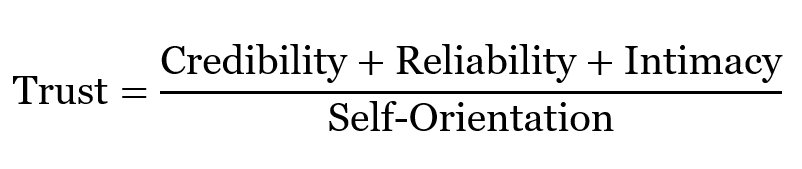
This is what each component means:

Credibility speaks to words and credentials. How authentic are we?

Reliability is the perception of a person’s integrity. Do you do what you say? Are your actions connected to your words?

Intimacy involves the feeling of safety or security when sharing information with someone. How safe or secure does the client or colleague feel in sharing with us?   

Self-orientation reflects the degree to which a person’s focus is directed towards themselves as opposed to being focused on others. What are our motives? For our benefit or the benefit of others?

The higher the numerator (credibility, reliability, intimacy), the greater the trust. Conversely, the higher the self-orientation, the lower the trust. Ultimately, the equation serves as a mindful tool to enrich discussions, elevate trust levels, and deepen relationships within our teams. 

  1. Transform how you are perceived

When leading a team or a department, it matters how you are perceived by others. The ability to self-assess your personal status is another strategic tool wielded by seasoned leaders to convey confidence and authority. It includes an assessment of your:

  • Body language.
  • Vocal tone.
  • Word choice.

Such elements can be ranked on a scale from 1 (‘low status’) to 10 (‘high status’) and, when done sincerely, this can be an invaluable guide for navigating various workplace scenarios and can even foster emotional intelligence, which is pivotal in forging genuine connections with athletes and team members. It can also facilitate the development of more impactful leadership skills that inspire and motivate with greater efficiency.

  1. Connect ideas and evidence through flows of logic

Flows of logic are the pathways our minds create to connect ideas and evidence to reach a reasoned conclusion. They are essential in critical thinking, problem-solving, and, of course, forming persuasive arguments. Flows of logic involve a sequence of statements or steps that follow one another in a rational and coherent manner. These frameworks can take three different forms, depending on your scenario: 

  1. Past –> Present –> Future 
  2. Problem –> Choices –> Solutions 
  3. Argument –> Evidence –> Conclusion

These can be indispensable guides when constructing persuasive arguments. By grounding our narratives in these logical flows, we enhance storytelling capabilities and foster deeper connections with our teams. This pragmatic approach ensures proactive, relevant support while avoiding unnecessary complexity, thereby maintaining clarity and engagement, particularly in high-pressure situations where decisive leadership is paramount.

  1. Practise mindful communication

If you can put those three factors together then you can be better at delivering your message. Mindful communication is another tool upon which you can rely. This idea urges leaders to remain present and deliberate when communicating. It can help a person to:

  • Remove filler words.
  • Omit unnecessary information.
  • Streamline communication channels.
  • Optimise attention and retention among listeners.

The members in attendance discussed the success and failure of these elements in the context of people that ‘think to speak,’ and those that ‘speak to think’.

Here are some effective mantras to keep in mind:  

  • ‘Slow down, speak up, bring more energy’.
  • ‘I don’t want to be anywhere else, talking to anyone else, about anything else’.
  • ‘Clean in, strong out’.

Final reflections 

As members reflected on the transformative potential of incorporating these persuasion techniques into their leadership repertoire, they described the following as essential steps towards mastering persuasiveness in your leadership approach: 

  • Embrace feedback and recognise areas for improvement in your own field.
  • The consistent practice and conscious application of persuasion techniques – they help to refine your leadership over time.
  • There are easy, everyday wins that elevate persuasion skills, from how you position yourself, the level of status you reflect, to how you convey a logical thought pattern.
  • Just as athletes relentlessly refine their techniques and strategies to achieve peak performance, leaders must adopt a mindset of continuous improvement and adaptability to persuasiveness. 

Go to home
Follow us on Instagram Follow us on LinkedIn Follow us on X

Contact

Leaders UK

Tuition House
27-37 St George's Road
Wimbledon
SW19 4EU
London
United Kingdom

Enquiries Line: +44 (0)207 806 9817
Switchboard Number: +44 (0)207 042 8666

Leaders US

120 W Morehead St # 400
Charlotte
NC 28202
United States

Enquiries Line: +1 646 350 0449

Leaders

  • Contact
  • About
  • Careers
  • News
  • Privacy Policy
  • CA Privacy Rights
  • Cookie Notice
  • Website Terms of Use

Performance Institute

  • Membership
  • Events
  • Content
  • Virtual Learning
  • Connections
  • Partners

Latest

Intelligence Hub
High Performance Future Trends Research Elite Performance Partners continue to drive the potential in high performance forward through renewed Leaders partnership
Your Privacy Choices

© 2026 Leaders. All rights reserved

  • Privacy Policy

Attendees

x