This year, the league has introduced broader startup criteria and encouraged a series of high-risk, high-reward bets.
Main Photo: Courtesy of the NBA

These companies will be paired with various league properties for six-month pilots culminating in a final Demo Day pitch session at NBA Summer League in Las Vegas.
This year’s batch of startups for NBA Launchpad in 2026 consist of:
For the second year, Launchpad’s selection criteria is loosely based on five league priorities — Future of Officiating, Youth Basketball, Player Health & Wellbeing, Future of Media and Fan Connection — without necessarily adhering to those exact categories. Ryan told SBJ the goal is to find products that live outside the daily core business but could be relevant within the next five years.
“In the first three years of Launchpad, we were really focused on putting out specific, almost DARPA-type of challenges, and then finding companies that map directly to those,” Ryan said. “Where we are in year four and five is just broadening up and always staying true to our big five priority areas around the game and our business, and then really just focusing on finding world-class founders and making sure that the problem they’re solving is a high-risk, high-reward type of bet.”
Alumni from the first four years of the program include seven startups to receive funding from NBA Investments and several who have gone on to work directly with NBA teams, such as insole sensor provider Plantiga, MRI-based muscle scan analysis company Springbok Analytics and broadcast tracking data supplier SkillCorner. Others have collaborated with the league on projects such as nVenue, which creates micro-betting markets, and SportIQ, whose ball sensor is being piloted for automated officiating use cases.
This article was brought to you by SBJ Tech, a Leaders Group company. As a Leaders Performance Institute member, you are able to enjoy exclusive access to SBJ Tech content in the field of athletic performance.
SBJ Tech explains how the USOPC Performance Innovation Fund is propelling American speedskaters to the Olympic podium in Milano Cortina.
Main Photo: Airo
This article was brought to you by SBJ Tech, a Leaders Group company. As a Leaders Performance Institute member, you are able to enjoy exclusive access to SBJ Tech content in the field of athletic performance.
With the Winter Olympics on the horizon, the organization is pursuing cost-effective and eminently scalable solutions.
Main Photo: US Figure Skating
Now the Chief High Performance Officer for US Figure Skating, Dillon’s affinity for the sport launched a career that reached the senior men’s national level. There was no resource to track progress or compare skating techniques in real time, something that will be much easier to do for skaters with the organization’s partnership with OOFSkate, which provides high-level analysis in an accessible way through an app.
“I was very self-driven, which is a great quality, but it was lonely,” Dillon told me. “So, I think that this also gives you the opportunity to compare your data. It’s almost like skating with a friend, because you can compare your data with athletes that either are similar levels or that you choose to share your data with or athletes at the level.”
The work comes as US Figure Skating looks toward the future, Dillon shared, in discovering how technology can move the sport toward the cutting edge around judging and analytical improvements. That journey is one that many sports and governing bodies find themselves on, with new startups trying to help that pursuit.
Simplifying analysis
OOFSkate is founded by Jerry Lu (the company’s CEO) and Jacob Blindenbach (CTO), a pair with extensive experience in applying innovation to performance and tracking for athletes.
Lu told my SBJ Tech colleague Joe Lemire that the startup’s education around skating has been powered by some significant names in the sport via an NBC connection, like former Olympians and world champions Nathan Chen, Tara Lipinski, and Johnny Weir, as well as the Skating Club of Boston.
With OOFSkate, skaters or coaches can record or upload skater routines to see insights like jump height, spin rotation and landing. It also provides for comparative analysis, where two videos can be analyzed simultaneously to compare multiple jumps from the same athletes or enable a skater to compare with fellow skaters. It only needs a single smartphone camera.
“If a coach records an athlete, they’re not going to carry a big camera connected to a big desktop computer that connects to something in order for them to use it,” Lu said. “So, it is designed to be a system that can be run on your cellphone with minimal lag.”
OOFSkate will support the upcoming Winter Olympics by providing data to boost TV production graphics and commentator analysis. The startup is self-funded. The founding pair met as students at the University of Virginia and have developed similar analytics tech for Olympic swimmers.
Perhaps my favorite detail? The “OOF” in OOFSkate is to replicate the reaction like “oof, that was bad,” but later retrofitted the acronym ‘obsess over form’ thanks to the help of sports scientist (and US Figure Skating Sports Science Manager) Dr Lindsay Slater.
This article was brought to you by SBJ Tech, a Leaders Group company. As a Leaders Performance Institute member, you are able to enjoy exclusive access to SBJ Tech content in the field of athletic performance.
SBJ Tech takes us inside the league’s Situation Room in Toronto, where data can be used to more intricately analyze the sport of hockey.
Main Photo: NHL
“Goal, Boston.”
These pronouncements from video technicians were, for a time, the only interruptions piercing the quiet murmur of the NHL’s Situation Room, the league’s high-tech Toronto facility where every replay challenge is reviewed and ruled on.
Most goals are straightforward, but every one is reviewed by a hockey operations executive to ensure its legality. So long as the puck wasn’t kicked or high-sticked into the net, the game continues. But the technicians, each assigned a single game, watch several angles of each goal to prepare for a possible coach’s challenge — such as whether the offensive team was offside.
“Goal, Pittsburgh. This one’s on us.”
Suddenly, the room stirs to life. The Penguins appeared to net a game-winning goal against the Flyers in overtime, and the Situation Room initiates all challenges in the final minute of regulation or in OT. As the braintrust began reviewing the play — several hockey operations executives and a retired referee — word arrived that the on-ice refs whistled an infraction that nullified the goal.
A few minutes later, the Flyers scored their own apparent game winner, but very quickly, a potentially incriminating view of their entrance into the zone appeared on the screen.
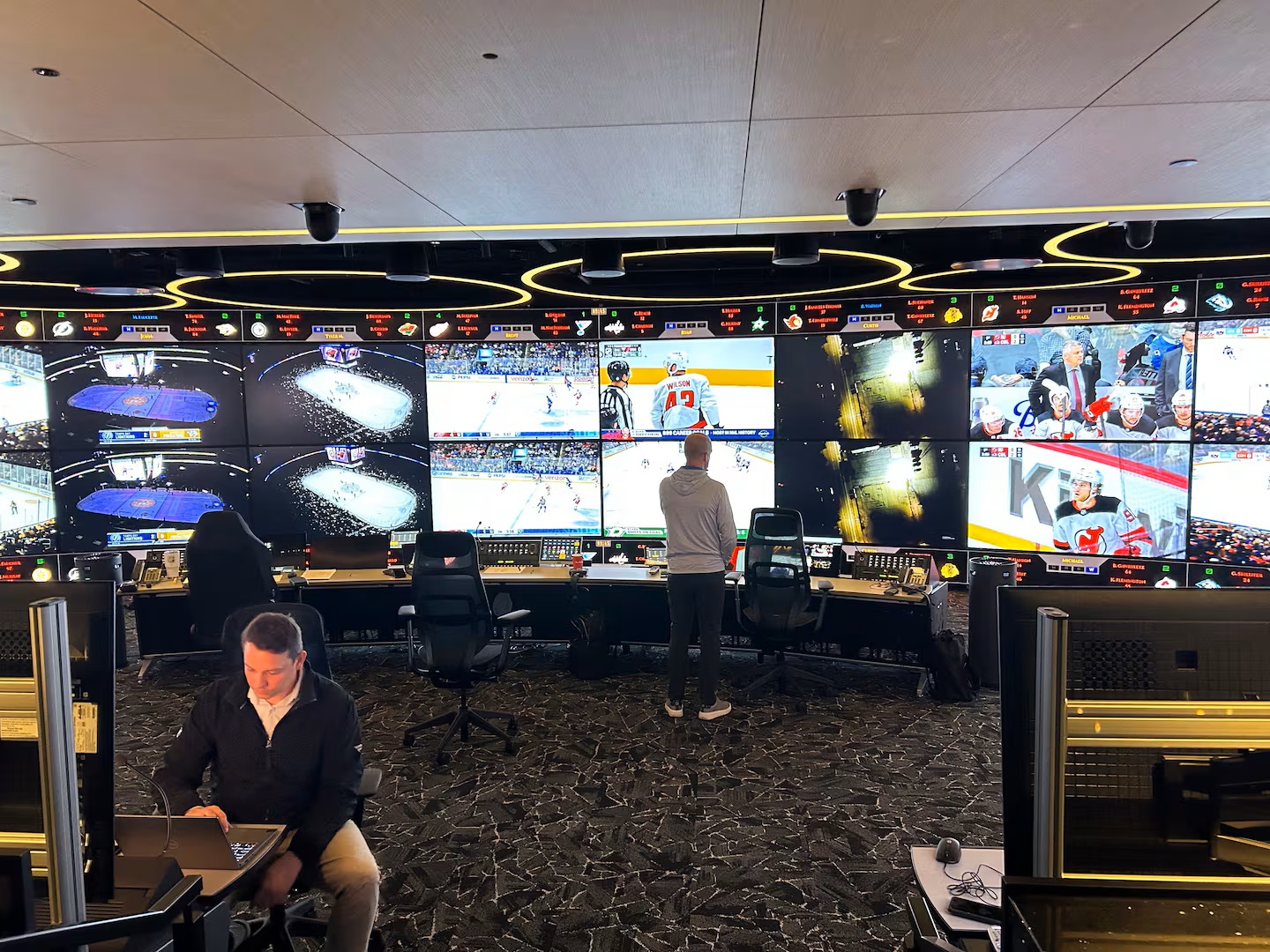
The Situation Room features 16 LED flat screens along the front wall and roughly a dozen workspaces for technicians, each assigned to one game. Photo: NHL
“We’re going to challenge this. Let’s get the linesmen on.”
Word is communicated to the on-ice officials, one of whom informs the crowd that “the previous play is under review by the league to see if the play was offsides prior to the goal” as boos cascade down from Flyers fans.
Situation Room staff pored over several angles, most notably a Sony 4K camera installed right on the blue line for exactly this use. And the final verdict, made by the Situation Room, was close, but clear: Offside. No goal. About 80 seconds after the review began, the ref shared the news in Philadelphia. Even more boos followed.
“We are the keepers of the game,” said Kris King, NHL Executive Vice President of Hockey Operations, the department’s No. 2-ranking official under Colin Campbell.
This is the second year of an upgraded, high-tech Situation Room. There are 16 LED flat screens adorning the front wall, a desk in the middle of the room for executives and roughly a dozen workspaces around the perimeter, where technicians monitor every game. SBJ was one of two news outlets granted behind-the-scenes access on the first night the 10th-floor space was open to media.
“Our job doesn’t really change a lot, but the equipment that we use, and the knowledge that we gain from using better equipment, just gives us a little bit of an upper edge to get to the right answer quicker,” King added.
The NHL was the first professional sports league to centralize its reviews back in 1991, and it has worked with Sony-owned Hawk-Eye’s Synchronized Multi-Angle Replay Technology (SMART) as its video replay provider since 2015.
Separately, the league named Sony a global technology partner earlier this year, and Hawk-Eye’s tracking cameras were installed in every NHL arena prior to last season. That system offers potentially richer data: Whereas NHL Edge, which is powered by SMT sensors on the players and in the puck, tracks a single, center-of-mass location for each player, Hawk-Eye collects data from 29 points on each skater and six points from the hockey stick.
In time, that optical data from Hawk-Eye should inform a richer future of hockey analytics, more immersive fan engagement and, perhaps, data-driven support for officials.
“The NHL are very much innovators in the space — they want to innovate with us to create the future of technology in sport — but I love the fact that it is coupled with patience,” said Dan Cash, Sony Hawk-Eye’s Managing Director for North America. “They know that this is going to be powerful for their game, but they aren’t trying to sprint to the finish line here, which I think with technology can be sometimes a mistake.”
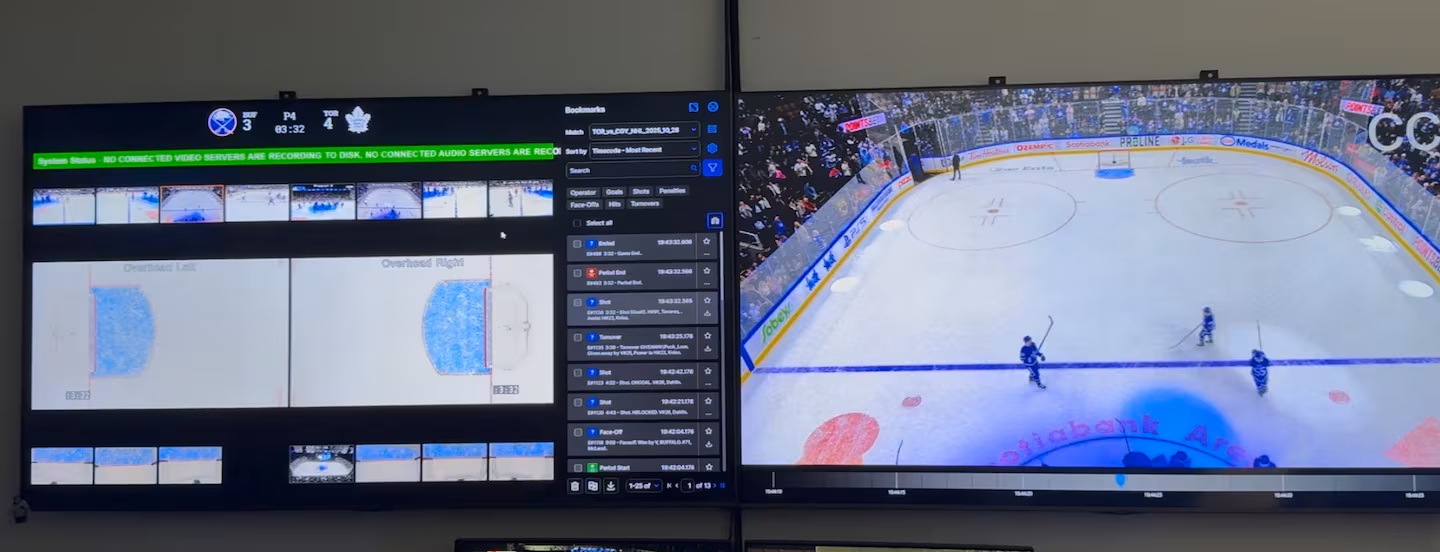
Cameras display a multitude of angles to enable the Situation Room crew to make speedy reviews. Photo: Joe Lemire
When King joined the league office in the early 2000s, the process was dramatically different. When a discipline issue arose, King would need to ferry a VHS tape to Campbell, who lived in Tillsonburg, a two-hour drive from the NHL office in Toronto.
They’d each get in their cars and drive halfway, inevitably connecting at a Tim Horton’s, the most Canadian of meeting points. Campbell would then drive home, review the tape and make a ruling about a possible suspension or fine. Nowadays, that video is transmitted in about 125 milliseconds from arenas to the Situation Room and about as rapidly to Campbell’s house, saving immense time and gas, at only the cost of a fresh coffee.
“How we transport video is the secret sauce, so to speak,” Cash said. “It’s not easy to transport video as quick as we do over a wide area network.”
We are the keepers of the game.
Kris King, NHL Executive Vice President of Hockey Operations
It’s even less for the league’s next-door neighbors. The goal horn from next-door Scotiabank Arena blared concurrently with a Maple Leafs goal scored on the Situation Room monitor. (The horn also later sounded for a Blue Jays home run; the World Series, featuring the local team, was discreetly on a few Situation Room screens.) That immediacy lets the Situation Room prepare video clips and look at questionable calls before even hearing from the on-site staff.
“It definitely is a real-time league now,” said Rod Pasma, NHL Group Vice President of Hockey Operations. “A lot of times we’ll know exactly what’s going on before [the coaches] even call the officials over to challenge a play.”
On that night, the Situation Room scoured replays to prepare a ruling that never materialized, with the on-site coach opting against the review process. “That’s a good non-challenge,” King said, noting the likelihood the call wouldn’t have been reversed.
The NHL continues to add cameras: There are three in each goal, one above, four on the blue lines and an elevated 4K lens to provide the All-12 viewpoint of every skater. Some arenas now have Cosm C360 cameras. The league will soon begin testing an 8K version of the All-12 at the Prudential Center — where the NHL and Verizon also are creating an innovation lab to test new tech, scheduled for full operation early in the new year.
On this particular night in the Toronto Situation Room, as part of ESPN’s Frozen Frenzy, all 32 teams were playing, many of the start times staggered by 15-minute intervals to make the action nonstop. One workstation was solely dedicated to pressing go on a digital dasherboards celebration for Alex Ovechkin’s 900th goal. The NHL didn’t want to chance it flashing live on-air, only for the goal to be overturned on review.
“The technology’s gotten to a point where the only thing we can’t do right now is literally hit the horn in the building,” Pasma said.
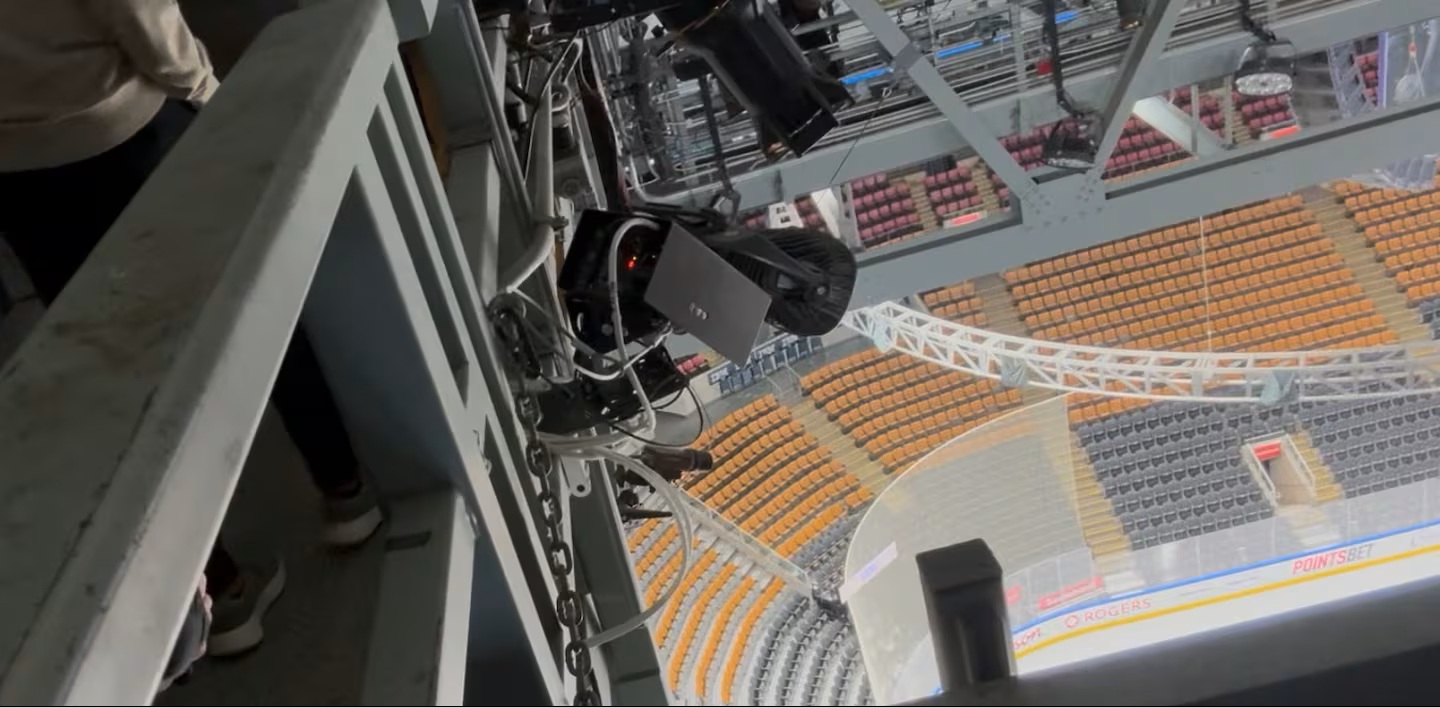
Hawk-Eye’s tracking cameras were installed in every NHL arena prior to last season. Photo: Joe Lemire
High in the rafters above Scotiabank Arena, looking down on the Maple Leafs’ 1960s Stanley Cup banners, are six black, rectangular cameras affixed to the catwalk and helping power the Hawk-Eye tracking system. From up here in the rafters, the ice seems impossibly low, but the 4K, 60-frames-per-second cameras capture granular movement data via images streamed directly to the cloud — Hawk-Eye’s first leaguewide deal to be cloud-native. Another six cameras are placed on lower levels of the arena to avoid obstruction from the center-hung video board.
Those dozen video inputs are triangulated and processed to determine the precise location of every skater and his stick. Hawk-Eye has provided MLB with bat tracking data for a couple seasons, but that’s only one bat in a known location every time — far different than 12 sticks across a 200-foot-by-85-foot ice rink.
For now, the AI models interpreting this data are still going through iterations to reach the confidence threshold for accuracy needed for wider distribution. The NHL has never had stick data, and Hawk-Eye and the league are in the “true development phase in refining the technology,” said Sean Williams, NHL Vice President, Innovation and Technology Partnerships. Williams added that it could soon be used to enhance the existing Edge tracking that teams can access through the data feed.
When Hawk-Eye data does become a part of the NHL Edge repository, it will not only further enrich the data-driven storytelling for fans via broadcast and digital media and help clubs more intricately analyze the sport, it also could provide other inputs for referees, linesmen and Situation Room executives.
“Not currently, but that’s definitely where we’re going,” said Sean Ellis, NHL Vice President of Hockey Operations, of using tracking data for officiating. “We’re not going to roll it out until we’re 100% confident and comfortable that the data that we’re getting is accurate.”
Even then, the potential is more to inform than automate. “We are genuinely looking at all options,” Williams said, “but our fundamental strategy is to keep the call on the ice made by humans.”
This article was brought to you by SBJ Tech, a Leaders Group company. As a Leaders Performance Institute member, you are able to enjoy exclusive access to SBJ Tech content in the field of athletic performance.
In the third and final session of his virtual roundtable series, Professor Fabio Serpiello of Central Queensland University raised the question of decision-making frameworks when choosing or discarding tech solutions.
Fabio Serpiello, the Director of Sport Strategy at Central Queensland University, first posed this question to Leaders Performance Institute members as part of the survey that resulted in our Trend Report.
Fewer than half of respondents said ‘yes’, with more than a third saying ‘no’. Curiously, nearly 20 percent said ‘I don’t know’.
“That’s a good chunk,” Serpiello told members of that 20 percent figure while leading a recent Leaders Virtual Roundtable. “It is probably more interesting than the ‘yes’ and ‘no’ given that most of the people that responded are at the ‘head of’, ‘director of’ or ‘vice president of’ level.”
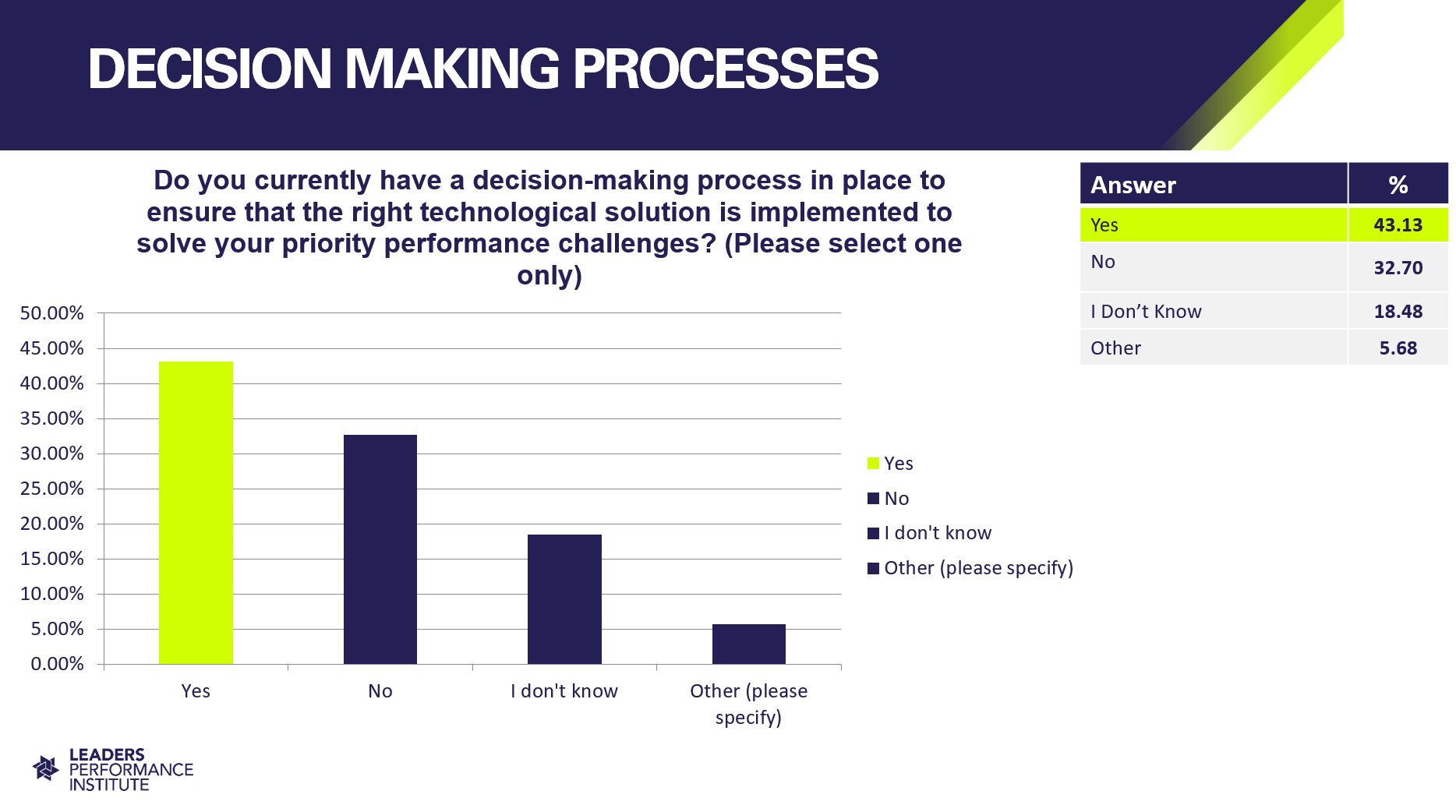
Yet in the same survey, almost 90 percent of respondents believed that a framework was at least ‘somewhat important’:
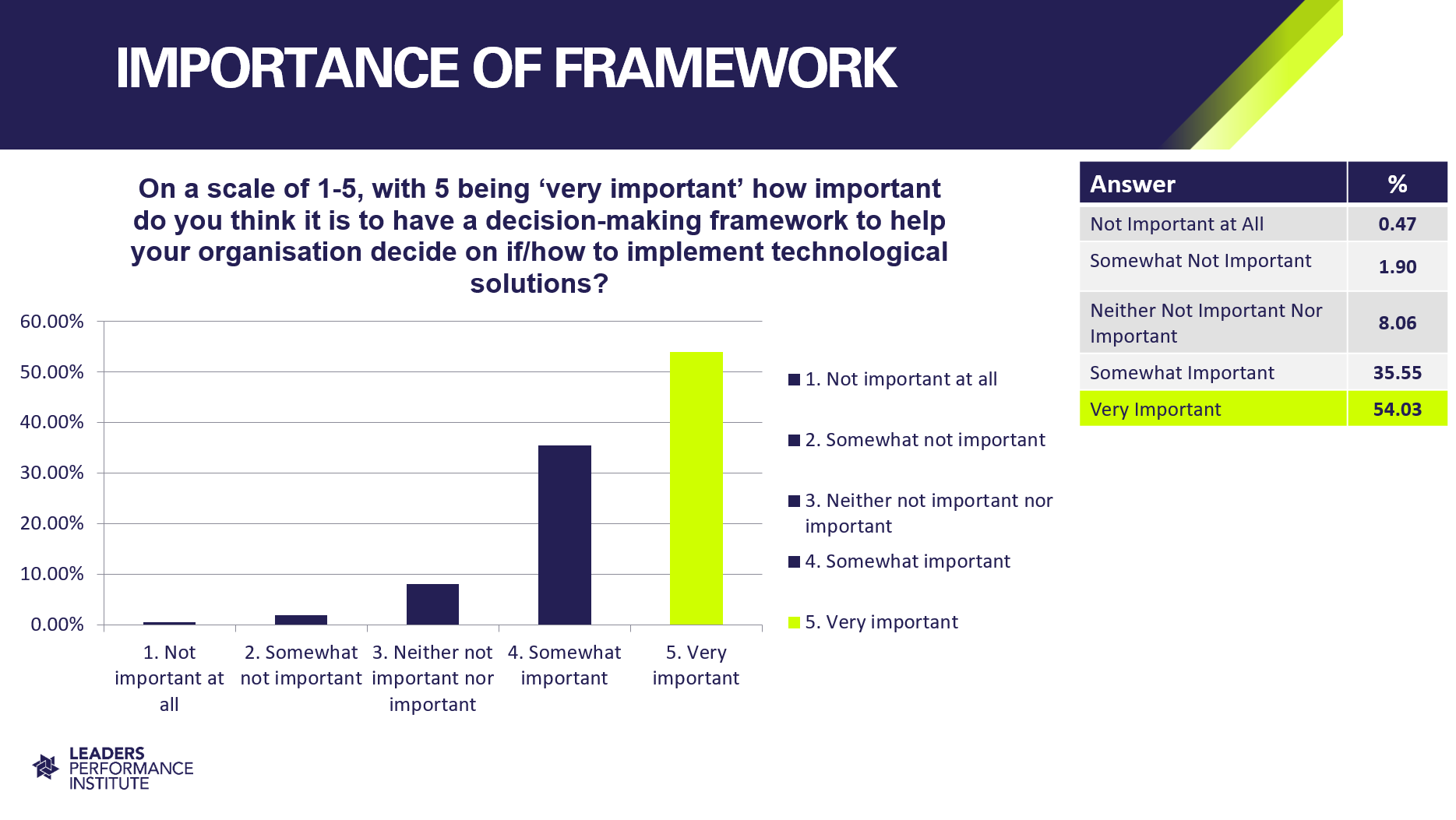
Logically, it seems likely that a good proportion of those respondents face frustrations in their work.
This likelihood set the stage for the third and final instalment of Serpiello’s roundtable series looking at tech-related innovation in sport.
First, the table noted some common problems around making decisions on tech.
A lack of decision-making frameworks: the magnitude of the challenge will depend on to whom you speak. Some markets are more mature than others; some sports resist tech-related innovation. As Serpiello said: “We are experiencing a lot of difference in the maturity of the European context and the Australian context versus the American context in some of these discussions, naturally, because of the way sport works.”
Overzealous vendors: almost every practitioner has heard a misfiring pitch from tech vendors at some point; they’re even more likely to have seen purported tech solutions gathering dust in a cupboard at their practice facility. A senior sports scientist illustrated the reality in his role:
“It’s not always us identifying a gap and reaching out to the best fit to fill that gap. It’s a lot of companies reaching out to us and trying to be ahead of the curve sometimes, which is maybe filling a need that you don’t have.”
Pressure from leadership: in some cases, senior leaders are pushing their high performance teams into finding the latest gadget. The aforementioned sports scientist also feels pressure from above:
“We’re being pushed from the top, even if you don’t know if the suggested tech solution makes sense. They’ll say: ‘just get some fancy toy that people will talk about’.”
The table also pointed to several solutions.
Serpiello spoke of the Sports Tech Research Network, specifically its Quality Framework for Sports Technologies, as a time-saver.
This white paper introduces a standardised, evidence-based framework which can be adopted by sports technology stakeholders to assess the value, usability and quality of technology.
Developed in collaboration with 48 experts across the sports industry by means of a Delphi study design, the framework includes a range of qualities grouped under five overarching pillars:
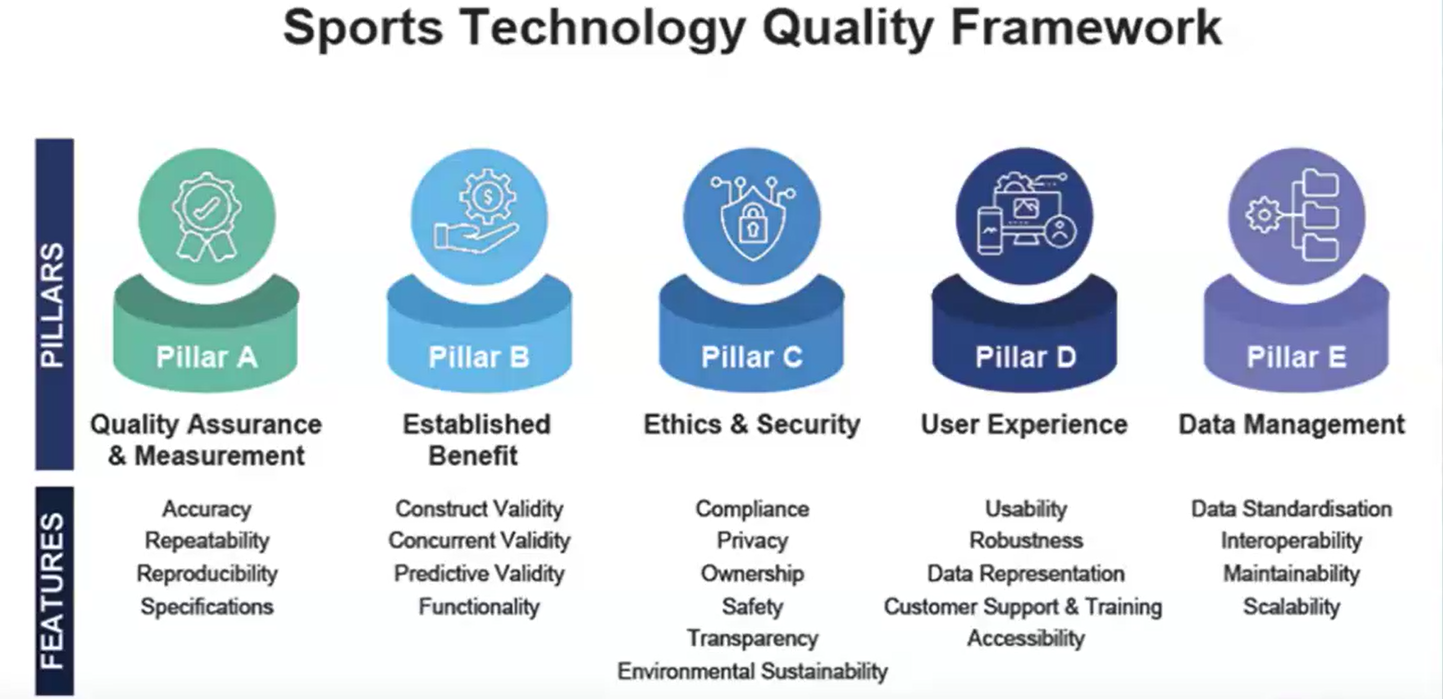
“Some of these pillars lead to more hardcore science questions; accuracy, repeatability, reproducibility, construct validity, or predictive validity; those are very much science-driven,” said Serpiello. “Some of them are more operational such as compliance, data privacy or environmental sustainability; and some are more user experience; how does the customer support and training work? These things are very important for you in sport because they make or break the day-to-day choices and the day-to-day use of technology.”
He then illustrated how the framework might be used to make informed choices:
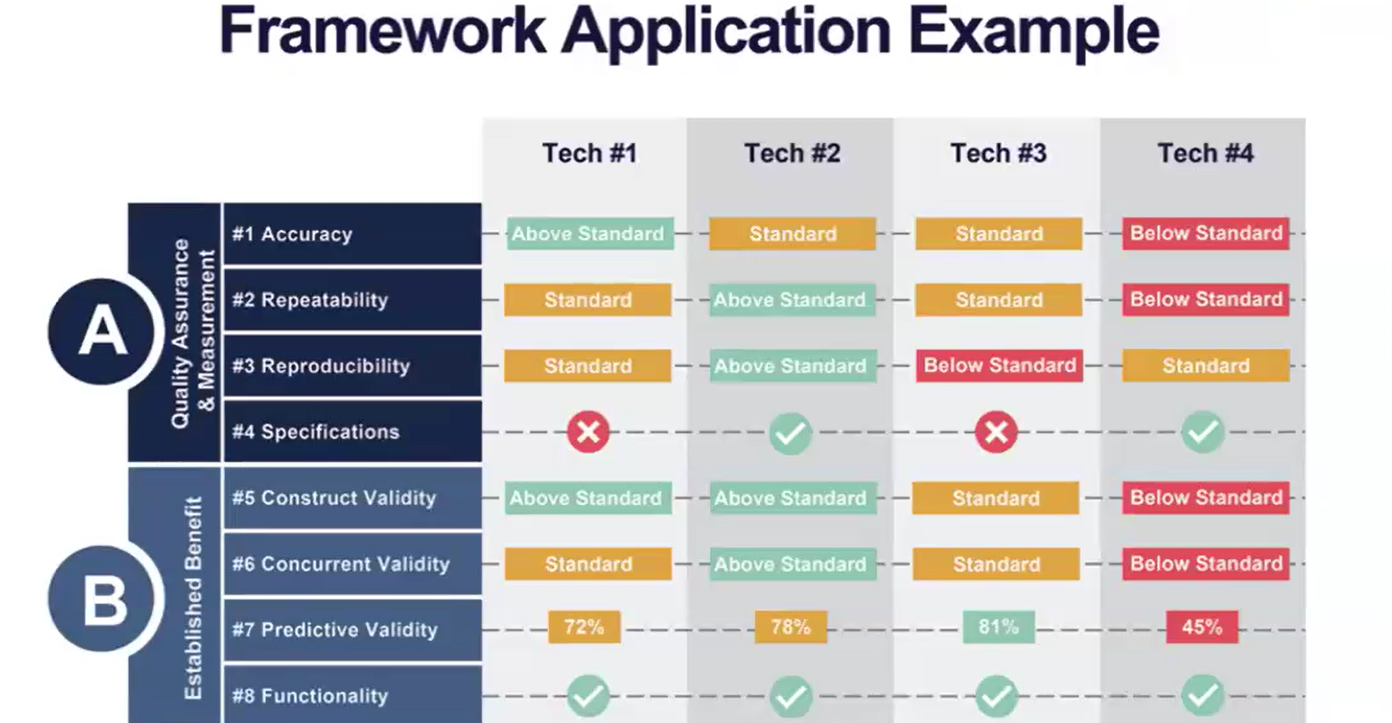
One or two members had already used and adapted the framework to their team, as one sports scientist explained:
“We’ve adopted it when we’re looking at multiple systems for velocity-based training or GPS, just to give our practitioners and stakeholders guidance and have that scoring system to then see how it ends up; and to put in some objectivity to the potential subjectivity of that process. I think it’s helped us a lot because different stakeholders in different departments can come together. We actually added to it as well for things like partnerships and sponsorships and adapted it to our setting, which made it even more useful.”
Governing body mandates
As Serpiello explained, international confederations such as FIFA and FIBA, as well as national governing bodies, such as the Dutch Olympic Committee*Dutch Sports Federation, mandate the format in which data must be produced by companies.
In a similar vein, the AFL has an “internal technology group” for vetting all potential tech solutions. Serpiello said: “It includes coaches, medical, sports science, S&C, commercial, legal personnel and they say ‘we meet once a month and we deal with the approaches this way’. So outside that process, they do not respond to you, they do not engage with you, they say to you as a company ‘this is the process, submit your inquiry, and then we’ll assess it’. I like it because it takes away a lot of that constant having to deal with companies that come and say ‘we’ve got this amazing product’ only for you to then realise that it’s really the same product as before.”
Another example is the NBA Launchpad, which is the league’s initiative to source, evaluate and pilot emerging technologies.
“It’s basically ‘come and show us what you have and we’ll look at it’,” said Serpiello. “That’s slightly different from ‘okay, we’ve got an issue and we’re going to throw it out there’.”
Accuracy and reliability are less important than practicality
Accuracy and reliability are important but they are not everything.
“I’ve slightly changed my mind on this over the years,” said Serpiello. “I’ve seen organisations chasing the product that was one percent more accurate or reliable on some of the main variables, only to then completely disregard the other part, which was does it have API [application programming interface] connections with my other systems? Does it allow me to make quick decisions every morning when the athlete rocks up? Those things are far more valuable than being able to say confidently that high-speed running this week was 1K or 1.1K.”
A programme manager in the Australian system concurred while highlighting the tension between providing broadcast data (where granularity and accuracy are not as important as they might be for a high performance team).
He said:
“I think that’s the healthy tension between something that is returning value, whether it be in the speed of decision making or feedback from experimentation; that’s the inherent tension of scientifically valid and reliable systems versus commercially valuable systems… and just because something’s not valid and reliable doesn’t mean it’s not valuable. You just need a measurement to be able to reduce that accuracy and reliability to a standard that you’re comfortable with.”
What to read next
NewtForce’s streamlined analysis tool enables real-time pitching feedback thanks to its collaboration with motion capture specialists Movrs.
Main Photo: Movrs
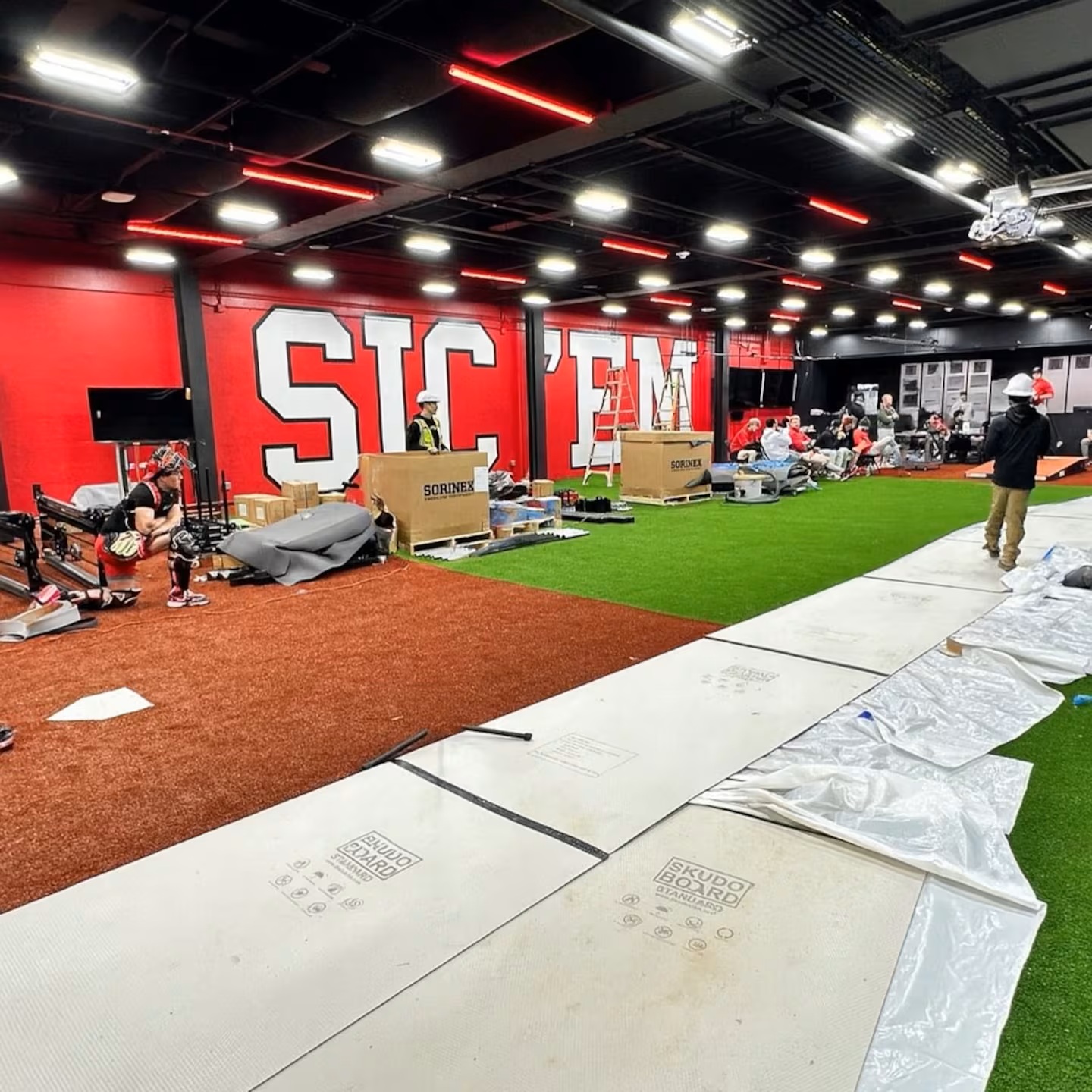
The Bulldogs began using the new high-tech pitching tunnels while construction workers were still clearing the space. Photo courtesy of NewtForce.
This article was brought to you by SBJ Tech, a Leaders Group company. As a Leaders Performance Institute member, you are able to enjoy exclusive access to SBJ Tech content in the field of athletic performance.
In the second part of his virtual roundtable series looking at tech-supported innovation in sport, CQU’s Professor Fabio Serpiello turns the light on the widespread lack of structured decision-making processes in sport.
The Director of Sport Strategy at Central Queensland University led the second instalment of a three-part Leaders Virtual Roundtable series aimed at exploring the dynamics of tech-supported innovation in sport.
As host, Serpiello wanted to “provide frameworks and stimulate discussion on how to select the right technology for performance challenges, ensuring decisions align with strategy and context.”
The Leaders Trend Report earlier this year highlighted that fewer than half of practitioners can point to a structured decision-making process within their organisation. Many have lamented this with Serpiello, which stands to reason as nearly all respondents in the report perceive such a structure as important.
It starts with a clear performance question, as a sports scientist working in European football put it.
She said: “If we’re going to make a decision, we have to have something well-structured. We need to ask what do we want from what we’re collecting or what do we want from what we’re asking the athletes to do.”
Another attendee, with oversight of several sports, recalled their own situation with problem clarification. “The solution looked like the key, but many sports were unclear on the problem.”
Serpiello presented the group with two models to address this issue.
Greg Satell’s Model of Innovation
Innovation, Serpiello argues, comes in several shapes and forms depending on the nature of the problem. To make his point, he introduced renowned change management specialist Greg Satell’s Model of Innovation, which provides a practical framework for introducing innovative practices, encourages strategic thinking about problems and helps to facilitate better collaboration.
He presented a diagram of Satell’s model to the table:
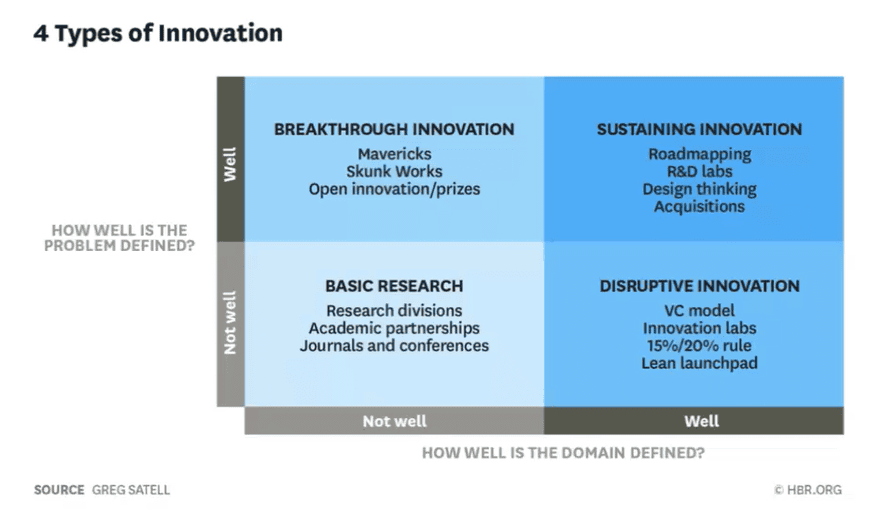
Serpiello had previously shared his thoughts on each quadrant:
Basic research – a low understanding of both domain and problem: “We don’t really know what the problem is and we don’t really know in which field or area it happens.”
Disruptive innovation – a well-understood domain but poorly understood problem: “In this area you may need something like innovation labs or launch pads.”
Breakthrough innovation – a poorly understood domain but well-defined problem: “This is the reverse of disruptive innovation… the classic example of open innovation.”
Sustaining innovation – a well-understood domain and problem: “The most common form in sport [and often the subject of] continuous research, design thinking or road mapping.”
A fuller account can be found here.
A general manager of a successful Paralympic programme gave an example of breakthrough innovation in their work supporting totally blind swimmers:
“We’re working with our institute partners and also reaching out to universities to understand if there’s interest in terms of product development and research in this space.”
There is a clear problem, the domain is less defined, and the organisation is piloting new concepts.
Another attendee working in the Olympic and Paralympic system spoke of an example of disruptive innovation when their team sought coaching tools, primarily:
“The piloting was done with the university [engineering department]… the final year project has to be sponsored, innovative, and they’re graded on the finish of the product and customer satisfaction… they were constantly in touch with us, so in terms of getting clear on the problem and implementing a solution, they were fantastic, these young engineers… The projects that succeeded were embedded into sport, and it was because the engineer was back and forth with the client, with us, and with the athletes.”
The Cynefin Framework
Serpiello then reacquainted the table with the Cynefin Framework.
‘Cynefin’, which is pronounced ‘ku-nev-in’, is a Welsh word that signifies ‘the multiple factors in our environment and our experience that influence us in ways we can never understand,’ as Snowden and Boon wrote in their 2007 Harvard Business Review essay titled ‘A Leader’s Framework for Decision Making’.
The Cynefin Framework, they continued, ‘helps leaders determine the prevailing operative context so they can make appropriate choices’.

Source: HBR
The framework classifies decision-making contexts into five domains:
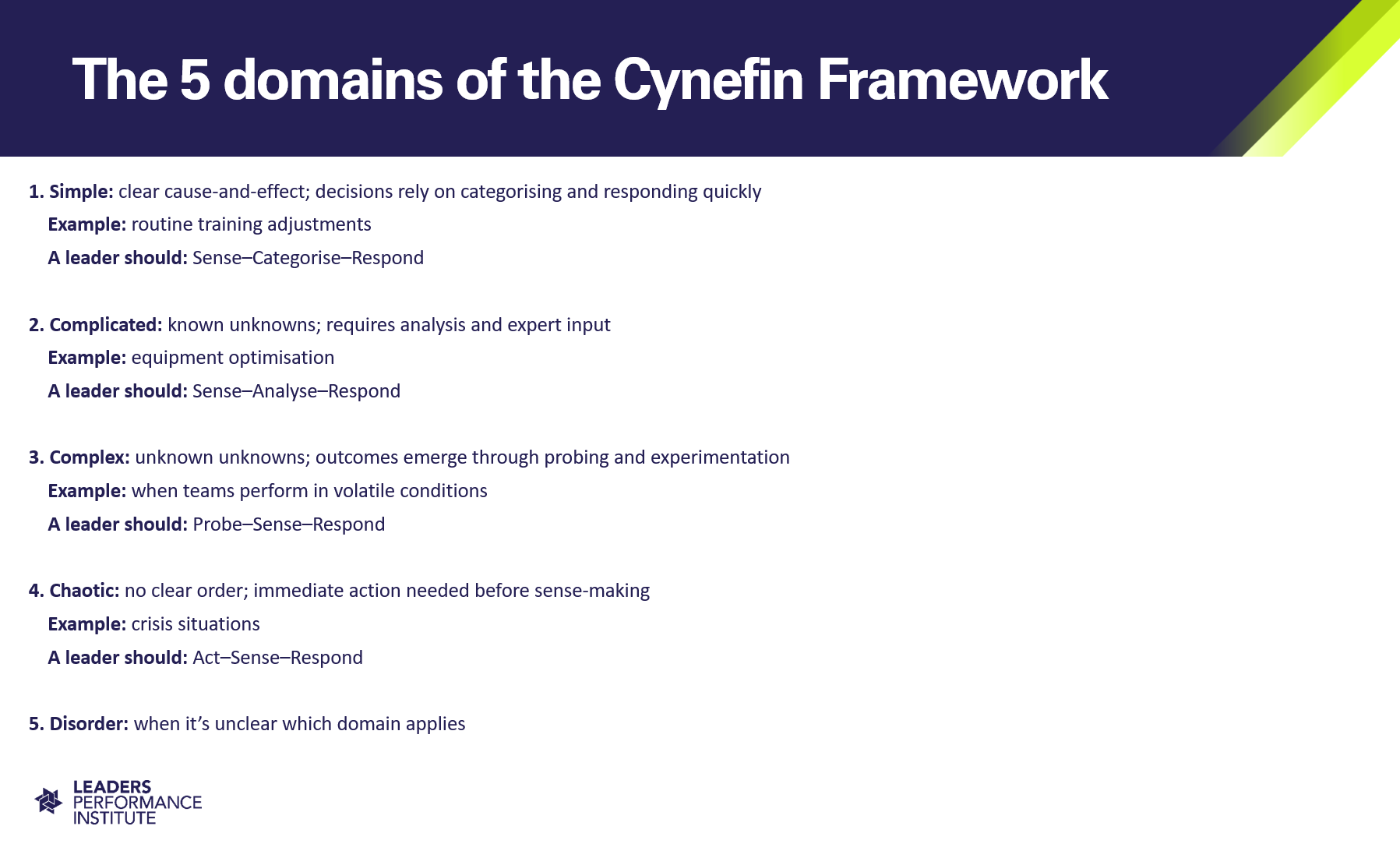 “The Cynefin Framework essentially classifies decision-making on the continuum between order and unordered conditions,” said Serpiello, adding, “because if you make the wrong decision, or if you use the wrong quadrant, you may waste a lot of time without actually getting to the right answer.”
He cited the example of tracking tech companies selling their wares as the answer to complicated and complex problems. “What tracking technology should do really well, in my opinion, is give you the ability to quickly categorise what’s happening in training and then respond properly, whether it is a load management, readiness or a recovery response.”
Other ideas
What to read next
The organisation has incorporated technology from NeckCare, a wearable head device that measures neck function through sensorimotor exercises and provides insights into the into the return-to-play concussion protocols of athletes at its UFC Performance Institute locations.
Main Photo: Getty Images
Heather Linden, UFC’s Director/Sports Medicine, told SBJ that over the past two years, UFC has collected data from 300-400 athletes, which will be used to establish baseline data on its athlete population’s neck function and inform future assessments.
The impetus behind the collaboration for UFC was to add more objectivity into its head injury assessments.
“It’s very easy to prescribe a knee rehab with — the range of motion is lacking, their peak torque-to-bodyweight [ratio] is this, their isokinetic strength testing is this. It’s really easy to say, ‘You’re not ready to return to sport,’” Linden said. “But in the concussion realm, a lot of times you can’t see the symptoms … By having NeckCare and having that objectivity and showing [athletes], ‘Hey, cognitively you’re performing like this normally and you’re not here’ — that now gives that competitive edge to [athlete] buy-in.”
UFC utilizes two NeckCare devices in the physical therapy clinics of each of its Performance Institute locations in Las Vegas, Mexico City and Shanghai. It uses NeckCare’s range of motion and neck position exercises as a part of its head injury evaluation process, and also for recovery/training purposes, Linden added.
NeckCare CEO Orri Gudmundsson said the primary focus for the company, which went to market about two years ago, is to sell into health clinics, but it also works with multiple NCAA football programs and Twin Cities Orthopedics, which treats NFL and NHL athletes, in addition to UFC.
“If you suffer a concussion, the neck is always involved,” Gudmundsson said. “Cervicogenic [originating from the neck but felt in the head] headaches, cervicogenic dizziness — that’s where we come in with technology that’s been in research and development for more than 20 years, to quantify the function of the neck and how your eyes, your brain and your neck are talking together.”
NeckCare’s devices, which are FDA-listed, price at $6,000 per year. The company overall works with more than 250 providers across North America.
This article was brought to you by SBJ Tech, a Leaders Group company. As a Leaders Performance Institute member, you are able to enjoy exclusive access to SBJ Tech content in the field of athletic performance.
The former US tennis star made the unconventional move of moving into venture capitalism.
Main Photo: Getty Images
At age 15, she was the No. 1 junior tennis player in the world. By four months after her 18th birthday, she’d climbed as high as 35 in the WTA rankings and reached two (of an eventual three) Grand Slam singles third rounds.
But after injuries forced her to retire in 2021, Bellis is now showing similar precociousness in a new endeavor — venture capital.
In mid-2023, Bellis launched an eponymous sports technology investment firm called Cartan Capital (her full name is Catherine Cartan). It has raised two funds — the first a $10 million pledge fund sourced from 15 investors, the second a larger fund that is nearly closed and deploying capital — and made eight investments.
“I grew up in Silicon Valley, so I felt like I was around venture from a young age,” said Bellis, 26, and an Atherton, California, native. “I grew up solely focused on tennis. … But school was always a big part of my life and something that my parents instilled in me — how important education is — from a young age. … I knew that I wanted to always have a backup plan.”

Catherine Bellis took the first set from Victoria Azarenka at Wimbledon in 2017. (Photo by Lindsey Parnaby/Anadolu Agency/Getty Images)
Bellis initially committed to Stanford, her dream school, but after cracking the WTA top 100 as a teenager, decided to go all-in on tennis. While playing, she pursued an undergraduate degree in business administration from Indiana University through a scholarship program facilitated by the WTA — eventually giving the commencement address for her graduating class in 2022 — then got her MBA at the University of Miami.
Her first professional break came through an internship with Orlando-based Tavistock Development Co., which she parlayed into another internship — and eventual promotion to investment analyst — with leAD Sports & Health Tech Partners.
Longtime venture investor Martin Mann, now a Cartan Capital partner and the largest backer of the firm’s first fund, met Bellis through his work on the board of the USTA Foundation, but remembers being “over-the-top impressed” by her straight-shooting answers to due diligence questions after she brought him in to meet with leAD during her time there.
“When she left to start Cartan, she called me and asked me if I would be an adviser. I thought it was a little shocking that she was jumping off after only a few years in venture capital,” Mann said. “But there are some people — and they are few and far between that I’ve seen — that are just more extraordinary than humans should be.”
Cartan Capital focuses primarily on participating in Series A or later-stage seed rounds, led by other firms, across sports, technology, health and wellness. Its portfolio consists of several startups that have made waves through partnerships with major leagues and media properties, including audio innovation company Edge Sound Research, AI-powered musculature analysis platform Springbok Analytics, interactive hologram maker Proto Hologram and TGL creator TMRW Sports.
Bellis’ reputation with her portfolio companies is that of an attentive, hands-on and well-sourced partner adept at facilitating connections — whether in business development or hiring — and providing an athlete’s perspective.
“She has a determination to support all their portfolio companies,” said Edge Sound Research CEO Valtteri Salomaki. “That’s rare with a smaller fund like hers, because usually — I mean, X amount of resources, X amount of time. … For her to not only source and understand companies, but then also from there be able to support those companies, her personality is clearly [that] she cares.”

CiCi Bellis, center, attends the Break The Love and Tory Sport private celebration in honor of Women’s History Month and The Miami Open in March 2022. Also pictured (L-r): Trisha Goyal, Marissa E. Hill, Taylor Townsend, Jessica Pegula, Christina McHale and Bethanie Mattek-Sands. (Photo by Desiree Navarro/Getty Images)
Bellis also began a two-year term as a director-at-large (elite athlete) on the USTA’s board this year, where, as has become custom, she is the youngest in the room. She has distinguished herself there by serving on several committees, including the USTA Investment Committee, USTA Ventures Committee and two athlete committees.
Bill McGugin, USTA Ventures chairman and fellow board member, said Bellis has made a particular impact in deal sourcing and analysis for the organization’s venture arm, which has made three investments since launching two years ago.
“Though she’s relatively young, you feel like you’re talking to someone that’s been in the profession for 20 years,” McGugin said of Bellis. “Her awareness of the market, her awareness of financial structuring, her connections to other investment firms and opportunities. … [Working with her has] been very positive.”
Bellis said the discipline she developed as an athlete has aided her transition to her next phase.
“My work ethic and dedication that I brought from my day-in, day-out tennis career and all the hours that it takes to be a pro athlete — I was able to catch on really quickly based on the work that I did outside of work, making sure I was up to speed on everything going on and learning about venture,” she said. “Just being scrappy.”
This article was brought to you by SBJ Tech, a Leaders Group company. As a Leaders Performance Institute member, you are able to enjoy exclusive access to SBJ Tech content in the field of athletic performance.