Swansea City Head of Performance Thomas Barnden believes that true innovation will blend AI and human input.
A Data & Innovation article brought to you by

Barnden arrived in June 2022 with a pedigree of analytics through his time at forward-thinking clubs like Brighton, where he spent seven years, and Manchester City, where he led an academy program. He’s well-versed in the latest innovations in soccer. Swansea, for instance, has added partners such as infrared recovery apparel marker KYMIRA, blood-flow restriction wearable Hytro, a HydroWorx training pool, cryotherapy and many standard devices such as GPS trackers.
From this perch, the biggest tidal wave coming in sports, Barnden believes, is the proliferation of artificial intelligence and machine learning. It’s already a big part of player recruitment, he noted in a recent interview, and growing toward improved recommendations for training programs.
“I think we do the prediction bit quite well, but I think the future is the prescription,” Barnden said, before he continued with his boldest projection.
“The way I see it is that there will be an assistant coach — an AI or machine learning assistant coach — on the bench within three to five years,” he added. “And I know that might sound mental, but I truly believe that we could see a position like that an assistant virtual coach or an automated assistant coach on the bench. What that looks like physically, I’m not 100% sure, but it would have a capacity to communicate tactical strategies, technical strategies, recommendation of substitutes.
“I know that sounds a little bit far-fetched, but I truly believe that is kind of the way it’s going. I’m not going to say that human behavior and human connection is going to be lost because that won’t happen. But I think there’s going to be a definite need for this integration of human and AI working together. I don’t think that the human will ever be replaced. That’s not the point. It’s for the integration of human and AI to work together.”
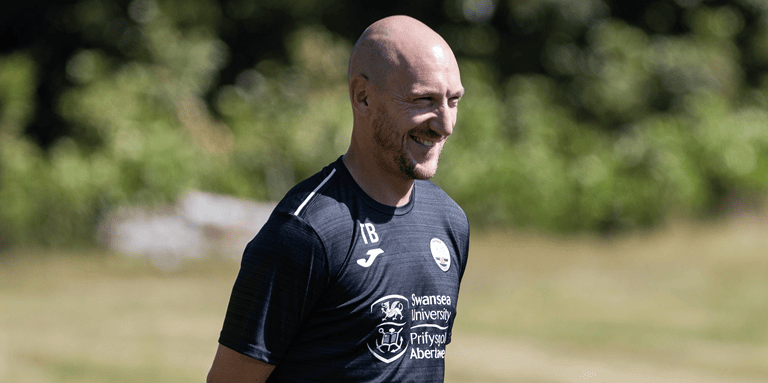
Swansea City Head of Performance Thomas Barnden is well-versed in the latest innovations in soccer and utilizes tools from KYMIRA and Hytro for the club’s recovery. Image: Swansea City
Generative AI solutions, such as ChatGPT, have phenomenal potential, Barnden added, while noting that there “are still some limitations with it.” What becomes crucial with the influx of all this data is making sure it is understood and used by all relevant parties.
“In many organizations, there remains a consistent disconnect between the data scientist and the executive decision makers they support,” Barnden said. “There’s a significant, what I would call, ‘interpretation gap’ in a lot of clubs. Where my role comes into the forefront is being this data translator. So it’s having effective interpersonal skills, and an ability to story tell the narrative of the message to the right people.”
One area that Swansea City — competing in the second-tier Championship this season — has emphasized is mitigating travel fatigue and promoting readiness. Swansea is a port town in Wales whose opponents are primarily in England. By one accounting, the club must travel the most miles (4,965 miles) this year, about 400 more than anyone else.
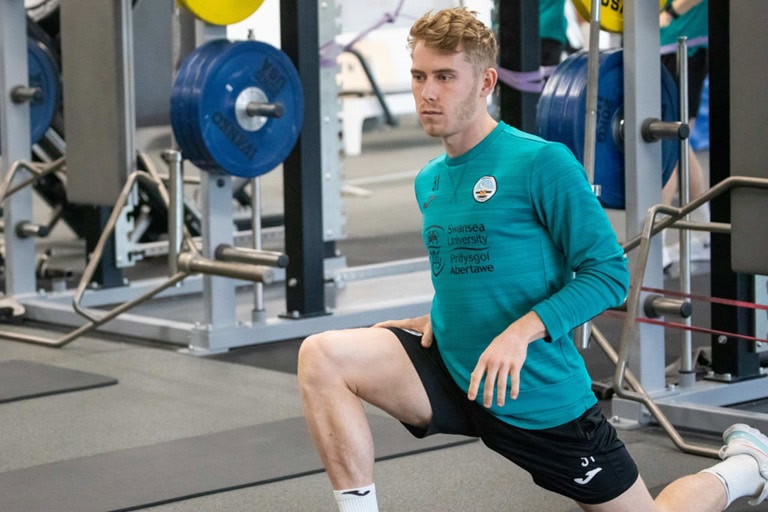
Sleep and nutrition are the two cornerstones for recovery at Swansea, adding in the specialized components like compression or cryotherapy to round out the recovery, Barnden tells SBJ Tech. Image: Athena Pictures/Getty Images.
Most recently, Swansea partnered with KYMIRA, which makes compression apparel infused with Celliant materials that turn body heat into infrared energy that is said to increase local circulation and cellular oxygenation. Such physiological change can boost recovery and improve sleep and performance.
While objective assessment of its impact is challenging — there are numerous confounding variables — but Barnden said the athletes have regularly been wearing the compression leggings and socks when traveling, as well as at other times for recovery. The team has reported positive subjective feedback. And the club is playing at a high level late in the season, having won four and drawn once in its last five matches.
“The two cornerstones that we use at Swansea really for recovery are sleep and nutrition,” Barnden said. “You add the little bits around it like the blood flow, the compression garments, the hydroworks or the cryotherapy — the active recovery part. They all add the whole package to promote recovery and regeneration.”
This article was brought to you by SBJ Tech, a Leaders Group company. As a Leaders Performance Institute member, you are able to enjoy exclusive access to SBJ Tech content in the field of athletic performance.
The startup’s AI-powered nutrition app is helping athletes to optimize their performance.
Main image courtesy of Hexis
A Data & Innovation article brought to you by
Through that experience, Dunne saw numerous innovations aiding sport science peers as they collected data and provided insights on athletic readiness and training loads, but there was nothing comparable for his field. That realization prompted the founding of Hexis, an AI-powered personalized nutrition app.
“Although wearables had rushed ahead and people were harvesting continuous physiological data from other sources, nutrition had really lagged behind,” said Dunne, the company’s CEO. “Everything was still a tracker and calorie counter. So we decided to take some of the advancements in sports nutrition in elite sport, which were really centered around predictive nutrition and understanding how to periodize intake, according to the load and demands of the day.”
After launching publicly in Q3 last year, Hexis has attracted more than 500 paid subscribers, of which more than 10% are professional and Olympic athletes. Endurance athletes are the most represented group. In mid-April it launched an integration with Apple Health to ingest more objective data for custom meal plans and also an in-house food tracking feature that Dunne believes will improve upon what’s available at MyFitnessPal.
Users are onboarded by sharing info about their sport, lifestyle, sleep patterns, weight, body composition, typical meals and training schedule and their goals. The duration and intensity of training is considered in generating a meal plan automatically. One recently added feature, Live Energy, evaluates intake versus expenditure at a micro level.
“If, for example, this went from being a light session into a hard session, everything pretty much updates on the fly as though I was your nutritionist in your pocket and how I would manipulate things,” Dunne said.
A desktop dashboard for team nutritionists to monitor an entire roster is in development. That’s an acute need in the field, as the best nutrition plans are personalized, which necessarily requires more time and effort. Augmenting a nutritionist’s resources to be more efficient is what helped bring together two of Hexis’ co-founders in the first place.
Dunne, whose longest team stint was with the Harlequins in Premiership Rugby, and British Cycling’s lead nutritionist, Sam Impey, both did their PhD work at Liverpool John Moores University and often crossed paths at industry events.
“Whenever we’d catch up, normally over a beer at a conference, and it was quite weird how often we’d see similarities in the challenges that we faced, even though [cycling and rugby are] dramatically different sports — but the issues of nutrition around scalability,” Impey said.
Their sub-disciplines within performance nutrition were different — Impey focused on carbohydrate periodization and physiological changes to the muscle whereas Dunne is a behavioral scientist with an expertise in the use of technology — but they both identified that same need.
While holding a postdoctoral position at the University of Birmingham, Impey began exploring the application of his PhD research around the timing of carbohydrate intake to help the body best adapt to training. Proper nutrition can increase the benefit of exercise, helping people get fitter, faster. He said he had compiled “a reasonably interesting Excel sheet” and thought he’d bounce some ideas off Dunne.
“I’ll never forget his face when I showed it to him,” Impey recalled, “because he was like, ‘Wow, that’s interesting.’ And he said, ‘Look, I’m actually doing the the same thing.’ But I think he was nine, 12 months, further down the road than me.”
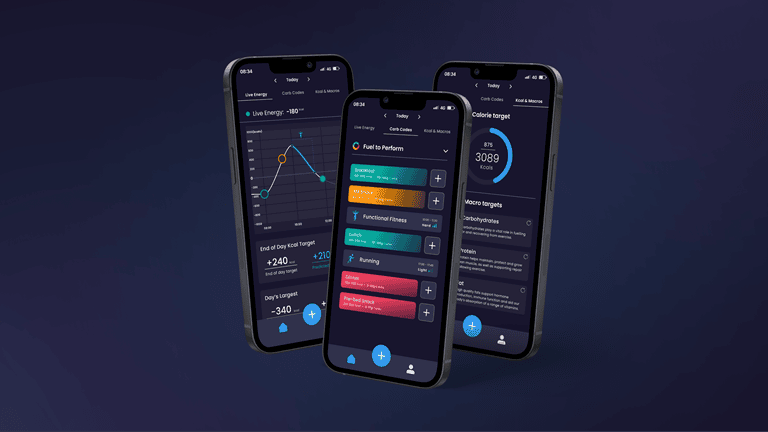
Image courtesy of Hexis
They joined forces, along with three other co-founders: Rodrigo Mazorra Blanco, the director of engineering and CFO; Xiaoxi Yan, who leads data science; and Carmen Lefevre-Lewis, a behavioral scientist who is also a UX research manager at Meta. Impey praised the executive team’s diverse experience and its “strong and encouraging check-and-challenge culture.”
Though most of the team’s experience is in Europe, Dunne’s CV includes a stint as a performance science consultant for Orreco — winner of SBJ Tech’s Best in Athlete Performance for 2022 — where he provided in-person support to client teams, including a two-year stint helping out periodically with the NBA’s Dallas Mavericks.
As with many startups, Hexis draws on elite sport experience to design and develop the product so it’s suitable for professional athletes, but the app is accessible for anyone who trains regularly.
“The reason we built Hexis and where we thought we could really cause a shift in behavior is more around planning,” Impey said, explaining that most tools available are retrospective, but they want to target prospective action.
“Adherence is obviously the golden nugget for everyone,” Dunne said, noting that team spends extensive time exploring ways to engage with all kinds of users who respond to different messaging and prompts at different times of day.
As prevalent as the technology is, one area Hexis has not delved into is machine learning. “When it comes to physiology, we don’t want the system to make a mistake and learn from its mistake,” Dunne said. “We feel there’s pretty good rules around exercise metabolism and biochemistry that, with the development of AI and expert systems, we can give a right and a wrong answer.”
This article was brought to you by SBJ Tech, a Leaders Group company. As a Leaders Performance Institute member, you are able to enjoy exclusive access to SBJ Tech content in the field of athletic performance.
Dylan Frittelli is among those using TourIQ for their own game analysis, course profiles, hole strategy recommendations and a schedule optimizer that can recommend which tournaments a golfer enters.
A Data & Innovation article brought to you by
Such power can come with a cost in accuracy, however. Until recently, when he began working with Cory Jez and his new TourIQ golf analytics business, Frittelli had no way to objectively measure the holistic impact on his game.
“I wouldn’t have any clue how to go about it,” Frittelli said. But he was able to ask Jez, “Have I actually improved my overall ball striking? Or does missing a few more fairways actually hurt me?”
“He did a deep dive in the analysis,” Frittelli continued, “and he basically found out it was almost a break-even, but then my wedge play was much worse out of the rough. So he was like, ‘Look, you’re hitting it much farther down, but you’re in the rough more.’ And between him and my coach, we decided, OK, maybe I’m going to toggle back a bit on driving distance.”
Golf is a data-rich sport, particularly with the PGA Tour’s Shotlink system generating several metrics per shot (and with an upgrade expected soon). TourIQ has more than 12 million Shotlink-tracked shots in its database. But golfers are independent contractors who don’t have the pooled resources to establish the necessary data infrastructure or hire analysts and developers to mine for insights.
That’s the need Jez is trying to fill. He is a former Director of Basketball Analytics for the Utah Jazz who then held a similar role foe Austin FC. That’s where he met Frittelli, a University of Texas graduate who had befriended some of the MLS club’s executives. Jez developed TourIQ to analyze and visualize data across four modules: a player’s own game analysis, course profiles, hole strategy recommendations and a schedule optimizer that can recommend which tournaments a golfer enters.
“It’s exactly what I would build for an NBA team, but it’s just built for a PGA Tour golfer instead,” Jez said. “For one-tenth of that cost, you can get 95% of the benefit.”
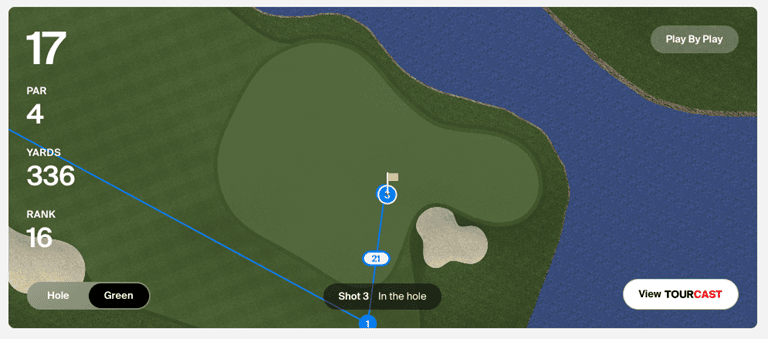
Photo: TourIQ
There are two tiers of access. Platform partners can use the portal for a fee in the low five figures while consulting partners receive additional individualized analysis for a flat fee plus a commission based on Tour earnings.
Jez is the founder and CEO while his software engineer is Phil Baker, whose day job is as the Assistant Director of Baseball Systems for the Cleveland Guardians. TourIQ’s advisors include BreakAway Data co-founder Steve Gera and StatsBomb founder Ted Knutson. They draw on their experience in pro team settings to inform not only the relevant data science but also the communication of the findings.
“I quickly realized in those roles that, obviously, the Moneyball part — building the predictive model to value the player — is definitely part of the job,” Jez said, “but so much of the job is, how do you get this information to your stakeholders in a really quick, easy-to-consume, easy-to-integrate way? How do you get a head coach to use the model?”
Two years ago, Frittelli spent considerable time working on his putting. After a couple months of practice, Frittelli wondered how it really translated to his performance.
“I knew my putting was bad — bad relative to the other guys — but I didn’t really have a metric to tell whether it was getting better or worse,” he said.
There are so many variables in terms of greens and pins to sift out the signal from the noise, but Jez built a model to determine that Frittelli’s putting was, in fact, improving.
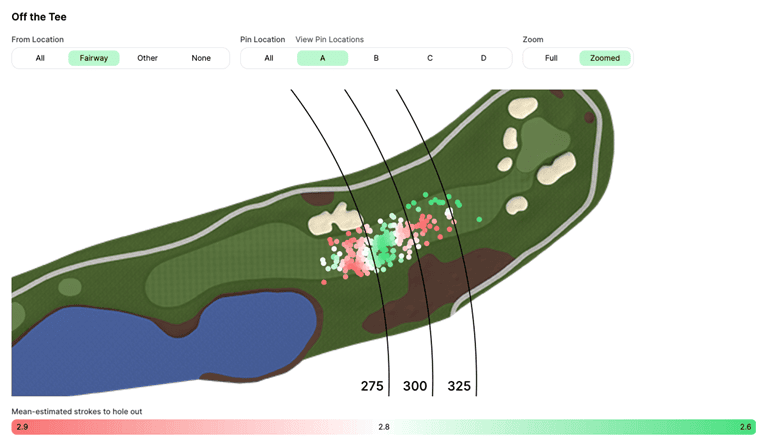
Photo: TourIQ
“There’s a bit of evidence here: now I know what I’m working on helps,” Frittelli said. “Previously I would just go on feel and I’d be looking at it like tournament to tournament or day by day. And it’s really hard to have that sort of bird’s eye view and know if you’re getting better when you’re just looking at small snippets of data.”
TourIQ normalizes the data to account for course variations and strength of tournament field, using 24- and 76-round moving averages as the default comparisons for recent play and baseline performance. The schedule optimizer identified two courses in particular for Frittelli to enter: the Sanderson Farms Championship in Jackson, Mississippi, and the World Wide Technology Championship in Mexico.
The 17th green at the Waste Management Phoenix Open proved a good case study in hole strategy. It’s a drivable par-four, but the second round’s pin location in the back-right corner mandated a different approach: hit to right of the green rather than straight ahead. Frittelli followed suit and made a birdie.
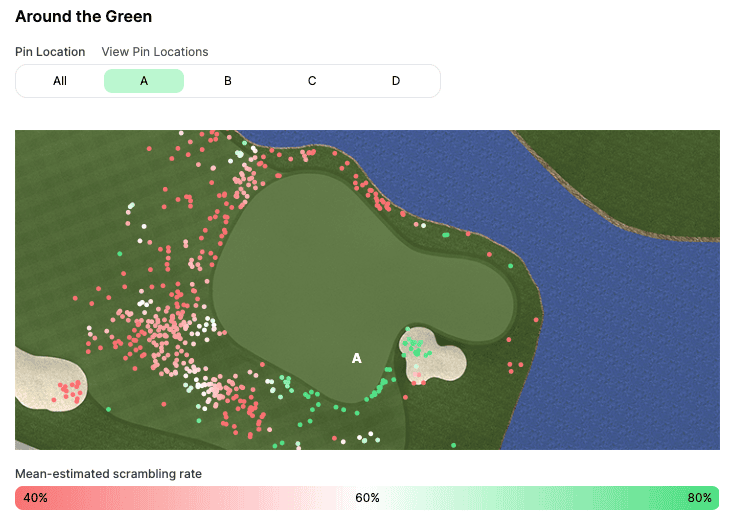
Photo: TourIQ
Generally, Frittelli said, his own experience and the accumulated wisdom of his long-tenured caddie are sufficient. But some of TourIQ’s more counterintuitive recommendations are worth jotting down in his yardage book.
“That’s what I always tell him, ‘I want to find anomalies,’” he said. “It doesn’t help if you tell me to miss it in the right rough here or left rough there. That’s obvious on most holes. But if there’s a random one that says ‘hit it in a different fairway’ or ‘hit it in this fairway bunker’ that gives me an edge that I wouldn’t think about, that’s where he comes in big time.”
“We can essentially give players the cheat sheet on how to play this hole when the pin’s front, when the pin’s back,” said Jez, noting that impact of a shot or two improvement per round. “Being able to make more informed decisions on those margins might be the difference between keeping your [Tour] Card or not. You take a missed cut, and you replace it with a 20th [place] — and you’re a guy who is a middle-of-the-field type of player — and that has really big implications.”
This article was brought to you by SBJ Tech, a Leaders Group company. As a Leaders Performance Institute member, you are able to enjoy exclusive access to SBJ Tech content in the field of athletic performance.
As part of a multiyear deal beginning in 2023-24, Hawk-Eye will provide the NBA with pose tracking data for the first time.
A Data & Innovation article brought to you by
As part of a multiyear deal beginning in 2023-24, Hawk-Eye will provide the NBA with pose tracking data for the first time, capturing 29 points on the body as opposed to a single, center-of-mass datapoint for each player. The league is in the process of installing 12 cameras in all 29 arenas that will shoot at 60 frames per second to generate the 3D dataset that will be new to basketball but similar to what Hawk-Eye has provided MLB via Statcast since 2020. Best known publicly for its tennis line calls, Sony-owned Hawk-Eye will also be used to develop future officiating uses for the NBA. Some examples they have been working on in a proof-of-concept capacity since 2019 include goaltending or out-of-bounds determinations, although specific implementations have not been finalized and may require policy sign-off from the unions for the players and referees.
Track record important: “The reason we felt so strongly that Hawk-Eye was the right partner for that is they have an incredible track record across other sports,” NBA EVP/Basketball Strategy & Analytics Evan Wasch said, adding that the primary focus was build a more robust dataset and have it be accessible in real time. “With those capabilities, that unlocks a whole range of use cases across broadcast, officiating, basketball analytics, fan engagement.” Wasch said that this process began with an RFP a little more than a year ago, noting that Hawk-Eye and Second Spectrum were the two finalists. Because they had different strengths that could work in tandem, he said, “We really tried to capture the best of what both companies offered.”
Second Spectrum still involved: Genius Sports-owned Second Spectrum will continue to support teams with the analysis and visualization of tracking data through its AI and machine learning. It will be an official augmentation provider for NBA League Pass, creating alternate telecasts in the spirit of what the company has done in powering ClipperVision. Second Spectrum is also collaborating with the NBA on its next generation tracking product, Dragon, which seeks to collect so-called “mesh data” — essentially, the entire surface area of a player as opposed to individual points. The NBA also touts the ability to use Hawk-Eye data — along with functionality from sister Sony sports businesses, Beyond Sports and Pulselive — for virtual recreations and other gamification activations, along the lines of how NBA Commissioner Adam Silver recorded Ahmad Rashad in 3D at the NBA Tech Summit and then his avatar was rendered as one of the players in game video. “The NBA is pretty progressive when it comes to engaging fans, and they have a lot of pretty experiential, immersive digital experiences on their platforms and obviously with their partners, too,” said Michael Markovich, CCO of Sony’s sports businesses. “And from that, we hope that some of this data we’re generating can create new fan experiences.”
Working with teams: Second Spectrum’s roots are in the analysis of data more than its collection, having originally used what SportVU captured to power its metrics a decade ago. Continuing to work with teams in that capacity through its AI and machine learning is “one of our big priorities,” Second Spectrum CCO Mike D’Auria said. Wasch added, “Second Spectrum remains the foremost basketball analytics experts in the world, and their ability to take raw tracking data and turn it into basketball insight — which brings tremendous value for the teams, for the league and for our fans — was something that we wanted to maintain.”
Hawk-Eye tested in the summer league: The NBA tested the accuracy and sub-second latency of Hawk-Eye at the Summer League and in six team arenas. Hawk-Eye will work together with the league’s exclusive data distribution provider, Sportradar, to maximize the possible stats. What the 3D Hawk-Eye data will offer is an opportunity to understand key dimensions of the game. Whether a defender has his hand in the face of a shooter, for instance, can certainly affect shot probability but center-of-mass data capture can’t make that distinction. “It’s a stepwise shift in the amount of data, and we’re really excited about all the ways that data can be leveraged to tell more stories about the game and to engage and educate fans about what’s happening on the court,” NBA AVP/Stats Technology Product Development Charlie Rohlf said, adding that the empirical data will help unlock insights “that are so integral to basketball that are seemingly so simple. We’ve never been able to measure before things like, How close was that player to blocking that shot? Or how high did he jump on that incredible dunk or that incredible block?”
This article was brought to you by SBJ Tech, a Leaders Group company. As a Leaders Performance Institute member, you are able to enjoy exclusive access to SBJ Tech content in the field of athletic performance.
“”Until you have this data at your fingertips, you can’t properly train these guys,” says Duggan Moran of ArmCare.com.
ArmCare’s strength sensor measures a pitcher’s arm strength and range of motion, and paired with pitchLogic’s velocity and key metrics, can track arm readiness and fatigue as well as offer pitch design recommendations and custom training plans. (Image courtesy of pitchLogic/ArmCare.com)
A Data & Innovation article brought to you by
On its own, pitchLogic — a smart baseball embedded with a circuit board full of inertial sensors — can measure velocity, spin rate, backspin, sidespin, riflespin, spin axis, spin direction, horizontal and vertical movement, arm slots and 3D renderings of the ball’s release from a pitcher’s fingers. In real time.
On its own, ArmCare.com — by pairing a dynamometer with an inertial sensor— can calculate a pitcher’s pinch grip, internal and external rotation, scapular strength, fatigue, recovery and an all-important metric known as Strength Velocity Ratio. In real time.
But until their announced partnership in February, pitchLogic wasn’t in the wellbeing business, and ArmCare.com wasn’t in the release point business. Under this joint arrangement, pitchers now have intertwined tech-centric apps that work in concert to improve performance and arm health all at once.
“We’re working together because we have the same customer,” says Jeff Ackerman, pitchLogic CEO. “What we’re saying to each other’s client base is, ‘Look, this is something that we recommend. We think that you should not just have pitchLogic, you should also have ArmCare.’ And then for ArmCare people, ‘You shouldn’t just have ArmCare, you should have pitchLogic so we can measure your progress.’ And then everybody still uses their separate equipment and goes to the separate websites to buy each thing, but rely on both.”
The gains and overlaps in baseball technology are beginning to accelerate these types of vital integrations. The pitchLogic app has already been adopted by the pitch design platform Driveline Baseball, particularly for remote training purposes, and the partnership between pitchLogic and ArmCare is the next obvious progression.
The goal of both companies is to be must-haves in the duffle bag of every pitcher. For instance, pitchLogic is a transient option to its competitors Rapsodo and TrackMan, which aren’t nearly as portable or affordable. As for ArmCare.com, the system was perfected in part by a former Angels pitching coach Jordan Oseguera and a former Angels director of performance integration Dr Ryan Crotin — both of whom believe their product can pinpoint whether a pitcher’s injury risk is lack of strength or pitiable biomechanics.
ArmCare.com, in particular, took a winding and scientific road to get here. A decade ago, a long-term Colorado Rockies arm study showed that spring training weaknesses in a pitcher’s external rotators and supraspinatus were precursors to regular-season throwing injuries. Accompanying research also confirmed that imbalanced throwing shoulders — meaning an unproportional ratio between external rotation and internal rotation — also increased odds of a crippling arm injury.
From a distance, the founder of a rotator cuff and scapular strengthening platform called Crossover Symmetry dug into the hypothesis. His name is Duggan Moran, and he enlisted his father Jim Moran, a physical therapist, to begin prohibitively testing throwing shoulders — just to confirm whether their exercises were targeting the right arm muscles.
Using a basic dynamometer, or muscular strength tester, they found promising results before shifting their strength testing to teenage prodigies at Perfect Game baseball tournaments. Alarmed at how weak and predisposed to injury the young players were, Duggan Moran took the technological steps needed to develop what is now the ArmCare.com app.
By using a new “research grade” digital dynamometer to measure pinch grip, combined with an Inertial Measurement Unit sensor chip to quantify range of motion, Moran’s company built proprietary software that ultimately democratized strength testing.
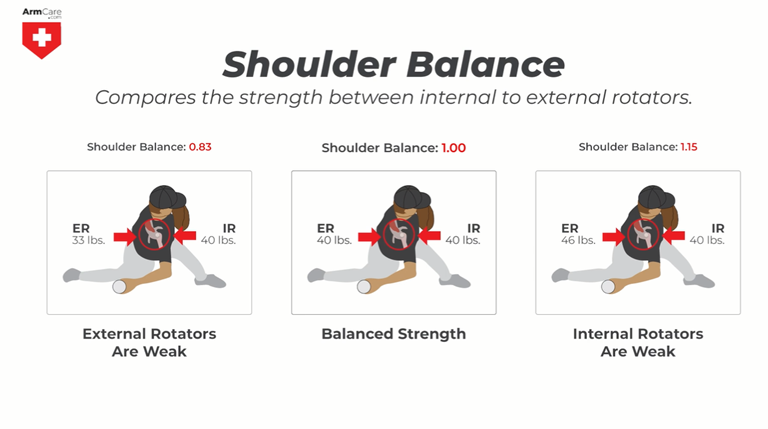
Image courtesy of pitchLogic/ArmCare.com.
Developed further by the pair of ex-Angels pitching specialists Crotin and Oseguera, the app began to pinpoint the most crucial metrics to empower pitching arms such as pinch grip and the ratio of strength to velocity (SRV), The platform ascended from there. They could state confidently that spin rate could only be improved through increased pinch grip strength, that simply altering a grip to create spin rate was fallacy. They could state confidently that talented and flexible teenage athletes could throw hard without proper strength, but those were also the very ones most likely to snap a ligament.
“Until you have this data at your fingertips, you can’t properly train these guys,” Moran says. “You can’t know whether you’re overtraining or undertraining unless you understand the fatigue and recovery of these athletes. And in less than five minutes, we can gather that data, and you don’t need a clinician. You don’t need expensive equipment to do it. You do it remotely. The app guides players through the exam with audio-visual graphics and then delivers customized exercises based on the results, as well as feedback.”
As a result, there are now players from all 30 MLB teams and most every D1 baseball program using the app — purportedly 15,000 youth, high school, college and pro players total — and Crotin claims the total number of ArmCare clients who’ve needed arm surgery is exactly…one.
Which is where pitchLogic comes in. Crotin and Co. know that an ever-changing arm slot can be a red flag for arm weakness, something their app does not ascertain. But pitchLogic’s smart baseball — utilized by all MLB teams, including Yankees closer Clay Holmes — contains the accelerometers, gyroscopes, magnetic sensors and Bluetooth radio to produce a 3D clock that shows precise arm slot, not to mention any irregularities in velocity and spin. From there, ArmCare can determine whether any arm slot inconsistency is from weakness, fatigue or simply biomechanics.
But if it is weakness — and a pitcher’s about to blow out an elbow or shoulder — pitchLogic and ArmCare.com can together sound the siren.
And go from one surgery… to none.
This article was brought to you by SBJ Tech, a Leaders Group company. As a Leaders Performance Institute member, you are able to enjoy exclusive access to SBJ Tech content in the field of athletic performance.
The performance specialists are preparing some NFL prospects for the ‘interview of their lives’ in an interdisciplinary fashion.
Main image courtesy of Exos.
A Data & Innovation brought to you by
The type of question asked during those otherwise idle spring months was, recalled Exos VP of Performance Brent Callaway, “if we’re trying to create the fastest athletes on earth and we have anywhere from eight to 10 weeks to do it, what’s the process that we should follow?”
Across its multiple performance institutes, Exos has trained more than 1,000 athletes for the NFL since 1999, including eight No. 1 overall picks and four of last year’s top-10. For this year’s Combine, which is being held in Indianapolis, 98 of the 319 invitees prepared at Exos, most working out on location for about eight weeks.
“Everyone’s coming here to do the biggest job interview of their lives,” Exos Director of Sports Science Matt Darnell said.
Despite that pedigree of success, its staff wants to continue iterating on its program. That Covid-mandated break prompted Exos to further investigate emerging technologies, leading to several new partnerships. Introduced into the ecosystem was Vald Performance for advanced human measurements, Hologic for DXA scans and Kitman Labs to organize the voluminous datasets. Exos piloted Intel’s 3D Athlete Tracking system in 2021 and uses DARI Motion, its primary motion capture partner since 2018.
“The true magic happens when they can start to feel the customization and then the output of effort that we receive is better because they know that it’s purposeful,” said Callaway, who has personally trained a top-five pick at the Dallas-Frisco location every year since 2017. “I always tell them, within the first 14 days, with the conversations that we’re going to have, you’re going to understand your body more now than you ever have in the past.”
While many athletes who played at Power 5 schools are exposed to advanced technology and staff of innovative coaches, that’s not everyone’s experience. Back in 2015, defensive back Will Brown had competed at Division II Missouri S&T before enrolling in the Exos program. He called the training environment “eye opening” and saw immediate dividends: in two months, he added nearly 10 pounds of muscle and improved his 40-yard dash time by two-tenths of a second.
Brown likened his stint at Exos to the metamorphosis of Captain America. “When he went in the tank, and then when he came out of the tank, that’s how I like to describe my Exos experience,” said Brown, an industrial engineering graduate who returned to work at the company’s Arizona location on its research and performance innovation team.
Callaway described a “downhill slope” of technology, where methods used in the NFL trickle down to college and then to high school, so the base level of training is higher. That’s where Exos delves into personal evaluations and bespoke training plans — “adding pixels to the pictures,” as Darnell put it.
That’s where the work Exos’ interdisciplinary team of physical therapists, sports dietitians and strength coaches coordinate to maximize each athlete’s potential, testing each participant on rapid movements, range of motion, nutrition, body composition, asymmetry and hydration. Instead of this data sitting in eight siloed spreadsheets across the computers of five experts, all of it is collected in Kitman’s intelligence platform. There are built-in alerts when an athlete falls below the 50% standard at his projected NFL position, so there can be training remedies implemented.
The marquee event of the Combine each year is the 40-yard dash, where margins can be razor-thin and even savings of hundredths of seconds can be meaningful. That’s where Exos graduates excelled last year: in Callaway’s first 18 years of draft prep, he has six athletes run the 40 in under 4.4 seconds. He had six more last year alone.
“Some of it, I’m sure, is just an anomaly of talent,” he said, “but obviously there’s quite a bit of training involved here too.”
The newest area of exploration is through Hologic’s DXA scan, which can quantify body fat percentage, detect limb asymmetries and even calculate muscle-to-bone ratio. In consultation with an expert in the field named Francis Holway, Exos is seeking to prescribe ideal body masses for every individual, which may be different even among two men of the same size and same position.
“If I’ve got a 6’2” corner, and I’ve got two of them, and they both weigh 190 pounds, I would imagine their skeleton weighs the same — and that’s not what we’re finding,” Callaway said. “So you have different bone densities, you have different bone sizes, you have different limb length. And if you have an athlete who has too much mass per pound of bone, that can actually be a performance decrement.”
If there’s any one area of training that is persistently underemphasized by athletes before arriving at Exos, Brown said it’s their mobility and functional movement patterns.
“Being mindful of how to incorporate PT as a part of your plan, rather than going once it’s already got the check engine light on,” he said. “We’ve got to really keep the car with the oil and the gas on a daily basis.”
“It’s almost hard to tell where our PT clinic stops and our training floor starts,” added Darnell.
Though there are critics of the Combine — most recently, NFLPA executive director DeMaurice Smith called for it to be scrapped — there is underlying value in some of the datapoints collected. That enables historical comparisons to successful pros. For example, one can assess a prospect’s force plate data and his ability to accelerate and deceleration and marry that data with results in the 40, the 20-yard shuttle and the three-cone drill. (Smith advocated for union-backed regional pro days instead of the national combine.)
“Now you can go back and say, ‘OK, these athletes who tested really well on these tests all have these specific qualities,’ and it’s objective, right?” Callaway said.
“At the same time,” Darnell said of the Combine’s value, “it’s really hard to play the game of football in today’s world without having explosive speed and power and the ability to put on brakes and the ability to show up in an environment under stress, with millions of people watching you.”
This article was brought to you by SBJ Tech, a Leaders Group company. As a Leaders Performance Institute member, you are able to enjoy exclusive access to SBJ Tech content in the field of athletic performance.
The human and AI-powered basketball analytics lab is able to provide an array of insights within 15 minutes of the final buzzer.
A Data & Innovation brought to you by
Synergy, the human and AI-powered basketball analytics lab that was acquired by Sportradar two years ago, has evolved into such a coaching resource that every D1 men’s and women’s program subscribes to their scouting service just for the sheer nuance and volume of it all.
A breakdown of every possession from every college team all season? That’s available. What plays the team ran on each possession? Available. Who passed the ball to whom and then to whom and then to whom? Available. Who shot the ball and from where? Available. Don’t believe them? They’ll gladly verify it on their proprietary video. Synergy has 1,000 human data collectors… to go with an automated camera tracking system in 250 D1 arenas… to go with their own shot quality algorithms themselves.
They literally monitor 75,000 basketball games a year — from high school to DI to DII to DIII to the G-League to the EuroLeague to the NBA — and estimates it has 50 million tracked shots in its database since its inception in 2004. But when it came specifically to this year’s March Madness, Synergy has logged every game in real-time and then distributed a data-video report 15 minutes after every final buzzer.
Considering teams sometimes have just 30 hours to prepare for an NCAA Tournament opponent, Synergy will also conveniently diagram every opponent’s play calls and supply APIs for more expert level coaching staffs that have their own analytic departments for additional game-planning.
“I don’t have [any stories] for this year’s March Madness, but, [in 2012], we had a 15-seed, Norfolk State, beat a 2-seed, Missouri,” says Mark Silver, EVP, Sports Performance, Sportradar. “And immediately after that game, the [Norfolk State] coach called and thanked us for everything we did and said, ‘The only reason we won was the fact that we had the Synergy scouting report.’”
One of the company’s first coaching clients in 2006, in fact, was a then-relatively unknown Jim Larranaga of George Mason University — who leveraged the platform all the way to a shocking Final Four run that season. Now, Larranaga’s back in the Final Four with Miami and again with Synergy.
The product helps coaches on multiple levels, the first being game prep. Synergy will provide an opponents’ innate tendencies such as which direction a post player tends to spin to the basket — off of his right shoulder or left. Or if a player turns to the baseline from the right block 100% of the time or dribbles first 95% of the time.

Photo courtesy of Synergy
The info is so nuanced, Synergy can tell a coach if an opposing player, or his own player, is superior driving right or left or better shooting off the dribble or off- a-screen or better pulling up or finishing at the rim. There are stats and videotape to support it all. “Advanced scouting,” Silver says.
Another new activation is quantifying the role of every player in this year’s NCAA tournament. Through machine learning, Synergy’s software can determine the positional characteristics of any player, leaning on a database that contains every college player’s shot since 2014. For example, Synergy classified Miami’s 6-foot-7 Norchad Omier as a “Rim-Finishing Big”, Gonzaga’s 6-10 Drew Timme as a “Post-Up Big” and Alabama’s 6-9 Brandon Miller is a “Playmaking Wing.”
By using artificial intelligence to categorize every player, Synergy has perhaps become the technological centerpiece of the transfer portal. Coaches can search the company’s database for “Slashing Wings” or “Spot Up Shooting Wings” or “Scoring Ball Handlers” or “Stretch Bigs,” and the names come spitting out.
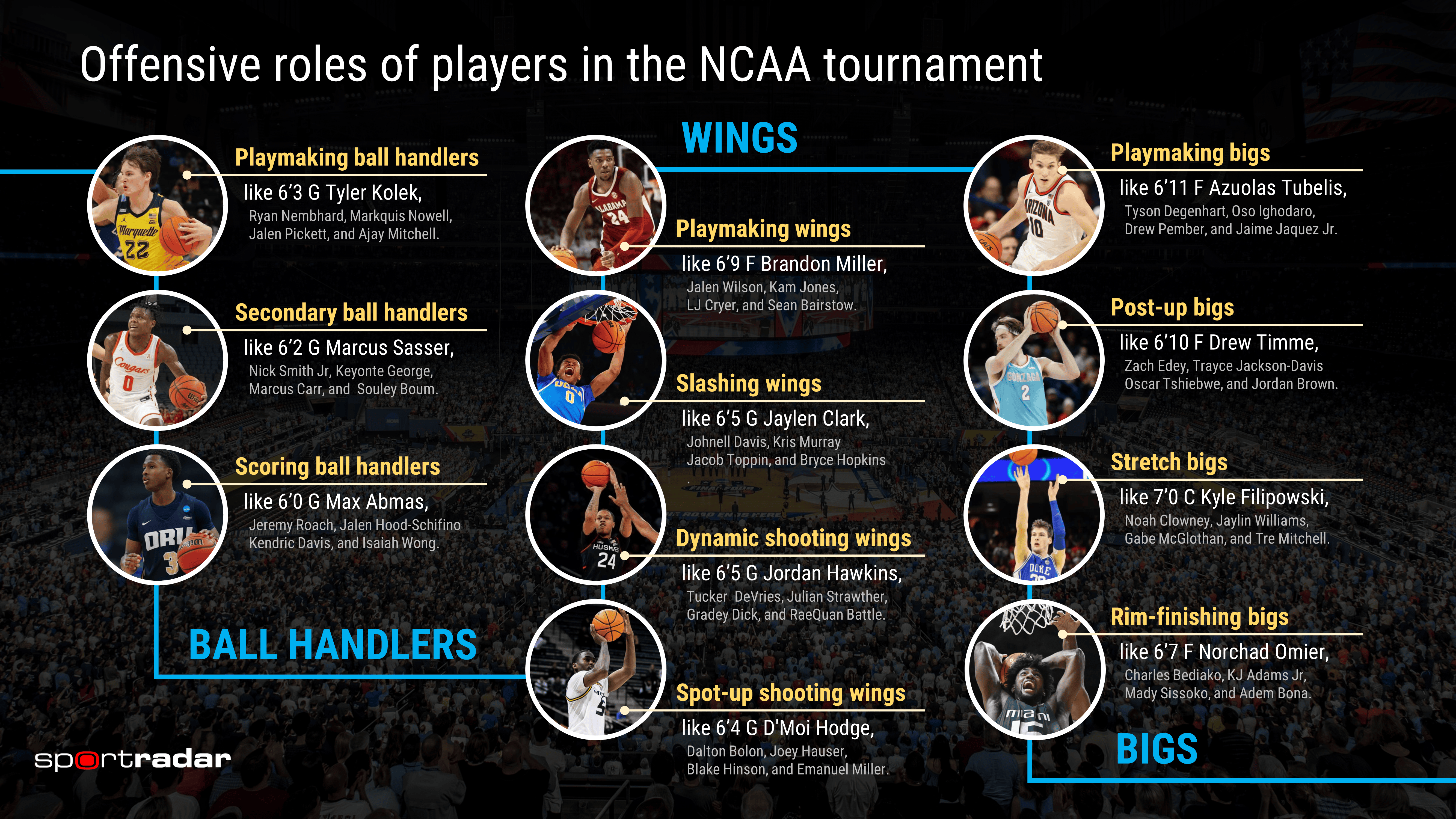
Photo courtesy of Synergy
“We undoubtedly play a huge role in the transformation of the transfer portal because you can go into our system,” Silver says. “And if you’re looking for a type of player or a player in a certain class, whether they’re playing in JUCO or D1 or D2 or D3 — or if you already know about the player — you can easily go and find every game that player has played. Since high school, most likely.
“Or if you just need to fill a spot, you can actually look and query the system to try to find a player that’s most fitting what you’re looking for. So recruiting, scouting, transfers: that’s one of the big ones for us.”
The Synergy Automated Camera system is another high-tech advantage, considering its camera vision tracks shot quality and team/player tendencies while also providing coach’s film and video confirmation. Hawk-Eye’s cameras handle that for the NBA. But when it comes to the college level, Synergy is more or less holding down the tracking landscape.
With all of these NCAA coaches bought in, the company has to try to stay neutral — which may be a little tricky at this weekend’s Final Four.
Especially when Larranaga starts winking at them.
This article was brought to you by SBJ Tech, a Leaders Group company. As a Leaders Performance Institute member, you are able to enjoy exclusive access to SBJ Tech content in the field of athletic performance.
The US Applied Performance Specialist Manager at Kitman Labs talks about development opportunities for female practitioners and athletes alike while exploring how workflows can be improved in both professional and college sports.
A Data & Innovation podcast brought to you in collaboration with
“The conversation has grown,” says MT Eisner, “but curiouser and curiouser: has the conversation grown because I’m in that circle or has the conversation genuinely grown?”
The US Applied Performance Specialist Manager at Kitman Labs would like to think it’s the latter. “Within Kitman, we talk about it consistently, within the other organisations that we’re helping [we ask] ‘how can we assist with this?’” she continues.
“We had this organisation want to now start tracking menstrual cycles, starting to do X, Y and Z with their athletes. ‘Who else is doing this? What conversations are you having? Who can we tap into?’ and so forth.”
In addition to the increasing focus on female athletes – and the development of female practitioners – our conversation also covered:
John Portch Twitter | LinkedIn
Listen above and subscribe today on iTunes, Spotify, Stitcher and Overcast, or your chosen podcast platform.
Trainers and jockeys will have more post-race information about how their horses performed and what tactics worked and didn’t.
The TRACAB Horse Tracking System (HTS) uses advanced satellite tracking technology via GNSS (Global Navigation Satellite System) and real-time radio communications systems for accurate and fast data delivery during live horse races. (Main image: TRACAB)
A Data & Innovation brought to you by
The latest iteration of the Horse Tracking System calculates horse positioning based on Global Navigation Satellite Systems, such as GPS, to centimeter accuracy and without the same level of hardware necessary at the track. The project was tested at more than 1,000 races at Norway’s national race track, Bjerke, and has led to a recent, five-year partnership with Norsk Rikstoto, the betting operator for Norwegian horse racing. The TRACAB Horse Tracking System (HTS) will be deployed at all major tracks in the country.
“We see in the horse racing industry that this is fairly new, because they’ve had tracking technology with varying degrees of quality and availability, but how can they really get some more value out from the data?” TRACAB head of wearable technology Stian Dahl said. “I think a lot of exciting stuff can be built upon this kind of tracking database.”
The most immediate use of the data — which includes position, speed and acceleration — will be to augment broadcasts with improved graphics and insights. With a latency said to be less than 150 milliseconds, the data can enable betting operators to improve their offerings. Trainers and jockeys will have more post-race information about how their horses performed and what tactics worked and didn’t.
In the near future, TRACAB executives hope, the wearables can help power robotic cameras using AI. TRACAB has already begun implementing that in soccer with its optical tracking system. That’s done in conjunction with the Bundesliga and Sportec whereby international rights holders can isolate a camera on the home country’s domestic star.
“Our plan here is to bring that same kind of technology now, with our experience from football, into horse racing as well, where we believe that automation is really something that’s going to be a big talking point in the next few years,” TRACAB SVP business development and strategy Oskar Norrman said.
TRACAB is best known for its work in soccer and for its camera-based tracking systems in that sport, but there are parallels to horse racing, which is a decade or two behind soccer in the adoption of big data.
“We see a big future of analytics coming into horse racing right now,” Norrman said, adding, “I do see this being something that can really grow within horse racing as well, everything from being able to see patterns in the behavior of specific horses to looking at historical data and looking at patterns there. So not only to enhance the experience or work with prediction of races, but also to help the betting companies to provide better odds and have a more automated functionality there. And at the end, also providing real-time, in-race betting, based on high quality and fast real time data.”
“HTS does not process data on the 100-gram (3.5-ounce) transponders themselves, but the devices instead uploads everything via radio technology,” Dahl said, “and then we can do some more clever things with a bit more CPU power on the server to create the best quality tracking.”
The Nordic countries were a logical starting place for this technology, as Sweden is the location of TRACAB’s home office and there is uniformity in management of racetracks and betting. The US market is “a bit more fragmented,” Norrman said, but is certainly an option for future growth.
“Working closely with the federation, or the organization, behind the racing is really key here, because they have a way to really monetize on this and find good synergies and cooperation between their own organization but also globally, as there’s a lot of cooperation between the racing associations,” he said.
This article was brought to you by SBJ Tech, a Leaders Group company. As a Leaders Performance Institute member, you are able to enjoy exclusive access to SBJ Tech content in the field of athletic performance.
The Zone is designed to integrate with a team’s wellness initiatives to improve the access and options available to users.
The Zone’s platform is an innovative and proactive approach to student-athlete wellbeing. (Main image: The Zone)
A Data & Innovation brought to you by
Those social repercussions persist, as do new pressures related to name, image and likeness (NIL) opportunities — and all the other stressors that come with being a college student and competing in a sport at a high level.
The Zone, a mental wellness app catered toward the specific demands of college athletes, has gained traction and today announced its largest deal yet, a multi-year, conference-wide deal with the Big East. The app will roll out slowly to start, with 100 student-athletes at Georgetown and Marquette onboarding this spring, before a similar number of app licenses will become available to all other Big East schools thereafter.
“Our student-athletes have reported some of the most significant challenges center around the pressures of being a Division I student-athlete and the need to make your life seem perfect on social media,” Big East Senior Associate Commissioner Katie Willett wrote in an email. “Additionally, student-athletes have struggled with the reintegration following Covid and successfully managing academics, athletics and community service.”
The Zone encourages users to complete regular check-ins in the app, answering questions about mood and academic and athletic updates in a gamified way. Through machine learning, the app offers advice, connections to on-campus resources, suggested activities like meditation and even the ability to book appointments with a counselor or therapist.
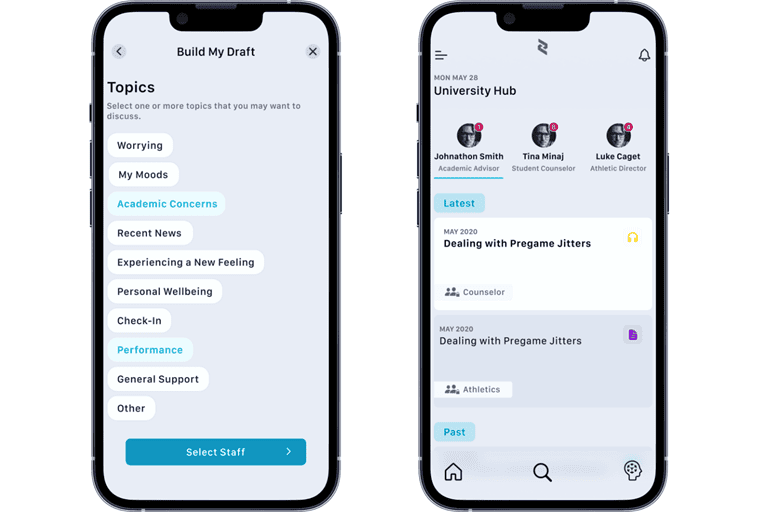
The Zone makes reaching out for mental health support easier for student athletes through the platform’s accessible and streamlined process (Image: The Zone)
“Performance anxiety is the biggest trigger we’ve seen over the last two years,” said The Zone Co-Founder/CEO Ivan Tchatchouwo, a former Division II basketball player whose own experiences with mental health challenges informed the founding of the app. “And it shows up in different ways. It’s not just performing on the court, right? It’s performing through the anxiety of being a first-generation college person on campus. Your parents pressure on you, or fans, friends and family. NIL pressure is causing performance anxiety because now it’s like, ‘I want to get paid just like a teammate.’
“Time management is another huge one that’s causing a lot of stress and anxiety for young people. And then also, lack of community. They’re in teams, but those two years have taken them away from knowing how to communicate correctly.”
Lehigh, Seton Hall University and St Francis-Brooklyn are all early adopters of The Zone; Memphis and Stony Brook previously used it as well. Former America East Commissioner Amy Huchthausen became such a strong supporter that she joined the company’s board of advisors. The Zone first connected with Big East leadership when hosting its fourth annual Student-Athlete Well-Being Forum at the University of Connecticut in June 2022.
Tchatchouwo says about 4,000 student-athletes are enrolled in the app, of which 2,800 remain active. Monthly participation is almost 25% whereas recent peer-reviewed research estimated that industry average for digital mental health apps is 3%.
“We spent the whole last year testing what works, what’s sticky, what doesn’t work. We’ve added a whole new content strategy,” Tchatchouwo said.
“That experience has to consistently be fresh for them, to want to go through it,” he added. “It also gets daunting to just see all the time, the same kind of inundating stuff. We’re getting creative on how we push that up. Machine learning is a big thing that we’re jumping bigger into and really understanding what it is that your data is saying. What is your storyline? What are your trends? And how do you the trends play out the life? And then what are the next steps for you?”
Tchatchouwo is quick to emphasize that The Zone is not a replacement to existing mental health services or professionals but rather a complement to or conduit for those options.
“The Zone is a state-of-the-art mental wellness platform that integrates perfectly into our institutions’ wellness programs,” Willett wrote. “It will make our services more effective by enabling a culture that prioritizes mental wellness, an important topic this day and age for our student-athletes. Our goals are to provide our student-athletes with a safe space and easily accessible resources to complement the amazing services being provided by our institutions when it comes to mental wellness.”
Other universities might try to buttress students by hiring additional psychologists to counsel student-athletes, but Tchatchouwo said that approach can suffer from inefficiency. Often the ratio of students-to-psychologists remains overwhelmingly high. Even then, the students need help discovering and accessing those resources. It’s important to have layers of defense, and The Zone seeks to drive awareness through content and to make specific referrals within the app to help maximize the use of what’s already available.
“You still need to educate the people that are on the forefront of what it looks like for their athletes,” Tchatchouwo said. “So we want to launch that education series for the coaches and the staff and administration, so they’re also educated, which makes the mental health investment even that much better.”
This article was brought to you by SBJ Tech, a Leaders Group company. As a Leaders Performance Institute member, you are able to enjoy exclusive access to SBJ Tech content in the field of athletic performance.