The case could lead to athletes having greater leverage over their digital identity and data.
A Data & Innovation brought to you by

Gervin, whose four NBA scoring titles are eclipsed only by Wilt Chamberlain and Michael Jordan, was one of Nike’s first signed athletes and was the very first to wear a popular Nike sneaker called The Blazer in a 1973 NBA game.
The lawsuit, which was filed in the Southern District of New York, alleged that the Ralph Lauren product has violated Gervin’s right of publicity and the Lanham Act, federal legislation that bars false advertisement and trademark infringement.
“I have worked hard throughout my career to build my name and reputation, and I will not allow any company to exploit it without my permission,” Gervin said in a statement. “I am taking legal action to protect my rights and ensure that consumers are not misled.”
In early 2022, Ralph Lauren’s website and affiliates began selling the Gervin Mid, a retro 1970s sneaker which, as the complaint claimed, bears a resemblance to the 1970s-era Blazers that Gervin wore. The suit alleged that Ralph Lauren did so without his consent or an offer of compensation and has continued to sell versions of the shoe despite being told to cease and desist by Gervin’s attorney.
The complaint alleged that counsel for Ralph Lauren at once point replied that the sneakers were “coincidentally” given Gervin’s surname by a French designer only because it “sounded good.” The fashion brand later altered the name of the product to the Ralph Lauren Mid, although secondary sellers are still offering the Gervin Mid by its original name and, as the suit said, the Ralph Lauren website still sells baby-sized versions of the shoe with Gervin’s name attached.
“We must protect those whose privacy and identity rights become exploited in today’s increasingly data, digital, online, and technology-driven world,” Michael Clohisy, attorney for Gervin, said. “George Gervin is suing Ralph Lauren to regain and control the commercial use of his name and likeness, as well as protect the next generation of athletes.”
The complaint said that, even after the name change, “due to the pervasive and permanent nature of the internet, the digital footprint damage was already done and the Ralph Lauren Mid is forever algorithmically linked to Gervin’s name.”
Representatives for Ralph Lauren did not immediately reply to a request for comment.
In September, Gervin became a brand ambassador for the launch of the “I Own Me” campaign, a joint initiative of sports marketing firm Fox Ellis Sports and IPrivata, a tech startup seeking to help athletes take ownership of their personal data and digital assets. It was built in conjunction with the HBAR Foundation, a nonprofit affiliated with the Hedera platform, a decentralized ledger that serves as a blockchain alternative.
This case could have far-reaching implications as athletes’ name, image and likeness (NIL) rights have become increasingly commercially viable, even for NCAA athletes, according to Fox Ellis Sports president Richard Lufkin.
“NIL for college and amateur sports has become a billion dollar market overnight,” Lufkin wrote in an email. “We believe the NIL Collectives are still significantly undervalued. The GG fight against RL will prove the true value of NIL is based on digital identity and data, which all athletes can leverage moving forward.”
In retirement, Gervin has led several philanthropic efforts, including the establishment of free public charter schools, and the player known widely as ‘the Iceman’ has remained involved in the sport. Most recently, he coached a team in the BIG3’s 3-on-3 league last year.
“Like his nickname, the Iceman did not bring this case in haste,” GS2Law chairman Robert Garson, the lead counsel for Gervin, said in a statement. “As an athlete, an ambassador of the game and a philanthropist, George Gervin deserved better. The Scriptures say, ‘A good name is better than precious oil.’ Clearly Ralph Lauren failed Bible class.”
This article was brought to you by SBJ Tech, a Leaders Group company. As a Leaders Performance Institute member, you are able to enjoy exclusive access to SBJ Tech content in the field of athletic performance.
The former NFL star, now a broadcaster with Fox, talks about wearables and tracking tech, as well as the implications of early specialization.
A Data & Innovation brought to you by
* * * * *
Greg Olsen has emerged as a breakout star in sports broadcasting, forming a dynamic duo with partner Kevin Burkhardt as the lead NFL broadcast team for Fox Sports. Olsen and Burkhardt’s biggest moment in the broadcast booth came on February 12 at Super Bowl LVII.
As a player, Olsen played 14 seasons in the NFL as one of the league’s premier tight ends for the Chicago Bears, Carolina Panthers, and Seattle Seahawks. He made three-straight Pro Bowls from 2014 to 2016 before retiring after the 2020 season. In March 2022, Olsen partnered with actor Vince Vaughn and former NFL center Ryan Kalil to launch podcast production network Audiorama. The company has received funding from Powerhouse Capital. Olsen, a New Jersey native and father of three children, hosts his own podcast called Youth Inc that’s focused on helping parents and coaches navigate the evolving world of youth sports.
Previous guests on Youth Inc include former NFL star linebacker Luke Kuechly, softball star Jennie Finch, NFL Pro-Bowler Marcellus Wiley, NBA forward Larry Nance Jr, MLB star Christian Yelich, Premier Lacrosse League founder Paul Rabil, and NASCAR legends Dale Earnhardt Jr and Kyle Busch. The show also sees Olsen interview legacy sports families, coaches, psychologists, and authors. Olsen coaches his 11-year-old son’s youth football team. He and his wife Kara also have twin 10-year-olds, a daughter who plays soccer and basketball, and a son who plays baseball and basketball. Olsen’s younger son was born with hypoplastic left heart syndrome and he received a successful heart transplant in 2021.
On the origins of his podcast …
It just spurred from a product of what my life has been. I grew up the son of a high school football coach, grew up around youth sports and high school sports. It’s what I’ve done pretty much my whole life. And now full circle after playing and making a career out of it, college and into the NFL, now I’m a father of three. I spend pretty much every night of my life at a kids practice, a workout, tournament on the weekends. And just from that experience I have a lot of unknowns, a lot of questions and things I don’t really understand or feel like I’m navigating correctly.
And if I don’t know it, someone who’s lived his whole life this way, how is anybody else going to do it? So we thought it would be an interesting concept for a podcast, to bring on some really interesting guests from all over the youth sports spectrum and have those conversations as a resource and a tool for other families, just like mine who are navigating this and trying to have the best practices for their son or daughter. It’s an ever-changing world. The youth sports world seems like every decade it’s unrecognizable, and for a lot of families it’s overwhelming. So we could be that resource, if we can bring on guests and specialists and experts to help share some of that wisdom and, and past experiences.
On his parenting approach and youth sport specialization …
We try to encourage our kids every season to try something different, to test their skill level, test their interests. Then if it’s something they don’t like, there’s no pressure to do it again. But we’re big believers of exposing our kids and exposing them to different sports, different styles of coaching, different types of kids as they get older for middle school and into high school. Find something that they really enjoy doing. Find something that when they practice, it doesn’t feel like work. It doesn’t feel like a chore. It’s something they wake up every day excited to go do. And I think the only way you do that is by kind of casting a wide net and exposing them to as many different experiences as possible.
I have three kids that have different abilities based on what sport, based on what season. And it’s not often about being the best kid or being the most talented, but maybe you find a sport that you had never played before and it’s the one you really wanted to spend the most time. That’s great. We’re on a constant search for that. When you’re young and the idea of just picking a sport at an early age I think could be a little dangerous because you don’t expose kids to finding what their true passion and what their true love is.
On safety conversations in youth football following Damar Hamlin’s cardiac arrest …
We’ve had a lot of those conversations, health and safety of all sports is of the utmost importance. In regard to the Damar Hamlin story, what we all watched unfold our national television was what appeared to be tragic, has kind of turned inspirational within nine days. Just today as of this call to hear that he’s been discharged and sent home. It’s truly remarkable. And, and to see the world kind of unites around him and in prayer and best wishes and faith it was pretty incredible and powerful to see.
In regard to the safety of football, I think that was such a one in a million thing. I think you hear about all these stories in all sports, and unfortunately, I don’t think that had anything to do with football. I think that happens to kids in all different sports — lacrosse, soccer, baseball. There’s unfortunate tragic stories of kids going into cardiac arrest or passing out. It’s unfortunate. I think obviously right now football kind of has the bullseye on it, because of all head injuries and the concussions. Watching that unfold, of course on live television with Damar was hard to watch. But I think when it all settles and all comes out, I think doctors and experts agreed that the risk of that happening on the football field is so small. It’s so rare that it’s really no greater risk factor of something like that happening on the football field versus any other number of fields. It’s tragic, it’s rare and thankfully, and I think everyone’s just thrilled that, that Damar is doing well. We’re just glad that it didn’t end tragically.
On wearables devices in the NFL and if the tech is reaching youth levels …
I think toward the end of my career, a lot of the GPS data tracking that we’d wear, wearable devices for acceleration and deceleration, velocities and load and whatnot. Not only was it implemented in our training, but it was even probably more valuable in our recovery. That that was kind of the last five or six years of my career, and I imagine going forward, it’s just going to continue to be more of a data-driven approach to how we care for athletes, how we train them, how we allow them to recover, how we load manage.
I think data and technology’s kind of at the forefront of a lot of things now, especially in the NFL, and, and I know it’s very common in basketball and, they use a lot of similar approaches in all major league sports. Whether or not that’s going to trickle down to youth level, I don’t know. I think there’s obviously like anything a cost involved. How practical is it for high schools and youth organizations to have the money to pay for that level of data and then obviously hiring the person who can interpret it and apply it.
I think there might be some time between now and when that gets down to the younger level. But I think as far as it’s applicability and value especially at the higher levels, I don’t think there’s any denying that it’s a really useful tool. It’s a really good gauge for coaches, trainers and strength and conditioning coaches that they don’t just have to use their gut instinct. They don’t have to just trust their eyes. They can really look at the data and say, okay, this athlete needs more or less attention in certain areas and, and they can kind of guide programming according to pretty precise data and whatnot. So that was something we used a lot and I only see it growing from here.
On baseball bat-tracking sensors used by his kids …
A lot of kids in baseball use those bat-tracking devices. You track your swing plane, your swing speed, exit velocity. You’re starting to see a lot of that kind of creep in now to the youth level. It’s something that my kids use. It’s something that we use at home and you get a lot of value at them. I think you’re starting to see wearables and technology devices that are a little more cost effective and a little more reasonable in that regard definitely make their way down to the youth level. People are using HitTrax and all sorts of different ways to measure how the kids hit and swing.
This article was brought to you by SBJ Tech, a Leaders Group company. As a Leaders Performance Institute member, you are able to enjoy exclusive access to SBJ Tech content in the field of athletic performance.
The South Carolina forward discusses NILs, sports science, and her deal with Six Star Pro Nutrition.
A Data & Innovation brought to you by
* * * * *
Aliyah Boston is, without question, the most decorated player in women’s college basketball. In 2022, the South Carolina forward became the first male or female athlete to win the Naismith Trophy as overall player of the year as well as Naismith Defensive Player of the Year. She was named the Honda Cup Collegiate Woman Athlete of the Year, joining a list of recent winners that includes Katie Ledecky, Breanna Stewart, Brittney Griner, Maya Moore and Candace Parker — as well as her coach, Dawn Staley, who did in 1991.
Boston, who is 6’5”, has rewritten South Carolina’s record book for just about every permutation of stats related to rebounds, blocks and double-doubles. She averaged 17 points and 17 rebounds in last year’s Final Four, as she led the Gamecocks to the program’s second NCAA national championship. She is the expected No. 1 overall pick in the 2023 WNBA Draft.
A native of St Thomas in the US Virgin Islands and a graduate of the Massachusetts-based prep school, the Worcester Academy, Boston has struck a number of NIL [name, image and likeness] deals with Under Armour, Bose, Bojangles, Crocs, Octagon Basketball, Orangetheory Fitness and, most recently, Six Star Pro Nutrition. When NIL deals became legal on July 1, 2021, Six Star Pro Nutrition announced three at midnight with women’s basketball twins Haley and Hanna Cavinder as well as then-Illinois player Edgar Padilla Jr South Carolina women’s basketball players are also all estimated to be earning about $25,000 per year through the Garnet Trust and NOCAP Sports.
On choosing to align with Six Star Pro Nutrition . . .
First of all, their want to partner with me was just something truly special because I know how big their brand is. But I also love their protein powder and their 4th Quarter Energy supplements. I really think that they do really well when it comes to training and recovery. They’re just a great partner, and I’m just super excited about it.
On when she began to emphasize nutrition and recovery . . .
It’s definitely been a major focus since I got to college because the pace of the game is just so much faster than it was in high school or anything that I’ve ever done. And so definitely in college I really started to focus on that, especially sophomore year going into junior year was definitely my key time to lock in and focus on that.
On college level training . . .
It’s definitely intense, but I feel like, as the time has passed, I’ve been able to adapt really quickly and I think I’ve done that pretty well. It was different because in high school I didn’t really have that focus — the strength coaches or the nutrition pieces that I needed. Now when I got to college, that was a major difference, definitely beneficial.
On sport science devices . . .
Definitely [we use] technology to track a lot of it. We have the Kinexons that we use [for load monitoring]. We have a jumping machine [force plate] that tells how fast or how hard we land and jump and how quick we get up and down.
On tracking sleep . . .
We actually used to do an Oura ring where it would tell us our sleep, but then I got a little nervous before I go to sleep at 1:00 AM and then my strength coach sees that and she’s like, ‘Why are you not in bed?’
On having Dawn Staley as a coach . . .
She understands the game very well, and so her IQ of the game has just helped us because she just directs us. She tells us really how things should go, and then when we really like look at it, she’s right. It makes it a lot easier because she never second guesses, she never questions. She’s always like, you know what? Like, ‘This happens, [then] this.’ She has a solution for every scenario that could possibly happen, which I just think is really cool.
On what she looks for in a brand when making NIL deals . . .
I look at them trying to help grow the game, which I think is definitely a priority. And I think Six Star is doing that well, especially, like they’re offering the trip to go to the national championship game, whether it’s the girls’ or the men’s game, which I think is something truly special because there are probably so many fans out there that might not ever get to get the chance. They can apply on the website, try to get in and they have a great chance to win.
On why growing the game is such a passion for her . . .
There’s a lot of attention on the women’s game specifically right now. I think we have a lot of talent, and I do think there are a lot of younger people looking up to us. If they could come to a game, they would love it, they would probably talk about it a lot more. But also [I want] to help grow the game in the future. When our time is done in college and we get to the league, we want people to continue to watch us — the same fan bases that we played for years and years or even a fan base that we competed against — and to say, ‘They’re no longer in college, let’s see how they do in the league.’
On her message to young girls who might be interested in basketball . . .
I would tell them to set high goals for themselves. Don’t think anything is untouchable because that’s what I did — a little girl from the islands trusted God, set high goals to go to college, play in the league. And so I’d definitely tell them to also do the same thing, no matter what, whether it’s not basketball, but something else. Make sure they set their goals themselves and surround themselves with people that support them all.
On her rebounding . . .
All the coaches I have in South Carolina have definitely helped, but I just track the ball and then I’m just like, ‘I need to go get it.’ Rebounding is a big part of South Carolina basketball, and Coach Staley emphasizes us rebounding defensively and offensively. And so it’s really just the will, the want, to go get the rebound to give yourself your team another possession or to help them push the ball in transition.
On taking pride in playing the post . . .
Everybody wants to now shoot the ball, dribble. Everybody’s a big guard. But playing the position that I play, having my back to the basket, I truly enjoy it because I feel like not a lot of people right now like the contact, like to bang, but I do. And so I think it goes to my advantage. But I also want to be growing my game as an individual, so definitely being able to knock down that jumper, take people off the dribble is definitely a priority, but I also think it’s important to be able to go and bang down there and score through contact or even get a stop defensively.
On how she views brand-building. . .
Social media is definitely a crucial part of it all because that is where you get your fan base, your followers, and partner companies. They look at that, your social media engagement, how you get along with fans.
At first I wasn’t a big social media girl. I had to be convinced time after time after time by my parents to post a simple post on Instagram. Before NIL started, my mom was like, ‘Aaliyah, you need to lie build a following.’ And I was like, ‘OK, sure. I’ll try. I’ll post the beach picture, let me post this.’
But now I really enjoy it. I enjoy posting, I’ll TikTok, I’ll post on Instagram, Twitter. So I definitely think it is an important role, though, because this is how you build your brand, who you are. So companies can see this and be like, ‘Oh, I like this, I like that.’
This article was brought to you by SBJ Tech, a Leaders Group company. As a Leaders Performance Institute member, you are able to enjoy exclusive access to SBJ Tech content in the field of athletic performance.
The former Head Performance Coach at LAFC is bringing genetics into the performance equation and he believes it will be a game-changer.
A Data & Innovation podcast brought to you in collaboration with
“Our genetics are just a code that says ‘here’s how your genetics express here whether that’s cardiovascular or it’s cellular or it’s your body composition or whatever it might be and here’s how we need to influence your environment’,” he tells Joe Lemire and John Portch on the People Behind the Tech Podcast.
“‘Environment’ being how do you train? How do you recover? What stresses do you have in your life? All of that stuff influences our genetics. Although our genetics never change, they can be expressed on or off. Kind of like a dimmer switch at any point.”
After more than a decade as a performance coach, taking in roles at the LA Galaxy, US Soccer and LAFC, Daniel joined 3×4 Genetics as the Head of Enterprise Sales in late 2022.
The Seattle-based startup believes its ability to analyze a person’s genes, whether they are an athlete or not, enables them to recommend lifestyle changes. In the case of athletes using its GENEFIT program, that might mean diet, training, recovery or other forms of preparation.
He anticipates a time when elite teams routinely call upon a geneticist to inform their performance.
During our conversation, Daniel also discussed:
John Portch Twitter | LinkedIn
Listen above and subscribe today on iTunes, Spotify, Stitcher and Overcast, or your chosen podcast platform.
Hypetex’s carbon fiber Adidas Kromaskin stick has a micro-cell core that ensures consistent production.
A Data & Innovation brought to you by
Not until a decade ago, in 2013, was the chemical code cracked. Composite specialists with experience in Formula 1 devised a process for coloring carbon fiber while preserving its structural integrity. That work laid the foundation for Hypetex, an England-based company whose first major foray into sports is the Adidas Kromaskin field hockey stick. Other partners include New Balance, Jaguar Land Rover and, until 2021, Formula 1 itself.
That stick, adorned with Adidas’s distinctive three stripes, was a visible part of the Men’s Hockey World Cup 2023 in India, especially during the final, where Germany beat Belgium on 5-4 on penalties following 3-3 draw.
“I started using the Kromaskin stick the moment it was released,” said German national team player Christopher Rühr, an Adidas-sponsored athlete who also won an Olympic bronze in 2016. “It’s perfect for forwards like me. It has the ultimate power for goal shots but also a soft touch for when you’re receiving and dribbling.”
What Hypetex offers is more than the aesthetics benefit of infused color replacing an outer lacquer on sticks, which is prone to chipping. In combination with a micro-cell core that is inserted into the head of the stick, the Kromaskin outperformed eight premium hockey sticks, according to testing conducted by the Sports Technology Institute at Loughborough University.
The Adidas Kromaskin stick — a finalist in the Sports & Leisure category of the 2022 JEC Innovation Awards, a prestigious honor within the composite materials industry — had a 16% higher coefficient of restitution (COR), which is a measure of power transferred into the ball, and 70% less variation in COR.
Even though modern field hockey sticks are generally made of synthetic materials such as fiberglass, aramid and carbon fiber, they are prone to similar variation in performance the way wooden baseball bats are.
“What [hockey athletes] were finding previously, which was their pain point, was that there was a massive inconsistency in the performance of one stick versus the other because the production process was really dependent on the user,” said Hypetex CEO Marc Cohen. “By creating this micro-cell core, what we ended up doing was standardizing the process very much, leaving it and moving it away from the production risks that come with individuals or labor. That in itself created a much, much lower variance across sticks to the point that there was insignificant. Every stick turned out like the previous one.”
Hypetex maintains its own manufacturing facility in the southeast of England, which enables tighter quality control and longer-term competitive advantages.
“We moved production away from Pakistan, whereby a lot of probably the top 10 brands all get produced from the same factory,” Cohen said. “So any IP that gets brought out in one season for one brand, very quickly finds its way into every other brand. So when Adidas had an idea around designing a new stick and developing new solutions, they were very keen to ensure that value didn’t get diluted directly into other people’s manufacturing.”
Though the core IP around colored carbon fiber was first created 10 years ago, Cohen acknowledged that finding the best product-market fit and implementing the necessary processes for volume manufacturing took time for a pioneering process of colorizing the carbon fiber.
“So that’s where the trickiness has been, is how do you create something that is, in essence, a layer between layers, that doesn’t affect the layering system?” Cohen said. “So there’s a really interesting equilibrium that’s looked for by using fibers and using what’s called the matrix. The matrix is like a glue system that goes within the fibers and enables the structure to actually exist in the form that it’s been designed for.
“Now, by adding something, what we do — the color — to the fibers, you’re creating a layer that could be a resistance or an issue when fabricating or laminating or creating that product. So that’s where the design of the chemistry was necessary to be very tech-orientated to enable those same mechanical properties.”
This article was brought to you by SBJ Tech, a Leaders Group company. As a Leaders Performance Institute member, you are able to enjoy exclusive access to SBJ Tech content in the field of athletic performance.
Sportec Solutions’ Tom Janicot stresses the importance of communication and the advantages of the league owning its own system.
It is a question the Leaders Performance Institute poses to Tom Janicot, the Director of Video Solutions at Sportec Solutions, who has invited us to RTL Deutschland’s HQ in Cologne on a January evening to explore the German Football League’s (DFL) Video Assist hub during a round of midweek Bundesliga matches.
“The DFL decided to come here because it’s a broadcasting facility in general,” he says. “From a technical perspective, it’s a place where we’ve got maximum redundancy and maximum security for our technical installations and connections to all the stadiums in Germany.” The centre provides both the comfort – much needed for referees when making high-stakes decisions – and the technical infrastructure.
The VAR system for the Bundesliga, known locally as ‘Video Assist’, was first used across the German top tier during the 2017-18 season. It joined goal line technology, which was introduced during the 2015-16 Bundesliga season, as a staple of the match day experience in Germany. Goal line technology provides an instant, accurate judgement on whether or not a ball has crossed the goal line, resulting in a goal.
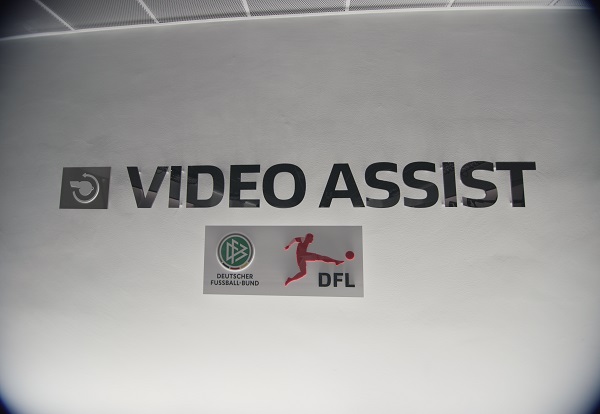
The DFL Video Assist HQ is operated at a central hub in the city of Cologne. (Image: Deltatre/Sportec Solutions)
Ahead of the 2022-23 season, in March 2022, the German Football Federation (DFB) appointed the Munich-based Sportec Solutions as the Bundesliga’s officiating technology partner for the next five seasons.
It is a pioneering development, as Sportec Solutions is a joint venture between renowned sports and entertainment technology provider Deltatre and the DFL, who operate Germany’s top two divisions under the auspices of the DFB.
Keeping the Bundesliga’s Fifa-certified VAR and goal line technology in-house affords the league overall control, as Janicot explains. “When it comes to changes in setup or innovative features, there’s a huge advantage to being in control of the road maps and the directions we want to take in the future. This also reduces development and feedback cycles. It is challenging for us but also good for our product that the DFL set a very high bar in terms of standards. It is relatively achievable to get everything to work 98% of the time, but that final 2% – that’s where it costs a lot of time, a lot of effort and a lot of money sometimes to get to that stage.” Sportec Solutions achieves such accuracy using technology designed by its subsidiary, Vieww, which specialises in camera-based systems.
Earlier in the day, Janicot had taken the Leaders Performance Institute to inspect the match day setup at the BayArena ahead of Bayer Leverkusen’s meeting with VfL Bochum. In the Bundesliga, he explained, both VAR and goal line technology are set up according to two camera plans: 19 for some matches and 21 cameras for others. A prominent fixture such as Bayern Munich-Borussia Dortmund may have a camera plan of 23. Additionally, there are 14 ‘intelligent’ cameras within a stadium tracking at 200 frames per second in real-time.
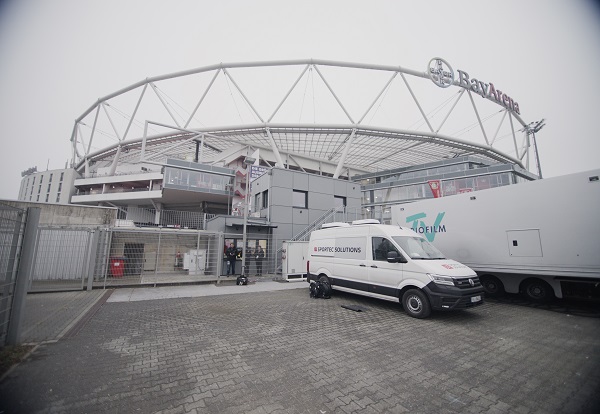
A Sportec Solutions van onsite at the BayArena ahead of Bayer Leverkusen’s meeting with VfL Bochum on 25 January. It is one of 12 all-electric vans in the Sportec Solutions fleet. (Image: Deltatre/Sportec Solutions)
Sportec Solutions will have a team onsite, both in the stadium and the TV compound outside, and will work to provide both images and audio to the VARs and operators back in Cologne. For each match, two match officials – a VAR and an assistant VAR – will work directly with two operators, who themselves are supported by an onsite backroom team.
There are eight screens at every terminal. The two largest screens relay footage from the main camera above the halfway line. The others will relay a variety of angles and enable operators to assemble a quad-split for the VAR officials to review an incident from multiple angles.
While the Bundesliga employs the full system, Vieww’s tech could theoretically be rolled out in more modest circumstances. There are already versions in the Portuguese men’s third division and the Bolivian men’s league. “The system we have built here in the Bundesliga is extremely modular,” says Janicot. “You can reduce it to a bare minimum and you can have a functional system – the processes don’t go away – you’re still going to check a red card exactly the same way. That’s something that’s very important for us, to document all of that to make sure that we have the same standards no matter the size and capability of the competition.”
The system in Germany is refined through regular VAR and operator feedback. “What we want is better decision-making and then you break it down from there. ‘OK, this is what you want to get to, how do you build every single building block to make sure that you support VARs in making the best possible decisions?’” adds Janicot, who says referees are involved in review processes.
“We had a testing phase of about one year of putting a product in front of them, getting them to give us feedback on how they liked it, how it was being used, what they didn’t like especially, and then being able to change that.
“I think it’s a luxury we’ve had in building this product from scratch over the past few years after VAR had been introduced [in German football]. We didn’t create it and then put it live and then figure out we need to change this and that. We went in with a fresh mind having had three or four years’ experience within our team and then using that to build the product as it is now.
“And now, on a weekly basis, we’re still discovering things where we get feedback from the referees or from operators and think, ‘hey, maybe we can add this or change that’. That’s a continuously evolving thing and I think that working so closely with the refereeing department – that’s really the key.”
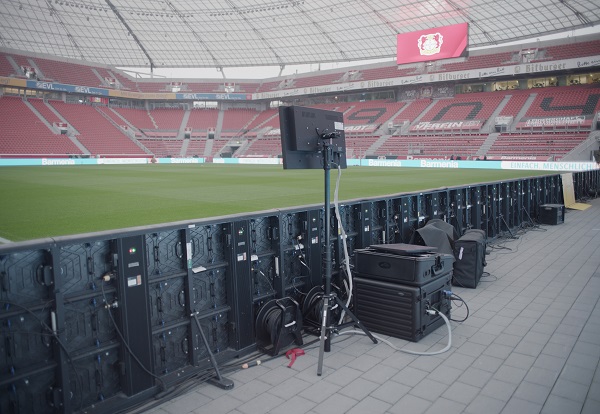
Sportec Solutions deploys its officiating technology across both divisions of the Bundesliga, the German Supercup, and selected matches in the national cup competition, the DFB Pokal. (Image: Deltatre/Sportec Solutions)
This ongoing review process led Sportec Solutions to discard touchscreens for VARs. “If you put technology in front of someone then they’re going to feel like they need to use it,” says Janicot, who explains that VARs were initially able to zoom in on a shot for themselves without the help of an operator. “What we actually found is that it was detrimental to the operation because the operator actually had something else in mind but you had the VAR doing something else. So you had two people to control the system when actually we found it’s better to have just one person who is in charge and the VAR hands-off, simply communicating.
“That’s the thing where you can’t solve everything with technology, you need to think about what the strengths are with the different people that are at the table and what their ultimate goal is or what their role is in the operation and then make sure they have all the tools to be able to fulfil that role.”
Nevertheless, the system still looks complicated to the uninitiated and the Leaders Performance Institute was all at sea when called upon to rule on an offside decision in a trial match-based scenario. Yet any risk of information overload is offset by the VAR and operators’ training, experience and ability to communicate.
“Clear communication is the absolute key to reaching fast, precise decisions,” says Janicot. “The team needs to speak the same language, to trust each other to do their respective jobs, especially when it comes to a complex process like an offside decision.”

Sportec Solutions’ VAR and goal line technology is provided by its subsidiary, Vieww. (Image: Deltatre/Sportec Solutions)
The DFB has brought in commercial pilots to work with referees and operators to help them to better understand how to engage in clear, direct communication techniques when issuing requests, commands and responses.
But what if the technology itself were to fail? “You need to make sure there are no single points of failure and that’s the whole way along the chain,” says Janicot. “All the way down to a single cable going to a monitor or making sure that you have a separate monitor going through a separate line, going through a separate converter etc. So making sure that you separate the work flows completely to make sure that there’s no one point where anything can fail. That applies to technology and also to people, right. What is your back-up plan if somebody gets ill the day before a match? Or if a van doesn’t make it to a venue the day before a match?
“About a year ago, we spent quite a few hours going through all the different scenarios. We called it a ‘pre-mortem’. Thinking about the absolute worst-case scenario. What happened? How can we fail? Then it’s making sure that you step back from that and going through all the different scenarios and you try as a team to cover as many as possible.”
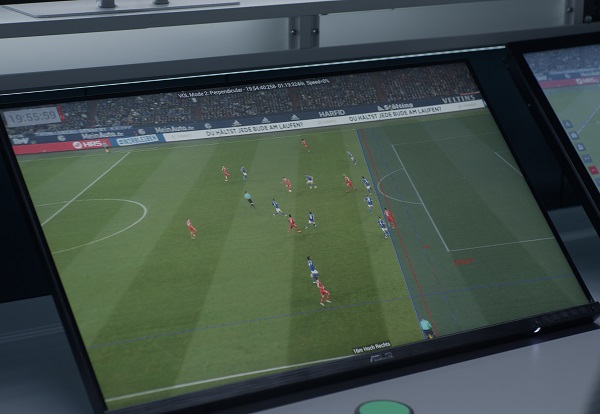
An operator draws the lines during a trial run of the technology that enables VARs to rule on offside decisions. (Image: Deltatre/Sportec Solutions)
What about imminent developments? Where does officiating technology go next? Janicot cites the potential for enhanced player tracking. “Do we at one point want to look at tracking more parts of the body than just the centre of mass?” He also refers to the use of balls containing microchips that support the use of VAR, goal line and semi-automated offside technology in Fifa competitions. “They showed it’s possible that it can be done and at Sportec Solutions we are of course having the discussion, if this is something that we need? What benefits do we get from it? And again, what benefits does it bring to the refereeing world?”
Offside decisions are another area where the DFL and Sportec Solutions are looking to further refine their process, particularly the length of time it takes to reach a verdict and the steps taken to get there. “We are looking at each segment of this decision tree and seeing ‘can we improve this? Can we improve this by work flows between the operators and the VARs or with technology?’ I think that’s something where we can make big steps forward.”
And if money were no object? “Informing the fans in the stadium, I think, is a real key part. Finding a way to do that in the best possible way. I think that’s key.”
He is optimistic for the future of officiating technology in football. “Top leagues have always had high requirements when it comes to precision and it’s also important to us because it’s an elemental part of the game. Afterall, it has influence on the decision-making process, so for us, along the whole way it was very important for us, at the end of this road, that we do get a world-class product where we have the chance to bring in our requirements in terms of quality and reliability but also our wishes and ideas for our future.
“We absolutely feel confident that we are in a very good position right now and in a very good position to develop whatever direction we might want to go in terms of the next years for refereeing technologies.”
The United States Tennis Association is using data to educate and inform players and coaches alike.
A Data & Innovation brought to you by
This particular maxim may indeed be true more often than not, but two of the world’s top players — reigning US Open champ Carlos Alcaraz and his finals opponent, Casper Ruud — are actually covering a lot more distance, according to data analysis from USTA’s player development team.
“They’re running significantly more because they’re covering more ground to hit the forehand and be more aggressive,” said Geoff Russell, USTA’s Senior Manager for Professional Players. “So maybe, them covering more distance is, relative to the tactical game style that they’re trying to play, that might not be a bad thing. That might be an efficient thing.”
The running habits of the Nos. 1 and 3 ranked players are but one insight gleaned from the Hawk-Eye player and shot tracking data available at every Grand Slam event, including the Australian Open, which took place in January. What the USTA has prioritized in recent years is in-depth assessment of match data in order to inform training. Practice sessions and workouts are tracked by wearable technologies to ensure that players are preparing appropriately to compete and contend at major tournaments.
A key figure in this initiative is Paul Robbins, Kinexon’s EVP of Sports Performance and a member of the USTA Sport Science Committee. Robbins pioneered this type of physical performance monitoring for NBA players as the Director of Elite Performance at STATS, which owned the first tracking system implemented in basketball, SportVU. He continues to consult extensively within the NBA.
Robbins jokes about how impressive the USTA Sports Science Committee is, noting that he’s just about the only one without an MD or PhD. (“I always say I’m the dumbest guy in the room,” he quipped with a laugh.) Now, in conjunction with Russell, Performance Manager David Ramos, medical advisory group member Mark Kovacs and others, Robbins is helping spearhead innovative analysis and training programs in tennis.
“How do these guys actually play? How do we actually then train somebody to play at this level? Their accelerations or decelerations, the loads, the work capacity you need over a two-week period of time in the tournament — things like that,” Robbins said. “It’s basically bringing everything I’ve done for the NBA for 12 years, now, we’re actually at that level for the USTA to be able to do that in our development of our US players.”
During the US Open, the USTA player and coach development staffs introduced the Physicality Index and published a series of web stories using this new metric to describe the intensity and toll of matches. One such piece, discussing the play of the men’s semifinalists, shared the aforementioned insight about Alcarez and Ruud, whose respective 6.9 and 6.6 Physicality Index scores dwarfed Karen Khachanov (5.2) and American Frances Tiafoe (4.8), as did their high-speed distance covered and number of explosive movements.
That public-facing metric was designed to engage and interest fans and, at times, included some sample workouts that competitive players could undertake to prepare for such demands. But the player development work runs much deeper.
Russell and Robbins drove from the greater Phoenix area out to Indian Wells for the BNP Paribas Open in October 2021, and over the course of the roughly eight-hour roundtrip drive, they designed most of the new tech-infused, player development program.
The first order of business was to assess the current practice routines among highly rated junior players at the USTA campus in Lake Nona. Performance Analytics Coordinator Katherine Gonzalez tagged every drill in the data management platform to help develop these baselines.
Early questions raised by Robbins, whose specialty is in metabolics, were about training the necessary energy systems: “Do we need a 15-minute drill? if you’re trying to mimic what’s happening in a match, that’s two minutes. You want to go at a much higher intensity to do that.”
One revelation of this work: several coaches were using mini-tennis — a rally-driven exercise using only the service boxes — early in training session to get their players loose.
“They were calling it their warmup,” Robbins said, “and that turned out to be the highest intensity drill. It’s like, ‘I don’t know if we want to start with the highest-intensity drill.’”
Providing education to the coaches is the important first step, and they’ve been largely receptive to the explanations they’re hearing.
“Coaches have the right intention,” Russell said. “They’re trying to do the right things, but they just need to understand the why — the effects of what they’re doing.”
USTA leadership has been supportive, he added, because every stakeholder in development stands to gain from the infusion of data and video to track not only physical load but stroke volume and heart rate, too. RPEs, the common shorthand for rate of perceived exertion scores, are also valuable data points from the athletes themselves even if they are inherently more subjective.
These sources appeal to tennis coaches, strength coaches, athletes, the medical team and also the mental skills coaches, with Russell noting the applicability of heart rate data as a proxy for pressure management. After all, physical, technical and tactical performance are inherently intertwined. The USTA performance team’s preview of the women’s semifinal, for example, used the data to show how Ons Jabeur and Caroline Garcia minimized their exertion by controlling court position, rarely standing far behind the baseline, by using their strength to return shots from closer in and rallying with powerful forehands.
Every player has his or her own style of play and requisite physical thresholds, but as the data gets collected and analyzed, the USTA can create clusters, or buckets, of player profiles who would all benefit from similar training. That serves as a base for further personalization.
“Going back to Alcaraz, I mean, those accelerations and decelerations that he had — and not only just one or two, he just kept doing it — you’ve got to train for that,” Robbins said. “And that’s what we’re trying to do is understand what the matches are. And then how do we how do we adjust our drills to do that?”
This article was brought to you by SBJ Tech, a Leaders Group company. As a Leaders Performance Institute member, you are able to enjoy exclusive access to SBJ Tech content in the field of athletic performance.
‘How can we put our athletes in positions to be successful?’
A Data & Innovation podcast brought to you in collaboration with
“When I need to be able to understand something, when I need to be able to communicate something, when I need to be able to have that conversation with our front office or coaching staff, whoever that might be, they’re the ones that I’m going to in order to get that information.”
McDaniel is the Vice President of Player Performance at the LA Dodgers and the first guest on the People Behind the Tech Podcast series, a new collaboration between SBJ Tech and the Leaders Performance Institute.
During the course of the episode, he also talks to SBJ’s Joe Lemire and Leaders’ John Portch about topics, including:
John Portch Twitter | LinkedIn
Listen above and subscribe today on iTunes, Spotify, Stitcher and Overcast, or your chosen podcast platform.
Ludimos’ solution is used by more than 19,000 players in 15 countries, including the IPL’s Royal Challengers Bangalore.
A Data & Innovation article brought to you by
“I lost all my fundamental flow and feel for the bat,” Rajagopal recalls. He adds, “Coming from India, cricket is kind of in our blood, in my blood, and I could live without anything but not without cricket. But in 2018, there was a point where I literally thought about stopping cricket because I wasn’t enjoying the game anymore. I wasn’t scoring. I wasn’t playing well. My performance was very bad.”
Around the same time, Rajagopal was helping coach the club’s junior players and was surprised not to find any apps to help track their progress. In his professional life, he is a data scientist and AI engineer, so he set out to build his own solution.
That product is now Ludimos, a smartphone-based cricket tracking and training app that has been used by more than 19,000 players across 15 countries. Among the team clients are nine national cricket associations, including those in Scotland and the Netherlands, as well as Royal Challengers Bangalore of the Indian Premier League (IPL).
Ludimos can analyze video from multiple viewpoints and provide tracking data on ball and bat. An assessment of player biomechanics is in development. And the platform is also a communication tool that enables coaches to assign drills, evaluate them upon completion and return annotated videos with tips.
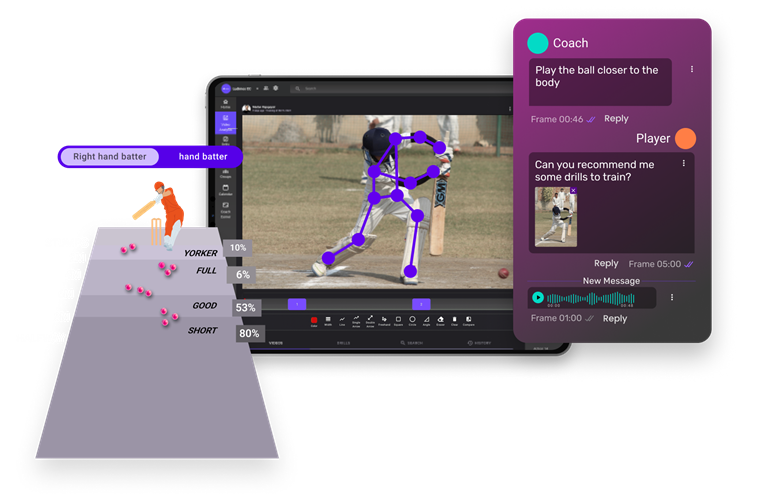
Ludimos can analyze video from multiple viewpoints, provide tracking data on ball and bat and act as a communication tool where coaches can assign and evaluate drills. (Courtesy of Ludimos)
“Our current core value prop is the ball tracking,” Rajagopal says. “So our ball tracking technology is good enough that it is already adding value to both batters and ballers, and in our roadmap, the next thing we have is to unlock the bat tracking and then the biomechanics. Then at that point, then we can merge everything together and have contextual analysis of the player in full.”
RCB, in fact, revealed this week that one of their newest additions — bowler Avinash Singh — was the direct result of its Hinterland Scouting program, a data-driven talent identification tool powered by Ludimos. Singh has never played professionally and mostly played tennis ball cricket until less than a year ago, yet now he is the first of more than 10,000 registrations to make the RCB roster through this program and has bowled 145 kilometers per hour (90 mph), an elite pace.
In a video interview, RCB head of scouting Malolan Rangarajan described Hinterland Scouting as a “very, very objective way of identifying talent where we don’t use human eyes” while likening the bowling action of Singh to Umran Malik, the IPL’s fastest bowler.
As part of an innovation contest in 2021, Ludimos earned second place in the competition hosted by Cricket Australia and HCL, with distinction for its player development tools. Ludimos is also a graduate of the Stadia Ventures accelerator program and is now raising a €1.5 million seed round, of which €300,000 was slated to come from a crowdfunding campaign on Seedrs. (By mid-January, Ludimos had exceeded that goal and raised €314,511.)
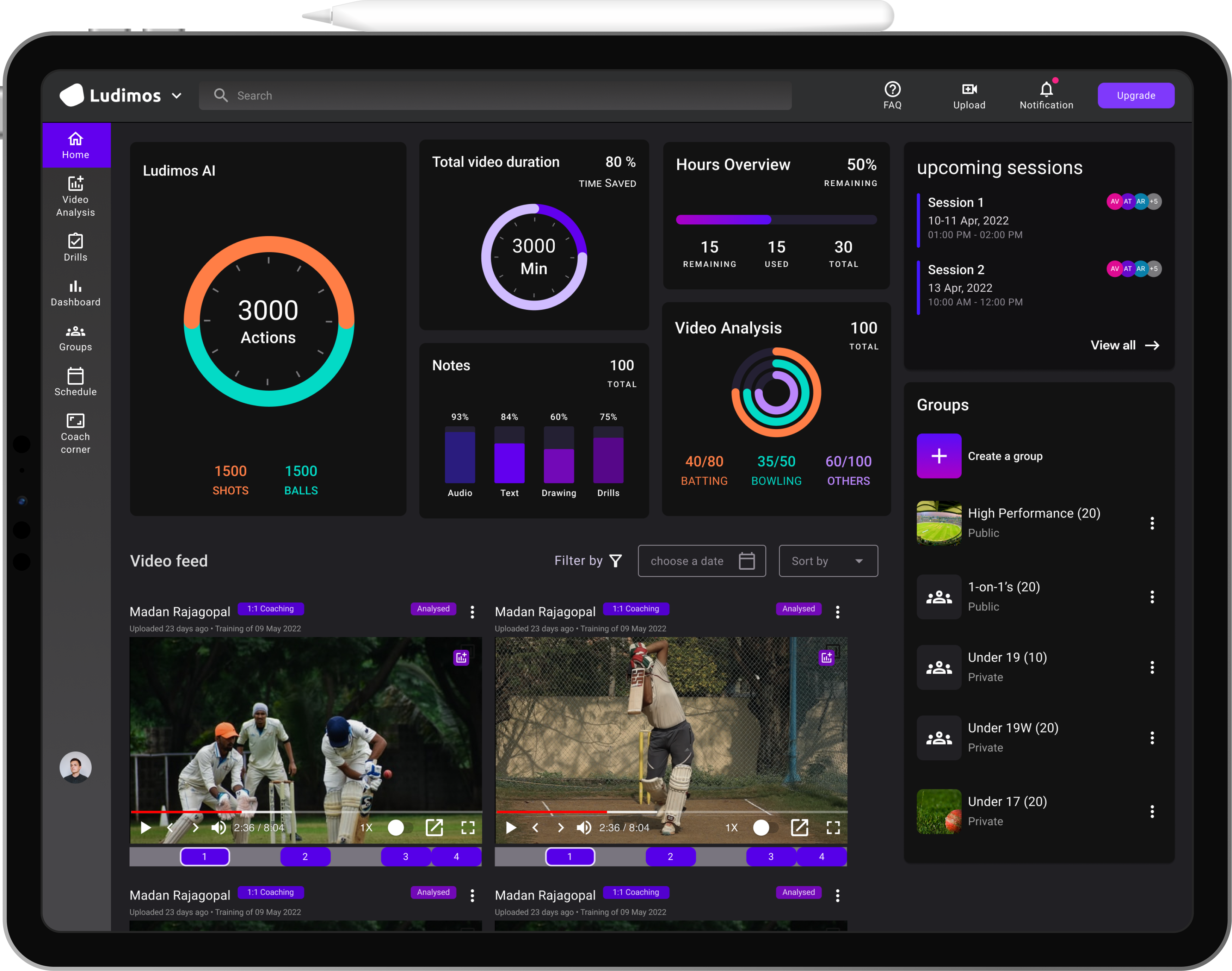
The Ludimos homepage interface includes access to video analysis, drills and more. (Courtesy of Ludimos)
While other sports — most notably baseball — have seen great advances in the understanding of the sport via publicly accessible databases and research, cricket’s advanced data has been more closely held.
“We don’t have any open data set about what’s been collected and how it’s been used, which means that there are only a handful of companies in the world that actually do this,” Rajagopal says. “And we are the only one of them, which does all three, which is bat tracking, ball tracking and biomechanics.”
Video review helped remedy Rajagopal’s own swing woes. He asked friends on the team to record him for three weeks straight and reviewed the clips with a coach.
“Even though the exact same sentence was said to me by several coaches — ‘that your head is moving away, that your weight is actually falling off and not coming towards the ball’ — I could never visualize what that actually meant, how that would look like, until I saw him pointing on the screen where he said, ‘Your head should be here, but it’s few pixels to the right or to the left,’” he says, describing the experience as empowering.
With small changes, Rajagopal dramatically improved his batting results, regaining his confidence and triggering his pursuit of Ludimos to create similar opportunities — with greater tech-driven features — to everyone. (Ludimos is an amalgamation of Latin words that try to capture the process of improvement: self-reflection, practice, habit formation.)
Rajagopal says Ludimos was designed for all age groups of cricket, recognizing that most club coaches might work with 11 year olds on up to 40-somethings. The older bracket will seek more detailed analysis; youth players will seek a different experience. “For 11- to 15-year-olds, it’s more about having fun and feeling for the game,” he says. “It’s more about gamification, so we turn our data and AI into a way that they can use as challenges and leaderboards.”
Ben Ferbrache, the cricket development manager for Guernsey, manages and coaches the junior programs for the small island state situated in the English Channel.
“It’s a really good way of tracking a player’s progress, especially with a lot of our guys that are going from one age group to the next,” he says. Ferbrache notes the ease of use, both for the players and for the coaches to record and assign their own practice drills. “What we find is kids love technology,” he adds. “Everything is on a phone or an iPad these days. So that’s where we were like, ‘Why don’t we just embrace the technology, and the kids will actually start using it?’”
This article was brought to you by SBJ Tech, a Leaders Group company. As a Leaders Performance Institute member, you are able to enjoy exclusive access to SBJ Tech content in the field of athletic performance.
‘Everything in athletics is determined by ground forces. If you want to jump higher, you have to convert horizontal forces to vertical forces as efficiently as possible. We increase ground force,’ says Founder Stuart Jenkins.
A Data & Innovation article brought to you by
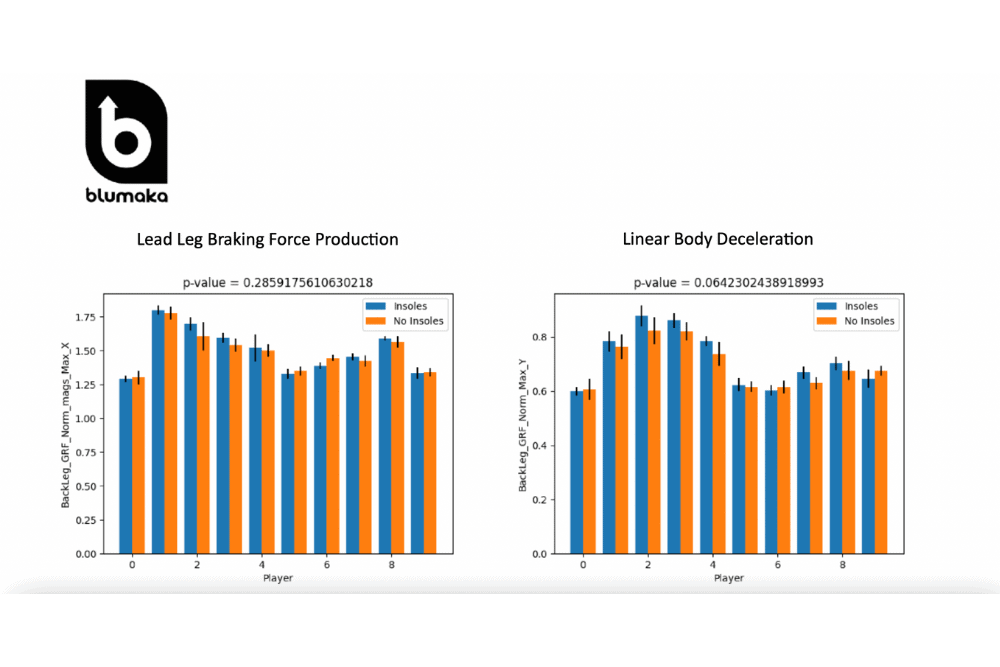
The study was conducted by a professional baseball organization — Blumaka is not publicizing which one–with movement tests performed on 190 athletes. Data from the biomechanics lab was collected through KinaTrax’s 3D marker-based motion capture system with integrated force plates. Among the findings from the study were 90% of athletes saw an increase in linear body velocity while wearing the insoles compared to not wearing them, 80% increased their lead leg ground-force production, 70% increased their back leg g-force production, and 80% had an increase in front knee stability.
“I can’t think of any sport where slipping helps other than curling,” says Blumaka founder Stuart Jenkins. “Everything in athletics is determined by ground forces. If you want to jump higher, you have to convert horizontal forces to vertical forces as efficiently as possible. We increase ground force.” On the lab testing, Jenkins adds: “They were running and then coming to a complete stop, looking at how fast do you start and how fast do you stop? They were also doing baseball things like a pitcher coming off a mound, what happens to that front leg when it hits the ground? Is that foot sliding down the mound or is it stopping so that you can get velocity on the ball?”
Konnect insoles are made from 85% of recycled foam materials, including a thermoplastic polyurethane (TPU) surface. Jenkins, 63, has spent over 40 years in the footwear industry including his previous role as VP of Innovation and Product Development at Deckers Outdoor Corporation, which owns brands such as UGG and HOKA. Investors in Blumaka include Donnie Ecker, the current bench coach and offensive coordinator for the Texas Rangers and former hitting coach for the Giants.
“Most insoles have cloth on the top and most socks are made out of fabric. You put two things together, a sock and a fabric that have the same coefficient of friction, they slide,” Jenkins says. “What we did is we picked a material that had a tackiness to it. If you put [Konnect] under a microscope, you would see these micro-grip patterns that we’ve built into the mold so that it would grab this sock more effectively.”
Giants outfielder Mike Yastrzemski has been among the staunchest advocators for Blumaka, wearing the insoles during games over the past two seasons after being connected to Jenkins though a friend of a friend. Several teammates, including Tommy La Stella and Evan Longoria followed Yastrzemski’s lead in purchasing the insoles. Testing on Yastrzemski’s swing showed his rotational acceleration increased by 5-7gs [g-force] wearing the insoles versus without, according to The Athletic.
“[Konnect] lasts something in the neighborhood of 10 to 20 times longer than the insoles they’re putting in these athletic shoes from a cushioning and durability standpoint,” Jenkins says. “Mike Yastrzemski told me he normally goes through three insoles a year in his baseball cleats. He has now played two consecutive seasons in one insole, our insole. Think about that from an environmental standpoint.”
“I’ve tried every kind of insole there is on the market,” Longoria, now a free agent, told The Athletic last summer. “I’ve had custom orthotics made, I’ve tried all the over-the-counter stuff you can buy. This [Blumaka] has by far been the best result that I’ve gotten from an insole.”
Jenkins says that 10-15 PGA Tour golfers wear Blumaka during tournaments. California-based athletic sock company Drymax has a distribution agreement with Blumaka, which has sold its Konnect insole at full price ($59) on its website to all professional athletes wearing the product and does not yet have any paid endorsers. A report from Fox Sports found that just 11 of 695 MLB hitters did not wear batting gloves in plate appearances during the 2021 season, and Jenkins thinks his insoles could become a just as common piece of equipment.
“The reason everyone wears batting gloves is because it makes you a little bit better, because slipping is not a good thing,” Jenkins says. “It’s gonna be the same way with insoles. Why would you want to slip? We’re not going to make people go from the sandlot to Yankee Stadium and be a star, but we’re gonna make the stars at Yankee Stadium a little bit better.”
This article was brought to you by SBJ Tech, a Leaders Group company. As a Leaders Performance Institute member, you are able to enjoy exclusive access to SBJ Tech content in the field of athletic performance.
