Prevent Biometrics believes its data creates a more accurate depiction of the head impact risks associated with youth sports.

“We have really begun to restate what’s the correct amount and magnitude of head impacts in sports are [and] at young sports it shows they’re pretty safe,” Prevent Biometrics CEO Mike Shogren tells SportTechie. “We’ve shown that less than 1% of all impacts are over 50 gs [g-force] and 50g is big.”
Prevent’s mouthguards measure the g-force of each hit though its built-in accelerometers that collect data such as linear acceleration, rotational acceleration, location on head, direction of impact and total number of impacts.
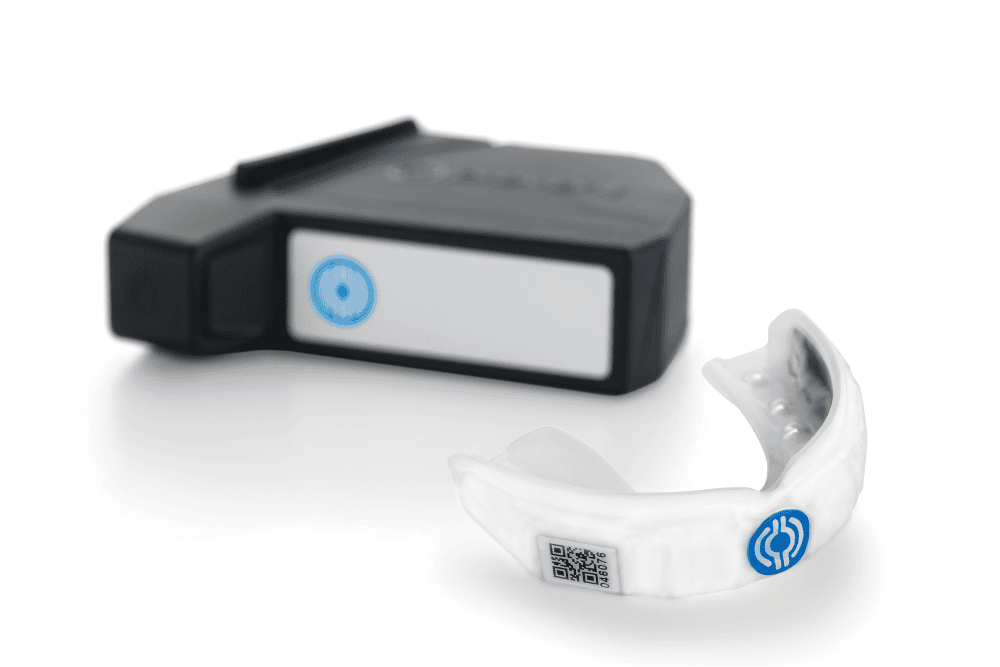
Prevent’s mouthguard’s tight-coupling to the skull is a newer (and possibly more accurate) method to measure head impacts.
“10g is what you do when you sit in a chair, you can stop really hard, and you’ll get five to 10g” Shogren explains. “Ten to 20g are a bump, you might not even know what happened to you, you might not contend you got hit the head, but you had some contact. 20-30g you realize you were hit, that’s a head to the facemask, a small trip and you bump your head. 40g is when you definitely know you got hit, and 50g is bad. And above 50 is we’ve almost shown all of them to be reflective of a person acting in ways you would typically remove someone from a game.”
Minnesota-based Prevent Biometrics is involved in several ongoing studies, including working with Indiana University to equip 160 high school football players with its mouthguards and another study with a suburban Minneapolis youth tackle football organization that equipped 400 players with Prevent’s mouthguard. The University of Nevada is entering year three of a study in which 50 players on the school’s D1 college football team have worn the mouthguard and has thus far collected data on 20,000 head impacts over the past two seasons.
“We’re seeing around an average of six impacts per player. And about 80% of those impacts are below 20g and 90% are below about 25g consistently in the schools that we look at. So less impacts that are smaller is the first finding in almost everything we do,” Shogren says.
Shogren is critical of past methods predominantly used in football to measure head impacts, such as the Head Impact Telemetry System (HITS) developed by Simbex that leading helmet manufacturer Riddell began adding to their helmets around the mid-2000s. That system saw accelerometers placed inside the helmet, but its impact data is less accurate than Prevent’s mouthguard because the helmet sensor system is more susceptible to moving out of place on each impact, effecting the measure of force.
The University of North Carolina at Chapel Hill equipped its football players with Riddel’s HITS-embedded helmet during practices and games from the 2004 to 2006 college football seasons. UNC released a study on the impact data in 2007 that found “In football, a hit can easily jerk the head, for milliseconds, at 50g, and hits above 100g are common,” adding that one player experienced a 168g hit.
“All of the football data you’ve ever seen about how dangerous football is, is about five times too many impacts and way too big. And it’s because the helmets systems they use move,” Shogren says. “All the way up to college and professional levels, we’ve showed that these games are nowhere near as dangerous as the studies have reported in the past. Hits equal to car accidents, this stuff is just not usually true.”
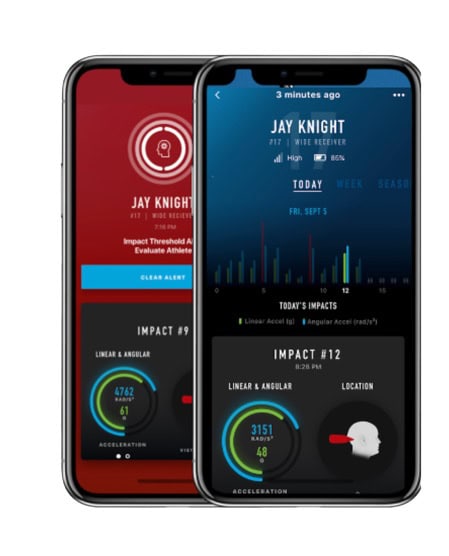
Prevent’s data can be accessed in real time and allows for multiple team users to monitor athletes.
Among the other support of Prevent Biometrics is Dr. Joseph Maroon, who is the Team Neurosurgeon for the Pittsburgh Steelers and medical director for the WWE. The NFL recognized Prevent Biometrics as a finalist at the league’s first and future pitch competition in 2017. Last year, the NFL expanded its impact-sensing mouthguard program from NFL teams to also include players on four college football programs, though that mouthguard device was developed with Virginia-based engineering firm Biocore.
“The data from the HITS system indicated there were 1,000s of hits and huge forces. And it was all erroneous, most of it was erroneous,” Maroon says. “The Prevent [Biometrics] system with fixing the mouthpiece to the upper teeth has been shown to be very accurate.”
Shogren says Prevent sells its mouthguard predominantly to teams with the price now around $300 to outfit an entire team in which each player gets their own device. The company’s biggest partnership to date has been with World Rugby, which began in 2021 with more than 700 youth players in New Zealand outfitted with Prevent’s mouthguards. The deal is now expanding to equip roughly 3,000 rugby players across the world, including players in the women’s Rugby World Cup.
Last month, World Rugby announced that it was extending its return-to-play window for players who got diagnosed with a concession to 12 days, meaning they likely would be forced to miss their next match after being diagnosed. Prevent is also working with World Rugby to establish a score of g-force that would signal when a player has reached an accumulation of impacts that would require evaluation for possible concussion.
“At some point in time, small impacts add up to a dangerous thing. We’re working with World Rugby now on with what we call a load calculation,” Shogren says. So figuring out this number where there will be some threshold where you would also say, ‘Hey, this guy in a football game, took 10 hits that added up to a number and that’s the threshold we want to assess him.’”
World Rugby’s collaboration with Prevent has also found that girl athletes at the youth level tend to sustain bigger head impacts than boys.
“We have seen differences in women, where we think because they start later in certain sports, they end up having more head to ground contacts and bigger impacts because they just don’t seem to go to the ground as well as boys,” Shogren says. We’ve confirmed that’s true that girls can have larger head impacts when they hit the ground, and it looks like it’s something to do with how they fall. So it’s immediately led to World Rugby developing some drills at the younger age for how you take a tackle and go to the ground.”
This article was brought to you by SportTechie, a Leaders Group company. As a Leaders Performance Institute member, you are able to enjoy exclusive access to SportTechie content in the field of athletic performance.
Two-time Olympic 400m hurdle medalist Dalilah Muhammad discusses the role of technology in her training, preparation and performance.
Muhammad later set a personal best of 51.58 seconds in the Tokyo Olympics, running what would have been another world record, if not for Sydney McLaughlin running even faster in the same race. In addition to that silver medal, Muhammad claimed a second career gold as part of the USA’s 4×400 relay team. At July’s World Championships in Eugene, Oregon, Muhammad returned from a hamstring injury to finish third.
A 2007 IAAF World Youth title winner, Muhammad, now 32, is a native of Queens, New York who graduated with a business degree while compiling an All-American career running at the University of Southern California. She starred in Nike’s 2017 ad campaign on equality alongside Serena Williams, Megan Rapinoe and LeBron James and, more recently, joined Cheribundi’s Pit Crew—its brand ambassadors of athletes and wellness experts promoting the company’s natural health products.
On why there’s been so many world records in the 400 hurdles . . .
I get this question a lot. And I think a couple of things come into play. The event is just run differently. It’s actually a newer event in track and field’s history—we didn’t start running the 400 hurdles until [the 1970s] when women actually started running the 400-meter hurdles. And I think at the time, it was thought of as a race for people that weren’t fast enough to run the open quarter [mile]. Originally, it was thought of that way, kind of like the steeplechase. You weren’t fast enough to run a flat distance, so your coach threw you in the steeplechase.
You had those standout athletes early on, but I think more and more people are falling in love with the 400 hurdles and it’s becoming that premier event. And it’s become a race that you have to be just as good in the 400, a good 800 runner and even a fast 200 runner to be able to run the 400-meter hurdles—as well as hurdle. It’s just a combination of finding that type of athlete that’s good and that has that type of broad talent.
And finding new ways to coach it. I think their approach in coaching has always been strength-based, and we’re turning it more into a sprint. And we’re seeing that now. When I first started doing the 400 hurdles, my coach would tell me and taught me to go out really slow and hold on and wait for that last 200. And now we’re all going from the gun because we know we can handle it. I think just having that faster increase in pace that first 200 is really making a difference.
On training tools for the hurdles . . .
I definitely look at video and look at myself and how I’m hurdling and how I can improve and what I’m seeing when I hurdle. I have a guy named Ralph Mann that comes to the track as well and analyzes our hurdle form. He created this model that can show you exactly, based on your weight and height, just how fast you’re getting over the hurdle, where you’re stepping over and the world record pace. Actually, he can put the model to a world record pace and see how close you are to it.
So we have those types of tools that we use, but of course it’s my coach’s eye, more than anything. He has the formula as to what hurdling should look like, and we’re adjusting it every year, honestly, trying to get better and better at it. So it’s just repetition and going over and over and reviewing just what I personally look like.
On how she improves her running technique . . .
I’ve become a better sprinter in the last couple years even just because of focusing on the form and looking at the greats to do it. I was just looking at [Usain] Bolt, looking at FloJo, just how she actually sprinted and what that looked like and just incorporating it into my own training. So that’s something that my coach and I really pay attention to—exactly what the form looks like. And that’s been a key component of my race. I never actually was that good of a sprinter—or at least I was told I wasn’t—so focusing really on the form has helped me to get faster.
On how there’s no typical training session . . .
As a 400 hurdler, we really do it all. I do interval work. I do speed endurance. I do distance. I’ll go up to like even 1K’s. I’ll run repeat 1000s. I’ll run repeat 200s. I’ll do short 30s at practice. And of course I hurdle as well. And there’s some days that I’ll just do straight 100-meter hurdle type training that you would see a typical 100 meter hurdler do. So there’s a huge balance. We really do a mix of every single thing, every single week.
On track shoe technology . . .
There’s a lot of controversy going around our spikes. Is it the spikes? Is it the athlete? And I feel like I’m not supposed to say this, but I’m going to say it anyway: Honestly, I think it’s both. I do think the advancement of our spikes has played a huge role in just how fast athletes have gotten.
To me, that’s not a bad thing. Those types of advancement have been made through history so many times, from just the type of ground that we compete on going from dirt to the Mondo we have now. Those advancements have been made, and you see the huge difference. And our timing system—there has been advancements in our timing system, and how much faster the world has gotten. And I think the spikes are definitely a part of that.
The important bit is it being an even-playing field. And I think they’ve done that amongst the companies. They put criteria that allows not one company to have an advancement when the other company cannot. If that didn’t exist, then maybe we’d be talking about something else, but the fact that it’s even amongst companies, yeah, I think we’re going in the right direction.
On feeling the immediate difference in her own spikes . . .
I remember the first time I put on the Nike spikes, and I said to the Nike guy, ‘Wow, I can break the world record in these.’ And that’s literally how it played out. That was in 2020. They were coming out with new shoes, testing them and having different models. And I broke it in 2021. So I think it’s great. I think technology should advance, and I’m happy that it has.
On her introduction to Cheribundi . . .
I’ve used their products for years now, but we just met recently. I told them my story back when I was in college, I started drinking tart cherry juice. It was introduced to us on campus as a snack that we can use to help recover and things like that. So I always loved it.
Nutrition was really focused on, especially when I went to the University of Southern California. And you notice, as an elite athlete, you start to realize how much the body needs to recover. There are different tools that we can use, and Cheribundi that we’ve been one of those tools that I’ve been using.
On the products she uses . . .
[I mostly] use their tart cherry juice for recovery, and I’ve recently just started using their one that has the melatonin in it as well. It helps you to sleep better, and especially when you’re traveling so much in our sport—we change time zones very frequently—and we have to adjust to that time period very quickly. Sometimes we are at a track meet, and we literally get there 48 hours before we compete—and we can be competing in China. So imagine the difference in time zones from China to Fort Worth, Texas. So that’s just something that helps me adjust really quickly, so I’m able to compete.
On whether she tracks her biometrics . . .
No, not really. Nothing for monitoring sleep and recovery. I definitely just pay close attention to how many hours I’m sleeping, and just making sure that I’m getting that eight hours of uninterrupted sleep as best as I can.
field. And I think they’ve done that amongst the companies. They put criteria that allows not one company to have an advancement when the other company cannot. If that didn’t exist, then maybe we’d be talking about something else, but the fact that it’s even amongst companies, yeah, I think we’re going in the right direction.
On feeling the immediate difference in her own spikes . . .
I remember the first time I put on the Nike spikes, and I said to the Nike guy, ‘Wow, I can break the world record in these.’ And that’s literally how it played out. That was in 2020. They were coming out with new shoes, testing them and having different models. And I broke it in 2021. So I think it’s great. I think technology should advance, and I’m happy that it has.
This article was brought to you by SportTechie, a Leaders Group company. As a Leaders Performance Institute member, you are able to enjoy exclusive access to SportTechie content in the field of athletic performance.
This question was tackled by Gavin Benjafield of LAFC and Ben Mackenzie of Zone7 in our latest webinar.

Ben Mackenzie, a Data Research Analyst at Zone7, an injury risk forecast and load management platform, is talking at the organisation’s webinar titled ‘Blending Sports Science and Data Science’.
“Quite often, when people refer to injury prediction, I think the mind goes to ‘this injury, on this day, at this time, as a result of this action’ – and it really isn’t any of those.”
Instead, Zone7 can dip into its ‘data lake’ of over 200 million hours of performance metrics and over 10,000 injury instances to produce an injury forecast based on clean, consistent data.
Still, data science remains misunderstood across elite sport. “Sometimes data analysts and data scientists get blended together now that we have analytics departments,” said moderator Dr David T Martin, the Chief Scientist, Director of Performance at Performance Health Science. “Some people will say ‘I’m not a data scientist, I’m an analyst’.”
Mackenzie and Martin are joined in conversation by Gavin Benjafield, the Director of Performance at Los Angeles FC, who have worked with Zone7 for two years.
Mackenzie uses Benjafield and the club to further illustrate his point on injury forecasting. “We’re able to identify that ‘this’ player, if he continues on the path that he is, he might be outside a certain range, might be at risk or is a risk of an injury as a result of being outside of the norms for LAFC’s training data. Therein lies the risk forecasting. This player either needs to do more, we suggest that he does more, or we suggest that he does less to mitigate that risk of injury.”
Practitioners from across the globe logged on to listen to the trio discuss the distinction between sports science and data science, the misconceptions that abound, as well as the steps teams can take to better use the data they are collecting.
Here, the Leaders Performance Institute highlights the other key insights from the session.
Sports science vs data science
There is a perception in the sports science world that data science is just another element of the job. Benjafield shares the story of a job opening at LAFC. The position was for a data scientist and the job description made that clear, yet just 25% of the 200-plus applicants worked with data. “Sports science: your understanding of physiology, psychology, biomechanics, all those components are nothing to do with data science,” said Mackenzie. Whereas the data scientist’s ability includes “[collecting] data, clean data, and understand multiple programming languages as well as the ability to clearly express what your findings are – they are completely different disciplines.”
Should you outsource your data science?
To illustrate a point around using consultants, Benjafield spoke of his ability as a handyman around the house. He is adept at certain task but draws the line at electrics. At LAFC, Zone7’s forecasting services and AI fulfil the role of the electrician. “If you’re just going to absolutely outsource everything then you’re just going to be an organisation with a ton of consultants running around you. You’re actually not going to have any identity,” said Benjafield. “We’re not going to become a consultant circus, we’re going to strategically pick those that we believe are the electricians that we feel comfortable doing that by ourselves, but we still want to take ownership and do a lot of the things ourselves otherwise we become spectators in our own department and I don’t think anyone wants that.”
As Mackenzie said: “A sentence that is thrown around at Zone7 quite a lot: we are a weapon the practitioner’s armoury. You have the tool box, we are just the hammer. There are many other tools that can get jobs done or can be used for other jobs. It is up to the practitioner to use their skill, their interpersonal skill and their skills in other sports science disciplines, combining all those elements and information provided by Zone7 for them to come to an informed opinion and not data-led.”
Creating actionable steps
Actionable steps are essential when using data, as 100 metrics cannot be manipulated by someone in Benjafield’s shoes across 25 athletes. Minor adjustments and corrections are a good start. LAFC worked with Zone7, who retrospectively analysed a season of data, to hone in on five GPS-related metrics. “Three of those we were already monitoring closely, two of them were not, so I think that just helped us to get actionable items,” said Benjafield, who is mindful of the challenge of pleasing coaches who want as many players as possible available.
The future
Mackenzie and Benjafield wrapped things up by pondering where the future relationship between data science and sports science. “People are fearful of losing jobs or being overtaking by data or AI,” said Mackenzie of the sports world. “I think it requires a change of mindset, a change in appreciation of different skillsets, and an understanding that a different skillset offers different things. That’s where it needs to start. Mindset, openness and willingness.”
Relationships are important for Benjafield too. He said: “I’d like to still be in an industry where we are wearing fewer external devices but we are collecting more data and richer data; and that is translated. I don’t want to lose the relationship with the athlete.”
Recent data demonstrate that an incremental increase in practice length can help curtail soft-tissue injuries.
According to the NFLPA’s General Counsel and Head of Medical Innovation Sean Sansiveri, all 32 NFL teams—besides being required for the first time to place GPS trackers on every player—had to adhere to the new health and safety protocol at training camp.
“We’ve now mandated a gradual ramp for the first time this season,” said Sansiveri, referring to the revision that was approved at this spring’s annual league meeting. “We had an acclimatization and contact integration period the last two years because of Covid, but this will be a whole different approach to that, and we anticipate seeing a reduction in the lower extremity injuries because of it.”
Sansiveri said that by monitoring players the last two “Covid” seasons through wearables designed primarily by Zebra and Catapult, the league determined that a spike in soft-tissue injuries came from “overbearing load” during early-season workouts.
“One of the things, very interestingly, that we learned from the GPS trackers was the teams that had a gradual duration ramp up,” Sansiveri told SportTechie. “Meaning start one practice at 90 minutes, the next one at an hour and five minutes, then an hour and 20 minutes—the teams that didn’t do that had almost a 25 percent higher risk of lower extremity injuries.
“But we wouldn’t be here if not for the use of the X,Y data and being able to monitor load [with wearables]. The information has turned out to be tremendously valuable for injury mitigation. And [this season] we want to look at intensity, we want to look at conditioning tests, we want to look at the number of padded practices. The CBA limits it to 16 during the training camp period, but not all clubs use all 16. And so looking at from the pure injury side, plus the load and the movement standpoint, we’re able to piece together with the help of our engineers a pretty clear picture of what’s contributing to the injuries.”
The NFLPA has to sign off on any wearables deployed by the NFL on its players and has formed a “joint sensor committee” with the league to ensure that the devices are “validated for its intended use and what the potential arms or downsides are.” Sansiveri, for instance, says some devices (such as sweat patches) are “bleeding over into bio-specimen” collection, and those need to be consented to by the NFLPA, as well.
Last season, Sansiveri said approximately 25 teams used various GPS devices during practice—either from Zebra, Catapult, STATSports or Kinexon. But by having all 32 teams gradually ramp up practice length during this year’s training camps, the data should be more definitive going forward. Last season’s Super Bowl Champion Los Angeles Rams were particularly lauded for their load management tracking during every preseason and regular season practice, which led to a reduction in injuries while winning nine of their final ten games.
“You can definitely bucket the teams in terms of the ones who are more effective than others,” Sansiveri said. “Depends on how you look at it. Whether you look at total number of injuries, which may not necessarily be indicative. Because you can have more contact injuries, for instance, versus non-contact and load-based. So if you break it down in terms of the duration ramp-up thing that I mentioned, there is a clear difference in the number of lower extremity injuries based on that. And that’s one of the reason we’re pursuing this the way we are.”
“As I said, the duration ramp-up question was primarily based on the two Covid seasons worth of data. But you can bolster that by looking at the piecemeal data sets on this issue we had previously. So I would say the study really solidified two years ago, and it’s sort of been in the works much longer than that.”
Troy Vincent, the NFL’s executive vice president of football operations, used the Rams’ game-wrecker Aaron Donald as a prime load management example in a conversation last February with SportTechie.
“Aaron Donald,” says Vincent, pronouncing the name with emphasis. “Nobody gets more double and triple-teamed in the National Football League over the last 7, 8 years than this man. In the trenches. That’s monitoring, that’s [load] managing. They have a lot of players in that situation where they don’t miss a lot of game time. But that is being properly managed through the head coach [Sean McVay] and the head trainer, Reggie [Scott]. So that’s everyone being on the same page. You can’t do it and be effective if it’s not a team. You can’t have one side of the house saying, ‘Data is it,’ and the other side of the house saying, ‘Nope, it doesn’t work.’ You can’t have sports science over here and someone says, ‘I don’t believe in sports science.’”
“[The Rams are] so cutting edge. When you look at their injury prevention, their injury reduction platform, it’s data science. They are no question light years ahead.”
This article was brought to you by SportTechie, a Leaders Group company. As a Leaders Performance Institute member, you are able to enjoy exclusive access to SportTechie content in the field of athletic performance.
The Seattle-based startup discuss the technologies that can help basketball players improve the mental side of their performance.
World’s shortest elevator pitch: “We focus on training the mental side of basketball. It’s a part of basketball we think is undertrained.”
Company: VReps. “The goal of the company is to give virtual repetitions of your sport, primarily basketball right now. That’s the impetus behind it.”
Location: Seattle, Washington
Year founded: 2015
Website/App: https://vreps.us/; Google Play app; Apple Store app
Funding round to date: “We are Pre-Series A. It’s all Seed funding.”
Who are your investors? “We are all angel funding and have raised roughly $2.5 million.”
Are you looking for more investment? “If the right investors came, yes.”
Tell us about yourself, CEO and founder Shawn Cooper: “I was studying computer science at the University of Michigan and was a scout player for the women’s basketball team. I’m 6-foot, I was 190 pounds and athletic, so as a scout player I could play any of the five positions. For an upcoming opponent, we would be given the scout team playbook and we’d have four or five plays we’re supposed to simulate during practice. That means during a span of 48 hours I was supposed to memorize 20-25 plays because I’m learning all five positions and it’s just a paper playbook, that was the best way to learn. The idea behind the company was initially making NBA 2K for playbooks, that’s really where we started–a video game version of playbooks. We’ve since broadly expanded to preparing the mental side of basketball, so how do you play basketball? What’s the chess match that happens? When you go through a ball screen, what are the reads? Why are there different ways you defend a ball screen? That’s the idea that came out of it. My senior year, I dropped out for a year and a half and started the company. I did graduate, went back, but that was the start of it.”
Who are your co-founders/partners? “I don’t have co-founders but have some really important leadership to the company in Mike Greenman and Matt Stewart-Ronnisch. They are both supremely talented in the worlds they occupy. Matt, our CTO, is a very talented engineer. Met him in college and he joined pretty quickly after we started, probably a year after we started. Mike Greeman is our Director of Basketball and joined us two years ago after it became clear we had potential to impact the NBA. I have no connection to the NBA, I don’t know enough about basketball to chase that market. We hired him and he has the connections and the expertise. He is a very talented basketball mind. He’s the one that trained Chet Holmgren before the draft and Jalen Williams. We had three first-round picks (Holmgren, Williams and Christian Braun), three second-round picks (E.J. Liddell, Kendall Brown and Jabari Walker) and one player picked up on a Summer League contract (Jermaine Samuels). Chet was our highest draft pick at No. 2.”
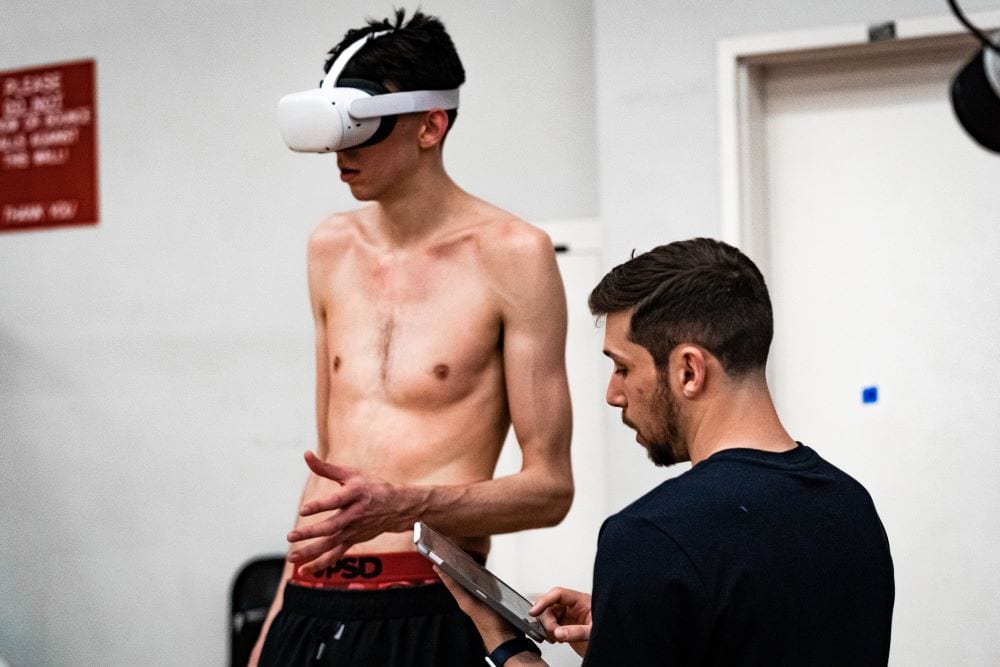
The 2022 No. 2 overall draft pick Chet Holmgren had signed an NIL deal with VReps while playing for Gonzaga.
How does your product/service work? “The product is technology at the NBA level. We recreate NBA games as they happen, any NBA game from the past five years, and we’re able to put players in virtual reality in the shoes of any player during that scenario. That’s the product and that’s available for any NBA team to purchase, and we’re working with a handful of NBA teams. The service is the player development training that Mike does utilizing that product. He actually trains players and trains them on how to prepare for the NBA using previous NBA scenarios as examples. So, before Chet got drafted we put him into the shoes of any player in the league. After he got drafted, we put him into Oklahoma City’s offense to prepare to play with the team. So before he ever steps on the court with Oklahoma City, he’ll have been in their offense for almost an hour in virtual reality.”
What problem is your company solving? “Basketball training is very focused on individual skills–shooting, ball handling, weight lifting, vertical, speed. There is an entire segment that is mostly ignored, which is the development of your mental understanding of how basketball works and why those things are that way and the strategy behind it. We’re filling the gap between how a player gets from a really good college player to an exceptional NBA talent. A lot of that growth is on the mental side and we are accelerating that mental growth, which is traditionally learned almost exclusively through game time.”
What does your product cost and who is your target customer? “Our product costs $10,000 to NBA teams as an initial offering. There are more expensive layers. The service to the NBA players, there are two tiers. One is $20,000 per year and the other is $60,000 per year. For the product, our target customers are the NBA teams. For the service, it’s NBA players or players that are preparing to be in the NBA. It’s not just NBA players.”
How are you marketing your product? “It’s entirely word of mouth right now and direct connections with those teams or players.”
How do you scale, and what is your targeted level of growth? “The technology we built has meaningful potential at nearly every level of basketball. It’s training the mental side of your brain in terms of the strategy aspect. Our growth will come, depending on what markets we want to grow into. Our growth from here, after we successfully enter the NBA market a little more, will be high-level international basketball and probably going into the college level in the U.S. We may also pursue other sports like the NFL. This technology has the same value in the NFL. We can do virtual reality training for NFL players. That’s another way we can grow. Depends on how much cash we get and from whom.”
Who are your competitors, and what makes you different? “Our nearest competitor would probably be Strivr. There’s also a company that does hockey simulations. Nobody, as far as we know, recreates historical games to relive that from the perspective.”
What’s the unfair advantage that separates your company? “Our unfair advantage is our technology expertise. We have 10 engineers working at the company. Very few companies our size are that heavily invested in their technology. We also have a few proprietary partnerships that give us access to the data streams we rely on. The recreation of the NBA games, for example, is through our partner, Sportradar. As of now, we are the only company that has access to those data feeds for player development purposes.”
What milestone have you recently hit or will soon hit? “We just trained the second overall draft pick. That was a huge accomplishment. We also trained a player that wasn’t on most draft boards through the draft process and ended up being drafted 12th.”
In what ways have you adapted to the Covid-19 pandemic? “NBA teams are very focused on in-person relationships, as are NBA players. Trying to create a business where we could work with NBA teams and NBA players remotely has been a challenge. I don’t think we’ve done it super successfully but we’ve managed to get through it and now we are growing on the other side of the pandemic, now that it’s mostly gone back to normal in how the NBA operates. We’re growing into the normal sales processes.”
Beyond the pandemic, what obstacles has your company had to overcome? “It’s a very slow market to adapt. For example, the idea of relying on analytics took almost a decade to catch on. Now, every team is heavily relying on analytics. The NBA moves very slowly and negotiating that very slow-moving market has been incredibly challenging. I’m not saying we haven’t been successful in it yet, because the company is still growing and trying to enter this market, but it’s an extremely challenging thing to overcome. ”
How has your company been affected by the current economic situation, and how are you dealing with it? “The current economy isn’t positive for startups and inflation has also made it more challenging, but I don’t think we’re doing anything special or noteworthy to mitigate those problems other than trying to reduce our spending as much as possible.”
What are the values that are core to your brand? “The values are engineering excellence and content excellence. We have a very talented basketball expert and a very talented engineering team and having a high-quality product that is impactful, it’s not just something to talk about, it actually does make players better. The impact we have is really a core tenant of the company itself.”
What does success ultimately look like for your company? “Success on a small scale is players that want to get better come to us as a way to mentally prepare and mentally enhance in any sport. Success at a big level is changing the culture around the importance placed on the mental side of basketball. If more people started to focus on the strategy behind their sport, that would be–on a broader scale–a lot more success from our perspective as a culture shift from just individual skill training to the broader picture of the strategy behind sports.”
What should investors or customers know about you—the person, your life experiences—that shows they can believe in you? “What gives me the best shot of making an impact in this market is my ability to build a very talented team. The team we have is exceptionally talented from an engineering and basketball perspective. I feel confident I can grow the engineering team as we need to, and also grow into deeper levels of basketball or build into new sports and build a team necessary to enter those markets.”
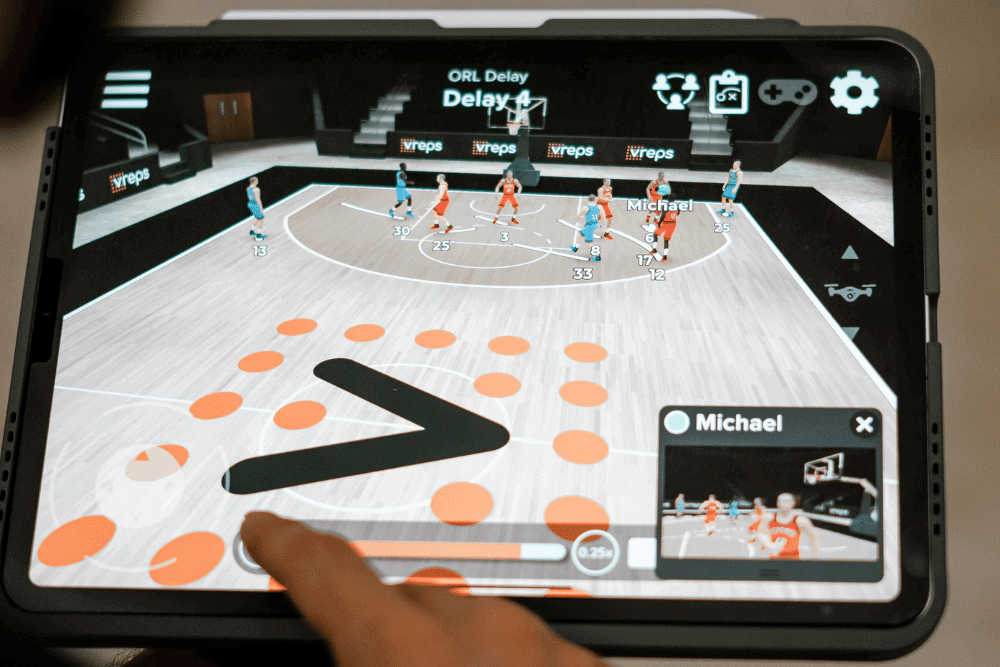
VReps allows players to create and watch plays through their app in 3D.
What made you start with basketball for VReps? “My true sports are lacrosse and ultimately frisbee. I was a very talented lacrosse player in high school but didn’t play in college because it’s really hard to do computer science and play a varsity level sport, so I decided to pursue a career. Now, I play at the highest level of ultimate frisbee. I play on a world-level team. Basketball is one of the easier sports to monetize and has one of the bigger markets and is a sport that has a very clear strategy to teach. Soccer is a little more fluid in the way strategy works. Basketball is a pretty ‘rock, paper, scissors’ type game where if they do this, you do this and they are going to do this and you do this. It’s not scripted in a football sense but more of a read-and-react sense, and it’s teaching that read-and-react decision making that is core to our business and what we can do. Basketball is the perfect petri dish for us to really prove our technology can grow in these sports.”
Do you have a favorite quote about leadership? “‘Knowing what you don’t know is more useful than being brilliant’ from Charlie Munger. The best leaders are those that build world-class teams around them. As an entrepreneur, you usually have very limited resources, so you need to be able to identify your biggest weaknesses and hire talented people to fill those gaps first.”
Question? Comment? Story idea? Let us know at [email protected]
This article was brought to you by SportTechie, a Leaders Group company. As a Leaders Performance Institute member, you are able to enjoy exclusive access to SportTechie content in the field of athletic performance.
Whether it is mere scouting reports or an analytical deep dive, the startup’s platform, which pulls in data from various sources, offers something to all coaches.
“I was jaded on some things, felt like they could be done a lot better,” he says.
Those pain points led to the founding of 6-4-3 Charts, a leading college baseball and softball data analysis and visualization tool. Five years later, 6-4-3 Charts works with 550 college programs, provided statistical support for ESPN’s broadcasts of the men’s and women’s College World Series and recently partnered with Sportradar-owned Synergy Sports on integrating its cloud-based video platform. Synergy already counts 96% of Division I baseball schools as clients, as well as growing numbers of softball programs and smaller school baseball teams. It also supports all 30 MLB organizations.
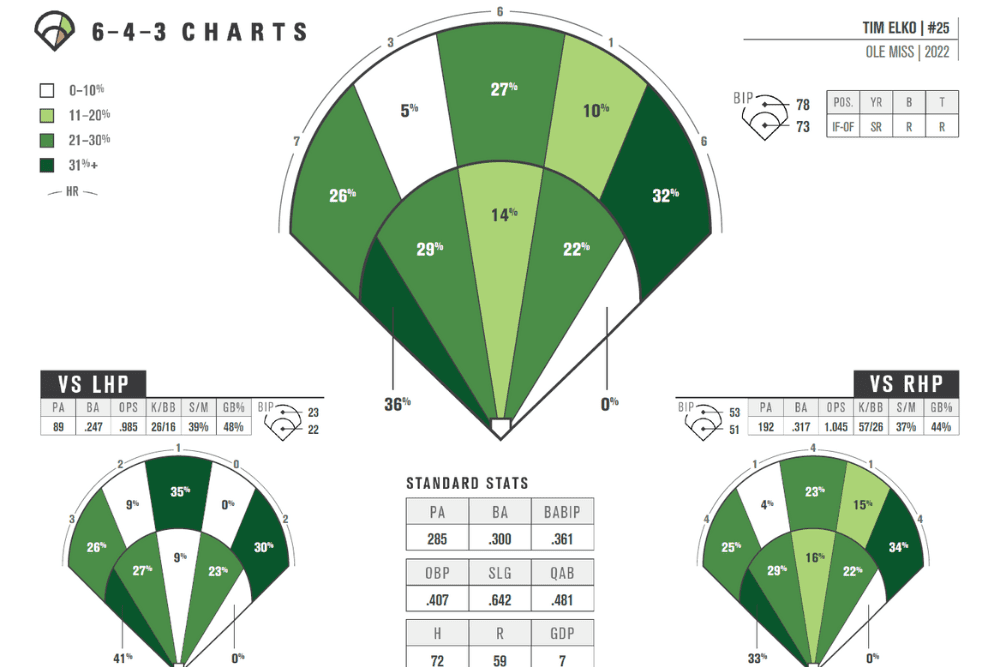
The 6-4-3 report generating process is on-demand and customizable. Coaches choose the template, stat year, spray chart design and players to include.
“What’s really cool is we’re sharing data between both of our APIs, so we’re not just leveraging Synergy data and video, but they’re also leveraging our data to improve some quality assurance processes and to look at potential ways to make their vlogging process even more efficient,” Weldon says. “And then, on our side, obviously, accessing all their video and data gives us a really unique opportunity to connect data from multiple sources.”
The origins of 6-4-3 Charts were humble, starting with a $12,000 investment and no full-time employees for its first two years. On the long bus ride to Tennessee Tech’s appearance in the ’17 NCAA regional in Tallahassee, Weldon called one of his former players from his time leading the Timberline High program in Lacey, Washington.
Rick Ahlf, who played shortstop for Weldon, was a high school valedictorian and Arizona State engineering graduate who had accepted a job at Boeing in low-speed aerodynamics product development. Ahlf laughs when recalling the experience of playing for Weldon at Timberline—“That was my first 50-hour-a-week job,” he jokes—but was interested in sports analytics and agreed that there was an opportunity to make a better product. (The third co-founder is Tim Kuhn, a CPA by trade who serves as COO at 6-4-3.)
Working out of his parents’ basement in the summer before the Boeing gig started, Ahlf coded the first iteration of the 6-4-3 Charts product. By scraping box scores and play-by-play data, the tool produced in-depth statistics and visualizations. In recent years, they’ve added a feature to sync TrackMan ball flight data as well as several other partnerships, including with SEQNZR and Playsight.
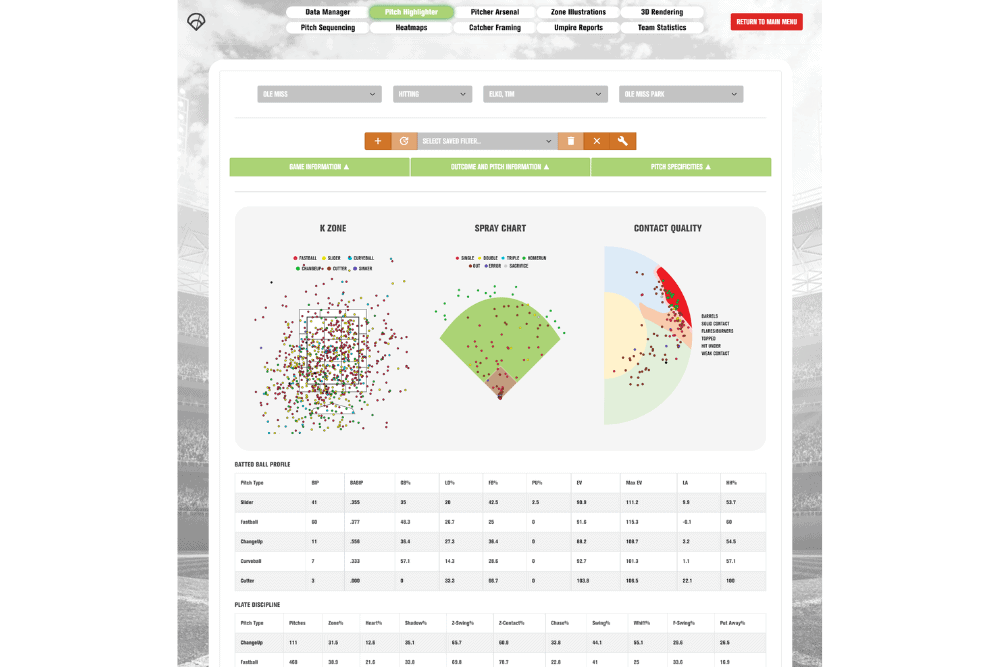
6-4-3 syncs with TrackMan to share ball tracking data visually with coaches and players.
“We started with PDF reports and Dropbox links, and we’ve evolved,” Weldon says. “Five years later, it’s a fully dynamic interface with on-demand reporting, customization, upload visualizations, video tagging, analysis, ball tracking.”
Coaches are the primary users, with some simply downloading basic scouting reports and spray charts and others delving deep into situational data.
“Coaches of all levels will now have the ability to enhance their game prep and film review,” Matt Lawrence, Synergy Sports’ senior director of baseball and softball, writes in an email. He adds, “And, importantly, their program is in-depth and easy to use. As a former D3 coach, I know this partnership is something that would have enhanced my video scouting and game preparation experience.”
Weldon says they are considering development of their own player portal; one of 6-4-3’s other partners, Driveline Baseball, already does with its TRAQ system. One of the 6-4-3 features is customization of a pocket card with info, for players to wear in a wristband during games or coaches to keep in their pockets. (NCAA rules prohibit in-game access to technology.)
In addition to serving its coaching clients, 6-4-3 has begun sharing some of its data in the media, both with ESPN and D1Baseball.com and D1Softball.com.
“We have all this data,” Weldon says, “and it’s like, ‘Well, other people besides coaches would probably be interested in this data. How can we tailor something for media, for example?’”
For the softball College World Series, Weldon was in the ESPN booth alongside the lead stats researcher and with two 6-4-3 team members in the graphics truck. Having seen how the process works, he is now brainstorming a specific TV production app to help broadcasters provide additional context and storylines.
6-4-3 started gaining significant market share by early 2019, when Ahlf left Boeing and dedicated himself full-time with the startup.
“Honestly, I like having control of my own future,” he says. “I’d rather bet on myself and the people that I trust to work with than being part of a large company where things just honestly move slowly. I like having that level of ownership and accountability that, ‘Hey, if I don’t perform properly, then this thing doesn’t go anywhere.’”
Weldon, incidentally, does still coach back in the high school ranks. His Olympia (Washington) High team won the Class 4A state championship last month. And he’s still in charge of the grounds. “Oh, absolutely,” he says, before correcting himself. He recently handed over mowing duty to a volunteer whose son is on the team.
So some things change, even if the spirit remains.
“All I ever say,” says Weldon, “is, ‘Just keep moving. We’re not going to be still. Let’s just keep going.’”
This article was brought to you by SportTechie, a Leaders Group company. As a Leaders Performance Institute member, you are able to enjoy exclusive access to SportTechie content in the field of athletic performance.
The asymmetrical training bar has helped PGA Tour players including Scheffler, Jordan Spieth, Zach Johnson and Ryan Palmer with their stability and mobility patterns.
A trained chiropractor with a focus on sports biomechanics, Van Biezen does some treatment on the training table before Scheffler begins his warm-ups. For the vast majority of that time—85%, Van Biezen estimates—the recent Masters champion is clutching GolfForever’s new SwingTrainer, a 44.5-inch, asymmetrically-weighted training bar with attachments that either replicate the feel of a driver or a club head that’s 2.5 times heavier for training. There is also a detachable resistance band for a wide variety of exercises.
“When we’re on the road, SwingTrainer is an integral part of our warm-ups and our training throughout the week,” says Van Biezen, who has worked on the PGA Tour for 20 years with Jordan Spieth, Zach Johnson, Ryan Palmer and others. “What I try to do in a gym, which is under a controlled environment, is just mimic the movement patterns that we want to have Scottie integrate into his golf swing. The SwingTrainer has been a very versatile, durable tool that we can apply those movement patterns under a light load but generating that neural pathway pattern to get that brain working on certain movements we want to get him into.”
GolfForever is the spinoff of chiropractor Jeremy James’ BackForever program, and the SwingTrainer launched in November as a training tool to complement the library of video content in the program. Scheffler, who has been training with Van Biezen for a decade in the Dallas area, recently joined Justin Leonard as a GolfForever ambassador, calling the SwingTrainer “critical” to his Tour preparation.
James, whose practice is based in Aspen, Colorado, welcomed patients suffering from chronic back pain for weeks or even months at his facility. Recognizing the challenge and expense of his location, he sought to distribute his message further, first by writing a book and then by recording streamed video content. Many of his most active users were golfers, which spurred the development of the GolfForever package that launched in 2019.
“Golf does a very predictable set of things to your body,” James says. “From a biomechanical perspective, it’s a repetitive, asymmetrical motion, and if you’re not in great shape or if you’ve had injuries in the past, it’s going to wear your body down.”
For the first couple of years, GolfForever relied primarily on resistance bands, but James sought to more precisely target the core muscles that generate and resist the rotational forces created during a golf swing. “We didn’t invent the idea of asymmetrical bar training—that had been in the fitness world for a while—but we took that concept and we made it specific for a golfer,” James says.
The SwingTrainer helps golfers open up the joints in all three planes of the swing, Van Biezen says, referring to the sagittal (left/right), frontal (front/back) and transverse (top/bottom) planes. He’ll have Scheffler do a side lunge with a rotation, a Bulgarian squat while doing a unilateral push or a single-leg overhead press, all while incorporating the SwingTrainer.
“With Scottie, he’s very, very strong,” Van Biezen says. “It’s just now, with the GolfForever, what I really like about is it just helps a lot with the stability and mobility patterns. It’s just a really high-beneficial, low-risk training tool. I think golf fitness has probably gone down one extreme where you get the Olympic lifting and all that kind of stuff and guys really getting hurt. I’ve always said the game of golf is a marathon, not a sprint. And so these guys can play for a long period of time and perform at a high level if they just keep themselves healthy.”
Van Biezen says he believes strongly in rigorous baseline testing to track movement patterns and detect asymmetries. He uses 3D motion capture regularly and employs massage therapists and strength coaches at his facility. There is also a golf shop and hitting bay with club fitting and repair, making it a one-stop destination. Scheffler first visited around the age of 14 or 15 and has kept coming back, much like Spieth, the 28-year-old who ascended to a world No 1 ranking in 2015.
“What’s going on with Scottie right now, it’s kind of like Groundhog Day for me with what happened with Jordan around the same time,” Scheffler says. “They both had a little bit of low back issues, and that’s why they first came in. Then they both just realized, for injury prevention, they have to start doing stuff off the golf course.”
Last season, Scheffler had eight top-10 finishes in his 29 starts but no wins. In fact, he had never won a tournament prior to the WM Phoenix Open in February—which began a streak of four wins in six tries, culminating in his Masters victory. Van Biezen pushed him hard in the offseason to strengthen his upper body and core but also build his endurance so that he was as fresh during the back nine on Sunday as he was the front nine on Thursday. By a small margin, his fourth round average a year ago was his worst, and his first round was his best.
“We’re just beginning to see everything come together finally,” Van Biezen says.
This article was brought to you by SportTechie, a Leaders Group company. As a Leaders Performance Institute member, you are able to enjoy exclusive access to SportTechie content in the field of athletic performance.
The Formula One team are make better, more data-informed decisions around race strategy.
Suddenly, the graph line began a rapid descent, so unexpectedly that Green, McLaren’s Head of Commercial Technology, quipped, “Oh, this doesn’t look good. We must have broken something.”
A colleague, however, assured him otherwise. The algorithm was predicting rain, which would cool the track. Though Green saw blue skies and sunshine, he shared the intel with folks in the hospitality area, who grabbed precautionary umbrellas.
“Sure enough, 20 minutes later, it started raining, and the clouds rolled in,” Green says. “That just made me smile, thinking that this is quite powerful that the race team that’s down there is using this information.”
This graph was the product of a new artificial intelligence model built and maintained by DataRobot, McLaren’s new partner this season. DataRobot has helped cull data and refine the AI models to make better predictions, even accounting for such details as how the hillier train in Monaco affects cloud movements compared to the flat Miami course. The rain in Miami cooled the track enough that F1 cars could make a few extra laps on their tires.
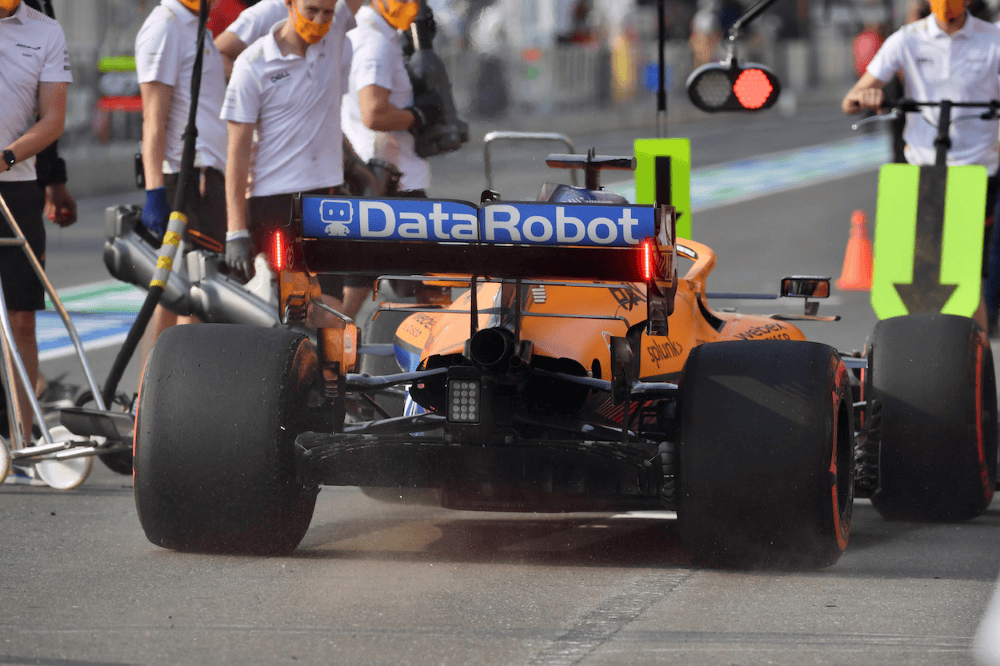
DataRobot is integrated into the McLaren Racing infrastructure, delivering AI-powered predictions and insights.
“It sounds a little pedantic, but it’s one of the most extremely important aspects that you could do for the race strategy team,” says DataRobot’s AI evangelist, Ari Kaplan. “So that was one of the successes is being able to better predict the actual air temperature, as well as the track temperature, more precisely than they could before.”
An F1 car is outfitted with 300 sensors, many of which sample data at different rates. The fuel flow sensor measures 2,200 times per second. Collectively, they produce tens of thousands of data points per second—and that doesn’t include any of the myriad of external sources—to be reviewed by the on-site team, which is in France this weekend, and the engineers at Mission Control, the nickname for McLaren’s headquarters in Woking, England.
“It’s a very data-rich sport, and we’re collecting and analyzing, truthfully, more data than we know what to do with,” Green says. While emphasizing how smart his team’s engineers are, he notes that a little more scrutiny was needed in their analysis.
“We’ve been running models and using AI for quite some time now, but like many organizations, as working on the IT team, we sort of just let people get on with it,” he adds. “And we didn’t really ask too many questions about which model they were using, how they made that choice where they were deploying it. It was really done without much supervision or much oversight.”
That’s where the DataRobot partnership, which was announced last November and includes McLaren’s F1 and IndyCar racing teams, plays a role. DataRobot maintains an AI cloud that serves a third of Fortune 50 companies.
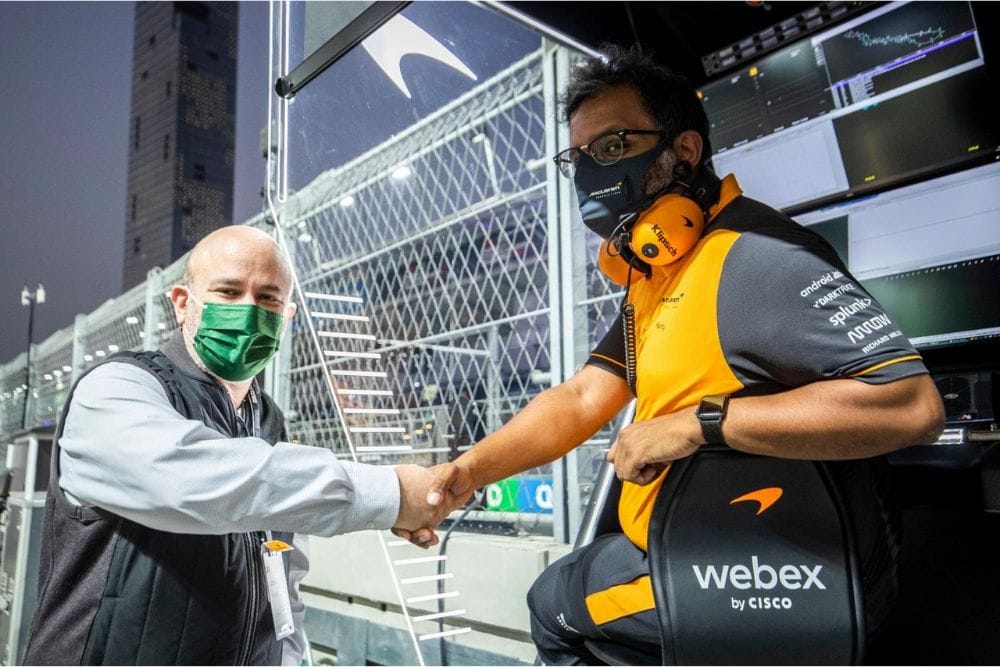
DataRobot’s Ari Kaplan (left) with Randy Singh, McLaren Racing’s Director of Strategy and Sporting.
“Anytime you have an AI opportunity,” Kaplan says, “you look at all different factors: what data is readily available? What type of insights could be given? What’s the actual value? If we get an insight, is it actionable and practical? Or is it just Trivial Pursuit and you’re getting fun data? Maybe that’s good for fans, but if it’s the race team, [they need] the things that they can take action on.”
Every area of racing strategy can be optimized in support of drivers Lando Norris and Daniel Ricciardo. McLaren’s pit times have been among the circuit’s fastest this season, with Norris making the fast pit stop in the field at Italy’s Emilia Romagna Grand Prix, needing just 2.27 seconds to get moving again.
Kaplan, who was a pioneer in baseball analytics, describes AI’s role in helping plan the timing of those stops—based on the car’s wear and tear, fuel management and weather—and also the intricate “ballet sequence” of so many crew members simultaneously tending to the car.
“You can spend hours and weeks in the wind tunnel trying to shave hundredths of seconds off the car—and you could lose that through through a pitstop,” Green says.
The remodeled car being raced this season in F1 are optimized for creating ground effect, an aerodynamic phenomenon that generates downforce. Green describes the change as going from “how much air can we push over the car to how much air can we pull under the car.”
To help with this transition, McLaren has built a digital twin of the car. Every new part begins its life on a designer’s computer where it undergoes rigorous computational fluid dynamics (CFD) modeling. Once it meets a certain standard, Green says they use a 3D printer to construct a part at 60% scale for wind tunnel testing. Only after those tests are passed is the part physically constructed for an on-car trial. These simulations are an area where AI has helped “massively,” Green says.
But for all the proliferation of data and technology, the AI models remain complementary to the process.
“We have this concept of ‘human in the loop,’” Green says. “So it’s not letting the AI make the decision for us. It’s not letting the machine model dictate your strategy that you’re clicking along with. It’s really about giving the human in the loop the best information, the best insight possible, so they can go and execute that decision with all of the other systems and information that’s coming out from the rest of the team—be that at the track or be that back in Mission Control.”
This article was brought to you by SportTechie, a Leaders Group company. As a Leaders Performance Institute member, you are able to enjoy exclusive access to SportTechie content in the field of athletic performance.
The tech organization’s innovative wearable technology adds sensors into fabric by weaving circuitry into clothing or other material.
“I thought giving them a sleeve would be a no-brainer: ‘I can tell you your perfect free throw form,’” Sun says. “But they’re more interested in ankle injuries, so that’s why they opted in for socks.”
What Sun has developed is IP around imbuing textiles with electronic properties so that the fabric looks and feels like normal athletic attire while managing to collect data on movements, forces and even biometrics.
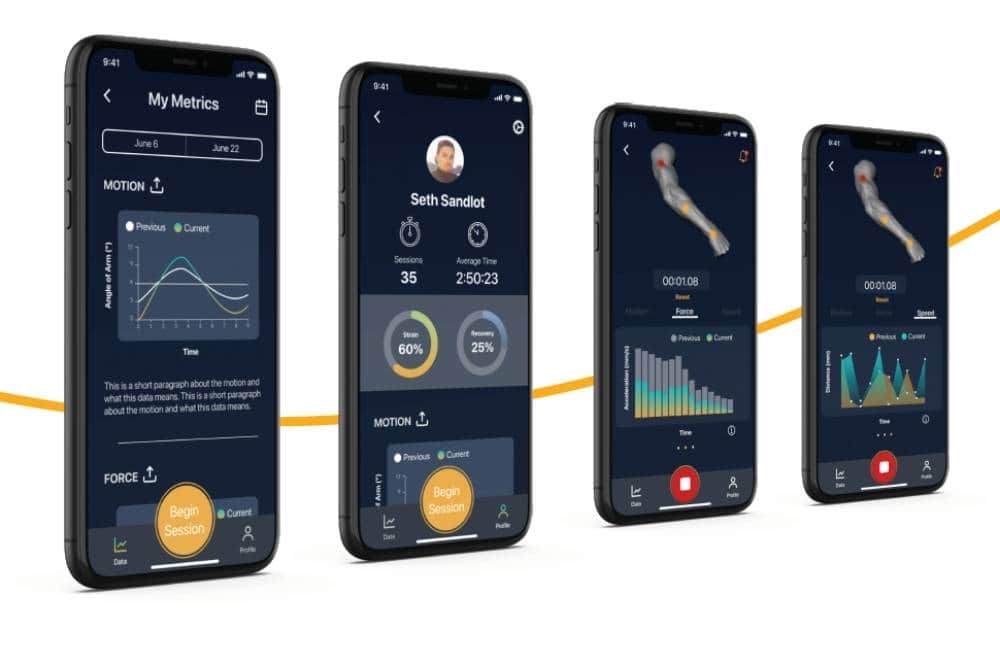
Users can view detailed biometrics tracked by Nextiles’ sensor-laden apparel.
The NBA example is a perfect case study of Nextiles’ B2B2C approach: develop innovative technology and let strategic partners guide the development of features and interface to meet their needs. Since the league selected Nextiles for its inaugural Launchpad startup program, the NBA has become a validator, a customer and now an investor.
Nextiles has raised a $5 million seed round led by Drive by DraftKings and joined by the NBA, Madison Square Garden Sports Corp., Alumni Ventures, SmartSports, Phoenix Capital Ventures, Newlab and Olympic hockey medalist Hilary Knight. Among its other early business partners are baseball training company KineticPro Performance, a tennis company and the US Air Force. The KP Sleeve, which monitors pitching workload and form, is expected to be available late summer.
“We’re not really in the business of guessing and saying, ‘Hey, you need to wear this.’ It’s more of you tell us what you want,” says chief business officer John Peters. “We have the form factor fabric, we have the sewing infrastructure, we have the supply chain set up, everything’s ready to go. And it’s really plug and play at this point.”
When Nextiles first stitched its socks for the NBA—technically, an outer layer to be worn over one’s usual socks—they quickly received more feedback: they foot covers are too small for the basketball player population. Peters laughs as he holds up the new product, which is befitting a man with a size 16 shoe. “So we have a new definition of ‘large’ after that,” he says.
Nextiles received that feedback and turned around the new product quickly. Its core team works out of NewLab, a hardware-focused workspace in the Brooklyn Navy Yard, and its product sewing studio is in New Jersey. The team shares communal resources at NewLab that enable rapid turnarounds.
“I want to ideate really, really quickly—as in, have a drawing, have a sketch and then print it out and touch and feel it to see if it’s the right geometry, the right fit,” Sun says.
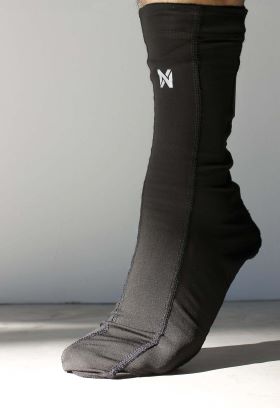
Nextiles stitched socks for the NBA because the league was interested in tracking data related to ankle injuries.
On a recent afternoon, Sun leads a guided tour of the 20th century shipbuilding factory that last decade was transformed into a prototyping studio. The first stop was to a room of 3D printers where, rather than order and shape mannequins to specific needs, Sun will use computer-assisted design to render the precise geometry of a body part he wants to clothe.
Most of the smart textiles his team makes include a patch of fabric with conductive materials covering about 5 or 10% of the garment. Sun uses the 3D printed body parts as a form around which to cut and stitch prototypes. His arts and crafts skills are a departure from his childhood spent tinkering with electronics.
“I used to break things—like, really disassemble things,” he says. “It wasn’t until I went to grad school and I worked for Puma that, yeah, I basically I can hand-sew now. I hot glue things together. I can teach kindergarten pretty well.”
Sun then proceeds to the chemistry lab where he experiments with materials of different ratios, combining metals like copper, stainless steel and silver with threads of polyester and cotton. Based purely on its inherent attributes and position on the periodic table, silver is best situated as the metal of choice, but Sun shies away from using because of both its cost and its inability to be reclaimed for a future iteration.
Instead, Sun prefers working with stainless steel. Because it’s less reactive than silver, it can be extracted from materials. It’s water-resistant. It is, however, a bit thicker and heavier.
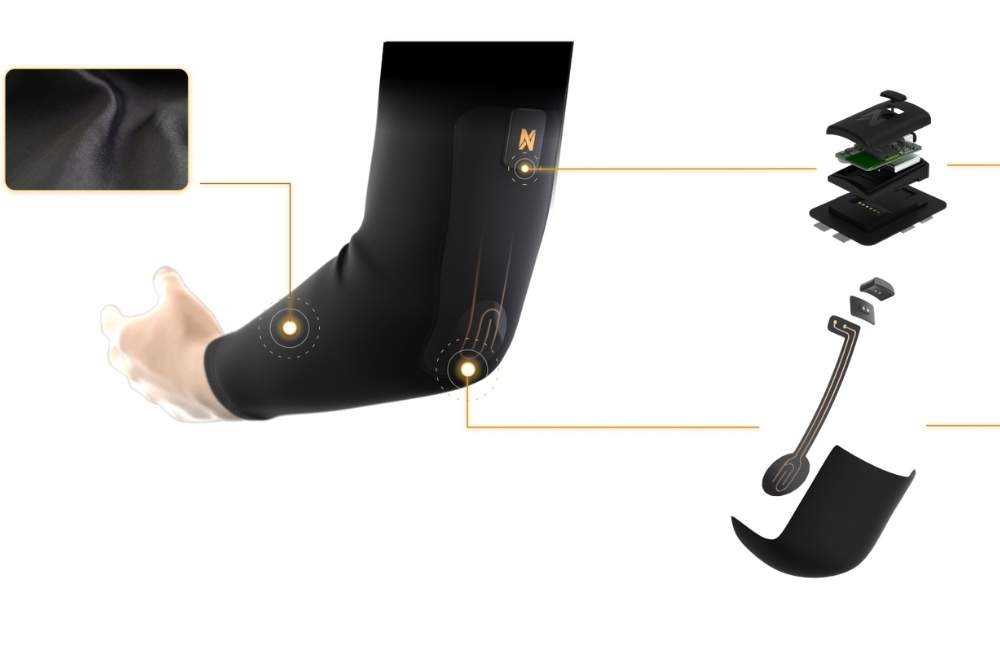
A Nextiles arm sleeve can help tennis players measure torque on their arm and help baseball pitchers manage their workload.
“It has more of a tensile strength than silver, and it’s just easier to sew,” Sun says. Many competitors “have deferred to silver, mainly because you can’t really see it afterwards. It’s so thin, it’s pliable. But for us, we found ways to have some interesting stitching patterns where the stainless steel is not as noticeable.”
From there, Sun walks down the hallway to an electronics testing room. Its benches are lined with soldering irons, voltmeters and the like. Here, he can experiment with signal strength and modulation as based on various twists, bends and folds of the fabric. Once a prototype is complete, one early round of informal testing is done upstairs where Bats-Toi—an MMA-focused mixed reality sports tech company—has a motion capture studio. Nextiles and Bats-Toi work collaboratively on some R&D, Sun says. (Asked to critique his wrestling style, he jokes, “I can’t fight. I go to the fetal position.”)
Back at Nextiles’ open loft space, entrants are greeted by a company nameplate touting a Steve Jobs quote, “Stay Hungry. Stay Foolish.” Inside the space are prototypes, conductive threads and desks for the small but growing team. The software team consists of only two engineers for now—who spend most of their time working on data security and “plumbing,” as Sun calls the encrypted data transmission to the servers—but will likely add at least a half-dozen more in light of the new investment.
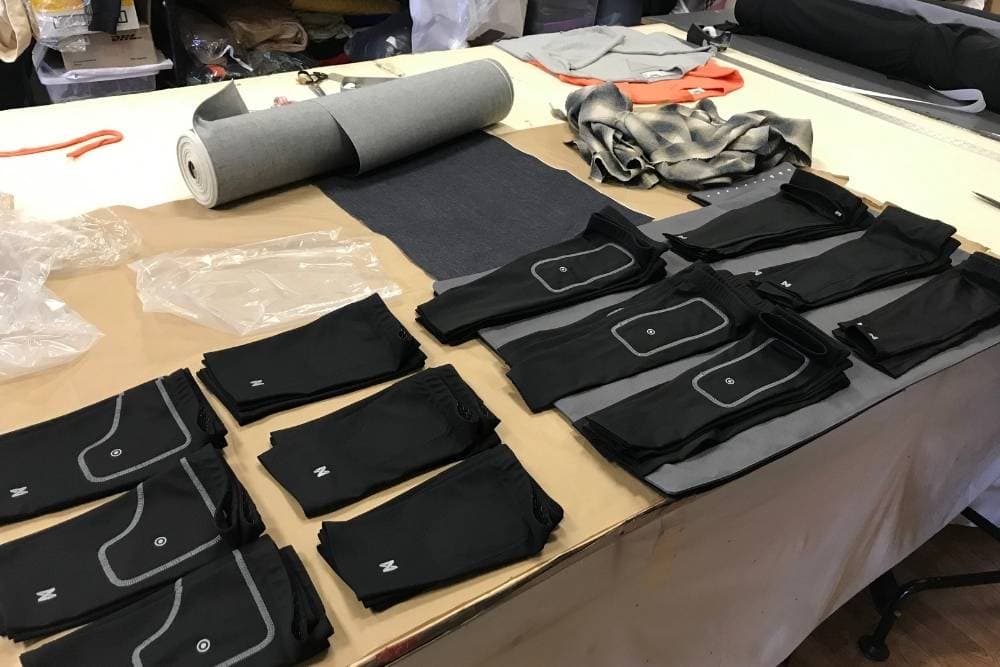
Nextiles uses repurposed sewing technology to merge fabrics and hardware to create a new type of wearable for athletes.
“The next six months is all about developing that software ecosystem,” Sun says. Nextiles still won’t be creating its own user apps, leaving that work for the partners, but much more can be done to organize and interpret the data to help clients gain more insights.
The filtering of all that requires actually quite a bit of analytics on the software and coding side, as well as data science and machine learning to say, ‘Hey, what is actually happening in this range of motion or this muscle movement or activity?’” says CFO Matt Evans. “That’s taking the science and translating it into adjustable outputs? That’s really the key part of what’s going to drive this forward.”
Two black fabric mats lie on the ground. A tablet is affixed to the wall at eye level. Every step or jump on the mats creates Richter Scale reading on the tablet’s digital seismograph-like display. While traditional force plates are heavy and expensive, Nextiles has replicated the concept with lightweight material that can be rolled or folded.
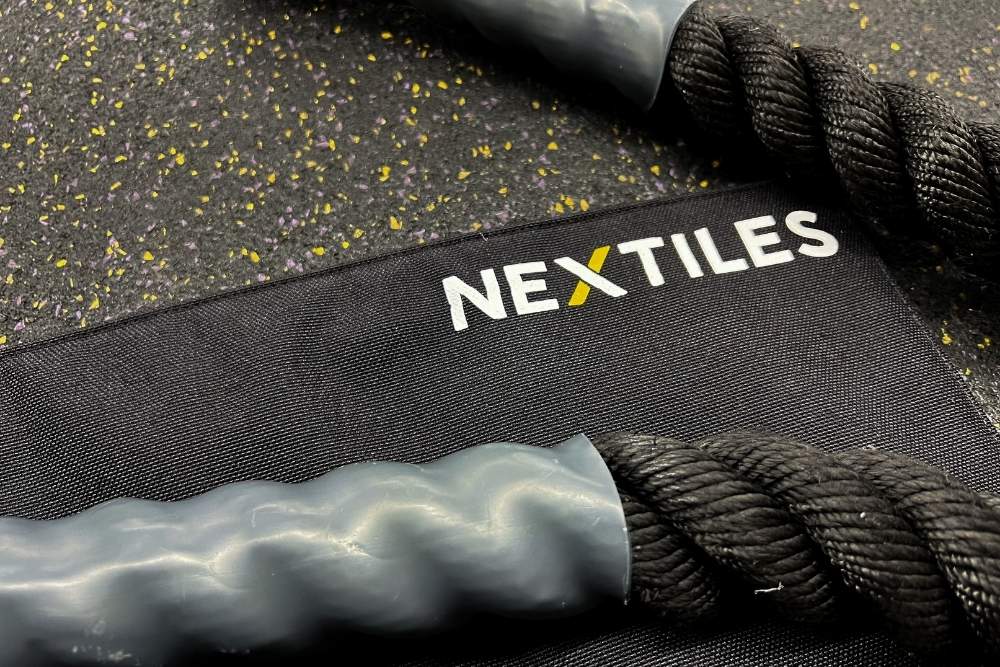
Nextiles created force plates with lightweight material that measure range of motion and muscle movement.
“I used to be a swimmer, so I’m not really a land guy,” says Sun, who swam through high school but stopped upon matriculating to Berkeley for his undergrad degree. “I had to be educated how important ground force was. I was really more about like, ‘Let’s build a body suit, an Iron Man suit.’ But it turns out just two pieces of fabric floor work for that information.”
The value of that data has made force plates a common sight in weight rooms and training rooms across all elite sports. Nextiles wants to deliver it more efficiently.
“We’re not always shooting out datasets that are claiming to be different,” Sun says. “We’re trying to say, ‘OK, our data sets can get the same thing but from a form factor that’s more seamless.’”
The same goes for one of its earliest partners, the US Air Force, who were the second—after the National Science Foundation—to award Nextiles funding (via a grant) following Sun’s PhD work at MIT. What used to be the data-collecting domain of wearable sensors can now be gleaned through fabric.
“The Air Force is looking for more biometrics like skin voltages, heart rate, breath rate, even eye movement,” Sun says. “And so that’s actually a different phase of our company that’s less mechanical and more biometric, and we can do that, actually, just by putting different fabric electrodes on the body, we can actually pick up signals from the skin.”
Eye movement? The human body is essentially a live battery, and the electric currents in the brain, heart and muscle can be detected by EEG, ECG or EMG. EOG, or electrooculogram, can do similar work for the eyes through nodes placed on the surrounding muscles.
The more imminent beachhead in sports will come through noninvasive motion capture and force analysis.
“Our goal is to deliver that experience—like a lab in a box—anywhere,” Peters says.
Nextiles hopes to provide that dataset as a companion to other technologies, all without the need for additional hardware. “Because,” Sun says, “I would hope you remember to wear your clothes.”
This article was brought to you by SportTechie, a Leaders Group company. As a Leaders Performance Institute member, you are able to enjoy exclusive access to SportTechie content in the field of athletic performance.
First-Team Fitness Coach Conall Murtagh explains how Zone7 is helping the club’s monitoring model to optimize individual player care.
An article brought to you by our Partners
Murtagh joined as a sports scientist while studying for his PhD in 2012. He then became the Fitness Coach for the men’s under-18s in 2014, and joined Head Coach Jürgen Klopp’s staff in early 2016. His tenure with the first team coincides with one of the most successful spells in the club’s history.
“When you come through the door each day there is a desire and expectation to be world-class,” he tells the Leaders Performance Institute. “Working under this philosophy is the ultimate motivation for me.”
Recipe for success
Liverpool, who won the League Cup and FA Cup this season, have played the maximum number of games possible – 63 in total and the most of all teams in the Premier League – the first time an English team has competed in every possible match in a single season since Liverpool themselves completed the feat during their FA Cup, League Cup and UEFA Cup-winning 2000-2001 campaign.
The Reds ended the season with almost a full complement of players thanks to the work of Klopp and his multidisciplinary staff which includes Murtagh, a former footballer himself and UEFA A Licence-qualified coach. It is a demanding environment. Murtagh’s fascination with sports science and physiology began long before his own playing days.
“I was obsessed with how the human body worked, particularly how it responded to training and games. That led me down the study of physiology and then sport science. When I was playing as a professional, I had no real knowledge of sports science until I started studying and playing semi-professionally. The individual response to training always intrigued me. How the day after the same session, some players would turn up fresh as a daisy, while others arrived feeling sore and stiff. We could also all do the same gym intervention programmes and yet some players’ sprint or jump performance would shoot through the roof, while others’ stayed the same.”
Murtagh believes that different players inherently have different capacities for physiological adaptation from physical workload. Therefore, they require a stimulus tailored to their individual needs in real-time; something that is very difficult to provide consistently in a team sport environment. That is the challenge Murtagh embraces, as he and the wider staff strive to keep all squad members in peak condition.
Zone7 adoption
Liverpool, much like any Premier League club, has an array of player monitoring and intervention tools at their disposal. For the 2021/22 Premier League season they have also enlisted Zone7, a data-driven artificial intelligence risk forecasting system, to support their development of personalised player workload management processes.
The collaboration, amongst many other important cutting-edge processes adopted at Liverpool, has been a success. Under the watch of club practitioners, Liverpool’s first team – according to Premier Injuries – have seen a 33% drop in days lost to injury this season compared to last. When narrowed to ‘substantial’ injuries (long absences marked by 9+ consecutive days lost), this drop increases to 40%. Goalkeeper and illness-related absences are excluded from the breakdown.
In essence, Zone7 empowers human decision-makers who oversee athlete workloads. These professionals are often tasked with making recommendations in highly pressurised situations. By analysing the extensive, disparate datasets generated and collected in elite sporting environments, Zone7 can detect injury risk patterns that may otherwise be invisible. In some instances, it can go a step further by making proactive recommendations to mitigate the identified injury risk. Importantly, Zone7 will often suggest increasing workloads in particular areas to lower risk. Reducing workloads or simply prescribing rest is not always the right solution.
“We know that adaptation for the human body is a dynamic process,” says Murtagh. “Every time the player performs a training stimulus we must reassess their body’s adaptation balance.”
“As a multidisciplinary team, we assess every player every day. Zone7’s AI works alongside our extensive internal monitoring processes by effectively identifying more complex data patterns that could indicate whether a player has good rhythm or has deviated from it. If our monitoring system identifies that the player is not in optimal rhythm, we intervene accordingly from a multidisciplinary perspective.”
The productive use of Zone7 requires pragmatism. No credible AI solution will claim it is correct all the time and periodic false flags are a natural consequence. Murtagh, however, is unfazed.
“You can never say [a Zone7 risk alert] is a false positive when you’re flagging the player,” he says. “Some players do receive flags and we do not detect anything to suggest they are at an elevated risk. There is such a fine line between someone getting injured or not, we try to identify when the player has sub-optimal rhythm and we intervene appropriately.”
Zone7’s data science team has evolved their solution this year by introducing a new ‘Workload-Simulator’ component, which enables practitioners like Murtagh to input projected workloads and simulate players’ future injury risk in advance.
“The thing I like most about Zone7 is that they’re constantly updating the algorithm, constantly evolving, constantly on the front foot in this field,” added Murtagh. “To have the AI working in our environment to support our internal monitoring system gives us a certain sense of safety around our player management recommendations. The simulator is a brilliant feature, which will be used more and more as the system evolves.”
With a full season behind them, and tangible success metrics to point to, Liverpool and Zone7 have extended their working engagement by another two years, a move that also includes Zone7 adoption across the Liverpool Women’s and Under-23 teams. Rich Buchanan, Zone7 Performance Director, says that “working with Murtagh and Liverpool FC is hugely important to Zone7. It shows that our technology, in the hands of progressive and experienced practitioners, can exist and evolve, in one of the world’s most elite sporting environments.”
