In this recent edition of The Athlete’s Voice, SBJ Tech catches up with former Olympic badminton player Howard Chu discusses the implications for AI that can deliver real-time feedback and data across racket.

You can’t have a discussion about sports technology today without including athletes in that conversation. Their partnerships, investments and endorsements help fuel the space – they have emerged as major stakeholders in the sports tech ecosystem. The Athlete’s Voice series highlights the athletes leading the way and the projects and products they’re putting their influence behind.
* * * * *
In January, the self-described “tech nerd” appeared at CES to try out a new AI-powered badminton training system developed by Taiwan’s Industrial Technology Research Institute (ITRI). An automatic serve machine fired shuttles, and when Shu returned the serves, cameras using computer vision relayed data such as shot speed and trajectory as well as on his own swinging motion.
Shu, 34, is a UCLA graduate and former EY consultant now working in supply chain logistics as Manager Business Development & Operations for Hizooo Network Technology. He was recently starred in a short film about his athletic career called 10,000 Days of Chasing My Dreams.
On connecting with ITRI before CES…
I didn’t know anything about it, actually, so it was really exciting. They reached out. I did a little bit of quick Google search as well and saw the machine that they had. This was my first time actually seeing it and testing it out. First impression, it’s cool. I think there’s some refinement [to be done], and we weren’t in a perfect, controlled environment, but just running through my head, there’s so many use cases for it already.
On the AI trainer…
Basically, it’s a typical shuttle feeding machine, which we’ve seen already. That’s not new, where it basically shoots a shuttle at you. You see this in tennis as well, if you’re trying to practice by yourself. But what happens is, after I hit the shuttle, it gives me some data output, like speed of my return shot, positioning, height. So those are some of the metrics that it was actually giving me after I hit the shuttle that it fed to me.
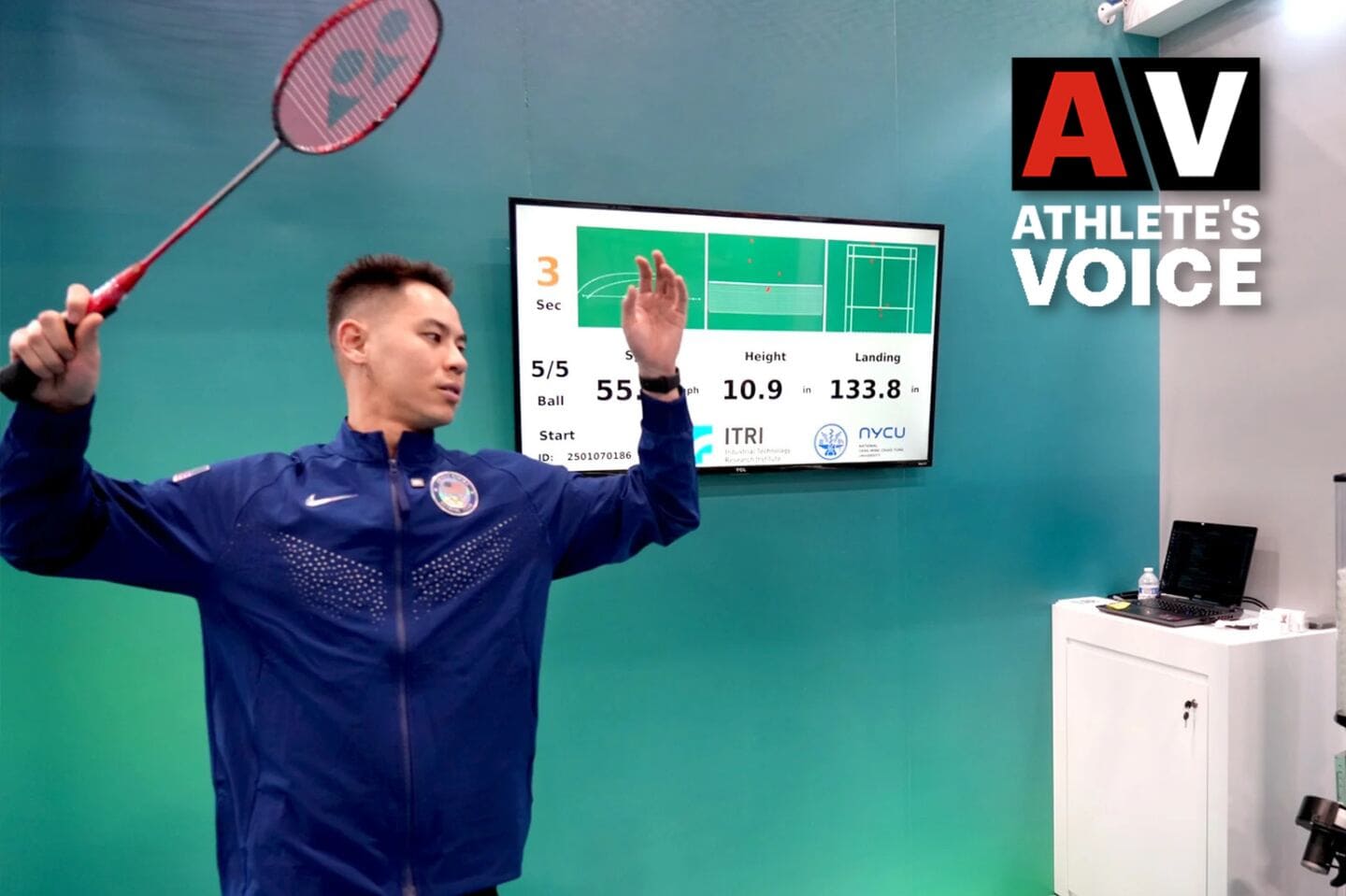
Photo: Getty Images
On whether he typically saw such data…
I haven’t. If we talk about AI or technology in the space with other racket sports like pickleball or padel, we’ve seen some other technologies trying to track number of shots in a rally or where you made the mistake. On tour, we do have metrics like speed, but it’s not to your own use where you can track every shot. Sometimes they’ll track a big smash or something like that, but not [it’s] something in your hands where you can track every single shot of your own.
On the limited data on tour…
If you’re in a big match, you might see, ‘Hey, this player hit a 400-kilometer-an-hour smash once during the match.’ It’s not like I would be able to dial in and say, ‘Hey, during the third match, I was feeling a little bit more tired. I want to know if my smashes were dropping off by 5 per cent or 10 per cent.’ So those are the kind of metrics that you would really be able to act on if you had something like this.
On using this new badminton data for racket fitting…
One of the main use cases that I thought right away is — I follow a lot of other sports like tennis and golf — I think this type of technology would be extremely helpful in customizing or picking out the proper equipment for the athlete. So we see this in golf a lot, right? They use their Foresight [launch monitor]. They track ball speed, ball spin, height, all these details that are really meticulous, right?
And so if I’m an athlete and maybe I’m not optimizing the proper equipment, whether it’s string tension or there’s head light or head heavy. I could go on to a court, test out 10 different models with 10 different variations of strings tensions and figure out which one is giving me the best smash, the best speed, things like that, which otherwise would just right now be going by feeling like, ‘Hey, this racket feels good. That smash felt good, [but] I don’t know exactly what the speed was.’ You’re seeing it in some of these other sports that have a little bit more money, that are already implementing it into a lot of their strategies.
On other tendencies the system could learn…
I’m sure those cameras are capable of [identifying tendencies], whether you put in a match video and it spits out some sort of post-analysis data like, ‘Hey, I made X amount of mistakes in my backhand or X amount of mistakes in my forehand.’ They might even be able to drill down to more meticulous details like, ‘Hey, the height over the net on this shot was five inches or 10 inches, and that’s what led to losing this point.’ It’s obviously a lot of back-end code and different scenarios that they have to run, but there’s definitely a ton of use cases for something like this.
View this post on Instagram
On his own data-driven training…
Very late in my career, at 34 years old, one of the things I’ve done is I’ve laid off of all the impact cardio. So, for example, no more running, whereas in my early 20s, I did a lot of that. But now it’s always low-impact cardio — swimming, biking — but then it’s tracking my heart rate, making sure I’m getting into the right zones to push that cardio.
There’s so much recovery tech out there, whether it’s compression boots, plunge, infrared sauna. These are just all things that I would say were not accessible to the average consumer, five years ago, 10 years ago, and now we’re really seeing companies push the envelope where it is very accessible to consumers. And I don’t know what the timeline is on a machine like this, or a technology like this, but I’m sure it’ll be scalable to one day where it will be in the hands of consumers.
On the surprising speeds of badminton smashes…
The world record now is [565] kilometers an hour. That’s [351] plus miles an hour. That’s obviously at contact because the way the shuttle works is, there’s a cork, right? So as it flips when it lands on the other side, it’s not traveling at 300 miles an hour anymore. It’s impact that they’re tracking. But I’m confident to say I could probably still get it over 240 [mph, I would say. I’ve seen people do challenges where they smash a shuttle into a watermelon or break through cardboard and things like that.
This article was brought to you by SBJ Tech, a Leaders Group company. As a Leaders Performance Institute member, you are able to enjoy exclusive access to SBJ Tech content in the field of athletic performance.
For the first time, all players will access to their data and video within 40 minutes of finishing their match.
Main image: ATP Tour
The tour treats the Next Gen Finals as an experimental ground for innovation, whether that be in competition format or technology. At the last edition that meant expanding access to filterable snippets of points within matches, which can be sorted by factors such as point result; shot type, direction or spin; and score, among others.
Metrics such as Shot Quality, developed by ATP partner TennisViz, are accessible within Tennis IQ in real-time to coaches sitting courtside, and supplementary video is typically available within 40 minutes of matches ending.
“What we’ve looked to do is offer the players an enhanced version of Tennis IQ across those two events (the ATP Finals and ATP Next Gen Finals), which actually is a bit of a glimpse into what we expect the future of Tennis IQ to be,” said ATP Director/ATP Events Adam Hogg. “It’s something that’s not currently available for the players on a week-by-week basis through the Tennis IQ platform, but ultimately something that we as the Tour at our own events wanted to offer as a premium service.”
The ATP is planning to roll out the video feature, along with biometric data derived from approved wearable devices, within Tennis IQ for its full schedule of events sometime in 2025, likely between Q1 and Q2. Tennis IQ launched as a match data platform last September.
To derive the metrics available within that platform, TennisViz applies custom-built machine learning algorithms to ball and player-tracking data provided by the ATP and ATP Media’s joint venture, Tennis Data Innovations (through the tour’s work with vendors like Hawk-Eye). TennisViz has collected data from more than 7 million shots dating back to 2004 and identified more than 60 different shot types, according to Head of Performance/Media and Broadcast Tom Corrie, with a shot’s quality determined by an assessment of ball characteristics, including speed, spin, bounce angle, and a shot’s depth and width on the court.
Relative to that process, the video feature is simple.
“What’s advanced is creating the Steal Score or the Shot Quality,” Corrie said, referencing two of the metrics TennisViz has developed. “We’re just attaching a time-stamping process to the [match] video, which we’ve developed the technology to do.”
TennisViz has a similar partnership with Wimbledon that encompasses video-tagging and has also worked with the USTA’s player development department. Corrie said the company is half-staffed by former coaches and half-staffed by engineers and developers, giving them a unique lens on the sport.
“Our vision was, ‘tennis data is dated,’” Corrie said. “All the other sports, particularly American sports, have moved on massively in the last 10 years in terms of different analytics and different fan-facing metrics. Tennis is still using ‘break points won’ as the number one determination of winning.
“This platform (Tennis IQ) rivals any platform in any other sports now, in terms of the fact that is’ live data. If you take the number of matches, the 24-hour nature of tennis, all those things – it’s now as good as any platform in any sport… We’re (tennis) now not behind. But we were.”
This article was brought to you by SBJ Tech, a Leaders Group company. As a Leaders Performance Institute member, you are able to enjoy exclusive access to SBJ Tech content in the field of athletic performance.
In this recent edition of SBJ Tech’s Athlete Voice, former US Olympic gymnast Samantha Peszek discusses AI and the role of technology in the sport.
You can’t have a discussion about sports technology today without including athletes in that conversation. Their partnerships, investments and endorsements help fuel the space – they have emerged as major stakeholders in the sports tech ecosystem. The Athlete’s Voice series highlights the athletes leading the way and the projects and products they’re putting their influence behind.
* * * * *
Olympic medal-winning gymnast Samantha Peszek, who now broadcasts for ESPN and NBC Sports, recently drew upon her careers as an athlete and analyst to speak with SBJ about technological advances in how gymnastics is scored. The Judging Support System, an AI-powered technology developed by Fujitsu, tracks gymnasts’ motion in 3D. It is used as a resource available to officials and was first deployed on every apparatus at the 2023 world championships in Antwerp, Belgium. Peszek, 33, is known as the Beam Queen for her prowess in the event.
On gymnastics judging…
I’ve seen it both ways. I’ve been the recipient of things going my way and getting the benefit of the doubt, and I’ve definitely been on the other side of it where I was really frustrated re-watching my routine, especially in college, and thinking that I should have gotten a higher score than I got. As much as you can get frustrated and complain, at the end of the day, that’s the sport of gymnastics. It’s a subjective sport, and so those are the rules that you play by, and you’ve done that since you’ve been a little kid.
You pick up different tricks along the way to maybe sell your routine to the judges a little bit more or [make] more eye contact to make them feel like you have more artistry. There are little like tricks to the trade — sliding your feet together to make it look like you stuck — so I always tell the girls that I coach at my event, Beam Queen Boot Camp, that it’s a sport about perfection, but it’s not about perfection. It’s about the illusion of perfection.
On the potential of AI in the sport…
The idea of AI having a play in gymnastics excites me because it’s helping a subjective sport transition to a more objective sport. The biggest area that I see for improvement is in the judging. Not only would I think it makes scoring more accurate, but it would also speed up the process.
Something a lot of people don’t think about is, when an athlete competes one event, they have to wait not only for everybody else to compete on their event but they’re changing to the next event [to get their score]. So that time that you’re getting cold in between events is pretty significant. You’re trained to learn how to do that at a young age, but there’s not really a practice for taking a turn and competing, doing one routine and then just waiting for 20 minutes, especially at higher levels. So that’s why oftentimes you see gymnasts jumping around and staying warm.
If AI can help the efficiency of generating more accurate scoring, I think that would be a huge positive for the sport, especially when it comes to out of bounds on floor, which we saw came into a really big play at this past Olympics. How crooked they are on the mats? [How is their] form, technique? Did they take a step on the landing?
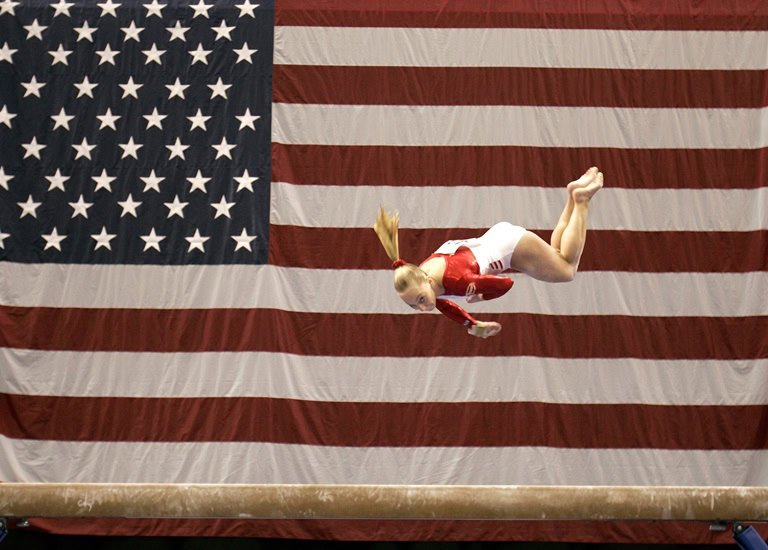
Photo: Samantha Peszek
On the limits of AI…
When you think about implementing that, the way I see it is you would have to add a judging panel for the artistry because my fear is that if you make it as objective as it possibly can, then you take away the beauty and the artistry, creativity and just the overall integrity of the sport. So you would have to do still do a combination because I think it would be really hard for AI to judge the artistry as well as the objective components of a routine.
On how such a dramatic change could be implemented…
I think lots of trial and error. They would need to present it to the committees and get a buy in from a majority of countries that participate in gymnastics. Another aspect that I think some other countries would probably ask is, is it going to be accessible for everybody, or is it just going to be the bigger countries that can afford to implement AI in all of their sporting events? And I know America in particular really values sports, but other countries don’t put the same emphasis and priority on sports as we do.
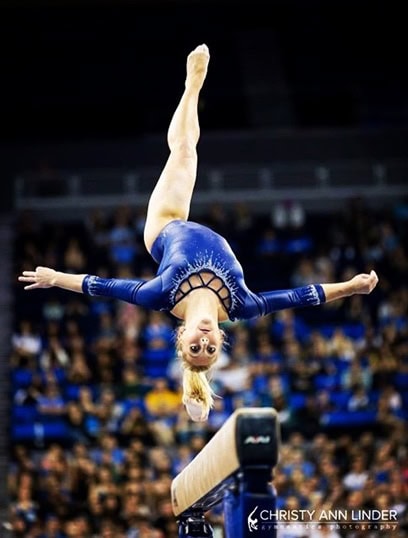
Photo: Samantha Peszek
On the training tech she’d like to see in gymnastics…
If there was some sort of tracking information on an athlete’s body that could tell a coach, Hey, she’s normally at this number, but today she’s operating — her energy level or her stamina or what have you — is actually lower than the average, then a coach can adjust the numbers. Maybe other athletes and other sports do this a little bit better because they’re older, but in gymnastics, most of the gymnasts are under 20 years old, and so, one, they don’t want to look like they’re not working hard, so they have a hard time speaking up, I think. And then, two, they haven’t lived with their body long enough to know, is this just soreness, or is it an injury?
I just know, from my own experience, other athletes I would see wouldn’t speak up, and then they would end up getting injured because they were pushing themselves when they probably should have been pulling back. So I think AI could really help injury prevention in that way, just more data to show coaches, ‘Hey, just FYI, she’s not operating at full capacity today. Take that information as you will.’
On becoming a beam specialist…
It was my least favorite [apparatus]. I used to pray to God growing up in bed, ‘If you love me at all, please let beam not be an event in gymnastics because I had so many fears on the event.’ I think, because I had so much trouble on that event in particular growing up, it forced me to home in on my mindset at a young age, figuring out how to be mentally tough. As much of a bear as it was, and a burden for me to go through all those challenges as a young gymnast, I think it actually benefited me in the long run because I had to visualize, and I had to goal set, and I had to do positive self-talk.
The majority of gymnastics, and specifically on beam, is all about the power of the mind and the confidence that you have on beam. And so for me to have to go through that and come out on the better on the other side of it, I forced myself to become mentally strong at a young age, and it became my secret weapon as I got older through the sport. So I wish I could go back and tell my younger self that it was all worth it because I almost actually quit gymnastics because of how many obstacles I had on the event.
This article was brought to you by SBJ Tech, a Leaders Group company. As a Leaders Performance Institute member, you are able to enjoy exclusive access to SBJ Tech content in the field of athletic performance.
A UPenn study found that Lena Blackburne Baseball Rubbing Mud improved friction – and performance – in Major League Baseball
Main photo courtesy of the University of Pennsylvania
Researchers at the University of Pennsylvania have completed the first study demonstrating that the special mud Major League Baseball uses to rub all of its game balls does, in fact, enhance friction and ensure pitchers have a consistent grip.
While questions remain about the compositional qualities of the South Jersey mud that create this effect, the new paper published today in the Proceedings of the National Academy of Sciences concludes that the Lena Blackburne Baseball Rubbing Mud — harvested by the Bintliff family for generations — spreads like skin cream and grips like sandpaper.
“The non-complicated headline, is that, in general, the friction is enhanced with the mud on the ball,” said Douglas Jerolmack, a Penn professor of engineering and environmental sciences, who said the combination was “kind of magical” how it spreads smoothly and still has grit. “The thing, though, that makes it delicate and complicated is that the sliding speed matters.”
The lead author of the paper is Shravan Pradeep, a postdoctoral researcher working in Jerolmack’s lab. He worked closely with a student, Xiangyu Chen, to design the experiments. Jerolmack and Paulo Arratia, a professor of chemical and biomolecular engineering, supervised the work.
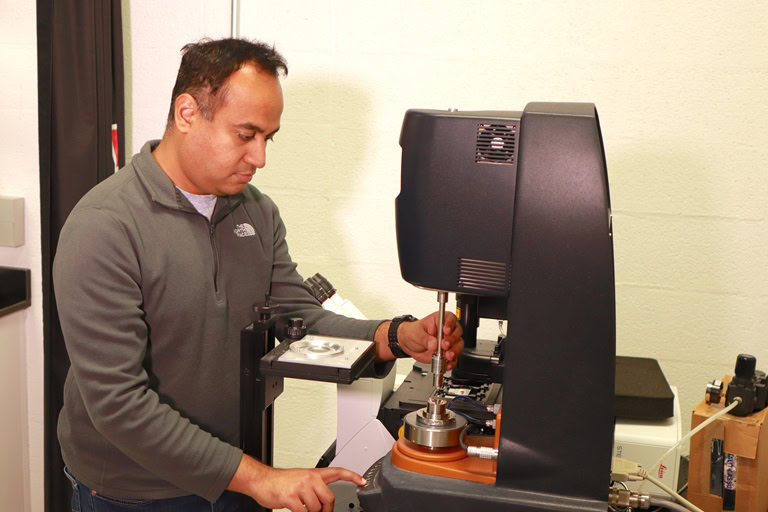
Photo: University of Pennsylvania
Much of their recent, grant-funded work studies the behavior of natural mud in debris flows — “catastrophic landslides,” as Jerolmack put it — but the baseball mud became a passion project after learning of its existence when approached by a journalist for comment in 2019.
The Bintliff’s mud is a quirky but essential part of baseball lore and logistics. It used to prepare every baseball to ensure the proper tack and feel of the ball. MLB has previously contracted with material science giant Dow to create pre-tacked baseballs, which were tried in the minor leagues but didn’t behave the way a traditional baseball does.
Mud procured by the Bintliffs is found along the Delaware River and is unique, even if it initially looks and feels the same, with Pradeep explaining, “When you try to spread it between your fingers, it looked and it felt like a face cream, like these clay masks we have you put on the face.”
“It allows you to spread a very thin and fairly uniform coating because it spreads so well,” Jerolmack added. “It makes this exquisitely thin layer.”
Based on published reports, the Bintliffs do treat the mud some, draining some water out to a certain consistency, sieving it to remove a particular fraction of larger particles and putting in a secret additive. The Penn researchers did some compositional analysis that identified the concentration of elements but not how they are combined. An area for further research is to examine the biological materials. They did note the product included “little bits of twigs and leaves and stuff because it’s actually natural mud from a real creek,” Jerolmack said.
“It behaves like a material that’s been optimized to do this,” he added. “They must have a very good working knowledge of this mud. . . . It appears that the ingredients don’t seem special, but the proportions of these ingredients are dialed in perfectly to make it have this behavior.”
The first of three tests conducted by Penn was the use of a rheometer, which measured its viscosity and found that it behaved similar to commercial skin creams. The second involved an atomic force microscope, which is essential a pin prick that measures the resisting force needed to pull the needle away — it assesses the stickiness of the substance, which Pradeep saying the Lena Blackburne mud-rubbed baseball was twice as sticky as an untreated ball.
The third test was the novel one involving the creation of artificial fingers for consistent force application. Pradeep and Chen used a silicone polymer called PDMS that has the same elasticity as human skin. They then added squalene, a fish oil that replicates what’s naturally found on fingertips. The scientists applied pressure on the baseball with these fingers and then created a shearing force by sliding the ball at various velocities.
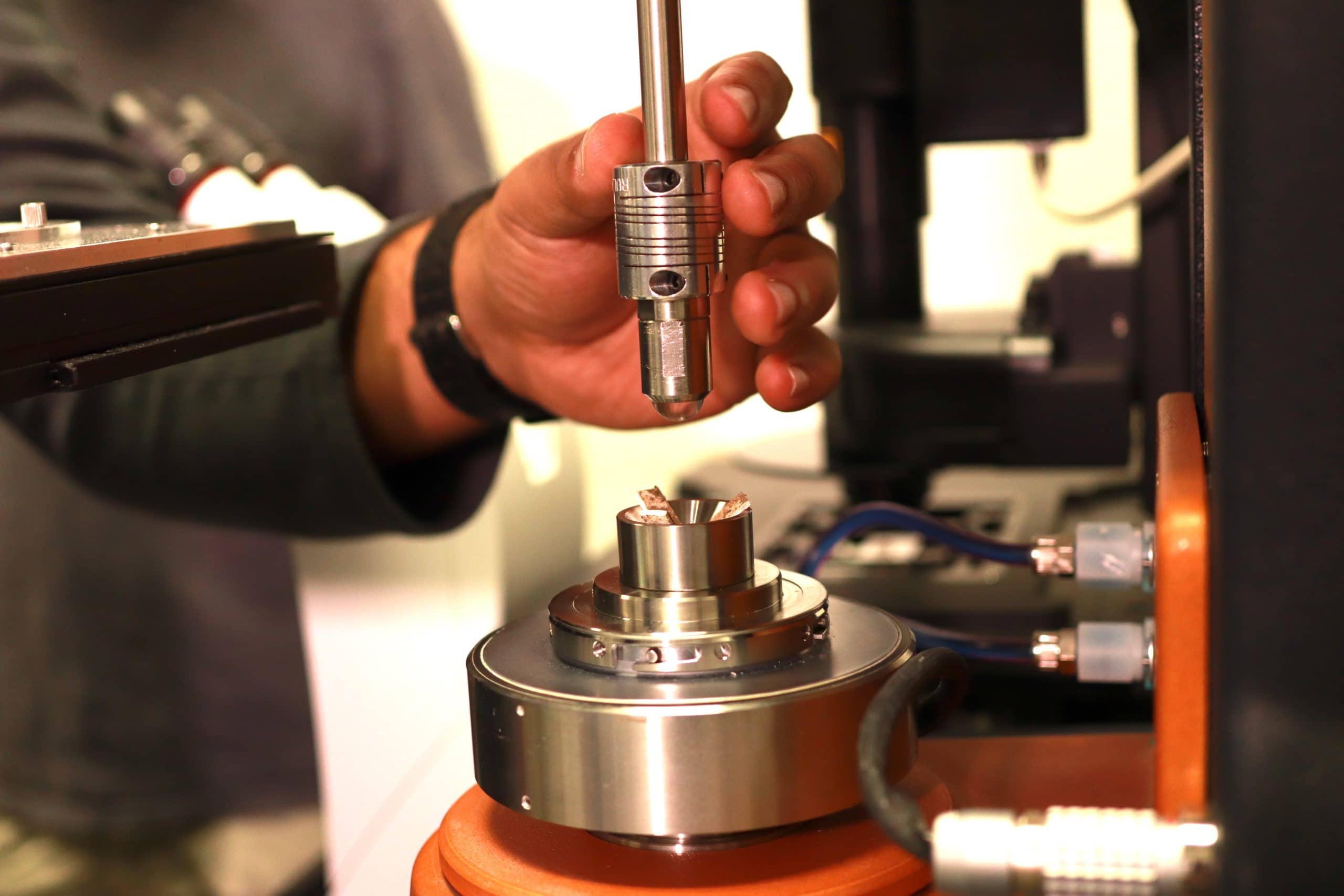
Photo: University of Pennsylvania
What they found was that the mud created only a small amount of friction at slow sliding speeds and that the friction disappears at very fast speeds, presumably because the small sand particles in the mud are knocked off the ball’s cover. But, in the Goldilocks zone in between the extreme speeds, the friction is notably enhanced by the mud.
“Over the past decade, we have worked with many types of cohesive mud, frictional mud, different type of muds that are out there,” Arratia said, “and in our experience, none of them has those properties that we saw with this particular mud.”
The researchers bought the mud and the baseballs on the internet and were not in touch with the Bintliffs to avoid any conflict of interest. They were just keenly interested in how the mud works more than any business implication of how their findings might affect the family business or the progress of a chemically enhanced, tacky ball.
But Jerolmack said his team ultimately did develop a stance — which was to endorse the continuation of the Lena Blackburne Baseball Rubbing Mud.
“It seems like the consistency of this mud has been more consistent than any other aspect of the manufacturing of these balls,” he said. “And our take now is that it’s 2024 and there’s a lot of people in material science and chemistry and other industries that are looking for sustainable and green solutions to replace synthetic and petroleum-based things. And here is a baseball tradition that is a material sustainably harvested, that’s replenished with the tides and takes very little of it to have this desired effect, and it’s a consistency for the pitchers — and I’m like, why would you try to change this?”
This article was brought to you by SBJ Tech, a Leaders Group company. As a Leaders Performance Institute member, you are able to enjoy exclusive access to SBJ Tech content in the field of athletic performance.
Former NFL star Greg Olsen discusses the second season of his show with Michael Gervais, Youth Inc., and the apps helping young athletes with their mental health.
You can’t have a discussion about sports technology today without including athletes in that conversation. Their partnerships, investments and endorsements help fuel the space – they have emerged as major stakeholders in the sports tech ecosystem. The Athlete’s Voice series highlights the athletes leading the way and the projects and products they’re putting their influence behind.
* * * * *
Former NFL TE Greg Olsen has stayed busy since retiring from the league after the 2020 season. He made a fresh name for himself as Fox Sports’ lead NFL color commentator over multiple years, and now anchors the network’s No. 2 booth following its addition of Tom Brady. In 2022, he partnered with former Panthers teammate Ryan Kalil, actor Vince Vaughn and LA-based venture firm Powerhouse Capital to launch podcast production house Audiorama, which has since spun off youth-sports-focused interview show Youth Inc. into a media company that is adding a digital commerce platform in 2025 and raised $4.5M earlier this year. On top of it all, he is also a dad and youth football, basketball and baseball coach.
“It’s hard,” Olsen said of juggling those responsibilities in a recent interview. “I try to coach one season per kid.”
The first episode of season two of Olsen’s Youth Inc. Podcast releases today with a new co-host in sports psychologist Dr. Michael Gervais. Earlier this week, SBJ Tech caught up with Olsen to discuss Youth Inc., working with Brady and sports technology trends that interest him.
On what to expect from season two of the Youth Inc. Podcast…
Season one was really almost testing the market. When we approached season one, our plan was, let’s cast a wide net, let’s have a big variety of conversations with all different aspects of the youth sports experience – whether it’s parents, coaches, Olympians, professional athletes, college, sports psychologists, performance coaches. Every aspect of what the landscape looks like, let’s have surface-level conversations, cast a wide net, and let’s test the interest level, let’s test which areas of the system people most gravitate to and respond well to.
It became very evident through those 40-some-odd episodes that there were certain areas that people had strong interest in. Season two is going to be a lot more of hyper-focused episodes that are more of a deep dive into different conversation with guests, but all have the same storylines.
For example, me and Dr. Michael Gervais, who’s one of the leading sports psychologists in sports from the youth level all the way up through professional athletes and Olympians – I met him when I played for the Seahawks and have gotten to know him – we sat down with a bunch of different guests. And while the conversations all covered different sports, different ages, different levels, different detail, they all had common threads around mental health, sports performance anxiety, best practices of parenting youth athletes, best practices for being a youth or college or professional athlete.
View this post on Instagram
On how technology is changing youth sports…
It’s a great question, and obviously [with Youth Inc.’s digital commerce platform] we’re trying to tackle one of the big areas, which is a very complicated and fragmented e-commerce experience. We spend all week very much on our phones or on our computers with the ability to process buying in a seamless one-touch, whether it’s Fanatics, or Amazon, and all these big e-commerce platforms that we’ve all become very accustomed to. And then when it comes to, you know, buying a hoodie for your kid’s middle school football team, it seems like you’re jumping through hoops.
With sports performance and mental health, there’s a lot of good apps and programs that people are investing in that are right on kids’ phones, take them step by step through performance anxiety, best steps to handling pressure, the best steps of handling failure – and they’re almost bringing a mobile sports psychologist into the palm of their hands. There’s scheduling apps that best process how to pick the best baseball tournaments and best volleyball tournaments. [The technologies are] all geared towards – yes, capitalizing on a big market, capitalizing on a big opportunity financially – but more so just trying to make the experience better.
On working with Tom Brady at Fox…
It’s been great. We’ve had a good relationship, and obviously we’ve had a lot of conversations as he’s transitioned to this role. He’s been really good to work with, super humble and open-minded to asking questions and wanting to learn and realizing that when you start anything new – it’s no different than when I first started – you don’t know what you don’t know. I give him a lot of credit. He’s been very upfront and humble and honest about wanting to learn and wanting to get advice from other people. And you’re talking about the best guy who’s ever played the sport. So, it’s a credit to him. I’m sure if you asked him, he feels a lot better now than he did in Week 1, and he’ll feel a lot better in five weeks than he did yesterday, and that process just continues to get more and more comfortable the longer you do it. No different than how it was when we all first came in the [NFL] as players. There is a learning curve and there is a process of getting comfortable as time goes on.
View this post on Instagram
On the keys to his transition from player to broadcaster…
Early on for me, what I tried to remind myself is: there was no learning curve for football. I knew football. The learning curve came through the technical part. The learning curve came through communicating on live broadcasts and communicating with producers in your ear and understanding replay sequencing and all the specific things to a broadcast were where I had to do a bunch of my learning.
To this day, I don’t know exactly all the camera angles, official names. When I ask for a replay, I’m probably calling it the wrong name, but they by now know what I’m talking about… At the end of the day, when you get your 20-second sound bite to get in there, talk about what you know. We’ve lived this sport our whole lives. We know it. We see it. Describe it to someone at home in a way that keeps it interesting, keeps it informative. The complexity of football is what makes it so special. But also you can’t talk like you’re in the locker room. You can’t talk like you’re talking to another 20-year veteran at the position. So, there is a little balance.
To sum it up, keep the football part. That’s the part you know. Don’t let the transition of the technical broadcast component paralyze you. At the end of the day, you’re talking football. Don’t complicate it. Talk what you know. Talk what you see. You can figure out the mechanics of a broadcast, figure out the mechanics of television along the way.
On the NFL’s in-game authorization of Guardian Caps in 2024…
I think anything that can continue to improve the health and safety of players while keeping the game the game is something worth looking into. So, I’ll always be a supporter of any of that.
I think helmet technology has come such a long way. I mean, I look back, I had my rookie year Chicago Bears helmet and when I look on the inside, let alone when I look back at what I wore in high school compared to what I wore at the end of my career, you talk about the technology growing and getting better with time. And then you factor in what the Guardian Caps are able to do and the extra layer. I know everybody wears them in practice. And I’m sure there’s some adjustment getting used to it. But I think everybody has the decision, what helmet they wear, whether they wear the Guardian Cap in practice or also in the games.
I don’t know if I would wear one. Obviously, I’m probably on the older side. By the time it was introduced I was like that ‘can’t teach and old dog new tricks’ kind of person. But for guys who wear it, I’m sure there’s a level of comfort, a level of protection. I wouldn’t be shocked if some of that technology Guardian is developing gets incorporated into some of the helmet design, and one day you get the combination of both things all wrapped up in one.
This article was brought to you by SBJ Tech, a Leaders Group company. As a Leaders Performance Institute member, you are able to enjoy exclusive access to SBJ Tech content in the field of athletic performance.
Prevent Biometrics’ new device has been introduced to augment World Rugby’s Head Impact Assessment protocol and lay the groundwork for long-term study of head impacts in contact sports
Main photo courtesy of World Rugby
It’s why he calls Prevent’s sensor-embedded mouth guards, which track linear and angular accelerations, providing what experts say is a more accurate measure of head impact than other methods such as helmet sensors, “the most important technology in sports.”
“We’re the data. We are not diagnostic,” Shogren said. “But if you don’t have the data, you can’t do much.”
As a focus on head impact reduction in collision sports — e.g., the NFL’s in-game authorization of Guardian Caps for this season — grabs headlines domestically, Prevent and years-long collaborator World Rugby are embarking on their largest data collection effort on the subject yet, and on a global scale.
Since January, World Rugby required that athletes competing in its elite-level competitions wear Prevent’s instrumented mouth guards, a deployment that will ultimately encompass 8,000 players. The aim: to both augment World Rugby’s Head Impact Assessment protocol and lay the groundwork for long-term study of head impacts in contact sports.
Dr Joe Maroon co-developed the ubiquitous ImPACT concussion management protocol, worked as the Pittsburgh Steelers’ team neurosurgeon for more than three decades and is now a Prevent adviser. He said World Rugby is “leading the charge” in concussion management, adding that smart mouth guards could eventually permeate contact sports such as American football, wrestling, lacrosse and soccer.
“We took ImPACT and other management tools to World Rugby 10, 15 years ago,” Maroon said. “World Rugby now is bringing another tool back to the sports in the United States.”
■ ■ ■ ■
The mouth guard mandate necessitated a $2.4 million investment from World Rugby, which covered fitting (via teeth scans), producing and delivering the gear, plus equipping teams with support staff to help operate the technology and analyze the data collected. The custom-fit mouth guards typically price between $225 and $250, Shogren said.
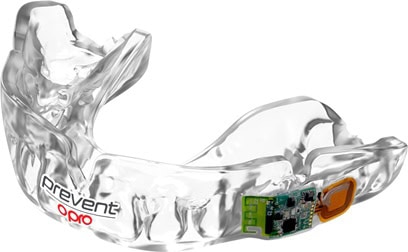
The mouth guards detect hard impacts as an early warning of possible concussions. [Photo: Prevent Biometrics]
“To draw any kind of meaningful analysis, you need to have hundreds of these [concussive] events, not tens,” said Falvey. “Our first priority at the moment is making sure the [impact] threshold is as clinically relevant as it should be.”
Prevent’s mouth guards trigger a Bluetooth alert upon registering a linear or angular acceleration above thresholds set by World Rugby, at which point the player is pulled from the game to undergo evaluation for a possible concussion. (Players can still be flagged for assessment based on observable clinical symptoms, independent of the mouth guard.)
“We’re not using this as a concussion detection device. We’re using it as a device that picks up a large impact,” Falvey said. “A concussion actually is a clinical diagnosis. There’s more to it than just an impact. There’s how the player is, what their previous exposure is, what their age is, what their concussion history is.
“It’s never going to be just about the impact. But that impact is putting the right players in front of us to have a look at.”
So far, unique alerts triggered solely by a mouth guard are adding an average of one extra stoppage every three games, he said. He added that 43% of total concussions logged across World Rugby competitions have triggered a mouth guard alert, and 35% of mouth guard alerts have ultimately correlated with a concussion diagnosis. According to Falvey, that 35% rate is in line with other individual subtests within the head injury assessment protocol, which include assessments of symptoms, memory and balance.
The hope is that having as many guardrails as possible in the protocol will continue to increase its overall accuracy and mitigate cases in which athletes continue to compete with a concussion. Citing research conducted by the University of Pittsburgh, Falvey noted that every 15 minutes a player continues playing after a concussive event, their recovery time is lengthened by three days. That comes with medical risks — for example, issues with non-resolving concussions — and, of course, the business impact that dovetails off player absences.
“None of the subtests on their own are fantastic, but the diagnostic accuracy of the HIA protocol [as a whole] is about 88%,” Falvey said. “That’s as good as an MRI for tendinopathy in your shoulder. When we are able to look back on this year, we feel this is going to have improved the accuracy above 88%. It’s another piece, which is as good as any of the other subtests so far.”
■ ■ ■ ■
Ultimately, World Rugby hopes to leverage the wealth of impact data it is collecting, high-impact and otherwise, to inform rule changes or best practices for competition and training. Falvey cited a dataset of 35 players who play the same position from a recent competition as an example.
“One player was getting nearly six times the number of impact events that a player in their position was getting in the same tournament,” he said. “It may be that they’re involved in more tackle events. But it also might be that their technique isn’t as good as it should be. Doing something about that can significantly improve that player’s health and welfare and make playing the game safer.”
Falvey will present findings from the first year of the mandate in early 2025 at a meeting of the International Collision Sport Group, a collection of collision sports medical leaders, including from the NFL and NHL.
“It’s a scenario where everybody helps everybody out in this space,” Falvey said. “It’s all about getting to the right answer as fast as we can.”
This article was brought to you by SBJ Tech, a Leaders Group company. As a Leaders Performance Institute member, you are able to enjoy exclusive access to SBJ Tech content in the field of athletic performance.
As Fabio Serpiello of Central Queensland University suggests, a structured approach to innovation – and a supportive environment – could be the critical edge.
“One of the issues we have in our organisations is that sometimes that definition is not set at the beginning; and that creates problems,” said Professor Fabio Serpiello, the Director of Sport Strategy at Central Queensland University in Australia.
“If there are different expectations of what ‘innovation’ is and they are not discussed properly – I don’t want to say ‘agreed upon’ but at least discussed – then we can have an issue appraising the results of innovation.”
It is just one of the pinch points discussed in the first instalment of this three-part virtual roundtable series titled ‘How to Approach Innovation’.
Serpiello, having previously served as Director of Sports Innovation at Victoria University in Australia, is the ideal host for a discussion based on the challenges facing Leaders Performance Institute members in this space.
In the first session, the group explored how a structured approach and supportive environment can make all the difference.
What innovation meant to the group
There were some common definitions:
The difference between creativity and innovation
The idea of putting creativity into practice chimes with the work of American psychologist Daniel Goleman, who alighted on distinct, but interconnected, definitions for each. Serpiello shared them in his presentation:
Creativity: defined by Goleman as the generation of new and useful ideas. It involves the ability to think outside the box and produce original concepts, whether they are ideas, products, or performances.
Innovation: defined by Goleman as the successful implementation of those creative ideas. It’s not just about having a great idea, it’s about executing that idea effectively to create value. To do that, the environment must support those tasked with innovation.
The last point about organisational support is critical: creativity can happen without innovation, but innovation can only follow creativity.
Greg Satell’s Innovation Matrix
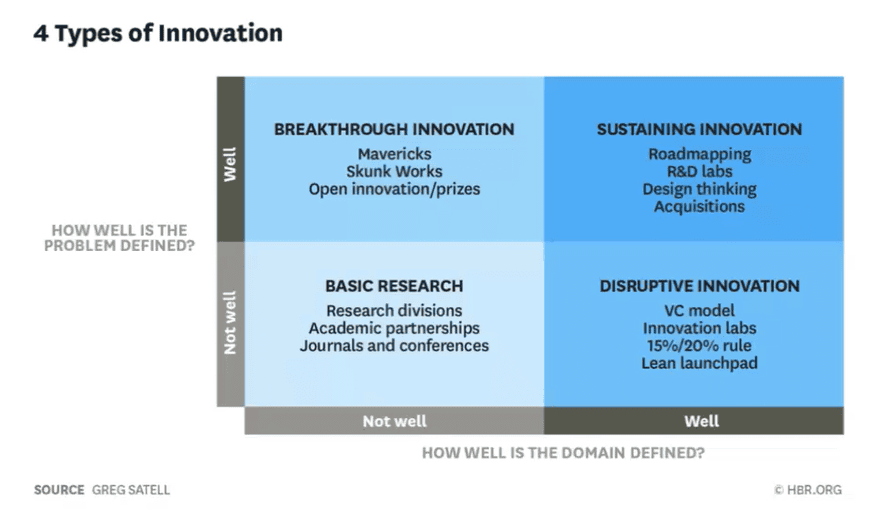
As leaders, we can better support innovation in our teams when problems are clearly defined and the skills needed to solve them are just as well defined. This is because effective problem-solving and innovation requires a suite of strategies tailored to the specifics of a challenge.
To address this challenge, Serpiello cited business and organisational consultant Greg Satell’s Innovation Matrix, in which he outlines four distinct types of innovation:
The group wrapped up the session with some reflections on their persistent challenges and the steps they can take to address those.
Identifying performance challenges can be tricky: Problems need to be clearly defined; and yet numerous organisations struggle with this initial step, which can lead to misaligned efforts and ineffective solutions. What specific challenges do you currently face? Which type of innovation might be most applicable?
Practicality can be elusive: Creativity is essential but must always be aligned with practical outcomes that address real-world problems faced by athletes and coaches.
Collaboration is crucial: Collaboration between end-users and innovators is essential in ensuring that relevance and practicality. Without this, there can be an over-reliance, as one attendee observed, on disruptive innovation.
Assess your skills and resources: Evaluate whether you have the right skills and resources available to address the problem. Do you have the in-house expertise or might you require external help?
Encourage open discussion: A collaborative approach can lead to a richer understanding of the challenges and potential solutions.
Integrate research into practice: Can research and innovation strategies be integrated into daily training environments? This helps solutions to progress from the theoretical to applicable in practice.
Avoid silos: As one attendee pointed out, there is a risk in assigning multiple innovation responsibilities to a single individual. This can lead to inefficiencies. The answer lies in greater collaboration.
In the latest edition of SBJ Tech’s Athlete’s Voice series, champion triathlete Matt Hanson discusses his approach to AI, both as an athlete and a coach, as he prepares for the world championships in Kona in October.
A Data & Innovation article brought to you by
You can’t have a discussion about sports technology today without including athletes in that conversation. Their partnerships, investments and endorsements help fuel the space – they have emerged as major stakeholders in the sports tech ecosystem. The Athlete’s Voice series highlights the athletes leading the way and the projects and products they’re putting their influence behind.
* * * * *
Triathlete Matt Hanson leads the Ironman Pro Series standings as the circuit gears up for the men’s world championship in Kona, Hawaii, on October 26. That’s the full 2.4-mile swim, 112-mile bike and 26.2-mile run in notoriously challenging conditions. Hanson races both full- and half-Ironmans, winning 13 races dating back to 2012, including four North American championships.
Prior to becoming a full-time triathlete, Hanson earned his PhD in exercise science and was a professor of exercise science and the director of the human performance program at Buena Vista University in Storm Lake, Iowa. In addition to his career as a professional athlete, the 39-year-old Hanson also coaches other triathletes. He recently partnered with Humango — an AI coaching platform — to advise on the creation of its algorithms and use the platform to assist his own coaching.
On getting his start in Ironman…
Kind of by accident. I definitely didn’t plan on this being my full-time gig, but that’s how it turned out. I was a college professor, and I was just doing the triathlon thing as a hobby. Then I turned into a quasi-professional, where I was still teaching full time and competing as a pro. Then I started winning some big races and decided to walk away from a tenured position and chase this dream in triathlon.
On his academic background prepared him for his athletic career…
In the early years, I was doing everything myself, so it gave me the information that I needed to know how to write my own programming, even though I knew nothing about triathlon. I knew how the human body adapts to exercise, and that actually formulated a lot of my views in terms of triathlon coaching. Triathlon is a really young sport relative to running, swimming, biking, and especially until very recently, most coaches were treating triathletes as runners, swimmers and bikers — and not triathlon as a sport in itself.
On how he monitors himself…
My role as an athlete is to execute sessions and give qualitative feedback. So I’m giving quantitative data and qualitative feedback and trusting the process of the people that I pay to be in my corner to do that. But obviously we’re monitoring power, heart rate, pace.
I’ve gone back and forth with monitoring HRV — currently, I’m kind of off that bandwagon right now, not really paying too much attention to that. I’m just trying to do things like quarterly blood tests and make sure that nothing’s getting out of whack. I’ve been using a company called BellSant this year, which is a little more of a holistic approach. I’ve definitely used InsideTracker in the past. Both are great companies, just a little different approach to the data. I think that’s an injury prevention thing as much as anything else. And then making sure we’re getting quality sleep with the Coros watch.
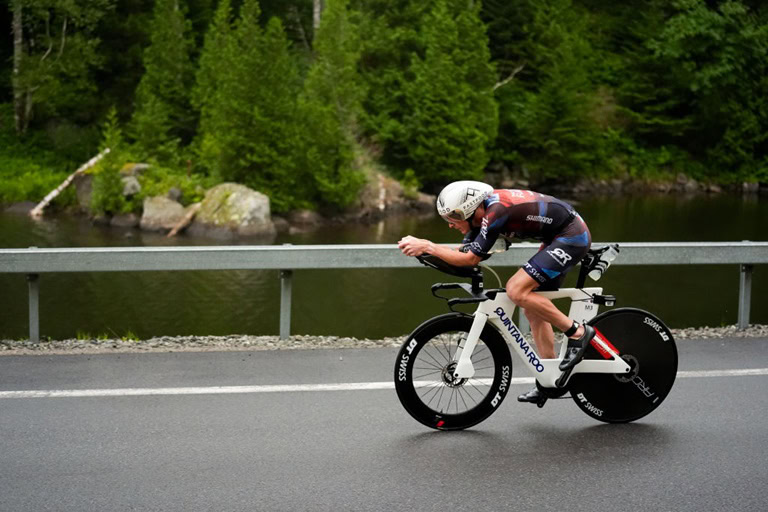
Patrick McDermott/Getty Images for IRONMAN
On partnering with Humango…
I’ve always wanted to skate to where the puck is going, instead of just sitting and reacting and trying to chase it. Obviously AI has been a big buzzword lately in all aspects of life, not just triathlon, but there’s definitely been a couple of companies that have come and really spent a lot of money to push what they’re calling AI programming. There were a couple things that were really important to me. One was, if I was going to partner with an AI company, it had to be somebody that was using true AI, or willing to push to use true AI, rather than algorithms and using historical data to set plans.
I felt a lot of the past practices were not treating us as triathletes or treating us as three separate sports, and if the approach of the programming is going to be based on all historical data, then we’re never going to adapt and be relevant and current with research. The first couple of meetings I had with other companies were very much that direction, and so it was just a non-starter.
I met with [CEO Eric Abecassis] a couple times and really appreciated how he wanted to incorporate me in having discussions about what’s current and what’s relevant in research and what the elite athletes are doing now, and how they could write programming to make plans that are based on that, rather than just, ‘Oh, we’ve got 20 years of other people’s Garmin data, so we’re going to make programs based on that.’ That was encouraging me enough to make the leap and start partnering with Humango and start using them as part of my coaching program.
On how he views AI when coaching other athletes…
The way I view it is that AI is a tool, not a crutch, so I can’t just let it do the work for me. I’m on the back end giving it the rules that I want the program to follow, and then I let it push out the program. Then I’ll go in and look at it and tinker with it a little bit and make sure that I’m happy with it. I’m not letting it coach for me at all. There’s definitely some benefits of doing that because obviously a fair amount of time is spent writing programs every week, and so in its current early stages of it, it just improved the access. Where a lot of people might have been searching for a pre-made program to buy online that may or may not be even remotely catered to them, where, for a similar price point, they can now get a program that is made for them.
That’s the no-touch model where I go in, set the rules and answer questions. Then I let Hugo, the Humango bot, take it from there. And then you can do the medium touch where I’m there every couple of weeks to touch base and answer questions, and then I’m still doing full, custom coaching, where I’m driving everything and still writing the plans completely. And so it just increases access, and it’s allowing a lot of people who probably couldn’t afford my previous rate, a way to have access to somebody who’s been around the block a few times.
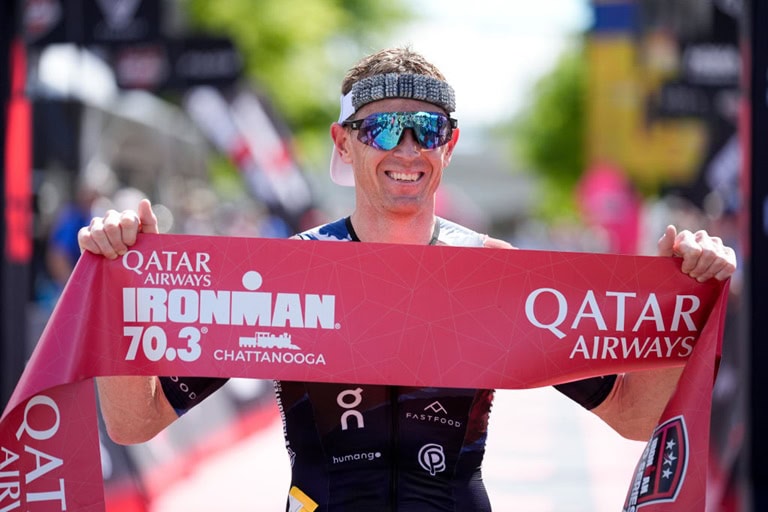
Patrick McDermott/Getty Images for IRONMAN
On the future of how AI will shape coaching…
I don’t think that I’ll ever lose my job as a coach to AI, but I might lose my job as a coach to somebody who knows how to use AI better than I do. And so I need to be involved and keep my nose on the ground. At some point when I can’t keep up with the young bucks anymore, coaching is going to be my full-time gig. I need to have a good understanding of where AI is now, where it’s going in the future and how to use that appropriately.
On the Ironman world championship in Kona…
If you go in with a target time into Kona, you’re setting yourself up for the potential of a really bad day. You can’t predict the weather there, even the morning of the competition. It’ll look great on hourly weather report, but the winds change there so fast. If you go in there thinking that you know exactly how the wind’s going to respond, maybe you get lucky, but more than likely not. So you just have to really take the conditions as they come and be prepared. It’s having somewhat of a plan, but definitely not being too stubborn to not adjust.
This article was brought to you by SBJ Tech, a Leaders Group company. As a Leaders Performance Institute member, you are able to enjoy exclusive access to SBJ Tech content in the field of athletic performance.
TempleOrthotics believe their proprietary compound could be the crucial difference in helping a player return to their peak post-ACL injury.
A Data & Innovation article brought to you by
Temple OrthoBiologics has created a proprietary compound called TX-33 that has shown good results in preventing fibrosis in abdominal and pelvic surgeries and is on track for human trials in knees as part of the FDA approval process in late 2025 or early 2026.
ACL tears rank among the most devastating injuries to athletes, particularly among girls and women, typically requiring a year of rehab and no guarantee of a full return to pre-injury performance. Understanding the mechanism of injury is a growing focus among researchers, with FIFPRO and the Women’s Super League among those who recently commissioned a study.
Temple OrthoBiologics is announcing its formation on International Arthrofibrosis Awareness Day. It has been privately by its co-founders to date.
“We have a technology that can make a difference in the knee,” said Temple OrthoBiologics CEO Sanj Singh. “The scar tissue that forms in the knee does several things. It prohibits proper function. The stiffness leads to pain and also inhibits good rehab.”
Renowned orthopedic surgeon Dr. Riley Williams — who practices at the Hospital for Special Surgery and leads surgical care for the Brooklyn Nets, New York Liberty and New York Red Bulls — is such a strong supporter of the drug’s potential that he joined as a co-founder.
Williams said he completes between 100 and 115 ACL reconstructions annually. The typical post-operative scar rate is 4-5%, but he noted the importance of reducing it further because, among his patients, “that’s four people” who might have that excessive scar response.
“The formation of scar in and around these surgeries is a very poorly understood phenomena, but it has real-life consequences in surgery,” Williams said, adding: “It’s very exciting because that in a very clean and unfettered way can help to dampen that [inflammatory] response without dampening the natural immune response.”
TX-33 can be injected after an injury or at the time of surgery and, by inhibiting excessive scar tissue from forming, healthy tissue can regenerate instead. Williams predicted that, following a successful trial and FDA approval, it will “become standard care very quickly.”
Another orthopedic surgeon backing the Temple drug is Dr. Vinod Dasa, who chairs the orthopedic surgery department at LSU, and has joined the company as an advisor.
“From a sports perspective, reducing scar tissue will definitely enhance return to play and faster recoveries,” Dasa said. “If it’s an issue in terms of scar formation, in terms of that ligament healing after a sports injury, maybe this will allow that natural healing to progress more appropriately.”
Retired Canadian Olympic bobsledder Neville Wright, who now owns and operates Wright Performance & Therapy, is a speed consultant and trainer for the Canadian men’s World Cup team who now advises Temple OrthoBiologics. (Bobsledder Emily Renna is the other athlete advisor.)
“Surgery is always a fear for a lot of athletes.” Wright said, noting the concern of post-traumatic osteoarthritis and its impact on full-fledged return to performance. “If I’m off a degree in regards to flexion of my knee, that can be a difference of running a really fast time to being outside of that high-performing category.”
Interest in sports is acute, but there is broader potential to help the general population, particularly with total knee replacements. “The age demographic of arthritis is slowly moving to the left,” Dasa said, referring to a trend of younger patients needing interventions.
Big Pharma doesn’t typically get involved in orthopedics, he added, noting the large opportunity for a drug like Temple’s. Dasa also noted that “non-surgical management of arthritis has essentially been non-existent. The lack of treatment options has implications on particular demographics, too.
“We see differences in fibrosis based on health disparities, so based on race, socioeconomic status, and a few other things,” Dasa said. “So if we can improve fibrosis, we may actually improve some of the health inequities and disparities that we see as well.”
This article was brought to you by SBJ Tech, a Leaders Group company. As a Leaders Performance Institute member, you are able to enjoy exclusive access to SBJ Tech content in the field of athletic performance.
SportAI’s system can be used in conjunction with phone or camera footage to generate overlays that chart swing curves in tennis.
A Data & Innovation article brought to you by
Through the agreement, SportAI’s offerings will be available on the MATCHi TV streaming service, which is underpinned by cameras installed at 2,000 of MATCHi’s tennis and padel courts. The integration lets players access highlights and technical analyses of match footage on their phones. In all, MATCHi has a network of more than 1M users across 2,600 venues and 14,000 courts in 30 countries.
Financial and duration terms were not disclosed.
Oslo-based SportAI was co-founded by Lauren Pedersen, a New Zealand native who is combining passions for sport and technology to democratize access to swing technique analysis – first in racquet sports but with the aim to eventually expand into the likes of cricket, baseball and beyond.

Image: SportAI
“Technique coaching, specifically, is still very subjective and expensive and unscalable,” Pedersen told SBJ in a recent interview at the USTA Billie Jean King National Tennis Center, where she spent time during the U.S. Open pitching prospective clients. “If you have a tennis lesson pretty much anywhere, it’s easily going to cost $100 – and you might have a good coach, but if you had three or four good coaches looking at your technique, they would all say something different, and there would be no data to back up what they’re saying.”
SportAI’s system is hardware agnostic; its algorithms can be applied to phone or camera footage and generate overlays that chart swing curves (and compare those curves to professionals), ball strike timing and other statistics like hip or shoulder rotation and swing velocity. The system also provides textual feedback, which as of now is pulled from a matrix of preset options but could in the future tap into a large language model, Pedersen said.
Here, Pedersen demonstrates the technology analyzing her one-handed backhand.
“To get to technique analysis, the computer vision, the platform itself, has to identify the boundaries of the court, identify different players on the court, be able to pick up all the biometric movement,” Pedersen said. “Before we even get to the technique analysis, we’ve got a lot of the technical data, which provides heat maps and statistics as well. We can deliver all that, and then technique analysis or coaching on top of it.”
Pedersen is charting a B2B model for the company, wherein SportAI licenses access to its software to three key segments: racquet sports clubs and coaches, broadcasters, and equipment manufacturers. She did not disclose pricing but noted it is variable based on which analysis modules businesses subscribe to.
As a coaching tool, Pedersen asserts that SportAI can reinforce instruction with empirical data, expand coaches’ influence outside of traditional lesson hours by making swing analyses accessible remotely, and unlock incremental revenue by creating a premium digital offering coaches or clubs can charge members to use.
For broadcast, Pedersen envisions the potential to improve the less objective niches of common tennis analysis and introduce technique comparisons between players or digital twin visualizations.
Integrating with equipment manufacturers, Pedersen added, would bring the opportunity for increased personalization in matching players with the appropriate racquet for their skill level and play style.
This article was brought to you by SBJ Tech, a Leaders Group company. As a Leaders Performance Institute member, you are able to enjoy exclusive access to SBJ Tech content in the field of athletic performance.
