Too often, soccer clubs across the globe fall foul of almost hidden contract clauses. TransferRoom’s Contingency AI is helping an increasing number of teams to navigate that space.
Main Photo: TransferRoom

And in that time, I saw a trend I assumed to be purely anecdotal to a still-fledgling soccer nut: add-on fees in player contracts. I felt like I was noticing a growing population of them. The mechanism accounts for future bonuses due to player on-field performance (appearances, goals, etc.) and fits into a complex ecosystem that also features loan-to-buy options, sell-on fees and more.
Turns out, soccer contingency payments like this have indeed been on the rise. According to the international soccer marketplace TransferRoom, these contract features have increased 5x in the last 10 years. That promptly demanded a tool that fits the landscape for the company’s massive soccer clientele list: TransferRoom’s Contingency AI. Deployed in August, this creation helps TransferRoom football clubs track these potential payments or capital injections to maintain accurate budgeting.
Simon Ankersen, TransferRoom’s Director of Football Relations, highlighted that the company has more than 800 clubs on its platform, which includes the MLS and its 30 teams, and all of them feel varying impacts around this growing contract structure trend. A brutal pain-point combination — the manual and constant contract scanning process paired with the churn inside football offices — exposed a clear need for a monitoring tool.
“Clubs are getting more and more creative with these clauses because they want to de-risk their purchases,” Ankersen said. “The operations are getting bigger, the deals are getting bigger, so therefore you have more people involved in it.”
Ankersen told me the feature has already produced savings for clubs, as well as found forgotten clauses that had been achieved, which helped teams scratch up a little more transfer-room capital to secure player acquisitions.
Beat Flückiger, the CFO for BSC Young Boys in the Swiss Super League, said the biggest risk for a smaller league club is not recognizing the earnings it’s due. He said he used to rely on a large Microsoft Excel file, pulling the figures of each contract in manually. But contracts can vary in terms — one may say an appearance is the moment a player hits the field, while another will dictate a 45-minute threshold.
“[The club was] using different data sources but never came to the point where it’s 100% satisfying,” Flückiger said. “And the clauses are so different in every contract, it’s almost impossible to do this on your own.”
TransferRoom began developing this feature in the spring. Ankersen added that the spin-up time of any project is now dramatically improved from the startup days. The company was founded in 2016 and now has approximately 150 full-time employees.
Expect more innovation from TransferRoom later this year. Ankersen shared that the company is working on another feature that will let teams forecast potential player purchases and how they could affect profit and loss, as well as help Premier League teams navigate the league’s Profit and Sustainability Rules.
“We are just unearthing more and more pain points,” Ankersen said.
This article was brought to you by SBJ Tech, a Leaders Group company. As a Leaders Performance Institute member, you are able to enjoy exclusive access to SBJ Tech content in the field of athletic performance.
PlayerData’s new FIFA-approved GPS and LPS units are a hit across the world of soccer and can be used by athletes in the offseason.
Main Photo: Getty Images
Other strategic investors in the Techstars-backed company include Pentland Ventures, Accelerate Ventures, Hiro Capital, and angels who previously invested in Strava and Revolut.
PlayerData’s new product, the Edge Air Tracker, is about half the size of competitors, and it combines GPS and LPS tracking, the latter an indoor alternative when satellite coverage is not available. The LPS system uses portable beacons that the company says can be set up in less than an hour. The Edge Air Tracker received the higher-standard FIFA Quality certification this summer.
“We had to build it in a PlayerData way: easy to use, fits in a backpack, mobile and affordable,” said CCO Jess Brodsky. “What gets us going is we get to give something to people that is just as elite quality — we don’t sacrifice on data quality — but to everybody.”
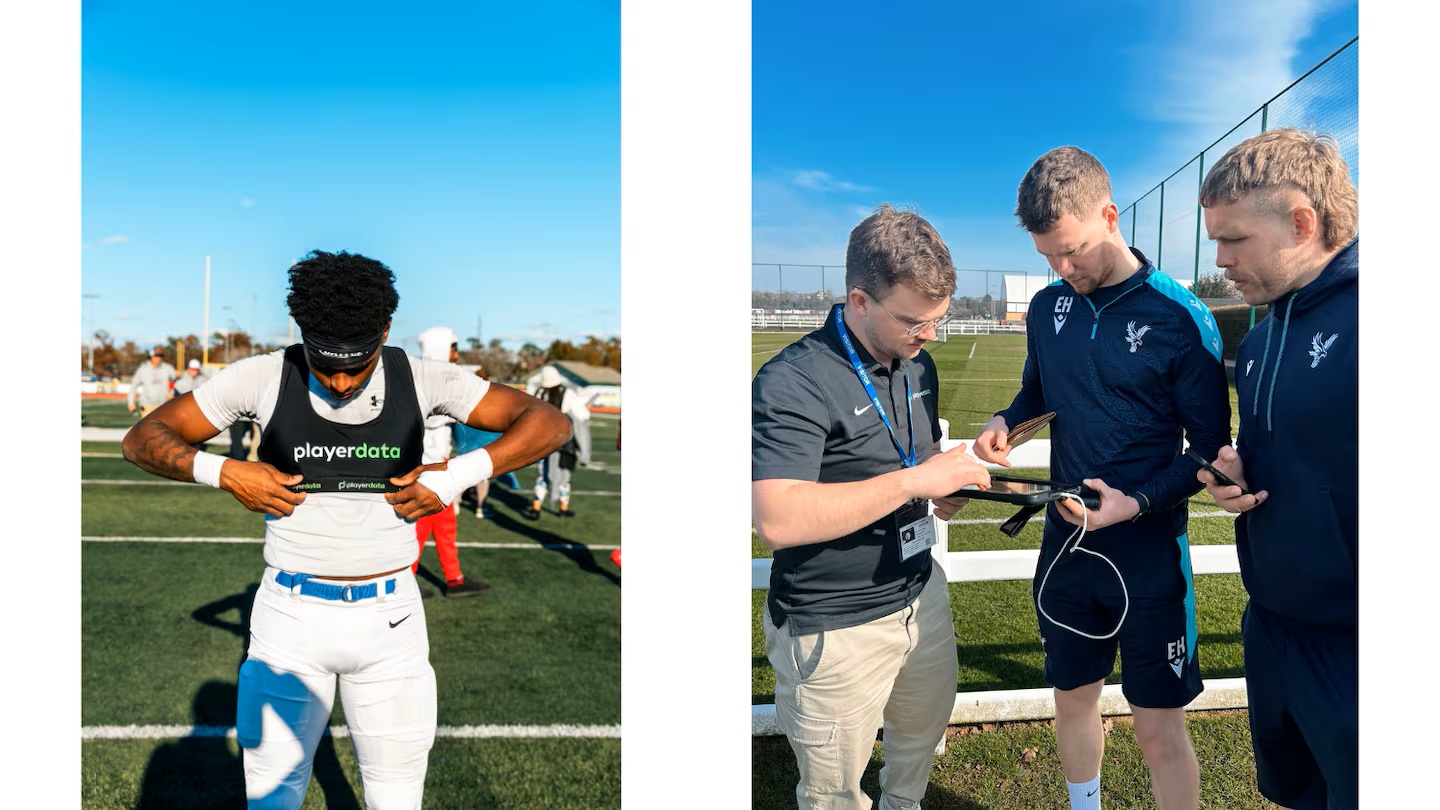
PlayerData’s Edge Air Tracker combines GPS and LPS tracking, the latter an indoor alternative when satellite coverage is not available. (Image: PlayerData)
The founding story is that, a decade ago, University of Edinburgh student Roy Hotrabhavanon had fashioned his own training tech to compete in archery by taking parts from consumer box retailers. Realizing there was little business upside in a niche sport, he sought to build for soccer instead, discovering there was a market gap particularly for grassroots, academy, university and women’s clubs who didn’t have the budget for an incumbent system such as Catapult or StatSports.
PlayerData is ubiquitous in the UK, where it records data from 94% of the country’s soccer pitches, Brodsky said, noting that the total includes the Premier League because its officials wear the monitoring devices during matches. The startup moved into the US market about two years ago, and Brodsky said the company has doubled or tripled its ARR (annual recurring revenue) in each of the past five years, building up to about 60,000 sensors in the market.
One of the biggest recent additions to the client roster is IMG Academy, where nearly 1,000 student-athletes will use the technology. The soccer program will install solar-powered beacons around all 15 soccer fields, and PlayerData and IMG will collaborate on developing and soft-launching sport-specific experiences in the app for volleyball and softball.
Abi Goldberg, an assistant strength and conditioning coach at Rutgers, supports the men’s and women’s soccer program whose seasons are concurrent, meaning she is balancing the training needs of both with little overlap. The use of PlayerData with both teams, Goldberg said, is helpful because the hardware and software systems are “incredibly user-friendly,” allowing her to review the data and communicate it the coaches even if it’s just a short window between their practices.
Often, each team’s director of operations will be tasked with overseeing PlayerData use at road games, but Goldberg said the tech doesn’t require an S&C professional to manage. She has even loaned devices to a few of the athletes for use in the offseason.
“Most GPS systems are in a big heavy briefcase-looking thing — I think there’s some been security nightmares in the airport — but these are way more compact,” she said. “They can put it in their backpack.”
This article was brought to you by SBJ Tech, a Leaders Group company. As a Leaders Performance Institute member, you are able to enjoy exclusive access to SBJ Tech content in the field of athletic performance.
Artificial Intelligence could be making key calls in your sport.
Main Photo: Getty Images
Current automation: NASCAR’s Optical Scanning Station maps the exterior of cars to ensure they comply with the rules. Bolt6 cameras also inspect the underbody of cars and operate the Pit Road Officiating system to flag violations.
Possible on the horizon? NASCAR intends to upgrade existing tech.
Current automation: The automated ball-strike challenge system is used throughout minor league baseball. A full ABS system is used by the KBO.
Possible on the horizon? MLB is likely to adopt the ABS challenge system for the 2026 season. It is also in the early stages of low-minors testing whether checked-swing calls can be automated.
Current automation: The NBA provides enhanced replays augmented with tracking data to assist with goaltending and basket interference calls.
Possible on the horizon? Determining who last touched the ball out-of-bounds and whether a shooter was behind the three-point line are under development, as are shot clock and other timed-based violations. The tech will start in the NBA, but it already is being investigated for the WNBA, too.
Current automation: The NFL will measure for first downs with Hawk-Eye cameras this season and contribute to calls about where punts fly out of bounds.
Possible on the horizon? The NFL and its innovation-minded collaborator, the UFL, are looking into whether the ball can be spotted after each play using technology, as well as making determinations on whether the quarterback is in the pocket (for intentional grounding and roughing the passer calls) or whether there are too many men on the field.
Current automation: The AI-powered Judging Support System is used as one input in the total score.
Possible on the horizon? There has been no report to date that gymnastics would consider full automation of scoring.
Current automation: None
Possible on the horizon? The NHL could use tech to determine offside, goal or no goal or whether a player high-sticked the puck.
Current automation: Rugby balls with embedded Sportable sensors were trialed at international youth tournaments to determine whether a ball was thrown forward, where a ball exited the pitch, whether a ball was touched in flight, whether the ball has reached the try-line and whether a lineout throw was straight. A Touchfinder feature helps Six Nations make boundary and ball spotting calls.
Possible on the horizon? Conversations around possible expansion of the tech are ongoing.
Current automation: Goal-line technology determines whether a goal is scored, and enhanced semi-automated offside technology makes all but the closest calls automatically.
Possible on the horizon? FIFA is researching whether technology can identify the player who last touched a ball before it went out of bounds. Detecting hand balls is also possible.
Current automation: All line calls can be called electronically.
Possible on the horizon? Technology could help determine whether there was a second bounce or a let serve. Electronic line calling will continue to move downstream into college and juniors tennis.
Current automation: AI judging will be one input in the total score beginning with the January 2026 X Games.
Possible on the horizon? Full automation of scoring might be possible.
This article was brought to you by SBJ Tech, a Leaders Group company. As a Leaders Performance Institute member, you are able to enjoy exclusive access to SBJ Tech content in the field of athletic performance.
The one clear theme across most sports is that human officials should be supplemented, not replaced, by AI.
Main Photo: Getty Images
There were also 20 4K optical tracking cameras triangulating motion from the players and ball. A few infrared cameras operated lightly in the background. The NBA is building a new R&D lab at the G League home of the Salt Lake City Stars. The lab will feature multiple tracking systems, connected basketballs and more to test a variety of on-court technology “with the top priority being officiating,” said NBA Senior Vice President Tom Ryan.
The NBA has created an automated officiating group within its Basketball Strategy & Growth Department, hiring data scientists and engineers — led by Avinash Bhaskaran, previously of Nvidia and autonomous vehicle company Cruise — to create a new, league-operated technology stack. Its three main purposes are to improve call accuracy and consistency, hasten game flow and enhance transparency and consumer confidence.
“You’re trying to trade off speed versus accuracy versus entertainment.”
Rufus Hack, CEO of Sony’s sports businesses
A recurring refrain from the more than two dozen insiders across sports that Sports Business Journal spoke to was that human officials, referees and umpires are far better at their jobs than fans will ever give them credit for, and few are seeking full automation of officiating; just supplementary aids. But they also have an inherent limitation of using only two eyes from one viewpoint, tracking projectiles that can travel in excess of 100 mph.
“At some point,” said SMT CEO Gerard J Hall, “that technology is more accurate than any human could ever pretend it to be.”
The presence of instant replay is ubiquitous in modern sports, but there’s a newfound emphasis on using technology not to review decisions, but to automate binary calls: ball or strike, in or out, offside or not? Tennis pioneered this practice with its adoption of Hawk-Eye Innovations’ cameras for line calls, first as a challenge system 20 years ago and now often used on every shot.

Automated officiating in baseball and other sports can help bring more accuracy and quicker decisions to games. But there are downsides to removing the human element from decisions. (Photo: Getty Images)
In recent years, that idea has spread downstream — junior tennis tournaments might have an iPhone or two mounted atop chain-link fences to call lines using an app called SwingVision — as well as to other sports. Every NFL stadium now has six Sony-owned, 8K Hawk-Eye cameras to virtually measure first downs and supplant the iconic, but archaic, chain gangs.
The Premier League adopted semi-automated offside technology last spring. MLB is likely to add a new challenge system for calling balls and strikes in 2026. The NHL, X Games, NASCAR and international gymnastics have all begun using or researching automated officiating principles as well.
How, why and even whether to implement such tech is thorny. Sports is approaching a tipping point where it reckons with how much of the human element to preserve, how much technology to deploy and the right balance of the two, putting human and machine in the best positions to succeed.
“All sports are wrestling with the right way to weave technology into the officiating of the game and to get as many calls right without making the game less entertaining and ruining the game’s rhythm and emotion and humanity,” said Morgan Sword, MLB’s Executive Vice president of Baseball Operations. “And it’s tricky. Each of these decisions is fraught with conflicts.”
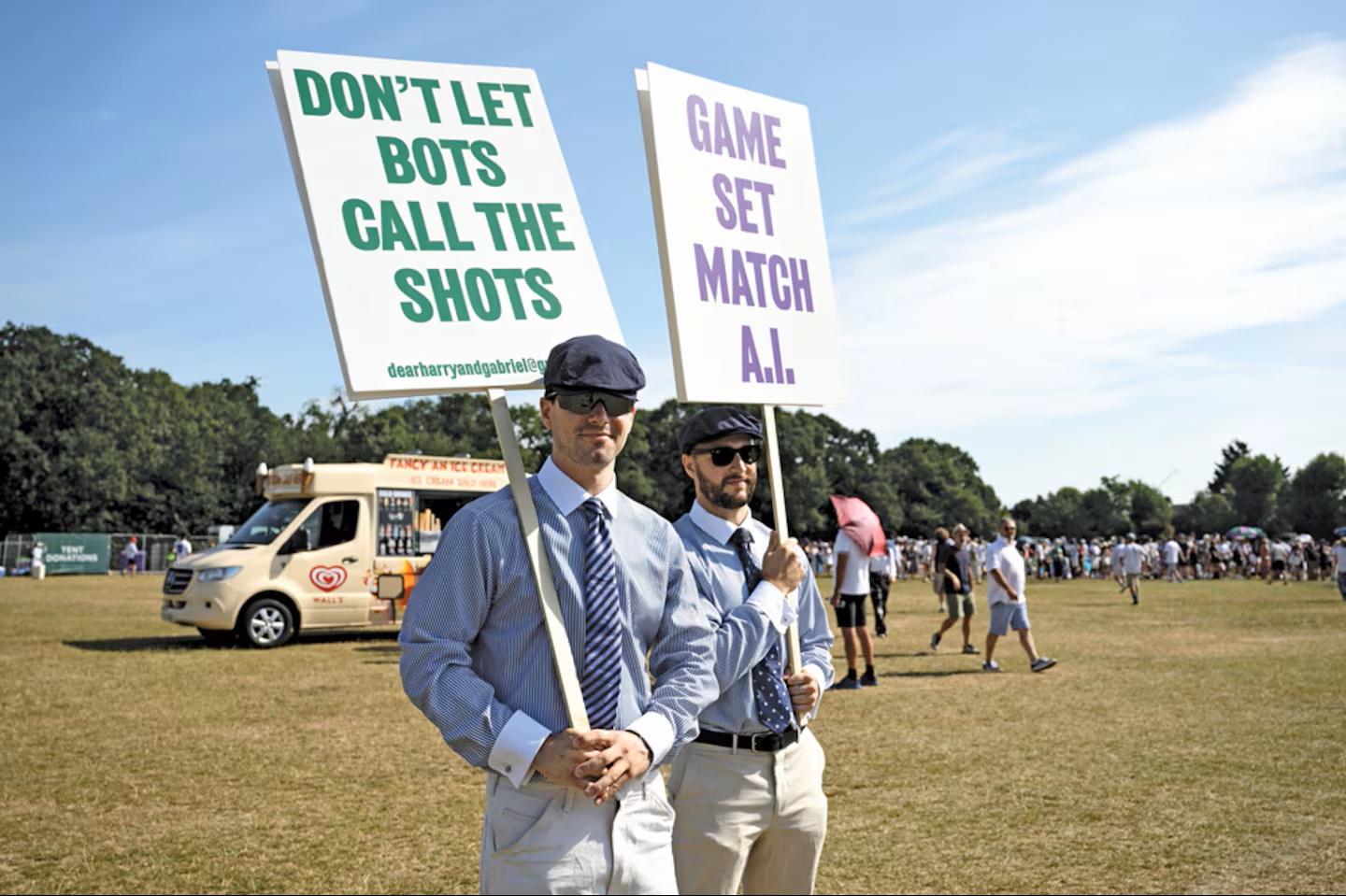
Protestors decried Wimbledon’s move to fully electronic line calls. (Photo: Getty Images)
Hawk-Eye is not only the trailblazer but also the primary provider of these technologies, with its cameras and algorithms able to track balls within one-fifth of an inch. Rufus Hack, the CEO of Sony’s sports businesses, shares a basic rubric for considering officiating tech.
“You’re trying to trade off speed versus accuracy versus entertainment,” Hack said.
The interplay of those three priorities varies by sport and league. He noted, for example, that accuracy is particularly paramount in short-duration tournaments, such as the FIFA World Cup, but perhaps less critical in the early throes of, say, a 162-game baseball season.
The dynamics and culture of a sport need to be considered and rigorously tested, Hack said. “Its implementation needs to be handled incredibly sensitively, and it needs to be empathetic to the values of the game because obviously people are incredibly passionate about their sport.”
The rigidity of technology’s calls also begs the philosophical question: What actually should be called? Is strict adherence to the rules always best or should there be some contextual subjectivity, such as when a police officer has the discretion to decide how tightly to enforce a speed limit?
The goal — and it’s a hard one — is not to let technology change the framework of a sport. As former NFL officiating boss Dean Blandino, who now holds that position with the UFL, said, “It’s just creating that right balance between ‘let’s get it right in those big moments’ but ‘let’s not distort how we do things for the majority of the game.’”
In the multitrillion-dollar asset class of sports, with athletes earning nine-figure salaries to play games with billions at stake in bets and broadcasts, the integrity of the competition has never been more closely scrutinized.
“The stakes are just too high not to try to solve this.”
Jeremy Bloom, X Games
As X Games CEO Jeremy Bloom, a two-time Olympic skier and NFL kick returner, described the gravity from his own playing days, “It didn’t feel like a medal was on the line. It felt like my life was on the line.” He’s now also Founder and Executive Chairman of Owl AI, an officiating tech spinoff run by the former head of AI at Google.
“The stakes,” Bloom said, “are just too high not to try to solve this.”
Here’s how leagues and tech companies are developing solutions that balance accuracy, speed, entertainment and the futures of their sports.
Accuracy
Paul Hawkins is an enthusiastic sportsman who earned a PhD in artificial intelligence in 1999 before developing a computer vision tracking system as a broadcast enhancement for cricket and tennis. Within a few years of it populating TV screens, the sports world started noticing the disconnect between what officials called and what the technology showed.
A 2004 US Open quarterfinal match in which four clearly incorrect calls went against Serena Williams in her loss to Jennifer Capriati ignited interest in a better system; Hawk-Eye was in use by the USA Network for the match.
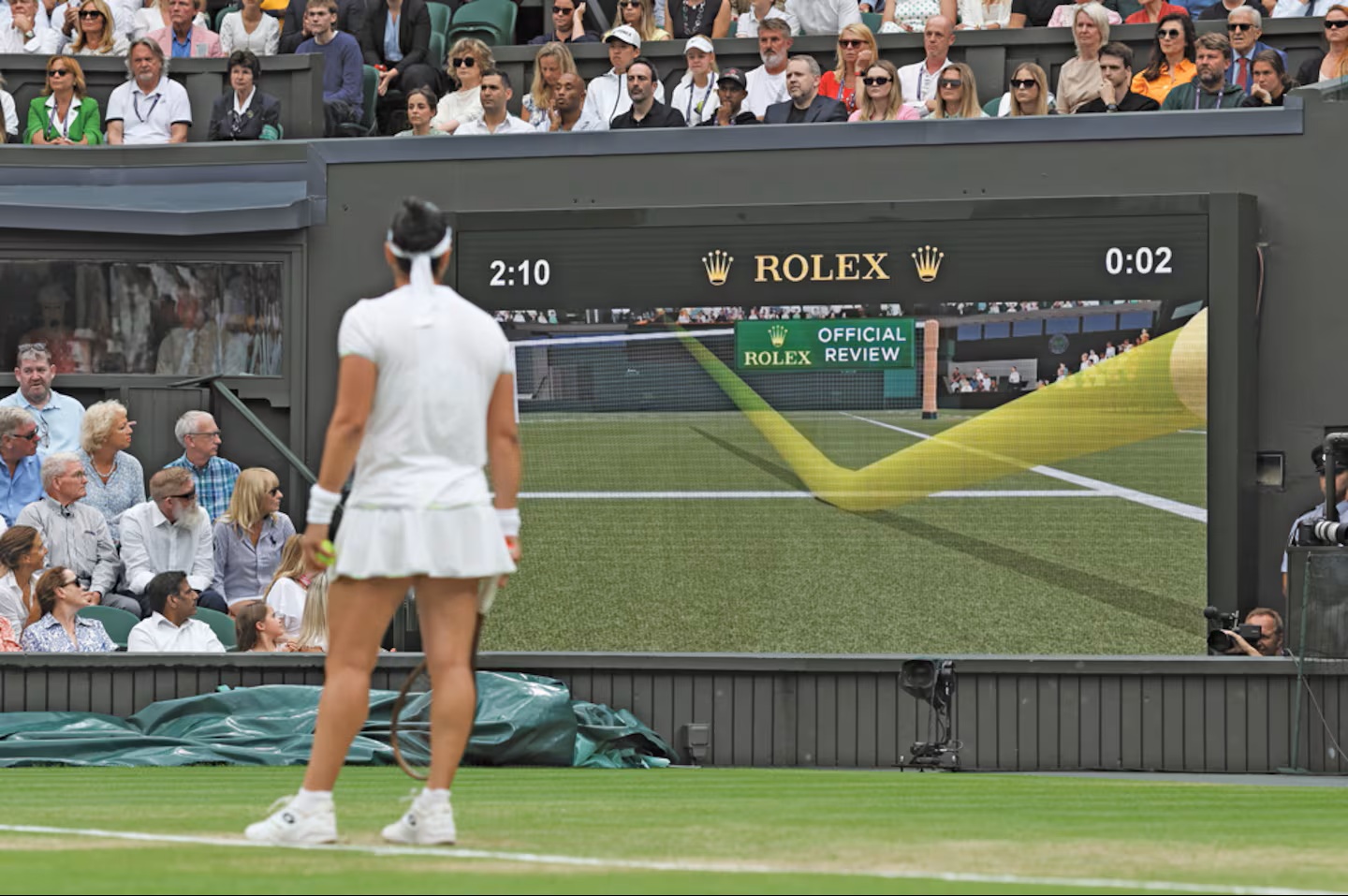
Tennis was the first sport to embrace automated officiating. (Photo: Getty Images)
“It became more and more apparent that the umpire essentially had the worst view out of everyone,” Hawkins recalled.
Hawk-Eye was used as an officiating tool for the first time a year later and, by 2006, was adopted at the US Open. At the outset of its first Grand Slam, USTA Tournament Director Jim Curley approached Hawkins and told him, “If I don’t see you over the next two weeks, you’ve done a great job.”
“You either can deliver what you’ve promised and worked very hard to do, or it can go horribly wrong,” Hawkins said.
“You can forgive or you can understand the human making a mistake and you can get over it,” he added, “but if a computer makes a mistake, that’s then suddenly a bigger controversy.”
Early adoption followed as a reactive step in response to a controversy — Williams’ Open loss in tennis, a disallowed Frank Lampard goal for England in the 2010 World Cup for soccer — but now leagues are making large investments even for incremental upgrades. The collective-bargaining agreement between MLB and its umpires signed in December 2024 codifies the league’s right to implement ABS.
“The real goal for us has always been in the high-leverage situations when it really matters, to have an outlet where you can get a bad call corrected.”
Rob Manfred, MLB Commissioner
Challenges in MLB spring training this year were overturned 52.2% of the time, up slightly from 50.6% during Class AAA games in 2024. With roughly four challenges per game, that translates to two overturned pitches. That might not seem like much, unless one of those calls is in the ninth inning of a tied game.
“We accepted, when we first went to the instant replay system, that you’re not going to get every call right — that’s an aspiration no matter how much you do,” MLB Commissioner Rob Manfred said. “The real goal for us has always been in the high-leverage situations when it really matters, to have an outlet where you can get a bad call corrected.”
ABS can input any strike zone shape, but finding consensus on what that shape should be is trickier than expected for such a fundamental part of the game. The rulebook defines a 3D shape over home plate. The plane facing the pitcher is a rectangle, but what it’s actually called is an oval. What ABS is programmed to call isn’t the same as either.
“Those are three different zones,” Sword said, acknowledging that “the zone that we actually call is dynamic and a little bit different for each umpire, a little bit different depending on the count, a little bit different depending on the pitch type. One of the challenges that has consumed a lot of time with testing ABS has been finding a static zone that will be the same for all pitches that best replicates what’s now a living, breathing thing.”
For now, ABS will adhere to the rectangle outlined in the rulebook but only call it as a flat zone at the plate’s midpoint, specific to each player’s height.
And automation calls it without bias, no matter the sport or stakes.
“You get the consistency because the AI doesn’t care who the player is, it doesn’t care if the fans are going to get upset, it doesn’t care what the money line is on the game,” Owl AI CEO Josh Gwyther said.
Speed
Goal celebrations in soccer are notoriously elaborate affairs, rituals that engage the fans and provide a natural break in the action. For officials, it’s a chance to review whether the goal should be allowed.
Those celebrations last 54 seconds, on average, according to Genius Chief Product Officer Matt Fleckenstein. “If you can actually get to a decision on whether or not someone was offside on a goal before the celebration has completed and they’re lining back, you’ve now not interrupted the fan experience.”
Expediency often helps retain viewers’ interest. “It is conceivable that a really, really hard, really, really clutch close call could be compelling for two minutes of time, but where it gets bad is when you get something that feels pretty routine, and that takes a long time,” said Phil Orlins, ESPN Vice President of Production, Technology and Innovation. “There is a shelf life on how long it feels tolerable before it becomes tedious.”
There’s a clear direction of travel, according to Bill Squadron, an Elon assistant professor of sports management. He previously led Sportvision, which created the first-and-10 yellow line in football and the K-Zone for baseball.
“Technology is now being applied to this element of the game,” he said. “It’s just being done often in clunky ways, with replays and challenges that slow down the pace and take forever.”
FIFA first used goal-line technology at the 2014 men’s World Cup, VAR at the 2018 tournament and SAOT for the 2022 edition. Enhanced SAOT, which is mostly automated, debuted at the FIFA Club World Cup. (A recent FIFA project developed AI that correctly identified 82.5% of last-touch-out-of-bounds calls, a promising start that still needs considerable refinement.)
“We are implementing technology on the field of play not to remove people, but simply to support people,” said Pierluigi Collina, Chairman of the FIFA referees committee, noting rule interpretations “are not given to artificial intelligence.”
“If we can turn a 60-second review into three seconds, and it’s automatically visualized on the broadcast and in an arena, even better.”
Tom Ryan, NBA senior vice president
The Korean Baseball Organization added full ABS for the 2024 season in part to expedite pace of play, and MLB is mindful of not giving back its dramatic gains from the pitch clock. MLB’s ABS saw an average of 13.8 seconds per challenge during 2025 spring training trials.
The NFL’s switch to a virtual first-down measurement system is said to reduce measurement time from 75 seconds for the human-carried chains to 30 seconds for the technology. The league measures about 12 times per week — fewer than once per game — but it adds up to nine minutes of weekly savings.
“Even though there’s a limited number of the virtual measurements, we are planning for what the future could potentially be,” said Kimberly Fields, NFL Senior Vice President of Football Business and Innovation Strategy, adding that the league is “lots of steps” away from using tech to spot the football. (The UFL is investigating a hybrid solution: Bolt6 tracking cameras and Sportable ball sensors; spotting the ball remains the “holy grail of problems to solve in sports tech,” Bolt6 Chief Commercial Officer James Japhet said.)
The NBA is mindful of its end-of-game pace when the strategic benefit of fouls already slows the last two minutes of a game to about seven minutes of real time. Deliberations over which of the 100 extra-long fingers last grazed a basketball heading out of bounds are tricky.
That’s why the league piloted SportIQ to see if its ball sensor might help automate those decisions. Summer League trials were “very successful,” Ryan said, and will continue in the G League.
Game flow is “very much top of mind for everyone at the league office,” Ryan said. “If we can turn a 60-second review into three seconds, and it’s automatically visualized on the broadcast and in an arena, even better.”
Entertainment
The first public demonstration of ABS took place at the 2019 Atlantic League All-Star Game. The proceedings were remarkably unremarkable. The so-called robot umpire only made one visibly jarring call — a low third strike. The hitter started to argue, only for the umpire to point to his right ear-worn AirPod, signaling it was an ABS call, not his, thereby deflating the player’s budding fury.
“I would love to see John McEnroe play with the machines,” retired tennis star Maria Sharapova recently quipped at a Bloomberg event. “He’d still find a cause for argument.”
Such argumentative theatrics are entertaining to some, but disrespectful to others. And they get trumped by what really matters.
“We are in the storytelling and drama business,” ESPN’s Orlins said. “Historically, there are elements of debate and argument over calls that are interesting, but at its core, I think the fans demand the best possible accuracy and, from a broadcast standpoint, we want transparency for the viewers as best we can. We want speed and precision.”
“I would love to see John McEnroe play with the machines. He’d still find a cause for argument.”
Maria Sharapova, retired tennis star
Technology, meanwhile, can generate a different kind of engaging presentation. Tennis fans clap in unison at the sight of a replay, cheering or booing the result. What’s shown on the video board is a conclusive 3D recreation of the ball’s landing. Hawkins explained that a tennis ball can skid along the ground for 8-to-10 centimeters, which is why the animation shows an oval, not a circle. Any single video frame will inherently be incomplete, and it’s the triangulation among several cameras that compounds the accuracy.
“It is very difficult to get video that is definitive,” Hawkins said. “The computer has made the decision, and any presentation is just there to sell the decision the computers made.”
The NBA created a similar graphic for goaltending, which is decided by a series of three discrete events — whether the ball is descending, whether it is over the rim and whether it has touched the backboard — that can be visualized.
Engendering fan support requires some transparency in the process. “You don’t want a black box,” SMT’s Hall said. ”You want to make sure it’s formulaic and it’s algorithmic, and it’s repeatable and explainable as to why this outcome was arrived at.”

The NFL replaced the chain gang with virtual first-down measurements this year, saving time during the game. (Photo: Getty Images)
One of the models underpinning Owl AI’s officiating provides a written explanation for its scoring. An evaluation of snowboarder Yuto Totsuka on the halfpipe mentioned his rotations and vertical height, while also describing his “DARING and powerful approach, all while being exceptionally SMOOTH.”
“The really tricky part was teaching the model what good style was,” Bloom said. “There’s a lot of inputs, of course, but the predominant one is what we describe as good economy of motion.”
While artistic merit would seem subjective, Owl deconstructs components of each trick. That piecemeal approach helps the AI conjure a score even for brand-new tricks — complete with a script saying why.
“We can take the collective input of the actual athletes,” Gwyther noted. “So it’s almost like they’re being judged by their peers versus an individual that has a specific thought process.”
As Hawk-Eye first proliferated sports and met with officials, Hawkins recalled those as “fairly frosty initial meetings” that felt “very much ‘us versus them.’” In time, the contentious dynamic faded, and recently he said, “I think they do see us as all a part of the same team.”
Officials’ early fear of being shown up by technology has, in many cases, evolved into appreciation for the cover. Getting overturned can spare them public criticism.
“One of their biggest problems is the pipeline of referees,” Bloom said. “The people who want to be refs, these guys are getting death threats because there’s so much money in sports betting. Their families are getting harassed.”
Recruitment and retention of officials is already difficult. The National Federation of High Schools has described the shortage as having reached a “crisis level.” When Wimbledon eliminated its line judges, one researcher wondered if it might disincentivize those seeking to reach a Grand Slam.
“That’s no longer an option for those line judges,” said Tom Webb, a Coventry University associate professor and the founder of the Referee and Sports Official Research Network. “What does that mean in terms of enticing people into the sport, in terms of performance and development below that level?”
Technology is typically more aid than replacement. Removing objective calls from the workload of referees could help them focus more on subjective decisions.
While most hockey penalties are judgment calls, NHL Commissioner Gary Bettman said there’s a place for tech: “Something like offsides and high sticking, in terms of where the puck was touched — those are things that we may be able to do better with using, not just the Apple Watch or the Hawk-Eye system, but even using artificial intelligence in terms of recreating situations.”
Players are not permitted to lift their sticks above an opponent’s shoulder to strike the puck to a teammate. Tracking cameras can assess stick height, so the on-ice official only needs to see who gains possession.
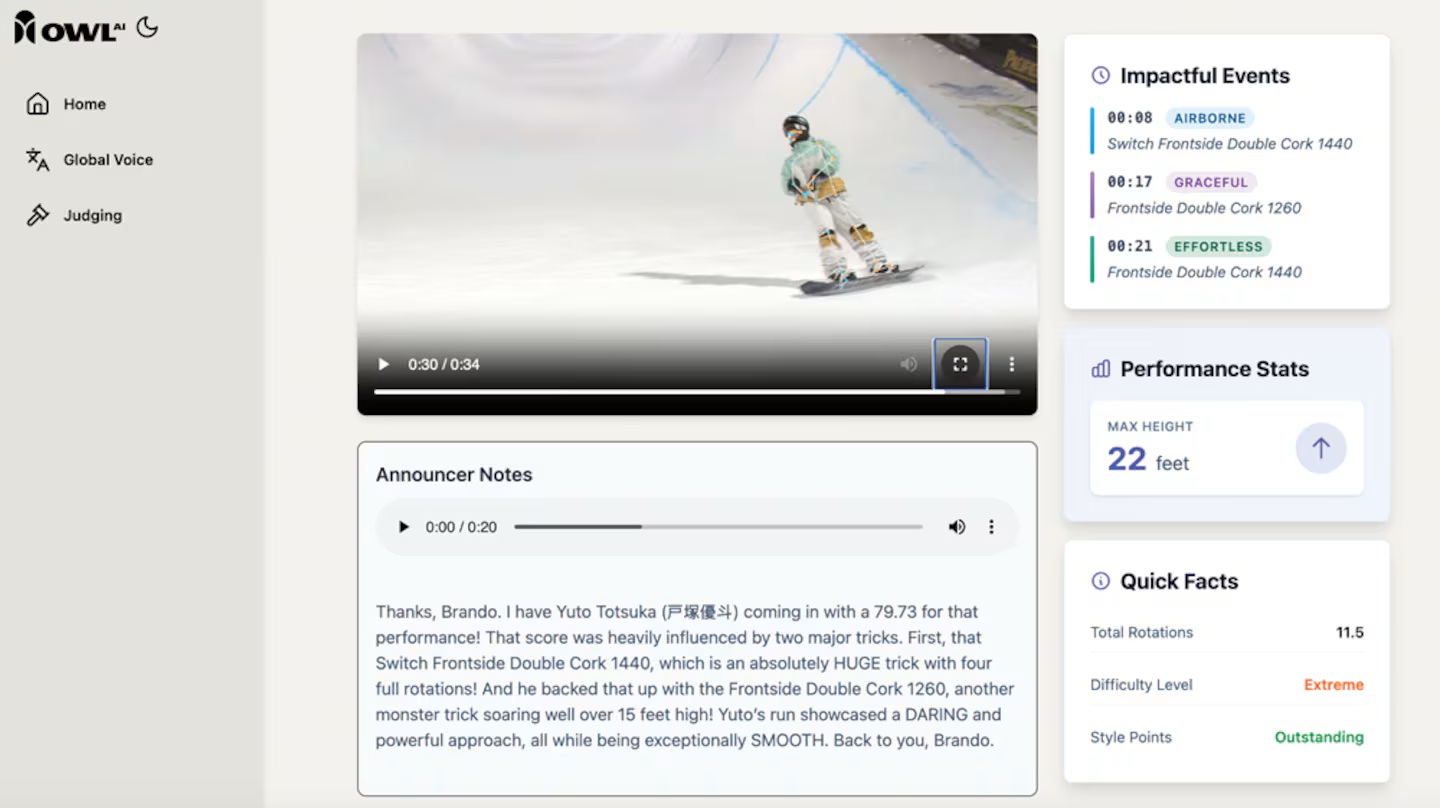
Owl AI’s officiating models create commentary about the action, enabling rare transparency in sports judged by scoring. (Photo courtesy of Owl AI)
“You only have one decision to make instead of two,” said Stephen Walkom, NHL Executive Vice President of Officiating, earlier this year. “Anything that is seamless and serves the game is always best.”
While an enterprise system like Hawk-Eye’s can cost nearly $100,000 for a single tennis court, some products are leaner and more easily democratized. Owl AI runs entirely as a software layer applied to video. It used a single camera for the X Games halfpipe, with the algorithms correctly predicting first, second and third place.
The same concept could be applied to other judged sports. “The goal would be that you get that certified by an Olympic committee, and now all these nonprofessional events — like your kids’ gymnastics — can now have a professional judge behind just a webcam,” Gwyther said.
Tennis is rife with line-call issues at the lower levels, with “hooking” — i.e. deliberate cheating — so rampant it has been cited as the No. 1 reason young players quit. Now, systems such as PlaySight and the USTA-backed PlayReplay are providing results with light installations, while SwingVision operates using only iPhones.
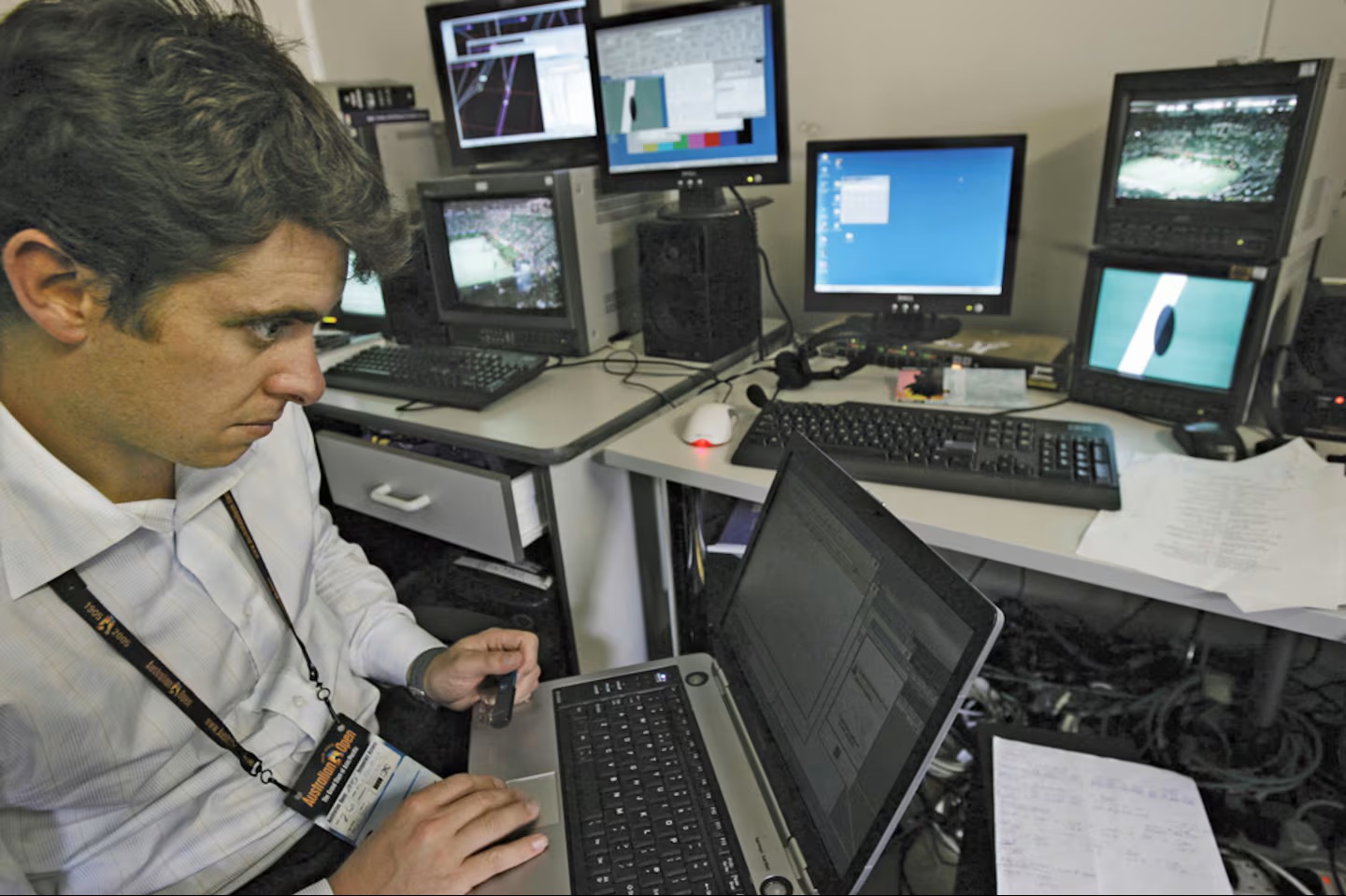
Paul Hawkins, shown at the Australian Open in 2005, founded Hawk-Eye, a camera tracking tech provider for the MLB, NBA, NFL, NHL, FIFA and tennis. (Photo: Getty Images)
SwingVision, financially backed by Tennis Australia, started calling lines at five USTA junior tournaments last summer. “There was one parent we talked to, and he said, ‘This is the first tournament where I was talking to the opponent’s parent, and we were just talking about life and we weren’t arguing about anything,’” CEO Swupnil Sahai said. “He was shocked. He’s like, ‘This is so transformational.’”
By and large, Squadron said, the reluctance to embrace more technology is less about its accuracy and more about people’s attachment to tradition.
“The human element is about the athletes, the unpredictability, the excitement about whether somebody can perform in an incredible, pressured situation,” he said. “Those unexpected errors that are so devastating — that is [part of] sports. The fact that an official doing his or her best misses a call and costs a team that’s trained, worked, performed for a championship? To me, that’s not part of the game.”
This article was brought to you by SBJ Tech, a Leaders Group company. As a Leaders Performance Institute member, you are able to enjoy exclusive access to SBJ Tech content in the field of athletic performance.
The International Tennis Integrity Agency’s launch of its new secure messaging service has a range of anti-doping benefits for athletes such as Jannik Sinner and Iga Świątek.
Main Photo: Getty Images
Branded “The Line,” the service will allow players to send anonymous messages — ranging from questions about permissible medications to reporting concerns about potential rule breaches by other players — directly to ITIA officials on WhatsApp. It was developed in partnership with anonymous communication platform RealResponse, whose encryption services are used by pro sports properties including NASCAR, the Kansas City Chiefs and IC360.
“The key bit for us is making it as easy as possible for players and agents and coaches to contact us,” ITIA CEO Karen Moorhouse told SBJ. “They’re people who are on the road, they’re traveling internationally. They don’t want to be looking up an email address or finding a telephone number to call. WhatsApp is where they’re at.”
Previously, the ITIA primarily fielded integrity-related questions and concerns through web forms, email or phone calls. “There was an extra layer that was slightly more cumbersome,” Moorhouse said. “The challenge we set ourselves was, ‘How do we make it as simple as possible for a player to get in touch with us and get the information they need?’”
She added that the recent, high-profile suspensions of Jannik Sinner and Iga Swiatek for anti-doping violations the ITIA found to be unintentional underscored the importance of having a better communication system in place.
“Those cases really shone a spotlight on the tennis anti-doping program, how it’s possible to inadvertently breach the anti-doping rules, and led to a lot of conversations across tennis that perhaps hadn’t previously happened,” Moorhouse said. “It got players really thinking about what steps they needed to take to mitigate their own risk of potentially testing positive for a banned substance — and then, linked to that, the importance of them getting the right information and the right education. Absolutely, some of the things that flowed from those cases strengthened and highlighted the importance of us having a system like this.”
RealResponse CEO David Chadwick said his company’s system enables users to communicate through “commonly used channels” like WhatsApp, while ITIA officials will field messages through an administrative portal. Players will be able to choose whether to enter anonymous or non-anonymous communication channels within WhatsApp depending on the nature of their inquiry (if the latter is chosen, their contact info will be shared with the ITIA on the back end).
“It makes it easier for people to be able to communicate and break down barriers in a system they trust and are familiar with,” Chadwick said. “But secondly, it allows for two-way communication.
“Through our system, the ITIA will be able to respond back to the person to ask further questions, clarify things, gather evidence, point to resources — all the while that person remains anonymous [if they choose]. They’re not having to download an app, they’re not having to call a hotline, fill out a web form, it’s as simple as them sending something via WhatsApp.”
This article was brought to you by SBJ Tech, a Leaders Group company. As a Leaders Performance Institute member, you are able to enjoy exclusive access to SBJ Tech content in the field of athletic performance.
The five-time Olympic medalist discusses his work as a strategic adviser to The Zone, a new platform designed to support athletes with their mental health and wellness through a range of programs and modules.
Main Photo: Getty Images
You can’t have a discussion about sports technology today without including athletes in that conversation. Their partnerships, investments and endorsements help fuel the space – they have emerged as major stakeholders in the sports tech ecosystem. The Athlete’s Voice series highlights the athletes leading the way and the projects and products they’re putting their influence behind.
* * * * *
Gatlin retired in 2022 and has found a new role in the sports tech space: he was named a strategic adviser last month for mental health platform The Zone, which offers mental health and wellness support to athletes through a collection of programming and modules.
The startup works with more than 200 teams across all levels of college athletics, along with some collegiate conferences and youth sports.
On connecting with The Zone and its founders, Erik Poldroo and Ivan Tchatchouwo, through a mutual friend…
“He said, ‘I think you’d be great for this program.’ So I did a little more research on it, and I actually liked it a lot because I think mental health, especially in the sports and athletic space, is the next frontier.
“Athletes are becoming stronger. They’re becoming faster. Obviously, recovery helps them stay in the game of play longer, helps extend their career. But going through the research of what The Zone represents and what it brings, it kind of tapped me on the shoulder to realize that I operated around a lot of athletes, and I saw a lot of athletes who had performance anxiety. Athletes who did very well at practice but couldn’t really cross over into the game of play.
“And that could be a whole array of things. It could be the fact that you’re not controlling your environment like you do at practice, or the fact of stage fright and competing in front of a certain amount of people, or even from a professional level, if I don’t get this job done, that means a reduction instead of a bonus. So I think it’s a really taboo and hush-hush area. And I think what The Zone brings to the table, it helps uncover that, but in a way to where athletes have a tool.”
On how The Zone could’ve supported him during his running career…
“From a collegiate aspect for me, my first year, I was constantly the bridesmaid to my teammate. To give you perspective — how you do in other sports like basketball, football, baseball, it’s very team-oriented. And you’re working with your team to better each other so you can go out there and win together. But you also have to remember, in track and field, the people you’re training with, it’s almost like those are the people you’re going to compete against. I’m training with other 100-meter runners who are trying to beat me to be able to get that one gold. And that goes from a collegiate aspect to the professional realm as well. So you’re always in that state of alertness.”
On his post-retirement life…
“Right now, I’m learning to slow down because being a professional athlete, especially in the track world, it was always like go, go, go, attack, attack, attack. … One thing for me was taking the time to calm myself down and know exactly where I am as a person and a human being, and that’s what I love about the retirement aspect of things. Now I can slow it down a little bit. I don’t have to feel like I’m in a rush all the time, and I get to enjoy my sons, who are growing up — I’ve got a 15-year-old and a 4-year-old — and tackling other things that I have a passion for, which is going out and doing speaking engagements, speaking to certain type of audiences, and also aligning myself with companies like Erik and Ivan’s with The Zone.”
On the tech that boosted his career…
“I think for me, Normatec, the cryochambers, the Whoop — those are the things that we used that helped me understand where my athleticism was at and gauge it, especially from recovery level. When I was still competing, recovery was that thing that was going to make sure you stayed in the game. … I think now the name of the game is mental. Because a lot of athletes are always searching for how to be able to be better physically. No one coaches you and teaches you how to compete. They just teach you the nuances of your sport: how to shoot a correct jumper, how to be able to hit a home run. But no one teaches you how to be able to mentally be in the game, and what it looks like to be in the game at a high level.”
This article was brought to you by SBJ Tech, a Leaders Group company. As a Leaders Performance Institute member, you are able to enjoy exclusive access to SBJ Tech content in the field of athletic performance.
The new Institute for Sports Tech Standards aims to provide reliable third-party testing with an aim to streamline the tech validation process and reduce redundancy.
Main Photo: Institute for Sports Tech Standards
But ultimately there were calls for more, and two of the white paper’s authors — Sam Robertson from TCG Advisory and Jessica Zendler from Rimkus Consulting — are now the founding co-directors of a new body, the Institute for Sports Tech Standards, that seeks to test product quality, establish accredited standards and consult on approval programs.
ISTS was formed from a strategic partnership between TCG Advisory and Rimkus and initially will focus mostly on collaborations with governing bodies but will expand to work with teams and tech vendors, too.
“There’s no Consumer Reports of sports tech,” Zendler said. “Everyone wants this, but no one does it. So what do we need to do to make it happen?”
Zendler, who is Director of Rimkus’ sports science practice, is Manager for the NBA/NBPA Wearables Validation Program; Robertson, a former Victoria University professor, has extensive experience working with FIFA’s Quality Program.

Zendler, the Director of the Sports Science Practice at Rimkus, is shown here speaking at a FIFA innovation conference. (Photo: Institute for Sports Tech Standards)
Robertson also previously served as a performance coach in soccer, rugby and Australian football, and has consulted for MLB, NFL and NBA teams. What he’s found is that many people in roles designed to be athlete-facing coaches or sport scientists have now largely become “applied technologists” spending upwards of 80% of their time managing software and hardware. All of them are inundated with inbound pitches of new tech, and none has the time to do proper validation.
“This was a classic problem that everyone in sport — particularly in the performance area, but also in the business space — would say, ‘We need to have better information about the technology we take on board,’” Robertson said. “But the reality is, it was a nice-to-have, rather than a must-have, and it’s only recently that shifted. The knocks on the doors became so frequent, so loud, that we thought, ‘Well, it’s time to do something about it.’”
The NBA and FIFA have taken leading roles in organizing technology vetting protocols, but those are deliberately bespoke to the needs of their sport and circumstance.
“A strategic labor of love on our part is to get more global standards out there that sports can agree upon that are going to cross-boundaries, cross-sports, cross-geographical regions,” Robertson said. “Once they are there, we can get a level of efficiency in what we’re doing.”
Tech vendors, especially startups operating on limited budgets, can’t afford multiple expensive testing program certifications. Those manufacturers would be glad to have a “paint-by-numbers” approach to validation, she added, because each league or governing body has different rules and associated fees — enough to hinder the focus on innovation.
Getting broader buy-in is a goal for the ISTS, which is working with the IEEE — a standards body Zendler described as having a “well-respected, high-integrity, public process” — on player and object tracking as its first project.
“We have seen this redundancy now happening, and this is not an efficient use of resources or anyone’s time,” Zendler said. “So can we make a way where it’s more of a third-party test institute that the governing body will say, ‘We’ll trust the report from that.’”

Robertson, who recently left his post at Victoria University, is the director of TCG Advisory and a consultant to pro clubs in the US and Europe. (Photo: Dave Holland/Canadian Sport Institute)
Both co-directors have PhDs and have held roles in academia — Zendler directed Michigan’s Performance Research Laboratory; Robertson led Victoria’s Sports Performance & Business program — but explained that most universities are set up more for innovation and research rather than testing. Higher education labs also tend to move more slowly.
Robertson, who has experience working with an accelerator in Melbourne, realized that young companies aren’t incentivized to seek testing early in the development timeline.
“It wasn’t lost on me that every single founder in that gets zero training on showing the quality of their product,” he said. “It’s all around getting a minimum viable product and attracting investment. That’s to be expected, but somewhere along the line you need to know [whether] your product is any good.”
This article was brought to you by SBJ Tech, a Leaders Group company. As a Leaders Performance Institute member, you are able to enjoy exclusive access to SBJ Tech content in the field of athletic performance.
The San Antonio Spurs is the first team to use OpenAI to create team master calendars, flight charters and email templates for outreach to preferred hotels and practice facilities on the road.
Main Photo: San Antonio Spurs
Where most organizational leaders agree, however, is that reconciling this transformative and constantly evolving technology is a core business priority, particularly in investigating ways it can streamline operations. And this emphasis comes from the top down.
“One of [our five biggest company objectives] is master AI to boost efficiency and impact,” X Games CEO Jeremy Bloom recently told Sports Business Journal. “That is a leg on the stool, it’s not a peripheral goal or an afterthought.”
Internal efficiency-focused AI use cases are not always flashy, nor directly revenue generating. They run the gamut of areas such as segmenting fan data, drafting communications and employee onboarding, and are increasingly tapping agentic workflows, a class of artificial intelligence that is more autonomous — meaning minimal or no human intervention — and layered in its decision making than large language models, and can act on behalf of users.
The empirical benefits of AI in these contexts remain theoretical in some cases, but tech leaders center their efforts on increasing productivity and freeing understaffed departments to focus on big picture priorities, rather than mundane daily tasks.
Enamored with the potential impact of AI on the sports industry, Josh Walker, co-founder and CEO of data firm Sports Innovation Lab, earlier this year launched a sports-focused AI education program called AI Advantage. With two of four planned sessions completed, the program has assembled hundreds of industry professionals — split evenly among teams/leagues, brands/agencies and media/technology companies, in Walker’s estimation — to learn more about AI and investigate potential use cases through presentations and product demos.
The biggest trend he has noticed with how sports teams and leagues are adopting AI?
“There is no pattern,” Walker said. “It would make perfect sense for the leagues to centralize the services that they are building for AI and roll it out to the teams. The teams never wait for that. You have some enterprising data science team or some enterprising CTO at the team level — they’re going to try stuff faster than the leagues do.”
Professional basketball is a hotbed of such enterprising teams.
The Cleveland Cavaliers, according to Michael Conley, the team’s executive vice president and chief information officer and president of Rock Entertainment Sports Network, began their generative AI discovery 3½ years ago. This started by consulting tech experts on the potential impact of generative AI and forming a cross-departmental generative AI committee. Eventually, they even transitioned one of their data quality analysts, Ben Levicki, into a full-time AI solutions architect, a first in the sports industry.
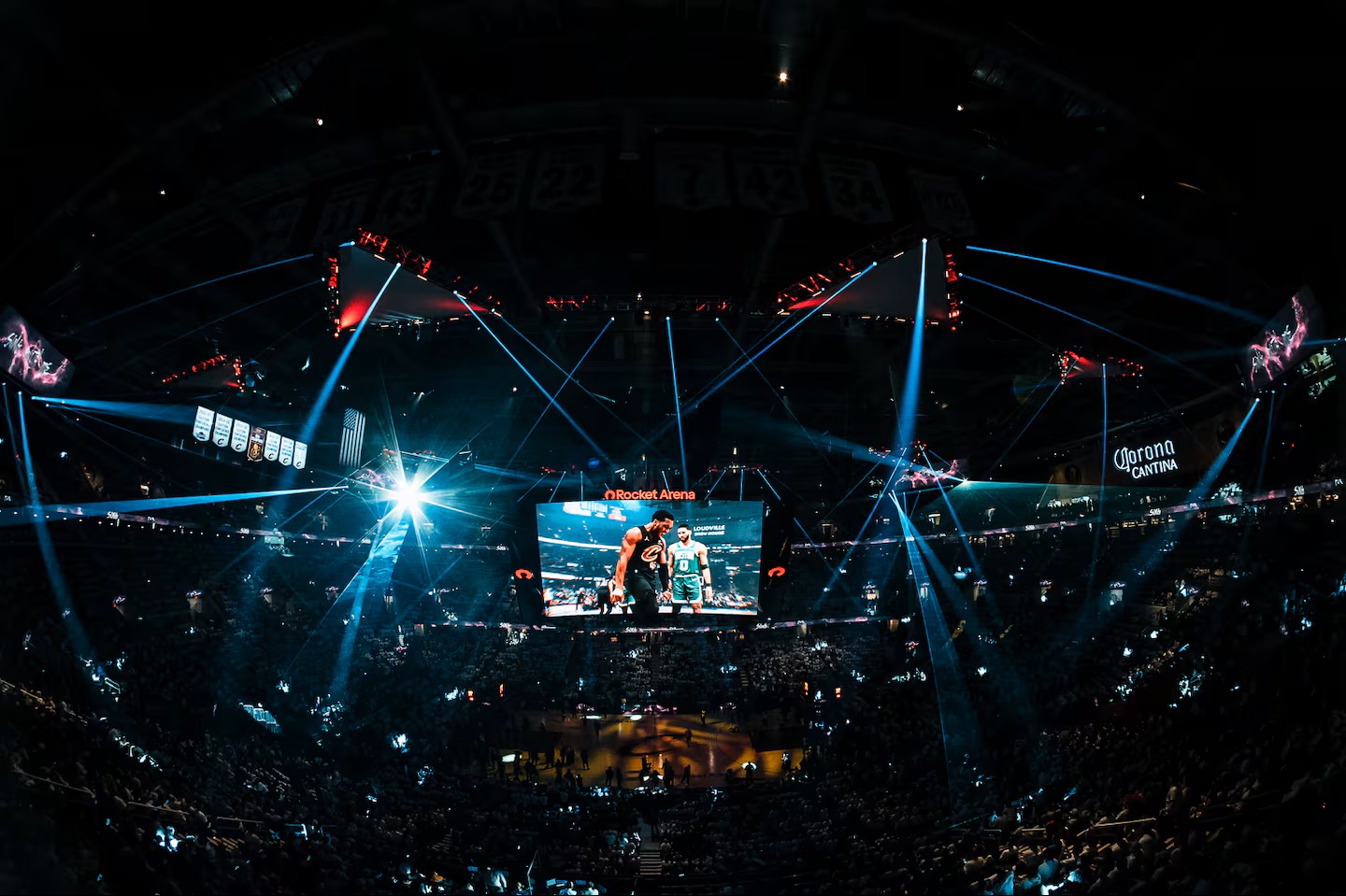
Ticket, food and beverage and retail data are among the areas the Cavaliers have deployed generative AI insights over the past 3 1/2 years. Photo: Cleveland Cavaliers
Since then, the Cavs have found success in initial use cases, such as building a semantic search function for the team’s basketball operations manual and a generative AI insights layer for their real-time ticket, food and beverage and retail data platform. At the direction of their C-suite, they are now focused on automating elements of their external communications, streamlining the processing of internal fan data and personalizing fan interaction.
During the NBA’s first Data Strategy Forum in July, the team presented the working prototype of a custom-built product that leverages a network of AI agents and fan information to distribute individualized emails to subscribers, down to details such as color scheme and emoji usage. After further testing using real fan profiles in September, the Cavs’ plan is for the product to be a part of email workflows by the start of the 2025-26 NBA season.
“Our goal is to be able to increase the amount of engagement that comes off a click action for those emails, to be able to eventually lead to better results down the funnel,” Conley said. “Is the messaging more effective, where we’re seeing greater open rates? Are we seeing greater engagement?”
Elsewhere, the Indiana Fever have seen potential in deploying AI agents (via Salesforce’s Agentforce platform) to comb through and segment internal fan data, which Joey Graziano, Pacers Sports & Entertainment executive vice president of strategy and new business ventures, said will help the team deliver personalized offers, content and experiences to fans and eventually be a resource for partners as well.
This is a massive potential use case in sports, given the multifaceted nature of fan data and ability for AI to scale the capabilities of understaffed data engineering departments.
“We are getting more sophisticated every day,” Graziano said. “And it’s not just the sophistication, it’s the speed and it’s the volume of segments you can create.”
The San Antonio Spurs, as a unique example, are using OpenAI to train models on previous years’ travel calendars (and other custom rules) to ingest the NBA’s overarching schedule and create deliverables such as team-specific master calendars, flight charters and email templates for outreach to preferred hotels and practice facilities on the road.
Human oversight is required, of course, but Charlie Kurian, the team’s director of business strategy and innovation, said tests have shown that first iterations of the deliverables can be produced in about 20 minutes, with the end-to-end, manual process of inputting information into Excel block-by-block distilled from three weeks to, at worst, one. He anticipates a version of the technology will aid the Spurs’ schedule-making as early as this season.
“This came directly from our CEO,” Kurian said. “[The message was], ‘Our people need to be focused on the higher ROI items. How do we use AI to deal with some of these tasks we’re bogged down with?’”
Kurian, at the head of the Spurs’ AI adoption effort, often says the first step of building a company’s “AI muscle” is enabling an AI-empowered workforce.
“We still believe we are very, very early on in the AI revolution. It’s hard to tell who is going to win, and what is going to stick,” Kurian said, comparing the current marketplace of competing AI platforms to the early days of social networking. “But what we can undoubtedly say is this technology will absolutely stick for the foreseeable future. [We’re] making sure we have invested in the most important thing we have — which is our people — so that, agnostic of what tool it comes to, we will still win.”
The team put this focus into action last year by piloting a generative AI learning program using ChatGPT, which has led to 90% of the 150 participants adopting the technology on a week-to-week basis, according to Kurian.
“We’ve crossed a threshold in people broadly using AI tools,” he said. “Now we’re doing discovery across every single department in our organization, understanding workflows, and, in the most positive way, blowing up the workflows to be able to integrate where AI can add value so that the real human beings can focus on the best use of their resources.”
Across its properties, TKO also is undertaking a hands-on approach to AI discovery and education, according to Alon Cohen, executive vice president of innovation. He and Melanie Hildebrandt, TKO and WME Group’s CIO, brought in an advanced prompt engineer for hands-on AI training with “natural early adopters” (e.g., TKO’s innovation and IT teams), and are now looking for other areas the technology can provide business value.
“The next version of almost every business application that we use has a heavy AI component to it,” Cohen said. “So, every team is identifying places where they think they can be successful, and when they go through their next upgrade cycle — or we consolidate to a new tool that’s also a good moment for an upgrade cycle — those tools become available.”

X Games CEO Jeremy Bloom said the property’s employees are encouraged to spend 10% of their working hours experimenting with AI tools that could increase productivity. Photo: AP Images
X Games encourages its staff to dedicate 10% of their working hours to experiment with AI tools that could boost productivity, Bloom said. One particularly effective use case has been in training a model on droves of internal data to be a resource for new hires on everything from finding sales deck templates to signing up for benefits.
“The company that I founded before [joining X Games], we had 600 employees, so we had really big and built-out functions across all these specific areas,” Bloom said, referring to the software startup Integrate. “[At] X Games, we have like 30 full-time employees. Necessity is the mother of invention for us.”
Across virtually all corporate industries, there is palpable and understandable anxiety about the potential for AI to replace certain job functions.
Bloom, for one, noted that the AI startup he recently launched, Owl AI — which offers AI-powered competition judging, data processing and broadcast commentary capabilities, including for X Games — is leveraging AI agents for market research, effectively substituting for an internal team or expensive third-party consulting firm.
However, he views live sports as not just insulated from automation, but potentially a benefactor of it.
“AI is going to disrupt so many jobs and so many industries,” Bloom said. “But I think the tailwind for us, and for any sport, is humans are still going to want to watch humans play football, and not want to watch robots play football. I think that is a huge tailwind for X Games, for the NFL, for Major League Baseball, basketball. I think it’s one of the big reasons we’re seeing so much private equity want to get into sports.”
This article was brought to you by SBJ Tech, a Leaders Group company. As a Leaders Performance Institute member, you are able to enjoy exclusive access to SBJ Tech content in the field of athletic performance.
In this recent edition of SBJ Tech’s Athlete’s Voice, former British athlete Andrew Steele discusses his transition from track & field and how a chance meeting with a genetic scientist transformed his career trajectory.
Main Photo: Getty Images
You can’t have a discussion about sports technology today without including athletes in that conversation. Their partnerships, investments and endorsements help fuel the space – they have emerged as major stakeholders in the sports tech ecosystem. The Athlete’s Voice series highlights the athletes leading the way and the projects and products they’re putting their influence behind.
* * * * *
Steele, 41, later began a career in genetics and how that science affects fitness, nutrition and performance. He led product at DNAfit and then Prenetics (which had acquired DNAfit) before starting his own digital health firm, Stride, in 2023, which this summer made strong inroads in North America through a partnership with Unity Fitness Canada. It provides multiomic testing: wide-ranging diagnostics on genomics, the microbiome, protein profile and more.
On his vision for Stride…
Previously, we’d had a lot of products which are point solutions: Here’s a DNA test for this, here’s a blood test for this. With Stride, I’m trying to bring it all together. So we’ve got a range of multiomic lab testing. We do a DNA test, a microbiome test, a blood draw, a biological age test, and an oral health test will be in the future too.
We knit all that together to see a holistic picture of your internal biology in a way which is pleasant to see and understandable — not a bunch of PDFs to download from the lab, but actually a really engaging digital dashboard. Your DNA doesn’t change, but you test everything else every six months and see how that’s tracking. And then we make a tailored supplement based off those results for you.

In 2008, Steele competed in the Olympic Games held in Beijing in the 4 × 400 m relay. AFP via Getty Images
On the cold outreach that changed his life…
I’m actually glad I didn’t get [my medal] at the time because it forced me to be very open to opportunities about what came next in my life.
There was one email that came into my inbox one day from a guy who was working with a genetic scientist and looking to commercialize this test and looking for research subjects to help them understand how genetics affected exercise response. And if my [running] career been going better, I would have just forwarded it onto my agent and said, ‘Hey, see if there’s some deals to be done here.’ I was, at this juncture in my life, when I was 27, I had zero higher education. I had zero work experience, and I certainly had not even zero money. I had minus money.
So I engaged proactively on this, and thank God I did because, long story short, [I joined] a health tech business called DNAfit in 2013. That business went well, I learned a bunch, and I became a co-founder there. Five years later, we sold the business for $10 million as bootstrap founders. Then I went into the next thing [Prenetics] as Chief Product Officer, eventually being part of the leadership team that led to a billion dollar NASDAQ IPO. So it changed the path of my life, not winning that medal — but probably for the better. And, along the way, they awarded me the medal anyway.
On his current business life…
I still sit pretty close to sport. I founded a business called Stride, which is in the similar space of diagnostics and preventative health. But I also have one other thing, which is a big passion of mine. Sport First is a venture studio, which helps people that come from a sports background navigate the transition into becoming a founder and entrepreneur.
On his science and tech interest as an athlete…
If you’d asked my teammates, I was probably always known as the guy that was [following] the latest nutrition science or supplements. It was always a passion of mine — and tech. I was always super interested in startups.

Steele founded personal genetics company DNAfit before going on to become part of the Prenetics group. Now, he’s building Stride for personalized supplements tailored to an individual’s unique genetic makeup and personal health goals. Courtesy of Andrew Steele
On what he learned about his genetics…
DNA is just one of the things in the picture, right? There’s a genetic variable called ACTN3, and there’s a version of this gene which is basically the C version of this gene. So with every gene, you have two copies of it — you have one that you got from your mother and another that you got from your father. And then basically there’s a version of this gene that is often colloquially called the Olympic gene, or the sprint gene, and it’s basically extraordinarily over-represented in elite-level power.
Everyone who’s generally an Olympic level power athlete has either one copy or two copies of the C variant of this gene. This is me completely oversimplifying the science, but that’s basically the lay of the land. And I found out, fascinatingly enough, I didn’t have even one copy of this. I was an absolute outlier from an Olympic-level sprint athlete who just didn’t have this gene, which was considered almost table stakes to be a sprint athlete.
This article was brought to you by SBJ Tech, a Leaders Group company. As a Leaders Performance Institute member, you are able to enjoy exclusive access to SBJ Tech content in the field of athletic performance.
How haptic feedback helps officials to keep their eyes on the ice during games.
Main image: Getty Images courtesy of the NHL
The league and its officials, in collaboration with Apple and technology innovation partner Presidio, developed the NHL Watch Comms App to track the game clock and signal the imminent end of periods and penalties. But to help the officials focus more on the action around them, the primary function is to provide haptic feedback with vibrations, rather than visual cues.
“The watch doesn’t distract you,” said Stephen Walkom, a former on-ice referee who is now NHL Executive Vice President, Hockey Operations. “It actually informs you. You think you’ve got to see a watch, right? And we feel a watch, but we know what time it is.”
Rollout of the Apple Watches began in September, with the league reporting a 92.5% adoption rate by officials. Saturday’s NHL Stadium Series game, in which the Columbus Blue Jackets are hosting the Detroit Red Wings at Ohio Stadium — the usual football home of the Ohio State Buckeyes — is an important milestone for the technology.
Every arena hangs scoreboards and places LED-ribbon clocks in different places, but over time, the officials grow familiar with their locations for quick time checks. In a one-off location like with the Stadium Series, everything is new, plus the size and typical depth perception is thrown off by the vast size of the venue.
“In that building,” Walkom quipped, “you’d be spinning like a top on the ice looking for a clock.”
Part of the impetus for the technology was a safety concern. There have been collisions and near-misses on the ice when players emerge from the penalty box and an official happens to be skating near the door. Having the haptic reminder that a player is about to emerge can help clear that space.
“We had a really high-level objective: It was an interest to figure out, how can we help the officials keep their eyes on the ice more?” said Dave Lehanski, NHL EVP of Business Development and Innovation. “We can’t understate how important it was to collaborate with the officials and how agreeable they were to participating in this.”
The NHL brought that goal to its tech partners. Apple had previously helped the league by providing iPads for in-game bench use, and Presidio developed applications for the NHL Draft and the league’s streaming operations.
As straightforward as the end result is, there were technical challenges to develop it, not to mention the need for significant input from the officials to ensure the app didn’t disrupt their workflow. Presidio developed the app, extracting about two dozen datapoints from the NHL’s OASIS data feed, rather than pushing notifications to the watch.
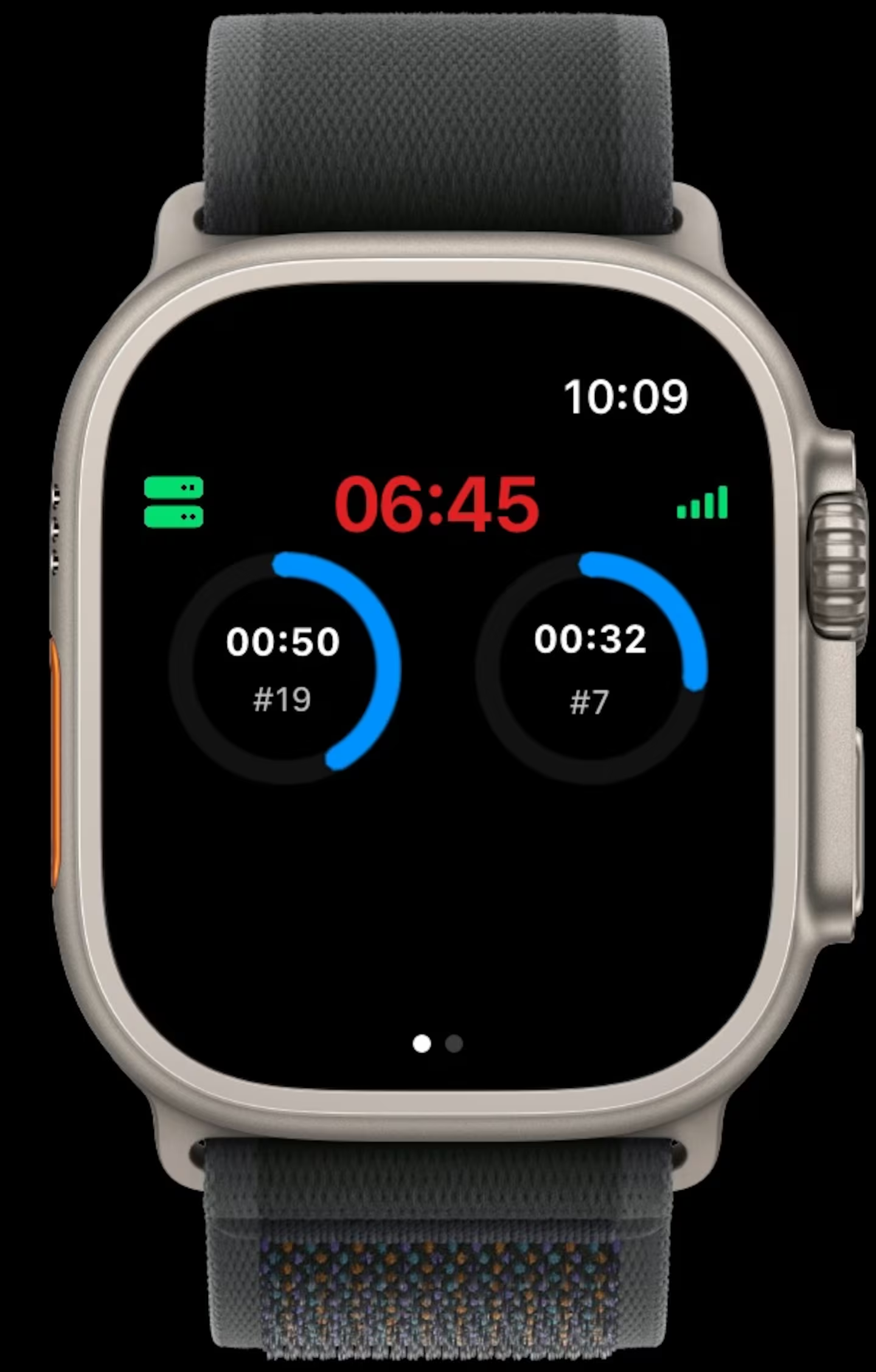
The NHL Watch Comms App showing the imminent end of two penalties (Photo: NHL)
“We had to build, not necessarily a push-based application, but a pull-based application, which was really, really unique, to make sure we had accurate data for the officials,” said Andres de Corral, Presidio VP Digital Services, noting that the timeline required “a series of design thinking sessions and trial and error.”
“The NHL has a real patience about these implementations,” added Scott Brodrick of Apple Worldwide Product Marketing. “The goal is the seamless use of technology to enhance the game, and I think that has materialized over this period of development. Sometimes the simple solution is the most powerful.”
Now, before games, almost every official grabs an Apple Watch as routinely as his shin guards, microphone and striped shirt.
“Guys just came to trust it,” Walkom said, “and we have less and less looking for a clock in the rink.”
This article was brought to you by SBJ Tech, a Leaders Group company. As a Leaders Performance Institute member, you are able to enjoy exclusive access to SBJ Tech content in the field of athletic performance.