Gemini has partnered with professional and college sport teams across the NFL, NCAA, European football and beyond.
A Data & Innovation article brought to you by

QPR soon turned its season around, however, after a change in leadership. The club won 10 times and added five draws over its final 19 matches to secure its spot in the second tier of English football another season. Most estimates suggest that relegation from the Championship to League One is a financial hit of more than $10 million (£7.9 million).
Right around the time of that upset over Leicester, QPR onboarded a new AI-powered predictive modeling tool, Gemini Sports Analytics, to make optimal use of the massive datasets they’ve compiled. Gemini is a “force multiplier,” CEO Jake Schuster has said, by simplifying the process of building machine learning algorithms catered to each club’s specific needs.
“What I really liked about Gemini was they didn’t have an ego in trying to solve every problem,” QPR Director of Performance Ben Williams said. “They created a tool where you can solve your own problems.”
Around the time of QPR’s on-field nadir, CEO Lee Hoos retired from that role, while remaining as chairman, and hired Christian Nourry as the new chief executive. Nourry was 26 and a managing partner at Retexo Intelligence, a data analytics and advisory business that worked with Real Madrid CF, AS Roma and the Mexican national team. (He became the youngest CEO in English soccer, with one European executive describing Nourry as “the Lionel Messi of the football business world,” according to the Independent.)
Nourry wanted to implement market-leading solutions to upgrade the club’s tech stack. QPR asked itself, according to Williams, “Are we able to interrogate that data optimally, to forge outcomes that are positive for the long-term future of the football club? Our answer to that was ‘no.’” That prompted the search that led the club to Gemini.
The very thesis of Gemini is to empower analysts, coaches or “anyone with a dataset,” as Williams put it, to take action with data. He noted that it can be used for everything from tactical match plans to traffic probabilities on bus trips to road matches.
Founded by Schuster, a longtime sport scientist, Gemini leverages the tech infrastructure of cloud and AI partners Snowflake, DataRobot and Databricks with data sources such as StatsBomb, SportRadar, Genius Sports, Sports Info Solutions, SkillCorner and Infinite Athlete.
As an example of what’s possible, Shuster explained that Gemini users can apply clustering algorithms to match stats and tracking data to create passing trees to identify how opponents like to create scoring chances of their own or concede them to others.
“The early lift was certainly centered around pre-match and post-match reports,” Schuster said. “So, opposition analysis — how do we approach this game? And then, post-match, what happened and what are the implications for future events? A big part of the early work with them was helping them automate those reports. And then the next step was approaching the summer transfer window.”
But it also remains an area of exploration, as QPR onboards more staff members over time.
“The power comes from our curiosity,” Williams said. “We’re in a phase of play and learn and discovery.”
Other Gemini clients include the NFL’s Indianapolis Colts, the SEC’s Texas A&M and Italian soccer club Parma Calcio, which just claimed a Serie B title to earn promotion back to Serie A. The Raleigh, North Carolina-based company also raised two investment rounds north of $3 million in the past year. There are now 27 sports franchise owners either directly invested in Gemini or through recent round-leading investor Will Ventures. QPR’s owners individually own minority stakes in two MLS clubs (LAFC and FC Cincinnati) as well as MLB’s Cincinnati Reds.
That financial backing has led to Gemini’s first customer success hire, former Arizona Diamondbacks Director of Operations Sam Eaton, and a budget allocation to hire a CTO, a role Schuster is actively recruiting. The company is also in the testing phase of some new generative AI features it hopes to roll out soon.
“The whole idea behind going with this tool was we can be really broad in our thought process of what we think helps our performance,” Williams said, “rather than be penned in by somebody else’s thought process of what is important to performance because they’ve created a tool that solves a problem that they once had.”
This article was brought to you by SBJ Tech, a Leaders Group company. As a Leaders Performance Institute member, you are able to enjoy exclusive access to SBJ Tech content in the field of athletic performance.
The Australian spoke to SBJ Tech about his cognitive training, using the simulator, and the data he seeks before and after a race.
A Data & Innovation article brought to you by
You can’t have a discussion about sports technology today without including athletes in that conversation. Their partnerships, investments and endorsements help fuel the space – they have emerged as major stakeholders in the sports tech ecosystem. The Athlete’s Voice series highlights the athletes leading the way and the projects and products they’re putting their influence behind.
* * * * *
The native Australian driver spent 2022 as Alpine’s reserve F1 driver, while also testing with McLaren and then joining McLaren’s Formula 1 team as a full-time driver in 2023.
In his rookie season, Piastri claimed two podiums — third in Japan, second in Qatar — and he claimed a further second-place in Monaco last month. Piastri, 23, currently sits in sixth place overall in the driver standings, and he spoke with SBJ last month just before the Miami Grand Prix, at which he finished in P13.
On what makes the Miami Grand Prix unique…
It brings a lot of star power to the calendar. Now that we have Vegas as well, we have two American events that are in pretty prime locations. We have Austin as well, which is, let’s say, a more traditional circuit. But yeah, having Miami on the calendar is very cool. It’s a place where a lot of people want to go. There’s a lot of celebrities and stuff, and it just adds a lot of stardom to the event, really.
On the start to the season…
It’s been a pretty good start to the year, I think, for the team. It’s been very positive. We’ve established ourselves as the third-quickest team at the moment on average. And for me, personally, it’s been a pretty good start. The last couple [before Miami] were a little bit more of a struggle in certain areas. But on the whole, it’s been a nice, clean start to the year. Definitely a much better place than we were 12 months ago.
On being teammates with Lando Norris…
You always utilize your teammate to try and go quicker. With Lando and especially his experience knowing how to drive a Formula One car in the best way and knowing how to drive a McLaren F1 car in the best way as well — because all the cars are going to be a little bit different across the grid — he’s been very useful for that. There’s certainly been things I’ve learned from him along the way.
We’ve been both pushing each other to become quicker, and that’s what you want out of out of a teammate, really, is to be able to push each other and find little bits and pieces here in different corners. Every driver on the grid is going to be looking at their teammate’s data. It’s how you go quicker, especially if there’s corners where they’re there quicker than you. It’s a good idea to look at what they’re doing and try and learn from that.
On the data he checks first after a race…
The first thing is you just look at where everyone’s finished in the race because you often don’t really know how exactly it’s gone. We make a graph of how everyone’s race has gone, so there’s a bunch of different lines, and you can see where people have been quick in their stint, where they’ve been slow in their stint, what their tire degradations look like. And the next thing is then looking into the data itself. You’re looking into what you do in every session like in practice and qualifying the race, looking at which corners you’re better in which corners you’re worse in, looking at how the tires are being used and stuff like that.
On his points of emphasis in development…
It can change a bit from weekend to weekend. For me, managing tires is probably the biggest thing I’m working on at the moment, which is difficult because you need to go as fast as you can but use the tires in a way that’s as friendly as possible for them. So that’s probably the biggest thing I’m still getting to grips with.
On simulated race time…
We do a lot of dedicated simulator work at McLaren trying to prepare the weekends, so the track is as close as possible to the real thing. We’re trying stuff with the setup, trying to get used to the track again, build up some references. I play some iRacing every now and again, as well, but more just for fun, because I enjoy driving racecars. So that’s more what I use that for, rather than actually using it to train or anything like that. It’s more just for a bit of fun in my free time. So yeah, mainly the sim work at McLaren to get a bit of a starting point for the race weekend.
On his fitness training…
Data certainly influences it, for sure. There’s certain metrics that you want to improve, which is, I guess for everyone, trying to get your muscle up and your fat down. But there’s some specific things as well. The biggest strain for us as a driver is our neck, so trying to build that up. And it’s not just your neck muscles that you need but the supporting muscles around it as well, to try and to build that up and see progress in the numbers that you can sustain when you’re training it.
We always log that and monitor that and see where I’m at. Same with my running and cardio side of things, always trying to improve your VO2, trying to get your pace down for a similar heartrate. We monitor all of that kind of stuff, just trying to improve your general fitness because you use a few weird muscles that you wouldn’t normally use in everyday life. But even just with the schedule, with all the jetlag, having a good cardio base is also important. Just so you stay healthy, and you’ve got to get to be able to concentrate for a long time.
On cognitive training…
Everyone’s a little bit different with that. You train your reflexes just by driving in some ways, and we drive so often that you’re always keeping it topped up. I do a bit of reaction training before the session, with tennis balls or whatever, just keeping your mind and hand-eye coordination switched on. We always try to improve our reactions for the start as well, but for me, a lot of that is the state of mind that you’re in, rather than actually training for it. You gain more by knowing whether you need to be revved up or relaxed, or whatever you need to be.
On help from McLaren’s partners…
All of our partners are pretty incredible. To be working with the likes of Google, with Coca-Cola, Dell, just to name a few, working with those kinds of big brands is pretty special. It’s good fun. Of course, they support us in going racing, in all kinds of ways — through financial support, of course, but especially with a lot of our tech partners, with a hands-on approach to helping us, whether it’s through computers or better ways to analyze our data, quicker ways to analyze it. That’s all very important to us. I always enjoy that side of things, the data and, and tech side of things. So yeah, being able to work with some of those big companies like that is very special.
We rely a lot on our partners, especially for our simulator, which we completed not that long ago in the grand scheme of things. Having all the computing power for that, being able to run the graphics well enough, being able to update the model quick enough in real time — I know exactly how important that is when I’m driving it because you know, when you’re lacking in that area.
On Netflix’s Drive to Survive…
I’m still pretty new to Drive to Survive. So I think people are still catching up with me on that. But it’s cool. The benefits it has brought to the sport are pretty incredible. All the sort of new fans that is brought in is very, very cool and positive for the sport. They’re not particularly intrusive on our weekends, so it’s OK. At the end of the day, it’s a good way of getting our sport out there more, and it’s exciting to watch as well.
This article was brought to you by SBJ Tech, a Leaders Group company. As a Leaders Performance Institute member, you are able to enjoy exclusive access to SBJ Tech content in the field of athletic performance.
LLume’s Light Lace technology measures respiration, heart rate, joint motion and impact detection.
A Data & Innovation article brought to you by
The core IP is the “LL” in the product name: Light Lace. Spun out of Professor Rob Shepherd’s Organic Robotics Lab at Cornell, LLume uses red LED light to measure, for starters, respiration, heart rate, joint motion and impact detection. It’s an exceedingly versatile tool when inhibited only by the speed of light.
“We are right now the only solution that has such high precision, and that’s because we’re using fiber optics instead of electrical sensors,” LLume CEO Ilayda Samilgil said during a recent SBJ visit to its workspace in the Charlestown neighborhood of Boston.
Following several years of development — during which time it won the NFL’s First & Future innovation contest, received grants from the Department of Defense and did early testing with an MLB club — LLume is now launching its first commercial product in beta.
The LLume strap resembles a standard chest worn heart rate monitor, only it doesn’t need to be worn directly on the skin and its initial focus is respiration. (LLume does monitor heart rate but initially won’t report that in the app until it has more time for validation.)
Most measurements of VO2 and — VO2max, a limit of oxygen consumption during exercise that is increasingly understood to be the single best predictor of fitness and longevity— need to be done either in a lab setting or else with expensive portable equipment, such as the VO2 Master that retails for $6,295.
LLume’s beta price tag is $199, with possible discounts for high usage. The early target market demo is the cycling community, with a preference for those near Boston for additional support testing.
“We’re going to start direct to consumer mainly to get feedback from the customer, but I think eventually — whether it’s with apparel companies or something like Peloton or iFit equipment or gyms — we’re definitely very open to going B2B2C instead,” Samilgil said.
The LLume strap doesn’t use a mask to quantify oxygen intake and carbon dioxide exhalation but rather uses its high sample rate to detect minute changes in the chest as a proxy for lung ventilation. (Though capable of higher sample rates, the team realized anything over 400 hertz is overkill for biometrics.) The idea is to provide personalized exertion monitoring that’s more precise than the standard wearable’s heart rate zones.
“Heart rate is affected by how you breathe,” LLume biomechanist Riley Edmonds said. “So that zone can change quite quickly if your breathing is not controlled. So if you want to look at the step behind what’s powering your heart, breathing is what does that so it gives you a more accurate, precise control over your zones.”
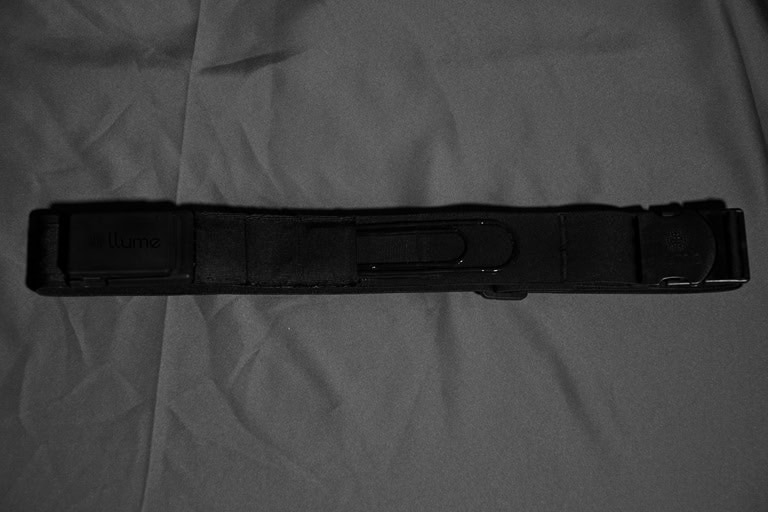
Image: LLume (Melanie Lyons)
This chest strap for endurance athletes is a starting point, but future adaptations are nearly limitless. With its baseball partner, LLume has been working on sleeves to track pitchers’ elbows and shirts to monitor their shoulders — those motions might be tracked at 20 kilohertz, they said. It can capture rapid accelerations in the joints, which Edmonds said is a more actionable datapoint than torque.
The 250 kHz measurements have been used by the military in research contracts to measure impact and trauma. LLume has developed algorithms that enable the device to sample at moderate rates continuously but then automatically increase when triggered by, say, a potentially concussive explosion.
Impact monitoring is, of course, applicable to sports such as football, hockey and rugby. The potential for embedding Light Lace into helmets or uniforms is possible but it hasn’t attempted that yet. The company’s winning pitch in the NFL competition — for which it received a $50,000 grant — was for tracking respiration and muscle fatigue.
At the time, LLume was doing business as Organic Robotics Corporation in a nod to its roots, especially with Shepherd remaining with the company as co-founder and CTO. But the name proved confusing to the marketplace, leading to the change. LLume has that double L, is pronounced as “loom,” which is relevant for its ability to be embedded into textiles and “llume” also means “fire” in Asturian, a regional dialect in Spain — fitting for a company whose core technology is red light.
There are future opportunities to make the Light Lace glow either as a fashion accessory or as an indicator — maybe it blinks twice when you reach a set respiration target. It’s another idea yet to be realized, on a long roadmap of possible destinations for the adaptable technology. And often when Samilgil looks at her iPhone, the auto-generated memories will be a picture of earlier product form factors.
“I’ll get a photo of an older prototype,” she said, “and I’ll be like, ‘Oh, my God, this is only like three months ago. We’ve come such a long way.’”
This article was brought to you by SBJ Tech, a Leaders Group company. As a Leaders Performance Institute member, you are able to enjoy exclusive access to SBJ Tech content in the field of athletic performance.
Six NFL teams used Ferretly’s innovative service as an extra layer of scouting ahead of April’s event.
A Data & Innovation article brought to you by
Ferretly is acutely aware of that dynamic and the startup has developed an AI-powered social media screening platform for a half-dozen NFL teams who took part in April’s NFL Draft in Detroit.
“The behavior off the field is almost as important as their athletic prowess to these organizations,” Ferretly Founder/CEO Darrin Lipscomb told SBJ in a recent interview. “Because their brand is at stake.”
Ferretly’s platform scans publicly available posts across seven top social media sites – including Facebook, X, Instagram and LinkedIn – links accounts to the subject (with a confidence score attached) and analyzes their activity across 12 classifications, like disparaging/prejudicial remarks, political speech, threats, drug mentions/images and so on. Such posts can include text, images or even memes.
The engine’s findings are then distilled into in-depth summary reports, with elements ranging from a subject’s flagged behaviors listed chronologically, a word cloud of frequently used phrases or topics, sentiment trends, and aggregated news coverage of the subject.
“A person that’s evaluating that individual can then use [the report] to better assess an individual’s character and integrity,” Lipscomb said. “We don’t adjudicate. We just want to surface those and say, ‘Here’s what he posts.’”
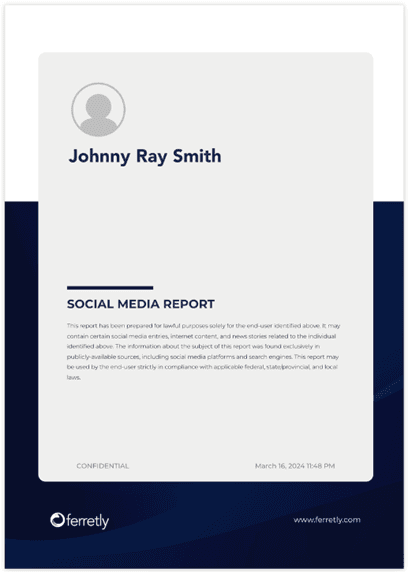
Image: Ferretly
That surfacing is surface-level, Lipscomb added, so past posts deleted at the time of the report would not be included, nor would posts from a private profile. Ferretly’s services are also Fair Credit Reporting Act (FCRA) compliant, a federal law protecting the privacy of subjects of consumer reports.
Still, Lipscomb noted that among this year’s top 200 or so NFL Draft prospects, about 70% had at least one behavior flagged – more than double the rate in other industries Ferretly covers (where the average is 33-34%). The three most common flags: profanity, disparaging remarks and political speech.
Lipscomb estimated sports teams comprise about 10% of Ferretly’s business, which encompasses nearly 1,000 clients across the retail, media, finance and public sectors, among others (they added 75 customers in Q1 this year). Influencer vetting is another popular use case, and teams in the English Premier League, NHL, NBA, MLB and Division I college are clients.
“There’s no real separate distinction between whether you’re hiring an NFL player versus an influencer,” Lipscomb said. “It’s the same report, the same assessment.”
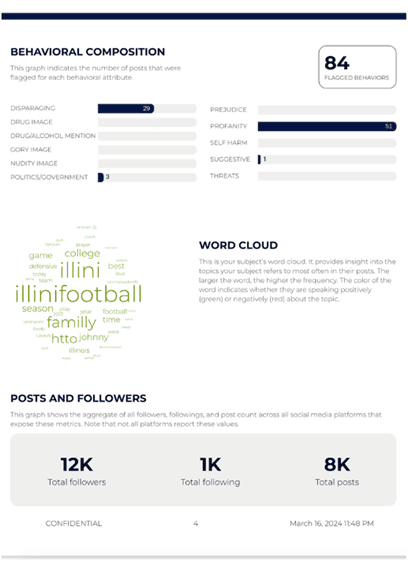
Image: Ferretly
Ferretly offers its platform as a SaaS solution, or with analyst support at a higher cost. Running an analysis takes about an hour, with reports typically turned around within a day, Lipscomb said, adding that most clients average about $20 per report. The price point is determined by volume of reports per month.
“It’s really a rapid turnaround because of the use of AI, especially for social profile discovery and the machine learning classifications. We probably do more use of AI than most of our competitors,” Lipscomb said. “There’s some competitors that do this mostly manually. They’ll produce a report at about three times the cost of what we charge.”
This year, Ferretly had analyzed around 250 NFL Draft prospects across their client’s potential targets by the time the Chicago Bears used the No 1 pick to select USC quarterback Caleb Williams.
This article was brought to you by SBJ Tech, a Leaders Group company. As a Leaders Performance Institute member, you are able to enjoy exclusive access to SBJ Tech content in the field of athletic performance.
Plantiga believes their wearable sensors can fight back against the male bias and collect data on ground forces, contact times, stride length, and asymmetries for female athletes.
Main image: Plantiga
A Data & Innovation article brought to you by
After that season, however, Bueckers underwent right ankle surgery. The following year, she suffered a tibial plateau fracture and meniscus tear in her left knee, which required another operation. In August 2022, she tore the ACL in that knee — another surgery.
But Bueckers was fully cleared for the 2023-24 season and returned to form. She was again a unanimous All-American, leading UConn to the Final Four again. During the tournament, her legendary coach, Geno Auriemma, called Bueckers “the best player in America,” in an implied comparison to Iowa’s Caitlin Clark.
Among the modalities helping monitor her as she returned to elite performance were sensors embedded in the insoles of the sneakers she wears in practices and games. That device, made by Plantiga, is in the early stages of a multifaceted effort to collect real-world biomechanics data on female athletes. Its sensors collect data on ground forces, contact times, stride length, asymmetries and more.
Plantiga is working with the WNBA through its participation in the NBA Launchpad program. It’s helping women’s running shoe brand Hettas inform its designs and materials. And it’s being deployed to track elite athletes such as UConn’s Bueckers, Azzi Fudd and Jana El Alfy, all of whom have suffered ACL or Achilles injuries over the past 20 months.
“The main problem that we see in women’s sports right now is that there’s a really big bias in the scientific literature, and there’s a bias in the resources that are often made available to women’s teams,” said Matt Jordan, a kinesiology professor at the University of Calgary who serves as Plantiga’s Chief Scientific Officer.
“Where Plantiga comes in is it affords us a brand-new opportunity to study girls and women playing in sport on the field of play, doing the things they do in the real world, not just in a lab, but on the field and on the turf. And it really opens up a new paradigm to be able to understand how training load, movement biomechanics and asymmetries, and how these things really influence the health profile of the female athlete.”
Plantiga Co-Founder/CEO Quin Sandler described the dual motivation for pursuing research in women’s sports: the altruistic idea of helping advance the science for women and also the business opportunity of supporting an underserved market. Title IX already ensures a large population of young women playing elite sports at U.S. universities, but the recent explosion in popularity of all women’s sports — pro and college — is helping grow budgets for more rigorous training tech.
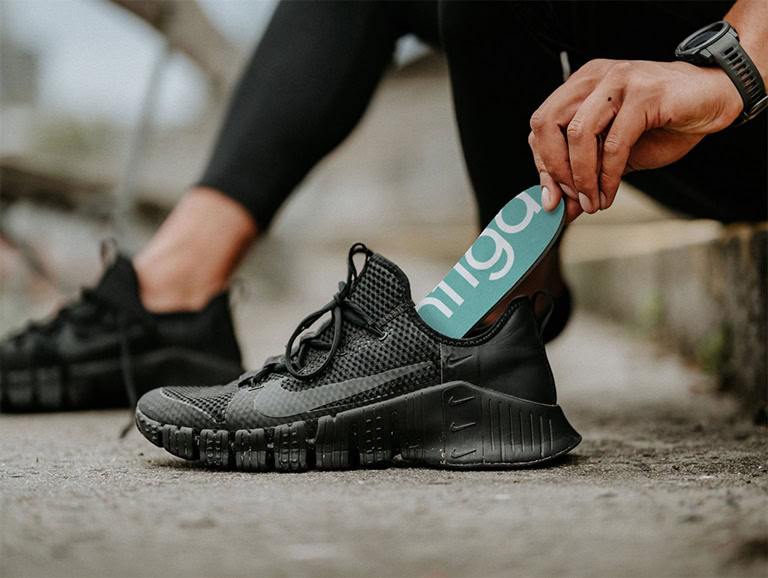
Plantiga is helping women’s running shoe brand Hettas inform its design and materials as it builds sneakers for elite athletes, as well as working with the WNBA through the NBA Launchpad program. Image: Plantiga
Sandler declined to specify the price, but said it is comparable to the cost of technologies such as Catapult and Kinexon. In some instances, teams could get the same load monitoring data only from Plantiga.
The research gap between male and female athletes has been well documented in recent years, but the severe discrepancy persists. Chris Napier, Director of the Simon Fraser University Run Lab that has been conducting research for Hettas, said there’s a huge opportunity to create more optimal sneakers for women because just about everything to date has been designed based on research for men.
“Then they just make the shoe a little bit smaller for women, and we think we can do better than that,” Napier said. “We think we can actually optimize those materials and the geometries to really suit female runners and make them improve their mechanics to make them perform better. And then we think, potentially, we can also do better to prevent injury.”
The stark need became apparent when his company built a predictive model for the Canadian Armed Forces regarding knee injuries in soldiers.
Because most of the test subjects were men, Plantiga’s model became precise in identifying trends in their data. It could estimate how long ago a male soldier injured his knee down to the month.
“When we applied that model to women, it just didn’t work. Same model, same machine learning, but that goes to show you that their movement patterns are so unique that our model — because it was just trained on male data — literally couldn’t even see it accurately on women,” Sandler said. “If [the data] wasn’t on both sexes, it basically rendered it almost useless.”
Through NBA Launchpad, Plantiga is conducting a two-pronged research effort. Its technology will be available to WNBA players and performance coaches for use in practice to collect data on elite players, and it will be offered to a high-level girls’ basketball program, New Heights in Brooklyn, with a particular focus on tracking its U17 club team for up to six months.
Plantiga successfully completed the NBA’s rigorous wearables validation program, but the WNBA CBA prohibits wearable usage in games. The WNBA is introducing optical tracking for the first time this year with Second Spectrum, but there’s appeal in the potential of collecting ground forces from a device such as Plantiga as well. (The company’s athlete user investors include NBA player Thaddeus Young and Olympic gold medal-winning sprinter Andre de Grasse.)
NBA Vice President Tom Ryan described the utility of an inertial measurement unit, which is the type of sensor used by Plantiga, in the shoe: “Being able to have an IMU that is right there at the point of contact for both feet, we think is just a piece of data that is always going to be valuable, as a complement to optical.”
This is the first year Launchpad introduced a focus on the WNBA, with Ryan explaining that the league looked at technologies with application at all levels of “the basketball pyramid.” He said, “The goal on the grassroots side is to take all those learnings that an elite health and performance professional at a WNBA setting or NBA setting could teach an athlete, but then being able to take those learnings and productize it into Plantiga’s platform.”
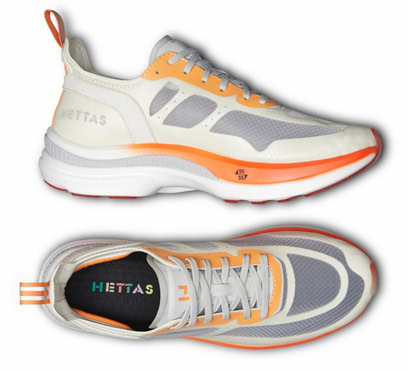
Image: Plantiga
The goal is to collect longitudinal data that would create benchmarks of progression, just as has been established in European soccer academies, which have voluminous data on what the physical performance of each age and positional cohort should be.
“We want to collect a first-of-its-kind data set on what that player development pathway looks like,” Sandler added. “What does an elite 17-year-old basketball player look like? What does an elite 19-year-old, 21-year-old, 24-year-old look like?”
In the case of Bueckers, she began wearing Plantiga in early January, according to Andrea Hudy, UConn’s Director of Sports Performance for Women’s Basketball. Hudy noted the use of Plantiga at this juncture is mostly for information gathering. For Bueckers specifically, the data indicates “there are some things we can do after the season that I think will be helpful for her,” Hudy said, but too much intervention during a season would be unwise and impractical.
Hudy, who is concurrently in a PhD program at UConn, cited a 2019 research paper on Division I women’s soccer players who had MRI scans of their ACLs before and after the season. The study found a 10% increase in knees with edema, a type of swelling in the tissue outside of the joint, which is strongly correlated with injuries to the ligament.
“Is it an overuse injury? Is it a traumatic injury? What are we dealing with?” said Hudy, who was recruited by Auriemma in the late 1980s before a pair of ACL injuries. She instead played Division I volleyball at Maryland and said her personal injury history helps drive her research.
“It’s all coming back, in my opinion, to just gait patterns, and what happens before or after an injury,” Hudy added. “And then how does that reflect your gait afterwards? Because your body compensates in so many ways. And it’s just the kinetic chain of dysfunction if you don’t correct it right away.”
That can persist and manifest itself in future ailments. Part of the epidemic around ACL injuries, added Jordan, is the high recurrence rates, which studies have pegged as anywhere from 8 to 40 times higher risk, as well as the challenge just to return to the same level of play.
“Your ability to return to performance — that, you can’t hack unless you’re training smart, monitoring your deficits and attending to this every single day as a part of your training,” Jordan said. “We’ve known that forever, and the blind spot is essentially that once the athletes are back on the court, we have no clue how they look because we don’t have biomechanical devices that allow us to measure in the real world.”
In a world of insole sensors and properly designed sneakers, the shoes female athletes wear might finally fit.
This article was brought to you by SBJ Tech, a Leaders Group company. As a Leaders Performance Institute member, you are able to enjoy exclusive access to SBJ Tech content in the field of athletic performance.
Alphabeats explains that the goal is to train one’s brain to produce more alpha waves, which are typically associated with calmness.
A Data & Innovation article brought to you by
The offering consists of an EEG-sensor-embedded headband supplied by BrainBit, which monitors brain activity while users go through mental training sessions in an accompanying mobile app. The sessions, ranging from eight to 12 minutes, are augmented by music playlists curated in partnership with audio streamer Feed.fm (which works with Dr Daniel Bowling, PhD, a neuroscientist at Stanford University School of Medicine) and include dynamic visualizations, cognitive games and eyes-closed meditations.
The idea, according to Alphabeats chief commercial officer Jorrit DeVries? “Training alpha [brainwaves],” he said, recommending users deploy Alphabeats’ solution several times per week over a four-to-six week span to see results. “This is not a solution that you use while you’re working out, for example.”
Alphabeats’ core innovation is in proprietary algorithms that respond to users’ brain activity – sourced from the EEG sensors – in real time. The goal through that feedback is to train one’s brain to produce more alpha waves, which are typically associated with calmness. The system does this by altering music to reinforce negative feedback when less alpha waves are being produced, and vice versa.
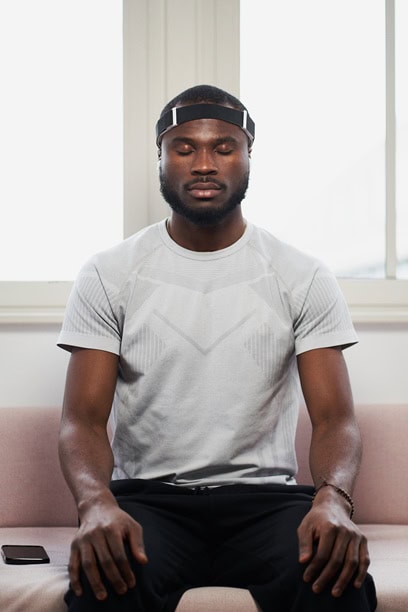
Image: Alphabeats
“At a very general level, you could say that [the music] would sound more flat [when providing negative feedback],” said Alphabeats’ head of product Elroy Verhoeven. “And if you were doing well, it would sound richer. It’s a continuous process as you’re listening to the music.”
Alphabeats’ thesis is that athlete training has historically not dedicated enough time to mental performance, instead focusing almost exclusively on physical training, nutrition and gear. Verhoeven and DeVries cite research conducted with Tilburg University in the Netherlands dating back to 2012 as evidence for their method.
“The trick is – if you’re familiar with meditation – to really tap into alpha, and to calm your brain down and to make sure that you produce more of the alpha waves than beta or gamma waves and really start to calm down your brain,” DeVries said. “That will ultimately lead to better focus, but also to better sleep outcomes and better recovery.”
Although Alphabeats’ technology is hardware-agnostic – it only requires EEG sensors to connect with – BrainBit is the company’s exclusive hardware provider as of now. Using the product on an individual basis involves purchasing a BrainBit headband (which retails for $499) and registering for Alphabeats’ $15.99 per month app subscription. In line with its US launch, however, Alphabeats is offering new customers a headband and one-year subscription for a total cost of $499.
The company also offers a starter package for teams, which includes 10 headbands and user accounts, access to an analytics dashboard, and support for onboarding and data analysis. Pricing for that offering varies. Alphabeats has a formal partnership with the Dutch Olympic archery team and a “couple” more in the hopper that they cannot yet publicly share, DeVries said.
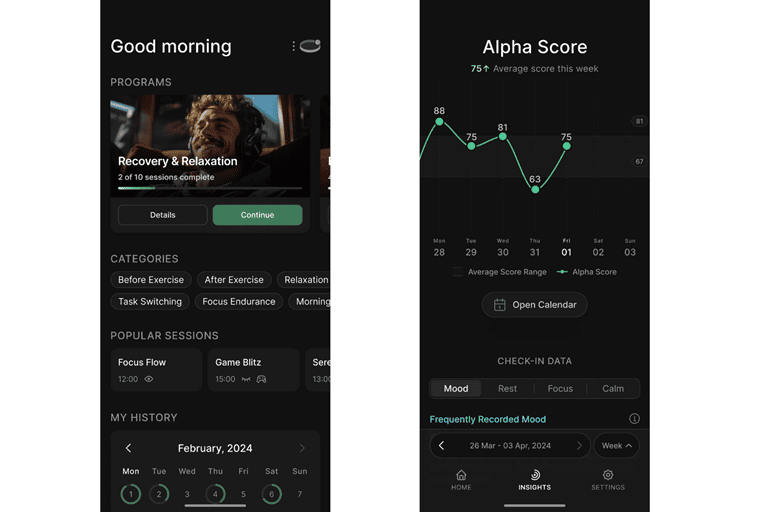
Image: Alphabeats
The vision is that as EEG sensoring becomes more widespread, Alphabeats will be well-positioned to serve athletes and teams. “That’s our moonshot,” Verhoeven said, referencing Apple’s work around EEG sensors in its AirPods – for which the tech giant received approval on a patent last year – as one example.
“There’s different market segments where this taps into. We look, potentially, at a $12 billion market,” DeVries said. “This is a huge market where you see a lot of potential in different areas. But if you then boil it down to what we’re trying to do here, is really capture the athlete platform market, to make sure we connect as many athletes as possible in a hardware-agnostic way, to really build an install base that drives us to the next wave of growth where you see that EEG measurement become more and more available.”
This article was brought to you by SBJ Tech, a Leaders Group company. As a Leaders Performance Institute member, you are able to enjoy exclusive access to SBJ Tech content in the field of athletic performance.
The PGA Tour player and US Ryder Cup captain is the latest guest in SBJ Tech’s series The Athlete’s Voice.
A Data & Innovation article brought to you by
You can’t have a discussion about sports technology today without including athletes in that conversation. Their partnerships, investments and endorsements help fuel the space – they have emerged as major stakeholders in the sports tech ecosystem. The Athlete’s Voice series highlights the athletes leading the way and the projects and products they’re putting their influence behind.
Among the standout traits of Johnson, 48, is his durability. He had played 69 consecutive majors until withdrawing from the 2021 Open Championship, not because of injury, but because he had tested positive for Covid-19. In fact, Johnson revealed that he has never undergone any surgery in his career — before joking that he wished he hadn’t said that publicly.
One fitness tool Johnson has adopted in recent years is GolfForever, which recently raised a $10 million Series A investment round and was named the Official Golf Fitness System of the PGA Tour. GolfForever uses its patented SwingTrainer, resistance bands and AI-powered app to guide workouts. It was created by chiropractor Jeremy James and has been used by company ambassadors Johnson, Scottie Scheffler, Justin Leonard and Tom Kim. In all, more than 400 PGA Tour and LPGA pros are users.
On how’s he incorporated GolfForever into his training…
The versatility of it is one of the aspects I love about it. I use it every day. I use it at my gym at home, if I don’t see any of my PT guys, just to get going. I can use it in my hotel room. I can use it to warm up for tournament, before I practice at home, whatever. I use it all the time, because of what it has and the ease of it. It’s very mobile — stick it in my golf bag and go. Shoot, I can use it on the range before I actually started to compete. So I just love the accessibility of it at any given moment is really what I think sets it apart from other apparatuses when you’re talking about engaging, warming up, creating some sort of mobility, yet stability. That’s where I find it to be the best thing on the market.
On his training progression…
I do use weights. I do use other apparatuses, too, for my conditioning. This thing is not going to put on 15 pounds [6.8kg] of muscle. I’m 48 years old. Longevity and injury prevention are my two focuses, and knock on wood, I’m probably an oddity in the sense that I’ve never had to go under the knife — I shouldn’t have put that out there, but anyway.
I give my body its full attention each and every day. I think [GolfForever] really helps from a corrective standpoint. It allows me to go through my corrective exercises, my corrective movements, so that I’m warm. I can even go in and do some heavier stuff after I use it. And then when I cool down, it’s great to get everything balanced and firing again after my workout. The app is great, too. They have an app that’s very comprehensive. If I’ve got a corporate event and I’m just going to travel [but not compete], I could just take I could take the bands and the apparatus and use the app, and I can get a full workout in my hotel room if I desire.
On golfers’ need to counterbalance their rotational movements…
That is an absolutely fantastic question. Obviously I’m right handed player, so there is asymmetry in me innately. And I say that it’s probably because I didn’t give my body the attention it needed when I was a young, young, young pro. In the late 90s, golf fitness was just kind of a thing — now, it’s a full-fledged industry. Shoot, golf recovery is a full-fledged industry.
From my body’s standpoint, I’m trying to get as symmetrical as possible, fully knowing that it’s probably not going to be that possible because I’m still hitting golf balls constantly. I would have to hit golf balls left handed, at a pretty high rate to find some sort of symmetry, and I don’t intend on doing so. But the beauty of this GolfForever is it allows me to get into motions. If I need to do more — we’ll just say, for lack of a better term, left handed — I can do that.
One of my imbalances is I can really turn through the ball. So post-impact, I can just keep going. On my backswing, my T-spine, my torso, even down into my low back and shoulders, that whole area basically is fine, but it just doesn’t want to turn as far in the backswing as it does on the downswing. So I’m constantly doing a little bit more to help open up my T-spine on the way back. That’s always an emphasis, if I’m going to get specific.
I actually have a left-handed seven iron. I can go in my gym, or I have a little simulator room. I can go in there and just hit balls — it’s ugly But I can do that. I can actually put a weight on there too, if I desired, and I’ve got to be careful because it’s really uncomfortable. It’s really awkward. And it kind of hurts. But there’s some there’s some truth in that. Yeah.
On other parts of his wellness routine…
I think I’m fairly diligent. I’m sure there’s peers of mine, especially guys that are younger, that may exhaust the resources even more, but I cold plunge probably two times a day, usually in the morning to get me going. It’s kind of like an endorphin release. It’s a hormonal balancing mechanism, and then I’m also going to use heat therapy as well. I just got done working out. So everybody thinks well, you should cool down and get the plunge. Well, the research says you should wait at least three to four hours, so I’ll cold plunge probably tonight before I go to bed. I’ve got a plunge at home, and then I’ll also introduce heat before I go practice to get limber.
Then for supplements, I’m pretty diligent on what I put into my body for the most part. I mean, I can eat bad, too, like anybody but I’m also very conscious of what goes in. I’m a chiropractor’s son, so that’s all I know. Whether it’s vitamins or other things of that nature, I’m a part of a company called LivPur with four other golfers and we make pre-, during and post-round supplements that help —whether it’s aminos, electrolytes, proteins. I’m always constantly monitoring, monitoring that intake.
On recovery…
Sleep obviously is massive. And that’s the best form of recovery for frankly anybody if you can get proper sleep. I used to wear a Whoop. Probably should get back into it. I’ve got some of the things I can wear, too, but it gave me a little bit anxiety. I was only into it for about four to five, maybe six months. I’d be like, ‘Man, I slept great last night,’ and then it says you didn’t or just the opposite. But that’s data, and I love objective data. I probably need to get back into it. My boys are actually starting to do that — I’ve got a martial artist and a football player.
Teammates of mine — my PT and chiros — are constantly encouraging me, pushing me, making me uncomfortable. That’s also, I think, very rewarding in the end, too, so there’s a lot of things that go into my day-to-day operation.
On evaluating business deals…
I think my plate’s pretty full. With my team, my manager, my wife, we pursue relationships more than business opportunities. It’s got to be a good fit. It’s got to be a win-win. So I don’t you know, with three kids at home, I’m not desiring anything more. I like who I’m associated with. I hope they would say the same. And I don’t say it lightly because if we’re going to start something, you’re going to get all of me. I can only be both feet in with a certain number of obligations or ambassador roles. I don’t think it’s fair to myself or them if I spread myself too thin.
On the PGA Tour’s offer of equity to its players…
That’s a hard question. I’m learning as I go. I’ve pursued some communication with certain individuals and the Tour. I think everybody’s kind of learning. I understand it is probably the appropriate or pertinent next step in our evolution as a product. I’m also pretty trustworthy in the sense that I feel like there’s individuals making these decisions that are a lot more wise than I am, especially when it comes to just business in general and the savviness it requires.
It is new. It is obviously somewhat reactionary. But I’ll tell you what I am: I’m grateful for my peers. Because I served on that board in the past, I’m really grateful for the time and energy they’re putting into it. I don’t even know the half of it.
There’s really two factors in my mind, and the first one is I hope the money side of things is not the motivation. There’s an appropriate way to pursue money. Greed is the inappropriate way. So I hope, and I trust that they’re doing that right. And then the second thing would be — and these are 30,000-foot view things — don’t let the game of golf be secondary. It’s still got to be for the fans, it’s still got to be a level of entertainment, it’s still got to be meritocracy, it’s still got to be the purest form of the game where you earn what you get in the dirt. I trust that that that’s still a priority.
This article was brought to you by SBJ Tech, a Leaders Group company. As a Leaders Performance Institute member, you are able to enjoy exclusive access to SBJ Tech content in the field of athletic performance.
Edge3 and Kenyon Rasheed are using data to help athletes navigate the complex recruting process in college football.
A Data & Innovation article brought to you by
* * * * *
You can’t have a discussion about sports technology today without including athletes in that conversation. Their partnerships, investments and endorsements help fuel the space – they have emerged as major stakeholders in the sports tech ecosystem. The Athlete’s Voice series highlights the athletes leading the way and the projects and products they’re putting their influence behind.
* * * * *
Kenyon Rasheed captained the University of Oklahoma football team before playing three seasons in the NFL as a fullback, starting 10 games for the New York Giants in 1993 and 1994. When his playing career ended, Rasheed began a career in tech. He started at Oracle, then ventured out on his own, licensing sports data to media in a quarter-billion-dollar deal and building a HIPAA-compliant medical record system for players at the NFL Draft Combine.
Rasheed, 53, later consulted for Opendorse and worked for Global Payments, Inc, helping the company become the official commerce technology provider for Atlanta’s Mercedes-Benz Stadium.
His latest project is Edge3, an athlete intelligence and advisory firm that recently partnered with IBM to leverage Watsonx AI to create a data-driven college recruiting service. Co-founded with a fellow NFL alumnus, Brian Jones, who is also a CBS Sports analyst, Edge3 raised a friends and family seed raise in 2022 and signed with Next League to develop its product strategy and business model. Other retired NFL and NBA stars — Warren Sapp, Gary Payton, Horace Grant — joined as advisors, and Edge3’s first client was Will Anderson Jr, a national champion at Alabama who recently was named NFL Defensive Rookie of the Year with the Houston Texans.
On the idea for Edge3…
I was running a podcast and was having on a lot of retired athletes, Jonathan Hayes, Rod Woodson. I heard a coach in them as they were being interviewed — a need to give back this intelligence and knowledge that they had. And my question was, ‘Why are you not coaching? You’re Hall of Famers.’ And they had the same question, ‘Why are we not coaching because we’re Hall of Famers?’ What I found is, there’s really only 32 opportunities to do that — or broadcasting — to really give back what you know. And as you get older, your name loses a lot of relevance. So what doesn’t always fade is that intelligence.
Instead of trying to coach 32 teams, what if they could coach 1000s of teams because of the information? Well, I looked at technology and said, What a great way to scale it. If I can take all of this information and stories and intelligence of all of these players that have been through, the recruiting process, college, pro, financial planners, agents, NIL deals, all of that, and then give it to the generation that actually needs it, which are these young athletes and parents that are coming up.
On proving the idea…
To test it out, I went out and said, I’m not an agent. Let me see if I can go sign a first-round pick and have them be our first client. And that happened to be Will Anderson Jr. And all we did was [say] we didn’t really know if we could help you at the time, but let us try to add our intelligence and advisory position to help you choose an agent, to help you choose a financial planner, teach you how the marketing game actually runs for an athlete. And we were able to do that and really kind of standardize his search around picking an agent. So we were interviewing CAA and Klutch and Octagon, and all of these under the parameters of what are the requirements for the family.
On convincing his first client…
This is where I realized this was different. Because whereas CAA and Klutch are spending hundreds of thousands of dollars recruiting players to get them to sign with them, I did it on a Zoom. But on the Zoom, I had Warren Sapp. I had Horace Grant. I had Gary Payton. I had Brian Jones. When his mom and dad turn on the Zoom and sees us, I tell Mr Anderson, ‘[I see] the scowl on your face. You’ve probably met with a thousand agents — we’re not agents. We don’t want anything from you. We want to be able to see if we can help you. These guys have been through the same thing your son’s going to go through. Our parents went through the same thing you guys are going through, trying to figure out who’s real, who’s not. And we would love to help you. And the difference is, it’s us. This is not a third-party coming through. You’re working directly with the guys who have actually been through it.’ Literally Mrs Anderson was in tears at the end of the call because she was so overwhelmed from the agents.
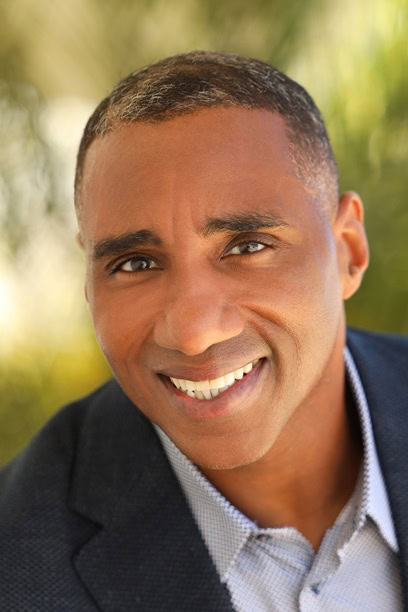
“All of this information and stories and intelligence, the recruiting process, college, pro, financial planners, agents, NIL deals, all of that, [Edge3] gives it to the generation that actually needs it.” Image: Edge3
We started to build out a plan for them that got them to the draft. It was really amazing because we were sitting in rooms with Klutch and CAA, listening to pitches that we heard 30 years ago. Our thing was, well, with all of this data available, we already know what Will’s going to make based on his draft position because we have enough information to know that these days — thanks to fantasy, thanks to betting — any datapoint that can possibly be had on a player, we have. So why are we not interpreting that for the athlete and the parent to understand, This is what the agent actually does. This is the value of what he brings. And understand that it’s a marketing game. And by that I mean this, the athletes on the field get their money. Agents are there to represent and present that in a way that leverages more opportunity for them.
But the data is the same. So if I have access to the data, you have access to the data. Why am I paying you 3%? And I’m not to say that they don’t deserve a fair shake. But at the end of the day, every vertical has changed. I looked at the finance industry, I looked at the legal business — I look at Legal Zoom, for instance. And as I said, 15 years ago, you had to walk in and to a lawyer’s office to create an LLC. Now I can go on LegalZoom and do with the templates, and if I need an expert, here’s a attorney and expert there. So why are we not doing that in sports when all of this information and data is available?
On how coaches benefit…
We believe it’s a lead generation for the schools as well. Because as we were talking to coaches, what they were trying to say is, ‘If you look at all of the media platforms that cover recruiting, one kid may be 6’2” on one site and 6’5” on another. He may be running a 4.8 [40-yard dash] on one site and 4.5 on the other.’ They have to sort through all of that data as well. So why are we not narrowing down the scope?
[They are] looking at this, from their perspective, as a roster management [tool] and the more information we take on kids, and the more information we understand about what they’re doing in their systems, we can figure out a better match. That’s really where IBM Watsonx has come in because it’s able to actually put into machine learning a lot of these data points because we’re asking the right questions from both sides. What does an athlete want? What does a coach want? What is the school looking for? What is a parent looking for? All of those things are what we’re putting together in the engine.
On developing the product with Watsonx…
We also worked with Next League who handled our discovery. Dave Nugent and those guys were awesome because they gave us a roadmap on how we can build this out and conceptually understood what this looks like. Because I have seen so many different platforms — I’ve worked with Opendorse, I’ve worked with Teamworks, I’ve worked with Microsoft — I’ve seen all of these technologies in bits and pieces. And they may have one piece of the solution, but not the totality of it, which is why we don’t see a lot of new technologies being implemented in sports.
One of the things I was talking to IBM about was, ‘We see the probabilities around tennis. What if we could take that predictive engine that you already are using and apply it to this industry the right way? By having subject matter experts sitting here telling you, no, here’s the information we need to retrieve from all of this data. You figure out how to get it to me and give me the answer.’
On the business proposition for college programs…
To be able to go into an athletic department, sit down with the AD, figure out their financials, and where they’re spending money on recruiting, being able to sit down with a position coach and say, ‘OK, how are you narrowing down your field and communicating who you want to offer to the head coach?’ Going to the front end analysts saying, ‘How many players are you evaluating? How are you bringing that data in and communicating that upstream to a CEO, which is, at the end of the day, a head coach making a decision?’ So we approached this from just a business standpoint, with information needing to be gathered, needing to be analyzed, and needing to be collaborated with within the organization.
Thanks to the transfer portal, we found that schools now have 48 hours to decide, ‘Do I keep recruiting this high school kid? Or should I take a kid out of the portal?’ And from athlete side, what we now know is, let’s look at the average age of a roster. If the average age of a starter is 23 years old, and I’m 17, 18, it says a lot. So when we talk data, it doesn’t really need to be this complicated process. We’re talking, simplify things that can give an athlete a better sense of my success at a particular school and on the other way around: what’s the risk of me taking this athlete and him being on my roster for three or four years and being productive within my system? And so we believe those are two core questions that we can help answer on both sides.
On leveraging playing experience…
Everyone’s got access to the same data. It’s how we look at it, and there are certain traits that every coach is looking for, no matter what the positional room, no matter what the team. This is a poll that I did with a lot of players: I would send tape out of a kid, and just say, ‘Give me five things that you see.’ They were all consistent with what they all saw. It was the same terminology — hip mobility, feet, I want to see his eyes, things like that — that I was like, ‘Well, what if we standardized those things?’
If Warren Sapp could develop an assessment for defensive tackles based on his eyesight — and what people didn’t realize is that Warren on a Saturday is watching multiple college football games with a Telestrator, sending me and the other partners on my team clips of what a defensive tackle is not doing. And I’m like, ‘Warren, first of all, you’ve got to stop this.’ But that’s how deeply we watch games. My wife gets irritated with me because I can see two plays and be like, ‘He doesn’t bend fast enough. He doesn’t work his head.’ Just automatically. And if you talk to any former player, they’ll tell you the same thing. They watch the game differently. I want linebackers that understand the linebacker position to evaluate linebackers.
On projecting college recruits’ performance…
We live in a world that a star system has been created by media companies to determine the value of a player. We have all ingested that as the standard. What I will ask you is, if a five-star is truly a five-star, how come all of them are not first-round picks? Because a five-star to one roster may be a three-star to another, based on the system, based on who they’re playing with, based on historical look at the coach, based on the fact he may be going out of state — there are so many other factors to determine the success.
We have a history that we can baseline now and then backtrack to start predictive models around the kids that are coming in today. [We have] a group of guys that we know who can actually dig in and understand the game and then look at it and re-engineer the solution backwards. Start with what we look for in a position and then build out from there. We haven’t even touched the surface yet. Yeah. Because everything that we’re looking at now is from what we know. I believe, with the help of IBM and Watsonx, that’s going to start to tell us things that we can’t see within those data patterns.
On how he started his career in tech…
When I retired, I didn’t know what the hell I was going do like any other athlete. I met a guy on the plane who worked at Oracle. He said, ‘Hey, I think you’d be good at sales.’ I said, ‘I don’t know anything about technology.’ He said, ‘I can teach you technology. What I can’t teach you is what you already know, and that is an understanding of people and markets.’ So I went to work for Oracle, which then taught me that there was software being built for individual verticals based on the processes of those verticals. Well, sports is as a vertical so who would know those processes better than me?
And so I took a gamble on myself. And in 1999 I started with what was called Rasheed & Associates. My first client was Interactive Systems Worldwide, which provided a real-time, play-by-play betting system that was in Las Vegas. I introduced them to the NFL, NBA, Concacaf , and all of them said, ‘Too closely resembling gambling. We will never touch it.’ This was at the NFL offices when I was 27 years old. Then I said, ‘OK, what if we had a game and a contest piece off of that,’ and I got to Kirch Media through Concacaf, and [Kirch] ended up licensing the technology for $250 million [over 14 years]. We were using it in SkyBet overseas as an interactive betting system.
On his next career steps…
So I was in betting well before and then two years later, someone asked me about a health smart card. Can we put our medical records on a card and take it with us? This was in 2002. And I was like, ‘What if the NFL players had their medical records on their player card?’ So I started polling trainers, then I found out about HIPAA, and then I started going out to teams.
I created what they called the Player Record Library System. I got everybody at the Combine, all 32 teams, to use the system. I took all of their medical information and put it into an API that they could access during the draft. Prior to this, they were FedExing medical records back and forth. I did not know anything about technology. I didn’t understand programming, and I wasn’t in the medical industry. But at 28 years old, I’m presenting to Paul Tagliabue, [NFL EVP and Chief Legal Officer] Harold Henderson, the medical council, and it changed how the Combine operated.
It taught me how to commercialize a product from concept, which is what we’re doing today. And then in 2015, when everyone was talking about fan engagement, I got into Global Payments. Mercedes-Benz Stadium is the first stadium that did a direct deal minus Ticketmaster, established payment and fintech within the sponsorship divisions within the sports industry. And now look at where we’re at right today with cash-less stadiums. So all of these purviews have given me an understanding of how this stuff actually works, how it can be commercialized, how we can build a product, and how to actually sell it, and have an instance where they can actually use it on a wide-scale basis.
This article was brought to you by SBJ Tech, a Leaders Group company. As a Leaders Performance Institute member, you are able to enjoy exclusive access to SBJ Tech content in the field of athletic performance.
Second Spectrum underlines the league’s status in the vanguard of player tracking and analytics in women’s pro sport.
A Data & Innovation article brought to you by
This multi-year, league-wide agreement with Second Spectrum marks the latest milestone in the rapid growth of the WNBA and could signal a new era of personnel decisions, game strategy and sports science for the teams. The NBA’s analytics revolution followed the installation of its first league-wide optical tracking system back in 2013. And such 3D tracking underpins so many modern fan engagement activations — everything from MLB’s 3D Gameday to ESPN’s Big City Greens NHL game and the Toy Story NFL game.
“Our teams are obviously very enthusiastic about this and that the league is making the investment on behalf of the teams,” WNBA Head of League Operations Bethany Donaphin said. “It’s really a statement to the importance of developing our basketball technology capabilities as the league continues to grow and as the game continues to evolve.”
One of the key criteria for the WNBA system was that ability to collect the raw x-y-z tracking data as well as being able to generate an “end-to-end suite of analytics,” added NBA VP Tom Ryan, who oversees technology initiatives. Such second-level metrics include assessing quality of shots and advanced defensive proficiency evaluations.
“Probably the most exciting thing about the deal for us is that this the first time, to our knowledge, that a women’s pro sports league is going to have this level of tracking and analytics,” Second Spectrum Chief Commercial Officer Mike D’Auria said. “We’re going to take the cutting-edge technology, not just from the tracking side, but going through the analytics, data and software that is the cornerstone of NBA workflows. We’re excited to level up the women’s game, which is something we’ve wanted to do for ages.”
This follows a major digital transformation from the WNBA before the 2023 season in which the league rebuilt its app and website following a $75 million infusion of capital. That enabled the W to assemble its own in-house digital team to better serve its fans. That group will now have considerably more data to power leaderboards, highlights and immersive experiences.
Ryan noted the value in finding a partner who will “be able to evolve with the WNBA. It’s at an incredible inflection point as a property. The first phase is really about advancing the game and the core product, but then over time, we’re obviously going to want to innovate the fan experience and add a new media element.”
“What people are starting to discover — hopefully more and more — is how elite our athletes are, how talented they are, how really skilled they are,” Donaphin said, “and I think it’ll be impactful to be able to tell stories around that with data supporting it.
Some of the media tools will need to be negotiated directly with each broadcaster in the coming months. Genius and Second Spectrum have a stable of AR and other visualizations tools that they’ve used in, for example, NFL coverage on CBS and NFL+.
“I really think some of the data information and graphics can really start to accentuate the women’s game in a different way and give a unique look and feel to the game,” D’Auria said, namechecking the potential of analyzing Caitlin Clark’s shooting in a new way.
“The WNBA is growing so much, which means they have a lot of new fans coming to them,” he added. “What we hope is that we can really help that process of driving new fans.”
Second Spectrum was the longtime provider of NBA tracking data until that deal concluded prior to this season, although it remains a provider of basketball analytics and broadcast augmentation for the league. The WNBA first tested tracking data at the inaugural Commissioner’s Cup in 2021 when it leveraged a combination of Kinexon sensors and Hawk-Eye cameras.
Soon after that game, WNBA Commissioner Cathy Engelbert shared her vision for tracking data in a keynote conversation with SBJ Tech.
“It’s really important to provide that to teams and players about workload and stuff like that, but it’s important also to integrate some of that data into broadcast to make it very interesting — and then integrate it into a second screen experience,” she said at the time, discussing the value in “finding ways to engage fans differently.”
On Tuesday, she reaffirmed that value proposition in a statement, saying, “Technology continues to fundamentally change the sports landscape. Deploying state-of-the-art optical tracking technology through Genius Sports will deliver rich data to our teams that they can leverage to enhance player performance while informing in-game strategy and enable a new wave of insights and media elements for fans.”
This article was brought to you by SBJ Tech, a Leaders Group company. As a Leaders Performance Institute member, you are able to enjoy exclusive access to SBJ Tech content in the field of athletic performance.