The Northern Irish startup Movetru offers solutions to both teams and individual athletes.
Main image: Movetru
A Data & Innovation article brought to you by

* * * * *
Our Startups series looks at companies and founders who are innovating in the fields of athlete performance, fan engagement, team/league operations and other high-impact areas in sports. If you’d like to be considered for this series, tell us about your mission.
* * * * *
World’s shortest elevator pitch: “Real-time biomechanics for on-field and on-court injury mitigation.”
Company: Movetru
Location: Belfast, Northern Ireland
Year founded: 2020
Website/App: https://www.movetru.io/
Funding round to date: “Angel, plus UK government funded.”
Who are your investors? “Movetru’s notable investors include: Jack Butler, entrepreneur, CMO, CFO; Mary McKenna, UK & EU Angel Investor of the Year; Rob Hargrove, VP of R&D; Andrea Sinclair, UK Angel Investor of the Year; and Alastair Moore, PhD, a serial entrepreneur with a focus in AI.”
Are you looking for more investment? “Yes, we are in discussions with athlete investors and VCs.”
Tell us about yourself, founder & CEO Naomi McGregor: “In pursuit of a ballet career at 14 years old, I injured my knee. It took three years and eight different specialists to finally diagnose. At this time, I was told I should never dance again and that my injury was completely preventable. After this, I pursued a degree in engineering. During my Master’s in product design engineering from Queen’s University in Belfast, I put forward the idea of a device to prevent injury. This allowed me to combine my frustration of injury, passion for dance and knowledge of engineering into my dissertation. After graduating as a First Class Masters in engineering scholar, I went full-time into the development of Movetru. Coming from a family of entrepreneurs, I was excited to begin the adventure of entrepreneurship. Since then, I’ve learned how to grow a team, raise over half a million in government funding and raise angel investment.”
Who are your co-founders/partners? “I am the solo Founder of Movetru. However, I am fortunate to have a fantastic team supporting me, along with invaluable guidance from incredible advisors and the backing of the best angel investors. While I may be the sole Founder on paper, the collaborative efforts of this talented group have been instrumental in bringing Movetru to where it is today.”
How does your product work? “Movetru is a wearable technology for real-time biomechanics for injury mitigation and performance improvements. This is done through smart activewear that allows the athlete to understand their movement quality from anywhere through their smartphone. Information is given to athletes, coaches and medical staff with an automated data pipeline. This means no additional data analysis is required. Movetru provides athletes the ability to understand improvements on injury rehabilitation and performance.”
What problem is your company solving? “As I’ve seen from my own experience, preventable injuries are all too common. They are caused by inadequate training, poor movement quality, overloading and lack of personalized training techniques. This results in both physical and psychological harm, along with financial burdens and long-term health implications. In the U.S. alone, $20 billion is lost due to sports-related injuries in U.S. high school and collegiate levels, and 33% of professional athlete salaries are lost due to injuries. Movetru targets preventable injuries to reduce this burden and keep athletes where they belong — on the field. One hundred participants have taken part in product trials to date. These focused specifically on injuries in the anterior cruciate ligament (ACL). We found that the participants who suffered an ACL rupture and received rehabilitation plans had better biomechanics compared to those who did not. This highlights injury can be reduced with improved biomechanics and early intervention.”
What does your product cost and who is your target customer? “Movetru is a SaaS-based platform offering two subscription models, differing between team sports and individual athletes. A beta launch this year will target individual athletes and teams across collegiate and professional leagues.”
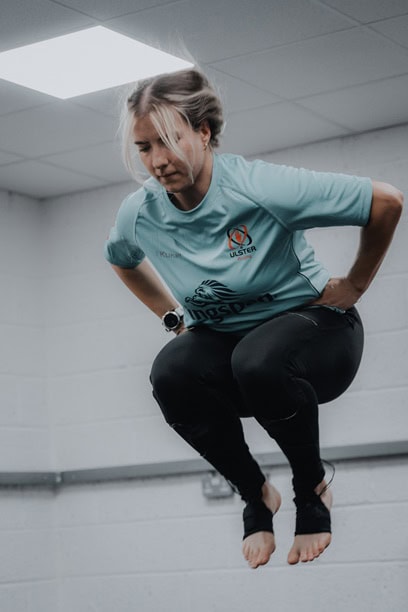
Image: Movetru
How are you marketing your product? “We’re marketing our product by engaging directly with beta users across NCAA, leagues and amateur sports teams, ensuring we develop a product they love. Our emphasis has been on early user conversations, rather than heavy marketing. As we expand, I’m excited to broaden our athlete base and welcome athlete ambassadors to join the Movetru team.”
How do you scale, and what is your targeted level of growth? “We plan to scale by expanding across the NCAA and leagues while onboarding exceptional athlete ambassadors along the way. Additionally, as we continue to grow, we already have plans to develop a consumer version of our product to democratize information for athletes at all levels.”
Who are your competitors, and what makes you different? “Currently, teams are required to use multiple devices, or attend biomechanics laboratories, with time-consuming data analysis. These include motion capture, force plates and computer vision. However, Movetru will be the first of its kind within the wearable technology market, encapsulating the capabilities of these existing products and integrating them into one product. Competitor products are limited in their ecological validity, as they are confined to laboratory analysis only. Movetru takes this one step further and provides useful insights and athlete profiling from on-field performance.”
What’s the unfair advantage that separates your company? “Female athletes are often overlooked in the male-dominated research area of sports technology. Female physiology, body structure and movement characteristics are under-researched and therefore not implemented sufficiently. Movetru seeks to counteract this injustice and our technology has been designed with all bodies in mind. Female athletes have been considered in every stage of design and development to ensure optimum performance and usability. Movetru is set apart with our multidisciplinary team of engineers, all-star athletes, textile designers, biomechanics specialists and psychologists. Together with our expert board of advisors, we are wholeheartedly committed to making a difference with our custom technology. Movetru will provide live on-field analysis with proprietary data algorithms that transform raw data into a biomechanical model representative of the user.”
What milestone have you recently hit or will soon hit? “The team is preparing for our beta launch in 2024. This comes as a result of our 100 athlete trials in Movetru’s Innovation Lab. We tested with participants who suffered ACL injuries, as well as control subjects to conduct thorough ACL research. On-court studies have also taken place with several sports teams to ensure ecological validity. We will also be closing a seed raise this year.”
What are the values that are core to your brand? “At Movetru, we are passionate about diversity. The composition of our project team and advisory board underscores this dedication. With backgrounds in technical, commercial, and legal domains, our team comprises over 50% women. This intentional diversity ensures a broad spectrum of perspectives, enriching discussions and decision-making processes. It aligns with our belief that diverse teams drive innovation and creativity. Stakeholder and athlete engagements are also approached with this lens. We actively seek representation from diverse stakeholder groups, including underrepresented communities, to ensure their voices are heard and needs considered. This inclusivity and consideration of different end-user groups enhances the relevance and effectiveness of our product. Another value of ours is athlete well-being. In preventing injury, we improve an athlete’s physical health and their psychological health will be significantly impacted. Injuries can end careers and completely reroute lives, Movetru is passionate about protecting athletes from this burden and improving their quality of life.”
What does success ultimately look like for your company? “Success for Movetru is defined by finding a way to ensure that we prevent athlete injury, and unlock an understanding of the human body that we currently do not have. I am specifically passionate about female athletes, a population that has been understudied, underrepresented and underfunded for far too long. As a result, women are up to eight times more likely to suffer an ACL injury. My personal hope is that Movetru can be an inspiration to the next female sports technology founder and to the next female athlete. I intend to see Movetru become a household name for wellbeing and wearable technology. We want to be the next gold-standard approach within sports technology.”
What should investors or customers know about you — the person, your life experiences — that shows they can believe in you? “Coming from a family of entrepreneurs, I’ve seen first hand the hard work it takes to create a successful business. Every single step of this journey has presented me with challenges for being a young female engineer in sports technology but I’ve overcome every barrier. I’m excited to be able to counteract social norms through the success of Movetru and be the next inspiration for women in STEM and sports. All technical challenges the team has faced have been overcome to be ready for our beta launch this year. We are ready to highlight the capabilities Movetru brings to athletes, coaches, and medical staff on and off the field. Movetru has come a long way — I started during the COVID-19 pandemic with the first product developed in my garage, and we now have custom hardware, proprietary data algorithms, and an incredible user experience. We have defied all odds of success and we will continue to do so for the rest of 2024.”
Is it challenging trying to stand out in the wearable device market? “In a crowded wearable device market, Movetru understands that users seek more than just superficial features. While many perceive wearable devices as interchangeable, the data they provide varies significantly. That’s why at Movetru we prioritize a clear USP and offer unique data points that truly enhance user experiences. With a relentless focus on user-centric design, rigorous validation processes and a commitment to on-field and on-court performance, we elevate data analysis beyond the laboratory, enhancing ecological validity and ultimately improving the athlete’s experience. Our approach ensures our products stand out, deliver tangible value and forge meaningful connections with our audience, driving long-term success in this competitive landscape.”
This article was brought to you by SBJ Tech, a Leaders Group company. As a Leaders Performance Institute member, you are able to enjoy exclusive access to SBJ Tech content in the field of athletic performance.
Al, the art of persuasion, and the habits that hinder performance – just some of the topics that filled the air in March.
Leaders Meet: Teaching & Coaching, an in-person member event, is just around the corner so, if you haven’t already, do check it out and register to join us at Millfield School in Somerset. We have some excellent topics on the agenda, including pedagogy & andragogy, non-directive coaching, coaching neurodivergent athletes, the language of coaching, complexity science and much more besides.
The day will be most relevant to anyone working with athletes on a day-to-day basis, whether in a first team environment or within the pathway. There’s just a couple of weeks left to register so don’t miss out.
Our Debriefs are designed to set you up for success. We’ll keep you on the pulse of contemporary thinking across the high performance space and provide members with the inspiration to engage with the variety of opportunities on offer through their membership. Do check out some of our upcoming events and virtual learning sessions to connect, learn and share with fellow members from across the globe.
And now, let’s reflect on the pressing performance issues of the day.
Virtual roundtables
March was a busy month for roundtables. From topic-led conversations around Sustaining Team Culture and the Influence of AI on Performance Programmes, to a Leadership Skills session focused on Building Persuasion and, last but definitely not least, part two in our series of learning around Wellbeing and what is having the most impact.
These are the insights that resonated with us most.
The potential impact of AI
We identified some of the enablers and outlined some of the key questions we still have around the technology.
So, where do we think AI can have a positive impact on our programmes?
All sounds good, doesn’t it? However, we still have some questions that need answering. Have you explored and come up with answers to these in your environments?
Why persuasion is an important skill in modern day leadership
How can you master the art of persuasion? We have some tips for you. Having good ideas is not enough. In order to change thinking and enact change, we need to be able to persuade people.
The Trust Equation
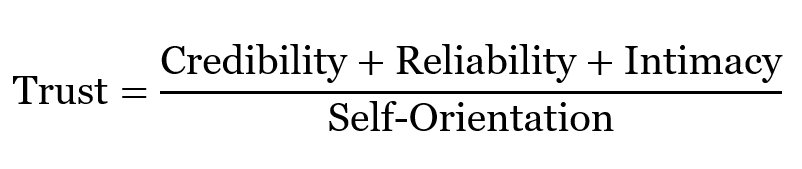
The equation is a conceptual formula used to describe how to build and elevate trust. To go into a big more detail, Credibility speaks to words and credentials and simply put, how authentic are we? Reliability is the perception of someone’s integrity, are your actions connected to your words? Are you credible in how you present yourself? Intimacy refers to the feeling of safety or security in the sharing of information and how safe and secure others feel in sharing with us. Finally, Self-Orientation reflects an individuals focus and where it is directed – is it towards themselves or others?
Essential steps in mastering persuasiveness
There was lots of gold in this skills session but as we reflected on the essential steps to impact the notion of persuasion well, there were four steps to reflect on in developing your persuasion muscle:
Additional reporting by Lottie Wright
Something a little different…
As many of you will know, we at the Leaders Performance Institute pride ourselves in exploring the world of high performance outside of the elite sporting context. With this in mind, we wanted to push your attention to some golden insights from the Royal Academy of Dramatic Art and their Director of Actor Training. To read more on their approach to elevating performance here and also how they’ve worked to redesign their curriculum here.
Skilbeck shared with us five factors that underpin their process to developing their talent. Are yours similar?
Additional reporting by John Portch
Community groups
In March, our Performance Support & Science community group took centre stage.
With 2024 bringing new projects and streams of work, we looked into the pressing questions and topics that are currently occupying the minds of those in this group.
Some of these will look familiar. How are you trying to approach some of these issues in your environment?
Sustaining staff health & energy
A few different people as part of the group discussion alluded to the topic of staff energy and sustainability, from the lens of the performance support and coaching team. Some of the spin off questions referred to how do we best integrate support and what does that look like, particularly due to the intensity of competition and in some environments, where there is uncertainty.
AI is coming, so how do we prepare?
Firstly, we’d recommend revisiting some of the bullet points above on what came out of the conversations of this topic in one of our roundtables. A lot of performance teams are evaluating it’s possible impact and the input it could have into our worlds. Will you be an early or late adopter and do you have a clear strategy in place to ensure there is clarity and preparation for how you will use it when that day comes?
Are you collaborating with external practitioners?
Arguably the most common response from the group when it came to current challenges. Such is the nature of modern day elite sport, performance support networks around our athletes are growing, including independent specialists who are not employed by the organisation. The crux of the conversation was, if we are to work with them, how do we do it best? Or do we not look to collaborate with them at all?
Balancing long-term planning and short-term delivery
This is a constant battle for performance support teams, such is the nature of the work that takes place in this field. The group brought to the table the question of how others are finding the balance to ensure they are moving at the ‘pace of performance’ in the day-to-day environment, but a nod to the future exists when it comes longer-term programme planning. We also discussed how to keep senior and experienced staff growing as it can be very easy to slip back into the short-term mindset, thus stifling longer-term development opportunities.
Circular’s ring is an AI wellness assistant designed to humanize and teach people how to use the data to help improve their performance.
Main Image courtesy of Circular
A Data & Innovation article brought to you by
Our Startups series looks at companies and founders who are innovating in the fields of athlete performance, fan engagement, team/league operations and other high-impact areas in sports.
* * * * *
World’s shortest elevator pitch: “Circular is a pioneering organization in smart ring technology with the mission of revolutionizing personal health by transforming complex data into actionable insights through an innovative and easy-to-wear device.”
Company: Circular
Location: Paris, France
Year founded: 2019
Website/App: www.circular.xyz; Apple app; Google Play app
Funding round to date: “In 2020, Circular began crowdfunding and utilized Kickstarter and Indiegogo. On Kickstarter, over 1,500 investors pledged approximately $380,000. Similarly, on Indiegogo, we raised $405,000 from just around 1,800 backers.”
Who are your investors? “Circular has a team of strategic and medical investors, including professional athletes, renowned doctors, and medical professionals.”
Are you looking for more investment? “Circular will be looking to grow its funding further over the next 18 months.”
Tell us about yourself, co-founder & CEO Amaury Kosman: “I’ve always been captivated by the intricate dance of technology and human well-being. After years of research and development, driven by a desire to enhance daily health management, Circular came to life. It was a melding of personal passion and professional pursuit, aiming to revolutionize how we interact with our own health metrics. My journey to CEO was fueled by this singular vision: to create a seamless, intuitive and deeply personal health monitoring experience. Noticing a gap in the market for user-friendly health-tracking devices, I dedicated years to developing the Circular ring. I realized other devices were not understood by ordinary consumers, not even by top-level athletes. By talking to a lot of health professionals and professional sports coaches and using my own experience and that of consumers, I was able to understand and create a product that would be of a professional standard but could be used by everyone. To solve this issue, I thought that creating wearables that are centered around an AI wellness assistant to humanize and teach consumers how to use the data would be a revolution. It was hard to create the product during COVID, especially after we’d succeeded in gaining the trust of consumers following Kickstarter. We had several production problems and had to bounce back several times. This would have killed a lot of companies of our size, but with our determination we always managed to find solutions. Today, we’re still working 12 hours a day, but we’re seeing the fruits of our labor take shape, and there’s still plenty of room for improvement.”
Who are your co-founders/partners? “Circular’s CTO and co-founder Adiasa Suharno. Circular’s COO and Co-Founder Laurent Bsalis. In total, 15 experienced team members make up a diverse and multicultural group who share the same passion for developing the next generation of wearable devices to improve human capabilities.”
How does your product/platform work? “Circular Ring Slim is the thinnest, lightest and most intuitive smart ring in the world and the first to incorporate haptic navigation and alerts. Paired with Kira+, Circular’s powerful AI wellness assistant, the sleek Circular Ring Slim assesses seven biometrics and 142 derived markers 24/7 to help people sleep better and live healthier lives.”
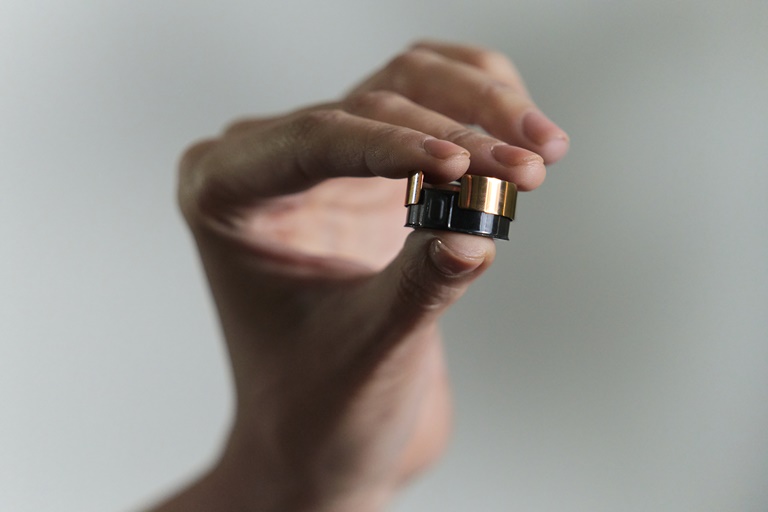
The Circular Pro ring features changeable shells for easy customization. (Image: Circular)
What problem is your company solving? “Most smart rings are heavy and bulky, while the Circular Ring Slim eliminates both of those problems. By creating a thin and lightweight ring, the Slim can be worn at all times which increases accuracy in sleep and activity analysis. It also solves the problem of complicated and difficult to understand data by simplifying it and making it more comprehensible to the everyday user.”
What does your product cost and who is your target customer? “Circular Ring Slim is priced at $275 and includes access to the app without any subscription fee. Our target customer is an individual who wants to live a healthier life but doesn’t understand the metrics or doesn’t want to understand the metrics. In a survey we conducted, 35% of people who bought Circular’s original smart ring said they did not own another wearable device. Circular is targeting an untapped market of people who are interested in a wearable device but need to be convinced that there is a product that can do the work for them.”
How are you marketing your product? “Circular’s marketing strategy is mainly digital oriented, focusing on the unique strengths and innovative features of the Circular Ring. Circular markets the Circular Ring Slim as an accessible and user-friendly health monitoring devices designed for everyday individuals, not just for professionals or biohackers. Our emphasis is on simplicity and ease of use, ensuring that anyone can understand and benefit from its advanced biometric tracking capabilities.”
How do you scale, and what is your targeted level of growth? “We try to double our volume every year. Currently, we’ve realized only 30% of our ultimate vision, with numerous enhancements and innovative features in the pipeline. In the near future, there will be an app update with new features around wellness and empowerment. Additionally, new medical features as well as products and services are on the horizon. Circular will also make strategic partnerships with wellness-oriented companies and celebrities.”
Who are your competitors, and what makes you different? “Smart rings are an emerging market and there are several competitors. Main competitors are Oura Ring, Movano Ring Evie, Ultrahuman Ring Air, Ringconn and boAt Ring. Samsung and Apple are currently developing smart rings, but there is no credible timeline on the release dates. Circular has many key differentiators both in hardware and software. As mentioned before, it is the slimmest and lightest smart ring among its competitors. It has haptic feedback, which allows the users to get additional features around wellness for example tapping anywhere on the surface to stop vibrations linked to an alarm or timer, guided breathing sessions or vital alerts. In terms of software, most of the major differences are within the Circular app. The app simplifies complex metrics and makes meaningful recommendations through Kira, a personal wellness AI assistant. No other competitor contains an AI feature that provides personalized advice. Circular has also gamified the app, offering users the ability to earn online coins and rewards to unlock new features in the app. Additionally, while most competitors record and track health metrics every five to 30 minutes, Circular records metrics every two minutes, which offers increased granularity in the data.”
What’s the unfair advantage that separates your company? “Circular’s unfair advantage lies in a mix of everything but is in the majority of our Vision and team. Circular has utility and design patents and has trained its own algorithm. We have created and own everything, from hardware to software, and have a dedicated team which makes us very versatile, flexible, and quick in development to reach our vision, which is completely different from the others.”
What milestone have you recently hit or will soon hit? “Launching soon will be our first medical features.”
What are the values that are core to your brand? “The core values of Circular’s brand are accessibility, data privacy and a commitment to advancing personal health through technology. Circular’s goal is to develop and create a multi-feature wearable ring to improve physical and mental performances of the users through unique and intelligent recommendations. The long-term goal is to provide the ultimate accessory that will be essential to the way we sleep, live and work. Circular’s multicultural team believes in the power of assisted technology and wearable devices, but often had the feeling that their true powers have not been unleashed completely. The wish was to create a device that would rather assist users in making good decisions and responding to their body signals in a healthier way rather than just something that would simply tell them how good or bad they are doing. As Circular is also in the fashion industry, the team strives to manufacture a piece of art, not only a technological advancement. The interchangeable outer-shells on the Pro model allow you to adapt the look of your ring to every moment of your life.”
What does success ultimately look like for your company? “Success for Circular is defined by widespread adoption of the Circular Ring Slim, leading to a significant positive impact on users’ health and well-being, and establishing Circular as a key innovator in the personal health technology space.”
What should investors or customers know about you — the person, your life experiences — that shows they can believe in you? “As the driving force behind Circular and my two co-founders, our journey reflects a profound dedication to health technology and innovation. My two co-founders and I started with no initial capital four years ago, and despite these humble beginnings, we have achieved remarkable progress. Launching Circular amidst the COVID-19 pandemic presented extraordinary challenges for a hardware company like ours, yet we overcame numerous obstacles that could have easily derailed our project. Our resilience and unyielding commitment have brought us this far, and there’s still much more we aspire to achieve. Currently, we’ve realized only 30% of our ultimate vision, with numerous enhancements and innovative features in the pipeline. This journey, marked by perseverance, is a testament to my unwavering commitment to transforming personal health technology and I hope this narrative instills confidence in my vision and capability to revolutionize the health tech landscape.”
Which demographics and sports is Circular enjoying its most success within? “Ordinary people who learn wellness prevention and monitoring thanks to Circular. And who find in it a passion/way of life and then explore biohacking further than just Circular to improve their quality of life in the parallels they have chosen to enhance.”
This article was brought to you by SBJ Tech, a Leaders Group company. As a Leaders Performance Institute member, you are able to enjoy exclusive access to SBJ Tech content in the field of athletic performance.
Previous Leaders speaker Alex Hill discusses the habits that set apart organisations that have been at the top of their game for a century.
It was the All Blacks’ worst-ever World Cup finish and their unconvincing performances were attributed to arrogance, complacency, poor team selection, and ill-advised tactics, or a combination of all four.
In any case, Henry was held responsible, so there was surprise in some quarters when New Zealand Rugby [NZR] decided to retain his services post-tournament. The controversy was largely forgotten by the time he led the All Blacks to the 2011 Rugby World Cup on home soil.
NZR had bucked their 20-year habit of replacing the All Blacks’ head coach either at the end of each World Cup cycle or as soon as results and performances were deemed unacceptable. ‘Now, they realised, this strategy wasn’t working,’ writes Professor Alex Hill of the episode in his book Centennials: The 12 Habits of Great, Enduring Organisations.
While changing a leader can feel tempting when analysing a poor outcome, in the All Blacks’ case, Hill argues it was their lack of stable stewardship that had hampered the team. ‘If you change your leader every four years then you fail to build a collective memory. You lose out on applying lessons you’ve learnt from one World Cup in the next, and you leave yourself with insufficient time to build up all the knowledge you require’.
Stable stewards – a quarter of your team
Hill, the Co-Founder and Director of the Centre for High Performance, has dedicated more than a decade to researching organisations that have outperformed their peers for more than 100 years – the Centennials at the heart of his book – which include NASA, British Cycling, the Royal College of Art, the Royal Shakespeare Company and, of course, the All Blacks. They won’t all endure all the same problems at the same time, or in the same ways, but Hill has identified 12 habits that denote them all at their best and the ingenious steps they took at key moments to sustain their high performance.
Beyond habits, a character common to all Centennials is the ‘stable steward’: an individual who guards an organisation’s values, purpose and long-term vision. They are embedded throughout a team and, according to research, should make up about a quarter of your people. They facilitate the building of collective knowledge within an environment and carefully manage transitions from one generation to the next.
“You keep thinking ‘I’ve met this person before’,” Hill tells the Leaders Performance Institute of his encounters with stable stewards during research visits to Centennial organisations. “It is often somebody who is quite humble, who is in it for the long term and comfortable working in an environment where the organisation is more important than they are. The stable stewards guide. They are more like parents and set the behaviours, norms, values and principles, the environment.”
In Centennials, Hill points to the fact that most Rugby World Cup-winning coaches have been part of their team’s coaching ticket for at least six years, while a quarter of their players have been regularly selected for the past eight years. ‘Inevitably, stable stewardship and stable team membership tend to go hand in hand. Fresh talent is always needed, but world-beating success demands continuity too,’ he writes.
For the All Blacks, further continuity came in the form of Assistant Head Coach Steve Hansen succeeding Henry in 2012. He led the All Blacks to a second World Cup in 2015. Hill says: “I went through some of the big All Blacks World Cup matches and what’s interesting is that it’s the disruptive experts who often turn a game or do something unusual in a moment that changes everything. So they have a real role, but the stewards are guiding them forwards.”
However, much like New Zealand Rugby in the decades before 2007, he believes organisations routinely fail to understand that balance.
Disruptive experts – the majority of your team
The stable stewards are fundamental, but sports, as Hill explains, need their disruptive experts too, whether they work part-time or hold other jobs. They are, as he writes in Centennials, ‘the grit in the Oyster that produces the pearl.’
He illustrates this point for the Leaders Performance Institute with another metaphor used in his book: “They are more like teenagers and their role is to tell you that you are rubbish, you’re out of date, you need to get with it, and that can be very challenging. But they tend to come and go. They have a very disruptive role whereas the stewards are more a part of the fabric.”
Some organisations, it could be argued, have suffered from too little disruption. Peter Keen, the former Sporting Director at British Cycling, told Hill of the transformation that occurred when the team opened itself up to outsider expertise. ‘Our biggest breakthroughs always came when we worked with brilliant people from outside who looked at our problem in a completely different way,’ said Keen in Centennials.
The team, who had been treading water in the late-1980s, started working with an aerodynamicist and a test driver from Lotus Cars as well as a psychologist from Tottenham Hotspur. None of these individuals had a background in elite cycling but their input led to innovations in bike and helmet design, the way riders sat on their saddle, and in psychological preparation.
As British Olympic gold medal-winning rider Chris Boardman told Hill, this approach is ‘the perfect mix of expertise and ignorance that can bring about giant leaps of innovation’. British Cycling claimed the nation’s first gold medal in 70 years in 1992 (Boardman’s) and Great Britain has topped the cycling medals table at the 2008, 2012, 2016 and 2020 Games. The organisation has endured its challenges down the years, but the incremental advances borne from ‘constant analysis, experimentation and enquiry’ continue to this day.
“What you realise is that although from the outside these organisations look incredibly stable, there is a disruptive element within them,” says Hill, who also considers himself a disruptor. However, “you do have to work alongside each other, so you have to be comfortable knowing that if you’re going into an environment wanting to shake things up, there will be tension and you won’t be able to do everything that you want to do. But ultimately, it’s the radical and the traditional that works together going forward.”
Radically traditional
It was the Royal College of Arts who coined the term ‘radically traditional’ and it applies to all Centennial organisations. ‘Out of this balance emerges the energy that propels them forward and a stability that ensures no one loses sight of what each Centennial is there to achieve or forgets what has led to success in the past,’ Hill writes in Centennials.
On one hand, that means recruiting brilliant individuals. Hill tells the Leaders Performance Institute: “Great institutions go broad in terms of where they look. As soon as they’re not working with the best in the world then they’re going to lose their edge.”
On the other hand, it also means finding the people who create the best team. Hill refers to the success of Norwegian polar expeditions of the early 20th Century. The most common factor in all those successful crews? “It was the cook,” he says, referring to the affable Adolf Lindstrøm. ‘He [Lindstrøm] has rendered greater and more valuable services to the Norwegian polar expeditions than any other man,’ wrote Roald Amundsen in his diary in 1911, which was the year he led the first successful expedition to the South Pole.
“What he did,” says Hill of Lindstrøm, “was sit down with everyone at the end of the day, nourish them with food and also with conversation and laughter. He listened and provided that supportive element. It’s a bit like Ringo Starr in the Beatles. He wasn’t the most creative, he wasn’t pushing things forward, but he kept the group together.
So you’re not just recruiting for exceptional talent, you’re also recruiting for people who have a real team role.”
Create the best environment and new recruits – whether they turn out to be stable stewards or disruptive experts – can thrive. “The British Olympic teams have a simple but useful phrase: ‘performance equals talent times environment’. How do we get the best people and then how do we create the best environment? You realise that the best environments are based on safety and people feeling safe to be themselves. How do we create a diverse team? Then how do we create a space where everyone can contribute fully and is fully engaged?”
The stable stewards will help to create that space, then disruptive experts can decide where they believe they can give the best of themselves.
“I think it’s working out the environment where you think you can create the most impact that’s important.”
NASCAR driver Anthony Alfredo explores cognitive training with Pison’s AI-powered neural sensors.
A Data & Innovation article brought to you by
You can’t have a discussion about sports technology today without including athletes in that conversation. Their partnerships, investments and endorsements help fuel the space – they have emerged as major stakeholders in the sports tech ecosystem. The Athlete’s Voice series highlights the athletes leading the way and the projects and products they’re putting their influence behind.
* * * * *
Alfredo, a 24-year-old native of Ridgefield, Connecticut, competes full time in the Xfinity Series as the driver of the Our Motorsports No 5 and makes appearances in the Cup Series behind the wheel of the Beard Motorsports No 62 car. (Both are Chevys.) Alfredo spent the 2021 season entirely on the Cup Series, leading parts of three races and securing one top-10. On the Xfinity circuit, he has 15 career top-10s, three top-5s and one pole.
The most recent addition to Alfredo’s sponsorship portfolio is Pison, makers of AI-powered neural sensors that track nervous system and brain function through skin measurements. The Boston-based, MIT-spinoff began as a tool to aid those suffering from ALS [amyotrophic lateral sclerosis]. That same core ENG technology — electroneurography, which reads neuromuscular signals — is now a part of its new performance product, Pison Ready, which was launched in conjunction with Alfredo’s participation in the Daytona 500.
On his introduction to Pison…
A cousin of mine does commercial real estate in Boston, Steele Divitto, with the Steele Group, a fellow sponsor of ours, and he introduced me to them. They actually were at the summer Daytona race last year as well, some of the co-founders and employees. I got to know them pretty well and learn about their technology. It was just different than most other products out there. For me, I take pride in only being affiliated with brands I believe in. When I learned about their technology, and how it could actually improve lives out there and potentially save lives in the healthcare industry, I thought it was really cool, and I wanted to figure out a way to partner up with them, whether it was on the track or off the track.
Fortunately, we had the opportunity to get together, and we’re doing some cool stuff on social media this year. They’re going to ride along on my B-Post as an associate sponsor all year long, and my gloves have their device printed on them. And we’re going to be giving away my race-worn gloves a handful times throughout the season, starting with my Daytona 500 gloves, which is pretty awesome.
On wearing the tech…
So I actually used a very early-stage device for testing, I would say late last year, and then now that their newer consumer product has been released, I’ve had it on for a few weeks and been able to get familiar with the app, the device itself, some of the cool features. The full version, when it comes out, is going to do a whole lot more as well, so I’m really excited for that.
Currently, I can test my mental agility, my focus and my reaction time at any point in the day, anywhere I’m at, from the comfort of my mobile device. It is really neat because you see a lot of athletes and other people train with cognitive function tools — whether they’re those dots on the wall and all this stuff — but that’s super inconvenient and you can’t get that everywhere. But to have this on my wrist, I was sitting in the airport the other day running a couple of tests. I could run them in the morning, I could run them before I get into the car to qualify — and it must have worked because I made the [Daytona] 500 on time.
On what he’s learned about himself…
My reaction time is super-fast, which I guess is kind of expected for probably most drivers. Now it’s like a game to me to always see if I could beat that [best score]. But more importantly, I can just check my mental readiness when I wake up in the morning — usually I can tell if I’m going to have a faster or slower time based on how I’m feeling. But sometimes I surprise myself, maybe I don’t necessarily feel 100%. Or I’m a little wore out or tired, but my cognitive function is still operating at peak capability.
Other than that, there is a focus test that is really cool, because a go/no-go. So this device, the flashes on the reaction time test, and basically you have to react to that as fast as possible. But with the go/no-go, you have two different colored lights. There’s one that you want to react to and one you stay static — you don’t react to. So that one has caught me off guard. It’s surprising how challenging that is because you’re still trying to go for the time, obviously, of being as quick as possible when you see the white light. But when you see the orange light, instinct is like, you see a light and you want to react, but you got to remember that’s the no-go light.
It can seem like a game at times because it’s so addicting, but in all reality, it’s improving my mental focus, my capability, and preparing me to go about my day but more importantly strap into a racecar and have to make split-second decisions at 200 miles an hour.
On his prior exploration of cognitive training…
I have a fair amount of experience with some of the other tools out there, just from trainers I’ve worked with and teams I’ve been associated with. But this has had the same effect for me, way more conveniently, because like I said, I could do it anywhere throughout the day. I think the important thing is implementing it into our training routine as professional athletes or race car drivers.
Say I’m doing reps with weights and then I’m super-setting that with the rowing machine. In-between sets, when I’m super worn out, instead of just sitting there taking a minute or two break, I’m doing my reaction time [on Pison] — and that is a challenge because you’re physically wore out, and you don’t really feel like paying attention to something like that. But in the racecar when it’s 130 degrees, and you’re uncomfortable, you’re tired, sore, whatever it is, you still have to be operating at your peak, at least that’s what it takes to be a winner.
When I ride my bike, I can almost break it up into a race, like stage one, stage two, checkered flag. So what I mean by that is, if I go ride 30 miles, maybe every 10 miles, I check my reaction time and my focus real quick and just see, how the further end of the ride I get, and the more wore out, I can see how my reaction time changes. Maybe it slows down, maybe it doesn’t. If it does, how can I improve that? I think doing it more consistently in my routine, is where you see that. So I have user other technology out there, like I said before, and I think a lot of people do implement it into their training routine, but this is so much more convenient. And you could do it anywhere, not just in the gym.
On his use of other wearables…
No, not anymore. I used to. I have quite a bit of experience with a lot of the other technology out there, but this is truly revolutionary, as I like to say, because there’s some amazing things going on in other industries — healthcare industry, [the United States] Department of Defense, and then obviously, professional athletes.
One thing we haven’t really talked about is why it is important to the average person. Someone might say, ‘Well, I’m not a NASCAR driver, I don’t need this.’ But I think for as humans, it’s important we all operate at our peak functionality at work, no matter what you’re doing, as a family member, maybe you’re a parent, whatever the case may be. You see how many people are out there wearing other devices or wearables that track their heart rate, their sleep. And the sleep isn’t even accurate, to be completely honest, from what’s out there. But people don’t know that.
On Pison’s upcoming circadian rhythm prediction functionality…
It’s coming soon, and that’s what I’m most excited about — that, the sleep and much more. So right now, it’s more cognitive function and preparation. But very soon, in a couple of weeks, I’m going to have my device and start testing. But I think summer is where anyone will be able to get their hands on this device and improve the quality of their life.
On whether he’s learned what makes him most ready for race day…
Yeah, 100%. And that’s kind of a fun thing: we were messing around yesterday with how Death Wish coffee could potentially improve your reaction time and your focus with the caffeine content. Or right now, even, I’m sipping on a Celsius energy drink on the track, seeing how that [impacts me]. I could do a test before and after that — that’d be interesting to see.
That’s what I’m most excited about when that the rest of the technology comes out here shortly. Right now I could say, ‘OK maybe I didn’t sleep that well. My reaction time was slow this morning.’ Or maybe I didn’t feel like I slept well, but it is good. But to eventually have that sleep data soon, I could directly correlate that information and validate these predictions I already have about myself.
This article was brought to you by SBJ Tech, a Leaders Group company. As a Leaders Performance Institute member, you are able to enjoy exclusive access to SBJ Tech content in the field of athletic performance.
In the recent edition of their Startup Series, SBJ Tech spoke to Bat Around, a company seeking to blend sport and entertainment with potential performance edges for athletes and coaches.
Main Image: Bat Around
A Data & Innovation article brought to you by
Our Startups series looks at companies and founders who are innovating in the fields of athlete performance, fan engagement, team/league operations and other high-impact areas in sports.
* * * * *
World’s shortest elevator pitch: “Bat Around is gamifying baseball batting practice.”
Company: Bat Around
Location: New York, N.Y.
Year founded: 2020
Website/App: https://www.letsbataround.com | Apple Store app | Google Play app
Funding round to date: “We are self-funded at this point. Pre-revenue.”
Who are your investors? “The main investor is single-sourced, Steve Zelin of PJT Partners in New York.”
Are you looking for more investment? “Yes.”
Tell us about yourself, CEO Matt Farrell: “I’m a career-long sports marketer with about 30 years working in the sports business. I mainly have worked for leagues and governing bodies – Golf Channel, USA Swimming, the U.S. Olympics and Paralympic Committee, as well as Warner Bros. in the early days of the internet. I started a consulting business in 2020 during the pandemic, and I started out as a contractor working for what is now Bat Around, and that eventually led to this role.”
Who are your co-founders/partners? “Steve Zelin, he’s a partner and the head of restructuring and special situations group at PJT Partners. Ken Byck, he was a co-owner of one of the largest fantasy baseball vacation companies licensed by MLB. Robert Lipps, 20 years of investment banking experience. Clint Hurdle, former manager of the Rockies and Pirates, 1,269 career wins as a manager, National League Manager of the Year in 2013 with the Pirates. He’s really the vision and the soul behind what is Bat Around.”
How does your platform work? “If you think about any type of simulator, most notably in the golf industry, hit the ball and watch the animation take place on the screen – that is essentially what we are for baseball. We’ve created a game out of that. We took a technical player development tool of swing analytics, swing outcome and turned that into a game. We call it “sportainment.” It’s a mixture of sports and entertainment. Hitting the ball with live, on-screen results.”
What problem is your company solving? “When we started this, we saw two things that weren’t necessarily headed in the same path but we thought they could. One is we saw the baseball/softball industry have a lot of really strong player development tools that were very technical, but few that really gamified the experience. That was happening at the same time we certainly saw the explosion of Topgolf, golf simulators generally and, believe it or not, even some activities like axe throwing that were getting people active in something they didn’t really think they could do or they didn’t think the game was available to them. We felt like that was a convergence of where we wanted to be.”
What does your product cost and who is your target customer? “Right now, we’re distributing the product free to batting cages that have a HitTrax system. That’s a product very prevalent in the batting cage world. We’re going to support that with sponsorships and partnerships, but starting this out to grow the user base and get as many people playing this game as possible as we start on this HitTrax platform. We have two target audiences. The first being baseball/softball batting cages with a HitTrax system. The second is more in the entertainment space of baseball stadium concourses, family fun centers or even entertainment locations.”
How are you marketing your product? “It’s a little bit of a combination. We have 12 former MLB players with 29,000 combined hits that are advisors on the project, and they are a great source of introductions, content and giving validation to what the product is all about. We’ve done an on-site activation for two weeks at the College World Series in the summer of 2023. We just finished in (early January) at a baseball conference in Dallas for coaches. We did a demonstration and were invited to be part of the MLB Winter Meetings in a tech innovation expo. We’re really starting to use experiential activations and digital marketing to spread the world about how you can get this in an area near you.”
How do you scale, and what is your targeted level of growth? “The good news about scale with the product being software is it’s really a one-click download to get the product onto your HitTrax system. We came out of our beta mode of three pilot cages in January to release the product. We see starting and building authenticity in the baseball/softball world first, but we really see growth coming in entertainment venues and restaurants. We have signed our first agreement with an MLB team and will be on their concourse as a fan activity starting this season. We will announce the team in the coming weeks.”
Who are your competitors, and what makes you different? “In many ways, we’re at the beginning of this sport and entertainment mixture within baseball and softball. The golf world is very well advanced in this, but baseball/softball has not been as much. Our competitors come in other sources of entertainment for people. Within the baseball world, it’s re-educating people how to take player development tools and turn them into a game. HitTrax is a great example of that. In the future, there are a ton of great player development technology tools in baseball – Diamond Kinetics, Blast Motion, Rapsodo, TrackMan. Really, we just see the universe of gamification in baseball having so much opportunity.”
What’s the unfair advantage that separates your company? “What we think is the special sauce to our game is we’ve created our own specific metric that actually measures your success of the game, it’s called your Bat Around Metric or your BAM Score. Obviously, baseball is a very statistics-driven sport. What we’ve done is taken different strategic hitting skills, strategy of the game, hitting a line drive, moving the ball around the field, moving runners and we’ve taken your overall success rate of all of these different hitting skills, not just hitting the ball hard, which is an over-focused area right now of just exit velocity and how hard you can hit the ball. What we’ve done is taken all of these hitting skills and rolled them into one successful number, where you’re a power hitter and I’m a singles hitter, we can actually score well in this game and maybe just perform well on different skills, roll that up into your BAM, which I describe as a decathlon of hitting. From there, just the other soft advantages are first mover in the gamification space, the advisors we have on the project, like Clint Hurdle, and being that early adopter in the space.”
What milestone have you recently hit or will soon hit? “We just came out of our Beta mode and we are now in 18 cages and adding new ones each day. Our major milestone, our coming-out party as a product, was really this past College World Series in Omaha. Having the feather in the cap of being invited by MLB to display at the Winter Meetings was huge for us as a young company. Another is this MLB team concourse.”
What are the values that are core to your brand? “We have a mission and our guiding principles of the game. Our mission statement is connect with the ball and others, meaning we want you to hit but we want it to be a social activity. That’s the simplicity of our mission, connect with the ball and others. Then, we have three guiding principles. One is everybody hits, which essentially means making the game, swinging a bat, accessible for anyone and everyone. The second guiding principle is what we call baseball with more BAM, which means there’s a fun element to this and also a scoring element that can actually help us – think of a handicap in golf – that can allow us to play different skills with each other. The third, really inspired by Clint Hurdle, is innovation built on tradition. We want to take old school hitting strategy and elements of the game of baseball but have it be packaged with modern technology, and in many ways trick people into learning the strategy of the game and strategy of hitting, versus just trying to hit bombs all day.”
What does success ultimately look like for your company? “It’s making the game of baseball and softball more accessible than ever before. Many people, such as myself, the game retired us. The game retired me at 19-years-old. Outside of adult leagues, I didn’t really feel as if there was much of an outlet for me to play. Now, we’re trying to re-open the door. We want to give the game back to people to enjoy, no matter what their skill level is. I feel like going back to our mission of making that a connected experience of the ball and with others, whether it be a restaurant or a professional stadium concourse or being able to play the game in your garage if you want – make the game more accessible again.”
What should investors or customers know about you — the person, your life experiences — that shows they can believe in you? “The depth and breadth of my experience working in sports and sports business, but not just that, but I’ve always worked for challenger brands in sports. It’s one thing to be a marketer and promote some of the biggest NFL, NBA, MLB teams. My career has been about building brands with Olympic sports, non-traditional golf events. It’s really the love of sports and sports business with being, of knowing the grind of building a brand and especially a challenger brand.”
How much does adding the gaming element of this more appealing across different sects of baseball fans? “In this case, I will make a loose connection to Topgolf and our game. What I love about both is if I stood out on a golf course or stood at home plate and hit a ball, the massive amount of real estate that is comes into reality really quick. When I can be in a more confined setting, then see the animation play out on the screen and see the defenders play my ball, score points, even if I hit a weak ground ball I’m still scoring some experiential points and there’s the phenomenon of seeing some numbers tally, whether they’re small or large, there’s a rush to that. And seeing some success. The same way in Topgolf, if I shank a shot, I can still hit a target and there’s some fun in it. It’s not the same in Bat Around, but we’re showing you constant feedback of you earned 50 experiential points for this hit, you earned 300 points for that hit, so we can give you instant feedback and keep the integrity of competing with someone but have some small wins along the way.”
This article was brought to you by SBJ Tech, a Leaders Group company. As a Leaders Performance Institute member, you are able to enjoy exclusive access to SBJ Tech content in the field of athletic performance.
The Hawkin TruStrength dynameter promises to guide training and rehab for athletes and coaches.
Main Image: Hawkin Dynamics
A Data & Innovation article brought to you by
Developed by John Cronin — a professor at the Sports Performance Research Institute New Zealand at the Auckland University of Technology — the TruStrength is the size of a fist with two protruding rings on which users can attach resistance bands or cable-tethered bars to measure both isometric (peak) and dynamic force.
Hawkin touts the TruStrength as having a sensitivity of one Newton and a reading measured at 1,200 hertz, a sampling rate several times the industry average. Data feeds into the same app as the force plates for practitioners — strength and conditioning coaches, physical therapists and others — to guide training and rehab.
“We can enable coaches and clinicians to get better, more accurate data easier and more rapidly, more efficiently — and that’s the name of the game in sports tech,” Hawkin Dynamics CEO Ben Watson said. “I don’t care what your device does. I don’t care how advanced the technology is, how much AI it’s got jammed into it, whatever other buzzwords we want to use. That stuff sounds great. But if it doesn’t make the coach’s job easier, they’re not going to use it.”
Between Cronin’s research at SPRINZ and some additional work he does in his appointment as Chief Science Officer of Athlete Training and Health in Houston, the TruStrength has already undergone years of validation with his team building protocols and normative datasets before he brought the device to Hawkin for commercialization.
Hawkin, which is headquartered just outside Portland, Maine, has deployed nearly 1,600 force plates across its performance, clinical and tactical divisions. It has a notable presence in elite sports, particularly in the NHL.
“We’re not inventing new modalities of measurement,” Watson said. “No, we’re just doing it better.”
Cronin, who has joined the Hawkin team as Product Specialist, said the use of TruStrength in physical therapy settings is an early focus. Many clinicians don’t have easy access to objective force measurements and thus under-load what patients are capable of because they don’t have the datapoints to help with exercise progression. Additionally, isometric movements are safe starting point for injured patients.
“What we’re trying to bring to the PT market as a rehab-by-numbers approach,” Cronin said. “We’re trying to bring a lot more quantitative accuracy to what they do. It’s a guessing game, really, for them.”
Low-tech training tools such as resistance bands can now produce objective data when attached to the dynamometer. And Cronin envisions the TruStrength as a training tool, with previously hard to measure movements now quantifiable.
“Peak force is important,” he said, “but a lot of people are really interested in how fast you express your force and so that’s that rate of force development measurement.”
The impetus for TruStrength first originated on the SPRINZ campus in Auckland, which doubles as New Zealand’s National Olympic Training Center. Cronin began collaborating with a PhD student seeking better isometric force measurements — an assessment of one’s true strength, hence the name. The faculty and graduate student population are wholly focused on improving sports performance with an eye on chasing answers in their research institute with a high bar for innovation, an environment that helped shape TruStrength.
“It’s a campus where industry and a university have come together,” Cronin said. “Our mantra is ask, answer, share.”
This article was brought to you by SBJ Tech, a Leaders Group company. As a Leaders Performance Institute member, you are able to enjoy exclusive access to SBJ Tech content in the field of athletic performance.
Reigning Formula E world champion Jake Dennis explains why he needs to be heavily involved in the process of each iteration of his Andretti car and some of the software used onboard.
Main Image: the tests, which highlight the demands of being a professional tennis player, can be used to showcase the attributes of the ATP Tour’s next generation. (ATP Tour)
A Data & Innovation article brought to you by
You can’t have a discussion about sports technology today without including athletes in that conversation. Their partnerships, investments and endorsements help fuel the space – they have emerged as major stakeholders in the sports tech ecosystem. The Athlete’s Voice series highlights the athletes leading the way and the projects and products they’re putting their influence behind.
* * * * *
Dennis, 28, is featured in the unscripted docuseries Formula E Unplugged that airs domestically on the Roku Channel and began Season 10 with a ninth-place finish in Mexico City earlier this month. He is again driving a Porsche, this time alongside his new Andretti teammate, Norman Nato, as well as the TAG Heuer Porsche team of Pascal Wehrlein and António Félix da Costa. Since 2018, Dennis has also been a simulator driver for Red Bull’s championship Formula 1 team, a role that included the opportunity of driving the car at a practice session in Abu Dhabi last fall.
On pushing the limits of the Next Gen Formula E car…
That goal is endless. How far we can push this car in terms of software is crazy, and to see how much it’s developed from this time last year, it’s pretty impressive. This time last year in Mexico, everyone was just trying to survive and see the checkered flag, and I think everyone did a really good job with that whereas now the reliability is extremely good. The software is being pushed to the absolute limit in what we’re allowed to do. And I think it’s going to be now down to lap time, efficiency and performance.
Even from July in London, I think we’ve made over 230 iterations of software changes, and the car has only been out [on the track] like four times. So it’s always evolving. It’s a snowball effect. They’re not always good [changes]. They’re not always positives, and definitely not 230 positive steps forward, that’s for sure.
But it’s just great to be part of it. The drivers have a real big input of the direction where the software should go. And they’re always keen to listen to us because we’re the ones driving it, obviously. But it can be quite easy, especially for the performance engineers, the data guys, when you really look down into the numbers, you can get led down the garden path, and they think they found the golden bullet, but it doesn’t always work like that.
On how much he wants to be involved in that planning process…
In the offseason, I definitely get more involved in terms of just the direction — not so much the nitty-gritty stuff — but the direction where I feel like the software needs to be changed. I made a WhatsApp group with me, Pascal, da Costa and Norman this year after London to put our heads together and make sure we’re all on the same boat because we’re all running the same software. So it’s important that all four drivers want to go in the direction we need it, and I think that was positive for us. I think that made it was a bit closer together as well.
But honestly, when the season starts and the development is obviously moving forward — but less of a rate because the races are just back to back and it’s a bit more intense — then generally I let my performance engineer, my software guy lead the direction of where he thinks it should go. And then on the race weekend itself, where there’s no development changes, it’s just you work with what you’ve got, then then you can go into detail of corner by corner. You can generally split each corner down to three stages as well, and then you can go into right detail. I think that’s important.
There’s definitely drivers who go in way more detail than me like Max Gunther, my teammate from the BMW days — he is like a guru with that type of stuff. He absolutely loves it. So he definitely analyzes every little bit, whereas there’s other drivers which are the complete opposite end, and I’m probably in the middle somewhere.
On Formula E Unplugged…
I’m really for it. I enjoy the series. I think it was filmed well so far, the two episodes I’ve watched, and I think it’s really good for the sport. We’re trying to obviously have this sort of mini-Drive to Survive series, which really allows the fans to connect with the drivers and see behind the scenes, which ultimately will hopefully make them keep coming back to watch the other episodes, but also mainly the Formular E season itself, to bring in better viewer [numbers]. So, yeah, I’m definitely looking forward to having Unplugged again next season, and trying to make it better — better insights, more personality across to the camera. I think that’s ultimately what the fans want, and what sponsorships want really as well.
On Formula E’s presence in North America…
Formula 1 now is massive in America, and I think it’s great because we definitely also get the knock-on effect of that, the second wind of it. I think the American following has definitely passed into Formula E. Personally it was a bit of shame to lose New York. It’s a great city. It’s a cool city.
And to go to Portland, I think all drivers were a little bit skeptical. But then when we went there, the race itself was absolutely mental. I was obviously on the fortunate side and had a great result [second place]. But it was a difficult race, we had well over 600 overtakes, which is bonkers. But it was a great spectacle. And I think everyone really enjoyed it. So I’m looking forward to going back. We’ve got a doubleheader this year as well, so really just trying to get as far into the American market as we possibly can. We’re pushing for more future races in America as well, which will be exciting.
On driving Red Bull’s Formula 1 car in an Abu Dhabi practice session last November…
It was amazing. It’s not very often you get to ride the most successful Formula 1 car ever made, and yeah, I’d be lying if I said I didn’t enjoy it. It was such a cool experience to obviously be driving in a Formula 1 race weekend — one off the bucket list.
I’m getting quite old now. I’m 28. So I’d say to get that ticked off before my career ends is pretty special. The cars are obviously achieving very different things to Formula E. It’s just all about performance and lap time in Formula 1, and to drive the Red Bull Car was pretty special. The handling, the behavior, of the car is everything a driver would want, and it was cool to get well over 100 laps on the Tuesday after the race weekend as well.
On his role as Red Bull’s simulator driver…
The development inside of simulators nowadays is massive, whether it’s Formula 1 or Formula E, but with the endless budget of Formula 1, you can really push the limits of software, hardware, and try and make the car as fast as possible. How close they are now is scarily good — the only thing you really miss is the sensation of speed and the fear factor. Everything else in terms of the way you brake, the way you accelerate, the way you turn is identical.
Don’t get me wrong, when I first jumped in Abu Dhabi, it was like, ‘What is this car? It’s so fast.’ But they’re so real life-like now, you can really improve the car throughout the season and develop it at a serious rate. They can make this virtual rear wing, like this is what it’s going to do and then you put it on in the simulator. You can get real life feedback of what it will do and then they also take your driver input and then they put the two together — driver feedback and then the numbers they generate — and see if it’s worth making it.
Before the budget cap came in, I think they probably would have just made it and just put on the car and see what happened whereas nowadays, with a budget cap of whatever it is, $250 million, they have to be a little bit more wary that they can’t just make every single idea that comes into their head. I think makes my life a little bit more harder, a little bit more difficult. And that they trust your feedback a bit more. Because yeah, someone like Max [Verstappen] and Checo [Sergio Pérez] are so busy, they don’t have the time to go on the simulator every other week. So yeah, I’d like to give myself some credit for making the RB19 or RB 20 so good. [laughs]
On wearing Whoop and the different training between Formula 1 and Formula E…
I hadn’t really paid too much attention to my sleep before I put the Whoop band on. It was just another factor of sleep analysis. I definitely just make more of a conscious effort not to try and put it in the red zone [indicating fatigue], which then generally gives you a bit of benefit the next day.
Fitness is obviously important inside the Formula E, and it’s a very different kind of fitness to Formula 1. Formula 1 was extremely easy from the neck down — you have power steering, and you’re strapped in so tight. You obviously have a lot of g-forces, but through your body, I felt nothing. It was just mainly your neck whereas in Formula E, your neck doesn’t really ever suffer. It is really your arms, your wrists, your shoulders. With no power steering, it’s extremely difficult, especially the Gen3 car with the Hankook tire. The front powertrain, when you brake and turn, the steering weight is so excessive, and I think that a lot of drivers are requesting for it to be lighter. But thankfully, I’m one of the bigger guys and have a bit of structure behind me.
You just have to train different aspects. But I would be lying to say like that you need to have the fitness of a football player or an NFL player or something like this. These guys, if they’re fit, they genuinely gain, I think, proper performance. They can just run faster, they can run longer, they can do way more, whereas for us, as long as you’ve got some strength behind you and some stamina and you can get from A to B, the biggest thing that’s making you so fast is how talented you are in terms of your skill and obviously how good your race car is — not so much how fast you can sprint 200 meters.
This article was brought to you by SBJ Tech, a Leaders Group company. As a Leaders Performance Institute member, you are able to enjoy exclusive access to SBJ Tech content in the field of athletic performance.
In time, players on the ATP Tour will benefit from benchmarking data and the establishment of definitive norms in tennis high performance.
Main Image: the tests, which highlight the demands of being a professional tennis player, can be used to showcase the attributes of the ATP Tour’s next generation. (ATP Tour)
A Data & Innovation article brought to you by
Before the tournament began, one of the courts at the King Abdullah Sports City was strewn with gadgetry: force plates, cameras, flashing lights. The ATP had organized the first athletic combine in Tour history, called Basecamp, putting the young men through a series of NFL Combine-style drills such as the 10m sprint, vertical jump and a pair of agility tests.
For the actual tennis matches, the players were offered tracking devices — GPS trackers with conjoined heart rate monitors — with two wearing them and five others indicating they were interested to do so in the future after having more time to acclimate. In combination with the existing player and ball tracking from Hawk-Eye, with Kinexon’s data analysis platform, the ATP Tour produced a Physicality Index to measure the athletes’ exertion and effort.
All of the data collected was shared with the players and some of it was published in web stories and social media to tout their athleticism. BreakAway Data’s app was used to grant the athletes easy access to their data from matches, practice and Basecamp while ai.io’s mobile tech unit, aiLabs, provided the testing equipment.
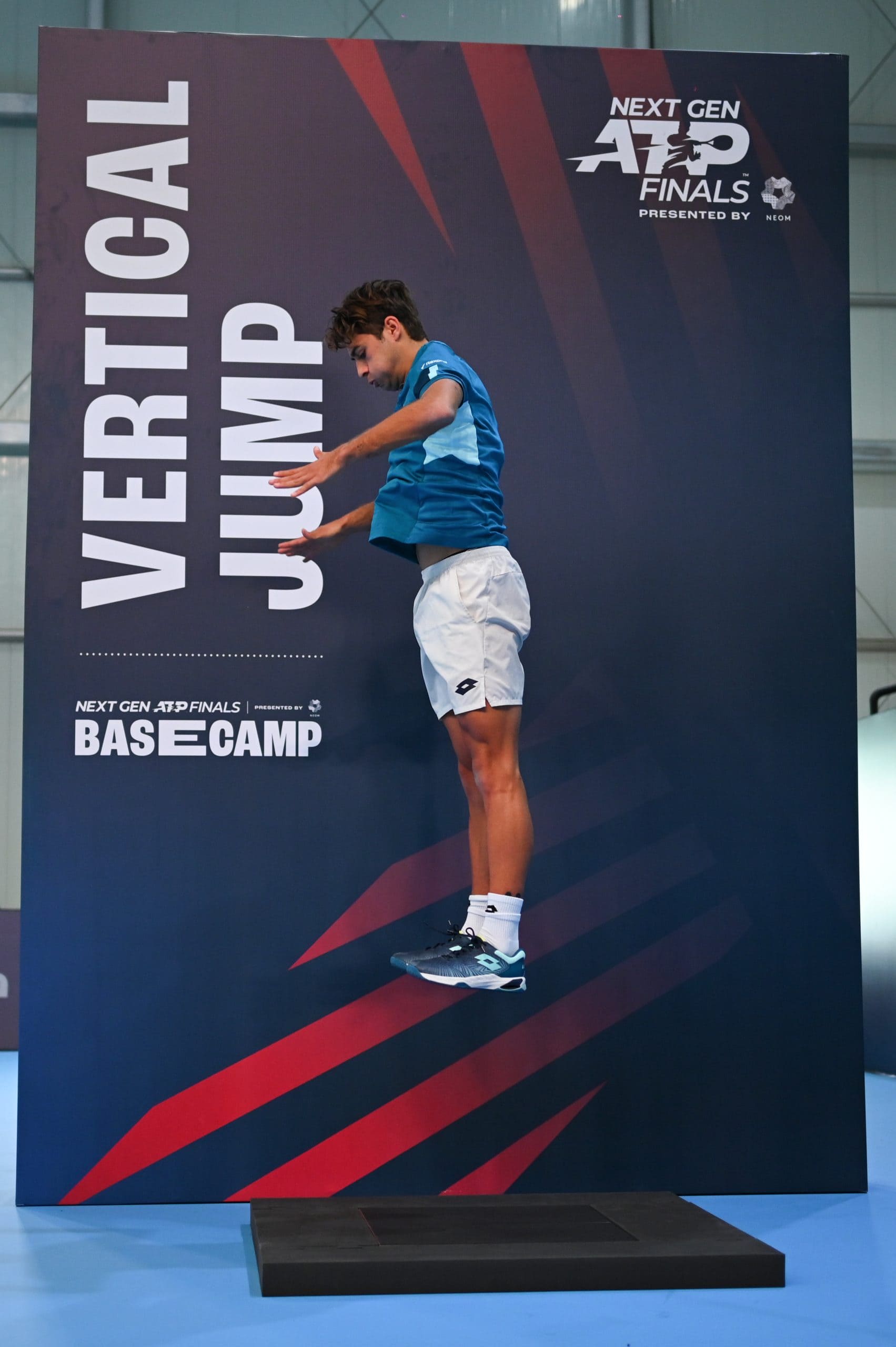
One of the motivations for the adoption of the new tech and data from Basecamp is to support athlete wellness guidelines, such as informing mandatory rest periods between matches. (ATP Tour)
“We really want you to understand yourself a little bit better off the court and tell that story to the fans as well because I think tennis players are great athletes, but we’ve never really had anything to measure that,” said James Marsalek, ATP Tour Senior Manager for Strategic Projects & Event Operations. “All these different metrics will then help us tell a slightly different narrative of, ‘Actually, you know what, they are [great athletes] because they compare X, Y and Z on the scales with basketball, football, whatever it might be.’”
The activations around the Next Gen Final were the most acute example of a broader strategy from the ATP Tour. In 2023, Tennis Data Innovations, which is the joint venture of the ATP and ATP Media, mandated that every tournament court have player and ball tracking. In March, Marsalek said the Tour started offering raw tracking data to all players for free. In September, the ATP and TDI created Tennis IQ, an analytics platform accessible to all ATP Tour players.
Marsalek said the goal is to have video embedded and synced to the data by 2025, with integration and visualization of wearable and other biometric data on the road map as well.
“It’s trying to tell this full story where players have got this one-stop shop that has access to everything,” he said, adding, “We tried to level the playing field and provide access to all our members.”
Though the ITF, the international governing body for the sport, began permitting wearable technology in matches back in 2019, the ATP didn’t sanction it until its most recent board meeting in November. It remains contingent on the Tour platform supporting it, which Marsalek estimated should happen in the first quarter of 2024.
“The ATP have got a hugely ambitious and fantastic opportunity to make data not just relevant but really progressive for the sport,” said BreakAway Data Head of International Business Ben Smith, who formerly led research and innovation at Chelsea FC. “Tennis, with the ATP leading it, have got an opportunity to help the sport progress over the next two, three years in a way that is, I think, hugely exciting and will advance both the physicality and the quality of the sport in a way that fans should be really excited about.”
In a video summary of Next Gen Basecamp produced by the ATP Tour, Arthur Fils — who ranked first in every category — could be seen celebrating his wins, a testament to the competitive spirit even with something brand news.
Just as often, the players asked, “Is that good?” Officials from the ATP Tour, ai.io and BreakAway Data were able to share some benchmarks, but more definitive norms will be established as this combine testing grows. Flavio Cobolli, who finished top-three in three of the four tests, called it a “good experience” and was quoted saying, “I want [Carlos] Alcaraz to do this for sure.”
Alcaraz is perhaps the premier athlete on the men’s Tour right now, whose 2022 US Open title run scored highly on the USTA’s Physicality Index, and would surely be a devastating combine competitor. But while the NFL Combine and team pro days are a rite of passage for all top prospects to improve their draft standing, that incentive doesn’t exist in tennis. To induce the elite players to participate, attaching prize money or other reward is likely necessary. But the accompanying videos and data may well be a new sponsorable asset.
“We ought to be a little bit creative,” Marsalek said. “We don’t have the same sense of jeopardy as the NFL does, where there’s a lot on the line, so we need to make sure that our athletes enjoy doing it. If they don’t, there’s no content.”
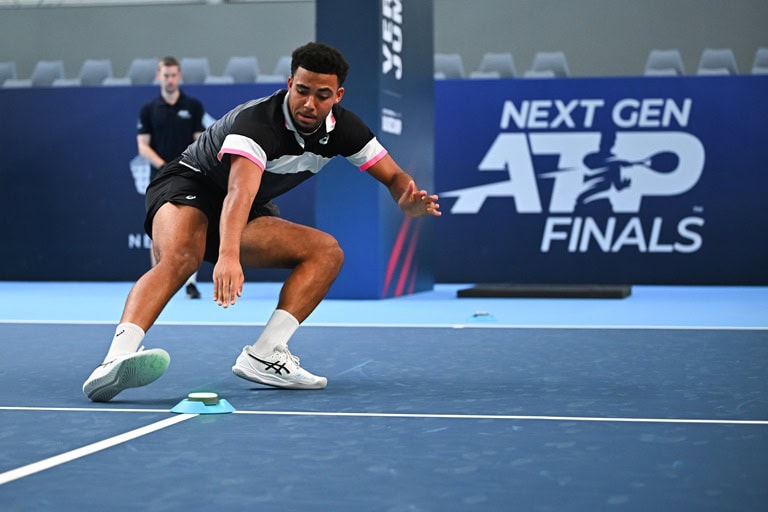
All of the data collected from Basecamp was shared with the players and some of it was published in web stories and social media to tout their athleticism. (ATP Tour)
The other motivation for the adoption of the new tech and data is to support athlete wellness guidelines, such as informing mandatory rest periods between matches. In the ATP’s 48-week season, most players average about 25 tournaments and, with Masters 1000 events all expanding to two weeks, that increases the amount of travel time.
Marsalek emphasized that data will not become the sole determining factor in decisions, but it is intended to provide a balance with an athlete’s feel in a skill-based sport. The goal is to encourage the use of data but have a centralized process to govern it — which should aid all stakeholders in tennis, just as was evident in Basecamp.
“It’s genuine high performance. Yes, it’s really enjoyable and competitive, and so the athletes have a good engaging experience. But there’s also valuable insight that those practitioner teams will take and move into the training environment,” Smith said, before adding about the development of data-driven narratives for fans. “That’s just really good, interesting engagement that, I think, opens up tennis to a slightly wider market.”
This article was brought to you by SBJ Tech, a Leaders Group company. As a Leaders Performance Institute member, you are able to enjoy exclusive access to SBJ Tech content in the field of athletic performance.