USA Bobsled and Skeleton have hired Marc van den Berg to help them craft a fleet of competitive sleds for the 2026 Winter Olympics.
Main image courtesy of USA Bobsled and Skeleton
A Data & Innovation article brought to you by

Short for “Made in the USA,” the new sled is the first of many that USA Bobsled and Skeleton is building with large financial contributions of partners that will see the Americans complete a fleet of about two dozen sleds over the next few years.
The M-USA project comes as the organization attempts to keep pace internationally and gain an edge leading into the Milan-Cortina Olympics in 2026.
“I feel our competitive advantage right now is our pool of athletes and our coaching staff,” said CEO Aron McGuire. “We’re lagging behind in sled technology, but that’s where we’re actively working to be on a level playing field with the rest of the world, Germany specifically.”
Indeed, everyone is chasing the Germans. They won seven of a possible 12 medals in the Beijing Olympics, including gold in all but one event and a sweep of the two-man podium. In monobob, where women compete in standardized sleds, the Germans were shut out with Americans Kaillie Humphries and Elana Meyers Taylor claiming gold and silver, respectively.
A team of engineers build German sleds at the government-funded Institute for the Research and Development of Sports Equipment. It has taken on an almost mythic-type quality in the sport, with a reported 80 employees and 7 million-euro annual budget — a total that is spent on other sports as well, but even a portion dedicated to bobsled eclipses many other countries.
To try to keep up, the Americans brought on Marc van den Berg to be their technology and equipment lead. The Dutchman had helped the Canadian team win gold in two-woman in Sochi and two-man in Pyeongchang.
Van den Berg joined USABS in 2020, finding the sleds lagging behind and spending the lead-up to the 2022 Olympics repairing existing sleds. At the time, the U.S. team was buying sleds from Europe.
“When I arrived over here, there was no workshop, no sled program, no runner program. There was no one with knowledge,” he said. “I had to build it from the ground up.
“It’s really hard to fight [the Germans], but I’ve got a lot of experience. There’s a lot of knowledge in the U.S. with racing and stuff like that, so I think we can do it, but it’s not going to be easy.”
Van den Berg started by enlisting partners who could help him rebuild the U.S. fleet. Mooresville, N.C.-based deBotech had long worked with USABS and its athletes on building sleds and signed on to produce the carbon-fiber bodies. Industrial designer Cameron Dempster designs sleds with van den Berg. Advance Mfg. Co., Inc. committed to building the chassis and the runners, or blades the sled rides on.
“We have a phenomenal team right now,” said Hans deBot, founder and president of deBotech. “This is probably the best and most wonderful opportunity that’s ever presented itself.”
It remains a challenge to effectively replace the Americans’ aging fleet of sleds.
In the 1990s, NASCAR driver Geoff Bodine helped fund and lead a project to get the Americans in new sleds rather than the secondhand European ones they had been using. In the 2000s, USABS partnered with BMW to build new sleds, and Steve Holcomb piloted the Night Train to four-man gold in Vancouver, ending a 62-year drought.
“When we’ve built competitive sleds, the U.S. has a history of being successful,” McGuire said.
The plan is to build 20 such sleds before Milan-Cortina, with a mix of development and competition two-person sleds, plus an additional three four-man sleds. (Advance is also making runners for monobob sleds.)
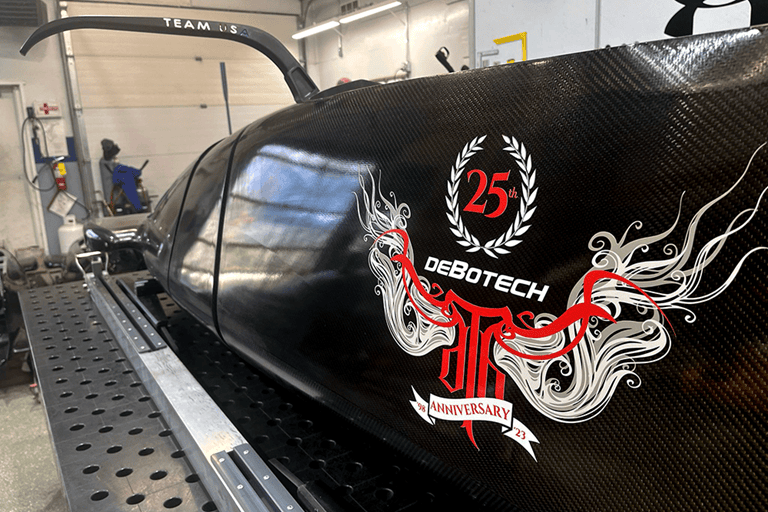
North Carolina-based deBotech is working with USABS and Advance Mfg. Co., Inc. to keep the team competitive with countries such as Germany. (Image: USA Bobsled and Skeleton)
Already, the Americans have four sleds on the World Cup circuit and plan to use feedback from athletes on the composites to tweak going forward.
“I think in 2014, we had the fastest sleds then after Germany got the fastest sleds,” said Meyers Taylor, a four-time Olympian and five-time medalist. “It’s really an arms race, but I think we’re moving in the right direction in terms of technology. To have Marc on board and to have partners on board, it’s really encouraging.”
It’s also the lifeblood of the project. USABS paid about $60,000 for deBotech to create the mold on which the new sleds will be based. But van den Berg estimated that in labor and materials, Advance is contributing around $1 million and deBotech is committed to $1 million to $2 million.
“Without these partners there was no project because we cannot afford it,” he said.
Advance, which had built runners for U.S. sleds for years, signed on to add chassis too. Like deBotech, the company wanted to support the athletes.
“It’s a great morale booster for our company and something that the whole team can root for,” said Jeff Amanti, Vice President at Advance. “Everyone can kind of get behind it.”
Sleds can cost anywhere from $28,000 for a monobob to $100,000 for a four-man. Once the M-USA project is complete, USABS plans to leave development sleds in Europe and Asia to cut down on the $125,000 to $150,000 it pays to ship sleds annually.
Many will be development sleds made on the same mold as the competition sleds. They’re similar enough that Love is competing in one currently as not enough World Cup sleds were ready when she made the team.
“What we did — 20 sleds — no one did that in the world,” said van den Berg. “Not even China with the Olympics with all the money, or Russia.”
Through the first month of World Cup competition, the U.S. team has three medals with the new sleds or runners, and van den Berg has heard from other countries inquiring about what they’re doing.
But the patriotic passion project for USABS and the partners will remain here. The M-USA sleds are not for sale.
In the latest edition of The People Behind the Tech Podcast, Peak AI’s Gary McCoy ponders the impact of artificial intelligence on coaching and performance.
A Data & Innovation podcast brought to you in collaboration with
Gary McCoy is the CEO of Peak AI, which has been shortlisted in Sports Business Journals’ list of the 10 Most Innovative Sports Tech Companies of 2023.
Peak AI uses psycholinguistics to enhance performance and Gary has a firm view on that coach’s comment.
“If you don’t know what they do, go and lead them because they probably don’t know what they’re doing either,” he tells Joe and John on the latest edition of The People Behind the Tech podcast.
“Artificial intelligence and data, as a general staple in sports, needs guidance,” he continues, “it needs transactional guidance to evolve the athlete.”
Gary spoke at length about the need for coaches to fully engage with AI and also dipped into a range of areas, including:
Listen above and subscribe today on iTunes, Spotify, Stitcher and Overcast, or your chosen podcast platform.
The former cornerback chats to SBJ Tech about his Coach Performance Assessment System.
A Data & Innovation article brought to you by
You can’t have a discussion about sports technology today without including athletes in that conversation. Their partnerships, investments and endorsements help fuel the space – they have emerged as major stakeholders in the sports tech ecosystem. The Athlete’s Voice series highlights the athletes leading the way and the projects and products they’re putting their influence behind.
* * * * *
James Hasty was a premier bump-and-run cornerback in the NFL for 14 seasons, mostly split between the New York Jets and Kansas City Chiefs. He received second-team All-Pro honors in 1997 and was named to Pro Bowls that year and again in 1999. A third-round pick out of Washington State, Hasty had 45 career interceptions, 24 fumble recoveries and 10 sacks before retiring after playing one game for the Oakland Raiders in 2001.
Hasty, 58, is now the Founder and Chairman of Eneje’ Consulting Firm that uses data and proprietary algorithms to champion the principles of equity, diversity, and inclusion among NFL coaches. The goal is to evaluate all candidates based on objective information — spurred by an insight from when Hasty coached at the Washington-based Bellevue High — and philosophical compatibility with the owners’ preferences. The hope is to surface more deserving candidates from all backgrounds to improve upon the league’s Rooney Rule.
On the origin of Eneje’…
Eneje’ as an African derivative word, essentially, means willingness to help your fellow man. The goal was to create a tool that allowed folks to grade a coach and his performance.
On what his experience coaching taught him…
I had coached high school football, and we were very competitive. In fact, every year that I coached at Bellevue High School as a defensive coordinator, we won the state championship. In fact, we beat De LaSalle out of California, and they had a 151-game winning streak — for nine years they hadn’t lost. What I struggled to show the kids is that the coach on the sideline didn’t have a game plan in his hand. What that showed me is that he calls plays off the top of his head, based off of what makes him comfortable, right. What I used was data analytics, to teach the kids the percentages of what they want to do in certain situations, and based on those percentages, we were going to set our defense up to stop them.
I realized, as a D-coordinator, I’m doing a lot of the work. I’m spending eight, nine hours a day breaking down film before I go to practice, and so what it said to me is, there’s got to be a way to create a system where we recognize people’s contributions to any organization, not just in sport, but in any organization everybody has a certain level of contribution to that organization. Everyone contributes towards a win, but they’re not all valued the same.
On gaining support for his idea…
That was the genesis of how I created this algorithm. Then I reached out to a friend of mine, Ronnie Lott, and I said, ‘Ronnie, I got this algorithm that I created, and it’s based off of these coaches and their contributions. So what do you think?’ And he’s like, ‘Man, that’s a great idea. I think you should go forward with it.’ I then went and met some folks that he suggested I speak to, and they encouraged me to continue to go.
I reached out to a friend of mine, his name was Dr. Steven Cureton. And Dr. Cureton and I go back to undergrad. He’s the head of the department now at the University of North Carolina-Greensboro, their sociology department. And I said, ‘Hey, I need to sign you to a contract, and I need you to come on board. I need you to go ahead and do the research on the hiring practices of the National Football League over the last 102 years,’ at that time, and he said, ‘I’ll do it.’ With the help of people like John Wooten who played with Jim Brown back in the day with the Cleveland Browns. Woot assisted us with meeting with different people to do the research into what they consider important elements of hiring a head coach or a general manager.
On developing Eneje’s interview protocols…
We talked to current and former coaches, we talked to lawyers, we talked to journalists, we talked to athletic directors, you name it. From that study came the creation of the interview tool that we have. Because some people will say, ‘The game is not just about analytics.’ This interview tool was critical because we were hearing about the whole sham interview deal that was ongoing within the National Football League, and so this tool essentially would work very simply.
Let’s say you’re the owner. We come in, and we say, ‘What are you looking for in your next head coach?’ And you say, ‘Oh, I’m looking for these variables: I’m looking for leadership, I’m looking for understanding of the salary cap, I need you to be a play caller, I need you to be a guy in the locker room that is great with the players.’ You’ve got these certain variables, as an owner, that you want your next head coach to have, whatever that might be.
We would take that same interview tool, and we would document all the stuff that you said you’re looking for. And now we would go and find a candidate that you had recommended to us, and we would interview those candidates separate of you and ask them the same questions. The interview tool would then record and transcribe their answers and grade your answers as it relates to your answers to see how closely they’re aligned to one another. In the heat of the moment, you want somebody that thinks like you. You want somebody that has a similar belief system that you have.
On the company’s qualifications algorithm…
We’ve got a tool that grades your background — high school, college, pro — and who you’ve developed and statistics during that particular year. I reached out to Dr. Filip Saidak, a professor of mathematics at the same school as Dr. Cureton, and Dr. Saidak said, ‘I can show you how you can add other elements to the algorithm.’
As an owner, let’s say you may want a guy that has a defensive background or you may want a guy that has a quarterback background, or whatever those elements may be to you, personnel-wise. You may be strong in some areas, but you may be weak in others. And so you want a head coach to offset those weaknesses. Whatever those variables are important to you, we can add those elements to the algorithm to where those coaches are graded accordingly. And you will find which of those folks, based on the quantitative formula, have the higher grade.
It’s not based on race, it’s all based on performance. And you’ve got the interview tool that looks to match your psychological compatibility with the owner as a coach. And so now you’ve essentially have two options as far as how to identify candidate.
On building an objective coaching network…
When it comes to the CPAS, which is the Coaching Performance Assessment System, we believe there should be a database, whereby we’re able to keep up with all the coaches in our database. We’re able to truly develop a pipeline where the NFL can always have access to knowing where and who and what coaches are available so that there’s never an issue where we’re talking about why are we continually hiring the same people? Because now there’s a there’s a place where you can go and find these coaches, and they have outstanding careers. And you’re not hearing about it through the media. You’re not hearing about it through a network of cliques of different former general managers, or former head coaches or whatever.
On the development timeline for the full platform…
CPAS, the database that we have developed, we put in a few thousand coaches ourselves right now. We believe that this database needs to be available for folks to join, and we want to make this available in the spring. So right now, I’m working with Microsoft to make it available in the marketplace so you can go and download the app. It’s available, but we don’t want it to go live yet — let’s just put it that way. You can go on Google Play, you can go into Apple, and you can find CPAS in there. Because of what we also have to get access to joining the database. But within that it’s also a tool that we call Huddle Up.
Huddle Up is basically [similar to] these podcast platforms like Clubhouse. There are these virtual rooms where people can go in, based on that particular topic, and they can talk about whatever the subject matter is. And in this particular case, we’ve created Huddle Up for coaches to go into these various rooms and talk on a podcast-like platform about their particular sport, any practice or game planning or anything relating to that particular sport. We want to use Huddle Up as a platform for coaches to engage and learn from one another, kind of like a peer-to-peer learning network.
On his vision for CPAS adoption…
Ideally, we’d like to make this a system for the league to use, not just for individual teams. We’d like to see a baseline approach where these owners have a place to start. What we do is we go back to the owner, and we say, ‘Here’s a quantitative grade. Here’s your qualitative compatibility score. Pick from these guys which one you want. It’s your call, obviously.’ We’d give them the information to where now they can go forward and have a better idea who may be the best fit for their organization. But our job is certainly not to tell them who to hire. We’re just providing information on these candidates that we believe in the long run [will succeed], based on the data, based on the research.
The former MLB right fielder was a recent guest on SBJ Tech’s Athlete’s Voice series.
A Data & Innovation article brought to you by
You can’t have a discussion about sports technology today without including athletes in that conversation. Their partnerships, investments and endorsements help fuel the space – they have emerged as major stakeholders in the sports tech ecosystem. The Athlete’s Voice series highlights the athletes leading the way and the projects and products they’re putting their influence behind.
* * * * *
The native Georgian had a football scholarship to play wide receiver at Clemson but instead signed to play baseball after the Braves drafted him in the first round out of high school in 2002. Three years later, Francoeur was an immediate sensation in the big leagues, earning a Sports Illustrated cover story with the headline, “The Natural.” Francoeur later earned a Gold Glove playing right field and played for the Texas Rangers in the 2010 World Series.
During his MLB tenure, Francoeur showed some versatility but had three particularly exceptional tools: his power, his throwing arm and his gift of gab. Amiable and gregarious, he endeared himself to teammates — often taking on a leadership role — as well as fans and the media. Following his first season with the New York Mets in 2009, Francoeur received the local BBWAA chapter’s Good Guy Award. Near the end of his career, an Atlanta columnist wrote a story headlined “Francoeur is first-ballot Good Guy Hall of Famer.”
It is little surprise, therefore, that Francoeur has become a successful broadcaster. He was the lead analyst on the Braves’ regional sports network before he recently scaled back his coverage, and also is part of the TBS playoff crew. As a side project, he also launched his own platform and podcast called Pure Athlete that seeks to help families navigate the world of youth sports.
On founding Pure Athlete…
I got asked to speak about a year and a half ago to a company, and I met a guy through it that lives in the area. We just started talking about youth sports. I got four kids now — 10, 8, 5 and 3, so yeah, so I’m busy — and I’m also coaching my kids now. If there’s one thing I was very blessed with, growing up, it was my dad’s ability to coach us, to love on us, to be hard on us. He had a great mix of it. He knew how to do it the right way to get the most out of, not just me, but people that he coached.
As I started getting into this man, I realized, that youth sports has turned into a freaking business. I mean, it really is. As I got going through this — Britt Lee and Brad Williams are the two other guys that I do it with — they’ve both got older kids and have been through it. We’re just telling stories of different scenarios we’ve seen. Honestly, we started Pure Athlete just with the idea of giving parents and coaches a platform to go to listen to other athletes, mental coaches and stuff and just get advice on the way that they see youth sports, ideas to do, different stuff. And I love it.
On his philosophy regarding sports specialization…
I make a big push for a multi-sport athlete. I was having this talk with Mark DeRosa [recently] on the golf course. Mark coaches travel baseball for his son, and he had a dad ask, ‘What do we do in November, December, January?’ He was like, ‘Go play basketball. Go play ice hockey. Do another sport and give your kid a break. He’s 12 years old.’ I just started hearing too many horror stories of that.
Most everyone we’ve talked to, where they really started to specialize or lock in was when they got to high school. If you’re in 10th and 11th grade and you feel like ‘I want to make a go of this thing,’ I’ve got no problem with that, especially when you start talking sports like golf and tennis. It’s a different skill set. But, at 10 years old, to be playing 140 baseball games, I have a problem with that.
On some of his podcast guests so far…
I thought of all the athletes I know in different sports and the connections, and it’s been great. We’ve had Dabo [Swinney] on, Chipper [Jones], Carli Lloyd, Misty May-Trainor, and just so many different sports, not just baseball, not just football, but different realms of people — Chase Elliott was on the other day, who’s NASCAR guy just to talk about his experiences. He had a father [Bill Elliott] obviously who was unbelievable, but he gave them a chance to grow a passion. And so for me, we started doing this thing, man and I had so many people reaching out.
Even former baseball player Shane Victorino sent me a couple messages saying how much he’s been impacted. David Murphy, one of my great teammates in Texas, his daughter is a stud volleyball player and having Misty May on, he was like, ‘We listened, and it gave such perspective.’
Honestly, I’ve gotten so much good feedback, we just kept doing it. We have probably close to 50 episodes, and I’ll be honest, I think I’ve learned more from this than probably anybody just on the standpoint of how I want to coach my kids and the way I want to coach.
On his own youth sports experience…
When I was in seventh, eighth grade, I’d do a couple of travel baseball tournaments, but I played football, basketball and baseball. I tell people this all the time. when I got done playing baseball in the summer — whenever that was, usually the first, second week of July — I didn’t touch a baseball bat until February. Or a baseball glove. I had football going on in the fall, and I’d go into basketball. And I was always all-in, no matter what sport I played.
Now you’ve got kids at these high schools, they might play a high school football game on Friday night and then drive to Jupiter, Florida, and play a doubleheader Saturday and Sunday. I’m like, ‘Why are you doing this? This does not have to happen.’ My background is I played all three. After my freshman year, I quit basketball. And then I just did football and baseball. I did six months football, six months of baseball, and I committed to go to Clemson to play football. Of course, the draft ended up happening, and I went the right way. But I think my biggest thing is we have too many of these young athletes starting to specialize, and I just don’t agree with that at such a young age.
On his own children’s sports of choice…
So that’s funny. My daughter plays travel softball, volleyball and tennis, and my son — I coached his first year of baseball — came up to me and said, ‘Dad, this is boring.’ For the last year and a half, he’s done lacrosse, man. I know it’s a northern sport, so I’m starting to learn, but I did not know crap about lacrosse. So I started watching videos, but it’s fun because, with him, he’s got two great coaches. And I just go to the game, and I watch. I’m a dad, I have fun, I enjoy it. He’s passionate about it.
And I think that’s the whole thing. Our goal at a young age — 8 years old, 10 years old, 12 years old — should be developing the passion for these kids that they have for the sport. I’ve always say I’m not one of these ‘everybody gets a trophy’ [guys]. Trust me: I’m old school, man. I want to win everything. I tell my 10-year-old softball team, ‘Every time we step on a field, we’re trying to beat the heck out of that other team.’ But I also tell him that we will never put winning over a development at that age. And if that means I’ve got to lose a game, that’s fine. It’s not that big of a deal. To me, it’s one game.
On the comments from guests that have resonated the most…
I’ve got three that absolutely stuck with me. Smoltzy — John came on, and he said one time that if your passion is greater than your kid’s passion, it’s not going to turn out well. It’s so true. If you’re the one that’s telling your kid all the time, ‘Let’s go to the cage. Let’s do this. Let’s do that.’ Chances are he doesn’t love or she doesn’t love playing what they’re playing.
David Pollack said something great one time. He was like, ‘We’re trying to talk about what 12-, 13-, 14-year old kids are going to be. Until these young girls or young boys go through puberty, you don’t know what you’re working with. Their bodies haven’t developed.’
And then Jay Bilas was the other one for me. Jay Bilas said, ’96.7% of all athletes finish their career in high school — not even Division III, Division II. So why are we not making this a great experience for the kids? Why are we putting so much pressure on them to perform at 10 years old?’
On possible business plans for the audience Pure Athlete has built…
We have some ideas here. You could have a platform where you could run some camps and have speakers come in and talk to some of these coaches just about the right way. Dabo Swinney said a great thing — we were talking about what makes a good coach. He said, ‘First of all, know what the hell you’re talking about. How many of these coaches do you have that come out that don’t know what they’re talking about? So now you’re getting wrong instruction.’ I don’t think we’ve really put a set thing on where it can go, but I think right now, we’re just enjoying seeing where it could go.
Orreco’s FitrWoman and FitrCoach apps can help to normalize conversations around female athlete health and provide an educational resource for athletes and coaches alike.
Main image: The new FitrWoman app includes cycle tracking for diverse menstrual cycles and hormonal contraceptives use as well as personalized content and recommendations informed by cycle status and symptom logging. [courtesy of Orreco]
A Data & Innovation article brought to you by
FitrWoman remains free for all users. The companion FitrCoach app — which helps coaches and sport scientists working with female teams — also received an upgrade and now offers both a free and premium option.
Users can input health information, such as symptoms related to the stages of the menstrual cycle, and receive educational resources catered to their specific needs at that moment. Among the enhancements is the ability to select a type of hormonal contraceptive for further personalization, with FitrWoman now offering eight user journeys instead of just one.
“We’ve increased the amount [of content], really translating that research and giving evidence-based material for a female health topic that is often taboo,” Orreco Female Athlete Specialist Jessica Freemas said. “We really want to normalize the conversation, and I think this app really helps do that through the resources that you can search and find specific to physiology, nutrition and symptoms all around how to train at your best and be at your best and really bring that body awareness and identifying patterns within yourself.”
The technical director of Orreco’s Female Athlete program, Georgie Bruinvels, is the science lead for FitrWoman and FitrCoach. Among the earliest adopters of FitrWoman after it launched in 2018 is American swimmer Allison Schmitt, a 10-time Olympic medalist who joined Orreco’s Female Athlete team last year.
“It really fosters a deeper understanding of your own health and well-being,” Schmitt said. “I think it really helps with knowing your own body — we always say, ‘Be the CEO of your own body.’”
There is growing research into the physiological impact of a female athlete’s cycle on her performance, with some early indications that the body has greater capacity of different types of exercise — such as cardio or strength training — at particular intervals.
That type of understanding hasn’t evolved enough for definitive recommendations but does warrant some guidelines for each user to internalize based on her own experience, noted Freemas, whose PhD studies included research on the effects of menstrual cycle hormone fluctuations on female physiology and performance.
“That’s so specific to physiology that not everybody might feel that effect,” she said. “It really depends a lot on the sensitivity to those hormones for each individual. And so the app is not prescriptive or diagnostic, it’s really just, ‘Hey, the research says that you might have increased readiness, you might have increased glycogen storage during this phase.’ And so take that as you will, if you feel those effects, learn about it and alter maybe nutrition or exercise performance and training. But there’s not a one-size-fits-all approach yet.”
Wearable companies Oura and Whoop are among those conducting research in this area as well. For now, FitrWoman relies on user-inputted data, but a technology integration is possible in the future.
Orreco, which received SBJ Tech’s Best in Athlete Performance Technology Award in 2022, conducted research that found two-thirds of women report changes in performance due to their menstrual cycles while barely one-quarter receive any information about it. Schmitt said the topic was never discussed in her swimming career until she developed significant physiological problems.
“The [Orreco] team really helped facilitate that, and my coach was very open to be on calls with the team and to discuss my period, which you would think is a very private thing,” Schmitt said. “But in a sport and especially when you’re working with a team, it’s very important to understand all aspects of the human body and it’s a little bit more complicated with a female athlete.”
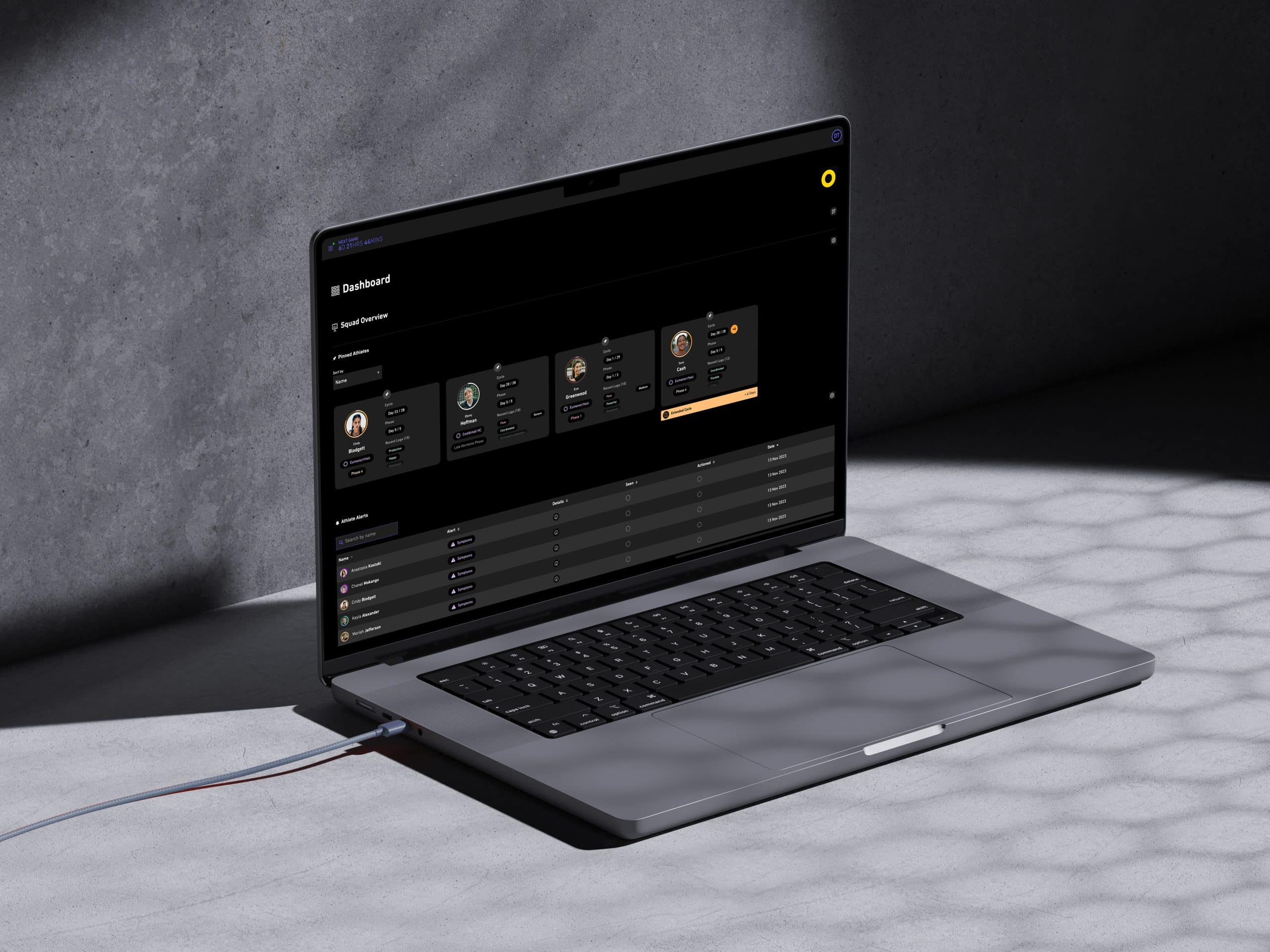
The FitrCoach platform integrates with the app and offers a dynamic dashboard and athlete profiles for coaches.
Helping bridge that gap — especially in more socially delicate situations of a male coach and female athlete — is FitrCoach, whose dashboard enables team-wide monitoring.
“The coolest thing is really the streamlined communication between FitrCoach user and athlete because the coach can see, ‘OK, this athlete has logged low back pain as a symptom for the last three cycles. I’m going to send her resources through this platform,’” Freemas said. “Maybe they’re not comfortable [with other] communication because it can be an uncomfortable topic of conversation.”
Freemas added that one of the other new features is the ability to add positive symptoms, a less-discussed portion of female physiology that she has personally researched.
“Oftentimes your menstrual cycle narrative is really that it’s a burden to exercise, performance and training and that it disrupts quality of life, which is true, but there are positives that come out from these hormonal changes,” she said. “Estrogen acts on the serotonin dopamine pathway that could improve mood at certain times. And so we want to bring that body awareness to a positivity of the menstrual cycle as well and be able to really harness your hormones as a superpower.”
The US Women’s National Team in soccer, USA Swimming and USA Volleyball are among the enterprise adopters of FitrWoman. And Schmitt makes clear that the reliance on this app is intended not as a crutch but as a resource.
“It’s also very important for us to have users understand that our product and our education is not to create an excuse because, if I’m at the Olympics and at an Olympic final, and I am not at my best, or I’m on my period, and I don’t feel like I’m at my best, I’m not going to be able to postpone the Olympics,” she said. “But we’re able to know that months in advance and really prepare and be proactive beforehand to best prepare me for that day.”
What are the implications for you and your team?
Main image: The PGA Tour demonstrated its generative AI virtual assistant at the Pro Am for Amazon’s re:Invent event in Las Vegas in late November. A video clip was generated after the AI assistant answered a question. Then the player would attempt to replicate the shot. [courtesy of Amazon]
A Data & Innovation article brought to you by
Limitations were apparent early — answers are not always factual, and there’s pending litigation challenging copyright protection on source material — but ChatGPT’s arrival forced everyone in every industry, including sports, to consider how generative AI might aid their end product or internal workflows.
“I would say it may be overhyped in the short term,” said Anil Jain, Google Cloud Global Managing Director for Strategic Consumer Industries, “but it’s definitely underhyped in the long term.”
AI has existed in sports for a quarter-century but not like this. Generative AI, the field that underlies ChatGPT, creates new data and content. Even what the public saw a year ago was not truly new technology, but it marked a change in scale and availability. It was officially ChatGPT-3.5; the original version, ChatGPT-1, was released in June 2018.
“The tech capabilities are a bit of an evolution — we’ve seen elements of this for the last couple of years — but the accessibility has become very revolutionary,” said Shaown Nandi, AWS Director of Technology for Industries and Strategic Accounts.
Microsoft-backed OpenAI may have grabbed the early headlines — and ChatGPT becoming a generic term for generative AI — but there are numerous entries in this space including those from Big Tech, such as AWS’s Bedrock, Google Cloud’s Vertex AI and Meta’s LLaMA, as well as other players like Databricks, Veritone, Pramana Labs and more.
Drawing on insights from more than two dozen leaders in the sports and technology industries, Sports Business Journal has identified applications of generative AI across media and content, operational efficiency, athlete performance, data analysis, marketing, customer service, ticketing and cybersecurity.
Already it’s being tested to fuel content in the NBA app, played a role in baseball operations for the World Series champion Texas Rangers, and automated commentary for highlights of tennis Grand Slams and the Masters in golf.
In some sectors, it will be a necessary cost center; in others, it can drive revenue. More use cases will emerge. And everyone stands to be involved.
“The uniqueness here is ChatGPT was the first time it was introduced to the public, and it was in an easy interface,” said WSC Sports CEO Daniel Shichman, whose company uses AI to automate the creation of video highlights. “It was not just behind the scenes. Everyone can interact with it. Everyone can see the magic of AI.”

CrowdIQ applies computer vision to generate crowd data from high-resolution photos. [Image: Detroit Lions]
WSC Sports does something that was unthinkable a decade ago. It ingests audio and video, recognizes the action and excitement, adds metadata tags for the archives and then generates video reels based on requested criteria, all without human intervention beyond the initial query. It has described its technology as “automagical.”
“It’s a very blurry line to say what is actually generative AI and what is just AI,” Shichman said.
Prior uses of AI in sports involved machine learning, computer vision and deep learning. Those sub-disciplines of AI had wide-ranging capacity to automate tasks, to scour through data for unnoticed trends and to track human and ball movement. Deploying machine learning on a CRM to identify fans’ needs is deeply useful, but it’s the creation of something new that more fully captures the imagination.
The closest one can find to a consensus definition for generative AI is that it requires — warning, gory tech terms ahead — a transformer-based neural network. A transformer is a deep learning architecture invented by Google researchers in 2017 that enabled more parallel processing for faster task completions and required less training time. (The GPT in ChatGPT stands for generative pre-trained transformer.) Generative AI can create in a variety of media, including images and videos, but it is commonly built on top of a large language model to create the conversational text exchanges.
“That’s a huge democratizing force,” Jain said of generative AI, describing it as “the ability to really understand and reason out, what is the intent of the words that are being strung together and how do we put those back. It’s all really complex math in the end. It’s mathematical representations of all these patterns and connections between words and ideas.”
Different models meet different needs. Google, for instance, developed Bard as its consumer-facing generative AI tool and Vertex AI as its enterprise offering. It’s an important distinction: ChatGPT, Bard and the like are trained on wide-ranging data sources, not all of them fact-checked, and such broad AI models are prone to “hallucinations,” which are fabrications generated to compensate for gaps in the training data.
Any product a sports property puts its name on for fan consumption or uses to drive business decisions will demand higher rigor. There’s a necessity for curated, verified datasets.
“The challenge with generative AI — and where you see a lot of fear and uncertainty being thrown out — is, because it’s creating new data, you then have to start asking about, ‘Did it create it with the right guardrails? Did it understand what was accurate as a source and what was inaccurate?’” Nandi said.
Creating a vocabulary of sport requires a bimodal process, Stats Perform Chief Scientist Patrick Lucey said, noting the prevalence of text and visuals. Stats Perform developed a tracking solution, Opta Vision, to extract data from video and bridge that gap. It can work on broadcast footage, using generative AI to model actions by players who are off-screen.
“Sport actually doesn’t exist in natural language — it’s a constructed language,” Lucey said. “At the heart of it, sports data is the language of sport. It’s how we communicate it, we understand it, [how] it’s codified.”
R&D for these large language models and generative AI algorithms has accelerated rapidly over the past year. One example: Microsoft has reportedly invested a total of $13 billion in OpenAI, with $10 billion allocated last January. (Training the most recent ChatGPT-4 model is said to have cost more than $100 million.) And it’s not just financial might, but collective brainpower concentrated on the field that’s rare in human history, with the recent exception of the scientific and medical communities concerting their efforts after the outbreak of the COVID-19 pandemic.
“Researchers and people from all over the world shifted from working on many other verticals, to researching and working on large language models and many implementations of generative AI,” Shichman said. “And I think that’s why we see this domain is moving so fast.”
An informal survey of North American sports leagues didn’t find much immediate traction except for the NBA working with Microsoft and WSC Sports to test some content in their app. The NFL has assembled an artificial intelligence task force from multiple departments to examine possible applications.
“That AI council has been meeting with some of our large partners to really figure out the landscape and where we need to go in this space but also trying to understand the regulatory things that may be coming down the pike,” said NFL CIO Gary Brantley.
“We’re not moving slow,” he added, “but we’re not sprinting.”

Amazon generated synthetic data to test scenarios around its Just Walk Out stores. [Image: Amazon]
On any given tournament weekend, 144 golfers compete in a PGA Tour event. That’s about 10,000 shots per day in the opening rounds. To superserve its audience, the tour first leveraged AI in 2018, partnering with Narrative Science to create automated written recaps for every player on the course.
That same year, the PGA Tour began collaborating with WSC Sports for AI-produced video highlights. By 2021, the tour adopted AI further through a new partnership with AWS; machine learning began helping power Every Shot Live.
Earlier this year, the PGA Tour became a launch partner of the AWS Generative AI Innovation Center. Scott Gutterman, the tour’s Senior Vice President of Digital Operations, said generative AI can create a chatbot that can answer historic questions (Who has the longest consecutive birdie streak?); betting analysis (Do Rory McIlroy or Jon Rahm have an advantage based on a certain pin location in the current weather?); or even logistics (What is the bag policy for fans at this week’s tournament?).
Between the voluminous ShotLink data, which is about to receive another enhancement, as well as the 160,000 hours of video in the media asset management system, the PGA Tour can provide multimodal replies: text, video and/or data.
“We have a lot of great content, but it’s in a lot of different places,” Gutterman said. “Generative AI can basically bring all that together in a response that allows you to ask that question and give you an answer.”
One burgeoning area several tech companies are exploring is automated audio. Using WatsonX, IBM debuted AI commentary this past year through analysis of specific golf shots and tennis points by drawing on past data — both numerical and unstructured text — to layer insights on video clips.
“We’re always focused on maintaining and building fan engagement,” said Monica Ellingson, IBM iX practice lead, sports and entertainment. “We all recognize the popularity of podcasts and audiobooks, and so not everyone just wants to watch their sports — they want to listen, out and about, they want to be caught up in what’s happening.”
Stats Perform and Veritone partnered last year to do the same. That product is “very close,” said Corey Hill, Veritone Senior Director of Product, noting that they will offer markers to insert ads into the commentary for monetization. What’s left is further refinement of that “compelling and engaging sports commentary vibe that you would get with watching a live match,” he added.
The automated voice can be programmed in any number of languages simultaneously and — with strict security permissions in place — can be produced using cloned voices of celebrities, athletes or newscasters. Because the AI engine can be programmed to never utter an expletive, the typically required latency could be eliminated, too.
“The other exciting, forward-looking concept is that, since we are actually not having to deal with broadcast delays, we’re actually faster to present commentary than the linear TV shows are,” Hill said. “So from a betting perspective, I think that puts us in an interesting space.”
That can be democratized to any level of sport, especially when combined with AI-powered video capture, such as Pixellot, which is researching the idea.
Julie Souza, AWS Head of Sports, Global Professional Services, said it could create a thrill for her school-age son: “You think about what a professional sports broadcast looks like — you’ve got talent and color commentary and all of this — I mean, wouldn’t it be great if gen AI could create color commentary for my kid’s hockey game and make it sound like it’s Paul Bissonnette and Henrik Lundqvist?”
Pratik Thakar, Coca-Cola’s Global Head of Generative AI, presented on the topic from the stage at Leaders Week London, noting the prospect of the technology in producing creative content.
“TikTok made everyone an entertainer,” Thakar said. “Maybe Instagram made everyone an influencer. Generative AI makes everyone an artist.”
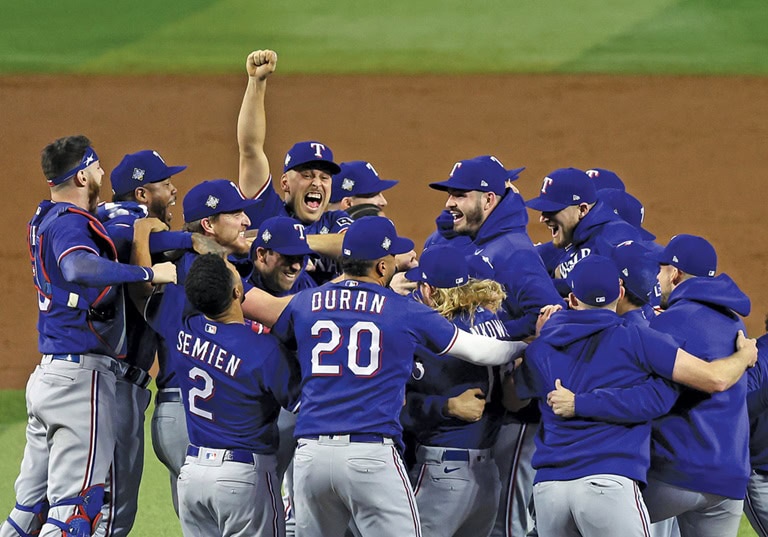
The Texas Rangers Celebrate winning the World Series in October 2023. [Image: Getty]
On MLB’s Opening Day late last March, Ryan Murray, the Texas Rangers Senior Director of Baseball R&D, entered a prompt into Dall-E, OpenAI’s image-generating companion to ChatGPT, to envision the Rangers winning the World Series. He had several of the results printed on canvas and distributed to his department, which adorned their desks throughout the season.
Generative AI didn’t exactly predict the World Series — with the Rangers indeed winning, their first title in club history — but the new technology did play a role.
Baseball clubs have vast quantities of data to consider, both in text via scouting reports as well as news coverage and especially in video, which spans game video, motion capture recordings from the biomechanics lab, high-frame-rate clips taken by scouts and more. The Rangers began implementing generative AI to help process all of that information for the sake of efficiency.
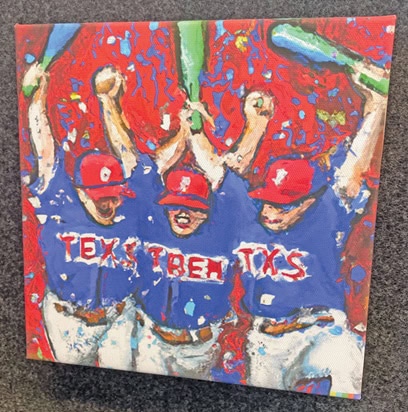
Before last MLB season, an OpenAI tool generated what a World Series win would look like for the Texas Rangers. Then the team experienced the real thing. [Image: Texas Rangers]
Booth acknowledged that, though a work in progress, generative AI’s use has “a lot of buy-in in the organization.” Some areas of continued refinement include ensuring that the algorithms understand the sport’s peculiar lexicon.
“The vernacular that a lot of the scout-specific authors use is pretty unique to baseball,” Booth said. “You may say something like, ‘This guy is built like a truck and throws gas’ — and that’s very, very positive — that he’s got a tree trunk arm. But your off-the-shelf generative AI model may not necessarily understand that. So while we can use pre-trained models to help do a lot of this aggregation and summarization, we’re really looking towards building and fine-tuning our own internalized model that is trained specifically on the baseball language.”
Databricks Head Evangelist Ari Kaplan was an early pioneer in baseball analytics, having worked for or advised more than half of MLB franchises in the past 30 years. He first used AI to make a personnel decision as an Astros consultant in 2007, using machine learning to make the case that Hunter Pence should be promoted to the big leagues. The Rangers are one of Databricks’ MLB clients, and they are developing sentiment scores to assess natural language evaluations. They can also determine if keywords such as “instincts” or “aggressiveness” have any bearing on performance.
“If you have a player who has 20 reports on them over the years, it’s frustrating for me to go through them,” Kaplan said, “and they said, ‘He is good at this. He’s inconsistent. But he has great bat speed. But occasionally he’s lazy running the base.’ I can’t make heads or tails over what’s the bottom line. Does the scout like him or not? So with gen AI, I could just summarize pros/cons or give a sentiment score. ‘This one report is 10 out of 10. But over a dozen scouting reports, the consensus is he’s a 6 out of 10.’”
For now, the Rangers are presenting the information via a retrieval-augmented generation model, a process by which users upload additional pertinent information to guide the algorithms. This can still be presented through a chatbot-style interface.
CrowdIQ CEO Tinus Le Roux envisions a future in which every employee has such a tool to serve as a personal data analyst. His company’s technology takes high-resolution photos and applies computer vision to generate crowd data — tracking its demographic composition and even fans’ attention. Such information can guide team decisions on start times, merchandise offerings, in-venue music and videos.
“Someone in game-day presentation won’t even know what to ask the data science people to improve what they’re doing,” Le Roux said, “but you can give them an app and say, ‘Make recommendations about how I can create a better vibe.’”
Pramana Labs has already begun implementing such automated assistants, who can use prose prompts to access enterprise data. “It’s a sea change in the way that people are going to do work,” CEO Corey Patton said. “I need to empower my subject matter experts to do things at scale.”
One such idea: Comb through typically siloed marketing, ticketing, sponsorship and viewership data to identify brand exposure. Patton shared an example: “‘When so-and-so driver is in the lead more than four laps, viewership goes up to X at this track on Sunday afternoons,’ and you’d be able to then sell sponsorships for that type of logo on a car.”
In addition to content generation, Noah Syken, IBM Vice President of Sports and Entertainment Partnerships, detailed customer service, human resources and code development as areas ripe for disruption through generative AI. Bundesliga is an early user of AWS CodeWhisperer, an AI-powered coding assistant. Google’s Jain explained how his team helped Fox Sports index its 1.7 million archival videos by adding more complete and consistent metadata, enabling clip retrieval by a natural language search.
Another area where generative AI is already helping businesses is in the training of other AI models. While developing Just Walk Out technology, the checkout-less retail experience, Amazon generated synthetic data to “create all these different possible scenarios, even unlikely ones, to be able to make sure that we were capturing everything and fraud was negligent,” AWS’s Souza said.
Asensei, which uses motion capture data for automated feedback, deliberately does not use generative AI in a consumer-facing manner, instead applying “old-fashioned AI” to ensure its human-led coaching expertise drives the user experience, CEO Steven Webster said.
“For generative AI in particular, the more exciting applications are when it gets buried inside a toolset in a product that you’re probably already using, and it makes that toolset and product better,” he added.
But, like Amazon, Webster noted that the generation of synthetic training data makes its markerless motion capture algorithms more effective. Even with the cost of compute power, generative AI is still cheaper and less error-prone than human data collection.
“One of the challenges of computer vision is you don’t want all the training data to be me in the same garage, with the same lighting, wearing the same clothing, with the same skin color, with the same body shape,” he said. “Because you’re really not training the machine to recognize the diversity of the real world it’s going to be out in.”
Souza and Webster both noted the circular nature of using AI systems to train AI systems. Webster took it a step further, saying, “What I’m really excited about is where the technology now exists — and I’m hearing myself just about to say this to you, and I’m like, ‘This is insane’ — that Asensei will be able to teach itself a new movement.”
■ ■ ■ ■
Google’s Jain spoke to SBJ while still reeling from the Arizona Diamondbacks’ World Series loss, so all of his hypothetical examples invoked his favorite baseball team. Among them: the creation of a pseudo-linear feed dynamically generated and completely personalized. Diamondbacks stars Corbin Carroll and Zac Gallen would be fixtures on Anil’s Baseball Channel.
“There’s a lot to be figured out there because I think the technology exists,” Jain said. “The question is, how do we make that feasible and viable and monetizable for media companies to be able to do it?”
The barrier to creating content is lower than ever, but balancing the P&L sheet could be a challenge, at least in the early going.
Technology research consultancy Gartner projects that 80% of large enterprise finance teams will rely on generative AI trained with proprietary business data by 2026. But a VentureBeat survey indicated that, while 73% of companies are either using or experimenting with generative AI, only 18% actually plan to allocate budget for that purpose.
“To use it at the enterprise scale and actually do things of value, there’s a significant cost to it,” Pramana’s Patton said. “So it will provide value, I am certain of that, but I’m also a little bit skeptical of the cost not being a barrier to the output in the future.”
The market is changing rapidly, in favor of democratization. Enough tech companies are building their own large language models that few will need to custom-build it; they will just apply what’s available.
“The cost to train a model could have been tens of millions six months ago, but now you may not need to train the model,” AWS’s Nandi said. “You have all these small models popping up. You may just need to add your data, and in a month or two, you may not need to add your data. You may use a Bedrock agent to constrain it.”
For those who do have proprietary data, it can be a new revenue source. The PGA Tour’s Gutterman noted the importance of cybersecurity for IP protection and what’s known as “red teaming” the models — industry slang for rooting out toxicity and bias — but having the tour’s golf data available for licensing could boost the bottom line for third parties wanting to engage with golf fans.
The definition of “rights holder” could evolve, too. “Another challenge/opportunity, which we’re already starting to see and hear in talks, is media rights,” Shichman said. “What does it mean to have media rights now that you can start to generate new things that didn’t exist before? Who is allowed to do what with generating content, A, on the training side of things, but B, on creating a type of content? What is considered to be part of the rights package that you acquired and what isn’t?”
The experts interviewed by SBJ saw AI improving workers’ productivity more than replacing them. And there could even be a new job description that emerges.
“We were joking that more and more companies are soon going to be needing to hire CPOs, which is chief prompt officer,” said Uplift Labs CEO Sukemasa Kabayama, whose company uses computer vision to analyze athlete biomechanics. “I think gen AI is going to be just as ubiquitous as the internet.”
The sports scientist behind recent British and Irish Lions tours discusses the real value of finding the right tech and the balance between domain expertise and leadership.
A Data & Innovation podcast brought to you in collaboration with
The question is posed by Brian Cunniffe of the UK Sports Institute [UKSI], who is Joe Lemire and John Portch’s first guest on The People Behind the Tech podcast for 2024.
Brian, a performance lead at the UKSI who works primarily in canoeing and who also served as the British and Irish Lions’ sports scientist on tours of Australia, New Zealand and South Africa, is discussing the power in gamifying training, particularly for younger athletes.
“There’s a slight irony in there but how do we bring it back to the stuff that matters, not just for players but for staff as well?” he continues.
“How do we help coaches on a journey to understand not just the stuff that players have completed but maybe some of the decisions that we need to take on a journey and learn from that so that we’re not replicating or duplicating and can be more efficient with our time?”
Elsewhere, Brian delves into:
Listen above and subscribe today on iTunes, Spotify, Stitcher and Overcast, or your chosen podcast platform.
Diamond Kinetics and Marucci Sports have have developed the industry’s first smart bat with a fully integrated swing-tracking sensor that never needs to be removed and charged.
Main image: Marucci Sports / Diamond Kinetics
A Data & Innovation article brought to you by
The new product, a limited release from Marucci called the CATX Smart, relies on new battery technology to provide a lifetime charge and is the first to be approved for in-game use by the United States Specialty Sports Association (USSSA), which governs a wide swath of youth baseball.
Users will have access to data, interactive games and content through the DK app. Notably, the Marucci CATX Smart bat retails for the same $299 price as the current CATX bat without the embedded sensor.
“The drive here was a very graceful, magical user experience,” Diamond Kinetics CEO/Co-Founder CJ Handron said, adding, “Overwhelmingly, this is taking the thinking out of it for the user, so the idea of having to thoughtfully say, ‘I need to get a sensor, put it on my bat, make sure it’s charged.’ That entire user experience is very doable — we’ve done that for a long time with lots and lots of people — but this is a completely mindless exercise.”
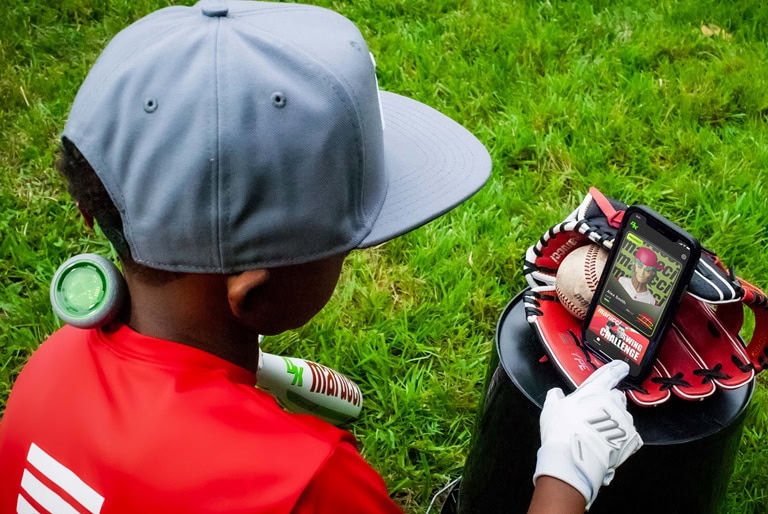
The CATX Smart bat connects via Bluetooth to iOS devices and can record more than 100 swings locally on the hardware when not connected to the app. Image: Marucci Sports / Diamond Kinetics
The CATX Smart bat is a one-piece alloy made from AZR aluminum that has the same weight and shape as its sensor-free counterpart. It connects via Bluetooth to iOS devices and can record more than 100 swings locally on the hardware when not connected to the app.
Marucci and DK first created a smart bat with a sensor embedded in the knob back in 2017, but that was for a wood bat and required extraction to charge the device. Prior to that, all sensors were affixed to the bottom of the knob.
“To be able to create a bat where the sensor is in the bat and it doesn’t need to be charged for the life of the bat was a really big deal for us,” said Marucci CEO/Co-Founder Kurt Ainsworth. “We didn’t really like the one that wrapped over the end — we wanted it in the bat because it’s also better for certifying bodies for it to be inside the bat where the bat can’t be altered. That was a big part of this.”
The USSSA is the first sporting group to certify the bat, but the goal is to complete the process for other leagues, including the BBCOR standard that has been adopted by the NCAA and high schools.
Bat sensors are currently prohibited in MLB but have been permitted in varying forms in the minors since 2017. Initially, only external sensors attached to the knob were allowed but, by 2019, embedded sensors were allowed at all levels of the minor leagues.
Though this new embedded sensor technology is available only in a limited release CATX Smart bat for now, Ainsworth predicted that “you’re going to see this in a lot more bat lines of ours moving forward.” When asked if DK might collaborate with other bat manufacturers for this type of sensor, Handron demurred, saying “we’re really focused on the relationship with Marucci.”
Marucci, whose parent company was sold by private equity firm Compass Diversified to Fox Factory for $572 million earlier this month, intends to produce training bats with the tech for older players who can use the bats in practice, even if they aren’t sanctioned in games, as well as for fastpitch softball.
Ainsworth praised DK’s app for gamifying baseball training while also providing young players the data they need to be successful.
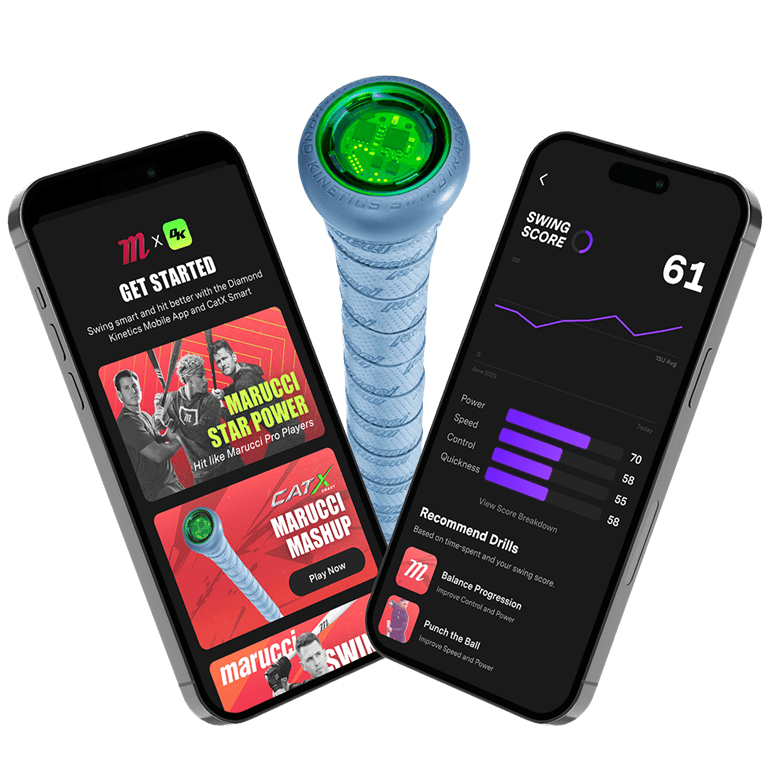
Users will have access to data, interactive games and content through the Diamond Kinetics app. Image: Marucci Sports / Diamond Kinetics
“What can that data do for you?” Handron said. “For us, that’s where it kind of hops and walks over into the app experience that we’ve developed, which is really meeting this generation of kids where they are, which is, What are the interesting and fun social digital experiences that you can marry together with physical play?”
Both men believe this will become universal, as reflected by intentional decision to list the smart bat for the same price as the one without the sensor.
“Why wouldn’t you hit with it if you had access to it?” Ainsworth said. “Why would you use another bat without it?”
“Marucci and DK are aligned on feeling like this can and will be the future of bats,” Handron added.
In this recent edition of SBJ Tech’s Athlete’s Voice Series, Johnson discusses how training has evolved since his retirement and how it has influenced athlete development.
Main image: Omorpho
A Data & Innovation article brought to you by
You can’t have a discussion about sports technology today without including athletes in that conversation. Their partnerships, investments and endorsements help fuel the space – they have emerged as major stakeholders in the sports tech ecosystem. The Athlete’s Voice series highlights the athletes leading the way and the projects and products they’re putting their influence behind.
* * * * *
Johnson, 56, has worked as a media analyst for track and field, mostly in the United Kingdom, on air for the BBC and in print for The Times and Daily Telegraph. In 2007, he opened Michael Johnson Performance, a training facility in Texas that has worked with Olympians, amateurs and Arsenal FC’s youth academy, among others. The physical building recently closed as the curriculum has moved into a fully digital model.
Recently, Johnson met Omorpho CEO/Co-Founder Stefan Olander and learned about the company’s “gravity sportswear,” micro-weighted apparel to improve the results of training. A connected app offers on-demand workouts for the proprietary MicroLoad products. Johnson recently became a brand ambassador of Omorpho, which in November announced a $3 million seed funding round led by KB Partners & Thirty-5 Capital, LLC, bringing the total investment to date to $16 million.
On his introduction to Omorpho…
I met Stefan, the founder of Omorpho earlier this year through a mutual friend, and as soon as he started telling me about what he was building with Omorpho, I was immediately interested. I’ve always been interested in training. After my athletic career, I started Michael Johnson Performance, my sport performance training and advisory organization, so I’ve been in and around sports performance and innovation over the years since my own retirement.
There have always been weighted vests and that are kind of cumbersome. And I’ve seen myself with the athletes that we would train, and you put it on them — it’s not comfortable, they want to get on with the training. It was really interesting to hear from Stefan how they were approaching this with the vest but also with apparel as well, which I’d never actually heard that before with weighted apparel.
On trying out the product himself…
Stefan said, ‘Okay, well, I’d love to send you some stuff,’ which I wasn’t going turn down free stuff. People are amazed — even when you’re an athlete and you’ve got the endorsement deals, which I had — you still get excited about free stuff. So anyway, he sent me some, and I was immediately just hooked on it and loved it.
I live near Malibu and do a lot of hiking. I’m always looking for ways to challenge myself more. I loaded up with everything I could — the gear with the vest as well — and just immediately loved it. So that’s how I got involved. Then we started talking about how I could help with what Omorpho was trying to do and getting this out there and helping athletes and people in the fitness industry to understand the benefits of weighted training.
On prior alternatives…
You’ve seen the parachutes for, not necessarily adding weight, but adding resistance. There’s all sorts of rudimentary ways in the past that people have done that sort of thing, to try to create more load when you’re training to increase the effect of whatever that activity is that you’re doing. The problem in the past has been, it’s always been adding stuff that doesn’t actually fit and that may not be intended for that particular purpose. Even though the parachutes are built for people to run with, parachutes aren’t for running. So even in that, it’s very cumbersome.
And at the end of the day, with what people are training, it doesn’t matter whether you’re an athlete, or whether you’re a fitness enthusiast, or you’re training just for weight loss, or whatever it might be, you just want to focus on the training — he movements themselves and the endurance that it requires and all of the athleticism that it requires to actually train. It’s hard enough and more difficult when you’re adding all of this stuff.
On how he added load in his sprinting career…
I just looked up on one particular ability for me to add load in my training. I had a chronic Achilles problem about the middle of my career, which caused me to not be able to use spikes, which don’t have a heel are very, very tough on your Achilles and all of your lower extremities, but good for training to actually hit the times that you need, to lighten the load and provide all of benefits that you do with spikes. And it simulates racing as well. But I wasn’t able to wear spikes because of the Achilles issue. So I had to run in regular shoes with a heel and with a little bit more support. Initially, of course, my times in the reps were slower because I wasn’t wearing spikes. So then that became my goal is to, wearing the heavier shoes, to be able to get down to the same times I was when I was wearing spikes.
It obviously creates a situation, when you’re actually able to put that load on, where physiologically now, you’re obviously getting stronger, no doubt about it, when you can hit the same sorts of times with that load. But it’s a huge psychological benefit as well. And so for me, then I never went back to the spikes. In fact, my coach, and I just decided, ‘Let’s go up to a heavier shoe, the same shoe I would do on my warmups.’
We decided just up the ante and go ahead with the with the heavier shoe that I would wear in my warmups so I already was very familiar with this loading effect before I even joined Omorpho. And I believe in it, and I’ve applied the same sort of thing to what I do now in my training when I’m hiking. Of course, I time everything. I’m just kind of obsessed with that, and I’m getting back to my same times when I was able to do it without the weight.
On improper added-weight training…
It affects your biomechanics. It affects your movement, which is really, really important for most training, regardless of what you’re doing. Let’s just say you’re doing plyometrics: obviously landing, it’s really important to land in the right position, otherwise, you’re much more susceptible to injury. And if you’re wearing some weight or something that’s not designed to move with you, then that’s going to create some counterbalance movement, and you’re now not focused on executing the actual plyometric movement.
Your focus now is on trying to make sure that you counteract whatever that piece of equipment you’re wearing is doing. Your body knows and will protect itself to try to make sure that it actually counterbalances that [extra weight], but then you may be off-balance and more susceptible to injury. and then mentally you’re just not focusing on the actual movements that you need to be and the workout was designed for —and that becomes frustrating. What we find is ultimately people just take it off and stop wearing it because it’s just not working for them.
On the evolution of his Michael Johnson Performance Center…
We closed brick and mortar, so we’re all digital now. We license all of the programming, all of our coach education courses and all of our youth programming to other organizations that actually are selling those types of programs and providing those services either to their own teams and athletes. Or they’re actually providing it through an app or something like that. Most of it is white label, but some of it is still our brand.
I’ve never actually been a coach. I’m an entrepreneur. I have the greatest respect for coaches. I know what it takes. I’ve hired more coaches than I could possibly imagine — over 100 coaches — as a big part of my business is coach education and we train coaches. So I understand coaches and what makes them great, and I don’t have that skill set.
On helping coaches with innovation…
I could certainly see [incorporating Omorpho]. Every coach has their own program, and it depends on what they’re trying to achieve. But there certainly are workouts for athletes of all sports and in fitness as well that benefit from loaded training and could be beneficial to the objective of the training program. So I certainly recommend it. Our clients are always looking for what’s new and more effective ways and more efficient ways that we can train. It’s just making them aware because a lot of coaches are scouring for what’s new out there.
On getting athletes on board…
You have to get buy-in from athletes. It’s really, really important, and it’s really difficult to do that when — whatever it is that you’re wanting them to do — is going to be disruptive to the training and it’s going to be cumbersome. Athletes are willing to do a lot of things, but at this point with technology and all of the innovation in the world, especially young athletes who grew up with this stuff, their position is like, ‘Why should I have to do something? There has to be a better way.’
We didn’t question it back in the ‘90s. There wasn’t all of this innovation that we have now. But young athletes are much more likely to question that there has to be a better way and there’s no reason for me to be putting myself through this. And that’s why I think you can get buy-in from athletes on Omorpho as well. It looks cool, which is pretty important now. Most people post their training on social media. It’s not behind the scenes anymore. So they want to look good — you look good, you train good. You train good, you compete good. So that’s another important factor. And I think, again, from a coach’s standpoint, that helps get buy-in.
On his use of Oura and what role modern tech would have played in his own career…
This Oura ring provides some great data to inform me about my sleep. If you have the latest one, it actually also tracks metrics throughout the day as well. It informs a lot that helps me make better decisions about my training, better decisions about what time I go to sleep, better nutrition decisions – all of those things, which helps me be better. If I’m competing and I have that, if everybody else has that, then it’s all the same for everybody. If only I had that, then yeah, I have a huge advantage. But that’s never been the case. Never will be the case. Everybody has access to the same technology.