The NHL Hall of Famer’s new helmet has received a five-star rating from the renowned Virginia Tech safety testing laboratory.
Main image: Jim McIsaac / NHLI via Getty Images
A Data & Innovation article brought to you by

You can’t have a discussion about sports technology today without including athletes in that conversation. Their partnerships, investments and endorsements help fuel the space – they have emerged as major stakeholders in the sports tech ecosystem. The Athlete’s Voice series highlights the athletes leading the way and the projects and products they’re putting their influence behind.
Over those 15 years, he scored 468 goals, added 545 assists and holds the all-time record of 1.17 points per game among American-born players. LaFontaine’s No 16 was retired by the Sabres, and he was included in the league’s 2017 list of the 100 Greatest NHL Players of All Time.
Though LaFontaine had a great career, it ended sooner than he would have hoped. He suffered a half-dozen definitive concussions but estimates the real total may have been twice that. The neurologist who treated him throughout his career — Dr James Kelly, a professor at the University of Colorado Anschutz Medical Campus who previously held a leadership position at Walter Reed National Military Medical Center — became a friend.
“Jim and I became very close over the last 25, 30 years,” LaFontaine said. “He was the doctor that cleared me to play, and he was the doctor said, ‘OK, that’s enough.’ I’m extremely grateful to him.”
LaFontaine, now 58, and Kelly are also now co-founders in a new venture, Valor Hockey, that has made a highly-rated helmet. The Valor Axiom received a five-star rating from the renowned Virginia Tech safety testing laboratory, the first new helmet to garner that best mark since 2017. The Atlantic Amateur Hockey Association, which is affiliated with USA Hockey, is the first league to partner in promoting the Valor helmet that retails for $299.
On the origin story of Valor…
It actually started when Dr Kelly and I looked into doing something in 2004. A company had a material that was 40% more absorbent and could deflect and absorb impact I think better than what EPP was at the time, which was the mainstay. What we found out was they went into an IP lawsuit issue with the material. So we tucked it away for a little bit.
We started talking again around 2016 or so. There was an opportunity with another impact material that we were looking into. The irony was [the helmet] was originally designed by a guy named Jose Fernandez. He did X-Man, he did Batman, he did Ironman. So it was more of like, ‘If you could do a futuristic, cool design of what a hockey helmet is in the future.’
We spoke with a gentleman, a designer and partner now, named David Muskovitz. So David did the engineering and did the final design, but we took an initial design and said, ‘OK, how do we make this safer? And how do we make it perform really well, fit really well? And then how do we make sure we can manufacture it? And most importantly, make it safe?’
We created a monoshell, which is a one-piece shell. I think one thing it’s important I want to say 98%, 97% of all helmets are two-piece shells, which we found interesting. All the NFL and motocross and lacrosse and Major League Baseball [helmets] — why are they one-piece shells? So we came up with a slogan ‘beyond traditional safe’ because in the hockey space, two-piece shells are traditionally safe. Then we found out making a one-piece polycarbonate injected shell is not easy with that kind of a design. But if you build a really good one-piece, and a really good two-piece, the one-piece will always outperform and be safer. Why? Because of the impacts will be distributed more evenly versus a two-piece.
On the shape of the helmet…
Dr Kelly described this in a really good way. We literally took that design, and we created smoother, slightly rounded edges around the sides of the helmet, and then the back and then the front. We made a lower profile with a little bit of an angle for deflection. The way he puts it is, so take a cue ball and then take a Rubik’s cube, and the cue ball hits the cube and it kind of grabs it, torques it, spins it and sometimes breaks it up because it’s got more flat spaces. Well, then take another cue ball with a billiard ball and hit it. And if it’s got more slightly rounded, smoother edges, it’s going to deflect and ricochet and glance.
On minimizing the magnitude of impacts…
You’re not going to stop a concussion — nobody’s going to stop it — but now knowing the science and the testing, you can minimize damage. And over the course of somebody’s career, you think about some of these catastrophic hits, these big hits, then you think of these every day compression hits, over a period of time, the brain in the head isn’t built to sustain those.
I don’t know exactly what the measurements are, but if somebody says you could get a Grade 3 concussion with one helmet, and potentially a Grade 2 or 1 concussion [with another helmet], that’s significant. You accumulate that over a period of time. Minimizing the damage makes a massive difference in the livelihood.
On the helmets he wore as a player…
Dr Kelly said something very profound to me along the way. We didn’t have the testing and the science behind the linear and rotational testing — we didn’t have that back then. This is just the way it was back then. The helmets were what they were. But if it was graded today, it was probably a zero to a one star.
Knowing now what a five-star [helmet] is, and the impacts that it takes to distribute the force load, and Jim actually said to me, ‘I can professionally and publicly be able to comfortably say, after knowing what I know about science and the testing, that you would have most likely had between 50% and 60% less damage during the course of your career. And to me, that’s profound.
On his own experience with concussions…
I’m here telling you the story because I lived it. I went through post-concussion syndrome twice. I went through one extremely dark period of time where things got really scary and depressed, and I really didn’t see a light at the end of the tunnel. I know what can happen if you hit your head enough, and you can do damage.
Fortunately, my brain found its way back. I was able to get that enthusiasm and excitement back. Dr Kelly was willing to let me go back again but warned me, ‘If you take another one, you’re probably going to go through a [dark] period of time again because there’s a threshold that you cross. What used to take 10 days to two weeks to recover is now taking you months. I probably had about six to seven [concussions] documented — when I broke my jaw, we never documented it, but I guarantee you I had a concussion. And then I probably had another handful of dings that I saw stars but we didn’t count them. I’m somewhere probably around double digits, 10, 12, concussions.
I went through six months [of rehab] twice. The second time wasn’t as severe. But even then, there was a part of me relieved that I didn’t have to make that decision, and then a part of me had to let go of something I loved since I was a kid. So it was still difficult to deal with. But I heard something really profound. I read this book called Legacy about the All Blacks rugby team. There’s a quote in there that talks about if, you’re a true servant and leader of your sport, then you have a responsibility to leave it better than you found it. My wife struggled watching my son play. He had a couple of concussions, then she couldn’t watch, having lived through what her husband went through. Now we have a little grandson who’s three, whose name’s Patrick. And you know what, I know that, should he choose to play hockey, that there’s going to be safer products for the next generation.
On how hockey shaped him…
I’m grateful for what we had when I played. This is something to take and [ask], how do we create an evolution of where safety continues to go and I think that should be a natural thing to do anyway. Listen, if I didn’t retire after 15 years from concussions, there wouldn’t have been a service and purpose for me to do this. So I always believe, in life, your experiences, good, bad or indifferent, whether you realize it or not, prepare you for what’s to come next in your life.
I believe your experiences shape you into your service and purpose. And hockey was always a stepping stone. I’m grateful for what the sport has done for me. But it’s put me into a place in my life where everything I learned from those experiences, has taught me how to give back in a purposeful way, a meaningful way and a service way. And I have a mantra in my life, whether it’s my foundation, or whether it’s what we’re doing with Valor, “Score your goals when you’re young because, when you get older, life is about the assists.”
On the values instilled by hockey and in the Valor brand…
Being a player, I was blessed, and it was a privilege and an honor to play in the pros as long as I did and represent my country. The game was my life, and it still is. I say that, even though I don’t play as much, the game still lives inside me. The character lessons, the life lessons, the values, the life skills, leadership, teamwork, getting through adversity, getting enough discipline, the friendships, the relationships, all of those things that you learn in the sport of hockey still are so much a part of who you are in your life going forward, which is really a big part of what the brand is built on.
The Declaration of Principles which we launched with the National Hockey League — the tip of the spear, that north star — and we were able to get the global hockey community to sign off on values and principles to aspire to live to. So part of the Valor brand is based on those declaration of principles and bringing those to life, whether it be in products, programs, technology, services. From my perspective, it’s so important that sports play a role in our society and our next generation, so creating a positive and safe environment is right up there as one of them.
Zendler speaks to Joe Lemire and John Portch about her work with Rimkus and the NBA and NBPA’s Wearables Validation Program.
A Data & Innovation podcast brought to you in collaboration with
The Program Manager of the NBA and NBPA’s Wearables Validation Program is discussing her first steps in the role with Joe and John on the People Behind the Tech podcast.
“Academic-type folks, we don’t like to set thresholds that exist for pass-fail,” she continues, as she explained the process of speaking to players and coaches and taking in all the relevant research.
“We want this to be rigorous, we want the players to have confidence in these devices, we know they’re generally hesitant to wear them and there is pushback.”
Zendler also spoke of balancing the need for commercial viability with real-world application, which chimes with her role as a sports science consultant with Rimkus, a worldwide leader in technical consulting and forensic engineering.
During the course of the conversation, we also discussed:
Listen above and subscribe today on iTunes, Spotify, Stitcher and Overcast, or your chosen podcast platform.
He is a rare technologist well-versed in bureaucracy, has just completed a 12-month listening tour of the league’s 32 teams and his first initiatives are starting to take shape.
A Data & Innovation article brought to you by
Rather than detail an immediate list of objectives, he embarked on a listening tour. Brantley met with every department of the league’s sprawling operations, spending enough time with each to understand the nuances of their roles. He spoke to the technology leaders at the NFL’s 32 franchises to learn their local issues and considerations.
Now, 12 months after taking the job, Brantley’s early initiatives are taking shape. Chief among them is the creation of an NFL Innovation Hub that seeks “to create a culture of innovation, cross-functionally and across the league, that allows us to operationalize ideas fast,” he said.
Guided by what he spent the past year hearing, Brantley has also played a role in streamlining efficiency, hiring three new roles in his department, creating a council to study artificial intelligence, helping the implementation of an updated credentialing system that uses facial recognition and introducing a concept that’s been called “Football as a Service.”
In his 2019 book — The Art of Organizational Transformation: 7 Steps to Impact & Influence — he wonders aloud why leaders are in such a rush to make changes ‘without being a part of the entity long enough to understand the true internal needs.’
“The first thing I’m trying to do is really understand how the organization operates,” Brantley said in a series of conversations with Sports Business Journal. “I don’t want to hear anything about tech — I’ll get to that at some particular point — but, how do you operate as an organization? What do you care about the most? What makes you go? How do you create revenue? All those types of things are interesting to me. And then I try to surround tech around it to be a support function for what the organization is trying to accomplish.”
Over the past quarter-century, Brantley has worked for big tech companies such as IBM and MCI WorldCom, founded his own faith-based media site, led technology at multiple levels of government — the state of Ohio, the city of Atlanta and the school system of Georgia’s DeKalb County — and then worked in the C-suite of a large home construction company.
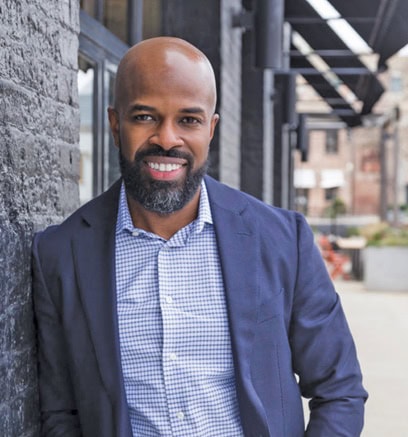
Image courtesy of the NFL.
Raised in Youngstown, Ohio, the son of a 30-year AT&T veteran, Brantley hails from a high-achieving family: His three siblings include a doctor and two attorneys.
These experiences have shaped Brantley. He is the rare technologist well-versed in bureaucracy, an innovator committed to efficiency, the entrepreneur with a long tenure in the public sector and the business leader who can roll up his sleeves and code — not to mention an accomplished drummer with an enviable collection of Jordans and a sub-two-hour half-marathoner who commutes to league headquarters on an electric scooter.
His hiring in October 2022 came at the end of a lengthy search, following Michelle McKenna’s departure as NFL CIO in March that year, but Brantley’s fit for the post quickly became apparent once he applied.
“When I interviewed him, I was like, ‘He gets it,’” recalled NFL Chief Administrative Officer Dasha Smith, noting his “understanding that you have a lot of key stakeholders, and every single one of them is very important. It’s really about consensus building.
“I knew within 10 minutes that Gary, honestly, was the one — based on his experience, based on being a real technologist, his humility, which is something that is really unique for someone who’s as talented as he is, and then he’s a sports fan, so that was good.
“He really just checked every single box.”
■ ■ ■ ■ ■
The IT department of some organizations is relegated to the same status as referees and umpires, in that they’re only noticed when there’s a problem. At the NFL, that expectation of smooth operation without drawing attention to itself is very much there — but that’s only one part of a broad remit that also includes everything from HR and payroll to player health and safety and the searchability of the NFL Media archives.
“We have no room for failure on the technology front,” Smith said. “A lot of people don’t see all the pipes behind the scenes that go into making sure that that you and I can watch the game, that the coaches can talk to the quarterbacks on the field, that their Microsoft Surfaces are all working correctly. We cannot have any points of failure, so first and foremost, making sure that the game could be played flawlessly. Every single game.”
But, she continued, technology is also a strategic priority with the NFL wanting to continue as a leader in the space. That’s what lured Brantley to the role; he describes himself as “a creator and more of a business entrepreneur than, I would say, a traditional tech guy. I see myself as a business guy who just understands tech really, really well.”
“Technology needed to be a core component of the organization that I was working for, not just a back office support organization, not just a cost center. I wanted an opportunity to really use technology to be able to affect positive outcomes,” Brantley said.
The NFL’s Deputy CIO, Aaron Amendolia, is a long-tenured member of the department who admitted that “every time you have a new leader come in, you’re always holding your breath about what’s this is going to be like, and it’s been refreshing,” he said, noting “Gary’s focus as a leader is always on communication and transparency.”
Together, they’ve endeavored to reconsider the role of the department. Messaging is important. The final chapter of Brantley’s book, after all, is titled Shaping and Controlling the Narrative. Along with adding a vice president of IT business services and posting for a vice president of football technology, Brantley hired the department’s first communications professional, to help craft storytelling.
“When you’ve been here for a while just doing IT for operational sake, you just do the operations, and you’re more attached to the systems than the outcome of what the systems do,” Amendolia said. “We’re actually tying to [ourselves] some of these business objectives and goals. That’s what we think will really change the perspective of IT from being this cost center and as being an operational back-of-house type of service to a strategic partner with the league.”
The Innovation Hub is the most concrete example. It’s a common platform within Fortune 500 companies but new to sports. The Hub is a way to standardize the process of ideating, monitoring and measuring progress. Major partners, such as Amazon, Microsoft and Verizon, are invited to collaborate, but it also can be used for crowdsourcing solutions, much as the NFL has found success with the Big Data Bowl and its health and safety competitions.
The idea germinated last spring, recalled Jason Dvorkin, AWS principal industry specialist for media, entertainment and sports, after Brantley gave a presentation on innovation at the National Association of Broadcasters conference. Conversations grew from there about how to shape this idea what Dvorkin described as Football as a Service — to take media and data such as the NFL Next Gen Stats and “make that all available in a centralized way, so that whoever needs it at whatever point in time in the process has a way to access it,” Dvorkin said. N-Ovate Solutions is spearheading implementation of the Hub.
Brantley then went out to build support, counting 39 meetings over six months. This is where politics, salesmanship and charisma become important.
“You can build and spend all types of money on technology, and no one really adopts the change. And that’s what you don’t want. And so everything about aspects of innovation, change, the ability to move the needle — it’s all people-focused,” he said, adding, “If you can go and you can approach it in a way that they don’t feel like it’s being forced on them, but they also feel like they had a piece and a part in it, it really helps us to speed things up.”
The conceit is to flip around the old truism that one has to hurry up and wait for other necessary pieces to fall into place for a project to move forward. Instead, it’s about waiting for the right idea and then hurrying up its completion.
“His vision is around trying to find the technology of the future and not make a snap decision. He’s looking five years out, 10 years out,” Dvorkin said.
“And he’s using us and our experience to help shape that operation. I mean, you look at what’s been done in player health and safety right now, using computer vision to create that Digital Athlete. He’s realizing that there’s more to that than just injury prevention. It’s: How do we start to coach the game of football better? How does that provide insights into the lower levels of the game to help cultivate and foster that next fan, to actually become passionate and deeply invested in the league?”
But innovation isn’t strictly relegated to the transformational ideas, either. Amendolia emphasized the importance of back-end efficiency to free up resources and time.
Brantley noted that it’s common for large organizations to be unaware of their redundancies or the full capabilities of their tools. He undertook a process called application rationalization, a mechanism of modern IT management to assess their software portfolio. He said they’ve identified 419 applications across the league, of which 40% show some redundancy. Different departments, for example, might use Microsoft Teams or Slack or Zoom for communications.
Aligning the league on shared platforms can be a major boon, though he acknowledged the importance of a multicloud environment and noted that compartmentalization is good — a point driven home during his time in Atlanta.
■ ■ ■ ■ ■
When Brantley arrived in Atlanta, the city was in turmoil. In March 2018, the capital of Georgia was stricken by a brazen ransomware attack, and it was still reeling from the consequences of that when Brantley took over as CIO in October of that year.
He discovered that the city had only one firewall in place, which thankfully protected the world’s busiest airport, Atlanta’s Hartfield-Jackson, but most of the city’s other services were shut down. That included four or five systems each for email, customer relationship management and permits. By the time he was done, many of the solutions were consolidated, and he bequeathed the city 37 firewalls to contain any future network breaches.
“The goal was to make lasting change and to create an environment that will protect the city for years to come,” Brantley said. “There was going to be no innovating here. I had to rebuild an entire city infrastructure that was depleted. I didn’t have time for a three-year technology plan. There was a 12-month road map that was tied to making sure my team got back to general basics and general hygiene of how you operate a successful environment.
“They all knew things needed to be improved. So I knew I would get the resources and the funding that I needed to turn this around — for a short period of time. And then it would go back to what government is.”
By contrast, Brantley said, the NFL is “more nimble and flexible,” owing largely to the team owners, who have a more business and revenue-generating mindset than, say, a community-focused city council. The missions are very different, but his fundamental approach to enacting change within organizations is similar. What he said about rebuilding Atlanta’s technological infrastructure seems applicable to how he began his tenure at the NFL.
“I saw the end,” he said, “so I knew where to start.”
Rugby union’s world governing body has teamed up with Prevent Biometrics to help monitor and protect players across the globe.
Main image courtesy of World Rugby
A Data & Innovation article brought to you by
The sensor-laden mouthguards track linear and angular accelerations, and when a rugby player endures a blow in excess of designated thresholds, an independent medical professional on the sideline receives a Bluetooth alert. That athlete then enters the HIA protocol to be evaluated for a possible concussion and needs clearance for return to play.
The new HIA policy won’t officially go into effect until January 2024. Participants in the international women’s rugby tournament WXV, which took place in October and early November, trialed the technology. World Rugby is also investing $2.4 million into facilitating the universal adoption of the mouthguards.
“It’s a game changer for our sport — it’s bringing tech into the space where it never has been,” World Rugby chief medical officer Éanna Falvey said, noting the overarching mission is to track each athlete’s overall impact load. “The focus of this is about individualizing care.”
Mouthguards are widely seen as the most accurate solution for impact measurement because the upper jaw is affixed to the skull. Prevent Biometrics outfits athletes across multiple continents, sports and age groups with World Rugby having used the technology extensively over the past three years. The instrumented mouthguards are worn in both training and matches in an effort to collect data not only on diagnosed concussions but also the cumulative impact of sub-concussive blows — the accumulation of sub-concussive hits are the most likely culprit of potential long-term damage such as Chronic Traumatic Encephalopathy (CTE).
The sport’s governing body has funded studies conducted by independent researchers at a number of academic institutions, including New Zealand’s University of Otago. Roughly 600 community rugby players in that country, from the Under-13 age group on up through adults, began wearing Prevent Biometrics wearables in 2021. A year later, the devices were offered to all elite English rugby players and all women competing in the Rugby World Cup that took place a year ago.
In all, Falvey reported that World Rugby has collected data from roughly 300,000 head acceleration events. (Across all sports, Prevent Biometrics has collected more than a million impacts.) That dataset is beginning to inform guidelines for the typical frequency and severity of collisions in the sport. He said 60% of those impacts are under a force of 20g, which Falvey described as not much different than normal physical activity.
To start, World Rugby has set alert thresholds at 70g for linear accelerations for men and 55g for women while the trigger for angular acceleration is 4,000 radians per second-squared for both. Falvey said that, of the roughly 80,000 head impacts per match for all players in an elite rugby game, only 0.3% are above that threshold in men’s matches and 0.08% in women’s matches.
For context, he said that equates to about one additional HIA protocol per men’s match that wouldn’t have already been initiated due to other symptoms — importantly, this new technology is meant to supplement what’s already in place.
“If we set a threshold where there are 10 alerts per game, basically, you’re going to have 10 different players removed, the majority of those will not have any clinical manifestation, will pass their test and will go back on again,” Falvey said. “So very quickly, you’re going to have a group of people who become disenchanted with the process and don’t want to engage with it any longer.”
Prevent Biometrics, whose technology was spun out of research from the Cleveland Clinic, processes the data on the mouthguard — “on tooth,” as Falvey described it — meaning an alert would reach the sideline in less than five seconds because there’s no need for it to be transmitted to the cloud first. The speed is important because research from the University of Pittsburgh Medical Center has indicated that, for every 15 minutes an athlete remains in competition after a concussion, the duration of his or her absence before returning to play is extended by three days because of worsening symptoms.
The mouthguard itself isn’t making the diagnosis but helping identify athletes who may be in need of proper evaluation.
“We’re never going to be in a position where you have something like an instrumented mouthguard telling you about concussion,” Falvey said. “But what you will be in a scenario is, I think, you’ll be able to say, here’s a threshold for your age, and for your concussion history and for your previous injury history that, for you, if you get if you get an impact above this level, you should sit it out.”
Prevent Biometrics CEO, Mike Shogren, said continued the latest iteration of the product have followed the simple remit that head impacts “had to be accurate, and the data had to be accessible as fast as possible.” The company raised $5 million in early 2022 to help develop the 2.0 version of the mouthguard, which has a 60% smaller profile than its predecessor and is better able to discern when the device is properly placed to get the most possible information.
“False positives are the biggest distractors of good datasets, and we realized — and it took us an extra two years to get it right — we have to have really good understanding of when this is on your teeth and when it’s not,” Shogren said.
Prior to the last men’s World Cup in 2019, World Rugby began requiring competing nations to create a load passport for each participant, to ensure proper monitoring of player welfare. This new HIA policy stipulates that all elite rugby players wear the instrumented mouthguards, which includes about 8,000 athletes. But Falvey noted that some 8 million play rugby at various levels, and the hope is this safety provisions permeate downstream.
At a recent meeting with experts, including those from BU’s CTE Center in how contact sports can effect neurodegenerative change, Falvey said there was some range of opinions on the severity of certain risk factors, but there was one overwhelming consensus.
“What all eight of the speakers said was, ‘Limit the number of head impacts that occur in your game,’” he said. “That was very encouraging for us, because we’ve spent the last three years working on how we could accurately measure that. Now that we know we can accurately measure it — you’ve got to measure it, to change it. And our job now is to provide the game with the data it needs to actually change that profile.”
Gary McCoy discusses Peak AI and its ability to track personality traits and emotional welfare.
A Data & Innovation article brought to you by
That was the question longtime performance coach Gary McCoy would ask his players each day, listening to the answers but also reading body language for subtle cues.
McCoy had success blending those daily check-ins with objective monitoring data from a series of tracking technologies, overseeing what’s likely the only injury-free professional baseball season with Taiwan’s Chinatrust Brothers in 2019.
In his latest venture, however, McCoy is the CEO of the previously stealth startup Peak AI that asks that same question, or a similar variation, and then leverages psycholinguistics and natural language processing to gain objective data for cognitive load — the amount of information that working memory can hold at one time — and emotional welfare.
Put simply, Peak AI seeks to identify traits and states — that is, to understand a user’s ingrained personality traits, which are largely invariable, and his or her daily state of mind, as influenced by physical and mental stresses.
“Psychology leads physiology,” McCoy said, outlining his assessment model that begins with psychological-emotional well-being before addressing physical systems, technical ability and then tactical use of the athlete. “It starts there, but I never had anything to measure it.”
For ongoing monitoring, users upload a video recording of about 30 seconds, and then Peak AI analyzes both the word choice and manner of speaking to determine one’s frame of mind. For more static attributes, such as a person’s need for group affiliation or attitude toward risk, any audio sample will work, even publicly available interviews. The AI is able to account for varying languages and accents, as well as identify attempts to trick it, such as reading a script.
McCoy, who lives in Arizona, eight time zones away from Chief Innovation Officer Walter Farfan, completed daily assessments through London-based Peak AI. One day, after saying what he thought was the usual response, McCoy received a call from a worried Farfan asking what was wrong. McCoy hadn’t said anything about it, but the intonation and timbre of his words triggered an alert. Turns out McCoy’s dog of 19 years had died the day before.
Mental wellness is the overarching mission, Farfan said, who was invited to give a talk on the subject at Buckingham Palace. Some early applications in the sports realm include individualized coaching, helping athletes reach their potential by appealing to their intrinsic motivation, rearranging clubhouse locker assignments to improve team culture, and scouting prospects to evaluate if they are a roster fit. It’s then easy to extrapolate its use from performance to other business operations, such as the mental health and culture of executive teams.
Peak AI completed seed funding rounds in July and now has a staff of six full-time employees and about a dozen contractors. The company charges $99 per month per athlete for the product. The plan is a limited rollout this year, followed by a broad deployment to teams in 2024.
Among the pro teams to have trialed or adopted the product from Peak AI include EFL Championship and Premier League sides Southampton and Brentford, Ligue 1 power Paris Saint-Germain, Formula One teams Red Bull and Aston Martin, and the NHL’s New Jersey Devils, who are the first to do so in North America.
After an assessment, Farfan said, “I’m going to speak to you about utilizing what you have internally, what you’re born with, what you’ve inherited — these unbelievable skill sets within your personality — to bring the best out of you, rather than trying to make something you’re not. And I can’t change your personality. But if I knew [what it was], I can use verbalization to say, ‘Well, I now see how you see the world.’”
Personality is roughly 70% inherited and 30% shaped by experience, Farfan estimated. And metadata analyses of large cohorts are helping unlock characteristics that underpin certain achievements, which could range from hitting home runs in baseball to excelling as an outdoor athlete in the cold climates of Scandinavia.
“We allow our clients to port in different youth players — and whatever they deem success looks like — and that builds a dataset for them to go and build a lens to shine on a group of youngsters to see which one of you 100 people have this specific trait,” he said.
Farfan and his longtime business partner, CTO Mike Blaster, have been collaborating for a decade on the study and automated analysis of language. They applied those techniques to sentiment analysis of social media posts and the development of marketing campaigns. They launched Trace Data Science in 2017 to parse ingrained human behavior from milder interests and to map cognitive load. The company worked out of Google’s London office from 2018 to 2020 as part of an incubator program.
Peak AI is a rebrand to reflect a change in mission. Farfan said external validation work is ongoing at the University of Georgia and Portsmouth University. Some prior studies have indicated the system’s ability to predict intrinsic motivation, cognitive load and personality traits at rates of 90% or higher.
McCoy said this sensitive personal information will be protected with military-grade security and be in accordance with HIPAA and all similar international medical privacy laws. A seasoned sports tech executive, McCoy was an early employee at Catapult whose signature GPS devices tracked stress on the body, at Whoop whose wearables assessed the body’s response to and recovery from that stress, and at Zone7, whose AI algorithms sought to predict injury risk.
The one piece missing was cognitive evaluation, especially not something that could be administered with so little friction. One persistent conundrum, McCoy said, was that “physically in an athlete, exhaustion and boredom present the same way. How do you know what to do?”
“We think sports psychologists will be the ones who have now a very accurate and effective tool, but they can prioritize, ‘OK, I need to attend to this person,’” he said.
“We’re teaching them how to be chameleons and how to interact with [every player]. It’s team culture. You hear that word all the time in sports clubs, right? But no one’s got a measurement tool for it. This, I think, will be the first measurement tool for culture.”
Former New England Patriot Nate Ebner discusses, an exercise science graduate, discusses blood-flow restriction technology and wearables while discussing his dual football and rugby careers.
A Data & Innovation article brought to you by
You can’t have a discussion about sports technology today without including athletes in that conversation. Their partnerships, investments and endorsements help fuel the space – they have emerged as major stakeholders in the sports tech ecosystem. The Athlete’s Voice series highlights the athletes leading the way and the projects and products they’re putting their influence behind.
Ebner was a standout youth rugby player and was still competing internationally upon enrolling at Ohio State. In his junior year — despite not having played football in high school — he walked on to the Buckeyes and earned a scholarship for his senior season.
In 2012, the Patriots drafted Ebner in the sixth round and, a couple years later, coach Bill Belichick described him as being “in the top 5% all time of players that I’ve coached, from where they were in college to how they grew in the NFL.” He played for the Patriots through 2019 before joining New York Giants Head Coach Joe Judge, a former Pats Special Teams Coordinator, for two more seasons.
Ebner, 34, finished the 2021 season on injured reserve during which time he wrote a book, Finish Strong: A Father’s Code and a Son’s Path, that detailed his close bond with his rugby-loving father. The day after Ebner shared the news that he was going to begin pursuing football, his father was murdered by a robber.
Now healthy again, Ebner has not ruled out a possible return to elite sports, but in the meantime, he has become an active speaker to groups of all kinds. He’s also an exercise science graduate from Ohio State who is researching blood-flow restriction technology and investigating possible opportunities in that space. He also is a minority investor in the New England Free Jacks of Major League Rugby.
On adapting his use of blood flow restriction technology…
Through my NFL career, I had quite a few surgeries, unfortunately, and seven on my knees. So there was a lot of use of blood flow restriction because it’s a major device in the rehab space. So the best part about it is it restricts your blood flow to the muscles so that your muscle gets this huge metabolic response, lactic acid buildup, without actually going through real stress. And you can do that by restricting the blood flow rather than load the joint and turn, like you would typically have to do if you wanted to run 1,000 stairs — you can get that same lactic acid build up by just restricting the blood flow, doing a bodyweight exercise or even less.
I used it a lot in my last year in the NFL, just with the injuries that I was going through, and for me, it was something that I think I was utilizing it in a different way. Like I said, it’s mainly used in the rehabilitation space, but for me, it was better suited for nervous system activation and muscle activation. It is a lot less time consuming than a typical dynamic warmup that we would go through in the NFL, and also a lot less invasive in energy expenditure.
Because to get warmed up without any restriction, you have to really get your motor going and get those feet firing and get your nervous system going. And when you restrict that blood flow, you get that crazy response without that type of energy expenditure. So for someone that was dealing with as much joint pain as I was, just getting warmed up was probably the hardest part. I stopped doing those team warmups before the game. We’d do that stuff for an hour before the game when the whole team goes out. I would just stand there, and I’d wait. And I’d utilize the BFR to activate me right before we’d come out for the national anthem.
On broader use of BFR…
I started to think about how to implement that for not only high performance athletes, but there’s exponentially more people that are older that wish they could be more active but deal with too much pain to even get warmed up enough to do the activities they probably wish they could do. That’s something that can be utilized big time in the recreational sports person’s life that just wants to continue to go play hoops, go play a pickup game of touch rugby or a bike ride.
I’ve been injured a lot. So I was really I was always very observant of what I was going through, why I was doing it. I’d ask a lot of questions. I was in sports science and nutrition in college so I had that background, but I learned a lot just through what I had gone through. That space has always interested me because there’s so much BS out there. So when there was something that actually was like, ‘Wow, this freakin’ works,’ it opens your eyes. And for me, that’s what BFR was in terms of activation. It’s a space I’m really interested in, and I’m venturing down that rabbit hole as a passion project.
On his use of wearable tech like Whoop…
What devices didn’t I try? Playing on the Olympic team, Whoop was awesome. They’re a big supporter of the NFL players, and I got in touch with them. I don’t know how many guys in the NFL are really using this, but for, the physical requirements of what it takes to play rugby — just practicing three sessions a day for 45 minutes — we’d run more than we do in football for three hours. And we do three of them in a day. So really understanding your recovery, where your body’s at and really for the coaches to understand that was big. Whoop was huge, helping with the National Sevens team.
On GPS…
Rugby was big, and obviously football, we had GPS. Those were awesome for the data on max speeds. I think they were also awesome for the deceleration. I could sit on a ladder with you in a five-yard box and wear do you out more than running a couple of miles because that stop, start, accel, decel — that’s really where, not only your joints are under stress, but your muscles are really working hard. Those accel/decels that those GPS units would give us were good because you might not log 5,000 meters in a day [during football practice]. But you could have 2,000 meters of high velocity.
With rugby, we run so much volume. Those were important because some guys would get up to 7,000 meters in those 45-minutes sessions, and it was like, ‘All right, we need to get him off the field.’ Because nothing good happens after 7,000, especially at those high speeds in training. It’s not like you’re just going for a jog.
On other training tools…
The Run Rocket is a really good tool. It’s basically a resistant wheel that connects you to a harness, and you can get some resisted running. I thought it was great for rehab because you’ve got to start to resisted run before you just try to explode with your bodyweight. And then you talk about just maximizing your performance, you do a couple resisted runs for 10-yard bursts, and then you take that thing off, and you feel like a fly and can just jet out of there.
We use a lot of the Kaiser machines in the NFL to gauge the max output because they had this system in there for weight and velocity. You could move heavy weight — some guys are really, really strong — but if you’re not moving fast, especially in a sport like football, I mean, the whole point is to be explosive. So between the Kaiser machines and what they call Tendo machines, where you attach them to a bar, those readings were important in translating the weight room strength to performance in a sport that really explosiveness is all that matters, not necessarily max strength. We’re not powerlifters.
On transitioning from rugby to football and back…
When I came back from rugby and then I went into football, that transition was seamless if we’re just strictly talking physical, not the mental, side of the game. I was a little lighter than I wanted to play football at but actually played really well. My aerobic capacity was so high from rugby that there was just nothing on the football field that would even challenge me — not even close to the requirement of rugby.
I was very quick twitch and we’d have 30 seconds to do these wrestling matches, and I could get the biggest guy on the team and I’d be fine. But we do them for four minutes, and after a minute or two, I would just be shot. My nervous system was shot, and that goes along with the aerobic capacity of just being able to exert yourself and then recover, exert yourself and then recover, but then do it for long durations and then recover in half the rest time and the work rate being twice as much — that’s kind of what rugby was. So it took a lot of time to physically change the way my nervous system operated my aerobic capacity to handle that.
Football is that four-to-six seconds of just absolute max effort, and then you have like 30 seconds recovery, compared to seven-minute halves of rugby where you really don’t stop and you’re reaching times where you’re exerting yourself to 95%, 100% and then you have to recover jogging. The transition from football to rugby was very hard.
On getting healthy and thinking about a comeback…
That first year out of the league, I had two really big knee surgeries. I had to have some cartilage replacements — 2022, for me, basically half the year, I was on crutches, trying to try to get healthy. So that’s where my focus was originally, but now that I’m getting better, I’m not shutting the door on [returning to sports]. I’m still 34. And we’ll see how healthy I get. Because now that I’m starting to feel good, I can’t believe how bad I felt playing those last couple of years. I can’t believe I was tolerating that. So I don’t know if I want to get myself back in that muddy water again, physically, but when I start feeling good, I can’t help it.
On writing his book and embracing his platform…
That’s been awesome. Urban Meyer really pushed me to write that. Urban knew my story. He wasn’t even one of my coaches, but I would come back in the offseason and he would talk to me a lot. And then obviously, I went to the Olympics, and we won the Super Bowl, and I was All-Pro and all that. And he just was like, ‘You need to write a book,’ especially what happened with my dad, [me being] a walk on and all that. So I was like, I don’t know about that. I ended up tearing my ACL six months later, and I was like, ‘You know what, screw it, I’ll write the book, I’ve got time.’
I’m really glad that I did that. It was not only therapeutic for me to relive all the memories I have with my father, but it’s just been going forward now. I really enjoy speaking to people. I speak to businesses quite a bit, just from a mindset standpoint and how to operate through turmoil and adversities. I also enjoy talking to the kids that are 16, 17 years old, that might might start to question things and maybe didn’t have the father figure that I had. I was very lucky to have the Dad that I had that showed me the path.
On his ownership of the New England Free Jacks in Major League Rugby…
That was a cool project-slash-investment, whatever you want to call it. When I was 16, 17, I played in the upcoming pro leagues in the United States. There was NA Fours, which was four pro teams. There was Pro Rugby, there were all these things. And you could just see, even as a player, there’s no way this will last. And none of them did.
As a young kid, you need a professional league. You need that aspiration. For a 16-year-old kid to continue playing the sport, they need to aspire to be a professional. For me, there was no professional league that I can make a living doing it. So you’re basically telling me if I want to continue to play this sport in this country, for the US, I’m probably going to have to go overseas to get a pro contract and then come back and live in France or England for six months, and then maybe play in Japan — that just wasn’t something I was interested in and, ultimately, is what led me to football.
To see where we’re at now, as those pro leagues have tried to get established, and then see the MLR come along in 2018 and see a franchise-based model that has real money around it, but also had a real business plan. We’re not going to just go rent out NFL stadiums and try to sell 40,000 tickets. There were stuff like that going on. You see that MLS tried to do that at the beginning and how hard it was for them.
This was done the right way. And for someone that was in a position to get a small ownership role in a startup, you don’t really get an opportunity to be an owner in a pro sports league unless you’re a billionaire. One, this is just, point blank, a good business opportunity, because if the league does have success, that growth is exponential, relative to the initial investment for those teams, but more so, being biased as a rugby player, just wanting to see that success and wanting to be involved in that was really something I was never going to pass up on. It was just where I decided to be involved with.
Volley’s AI-enabled trainer seeks to revolutionize platform tennis, padel and pickleball skill acquisition.
Main Image: Volley
A Data & Innovation article brought to you by
The racket sports training system that uses vision algorithms and machine learning to simulate practice programs was founded by CEO John Weinlader, who crafted the original contraption to refine his platform tennis game – but quickly grew frustrated with the device’s rigidity.
“It was good for certain things. But platform tennis, you’ve got to be able to throw a lob 50 degrees high up in the air,” Weinlader told SBJ. “No tennis machine does that.”
After three years of development and eight prototypes, Volley went to market with its high-tech Trainer in 2023 and now has machines at around 45 platform tennis courts – mostly country clubs in the northeast and Chicagoland area. Its latest expansion comes via a partnership with the American Platform Tennis Association (APTA), which boasts 32,000 members and hosts more than 250 annual tournaments. The partnership will make Volley the presenting sponsor for the APTA’s match livestreams. Volley will also demo its Trainer system at the association’s events circuit.
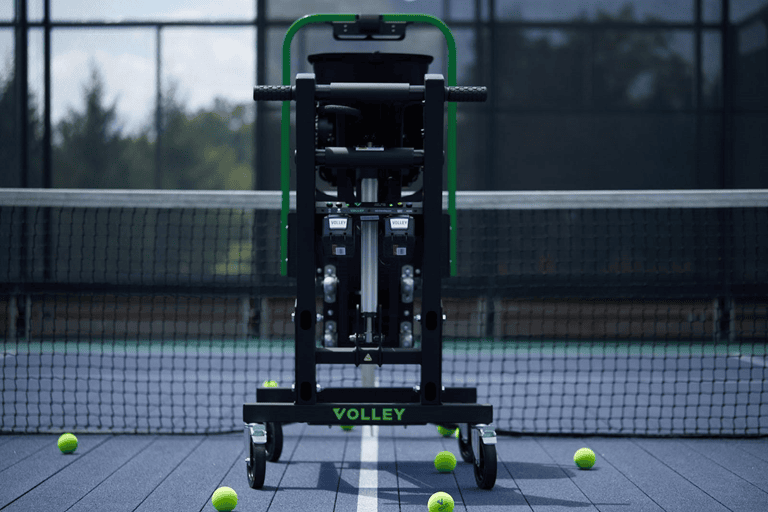
Image: Volley
The Trainer is more dynamic than your typical ball machine. Powered by a rechargeable battery with three-and-a-half hours of life, its height is adjustable up to 87 inches high, and its tilt between 56 degrees up, -38 degrees down and 34 degrees left/right, to simulate a wide array of shot angles for players to train against. It is equipped with multiple stereo cameras and an NVIDIA computer vision system to track player and ball movements, plus an LED screen and speaker to guide workouts. Through the company’s mobile app, players can program the Trainer to execute its desired practice program, watch film, or review play time statistics (i.e. balls hit, time on court).
“We have this model that we’ve built in the cloud of what the platform tennis court should be, where people are positioned, what all the shots might be. And we’ve analyzed through match play based on people at different levels a schema of what they would see at that level. You’re not going to go out there as a beginner and get a 120 mile per hour serve thrown at you,” Weinlader said. “You would go out there as a beginner, and we already have a profile built up, from watching match play, of what beginners typically would hit… That’s the first part of the AI side of this.”
The vision system can also track shots hit towards it, which, in a development coming “very, very shortly,” according to Weinlader, will allow users to play out entire points against the Trainer, with the machine’s return shots timed precisely to when a human on the other side of the net would strike the ball.
The company does not charge clubs anything upfront to carry its Trainer. Users instead can use the system once ($30) or purchase a monthly ($40 per month) or yearly subscription ($300), which is revenue-shared with client clubs.
“It’s all cell phone controlled,” Weinlader said. “The machine lends itself very well to an account-based model. This is a bit of a shift from typical ball machines.
“We give the machine away to the club and then members subscribe to it. In subscribing, they get their own account and that tracks their number of workouts that they did, it tracks their history, it tracks their video clips that they can then share with their pro for virtual coaching.”
As of now, Volley is available for platform tennis and padel, with pickleball coming soon. Weinlader hopes partnerships like the latest with the APTA will raise their profile even more.
“We’re looking to get some experience with customers, interfacing the machine that way, to help build our awareness,” Weinlader said.
The club design process can take up to a year and shares several elements with manufacturing in Formula 1, from AI-powered software to generative design tools.
A Data & Innovation article brought to you by
Altair’s engineering started in the automotive industry when it launched 38 years ago, which Benhayoun called one of the “most complex industries.” That complexity allowed Altair to grow and touch many other facets of engineering technology, such as the design of golf clubs.
To illustrate the intricacies of a golf club build, Benhayoun points out that the average car design takes roughly two years. Golf clubs can take between nine and 12 months. So while the club may look much simpler than your average vehicle, both have to account for so many variables. F1 is also using the same technology to develop faster cars. “You’re designing a product that has multiple needs and multiple expectations and multiple factors around it,” Benhayoun said. “When you look at golf clubs, there is the human factor. There’s the technology performance factor of things: how fast it is, feel, how beautiful does it look, etc.”
With all of that to consider, Altair’s software helps streamline the entire design process. AI-powered simulations and generative design tools (through Altair’s simulation/design platform called HyperWorks) can run prototype clubs through numerous projected test swings and cut down on production waste. They’ve also developed digital twin tech to help visualize the data.
Benhayoun has been with Altair since 2012, and in that time, he’s watched the golf club conform to include two significant elements. The first is forgiveness for the golfer, no matter their skill level. The forgiveness of the clubs now, he said, is far superior due to the massive number of digital tests a club set can go through before mass production.
The second has been resilience to the strain caused by the top-level athlete. Case in point: The average drive on the PGA Tour is 299.8 yards (274.14 m). Carbon shafts and club heads have been tested in Altair’s software too before they hit the market.
“We are delivering that software that allows you to do things digitally,” Benhayoun said. “Instead of testing in your (golf club manufacturing) lab, you’re testing on your computer. And now instead of testing one club a day, you’re testing thousands of designs a day for different players, the amateur and the professional.”
Brave Virtual Worlds will be seeking to solve the challenge in 2024 with the aid of a $275,000 research grant.
A Data & Innovation article brought to you by
Brave’s core product, called Valor, is wearable technology that produces 4D motion capture with 10 inertial measurement unit sensors. The software measures human motion with corresponding data. This grant, which is for a year and could result in $1 million of additional funding, will allow Brave to enhance its motion-capture system and build an AI engine. Dhyey Parikh, COO and cofounder, told SBJ that Brave is hoping the company’s work can develop a closed biofeedback loop.
“The field of clinical biomechanics has grown expansively the last 20-25 years through motion capture,” said Parikh. “How do you transmit that data in a language that anybody can understand?”
Parikh said the overall process will break into three steps:
William Kodama, Brave’s CEO and cofounder, said the process required an extensive application that resulted in the creation of both a technical and commercial roadmap. They initially applied August of last year. That first attempt was declined, Kodama said, but it came with valuable feedback this February, when Brave was participating in the second class of The Minnesota Twins Accelerator by Techstars.

Image: Brave Virtual Worlds
Prompting from the NSF program director led to Brave’s second application attempt, which Kodama said featured an effort to refocus, change the program language and add more details to the technical and commercial routes of the research.
Brave had a built-in advantage: a product in Valor with prominent users. The company has also decided to push more of its marketing focus on the Valor name, changing social media accounts and webpage to place the prominence of the tech.
CTO and CFO Evan Magnusson said that the program looks for impact, innovation and ability to scale the product for a need in the market. Having partnerships, such as Brave’s work with the Minnesota Twins’ farm system, was a helpful boost.
Kodama said this process could yield big opportunity for Brave. That is reflected in the company’s future client goals.
“We are trying to rapidly expand right now,” Magnusson added. “Try to get to 25-plus clients by the end of the year, and definitely well over 100 next year.”
A Data & Innovation podcast brought to you in collaboration with
He spent two years as an S&C at the Orlando Magic, a further six years as Director of Science & Research at the Houston Rockets, before spending almost nine years at the National Basketball Players Association [NBPA].
Since 2022, he has served as Chief Medical Director of the National Basketball Retired Players Association [NBRPA], a non-profit organization comprised of former professional basketball players of the NBA, ABA, Harlem Globetrotters, and WNBA.
Rogowski was at the NBPA in 2015, the year the league introduced its wearables committee and his views were informed by his time in Orlando and Houston.
As he tells Joe Lemire and John Portch, he worked with players wary of wearables as well as those mor willing “guinea pigs”, as they refers to them, such as retired Magic point guard Jameer Nelson.
Rogowski would ask himself of the latest devices: “Is it practical? Is it something that you can wear in a practice? Is this something that I can consistently do? Or is this a one-time thing and you collect the data and move on?
“I had plenty of those devices that actually changed how I think about training these guys or how I’d help them with recovery. But it is a sale because, with the players, you only have so many asks.”
Rogowski recalls those moments working with players as well as:
Listen above and subscribe today on iTunes, Spotify, Stitcher and Overcast, or your chosen podcast platform.