The 2015 Super Bowl champion is an investor in startup Smart Picks, which takes into account 150 different variables in order to predict the outcomes of events.
A Data & Innovation article brought to you by

You can’t have a discussion about sports technology today without including athletes in that conversation. Their partnerships, investments and endorsements help fuel the space – they have emerged as major stakeholders in the sports tech ecosystem. The Athlete’s Voice series highlights the athletes leading the way and the projects and products they’re putting their influence behind.
* * * * *
Davis recently backed Smart Picks, a sports prediction platform that will utilize artificial intelligence and machine learning to predict outcomes. As a subscription-based service, the AI will take factor in more than 150 variables.
Smart Picks will start with the upcoming NFL season, then will eventually expand to other professional sports.
On why he invested in Smart Picks…
Whenever I’m looking at investing, I always look at the people. That’s first and foremost. It’s just something I learned to do all the time. But you’re talking about an invention. A startup is something that changes the world. And I felt like these guys were on to something. I felt like this was something that we can really leverage when it comes to using learning algorithms to predict outcomes of sporting events, this is something unmatched.
On learning about AI and the sports-betting scene…
It’s definitely a new world. It’s different, but it shows us where the world is going when it comes to artificial intelligence. I think about four or five years from now, we’re going to see a lot more of this because it’s been proven that when it comes to AI in general, it can be really proficient and accurate in anything you wire it, program it to be proficient.
On pivoting to investment following his professional career…
Having a platform like this has been a beautiful experience for me because I didn’t come from much. I grew up in a household with six other siblings, raised by my grandparents. To be able to come from that and look at where I am now is truly a blessing. I’m very grateful for the opportunity to be able to surround myself with individuals like guys in this company — like Henry Penzi, Josh Webber and Paul Van Kleef. Because people like this can help make the world a better place and help make life great because they’re all positive and they want to do something and give back in so many different ways. So I’m extremely grateful, truly grateful for it.
On having an investment advisor or role model…
Magic Johnson was a guy who I really looked up to because he was an athlete. He wasn’t particularly a football player, but he was an athlete. So he was someone that I really looked up to. I heard about him and Starbucks (Johnson partnered with the company and facilitated the Urban Coffee Opportunities) and a lot of the business moves that he was able to make, post-career. To watch him transition the way he did and go through some of the trials and tribulations he had to face, it was truly inspiring and amazing.
On other investment projects…
There’s a lot of different things right now that I’m involved in. I have several different restaurant groups that I’m a part of in Washington, DC Big Tony’s Pizza and Dive Bar. Then we have the Cove Garden, which is next to the Nats’ stadium. I became part owner of the Brisbane Bullets basketball team (of the) National Basketball League over in Australia. I can go on and on and on. There’s a full list, but that’s just some of it. And I’m going to continue to keep going on, educate myself and learning, finding out different ways to really add to my resume, to my bottom line, and just grow in general.
On useful wearables from his playing career…
The equipment that I used was called the Q-Collar from Q30 Innovations. It was a company that was all about mitigating the impacts that you take whether you’re in practice or you’re in a game. And I thought that was very helpful to me, that technology they created, because we all know about the trauma and the history of concussions and things of that nature. Q-Collar is not there to prevent concussions, but it’s there to minimize the amount of impact you take on. Because it’s always those little things. It’s the little things in between the big things. It happens all the time. So that’s why I was very grateful to be able to be a part of that company as an investor, an ambassador and being able to wear it.
This article was brought to you by SBJ Tech, a Leaders Group company. As a Leaders Performance Institute member, you are able to enjoy exclusive access to SBJ Tech content in the field of athletic performance.
In this edition of The Athlete’s Voice, Cheyenne Knight discusses her use of the SuperSpeed Golf’s innovative program.
A Data & Innovation article brought to you by
You can’t have a discussion about sports technology today without including athletes in that conversation. Their partnerships, investments and endorsements help fuel the space – they have emerged as major stakeholders in the sports tech ecosystem. The Athlete’s Voice series highlights the athletes leading the way and the projects and products they’re putting their influence behind.
* * * * *
En route to that win, Knight noticed tangible improvements in her swing speed and drive distance thanks to her work with SuperSpeed Golf, a company that utilizes data and targeted speed training to increase swing speeds. SuperSpeed’s core offering is a three-piece set of weighted clubs designed to reprogram a players’ neuromuscular reaction time by training from both their dominant and non-dominant side.
“My partner (for the Dow Great Lakes Bay Invitational) Elizabeth hits it pretty far, she’s probably one of the longest on tour,” Knight said. “We were kind of joking around, she’s like, ‘Man, Cheyenne! You’re hitting it out here kind of close to what I do.’”
Knight first purchased a SuperSpeed set in college, and officially signed on as a partner in 2023. The company, which started signing player ambassadors earlier this year, had between 700 and 1,000 player clients as of late June.
As for Knight, SuperSpeed reports that her ball speed increased by nearly 10 miles per hour – from 128 to 136-137 – within two months of adopting her focused speed training regimen.
Here, Knight discusses her work with SuperSpeed and using technology as a tool in her training.
On the motivation to first purchase a SuperSpeed set…
Growing up [as a golfer], it was kind of different as to what kids are taught now. I think now kids are just taught to swing as hard as they can and then figure out where it goes later. But when I was growing up, and I feel like for my generation, it was more, ‘You need to hit it straight.’ And then you saw the shift, I think starting with Bryson [DeChambeau], that really made people think about speed. With SuperSpeed there was a market for that, to help you hit it further. I bought the set and watched the instructional videos on their website. That’s how it got started.
On using the program…
I was lucky enough to do it with the SuperSpeed team and they showed me everything. You make it your own. There’s different things. You have the speed sticks – there’s light, medium, heavy, and then a counterbalance stick. There’s different series of swings that you do on your dominant and non-dominant side.
It doesn’t take that long – you do a few swings with each, like a step-and-swing, and there’s a radar that tells you how fast you’re swinging it. And the goal is to swing the heavy one close or the same as you do the light one. There’s other equipment that they also offer that helps you with your grip strength and these little discs that help you use the ground better. I think with that you’re just really trying to learn how you need to incorporate speed, because using the ground, pushing off the ground is a really big leap in power.
On the specific improvements with SuperSpeed…
I hit the ball pretty straight, but I’m not one of the longest hitters on the LPGA. I feel like you can only benefit from [SuperSpeed]. It doesn’t change the mechanics of your swing, it just teaches you how you can hit the ball further and gain some speed. I just used it as a tool.
I just wanted to see some gains in my swing speed and my club head speed. And if I could gain a few miles per hour, I would hit it further off the tee and kind of just have some different clubs into the greens. When you increase your club head speed and your swing speed, you generate more spin, so that would help my irons too, just being able to generate more spin and hold some of the greens more – because I’m usually coming in sometimes as a longer club than the other girls.
On feedback from SuperSpeed…
When I spent the day with them, I saw some gains in my club head speed and ball speed. I think, for me, swinging on my non-dominant side was really good. Just learning how my body works, and you’re on the force plates and seeing where I lose some of my power. The kind of stuff I already knew – I don’t load that well into my right side in my backswing. But seeing it from a different perspective and technology definitely helped. Me swinging lefthanded, it really gets my muscles engaged and learning how to load a little bit better by swinging on my non-dominant side.
On the length of time it took to see results on the course…
It’s a little tricky, because when I’m playing in a tournament I’m so in-tuned to what’s going on. When you hit it off a tee, I didn’t know if I was hitting it further because at that point I’m just trying to hit the fairway when I’m in competition.
But I would say I really noticed it with my irons, because with my irons you’re being more specific of how far you need to carry it onto the green. I could tell I was picking up three or four yards in carry with my irons. And that was probably two months into it that I saw that.
On being technologically inclined in training…
I’m not going to go online and buy a bunch of stuff to just see if it works. I’m more of a word-of-mouth person. So when SuperSpeed first launched on the market, I heard a lot about it from people in my industry. The guy who fits me, Art Sellinger, in Dallas, my club-fitter, he had talked about SuperSpeed and how that could help me.
The golf community is quite small, and if there’s a good product out there, people will talk about it and rave about it. That’s how I heard about SuperSpeed. Technology-wise, I’ll get a TrackMan or a GCQuad. I’m a TrackMan person. I use SuperSpeed and AimPoint.
This article was brought to you by SBJ Tech, a Leaders Group company. As a Leaders Performance Institute member, you are able to enjoy exclusive access to SBJ Tech content in the field of athletic performance.
Donna Johnson of Zena Sports discusses her organization’s protective vests and the wider need for education around breast injuries in sports.
A Data & Innovation article brought to you by
A 2020 study by the University of Wollongong in Australia surveyed 297 female athletes (rugby players and Australian rules footballers) and 242 team employees, like coaches and medical staffers.
On the player side, 58% said they had experienced a breast injury in their careers, with 48% feeling that their play had been affected following the injury. On the team side, half of the staffers “were not aware that breast injuries were a problem for female contact football players.”
In 2022, Wollongong released another study that said that 60% of female athletes had experienced previous breast injury, but 90% of those athletes never reported those injuries.
Donna Johnson wasn’t armed with those stats when she first dreamed up the Zena vest in 2017, but she recognized a void. The idea came over coffee with a friend with three daughters who just started playing Australian rules football. The conversation made Johnson, a mother of two, think about the amount of equipment she would purchase for her son’s sports. She didn’t see nearly as many options for her daughter.
“We were just discussing how fierce these girls were playing and the impact that they were receiving,” Johnson said. “I was just concerned that these girls were sort of at an adolescent age, crucial stage of their physical development, and they weren’t wearing any form of impact protection.”
Later that day, Johnson spoke with her husband, Brad, a hall of fame Australian rules footballer. After some initial research, the only chest protection she found for women was a hard chest plate meant for martial arts. It was not nearly nimble enough to move around in, much less sprint and jump.
For the next 12 months, Johnson tried to find a manufacturer with no luck, and the idea nearly died on the vine. One final internet search yielded Sydney-based Modulus Design, a sportswear company with expertise and manufacturing contacts. During that same time, Johnson toured Australia, meeting with different female athletes in sports, trying to understand the need for this product. The responses both validated and shocked her.
“I was really surprised by the feedback I got from them in terms of the type of breast injuries that they had, in terms of bruising, what they were doing to try and prevent it,” Johnson said. “A lot of girls talk about wearing two sports bras, a lot of girls talk about bandaging padding to their ribs or something like that.”
Fast forward to now, Zena Sport’s product uses a polyurethane foam that is injected into the molding (which Johnson compared, visually, to an ice cube tray). It’s then heat-sealed against the fabric so there’s no stitching into the nylon and elastane material, all of which increases durability.
Johnson said 70 to 80 players in top-level Australian competition wear the Zena Sport vest. “We don’t have any research yet to tell us what the long-term impacts of a breast injury could be,” Johnson said. “So we’re sort of in that unknown space and trying to educate people.”
Zena Sport is still a small company. The only employees right now are Donna and Brad, who oversees lead operations. Brad has spent some time in the US, building connections with governing bodies. Johnson said the company sees real growth potential in options like soccer, basketball, lacrosse and flag football.
This article was brought to you by SBJ Tech, a Leaders Group company. As a Leaders Performance Institute member, you are able to enjoy exclusive access to SBJ Tech content in the field of athletic performance.
Former Olympic swimmer Shikha Tandon discusses her work in Silicon Valley and her role with the US Anti-Doping Agency.
A Data & Innovation article brought to you by
You can’t have a discussion about sports technology today without including athletes in that conversation. Their partnerships, investments and endorsements help fuel the space – they have emerged as major stakeholders in the sports tech ecosystem. The Athlete’s Voice series highlights the athletes leading the way and the projects and products they’re putting their influence behind.
* * * * *
While competing as an elite swimmer, Tandon also was enrolled at Bangalore University, from which she graduated with a Bachelor of Science and a Master’s in Biotechnology. Upon moving to the US, she completed a second master’s, this time in biology, from Case Western Reserve University.
Following a five-year stint working as a science program lead at the US Anti-Doping Agency, Tandon worked at a couple fitness startups (Moov Inc, Repmonk AI) and at TechCrunch as a product manager before joining Silicon Valley Exercise Analytics. At SVEXA, she is the Director of Global Partnerships working on a team intentionally assembled of members with dual competencies: both technical and athletic. SVEXA’s employees include numerous current and retired athletes who have competed professionally as well as at the Olympic and Paralympic Games.
On her early life in sports…
I grew up in India. I spent most of my childhood there. I swam and competed for India for about 15 years, eventually, but at the start of it all, swimming was not my sport of choice. I was a pretty athletic kid, loved being outdoors, and actually running was my sport of choice. I was eight at the time, and I wanted to join a local running club in India, but they were taking kids only when they were nine. I was told to come back when I was nine.
I have a younger brother who had severe asthma at the time, and so the doctor recommended that he start swimming just to help his lung capacity. Being the age that my mom was not going to leave me behind at home, I was taken to the pool with him, and one thing led to the other.
Initially, I was really scared of the water — I didn’t want anything to do with it. But over time, I quickly learned to enjoy it, love it. I won my first national medal when I was nine, so pretty much a year after learning to swim. I was just enjoying it so much. I went to nationals, went to international events right from when I was 12. And there was really no turning back beyond that. It was just one of those things, which happened by chance that swimming was brought to me and I loved it.
On beginning to train more seriously…
The coach I had the first year was one coach, and then I moved over to train with another coach. And so he was my coach for 14 of the 15 years so right throughout. And so when I say train more seriously, it was more just setting higher goals, competing at more international events and really keeping an eye out on those qualifying times and training outside India as well, because after the age of 13, actually, I was the fastest swimmer in, in my event at the time.
I needed to train outside to just get exposure to understand how things work, to help me compete in those international events. A lot of those things — the training mindset, the training programs — are geared towards those bigger international events versus just winning at nationals. Four or five years prior to when I qualified for Athens, that’s when I really started thinking that the Olympics is something I could do.
On the training tools and tech available to her…
Very, very limited. And nothing compared to what we have today. So we would have some amount of video analysis, some amount of heart rate-related training that we would do. We would have these different threshold sets and whatnot for benchmarking, but nothing really beyond that. So it was a very, very different world training environment 15 years ago than it is today.
On her swimming career after Athens…
I trained to try and qualify for Beijing as well in 2008. I missed a qualifying time by .05 of a second. I actually swallowed water at 35 meters of the 50 meter raise, so that didn’t help. I swallowed water when I turned to take a breath — it’s something that I still think of. I moved to the US in 2009 and then swam a little bit more ’til 2010 and then decided that I wanted to switch focus to something outside the pool.
On her studies in science…
I was interested in biology, just because of being an athlete. I wanted to understand how the human body works, and just from a performance standpoint, we were reading up and talking with my coach. Everything just came together from an interest standpoint. And then also, as an athlete, I’d been drug tested so much. So I’d seen how that system works in India, and I saw I wanted to work in the anti-doping field after I graduated college. Some of the classes and courses that I took in college was geared towards getting to work at an anti-doping agency, post-graduation. So that was the motivation, really. And then after I graduated, I worked at USADA for about five years on the science team. And that was, at the time, my dream job.
On her belief in the anti-doping mission…
I definitely believe in clean sport. We put in so much effort as athletes, and you want to know that you’re standing at the start line with a level playing field. And I’ve also seen people around me in India not really — there was stuff going on, which didn’t get the appropriate, for lack of a better word, punishment. Part of that [interest] was because of that, and USADA is pretty much on top of things, as far as anti-doping goes in the world.
My role involved a bit of research and also understanding current trends and research. At a high level, it was translating that science into stuff that people could understand and that we could use that science to educate folks. While I was at USADA, towards the end, I actually helped build out one of the first online tutorials for anti-doping science, which was geared towards health and medical professionals and I think that’s still running even ’til today.
On her transition into the Silicon Valley tech industry…
I was immersed in the tech space, way more than I’d ever imagined. And so that’s what got me interested in tech, just by nature of being here. I worked at a few fitness wearable companies, and then I also worked at TechCrunch, which is a tech media platform. Working at TechCrunch allowed me to think about startups, understand a lot more about startups because that was the content we were covering.
I was drawn towards SVEXA for two reasons. One, I understood the space from an athlete perspective, but also from a tech standpoint, and I understood what they were trying to do. I really, really believe in their mission.
On her work at SVEXA…
From a SVEXA standpoint, we work with these different [stakeholders]. It could be tech companies, it could be sports teams, it could be junior athletes, it could be individual athletes, it could be even health and medical professionals who are reaching out to us. We help them essentially use all of this data, and then based on who their end customer is, help them with insights and recommendations that align with what their end customer is trying to achieve.
What we’re trying to do is a combination of AI and that human domain expertise, which is what a coach typically brings. And so for me thinking back, what we’re able to do here using all the data that we have is keep people in optimal zones in terms of performance, recovery, taking into account their goals, and when they want to peak and things like that. We’ve worked with a lot of elite athletes, and we’ve essentially helped them do that on a day-to day-basis — how do you structure and modify your training regimes to peak.
Having access to this, I think, would have helped me potentially elongate my career a little more because I did start getting injured quite a bit towards the end. So I think from an injury prevention or management standpoint, I think a lot of this could have also helped. And, again, from an overtraining perspective, keeping me in my optimal zones, I think, also could have helped in some situations.
This article was brought to you by SBJ Tech, a Leaders Group company. As a Leaders Performance Institute member, you are able to enjoy exclusive access to SBJ Tech content in the field of athletic performance.
Crystal Palace and Royal Antwerp have developed data storage and visualisation systems that increase athlete availability, enable smarter recruitment, and ensure more efficient workflows.
An article brought to you by our Partners

Dr Cedric Leduc, a sports scientist at English Premier League club Crystal Palace FC, is sharing his experience with practitioners working in athlete monitoring.
It is a natural enough recommendation for a sports scientist to make but the case Leduc makes to the Leaders Performance Institute is compelling. “If you aim to work in a sports club as a practitioner,” he continues, “one of the key things when considering your own learning and development journey is to integrate some of those data skills that will help you to understand what is actually required by an organisation when it comes to data and technology.”
Why a data infrastructure is important
Leduc, who has been at Crystal Palace for almost two years, addresses that question on a daily basis. “How can I refine a thousand possible metrics on the market into a presentation or construct of what I am seeking to present?” As he sees it, there are two viable approaches; firstly, by calling upon his own experience and relationships with colleagues, coaches and athletes; and secondly, by running statistical analyses that enable those selections to be made in an objective way.

Crystal Palace and Royal Antwerp track Player Availability using Smartabase, which enables performance staff and coaches to make informed training and performance decisions. Image: Smartabase
“A combination of both works,” he says. “When you have to turn things around quickly, you might actually use your experience, but when you have time and access to a good historical database, you might be able to run those analyses. There’s a trade-off between short-term actionable points and more long-term objective decisions.”
Leduc and Crystal Palace use human performance optimisation platform Smartabase as a data storage and visualisation solution for all players and staff, from the academy to the first team.
“In a way, building the system from nothing was an advantage because you can build it the way you like and set up the structure” – Peter Catteeuw
To operate without such a system puts a club at a disadvantage, as Dr Peter Catteeuw, the Head of Performance at Belgian Pro League champions Royal Antwerp FC, explains.
“When I arrived at Antwerp in 2017 there were no records of injuries, records of tests with the players, no records of training sessions and so on,” he tells the Leaders Performance Institute. Mindful of how well Smartabase had served him in his previous role at Racing Genk, he began to use their technology at his new club, building a monitoring system for a second time with the help of Smartabase’s agile customer success team.
“In a way, building the system from nothing was an advantage because you can build it the way you like and set up the structure,” he says. “It’s still changing every day and getting better, helping players from the academy to the first team. The team’s management and administration is also coming onboard.”
It is a product of the latitude afforded to Catteeuw and his ability to scale the system. “We needed time to build the system to our own needs and it continues to develop. On the other hand, we can implement changes immediately.”

Smartabase enables the collection of both objective and subjective sources of data relating to athlete wellness. Image: Smartabase
Of advice he would give a team who are starting from scratch, Catteeuw says, “You can easily start with a smaller group within the club, say the academy, and then progress through the organisation as you build the system.”
How accessible and actionable data can improve workflows
Alignment and accessibility are critical for new members of staff. When Leduc arrived at Crystal Palace, his first question was: where is the data and can I access it easily? “Then you start to realise that you have multiple data sources like in any sports organisation,” he says. “What’s important, if you want to make practical use of that data, is to first make sure they are stored in one secured place so that it can be easily accessed – then you can turn that into something actionable.”
“We have a holistic view of the players; what they did in training, what they are doing outside of training, how well they are recovering every day and if they are ready to train or take on more load or not, and if they are ready to play games or not” – Peter Catteeuw
At Royal Antwerp, Catteeuw welcomes the ability to tailor the club’s data management platform to his wishes thanks to Smartabase’s hands-on approach to customer success. A response within hours is the norm. A solution often follows in a day or two. “Most systems are fixed but Smartabase gives you the tools to create your own club system to enable you to work the way you like with physios, strength & conditioning staff, the technical coaches and management. Most companies only make it if it’s interesting for other teams.”

Injury Risk Profiling is an essential area of Catteeuw’s work at Royal Antwerp. Image: Peter Catteeuw / Royal Antwerp FC
Leduc has witnessed the benefit first-hand at Crystal Palace. “A new player signed this summer and the head physio asked me if he can integrate the profile of that new player so that he can start adding notes,” he says. “Another example from pre-season was the request to implement a new technology, integrating its data with their Smartabase storage system.” The organisation was able to facilitate the club’s request. “They are very reactive in trying to understand your needs and not simply relying on what already exists.”
At Royal Antwerp, Catteeuw was able to make the API work in linking the sleep tracker Whoop and Smartabase. “Now it’s up to me to pick the right data, the data we want to see, and make clarifications if necessary,” he says. “I will make the first simple dashboards for ourselves, the medical staff or the coaches to have a quick view every day. In the next days, I will try to combine data we have now from Whoop with the players’ wellness questionnaires and with all the training and game data we collect so that we have a holistic view of the players; what they did in training, what they are doing outside of training, how well they are recovering every day and if they are ready to train or take on more load or not, and if they are ready to play games or not.”
Agility is critical to data-informed decision making
There is the imminent possibility that this process will lead to red flags with some of the players. Perhaps they have not slept well on a consistent basis. This will, however, not lead to an overreaction from Catteeuw and his colleagues.
“We don’t have to take drastic action right away. These alarms just let us say ‘let’s first talk to the player and see what’s going on’ and then maybe check with the physios. Is there something else from the medical staff? Is there something from the training pitch that also raises an alarm?”
Catteeuw recalls an illustrative example from last season when Royal Antwerp used NordBord, ForceFrame and ForceDecks in strength testing. “In every first training session after a match, we ran tests. The data gives us a signal i.e. it’s too slow for these players, the difference between left and right is too large. We won’t pull them out of training immediately but we’ll check the player and see if there’s anything too serious to let them train. But most of the time it means we maybe have to adapt a little bit of training or we need to get an additional session in the gym.”
Access to the initial sources of raw data has enabled Leduc at Crystal Palace to streamline some of his processes. “The initial data collection with a given technology can be pushed into Smartabase in the right format,” he says. “I can then push it to get the right visualisation or run some analysis on it in a very straightforward way. You limit human interaction, which decreases the risk of errors. Having access to the original data enables you to be very agile with the data you’re collecting.”
However you use your databases, the important thing is to understand the needs of your organisation. As Leduc says: “Do you need a storage or visualisation solution? That will depend on your organisation.”

Crystal Palace and Royal Antwerp use Smartabase to track player soreness on a daily basis. Image: Smartabase.
The data landscape is changing and the days of teams failing to track even basic performance metrics are largely consigned to the past. In addition to Crystal Palace and Royal Antwerp, Smartabase clients include both Arsenal and Nottingham Forest in the Premier League, Stoke City in the English Championship, to AS Monaco in the French Ligue 1, Ajax in the Dutch Eredivisie and SL Benfica in the Portuguese Primeira Liga – all clubs looking to make a real difference both in training and in competition by developing a data infrastructure that enables coaches, practitioners and the players themselves to make faster, smarter and better informed decisions.
The world soccer union wants greater education and regulation around data that can help to prevent injury and improve performance.
A Data & Innovation article brought to you by
Such a statement reflects data’s evaluated status in modern sports. Yet while name, image and likeness rights have been commercialized extensively in professional sports, data rights are a nascent field, evolving at varying speeds based on club cooperation, league and union maturity and legal jurisdiction. There’s a wide range of data collected, too, inclusive of GPS vests, optical tracking cameras, force plates, heart rate monitors and more.
FIFPRO, the consortium representing 66 global professional soccer unions, recently announced its grand ambition to tackle the issue itself, serving as an accelerant of a universal solution across soccer. The idea, Baer-Hoffmann said, is to “translate the highest standard of data protection legislation” into a centralized platform whose development is led by FIFPRO with the athletes’ interests at the center.
The Netherlands-headquartered FIFPRO started exploring rights and protections of athlete data about five years ago. A survey it conducted during the 2020-21 season reported that 80% of pro players rated their interest in using data as at least an 8 on a 1-to-10 scale. Only about half, however, had full access to it or even understood why and how it was collected.
This led to the Charter of Player Data Rights that FIFPRO created in collaboration with FIFA and published in September 2022. Athletes’ three primary expectations for data was codified in that document — access, portability and control — and followed the framework of stringent privacy protections instituted by the European Union’s GDPR and others.
FIFPRO’s work is independent of the Project Red Card lawsuit — through which 1,400 cricket, football and rugby players are seeking compensation for what they consider unlawful use of athlete data — but it espouses the same underlying legal reasoning.
The first test case of this plan was the FIFA player app made available to all participants in the men’s World Cup 2022 in Qatar last December and again in July and August this year for the Women’s World Cup 2023 in Australia and New Zealand.
“We obviously have much higher ambitions and ambitions that go well beyond a World Cup environment but really go throughout the entire career parameters of any of the professional players around the world,” Baer-Hoffmann said, “whether it’s club, whether it’s country, whether that’s commercial partners, whether that is high performance coaching, etc., with all the different applications, risks and opportunities that come with it.”
FIFPRO has not announced any technology partners, but the expectation is that one or more third-party vendors will help build the product, which Baer-Hoffmann estimated will take six to nine months. Educating and onboarding athletes across so many leagues and countries will take considerable time as well.
The scope of global soccer makes FIFPRO’s task daunting while some individual unions have begun seeking their own solutions, with the NWSL Players Association partnering last week with BreakAway Data for use of its athlete data passport app.
“One of the things that’s become very clear is that an athlete’s right to have access to their own data is important, but it’s not very practical unless there’s actually a tool to make that access easy,” NWSLPA Executive Director Meghann Burke said.
Baer-Hoffmann contended that most current uses of athlete data by clubs could be easily challenged legally, but he was clear that athletes don’t seek to shut down all such uses and want to preserve the many benefits of preventing injury and improving performance — just with agency over how it’s used. The data platform, he added, can help bring to life the privacy rights that are often “very technocratic, and the enforcement is very, very legalistic.”
“A natural phenomenon that is happening at the minute is that the innovation potential, in the private sector around sports data and technology, is just a whole lot faster than the regulatory response, which is the case in many parts of society, right?” he said. “Usually technology just exponentially grows faster than the regulatory capabilities of institutions that govern the country or a certain sector.”
Basic game stats such as goals scored and shots saved plainly reside in the public domain. MRI results and bloodwork are clearly private medical records. But the performance data in question — biomechanics, movement patterns, heart rate — sits “somewhere in between, and which way should it lean?” BreakAway Data CEO Dave Anderson said.
Volumetric data, such as Hawk-Eye’s ability to track 29 points on the body for 3D motion capture, is an example of the increasingly granular data that prompted Anderson to conclude “that performance data is starting to lean more and more towards health data and that it’s vital to understand, how much wear and tear is on these guys?”
Commercial opportunities for the data are possible, too. The NFLPA is among the unions investigating that market fit, partnering with Sports Data Labs last year to explore possible revenue generation potential.
“We ultimately view your personal data — if you’re an athlete, a patient, a citizen with a watch that collects data — as a digital asset,” Sports Data Labs CEO Mark Gorski said, before cautioning that such assets won’t immediately lead to new income. “Most people want to talk about the end use case. There’s a whole bunch of steps that have to be taken in the right way in order to get there. What we’re spending part of our time with is really helping groups navigate some of those complexities on a global level.”
This article was brought to you by SBJ Tech, a Leaders Group company. As a Leaders Performance Institute member, you are able to enjoy exclusive access to SBJ Tech content in the field of athletic performance.
The program’s Director of Football Performance Nutrition discusses the dietetic practices of the back-to-back national college champion.
A Data & Innovation podcast brought to you in collaboration with
“He used that next year to really focus on nutrition,” she tells Joe Lemire and John Portch. “[He] got down and dropped his body fat percentage by 7%, lost 45lbs [20.4kg], and he was a first-round draft pick.
“He just did such a good job at buying in and it made him a faster, more explosive person. He never lost any muscle mass, which meant he was really focusing in on eating enough of just the right things so that we were able to retain that muscle and focus on losing that fat.”
Collier’s pride is palpable, particularly as a native of Athens, Georgia, and long-term Bulldogs fan. “It’s so much fun to see them buy-in and then say ‘C, I feel so much better in practice’. ‘C, I didn’t know I could have this much energy’. It’s probably the most rewarding part of my job.”
In this edition of The People Behind the Tech podcast, Collier lifts the lid on her work as the Director of Football Performance Nutrition at the Georgia Bulldogs, who retained the NCAA national championship in January.
During the course of the conversation, we covered:
John Portch Twitter | LinkedIn
Listen above and subscribe today on iTunes, Spotify, Stitcher and Overcast, or your chosen podcast platform.
As the league introduces Hawk-Eye as its new tracking technology, the level of granular detail available to officials is set to grow.
Main Image: Hawk-Eye
A Data & Innovation article brought to you by
To the right is the group overseeing the implementation of the Hawk-Eye player and ball tracking system that is set to replace Second Spectrum as the raw data collector and enhance the offering by providing 3D pose data via 29 points on the body, rather than a single center of mass. To the left is the on-premises replay room, a luxury not typically afforded the NBA Summer League.
The Summer League, which took place between July 7 and July 17, was used as an experiment in innovation, as the league conducted a final test of its new tracking provider while also assessing new avenues of reviewing close calls and then communicating those decisions swiftly to the earpiece or wristwatch of an on-court official.
“Number one is just a dry run of the core tracking system because that’s the lifeblood of team front offices and Sportradar, our partner — we want to make sure that is working because that’s the foundation of all this,” said NBA Basketball Strategy VP Tom Ryan, who oversees technology initiatives. “Building on top of that, we are, for the first time, going to see what a fully-integrated, tracking-plus-video replay system looks like. We’ve never used tracking data live in a replay center.”
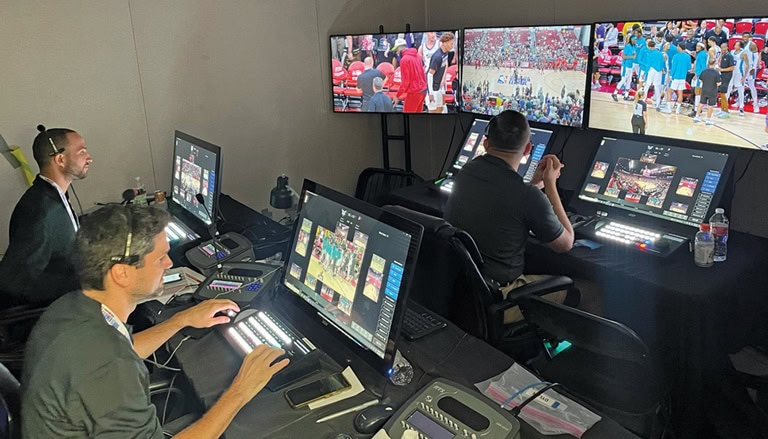
Image: Joe Lemire
The legacy product of Sony-owned Hawk-Eye is its precision ball tracking used to adjudicate line calls in tennis before an expansion to tracking players, their limbs and balls in other sports, like MLB. Its other primary offering is the Synchronized Multi-Angle Replay Technology (SMART) video replay that’s used by the NFL and others.
Now, the NBA is pairing the two with an eye toward generating supplemental evidence to help referees make decisions on goaltending, the primary point of emphasis this year. Foot-on-the-line and last-touched-out-of-bounds calls will be in R&D all year. In the future, those determinations could be fully automated, though that step would require sign off from the Competition Committee and the National Basketball Referees Association.
“Our top objective here at the Summer League is to showcase how all of our different technologies can come together to create this synergy of solutions to provide the NBA with ultimately what they need to better officiate the game,” said Dan Cash, Hawk-Eye’s Managing Director for North America. “We believe that if you couple that [tracking] with replay, which we’re demonstrating here, you have a really powerful tool to be able to officiate the game efficiently and effectively.”
Hawk-Eye installed its optical tracking system in every NBA arena over the course of two months, January to March, this year. It entails 14 cameras with 4K resolution that are expected to operate at 120 frames per second — double the broadcast standard for sports — and could go even higher, although the requisite processing power necessitates a trade-off with latency. A 15th camera may be deployed at times that’s capable of a whopping 1,000 fps with even greater resolution.
What these cameras provide, first and most obviously, are more angles of the action. A questionable three-pointer in the Summer League’s first few days lacked a conclusive broadcast view, but one of the Hawk-Eye cameras had a better angle to confirm the foot was behind the line.
But the tracking data provides a new dimension of analysis. The NBA flew out its usual Secaucus-based replay operators for a trial. “It’s video plus data, which is a new skill to learn,” Ryan said, adding that “we have a different [replay] partner that we’re really happy with,” referring to EVS. Hawk-Eye’s three prior visits to the Summer League were all for testing in the background; this is its first time used in games.
The cameras collect positional data of the basketball and players’ hands, then apply the rules of goaltending and the laws of physics. On the replay operator’s screen are yes-no indicators for the goaltending criteria.
“Goaltending is relatively easy — if the ball passes its apex, if it’s over the cylinder, if it’s touching the backboard — those are all pretty defined use cases, but if we haven’t collected data for a significant amount of time, you don’t have a historical data set to refer to, to understand where your pain points are,” Hawk-Eye Commercial irector Justin Goltz said.
“Realistically, the technology moves in at a pace that it can do it relatively quickly, but there’s a lot of logistics to get it from this broadcast truck, or from the stadium, down to the court that needs to be hashed out over a season or two.”
The operator also sees a second-screen experience with a replay animation similar in spirit to what Hawk-Eye has made famous in tennis. The NBA is still evaluating the best presentation of information and visuals to, first, help make the correct call and, second, show the fans. “A big part of this initiative is just more transparency,” Ryan said.
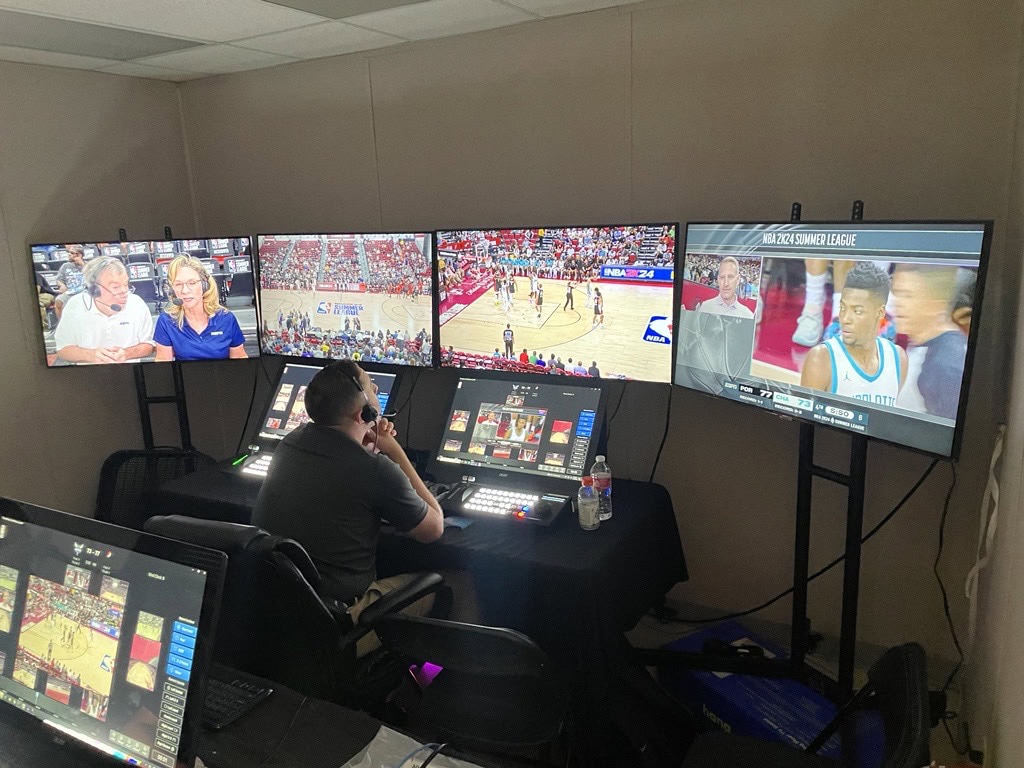
Image: Joe Lemire
Following the same adage that content is king but distribution is queen, so too with this enhanced replay format is that accuracy is paramount, but efficiency is critical, too. The league is testing two methods of communication to its referees: both audible messages to an earpiece or haptic and written transmissions to a watch.
The NBA, for example, introduced a new mechanism for relaying a scoring change from the replay center to the on-court officials last year. If a two-pointer became a three, or vice versa, a blue light would flash at the scorer’s table. The problem: looking in that direction was never part of the usual routine or field of vision. Of about 120 such blue light indicators, only five were organically spotted.
That’s an obvious starting point — and not novel as other sports, such as soccer, have done this for years — but it could lead to other use cases.
“Live communications with the ref is definitely a core component of our strategy because if we’re doing all this work on the automation side,” Ryan said, “you have to be able to communicate that with the ref in real time.”
This article was brought to you by SBJ Tech, a Leaders Group company. As a Leaders Performance Institute member, you are able to enjoy exclusive access to SBJ Tech content in the field of athletic performance.
The pitcher explains why wearables have their limits in his eyes and how biomechanics have transformed his approach to strength training.
A Data & Innovation article brought to you by
You can’t have a discussion about sports technology today without including athletes in that conversation. Their partnerships, investments and endorsements help fuel the space – they have emerged as major stakeholders in the sports tech ecosystem. The Athlete’s Voice series highlights the athletes leading the way and the projects and products they’re putting their influence behind.
* * * * *
Cole is 10-3 with a 2.27 ERA [Earned Run Average] over 150 innings so far this season. He has twice led the majors in strikeouts, including in 2022, and also led the AL in ERA back in 2019. He has finished in the top-five in Cy Young voting five times and twice been the runner up.
A Yankees first-round pick out of Orange (California) Lutheran High, Cole turned them down to attend UCLA, after which he was the Pirates’ No. 1 overall pick in the 2011 draft. His nine-year, $324 million free agent deal with New York prior to the 2020 season remains the largest contract ever awarded a pitcher — nearly $80 million more than anyone else.
On how he recovers the day after a start…
I try to sleep as best I can, but I don’t always sleep great. And then if I need to catch up on sleep, I just I try to find some time to maybe take a nap. I’ll try to put down some electrolytes and about four liters of water. I’ll do a recovery walk either at the house through the woods or on the treadmill. I’ll get a little bit of treatment in the training room just to make sure things are roughly in the right place so that I can walk better
To me, [soreness] is always a whole body experience. And then sometimes, hot or cold tub therapy, just depending on how life’s going, I guess. And I’m hungry. I’m going to eating all day.
On his previous use of Whoop…
Basically, I’m in the green pretty much all the time, and so I thought it validated my process. And I thought after I collected four or five years worth of data on it that it validated some of my practices and my routine, and going a little bit too much into the micro aspect of it, I’m not sure it’s so beneficial.
So there’s stuff you can’t control, right? Like we’re going to fly to the West Coast, and I’m probably going to be red for three days after that. And we’ve got to play. Sometimes I’ve got to pitch. Do I need something to tell me I’m in the red all the time? Or do I just need to know that I need to be on top of everything that I possibly can be to give myself the best chance?
On heart rate variability (HRV)…
HRV fluctuates throughout the day. There are different breathing cadences. There are different physiological things that evolve throughout the day in terms of exercise, how stimulated your nervous system is, caffeine [consumption] — all these things fluctuate HRV positively or negatively throughout the day. Obviously alcohol and dehydration negatively affects it, but sometimes those are quality of life [decisions].
But the algorithm the Whoop uses is at a specific time, right [before] you wake up. So it’s not like you’re a 50 HRV for the whole day. It’s just when you wake up. So depending on how you slept, depending on what your routine is for the rest of the day — let’s say you had to perform at 7 o’clock [p.m.], your HRV could be back to normal. I wore it for a long time. I wore it through a lot of stuff — starts and workouts and vacations and everything. There are some things that we learned, for sure. I definitely tightened some stuff up, but on the whole, it just validated that you’re pretty good.
On nutrition…
I’ve done a lot of food allergy and blood work over the last, I don’t know, forever. So I pretty much know what I’m sensitive to, what causes systemic inflammation and how to try to manage those levels by just regulating the exposure to those things: gluten, dairy and some other random stuff. Sometimes they change, too, depending on how much you avoid them or where your tolerance is.
I would expect a player to have things be more inflammatory, inadvertently, at the end of the year when your immune system is depleted, and you’re at the end of your rope and your at high-level stress. Just your tank is not full, so in a sense you’re overall less resilient. But at the same time, if you focus all of that resiliency on your performance, you can maintain, or even sometimes improve, regardless if all the other stuff is falling low. So t’s always an ebb and flow. It’s always a balance.
On strength training after a start in season…
Day two, day three depending on if it’s five or six days [between starts]. I would say definitely trying to maintain power, elasticity, control. Through that control, the proper mobility. You build a tank up in the offseason, and you just put as much gas in there as you can. And then during the [season], you’ve got to make sure you treat your performance as load, and your weightlifting as a supplement to that load. So I am gaining strength by pitching, I am gaining more efficiency the more I pitch.
These things are allowing me to operate at a more efficient level, and the supplementation of the lift maintains the integrity of the tissue, maintains the power, maintains the routine in terms of when your central nervous system is recovered and spiking and peaking on the fifth or on the sixth day. It’s different than position players, very much so. It’s very much almost like horse racing, football [when you have one shot kind of thing].
On how his approach to training has changed since the beginning of his career…
Total strength, we build in college. We build when those growth plates are just about ready to be closed up, and then you go through life and you start maturing and, again, you’re trying to find ways to maximize power with the least amount of wear and tear because you only get one joint. And then you have kids, and then you carry you carry your kid around. So then you get the dad strength, so your load goes from just your body all day to another 10 pounds for about 10 months, and that has a cumulative effect. And then you have two, and then your 10-month-old turns into three and he’s 40 pounds.
You definitely mature as you get older, and you realize that you want to take all that tissue and strengthening stuff that you built early in the career and make sure that functionally you’re rock solid because that preserves the joints, preserves the tissues, and maximizes power.
On how much he analyzes biomechanics…
The Hawk-Eye stuff is super helpful. At this point, I just think the more data we get is even better. AJ Burnett told me once you’re never going to throw two pitches the same way even if they land in the same spot. And I think, to a certain extent, do we want to be ultra-repeatable? Yes. So do we need to be adaptable at the same time and still be able to produce the same output? It’s going to be hot, could be a hard mound, could be wet, sloppy, it could be slipping, I could be pushing through an injury in a certain area.
There’s all these different variables that are going to contribute to the release point having some variance and the delivery never being the same back-to-back outings. Always being able to be resilient while you have those uncontrollable things changing. Your body’s always adapting to this and that. You can look at one delivery in slow mo and look at another delivery, and that’s not always very helpful.
What I find will be probably really helpful, especially it continues, just the more and more reps that we get on the Hawk-Eye and finding the centration of the joints and the centers of the joints and how biomechanically they’re moving over and over again. Where’s my window for performance? And how do I use that to my advantage? I don’t really know yet. But how do you use that to your advantage as you as you start to gain [more data]? Gill’s great and David’s great, and they’re on top of it all the time. [Gillian Weir, Senior Biomechanist, and David Whiteside, Director of Performance Science.]
On childhood pitching mechanics and throwing load…
I built my mechanics as a kid, just basically trying to be as close to some form of Clemens, Pedro and Maddux. Just simple and repeatable and putting myself in position to minimize load and also giving myself time to recover as a youth. My dad only let me throw six months out of the year until I was 18 at UCLA.
You’re going to stress the ligaments, you’re going to stress the labrum and all that stuff, but then you’re going to give it six months while you’re still producing large amounts of GH and growing and your growth plates [close]. So it gives your tissues time to adapt and lay down those adaptations.
They should look asymmetrical left to right, but they shouldn’t necessarily look worn down, to a certain extent, because you’re pushing, you’re pushing and pushing, and then you’re recovering. A lot of kids these days, just push, push, push, push, push. [Pitching] being a unilateral move, the more fatigued you get, the more you just end up putting too much load in the wrong areas.
On the importance of training the deceleration muscles…
They always used to use an analogy of ‘you can’t have a Ferrari V12 engine and Honda Civic brakes.’ The car’s not going to go very fast, and it’s going to crash.
On tracking his spin rate and other pitch tracking metrics…
I have general parameters that I keep an eye on, I would say, but that’s not at the expense of performance. So if the fastball is spinning high, but it’s getting hit, or if a fastball is sitting low but it’s not getting hit — I’m in for not getting hit, you know what I’m saying? In terms of introducing a new pitch, I would only start that in the offseason, and it probably will take a year or two at this point for it to really even settle in. I feel better with the cutter this year than I did last year, but I guarantee you that next year I will feel even better.
This article was brought to you by SBJ Tech, a Leaders Group company. As a Leaders Performance Institute member, you are able to enjoy exclusive access to SBJ Tech content in the field of athletic performance.