The luxury retailer’s Head of DEI, Recruitment & Onboarding, Sharlene John, told an audience of Leaders Performance Institute members how they started again, bringing employees into the process and building a plan around purpose, participation and measurable outcomes.
Sharlene John, the Head of DEI, Recruitment & Onboarding at Selfridges, relayed the story of the luxury retailer’s failed 2020 DEI strategy at March’s Leaders Meet: the Art of Strategy.
The trouble for Selfridges was that despite some well-meaning intentions, “there was not a single Black person in the room” of C-suite executives to advocate for a strategy focusing on Black representation. As John explained, “it would get shown at a couple of team meetings” but senior leaders were talking about a strategy to which, John said, they had “no connection”, “no passion” and “no conviction”.
Nor had anyone connected the strategy clearly enough to Selfridges’ commercial performance. It died a death in that guise.
A strategy cannot simply ‘float around’ if its aim is to unite people behind a common purpose. John joined Selfridges in July 2021 and set about developing a more effective approach that became Open to the World, a co-created framework that gave employees a stake in the plan and leaders a clearer basis from which to explain it.
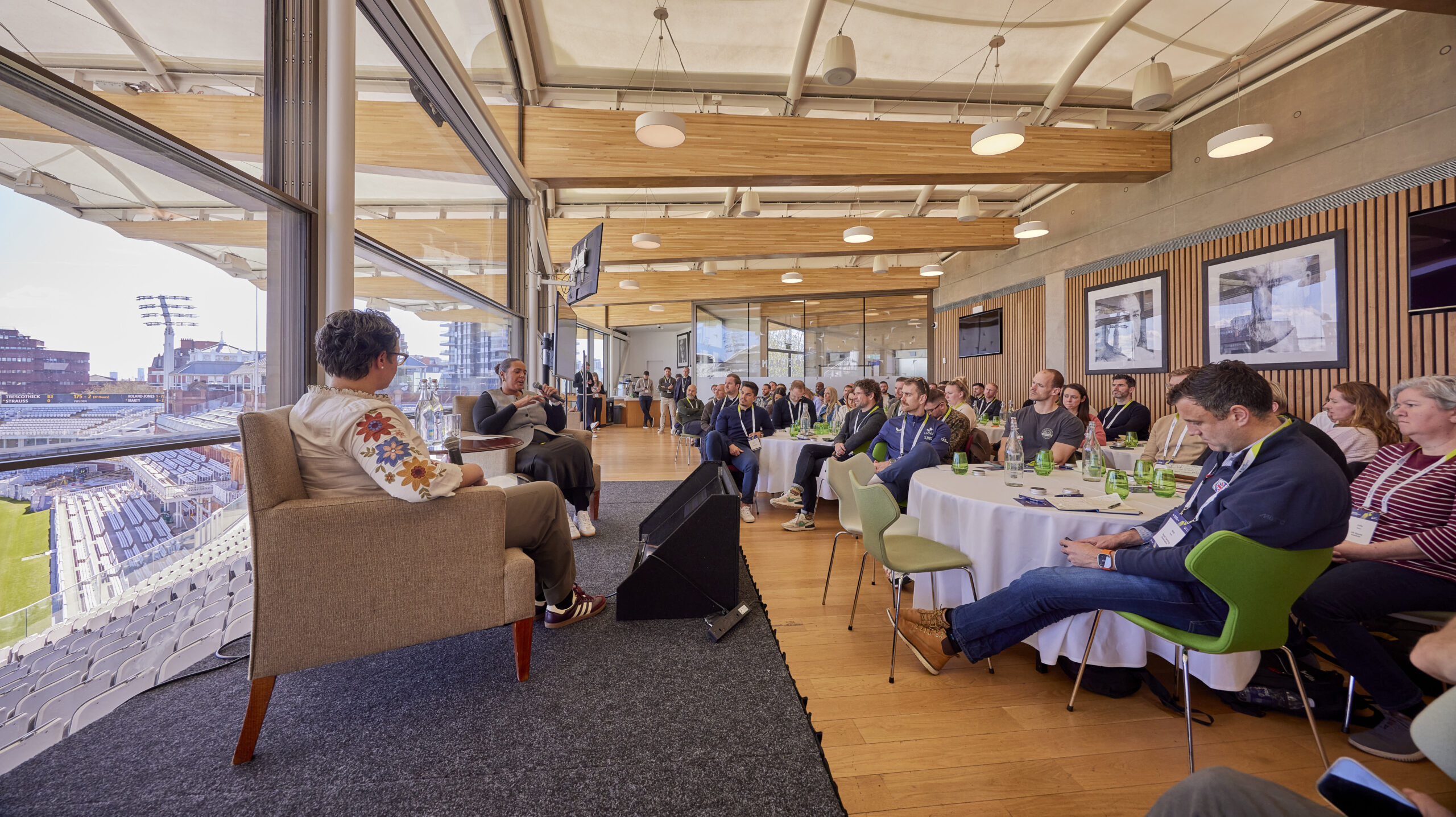
Sharlene John in coversation with Management Futures’ Shona Crooks at Leaders Meet: The Art of Strategy at Lord’s Cricket Ground. Photo: Leaders Performance Institute / Robert Obreja
This is the story of how John and her colleagues did it.
They listened across the organisation before putting pen to paper
John consulted people across Selfridges’ organisational levels and locations “before we put pen to paper”. It was critical that ‘inclusion’ did not remain an abstract concept. She asked people: “What does it mean from your experience coming to work? What does it mean for the customers that you’re serving? What does it mean for trade?” Only then could John define Selfridges’ DEI problems and shape the response. The process also created a collective sense of ownership lacking in the 2020 plan. “Every single person in our organisation feels connected to it because in some way they’ve had a voice and had a part in putting that strategy together.”
They did not let hierarchy become an impediment
Consider: what knowledge does your strategy require and are the relevant people involved early enough? John encountered resistance to the notion of involving employees below executive level. “‘That person’s not an exec – they can’t come in and possibly contribute to this’,” she was told before she pushed back. “They absolutely can and they’re going to.”
Where there were “missing voices” in the room she “went down a layer” to find colleagues with relevant knowledge or experiences unavailable to decision-makers.
Different groups require different entry points
John could not rely on a single presentation doing the legwork. “What I discuss with my C-suite is very different from what I discuss with our shop floor,” she said. “It is really important to get everybody on the same page and find the anchor piece that connects your vision, your strategy, to the audience.” For executives, that meant better understanding the relationship between a healthy culture and commercial outcomes; for shop floor employees, that meant understanding how Open to the World affected their experience, opportunities and sense of belonging.
Leaders need to be able to take a central message and make it relevant to their teams. When the translation has worked, every group should be able to answer:
Win hearts, move heels, make headlines
“Underpinning our strategy is winning hearts, moving heels, making headlines. Very Selfridges,” said John with a smile. “You’ve got to link the three.”
Check for understanding
Selfridges drew on a cultural assessment containing approximately 70 questions and selected ten for deeper investigation. John and her colleagues asked employees what their answers meant in practice. “When you say you can’t show up as your best self, what does that mean? Talk to me about this. Help me understand.”
Selfridges now uses opinion surveys, quarterly pulse checks and annual reviews to assess whether Open to the World has translated into employees’ everyday experience. “We use that data to understand if it’s translated and it’s working,” said John.
Questions for leaders to consider:
What to read next
5 Ways in Which Alignment Shows Up in the Work of High-Performing Teams
In the final part of his miniseries, Basketball New Zealand GM Paul Downes what kind of leadership works when authority is limited and commitment is discretionary.
In senior 5×5 teams, athletes are commonly not selected from within domestic systems given the time of year for FIBA competitions. Instead, they are selected whilst under contract within professional (and semi-professional) environments across various global leagues. Athletes for FIBA 5×5 age-grade tournaments (Under-15 to Under-19) are typically selected from performances across school, Association and National camp assembly periods.
Supporting the selected athletes are coaches and management that also are operate in decentralised, time‑limited contexts. No role holders are employed full-time and, as such, are operating without the contractual levers that traditional high‑performance (HP) models assume. Across the 5×5 HP pathways, BBNZ runs six age‑group national teams (male and female), plus select teams that provide ‘best vs best’ exposure to support development (on and off court) and prepare for FIBA tournaments.
Within this reality, management team members are asked to balance a number of competing demands. Examples include: short‑term competitiveness versus long‑term system sustainability, respect for professional autonomy versus national‑team standards, and redefining ‘success’ in an international sport increasingly dominated by wealthy, highly resourced nations. These challenges, among others, sit outside of being simply tactical or financial rather the most complex challenges that present are systemic and relational. Therefore, a crucial leadership question what presents itself to the BBNZ HP team is no longer whether leadership is required, but instead what kind of leadership actually works when authority is limited and commitment is discretionary.
The purpose of this article is to apply the research pertaining to Leadership Climate and Followership to the context of the 5×5 National Teams of BBNZ and demonstrate the opportunities that the constraints presented offer HP leaders for generating elevated levels of engagement and commitment to the HP strategy.
What is Leadership Climate and why does it matter?
The National teams of BBNZ can be considered to have compromised formal authority outside of assembled periods due the nature of management composition and contractual status. Without the ability for HP leaders to rely on extrinsic levers such as significant salaries, full-time contracts and formal hierarchies there could be supposed to be high risk regarding team culture and operational effectiveness. Powerful research from Goleman into Leadership Climate (1, 2) supports organisations such as BBNZ to succeed and maximise the opportunities that come from such constrained circumstances.
Goleman (1, 2) describes Leadership Climate as the emotional tone of the working environment created by leaders’ behaviours, which in turn shapes motivation, engagement, wellbeing, and performance outcomes. When HP leaders cannot rely on extrinsic motivation levers or formal hierarchy the notion of Leadership Climate becomes the primary lever for sustaining commitment and discretionary effort.
Unpacking climate further
To make Leadership Climate assessable and actionable, JCA Global (3) developed the Leadership Climate Indicator (LCI) as a behavioural measure of how it feels to be led within a given system. The LCI translates leadership behaviour into four distinct climate quadrants made up of twelve observable scales:
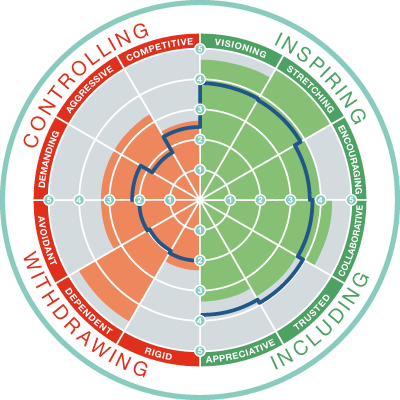
Green climates: the Inspiring and Including quadrants represent green climates – those that build clarity, trust, energy, and commitment through behaviours such as visioning, encouragement, collaboration, reliability, and appreciation.
Red climates: by contrast, the Controlling and Withdrawing quadrants represent red climates which, while sometimes effective in short‑term crises, erode trust and engagement when used habitually through behaviours such as micromanagement, aggression, avoidance, or rigidity.
In decentralised, tour‑assembled environments like BBNZ’s National teams, this framework provides a practical lens for understanding why some campaigns generate ownership, voice, and discretionary effort, while others default to compliance, silence, or disengagement under pressure. In these teams leadership climate can be considered to be the felt experience of being led by the HP team. This spans the experience one has at the recruitment stage, their subsequent onboarding, the connections leading into a camp/tour, tours themselves and the review period after each assembly. They are the conditions created by leaders’ behaviours during both stable and complex, high-pressure context and govern whether people think, speak up, and commit fully, or retreat into compliance and self‑protection.
Defining and contextualising Followership
Contemporary leadership research is explicit that leadership is not delivered one way from leaders to followers but is instead co‑produced through the active judgement, engagement, and agency of followers within relational and contextual systems (4, 5, 6). Within this literature, ‘Followership’ is defined as the behaviours, decisions, and choices individuals make in how they support, challenge, and contribute to collective goals – not simply their positional role or willingness to comply. It is an active function requiring judgement, commitment, and moral courage.
Kelley’s foundational work (6, 7) was pivotal in reframing organisational performance as being driven disproportionately by effective followers. These being followers who think independently and engage actively rather than by compliance‑based execution alone. This reframing shifts attention away from what leaders do to people, and toward the conditions leaders create with others.
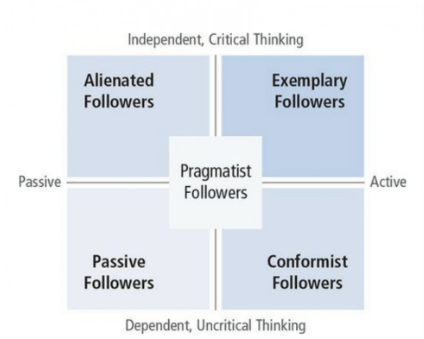
Figure 1. Kelley’s Followership Model (1988)
Figure 1 and Table 1 provide a summary of the five types of followers and what these mean in the context of BBNZ’s HP management teams. For Kelley, the ideal follower was a critical thinking contributor, termed the ‘exemplary follower’. Kelley argues that most leaders prefer ‘conformist followers’ because they are easy to control. ‘Alienated followers’ are critical but do not contribute; and ‘passive followers’ have little to no value other than bring present. A critical thinking follower who is alienated is far more likely to be a negative team member.
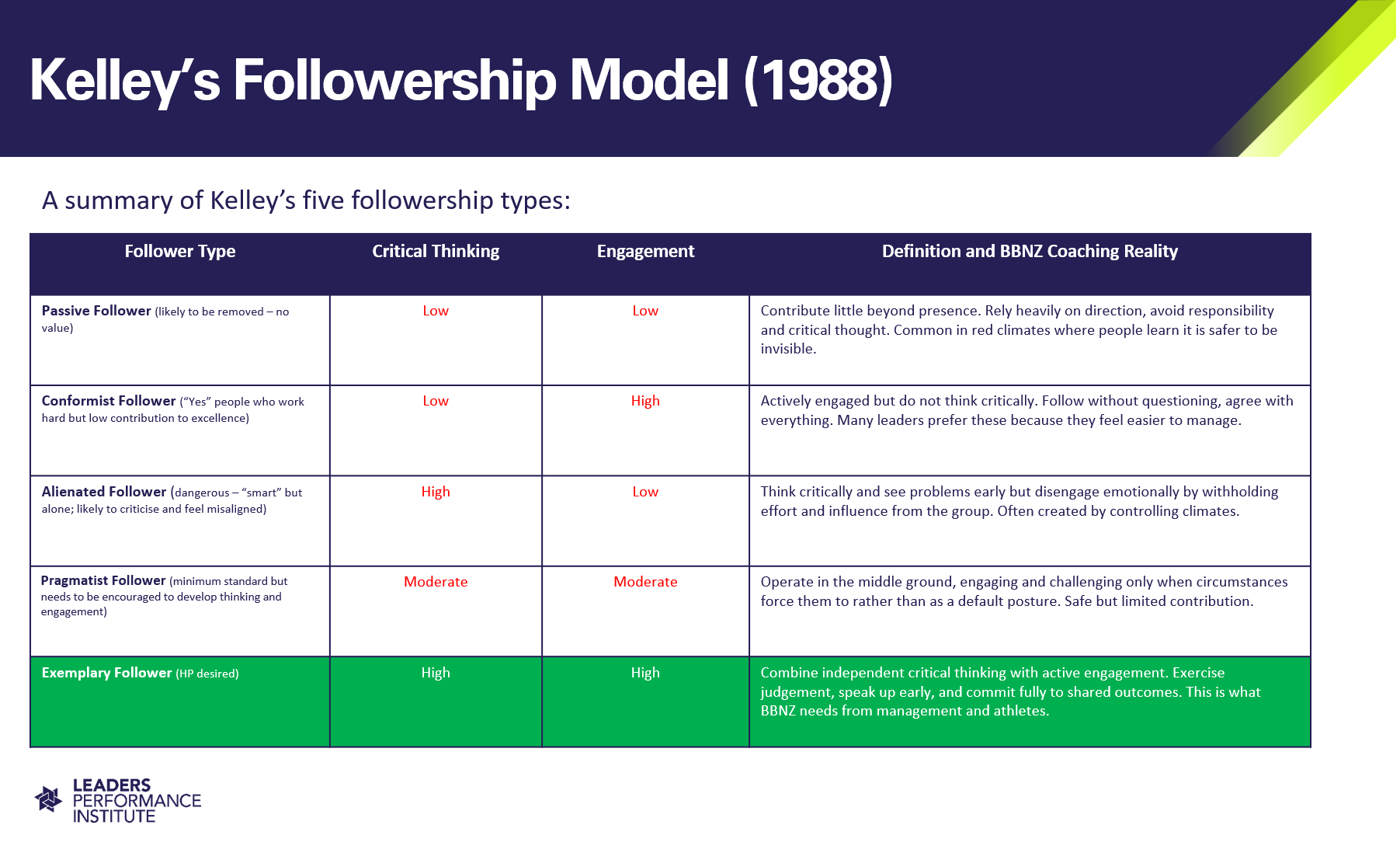
Table 1. A summary of Kelley’s five followership types
A clear understanding of Followership theory and the interaction of critical thinking with active contribution is valuable for organisations like BBNZ, where management teams operate in periodic, decentralised, and contractor‑heavy environments. Once national teams assemble for FIBA events, organisational charts flatten quickly, formal authority as a national sporting organisation (NSO) reduces, and the HP system functions largely through trust, clarity, and discretionary effort. In these contexts, the quality of followership becomes visible in what people do when conditions are uncertain, pressured, or imperfectly resourced.
In tour‑assembled environments, followership quality is a strong determinant of whether standards are sustained, problems are surfaced early, and judgement is exercised when it matters most. Kelley’s insight remains deliberately uncomfortable. Leaders often gravitate toward conformists because they feel easier to manage, yet doing so suppresses the independent thinking and ownership that complex, time‑bound campaigns depend upon.
How Leadership Climate and Followship exist across BBNZ’s national teams
An example of system logic is provided in Figure 2.
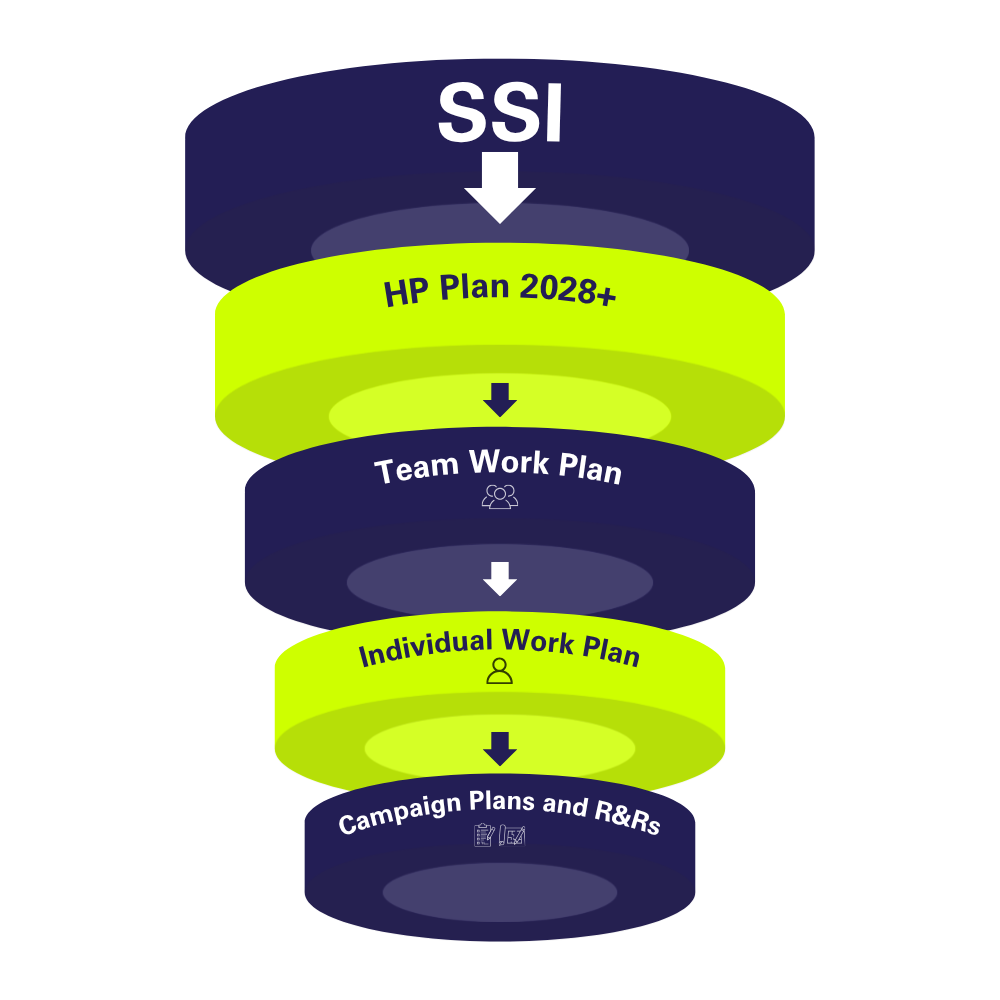
Figure 2. A system logic view of BBNZ HP Strategy spanning the NSO’s Strategic Statement of Intent (SSI) to HP Strategy (HP Plan 2028+) into HP Team Plan that support HP team member’s individual plans that inform how HP constructs and operationalises Campaign Plans and Roles and Responsibilities across various National teams.
In this example, clarity is treated as a primary leadership behaviour. Through making purpose, expectations, roles, and decision rights explicit HP leaders are able to reduce anxiety and guesswork in management teams and create the conditions for Inspiring and Including climates. These favourable climates elevate the quality of followership the HP system produces. Across the HP team’s ways of working there is a deliberate emphasis on a clear, shared purpose, psychological safety, empowerment with accountability, and inclusion.
These act as necessary prerequisites for ‘exemplary followership’ which are characterised by independent thinking and active engagement. Examples of how this is achieved are engaging in collaborative approaches to define ‘What It Takes To Win’ (WITTW), clarifying campaign roles early in a cycle, and making HP expectations visible through Team Charters to allow management and athletes to exercise judgement rather than wait for instruction. When management are recruited and onboarding takes place there is a priority to build early senses of belonging and clarify the conditions for constructive candour and continuous learning. With reference to Leadership Climate terminology, such conditions actively strengthen Visioning, Trusted, Collaborative, and Encouraging behaviours while reducing the likelihood that pressure induces Controlling or Withdrawing patterns.
In the realities of global FIBA tournaments existing in dynamic, uncertain, complex conditions the benefits of positive team climates and exemplary followship are experienced. By making purpose, boundaries, and expectations explicit before and during campaigns, BBNZ increases the probability that touring parties will act as capable followers. Ones who can think ahead, raise issues early, hold standards without being policed, and sustaining discretionary effort under fatigue. The latter is imperative with international travel and compressed recovery windows between competition. In this sense, the HP frameworks developed and communicated are not just management tools, they are deliberate climate interventions that enables leadership and followership to be co‑produced in conditions where formal control is neither realistic nor effective.
At age‑grade level, clarity is what allows people to coach and support with judgement rather than hesitation. When purpose, roles, and decision‑making boundaries are clear early in the cycle, staff don’t wait for permission—they act in the best interests of the athletes. That creates trust, encourages honest challenge, and allows learning to happen quickly. In high‑pressure tournaments, those conditions matter because we need people thinking and contributing together, not just executing instructions.
Mel Bennett (Head Coach of U15-U17 Women and Assistant Coach of 2Degrees Tall Ferns)
From a medical and recovery perspective, clarity changes everything. When roles, decision rights, and expectations are explicit, I don’t have to guess whether to escalate an issue or wait—and neither do the players. It allows us to act early, manage load properly, and hold standards without friction. In the middle of a FIBA campaign, that clarity creates trust, reduces stress, and lets everyone contribute their judgement rather than just follow instructions.
Mikayla Rosieur (2degrees Tall Ferns and U17 Men’s Physiotherapist)
To help better illustrate the interactions of Leadership Climate, the types of climate conditions and Followership, Table 2 maps the JCA Climate Types to Followership Behaviours in the form of ‘touring realities’.
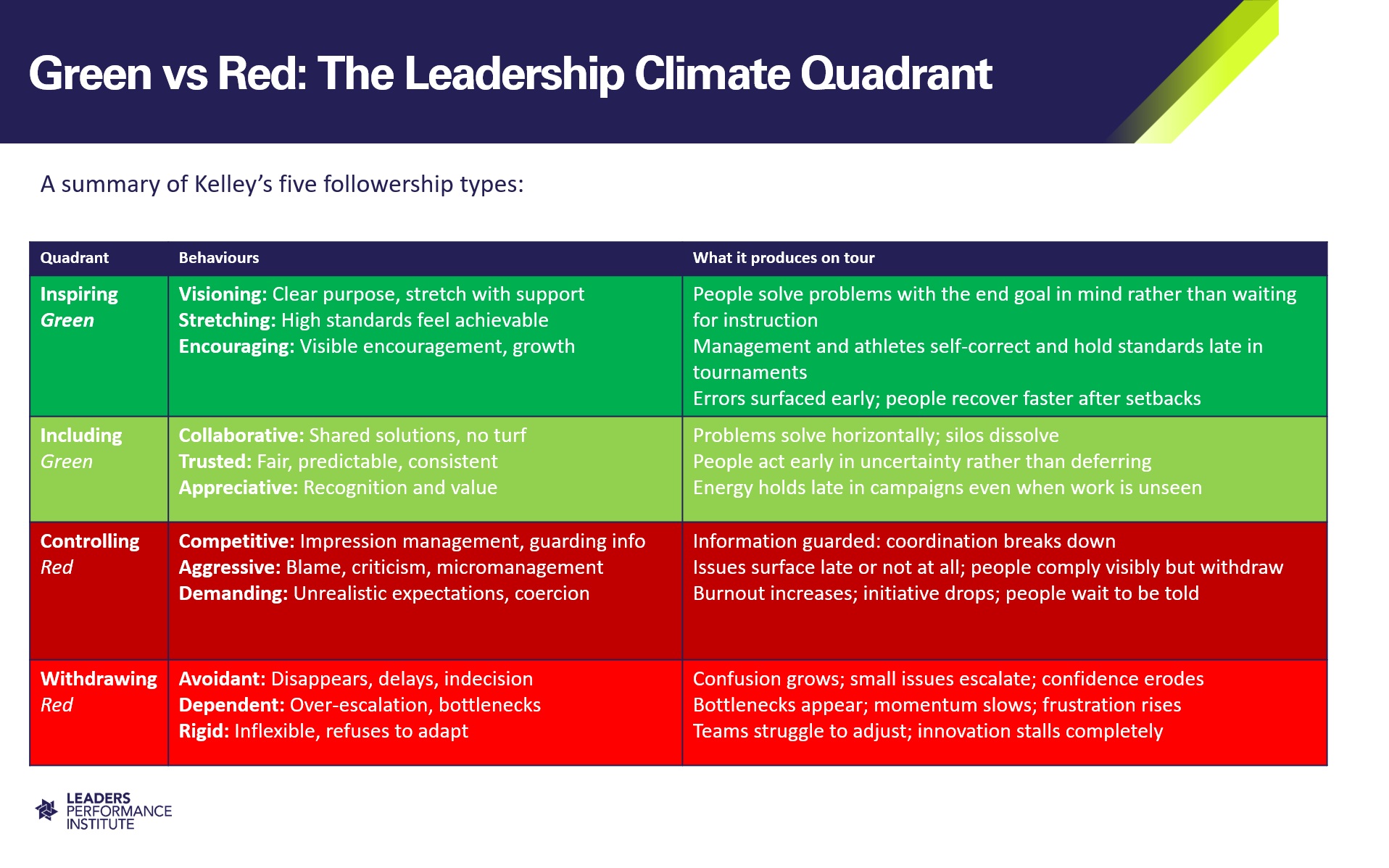
Table 2. The JCA Climate Types mapped to Followership Behaviours in the form of ‘touring realities’.
Recently the BBNZ HP team has constructed Team Charters as an initiative to elevate leadership climate and followership by replacing hierarchy with shared clarity. These charters make purpose, expectations, and behavioural norms explicit so that independent thinking, early voice, and accountable contribution become safe and expected, even under pressure. Through the removal of ambiguity (the primary trigger for anxiety, silence, and defensive followership) the Charters serve to stabilise the emotional climate whilst actively strengthening Inspiring (Visioning, Stretching) and Including (Trusted, Collaborative, Appreciative) climates by ensuring people know what matters, how decisions will be made, and how they are expected to contribute.
Concluding remarks
In decentralised, time‑limited national‑team environments, the decisive leadership task is not to demand compliance but to design the conditions for exemplary followership. That begins with making the why unmistakable for all parties. There needs to be a clear purpose, realistic success markers, and alignment surrounding how each role contributes. These conditions enable the setting of mutual expectations about standards, decision rights, and escalation pathways to hold teams steady under pressure. There is a requirement to create permission for feedback and insights by rewarding early problem‑raising, building trust through reliable follow‑through and predictable communication. HP leaders need to recognise the contributions that sustain standards, energy, and learning throughout campaigns. Create conditions, not compliance because international performance is built on the effort you cannot mandate.
References
Strategy, skill acquisition and change management were just some of the topics on the agenda at the Leaders Performance Institute in April.
“I joked last week that this place feels like my home course,” he said. “I haven’t played anywhere else in the last two or three weeks really. I felt prepared in that way. I felt prepared that wherever I hit it on the golf course, I sort of know what to do. I know where to miss. I’m pretty comfortable with all the shots around the greens.”
McIlroy, a six-time major winner, disregarded other PGA Tour events and even chose to ignore a back injury that had been hampering his performance. At one point he even carded a score of 29 on the front nine at Augusta.
“It’s a good blueprint,” he continued. “I’m not going to take three weeks off before every major, but to get to the major venues early, do your preparation, play. And not just play and look at things, but actually play. Go out there with one ball, shoot a score and try to do it that way.”
McIlroy’s successful strategy came not long after our Leaders Meet: the Art of Strategy event at Lord’s Cricket Ground, where a range of guests, including Olympic gold medallist Tabby Stoecker and Lawn Tennis Association Performance Director Michael Bourne discussed how to build, stress-test and execute an effective performance strategy.
We know McIlroy wasn’t there because he was in Georgia, but he, much like yourselves, can check out the chief insights here.
And now on to other happenings at the Leaders Performance Institute in April.
Quote of the month:
Personally, I don’t believe in skills coaches.
These are the words of Rory Teague, who notably spent a year and a half between 2016 and 2017 working as a skills coach under then England men’s rugby union Head Coach Eddie Jones.
A decade on, Teague serves as the Head Coach of French Pro D2 club AS Béziers Hérault and, as he tells the Leaders Performance Institute, would not copy Jones’ appointment in southern France.
“I wouldn’t myself employ a skills coach,” he says. “I think every coach who coaches an area of the game should be able to coach the skill of their area. ‘Skills coach’ as a term has become archaic as coaching has moved along.”
Read the full story here.
We also addressed some of the common tensions, challenges and opportunities in skill acquisition here.
Insight of the month:
British military operations are primed to perform when personnel do not have even 60% of the desired information at hand.
As Aneaka Reay-Kemp, the Lead Military Intelligence Specialist at the UK Ministry of Defence, told the audience at Leaders Meet: the Art of Strategy, they are trained, as she said, to be “comfortable being uncomfortable”.
Rank, she argued, has limited bearing. In fact, the British military has taken steps to reduce the influence of its own hierarchies in moments of uncertainty. She said:
It doesn’t matter what’s on that person’s chest, it doesn’t matter their background, they still bring value no matter how junior they are. So for me, I find that when you’re operating in an environment where you don’t have all the information, understanding your people, understanding their capability, what they bring to the party can help save someone’s life.
Reay-Kemp was one of six guests who brought the day’s proceedings to life.
Shock of the month:
We often hear informally of ‘bad’ environments, but we don’t necessarily expect them to be amongst those considered the very best.
Yet that was the experience of Alexander Campbell, the former principal dancer at the Royal Ballet and Birmingham Royal Ballet when he attended the Royal Ballet School in the early 2000s.
“I struggled so much that I wasn’t sure whether I wanted to continue pursuing a career in ballet,” he said.
He had arrived from his native Sydney mid-term, which didn’t help him to settle, but it was also down to the type of prescriptive teaching that routinely irks younger generations today.
“We weren’t really encouraged to step out of our lane. It was like, ‘you know the steps, you focus on this, and we’ll worry about everything else,’” he added.
When reflecting on that time for Leaders members, he said it was “such a missed opportunity.”
His turn-of-the-century experience as a ballet student shows that the need for teachers to meet their students halfway is not new. Two decades later, talent environments in performing arts, and in sport, must be designed to engage a cohort that wants to know ‘why?’
Campbell, now the Artistic Director of the Royal Academy of Dance, shared his full story here.
Good to know:
What’s the difference between a ‘change’ and a ‘transition’?
A ‘change’ is simply that, but a ‘transition’ refers to the human adaptation required in the face of change.
That is according to John Bull, the Head of High Performance at Management Futures, who posed this question at a virtual roundtable for members of the Leaders Performance Institute where the topic of the day was ‘what makes change stick?’
In simple terms, as Bull explained, change initiatives fail not because the change itself is wrong but because the human transition is misunderstood, ignored or rushed.
“The object of change is quite straightforward; transition can be super complicated,” he said, “and what we tend to do in organisations is not pay nearly enough attention to managing transition. We forget about that.”
To help the virtual room in this regard, he introduced attendees the three phases of transition:
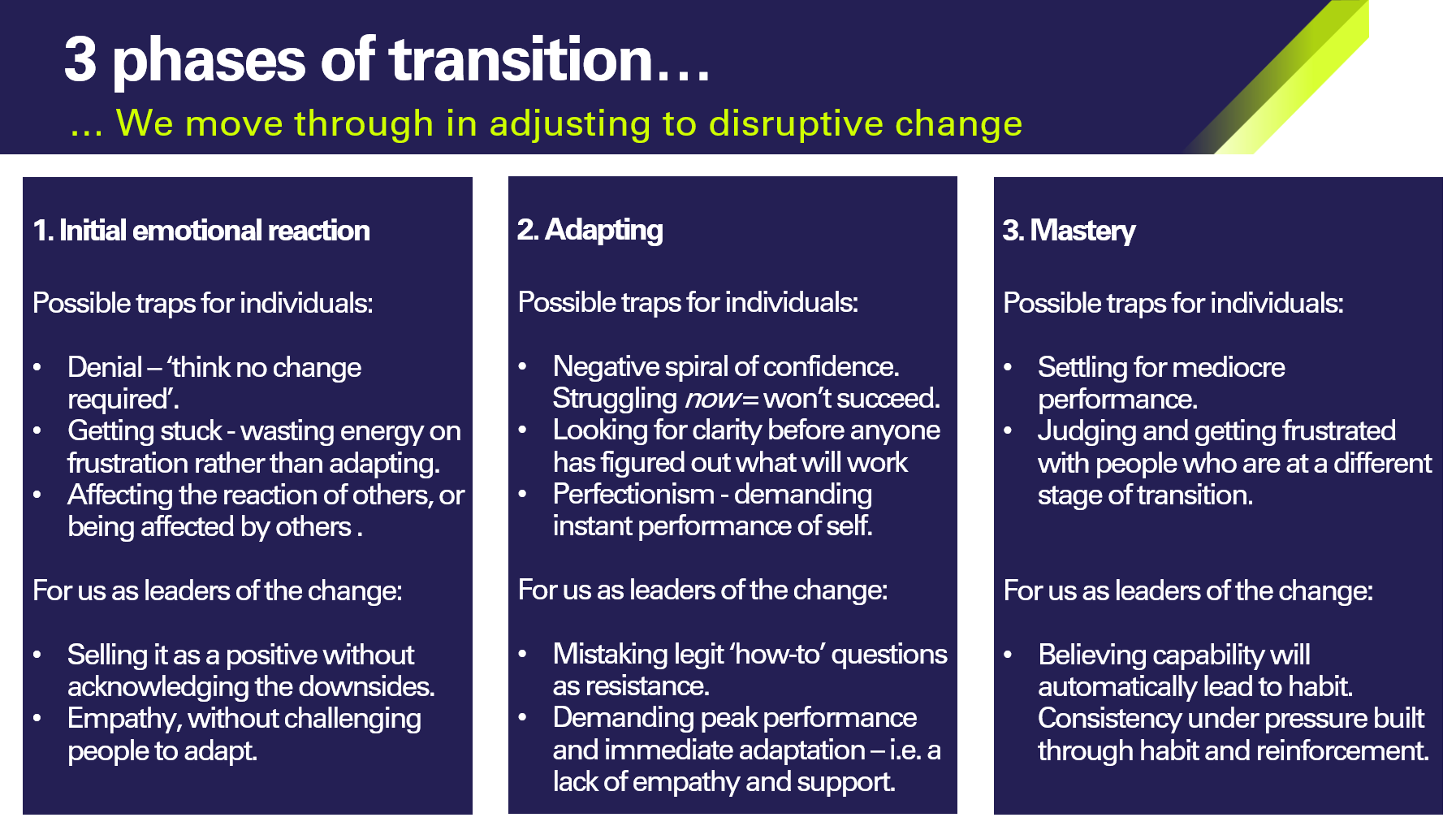
Bull brought these three phases of transition to life by describing how he went through each in response to a postponed work project:
The key thing about stage one is I am still really frustrated and annoyed with certain individuals that have led to that happening. Now, I would say on one level, that’s really understandable. It’s a significant project that we were really excited about; but here’s the key point: it is useless and doesn’t help me one bit. So all the energy that I’m investing in the frustration is not going into the adapting; and what I should be spending much more time on is focusing on what do we need to do to adapt now that change has happened.
Finally…
Four common causes of tension between business and performance… and four opportunities for increased collaboration.
Coming up for Leaders Performance Institute members
World Rugby’s Brett Robinson describes the treacherous path he navigated when delivering the global federation’s Impact Beyond 25 strategy.
Robinson, a former Wallabies international-turned-sports scientist and C-suite executive, beat France’s Abdelatif Benazzi by 27 votes to 25 in the second round of the election held by World Rugby’s Executive Council.
His narrow majority meant he succeeded Sir Bill Beaumont without a honeymoon period. Yet his achievements thus far, chiefly the implementation of World Rugby’s Impact Beyond 25 programme and building consensus around new laws of the game, have been commendable.
“I’m really proud of where we’ve got to as a game because, when I came into the role, we were fractured and divided,” he told an audience at Leaders Meet: Australia in Brisbane in February.
There were factions within the World Rugby Council that could be divided into England and the Celtic nations on one side with the French and Latin nations on the other. Robinson, as an Australian, said he was “coming into a gunfight between the Celts, the English and the French.”
For all that, in September 2025, the 17th World Rugby General Assembly had endorsed Impact Beyond 25, its five-to-seven-year strategy for developing and promoting the world game heading into the men’s Rugby World Cup in 2027 and Women’s Rugby World Cup in 2029 (both to be hosted in Australia) with the 2028 Olympic Games in LA sandwiched in between.
So what changed? Below, we explore Robinson’s approach to calming rugby’s internal strife.
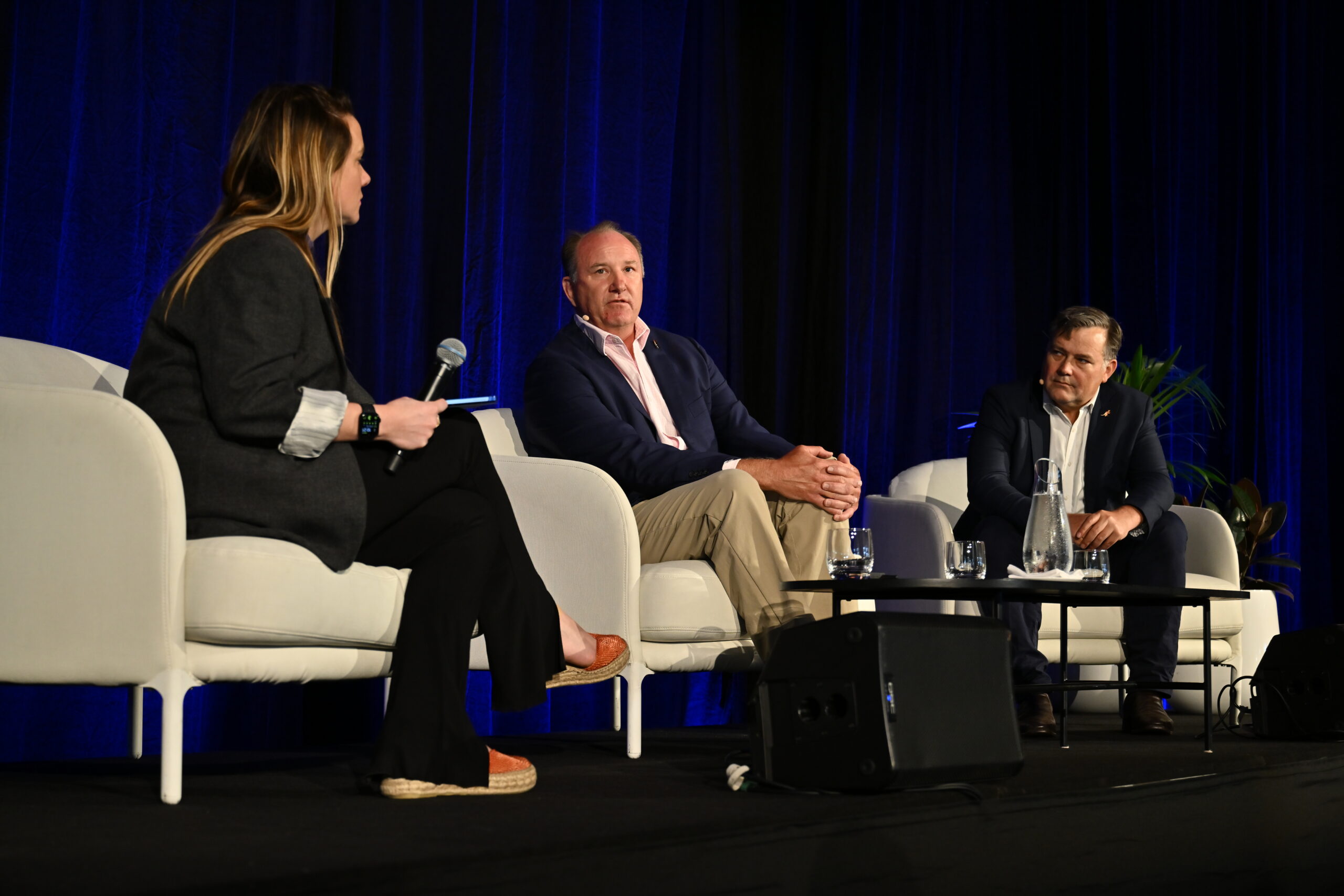
Brett Robinson (centre) onstage at Leaders Meet: Australia with Rugby Australia’s Director of High Performance Peter Horne and Leaders’ Managing Director Laura McQueen. (Photo: Albert Perez / The Leaders Performance Institute.)
Firstly, he didn’t shy away from the problem
As Robinson explained, “some countries were incredibly frustrated; they wanted to revolt and blow everything up.” Others were about “organisationally working with the change and not being too destructive”.
Almost half of the 52 members of the World Rugby Council voted for Benazzi as Chair. Robinson, who will serve a four-year term, did not shy away from that fact. “We’ve got differences of opinion, we’ve got some challenges, and there’ll be some people that were disappointed after the election,” he said in the aftermath.
In December 2025, he expanded on his thoughts as a guest on the Rugby Unity Podcast. “The system upon which World Rugby is built has been in place for 30 years,” he said. “We have systems that simply don’t work and prevent us from reacting with the necessary speed.” It is worth remembering that he made those observations after Impact Beyond 25 had been launched.
Onstage in Brisbane, he further outlined an enduring sticking point: that France and England account for approximately 70% of the revenue generated in rugby union. This had led to political as well as economic tensions across the different factions; and the question was how World Rugby could engage and incentivise the other unions to align in pursuit of a more equitable distribution.
He ensured World Rugby’s new strategy was a collective endeavour
The Impact Beyond 25 strategy was unanimously ratified just days before the 2025 Women’s Rugby World Cup final, which saw a crowd of 82,957 watch England beat Canada 33-13 at Twickenham.
The timing could not have been better. England 2025 was the most well-attended Women’s World Cup ever. World Rugby’s unions gave their blessing to a global impact plan that, in the international governing body’s own words, ‘is built around three core themes of profile and participation, careers and gender equity, and capability and expertise with the mission of inspiring more women and girls to get into rugby on and off the field of play.’
Most importantly, it bore the fingerprints of all those involved in its creation.
“It’s really important that, in my role, I bring the game together and we agree on what shared success looks like and we pursue it together,” Robinson told Rugby Unity.
He expanded on those comments in Brisbane. “We’ve built a collective plan where we’re all engaged, we’re all incentivised, and we’re all a part of that journey,” he said, adding that the plan includes taking All Blacks and Wallabies Test matches to the United States. Such moves “will help build the fandom that ultimately will drive the commercial outcomes and [increase rugby union’s] market share”.
He accounted for local complexity
“We are not going to do everything from Dublin,” he told the Brisbane audience, name-checking World Rugby’s base and then pointing to the man sat beside him onstage, his former World Rugby colleague Peter Horne, who now serves as Director of High Performance at Rugby Australia.
“What we do is only as good as what he [Horne] can deliver and vice versa.”
In some places, such as Australia and England, Robinson said, “we have an Anglo-Saxon way of governing; we’ve got strong boundaries around the role of the chair, the board, the CEO, the executive. In other parts of the world, they have very different ideas of the president or the chair being an executive authority.”
He cited the example of Argentine Gus Pichot, the former Vice-Chair of World Rugby. “He’s not the chair and he’s not on the board of the Argentine Rugby Union, but he is making every decision coming out of it; and so I have to work with that, acknowledging that I need to keep his chair informed and his CEO informed; but if Gus doesn’t agree with it, it doesn’t happen. And I could say, ‘well, that’s just a crazy way of governing’, but I can’t change it, so I have to work with it. The French are the same; Florian Grill is their president. He’s not the CEO, but he operates as an executive chair.”
On that last note, Robinson said: “I spent a lot of time before Christmas with the French in Paris. I’m going back there in a couple of weeks’ time.” These meetings have proven invaluable. “You have to work really hard to genuinely display that you’re listening and supporting, and they don’t necessarily say ‘yes, yes, yes’, but actually they can see the ‘why’.”
World Rugby is now reaping the rewards of his efforts. “Having the French and the Argentinians now with us, and rebuilding the relationship with the Celts and the English, was probably the biggest challenge that I faced; and now we’re there, we need to push on and deliver.”
He won’t rest on his laurels
“You’ve got to be systematic; from my experience, if you go randomly into anything like this, you are more likely to fail than not,” said Robinson. “You have to set up a proper process.”
He listed the necessary personal qualities of a chairperson: trustworthiness, empathy, and emotional intelligence. He balanced these against an ability to act and make tough decisions. All are essential in a world where alignment is predicated on retaining the trust of the individuals involved in the process.
Robinson then explained that the executive board of World Rugby had just undergone a review. He said: “I’ve been running a process over Christmas where we have a 360 on our behaviours; I’m getting a 360 on me. We’re having a discussion about board effectiveness; how that relates to the implementation of our strategy. We have some blind spots and weaknesses on our board, and we have succession plans that are coming. So those things are really important because it all rots from the head.”
What to read next
Why Change Only Sticks when you Lead your People Through the Transition
We bring you five factors to consider as discussed at Leaders Meet: the Art of Strategy this year by guests including Michael Bourne of the Lawn Tennis Association, Olympic gold medallist Tabby Stoecker and the UK Ministry of Defence’s Aneaka Reay-Kemp.
Main Image: Robert Obreja / Leaders Performance Institute
“In order to build the right bridge, you need to understand those two things.”
Bourne, the Performance Director at the Lawn Tennis Association [LTA], was the first to speak at Leaders Meet: the Art of Strategy, which took place at Lord’s Cricket Ground in London in late March.
Members of the Leaders Performance Institute travelled from far and wide for a day that challenged assumptions and provoked some of the sharpest minds in the sports industry to rethink how strategies emerge in high-performance environments.
Bourne was joined on the bill by Milano Cortina mixed skeleton gold medallist, Tabby Stoecker, and speakers from organisations including the Football Association, luxury retailer Selfridges, and the UK Ministry of Defence. Together, they explored how strategies are built, stress-tested and executed by the best in the business.
Below is a snapshot of the day’s proceedings; five fresh insights to help strengthen your own planning and execution.
1. A strategy starts with a brutally honest discussion
Bourne joined the LTA in 2018, when they were two years into their ten-year performance strategy designed to tackle the lack of players coming through the British tennis system.
Yes, Andy Murray had won three majors in recent memory, but the sense was that this was “despite the system, not because of it”.
“In essence, between 2016 and 2017, the organisation undertook a diagnosis of the situation,” said Bourne, “and they came up with a number of different issues”.
This diagnosis, which included a lack of coherent pathways, limited programmes for talent ID, and resources spread too thinly, enabled the LTA to have a long, hard look at itself without pointing fingers at individuals. It lowered stakeholder defensiveness and provided the foundations for what they needed to do next.
Bourne was not present for the diagnosis, but he was recruited shortly after to ensure the LTA adopted the right approach and a coordinated set of actions. But they could not jump ahead. As he said:
I believe that you have to have that first element of the diagnosis and your guiding policy right first.
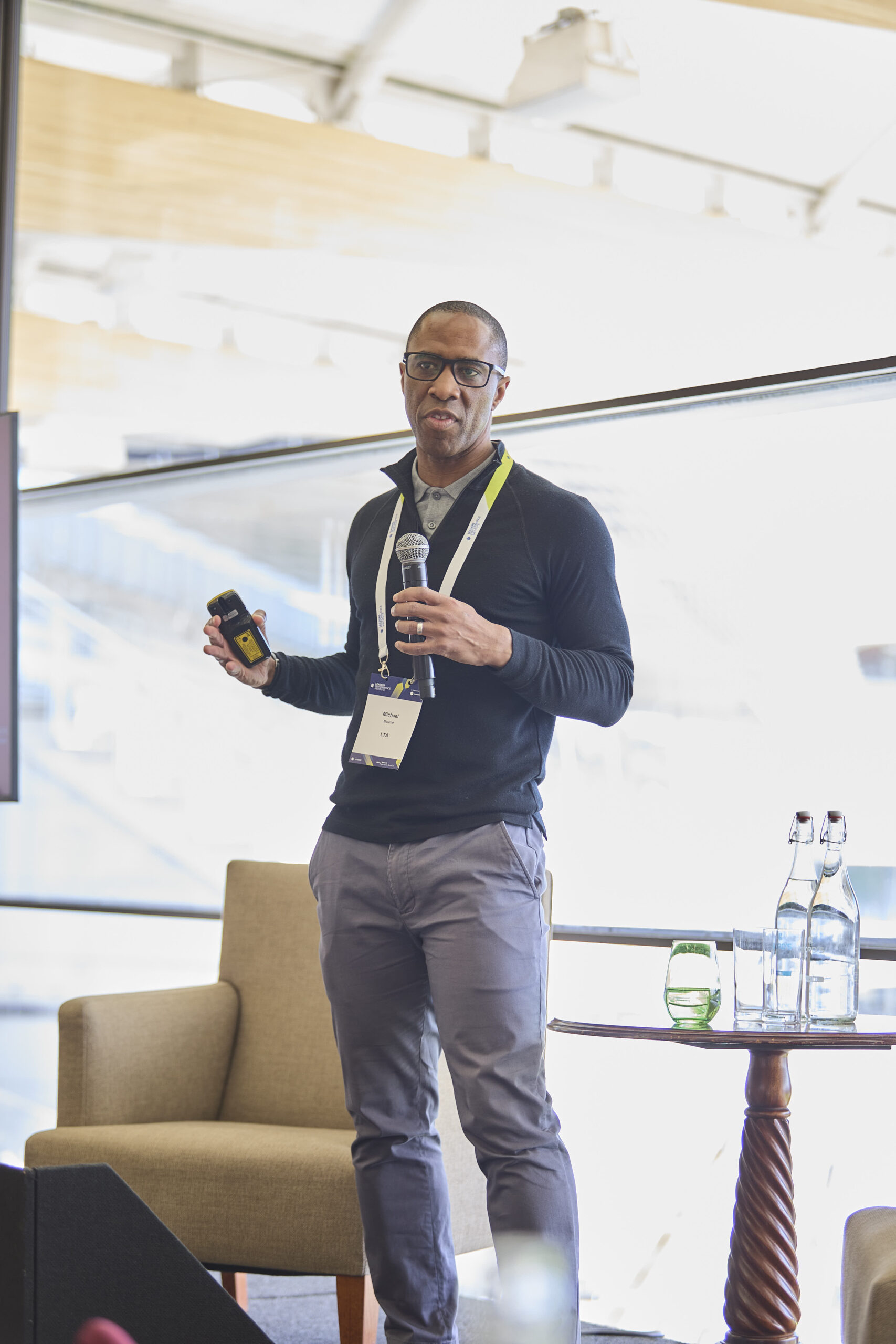
Michael Bourne, Performance Director at the Lawn Tennis Association, spoke first and set out the hard truths confronting British Tennis back in the mid-2010s. Image: Robert Obreja / Leaders Performance Institute
2. Your strategy must be co-created
At luxury retailer Selfridges, Head of DEI, Recruitment & Onboarding, Sharlene John, faced the challenge of trying to tie her work to commercial outcomes while challenging the idea that DEI is “fluffy” and irrelevant.
The result was Selfridges’ award-winning DEI and culture strategy Open to the World. On John’s watch (she joined Selfridges in 2021), female leadership within the organisation has grown from 32% to almost 70%; Selfridges is also an industry leader in ethnic representation.
Open to the World flourished because of John’s efforts to ensure it was a co-created initiative from the start. She said:
Before we even put pen to paper, it was going out and speaking to my teams, but also my leaders, to understand what does DEI or culture mean to you? And where there was that missing voice, it was bringing people into the room. So not just relying on those senior leaders where we don’t have representation, it was ‘OK, we’ll go down a layer’… I was talking to people across our business with a headcount of around three and a half thousand… We’ve got stores in Manchester, Birmingham, a tech suite in Leicester, and then the flagship in London. I went to every site speaking to people from grade 2, which is our junior role, up to our grade 7, which is exec positions, to understand what Open to the World actually means to them.
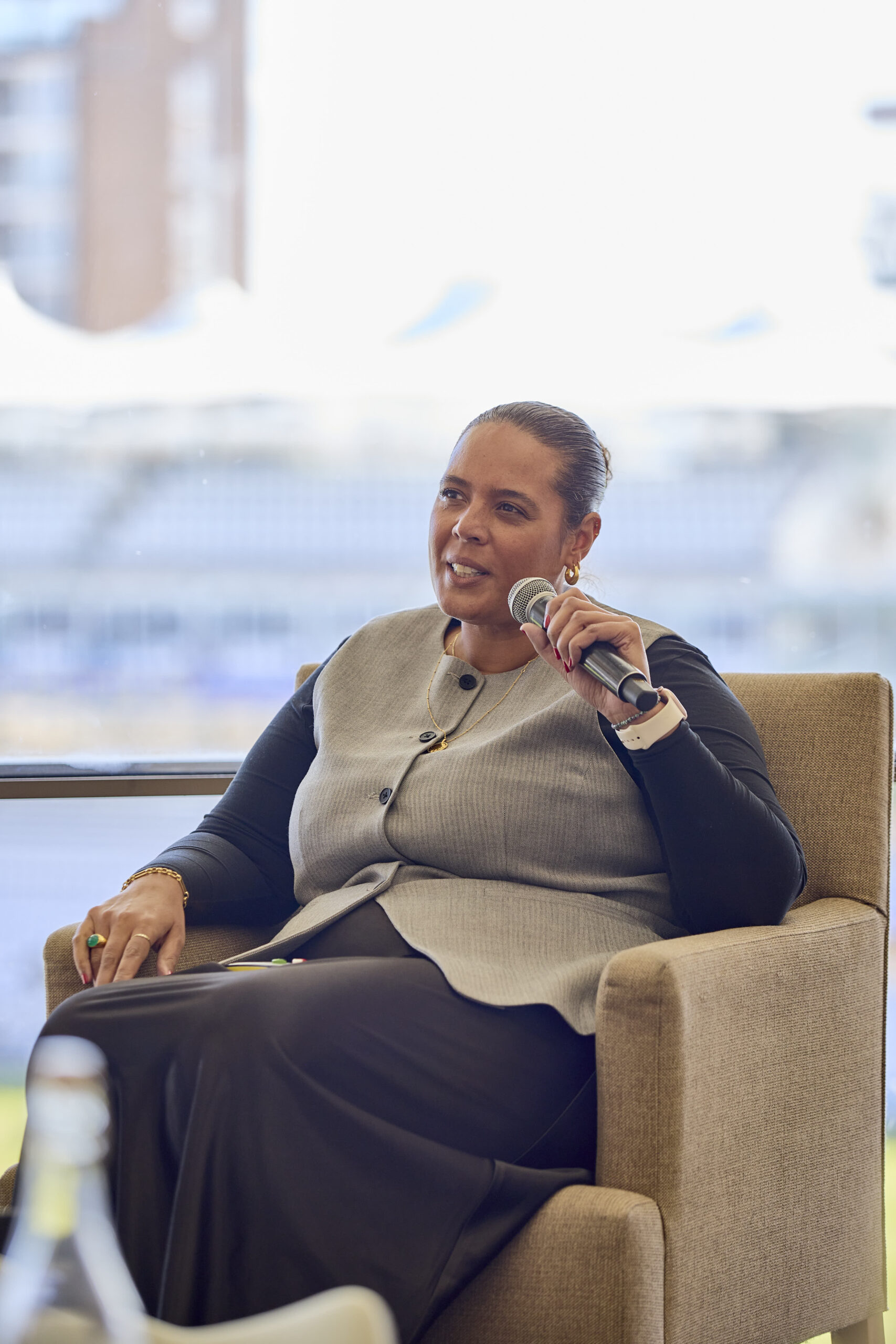
Sharlene John, the Head of DEI, Recruitment & Onboarding at Selfridges, describes her organisation’s award-winning Open to the World inclusion programme, which was built by a plurality of stakeholders. Image: Robert Obreja / Leaders Performance Institute
3. Evaluation (and re-evaluation) is continuous
“If you don’t get it right when you’re there in the moment, doing a review process at the end is worthless.”
So said Paul Ford, the former Head of Sport at the British Olympic Association [BOA] who recently joined English Championship side Norwich City as Performance Director. He spoke alongside Tabby Stoecker, the mixed team skeleton gold medallist at the Milano Cortina Games alongside her teammate Matt Weston.
When it comes to in-the-moment tweaks, Ford has a point. The BOA must work with national governing bodies, coaches and athletes continuously throughout a four-year cycle. “It’s making sure that we are doing it hand in hand with our sports as frequently as possible,” Ford added.
A macro ‘plan-do-review’ alone is not adequate. Of competition time itself, he said:
It’s on a daily cycle during delivery mode at a Games. [We ask] what are you planning for this day? What are we doing this day? How has this day gone? Because if you don’t make the most of that experience in the moment, it’s not going to happen for another four years.
Stoecker benefited from this approach, as demonstrated by her success. She said:
There wasn’t just the review of that specific race, but also ‘what are you taking from this that you’re going to change or carry forward for three years’ time, two years’ time, six months’ time?’… you can get quite swept up in what you’re doing and you have these extreme highs and lows. So I think staying focused, and when you’re then doing that and being so process-driven, the results just come.
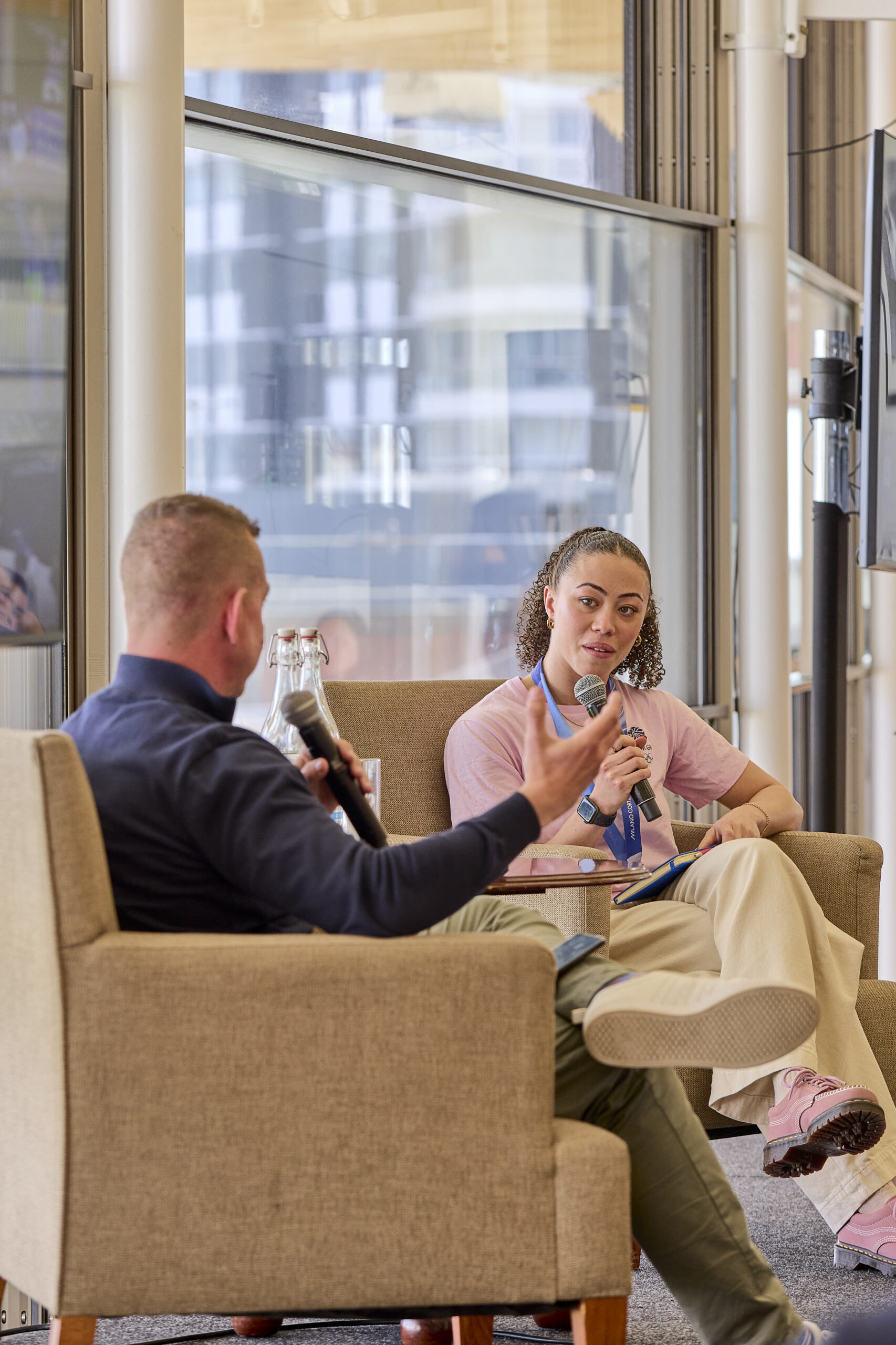
British Olympic gold medallist Tabby Stoecker is deep in conversation with Paul Ford, the former Head of Sport at the British Olympic Association, as they discuss Team GB’s strategic approach to Olympic cycles and, more specifically, Stoecker’s path to gold in the mixed skeleton at the Milano Cortina Games. Image: Robert Obreja / Leaders Performance Institute
4. Be ready to act on incomplete information
You and your team may enjoy clarity and alignment of purpose, but optimal operating conditions are likely to be elusive whatever your efforts.
With this in mind, Aneaka Reay-Kemp, the Lead Military Intelligence Specialist at the UK Ministry of Defence, told the audience how British military operations are primed to perform when personnel do not have even 60% of the desired information. They are trained, as she said, to be “comfortable being uncomfortable”.
Rank, she argued, has limited bearing. In fact, the British military has taken steps to reduce the influence of its own hierarchies in moments of uncertainty. She said:
It doesn’t matter what’s on that person’s chest, it doesn’t matter their background, they still bring value no matter how junior they are. So for me, I find that when you’re operating in an environment where you don’t have all the information, understanding your people, understanding their capability, what they bring to the party can help save someone’s life.

Aneaka Reay-Kemp, the Lead Military Intelligence Specialist at the UK Ministry of Defence (centre), in conversation with moderator Iain Brunnschweiler (left) and Football Association Head of Strategic Development & Operations, Paul Cleal (right) as she explained what it takes for military personnel to act with incomplete information. Image: Robert Obreja / Leaders Performance Institute
5. What are you ready to discard?
New initiatives, new processes and new ways of thinking are great, but what are you prepared to discard?
“One of the things about strategy is making choices,” says Paul Cleal, who spoke alongside Reay-Kemp in his capacity as Head of Strategic Development & Operations at the Football Association. “If you’re trying to change something, it almost always involves stopping doing something else.”
However, as he has experienced, this is often easier said than done. “If things involve stopping doing something for the new thing you need, a lot of organisations struggle with that.”
Evidence, he explained, is critical in making those choices:
When I walked in three years ago, my job was not to throw things in the bin and do them differently. It was to ask: is what we’re doing now meeting the strategic aims and to what extent do we need to get closer to our strategic aims and what is it we can change?
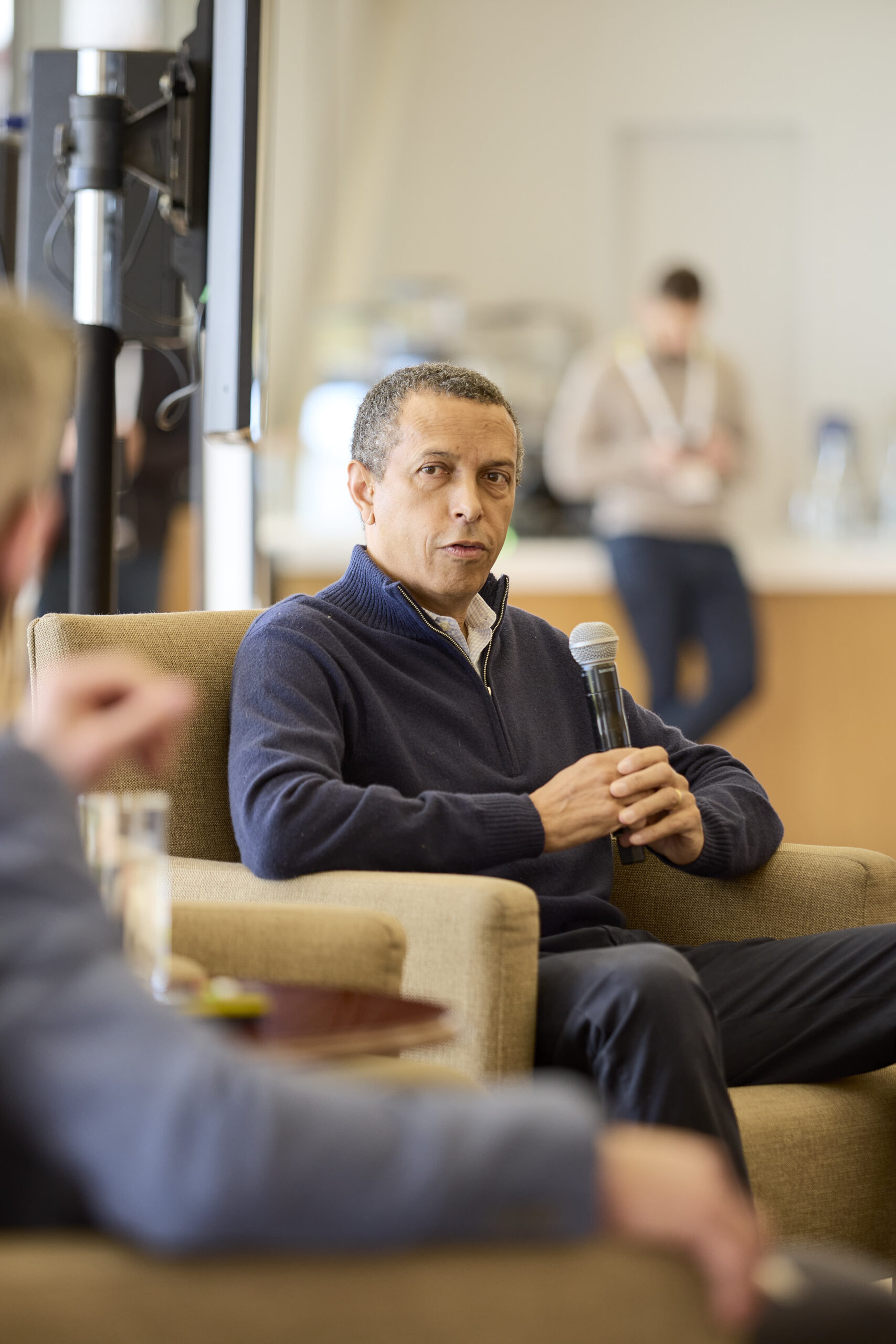
Paul Cleal, the Head of Strategic Development & Operations at the Football Association, explains why it’s important to discard programmes and processes when they no longer serve the collective. Image: Robert Obreja / Leaders Performance Institute
See you at the Sport Performance Summit in New York?
As John Bull of Management Futures explains, change initiatives fail not because the change itself is wrong but because the human transition is misunderstood, ignored or rushed.
John Bull, the Head of High Performance at Management Futures, poses this question at a virtual roundtable for members of the Leaders Performance Institute where the topic of the day was ‘what makes change stick?’
To set up the conversation, he looked at the twin elements that enable sustained change (people taking ownership of the change and the idea of change itself as a habit) before identifying some of the common sources of resistance.
“There are times where we will resist change, we’ll engage less quickly in it, even when we have to; or we waste energy in how we’re responding to change,” said Bull. “But we also have to understand resistance from others and what that requires of us as leaders.”
People, he explained, resist change for two primary reasons: loss (what they perceive they are losing) and uncertainty or ambiguity. It is not enough for a leader to merely sell the change.
He continued: “If we’re just pushing change and we haven’t understood what people perceive they’re losing, then we run the danger of increasing the resistance rather than decreasing it. By understanding where the resistance is coming from and being able to address that, we’re in a much better position to be able to lead it.”
A ‘change’ or a ‘transition’?
In simple terms, as Bull explained, change initiatives fail not because the change itself is wrong but because the human transition is misunderstood, ignored or rushed.
He illustrated this distinction between ‘change’ and ‘transition’ with a slide:
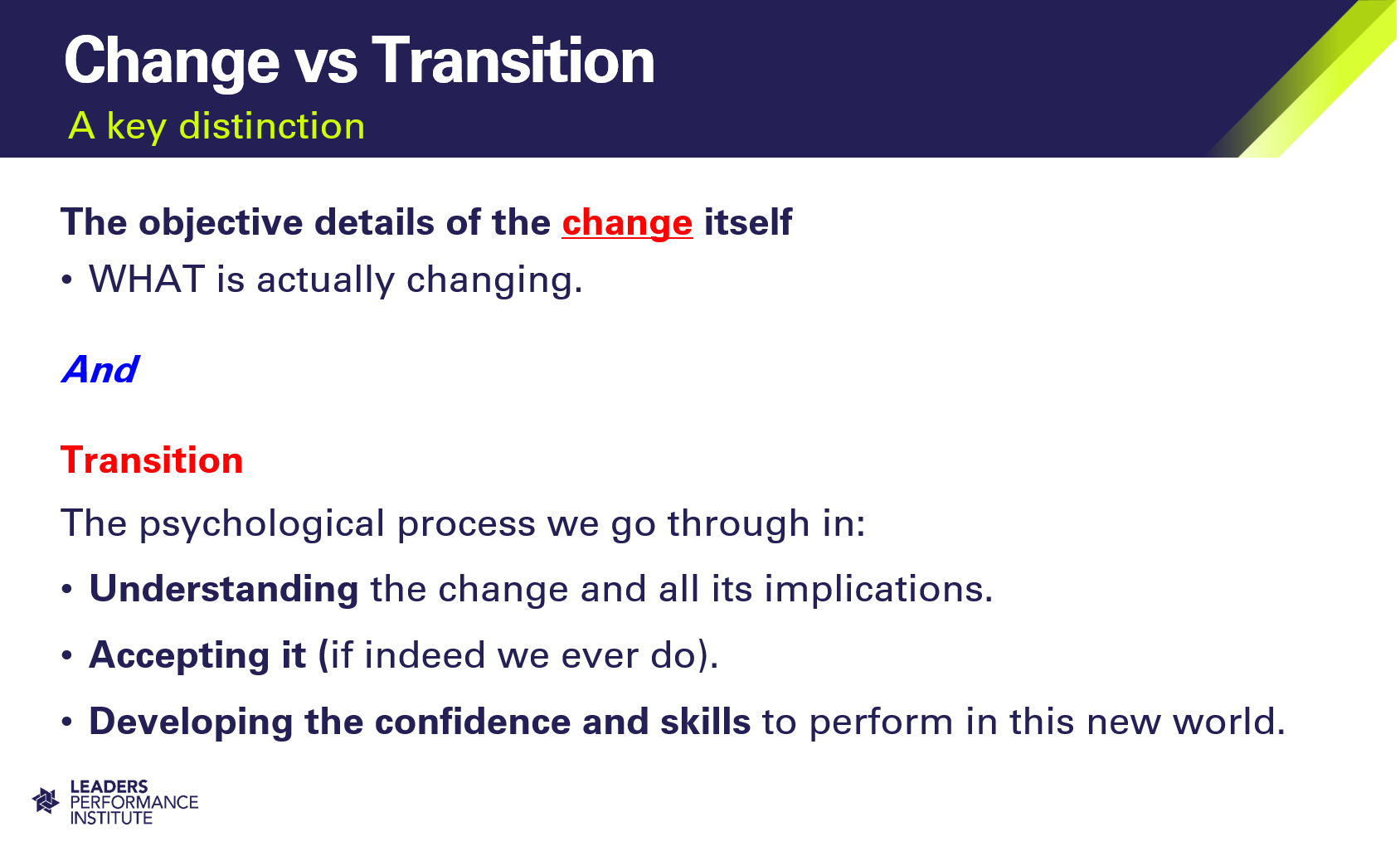
“The object of change is quite straightforward; transition can be super complicated,” he said, “and what we tend to do in organisations is not pay nearly enough attention to managing transition. We forget about that.”
To help the virtual room in this regard, he introduced attendees the three phases of transition:
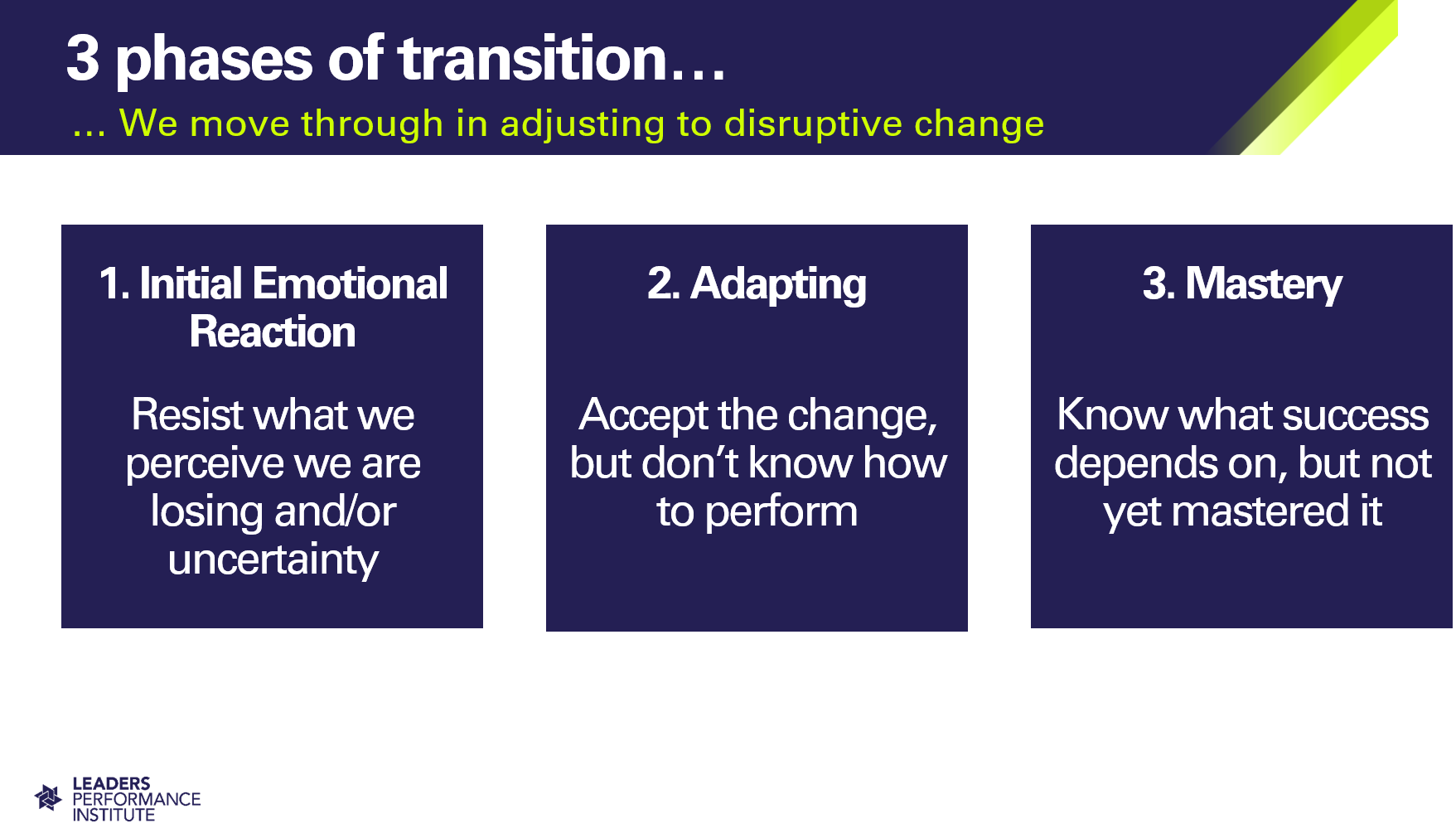
These are an adaptation of the ‘unfreeze-change-refreeze’ model of German-American psychologist Kurt Lewin, who drew attention to the emotional and behavioural elements of change. Modern scholars, including William Bridges (whom Bull also namechecks), place an emphasis on the personal dynamic.
Bull brought these three phases of transition to life by describing how he went through each in response to a postponed work project:
The key thing about stage one is I am still really frustrated and annoyed with certain individuals that have led to that happening. Now, I would say on one level, that’s really understandable. It’s a significant project that we were really excited about; but here’s the key point: it is useless and doesn’t help me one bit. So all the energy that I’m investing in the frustration is not going into the adapting; and what I should be spending much more time on is focusing on what do we need to do to adapt now that change has happened.
With the behavioural elements of transition established, Bull then set out what neuroscience tell us about human resistance to change, with reference to the SCARF model.
This framework, devised by neuroscientist David Rock, sets out five domains that influence human social behaviour and motivation. ‘SCARF’ stands for ‘Status-Certainty-Autonomy-Relatedness (Relationships)-Fairness’. Bull explained each in turn:
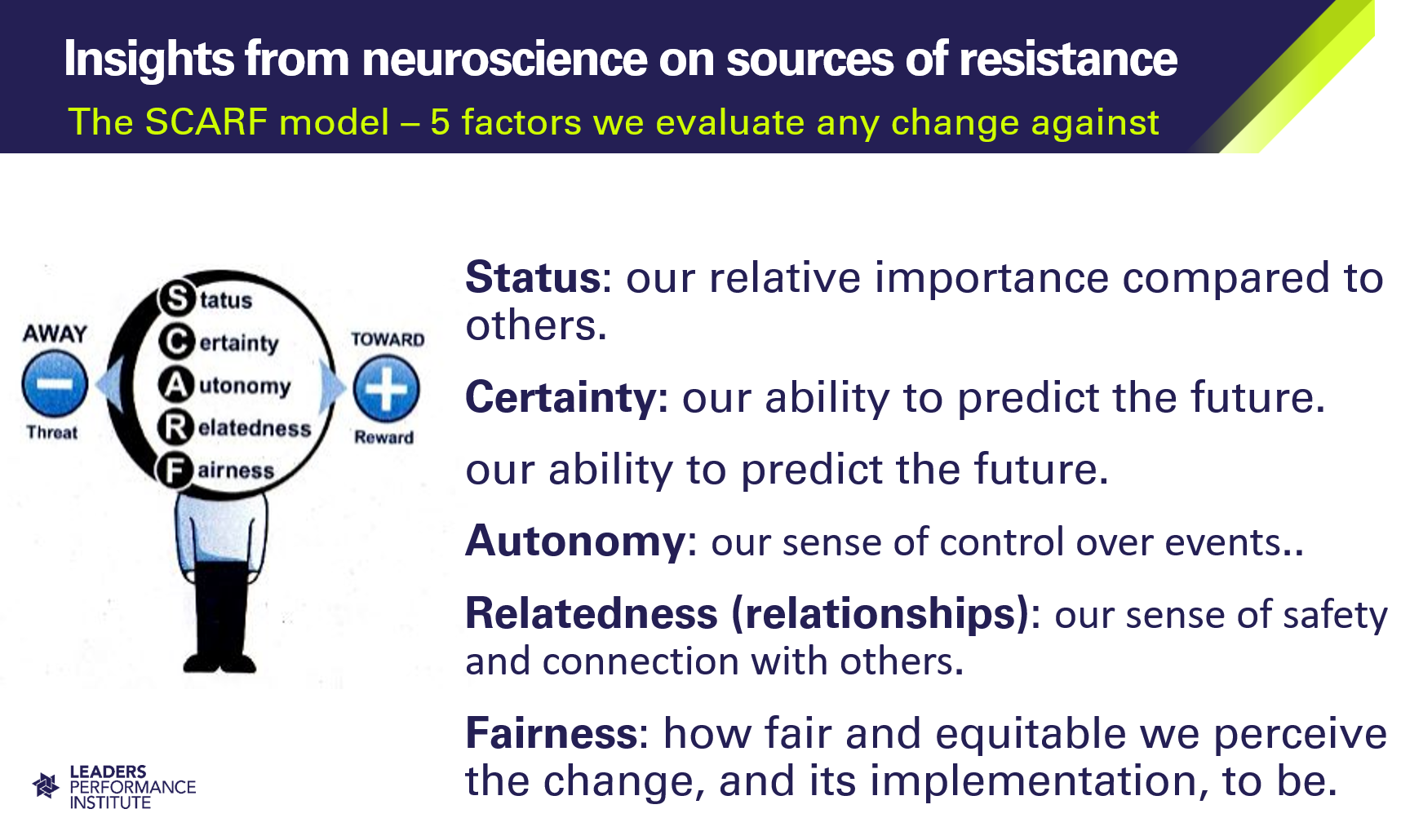
Depending on their circumstances, people can either feel threatened or rewarded in each of these domains.
“I’m not constantly thinking about the SCARF model,” said Bull. “I use it when I get a response from a client that surprises me; then I’ll go back to the SCARF model and go ‘what might I be missing?’ But it’s also a really good model when you’re thinking about how to frame and communicate the change. Because each of these can give a negative hit, but you can also think about ‘how do I promote this change? How do I sell this change in a way that it highlights how it might increase status? How might it increase autonomy?’
He then returned to the three phases of transition and set out the possible traps to be avoided for both individuals and leaders:
Bull emphasised that these traps reflect predictable human responses when transition is not adroitly led rather than poor intent or capability; and, if anything, leaders often respond with the wrong behaviour at the wrong stage.
He then pivoted towards organisational psychology, specifically the idea of change-curves.
People can respond both positively and negatively to change and these reactions can be plotted on a ‘change curve’. First, he showed the virtual table an example of a negative response to change:
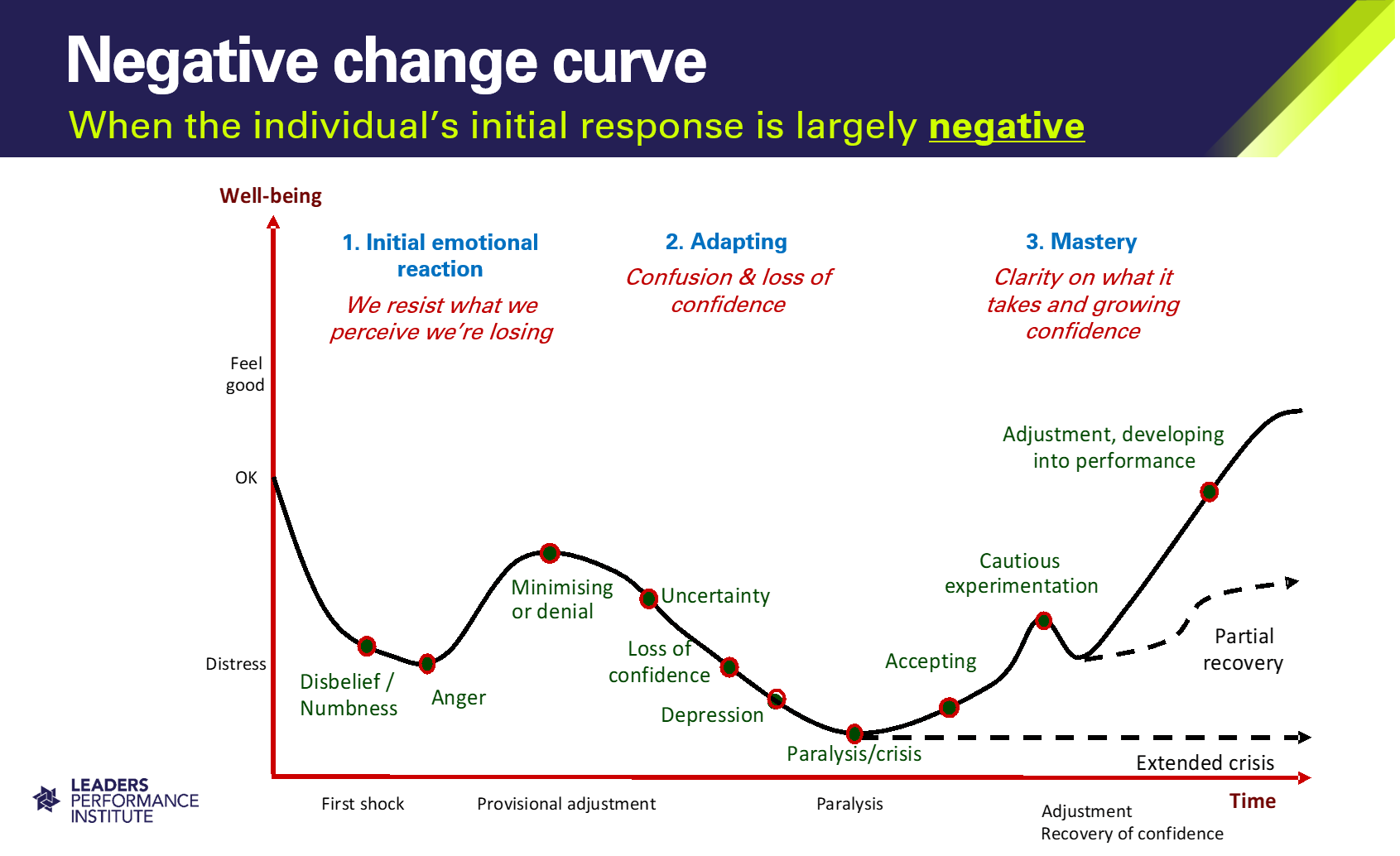
Bull explained the line of trajectory through his own negative experience of discovering that a restaurant in Bath had stopped serving his favourite pizza.
He added: “I just want to make the point: you don’t move linearly through each stage. I think of it more as water sloshing through a container. You will be partly in stage one, partly in stage two. So even though I’m intellectually trying to figure out what am I going to have on the menu, I’m still partly in frustration.”
Bull then shares an example of a positive change curve:
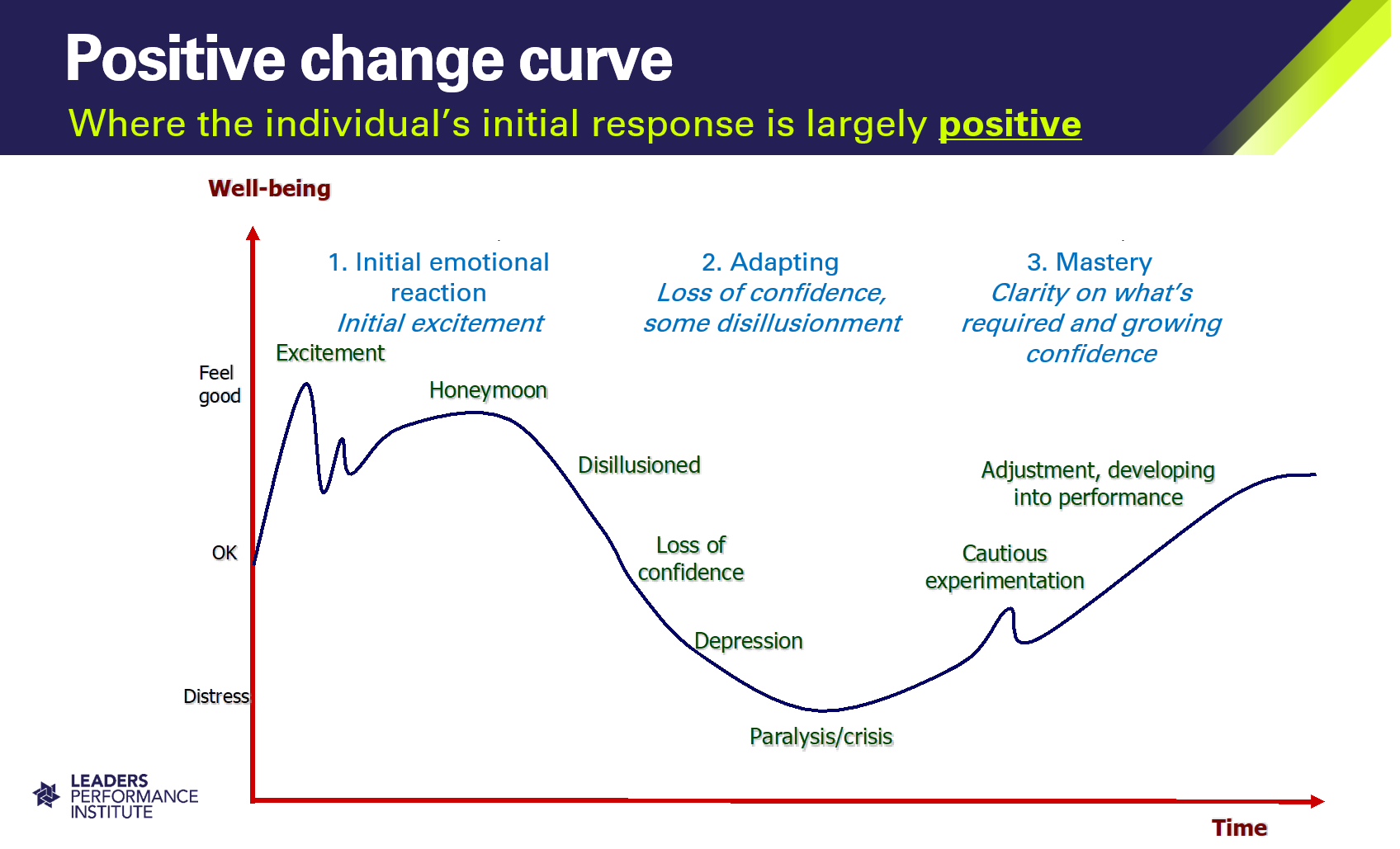
He noted that positive change:
Next, Bull summarised what people need from their leaders at each phase of transition:
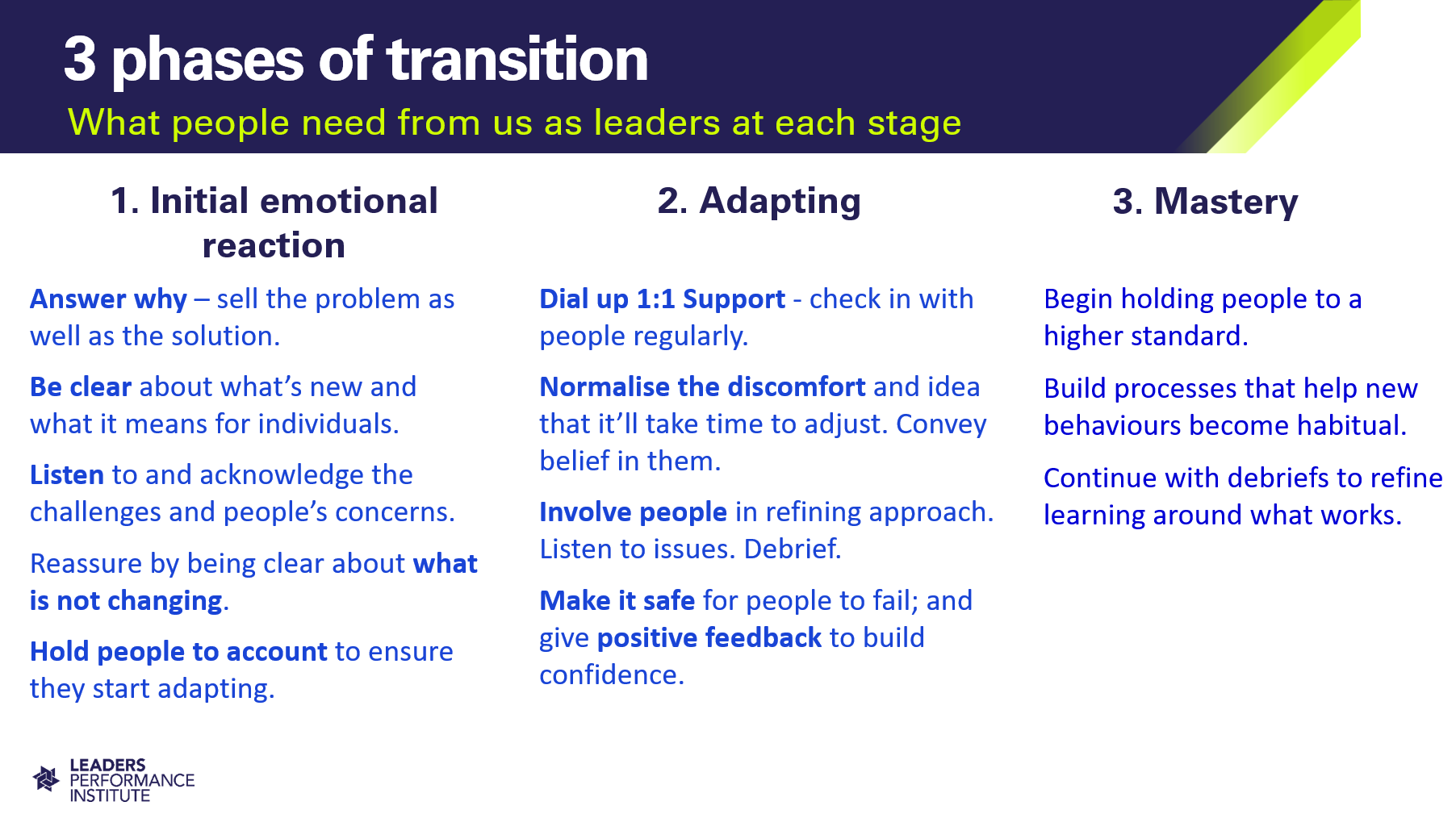
To wrap up his presentation, Bull suggested the ‘Four Ps’ model as a communications tool for members to use in their teams when leading change. It can help hold the process together and ease the psychological demands of transition:
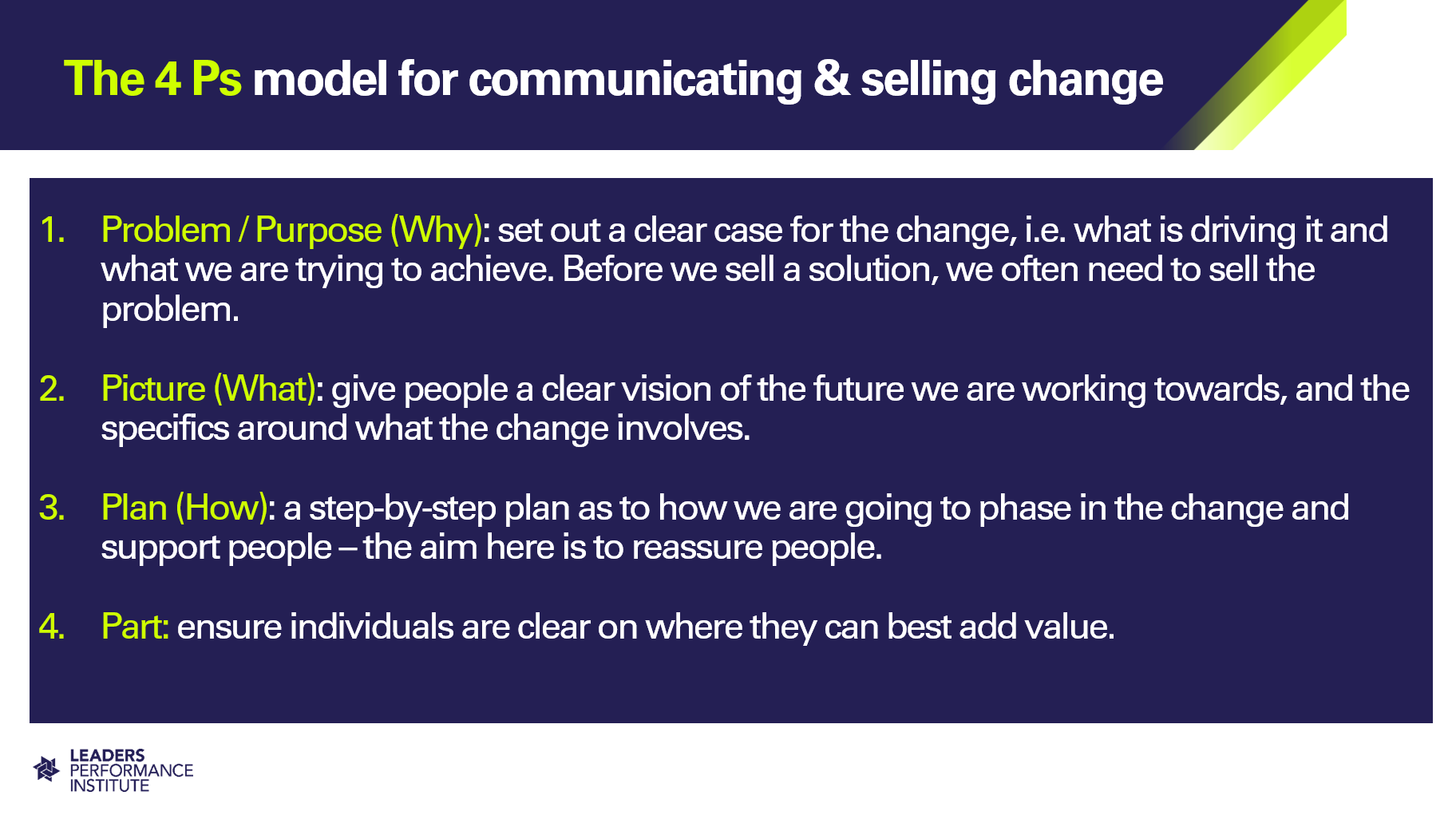
He said: “This isn’t new content, but it’s a new way of presenting it; it tends to be one of the things people remember six months, 12 months later.”
What to read next
Rec Revolution: Does Transformational Leadership Theory Explain Bath Rugby’s Resurgence?
In our latest Leadership Skills session, Jeff Pagliano of Management Futures reframes how organisations should understand, shape and protect their cultures.
Amaechi’s words are shared by Jeff Pagliano, a consultant with Management Futures, who in our latest Leadership Skill Series session, introduced members to tools that will enable them to help shape their team’s culture.
How do cultures develop?
Pagliano began his presentation with a definition:
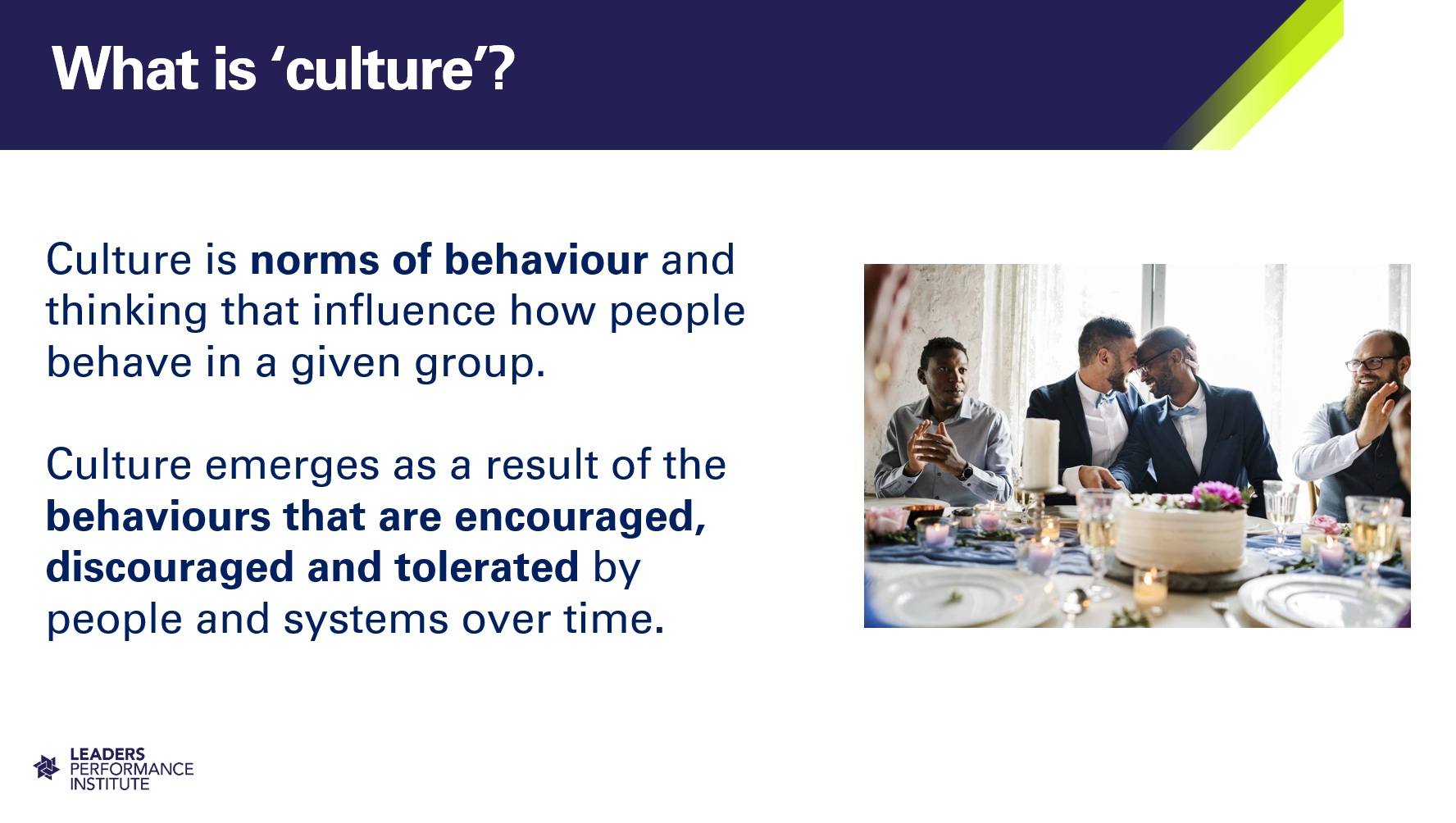
Management Futures uses the analogy of tables at a wedding reception to explain how cultures develop.
“You’ve seen how at a wedding each table develops its own personality,” said Pagliano. “It’s interesting that even in those interactions where some people know each other or some people don’t, a culture begins to form around that table. You can have the rowdy table, the quiet table; some are eager to get up to dance and some are not.”
What we see, what we say, what we believe
Pagliano then shared his ‘cultural iceberg’ model, which has been inspired by Swiss-American psychologist Edgar Schein and his pioneering work on organisational culture:
What we see
“This is literally what we see. So behaviours, systems, and processes,” said Pagliano. This could be how people interact, how leaders comport themselves, what actions are common or repeated. It also includes the physical environment (e.g., office layout or the visibility of team members).
What we say
“These are our goals, values and aspirations.” In other words, the official narrative.
What we believe
“These are the underlying assumptions we have about the organisation.”
The risk of emerging ‘shadow’ values
Underlying assumptions can lead to the emergence of what Pagliano calls ‘shadow’ values – unspoken, unofficial rules.
“Employees are acutely aware of what is rewarded or encouraged in everyday activities,” he said.
Pagliano quoted the British government’s sports funding agency, UK Sport, in making his point.
Therefore, it is important to be able to ‘map’ your team’s cultural influences to better help you understand who shapes your culture and in what ways.
Mapping cultural influences
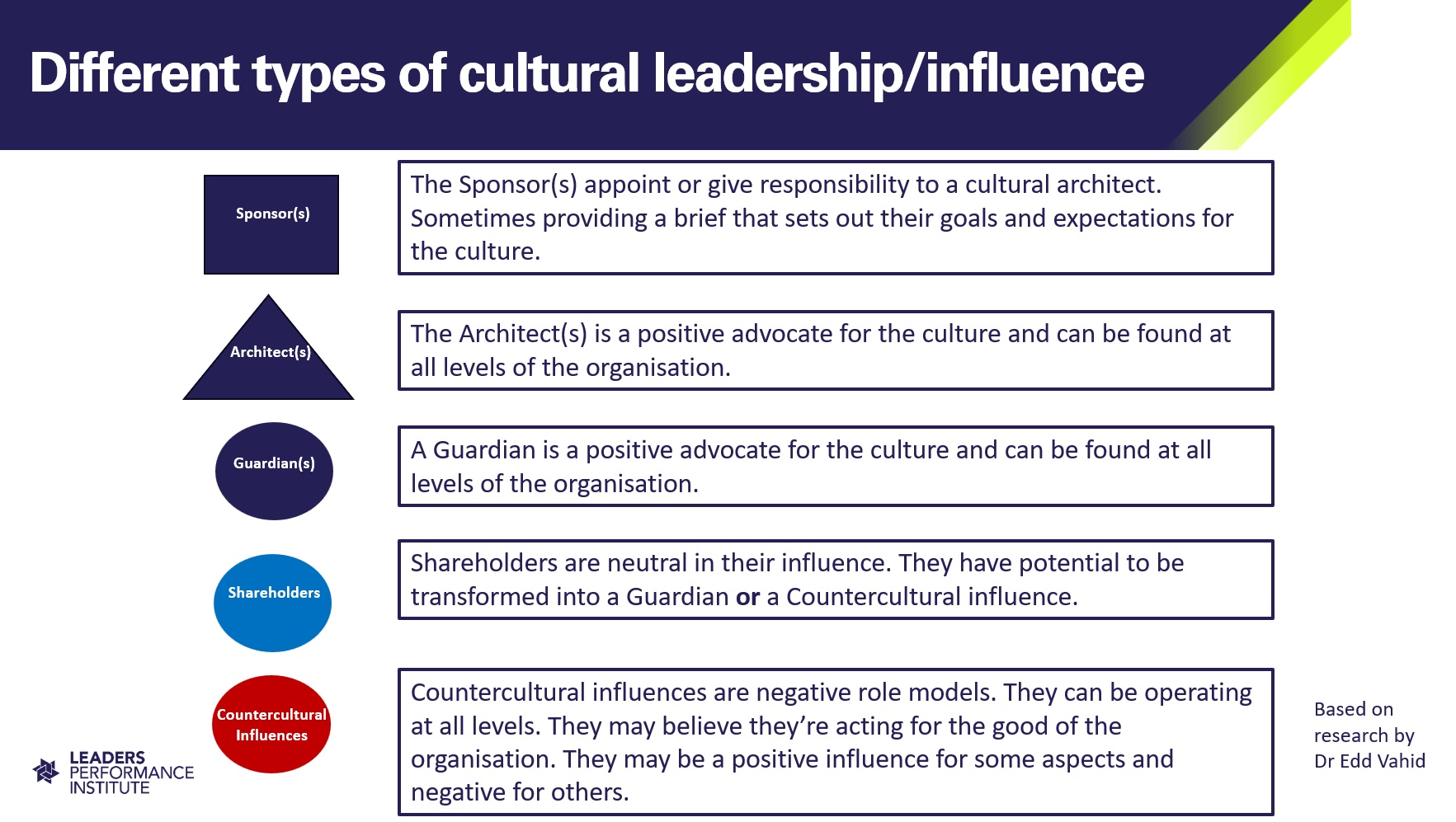
For this part of the session, Pagliano called upon Dr Edd Vahid’s Cultural Hypothesis, in which he spoke of the importance of ‘sponsors’, ‘architects’, and ‘guardians’ in shaping a culture through a combination of leadership and influence.
Pagliano added two further categories: ‘shareholders’ (“I would argue that everybody who works in an organisation is a shareholder”) and ‘countercultural influences’ (“countercultural influences are negative role models that can be operating at all levels”) and presented the following slide:
He then shared a hypothetical example of a cultural map that pulls on these five types. The result is a complex diagram:
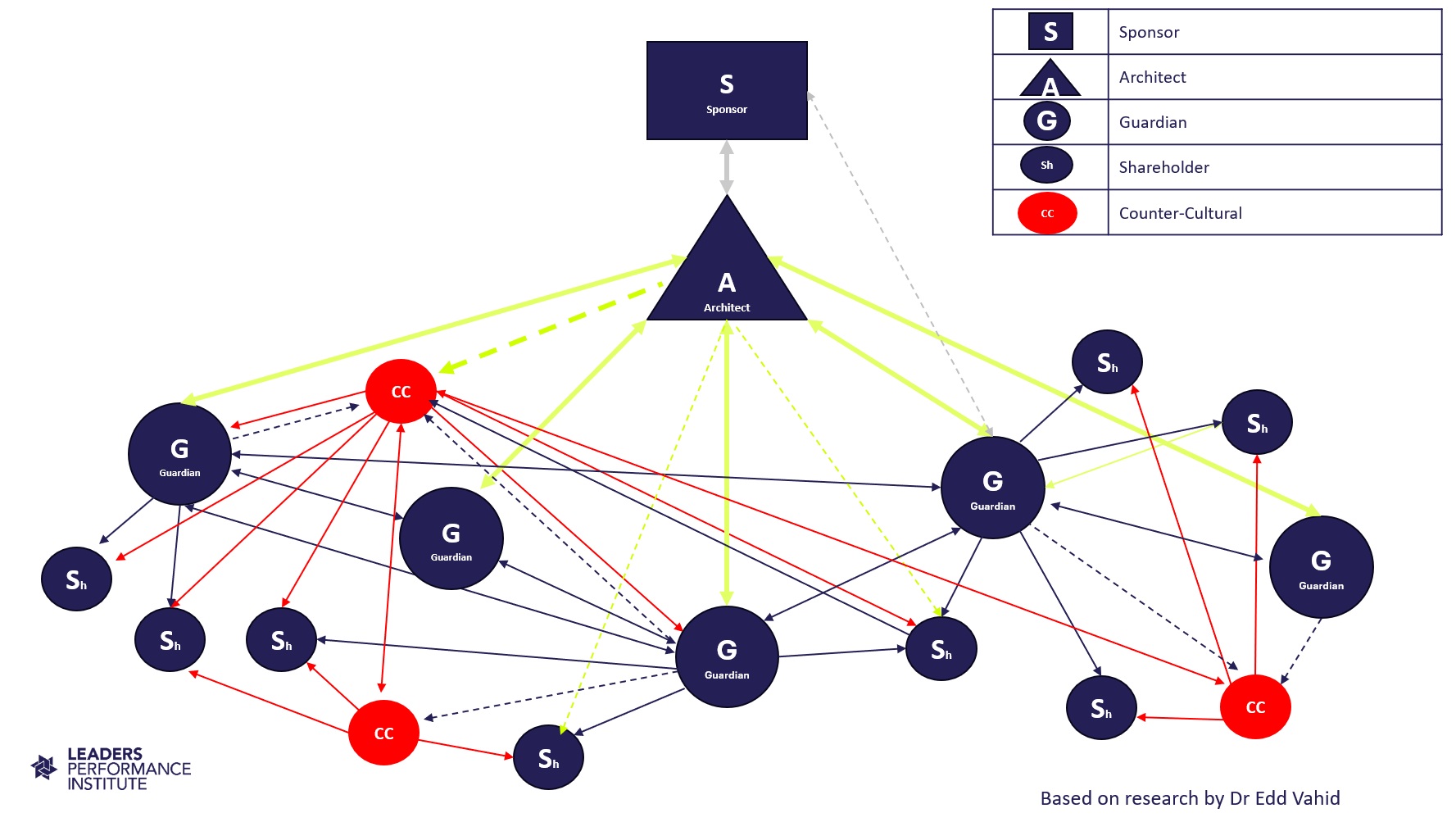
“Your sponsor is at the top,” said Pagliano. “That can be the owner of an organisation, maybe a GM, maybe a coach, but it’s somebody who has the ability to decide whether resources are allocated for building culture.
“Then you have the architect: the one who thinks about ‘see’, ‘say’, and ‘believe’. This is the person who has the ability to influence processes and has decision-making power.
They may or may not be the leader of the organisation, but they certainly have the ear of the leader.
“Then below is where the web gets a little complicated. This is where you can see how certain policies, procedures and aspects of culture can intertwine and be influenced.”
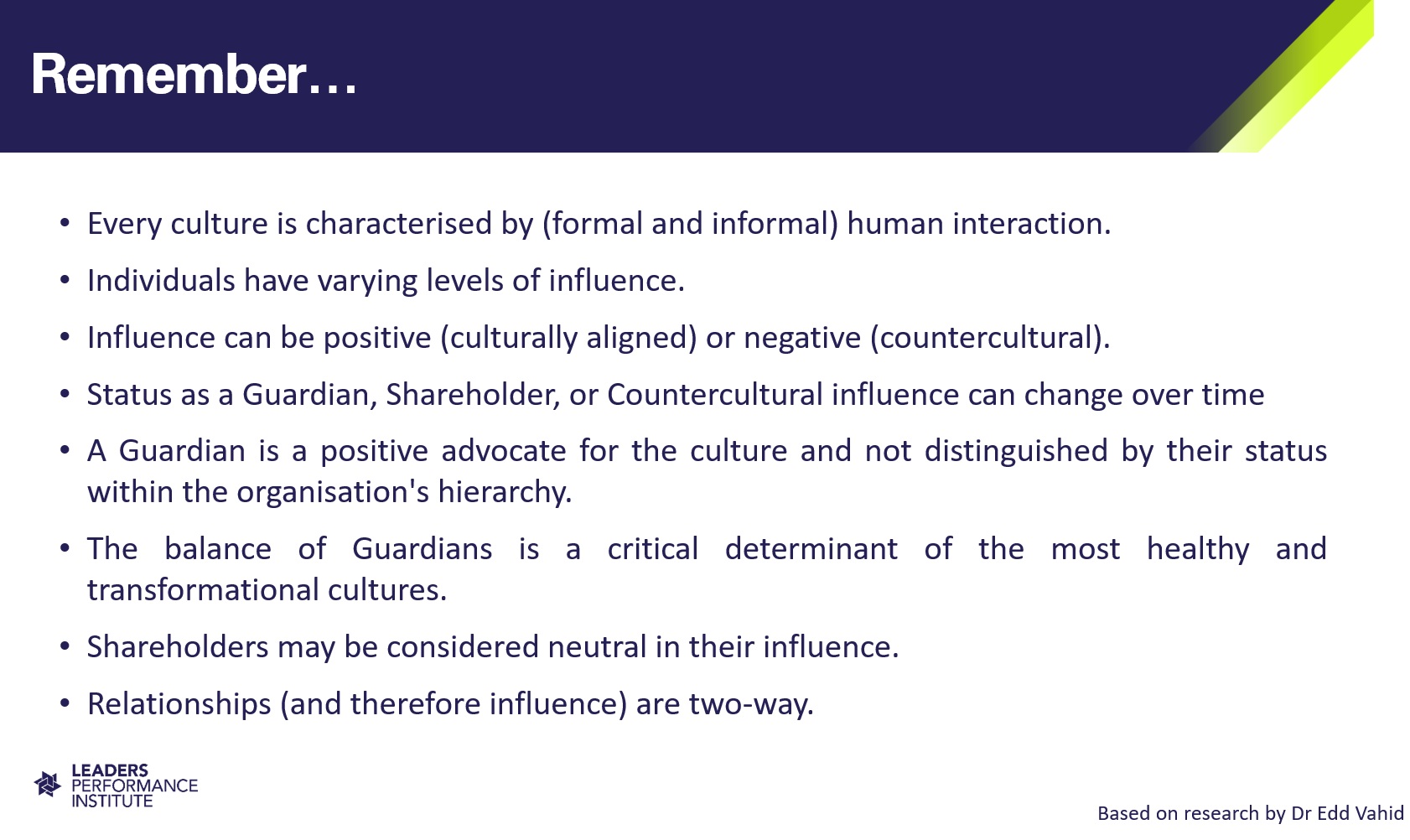
Pagliano concluded this section with a summary:
He concluded his presentation with six cornerstones of cultural leadership.
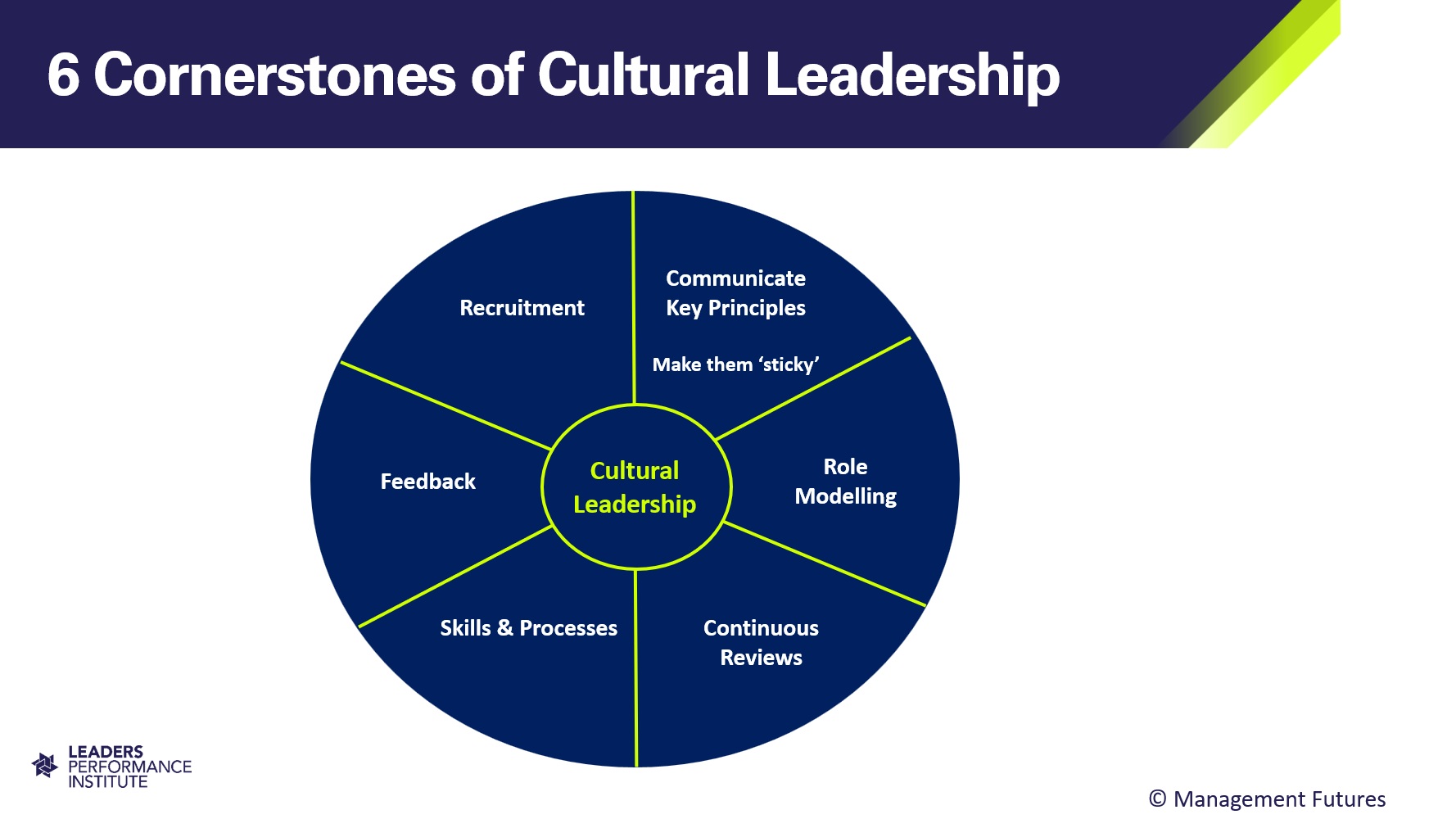
“These are the six levers that any culture leader, whether it’s your sponsor or your architect, can pull to make sure that vision of culture is consistent across your organisation.”
He then gave a real-life example for five of the six.
Communicate key principles – Netflix
“Netflix’s key principle is ‘act in Netflix’s best interests.’ And so their culture of ‘Freedom & Responsibility’ can be captured in these five words,” said Pagliano. “Anytime there’s a decision being made, you can always ask your team, ‘are we acting in Netflix’s best interests?’”
Role modelling – Collingwood FC
Pagliano explained that Collingwood’s Senior Coach, Craig McRae, asks himself daily, “‘to what extent are my day‑to‑day actions equal to our ambition?’” The Melbourne-based club were AFL premiers in 2023.
Continuous reviews – Pixar
“They had this concept of appreciative inquiry,” said Pagliano of Pixar. “It’s all about setting examples of excellence to create a blueprint for future performance.” In testing Toy Story, for example, the relationship between Buzz and Woody wasn’t working. So they went back to the drawing board over the course of six days and created those characters that we know and love today. Further down the line, they would go back and ask, ‘what were we doing right during those six days when we pulled together?’”
Skills and processes – the UK Sports Institute
This example is specifically about their approach to developing their staff members’ “teaming skills”. “This can come down to something as simple as ‘speak up, listen up’ and then a shared responsibility for performance,” said Pagliano. The UKSI wanted to teach “teaming skills across the different groups so that when groups from different parts of the organisation interact with each other, they have a shared language.”
Feedback – Doctors Without Borders/Médecins Sans Frontières
“Their motto is ‘we are intolerant of, but empathetic, when people don’t initially meet our high standards’,” said Pagliano, who explained that employees are given “three strikes”. “Feedback as a continual part of the process is really important to maintaining their culture.”
Recruitment – get the right people on the bus
Pagliano does not give an example for recruitment. Instead, he poses a question: “When you’re looking to hire folks, who do you think is going to buy into your shared cultural values and who is going to be a guardian or an architect of that?”
If you have any further questions around how to understand, shape and protect their cultures, feel free to reach out to Management Futures directly via [email protected]
What to read next
In the first month of 2026 Leaders Performance Institute members discussed at length strategies for effective learning, the value in evidence-informed practice, and why your values should be the carrot, not the stick.
It was a lesson to all sleeping giants. Here was a team with the most losses in the sport’s history and, over the course of their 16-0 season, had compiled more wins than between 2020 and 2023 in total.
Indiana Head Coach Curt Cignetti spoke of a “paradigm shift” in the aftermath of the Hoosiers’ 27-21 defeat of Miami.
“People can cling to an old way of thinking, categorising teams as this or that or conferences as this or that or they can adjust to the new world, the shift in the power dynamic in college football today,” he said.
Cignetti was brought in ahead of the 2024 season and transformed the mindset of a team that had been treading water for decades.
“There’s got to be a lot of like-minded individuals who come together for a common purpose, and sometimes that belief has to be a little bit irrational,” said Indiana centre Pat Coogan.
“Especially in a place that hasn’t had success like Indiana. I’ve seen it, and I’ve seen the way this place has been characterised, and when Coach Cig got here, he believed, and he got people to believe. Sometimes people laughed at him and thought he was crazy, but that’s irrational belief. You’ve got to get people to buy-in and believe in the mission.”
With a host of senior players set to graduate, success may not be replicable in the short term, but Cignetti is ready for whatever comes next.
“Perfection is impossible to attain on a consistent basis,” he said. “But we’ll continue to take it one day at a time, one meeting at a time, one practice at a time, and just keep improving and committing to the process and showing up prepared, trying to put it on the field, and see where it takes us.”
It was a powerful message to kick off the year in sports performance and one that underlined the importance of the fundamentals while refusing to stand still.
Which brings us nicely to the happenings at the Leaders Performance Institute these past four weeks.
Insight of the month
‘What underpins successful teams across formats is not uniformity, but clarity of individual responsibility within a collective framework. Team performance does not replace individual accountability; it depends on it.’
In a guest column, James Thomas, the Performance Director at Warwickshire CCC, spoke about facilities being a secondary concern until the leaders had created the right environment to enable athletes, whether they’re the Olympic champions with whom he has worked or Premier League and Champions League-winning footballers, being paramount.
Read more about why high performance is not something leaders should demand. It is something they should enable.
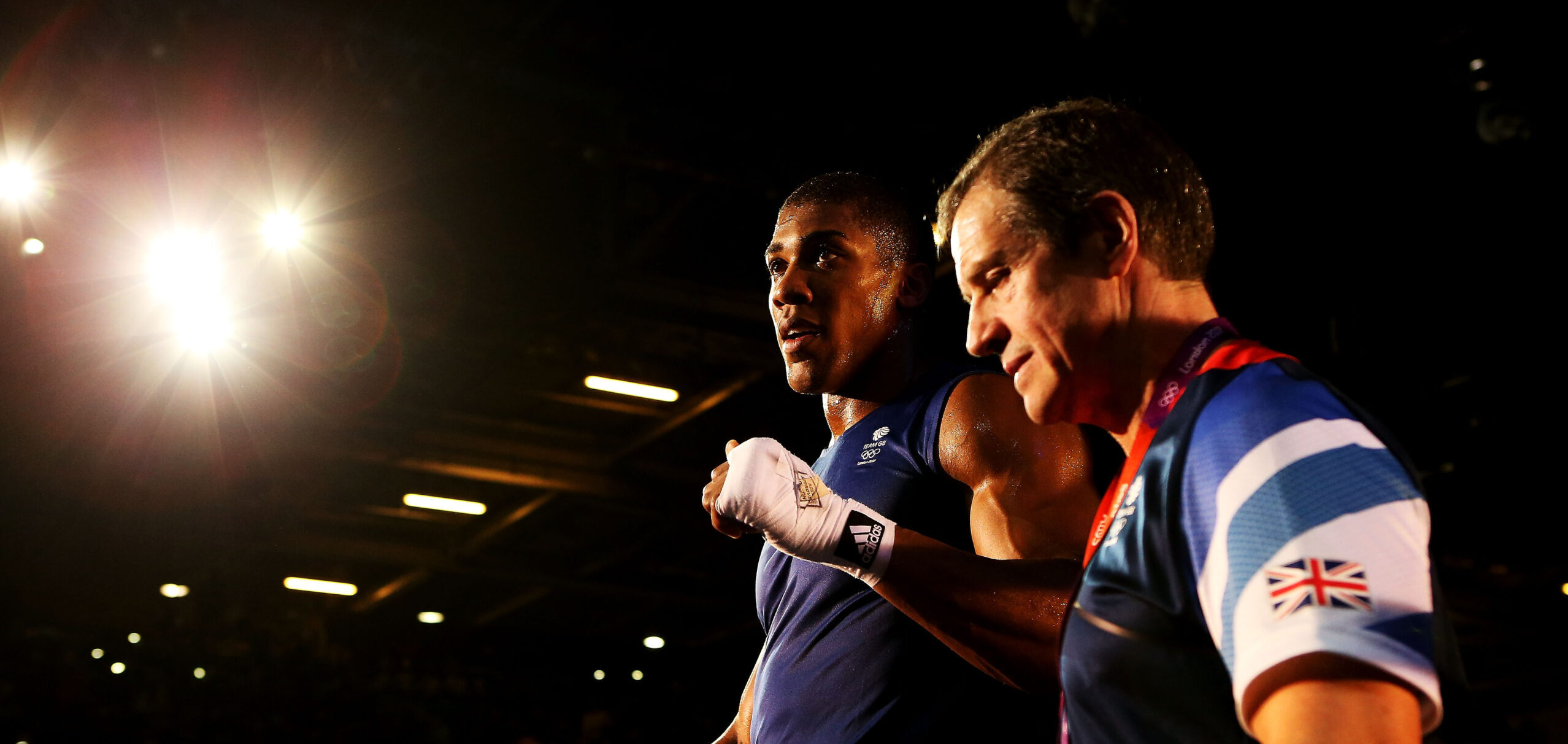
Britain’s Anthony Joshua on his way to winning gold at the 2012 London Olympics. (Scott Heavey/Getty Images)
Surprising insight of the month
Did you know that Team GB built its own hub within the London Olympic Village in 2012. This was very much a “host nation benefit” as Paul Ford MBE called it in another popular guest column last month.
The Head of Sport at the British Olympic Association wrote:
When we finished in London we looked and thought: ‘it’s not home advantage necessarily, we just need to be more creative’.
It provoked a question: how do we create an optimal physical way of uniting the team within the Games environment? Part of it was using our Olympic Village residential space smarter. But you can’t expect this of the local organising committee to do on our behalf, since their brief is so vast. Instead, we decided to take it out of their hands. And for each of the subsequent Summer Olympics we have found an out-of-village space exclusively for our use.
Read more about their approach here.

Team GB flag bearers Helen Glover and Tom Daley pose for a selfie outside the residence of the British Ambassador to France ahead of the 2024 Olympic Games in Paris. (Alex Pantling/Getty Images)
Best advice
Leaders Performance Institute members across the globe strive to encourage learning throughout their teams and while it will always be an important feature of any successful team, you should not waste your time on the wrong people.
As performance specialist Iain Brunnschweiler explained at a Leaders Virtual Roundtable:
“There’s definitely some people who, you can try as hard as you like to get them to learn and I think we have to be cognisant of our own energy as someone who’s seeking to help. It’s a bit like athletes, isn’t it? If you’re up for it, I’ll give you 150% of my energy. If you’re not, after a period of time, I’ll just go, ‘look, you crack on’. So I think we have to be accepting of that.”
Over the course of an hour, Brunnschweiler and a band of LPI members noted ten strategies for more effective learning.
One you might have missed
Jamie Taylor of Dublin City University and the CoEx|Lab made the case for evidence-informed as opposed to evidence-based practice.
He enlisted the help of students from DCU’s online doctorate and MSc programmes, which are aimed specifically at coaches and practitioners in high performance sport.
One such student is Eilish Ward, the Head of Player Development at the Ladies Gaelic Football Association.
As she told Taylor, you can’t simply drop research on top of a sports programme. It must be used critically, in conjunction with a coach’s own research, and applied in an informed manner.
“There’s not necessarily one solution,” she said. “There’s no one way to learn anything or to gain experience or expertise.”
The key for Ward in her work is to ensure she and her colleagues are “making as informed decisions as possible when we’re designing learning activities” because “not everything from research may be transferable into a practical environment and, equally, every practical environment is going to be hugely different.”
Read more about DCU’s programmes here.
Quote of the month
“We have to become diplomats, high‑level development people who can manage such diverse groups. Somewhere along the line, we need to start creating those development opportunities for everybody who’s on this call.”
These are the attention-grabbing words of a performance director working in India who spelled out the challenges in talent identification and development.
He and a host of LPI members listed five of the most common trends (and five opportunities) in that space.
Good to know
Organisational values should be your carrot, not your stick.
That’s according to Emma Keith, a Royal Air Force Group Captain, is the Commandant of the Tedder Academy of Leadership at the RAF. In 2015 she became the first woman to run RAF Officer Training.
In her appearance at the 2025 Leaders Sport Performance Summit in London, she spoke about how the RAF’s values, all contained within the prosaically titled Air Publication One document, had been used to browbeat good people.
“Actually 99% of my organisation are amazing, they really are, and I wanted a document that was aspirational for them, that they could believe in, that it was the organisation they wanted to be a part of. And we know from all the different behavioural models of change that it only happens when people want to change, not because it’s been forced on them.”
Again, the focus was learning strategies in an inspiring presentation.
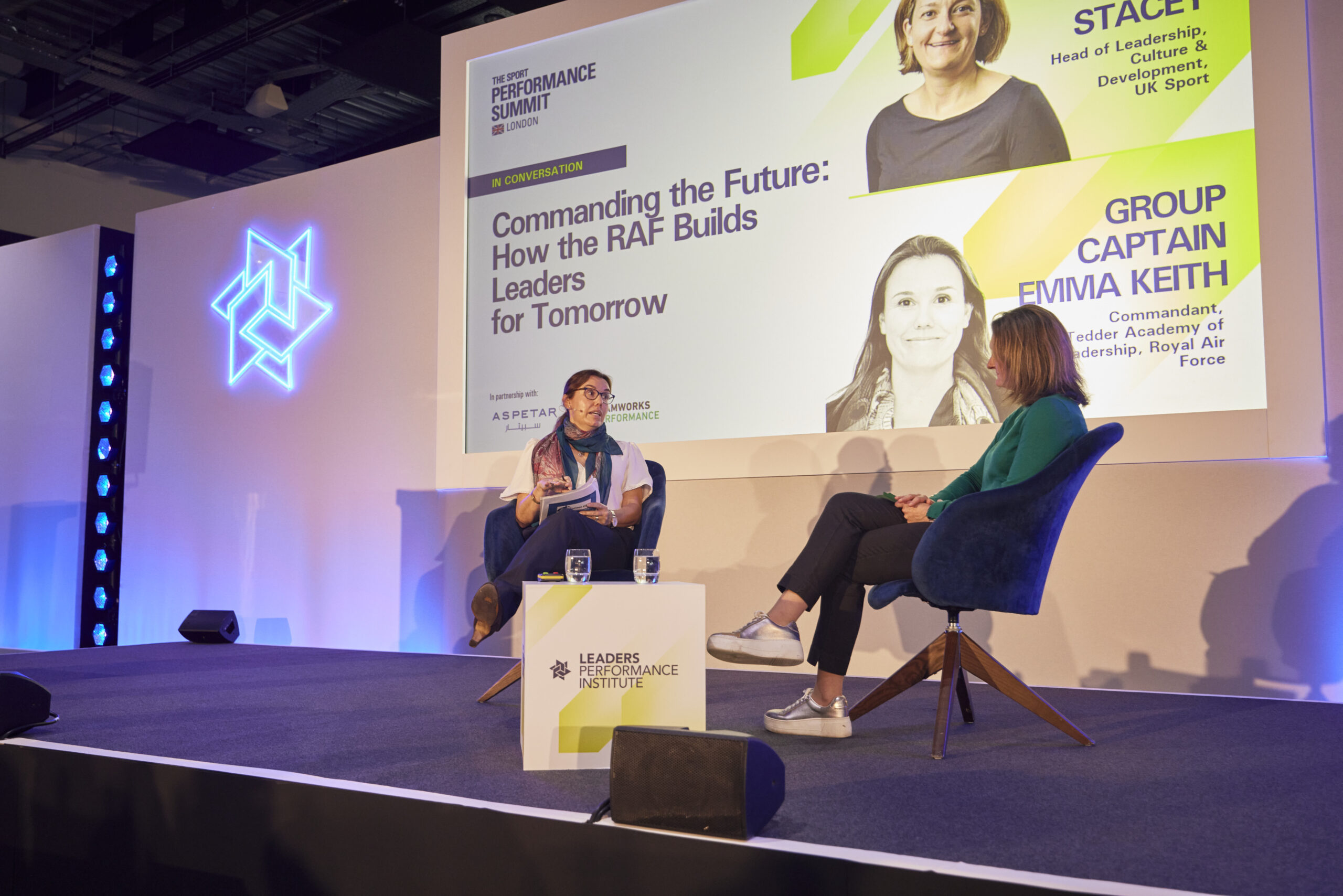
The RAF’s Emma Keith onstage at the 2025 Leaders Sport Performance Summit in London. (Leaders)
What’s coming up for members