David Clancy and Richard Pullan set out their strategic and intentional approach to network building in a high-performance world of ever-growing complexity.
In today’s fast-paced world, high-performing individuals and teams face increasingly complex cognitive demands. These challenges are not just about processing information but also about managing stress, navigating uncertainty, and maintaining clarity amid competing priorities. This is where the power of strategic and intentional network building comes into play.
There are several means available to help build this network. They include purposeful twinning with others, developing an ecosystem of critical friends and identifying a web of second-opinion teammates. Each of these connections provides leaders with the means to make more informed and rounded decisions, make perspective shifts as well as provide objective feedback.
Twinning
‘Twinning’ refers to the practice of forming reciprocal partnerships with other teams or organisations that share similar goals, challenges, or conundrums – perhaps they might even be competitors, if the context makes sense. This is a huge part of what the Leaders Performance Institute does, in fact, forging ‘partnerships’ with teams and individuals. This is how the Houston Texans of the NFL became professional friends with the Texas Rangers of MLB, as an example. This symbiotic relationship allows for mutual learning and growth, where both parties can share best practices, resources, and insights. A term we often hear is ‘collaboration over competition’ – we can all row the boat faster if we are willing to exchange protocols, philosophies and pain points.
Professional sports teams all face their unique set of struggles but, oftentimes, there are numerous similarities with these. Sharing best practices and ways to approach challenges is a significant benefit downstream of this pairing. By ‘linking’ with another team, leaders can expand their knowledge base, reduce the isolation often felt in high-pressure roles, and benefit from other viewpoints.
In terms of innovation, if teams are open to sharing what they do (to a degree), how they do it, etc, they can draw on the experience and solutions already implemented elsewhere. This save them time, effort, and energy. Food for thought.
Critical friends
Critical friends play a unique role in leadership, deliberation and decision-making. A critical friend is someone who offers candid, constructive feedback and is unafraid to challenge assumptions. This is ideally someone outside the team/ franchise. They are trusted individuals who can act as a sounding board for ideas, provide a second perspective, and offer checkpoints when needed.
Creating and nurturing these ‘friends’ requires energy and effort, but the payoff can be huge. As an example, if you are ideating a new return-to-play system and method, bouncing ideas off someone with exposure to this in another environment could help make your system better. A no-brainer if you ask us!
We have witnessed the benefit in relation to cognitive demand also, as critical friends offer a safe space to validate thinking and refine or rethink ideas. Critical friends help prevent blind spots, biases and assumptions by encouraging the leader to pause and reflect before executing a critical task. The best critical friends strike a balance between support and challenge. They are not afraid to disagree, but they do so with the intention of helping the leader grow.
Second-opinion teammates
Second-opinion teammates (teammates being a crucial word) serve a similar purpose, offering alternative viewpoints to ensure a more well-rounded decision-making process, such as another set of eyes on an MRI report and image for a hamstring injury.
Particularly in high-stakes environments, seeking a second opinion reduces cognitive stress by distributing the weight of responsibility and allowing leaders to feel more confident in their choices. Knowing that a trusted colleague has reviewed the same data or proposal with rigour and objectivity can provide a sense of reassurance and clarity.
Strive to stock a bullpen of second-opinion teammates. It’s a game-changer.
Mentorship
“The delicate balance of mentoring someone is not creating them in your own image, but giving them the opportunity to create themselves”, said Steven Spielberg. To create themselves entails helping one to find their way. Consider giving a project to a more junior member of staff from a senior ‘mentor’, rather than the ‘easier’ option, of giving the project to a ‘middle manager’ who has done the type of project before. That’s an example of what this could look like.
Mentorship is a timeless strategy – one for managing both the emotional, physical and intellectual demands of leadership. This is typically someone with more experience who can offer guidance, advice, and lessons learned from mistakes, and successes. Great mentors provide leaders with the tools to think more effectively for themselves, enabling them, giving them their own toolkit; this helps them navigate complexity, prioritise, and mitigate stresses. They leave breadcrumbs behind.
Mentors can help leaders manage cognitive demands by offering perspective on what truly matters, helping to sift through the noise and focus on the signal i.e. what is essential. They also provide historical insight, showing leaders that many challenges they face are not new and can be tackled using time-tested methods. This reduces the sense of overwhelm that comes with thinking one must always reinvent the wheel. The issue you are facing has been faced and solved before.
Moreover, mentors are invaluable in helping leaders manage their wellbeing, as they can provide reassurance and encouragement when times get tough and they can acknowledge that these times come with the intense world of competitive sport.
Building a network
In high-pressure environments, leaders often find themselves juggling multiple competing priorities, balancing short-term, ‘urgent’ demands with long-term, ‘important’ goals.
Here are five reasons for nurturing a network to help with this:
What makes a good mentor?
The best ones share several key traits that make them invaluable in helping leaders grow and meet the demands of high-performance sport.
Here are five traits we often see:
And let’s not forget that mentors need mentors. This could be your partner at home, as an example.
So, here’s our challenge for you reading this article today – take on a mentorship role in some capacity, to give back…to pass the ladder down, as it were.
Final thoughts
In today’s fast-paced and ever-evolving landscape in high-performance sport, a leader’s success isn’t just defined by individual strength – but by the strength of their network. Jobs these days in sport are complicated and complex. It is now rarely possible for one individual to serve a function fully without seeking support from other disciplines, to deliver the final solution to a given problem.
By cultivating relationships through twinning, critical friends, second-opinion teammates, and mentorship, leaders create a support system that fosters psychological safety, collaboration, and continuous learning. These connections enable leaders to confidently navigate complexities, make incisive decisions, and lead afront with impact. After all, just as every great athlete stands on the shoulders of their team, no leader can truly flourish without a trusted network standing behind them.
David Clancy is a Learning and Development Consultant at the Houston Texans and Director at The Nxt Level Group. He is also the Editor of Essential Skills for Physiotherapists: A Personal and Professional Development Framework, which is available now from Elsevier.
Richard Pullan is a Director at The Nxt Level Group, the Visionary Founder of The Altitude Centre, and leads the training of clients for flash ascents of Everest and other 8,000m peaks, while also preparing professional athletes and elite sports teams. He is formerly of Sporting Health Group.
If you would like to speak to David and Richard, please contact a member of the Leaders Performance Institute team.

In the second part of this miniseries, David Clancy and Michael Davison explain why there’s more to interdisciplinarity than merely assembling experts. In fact, it requires an environment that lets diverse knowledge flow, interact and coalesce into something far greater than the sum of its parts.
A story of interdisciplinarity
Let’s start with Jack Draper.
Imagine Draper, who is the currently the No 1 British men’s tennis player (currently ranked 20th on the ATP Tour) seeking that extra edge to stay at the top. His success isn’t just the result of raw talent or relentless training. Behind the scenes, he has a backroom team seemingly working in support of him – a nutritionist optimising food intake and hydration, a sports psychologist fine-tuning performance under pressure, a physiotherapist managing recovery, and a strength coach – pushing physical limits. Each expert has mastery, but what sets this team apart is how they interact and click.
To reach this point, Draper’s coach, James Trotman, didn’t just talk tennis strategy. He collaborated with Draper’s physiotherapist to adapt his game around his body’s capabilities. The psychologist worked closely with the strength coach to ensure mental resilience matched Draper’s physical preparation. Let’s not forget that the player himself was at the centre of this interdisciplinary team, which like most sports is player-focused. Each discipline flowed into the other, creating a holistic approach that made Draper not just a better tennis player, but a stronger, more balanced athlete.
The secret to his rising dominance wasn’t just in individual expertise, it was in the ‘interdisciplinary’ synergy that allowed his team to anticipate challenges, innovate, and help him evolve in a way no single expert could have achieved alone. This ‘collective intelligence’, and high-level teamwork, propelled him to achieve even greater heights, proving that in today’s complex world, true success is a team effort built on the integration of diverse applied knowledge and experience.
So, what is interdisciplinarity and how is it different?
Interdisciplinarity is the fusion of knowledge from multiple fields to tackle complex problems that no single discipline can solve on its own. This differs to a multidisciplinary or transdisciplinary model; the former is when experts from different disciplines work in parallel on a common problem, but each remains within their own disciplinary boundaries. The latter relates to the integration of academic disciplines by involving stakeholders outside of traditional academia (e.g., community members, policymakers) to co-create new knowledge and solutions.
All approaches seek to leverage multiple perspectives and areas of expertise to solve complex problems, but they differ in how deeply the knowledge is integrated and in the level of collaboration. Multidisciplinary maintains strict disciplinary boundaries, interdisciplinary integrates them, while transdisciplinary dissolves these boundaries completely. Multidisciplinary focuses on parallel efforts, interdisciplinary on integrated collaboration among academic disciplines, and transdisciplinary on forming external stakeholder engagement. Multidisciplinary brings together separate expertise, interdisciplinary synthesises it, and transdisciplinary creates frameworks that include non-academic insights, in a nutshell.
Back to interdisciplinarity
In a world where challenges are increasingly multifaceted – spanning biology, psychology, sociology, technology and beyond – interdisciplinary approaches are critical to innovation, creativity and progress. Research shows that teams combining diverse expertise produce more inspired and robust solutions, with improved and more accurate group thinking (Rock & Grant, 2016), leveraging what’s known as collective intelligence. This approach fosters interactional expertise, where individuals, though not specialists in all fields, become adept at understanding and integrating knowledge across domains, enhancing the team’s ability to solve problems from multiple perspectives. This is cross-functional working at its best.
Studies in cognitive science and organisational behaviour confirm that interdisciplinary teams outperform homogeneous ones in problem-solving, originality, and adaptability. By blending insights from different scientific traditions, interdisciplinarity accelerates breakthroughs that shape our future in high performance sport.
The Expert Compass
Visualise a group of elite performers – whether it’s a special operations military unit or an executive leadership team at a multinational – coming together to tackle a complex challenge.
What sets these teams apart from the rest? It’s not just that they each possess individual expertise, it’s that they know how to navigate their combined expertise with precision and ownership. Enter the Expert Compass, a mental map that allows high-performing teams to leverage the unique knowledge of each member while orienting toward a shared, clearly aligned goal.
In an interdisciplinary team, the compass acts as a guide, ensuring that no single expertise is overvalued or sidelined. Instead, the team becomes adept at knowing not just what expertise is needed, but when and how to use it effectively. They know who to turn to for specific knowledge, and more importantly, they understand how to integrate that knowledge seamlessly into the problem-solving or decision-making process.
This is where the power of interdisciplinarity reveals itself. Instead of working in silos, where experts are isolated in their own domains, the team leverages their diverse knowledge bases to create solutions that are more progressive, rigorous, and resilient. It’s a fluid process, navigating complex terrain with the agility of a compass, constantly adjusting and recalibrating based on the input from different fields.
Interactional expertise
But it’s not enough to just assemble a group of experts and hope they collaborate. The secret sauce of interdisciplinary success is interactional expertise: the ability of team members to understand and communicate across disciplines, even if they aren’t trained specialists in those areas.
This form of expertise allows a neuroscientist to engage meaningfully with a software engineer, or a physiotherapist to collaborate with a performance analyst, even if they don’t have deep technical knowledge in each other’s fields. They’ve developed enough fluency in the language, messaging and logic of the other disciplines to ask the right questions, contribute valuable insights, and understand the broader implications of their colleagues’ expertise.
Interactional expertise is what prevents interdisciplinary teams from becoming chaotic, disjointed or fragmented. It creates the connective fascia that holds different domains together, that interwoven fabric of performance, and allows them to produce something greater than the sum of their parts.
Collective intelligence
When interactional expertise is present, a team taps into a powerful phenomenon – this is known as collective intelligence. This is the magic of interdisciplinarity done well. When the team becomes smarter than any individual could be on their own. They think, adapt, and solve problems with a kind of emergent intelligence that draws from the diverse perspectives and knowledge sets within the group.
Collective intelligence doesn’t happen automatically. It’s the product of deliberate design, creating environments where knowledge flows freely, trust and psychological safety is high (Reynolds & Lewis, 2017), and each expert is empowered to contribute. It thrives on a sharing environment and culture, but also articulated shared goals. It relies on individuals having the humility to know the limits of their own expertise, and the curiosity to learn from others by sharing and challenging one another with questions like ‘Why are we doing this?’ and ‘Is there a better way?’.
The secret to success (and why others fail)
So why do some teams excel at interdisciplinarity while other teams flounder? The secret lies in the ability to manage both ego and ego-less collaboration. High-performing interdisciplinary teams have members who are confident in their own expertise but are humble enough to acknowledge when they need input from others…that they do not have all the answers. They’ve mastered the balance of asserting their knowledge without overstepping their lane.
On the other hand, teams that fail at interdisciplinarity often do so because of misaligned priorities or a failure to establish clear lines of open communication. Experts can become territorial, clinging to their domain and shutting out contributions from others. Or, in the absence of interactional expertise, conversations become broken, with different disciplines speaking past each other instead of to each other.
The best teams recognise that interdisciplinarity isn’t just about bringing together experts. It’s about building bridges between those experts and creating a culture where learning from one another is just as important as showcasing your own knowledge.
Acquiring interactional expertise
Developing interactional expertise requires intentional effort and a willingness to engage.
Here are a few keys to acquiring it:
The role of leadership and processes
The leverage in interdisciplinary teams lies in both the individual leader and the processes they put in place. Leaders play a critical role in setting the tone for collaboration, fostering psychological safety, and modelling interactional expertise. Great leaders make a point of being learners themselves. They actively engage with other disciplines and encourage their team members to do the same.
But leadership isn’t enough on its own. There must be systems and incentives in place to support interdisciplinarity. This includes structured opportunities for cross-functional work, regular knowledge-sharing sessions, and mechanisms to ensure that all voices are heard. High-performing teams often use formal frameworks like design thinking, agile methodology, or interdisciplinary reviews to ensure that expertise is integrated, not isolated in silos.
Leadership plays a pivotal role in fostering diverse perspectives that lead to innovative problem-solving and knowledge creation. However, the benefits of the diversity are maximised when coordination is effective, particularly in environments with low task uncertainty (Fang He., et al. 2021).
In short, leadership provides the vision, mission and the encouragement, while systems, processes and team behaviours ensure that the objective is realised in a sustainable and scalable way.
Actions
In the world of sports, athletes often have a team of private practitioners – physiotherapists, nutritionists, psychologists – who work closely with them. When these practitioners interact with a broader team, especially in high-performance settings, the principles of interdisciplinarity become even more important.
The key is to establish a collaborative ecosystem where information flows freely, and each practitioner is seen as an integral part of the athlete’s overall performance.
This requires…
Conclusion
Interdisciplinarity in high-performing teams is about more than just assembling experts; it’s about creating an environment where diverse knowledge can flow, interact, and coalesce into something far greater than the sum of its parts. By cultivating interactional expertise, leveraging collective intelligence, and fostering a culture of trust and humility, teams can unlock the true potential of their combined expertise.
And in fields like sports, where collaboration between the team behind the team and broader teams is critical, the principles of interdisciplinarity can be the difference between good performance and greatness. As Matthew Syed, author of ‘Rebel Ideas: The Power of Diverse Thinking’ said, ‘collective intelligence emerges not just from the knowledge of individuals, but also from the differences between them’.
David Clancy is a Learning and Development Consultant at the Houston Texans and Director at The Nxt Level Group. He is also the Editor of Essential Skills for Physiotherapists: A Personal and Professional Development Framework, which is available now from Elsevier.
Michael Davison is an International Sports Performance Consultant at the Houston Texans and Director at The Nxt Level Group and Board Member of the Football Research Group.
If you would like to speak to David and Michael, please contact a member of the Leaders Performance Institute team.
References
Fang He, V., Krogh, G., and Siren, C. (2021). Expertise Diversity, Informal Leadership Hierarchy, and Team Knowledge Creation: A study of pharmaceutical research collaborations. Volume 43 (6). European Group for Organisational Studies.
Reynolds, A. & Lewis, D. (2017). Teams Solve Problems Faster When They’re More Cognitively Diverse in Collaboration and Teams. Harvard Business Review.
Rock, D. & Grant, H. (2016). Why Diverse Teams Are Smarter in Diversity and Inclusion. Harvard Business Review.
Acknowledgements
Special kudos to Carl Gombrich of the London Interdisciplinary School, who spoke at the 2022 Leaders Sport Performance Summit in London. One of the school’s courses, titled ‘Cross-Functional Leadership’, was very insightful. This article has been influenced by that programme, as well as research on the Expert Compass, requisite knowledge and expertise from Tim Davey and Amelia Peterson.
Gombrich also contributed a chapter to Essential Skills for Physiotherapists: A Personal and Professional Development Framework by Clancy, et al. (2024), about interdisciplinarity and soft skills.
Jide Fadojutimi and Marianne O’Connor of Management Futures explain why ‘skilled candour’ generates psychological safety and lets you show your people that you care.
They may recognise the need to take someone to one side, but if they are unable to broach the topic in a skilled and productive way, then a small problem can quickly escalate.
At the 2023 Leaders Sport Performance Summit in London, Jide Fadojutimi and Marianne O’Connor from Management Futures led an onstage skills session explaining what to do and what not to do when approaching someone to have a ‘courageous conversation’.
What is a ‘courageous conversation’?
The term was coined by executive coach Kim Scott, who argues in her 2017 book Radical Candor: Be a Kick-Ass Boss Without Losing your Humanity that leaders have a ‘moral imperative’ to step into difficult conversations and challenge with skill. This requires courage because it is simply easier to avoid such conversations.
Scott devised a skills grid to illustrate what it takes to lead a courageous conversation. O’Connor and Fadojutimi shared Scott’s grid with the Leaders audience but changed the top-right quadrant from ‘radical candour’ to ‘skilled candour’:
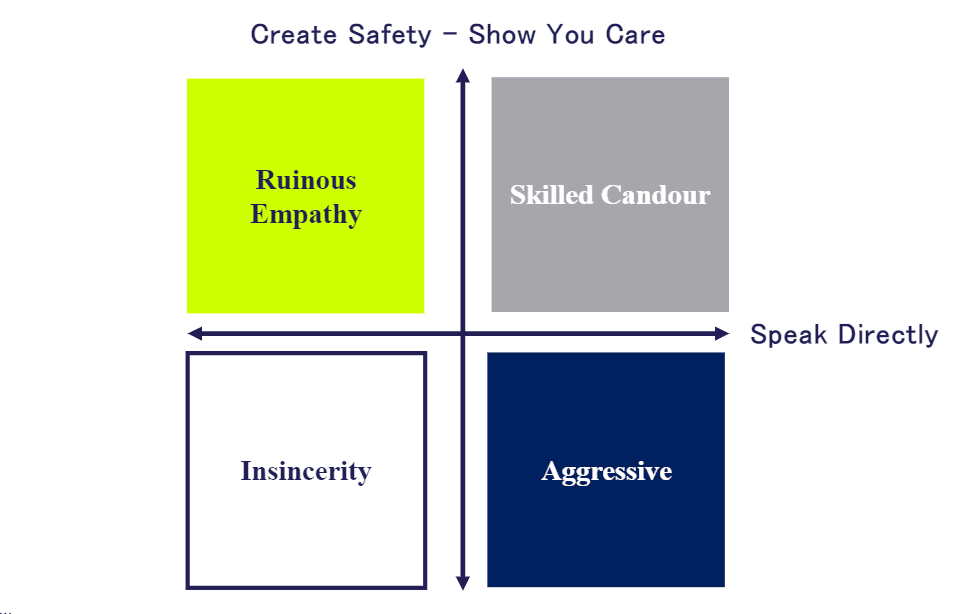
Image: Management Futures
“We’re going with ‘skilled candour’ because it’s a skill we can all learn and build,” said Fadojutimi of Management Future’s way of teaching the topic.
The three pitfalls to avoid
The arrows on the grid suggest that the path to skilled candour lies in giving people a sense of psychological safety and the feeling that you care about them. The grid also suggests three pitfalls, which were discussed at length by Scott in Radical Candor:
The five steps towards skilled candour
O’Connor explained that there are five steps you can take to help develop your ability to approach conversations with skilled candour:
Team USA’s Managing Director tells us what it takes to enable the athletes of one of America’s greatest sporting success stories to thrive in the pressure cooker environment of an Olympic Games.
A podcast brought to you by our Main Partners

So says Lindsay Mintenko, the Managing Director of USA Swimming’s National Team, in the second episode of this new series of the Leaders Performance Podcast, which is brought to you by our Main Partners Keiser.
“Just being able to sit with an athlete; sometimes you don’t even have to talk,” she continues, “it’s just so they know you are there.”
It is difficult to imagine many of her predecessors demonstrating such empathy with athletes whether they’re a multi-medal winner like Michael Phelps or Katie Ledecky or a swimmer who came agonisingly close in some of sport’s most competitive trials. The top-two finishers are guaranteed a spot on the roster; those in third – who would likely medal with other nations – are almost certain to miss out.
“After the trials, our main job is to make sure our athletes are focused on Paris, but we don’t always take a step back and look at those who came third by a hundredth of a second. That’s a tough place to be; so we really need to make sure that we do a better job of looking out for those athletes afterwards.”
It is perhaps no surprise that USA Swimming is currently the only national governing body in the US to have an in-house licensed clinician on staff.
This has happened on the watch of Lindsay, a two-time Olympic gold medallist in the 4x200m freestyle.
She is the first former athlete and first woman to serve as Team USA’s Managing Director, but as she tells Henry Breckenridge and John Portch, it is not about her but serving her athletes and their coaches.
Lindsay also spoke about her role being analogous to that of a general manager in the major leagues [8:00] and the importance of providing a challenging but safe environment [17:40].
Elsewhere, she elaborates on the importance of providing mental health support for her athletes [29:50] and explains how her swimming career began when as a six-year-old Lindsay fell out of a tree [5:30].
Henry Breckenridge X | LinkedIn
Listen above and subscribe today on iTunes, Spotify, Stitcher and Overcast, or your chosen podcast platform.
The man responsible for ensuring a pipeline of British talent to the upper echelons of world tennis spoke about his role in delivering a programme based on ‘passion and care’.
The Performance Director of the Lawn Tennis Association [LTA] was a guest on the Leaders Performance Podcast in early July, where he discussed his remit.
“I break it down as if we want to deliver performance, then performance equals the talent that you’ve got multiplied by the exposure you can give that talent to them to develop and grow, minus interference.”
When it comes to high performance, tennis has several traits that separate it from other sports and this is reflected in the LTA’s provisions. For example, the organisation offers full-time multidisciplinary support to players from under-10s through to elite level, but player needs vary from individual to individual. They provide coaching too, at camps and competitions, but players tend to have private coaches.
It is a balance and one that he has been trying to strike during his four years in the role, which began during the first year of the pandemic. “It was a huge learning curve for me,” said Bourne, whose non-tennis background has never held him back.
Here, we reflect on his thoughts about his role.
He has a firm focus on the mission
Bourne, who has worked in sports science for organisations including UK Sport, the UK Sports Institute and the England & Wales Cricket Board, has a clear understanding of what the LTA is trying to achieve and why. “Our mission is to be world-class and respected at player development,” he said. “The slightly longer answer to that is that we create a pathway for our most talented players to go on a journey to becoming elite professional players, whether that’s in the tennis game or wheelchair tennis game.” It requires continuous self-evaluation on both his part and the LTA’s as well as acknowledging how the challenges faced evolve. Bourne emphasised a people-first approach. “However you cut it up, we are a performance-based industry and you have to have great people to do great things.” He spoke of “passion and care”. “We have a team of individuals who deeply care about the journey these players are on”. Passion is one of the LTA’s values and the sight of others in service to players is one Bourne finds “very humbling”.

Michael Bourne, Performance Director at the LTA. (Photo by Shane Anthony Sinclair/Getty Images for LTA)
His role in driving change
In addition to being mission-focused and people-centred, Bourne places a premium on critical thinking. He also believes that having great ideas is one thing, but being able to apply them is quite another. “You can have the greatest thinking and the greatest ideas in the world, but if you can’t drive and implement change, then it’s for naught,” he said. “Ultimately, leadership is about being able to drive and support change.” His team bring their tennnis-specific expertise and Bourne ensures everyone is aligned around the work that needs to be done. “It gets the balance between my background and their backgrounds in the right space.”
He does not assume things will happen on their own
Bourne readily admits his expertise is not rooted in tennis. Nevertheless, the necessary traits and skills are made familiar to him through his staff. He has set up a clear chain of direct reports and basic processes, but it needs constant attention. “Don’t just trust that they’re going to happen all the time – make sure that you’re around enough and verifying whether the communication, the connection that’s supposed to be in place, is actually in place; and if you need to step in and just give the person that support or just give that reminder of what we’re trying to do to prevent those dreaded silos developing people ploughing their own furrow”.
He relishes the daily challenges
Bourne feels that his role is inherently challenging; and that’s alright. “I feel like in these types of jobs, if your job is easy, something is wrong – I don’t think they’re meant to be easy,” he said. “If they’re easy, then you’re missing something or you’re not pushing when you need to push. There’s always more.” It feeds into his attitude towards the challenges faced by the LTA. “It should be unacceptable in a high performance environment to know there is a challenge and to take no steps to do anything about it.” There will often be “brutal facts”, as he put it, “then it’s my job to ensure that we’re all leaning into that and in the right way in a professional way and in a safe way; having the right types of conversations that we need to have.”
Listen to the full interview below:
Listen above and subscribe today on iTunes, Spotify, Stitcher and Overcast, or your chosen podcast platform.
In the first episode of our new series, Michael Bourne describes life as the LTA’s Performance Director.
A podcast brought to you by our Main Partners
“It is core to me,” the Performance Director at the Lawn Tennis Association [LTA] tells the Leaders Performance Podcast, which is brought to you today by our Main Partners Keiser.
Critical thinking is a skill that also served him well in roles at UK Sport and the England & Wales Cricket Board amongst others before he took the reins at the LTA in October 2020 (with Covid restrictions still in place).
“But,” he cautions, “leadership for me is about change and progress, and you can have the greatest thinking and the greatest ideas in the world, but if you can’t drive and implement change, then it’s for naught.”
It starts with taking stock. “As a leader, make sure that you are ensuring everybody else is confronting those brutal facts and you’ve got to be ahead of that,” he says, adding that he too must be open to feedback.
“It should be unacceptable in a high-performance environment to know there is a challenge and to take no steps to do anything about it.”
In the first episode of this new series, Michael explains his mission-driven and people-centred approach to helping produce British tennis players with the means to compete with the world’s best [33:10].
During the conversation, we also touch upon the challenges the LTA faces and the benchmarks set [8:30]; his belief in the unique qualities of British tennis [14:30]; why the flow of information cannot be taken for granted at the LTA [38:30]; and the enduring power of the Lion King to move him [48:00].
Henry Breckenridge X | LinkedIn
Listen above and subscribe today on iTunes, Spotify, Stitcher and Overcast, or your chosen podcast platform.
Here we explore why effective debriefing can enable you to squeeze as much as possible out of your athletes, coaches and staff members’ experience.
For learning to take place, people need to both reflect on and make sense of the experience; then they can think through how they will apply the knowledge gained.
Therefore, it follows that one of the most powerful applications of coaching is to facilitate learning through an effective debriefing process; to squeeze as much richness out of the experience as possible.
Done well, it can drive a very steep learning curve, build responsibility and confidence, and increase the focus on results.
In short, the high performance organisations that best sustain success know how to debrief.
What the literature says…
Debriefing was at the heart of the most recent Leadership Skills Series session, where members of the Leaders Performance Institute spent time considering some academic findings on the topic.
A 2008 study in the International Journal of Performance Analysis in Sport found that coaches only recall between 16.8 per cent and 52.9 per cent of events. This underlines the notion that if coaches don’t debrief consistently well, they are missing out on potentially rich conversations and insights.
Here are some further numbers:
The positive effects of good debriefing
What Leaders members are doing well in this space
During the session, members were invited to rate their teams’ debriefing skills on a scale of one to five and the mean was 2.8. Much room for improvement, no question, but there were a list of things that people believe they are doing well:
Six steps towards an effective structure for debriefing
The following is a six-step approach to debriefs. Consider each when designing the structure that works for you and your team:
David Kolb’s learning styles model
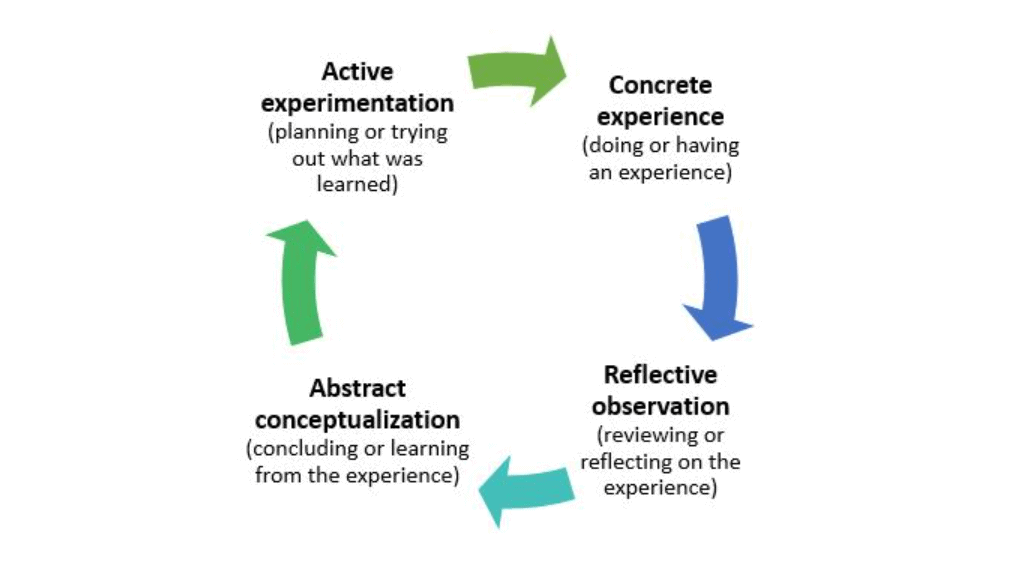
The session explored the work of educational theorist David Kolb, who devised a structured approach to understanding how individuals learn from their experiences. It involves a four-stage cycle and four separate learning styles. Much of Kolb’s theory concerns the learner’s internal cognitive processes, therefore can be a useful model to consider when thinking about both individual and collective debriefs.
The four stages of learning:
Graphic designed by Educational Technology.
1. Concrete experience
The learner encounters a concrete experience. This might be a new experience or situation, or a reinterpretation of existing experience in the light of new concepts.
2. Reflective observation
The learner reflects on the new experience in light of their existing knowledge. Of particular importance are any inconsistencies between experience and understanding.
3. Abstract conceptualization
Reflection gives rise to a new idea or a modification of an existing abstract concept (the person has learned from their experience).
4. Active experimentation
The newly created or modified concepts give rise to experimentation. The learner applies their idea(s) to the world around them to see what happens.
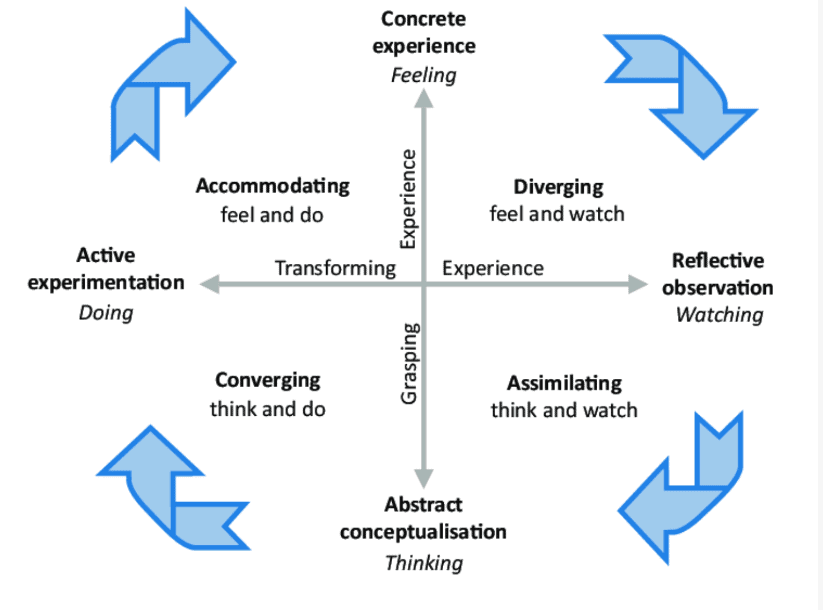
Kolb developed his four learning styles to illustrate different ways people naturally take in information:
Graphic designed by Educational Technology.
1. Diverging (concrete experience/reflective observation)
Learners who prefer the diverging style are best at viewing concrete situations from multiple perspectives. They prefer to watch rather than do, tending to gather information and use imagination to solve problems.
2. Assimilating (abstract conceptualization/reflective observation)
Assimilating learners prefer a concise, logical approach. They require a clear explanation rather than practical opportunity. They excel at understanding wide-ranging information and organising it in a clear logical format.
3. Converging (abstract conceptualization/active experimentation)
Learners with a converging style can solve problems and will use their learning to find practical applications for ideas and theories. They prefer technical tasks, and are less concerned with people and interpersonal aspects.
4. Accommodating (concrete experience/active experimentation)
Accommodating learners are ‘hands-on’, and rely on intuition rather than logic. They use other people’s analysis, and prefer to take a practical, experiential approach. They are attracted to new challenges and experiences.
The STOP model for live debriefs during the event
The session also discussed the STOP model, which is useful for ‘in the moment’ debriefing (sometimes known as ‘hot debriefing’).
Stand back: take a helicopter view of a situation or problem.
Take stock: analyse what is happening in the moment.
Options: explore options around what you can do differently.
Proceed: step back in and take action. Then assess what impact your new approach has.
The features of a great debrief