Dr Kate Ackerman of the Women’s Health, Sports and Performance Institute discusses what it will take to bridge that gap.
“We already know important things about female athletes, but our systems are not effectively translating that knowledge into practice,” she told the audience at June’s Leaders Sport Performance Summit in New York.
Ackerman is the Co-Founder and President of the Women’s Health, Sports and Performance [WHSP] Institute, which was founded to address that very issue. “I would argue we cannot fully understand human performance without fully understanding female performance,” she added.

Dr Kate Ackerman of the Women’s Health, Sports and Performance Institute talks at the 2026 Leaders Sport Performance Summit in New York. (Photo: Leaders Performance Institute / Evan Bernstein)
The problem
Women’s sport is outpacing the infrastructure built to support it.
The annual revenue for women’s sport is set to hit $3 billion in 2026 and there are more than 160 professional women’s sports leagues across the globe. “My 10-year-old son didn’t even know that men played basketball,” said Ackerman.
Yet the science still lags behind. As Ackerman explained, less than 10% of sports and exercise research is focused only on women, while only 6% of healthcare investment goes to women’s health. “If only 6% of research is focused solely on women, then you start to tease out which athletes are being studied, which women are being studied, we’re talking mostly about well-off white women. So this is a problem. We’ve got to figure out how to invest more.”
Why this matters
Sports science and performance have designed an environment based on male norms.
Ackerman points to 2020 as the first year that female-specific soccer cleats came on the market. “We’re jamming our feet into men’s shoes – and we know our feet are different,” she said. “Female athletes have unique considerations. Sex shapes injury, recovery, fuelling and adaptation.”
She then explained that female athletes face two to eight times the risk of ACL injury compared to their male peers. Similarly, “women have three times the incidence of bone stress injury compared to men” and “female athletes have a greater risk of developing relative energy deficiency in sport [REDs]”.
British former long distance runner, Pippa Woolven, experienced the symptoms of REDs and its consequences long before she was diagnosed.
“I think a lot of athletes aren’t well informed enough, especially females, about the energy demands that their sport might place on them,” Woolven told the Leaders Performance Podcast in 2022. “And when that’s paired with an active lifestyle and travelling around and commuting via active transport, these things can easily add up into a low energy availability.” At the time, the International Olympic Committee had not even named REDs and, as Woolven observed, “nobody really knew what was wrong with me.” It took her several years to recover with the right support.
Woolven went on to found Project REDs in an effort to educate and inform the industry. “There are so many myths and misconceptions out there about how to as somebody who is active or somebody who participates in sport, especially for women whose nutritional information is often based on that of males, whereas now we know it’s incredibly different.”
The research and practice gap
Women’s sport is already at a disadvantage, with coaches, practitioners and medical staff often making decisions with incomplete evidence. Female athletes themselves must navigate support structures originally designed around male norms. The result is not necessarily poor care, but fragmented care.
In reflecting on an athlete who was seeing multiple specialists for interconnected problems, Ackerman recalled asking: “What is happening? Why do you know all these different doctors? Why are you being sent all over town for your treatment?” Female athletes do not experience injury, fuelling, hormonal health, recovery and performance as separate issues but support structures often treat them that way. “The system seems like it’s kind of broken,” she added.
Progress, she argued, lies in building environments where research, medicine and performance operate side by side.
What’s next
It led to Ackerman establishing the Female Athlete Program, the Female Athlete Conference and ultimately the WHSP Institute, which combines clinical care, research and performance training within a single environment.
Of the Institute, she said: “It’s a 5,000 sq ft clinic, a 5,000 sq ft research space, and a 5,000 sq ft gym training facility all connected – it actually doesn’t sound that novel, does it? It’s the first one in the world for women. That’s kind of sad, but we’re excited to be the first ones.”
For Ackerman, the challenge is ensuring that knowledge reaches athletes, clinicians and coaches quickly enough to make a difference. She shared a striking stat: it takes an average of 17 years for scientific discovery to go fully into real-world practice. “I can figure out something in my lab, and it’s not going to get implemented with routines for quite a while.”
What to read next
Why the WNBA Is Ready to Enter a New Era of Personnel Decisions, Game Strategy and Sports Science
In September, Leaders Performance Institute members tackled topics including AI, alignment and strategy.
He remains the only senior coach to have won a premier (let alone three) without having played at elite level in the AFL or its predecessor, the VFL. Fagan suspects he won’t be the last.
“I think there’s plenty of people out there that could be like me if they were able to get that opportunity,” he told Fox Footy’s AFL360 programme. “Coaching is just a little bit more than how you played the game – it’s a lot about how you teach people, how you develop people, how you give them confidence, how you give them a sense of belonging. All of that comes together in those big performances in finals – it’s not just as simple as knowing a lot about the game, and being a good player.
“One of the good things for me is that I couldn’t rely on my reputation as a player; I’ve had to develop other skills that have helped me be able to communicate with my players and get the message through. I’m proud that I’ve been able to do that, and I just hope others do get the chance at some stage to do the same thing.”
We have very little to add to that other than to point you in the direction of Fagan’s appearances onstage at the Leaders Sport Performance summit here, here and here and offer our warmest congratulations to the man and his organisation, who have long-been esteemed members of the Leaders Performance Institute.
Right, let’s round up the happenings at the Leaders Performance Institute for September where the discourse ranged from AI and alignment, to problem-solving and strategy.
Quote of the month:
Remember… AI will not palpate a hamstring. It will not notice the hesitation in a player’s voice. It cannot carry the moral weight of a return-to-play decision. It cannot rebuild trust after a setback. But… it can place the right information in front of the right people. It can preserve why a decision was made. It can return hours to practitioners… give some white space back into a crammed calendar. Free up headspace and offset cognitive load. It can help a department learn from every case rather than simply move on to the next one.
David Clancy of The NXT Level Group and Ivan Peric of Peric & Partners penned a guest column exploring how artificial intelligence can help your performance team to see more clearly, remember more accurately – and learn more quickly.
They make their case using the Premier League. Read the full story here.

(Photo by Justin Setterfield/Getty Images)
Insight of the month:
Darren Shand, the former General Manager of the New Zealand All Blacks, posed a question at a recent Leaders Virtual Roundtable: how does your plan unfold when you’re not there? His argument is that he should be able to visit at hear, see and feel your plan in action. However, that can only be the case is everyone is bought in and, as he explained, clarity and alignment are not the same thing:
If we’ve got clarity without belief, we’ve just got compliance. We’ve just got people doing what they think they need to do. But if we’ve got clarity with belief, we’ve got a much deeper commitment to whatever that plan is… The more we could create things together, the better we were… it forced us as management to make the plan even simpler because we had to fit with their way of thinking and their way of being rather than ours.
Read the full report here.

(Photo by David Rogers/Getty Images)
Good to know:
Were you aware that McDonald’s tried to introduce ‘McSpaghetti’ in Italy in the late 1980s?
They held back because, when they put it on the menu, no one ordered it. The idea failed but it was a cheap failure. McDonald’s’ approach in this instance certainly compares favourably with Google’s expensive first-generation Glass product.
John Bull, the Head of High Performance Research at Management Futures, shared those two examples at another Virtual Roundtable that explored the idea of empowering others to solve. He said:
The key trap that we fall into is, when faced with uncertainty or sudden change, we feel pressured to come up with the answer. That is deeply misleading if we don’t know what works… A lot of us are conditioned to think of strong leadership as being linked to having the ability to give clear direction; and when you are in a time of uncertainty, if results aren’t going as you would expect or like or the expectation on you, a lot of people will look to their leaders for guidance… Faced with uncertainty, sudden change, we feel pressured to come up with the answer, but if we don’t know what works, we should move into an ‘empower to solve’ response rather than defaulting to directive leadership.
Check out the full report here.
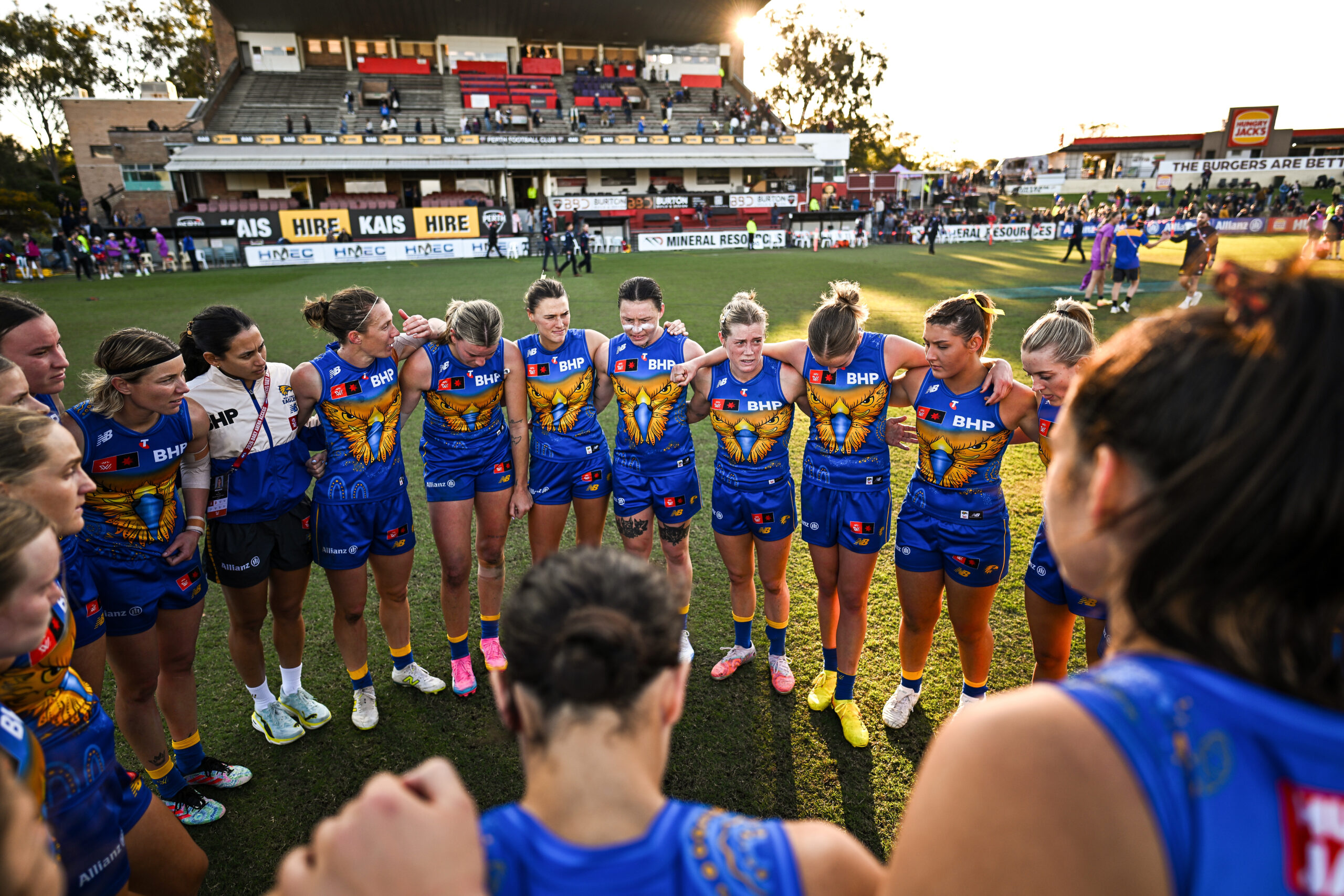
(Photo by Daniel Carson/AFL Photos via Getty Images)
One pitfall to avoid:
What makes a good strategy? Members of the Leaders Performance Institute answered that question at another Virtual Roundtable, which you can read about here.
Here is a story one performance director shared about their organisation’s penchant for a quick measurement at the expense of long-term development:
I was in an environment where the executive team focused heavily on the number of athletes coming through the facility. The problem was that there wasn’t really a clear plan behind it and trust started to erode among the staff working closest to the athletes. What actually drove success – delivering a world-class service – wasn’t being recognised or measured in the same way. So it was a good example of how a strategy can look clear on paper but still struggle because of issues elsewhere in the system.
(Photo by David Ramos/Getty Images)
What’s coming up for members
Jen Bryant of the USOPC explains the three questions powering Team USA’s Winter Olympic resurgence.
“I do make sure to tell people they didn’t hire me in 2011,” joked Jen Bryant at June’s Leaders Sport Performance Summit in Brooklyn.
Bryant, who joined the United States Olympic and Paralympic Committee in 2019, had just been promoted to Senior Director of Summer Olympic and Paralympic Sport. Until the 2026 Milano Cortina Games, she had served as the organisation’s High Performance Director of Winter Sports.
Onstage, she discussed Team USA’s resurgence. In Italy, they finished second in the medal table with 33 medals, including 12 golds. It was the first time they had won more than ten Winter Olympic golds in a single Games.

Jen Bryant onstage at Barclays Center at the 2026 Leaders Sport Performance Summit in New York. (Photo: Leaders Performance Institute / Evan Bernstein)
“Our goal is to be the best nation in the world again in 2030,” said Bryant, with the French Alps in mind, as she repeated the USOPC’s stated ambition since the reality check of Pyeongchang. Yet, as she admitted, there have been times when “it felt like we could not even spell ‘winter’.”
The US’s winter Olympic team has too often been “relying on too few athletes to win too many medals”, as Bryant put it while standing in front of an image of three-time Olympic skiing gold medallist Mikaela Shiffrin.
Bryant then explained the journey from being barely able to spell ‘winter’ to once again becoming a top three nation through three questions that guided the USOPC’s work.
“Something needed to change in the way we thought about winter sport,” said Bryant.
The USOPC needed to understand where they could improve and where it was most exposed before committing its resources. They began by asking their eight national governing bodies for winter sports to identify what Bryant called the “obvious opportunities”. She continued: “Where in the programme did we see our greatest areas of opportunity for growth? And, candidly, where did we see our biggest risks from Beijing? Where have we got deeper pipelines? Where could we look at new events?”
“We couldn’t just focus on what we were going to do at the Games,” said Bryant. Instead, the task was “building a team that was capable of going and delivering a podium-level performance”.
Bryant previously worked at the British Bobsleigh & Skeleton Association in her native UK. “They typically say Team GB is really good at all the sports you have to sit down in,” she added. “What they really mean is they’ve got a really, really strong R&D programme.”
At the Milano Cortina Games, Team USA won one of the four bobsleigh gold medals on offer. Germany claimed the other three in a repeat of their dominance in Beijing in 2022. Germany holds an advantage through its long-established engineering and research programme in sliding sports. The USOPC is working to close that gap and Bryant said the US now has some of the best sleds in the world. She also referred to regulatory changes involving carbon and ski preparation as an R&D opportunity to be exploited.
Then there was the issue of talent transfer. “We have incredible talent in this country that may not have been correctly connected with the right sport opportunities,” said Bryant. “Can we find entry points into these sports?”
She pointed to bobsledder Kaysha Love, a former collegiate sprinter who transferred into the sport and went on to become a world champion. “We focused on bringing a broader number of athletes through the pipeline.”
Training time was another issue, with athletes lacking reps and exposure to Games-like conditions. “We identified a gap in the amount of time our athletes were able to spend on snow or on ice training, and that was something we needed to remedy,” said Bryant. They upped their quota of overseas training camps. There was no other choice. “We struggle with winter sport conditions year round for obvious reasons.”
As the Games approached, Team USA concentrated on the details that might make a difference in competition.
“Spoiler alert: there’s not a lot we can do by the time we get to the Games,” said Bryant while explaining there were still areas where better preparation might help. She described a project in the luge programme that examined “steel composition, steel preparation, and how that interacts with ice.” That work helped the team understand the track conditions and adjust their equipment. There was a similar project with US Ski & Snowboard around ski and wax preparation.
The final element Bryant discussed was tailored support. As Milano Cortina was spread across six villages in three Italian regions, Team USA adapted their facilities and services to the needs of specific sports rather than applying a standardised approach. In Cortina, facilities were designed for the sliding disciplines; elsewhere, support reflected the needs of the sports based there.
What to read next
‘We’ve Lost Athletes Because of this’: When Support Descends into Surveillance
At a recent Leaders Virtual Roundtable, John Bull of Management spelled out the difference between technical and adaptive problems and how understanding which is which is key to enabling others to innovate and find solutions.
They ultimately decided against doing so following an experiment that John Bull spoke about at a recent Leaders virtual roundtable.
“What would be the cheapest, easiest way to test whether spaghetti was going to work as a product?” he asked the table, before revealing the answer.
“What one store did was just put it on the menu,” he continued. “They didn’t make any and they didn’t even develop the product, but just took note of how many people asked for it from the menu. After three days, no one had asked, so they never even had to bother.”
For Bull, the Head of High Performance Research at Management Futures, the test was a success in learning terms and an example of intelligent experimentation and adaptive leadership. Any ‘failure’ was minimal.
The story is cited by Kirk Vallis, the Global Head of Creativity Development at Google, where their first-generation Glass product proved to be an expensive flop.
“They spent some phenomenal amount of money, in the tens of millions on this without really testing whether there was demand for it in the market,” said Bull.
Few companies have Google’s scale, but their experience is not unique. It brings us back to the message behind this roundtable, which was titled ‘Empower to Solve’. He uses it to refer to situations where a leader must respond to a situation where the answer is unknown.
“The key trap that we fall into is, when faced with uncertainty or sudden change, we feel pressured to come up with the answer. That is deeply misleading if we don’t know what works,” he continued, adding that it is often a skill that leaders struggle to master.
“A lot of us are conditioned to think of strong leadership as being linked to having the ability to give clear direction; and when you are in a time of uncertainty, if results aren’t going as you would expect or like or the expectation on you, a lot of people will look to their leaders for guidance.”
Bull cautioned against this approach. “Faced with uncertainty, sudden change, we feel pressured to come up with the answer, but if we don’t know what works, we should move into an ‘empower to solve’ response rather than defaulting to directive leadership.”
Over the course of an hour, Bull helped Leaders Performance Institute members to understand that, when facing adaptive challenges, their primary job shifts from providing answers to creating the conditions in which those answers can be unearthed.
Empower to solve: a skill of adaptive leadership
Bull introduced the table to the typical skills found in good adaptive leaders and the traps they evade even in trying conditions. “I think all of us will recognise these, and you’ll certainly recognise them in your organisations. I think that they’re fairly generic and fairly normal as traps”
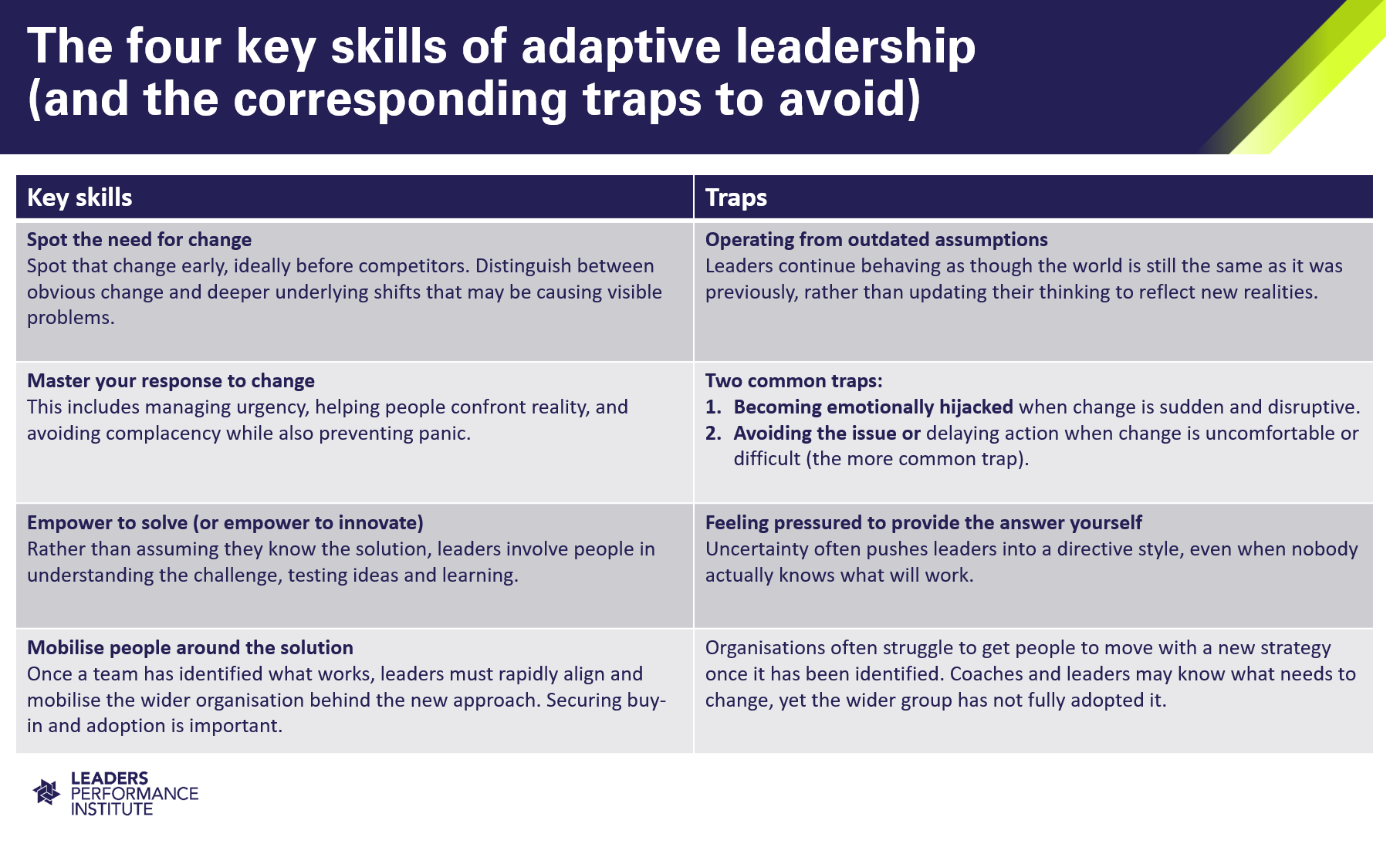 Is your problem technical or adaptive?
Bull cited the 2010 Copiapó mining accident in Chile as a prime example of what it looks like when a leader empowers their people to solve a complex problem.
A cave-in at the San José copper-gold mine in the Atacama Desert in August 2010 left 33 men trapped 700m (2,300ft) underground and 5km (3 miles) from the mine’s entrance. They were all rescued 69 days later.
The rescue was led by André Sougarret, a mining engineer with nearly three decades of experience in an area where accidents were all too common. Yet he was quick to call in others, from people at NASA to psychologists and geologists.
“He said to everyone: ‘your experience is massively relevant here, but your expertise is not’.”
Sougarret even adopted the idea of a 19-year-old American undergraduate who suggested a drilling technique that took six to eight weeks off the rescue.
“As a leader, I think I would have gone, ‘tell the guy to buzz off’,” admitted Bull with a smile. The crucial point, he explained, is that a leader must figure out when ‘empower to solve’ is the best approach. For that, they must be able to distinguish between a technical and adaptive problem.
This distinction is important because, as Bull said: “One of the most common traps that we see is organisations inside and outside of sport treating an adaptive problem as though it’s a technical problem.”
In conclusion, as Bull said, a leader must…
Identify the challenge. “The key thing is being able to make a distinction between two types of problem.”
Assemble the best minds. Bull: “Assemble the best minds that you’re able to get fairly quickly together.”
Set the context. Bull said: “People think empowering to solve is just about handing over to others. If you do that, you’re likely to not get good results.” Preparation is essential. As one participant working in professional basketball said: “We can prepare all week for a certain way and then maybe right at the beginning of the game, it’s not going to work and we’ve got to change.”
Run small experiments and learn quickly. “The key takeaway from the session is to start thinking about what are we doing to fire bullets as a cheap way to kind of test things,” said Bull, referencing Jim Collins’ analogy that naval forces in the Age of Sail would fire range-finding shots before committing to cannonballs. Experiments, however, need a clear purpose. As one participant observed, everyone must be “super clear on what it is they’re trying to achieve.”
Sense-make before acting. “One of the key traps we can fall into, particularly under pressure, is move to action too quickly before we understand actually and make sense of what’s going on.”
Debrief and capture learning. Bull said: “In the idea of empower to learn, you are testing to learn and debriefing becomes even more important.” As one participant added, this means “engaging players in the feedback loop and getting them to open up to provide feedback on the changes you’re making.”
If you have any further questions around how to sustain success with your team, feel free to reach out to Management Futures directly via [email protected]
What to read next
Aneaka Reay-Kemp and her FA predecessor Paul Cleal explain what it takes for your strategy to survive in complex environments.
“You’re never going to know more than 60% of information, so you deal with that as best as possible,” said the former Lead Military Intelligence Specialist at the UK Ministry of Defence. “You’re almost comfortable being uncomfortable.”
Reay-Kemp, who has since joined England’s national football federation, the Football Association, as Men’s Technical Strategy & Operations Manager, was talking to Leaders Performance Institute members at March’s Leaders Meet: The Art of Strategy.
She was joined onstage by the man she succeeded in August, Paul Cleal, which makes for an interesting, if unusual, dynamic in retrospect.
Cleal, whose business interests include serving as Chair of the Palace for Life Foundation, told the room that knowledge is inevitably distributed across a team. “I know 30%, you know 40%. It’s possible we might know 100% between us,” he said, before adding that if leaders prevent that knowledge from being combined then “you’re sunk”.

Aneaka Reay-Kemp (centre) in conversation with Paul Cleal (right) and moderator Iain Brunnschweiler (left) at Leaders Meet: The Art of Strategy at Lord’s Cricket Ground. Photo: Leaders Performance Institute / Robert Obreja
Together, Reay-Kemp and Cleal explained why the execution of a strategy depends on teams being able to make coherent decisions as reality veers away from expectations.
Collective creation
“Being part of having created it, you’re more likely to make it successful,” said Cleal. He wants to avoid the fate of strategies that look impressive but are then left “sat on shelves”, ignored and unloved.
A strategy is more likely to succeed, he argued, when the people responsible for its delivery are involved in its creation. Staff have the operational knowledge to reveal where resources are already stretched or proposals may encounter resistance. Their direct involvement in strategising can expose gaps, challenge latent assumptions and clarify their responsibilities.
“Get people to really surface those assumptions,” added Cleal, who explained that these should not be mistook for wisdom. “The more you can break people out of the normal, the better.”
He made the distinction between the divergent process of the collective challenging assumptions and generating alternatives, and the convergent process of the leader turning them into choices.
This approach is echoed in Reay-Kemp’s “analysis of competing hypotheses”, where teams generate several possible explanations and test the available evidence against each, which enables them to establish “what’s likely and what isn’t likely”.
Set the intent, then let your team decide how to do it
Reay-Kemp explained that teams in the military are told the purpose and specifics of their missions but retain discretion over how they proceed.
“How you go about it is completely up to you,” she said. “It will vary according to who you’ve got available and what they’re capable of.” This strikes a balance between being overly prescriptive, which can prevent teams from adapting in the field, and offering a vision too broad to guide action.
Reay-Kemp spoke of three layers of preparation: core individual readiness, specialist expertise and an understanding of the wider team’s capabilities. As she put it, preparation means “understanding your individual, your basic soldiering, your trade, and then the people around you” because a team must be able to respond to the circumstances.
Collaborate for a clearer picture
Reay-Kemp has seen the military move away from the assumption that rank determines the value of an opinion.
“It doesn’t matter what’s on that person’s chest, it doesn’t matter their background, but they still bring value no matter how junior they are,” she said before emphasising the need to understand the person behind the role. They are, she added, “people first before they’re a soldier, before they’re a player, or whatever kind of athlete they are.” A leader may learn something about their previous work, interests or experiences that reveals previously unseen capabilities, she argued.
Cleal concurred. “You’ve got to have the ability to override the hierarchy,” he said, adding that a leader should not prevent relevant information from reaching the person making the decision.
No new priorities without trade-offs
“One of the things about strategy is making choices,” said Cleal. Some are easier than others. For example, adding a specialist, programme or priority is relatively easy if no existing activity is displaced. But, as he asked: “What have you decided not to do?”
Too often a strategy fails because previous commitments endure in daily practice. People may understand your new direction but will not act if they lack the time and resources to give it proper attention.
Lessons must inform new practice
A review should be judged by what people do differently afterwards.
Reay-Kemp explained that military personnel returning from exercises submit reports containing recommendations for future teams. She said: “We extract any suggestions they might feel would be beneficial to feed back into the pipeline for the next person going out or the next team.” Ideally, these would be used to inform training. “Does it happen all the time? No,” she admitted candidly.
Programmes, Cleal argued, tend to advance when one person has accountability; with this sense of ownership comes the capacity to change practice. He said the FA tries to give each strategic programme a clearly accountable lead. The difficulty increases when programmes cross departmental boundaries. As Cleal put it, “the more people are involved, the more outcomes of those programmes are less clear.”
In summary, Reay-Kemp said: “Understand that picture, understand what you have, the people you have, the resources that are available to you, and then work as best as possible off of that.”
Five tests of your strategy:
What to read next
In July, talent pathways, performance under pressure and the importance of a smartly implemented strategy were all talking points.
Having joined the Spanish federation in 2013, he worked with many of the same players through the Under-19s, Under-21s, the Olympic Games, Euro 2024 and now a World Cup triumph, making him one of the rare international coaches to oversee an entire generation from adolescence to the sport’s biggest prize.
“When I was made seleccionador I said that if I had an advantage it was that I knew the players. That allowed us to ‘bet’ on the future,” he told the Guardian in 2024.
It is a model many sports organisations would love to replicate. Yet, as performance specialist Iain Brunnschweiler observed during a recent Leaders Performance Institute roundtable: “I don’t think anyone’s solved this. That’s why we’re still talking about it; we’re still trying to work out how to do it most effectively.”
Spain would not claim to have cracked the code. Nevertheless, their success focuses attention on one of the most enduring questions in performance: how do organisations consistently develop talent capable of succeeding on the biggest stage?
That discussion was just one of the standout conversations among Leaders members in July.
We share some of the choicest cuts in this month’s Debrief.
Insight of the month:
When it comes to talent pathways, are we designing programmes around the needs of the athlete, or around the needs of the system?
Brunnschweiler wrapped up his presentation during the aforementioned roundtable with a reflection on his career working on elite talent pathways:
At the upper end of the talent pathway, the highest potential athletes can get the ‘worst’ programme.
An athlete may look as though they are receiving the best possible opportunity when they are training with senior professionals, yet if that exposure comes at the expense of match minutes, individualised development, physical preparation and psychological support, they may actually be receiving a worse developmental programme than peers lower down the pathway.
“They were being utilised more as a training mechanism for senior performers rather than a really high potential young player,” said Brunnschweiler, who worked with his colleagues to find a solution.
“One mechanism we did put in place was having a transition coach whose specific role was to go with that high potential player or group of players when they went into the senior training environment.”
Read the full roundtable report here.
Myth buster of the month:
Strategies don’t deliver outcomes – that’s the reality.
Michael Bourne, the Performance Director of the Lawn Tennis Association, admitted he loves a strategy. But as he told an audience at Leaders Meet: The Art of Strategy in April, ideas count for little without coherent actions.
He continued: “I’ve talked about a strategy that was written in 2018. So the idea of that being accurate to what we have to do today, well, a realism needs to be brought to that. The critical factor in those clear and coherent actions is if you still believe in your basic principles, you’ve got to have rapid review cycles that can tell you what you need to do today against the mission and the vision that we’ve set ourselves.”
These reviews are tracked on a dashboard, which contains 56 metrics that enable the LTA to link their strategy to “the bigger picture, to what everybody’s doing.”
Last month, with Wimbledon underway, we returned to that session to explore Bourne’s role in delivering the LTA’s ten-year performance strategy.
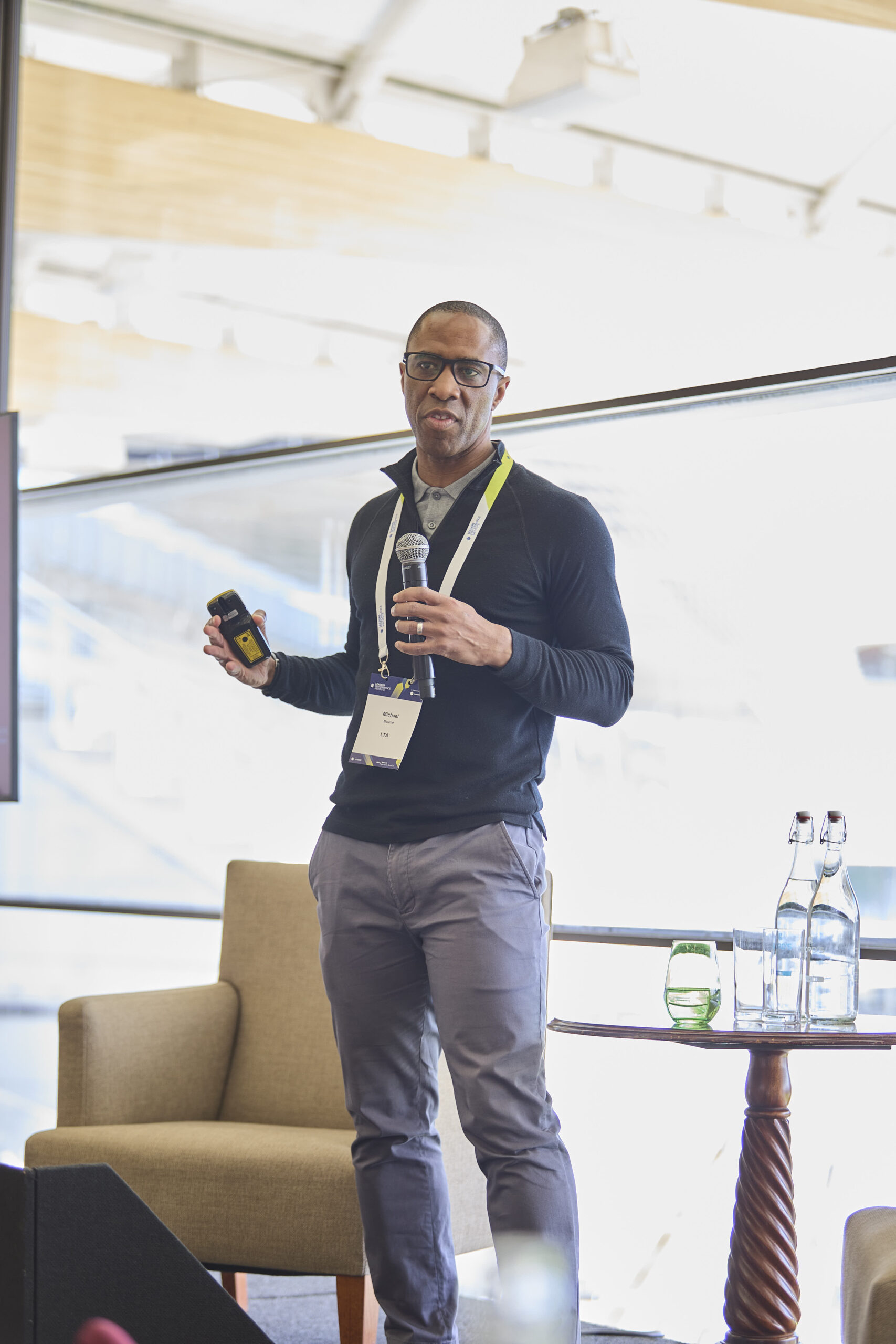
Michael Bourne, Performance Director at the Lawn Tennis Association, spoke first and set out the hard truths confronting British Tennis back in the mid-2010s. Image: Robert Obreja / Leaders Performance Institute
Good to know:
My work has taught me that you cannot overcome biases by simply trying to be more rational. The optimal path is to create processes that prevent us from succumbing to them.
Behavioural economist Dr Benjamin Kelly used the start of rugby union’s Nations Championship to run the rule over the biases that most commonly present themselves in the sport.
He advocates a structured intervention, as depicted below:
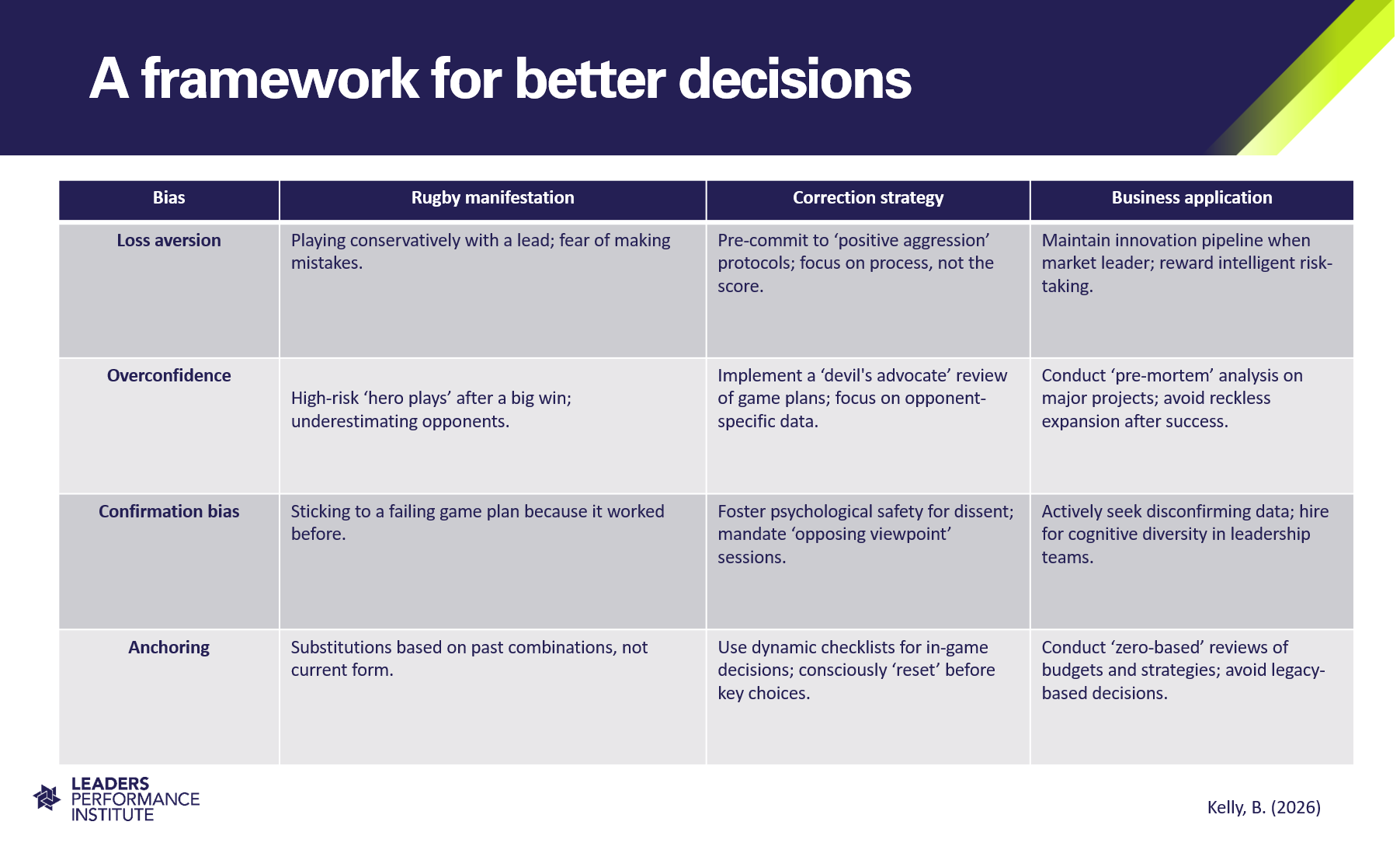
‘By understanding how these biases manifest, leaders can design and implement structured processes to counteract them,’ he wrote. ‘The journey to mastering the mental game is one of discipline and a commitment to process over outcome. The critical insight is not to eliminate bias, but to build systems that account for it. For any leader, in any field, that is the ultimate competitive advantage.’
Read the full article here.
Quote of the month:
Do the common things uncommonly well.
So said performance specialist Rachel Vickery at a roundtable on the topic of performance under pressure.
She argued that an ability to manage pressure is less to do with fancy tricks or even an attempted recreation of pressure moments in training, and more to do with reducing an athlete’s allostatic load – the accumulation of stressors and demands over time that push a person into a heightened state of physiological arousal.
“What they end up seeing in finals is not a sudden, unexpected failure of performance,” she said. “It was something that was actually built because of that accumulation in the system as a whole.”
The secret lies in increasing an athlete’s ‘buffer’ – the spare capacity between a person’s current arousal level and the point at which performance starts to deteriorate. When someone has plenty of buffer, the pressure can rise naturally, their arousal can increase, and they can still stay below their threshold.
Vickery argued that many organisations make a fundamental mistake by treating sleep, recovery, relationships and gratitude as wellbeing initiatives rather than as performance interventions that create buffer.
Read the full story here.
Best advice:
There’s this quote: every time you say ‘yes’ to something, you’re saying ‘no’ to something else. You’ve just got to make sure you’ve got the energy and the headspace to provide the appropriate level of support that your performance team need.
Ian Costello became the General Manager of Munster Rugby in 2025 and, in assuming the role, took a strategic leadership position after two decades of coaching on the grass.
He admits it has been a steep learning curve, but with a shared vision he has allowed Munster’s domain experts to flourish while finding the space to spot performance trends and nip issues in the bud.
Read our interview with Costello here.
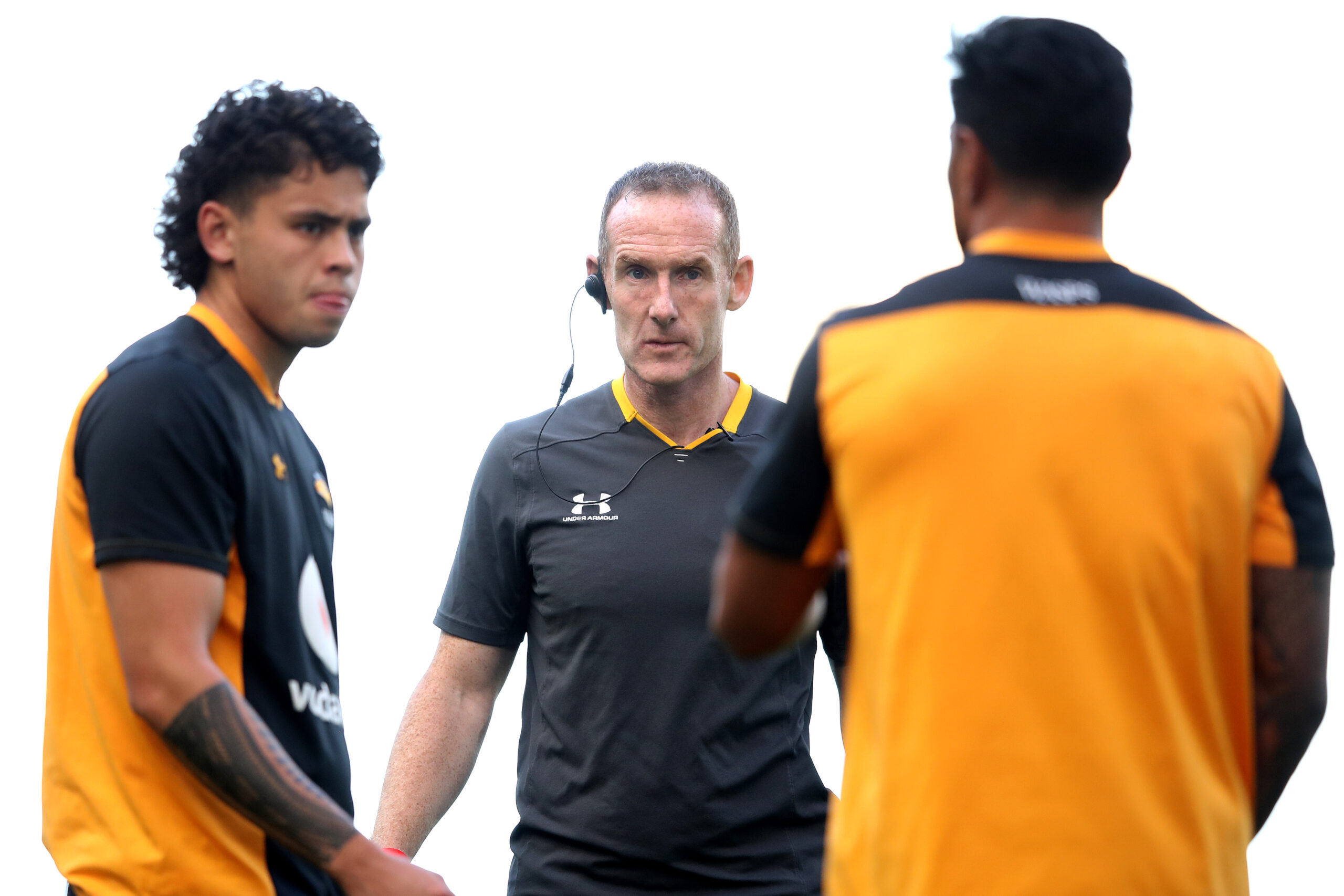
Ian Costello (centre) has been the General Manager of Munster Rugby since 2025.
What’s coming up for members
Why Succession Planning & Sustainability of Handovers is Critical
Michael Bourne explains how the LTA has built a national performance system by turning strategy into a shared pursuit across British tennis.
“I don’t know what makes people good at strategy,” he told an audience at Leaders Meet: The Art of Strategy, “but I love it.”
“Strategy is a dream with a road built to it and, when I think about strategy, I love the idea of making things possible that aren’t currently possible.”
Bourne is on hand at Lord’s Cricket Ground to discuss the LTA’s ten-year performance strategy, on which the national governing body embarked in 2018.
“I actually joined the LTA in 2020, so I’m telling you a story of how I received the strategy, how I sought to understand it in my team and also where we’ve taken it since that period.”
Michael Bourne, Performance Director at the Lawn Tennis Association, spoke first and set out the hard truths confronting British Tennis back in the mid-2010s. Image: Robert Obreja / Leaders Performance Institute
The ‘kernel’ of a good strategy
Bourne has been heavily influenced by Richard Rumelt’s 2011 book Good Strategy, Bad Strategy.
“It’s actually a book I walked past for years in the airport just thinking it was one of these random books that they sell at airports,” he said, “and actually, when I checked by own biases and decided to read the book, I found that it had some of the greatest insights into building a strategy that I’d found anywhere.”
The element of Rumelt’s work that resonated most with Bourne was the idea of a “kernel of a good strategy”. Bourne said: “you can have multiple strategies that will get you from where you are to where you want to get to, but I like the idea that there’s elements you have to master in order for your strategy to be successful. There’s an understanding of where you are at the time and the challenges you’re trying to overcome.”
The LTA arrived at their kernel in the three areas described by Rumelt:
Between November 2016 and February 2017, the LTA conducted a ‘current situation analysis’ of its performance pathway and performance coach development systems and how they stacked up against their foreign counterparts’.
The analysis did not make for pleasant reading. “In essence, we’re talking about a chronic undersupply of junior players and senior professional players,” said Bourne. There was no coherent pathway, no process for identifying and developing talent, and resources spread too thinly.
Yes, Great Britain could point to players such as three-time grand slam winner and double Olympic gold medallist Andy Murray, but the sense was that he came through despite – not because of – the system.
Participation numbers were down too. “It wasn’t a sport that everybody felt welcome to,” added Bourne. “It didn’t feel open and it didn’t feel inclusive.”
The LTA needed a unifying mission. “The performance strategy came from many of the same grounding points as the wider organisational strategy — a feeling like it needed to have more identity, it needed to be more open to people, it needed to find new ways of driving success for the sport.”
The LTA landed upon: ‘make Great Britain one of the most respected nations in the world for player development’.
“The first thing is ‘Great Britain’ – it doesn’t say ‘make the LTA the most respected NGB in the world for player development’. It’s an open scale; and how we think about implementing the strategy has to take into account it’s not just about us in blue jackets; it’s actually about the whole nation and how it’s perceived as a tennis nation.”
The second thing was ‘respect’. “When I inherited this strategy it was the one word I focused on because it was different to any of the strategies I’d worked on before.” In Bourne’s work at UK Sport and the England & Wales Cricket Board, strategies tended to focus on tangible outcomes such as medals and accolades. The sense at the LTA is that titles will follow when people understand the mission.
The LTA had created the space to devise their guiding principles.
Back in 2016, the LTA developed 11 guiding principles. They preceded the full diagnosis but provided the foundations and recommendations on which the LTA’s strategy could be built.
Bourne shared a screenshot of the first draft. The detailed document outlined the LTA’s intention to build a nationwide, integrated development system that identifies talent, creates the right experiences and reduces barriers to entry; but he explained that it had limited utility in and of itself.
“I have colleagues in the room,” said Bourne. “If you ask them if they’ve ever seen this page I suspect the answer would be no. This is not what gets lived. This is what the board use to sign-off on these things [but] we have to live this strategy on a daily basis.”
Bourne holds two beliefs in his approach to guiding policy. “Firstly, you try and make them as simple as possible. We have 64 people in our performance team; we have over 100 partner organisations delivering our strategy; and our senior players, of which we support 45, plus 50 in wheelchair tennis; each will have individual coaches, physios, S&C coaches, therapists etc. That’s a lot of people delivering the strategy on a daily basis. So simplification is important because that’s the message that sticks.”
The LTA alighted on the following:
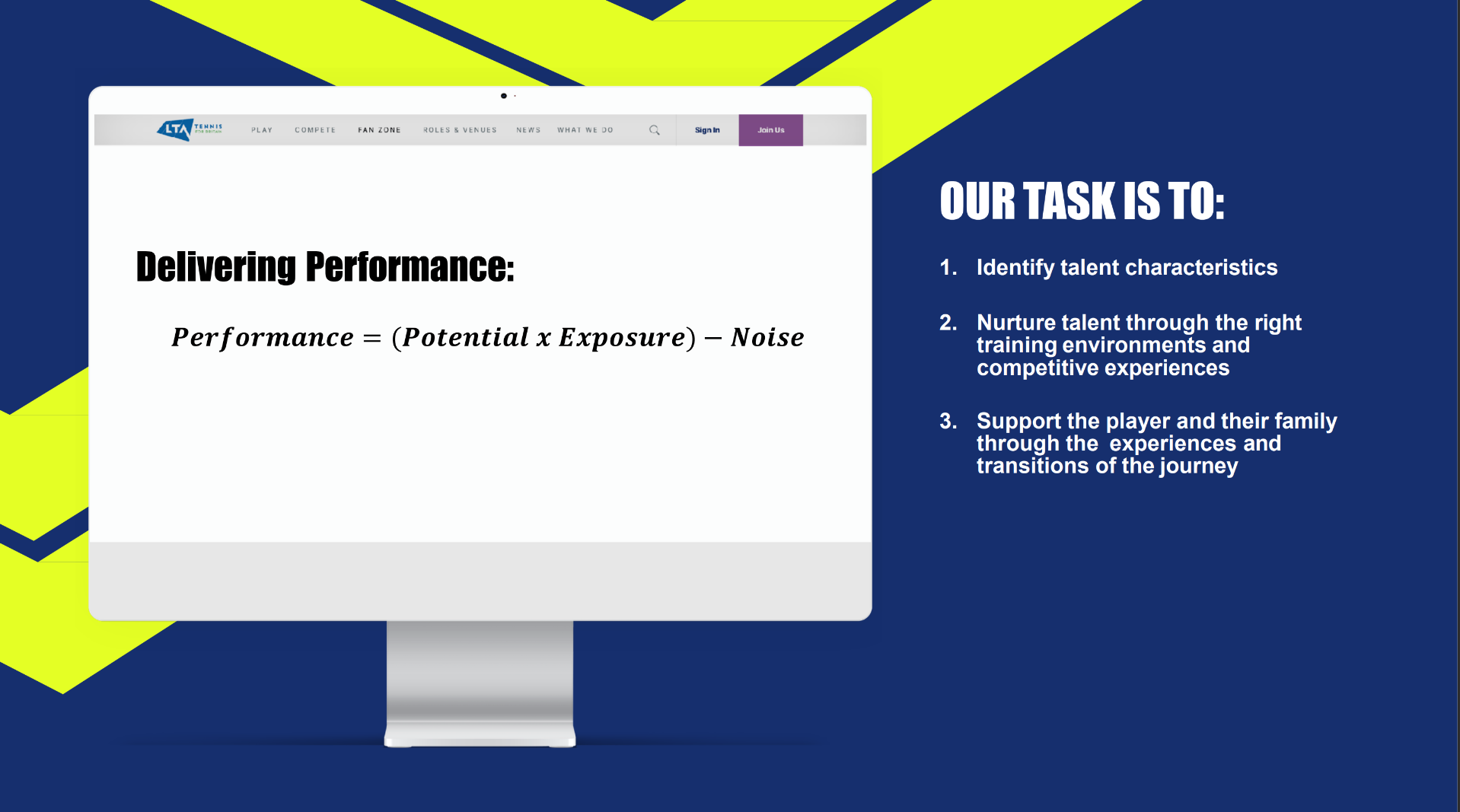
Secondly, with all these different areas of activity (Bourne calls them “nested strategies”), he explained that one has to “understand that the programmes you put in place, the philosophies, the training camps, the trips, the competition structures are actually making an impact on what it takes to become an elite level tennis player or elite level wheelchair tennis player.”
He added: “we should be able to draw a line from all these activities that we’re doing in our guiding policy back to developing [the required] skills in players over an extended period.
“That takes us to coherent actions.”
Bourne freely admits he loves strategising but, as he said, “strategies don’t deliver outcomes – that’s the reality.”
He continued: “I’ve talked about a strategy that was written in 2018. So the idea of that being accurate to what we have to do today, well, a realism needs to be brought to that. The critical factor in those clear and coherent actions is if you still believe in your basic principles, you’ve got to have rapid review cycles that can tell you what you need to do today against the mission and the vision that we’ve set ourselves.”
These reviews are tracked on a dashboard, which contains 56 metrics that enable the LTA to link their strategy to “the bigger picture, to what everybody’s doing.”
There are still two years left in their strategy and Bourne’s work is not finished. “Our diagnosis is about right; we’ve probably got in place the right guiding policy; we just need to make sure that on a daily basis we’ve never ignored coherent actions to help us move towards that point.”
What to read next
How to Build, Stress-Test, and Execute an Effective Performance Strategy