In the first session of his Performance Support Series on talent development, Edd Vahid of the English Premier League, discusses methods that have stood the test of time and enabled sustained success. It turns out there are commonalities across numerous leagues and sports.
For the first session within the series, Edd outlined a few aims for those in attendance, as we begin the journey of exploring the theme that will also see sessions in August and September. The aims were as followed:
What has stood the test of time?
As a way of setting the scene for this particular Performance Support Series, Edd shared some of his reflections from working within elite football academy environments, in which there were a number of consistent themes based on those experiences and interactions with others operating within the field of talent development.
Taking the above insights into consideration and if we believe these elements are universal truths, how effectively does your current practice acknowledge these realities? Edd said that it is often important to pause as we work in such a dynamic industry where it can be challenging to reflect on current practice.
The 5 I’s
‘Thinking like a scientist involves more than just reading with an open mind. It means being actively open-minded. It requires searching for reasons why we might be wrong – not for reasons why we must be right – and revising our views based on what we learn’ – Think Again, Adam Grant
Why this quote? The model that follows is an informed model from Edd’s experiences and expertise, but we were keen to reinforce that there are different contexts, so throughout this series of learning, we want to challenge and provoke discussion around the model.
The model has five elements which reflect what has been successful in the past in talent development, what is showing up in the most successful organisations presently and what we might want to consider in the future.
Individualised: the best talent development environments are individualised in nature.
Interdisciplinary: the most effective talent development demonstrate an interdisciplinary approach. Whilst the multiple disciplines will operate with an athlete, where it works most effectively is when there is an interdisciplinary approach to ensure the athlete is receiving the most critical and important piece of information and not an overload of information from the multiple disciplines.
Intervening upstream: the best talent development environments invest significant time in future proofing their activities and protect time for those conversations to understand what the future might look like. This is incredibly challenging with the dynamic and relentless nature of our environments, leaving a lack of time to think about these conversations.
Inclusive environments: the best environments for developing talent are inclusive, which also nods to the point on them being individualised.
Investment return: in the sense that it is not restricted to an economic conversation so it’s not a case of an investment of a certain amount of money and that gets return on players progressing through to the first team or elite level or being sold for profit (in a football context). The best talent development environments are considering the range of stakeholders that they are servicing. What’s the investment return of a young person who is dedicating so much time in that environment? What is the investment return for a parent who is probably offering a critical amount of support both emotionally and practically? What is the investment for the CEO, President or Head Coach?
Benchmarking against the model
The 5 I’s model serves as a fantastic benchmark for all environments, but how do we think we are doing? Within the session, we ranked our organisation’s delivery against these features on a scale of 1-5 to get a sense of our environments’ current effectiveness. What do we think we do best? The below is ranked in order of what we think are doing most effectively with the least effective being at the bottom:
Reflecting upon the responses, it wasn’t a huge surprise to see that most environments on the call felt they were delivering the Individualised Support element of talent development relatively effectively. Similarly, seeing Investment Return and Intervening Upstream as lower on the scale of effectiveness presents an expected but interesting insight – in Edd’s experiences, the feeling is that these elements are becoming more critical. There are more questions being asked in organisations around the Investment Return element from different stakeholders and with the fast-paced nature of high performance sport, taking time to predict how the ‘game’ will evolve and develop is becoming a core consideration in the quest to sustain success in this process.
Exploring individualisation
For the purpose of session one in the series, we explored the first element of the 5 I’s model in some further detail. It was the feature of the model that the group on the call felt we currently deliver the best, whilst appreciating that there are some significant organisational and individual challenges that accompany this.
Edd shared some insights and reflections from ten years of the Premier League’s Elite Player Performance Plan (EPPP), in particular highlighting the tension that can exist around being truly individualised. There around roughly 14,000 players in the football academy system in UK, ranging from ages of 8 to 20. The vast majority of these players enter the system at an Under 9 age group and range from a multitude of regions.
The purpose for sharing these insights is to reiterate how challenging it is to be genuinely individualised.
Part of effective talent development is the ability to instigate changes in behaviour of an individual, and it is worth pointing out that each athlete will require different experiences to reach that end goal. Edd shared a framework that was introduced to him a number of years ago called the ‘Behavioural Change Stairway Model’ created by Vecchia et al (2005). There are a number of stages you need to get to before witnessing true changes in behaviour.
Step 1: Active listening
Step 2: Empathy
Step 3: Rapport
Step 4: Influence
Step 5: Behavioural change
28 Jun 2023
ArticlesIn the second of a two-part interview, Hector Morales, the Pirates’ Director of International Development, delves into his work addressing those limiting factors.
“That’s what I call it. This confidence is just based on the people that are around you where you are,” says the Pirates’ Director of International Development. It is not uncommon for recruits from places such as Colombia, Venezuela, Mexico and the Dominican Republic to be the best player on their youth or school team. In those surroundings, they may be the best.
“But then that competence dissipates and goes away as soon as you step up to another cohort, where there’s a group of people who play better than you; and this is the first time you’ve seen this so it’s a culture shock sometimes.
“One player said to me once ‘my uncle lied to me – he said I was the best he’s seen’. I said: ‘He didn’t lie to you – you’re probably the best he’s seen, but that doesn’t mean there aren’t better arms out there’. I always tell the players, ‘if it’s too easy for you now, then your competition’s not here’. You shouldn’t be saying to yourself ‘I’m the best’ you should be saying ‘where’s my competition at because they’re not here? Where are those people who are going to give me the run for my money?’
“We’re never that good. There’s always somebody out there who can change our perspective”.
Morales spoke at length about bridging the cultural and development gap between Latin players and US players in part one of our interview. He also spoke of the practices that underpin the club’s approach at their Dominican Summer League academy in El Toro. In this second and final part, he delves further into some of the limiting factors that can affect Latin players and how he and his colleagues seek to address those.
“I still think that the biggest challenges we face are unrealistic expectations that things can go fast, that’s it’s like highlights,” says Morales, echoing the observations of some youth coaches across the globe.
“They were raised on highlights, they don’t see the games any more. If you asked, I’m pretty sure in soccer it’s the same, if you ask them, ‘do you see the full length of the game so you can understand the game?’ They’ll tell you ‘No, I saw the goal. I saw this pass or this tackle or I saw the red card’. They’re used to the 15-second or 20-second bite and they expect that their development will be the same.
“If you’re thinking that things should be fast – and elite level performance takes time – then there’s an immediate disconnect on satisfaction and effort and other things because it’s taking so long and you think you’re not progressing the way you should be”.
Morales adds that while smartphones have transformed all of our lives (“they dictate our moods and what we do”) the younger generation are “even more comfortable communicating this way, which has taken a toll on the social aspect of things”.
Compounding these factors, in Morales’ view, is the role of these young players’ agents. “They are overly protected,” he says. “They want their agents to fight their battles for them. There’s no longer this coach conversation. It is now ‘I will have my agent reach out to you. My agent will talk to you now’. ‘I’m talking about development, I want to talk to you’. ‘Talk to my agent’.
“It’s that [lack of] nurturing, not being able to solve problems and deal with an adult, to reach a potential opportunity to do something differently. Those are very big limitations we’ve got to train our young athletes for and prepare them for. ‘If you’re expecting X then let’s have a conversation because we need to reframe your expectations’. It’s interesting and a good challenge to have, I believe, the more the realistic the expectations, the better for the kids in the competitive environment”.
Morales explains that the players’ parents or guardians remain influential in their children’s lives, but it is the ‘buscones’ – a Dominican term for local agents – who pedal young players to visiting major league scouts and often have the most influence on the player.
“When you ask the players who’s the person they trust the most, they’ll tell you that person. They’ll give you the name of that person. That’s still the case,” he says. “This is one of the key elements I’m focused on. Who does this person trust? What’s their ‘why’? It is constantly evolving but we’ve got to stay on top of that so we can help them and they can feel connected”.
The Dominican academy’s roster of mentors perform a significant role in this regard. A player is assigned a mentor at the academy who checks in regularly to discuss the player’s development.
“I normally select former players who have been through the stages the players are going to go through in transition,” says Morales. “So they’ve been there, understand the challenges of going to the next level. They can sell it through emotional and personal connective stories of what it was like for them to go through those transitions. And there are a lot of times where guys didn’t make it all the way through, or their career ended early or their talent got to a certain level, but they always dominated the mental game whether in college or if they played for the Pirates. They did everything they needed to do and they controlled everything they needed to control and they were engaged in trying to get better but their talent met its ceiling.
“The next requirement for a mentor is that they want to be in baseball or find a way to get a career in baseball. So they are here for two reasons: to mentor players and also open their own understanding of what the potential opportunities are out there for them so they can continue to have a career in the game”.
As we wrap up the interview, the Leaders Performance Institute asks Morales for his hopes for the future in baseball development in this part of the Americas.
“I still have a ways to go to get all the players to understand all the components that influence performance,” he says. “At the elite level, when you have a bunch of people whose talents are the same, there at elements of the head and heart that get in the way, there are elements of nutrition and recovery. I’m still struggling to get them to understand this because I’m breaking the paradigm of ‘I’m only being looked at because of my tools so far’”.
He elaborates on that last point. “No scout in any sport goes to a player and says ‘talk to me about your sleep, talk to me about your recovery strategies. How do you prepare? What are your routines to ensure that you are eating well?’ They’re just looking at their capacity to dribble the ball, their capacity to hit, how hard the arm can throw and move. They’re looking for the fundamental raw tools.
“So now I’m trying to get the player to go from ‘I was valued, paid and given a bonus before this one thing and now you’re telling me this is not the only thing that matters, that everything else in here matters so I can be the best athlete I can be’. So it takes time. You finally get a nutritionist in there last year and now these players are understanding how to assess themselves and the importance of having one-to-one sessions with a nutritionist. We’re talking about the mental game all the time and we do mindfulness practices twice or three times a week during camp so they can practise and study, so they can find the opportunity to be in the moment.
“Some still do it with hesitation. They say ‘I don’t need this’ and then until I get video and show them what happened with this particular play ‘I guess I wasn’t paying attention’, ‘oh, so those mindfulness things we talked about – you might need it, you might need to practise how to focus and be in the now and in the moment’. So how about giving that a try now that you have proof they do need it because multiple times in the field it’s proven that they cannot focus very well.
“It’s a battle. And the next stage of this is for them, once we’ve nailed this down, is for them to understand the analytics and the things that we know are important so they can begin to understand how to address those challenges and how to make changes and how to adapt. And one that’s always in the forefront for me is to ensure that they don’t go back home without any one to change what they have going forward, because the natural tendency over time as they go home for the off-season and they see their old coaches who say ‘that’s not what we used to do here. This is the way you used to it. Keep doing it this way’. Because they trust this person they show up back at the academy worse than when they left because we have moved them forward in development and now they have gone back to something that they were doing before because they didn’t have the tools to say ‘no, my team’s metric of success is this way and they taught me to do this and I’m going to continue to do it this way’. They’re too young to tell an adult figure with authority that they can’t use their advice.
“I want 80% of my guys to go home and say ‘no’”.
It takes time, but Morales, the Pirates and their young recruits are on the right path.
21 Jun 2023
ArticlesIn the first of a two-part interview, Hector Morales, the Pirates’ Director of International Development works to ensure that the club’s Latin players are not at a disadvantage to their American peers.
“A lot of times it’s easy because they see it,” says Hector Morales, the Pittsburgh Pirates’ Director of International Development.
Dr Morales, from his base in Florida, oversees the Pirates’ Dominican Summer League academy in El Toro in the Dominican Republic. With locals, the academy houses up to a hundred players from nations including Venezuela, Mexico and Colombia.
In keeping with elite sport, a significant number, around 30 players in this case, are released from the academy each year, but most of these youngsters, as Morales explains, expect it.
“These young men can look to the left and to the right. They see the writing on the wall, they see the talent of other players, they see they’re not getting as many opportunities on the field. Many of them welcome that conversation,” he says. “They don’t want to be the ones making the decision, they don’t want to come to you and tell you ‘I recognise where my career is and I don’t want to play no more’. They see it as a welcome relief to say ‘I was terminated, I did the best I could, it was out of my hands. My career is over and I can transition’.
“But still, research tells you that a career ending, whether it’s a college career or a professional career, the athletes go through the natural grieving process emotionally as if they’ve lost their best friend”.
This is an area where Morales feels US baseball has often let down Latin players. “At times, we forget to provide resources and services on the other end of a player’s career, for people who make it transactional – ‘I’m the GM and I’m going to make this transactional. I’m sorry your career has come to an end’ – there has to be a support system that is part of that process to ensure that the player has a plan and is moving and we’re setting them up for success. That’s one of the things that we do with international players. We find a way to have a final transition approach where we give them a resume, we teach them, we connect them with courses and trade courses and opportunities for them to make a life for themselves and their families after baseball”.
Setting people up for life
Players are recruited from Central and South America at the age of 16 and, typically, those with a future in the American game will spend three years at the Dominican academy before crossing the sea to Florida, home of Pirates’ domestic operations.
The Dominican academy hosts two teams – its Black and Gold teams – each with a manager and full coaching staff. There is also its fully-staffed Performance Center that caters for all the players’ high performance needs. It is designed to mirror the Pirates’ provisions for American players in Florida.
“We have eight classrooms where they can take their classes,” says Morales, who explains that the local players complete their secondary education under the ‘Nivel Medio’ system laid out by the Ministry of Education of the Dominican Republic. Players from Central and South America are enrolled in systems recognised in their homelands. “Our Senior Coordinator of Education manages where the players are assigned and what route they’ll take. We celebrate them all in one graduation at the end of every year. That’s the last event before we go into our off-season”. Additionally, all players take classes in English as a second language.
This has been a long time in the making and predates Morales’ employment at the Pirates, whom he joined in 2014 as a Spanish-speaking assistant to the Mental Skills Coordinator. His role expanded as he sought to address the shortcomings of the club’s induction program for young Latin players coming to play in the United States. Too often, these players would find themselves at a disadvantage, culturally and socially, in comparison to their American peers.
In 2015, Morales became the Director of the Pirates’ ‘Cultural Initiative’, which morphed into the Department of Cultural Readiness and, eventually, adopted its current moniker, the Department of International Development.
“The idea was to research the entire year and learn some of the things that we needed to do differently to ensure our players can transition and compete at this level and get cut only because of their talent. That was my personal goal,” he says.
“My personal goal was that they sent you home only because your skills reached their ceiling. The second goal I had, because I’m naturally an agreeable person, and I’m an underdog mindset kind of guy, it was that if any scout or anybody told you that the highest you will go would be Rookie ball, then you will be in a Double-A team threatening to take somebody’s job”.
What you can control
The Leaders Performance Institute asks Morales how academy staff work with players to bridge their developmental gaps. “The baseball skills are easier to find because we have more baseball coaches than anything else,” he says. “Let’s say a player is recognised for what we value, whether it’s some analytical aspect; spin rate or exit velocity, the fear that that player is not there. It’s a way to centralise our approach to a player.
“We try to connect all the resources around that player. ‘So right now, the primary need for this player has to do with him having more power to exit’. So the analysis is the strength & conditioning coaches analysing the effectiveness of the kinetic chain. ‘Is he using the body properly? Is his movement maximised for him to be able to generate that power? Or do we need to go to the gym and develop muscle mass? Or do we need to add more motor unit recruitment so he can just develop some natural strength because he doesn’t have that?’ If that’s the case then whatever work we have to do in the gym has to be connected with that need that we know is going to be the primary thing for them to move”.
The bigger challenges concern cognitive capacity as well as social and emotional learning, all of which are regularly assessed. “We’re talking about baseball IQ and all that,” adds Morales of cognitive capacity. “Can this player gather and receive information and process it right away or do they need to explain it to him multiple times? How does he problem-solve? Does he have strategies for problem-solving?”
As for social and emotional learning, questions asked can include: “How does he relate to others? How does he associate with the coach or the team? How does he respond to feedback? Those things are critical for us to identify and then be able to see based on the knowledge that we have from them and their family background if there were things that were not developed, that they were not exposed to in development?”
Morales cites the concept of concentration as an example to illustrate this at play. “People go to school and people go to college and they tend to have the capacity to be a little bit more focused because they were trained to do so. They were trained to read, they were trained to focus on a book or gaps in information for a long period of time to be able to gather and evaluate research. People who did not do that or did not go to school, they were not forced to focus on things that didn’t matter to them. They only focused on the things they wanted to focus on. Their capacity to be in the moment was diminished because they were not exposed to opportunities to develop that skill. So what do we do to help them improve that capacity and do better in their ability to focus? That’s just another of the many areas we look into for developmental gaps”.
It goes beyond raw ability. “Some people may say they’re better than you, although they’re not better than you in skill but they were able to be a better teammate because they understood social and emotional learning, they understood how to get information quickly so they could process something. He might have a better toolset but he has two other things that allow him to fit into a culture better and that can cost you an opportunity to reach your maximum potential, if you look at the big picture”.
The academy has four ‘controllables’ that guide all athletic development: preparation, attitude, concentration and effort. “Preparation is king,” says Morales. “In whatever we do, our head and our mind is free and anxieties are diminished; and it’s something that’s completely under your control. You can prepare the night before and have your stuff ready or you can run around at 5:30 in the morning after you overslept to try and put things together and be stressed out for the rest of the day. To me, that’s controllable.
“The second one is attitude, meaning how do they approach things? The way that they decide to tackle a task and approach it is going to have a great impact on how people see them and how it’s reflected.
“The third one is concentration, which is ability to be in the moment, the ability in the now. Being able to control your mind in the natural battle of fighting forward or going backwards.
“And lastly, it’s effort, which for me is defined by them showing up and giving you what they have at that moment. People will say at times ‘100%’ but in reality we’ll only be 100% at day one of training. After that, you’d never have 100% – what you have is what you have, so can you give me what you’ve got?
“I say ‘control what you can control’. And these things, no one else will influence them because your preparation, attitude, concentration and effort belong to you and you only. And if you can control those you give yourself a better chance to not have distractions”.
Self-assessment
Players are evaluated on a weekly basis and part of that process involves a self-assessment survey, which is sent to each player. “They evaluate their own week – ‘the things that went well in my week, the things I need to do better next week’ – to give themselves a goal. It’s an opportunity for them to close the door on the last week. That’s pretty much what we’re trying to do. And then, because we have access to mentors and the mental performance coordinators, they go around and have one on one conversations to get clarity; ‘I saw your report and I saw your review. You did this and you also talked about getting better at this. What are you going to do get better? What are some of the strategies? Or I’ve noticed that you’ve had success in this area but I don’t think that’s the way the orientation defines success. How can we find a way to match the way they are looking at success with the way that you look at success?’ So there’s a lot of things you learn by getting into the mind of them and seeing how they are seeing themselves, how they are evaluating themselves”.
Are there other common characteristics in those who make it to the United States? “In general, what we see is connected to the desire to be better,” says Morales. “That’s one of the things you can’t teach the guys. Their ‘why’ is pretty well connected to who they want to be for their families, to who they want to be for their siblings, who they want to be for their communities.
“The ones that have the most intrinsic approaches and motivations are the ones that tend to do best with all the different challenges associated with a minor league career. In terms of their tools and their potential, it’s putting all those tools together and then, leaning to the expectations, I would say that there are more that come in from more solid structure families and the ones that come with lineage of other baseball people in their families, tend to have a little bit of a leg-up compared to some of the other ones because they know the game better, they understand and they’ve been around the game for a while.
“So guys from the Dominican that have dedicated their life to this, you can see right away that they’re more of a gamer; they understand the game a little more. Mexican players, for example, they go through school. They’re almost ready to graduate high school so their cognitive capacity is a little more advanced than some of the others. Venezuela used to be like that but it’s regressing a little. So I think from different places you’ll see some of those differences that helps them set themselves apart just based on the foundations that they were given”.
31 May 2023
ArticlesJustin Bokmeyer, MLS NEXT’s first GM, is the person tasked with developing the region’s talent identification and development programs.
The New York-based MLS NEXT was founded in 2020 as a youth soccer league in the United States and Canada with a view to establishing itself as the premier talent identification and development program in North American soccer.
It is well on the way to achieving that aim. In a little over three years, MLS NEXT has grown to consist of 137 clubs, 628 teams and more than 13,500 players.
Bokmeyer was seen as the ideal candidate for the GM position following his sterling work at the NBA where as the Head of Strategic Initiatives he helped to found the Basketball Africa League. Earlier in his career, he also served as the Director of Lacrosse Operations at the United States Military Academy at West Point for two years and spent 11 years on active duty in the US Army.
The Leaders Performance Institute asks Bokmeyer if he was attracted to MLS NEXT because, much like the Basketball Africa League, it is a new venture.
“Absolutely,” he replies. “In my military career and in working in the NBA, I was working in new things and got to build them from scratch.” He cites examples from the athletic department at West Point, where he helped to establish programs, as well as the numerous NBA academies set up on his watch. “That was one of the exciting things about me taking this MLS NEXT role. I don’t know if I can jump into something that’s set for 20 or 30 years. That’s a very different mindset and a very different leadership skill.”
MLS NEXT’s aim is to provide the requisite coaching contact and a unified approach akin to the English Premier League’s Elite Player Performance Plan that taps into the region’s large talent pool.
Here, the Leaders Performance Institute outlines Bokmeyer’s first steps.
Year one, hands-on
Bokmeyer explains that he feels he needs to be heavily involved in his first year as GM. “I’m very hands-on this year but then, leading into next season, people should feel very empowered,” he says. “They’ll know our culture, the standards, our norms. They’ll know which decisions they can make.” There are, at present, ten people on his staff who share responsibilities for operating and executing the program, player engagement and experience, and commercial opportunities.
Bokmeyer has ensured that roles and responsibilities are clearly defined across the team. “It’s the focus on how we work,” he continues. “It’s being very deliberate in the platforms we use, how we communicate, when we meet, what decisions need to come to me, being very deliberate in how we work.”
MLS NEXT has made inroads but brought onboard its first GM because the league understands there is still a ways to go. “One of the things that I pride myself on is being able to piece things together; really diving into how we make those decisions and what the long-term effects are. Are we solving the problem we need to solve? The ability to think through second and third order effects is one that I pride myself on, making sure that we stay focused on what we’re trying to solve for.”
Development tools
Bokmeyer has introduced a series of tools to support his staff’s development. “We held a staff meeting on the theme of decision making and so we introduced the idea to them around a decision journal and why that’s important for different decisions,” he says.
He also introduced the Questions & Empathy card deck to his team. It is a 56-card companion to Michael Ventura’s book Applied Empathy. “Seeking clearer understanding or deeper connections?” asks the Questions & Empathy website, “Let these cards guide your conversation and exploration.” The deck is: “designed to help inspire empathic exchanges among individuals, teams, and communities alike.”
Says Bokmeyer: “How do you have deeper conversations and get to know people so you develop that trust quicker? You really speed up that learning; and so I use those questions and empathy decks often within our group to open up conversation.”
The work of Daniel Coyle, author of the Talent Code and Culture Code, has proven useful too, with some tools freely available on his website.
‘What keeps you up at night?’
Bokmeyer and his staff will endeavour to visit each of MLS NEXT’s 137 clubs at suitable moments. “I’ve told my team several times that we cannot lead and be actual leaders from the New York office,” he says. “We have to be out to see the environments and talking to people. We’re in this initiative now over the next couple of months visiting all parts of the country, seeing the clubs, MLS clubs, non-MLS academies, anybody and everybody, getting out there, talking to them, and meeting them in their environment and not over Zoom. That lowers the defences, it creates more trust, and so we’re absolutely committed to getting out there.”
He runs through his itinerary at the time of our interview. “We’re going to hit the four clubs in San Diego next week; a couple of weeks ago I was at a site visit in south Florida for an event and visited the local clubs, five clubs in Miami, to make sure that I attend matches, training and see their facilities. Really trying to understand it is critical. You lose so much if we say we’re going to make these policies from the New York office.”
What is the first thing he asks those stakeholders? “What keeps them up at night?” he says. “That’s the biggest thing. Absolutely understanding that. Everybody we’re visiting, they’ve got to play the long game and we’re requiring them to play the long game and focus on that while they have to produce short-term results. And I know that they have families – their jobs and livelihood depend on that. So trying to balance that. Understanding what keeps them up at night is critical, whether that’s they don’t have enough players, their talent ID process is wrong, who they’re hiring, anything like that, we want to know. Then really focusing on what we can do to improve.
“Tell us your recommendations, competition schedule, talent ID, roster numbers, any of that. We’ve got this blank slate. ‘Tell us, if you were in our role, what would you do? What would you be looking at?’ That really brings out some good insights across the board from all these clubs.”
The role of college soccer
Bokmeyer believes that young players growing up in North America may have a unique opportunity to sample different sports to a competitive level. “I think the benefits of being exposed to a lot of different sports in the United States and Canada can provide a unique athletic skillset that other countries may not have,” he says.
Tapping into the large talent pool remains the primary goal. “How can we access that talent pool better? We’ve got some things in the works with technology and AI, but we want to be able to canvass the entirety of North America and find the players that could be hidden in different parts of the country.”
He also feels that the unique North American college system can complement MLS NEXT’s goals. “We know that 90% of our players won’t go pro pathway right away,” he adds. “Everyone is looking to go to college unless you’re going pro, so we have to ensure that the right conversations are happening, that the players are deciding what’s best for them and their development and not pushing them either way.
“We still see the college pathway as being a unique ecosystem for late developers or bloomers. If you look at Matt Turner, who played university college soccer in the US and now look at him playing in the Premier League with Arsenal. He’s one of those guys. We had 19 players who played at NEXT, went to college, and then were drafted in the MLS SuperDraft this past year. So there is still a viable pathway for NEXT players to go to college and then get drafted at some point during their college career and still get that chance.”
What’s next?
The research on athlete maturation by Sean Cumming at the University of Bath is of considerable interest to Bokmeyer, as is biomechanics, but, beyond specific physical markers, his immediate interest is to stimulate MLS NEXT’s development.
“We’re very clear on what we want to accomplish, we know how we’re going to do that, and we’ve got the things in place to do it and we’ve got the right clubs in place as well,” he says. “That’s through our standards and governance, that’s through clear communication and trust between the league and member clubs. And what it looks like is absolutely athlete-centred, and that’s putting player’s rights, whether it’s their data, first and foremost. We want to be aligned in our behaviours and in what we do – and we won’t have to be talking about that because it’ll just be known that we are athlete-centred. They’ll see that it’ll just be part of the behaviour and culture that we’ve set.”
What Leaders Performance Institute members said in a recent Virtual Roundtable about the future learner.
These are questions and comments we have heard from our interactions with the network over the past couple of years which drove the inspiration to engage in a roundtable discussion around ‘The Future Learner’, whether that be from the athlete, coach or staff perspective. Within the conversations, the group sought to explore two questions:
The current learner
As a starting provocation for the conversations, the group took time to reflect on the ‘current learners’ in their environments to outline what we see as consistent with other generations, but also identifying some of the differences between the likes of Millennials and Generation Z. What are we seeing and experiencing?
Projecting forward – the future learner
After taking time to take stock of the current learner, the second part of the call focused on projecting forward. Taking the reflections above in mind, what trends could we see in the future learner that is important for our environments to begin considering?
With the influence of social media, will we witness a deficiency in the ability to be aware of social cues in both larger settings and even in one-on-one interactions? The group shared that in some environments, individuals are mis-reading certain dialogue and shy away from face-to-face communication which will prove even more challenging for interaction and collaboration between staff and other athletes. We expect we may well see gaps in the subtleties of group communication.
We will likely have to shift more strongly towards having conversations around identity. They’ve grown up in a world where externally through social media and other technology, there’s expectation that has been casted of what matters and what people value. However, what we’re beginning to see when peeling back the layers is a kind of established identity on things that can be taken away which will set you up for crisis. Working with them to elevate their ability to be self-aware is going to be important.
Historically, learning has come about through traditional workshop settings. Consider open discussions more as a way of driving learning and growth through speaking to other leaders in the room on a given topic so there’s a level of empowerment for involvement. With the immediacy of content and answers through technology, we will likely have to dive into the weeds with them to help connect the dots and understand what those answers haven’t taken into consideration. To complement this point, how can we add value to the learner beyond the information that they have access to? Checking for understanding is also important – what methods can be used to assist this?
Helping coaches and staff to be able to connect, communicate and create these environments that have clarity around the message of ‘we’re here to learn in the environment’. Helping them to create their own values more from the inside out than the outside in. We need to also be intentional in how to help them learn. We live in a distracted society, so how do we help them receive, retain and recall information when it matters most?
How do we make the things we do personal? How do we extract input from them? We want to create dialogue and get them talking and learning from each other so when they have to verbalise it through their own words, their retention and ownership of it becomes a lot stronger – this all links back to the notion of developing them to be better critical thinkers. To take this point a step further, how are we then measuring the learning? Typically, many organisations are still measuring by objectives tied to on-field outcomes, rather than the processes behind achieving those performances. Motivation and alignment to one’s learning is why personalising it is key – how do we do that? 1) ask them what they want; 2) change something based on their responses; 3) asses the balance between their wants and the expectations of the environment at their next stage.
We have a role as leaders and senior staff to provide structure so that there is common language and consistency. There is an overwhelming number of possibilities for athletes which means that help in focusing attention is key. If we were to shift focus of the question of ‘what does the future learner look like?’ to instead ask about the ‘future leader’, it ties into the idea that our roles will be more as ‘facilitators’ of learning. One example of providing structure to them is to narrow their focus to two things. One they pick themselves, which is the most important, where they will have the motivation to own their own development. The second should be the one with the biggest potential impact or performance gain, which we need to make sure their training evolves around. Linking to number two, how do we make sure all staff know what that focus is to enhance programme alignment?
10 takeaways: group reflections and insights
At the end of the call, attendees were asked to share a key reflection from the roundtable that they’d like to take forward:
25 Apr 2023
ArticlesLúcás Ó Ceallacháin of the Australian Institute of Sport delves into his work with teams across the Australian system.
Main image: courtesy of the Australian Institute of Sport
“If I were to describe it in a nutshell,” he says, “It’s a facilitation method. A novel way of having great conversations.”
During his sessions, attendees will be encouraged, using un-themed Lego (“no Star Wars”), to build a model based on a thought, question or intention.
Lego Serious Play’s reputation as a tool for solving complex problems stems from a project in 1996 when Lego Group owner Kjeld Kirk Kristiansen worked with two professors from the IMD Business School in Lausanne, Switzerland, to explore ways to stimulate imagination and creativity within his organisation.
It has proven popular as a strategic planning tool, with Lego bricks physically standing in for issues and challenges faced by companies across the corporate world. The method is also making inroads in the world of sport thanks to the work of individuals, such as Ó Ceallacháin, who has observed high levels of engagement with athletes and coaches.
“The amount of cortex devoted to any given body region is not proportional to that body region’s surface area or volume, but rather to how richly innervated that region is,” he continues. “Your hands have a disproportionate representation in your brain. Sports people use their hands and body more than the average person so these senses are trained to a higher level.”
Some of sport’s challenges are ideal for exploration through Lego Serious Play. “Where it works really well is with things like high-ceiling, low-threshold questions where everybody’s got an answer, everybody wants to contribute. If you’re talking about strategy, culture, values or vision, it’s a good tool.” Lego Serious Play also encourages people to be curious rather than judgemental, and is designed to give everyone a voice, from the head coach to the kit person.
It is not, Ó Ceallacháin stresses, a mere team-building exercise. “There’s definitely a team-building element because you build connection, but if someone says ‘we’ve done paintball and we’ve done go-karting – let’s do Lego next’ then I know they’re just trying to fill a couple of hours with a fun activity. I’ll quickly say no to those kinds of things, but if someone says ‘we’re struggling to understand why this is a problem in our organisation’ that’s where I get curious.”
Here, Ó Ceallacháin explains how he uses Lego Serious Play with teams across Australia.
How does a typical session pan out?
LÓC: A typical session lasts for two hours – this is to ensure we have time to build the skills they need to use the method. The first 30 minutes are dedicated to introducing the method, the background and how to communicate through metaphor and storytelling. Then we get cracking! The method follows four steps – Question, Build, Share and Capture. We use the Padlet App to capture our work as we go.
Is there an optimal group size?
LÓC: I like to work with smaller groups but it can be done on a large scale. The challenge with large groups is you won’t have enough time for everyone to hear what is being shared – so you need extra help on tables or in the room.
How do you use Lego Serious Play in your sessions?
LÓC: I’ll take a group through the skills first; ‘what do you need to be able to do?’ and the skills are not about ‘how do you connect these pieces or how do you do that?’ The skills are about ‘how do you tell stories, how do you use metaphors?’ So something as simple as an orange brick might hold a lot of meaning for somebody because they’ve put meaning into it. We ask questions, we build the answer, we reflect and share the answer together – that’s how we generate insights – then we capture, we’ll take pictures and keep a record of it and break it all down and build something else. Typically they’re building for five minutes. It’s not hours of building. The bulk of the session is always about the discussion that they have about whatever they’ve built.
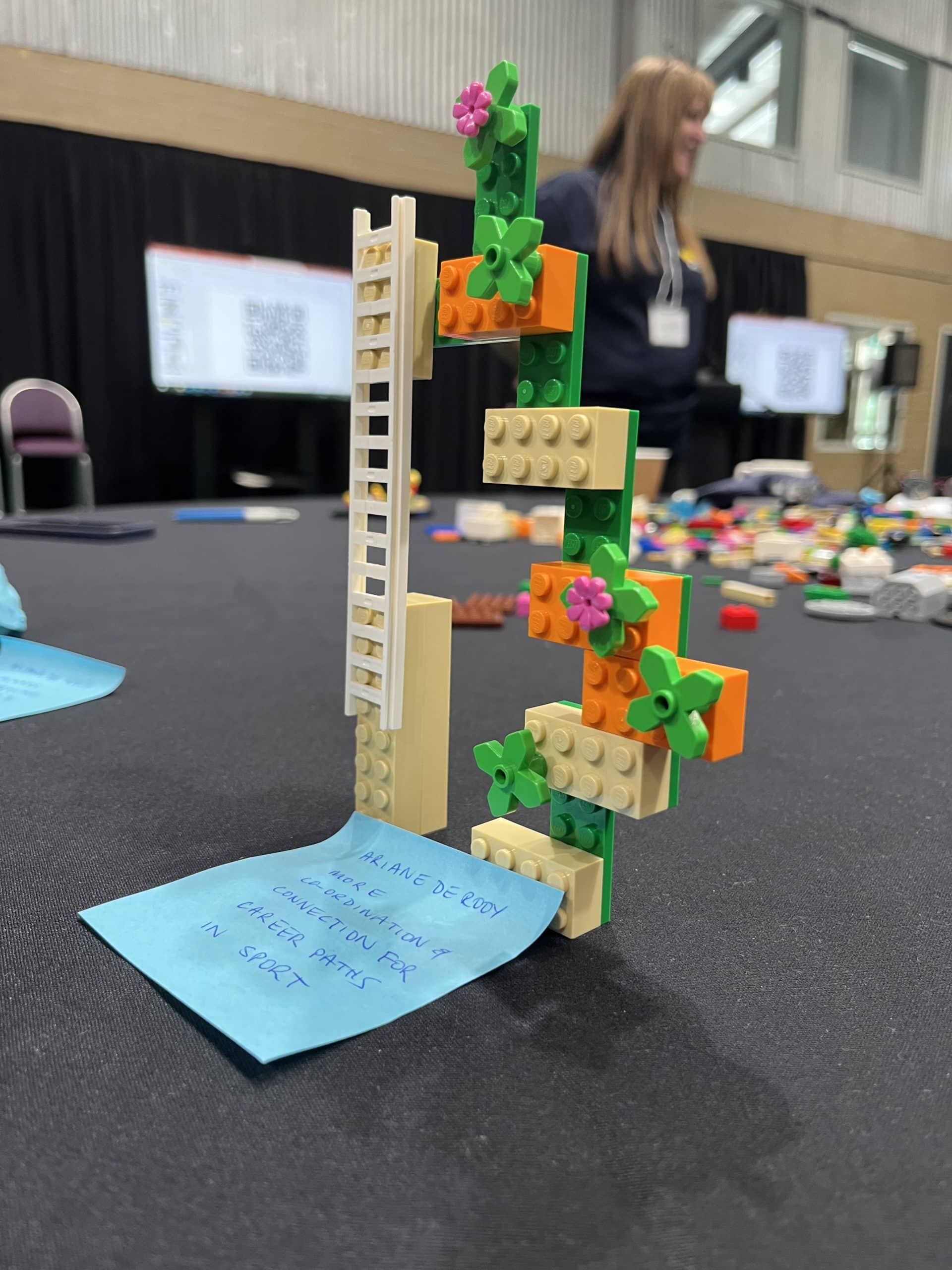
Image: Australian Institute of Sport
With what issues does Lego Serious Play work best?
LÓC: Questions that need creative answers. These are typically around vision, strategy, culture, values, UX design, innovation, team development. What’s exciting now is how people are taking this to their own environments and applying their owns skills to enhance it. It unlocks the creative thinking of the wisdom in the room.
What is a good type of question to ask?
LÓC: High-ceiling, low-threshold questions – future-focused questions where everyone has an answer and can contribute. I use an assets-based approach so I will often frame the question in a positive way. My approach is to understand what their challenge is currently and also what they may have tried previously. The flow of a session builds to a bigger question but all the steps on the way contribute to the momentum of a session.
How does that look in practice?
LÓC: For example, one technical director asked: ‘how do we get the best out of each other?’. Their team was new and had few opportunities to be in the room together. So there was a bit of ‘who am I and what am I about? What do I care about and what are my values? What makes me tick?’ All of that came out in a three-minute build that we did and they started talking about that. Then we said ‘think of a time when you’ve been part of a really successful team – what did it look like? What did it feel like? What helped you to be your best in that team and what are some of the things that you bring to that team that no one else can bring?’ Lots of stuff came out and then they were then able to talk about ‘what are the things that are common? What are the things that are different? How do we get to those next steps for what we want to build?’ And they’ll continue that conversation long after I’m gone. But it just kind of gave them a primer rather than just coming in and asking ‘what are your values?’ and they look at their logo or their crest and start talking about whatever had been written down by corporate leadership a couple of years ago. They asked of themselves: ‘what are our behaviours? What does that look like? How do we want the players to experience us as a coaching team as well?’

Image: Australian Institute of Sport
Can you outline the science behind Lego Serious Play?
LÓC: I learned from [Lego Serious Play expert] Michael Fearne – who trained me – there are sound scientific principles underpinning the use of Lego in engaging people, changing the conversation and solving complex problems. The way building something with your hands unlocks knowledge you didn’t know you had. There is also the joy and productivity of getting into a flow experience. There is safety in talking about issues through a model rather than the usual business/power dynamic. For example, we might have an idea and we try to make sense of it, but when you put something physical out into the world and you and I can look at it together and say ‘well, what do you see? What do I see? Let’s turn it around and look at it from another side’. We see very different things. And then the flow piece is fascinating with sportspeople because of the connection between the hand and the brain. When you’ve got a big pile of Lego in front of you and your hands are like another search engine for your brain. So you start pulling out stuff that you didn’t even know was there. With my HP hat on – in simple terms, it works!
How might that emerge during a session?
LÓC: So I go back to our orange brick. One coach used an odd orange brick in a model and I asked them about it. They said: ‘Oh… that’s the fire in my belly and that’s why it’s in the middle. My grandad was the first person who brought me to a game. That’s where I got the fire and I take that wherever I go and I think about how important it is to pass that on to the next generation of kids’. That was just a little brick, just the colour, that didn’t look like anything but the fact that we had a quick conversation about it; and the meaning that somebody had put into that brick was really powerful. These stories come up and the power of storytelling resonates here in Australia, where that storytelling tradition is really strong. And I feel like sportspeople just love a good yarn.
How does a second or third session differ from a first?
LÓC: We can get to more complex questions more quickly using different skills, such as rapid builds or you can build with no question or instructions. Then I hand them a Post-It with a theme to explain using the model they built. With the skills warmed up we can tackle system issues or stakeholder maps – the truly complex environment that HP Sport operates in.
How do you encourage introverts or those less likely to talk to actually speak up?
LÓC: I make sure that we let people know that they only have to share what they want to and I also put caps on time. With curious questioning lots of people start to share more. Best of all is that others in the room model the sharing and it gets the rest of the group going. The design of the first hour is all about warming up to get to better sharing – we don’t jump in at the deep end. In my research as part of my Professional Doctorate in Elite Performance at Dublin City University I am also looking more closely at how Lego Serious Play builds the behaviours that contribute to psychological safety.
How do you know when to stop digging with a person? What are the signs to move on to the next person?
LÓC: We put time limits to ensure that we don’t get one person dominating the conversation but I also invite the group to question the model and be curious about it. Often I do very little talking. At the top of the session I make sure that people know that they only have to share what they are comfortable with. The time limit helps with those who are more sceptical too – they get time to warm up to the method and once others share their stories you find the sceptics start to join in. This is also part of the power of Lego Serious Play – it flattens the hierarchy – no one is more expert in your own story and model than you, but you invite others in to see and share your inner world. That demonstrates courage and vulnerability.
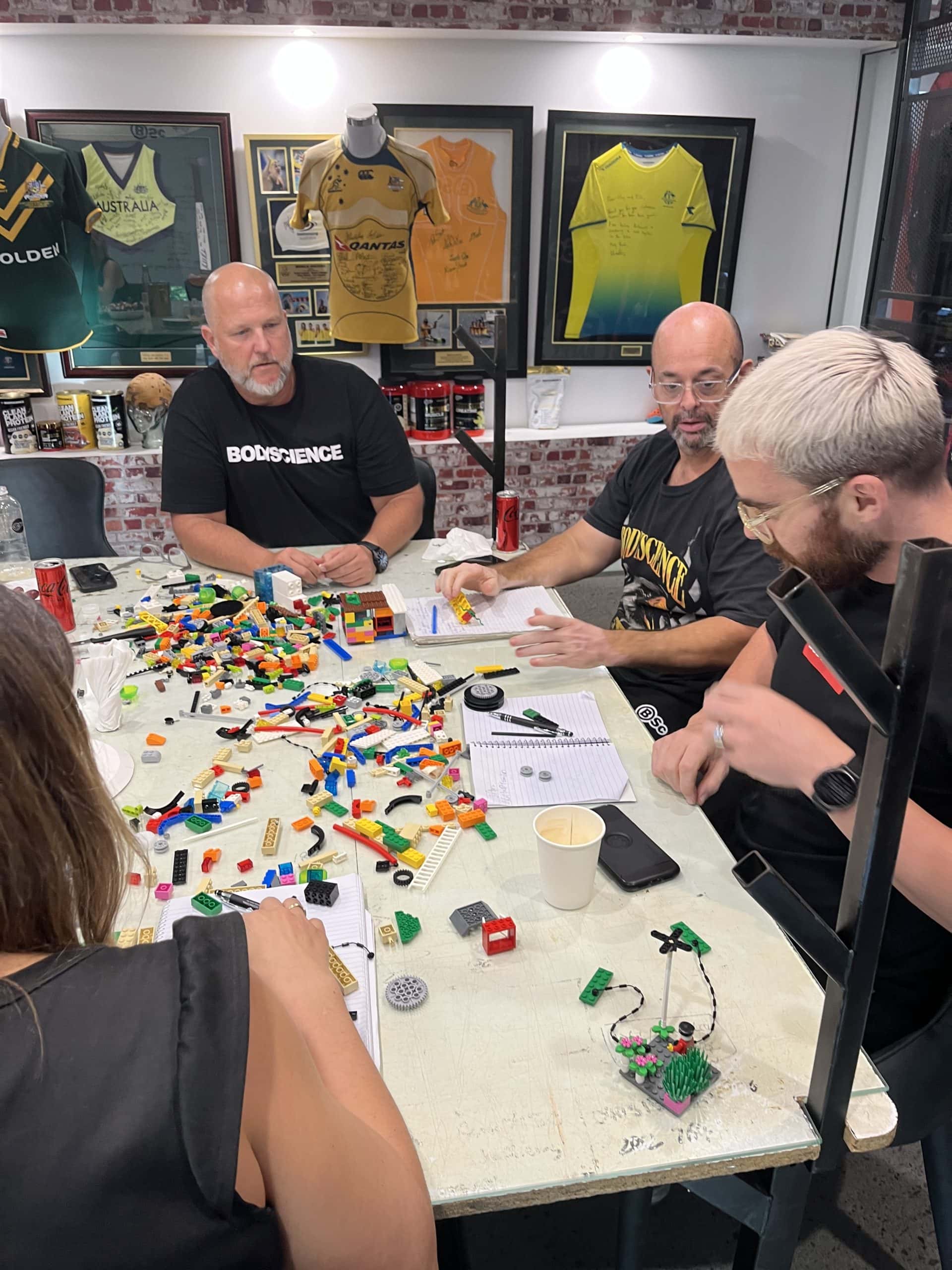
Image: Australian Institute of Sport
You said you take pictures. What are you trying to capture?
LÓC: I’m documenting the experience, summarising insights and generating artefacts that can continue to be used long after the session ends. We are also encouraging people to reflect on and retrieve what they have learned. Also, each model is broken down after it is built – so you are constantly breaking down the models to build something new. It also allows me to be fully present in the room and the conversation.
Do you take notes along the way?
LÓC: Honestly, very few. My job is to continue to facilitate the flow of the conversation so that the participants are producing the questions. This is another reason why the live feed on Padlet is important. By the end of the session the group will produce some simple guiding principles to apply going forward.
Do you prefer to be well-versed in the sport or team?
LÓC: I like to have some background and context of the room I am walking into – where does the session fit in for them, what kind of headspace are they in? I don’t want to have preconceived notions about the group or the outcome. As a former athlete, coach and High Performance Director myself, I’m cautious about what I introduce to an environment.
How do you work with leaders to give them the skills to host sessions of their own?
LÓC: I’m doing a large amount of Lego Serious Play facilitator training now. It can be nerve-racking to lead a session with your own team so I’m currently building a community of practitioners who I train. They are very supportive of each other and help to design sessions for each other. I am excited to see how others apply LSP, especially in situations like 1-to-1 wellbeing or coaching sessions. Everyone will come up with their own way of applying this to solve their challenges.

18 Jan 2023
ArticlesThe Leaders Performance Institute highlights six areas in the EPPP’s ten-year review.
The EPPP was launched in 2012 to overhaul the English boys academy system and ensure the development of a higher quantity – and better quality – of ‘home grown’ players at a time when English talent pathways were widely considered to be lagging behind their counterparts in nations such as France, Germany and Spain. The EPPP was adopted across the academies of the English men’s football pyramid from the Premier League to League 2.
Today, the top line numbers released by the Premier League, FA and EFL indicate that the EPPP has had a positive impact. For example, there are 762 more academy graduates with professional contracts in the English leagues than there were during the 2012-13 season. There has also been progress at international level, where the England youth and senior men’s teams have enjoyed considerable success in recent years. The EPPP faces the constant challenge of trying to satisfy all its stakeholders, but English football is better at transitioning home-grown talent than it was in 2012.
The plan is overseen by the Premier League’s Director of Football Neil Saunders, who spoke about the progress made in the last decade at the 2022 Leaders Sport Performance Summit at London’s Twickenham Stadium.
Saunders’ appearance came shortly after the publication of the EPPP’s first 10-year review and, here, the Leaders Performance Institute highlights six ways in which the initiative seeks to address some of our members’ most pressing concerns around talent pathways and player evaluation.
What are the best predictors of success in youth and academy football? No club or organisation claims to have all the answers, but the EPPP has been designed to maximise the opportunity for those who enter talent pathways from under-nine and upwards. The approach is based on the Four Corner Model for long-term player development. The ‘four corners’ – technical, psychological, physical and social – were applied to the FA’s Future Game Plan in 2010, which according to the EPPP review, ‘has been adapted and tailored by each club according to their own playing and coaching philosophy.’ All clubs have developed an Academy Performance Plan in line with its vision, philosophy and strategy. These Academy Performance Plans also integrate ‘core programmes of the EPPP, such as: education, games programme, coaching, and performance support.’
In the discourse around talent pathways, some have bemoaned the fact that coaches have not always been credited for their inherent expertise, that they are too readily dismissed for not being objective. The EPPP works at a systemic level to underline the value placed in coaches and, since its inception, there has been an increase of approximately 50% in the number of coaching hours available to young players at English clubs. ‘Changes to the coaching offer since the EPPP have been led by three key factors,’ says the review. The first is ‘quality’. The EPPP set standards that focused on elements such as ‘different aspects of the game as a player progresses, including age-specific coaching and coaches.’ Then there is ‘access’, which is where the EPPP tried to bring coaching hours ‘in line with leading practices across multiple sports and disciplines’. Finally, the question of ‘development’, which is the effort to offer coaches ‘new individualised programmes and qualification requirements, tailored to each phase and Academy category.’
Through the aforementioned Academy Performance Plans, the EPPP enables multidisciplinary player profiling. ‘Performance support staff work closely with other key Academy staff groups to aid and inform player identification, development, and transition along the pathway,’ the review says. ‘Academies have increasingly taken an integrated and holistic approach to delivering individual programmes, tailored for age and stage of a player’s development’. ‘Generally, [the EPPP] has led to more informed discussions and a genuine appreciation of the capacity an individual player can express given the physical and mental limitations imposed by their stage of development,’ wrote Edd Vahid, the Head of Academy Operations at the Premier League – and Leaders Performance Advisor – in 2021 while still working at Southampton’s academy.
The fear of biases undermining decision-making in talent development and evaluation is universal. For its part, the EPPP has taken steps to abate the effects of relative age effect. ‘As a global phenomenon,’ says the review, ‘a higher proportion of boys in the Academy system are born in the first quarter of the academic year’. The system has organised festivals for children born towards the end of the academic year, but ‘analysis has shown that this bias does not necessarily translate to the likelihood to succeed in the professional game’. Indeed, the provisions of the EPPP understand that the transition to senior football is not one-size-fits-all, that player journeys are unique.
There are, however, three broad player ‘archetypes’ found across English football, according to the review. First is the ‘fast-tracked’ player, such as Liverpool’s Trent Alexander-Arnold, who broke into the senior team as a 19-year-old; second is the ‘focused development’ player, such as Harvey Barnes of Leicester City, who took targeted loans (temporary transferral of his registration from his parent club to a loan club) before making his Premier League debut; third is the ‘tiered progression’ player, such as Aston Villa’s Ollie Watkins, who had extensive lower league experience (including some targeted loans) before making his Premier League debut at 25.
There is also the question of underrepresentation of players with Asian backgrounds in the academies of English football. During the 2021-22 season, and within the auspices of the EPPP, the South Asian Action Plan was launched in partnership with the anti-racism football charity Kick It Out. Says the review: ‘It aims to ensure that every player has the opportunity to achieve their potential in football through the delivery of research, staff training and Emerging Talent Festivals focused on equal access and improving pathways through the Academy system.’ It states that 648 players attended an Emerging Talent Festival during the 2021-22 season and there has been a more than 60% increase in academy scholars from black, Asian, mixed and other backgrounds in the last ten seasons. There is, however, much work still to be done on that front.
The EPPP provides a uniform structure to academies, who then issue players with bespoke individual development plans (IDPs). IDPs are useful for assessing how a player is developing against the principles set out on an academy’s talent pathway. The resulting contrasts can often validate the methods being used, one of which is self-reflection. IDPs provide the space for players to self-reflect with increasing emphasis as they progress along the pathway. The review says IDPs aim ‘to be aspirational and provide the right level of challenge to encourage the individual to maximise their potential as a player and as a person’.
Teams also place an emphasis on player and team analysis. ‘Academy players fully understand the demands of the game, with a deliberate focus on performance analysis education to equip them with the skillset to drive their own development, underpinned with a unique club philosophy and data-driven approach.’
The EPPP also supports a player’s academic progression and seeks to provide both life skills and what the review terms ‘life-enriching experiences’. According to the review, more than 20,000 players have attended the academy life skills and personal development programme since its introduction.
As for coaches on the EPPP, they are invited to join a ‘community of learning’ as part of English football’s Integrated Coaching Strategy, which is ‘a multi-stakeholder partnership to deliver and sustain world-leading coach and manager education, development and career pathways across English Men’s and Women’s professional football.’
During its ten-year existence, the EPPP has never stood still. Tweaks have been made across the board, whether it’s the academy games programme, which was redesigned and enhanced during the 2013-14 season or the creation of the Professional Game Academy Audit Company, between 2018-19 and 2020-21, which provides ‘an independent and comprehensive audit of rules and standards to clubs.’ Competition rules will continually be updated, new processes introduced, and priority areas identified.
Don Barrell of the RFU sets out six essentials as they are viewed in English rugby union.
Experience is everything
Are you creating an environment where everyone – athletes and their parents or guardians – wants to be? Don Barrell, the Head of Performance Programmes & Pathways at the Rugby Football Union [RFU], believes it is essential. He told the Leaders Performance Institute in 2021 that, “If your primary driver is the quality of experience that people have, both the player and all the surrounding stakeholders, you can create a model where people want to be there and choose to come into your programme as opposed to others and that’s where we’ve positioned our programme.”
Establish age-specific priorities
A smart talent pathway recognises that what an athlete needs as a teenager is not necessarily what an athlete needs at 25. “The whole purpose of it is that you’ve got two or three years to look at players and for them to be nurtured and developed; go through puberty, grow, change, held by some really core principles,” said Barrell. “One of the big challenges is when the top of the game says it needs A, B and C – at 14 that will look very different and we probably don’t need to see A, B and C, we may just focus on one thing.”
Stick to your guns
Being aware of best practice is one thing, but once you have established your guiding principles, stick to them. Barrell said: “If you keep compromising because someone else will do ‘something’ and you feel the need to react then you’ll end up with six-year-olds in academies as everyone races to the bottom. We have set a clear line based on solid evidence and practice.”
Ask: who is the athletes’ main point of contact?
Talent pathways at club and international level are inevitably different in English rugby union and Barrell was keen to avoid stepping on the toes of the clubs with whom the RFU works. “The whole myth of age-grade international programmes – and I’m not trying to talk myself out of a job here – the majority of contact is at the school, club, academy. Pre-18, it is not with an international programme. Age 18-20, it’s still not with an international programme – 80 percent of your contact is still within your club,” he said. “The international programme’s job is to add value to the journey and act as a critical friend to the clubs, working with them to develop the players. We have excellent people who work with the academies and schools to help shape practice.”
Employ both specialists and agitators
Any talent pathway needs its specialist coaches who are happy to work at academy level. “If we want world class development systems then we need to reward those world class practitioners who want to specialise with young athletes. Having your most knowledgeable people working in the pathway, a good pathway will make your senior teams better and add huge value,” said Barrell. “You will always have some coaches that want to go in and progress to a senior role. That’s fine, but I’d suggest if you’re running the system, you need to understand how many of those you’ve got versus how many people you can install who want to stay in development.”
Temper the input of senior coaches
Beware the input of the senior coach. “One big challenge you find across all sports is the idea that senior coaches have all the answers the whole way through,” said Barrell. “Senior coaches often specialise for the here and now, ‘how do we win this weekend?’ Bringing expertise at the top end of the game is critical, as this is where our players end up, but is it always right for the developing player?; the same way I don’t need my primary school kids being taught by a university lecturer.”
This recent Leaders Virtual Roundtable sought to develop Leaders Performance Institute members’ thinking around these ever-pressing topics.
Recommended reading
How Do you Ensure you Are Giving Talent the Time to Hit your Performance Metrics?
Why Are The Red Bull Soccer Teams So Good at Talent Identification?
The Importance of Diversity in the Decision-Making Processes Around Talent ID and Development
Framing the topic
Understanding what talent is now versus future potential is a constant question within much of our membership here within the Leaders Performance Institute. Therefore, within this topic-led roundtable discussion we wanted to delve into our members’ current thinking around player evaluation and talent identification, as well as how they are looking to develop this further in practice.
Due to the popularity of the topic, we split the group into two to cover more of the detail.
Group 1:
Group 2:
Ken Lynch of Australian Sailing explains that efficiencies come from understanding the numerous factors behind what it takes to win.
“Not everybody will fit into ‘the box’ and there are many out there that comment negatively on sport ‘pathways’,” he tells the Leaders Performance Institute.
“While the term ‘pathways’ can be off-putting, looking beyond the concept and understanding that many sports are producing pathways that represent the many but are tolerant of the few is important. Getting clear on what ‘good’ looks like enables you to achieve this flexibility and offer time and resource to those with potential who may not quite fit the mould.”
Lynch argues that rigid, linear pathways are unlikely to be fit for purpose as a guide or for use as a selection tool. “Most performance pathways I have worked with are considerate of non-linear progression,” he adds. “They give athletes room to fail and learn and work with other athletes over extended periods to better understand athlete potential and how they respond to the various stimuli provided within the parameters of any well designed and applied framework.”
Can a performance model sustain both linear and non-linear progression? “I think that it has to if sustainable, repeatable success is the goal,” says Lynch, who explains that efficiencies come from an accurate understanding of the numerous factors behind what it takes to win.
“There are plenty of elements that contribute to sustainability that require attention and minimal resource to have impact in the first instance. For example, how are you succession planning your coach pool? How are you testing who has potential while adding capacity to your coach workforce?
“Many of these things can be achieved utilising existing platforms and, with the addition of a small level of investment, can become a significant contributor to your program. Even something as simple as how you treat your people can significantly increase the value proposition of being involved with your sport for no additional investment.”
This is the second of two instalments in which Lynch, a former teacher who has worked at sports organisations including the Irish Institute of Sport and High Performance Sport New Zealand [HPSNZ], discusses the space given to talent pathways in sport.
The first half of our interview explored long and short-term planning, as well as the need to be evidence-based in your practice and, in this second half, Lynch reflects on the need for patience and the need to ensure staff and athletes have ready support.
How important is patience in high performance and how can a performance manager buy themselves more time?
KL: Patience is extremely important in high-performance. When we think about how long it takes an athlete to achieve the required level to deliver an Olympic medal-winning performance or how long it took their coach to learn their trade, we start to understand the importance of patience and sustained, consistent support to be able to deliver these types of moments. The ‘flow’ of a system (insert link to part one) should see the right number of athletes and coaches on the right trajectory at the various phases of the High Performance [HP] pathway. Gaps in that athlete or coach population risk the ability to deliver the required consistency and performances over more than one athlete generation. This type of view and thinking should enable a system to identify and fill these gaps early and minimise the associated risks. Milestone targets and markers can support informing stakeholders and giving confidence that interventions are having an impact and that the progress towards pinnacle goals is on track.
How can you ensure that everyone is onboard when it comes to supporting your pathway?
KL: Building capability and effective system leadership takes time. When I arrived at HPSNZ there were three leaders in sports tasked with managing HP Pathways. Minimal direct investment into that area of the system required us to generate understanding in the value of the space to sustainability. Post generating understanding, we needed to build capacity and then develop capability. The system supported this movement by including HP Athlete Development as part of the annual review process, emphasising that demonstrating future potential was an important part of the investment process. Having people in various sports waking up in their sport every day thinking about development was a huge advantage – much better than an external probe or support dropping in periodically. These types of pathway roles are quite new to Olympic and Paralympic sport so the learning curve for many was quite steep. Very soon people shifted from managing the space to leading and driving it. This was a real turning point for many sports but it took six to eight years of consistent attention to achieve that. Rome wasn’t built in a day, but a lot of it still remains – not a bad effort!
What did you learn from that experience in New Zealand, where you worked for eight years?
KL: The learnings suggest that patience is required, as I believe it is, but there were many times in that six to eight years where we tried to move things a little too quickly or moved too far away from the capability build to be useful. Having built honest working relationships with those leaders their feedback helped us realign and move at a pace that was more appropriate. Bringing them with us was what enabled its success and was a good reminder to me around understanding tolerable pace and the intensity of leadership and support.
Surely tensions can emerge when the message is to be patient?
KL: It requires constant attention. Consider the markers that you lay down around the progression of something for the future. It’s important to be able to show progression. When you write a strategy across three cycles, the first four years of the cycle should see you working on all three strands:
All three areas of work should carry milestone markers and enabling the reporting of progress across each of them. Each will have projected targets to project against to understand how athletes and coaches are tracking against future performance targets rather than what it will take to deliver a performance in this cycle only. Previously, and perhaps currently in some systems or sports, perhaps those with less resource, only focus or can only focus on the current cycle and don’t turn their attention to the next one until they get to it.
How and in what ways can a performance manager support their staff?
KL: Another part of that constant, which I probably didn’t do in New Zealand well enough, is to continue to reiterate people’s understanding or support people’s understanding of the value and importance of what next cycle thinking is. Highlighting the progression so that people can see we’re having an impact and retain the interest and motivation to continue to support sustainability and the value of those with roles in this space. Most people are attracted up. Coaches are thinking: ‘how can I coach at the Olympics?’ Service providers may be thinking: ‘how can I work with the best athletes?’ There’s not many people in the world that place themselves in the high performance development space going ‘this is me. I don’t actually want to go up there. This is where my expertise is, this is where I can really deliver, this is where I can make a difference.’ Some that have lived in the ‘current cycle’ space have arrived at: ‘I’m better suited here, at this level.’ I think it requires a bit of system experience and guidance from people who lead in shepherding those with a real ability at this level to see their value to the system, the future and the repeatability of success. Quality professional development opportunities, effective planning and honest conversations are key ingredients to supporting coaches to realise their potential regardless of the level. The next step is ensuring we value and promote the work they do to highlight the important role they play in the system. These roles are critical to sustainability and have often been the forgotten ones in the past. Let’s value these people and these roles as they become a more prominent and important part of their sports.