The last in a series of three articles exploring the growth of digital scouting in global soccer.

This story is part of our series on digital scouting. This piece, the conclusion to our soccer series, looks at the new sets of metrics available to coaches and scouts. You can read Part 1 on the growth of digital video here and Part 2 on how access to physical data has improved here.
But there was a problem. Just two weeks after implementing the shoe-worn sensors, Fulham called Playermaker and said, “Your data is not reliable. It’s bad data.”
Someone from Playermaker’s team paid the club a visit where the Fulham coaches conceded that the day was “generally okay but look at this player: it’s abnormal. There’s no way he has so many touches and that he’s dribbling like this.”
“We’re looking at this, and the data is legit,” recalls CEO Guy Aharon of 16-year-old Harvey Elliott’s preternatural ball handling. “And he became the youngest player ever to play a Premier League game.”

Harvey Elliott’s impressive data from Playermaker’s shoe-worn sensors was initially thought to be a glitch.
The world of soccer data is evolving rapidly thanks to the proliferation of digital video, the growing accessibility of physical data inputs and now the introduction new devices and datapoints. Sensors such as Playermaker—which proffer physical data and, in a first, also metrics evaluating technical skills—are gaining a foothold in the scouting process, even if there’s a requisite learning curve to make sense of this new information.
Other new areas of information gathering include analysis of biomechanics using only smartphone cameras from AiScout and JuniStat, the democratized collection of physical data from SkillCorner and Track160, and the application of advanced algorithms to assess a player’s fit in varying tactical styles from SmarterScout and StatsBomb. Even the evaluation of the evaluators is being considered by thoughtful organizations such as 360 Scouting.
Players are getting more control of and context from their data from apps like BreakAway Data, which seeks to help prospects gain commensurate scouting interest for their talent. Presenting more true markers of talent helps minimize the need for multimedia skills in crafting highlight reels in hopes it reaches the right evaluator.
“Contrasting those is a very manual process, and making yourself stand out is based on selecting some good clips and being lucky if the right person looks at it,” says Ben Smith, Chelsea Football Club’s Head of Research and Innovation who also heads BreakAway’s international business. “But data has the ability to genuinely actually contrast you to people in a way that gives you, I think, a much higher percentage opportunity of actually being seen because it’s a marker of talent, rather than creativity in how you put together a CV or a visualization of who you are.”
Global soccer already suffers from the chasm between the haves and have-nots financially, but the gulf between clubs using advanced methods of scouting will contribute to the talent gap. The existence of scouting innovation doesn’t necessarily mean widespread adoption.
“People would be shocked if they saw the behind the scenes of Europe in terms of the way these clubs are run, not just from an operational standpoint, but from a sophistication,” says Jordan Gardner, Co-Owner and Managing Partner of Denmark’s FC Helsingør as well as an investor in England’s Swansea City and Ireland’s Dundalk FC. “So many decisions on recruitment are still made like, ‘I’m gonna go call my buddy, who’s an agent.’”
* * * * *
Every year, the Reliance Foundation Young Champs, a five-star residential soccer academy in Navi Mumbai, scours India for the best 12 year-old players, offering them five-year scholarships to live and train at the academy. It’s a multi-pronged process of scouting trials all culminating in what’s a life-changing opportunity. Nine of the 10 players in its first graduating class two years ago received contracts to play professionally in the Indian Super League.
When the pandemic struck, however, RFYC had no ability to go see any young players in action. It sought help from a small London-based startup, AiScout, which uses Intel’s 3D Athlete Tracking computer vision technology to assess the physical movements of players.
From May to December, RFYC invited youth players to complete drills through the AiScout app. That helped whittle down the player pool to 400 who were invited to a regional trial. Eventually, the academy signed 19 players; AiScout was not the sole factor, of course, but 16 had participated in the virtual trials.
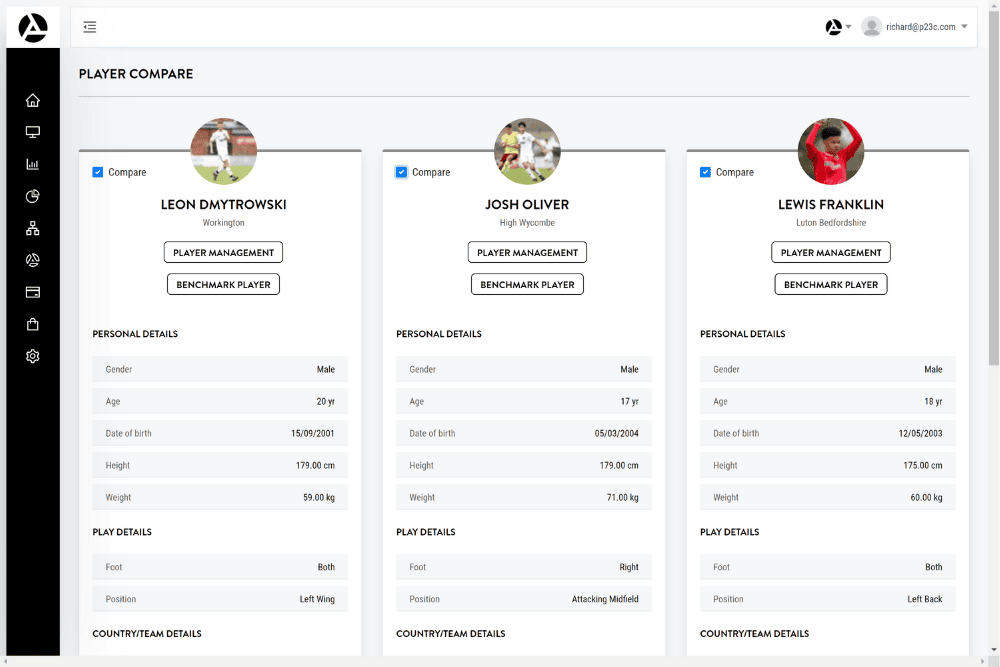
AiSCOUT is an AI-based platform that pro clubs are using to scout and develop amateur players based on uploaded data.
“Reliance Foundation actually found four players that weren’t even playing organized football,” says Richard Felton-Thomas, AiScout’s COO and Director of Sport Science. “They were just in rural areas, so scouts wouldn’t naturally find those anyways. That was a great test for the mobile phone as a system.”
The genesis of the app can be traced to the experience of Founder and CEO Darren Peries. After his son was cut from Tottenham’s academy, scouts from other clubs began calling him for more information. Peries had nothing to share outside a few mobile phone videos of varying quality.
“It just baffled him: here was a multi-billion pound industry,” Felton-Thomas says. “How can we sign a player for 100 million at 21 years old when, if they’re 18 or less, we’ve got almost next to nothing on them?”
Digital video was growing more available, but its analysis can be hindered when there’s limited information about the opponent and the level of competition. AiScout, a member of FIFA’s innovation program, entered as a source of objective data by tracking 21 points on the body, benchmarking the abilities of players at every level and every league and computing a National Rating Score.
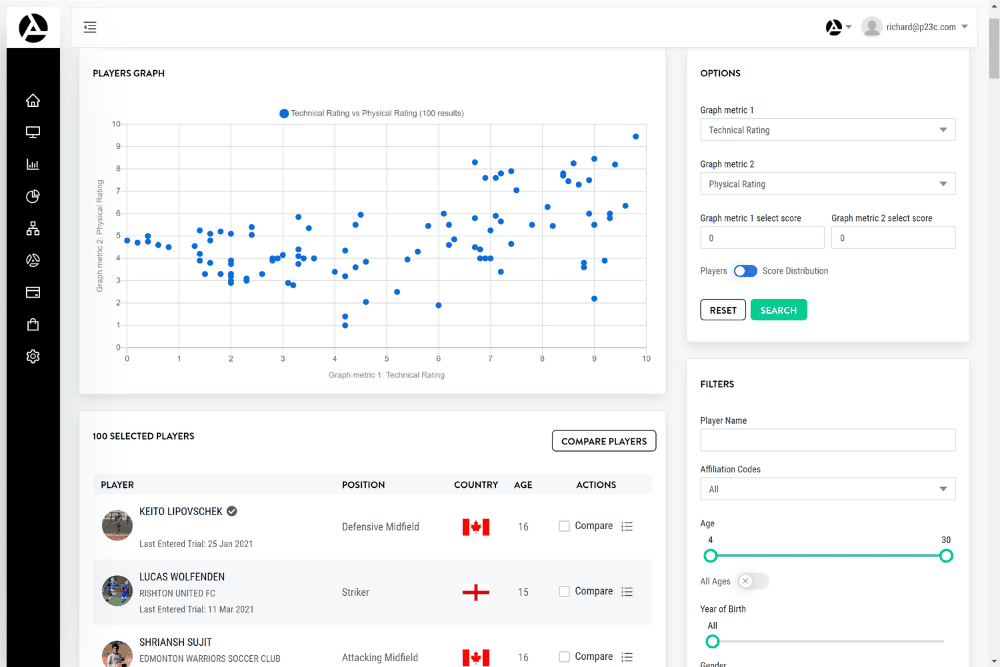
Amateur players can upload videos and data to trial for a Premier League club.
Two Premier League Clubs, Burnley and Chelsea, have been involved as early partners. Just as Tonsser began assembling showcase teams based on user-submitted videos, AiScout used its data to select 24 players to compete against Burnley’s U18 academy team; the game ended in a 2-2 draw. An additional four players were deemed exceptional and invited for weeklong trials at Burnley. Across the entire soccer ecosystem, more than 20,000 users have submitted information to AiScout with 64 players who have been trialed, signed or recruited.
“The nature of talent development can be a bit random,” says Chelsea’s Smith. “So if we can have a technology to work at scale across vast areas, then that our scope and our reach is potentially very substantial.”
JuniStat is a Russian-founded app now based in the US and Chile that seeks to do the same, with a user base of 40,000 users, mostly from Eastern Europe and Latin America with a strong growth market in Africa. Co-founder Gleb Shaportov says there are now 21 pro clubs using the app with most of the players between the ages of 10 and 15.
Shaportov says JuniStat validated its technology with the Russian Football Union and has started the process of doing the same with Fifa this fall. “Directly from the smartphone, we can detect the skeleton of the player, and based on thousands of kids of the same age in our database, we are immediately tracking their performance. We get complex raw data from them, we analyze it and then we present the results to the user in an easy to understand and usable way.”
AiScout is working to create a mobile performance lab with additional technologies to gather physical data and is working with Chelsea as an R&D partner on cognitive testing and psychometric awareness. “Attention, spatial awareness, vision, or speed of processing—these types of things that you can, let’s say, ‘footballize,’” Felton-Thomas says.
The AiScout app is free for players, while scouts and clubs subscribe for access. Felton-Thomas says the mission is to create “an access-for-all, objective approach to talent identification,” no matter one’s hometown or finances. Results in the app can help secure a tryout or invitation to a showcase. “You’re going to have to prove yourself from there,” he says, “but we can get that visibility.”
* * * * *
Thiago Almada began playing for a local soccer club in his native Argentina at age four. He made his professional debut at age 16. By the time he was 18, in March 2020, and starting for Vélez Sarsfield, an AI-powered service called SmarterScout had flagged his Premier League potential, noting his skills in retaining the ball, winning ground duels and scoring.
Interest from major European powers in the Premier League, LaLiga and Ligue 1 all followed, with Manchester United and Manchester City among those reportedly in hottest pursuit. Almada instead opted for Atlanta United, signing for an MLS-record $16 million transfer fee.
A similar trajectory followed Almada’s countryman Julián Álvarez, whose performance at River Plate drew attention from the SmarterScout platform and later preceded a move to Man City. His data drew a “pretty stunning” resemblance to that of superstar Kevin de Bruyne and, the analysis concludes, “why Alvarez may be a better fit in the Premier League—and especially at Manchester City—than his physical attributes might suggest.”
SmarterScout is the work of Daniel Altman, a Harvard-educated economist who has been a soccer analytics consultant for Premier League and MLS clubs. The fully-automated platform ingests event data from 60 global leagues, enriches them algorithmically and then evaluates how well a player would fit in another league.
This type of data application is showing dividends at all levels of the sport. Popular analytics provider StatsBomb has more than 150 client clubs from the Champions League on down to the fifth division of English soccer—but it has fewer clients at the lower level than before.
Last season, three of the four clubs in England’s fourth division, League Two, to achieve promotion to League One were all clients of StatsBomb. A fourth team reached the playoffs but narrowly failed to advance.
“We were told at some point that that would never happen: it’s too far down, they won’t want to spend budget on that,” StatsBomb Founder Ted Knutson says. “And obviously I’m a CEO and I’m a salesperson of this stuff, but the fact is, that surprised me.”
From those clubs on up to the Champions League clients, everyone receives the same data. “They get offered the same stuff,” Knutson says. “It’s a bit of a democratization of data science.” StatsBomb’s platform helps to make bespoke additions to a roster, helping avoid what Knutson has described as clubs building a “Frankenstein monster of a squad.”
He adds, “It’s not just counting numbers of how many tackles did this person make: ‘Are they positionally correct on a regular basis? Are they used to playing in a high line because we need guys that are comfortable in our tactical system that we’re definitely not going to change? We have this manager for another three years—we really like him—so we want a center back that fits in with him, as opposed to us going out and finding what we thought is the best center back in the market.’”
Firms like SmarterScout and StatsBomb are building on top of event data, a record of key moments in the match that are typically relegated to what happens around the ball: shots, passes, tackles and so forth. The tracking data that encompasses player speeds and distances is much harder to come by, which is where SkillCorner has found a niche extracting that dataset from broadcast.
“We’re still very much at the top end at the moment, but we have a lot of interest coming from academies,” SkillCorner GM Paul Neilson says. “The challenge when you get to that part of the market is the way that the video is filmed, the way it’s captured, the way it’s shot, is inconsistent compared to the professional level. Once you get into the academy structure, the position of the cameras, the vertical height, the horizontal distance from the field, the type of the cameras—is it manual operator or is it going to be smart cameras, Pixellot or Veo or Spiideo? And it’s just so much variation.”
SkillCorner is working on adapting its algorithms to meet that need while also teasing an evolution in analysis that will eclipse that information. Neilson says his team is developing its own set of next-level analytics to quantify defensive pressure on the ball, field awareness, the ability to find open space and more.
“To be honest, this is more important than physical data, because this is really about gaining intelligence and decision making,” Neilson says. “It’s not just the legs and how much they run. It’s the brain behind the athlete as well. And I think this potentially is the next big breakthrough for scouting and recruitment.”
* * * * *
A decade ago, Marco van der Heide was an attacking midfielder for Cambuur, which at the time competed in Netherlands’ second division. Over parts of two seasons, van der Heide scored four goals in 16 matches, but a bad concussion prematurely ended his professional career.
When he had recovered, Cambuur hired van der Heide as a video scout, specializing in opposition analysis. The head coach then joined the staff at AZ Alkmaar—best known in the US as the club Oakland A’s executive Billy Beane has advised and invested in—and brought his former player with him.
On the side, van der Heide began collaborating with Sander IJtsma, a surgeon by day and proprietor of data-driven soccer analysis site 11tegen11 by night. Their video and data skills were a good combination but, noting the demands of IJtsma’s occupation and his interest in growing more quickly, van der Heide started his own video scouting company, 360 Scouting. And he set out to change the way the industry hires its evaluators.
“A lot of clubs still, very strangely, select scouts for their club because most of the times they are players who used to play at the club,” van der Heide says. “This is how I came in at Cambuur as a video analyst, but after that, I also showed that I had the required quality. But I wouldn’t have had this opportunity if I wouldn’t have played the club—which is good for me, but actually kind of weird because they should be selecting just on quality.”
To build out his startup—which currently has two clients, Cambuur and a Champions League participant he’s unable to divulge—van der Heide developed an application that explicitly told candidates that there was no need to send a résumé or cover letter. All that mattered was completing a video assessment. Initially, 350 applied, which got trimmed to 50 for a second assessment.
“Then there was the moment to ask them who they are, which age they are, et cetera,” van der Heide says. Among the six he eventually hired after eliminating the noise and bias of the process were a 41-year-old teacher and father of two and an 18-year-old student.
360 Scouting is now beginning to pivot from consultancy to platform. Van der Heide has continued his hiring practices to find local scouts who can do video and live scouting in four leagues this season: Poland, 2.Bundesliga, LaLiga 2 and the Eerste Divisie, the second division in the Netherlands. He hopes to grow to 50 leagues within three years using a network of quality, local scouts even if many are hobbyists.
“If clubs are finding people to scout players, then they’re also looking for undervalued talent,” van der Heide says. “So why wouldn’t they apply the same intention to finding the scouts themselves?”
* * * * *
Even when a club is willing to invest in data, it needs requisite patience in the process, too. Gardner, the owner of FC Helsingør in the Danish second division, says the minimum timeline for seeing improvement is two to three years. That was especially true at the club he purchased, which he described as having “basically no scouting infrastructure at all.”
“What’s interesting in the European soccer space is, with the promotion and relegation system, you can have an organization that is like a Single A baseball or even a summer league baseball team, and you have a couple of good years, and all of a sudden you’re in the majors,” Gardner says. “The infrastructure and the way the club runs is doesn’t catch up fast enough.”
Making the use of data more accessible could ease that prospect. For now, data analysts are still typically required to mine spreadsheets to find value. Bringing it within the realm of a coach’s expertise is an essential next step.
“Data, certainly across football, is making an interesting transition where it’s getting closer to performance and so performance practitioners rather than data specialists are starting to take more meaning from it,” says Smith of Chelsea and BreakAway Data.
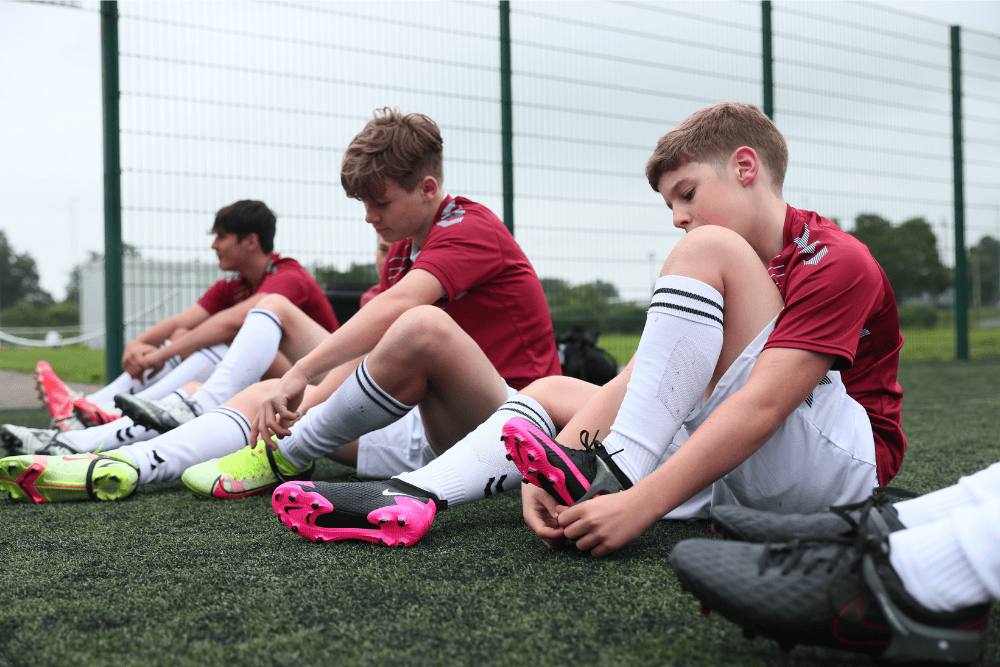
Playermaker’s data captures a player’s foot-to-ball interactions including ball touches.
The earliest adopter of PlayerMaker in the US was the University of Pittsburgh women’s soccer program. Coach Randy Waldrum says he understood it would take a few years to develop proper context for the metrics. Incidentally, the overall quality of the program has improved considerably, so the baselines keep evolving, too. The shoe-worn sensor, which provides physical and technical data, helps solidify what he’s seeing and, at times, can serve as a tiebreaker between two players.
“We now have a pretty good system in place and a pretty good file on what the average distance is players should be covering per position, the kind of touches that are required,” Waldrum says. “We can even get into some of the positions, whether it’s more right foot or left footed—those kinds of things.”
When PlayerMaker launched, it sold only to professional clubs and college teams, but when the pandemic struck in March 2020, several clients asked about obtaining individual units that its disparate players could use for training. Aharon, the CEO, told those clubs, “Yes, sure, we can.” Shaking his head, he hung up and called his COO, “Hey, this is something I just committed to that we need to deliver.”
“For us as a company and as an industry,” Aharon says of the pandemic, “it shortened what could happen in three, four or five years from now and it happened in a few months.”
This article was brought to you by SportTechie, a Leaders Group company. As a Leaders Performance Institute member, you are able to enjoy exclusive access to SportTechie content in the field of athletic performance.
The second in a series of three articles exploring the growth of digital scouting in global soccer.
This story is part of our series on digital scouting. This piece explores how access to physical data has improved in soccer scouting. The next article will look at the new sets of metrics available to coaches and scouts.
Each of these young players had been invited for the tryout based on data collected by a small sensor suspended between the shoulder blades in a black compression harness. This GPS device from STATSports carried Arsenal branding and enabled anyone who bought the device, which retails for $350, to vie for a spot in this showcase.
Players were judged on the data collected by the Fifa-approved wearable carrying the GPS transmitter, accelerometer, magnetometer and gyroscope. They produce 16 metrics including a bespoke Pro Score, all of which are shared with Arsenal staff and can be compared in the accompanying app to anonymized data of current Arsenal academy players. This provides an incentive for users to train and exposes a Premier League club to potential talent that may have been overlooked.
While the ease of access to digital video has aided scouts in making subjective evaluations of prospects’ playing ability and style, the growth of GPS devices in the consumer and youth markets is helping objective physical data be incorporated into that process—not as the sole determine factor, of course, but as another vetting tool.
“Just to make clear, obviously, the ability to play football is the most important aspect of any player who plays for Arsenal Football Club or any football club in the world,” says Barry Watters, the head of sports science at STATSports. “Even if they’re technically and tactically very good, are they physically capable of performing at the top level?”
This marked a major evolution in scouting standards. Sport scientist Chris Barnes currently consults with Catapult and Uefa but previously worked with several clubs, building what some consider the first sport science department in the Premier League when he took on that role with Middlesbrough in 1997. He notes a clear rise in the adoption of objective data in scouting and recruiting over the past 15 years, which was not the standard practice for decades before that.
“The way that traditionally recruitment was performed, certainly in the UK, is you would have a troupe of middle-aged or elderly men in oversized coats who would stand on the side of a field and make some paper notes on players,” Barnes says. “And if they created sufficient interest in the coaching staff, eventually one of the more senior people would go, and it would be done so subjectively.”
The leading GPS brands have made entreaties in the consumer market. STATSports makes its Apex Athlete Series wearable—with and without Arsenal branding—and Catapult tried first with its PLAYR device in 2018 and then with Catapult One in 2021. Other smaller brands, like Sports Performance Tracking, FieldWiz and SoccerBee are also available.
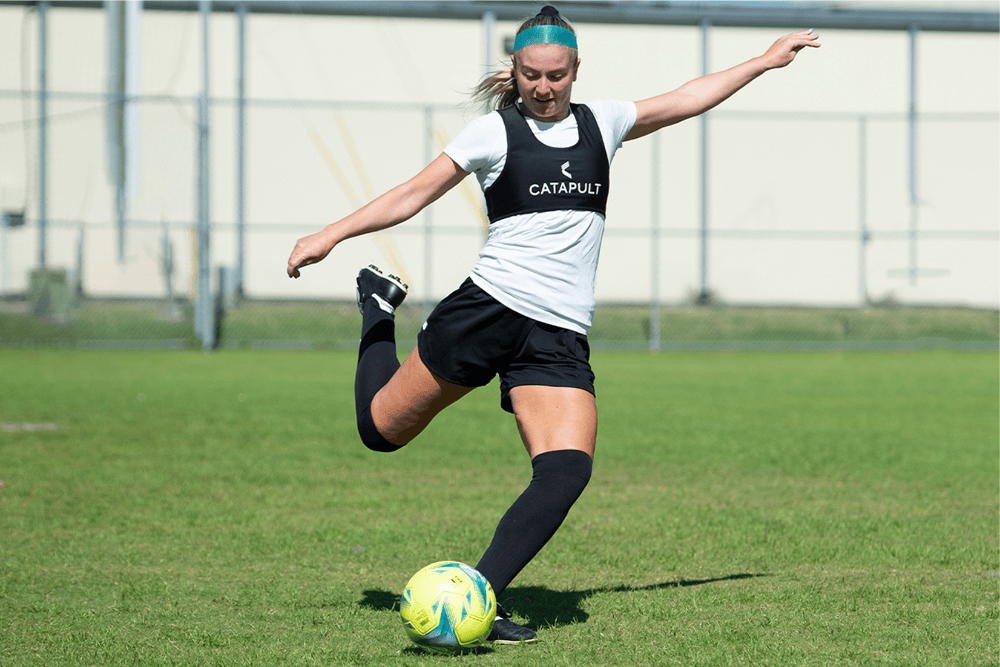
The Catapult GPS device is used in academies to measure a player’s performance across load, speed, endurance and position.
At the upper levels of the sport, league-wide data-sharing agreements are common. What’s collected by optical tracking systems Second Spectrum, ChyronHego, Stats Perform SportVU, Hawk-Eye and the like are disseminated freely within the clubs of the top leagues. There’s less cutthroat competition at the academy level, so Barnes says there’s some degree of informal data sharing.
But getting one’s hands on that physical data has been “very difficult, historically,” says AS Monaco Technical Director Laurence Stewart. “I’m a big believer that some information is better than no information, as long as we understand the right context around it. [It’s] definitely more difficult the younger you get, and there’s less coverage and sort of openly available information on the younger players.”
* * * * *
Chris Barnes had never stepped foot in Nigeria until he reported for his first day of work in December 2020 as Sports Science Director at Vandrezzer FC in the second division. There, he introduced Catapult’s PlayerTek device, with Vandrezzer touting itself as the first club in the country to use a GPS tracker and to have a sports science department. It also added Veo’s AI-powered cameras. All of the national teams in the African federation, CAF, have been using GPS for a few years—first FieldWiz and now PlayerTek—piquing the interest of the professional clubs on the continent.
Vandrezzer had a pair of precocious talents, defenders Felix Oloye and Samuel Edoho, that began attracting outside interest from clubs in Denmark and Poland. The longstanding challenge of scouting across countries and leagues has been finding a way to compare contexts of league quality and physicality. That’s where the PlayerTek GPS devices played a role: both players exceeded the physical requirements of the European clubs, although the transfers ultimately fell through for other reasons.
“They wanted the training data that we’ve got on these two young players before they make a decision as to whether they’d take them on trial. So it really was at the center of the recruitment process,” Barnes says. “What the Danish and the Polish teams were interested in was essentially tempo or intensity. So, within the games themselves, they’re looking at what we would call a relative data—can they can they maintain high-intensity actions, accelerations, decelerations, sprints, and repeat them consistently over a period of time?”
The enterprise optical tracking systems such as Second Spectrum, ChyronHego, Stats Perform SportVU and Hawk-Eye have been available in top leagues for several years with data-sharing agreements so that each member club had access to everyone else’s match data.
Increasingly, such systems are trickling down to smaller leagues. Second Spectrum, for instance, reached a deal with the Danish League in October 2021 to install its solution not only in the first-tier Superliga immediately but also in the country’s second division in the near future. Similarly, the recent MLS deal with IMG Arena includes a provision for tracking to extend down to MLS Next Pro next year. And companies like Track160 have entered the market to offer more affordable alternatives.
In the absence of in-venue cameras, companies such as SkillCorner are generating similar datasets of physical performance using only broadcast video. Liverpool was its first customer, and now it culls footage from 50 global leagues to retroactively produce tracking data, which clubs can then import to existing systems such as Catapult’s SBG MatchTracker and Hudl’s Sportscode.
“If you’re looking at a player in Uruguay, historically there was no way to get data on that player,” SkillCorner GM Paul Neilson says. “Well, guess what, now we’ve got SkillCorner tracking data, bring it into SBG and you can really understand that player and the decisions they make, their movement profile, how they respond to different triggers, different situations, how aware are they of their teammates and X, Y and Z.”
To date, SkillCorner primarily works at the top end, informing clubs’ decisions in the transfer market, but it is working to adapt the product for different video sources to accommodate lower tiers, such as academies. Compatibility across systems so that video and physical data can be reviewed in tandem is important, too.
“We see a very similar thing happening in human performance as we did in recruitment a few years ago when we acquired Wyscout, which was more and more match analysts were moving from just analyzing games to recruiting players, and they were using the same tool sets,” Hudl SVP of elite sports Sam Lloyd says of acquiring Wimu, the wearable tracker used by FC Barcelona, the Spanish national team and all of Liga MX. “So it just made total sense for us to have both tool sets under the same umbrella and make them easier to use.”

Youth soccer players were given the same tech as the pros, and if their stats were high enough, their data could get them recruited to academies.
StatsBomb is an analytics provider that has devised its own proprietary metrics, combining computer vision techniques with some manual input. It serves more than 150 team customers while ingesting data from more than 90 leagues, helping create those league benchmarks.
“Part of it is baselining the whole league and how physical something is, so that you know, ‘Where can we recruit from?’” says StatsBomb CEO Ted Knutson. “That’s something that scouts always talk about, ‘Oh, that’s a physical league, so they’ll do fine here.’ And you get proxies for it. But you won’t need proxies anymore.”
Before Track160’s entry into the US market, the Israeli company held a number of focus groups, using its system to track players and then sharing that data. Many of the young players immediately started getting competitive, comparing top speeds and other metrics. The parents were all eager to garner more exposure for their children and, in time, they’ll be able to make relevant comparisons and projections.
“They’ll be able to benchmark players between the same age group, same gender, compare it to other regions,” says Track160 CEO Eyal Ben-Ari. “They could even tell the player, ‘Look, if you want to play in the Bundesliga 3, that’s the level that you’d have to get to. And if you want to be recruited to Division I in the US, that’s the threshold.’ Eventually, we’ll see more of that, but that will require some time to collect historic data.”
Barnes used to work at West Bromwich Albion of the Premier League when they used event data from sources such as Opta that quantified matches based on granular detail of shots, passes and touches. Barnes and the WBA data scientists created models based on their own clubs’ wearable data and the event data to find, say, the best fit at right-side midfield for their tactics. It would share percentage matches and also, crucially, compute financial value of the players to guide the targeting of realistic options for a smaller club. But that had limitations.
“The biggest challenge you’ve got as much as anything else, though, is probably 90% of the meaningful event data is when you’ve got possession of the ball, and that’s probably great when you’re trying to recruit midfield and attacking players,” Barnes says. “But of course, a little bit more difficult when you try to recruit defensive or strong defensive midfield players. But here’s where, if you can access the wearable data—and it’s becoming increasingly possible with league-wide deals because then it’s shared—you can actually build timestamped and time coded pictures, which will give you information related to events.”
* * * * *
The largest undertaking in elite development soccer is beginning this fall. US Youth Soccer, a nonprofit affiliated with the national federation, announced plans for its new Elite 64 league, which will include 64 boys teams and 64 girls teams at each of six age groups for teenage players. Assuming 23 players per roster, that’s roughly 17,500 soccer prospects from Bangor to Burbank, all competing for national trophies and recognition.
Each participant will receive both qualitative and quantitative data, from USYS partners ProScore and STATSports. ProScore uses its own evaluation metrics to assess key moments of the match while STATSports will be providing the same GPS technology that the Arsenal invitees used. In this case, instead of being tethered to just one pro club, the users can share their data with any college coaches or pro scouts.
“That’s where we can see the consumer product overall going as well—the ability of the individual user themselves to be able to share that data with whatever third parties they want, be that scouts or coaches so that they can see what they’re physically capable of,” says Watters, the STATSports sport scientist. “They share everything else already. They share video reels, they share anything. There’s a lot of data.”
This remains a largely new frontier for wearables in the US, so building appropriate benchmarks will take time for each MLS academy and college program to gain an appreciation of what they’re looking for and what physical output is appropriate. “So that we can see what good looks like, but it all must be put in the context of the type of team they play for,” says Watters, adding that eventually the STATSports app can use those recommendations to serve as a “virtual coach” for players without access to top club programs.
“Most actual high schools don’t have the budgets to do that, [but] lot of the youth clubs do,” University of Pittsburgh women’s soccer coach Randy Waldrum says of GPS device. “It’s not where it needs to be yet, but we’ve certainly—over the last five, six years—seen it start to grow.”
US Soccer signed its own major partnership with STATSports back in 2018 to incorporate the devices through the federation, including the youth national teams. The US Soccer High Performance Director at the time, James Bunce, previously held that role with the Premier League and was a proponent of bio-banding, a concept of grouping players on teams based on physical maturity and age rather than sorting strictly by birth year.
GPS devices can help play a role in determining those selections, along with other inputs of physical data. US men’s national team Coach Gregg Berhalter says that his pool of players are receiving regular assessments from his own staff and their respective club staffs to formulate a holistic view of each athlete.
“Everything. Body screens, motion screens. The breadth of data that we’re collecting on these players is pretty impressive,” Berhalter says. “Not only that, we’re working together with their clubs to import data from what they’re doing at their club level into our system. So we can piece together where a player is at physically when he comes into camp.”
Over in the UK, STATSports outfits Rising Ballers FC, a youth club for unsigned players. Several of its alumni have gone on to sign with pro clubs and academies where there’s greater maturity of physical data. That’s where the Premier League and other overseas circuits are ahead, Barnes says, because the academies have been “running in a structured way for 15-plus years.”
New avenues of entry remain possible, such as through Arsenal’s partnership with STATSports. Of the first 22 players to trial at Emirates, none has yet signed, although one of the female players continues to be closely scouted and the Arsenal staff says it saw “flashes of brilliance” from the prospects.
“For us, the golden ticket obviously is if someone does get picked up,” Watters says, “but I think even the ability to allow these end users to be able to get in front of these people was absolutely brilliant and all the kids and everything loved it.
This article was brought to you by SportTechie, a Leaders Group company. As a Leaders Performance Institute member, you are able to enjoy exclusive access to SportTechie content in the field of athletic performance.
The first in a series of three articles exploring the growth of digital scouting in global soccer.
This story is part of our series on digital scouting. This piece explores the growth of digital video in soccer scouting. The next article will look at how access to physical data has improved.
Those top-line results, however, obscured a hidden talent. A hemisphere away, French Ligue 1 side AS Monaco received a midseason alert about a young Grêmio defender. A one-named wunderkind named Vanderson, who plays right back, was starting and logging significant minutes at the age of 19, while contributing tackles, pass interceptions and goals on some brilliant free kicks. Such production triggered an alert within Wyscout, the Hudl-owned scouting service widely used in pro soccer.
AS Monaco employs a scout in Brazil, but it’s a massive country that was still contending with Covid travel restrictions. The scout couldn’t get there right away, but the club had access to plentiful data and video resources to some preliminary vetting before the AS Monaco scout—and, subsequently, Technical Director Laurence Stewart—got on a plane to see Vanderson play in Porto Alegrense.
“That’s an example of a player that it would be a lot more difficult for us to sign if we’ve not been able to do a lot of that prior work [before we travel] and see them play in different contexts and in different scenarios,” Stewart says. “So we have quite a diligent process that we have to go through, in a way to tick as many of the boxes as possible before we look to recruit a player.”
Monaco ultimately completed a $12.1 million [£10.4 million] transfer for Vanderson in January and, by February, while still four months shy of his 21st birthday, he became a regular starter on a club that finished third in Ligue 1.
The recruitment of Vanderson is a perfect case study of modern digital scouting in soccer: a quick, data-infused process to sign a young talent.
“What is becoming more prevalent after the pandemic, after Covid, we’ve seen that a lot of organizations are shifting their demographic of players that they recruit, so the average age of players recruited is dropped,” Stewart says. “What that does is brings a pressure around there being a time sensitivity to the way that you work.”
The global pandemic gave clubs a rare respite long enough to step back and re-evaluate processes, all while cutting into revenues from diminished match revenue. One trend that accelerated as a result was the speculation on younger players. Stewart says the window to evaluate prospects has shrunk, on average, from two seasons to one and now, at times, only half a season.
Getting players younger allows a mid-sized club to reap the benefits of a few productive seasons before, as the player reaches his prime, transferring him on to a mega club for an increased profit. Prospecting earlier also lessens the financial risk. It’s little surprise that one of the other rumored suitors of Vanderson was Brentford, well known for its hearty embrace of analytics.
“We have to be agile and ready to know our assessment and know our profiles in a shorter period of time,” Stewart says, “so that’s where we need technology to help us be more intensive in that process.”
The pandemic forced teams to embrace online scouting
Victoire Cogevina, a former player agent and now the Founder/CEO of Gloria, began the company a half-dozen years ago with an intention of using the app to aid scouting. She’d partner with leagues who would subscribe to gain access to new recruits. The idea, she says, was that the players matter most, so if you build a product they want to use, the clubs and leagues will follow.
Before the pandemic, the foothold data analytics had gained in the tactical decisions of many elite clubs has been well documented, but that embrace lagged behind in scouting, which largely remained a bastion of older, more subjective methods. (Gloria has since pivoted to a larger purpose, serving more as a social and community-drive app centered around the beautiful game with grand plans to become titular sponsor of the new women’s league in Spain.)
“The pandemic was this kind of a slap in the face for clubs understanding that a vital piece of their business, which was finding new talent, and also a vital piece of their revenue share [from transfers] was something that they can do in a much more efficient way than they had done,” she says. “And they were so closed off because, by the way, in 2018 when I was speaking to clubs, they thought I was an alien.
“I remember having conversations with clubs that were forefront, big brands—obviously smart in their decisions—and they were very much against the idea of online scouting. And when you told them, ‘Hey, it’s going to be just a few years when you’re going to change your business dramatically. They were like, ‘No.’ They had a ton of excuses around it. So when the pandemic happened, immediately I got a ton of phone calls from all of those clubs that I had once been in their boardrooms and offices and, ‘Hey, remember what you pitched me? What are you doing now?’”
For a national federation like US Soccer, whose remit is to monitor professionals across the world and millions of youth players across a sprawling country, the centralized collection of video and data at its headquarters in Chicago has become essential. Men’s national team Coach Gregg Berhalter says he can keep tabs on his player pool—collecting video and performance data—for every match they play, no matter the league or country. Much of that infrastructure helps scout the players.
“Very similar,” Berhalter says. “We’re able to watch our youth teams through the platforms that were created that houses video, but also youth scouting, sharing methodology—all that stuff, technology makes it a lot easier.”
Some clubs shifted toward digital scouting more organically than as a result of the pandemic. Two years after Monaco won its first Ligue 1 championship in 2017, the club finished 17th, staving off relegation by a mere two points, and churned through managers like a tipsy tourist burns through chips at the Monte Carlo poker tables. In 2020, Monaco modernized, investing in data, a new training facility and key hires, such as Stewart, Sporting Director Paul Mitchell, and two key US Soccer Federation personnel, Performance Director James Bunce and technology guru Tyler Heaps. The club is now significantly younger and more fit.
Monaco has been a fairly prolific spender since a new ownership group took over a decade ago, but the trend lines toward data, video and youth can be seen throughout the sport. Hudl SVP of Elite Sports Sam Lloyd says that, historically, recruitment was the product of scouts and agents. But now a “golden triangle” has emerged, and “data is as important as scouts and agents,” he says, noting that the Wyscout usage skyrocketed during the pandemic.
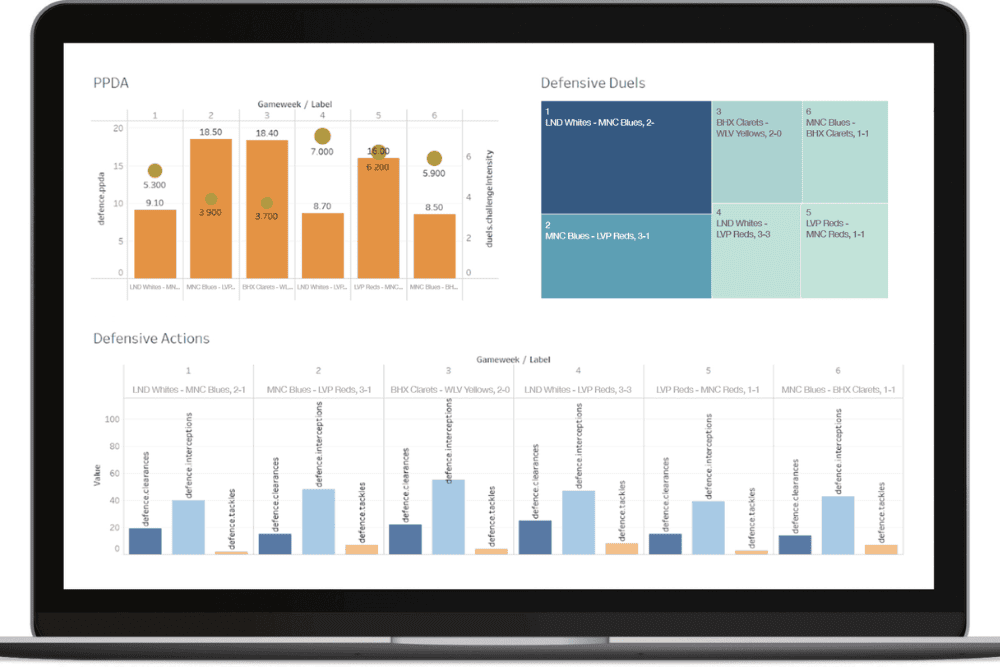
Wyscout provides data regarding performance, patterns of play and tactical strategies for coaches, teams and players to analyze.
“The biggest change that’s happened because of Covid is it’s mobilized the much smaller organizations to become literate with data and data scouting,” adds Lloyd, noting that the bigger clubs were already investing significant resources in the practice. Tools like Wyscout narrow the funnel of players for more targeted scouting trips. “The rest of the football pyramid,” he says, “it’s opened up ways in which they can scout not just from where they can drive to in a single day.”
Tonsser gives scouts access to larger pool of players
Four years ago, a group of teenage strangers gathered in Paris. Each was summoned on the merits of the videos and stats he had uploaded to a Danish soccer app called Tonsser, borrowing the local nickname for a gritty, high-effort player who maybe succeeds in spite of some technical deficiency. This group—from disparate backgrounds and no experience as teammates— played a Paris FC youth team to a 2-2 draw.
That result was “very motivating for us,” recalls Tonsser Co-Founder and CEO Peter Holm. It led to a more formal showcase program called Tonsser United, an ever-changing roster of previously overlooked players who would gather and compete in tournaments against organized club teams.
“That started actually as an experiment, maybe to challenge ourselves bit,” Holm says. “It was more like a question, ‘Can players from outside the academies, found through an app, compete with established academies?’”
With a user base now of 1.4 million players, mostly aged 13 to 19 and living in Europe, Tonsser subsequently entered a squad in the Vinci Cup, an under-15 tournament later that year. A photo advertising the event shows the logos of all 16 participants, including the storied crests of European powers like Manchester City, Paris Saint-Germain, FC Porto—and a turquoise circle with a soccer ball centered the middle, a logo looking like it had been hastily selected from a clip art catalog.
Tonsser United acquitted themselves well, winning or tying its first several matches and drawing distinction for its surprise performance in the tournament recap, noting how the players all met each other on Thursday before playing four matches together on Saturday.
The concept of the club has continued, with a new roster each time, and Holm reports that 40% of its alumni have gone on to sign with professional academies through this alternate route, at least in part because of this new exposure.
“That helped us incubate the idea of how can you create a concept of a football club that is born out of values, born out of a vision, rather than born out of geography,” Holm says. “Because football clubs today, they have a stadium, a physical presence, and usually you have fans out of legacy, because where you are born or you fall in love with it from afar. What we wanted to create was a more of a concept of a football club that anybody can support because they want to support the underdog.”
A product like Tonsser helps players at the beginning of their scouting journey. While the use of Wyscout and other tools are used to identify a match with a single pro prospect like Vanderson, Tonsser works in the reciprocal: select a whole roster of players higher up the talent funnel and make it easier for scouts to see a larger pool. It integrates with national federations to ensure player identities and data quality, but an integral part of its methodology is to seek the “wisdom of the crowd” in which peers vote for those who turn in the best performances, Holm says.
“That’s really the trenchant analogy that we use for football,” he adds. “So instead of asking the coach or experts in football, we flip it to the community to help them generate data points.”
The app has been in the market long enough that some professional stars used it in their youth, most notably Erling Haaland, Manchester City’s newly acquired prized striker. Holm quickly notes that “we can take no credit” for helping the upward trajectory of his career, though “it’s just fun and inspiring that he’s used the app,” but there are a few case studies where Tonsser seems to have played a role.
Frankfurt’s Jesper Lindstrøm was a heavy user as a teen. In four years, he went from Tonsser’s Player of the Season to Bundesliga Rookie of the Year. After a friend played a match with the Tonsser United showcase team, a young French player named Alexis Kabamba downloaded the app and fared well in a friendly. That led to a contract with Ligue 1 club Stade de Reims and subsequent appearances with France’s U17 national team.
“My experience is that so many players that we don’t know just fall off the edge of the cliff, for one reason or another, because they don’t have the opportunities, they lose motivation, think they’re not good enough,” Holm says. “They don’t have the right environment to bloom. And that really what we’re trying to provide with Tonsser United. There’s always a second chance.”
Affordable video opens more global opportunities
Some aren’t afforded a first chance. Africa has been underscouted, but the proliferation of quality, affordable video—and the platforms for distribution—is granting the continent’s players more exposure. Lloyd says Hudl has begun contracting more frequently to record tournaments and then upload the footage to Wyscout.

Hudl’s focus camera was installed at Rio Tinto Stadium, home to the Real Salt Lake soccer club.
After Hudl shared video from a tournament in Cameroon, for instance, and club scouts were able to compare the analysis with the benchmarks of players already in their academies. Several then flew to Cameroon to recruit those young players. The same was true for some matches in Zambia, which led to interest from elite clubs like Villarreal and Porto.
“There’s more justification for the travel expense, whereas sending a scout on a whim to Zambia—it seems crazy, doesn’t it? Who’s going to do that?” Lloyd says. “But if you’ve watched him five times, you’ve got the data to verify he’s above and beyond what you currently have. That becomes an easy trip, doesn’t it? Because now it’s, ‘Let’s get him before these other teams work it out,’ rather than, ‘I hope to go and find a good 15 year old in Zambia.’ That’s not a good trend.”
Chelsea FC star midfielder Kevin de Bruyne, a recent Premier League Player of the Year honoree, sponsors his own youth tournament, the KDB Cup, in his native Belgium. The event already invites many of best U15 players, gathering them for elite competition—and easy scouting. But whether it’s due to Covid or budget concerns, travel still isn’t easy for everyone, so the KDB Cup began a two-year partnership with automated camera company Veo to provide coaches and players match analysis and broadcast the matches for free to 104 countries.
There are several AI-powered camera systems in use—Veo, Hudl Focus, Pixellot, Spiideo, PlaySight, Trace and more—but more manual efforts remain the norm.
“Some of it is automated capture, but the vast majority is still one guy standing on a scaffold with a video camera,” Lloyd says. “Times haven’t changed that much, unfortunately, but the automated capture is definitely making it more easy and more available.”
Wyscout users can view related videos for a team, player or game as well as download clips and make their own analysis.
Longtime UConn men’s soccer Coach Ray Reid, who won a national championship in 2000, used to employ video and scouting services such as InStat and Wyscout was the beneficiary of several impact recruits from Europe he otherwise never would have recruited. Kai Griese and Bjorn Nikolajewski arrived from Germany, and Mateo Leveque matriculated from France. Reid calls Leveque—the 2021 Big East Freshman of the Year—“one of the best guys we’ve ever recruited.”
“It helps you figure out if you want to go there, if you want to fly to France to see a young man,” says Reid, who recently retired from coaching and became a Senior Strategic Advisor for optical tracking company Track160. “It’s a good first step.”
This article was brought to you by SportTechie, a Leaders Group company. As a Leaders Performance Institute member, you are able to enjoy exclusive access to SportTechie content in the field of athletic performance.
Members of the Leaders Performance Institute convened at St George’s Park to hear from pathways specialists at the Football Association, Wales Rugby Union and the Lawn Tennis Association.
In partnership with

Session 1: Performance Pathways Part 1: Creating Effective Transitions
Speakers:
John Alder, Head of Player Development, Welsh Rugby Union
Helen Reesby, Head of National Performance Pathway, Lawn Tennis Association
Transition experiences:
Effective transitions:
Session 2: Performance Pathways Part 2: The Different Stages of Psychological Safety
Speaker:
Tim Cox, Managing Director, Management Futures
Psychological safety:
Why it matters:
Social pain & the brain:
Four stages of psychological safety:
Inclusion safety – key concepts:
Learner safety – key concepts:
Contributor safety – key concepts:
Challenger safety – key concepts:
Six ways we can increase psychological safety:
Model openness & honesty
Make it easy to speak up
Session 3: Performance Pathways Part 3: An Insight into the FA’s Approach
Speaker:
Phil Church, Senior Coach Development Lead, The Football Association
Attendee takeaways:
