This month we touch upon the power of flexibility, relatability and collaboration in leadership and what you need to know to be better in each area.
Ideally, you found time for both and, here, we highlight a selection insights from the first month of 2025 that may help you to consider a problem in a different way or enable you to identify the right people to whom you can turn.
We hope to see some of you in Melbourne later this week for the Leaders Sport Performance Summit.
And, whether or not you can make it to the Glasshouse, here are five thoughts for all leaders to ponder.
If you can find new ways to consider your problems, it can open up new ways of thinking.
In this article, John Bull of Management Futures used the example of an elevator. Perhaps your goal is to make the elevator go faster, but what if your aim was to make the wait less annoying?
“Most hotels will put a mirror beside the elevator,” he said. “That seems to kill time when we’re looking at ourselves in a mirror.”
Bull suggested we “think of at least three different ways we could define our goal, to help open up new ways of thinking about the problem”.
He also share the STOP process for creative problem-solving:

In November, John Longmire called time on his 14 years as Senior Coach of the Sydney Swans. He has taken a new position as the Swans’ Executive Director of Club Performance but, before doing so, he reflected on his tenure as Senior Coach, which brought two AFL flags and four Grand Final appearances in total.
You can read his thoughts here, but here is a snapshot of his desire to remain “connected and relatable” to his players and staff. As he said onstage at November’s Leaders Sport Performance Summit in London, “the coach is no longer looked upon as being bulletproof” whatever their standing may be within the game.
His final speech to the players and staff as Senior Coach attested to that belief. He weaved in personal stories and his voice cracked at times. He wiped away tears too.
It called to mind the weekly ‘storytelling’ sessions that Longmire made a key feature of the Swans’ environment. He told the Leaders audience that players and staff share stories or complete a series of tasks for discussion each week. Recent examples included writing ‘a letter to your 16-year-old self’. These sessions are popular with players and staff alike.
“Sometimes it’s a photo of something that mattered to you and quite often there’s tears involved,” he said. “The way I looked upon coaching 25 years ago is completely different now – these 18, 19, 20-year-olds need to be able to relate to you. If you can show that you’re human, you get a lot more back.”
The question of team dynamics sits at the heart of The Social Brain: The Psychology of Successful Groups by Tracey Camilleri, Samantha Rockey and Robin Dunbar. The trio has spent decades observing the worlds of academia, business, and government as they look to better understand the workings of high-performing teams.
Camilleri and Rockey came to the summit in London to discuss how their research has its applications in the world of sport. Decision-making was one such area:
For decisions made at speed, you’ll count on five people.
Five is the number of intimate relationships a person can have. Rockey said: “These are the relationships that protect us, make us thrive, and ensure that we go through life in a joyful way. They protect us from ill-health and from some of the psychological challenges that we might have from feeling insecure.” They, of course, occur in intimate spaces.
For more complex decisions, you’ll count on 15 people (including your original five).
The ‘pain’ comes when you look to insert new thinking into complex decision making in a group space. “We spend about 60 per cent of our social time with just 15 people,” said Rockey. “With the 15 in the workplace, they would have built long-term relationships and loyalty to you over time – that’s how we work as humans – so breaking up those people to bring in new thinking is painful.”
According to Dunbar, the upper limit on the number of social relationships we can enjoy is 150
Dunbar suggests that people can have no more than 150 social relationships at any one time. “It’s a very stable number across all societies and cultures,” said Rockey.

From The Social Brain: The Psychology of Successful Groups by Tracey Camilleri, Samantha Rockey, and Robin Dunbar.
Young athletes are bolder in stating their desire for belonging and connection than their forebears, but this comes with a paradoxical demand for more personalised training and attention. There are clear implications for the time coaches spend on team dynamics in an era where the power has shifted to the athlete. The topic was discussed on a recent virtual roundtable. “Staff and coaches are more vulnerable,” said one participant, who pondered where the balance needs to sit. “Give the athletes a voice and a choice, give them ownership, have the consultation, but there is a line too.”
Another participant with experience of coaching in European football, highlighted that individual work will mean different things to different people and can be dependent on team selection. They argued that there is room for better management of expectations and, more broadly, a consensus for coaches and athletes alike on what constitutes ‘individual’ training.
In February 2024, the England & Wales Cricket Board launched its Insight 360 platform, which adopts a data-driven approach to athlete and performance management.
Ahead of the launch, the ECB gathered input from practitioners and coaches across the English game. “This means Insight 360 is bespoke for women’s cricket,” said Anna Warren, the Head of England Women’s Science & Medicine. Players, she said in this article, are happy with an app that allows them to review their own data in as much detail as they like. “This is good for player buy-in, which is always a challenge in relation to athlete monitoring.”
There is also the power of a co-designed project. UK Sports Institute have found as much with their Project Minerva. Dr Richard Burden, the UKSI’s Co-Head of Female Athlete Health & Performance, said: “Get the practitioners involved, get athletes, get the teams and bring them along with it because if they’re onboard you get easier access to them and you’re going to produce something that’s more translatable, meaningful and applicable to them.”
Warren is on the same page with Insight 360. “You can link loads of different data sources together and start to answer some key performance questions – we’re not looking at everything in isolation.”
Leadership specialists Tracey Camilleri and Samantha Rockey explain how matching team density, size, and space to the task at hand can boost performance.
Reid’s celebrated right-hand men, including Offensive Coordinator Matt Nagy and Defensive Coordinator Steve Spagnuolo, are in demand for newly vacant head coaching roles elsewhere now that the NFL regular season has concluded.
Time will tell whether Nagy or Spagnuolo can assemble winning rosters of the kind that delivered the Chiefs back-to-back Super Bowls (with a third still on the cards), but they will have a better chance of ticking all the right boxes if they can surround themselves with the right people.
On that note, the question of team dynamics sits at the heart of The Social Brain: The Psychology of Successful Groups by Tracey Camilleri, Samantha Rockey and Robin Dunbar. The trio has spent decades observing the worlds of academia, business, and government as they look to better understand the workings of high-performing teams.
“We wrote this book because we were fascinated with the question: what is it that makes a group of people more than the sum of their parts?” said Camilleri when addressing the audience at November’s Leaders Sport Performance Summit in London.
“In our world, the unit of identification is most often the individual – if you think about how we hire, how we promote,” she continued. “Very rarely is the focus the team.”
Camilleri and her co-authors redress that balance in The Social Brain and here we explore how leaders can amplify the collective in the pursuit of better decision making.
‘The rocket fuel for performance impact and innovation’
The Social Brain applies theories of evolutionary biology to groups of high performers.
“We’ve been interested in what doesn’t change,” said Camilleri of this lens of enquiry. “When humans are part of small groups they can take advantage of their collective intelligence as well as a sense of safety, reciprocity and shared obligation.”
Camilleri, Rockey and Dunbar devised their ‘Thrive Model’, which sets out six foundational conditions for high-performing teams that consider social health (in addition to physical and mental health) as a prerequisite of wellbeing.
Onstage, Rockey defined these conditions as “the rocket fuel for performance impact and innovation.”

From The Social Brain: The Psychology of Successful Groups by Tracey Camilleri, Samantha Rockey, and Robin Dunbar.
What do the numbers in the circle mean?
As Rockey explained, it is important for leaders to know where to focus their energy most effectively.
“All of us have the same amount of time in a day and we use it differently, but what doesn’t change for each individual in this room is how many relationships that we can have at any given time,” she said. Our brains are only so big, “so we can’t have endless relationships”.
She used Dunbar’s number, which was devised by her co-author in the 1990s, to illustrate her point:

Dunbar’s number has long been influential across several fields, from government and administration to business and academia.
Five, 15 or 150 people? Performance improves when you match team density, size, and space to the task at hand
For decisions made at speed, you’ll count on five people.
Five is the number of intimate relationships a person can have. Rockey said: “These are the relationships that protect us, make us thrive, and ensure that we go through life in a joyful way. They protect us from ill-health and from some of the psychological challenges that we might have from feeling insecure.” They, of course, occur in intimate spaces.
For more complex decisions, you’ll count on 15 people (including your original five).
The ‘pain’ comes when you look to insert new thinking into complex decision making in a group space. “We spend about 60 per cent of our social time with just 15 people,” said Rockey. “With the 15 in the workplace, they would have built long-term relationships and loyalty to you over time – that’s how we work as humans – so breaking up those people to bring in new thinking is painful.”
According to Dunbar, the upper limit on the number of social relationships we can enjoy is 150
Dunbar suggests that people can have no more than 150 social relationships at any one time. “It’s a very stable number across all societies and cultures,” said Rockey.
From The Social Brain: The Psychology of Successful Groups by Tracey Camilleri, Samantha Rockey, and Robin Dunbar.
Camilleri and Rockey wrapped up their presentation by offering nine ‘social hacks’ for building relationships swiftly:

From The Social Brain: The Psychology of Successful Groups by Tracey Camilleri, Samantha Rockey, and Robin Dunbar.
Rockey then homed in on five…
Synchrony: “Sport has done this brilliantly. The perception of pain is reduced when we’re doing something together. When you’re running with a partner it feels less painful.”
Laughing together: “A fantastic way of finding a group”.
Engaging with strangers: “When we have conversations with people we don’t know, it has a positive effect on us – I encourage you to meet people that you don’t know today.”
Giving and receiving kindness: “A New York-based study saw that when young people were able to engage with strangers and be helpful to them, they saw an uptick in their mental health.”
Eating together: “There’s something very magical about breaking bread together. You have about 30 minutes when you’re having food together in which you have a sense of wellbeing and positive vibes towards your dining partners. So if you want to do something difficult, eat with your group first and then go to the difficult meeting.”
The Social Brain: The Psychology of Successful Groups by Tracey Camilleri, Samantha Rockey, and Robin Dunbar is available now from Penguin.
The Adelaide Football Club’s General Manager of Player Development & Leadership reflects on his journey with the club.
A podcast brought to you by our Main Partners

“I can’t teach leadership,” he tells the Leaders Performance Podcast. “I can help unlock what’s already in there.”
On that note, he is certain that leaders are not born. “Leadership is 100 per cent made, but it’s made from a very young age.”
Beyond the origins of leadership, Dan spoke to Henry Breckenridge and John Portch about the importance of prioritising others [10:40]. “Great sustainable teams are built in environments where everyone’s looking to help someone else out,” he adds. “When you fill someone else’s bucket, it fills yours.”
Also on the agenda were the importance of humour and enjoyment [22:00]; the argument against ‘refreezing’ culture [48:30]; and the practical steps that help leaders to manage team operations [32:00].
Henry Breckenridge | LinkedIn
John Portch | LinkedIn
Listen above and subscribe today on iTunes, Spotify, Stitcher and Overcast, or your chosen podcast platform.
David Clancy and Alexia Sotiropoulou set out strategies for leaders to inspire meaning, fulfilment and belonging in their people.
Purpose is the north star that guides us through adversity, keeps us focused amidst distractions, and fuels our long-term engagement. When leading yourself and others, the power of purpose cannot be understated. It’s about creating an environment where every individual finds meaning in their role, feels fulfilled in their contributions, and experiences a sense of belonging to something greater than themselves.
Purpose-driven leadership is not just about results. It speaks to human connection; when one feels seen and heard. Great leaders cultivate deep relationships with their teams, which comes by empathy, trust, and support. The connection between a true leader and their team hinges on a shared understanding of what motivates everyone on a deeper level. As John C Maxwell puts it, “People don’t care how much you know until they know how much you care.”
It’s more than just retention
Gallup and studies reported in HBR often highlight that employees who find meaning in their work show increased productivity and retention. One well-cited article is ‘Meaning Is More Important than Happiness’ by Emily Esfahani Smith, which explores the impact of meaningful work on wellbeing, productivity and engagement. Deloitte highlighted in their Global Human Capital Trends Report of 2019 how employees who find purpose in their work are more likely to stay with their employer. That makes sense. A great place to work is a great place to work.
As Simon Sinek, leadership expert and author of Start with Why, says: “People don’t buy what you do; they buy why you do it.” This fundamental concept applies not only to customers but also to team members, colleagues, and leaders. By fostering purpose in yourself and others, you align actions with deeper values, creating a culture where high performance and personal fulfilment coexist.
Meaningfulness: a compass in uncertain times
Meaningfulness isn’t just about liking what you do; it’s about understanding why it matters. In elite environments, whether you’re a player, coach, or part of the front office, the pressures and expectations are immense. The need to win, deliver results, and meet expectations often dominates the narrative. But the best leaders, those who guide their teams with purpose, know that long-term success is rooted in meaningful work. This drives individuals to not only execute their tasks but also to find value in how those tasks contribute to the big picture. Leaders who strive to inspire meaningful work allow individuals to not just survive pressure, but thrive under it, empowering them to embrace challenges as part of their career journey.
Three principles to cultivate meaningfulness:
Fulfilment, fuel for high performance
Fulfilment is about finding personal satisfaction in the work you do. It’s that feeling of deep contentment that comes from using your strengths to their fullest potential and knowing that what you do matters. In high-performance sporting environments, the external pressures can sometimes overshadow personal fulfilment, but when fulfilment is present, individuals feel more locked-in and resilient.
Fulfilment creates a ripple effect throughout the entire organisation. When team members feel fulfilled – filled full if you would like – they bring their best selves to work, inspiring those around them to do the same.
Four ways leaders can foster fulfilment:
Case in point, Dennis Rodman. Here is a prime example of where recognition can be seen, by how Head Coach Phil Jackson managed his Chicago Bulls squad during the 1995-96 season. Jackson often recognised Rodman, not just for his defensive prowess, hustle and rebounding, but for his unique role, style and intensity on the court. By publicly acknowledging Rodman’s contributions, Jackson built Rodman’s confidence and reinforced his core value to the team, despite his unconventional approach. This clear recognition played a critical role in fostering trust, thereby maximising Rodman’s performance. The Bulls had a historic 72-win season.
Belongingness, the glue that binds it all
At its core, belongingness is about feeling valued and accepted by the group. High-performing teams that experience a strong sense of belonging operate on a different level.
One of the guiding principles within the All Blacks is the Māori concept of ‘Whānau,’ which means ‘family’, but it extends beyond immediate relatives to include the team as a whole unit. Players are taught to understand that when they put on the famous black jersey with the silver fern, they are not just playing for themselves, but for their teammates, their country, and the generations of players who came before them.
Belonging. Part of something bigger.
It’s a powerful feeling to know that you are a part of something bigger than yourself, like helping to put someone on the moon.
Four strategies to create a sense of belonging:
Final thoughts
Leading yourself and others with purpose is about much more than reaching performance goals. Before you can lead others, you must first lead yourself. Leading with purpose involves setting common value-based goals, staying focused in the choppy seas of collaboration and motivating yourself and your team to stay on track, with eyes on the prize.
To lead yourself with purpose, you need to define your own personal mission, vision and values.
Start there.
These are your guiding principles to help shape decisions and actions aligned with your purpose. You must also set clear goals for yourself and develop a plan to make them happen. This will take discipline and fortitude. Give it a go, starting today.
As with anything in high performance, you need to find what works for you first. So off you go.
David Clancy is a Learning and Development Consultant at the Houston Texans and Director at The Nxt Level Group. He is also the Editor of Essential Skills for Physiotherapists: A Personal and Professional Development Framework, which is available now from Elsevier.
Alexia Sotiropoulou is a Co-Founder & International Markets Specialist at the The Nxt Level Group. She is also a Public Relations & International Sales Specialist at the Isokinetic Medical Group.
If you would like to speak to David and Alexia, please contact a member of the Leaders Performance Institute team.

Alex Hill, the Co-Founder and Director of the Centre for High Performance compelled the league to consider its own mortality before suggesting ways it can ensure its relevance a century from now.
A podcast brought to you by our Main Partners
On one such occasion, Hill, the Co-Founder and Director of the Centre for High Performance, compelled senior leaders at the Premier League to confront its own demise.
“I said: ‘at some point people will not want to work for you’. Now that feels impossible at the moment,” Hill tells the Leaders Performance Podcast.
How did that observation go down?
“It was quite a quiet room,” Hill says. “At the moment, they’re lucky they’ve got the pick of the best talent, the best physios, the best scientists – but that might not be there forever.”
Hill spent 13 years studying organisations that have out-performed their peers for over 100 years, including the All Blacks, Eton College and the Royal Shakespeare Company. The result is his book Centennials: The 12 Habits of Great, Enduring Organisations.
“If you want society to support you long term, your impact has to be much broader than just creating role models,” he continues. “Why don’t you take the learning from being at the cutting edge of mental and physical performance and share that?”
Hill believes that the British national governing bodies competing at the Olympic and Paralympic Games could feed those lessons back into the community in the form of a “spin-offs division” similar to that of NASA (another centennial).
“This spin-offs division [could be] designed to take that learning and feed it into all of society so that the whole of our country develops.”
It is just one idea Hill shares during the course of a conversation full of advice for sporting organisations. He spoke of the New Zealand All Blacks and their readiness to embrace failure [40:20]; finding smarter ways to attract money and talent [10:45]; and why a diverse talent pool can make an organisation more relevant to a broader swathe of society [17:15].
Henry Breckenridge X | LinkedIn
Listen above and subscribe today on iTunes, Spotify, Stitcher and Overcast, or your chosen podcast platform.
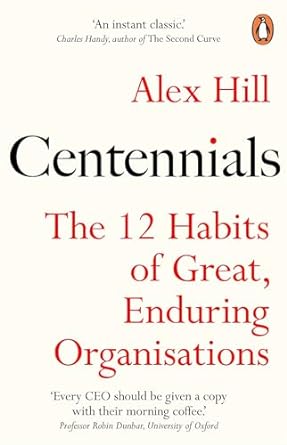
Alex Hill’s Centennials: The 12 Habits of Great, Enduring Organisations is now available in paperback from Cornerstone Press / Penguin Random House
Natasha Patel of US Soccer and Simon Wilson of Stockport County discuss the influence of performance analysis on organisational strategy.
An article brought to you in collaboration with

That is according to a straw poll of attendees at a recent Virtual Roundtable hosted by the British Association of Sport & Exercise Sciences [BASES] and the Leaders Performance Institute.
We have collaborated with BASES on a three-part series called Advances in Performance Analysis and kicked things off with a first session, titled ‘The Influence of Performance Analysis on Organisational Strategy’.
Leading the conversation were Natasha Patel, the Director of Sporting Analytics at US Soccer, and Simon Wilson, the Director of Football at League 1 side Stockport County.
They began by leading a discussion of the biggest challenges facing people who use data analysis in sport. There were four that stood out:
Patel and Wilson, who began their careers in sport as performance analysts, shared a series of considerations rooted in clear principles, effective communication and strategic benchmarking when leveraging performance analysis to drive organisational success.
Establish key principles
Both Patel and Wilson continually referred to the importance of key principles. These, as Wilson explained, must outline how you are going to work and how data and analysis inform this; this allows for more creativity (and alignment) when you move through the layers. Patel, who worked at Premier League club Southampton across two spells, explained that from the beginning of her first spell, between 2011 and 2019, there was immediate buy-in from the technical director, who valued data and video analysis hugely.
Have a clear game model
A game model – a common requisite in football as well as other sports – can inform everything that follows, including data analysis. Patel said she better understood the coaches’ needs and how they want analysis delivered when there was a game model to follow. She and her colleagues were able to gain the buy-in of coaches when being intentional in spending time with them. This allowed the analyst to shine when they were able to take information from the coaches themselves and the athletes, turning it into digestible data and visuals that could help everyone. Similarly, Wilson explained how Stockport’s game model has informed their squad building and helped to generate a well-filtered target list of players who may improve the team.
Consider the end user
As Patel said, it is important to consider the end user and what performance analysis looks like to them. Once you have identified the end users, you can then work out how to get the best process for them and, subsequently, enable the trickling of information to help influence the end user, whether that be to help support or challenge their way of thinking. She referred to this as ‘stakeholder mapping’. In her second spell at Southampton, between 2022 and June 2024, Patel came to understand that each stakeholder had a unique information threshold and that more education could have been provided in-season for different stakeholders. This was a good reminder to Southampton that as performance analysis teams and departments grow and mature, so does the quantity and depth of insights.
Know the journey
Wilson, who has been with Stockport since 2020, shared that at the beginning of their current seven-year plan, they adopted a version of the Elo Rating System (derived from the world of chess), with support from a third party, to showcase the quality differences between clubs, leagues and countries. Wilson explained that the system provided objective insights into how much better the team needed to be and how they needed to grow to progress through the leagues. Engaging in this benchmarking exercise then informed the business case of how much to invest in players, staff, facilities and other infrastructure.
Patel spoke more specifically about the influence of performance analysis on player and athlete auditing and the amount of impact it has had in this space. When primarily operating in an academy environment, there are also decisions to be made around retaining and transitioning players. These metrics formed a core part of how decisions were made at Southampton, whether they were to challenge opinions and assumptions or to simply create more productive conversations. As a matter of course, Patel’s department collected athlete maturation data, leveraged the Premier League’s game-wide injury data and, finally, garnered insights from character profiling.
Here we explore why effective debriefing can enable you to squeeze as much as possible out of your athletes, coaches and staff members’ experience.
For learning to take place, people need to both reflect on and make sense of the experience; then they can think through how they will apply the knowledge gained.
Therefore, it follows that one of the most powerful applications of coaching is to facilitate learning through an effective debriefing process; to squeeze as much richness out of the experience as possible.
Done well, it can drive a very steep learning curve, build responsibility and confidence, and increase the focus on results.
In short, the high performance organisations that best sustain success know how to debrief.
What the literature says…
Debriefing was at the heart of the most recent Leadership Skills Series session, where members of the Leaders Performance Institute spent time considering some academic findings on the topic.
A 2008 study in the International Journal of Performance Analysis in Sport found that coaches only recall between 16.8 per cent and 52.9 per cent of events. This underlines the notion that if coaches don’t debrief consistently well, they are missing out on potentially rich conversations and insights.
Here are some further numbers:
The positive effects of good debriefing
What Leaders members are doing well in this space
During the session, members were invited to rate their teams’ debriefing skills on a scale of one to five and the mean was 2.8. Much room for improvement, no question, but there were a list of things that people believe they are doing well:
Six steps towards an effective structure for debriefing
The following is a six-step approach to debriefs. Consider each when designing the structure that works for you and your team:
David Kolb’s learning styles model
The session explored the work of educational theorist David Kolb, who devised a structured approach to understanding how individuals learn from their experiences. It involves a four-stage cycle and four separate learning styles. Much of Kolb’s theory concerns the learner’s internal cognitive processes, therefore can be a useful model to consider when thinking about both individual and collective debriefs.
The four stages of learning:
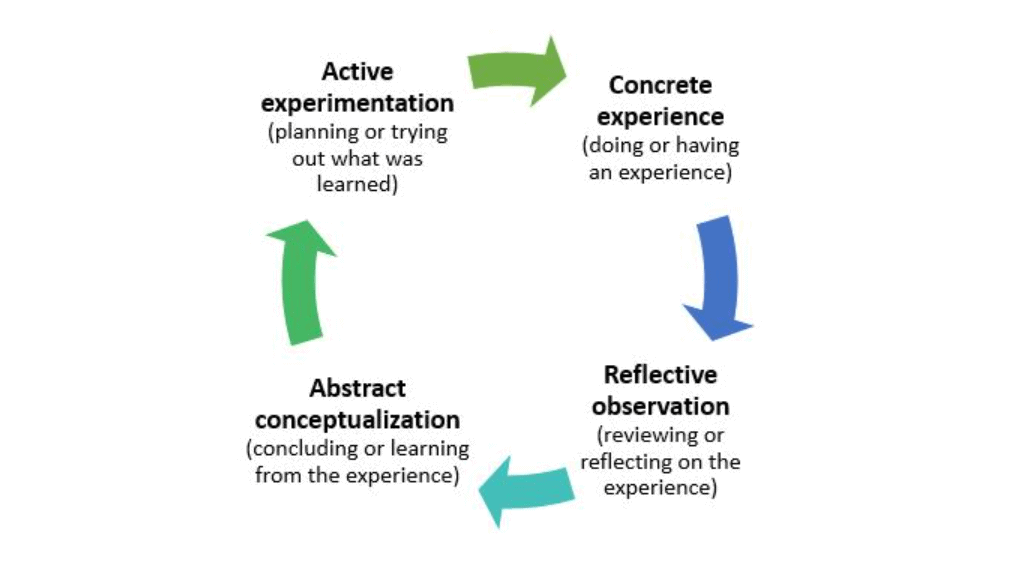
Graphic designed by Educational Technology.
1. Concrete experience
The learner encounters a concrete experience. This might be a new experience or situation, or a reinterpretation of existing experience in the light of new concepts.
2. Reflective observation
The learner reflects on the new experience in light of their existing knowledge. Of particular importance are any inconsistencies between experience and understanding.
3. Abstract conceptualization
Reflection gives rise to a new idea or a modification of an existing abstract concept (the person has learned from their experience).
4. Active experimentation
The newly created or modified concepts give rise to experimentation. The learner applies their idea(s) to the world around them to see what happens.
Kolb developed his four learning styles to illustrate different ways people naturally take in information:
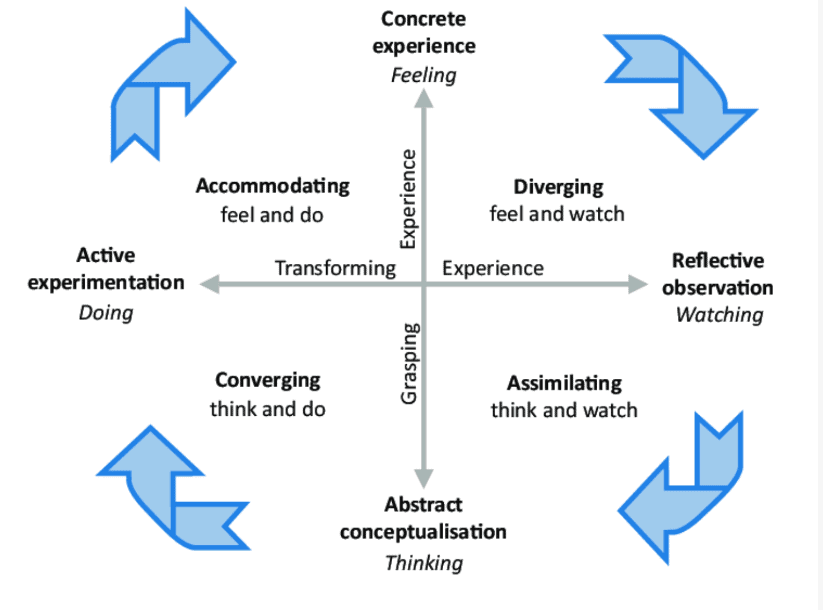
Graphic designed by Educational Technology.
1. Diverging (concrete experience/reflective observation)
Learners who prefer the diverging style are best at viewing concrete situations from multiple perspectives. They prefer to watch rather than do, tending to gather information and use imagination to solve problems.
2. Assimilating (abstract conceptualization/reflective observation)
Assimilating learners prefer a concise, logical approach. They require a clear explanation rather than practical opportunity. They excel at understanding wide-ranging information and organising it in a clear logical format.
3. Converging (abstract conceptualization/active experimentation)
Learners with a converging style can solve problems and will use their learning to find practical applications for ideas and theories. They prefer technical tasks, and are less concerned with people and interpersonal aspects.
4. Accommodating (concrete experience/active experimentation)
Accommodating learners are ‘hands-on’, and rely on intuition rather than logic. They use other people’s analysis, and prefer to take a practical, experiential approach. They are attracted to new challenges and experiences.
The STOP model for live debriefs during the event
The session also discussed the STOP model, which is useful for ‘in the moment’ debriefing (sometimes known as ‘hot debriefing’).
Stand back: take a helicopter view of a situation or problem.
Take stock: analyse what is happening in the moment.
Options: explore options around what you can do differently.
Proceed: step back in and take action. Then assess what impact your new approach has.
The features of a great debrief