New Zealand Rugby’s Mike Anthony lays out why the All Blacks and Black Ferns are always ‘restless’, ‘uncomfortable’ and ‘itchy’.
The former first five-eighth (fly-half), who won back to back Rugby World Cups with New Zealand in 2011 and 2015, was one of a “legacy group” of former players invited in August 2023 to observe the team’s preparations and answer any questions the younger players might have ahead of their World Cup campaign.
“It’s a new bunch and you guys know pretty well that when you finish playing, you get invited back into the changing rooms or the team room and it’s quite awkward,” Carter told former England internationals James Haskell and Mike Tindall on The Good, The Bad & The Rugby podcast.
It was a changing room Carter had shared with a number of that All Blacks squad. “I don’t know if you guys feel it but going back into that environment, you kind of feel like a spare wheel.”
At no point was this the perception of the players, coaches or the All Blacks’ high performance team. In fact, two months later Carter, Keven Mealamu, Richie McCaw, Conrad Smith, and Liam Messam were invited to return at the Rugby World Cup in France, which took place in October and November.
“Talking to our team’s leaders, they got the most from the legacy group because the players are the ones who are having to drive along with that in the environment and the playing group would look up to them,” said Mike Anthony, New Zealand’s Head of High Performance, at February’s Leaders Sport Performance Summit at Melbourne’s Glasshouse.
Here were some of the most-esteemed guardians of the All Blacks culture coming back to reinforce the connection between all those who have worn the jersey.
Anthony continued: “That group had been through adversity. They’d lost World Cups and won World Cups. They knew what it took. The legacy piece for us is important.”
Legacy – a word long-associated with the All Blacks – is crucial in bringing to life the ambitions across the ‘teams in black’ i.e. the All Blacks, the Black Ferns (current women’s world champions) and both programmes’ sevens teams.
Their three core ambitions are:
These ambitions help to plot the path towards a performance culture described by Anthony as “unwavering at it’s core, it’s inspiring, it’s empowering, it’s inquisitive, and it’s responsive to change.”
The last point is critical. “How do you bring it to life day to day and how do you refresh it so that’s it’s relevant to your current group?” asked Anthony. “I’ve observed teams being successful and then they continue to run with what worked before as the group changes. It comes down to induction: how do you make sure your vision is relevant for your current group?”
Here, we unpack how the ambitions of the teams in black are brought to life through their behaviours and habits.
The building of a legacy: the All Blacks have won three World Cups; the Black Ferns have won six of the last seven Women’s World Cups. This enduring excellence burnishes their legacy year on year. “We talk of leaving the jersey in a better place,” said Anthony. “You’re the guardian for a short time, so when you leave it to the next person, you hope to add value.”
A team-first attitude: this is a challenge for New Zealand Rugby as a whole, with the growth of individual brands and the often more lucrative opportunities on offer abroad. Yet New Zealand’s best players invariably remain at home during their peak years to pull on the black jersey. The allure runs deep and it requires selflessness. “You’ve got to be selfless,” said Anthony. “You’re an All Black or Black Fern 24/7 and it’s in the little things you do when no one’s watching. You’ve all heard the analogy ‘sweep the sheds’ – it is genuinely something that our guys do. It’s not the job of somebody who’s paid to clean up after us and we take pride in how we do that.”
A player-driven environment: Anthony explains that buy-in is at “100 percent” amongst the players and that some players “never want to leave” New Zealand. This is in part because the team is intentional in its efforts to encourage players to speak up and contribute to the culture (“you have to create something pretty special to keep players here”) but it is also due to the increasingly creative ways that players are incentivised. “We give guys sabbaticals to go away because we know the money’s good; then we bring them back and that’s worked really well,” said Anthony.
Alignment: it is obvious that no two people are alike but that does not necessarily prevent them sharing a common vision. Said Anthony: “For me, ‘alignment’ is when people understand and are deeply connected to your vision.”
It is also a consequence of effective leadership, which he distilled into several traits while adding the caveat that you have to, above all else, play well. “I think we sometimes burden our leaders and they feel cluttered,” he said. “We want the spine of the team playing well first because, generally, they’re your best players. You have to get the balance right there.”
In New Zealand rugby, leaders embody…
Humility. As Anthony said, “you’ve got to be humble and vulnerable because that’ll encourage others to step into that space and contribute.”
Inclusivity. Anthony felt that although teams want everyone to have a voice, there is too little focus on schooling people in how to give and receive feedback. “If we want our players to challenge their peers, we’ve got to give them the tools”.
A growth mindset. There is always a performance gap; always a challenge. “It’s never about ‘we’ve arrived’,” said Anthony. “That gap creates that discomfort and itch that you want in a high performance environment.”
Ownership. Being an All Black or Black Fern is a 24/7 commitment. Anthony described Richie McCaw as the embodiment of that view. “It’s doing the unseen things,” he said. “It’s easy to sweat, but when you go home, what you’re eating, your sleep, how you present around your family – those are key.”
Finally… he tāngata, he tāngata, he tāngata
Anthony wrapped up his presentation with a whakataukī (Māori proverb):
He aha te mea nui? Māku e kii atu, he tāngata, he tāngata, he tāngata.
What is the most important thing in the world? Well, let me tell you, it is people, it is people, it is people.
“The price of entry is technical knowledge,” said Anthony, “but get the people right and hopefully you can build the right environment for a performance culture that supports the athletes.”
25 Jun 2024
ArticlesThere are some persistent challenges but intentional leaders and their teams can find ways to flourish.
The chances are that for all your fine work fostering a collaborative multidisciplinary team there are challenges you still face daily.
At a recent Leaders Virtual Roundtable, we encouraged members to reflect on areas where there is room for improvement and areas where they have made real inroads.
Some responses, such as limited time, busy schedules and the decentralised nature of some programmes were raised by members time and again but, below, we focus on communal challenges.
Common issues that prevent efficient collaboration
Misalignment of needs, expectations and responsibilities: such issues still endure, as evidenced by the number of members who mentioned the lack of alignment within departments and teams. One mentioned a lack of role clarity and, in turn, knowing with they should collaborate or bring into the conversation at the right times. Some cited the challenge of matching the expectations of individual staff and the collective needs of the team. Others noted situations where there are competing objectives and priorities.
Expertise bias: a Leaders member cited ‘discipline protectionism’, which resonated with most attendees. There are enduring examples of intellectual arrogance from some disciplines or an expertise bias that impacts communication, information sharing and can reduce general curiosity. These are all collaboration killers.
Team makeup: there are several elements here. Firstly, when team members are hired in at different stages there is a natural impact on the functionality of the team. There are also different personalities and communication preferences. Several attendees also noted that some environments are geared towards individuals highlighting their own impact and values as opposed to the greater good of the team.
Other considerations: the leader’s ego; a lack of psychological safety; finding the space and time for reflection; a lack of understanding about what optimal multidisciplinary work looks like.
Potential pathways to better collaboration
Centralised communication: can lead to a higher quality of comms between all stakeholders. Perhaps you can profile your team members and better communicate agreed expectations.
Consistent data capturing: when multiple departments are capturing data consistently, instead of sporadically, it can create more alignment around communication and collaboration with other disciplines.
Humble leadership: the leader or leadership team must be humble enough to accept when change or re-organisation is required. They need the humility to step back, evaluate their approach as a leader, as well as the situation, and enact change. This is where clearly defined needs and a common understanding are useful.
Clear standard operating procedures: a well-functioning system promotes better asynchronous information sharing. If you can outline standard operating procedures for communication between platforms it can prevent key information and messages being missed.
Team structure and role clarity: as a team leader, it’s worth considering the effectiveness of your onboarding and offboarding approach to minimise the impact. Diversity of thought is also essential, but it’s worth considering how to feed this into the design and operation of the team. One roundtable attendee suggested hiring an independent auditor to help outline role clarity, the sharing of best practices and, in general, promoting leadership – in essence, they act as a critical friend. Additionally, discipline or team leaders can create networks within their teams to enable such sharing. Another member explained that they have adopted a ‘team of teams’ approach e.g. a structure based on a ‘constellation’ of smaller teams that work together closely. It has yielded some positive results. Finally, in an effort to encourage a team-first approach, consider how you profile team members and communication of expectations.
What’s missing and what are the further opportunities?
Support for new leaders
How are you supporting new leaders in your teams? Often we see those in technical expertise or ‘tactician’ roles move up to a leadership position but lack the requisite skills to lead effectively. The role inevitably changes, so what are you or we doing to help them ‘lead’ their teams and embed true collaboration?
Robust and thoughtful feedback
Be intentional in creating a robust and thoughtful feedback mechanism that allows for variations of approach. Detailed feedback can support team learning on a consistent and ongoing basis. True, it can be a challenge, but therein lies the opportunity.
Psychological safety and empowerment
How can we better empower people more effectively to take targeted risks within their roles, whilst still feeling safe and secure? There needs to be a team-wide understanding of what psychological safety means and what it looks like in your environment.
21 Jun 2024
ArticlesThe NSWL’s Bay FC and the WNBA’s Golden State Valkyries are two expansion teams and both have women GMs. Here, we bring you the views Bay’s Lucy Rushton and the Golden State’s Ohemaa Nyanin.
In March, Bay FC began their inaugural NWSL campaign to great fanfare.
The club was co-founded by former US women’s national team stars Brandi Chastain, Aly Wagner, Danielle Slayton and Leslie Osborne, who propelled the project from an ambitious idea to a grand reality.
They hired Lucy Rushton as General Manager. Rushton, who was the second woman to serve as GM in MLS when she joined DC United in 2021, spoke at this month’s Leaders Sport Performance Summit at Red Bull in Santa Monica.
Rushton is no stranger to the Leaders stage having also spoken during her time at Atlanta United, whom she joined following excellent spells with Watford, Reading and the Football Association in her native England.
She sat next to another trail blazer, Ohemaa Nyanin, the newly appointed GM of WNBA expansion franchise the Golden State Valkyries, who will join the league in 2025.
Nyanin, a Ghanian-American, had been with the New York Liberty for five years, most recently as Assistant GM, jumped at the chance to bring further basketball prestige to this corner of southern California. She previously served as Assistant Director of the US women’s national team and helped Team USA to Olympic gold in 2016 and World Cup gold in 2018.
The duo delivered insights into how they are shaping the cultures of their nascent organisations; how they’re working or planning on working with their athletes; how they’ve chosen to lead; how they’re supporting their staff; as well as how they’re changing the sporting landscape.
Owners must establish the culture and values
The Bay culture was clear well before Rushton had even accepted her position: everything is about the people, from the staff to the players. The owners want everyone to be B-A-Y. That is:
Brave – the ownership want the franchise to be bold in the industry, pushing boundaries, breaking barriers by being innovative.
Accountable – the staff turn up everyday and are responsible for their actions and drive, and push themselves forward.
You – Bay FC also celebrate themselves as individuals and bring their true authentic selves to work every day.
The three concepts have helped shape the mindset each day and give the staff and players something tangible to hold onto. The organisation’s vision is to be a global sport franchise at the head of innovation and change.
How can these be measured? For Rushton, “it’s the feeling when you go to bed or wake up and how you feel about going to work the next day or that morning”. She believes the staff feel good and know they can influence what is happening; they know it’s a positive environment and everyone is striving for the same things.
Women’s sport should not simply replicate men’s sport
Rushton’s experience of men’s football taught her a valuable lesson. “Coming into a women’s franchise, it’s so important that we understand and appreciate the difference to men’s sport and don’t try and replicate it,” she said. The club has been intentional on that since day one and strives to be people-first, player-centric, and celebrates and promotes good female health.
With Bay midway through their first season, Rushton reflected on how the staff live the values every day. They all want to work hard, but care, kindness, and mutual support are just as critical for an expansion team. You need people who want to be there, who have the grit to go through the ups and downs, but support each other when you might not have the same resources as the teams that are 5 or 10 years old.
“How we approach training everyday and present ourselves to the players gives them energy,” she continued. “Which in turn the players buy into and end up energised and galvanised.” The key is how you present yourself and how you turn up and how you live by the standards that have been set, and the biggest factor is togetherness and collaboration of all departments.
Measure success through environment and collective wellbeing
Nyanin left a household name in the New York Liberty, but her goal is not to merely recreate that team in the Bay Area. Nor does she simply want to recreate the Golden State Warriors (Valkyries co-owner Joe Lacob is also the majority owner of the Warriors). Nyanin wants the Golden State Valkyries to stand alone.
She needs to find people that are interested in a vision of winning championships, in alignment with the ownership group. Success will ultimately be measured in trophies. They are the first WNBA expansion team since 2008, so Nyanin is considering what it looks like to build a successful organisation. She said: “We need to find individuals who are interested in being challenged every day, leaning into the team. Do you want to come to work everyday, and serve the athletes everyday in a way that provides for an innovative space, that provides for us to do what we know we can do, and how quickly can we get there?”
With this question in mind, Nyanin reflected on the qualities she seeks out as the Valkyries hire and write job descriptions. “Being an expansion team means you have to be entrepreneurial. By embracing the unknown can you be empathetic too,” she added.
Rushton asked Nyanin about measuring success from a cultural perspective rather than through championships. In response Nyanin said it is about the climate of the people that come in the door. “When we ask how you are doing they might say ‘I’m fine’ or ‘I’m good’, but if you say ‘how are you doing in the terms of a climate?’; so ‘sunny, or ‘cloudy’, or ‘rainy’ – it adds depth. A way of measuring success is how we can collectively come up with our non-results-based success criteria, how do we make it such so that everyone is sunny?”
For Nyanin, ‘sunny’ doesn’t mean super excited, or super extroverted – you can be introverted but still be sunny. Success is ultimately defined by how the Golden State Valkyries create their own definitions of safety in the workplace; it stems from executives to coordinators, to players, and even changing the way agents and external stakeholders engage with the organisation.
A culture born of diversity
We all know the saying about the best-laid plans, so Rushton and Nyanin spoke of the importance of allowing culture to shape itself. For Rushton, the critical moments are when things haven’t gone to plan. “How you react to things not going to plan is how you create culture. Actions taken in those moments show the players and staff what’s acceptable and what’s not,” she said.
Some decisions have been made that may have impacted performance outcomes but certainly reinforced their culture and values. They might have been a “nightmare” at times, but they’re critical. The backing of the ownership and the Head Coach, Albertin Montoya, helped give Rushton the confidence to go ahead. Showing the group that the leaders are aligned was powerful and gave them the confidence that it was the right thing to do and that the leaders had each others’ backs.
For Nyanin, it is important to give newly-hired executives their own blank slate to contribute to the masterpiece. She said: “If everyone has a different background, you have to listen to their ideas as they’re all coming from different spaces. So it’s still being architected from all different walks and types of cultural differences.”
This means that it’s important to Nyanin to have each executive bring their own unique experience. Through these different experiences and backgrounds the culture develops. This will bring challenges and added work, as you have forces leaders out of their comfort zones. It also means that you have to be willing to think differently.
“It’s like explaining basketball to children, who all ask ‘why?’ People from different backgrounds are going to ask why do we need to execute things this way, and will ask good questions, and bring contributions beyond asking ‘why?’”
In return, Nyanin believes that the athlete will benefit, especially the female athlete who comes with different complexities. “If your own staff can challenge you and ask you why before the athlete does, then you’re giving the athlete a space for them to feel safe to be elite at their sport.”
Athlete care is paramount
What about their appeal to female players? Bay spoke with the potential recruits about player-centricity of club and how they were going to elevate player care. From starting from a blank slate, they were able to accelerate mechanisms that can help with impacting the salary cap through player housing for example. The club emphasised treating them like the athlete they are in comparison to some of their poor experiences in other environments.
In Rushton’s experience, the priorities are very different to male athletes, where pay often dictates the direction of negotiations. With females, it’s about living standards and how the organisation will elongate their career. It’s important to give them confidence in the staff who would give them the best care, medical treatment, and infrastructure. Rushton is proud that, as far as she knows, the players have no complaints about the level of care and how the organisation treats them as female athletes.
On a day to day basis it boils down to two things in her mind. Firstly, helping them be in the best position they can be for the longest time possible and, secondly, to help them live a nice lifestyle outside of football.
This focus on player care resonated with Nyanin, who was pleasantly surprised at the rapid expansion of the NWSL given her own experience of the WNBA. Bringing it back to athlete experience is hugely important because, in WNBA, athlete experience tends to focus on ‘how you do get elite talent to come through?’ Nyanin explained that longevity in the sport is different, although is it changing, because the majority of the athletes play six months in the WNBA and then go and play overseas where the conditions are often worse, but they’re getting paid more money. “Understanding the motivations of the athlete prior to them coming to your organisation and engaging in your space is important,” she said.
Attracting elite practitioners from male sport
How might top level practitioners be attracted from historically better-funded male sports? Both Nyanin and Rushton believe that efforts must be based on the vision, culture and concepts the organisations trying to build.
For the Valkyries, as Nyanin explained, the vision is to “build the best, to be the most elite, to build a space where people feel they’re being heard and their ideas being executed in a way that results in excellence. Why wouldn’t you want to come? How can I create an environment for you to thrive, and how can we do that together?”
Rushton agreed. She said: “it shouldn’t be about the gender. It does matter though – many wouldn’t be right for women’s sport. I want to make you the best practitioner in what you do, and give you the platform to excel in your specialisation.”
New franchises means recruiting for those who are willing to challenge themselves and go outside the box with their thinking. It becomes about finding the people who are comfortable with the associated risk in order to better themselves. Rushton believes they have to “believe that they can go there and make a difference.” Rushton also observed that, “a lot of males would find it refreshing to come to a female athlete team because it’s a totally different environment, with totally different feeling and vibe.”
For Rushton herself, when she moved from men’s to women’s football there were two main factors that drew her in:
How fans contribute to a team culture
There remains another crucial component of a team culture: the fans.
The final moments of the session were used to discuss how both Nyanin and Rushton, and their organisations, are forging connections with their fans. As Nyanin said, fans expect communications, but there are times when you can’t share with them. This is a dilemma considering that the fans are also investing in the franchise and so they deserve communication. It becomes about finding the balance around what to do when things aren’t going well. Working on being honest in their communications so that the fans understand that the leaders and everybody involved is working to solve any issues.
Similarly, Rushton and Bay have been deliberate in how they present the organisation to the fans. The Business Operations team at Bay go to the fans and ask them to bring the energy and passion; to be part of their story. They seek to empower the fans and have them be part of the journey. Bay have gone out to the community, had fans come and watch training, and prioritised outward action in the build-up to launch. People now want to be a part of their journey.
Rushton spoke of how Bay deliberately tell the stories of their players. This means that people become invested in the emotional side of who the player is, so if the team lose a game, the fans are more invested in the person than the result. The outcome is one of which she is proud and the Valkyries hope to emulate. “The fans have fallen in love with the team, despite the record.”
Results will surely follow but, here and now, both women are intent on proving that new women’s sports teams are not only viable but can thrive.
9 Apr 2024
ArticlesIn a recent Leaders Virtual Roundtable, members discussed the enablers and barriers to sustaining a successful culture.
There are a wealth of barriers that work against the creation of strong and positive cultures in high performance.
However, there are also enablers that have served members well in their teams.
This split was in evidence during a recent Leaders Virtual Roundtable when we asked attending members to rate their organisations’ cultures on a scale of 1 (‘very weak’) to 5 (‘very strong’).
While 43% considered their team’s culture ‘strong or very strong’, 14% perceived their culture as ‘weak’, with a further 43% suggesting their team’s culture was ‘neither strong nor weak’.
There is plenty of room for the weak to improve and for the strong to get better too.
Here we explore how to best build, sustain and renew your team culture.
Before we get into that, let’s look at the main barriers.
Poor results. The inevitable starting point. Negative results can lead to a blame culture and, in some of the worst cases, the beginning of a downward spiral. Even teams with good intentions can stall. One attendee said: “we have strong expectations at the start of the season, but as soon as the season starts, there’s lots of grey areas and we find it difficult to upload our expectations and we end up going off in silos.”
Differences of opinion. If there is minimal alignment or collective belief in what matters between the senior representatives of your team then it can be a killer for culture, especially if results begin to go south.
Unconstructive / non-existent feedback. Blame culture is one thing, ultra criticism another, but several members admitted they can struggle to glean feedback from younger generations of athletes in particular. This hinders their team’s efforts to create an environment that is about more than just winning.
A lack of psychological safety. While also recognised as an enabler (see below), is psychological safety truly attainable in a high-performance (and therefore high-risk) environment? The jury is still out for some people in sport.
With these barriers in mind, let’s turn to the positive influences on team culture.
Clarity and alignment: these are by-products of environments that have been able to define, manage and model their expectations – essentially those that take the building, sustaining and reviewing of culture seriously. Get this right and it helps to provide a framework for constructive feedback that extends beyond culture to performance. Moreover, if the performance side of your team has meaningful interaction with the business side (and vice versa), it can enable the different groups to see how their work impacts others and it provides the foundations for wider cultural alignment.
Celebrate positive behaviours: no, this is not a silver bullet but it can work wonders as part of an intentional and consistent approach. “It’s about giving it more than lip-service,” noted one member. “It’s about calling it out when people aren’t meeting expectations but also celebrating culture in action.” Crucially, this practice is not results-based. It separates the desired behaviours from the performance outcome.
Storytelling: this is a useful tool for instilling purpose, inducting new athletes, and enabling periodic cultural resets. There is a tendency to fall into the trap of not renewing your culture at the end of a natural cycle and basing your work on the assumption that everyone knows where they need to be. Yet sport is transient in nature and the central cast is continually changing. Meet that challenge by giving your athletes, old and new, the opportunity to write the next chapter of your story. Storytelling can build connections and help people to explain where they see themselves and how they want to be known both individually and collectively.
Let’s wrap up with some key questions to ask yourself:
Who are your cultural leaders? They need not be your head coach – in fact they may be the wrong person – it is important to identify and empower your cultural architects, whoever they may be. They will be able to ensure you are consistently celebrating positive behaviours.
Are you hiring the right people? One attendee shared they would rather have the “right” person doing the job not quite as well than the “wrong” person having the skill and competency but continuously undermining the collective.
Do your people feel they belong? Belonging is a significant enabler and comes from psychological safety, where individuals feel safe to take interpersonal risks. These dynamics play out differently in each environment. How it looks in your environment is for you to determine. One attendee, for example, suggested that female athletes need to feel they belong in order to play well, while male athletes need to play well in order to feel like they belong.
As this session of the Leadership Skills Series demonstrated, we can all become better leaders by developing trusting relationships.
For the latest edition of our Leadership Skills Series, we explored the art of persuasion. All leaders in sport have the potential to influence others’ thoughts, feelings or actions through effective communication and interpersonal techniques.
The session highlighted four related areas of focus.
Trust is rightfully acknowledged as the cornerstone of effective leadership and the foundation of relationship-building. To unpack all of that we turned to the Trust Equation. It is a conceptual formula used to describe the components that build trust in professional and personal relationships. It’s often represented as: 
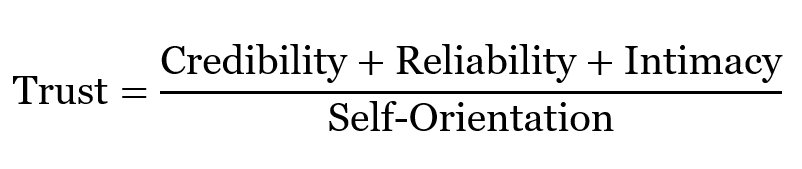
This is what each component means:
Credibility speaks to words and credentials. How authentic are we?
Reliability is the perception of a person’s integrity. Do you do what you say? Are your actions connected to your words?
Intimacy involves the feeling of safety or security when sharing information with someone. How safe or secure does the client or colleague feel in sharing with us?
Self-orientation reflects the degree to which a person’s focus is directed towards themselves as opposed to being focused on others. What are our motives? For our benefit or the benefit of others?
The higher the numerator (credibility, reliability, intimacy), the greater the trust. Conversely, the higher the self-orientation, the lower the trust. Ultimately, the equation serves as a mindful tool to enrich discussions, elevate trust levels, and deepen relationships within our teams.
When leading a team or a department, it matters how you are perceived by others. The ability to self-assess your personal status is another strategic tool wielded by seasoned leaders to convey confidence and authority. It includes an assessment of your:
Such elements can be ranked on a scale from 1 (‘low status’) to 10 (‘high status’) and, when done sincerely, this can be an invaluable guide for navigating various workplace scenarios and can even foster emotional intelligence, which is pivotal in forging genuine connections with athletes and team members. It can also facilitate the development of more impactful leadership skills that inspire and motivate with greater efficiency.
Flows of logic are the pathways our minds create to connect ideas and evidence to reach a reasoned conclusion. They are essential in critical thinking, problem-solving, and, of course, forming persuasive arguments. Flows of logic involve a sequence of statements or steps that follow one another in a rational and coherent manner. These frameworks can take three different forms, depending on your scenario:
These can be indispensable guides when constructing persuasive arguments. By grounding our narratives in these logical flows, we enhance storytelling capabilities and foster deeper connections with our teams. This pragmatic approach ensures proactive, relevant support while avoiding unnecessary complexity, thereby maintaining clarity and engagement, particularly in high-pressure situations where decisive leadership is paramount.
If you can put those three factors together then you can be better at delivering your message. Mindful communication is another tool upon which you can rely. This idea urges leaders to remain present and deliberate when communicating. It can help a person to:
The members in attendance discussed the success and failure of these elements in the context of people that ‘think to speak,’ and those that ‘speak to think’.
Here are some effective mantras to keep in mind:
Final reflections
As members reflected on the transformative potential of incorporating these persuasion techniques into their leadership repertoire, they described the following as essential steps towards mastering persuasiveness in your leadership approach:
Our Leadership Skills Series turned its attention to the people at the heart of cultural change and the steps they can take to become more skilled as architects of their team’s culture.
We revisited the definition of culture, explored a newly formed hypothesis around sustaining high performing cultures and discussed six levers for leading a culture.
What is ‘culture’?
To frame our conversations, we revisited the definition of culture to set the tone for the insights that followed. It’s fair to say that culture does have a multitude of definitions but the ones we landed on as part of this call were:
‘The norms of behaviour and thinking that influence how people behave in a given group’.
‘Culture emerges as a result of the behaviours that are encouraged, discouraged and tolerated by people and systems over time’.
Four core components of sustained high performing culture
As part of our roundtable conversations, we had the opportunity to explore the latest research into sustained high performing cultures and took the opportunity to learn from organisations that have made genuine progress.
The research hypothesised that if you can excel in these four areas – purpose, belonging, psychological safety and cultural leadership – you are in an excellent position to drive, influence and sustain your organisation’s culture.
To bring these areas to life for our members, we ran a series of interactive polls at the table to score on a scale of 1-5 how well we think our organisations do at these four different elements. The data from the polls are as follows:
We asked: to what extent are people in your environment motivated to serve a purpose that feels bigger than them?
We asked: to what extent does everyone feel valued, a sense of belonging and safe to be themselves?
We asked: to what extent do people feel safe speaking up and challenging each other?
We asked: to what extent is their shared ownership for our culture from staff and athletes?
This poll highlighted that there is a lot of development work and intent required to drive our cultures forward.
The six levers needed to lead a culture
What are you keen to pay more attention to in strengthening your culture? As we came to the end of the skills session, we explored six key levers for leading culture and, specifically, cultural change.
For any individual, a message needs to be heard at least six times for you to take it in. That message needs to be continually repeated, so if the principles are sticky, they naturally become easier to remember. Think about your straplines or strategy and reflect on if they meet that level of ‘stickiness’. A good example from the Olympic world is the question: ‘will it make the boat go faster?’
This is the classic example of ‘words on the wall’ versus living the values. If the leaders and cultural leaders really model those behaviours, it’s what people will experience and lead by. When we consider inclusive leadership, the research shows that leaders can influence the people, the athletes, the organisation around them by up to 70% with their behaviours.
Constantly reviewing your organisation and your culture to make sure you are reflecting on where you are. Ask yourself: where are our gaps? Where are our strengths? How can we improve?
You can use a system rating scale from 1-4 to guide some of these insights. These system rating scales create an opportunity for those culture conversations to emerge in how they provide insight into the health of the culture at a specific moment in time.
One attendee shared they had invested a lot of time around the theme of psychological safety. As an example, if you want to go after psychological safety as an organisation, one of the key skills that underpins psychological safety is enabling people to speak up. Providing these opportunities supports the intent to make positive change.
Feedback is so critical. One of the things that we see happen in a large percentage of organisations is that people don’t deliver skilful feedback; and feedback can feel quite personal. Therefore, it’s about creating that feedback loop and that culture of what we call ‘skilled candour’, so that people are able to deliver feedback in a skilful manner.
When engaging in culture change, do you have the right people in the environment? Ultimately, it may come down to a time when you have to make a decision as a leader about getting the right people on the bus.
We bring you insights, reflections and a range of tips from the Brisbane Lions, San Antonio Spurs, Melbourne Business School and beyond.
An article brought to you by our Event Partners


The renowned leadership consultant was onstage at the Leaders Sport Performance Summit at Melbourne’s Glasshouse speaking about her book The Leading Edge, in which she proposes a framework for leadership based on notion that when we are able to lead ourselves we are better equipped to steward others through periods of change and development.
An audience of more than 200 Leaders Performance Institute members sat with rapt attention as Ransom joined coaches and leaders from organisations including the Brisbane Lions, San Antonio Spurs and Melbourne Business School, all of whom laid out how they are working to ensure their people can navigate the shifting sands of high performance in years to come.
“Research suggests some of the most in-demand skills by 2030 will be how we work together, connect, and build empathy,” Ransom continued.
Here, in light of those skills, we explore eight ways those who took to the stage are working to future-proof their teams.
The recent renaissance in Australian cricket – the men’s and women’s teams are reigning world champions across four different formats – has not been a happy accident. Andrew McDonald and Shelley Nitschke, the head coaches of the men’s and women’s teams respectively, stressed the need for thorough performance planning, skilful execution and finding the space to pick up lessons along the way.
Andrew McDonald, Head Coach, Australia men’s cricket team
Shelley Nitschke, Head Coach, Australia women’s cricket team
Next steps:
Burnout is a universal problem, with New Zealand and Australia suffering some of the highest rates in the world, according to leadership consultant Holly Ransom. She argues that while stress is inevitable, and can be abated, burnout can be entirely avoided. In her view, the conditions necessary for eradicating burnout stem from empathetic leadership and, when a leader adapts their habits, it gives permission for others to do the same.
Holly Ransom on the notion that we can’t sustain leadership, without leading ourselves first.
Next steps:
1) Complete an energy audit – when are our natural highs and lows in a day, and how are we using them?
2) Establish your building blocks – do the little things that help you build momentum.
3) Set your micro-breaks – take time to get mini hits of new energy.
Kit Wise of the Royal Melbourne Institute of Technology [RMIT] and Budi Miller of the Theatre of Others, an innovative performing arts company, were invited onstage to share their approaches to fostering creativity and risk-taking in their environments.
Professor Kit Wise, Dean, School of Art, RMIT
Budi Miller, Co-Artistic Director, Theatre of Others
Next steps:
The New Zealand All Blacks and San Antonio Spurs are worlds apart in sporting terms but share numerous commonalities when it comes to bringing to life and sustaining a winning culture. Beyond results, both are renowned for creating environments where people and innovation flourish, as the All Blacks’ Mike Anthony and Spurs’ Phil Cullen explained.
Mike Anthony, High Performance Development Manager, New Zealand Rugby Union
Phil Cullen, Senior Director of Basketball Operations and Organizational Development, San Antonio Spurs
Next steps:
New Zealand Rugby have identified five factors that enable their group to flourish:
1) Connection – players take pride in serving their community.
2) Balance – the group looks for learning, stimulation and edge.
3) Fun – a big part of balance.
4) Learning – athletes learn by doing; so what environment will facilitate the best learning?
5) Family – the organisation has worked to bring families in while also helping them to understand the expectations of an athlete in high performance sport.
The Spurs have their three core values:
1) Character, which is based on values.
2) Selflessness, which is culture-focused.
3) ‘Pound the Rock’. A metaphor inspired by 19th Century Danish-American social reformer Jacob Riis. His Stonecutter’s Credo perfectly captures the Spurs’ drive for championships:
“When nothing seems to help, I go and look at a stonecutter hammering away at his rock perhaps a hundred times without as much as a crack showing in it. Yet at the hundred and first blow it will split in two, and I know it was not that blow that did it, but all that had gone before.”
The Stonecutter’s Credo, Jacob Riis
The Brisbane Lions men’s team, under the stewardship of Senior Coach Chris Fagan, have in recent years returned to prominence for the first time in a generation. Amongst the factors responsible for their rise is their ability to out-learn their opponents, as High Performance Manager Damien Austin explained.
Damien Austin, High Performance Manager, Brisbane Lions
Next steps:
Models for change are all good and well – change is inevitable, so perhaps they are entirely necessary – but what are some of the so-called ‘soft’ factors that enable a leader to influence change? Professor Jen Overbeck was on hand in Melbourne to dispense some tips for explaining and justifying change to others.
Jen Overbeck, Associate Dean, Melbourne Business School
Next steps:
Wellbeing and performance are indivisible, yet there is more we can all be doing to ensure our people can flourish. At the Glasshouse, Emily Downes of High Performance Sport New Zealand and Sonia Boland from the Australian Institute of Sport provided an insight into their work helping people to thrive amidst the challenges presented by high performance sport.
Emily Downes, General Manager – Wellbeing & Leadership, High Performance Sport New Zealand
Sonia Boland, National Wellbeing Manager, Australian Institute of Sport
Next steps:
As women’s sport continues to evolve, the system will need the athletes and the coaches to fill the spaces created. Given the hitherto piecemeal approach to developing women’s sport, and the often misunderstood differences between men and women athletes, this is far from a given. Helene Wilson of High Performance Sport New Zealand and Tarkyn Lockyer of the AFL are two individuals meeting this challenge head on.
Helene Wilson, High Performance Sport New Zealand
Tarkyn Lockyer, Australian Football League
Next steps:

Bobby Scales lays out areas where sports routinely fall down when it comes to diversity, equity and inclusion.
Inevitably, the player makes a poor play in a game or practice and their coach, typically an American, will need to correct the mistake.
The coach finds that the player will not look them in the eye and feels disrespected because, in American culture, you are taught from a young age to look a senior person in the eye and you say ‘yes sir’, ‘yes ma’am’, ‘no sir’, ‘no ma’am’.
By contrast, in Latin culture, you do not look your elders in the eye when they are correcting you.
There is a mutual misunderstanding that does little for team unity and does nothing to further the cause of diversity, equity and inclusion.
Teams are increasingly aware of this. When I worked at the Los Angeles Angels, we considered it important to take American coaches to the Dominican Republic, to let them immerse themselves in the culture at the academy and work with the players. We wanted them to understand what life looks like in the Dominican; to better understand how these young men grow up.
Equally, Latin American players need to be afforded the grace to learn the social norms of the United States.
This mutual understanding is the key to weaving the fabric of team unity and success.
So how can we better embrace diversity, equity and inclusion? Here are four thoughts.
1. Don’t be afraid of the conversation
No team is perfect and we could all be doing more to further the cause. But are you ready to have the conversation? It may sound obvious but people are often too afraid of the conversation for fear of saying something wrong or fear of being canceled. The benefits of diverse teams are clear in the world of business and sports has started to take note. But would you be comfortable or promoting, say, a female coach in a male-dominated environment? Is it within your gift to go against the grain and make what may be a counterintuitive appointment? To reach that point, a leader must construct an environment where people understand that players, coaches and practitioners are here because they are the best possible person to be in their position. I would rather lose with players that have a growth mindset – and I don’t think you’re going to win with players that have a fixed mindset anyway. There’s not a player on earth worth their salt who does not want to get better. They will listen to an individual if they have cultivated a relationship. For a complete culture, you need to have coaches and staff members that are aware of this, who feel supported.
2. Don’t get bogged down in the obvious differences
I am a 46-year-old black man and I could be sitting in a front office next another 46-year-old black man, but we could have grown up in different circumstances and, as such, we will bring different experiences to the table. As important as ethnic, religious and gender diversity are, they may not necessarily lead to diversity of thought – cognitive diversity. Someone in your team may have grown up on a council estate in a tough part of London and another may have grown up in Beverley Hills, California, and had people who worked in their house and they’ve never made their bed. Perfect: LEAN INTO IT! People from different walks of life, socio-economic backgrounds, and different cultures will come to a problem on the table in a different way. Perspectives – different perspectives – are exactly what I, as a leader, want. This allows for constructive dissent, which is where the best outcomes lie. When you have people who are willing to disagree with each other you will have a richer conversation. It’s then up to the leader to pull those opinions together, form a consensus, and move forward with an outcome or a solution that is beneficial to the team.
3. Identify the individuals in your team who are underserved
You have to cultivate relationships – they are way more important than the X’s and O’s, tactics or data. As well-known American football coach Herman Edwards once said: YYP – Know Your Personnel. A leader must know how to access them even if it isn’t the leader directly. Maybe it’s an assistant coach or a practitioner on your staff who has built a trusting relationship with the player. Again, lean into that. There is a certain truth to the idea that the physio knows everything that’s going on. I’m a big believer in authenticity and people will reveal themselves to you if your environment is one of support, warmth and truth.
4. Find opportunities to learn… then teach people!
Do you celebrate cultural milestones and holidays? You should, because they represent an opportunity to teach people from other cultures about that culture. For example, if there is a Muslim player in your mostly non-Muslim team, and you’re playing during Ramadan, there is an opportunity to educate your other players and coaching staff on what that means for that player and their faith. A crucial point to make: before even reaching that point of cultural exchange you yourself as a coach or executive are going to need to get stuck in and commit to proper research for yourself – you cannot teach that which you yourself do not know. Manage this process well – within an environment of support, warmth and truth – and you’ve brought your team closer together.
31 Jan 2024
ArticlesBen Baroody tells us the World Series winners needed to find values that meant something to everyone in the organization.
Culture often precedes results
The Texas Rangers’ transformation under General Manager Chris Young and Manager Bruce Bochy saw them go from 102 losses during the 2021 Major League Baseball season to the World Series just two years later. Bochy, for one, could not have enjoyed a more successful first campaign in Arlington.
It is tempting to attribute part of the turnaround to the organization’s increased focus on personal development, particularly when Ben Baroody was promoted to Director of Leadership & Organizational Development, Player Enrichment Programs, and Mental Performance in November 2021. But the truth, as he told us himself, is that the groundwork had been laid for years by the staff, coaches and players independently of on-field results.
“I’ve been here nine seasons and there have always been a lot of positive elements to our culture,” Baroody told the Leaders Performance Podcast in January.
The team did, however, revisit their values in light of that 2021 season. Baroody continued: “It came down to refining our core values – who we are and what we represent, how we live out those values – and [establishing] a belief in what we can accomplish together when everyone has a clear picture of what those priority values are. [Then] it’s easier to embody them and be held accountable to them. We know what matters most and what we are working towards.”
The Rangers values include “be a good teammate”, “compete with passion” and “dominate the fundamentals”. “On the surface they seem over-simplified but they mean a lot and can be applicable in a lot of different ways.”
Your values need to be reinforced daily
Too often teams fall prey to the words they stick on the clubhouse wall and the Rangers were no different in the past. “We’ve been victims of that,” said Baroody. “I think that every organization is.” One solution, he added, is continuous reinforcement “through meetings, through presentations, through discussions – they aren’t just on a wall somewhere – they are truly part of how we operate, they are included as we constantly evaluate our decision making and in our evaluation of personnel, both players and staff. They are the main component of our performance reviews from a staff standpoint.”
Values, when they are perceived as meaningful, can be applied by people on a 24/7 basis. “You can boil them down to the most obvious application, but when you think through how you’re structuring your day, how you’re structuring your week, your season, your lifestyle. They can be applied 24 hours a day and we’ve tried to really live them out and not be selective in when we embody them,” Baroody said.
They should resonate beyond your sport or competition
The Rangers’ values are defined by all domains of the organization. “We all have clarity into what they mean for us personally in our different sub-departments,” said Baroody. The same goes for staff and players. In fact, it is a fundamental development exercise for young players at the Rangers’ minor league affiliates. “We’ve put it to them to speak amongst themselves, have collaborative discussions, to create the definitions around those [values] and to set forth the behaviors that exemplify those values.”
At a staff level, “it comes down to simplicity and clarity in having values that are applicable to everyone in the organization whether you’re a player, whether you’re a scout, whether you’re a coach, whether you’re an analyst – you know what it means to the organization as a whole.”
Even if you’re a non-playing member of staff you’re still “leading with a competitiveness. The communication and collaboration and care you have for others – that’s how you’re exemplifying being that good teammate.”
It doesn’t end with winning
The process did not end with the Rangers’ World Series victory in November. “It reinforced we’re on the right track with culture,” said Baroody. However, “as soon as you think you have it figured out, you’re close to being humbled.” The word ‘culture’, as he explained, has its roots in agricultural cultivation. “[Your culture] has to be cultivated so you’re always going to have to pull some weeds and tend to things, and give it water and give it sunlight. It can’t be stagnant.”
Therefore, he does not perceive a hunger issue as the team prepares for Spring Training. “There’s pride, there’s accomplishment, there have been celebrations, but there’s definitely not been contentment and our focus is on building on 2023 with a competitive focus on 2024 and beyond. And I think that in itself is a good insight into who we are and who we aim to be and what we try to represent.”
Listen to the full interview with the Texas Rangers’ Ben Baroody:
Listen above and subscribe today on iTunes, Spotify, Stitcher and Overcast, or your chosen podcast platform.
15 Jan 2024
ArticlesHelene Wilson led the Northern Mystics to the ANZ Premiership in 2021 but not before taking her playing group on a individual and collective development journey.
“Working in netball, in a woman’s environment, and coming from a background of being a teacher, I think that learning is incredibly important,” she told the audience at September’s Leaders Meet: Driving Step Change in Female High Performance at Manchester’s Etihad Stadium.
“And how do we create an environment where high performance comes from out-learning your opposition and people are on a journey together to get there?”
Wilson, who currently serves as Manager of High Performance Sport New Zealand’s [HPSNZ] Women in High Performance Sport programme, was primarily at the Etihad to discuss her five years as Head Coach of the Northern Mystics, a netball team in New Zealand’s ANZ Premiership.
She took the Mystics’ reins in 2017 and would eventually lead the Auckland-based franchise to success in the 2021 Premiership Grand Final, ending their 24-year wait for a national championship. But not before the team bottomed out in 2019. “We were the wooden spooners,” she said.
The team had performed promisingly in the preceding seasons but, in 2018, the unforeseen departure of goal shooter Maria Folau due to personal reasons left the Mystics underpowered. It showed on the court and Wilson admitted that she was perhaps fortunate to retain her job at one stage given the turmoil behind the scenes, “but the players wanted to come back and play for the team because they believed in what we were trying to do.” Two years later they were champions.
Beyond reaching and winning a Grand Final, Wilson and the Mystics wanted to rewrite the history of netball underachievement in New Zealand’s Northern Zone, where Wilson coached the sport for three decades.
“The Northern Zone has the biggest number of participants in netball – a third of our netball-playing population is there. There is also a population of ethnic diversity, age diversity, socio-economic diversity,” she continued. “We had 17 netball centres across that area and I inherited a narrative over that time that we’re talented – more than anyone else – but it’s actually a curse in high performance because that doesn’t matter.”
There had, according to Wilson, been a history of disharmony in the Mystics ranks. “The landscape of where we come from, and thinking about the land, it was actually quite disjointed. Auckland, our biggest city in New Zealand, is groups of little villages that are quite insular and quite different to each other. And we were also sitting on volcanoes and literally it was pretty explosive the way we used to behave.”
By the time they won the championship in 2021 and went close again the following year, this was a team transformed. “We won the Premiership after 24 years of trying, but really the learnings, what happened between 2017 and 2019 and up to 2021 was massive and it’s not just about me and what I did – it was about what we did together.”
Finding energy and bringing clarity to the changing room
The “catalyst for change”, as Wilson describes it, was her involvement in HPSNZ’s Te Hāpaitanga: Women in High Performance Sport Coaching Initiative. Its pilot programme ran in 2019 with Wilson serving as a mentor to women applying to be high performance coaches.
The cohort visited a ‘marae’, a Māori meeting ground, of which the focal point is the ‘wharenui’, the communal house where people meet. A wharenui, with its ornate wooden carvings and elaborate design, is steeped in Māori metaphor. It provides a space for collective, inclusive, reflective practice (‘Rongo’ in Māori) that enables people to reengage with problems in the world beyond (‘Tū’) having formed a consensus on the best solutions.
“There is an energy about it,” she said. “The process and energy is like a coming together and moving apart in a state of clarity, which is collectively built together. The process of ‘Karakia’ – transitioning from one realm to another – takes us from the worlds of Tū and Rongo.”
It was a cultural element that resonated first with Wilson then with her playing group. “You don’t need to know it’s Māori,” she said. “If I stood at the front and tried to be Māori I think people would think I’m a fraud and I’ve got to be respectful, not being Māori, but having a deep understanding because I do come from New Zealand.” Wilson encourages coaches working in other regions or nations to find the cultural artefacts that are authentic their groups. “There’s stuff around us everywhere that you can apply in different ways and it’s the framework that is key.”
Coming away from the pilot programme, Wilson drew on the work of corporate anthropologist Michael Henderson who wrote a book in 2014 entitled Above the Line. According to Henderson, people will come to a team with their own beliefs, which play out as behaviours. People’s values are born of their beliefs and behaviours and, in a team setting, these all help to construct the group’s collective behaviours. These eventually become the team’s culture.
At the Mystics, group behaviours tended to be a product of the disharmony that denoted the team’s decades of under-achievement. The group would seemingly generate a lot of heat but not necessarily much light.
It ultimately comes down to the leader. “The mistake we often make is starting at values rather than giving space for beliefs to be heard,” said Wilson. The trick was to create a space where everyone felt empowered to share their beliefs. “We came together as a group and said ‘everyone’s a leader. The standard we walk past is the standard we are prepared to accept’ and it’s super important not to walk past unacceptable standards. So we redefined our environment so that everyone on our team was a leader and ‘leadership’ was simply our actions and our behaviours. It wasn’t the role or the position we were given.
“We needed to have a better understanding of what being valued and contributing to value looked like and how that would affect performance. So there was intense learning at this time because the players wanted to be a leader but there needs to be clear evidence of what that means for performance – and intense learning is how do we care, listen and bring those diverse opinions to the table, as well as skillsets the people bring. I think we learned that together as staff, performance experts and players.”
Learning from the ‘moment of truth’
In his 2021 book Belonging, Owen Eastwood cited Harvard professors (the late) Richard Hackman and Ruth Wageman, specifically their renowned 2008 publication on corporate leadership teams entitled Senior Leadership Teams: What it Takes to Make them Great. ‘Of all the factors we assessed in our research,’ they wrote, ‘the one that makes the biggest difference in how well a senior leadership team performs is the clarity of the behavioural norms that guide members’ interactions’.
It was on Wilson and Sulu Fitzpatrick, who was appointed as the Mystics captain in 2021, to create the right environment. “We were trying to learn what stuff we will deploy in that circumstance to ensure that the collective performance outcomes we needed were going to happen. In the Māori world we call this ‘Kotahitanga’. ‘Ko’ meaning a central point’; ‘Tahi’ meaning one; ‘Kotahitanga’ meaning collective unit.”
For the Mystics, Kotahitanga meant reaching a consensus through ‘Wānanga’. “It’s a word that means coming together and meeting to discuss, collaborate and consider,” Wilson told the Etihad audience. “It could look similar to a team meeting but it can take many forms and Wānanga happens in many ways. Conceptually, it happens in the world of Rongo; you’ve got to go deep. At a Wānanga, I put a concept on the table, a picture of performance that I may see as a head coach, or someone else may put it there depending on who’s taking a lead that day, and the Wānanga takes the form of questions, from multiple perspectives, and we keep going until we get some sense of alignment. It doesn’t come with any level of expertise or experience, it comes with everybody’s level and everybody contributes.”
The Mystics would typically hold a team-wide Wānanga once a week and any time the group deemed one necessary. Wilson’s role was to ensure: “enough creative tension in the room to drive performance and shift performance but also making sure that people were able to learn the art of listening, hearing, weaving different perspectives and energy that people brought to the Wānanga.
“Wānanga can get heated, it can be soft and gentle, it can be all of those things, but Wānanga is about is that you sit there in the world of Rongo until you get it done. Sometimes we had training or practice [in the world of Tū] straight after and we were running late because the Wānanga is more important than the physical practice – practice had to happen whenever it needed to happen based on the Wānanga.”
Wilson explained that there were three broad categories of people, characterised through their ‘energy’, who would join a Wānanga: people who connected to others from the heart, those who had insight from their intellect, and people with the drive and willpower to perform. “My shift as head coach was to connect to those three levels of care of where I was with an individual.”
It was not easy. At first, there was a lack of intent, decisiveness and the results did not necessarily translate into performance. “I think setting this up was one of the most challenging things I’ve ever done and one of the spaces where I learnt so much as a coach.”
Crucially, the group bought-in, even after the underwhelming 2019 season and the disruption of the pandemic. In time, the group developed its own lexicon, which included the term ‘moment of truth’, meaning a reference to the key moments in a match as defined by players and coaches individually, who would then weave their ‘moments of truth’ together in a Wānanga. “We would stay there until we were ready to define the moment of truth that was going to give us the greatest learning going forward.”
As she said, it was not always Wilson who led the Wānanga. She recognised the need for others to take the lead in order to feel that they belonged and that their input was valued. ‘We look for proof of our values from our leaders,’ wrote Owen Eastwood in Belonging. ‘We do not want our leaders’ personal beliefs forced upon us – we want our tribe’s authentic values articulated.’
That is where Wilson felt the key knowledge sat in any case. “My learning was to sit at the back and know that my knowledge was not sufficient; that the knowledge was in the room and I was there to sense the problem and the Wānanga would sort out what the problem was. I needed to be the last one talking in the room.”
In Part II, we explore how the coaching staff helped the Mystics players to transfer their personal and collective development to the court.