Head Coach Chris Fagan laid the foundations for the Brisbane Lions’ 2024 AFL Grand Final success with three big steps.
Their premiership success was not a bolt from the blue – they had reached the Grand Final a year earlier – but it was a far cry from the 18th place finish the Lions managed in 2017, which was Fagan’s first campaign at the helm.
He appeared at the 2023 Leaders Sport Performance Summit in London – just weeks after Brisbane narrowly lost the Grand Final to Collingwood.
There were no guarantees that they would make the decider again in 2024 but Fagan, who had his doubters in Australia, transmitted confidence from the Oval stage. “Last year [2022], we lost the preliminary final by 71 points. A lot of people said we wouldn’t recover from that,” he said. “This year, we made a Grand Final and lost it by four points. I said to the players, ‘we’re getting better, we’re getting closer. We’ve been the most successful team over the last few years. Be proud of that. The team we played in the Grand Final is older and more experienced, so that’ll be good for us.”
So it was to prove. But the focus here is those early years, when Fagan worked to turnaround a faltering team. It was only in year three, when the team jumped from 15th to 2nd in the AFL ladder, that his methods were vindicated by points and victories.
There were three factors that underpinned Fagan’s approach.
In 2017, Fagan arrived with his vision for a high performance culture. In outline it bore some familiar features:
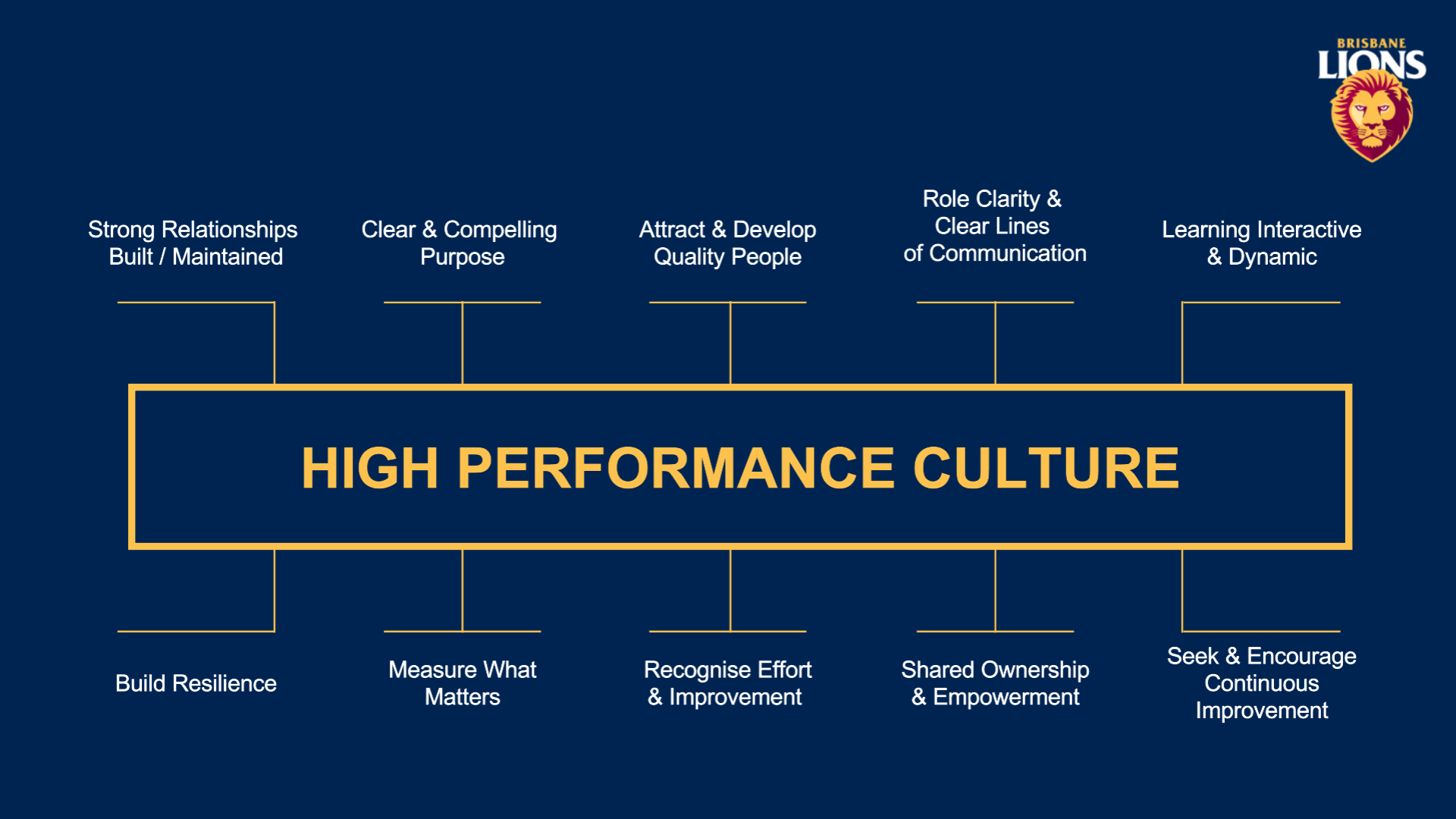
But in order to deliver this through a strategic plan, Fagan needed everyone onside. It wouldn’t be easy in what had become a “poor bugger, me” environment. “I discovered that many of our players preferred to be in rehab than to be actually playing – it was safer there,” he said.
Over the course of four weeks he solicited the views of every player and member of staff. “I wanted to send a message to everyone at the club that they would be listened to, that it wasn’t just me coming in and telling them what was going to happen,” he added. “I wanted to find out what they thought the club needed to do to become better because they needed to be partners with me in the process. I think they appreciated that because they hadn’t had a process for a long time. They’d just been told what to do.”
This brought him trust and credibility during those first two seasons when there was barely a flicker of improvement in scoreboard terms.
Fagan is a big believer in high challenge, high support for players in pursuit of their goals. The challenges were plain to see in 2017, and the first measure of support came from Fagan himself. “I see myself as the chief energy and psychological safety officer,” he said onstage. “I want to build an environment where the players and staff feel trusted and motivated, because that certainly wasn’t the case when I turned up.”
Even as the poor results endured, the team’s morale did not falter. “You’d have said we were the happiest bunch of losers during the early years,” says Damien Austin, the club’s High Performance Manager. “We celebrated everything because we were such a young team.” That included winning quarters of games, strength gains or running PBs in training. “We were always striving for progression,” he continues. “And if there wasn’t progression there’s a reason why, and I think like any young kids today, you’ve got to take them on a journey.”
It chimes with Fagan’s emphasis on growth mindsets and, as a former teacher himself, the importance of learning day in day out. As ever in a Fagan team it comes with a human face. His list has a WhatsApp group chat called ‘Moments of greatness’ where players celebrate examples of their teammates setting new standards.
AFL veteran Luke Hodge joined the Lions’ journey for Fagan’s first two years. The new coach’s first big recruitment decision was to bring in the man he regarded as “the greatest captain to ever play the game” from Hawthorn, the club from which Fagan himself had joined Brisbane.
“He was well and truly at the end of his career,” said Fagan of the four-time premiership player. “But I just wanted somebody to come in and role model great leadership to a young group of players.”
Additionally, Fagan worked with leadership consultant Simon Fletcher to devise a leadership development programme for senior and emerging leaders. “The first thing he did was establish a trademark, which was a reference point for leadership.”
To this day the Lions’ trademark is built around the concepts of ‘brotherhood’, ‘heart’ and ‘selflessness’:
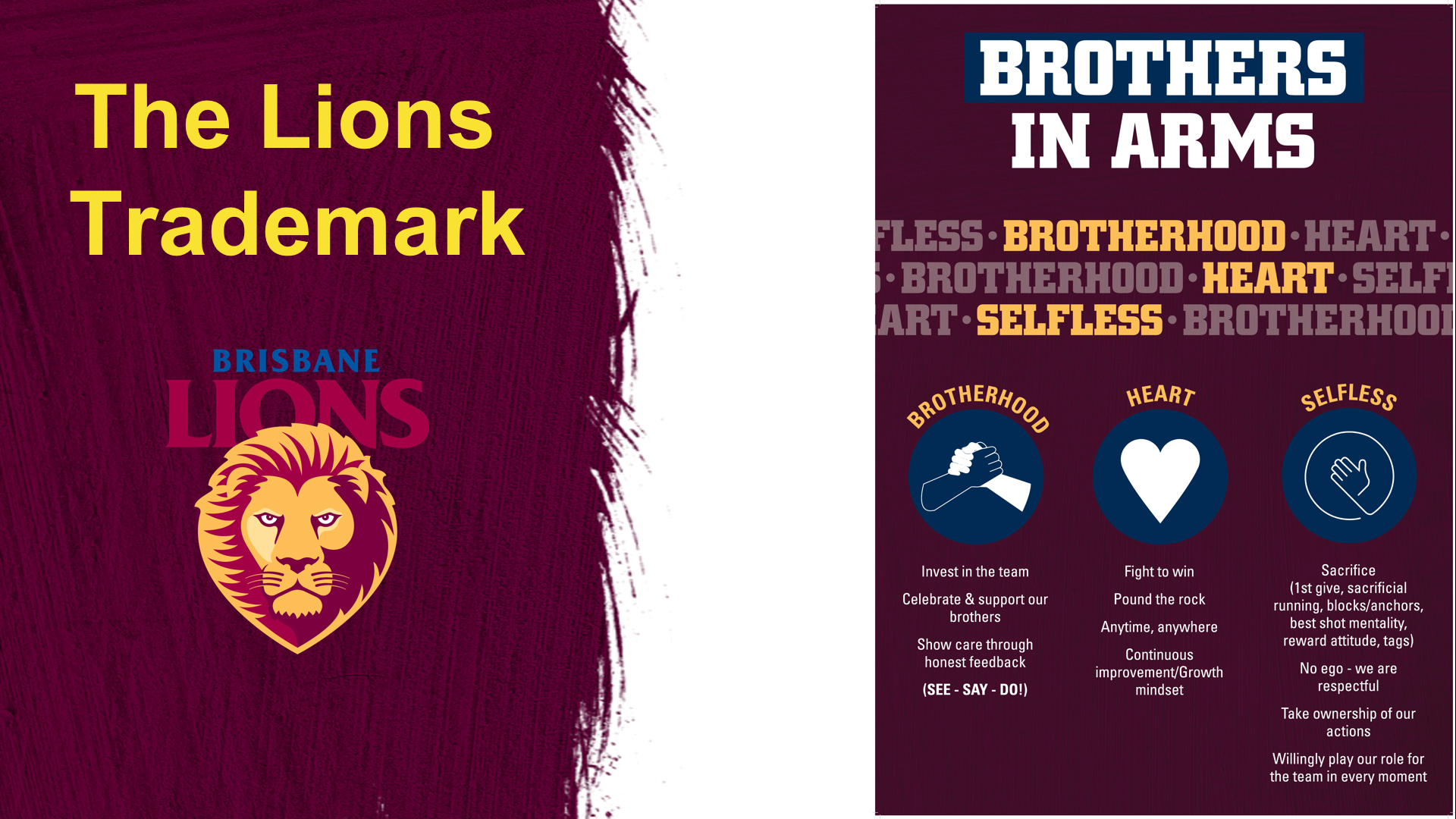
But Fagan knows as well as anyone that these are just words on a wall without the behaviours that drive and sustain these ideas. “The players come up with those and we drive it,” said Fagan of the Lions coaching staff.
“After a game, the players have to send me a text the day after and one of the things they need to rate is their compliance to the trademark for that game.” Usually, the better the result and performance, the higher the rate of compliance. It can go the other way when the team loses. In any case, “we have a vision of it being done well and we also show a vision of when it’s not so good”. Additionally, the Lions hand out a ‘brother of the week’ award, where players are invited to vote via WhatsApp for the player who best demonstrated the trademark behaviours that week.
In summary…
Fagan understands that if your environment is highly demanding then it must also be highly supportive. He has clear ideas on what motivates people that go back to his days as a teacher:
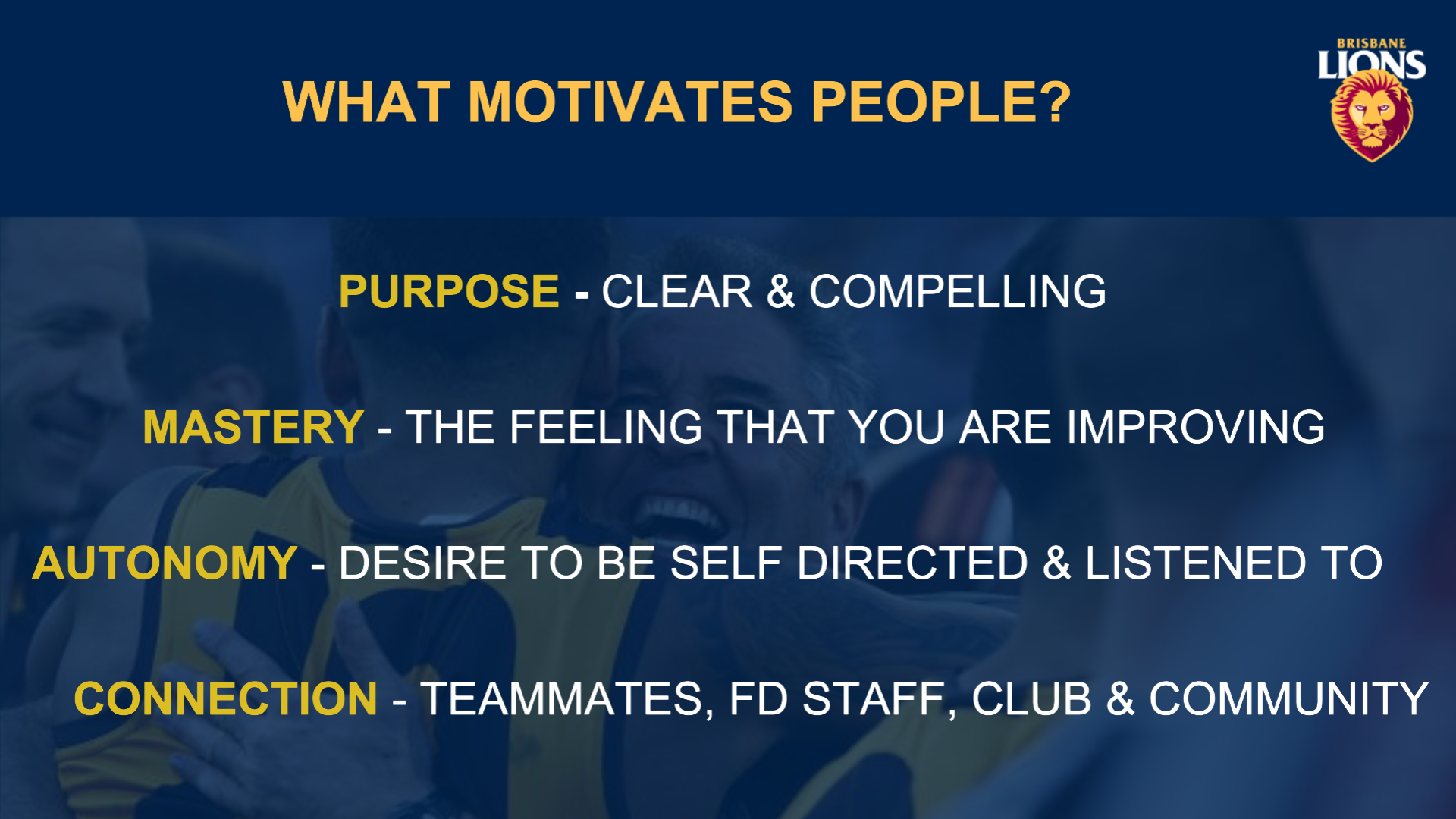
He said: “To be motivated, you have to have a clear purpose, that feeling that you’re improving, which I think our guys hadn’t felt for a long, long time. There is a desire to be listened to and to be a participant in your own growth and development; and that connection with teammates, staff and community.
“I put that model up as areas we would spend a lot of time on over the next few years, trying to grow our culture and team into a better place.”
What to read next
Nurtured and sustained excellence sat at the heart of proceedings at the 2025 Leaders Sport Performance Summit in Melbourne. Below, discover the insights to help propel you to greatness courtesy of the worlds of medicine, academia, the military and, of course, the world of sport.
Brought to you by our Event Partners

“There are parts of your game going well at a particular time and other parts of your game that are not going well,” he told Fox’s Face to Face in 2023.
“You’re trying to improve these things without sacrificing the things you’re doing well.”
He and Collingwood span those plates with alacrity during the 2023 season, his first as captain: they won the AFL Grand Final. Today, they remain one of the league’s finest teams; and Moore has been praised for his leadership abilities both on and off the field. It was to great acclaim that we welcomed him to the stage at the 2025 Leaders Sport Performance Summit at The Glasshouse in Melbourne.
“Good player leadership is organic and comes from natural respect based on competency, status and character in alignment to the team’s values,” he told an audience of Leaders Performance Institute members.
In addition to Moore, across two insight-laden days, we hosted a range of speakers from organisations including Melbourne FC, Leinster Rugby, the Royal Melbourne Hospital and Royal Australian Air Force. The overarching theme was the approaches one can adopt to give performers the best chance of success.
There were six approaches that stood out.
The athlete-coach relationship is pivotal, whether it’s a long-tenured coach setting up a new leader for success or, conversely, a senior athlete taking steps to put a new coach at ease.
Craig McRae, the Senior Coach at Collingwood, demonstrated the former with his public endorsement following Darcy Moore’s appointment as captain in 2023. “Be yourself, forge your own journey, and take a swerve at what that needs to be,” he told Moore. “Lead from the front and lead your way.”
Across town a year later, Rebekah Stott, a hugely experienced New Zealand international defender with more than 100 A-League appearances under her belt, went out of her way as captain of Melbourne City FC to ensure incoming Manager, Michael Matricciani, felt at home.
“From day one when I signed for the club, from the first conversations I’ve had, she’s only welcomed me with open arms,” said Matricciani. “She’s been a great support and she’s an excellent leader off the pitch.”
Neither Moore nor Stott, who spoke onstage together, believe they’re the finished article. Both spoke of their need to work on confronting teammates and having difficult conversations. In that regard, it helps when the on-field leader feels both comfortable and supported.
Rebekah Stott, Melbourne City FC
Darcy Moore, Collingwood FC
Moore and Stott’s concern with confronting people in emotionally charged environments is a daily feature of life at the Royal Melbourne Hospital, where Brian Le serves as Director of Palliative Care at the Peter MacCallum Cancer Centre. “Preparation is really important,” he said. “I formulate what needs to be spoken about and what my agenda is. But once with the patient, I adjust to what I’m hearing and the clues I’ve picked up in relation to their context.”
Timing is critical too. “Not addressing the situation has its own cost,” said Le, adding that delays are regrettable when the patient likely knows that an emotionally-wrought conversation is coming anyway.
Brian Le, Royal Melbourne Hospital
Data-informed decision-making is preferable, but where does the balance sit between objective and subjective sources? Additionally, what of the balance between disruption and stability? The topic was tackled by Kate Hore, the captain of AFLW team Melbourne FC, who spoke alongside Marcus Wagner, the club’s Chief Innovation Officer & General Manager of Football Operations. The Demons have been using Teamworks Performance as they look to strike that balance.
“You can get a flag from your monitoring that helps a discussion, but the impact really comes from your relationship with the athletes,” said Wagner. “Baseline information helps, but understanding the person is most important.”
When you understand the person, you can ask the right questions (either in-person or via questionnaires) and, if something needs to change based on something that happened in training, staff can swiftly make adaptations (supported by data).
As for the balance between disruption and stability. “It’s fine balance,” added Wagner. “You need to ensure you don’t lose your identity by going too far either way. How we measure is by looking at overall performance internally and externally, how we communicate, and the quality of our data.”
Kate Hore, Melbourne FC
Approximately 95 per cent of Nobel Prize-winning scientists emanate from the same cluster of labs or have enjoyed the proximal influence of past winners. Why? It is their higher minimum standards or greater openness to new (and often bad) ideas?
David Burt, the Director of Entrepreneurship at the University of New South Wales, delivered a presentation in which he lauded the value of exploring ‘terrible ideas’. His rationale was sound: it reduces the negative emotions that can cloud creativity and reduces the impact of power dynamics in a team environment.
He recommends an ‘accountability loop’:
David Burt, University of New South Wales
What must we do to sustain excellence? That was at the centre of Dave Walker’s appearance at the summit. The former naval pilot, who works for the Royal Australian Air Force, spoke of PBED:
PBED, he explained, is a continuous improvement process to table improved error recognition, error reduction or correction, which enables the creation of efficiencies that lead to improved performance. It is an essential tool in an environment where students must learn quickly.
“It’s the quality of interaction in each event that ultimately turns a team of experts into an expert team,” said Walker. “We often find that members do not know how to work or operate as a team – just following a framework does not make a team.”
David Walker, Royal Australian Air Force
Leinster Rugby, one of Europe’s most prominent teams, has a squad that is 86 per cent homegrown – what is the secret to finding and nurturing supreme talent in your region? As Simon Broughton, the Academy Manager at Leinster, explained, the team benefits from a group that has played and developed together in the youth ranks. They have travelled, won and lost as a collective. “So many experiences that strengthens their connection,” said Broughton.
The club has adopted a variety of approaches, including proximal role modelling, which sees younger players spend 80 per cent of their time integrated with older players. Proximal role modelling is “integrated organically into different aspects of their training week, from walking the pitches, to session design, and into analysis rooms.”
Leinster have also latched onto the ‘goldilocks principle’ as 33 per cent of their players are neurodivergent. “This has led to changes in how messages are delivered,” Broughton added. “There are slides, but also video and walkthroughs, and time for reconnecting and breaking mental circuits.”
Simon Broughton, Leinster Rugby
John Wagle of Notre Dame explains how the question of sleep enabled true interdisciplinary work to emerge at the school’s athletic department.
As you reflect on your team or department, you may be moved to ask a question of your own: what’s the difference?
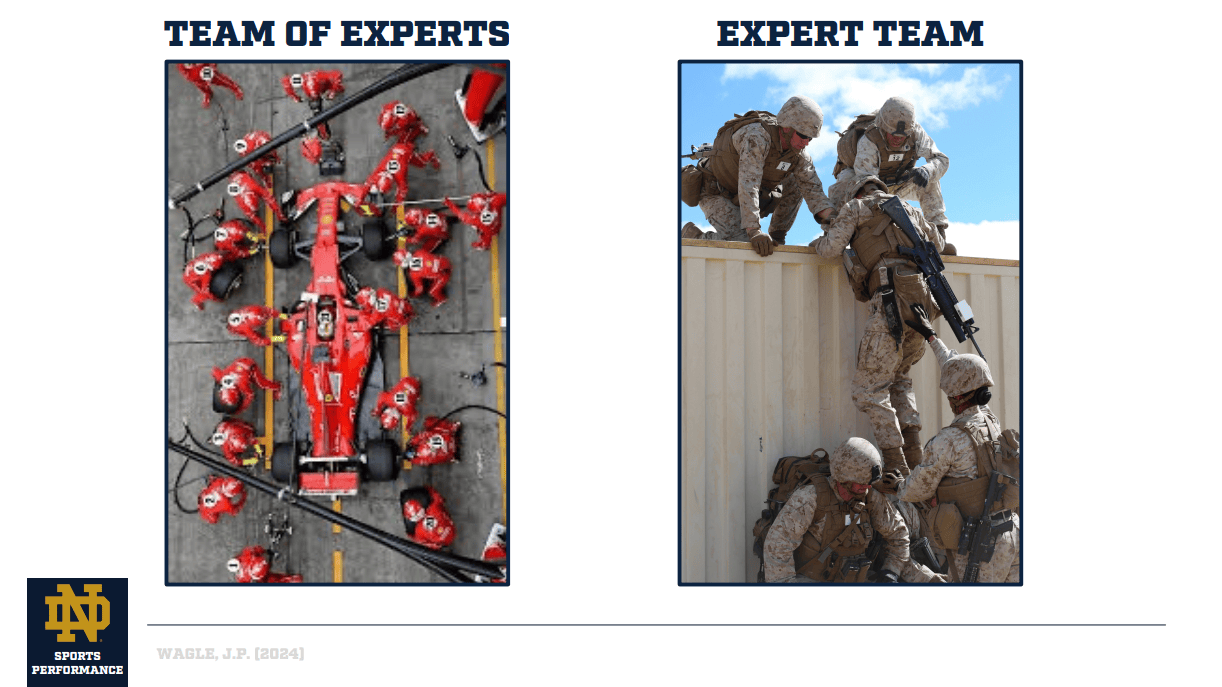
According to John Wagle, in a ‘team of experts’, “everyone has their job, they do it well, and the execution of their role doesn’t directly impact another person”. He cited a Formula 1 pit crew as an example.
An ‘expert team’, on the other hand, refers to groups where “the work of an individual may directly impact that of another person”. Wagle’s example was a US Navy SEALs team.
In illustrating this distinction onstage at November’s Leaders Sport Performance Summit in London, Wagle, the Senior Athletics Director for Sports Performance at the University of Notre Dame, highlighted the distinction between multidisciplinary and interdisciplinary.
Wagle was hired by Notre Dame in 2022 to lead an athletic department that was unable to consistently deliver an interdisciplinary approach despite the best intentions of all staff members.
“We needed a catalyst,” he continued. “The challenge as a performance director is to set the stage to solve a problem at scale in your environment.”
‘Constraints push you into new places’
Student-athletes continuously juggle their sport, academic studies and lives on campus – a situation Wagle described as “suboptimal”.
However, as he said, “these operational constraints push us into new places. They push our boundaries of how we can create solutions and I believe the best way to do that is to bring together two largely opposed ideals: knowledge and belief.”
Knowledge v belief
Knowledge, as Wagle explained, stems from a practitioner’s formal training as well as any external and internal research. He said: “the more common terminology for people in this room is evidence-based practice”.
Belief is different. It is an aggregate of a practitioner’s experiences from working in the field, athlete values and preferences, and the matter of risk tolerance and uncertainty management. “There is an element in belief that you’ve got to harness and steer into uncertainty.”
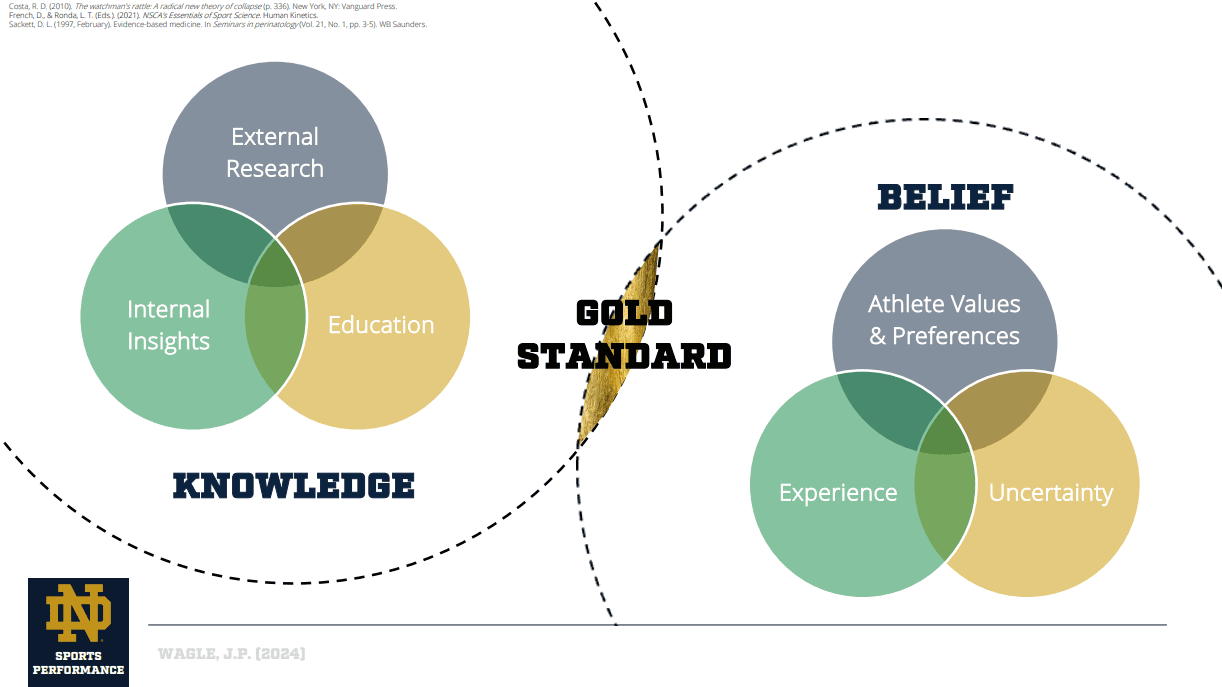
“These don’t need to be opposing viewpoints,” Wagle added, despite admitting that people “gravitate towards their tendency”.
“This is the true power of interdisciplinarity and, if we don’t bring these pieces together, we run the risk of being blind to what a lot of our athletes are experiencing.”
He spoke of the student-athlete being in a “complex adaptive system” where the interaction of different elements leads to either a health or a performance outcome, with the ‘gold standard’ somewhere in the middle.
Sleep = the catalyst
Wagle admitted that Notre Dame’s athletic department oscillated between knowledge and belief despite concerted efforts to bring both together.
“There were members of our team that no matter what the problem was were always on the knowledge side and there were members of our team who were always on the belief side,” he said. “It did not necessarily manifest in conflict – it manifested in avoidance – because I think every problem we tried to solve was inherently biased towards a discipline and it was easier to run away from that problem.”
They needed a catalyst to underline the power of interdisciplinary work and alighted upon sleep.
“We chose sleep because it is inherently lacking a discipline,” Wagle continued. “It can be owned by psychology, by nutrition, by strength & conditioning, by medical. There’s no obvious lead person in that.”
Everyone was able to meet the challenge that Wagle set: to be the best sleep support ecosystem in the whole of college sports. The knowledge people combined their data-driven approaches and devised a sleep screening tool. “We were able to get more granularity on our sleep habits and behaviours.” The belief people “brought to the table the ebbs and flows of the academic year.”
Remember: you could be part of the problem
Notre Dame’s approach to sleep has proven a game-changer in their approach to interdisciplinary work. Staff members recognised their biases, let go when necessary, and committed to collaboration.
Wagle said: “If we don’t acknowledge that ‘we could be part of the problem’, that’s where culture and alignment suffer; and resources fail to be allocated properly.”
This month we touch upon the power of flexibility, relatability and collaboration in leadership and what you need to know to be better in each area.
Ideally, you found time for both and, here, we highlight a selection insights from the first month of 2025 that may help you to consider a problem in a different way or enable you to identify the right people to whom you can turn.
We hope to see some of you in Melbourne later this week for the Leaders Sport Performance Summit.
And, whether or not you can make it to the Glasshouse, here are five thoughts for all leaders to ponder.
If you can find new ways to consider your problems, it can open up new ways of thinking.
In this article, John Bull of Management Futures used the example of an elevator. Perhaps your goal is to make the elevator go faster, but what if your aim was to make the wait less annoying?
“Most hotels will put a mirror beside the elevator,” he said. “That seems to kill time when we’re looking at ourselves in a mirror.”
Bull suggested we “think of at least three different ways we could define our goal, to help open up new ways of thinking about the problem”.
He also share the STOP process for creative problem-solving:

In November, John Longmire called time on his 14 years as Senior Coach of the Sydney Swans. He has taken a new position as the Swans’ Executive Director of Club Performance but, before doing so, he reflected on his tenure as Senior Coach, which brought two AFL flags and four Grand Final appearances in total.
You can read his thoughts here, but here is a snapshot of his desire to remain “connected and relatable” to his players and staff. As he said onstage at November’s Leaders Sport Performance Summit in London, “the coach is no longer looked upon as being bulletproof” whatever their standing may be within the game.
His final speech to the players and staff as Senior Coach attested to that belief. He weaved in personal stories and his voice cracked at times. He wiped away tears too.
It called to mind the weekly ‘storytelling’ sessions that Longmire made a key feature of the Swans’ environment. He told the Leaders audience that players and staff share stories or complete a series of tasks for discussion each week. Recent examples included writing ‘a letter to your 16-year-old self’. These sessions are popular with players and staff alike.
“Sometimes it’s a photo of something that mattered to you and quite often there’s tears involved,” he said. “The way I looked upon coaching 25 years ago is completely different now – these 18, 19, 20-year-olds need to be able to relate to you. If you can show that you’re human, you get a lot more back.”
The question of team dynamics sits at the heart of The Social Brain: The Psychology of Successful Groups by Tracey Camilleri, Samantha Rockey and Robin Dunbar. The trio has spent decades observing the worlds of academia, business, and government as they look to better understand the workings of high-performing teams.
Camilleri and Rockey came to the summit in London to discuss how their research has its applications in the world of sport. Decision-making was one such area:
For decisions made at speed, you’ll count on five people.
Five is the number of intimate relationships a person can have. Rockey said: “These are the relationships that protect us, make us thrive, and ensure that we go through life in a joyful way. They protect us from ill-health and from some of the psychological challenges that we might have from feeling insecure.” They, of course, occur in intimate spaces.
For more complex decisions, you’ll count on 15 people (including your original five).
The ‘pain’ comes when you look to insert new thinking into complex decision making in a group space. “We spend about 60 per cent of our social time with just 15 people,” said Rockey. “With the 15 in the workplace, they would have built long-term relationships and loyalty to you over time – that’s how we work as humans – so breaking up those people to bring in new thinking is painful.”
According to Dunbar, the upper limit on the number of social relationships we can enjoy is 150
Dunbar suggests that people can have no more than 150 social relationships at any one time. “It’s a very stable number across all societies and cultures,” said Rockey.

From The Social Brain: The Psychology of Successful Groups by Tracey Camilleri, Samantha Rockey, and Robin Dunbar.
Young athletes are bolder in stating their desire for belonging and connection than their forebears, but this comes with a paradoxical demand for more personalised training and attention. There are clear implications for the time coaches spend on team dynamics in an era where the power has shifted to the athlete. The topic was discussed on a recent virtual roundtable. “Staff and coaches are more vulnerable,” said one participant, who pondered where the balance needs to sit. “Give the athletes a voice and a choice, give them ownership, have the consultation, but there is a line too.”
Another participant with experience of coaching in European football, highlighted that individual work will mean different things to different people and can be dependent on team selection. They argued that there is room for better management of expectations and, more broadly, a consensus for coaches and athletes alike on what constitutes ‘individual’ training.
In February 2024, the England & Wales Cricket Board launched its Insight 360 platform, which adopts a data-driven approach to athlete and performance management.
Ahead of the launch, the ECB gathered input from practitioners and coaches across the English game. “This means Insight 360 is bespoke for women’s cricket,” said Anna Warren, the Head of England Women’s Science & Medicine. Players, she said in this article, are happy with an app that allows them to review their own data in as much detail as they like. “This is good for player buy-in, which is always a challenge in relation to athlete monitoring.”
There is also the power of a co-designed project. UK Sports Institute have found as much with their Project Minerva. Dr Richard Burden, the UKSI’s Co-Head of Female Athlete Health & Performance, said: “Get the practitioners involved, get athletes, get the teams and bring them along with it because if they’re onboard you get easier access to them and you’re going to produce something that’s more translatable, meaningful and applicable to them.”
Warren is on the same page with Insight 360. “You can link loads of different data sources together and start to answer some key performance questions – we’re not looking at everything in isolation.”
Leadership specialists Tracey Camilleri and Samantha Rockey explain how matching team density, size, and space to the task at hand can boost performance.
Reid’s celebrated right-hand men, including Offensive Coordinator Matt Nagy and Defensive Coordinator Steve Spagnuolo, are in demand for newly vacant head coaching roles elsewhere now that the NFL regular season has concluded.
Time will tell whether Nagy or Spagnuolo can assemble winning rosters of the kind that delivered the Chiefs back-to-back Super Bowls (with a third still on the cards), but they will have a better chance of ticking all the right boxes if they can surround themselves with the right people.
On that note, the question of team dynamics sits at the heart of The Social Brain: The Psychology of Successful Groups by Tracey Camilleri, Samantha Rockey and Robin Dunbar. The trio has spent decades observing the worlds of academia, business, and government as they look to better understand the workings of high-performing teams.
“We wrote this book because we were fascinated with the question: what is it that makes a group of people more than the sum of their parts?” said Camilleri when addressing the audience at November’s Leaders Sport Performance Summit in London.
“In our world, the unit of identification is most often the individual – if you think about how we hire, how we promote,” she continued. “Very rarely is the focus the team.”
Camilleri and her co-authors redress that balance in The Social Brain and here we explore how leaders can amplify the collective in the pursuit of better decision making.
‘The rocket fuel for performance impact and innovation’
The Social Brain applies theories of evolutionary biology to groups of high performers.
“We’ve been interested in what doesn’t change,” said Camilleri of this lens of enquiry. “When humans are part of small groups they can take advantage of their collective intelligence as well as a sense of safety, reciprocity and shared obligation.”
Camilleri, Rockey and Dunbar devised their ‘Thrive Model’, which sets out six foundational conditions for high-performing teams that consider social health (in addition to physical and mental health) as a prerequisite of wellbeing.
Onstage, Rockey defined these conditions as “the rocket fuel for performance impact and innovation.”

From The Social Brain: The Psychology of Successful Groups by Tracey Camilleri, Samantha Rockey, and Robin Dunbar.
What do the numbers in the circle mean?
As Rockey explained, it is important for leaders to know where to focus their energy most effectively.
“All of us have the same amount of time in a day and we use it differently, but what doesn’t change for each individual in this room is how many relationships that we can have at any given time,” she said. Our brains are only so big, “so we can’t have endless relationships”.
She used Dunbar’s number, which was devised by her co-author in the 1990s, to illustrate her point:

Dunbar’s number has long been influential across several fields, from government and administration to business and academia.
Five, 15 or 150 people? Performance improves when you match team density, size, and space to the task at hand
For decisions made at speed, you’ll count on five people.
Five is the number of intimate relationships a person can have. Rockey said: “These are the relationships that protect us, make us thrive, and ensure that we go through life in a joyful way. They protect us from ill-health and from some of the psychological challenges that we might have from feeling insecure.” They, of course, occur in intimate spaces.
For more complex decisions, you’ll count on 15 people (including your original five).
The ‘pain’ comes when you look to insert new thinking into complex decision making in a group space. “We spend about 60 per cent of our social time with just 15 people,” said Rockey. “With the 15 in the workplace, they would have built long-term relationships and loyalty to you over time – that’s how we work as humans – so breaking up those people to bring in new thinking is painful.”
According to Dunbar, the upper limit on the number of social relationships we can enjoy is 150
Dunbar suggests that people can have no more than 150 social relationships at any one time. “It’s a very stable number across all societies and cultures,” said Rockey.
From The Social Brain: The Psychology of Successful Groups by Tracey Camilleri, Samantha Rockey, and Robin Dunbar.
Camilleri and Rockey wrapped up their presentation by offering nine ‘social hacks’ for building relationships swiftly:

From The Social Brain: The Psychology of Successful Groups by Tracey Camilleri, Samantha Rockey, and Robin Dunbar.
Rockey then homed in on five…
Synchrony: “Sport has done this brilliantly. The perception of pain is reduced when we’re doing something together. When you’re running with a partner it feels less painful.”
Laughing together: “A fantastic way of finding a group”.
Engaging with strangers: “When we have conversations with people we don’t know, it has a positive effect on us – I encourage you to meet people that you don’t know today.”
Giving and receiving kindness: “A New York-based study saw that when young people were able to engage with strangers and be helpful to them, they saw an uptick in their mental health.”
Eating together: “There’s something very magical about breaking bread together. You have about 30 minutes when you’re having food together in which you have a sense of wellbeing and positive vibes towards your dining partners. So if you want to do something difficult, eat with your group first and then go to the difficult meeting.”
The Social Brain: The Psychology of Successful Groups by Tracey Camilleri, Samantha Rockey, and Robin Dunbar is available now from Penguin.
