In a recent Leaders Virtual Roundtable, members discussed how their team cultures are evolving, with one readily embracing the global hit Bluey in its pursuit of performance.
“We used an episode to bring to life our ‘embrace change’ value,” said the team’s performance lead at a recent virtual roundtable.
It made sense. For one thing, the eponymous character, an Australian cattle dog (known colloquially as a Blue Heeler) puppy, is cute; secondly, the show’s themes of self-development and selflessness resemble the values often espoused in dressing rooms.
With his fellow Leaders Performance Institute members smiling, the performance lead explained that his playing group had gone as far as creating a ‘Rusty Award’, which is named in honour of Bluey’s friend Rusty, an Australian kelpie, to celebrate teammates.
He continued: “At the end of each camp, the players pass the Rusty Award to whoever they think has either embodied our values or has been a real good person around their teammates over that camp or weekend.”
That insight set the scene for a conversation on how members believe their own team cultures are evolving; what is working well and where the opportunities lie.
This is a snapshot of what they shared.
Firstly, there are five things that most teams on the call tend to do well:
1. Articulate their values in a resonant way
Values have to be more than words on a wall.
“Having consistent language has worked well for us,” said the aforementioned performance lead. “We have three values or pillars – ‘embrace challenge’, ‘evolve yourself’ and ‘enjoy the ride’ – and the coaches and support staff have been forthright in using that language within sessions so that the players can always draw back to that.”
A performance support specialist from the Australian Olympic and Paralympic system spoke of her organisation’s renewed emphasis on transparency.
“We’re trying to communicate to athletes as frequently as we can to drive that connection,” she said. “If they feel like they’re well informed and they’re part of the planning, they can also hear reflected back to them things that they have potentially asked for in our feedback mechanisms.”
“We can’t leave any of this for chance,” added a head of coaching and development from the British system. “How intentional can we be with spending time on it? To start to label things so they aren’t subject to misinterpretation?”
2. Inspire personal accountability
It is a question of the standards you walk past being the standards you’re prepared to accept, whoever you are.
“That starts with leading yourself,” said the performance support specialist. “You’ve got to be able to look after yourself before you can look after your teammates.”
“When are we nudging?” said the head of coaching and development. “When are we realigning and checking and challenging the behaviours that we do not want to see or may not be in line with our desired options?”
3. Make their people feel safe
Whether you encounter resistance from long-tenured staff or you are dealing with rapid turnover, your people must feel that you are listening to them.
“Listen to the system and the system will tell you what it needs,” said the performance support specialist, adding, “I think a large part of where culture can get derailed is where people don’t feel heard and valued.”
In response, a sports scientist spoke of their institute’s desire to engender a collective sense of belonging in the pursuit of innovations.
“It’s allowed people to feel like they can make another level of contribution,” she said. “It opened the door in ways where some of our different support team members and our coaches have been given an opportunity to talk about their ‘why’ and talk about their own attachment to our values.”
From that place of interpersonal safety, teams and team members are ready to tackle the issues of the day, even if they end up down “rabbit holes” as an athlete support officer working in the UK system put it.
The first step is to establish the performance question. “That enables us to have challenging conversations without it feeling personal”. Then you must “make sure your people have the ability to express themselves, bring new ideas, problem-solve and make decisions and add their own flavour.”
3. Try new things in low-risk settings
Comfort in risk-taking cannot be separated from notions of accountability, belonging and safety.
“We have benefited from a strong, overt, and repeatedly iterated attitude from our new director and leadership team to take on and try new things,” said one long-tenured attendee presently adapting to new management at a new practice facility. “There’s a sense that we’re not writing a new story but a new chapter.”
4. Celebrate their people
The Rusty Award is a prime example, but gestures can be just as important.
“A lot of people probably perceive working on your culture as a grand gesture moment,” said one attendee, “whereas the little gestures and the little interactions matter way more because they stack and pound over time”.
On top of these encouraging signs of progress, there are three areas where teams can further strengthen their culture with simple tweaks:
1. Celebrate progress, not perfection
“I like to celebrate our imperfections and reframe expectations to give the team belief in its potential,” said a performance support specialist based in Australia. “We say pressure is a privilege, but expectation can sometimes make culture deteriorate because of the pressure and expectation to perform or to behave in a certain way.”
2. Focus on the small interactions
“Corridor conversations are key,” said the athlete support officer, “and I think we forget the impact that they can have.”
3. Keep challenging your assumptions and biases
One attendee suggested red-teaming, which is the practice of stress-testing ideas. He said: “How do we check our blind spots? How do we identify them? How do we systemise those processes?” Doing so is important because “what don’t know what we don’t know”.
What to read next
Everton’s Head of Sport Science Jack Nayler concludes his exploration of complexity in sport by outlining what it takes to be resilient and adaptable under pressure.
We also looked further at the implications for this in a sporting organisation, notably that complexity is fractal, exists at different levels, and that each person within the organisation will exert different levels of influence over the performance at any given moment.
Last week, I began to look at what this means for those in leadership positions.
Leadership in complexity requires you to have the humility to accept the ignorance of your position and the understanding that autocracy won’t work. It is impossible to micro-manage every decision in the fast pace and short turnaround of games in a professional sports season. You will not be present to control every interaction that occurs and you will not possess all of the information available to make every decision.
With the inherent fluctuations that occur in a complex environment, it is incumbent on the leaders to provide a framework within which everyone can operate, as effectively as possible, in a transdisciplinary manner.
I believe there are four pillars to this framework, that are characteristics of high-performing environments.
Your role as a leader is to ensure that these are in place so your team operates as effectively as possible.
I explored the first two pillars here. Let’s now delve into the third and fourth pillars below.
The complexity of the sporting season ensures that as results wax and wane so will pressure and external noise. The processes you have in place need protecting from this pressure and the associated emotion.
For some simpler tasks and processes you can have checklists or flight manuals where processes can be recorded, ratified and referred back to (1). However, these only go so far and will be less useful as the complexity dials up.
When you and your staff are committed to helping the team perform, it is easy (or just human nature) to become overly emotional about performances (both positively and negatively), and this can leach into your decision-making processes. Leaders need to be aware of the propensity for this as well as the influence of subconscious bias on any decision making (this is a wider topic than the scope of this series but a good place to start is Thinking Fast and Slow by Daniel Kahneman, 2). Setting up your team/environment to reduce the effect of these factors is key to leading your team effectively.
As the leader, with your wider viewpoint and greater access to those higher up the organisational hierarchy, you should have a greater appreciation of the pressures you and your team face. As emotions tend to affect quality decision making, it is your job to be judicial over which pressures you allow to filter through to your team and which you will bear.
Objectivity must become a cornerstone of making decisions. We need to collect data on the subject (player or situation) over which we are trying to make a decision. This data then needs turning into information (tables, graphs and other visualisations) by adding context (use of appropriate statistics) to help the reader understand the magnitude of any effect. This information turns into knowledge when the reader reflects on the new information, with respect to what they already know and understand.
As we have discussed, each person will have their own unique take on a given set of information. Organisations that can successfully make the leap from individual to organisation level knowledge will be better prepared to perform in complexity.
The threat to an organisation if knowledge sits siloed with individuals is two-fold. Firstly, the quality of the decisions being made will fall and secondly the organisation is fragile to an individual leaving and removing the intellectual property (IP) from the building.
I believe the threat to the organisation is greater from the loss when IP walks out of your facility, than if that person was to be employed by a rival team. As each organisation is its own complex mix of culture, practitioners and athletes, it is difficult to transfer tacit knowledge from one environment directly into another.
Once you have objective information around which you can make decisions, you can begin to plan what you and your team will deliver. This planning process provides a framework for everyone involved to work within and should remain just that: a framework. Remember that in complexity the person closest to the action has the most information in a given moment. This framework provides a set of parameters that act as a fallback, against which new information can be assessed. In the moment, under pressure, this framework coupled with a clearly understood direction of travel from you as leader should help the practitioner on the ground make a better decision.
As the outcomes of the decisions we have made as a team become apparent our framework can become the basis against which we can reflect and review the decisions made, by providing a reminder of the conditions as they existed in that moment. This again helps to objectify the review process and fosters a culture of psychological safety (3).
Understanding the complex nature of this environment has helped me to appreciate that we cannot get everything right all of the time (remember there is never a perfect game) and my first thought when things fall down is: how could I, as an intrinsic part of this complex system, have acted differently through the process to have affected a better outcome? This helps me to remain less emotional when analysing failures as and when they happen. I do this before turning my lens outwards to think how we could have done better as a team.
The fact that complex systems are never perfect and we cannot predict outcomes with 100% accuracy creates uncertainty. In their book Radical Uncertainty, John Kay and Mervyn King describe uncertainty as “the result of our incomplete knowledge of the world, or about the connection between our present actions and their future outcomes.” (P. 13, 4). We need all members of the team to understand that although this space is uncertain, performance will emerge from it.
There is then a gap that exists between our expectations and the outcomes. Acknowledging the inevitable existence of this gap allows the leader to be more sanguine and less frustrated by it, putting us in a better headspace to explore why the gap exists like it does and how we can narrow it in the future. I see little point in the wasted energy that would be spent railing against this gap’s existence. Rather I see this gap as the learning space, a space to be curious about. It is the space where the information mentioned in the previous section becomes knowledge.
When we reflect on information in the context of what we already know, we develop our knowledge base. This should then spark off further questions as to why we ended with the result we did, restarting the cycle back to collecting more data. This process is critical in the complex world. As the system shifts and changes, so do our levels of expertise (5). Further, knowledge developed in other environments and populations diminishes in power the further away from that population it moves. The most powerful learning will come from research done in our own group of athletes. This should be a mix of quick and dirty in-house enquiry and more formalised research carried out with partner universities and led by in-house research and development departments.
You also need to lead your team into this gap by putting in place structures that allow your team the time and space for reflection. We are really good in team sports at planning and doing, before all too soon the next fixture rears its head. You need to be intentional about reflecting and reviewing. Reflecting skills can be learnt and should be fostered amongst your team. Make reviews normal and model behaviour by openly reviewing the things you personally have done and seeking feedback. This normalises the feedback process and creates space for you to feedback to your team members more easily (6). Mix regular small hot reviews in the moment (7) with more analytical, larger reviews. In these, review a specific subject (e.g. grade 2b hamstring injury rehab) as opposed to generalised time periods (e.g. pre-season). Signpost your reviewing – create a structure or framework around how you want to reflect and share it with the team ahead of time. Your team should then turn up in the spirit of reflection, rather than having it sprung upon them. Most critical of all is to have concrete outcomes that everyone is aware of and can be held to.
The second space we need to be mindful of as leaders is the space from which the performance of our team emerges.
In 2012, Google embarked on a large study to try and discover what made a successful team within their organisation, they called it Project Aristotle (8). Google studied 180 teams from across the business and looked many combinations of factors (e.g. personality traits, emotional intelligence, demographics and skillsets of team members) that they hoped would indicate levels of learning and performance. Whichever way they crunched the data, they could find no pattern as to what would bring success. Some of the factors that did not influence team success intuitively sounds like items that would be important when trying to build a successful team:
Eventually the researchers looked away from the hard skills and instead looked at interactions between team members, driven by the work of Amy Edmondson, Professor of Leadership and Management at Harvard Business School. Professor Edmondson’s research has also studied effective teams and the work at Google confirmed her theories. The number one factor that will describe team success is termed psychological safety, which she describes as “a shared belief held by members of a team that the team is safe for interpersonal risk-taking… a sense of confidence that the team will not embarrass, reject or punish someone for speaking up” (P. 354, 3).
A psychologically safe environment is one which recognises that the space between the components of the complex system is where the magic happens and works to ensure that all members of the team can lean into said space.
In a complex world, we cannot see the connection between our decisions and their future impact, we only make sense of them with hindsight. As the author Robert Louis Stevenson said: “The worst historian has a clearer view of the period he studies than the best of us can hope to form of that in which we live. The obscurest epoch is to-day.”
However, there is evidence to suggest that better predictions and decision making come from cultures that “harness the power of collectives and encourage diverse opinions, perspectives and collaborative teamwork” (9).
The challenge we face when leading in an increasingly complex world is that it is constantly shifting in front of us, and we only see what is happening through our lens. There are a whole host of things we cannot see and second and third order effects that we cannot predict. Therefore, any time we take an immovable position or opinion, we are also opening ourselves up to being incorrect.
As leaders these positions, either polarised, immovable (or worse, both) are dangerous places to be. This is demonstrated by the work of Philip Tetlock, summarised in his book, Expert Political Judgement: How good is it, how can we know? Over a nearly 20 year period Tetlock ran forecasting tournaments with 284 experts from a variety of fields, leading to 28000 predictions (10).
Experts were only slightly more likely than chance to be correct, however the interesting part was in discovering that how the experts thought was more important than what they thought when it came to the accuracy of their predictions. Tetlock characterises these two styles as Foxes and Hedgehogs after the title of an essay by the philosopher Isaiah Berlin, based on a quote by the Greek philosopher, Archilochus: “a fox knows many things, but a hedgehog knows one big thing”.
When the hedgehog is challenged, they curl up in a ball with their spikes out to deflect the world. It is the same with the experts, their position is immovable, and they deflect critique. Experts who were more fox like were less sure of their predictions and more willing to change them as events unfolded. Foxes were more likely to be accurate in their predictions than hedgehogs in the long-term. Hedgehogs had the potential to be more precise, but with a much greater chance of being wrong. When dealing in complex environments, when you are wrong, you have the potential to be spectacularly wrong.
By contrast, foxes will recognise that they do not have a complete perspective and therefore not all of the answers. They will lean into the space between themselves and others, inviting their perspective and collaboration, seeking to co-create solutions for the best possible outcome.
To develop a climate in which foxes can flourish, we must create psychologically safe environments that protect the space between the members of our teams as sacred and encourage them to lean into these spaces to collaborate and provide diverse perspectives. Edmondson (3) describes it as “a team climate characterized by interpersonal trust and mutual respect in which people are comfortable being themselves.”
This process takes modelling from us as leaders. If we cannot show up, be true to ourselves and honestly lean into the space between us, those we lead, and our teammates, then we can never hope to engage others to do the same. If we fail to do this effectively, we may struggle to create a high performing environment.
Further thinking
Bottom line
Throughout this series, I have endeavoured to explain the way that I have come to see the world and, because I work in performance sport, how this applies in that context.
In the spirit of this, I also see how it has emerged from my own upbringing, education and experience to form in this way, at this point, and that you may well see things differently. This is OK because we all encounter this world in different ways. As my own experience grows, I am sure these ideas will develop and adapt.
The biggest messages I would wish to convey is that as a leader, show up and be authentic to yourself and your beliefs, don’t be afraid to try things and fail (as long as you’re willing to do the work to understand why) and go looking for feedback.
Writing is a fantastic way to force you to critically confront your thoughts and assumptions, and writing for an audience, to distil your ideas down as succinctly as possible. I would recommend it as an exercise for anyone leading or aspiring to lead as clear communication of your ideas helps bring people on a journey with you.
References
1 Dec 2025
ArticlesTeam standards, the price you pay for poorly delivering feedback, psychology and innovation have all been on the Leaders Performance Institute agenda these past two months.
Michael Maguire’s team were behind at half-time in every game of the finals series but came back to beat the Canberra Raiders (the minor premiers) in the qualifying and elimination finals; they over-turned another half-time deficit to beat the Penrith Panthers in the preliminary finals; and lightning struck thrice in the Grand Final when they faced a 22-12 deficit at the interval.
“I didn’t have to say too much at half-time. I just said to them ‘your best half is about to come’, because we have come from behind over the last month. I said if you go and do that, we win the game,” said Maguire – a former speaker at the Leaders Sport Performance Summit – after the Grand Final.
This was a team whose belief in their ability was forged in adversity. Maguire stuck by his players at tricky moments during the season. At times, following a run of poor results, it seemed unlikely that the club would challenge for its first NRL premiership since 2006.
“I remember Madge’s passion and him sticking up for us midway through the year when we were getting rinsed through the media about the way we go about things, but the care he has for us, no one knows outside the club,” said fullback Reece Walsh.
“The way he looks after us as people, the way he looks after our partners, there is nothing more we could ask for. He demands a lot, as he should demand a lot – we have just won a comp.”
Both Maguire and Walsh hint at the ingredients for high performance – empathetic leadership, high standards and mutual trust – that underpinned the agenda at the Leaders Performance Institute in recent weeks.
Below, we give a flavour of the conversations that commanded attention during that time.
‘The standard you walk past is the standard you accept’
Maguire was in attendance at the Leaders Sport Performance Summit in November where the Broncos appeared onstage courtesy of General Manager Troy Thomson.
We also heard from rugby’s other code, rugby union, as England’s former fullback Emily Scarratt and Red Roses Head Coach John Mitchell explained how the Women’s Rugby World Cup was won; before that, Johann van Graan delved into the transformation he led at English Premiership champions Bath Rugby.
Nestled in between was an inspired presentation by Emma Keith, a group captain, who is the first female to run Royal Air Force officer training.
Hers, much like Maguire’s, was a message of empowerment rooted in accountability and care. She said:
“The standard you walk past is the standard that you accept. That can be poor infrastructure that you don’t report; it could be poor behaviour. If you walk past it, you’re saying it’s okay. And that’s a slow rot from within.”

Group Captain Emma Keith talks to UK Sport’s Alex Stacey following her presentation on officer training in the Royal Air Force.
Read more from the summit here.
The price you pay for poorly delivering feedback
“In terms of feedback, we’re quite basic creatures,” said Simon Eastwood. “We will react and respond instinctively to what we perceive as threat or reward.”
As Eastwood, the Head of Leadership Skills at Management Futures, explained, the wrong word, tone, timing or even body language from a coach can trigger a negative reaction when giving an athlete feedback.
Eastwood hosted a virtual roundtable aimed at helping coaches and practitioners to improve how they deliver feedback.
He shared a number of tools on the day, including the SCARF model.
This framework, devised by neuroscientist David Rock, explains five domains that influence human social behaviour and motivation. SCARF stands for:
“It’s a great tool for stepping back and assessing your team and thinking about what really makes them tick,” said Eastwood. “Crucially, it’s not about avoiding that feedback.”
He suggested that leaders should reward these needs through feedback, so people feel valued and motivated rather than threatened and, to illustrate his point, presented a table that set out what ‘threat’ and ‘reward’ may look like in each domain:
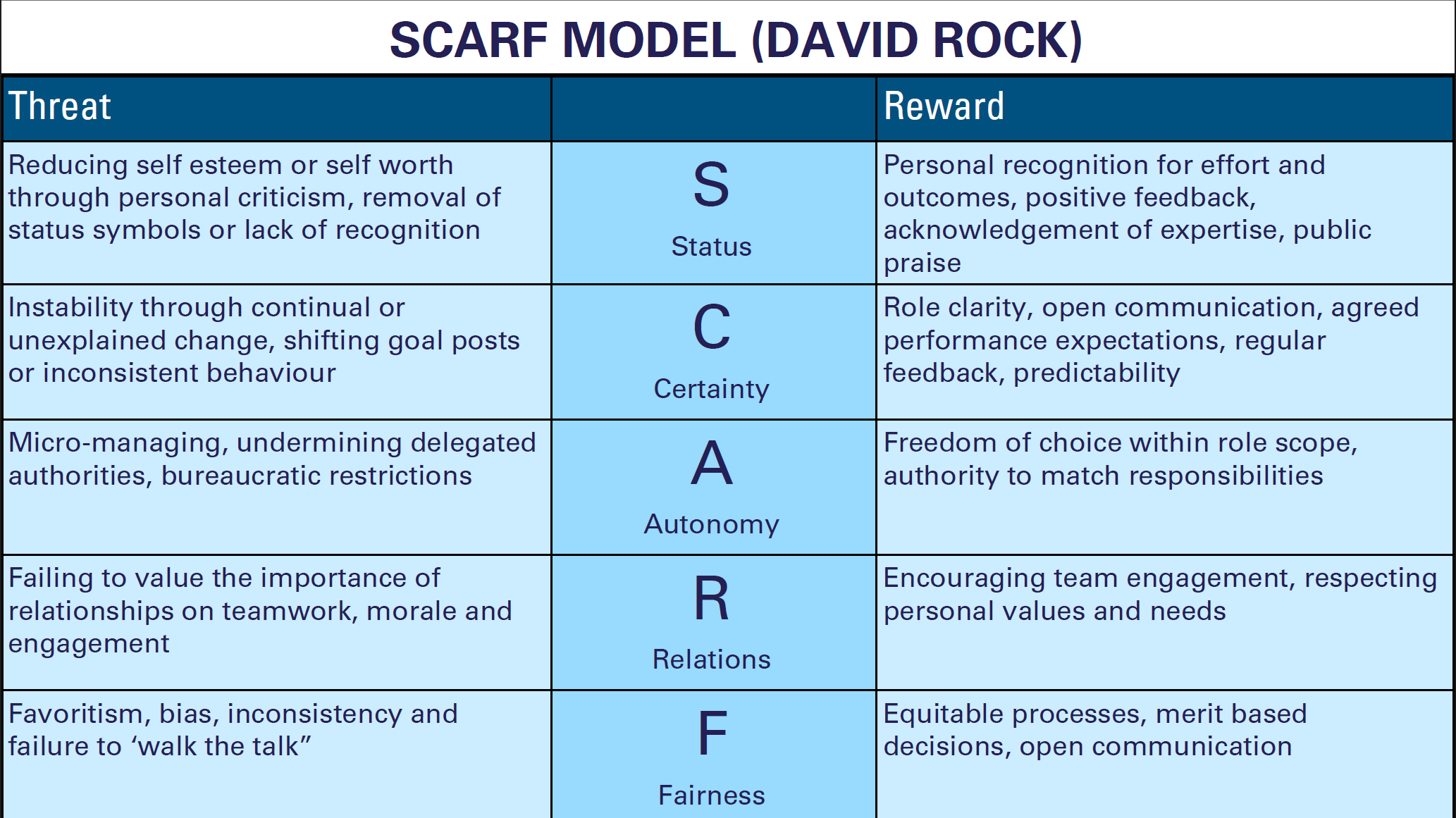
Eastwood then posed a question: “When giving positive feedback, which elements do you find most need to be reinforced?”
Leaders Performance Institute members can read more here.
The evolving work of the psychologist
Elsewhere, Dr David Fletcher, a Professor of Human Performance and Health at Loughborough University, and Dr Danielle Adams Norenberg, the Head of Psychology at the UK Sports Institute co-hosted a roundtable on the evolving role of the psychologist.
They outlined two ways in which a psychologist may be a useful asset for the head coach:
1. The development of the coach’s leadership skillset
A psychologist, Fletcher explained, can help a coach to develop their “time management skills, body language, and communication skills” in the pursuit of better performance.
By the same token, psychologists have been instrumental in facilitating a shift from deficit-based to strengths-based coaching. Adams Norenberg said: “Even if planted within a very generic training session, athletes have the self-awareness, knowledge and autonomy to make the most out of their training session by focusing on developing their strengths.”
2. The development of their psychology skills
Psychology is another string in a coach’s bow. If they understand the types of pressures that athletes experience they can “choose a particular training session to not necessarily develop technique or tactical skills, but psychology skills.” Adams Norenberg cited the example of the VR headsets used in training by Team Europe ahead of the 2025 Ryder Cup. Some players simulated the spectator abuse they would endure at Bethpage Black; others used it not for pressure training but relaxation, such as the Norwegian Viktor Hovland, who recreated the fjords of his homeland.
Leaders Performance Institute members can read more here.
True innovation must have an impact… but what is innovation?
Fabio Serpiello, the Director of Sport Strategy at Central Queensland University, posed this very question at a recent virtual roundtable.
He argues that teams should alight on a shared definition; one that does not conflate the concept with ‘creativity’. (Creativity, as Serpiello explained, is the outcome of an ideation phase, while innovation covers the execution and eventual impact of an idea.)
Then, he made the case that when teams have an agreed definition of what ‘innovation’ means to them then it offers a “clear way to approach and analyse whether the innovation processes in your organisations work or not.”
Greg Satell’s Model of Innovation
Innovation, Serpiello argues, also comes in several shapes and forms depending on the nature of the problem. To make his point, he introduced renowned change management specialist Greg Satell’s Model of Innovation, which provides a practical framework for introducing innovative practices, encourages strategic thinking about problems and helps to facilitate better collaboration.
He presented a diagram of Satell’s model to the table:
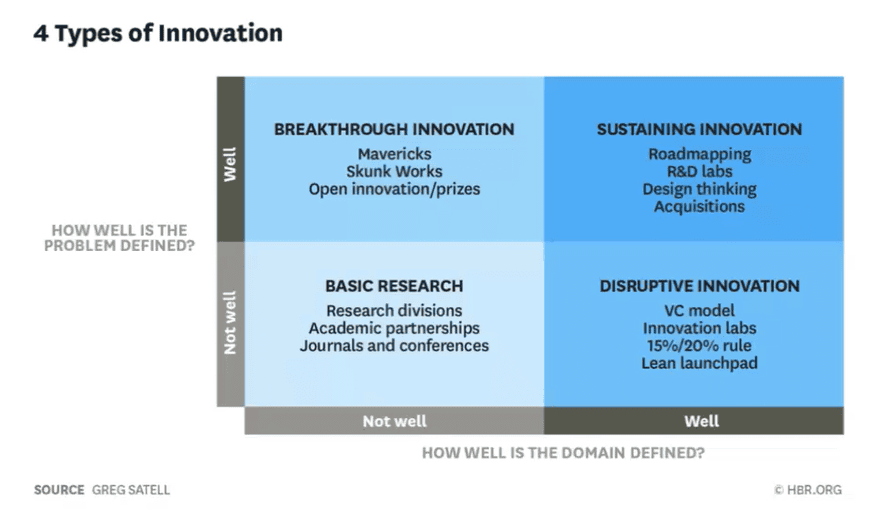
Serpiello then shared his thoughts on each quadrant:
Basic research – a low understanding of both domain and problem: “We don’t really know what the problem is and we don’t really know in which field or area it happens.”
Disruptive innovation – a well-understood domain but poorly understood problem: “In this area you may need something like innovation labs or launch pads.”
Breakthrough innovation – a poorly understood domain but well-defined problem: “This is the reverse of disruptive innovation… the classic example of open innovation.”
Sustaining innovation – a well-understood domain and problem: “The most common form in sport [and often the subject of] continuous research, design thinking or road mapping.”
Leaders Performance Institute members can read more here.
Renowned performance advisor Richard Young explains how serial winners cut through noise, prepare for pressure, and deliver when it counts.
It’s on every classroom wall for a reason: literacy is foundational. It’s the skill that keeps on giving.
In high performance, we need a different kind of literacy — one that helps us lead, perform, and sustain success amid noise, pressure, and constant change.
It’s the ability to navigate complexity with clarity and intent.
That’s what I call performance leadership.
Over eleven Olympic cycles, I’ve seen what separates one-off winners from serial champions. It isn’t more talent, motivation, or resources.
It’s three deeper literacies that repeat medallists — and the systems around them — consistently master. I call them The Three Literacies of Repeat Medal-Winning Systems. This idea is explored in my book Amplify: The Keys to Performance Leadership.
Beyond the surface
There’s a difference between reaching high performance and sustaining it. The first is an achievement. The second is an art.
Sustained success isn’t about pushing harder or repeating what worked before, it’s about finding and releasing the hidden friction — the small resistances that quietly wear performance down over time. Grit may get you to the summit, but clarity, alignment, and rhythm are what keep you there.
Too often, leaders chase short-term wins or mistake movement for momentum. These distractions drain energy and blur focus. Exceptional leaders rise above by cutting through the noise — focusing on the vital few forces that sustain performance over time. That’s where the Three Literacies come in: the disciplines that keep clarity sharp, alignment strong, and rhythm alive. Let’s explore each of these.
Einstein once said, “If I had an hour to solve a problem, I’d spend 55 minutes defining it and five minutes solving it.” Most teams flip that ratio.
Problem literacy isn’t about tackling a high volume of problems, it’s about knowing which problems matter most and gaining alignment around them. It’s the discipline of naming the real issue, not just the visible one.
In medal-winning systems, people don’t confuse activity for clarity. They slow down to diagnose, ask uncomfortable questions, and map the terrain before they march.
I once worked with a cycling team convinced their problem was bike technology. Our analysis revealed the real limiter wasn’t the equipment, it was the decision speed between coaches and mechanics during live races. Once they solved that, medals followed.
Try this:
Before your next big decision, pause and ask: what problem are we really trying to solve?
Then get the people closest to the action to describe it.
If you hear ten different answers, you don’t have problem literacy yet.
Once the right problem is named, preparation literacy ensures you build the systems, habits, and routines that hold under pressure.
A gold medallist once told me, “When I feel pressure, I return to my basics. That’s my anchor.” True preparation is quiet, repetitive, and often invisible — like a rhizome spreading beneath the soil. You don’t see the roots growing, but they’re forming strength, connection, and resilience long before anything breaks the surface. When pressure comes, those roots hold everything together.
When the right problem is identified, the solution becomes leverageable and sustainable.
As a great leader once told me, “Think once and deliver often.” That’s the essence of preparation literacy: finding the root issue and creating a systemic solution that can deliver again and again. It’s not about reacting faster, it’s about building better. The deeper the root, the stronger and more repeatable the performance.
Try this:
Audit your preparation. Ask, “If the pressure doubled tomorrow, would our routines still hold?” Preparation literacy isn’t about doing more—it’s about building deeper. Because when the surface shakes, only what’s rooted endures.
Knowing what to do and doing it under pressure are two different skills.
Performance literacy is the capacity to act with clarity when the stakes are high and the conditions unpredictable. It’s the meeting point of preparation and reality where plans are tested, emotions surge, and choices define outcomes.
Champions train for this space. They prepare their systems, minds, and relationships to hold steady when the environment doesn’t. High performers don’t wait for calm. They rehearse in the storm. They build familiarity with chaos, practice decision-making under fatigue, and refine communication when time and pressure close in. Over time, they develop a kind of internal rhythm that holds even as everything around them speeds up.
Performance literacy shows up in the small details — the pause before reacting, the deep breath before deciding, the steady tone in the middle of noise. It’s the mark of someone who has built trust in their process and belief in their preparation.
Try this:
Pressure-proof your moments. Rehearse them. Run “what if” scenarios. Expose yourself and your team to the demands of performance before the real moment arrives. Each deliberate repetition builds readiness, confidence, and flow.
The best don’t rise to the occasion; they return to what they’ve trained for. Performance literacy ensures what you’ve trained for is enough when it matters most.
The Performance Leadership Triad
Together, the three literacies form a Performance Leadership Triad:
• Problem literacy focuses your energy on the right target.
• Preparation literacy builds the foundation to hit it.
• Performance literacy ensures delivery when it counts.
Miss one, and the system wobbles. Solve the wrong problem and effort is wasted. Prepare poorly and pressure exposes it. Neglect execution and planning stays on paper.
Literacy never ends
School teaches reading, writing, and arithmetic. High performance demands Problem, Preparation, and Performance literacy—the hidden grammar of sustained success. Because literacy doesn’t end at school — it evolves. And when you master these three, you don’t just win once; you create a system capable of winning again and again.
In my book Amplify: Performance Leadership, I explore these three literacies in depth, with stories from Olympic campaigns, diagnostic tools, and practical frameworks you can apply immediately.
Richard Young is an internationally renowned performance advisor. He has been involved with 11 Olympics as an athlete, coach, researcher, technologist, and leader working across more than 50 sports and seven countries focused on sustained high performance. He has won international gold medals and coached world champions. He founded international performance programmes including, the Technology & Innovation programmes for Great Britain and New Zealand, and a Performance Knowledge & Learning programme for the New Zealand Olympic, Winter Olympic and Paralympic teams. Across seven Olympic cycles he has researched the differences between medallists and non-medallists, their coaches, support staff, leaders and the system they are in to unlock the keys that separate them from the rest.
24 Nov 2025
ArticlesIn the third part of his miniseries exploring complexity in sport, Everton’s Head of Sport Science Jack Nayler explains the importance of a clear direction of travel and a solid, collective decision-making process.
The second part looked further at the implications for this in a sporting organisation, notably that complexity is fractal, exists at different levels, and that each person within the organisation will exert different levels of influence over the performance at any given moment.
This brings us onto this third instalment, where I begin to look at what this means for those in leadership positions.
Leadership in complexity requires you to have the humility to accept the ignorance of your position and the understanding that autocracy won’t work. It is impossible to micro-manage every decision in the fast pace and short turnaround of games in a professional sports season. You will not be present to control every interaction that occurs and you will not possess all of the information available to make every decision.
With the inherent fluctuations that occur in a complex environment, it is incumbent on the leaders to provide a framework within which everyone can operate as effectively as possible, in a transdisciplinary manner.
I believe there are four pillars to this framework, that are characteristics of high-performing environments.
Your role as a leader is to ensure that these are in place so your team operates as effectively as possible.
Below, I will run through the first two on that list. I will tackle the third and fourth pillars in another piece.
Previously we spoke about how in a game, the influence over performance grows or diminishes in relation a player’s proximity to the ball, peaking whilst they are in possession. At the complexity scale of the wider organisation, this becomes the person (practitioner) stood in front of the player.
As a leader, whilst you may previously have had boots on the ground, chances are when stepping into a leadership role, your player-facing time has diminished. You are now generally removed by at least one, if not several degrees, from working directly with players.
The challenge you face is that the responsibility for the decisions taken around the athlete(s) is still ultimately yours and, as you rise higher, the difficulty factor of the decisions increases.
As your time with athletes diminishes, so does the amount of knowledge and information you have about them. There should be no way that a head of performance in an organisation has more ready information on an athlete than the therapist who has hands on that athlete daily. The paradox is that the closer you get to the centre of the complex system (the athlete), the more difficult it is to see the whole.
There is an Indian proverb about five blind men who are presented with a different part of an elephant, each perceives that they are touching a different object (e.g. the tail is a rope, the trunk a snake etc) because they have not been presented with the whole. The more reductionist we become in complexity, the narrower our focus, the more we are reducing our bandwidth and leaving ourselves open to larger errors.
Thus, your ability as a leader to frame the nature of the problem, provide an understanding of what the wider landscape looks like and cut through noise with your team is essential. This creates your direction of travel, a clear understanding around what you expect as a leader that frames the decisions made by your team on a daily basis. You may need to do this at larger scales (philosophy setting, season planning, game model development) as well as smaller scales (planning end stage rehab and return to performance, or where to place team meetings in the training week). Whatever the scale, you need to be able to provide a consistent thread of behaviour and values that will underpin how decisions are taken, and you need to do this regularly.
You also need to ensure that the vision you are setting fits the wider organisational goals. If necessary, this can be accompanied by some relevant key performance indicators (KPIs), but caution is advised. The aim of KPIs should be more of an outcome measure than a target in and of themselves. They should be the resultant of good practice, not become the embodiment of it. When numbers become targets, they can become a form of control placed on the complex system and, as per Goodhart’s law (1), can be gamed. A case in point is player availability. If the target is above a certain percentage availability for the team, it can lead to under-reporting by practitioners who do not want to negatively affect the standard by which performance is being assessed.
If the behaviours and values that underpin your vision can be co-created with your team, then the understanding and buy-in from the members of the team will be much greater. This will provide the basis for how your team will operate. This is less about the tacit knowledge in your team or the operational decisions that are being made (as these will be constantly adapting to the changing situation or player) but should include the values and behaviours the team want to exhibit and hold each other to. These are akin to the ‘why’ in Simon Sinek’s famed Golden Circle (2).
A clear vision with underpinning values set by the leader (with their team) creates a north star that will guide the decisions made by the team.
Even though cause-and-effect aren’t obvious in complexity and there is a degree of uncertainty in every decision made, we should not become fatalistic about making decisions and leave them to chance. We can absolutely increase the quality of the decisions that we are making.
As a part of the complex system, you are inherent in the decision-making process, but as mentioned above, you often have less information than those you lead.
In a hierarchical command structure, it takes too long to gather all of the relevant information and pass it up the chain of command to make a decision that is then passed back down again. Remember that the more you try to control a complex system, the more you leave yourself open to bigger failures.
David Marquet is a retired US naval captain who illustrates this problem well in his book Turn the Ship Around (3). He describes how he was trained to command one class of submarine and, at the last minute, was switched to another ship of a different class (at the time, the worst-performing ship in the Navy). He decided what the crew needed was licking into shape with training.
On their first voyage, Captain Marquet gave an order that was passed down the chain of command to the sailor whose job it was to enact that order. When the action didn’t happen, Marquet thought he had to gotten to the bottom of the problems that beset the boat. He marched over to the sailor demanding an explanation, and the sailor calmly informed him that what he had ordered wasn’t possible on this class of submarine. Marquet didn’t know what he didn’t know.
His experience speaks to another truism of complex environments: there is always a gap between expectation and reality, it will never play out exactly as you think. Crucially, Marquet stepped into this gap; he learned from the experience and changed the command structure from top-down order to bottom-up intention. Sailors had to declare to their superior that they intended to carry out an action, and this was then either approved or denied. The boat went from worst to best-performing ship in the US Navy the following year.
General Stanley McChrystal recognised a similar challenge whilst commanding US forces during the Iraq War in 2003 (4). US forces were picking up suspected insurgents off the streets and taking them back to base for interrogation. The information gathered was assessed by analysts before leaders made decisions and then issued orders back down the chain of command. The trouble being that by the time it took to do this, the message had been passed around the insurgents’ network, which immediately went to ground. McChrystal recognised the complexity of the situation and pushed decision making closer to the centre of the action on the front line. He trained troops to be able to question insurgents on the street and empowered them to act on what they found. This is credited as a key tactical change that helped to swing the tide of the insurgency back in the favour of the US forces.
Accepting then that in complex environments, we need to empower those in our team to make to make decisions, the most obvious way to improve decision making is to hire the best skillsets available to you. The art comes in blending these skillsets and setting them up to make good decisions.
As each person in the staff is their own complex mix of upbringing, education, skillset and experience, all may have a different viewpoint on the same set of information. Played correctly however, this is a value-add and is a key part of why diversity within your team is beneficial, each person will see things others cannot (5). Leading means you need to be able to synthesise what others are seeing and hearing and bring that together in a coherent decision.
There can be a temptation (which I have fallen for) to think you need to gather as many people/opinions together as possible when making decisions, allowing everyone in the team the opportunity to contribute. In fact, there is a limit beyond which the quality of decision-making drops. As the number of people involved in the process increases, there can be a reduction in the trust that the group members have in each other. This reduces psychological safety, and you lose agility.
For the kind of agile decision making necessary in and around a heavy fixture schedule, quality discourse will begin to reduce with as little as 5 people involved in the decision (6). A key task for the leader therefore is to figure out what the key decisions are that need to be made, and then set their team up accordingly, with the appropriate individuals correctly assigned.
Once you have your best people in place to make decisions, the next step is to ensure they are set up for success. Whilst we want people to bring all of their experience to bear on the decisions being made, we also need these to be informed by the available evidence. We should be collecting data and turning this into information (visualising it) so that the team members can then begin to process the evidence and reflect on it in relation to their existing knowledge. (I will describe this process in more detail in part four).
Leaders need to check and challenge the decision-making process effectively. They should ensure that those involved have all had the chance to contribute, check that the team have used the available evidence and provide the greater context held, if appropriate.
Also crucial is to break an impasse when it occurs, you hold the casting vote. As the leader, the more difficult decisions will be yours to make when they are beyond the scope of your team (who can help advise). You may well be in your position due to your greater level of experience. Your team will expect you to bring all this to bear when influencing the final decision that is being made. Whilst not everyone will agree with the final decision, ensuring the relevant people have had the chance to contribute and then explaining your decision will help to unite everyone behind a course of action.
Disagreeing and committing is a key skill for high performing teams, particularly when the stakes are high.
Future thinking
In the fourth and final part, I shall explore the remaining pillars: processes robust to pressure and a culture of curiosity and learning.
References
At the 2025 Leaders Sport Performance Summit, some of the most respected leaders in high performance set out their plans to build the winning teams of the future.
The South African, then with Munster, had agreed to become the Head Coach at struggling Bath in December 2021.
A few days later, he switched on the TV only to see Bath go 0-28 down after just 25 minutes of their Champions Cup tie with Leinster.
It prompted the Everest comment, as Van Graan told an audience at the 2025 Leaders Sport Performance Summit at the Kia Oval in London.
He eventually took the reins at Bath’s Recreation Ground in July 2022 and, over the next three years, led one of the most remarkable transformations in English rugby history.
In May, Bath lifted the European Challenge Cup, Premiership and Premiership Rugby Cup.
The tale of Van Graan’s ‘Rec Revolution’ set the tone for an international gathering of over 300 high-performance leaders to share knowledge, best practice and inspiration.
The agenda took its lead from our Trend Report in which more than 200 performance leaders from almost 40 sports told us how they expect the industry to develop in the years ahead.
Five trends stood out:
Van Graan is at the vanguard of several of these trends and, across both days, the Leaders Performance Institute delivered a range of guest speakers from organisations including England Rugby, the Royal Air Force, and the Haas F1 team to speak to each trend.
The following is a snapshot of what they said.
1. Alignment is now a competitive advantage
For evidence of the stock placed in being aligned, look no further than Bath’s transformation from a rabble to the best team in England in just three years.
Van Graan said: “I put up a picture of Twickenham on the very first day. I said ‘I can’t tell you how we’re going to get there, but we will get there.”
He wanted his playing group, coaches and other performance staff to coalesce around three values: connection, clarity and commitment. The trick was then bringing those to life.
Johann van Graan
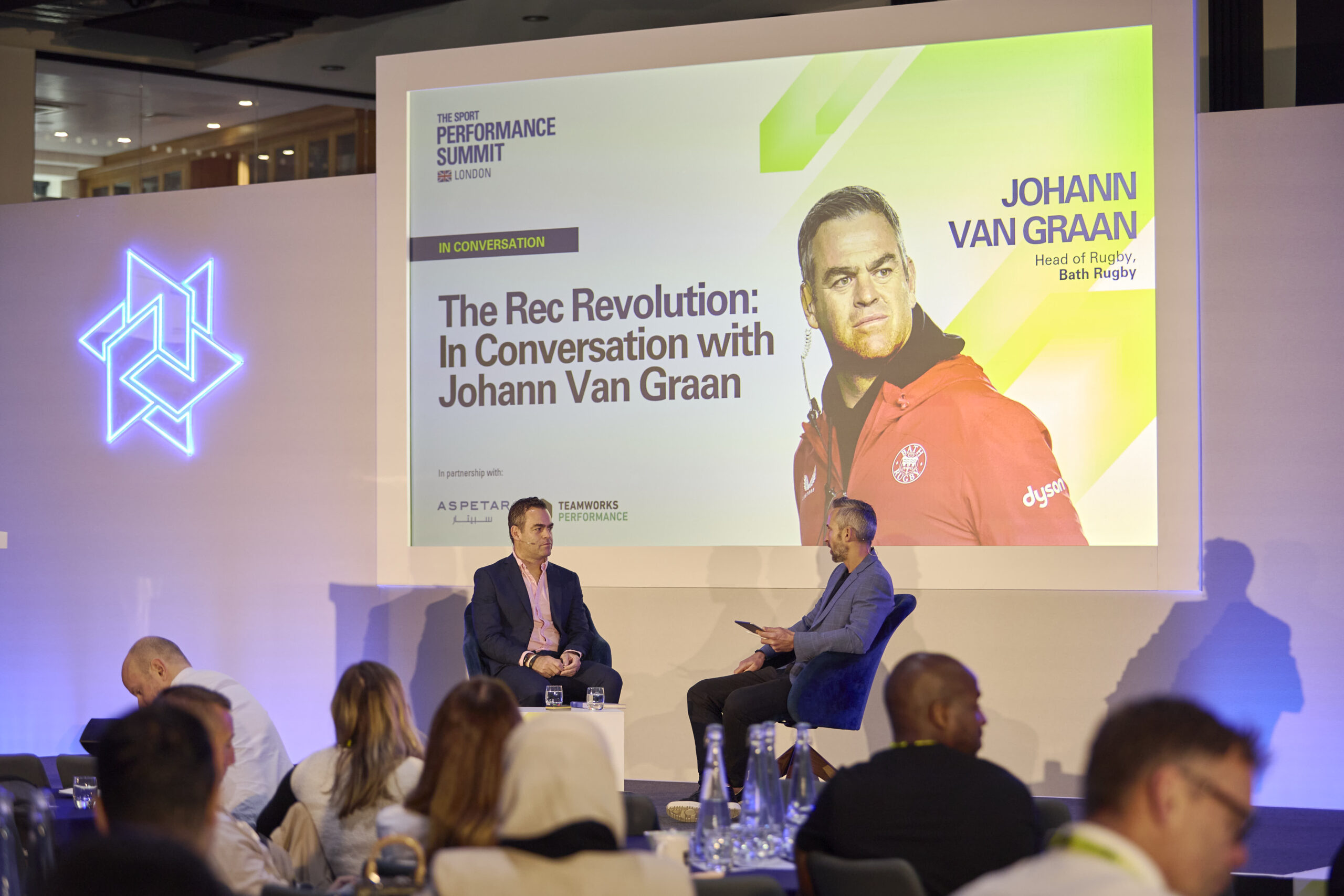
Bath Head Coach Johann van Graan in conversation with host Iain Brunnschweiler.
2. Leaders increasingly seek to empower and collaborate
John Mitchell offered another inspiring story from the world of rugby union.
In 2023, when he signed on as Head Coach of the England women’s national team, it was Mitchell’s first time coaching a women’s team.
The Red Roses had a genuine shot at winning the Women’s Rugby World Cup on home soil in 2025, but a talented team needed an experienced guiding hand.
The team delivered, with Mitchell receiving plaudits for his role as England secured their first world title in 11 years.
Two months on from that achievement, the audience found Mitchell (affectionately known to his peers as ‘Mitch’) in typically reflective mood alongside the recently retired Emily Scarratt, who was part of the Red Roses’ winning squad.
Sport (and rugby union) grows ever more complex and yet, after 30 years, Mitchell feels he has never been better equipped to coach.
“You don’t have the full scope,” he says of his early coaching days in the mid-90s. “You have strengths early on that are recognised but then also you sometimes don’t know the whole of yourself. So you take the time to understand the whole of yourself.”
He came to a critical understanding. “When I was younger, I was going to try and be right. Maybe I was trying to prove myself as a coach.”
John Mitchell

England Red Roses Head Coach John Mitchell shakes hands with former England fullback Emily Scarratt at the conclusion of their panel session.
Emma Keith built on the theme of empowerment in her presentation on officer training in the Royal Air Force.
“Cultures and environments can only grow when everybody takes accountability,” said the Commandant of the RAF’s Tedder Academy of Leadership. Keith, a group captain, is the first female to run RAF officer training.
Emma Keith

Group Captain Emma Keith talks to UK Sport’s Alex Stacey following her presentation on officer training in the Royal Air Force.
3. Teams are prioritising resourcefulness over resources
As Team Principal of MoneyGram Haas F1, Ayao Komatsu knows as well as anyone that his team is competing with better resourced and more illustrious teams.
The team has 375 staff members, which may sound like a lot, but it pales in comparison to the likes of Ferrari, Red Bull and McLaren.
“If we cannot work together, if you’re not supporting each other, if you’re not aligned, we’ve got zero chance against organisations minimum three times our size,” said Komatsu, who had just flown in from the Brazilian Grand Prix in São Paulo where Haas’ Oliver Bearman achieved a creditable top-six finish the weekend before the summit.
Ayao Komatsu

Ayao Komatsu, the Team Principal of Haas F1, shares insights into life in the pitlane.
Similarly, albeit in vastly different circumstances, the Red Cross must make the most of its limited resources when emergencies strike.
Chris Davies, the Director of Crisis Response and Community Resilience at The British Red Cross, cited his team’s core operational process:
Chris Davies

Chris Davies of the British Red Cross in full presentation mode.
4. Psychology will be a game-changer
The mental and behavioural side of performance was an ever-present topic on both days of the summit. Our guests discussed several elements:
The importance of individual expression and acceptance
Johann van Graan
Belonging as a contributor to wellbeing (and performance)
Emily Scarratt
Psychological safety
Ayao Komatsu
5. Teams are engaging in a tech arms race
Professor Tom Crick spoke in his capacity as Chief Scientific Adviser at the UK Government’s Department for Culture, Media and Sport.
He presented on the growth of AI and continually stressed how important it is to keep “the human in the loop” regardless of whatever advances are coming.
To this end he offered Leaders Performance Institute members a series of recommendations.
You must be able to explain why you are using an AI tool…
“You can’t just say ‘the computer says so.’ There has to be some understanding and explainability, and there has to be trust.”
An AI tool should not replace your people…
“AI should not erode or disempower or remove agency for people within your domain. It should augment human capability, not replace it,” said Crick. He added: “It is about co-design, co-decisions and co-evolution as we go forwards – keeping humans embedded in the process.”
Don’t assume your AI tool is right…
“Don’t automatically trust the system. Always ask: is that the right data? Does that feel right? Can we verify and validate it another way?”
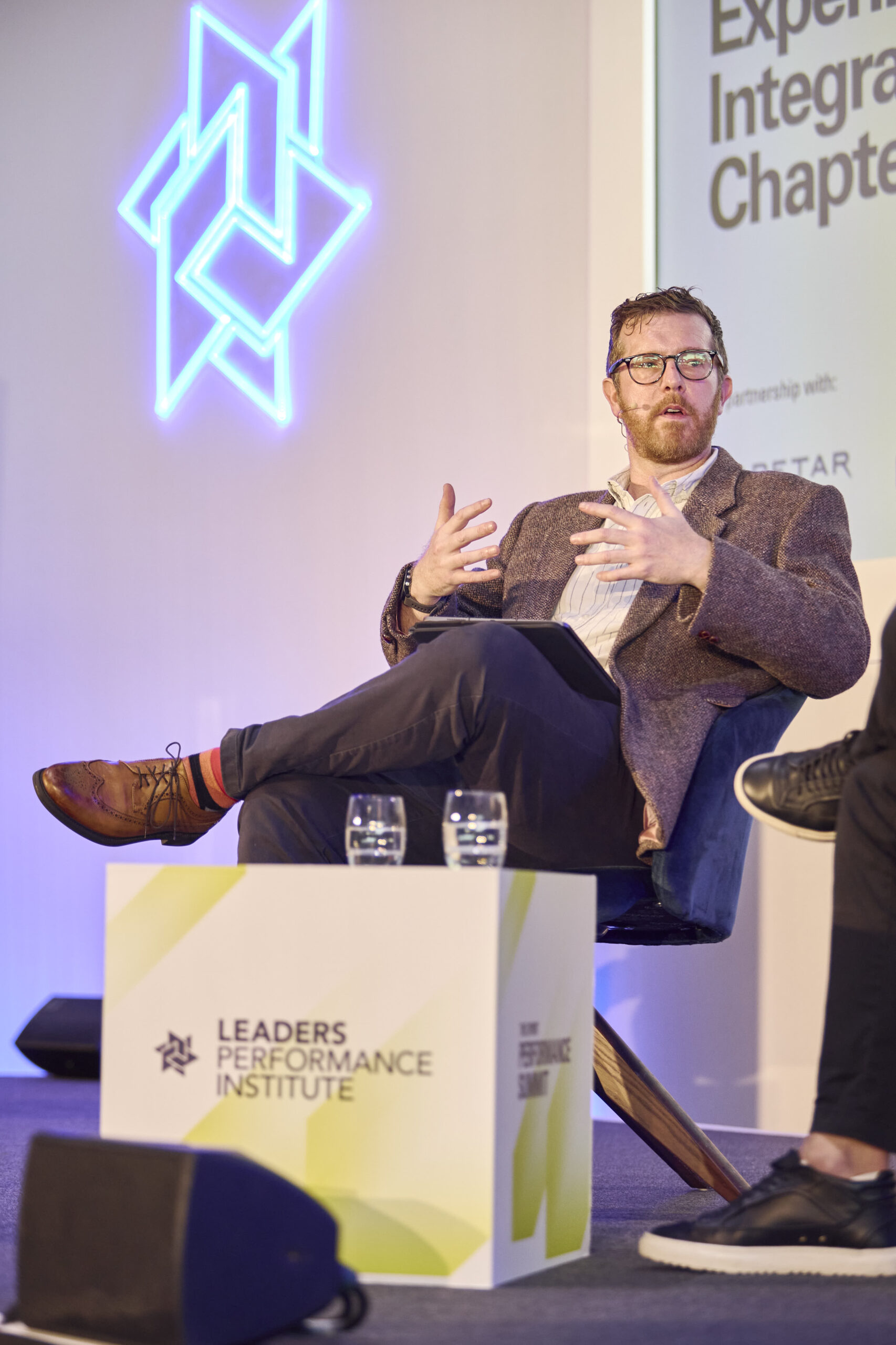
Tom Crick, the Chief Scientific Adviser at the UK Government’s Department for Culture, Media and Sport, answers questions from Leaders Performance Institute members.
Next stop for the Leaders Performance Institute
ESA Director of Science Carole Mundell discusses creativity and problem-solving in volatile environments both in space and here on Earth.
Main Image: European Space Agency
The video depicted a range of space-faring feats performed by the European Space Agency [ESA] as it enjoyed its 50th year.
Mundell, who is the Director of Science at the ESA , brought the room back to Earth again when outlining her efforts to bring together 23 European nations (more specifically their governments) in pursuit of the agency’s interstellar goals.
“Diplomacy is a contact sport,” said Mundell, who is a diplomatic veteran at this stage. She is responsible for a pan-European staff of over 45,000 people, with headquarters in five jurisdictions. You can also throw in the challenges posed by Brexit, the pandemic (when international diplomacy definitely was not a contact sport) and the war in Ukraine.
“The political churn at the moment is unprecedented,” she continued. “From one day to another, we don’t know whether our member state governments will continue to be governments or remain in place for another election.”
This volatility stands in contrast to ESA missions, all of which take decades to devise and tend to last longer than most political careers.
Then there’s the space-based challenges. In her time onstage, Mundell described a range of missions, from explorations of Jupiter’s moons to detailed observations to the surface of Mercury. All require incomprehensible precision.
Take the LISA [Laser Interferometer Space Antenna] mission. Its purpose is to detect gravitational waves in space; the ripples in space-time caused by cosmic events such as black hole collisions.
“They will have three spacecraft flying in convoy, with two and a half million kilometres between each spacecraft,” she said. “They will follow an Earth-Sun orbit and they will rotate and stay in that triangle.”
The lasers in question must be able to point with precision narrower than a proton.
““We’re going to measure the nature of space-time itself. It’s eye-watering technology.”

LISA measuring the properties of gravitational waves (Image: the European Space Agency)
Mundell has become adept at managing the external elements that could derail projects such as LISA. Thanks to her leadership, ESA’s creative and technical minds are able to do their best work in a climate of political uncertainty.
Psychological safety
In space, Mundell told us, things often go wrong. Take the Euclid mission, the purpose of which is to map the ‘dark’ universe. The lens of space telescope, which orbits the sun 1.5 million km from Earth, became contaminated by a strip of ice thinner than a strand of DNA. Mundell’s team had to find a way to defrost the ice without damaging the equipment’s sensitive optics.

Euclid begin its dark universe survey. (Image: European Space Agency)
But if you can reasonably anticipate microscopic space ice then you can devise a plan to defrost it.
“We did that last month,” she said almost matter-of-factly, but the ESA’s staff have built trust in their systems. “At a time of crisis, the first thing you do is check the process.” The system provides a layer of safety that goes beyond the interpersonal dynamics originally associated with the term ‘psychological safety’ (although these remain important; Mundell says: “Please create the best possible cultures you can. Please have the courage to really call out bad behaviour”).
“The cognitive safety comes from the fact that you know there is a process that you’ve all built together.”
This knowledge is also useful when navigating potential cultural differences present in a supranational organisation.
More creative, less expensive, more innovative
On her way to the Kia Oval, Mundell received news that one of an ESA contract negotiation was going backwards.
“My first instinct was to think of a solution,” she said. “And a very calm senior colleague said to me: ‘we don’t need to escalate this’. We don’t always need to go to the nuclear option.”
Such setbacks and budget cuts are par for the course. During his annual press briefing in January, ESA Director General Josef Aschbacher revealed that the ESA budget for 2025 would be €7.68 billion. It was €7.79 billion in 2024, but Germany, Italy and the UK reduced their contributions by a collective €430 million.
“We have to continually innovate and make things more creative, less expensive, but more innovative,” said Mundell, who explained that the ESA must design to cost. While there is room for creativity in day to day problem-solving, the process guides the action taken. “We have a whole quality assurance system where we set our objectives and we say ‘what will we do?’ ‘What did we say we’d do?’ ‘Did we do what we said?’”
Enduring purpose
The ESA was founded to enable European nations to explore the cosmos and further the continent’s knowledge and understanding. It’s an enduring purpose that continues to appeal. On 1 January this year, Slovenia became the 23rd member state, with several others still in the queue to join.
“Our missions are lifetime generational missions,” said Mundell. “You’ll see that people will give a significant fraction of their lifetime to develop, design and fly these missions, and ultimately protect them, to deliver science back to society. Children in school today will use data from our missions.”
She explained that once every three years there is a council meeting of ESA members at a ministerial level to decide the agency’s budget for the next three-year cycle. She shared an image from the 2022 meeting in Paris. It was taken just before she joined:

The official portrait of ministers at the 2022 ESA Council Meeting at Ministerial Level. (Photo: Stephane Corvaja / European Space Agency)
“This is a photograph of inspiration,” she said. “These ministers come from all different political backgrounds, they were facing various different challenges at this time. There was cost of living crisis and obviously the war in Ukraine was pushing all sorts of problems across these member states, and yet they all came together and they agreed that space is important.”
Hear more from Carole Mundell
10 Nov 2025
ArticlesAs Scottie Scheffler’s Ryder Cup travails show, team performance is not simply the sum of individual capabilities. It’s the product of psychological compatibility, complementary strengths, behavioural synergy under pressure, and clear role definition.
Whilst traditional analytics focused on individual statistics and course fit, the tournament results validated what behavioural economics could have predicted: personality compatibility matters more than raw talent in team formats.
As Europe secured a commanding 15-13 victory, several US pairings failed spectacularly despite strong individual credentials. These failures weren’t random—they were predictable through behavioural analysis. Equally important, Europe’s successful pairings demonstrated the power of complementary psychological profiles. Here’s how the science of decision-making under pressure explains both the failures and the successes.
Prospect Theory in action
Before examining specific pairings, it’s necessary to understand Prospect Theory, the Nobel Prize-winning framework developed by Daniel Kahneman and Amos Tversky. The theory reveals that people feel losses approximately twice as intensely as equivalent gains, evaluate outcomes relative to expectations rather than in absolute terms, and shift their risk-taking behaviour depending on whether they’re protecting a lead (becoming conservative) or trying to recover from a deficit (becoming aggressive). Understanding these principles allows us to predict when players will make poor decisions, even when they’re emotionally calm and technically skilled.
The gold standard: Seve Ballesteros and José María Olazábal
The most legendary Ryder Cup partnership in history provides the perfect template for behavioural compatibility. Playing together 15 times between 1987 and 1993, Seve and Ollie won 11 points with a record of 11-2-2—the most successful pairing in Ryder Cup history.
Why they worked:
Ballesteros’ aggressive, risk-seeking approach was balanced by Olazábal’s steady precision. Different styles, unified purpose, perfect synergy.
At the 2025 Ryder Cup, Rory McIlroy and Tommy Fleetwood demonstrated the same principles, going 4-0 in their matches. McIlroy’s aggressive, expressive leadership paired perfectly with Fleetwood’s steady, supportive presence. It was a modern validation of the Ballesteros/Olazábal template.
The English-Morikawa disaster
The most glaring failure at the 2025 Ryder Cup was the Harris English and Collin Morikawa pairing, which DataGolf retrospectively ranked as the worst possible combination (132nd out of 132 pairings for Team USA).
They lost 5&4 to McIlroy/Fleetwood on Friday and lost 3&2 to the same pair on Saturday.
Behavioural analysis tells us that both players share problematic psychological profiles for team play.
These include:
When facing the aggressive, crowd-energised McIlroy/Fleetwood duo, they had no mechanism to generate counter-momentum or break negative cycles. Their conservative tendencies amplified each other, creating a downward spiral that traditional coaching couldn’t address.
The contrast with Ballesteros/Olazábal is stark: Where Ballesteros told Olazábal “I will take care of the rest,” English and Morikawa had no such clarity. Both waited for the other to lead.
Scheffler’s team format struggles: when strengths become weaknesses
Perhaps more surprising was Scottie Scheffler’s continued struggles in team formats. Despite being the world’s most dominant individual player, his Ryder Cup record tells a different story: 2-4-3 overall, 0-3 in foursomes.
The behavioural explanation is that Scheffler’s individual strengths become liabilities in team play.
More specifically:
The same psychological traits that make him unbeatable individually (complete control, perfectionism, internal focus) become obstacles when success depends on partnership dynamics. His pairing with Russell Henley (both introverts, both analytical, no clear leadership dynamic) lost 5&3 to Jon Rahm and Sepp Straka, the match effectively over after the front nine.
These Ryder Cup results offer crucial insights for organisational team building:
Traditional thinking suggests pairing similar personalities for harmony. Behavioural economics shows the opposite: complementary traits create stronger partnerships. Successful teams need energy generators AND steady influences, communicators AND processors, leaders AND supporters.
Evidence: Ballesteros/Olazábal (complementary) = 11-2-2. English/Morikawa (similar) = 0-2.
Individual excellence doesn’t guarantee team success. The psychological skills required for individual performance (self-reliance, internal focus, personal control) can become liabilities in collaborative environments. Leaders must assess team readiness separately from individual capability.
Evidence: Scheffler is world No1 individually but 2-4-3 in Ryder Cup team play.
Every successful partnership has clear role definition: who leads, who supports, who generates energy, who provides stability. Without this clarity, decision-making becomes paralysed.
Evidence: Ballesteros told Olazábal “I will take care of the rest”—instant clarity. English/Morikawa had no such definition.
How individuals respond to pressure in team settings follows predictable patterns. Some become more conservative (loss aversion), others more aggressive (risk-seeking), some internalise stress, others externalise it. Understanding these patterns allows for better team composition and intervention strategies.
The Prospect Theory twist
Interestingly, as the US fell further behind, Prospect Theory predicted they would become more risk-seeking (people take more risks when in the domain of losses). This psychological shift actually improved some performances in singles play, where individual risk-taking could be an advantage rather than a team liability.
Practical applications for leaders
Team formation:
Performance optimisation:
Crisis management:
Conclusion
The 2025 Ryder Cup demonstrated that in high-stakes team environments, behavioural compatibility often trumps individual talent. Whilst the US had superior individual players on paper, Europe’s better understanding of team psychology—whether intentional or intuitive—proved decisive.
The evidence is compelling: Ballesteros/Olazábal’s 11-2-2 record and McIlroy/Fleetwood’s 4-0 performance demonstrate the power of complementary psychological profiles. Conversely, English/Morikawa’s 0-2 disaster and Scheffler’s 2-4-3 record show the cost of ignoring behavioural compatibility.
For leaders in any field, the lesson is clear: team performance is not simply the sum of individual capabilities. It’s the product of psychological compatibility, complementary strengths, behavioural synergy under pressure, and clear role definition. Understanding these dynamics isn’t just useful, it’s essential for consistent high performance in team-based environments.
The most successful organisations will be those that apply behavioural economics principles to team formation, recognising that the science of human decision-making under pressure is as important as technical skill in determining outcomes.
Dr Benjamin Kelly is the Head of Behavioural Economics & Social Impact at Kavedon Kapital. If you would like to speak to Benjamin about his work, please contact a member of the Leaders Performance Institute team.
What to read next
What Behavioural Finance Teaches us about (Bad) Decision Making in Golf
Mo Bobat of IPL champions Royal Challengers Bengaluru describes the fundamental difficulty with forging alignment in a ‘high-judgement environment’.
The question is posed by Mo Bobat, the Director of Cricket at the 2025 India Premier League champions Royal Challengers Bengaluru. He also serves as Director of Cricket at London Spirit.
“We don’t know that it is more significant in sport,” he continues, “in fact it’s probably the same in other industries”.
Still, the Leaders Performance Institute knows from our Trend Report that more than a quarter of practitioners believe that alignment (or misalignment) has the single greatest impact on the quality of leadership at their team.
So why might alignment seem more significant in sport?
“In a lot of other industries you may have to wait a quarter before you get that ripple effect of trends and feedback,” says Bobat, who also spoke to the Leaders Performance Institute for the report.
“In sport, there’s actually feedback every week; and it’s pretty open and transparent feedback too. It isn’t the way that someone interprets a board report or a set of accounts, it’s ‘one-nil’, ‘two-nil’, it’s ‘lost by an innings’. “That means there’s a lot of judgement attached to how things are going and, therefore, I think any misalignment is highlighted quite quickly.”
For Bobat, this raises another question: who actually needs to be aligned?
“When you think about alignment, you can almost convince yourself that everyone in the building needs to be aligned,” he says. “Of course, that’s true to a degree, but not every single person in the system has the same proportional impact when it comes to alignment.”
The most important is alignment between your executives, board and key performance decision makers.
“You can add the captain in cricket just because of the role they play,” he continues, “and if you’ve got those four or five people aligned you can almost guarantee that everyone else will be.”
The flipside is true as well. “If that core is misaligned, it doesn’t matter if everyone else is aligned to something.” He repeats his second question: “So who needs to be aligned? I think it’s worthy of debate.”
In sport, the immediacy of the feedback and, therefore, the judgement, has implications for how a performance director seeks alignment within their team.
“You’ve almost got to approach it like a psychologist,” says Bobat, who explains that sport is full of practitioners and coaches exhibiting protective tendencies in the workplace.
These people can protect for different perceived threats. An owner, for example, might be trying to protect the value of the team, a CEO may also have financial concerns. If that were the case, then it stands to reason that the CEO may have a different level of appetite for transfer/trade risk to the head coach, who will perceive threats of their own.
Bobat says: “If you’re protecting for a different threat, you’re going to value different things, and you’re going to have slightly different emphases. That’s misalignment already.”
His solution is easy to say but potentially much harder to deliver, as he freely admits.
“What you need to create – and this is hard in a high-judgement environment – is everybody having exactly the same purpose and intent, with nothing going unsaid.”
If the performance director or head coach perceives differences in key stakeholders then it is incumbent on them to find ways of managing in all directions.
Bobat says the leader has to “bring people back to the same North Star and try not to let the things they’re protecting for drive the behaviour” of other key stakeholders because when highly functional people are unshackled from protecting for things, you tend to see the best results. When they are dysfunctional, it tends to be the opposite.
Is psychological safety the answer?
“Yes, although that’s quite idealistic,” says Bobat. “People talk about ‘psychological safety’ like its dead-easy. Ideally, you want to feel safe enough so that you’re not reacting to those threats, but it’s unrealistic to think that those threats are going to go away. They’re not.”
The true answer, he believes, is “to try and create a culture where you can at least call it out. That’s what you’ve got to aim for.”
Another variable is your stature within an organisation. “Your ability to influence events, as optimistic as anyone is, is a little bit contingent on your own level of authority as well.
“So it’s tricky. It’s not straightforward. It sounds simple, but it’s not easy.”
What to read next
As behavioural finance specialist Dr Benjamin Kelly explains, these four common biases can derail even the best players.
While technical skill and conditioning are paramount, behavioural biases frequently derail even the most talented players. For leaders in sports, understanding these cognitive shortcuts and emotional responses is crucial for optimising athlete performance, coaching strategies, and mental resilience.
I believe that golf, much like financial markets, is fertile ground for behavioural finance – a field integrating psychology and economics to explain irrational decisions. While behavioural finance has profoundly reshaped our understanding of investment behaviour, its application to sports decision-making, particularly in golf, remains remarkably underexplored. This is a significant oversight, as the very same biases impacting trading decisions equally affect decision-making on the golf course.
By examining cognitive shortcuts and emotional responses that derail golfers, we uncover profound lessons applicable to high-pressure environments across sports and business.
My work with investors has consistently demonstrated that reducing ‘bad decisions’ incrementally improves investment returns. This same principle applies directly to golf: eliminating poor choices on the course directly translates to saving shots and enhancing performance.
Overcoming behavioural biases is notoriously difficult; our innate cognitive architecture makes us highly susceptible. Therefore, the optimal path to mitigation is not to fight the bias directly, but to create a step in the process that prevents us from succumbing to it. In trading, a simple yet powerful example is the stop-loss order – a pre-defined instruction to exit a position if it falls to a certain price, removing emotional discretion from a critical decision.
This methodology, involving structured interventions, is evolving for golfers of all abilities.
Below, I illustrate these points with compelling examples, including Robert MacIntyre’s dramatic final round at the 2025 BMW Championship, and propose actionable strategies for correction.
Loss aversion describes our innate tendency to prefer avoiding losses over acquiring equivalent gains; the psychological pain of a loss is often twice as powerful as the pleasure of a gain. In golf, this bias is a primary contributor to the dreaded ‘choke’ phenomenon, particularly when a player holds a significant lead. The shift from playing to win to playing not to lose is a classic manifestation. It leads to tentative play and costly errors.
Consider the ‘final day phenomenon’ in golf, where approximately two-thirds of leading players fail to convert their lead into a win on the final day of a tournament. This represents a conversion rate of roughly 33%. My work with investors has consistently shown that even a modest improvement in decision-making, leading to an increase in success rates from 33% to 45%, can yield material benefits. For a professional golfer, this translates directly into more career victories and significant financial gains. For investors, it means incrementally improved returns and enhanced portfolio performance. This isn’t a sudden decline in skill; it’s a psychological battle. A player leading a tournament, especially on the back nine, often shifts from an aggressive, winning mindset to a conservative, loss-averse one. Instead of continuing the attacking golf that built their lead, they focus on not making mistakes, which leads to tentative swings, reduced pace, and increased unforced errors. The fear of losing the lead becomes more potent than the desire to win. It paralyses their natural game.
Robert MacIntyre at the 2025 BMW Championship provides a vivid illustration. MacIntyre entered the final round with a commanding four-shot lead, having played exceptional golf through the first three rounds (carding 62, 64 and 68 for an average of 64.67 shots). However, in the final round, under immense pressure and with a significant lead to protect, he shot a 73 – eight shots worse than his average for the preceding rounds. This stark difference, which ultimately saw him lose the tournament to Scottie Scheffler, is a textbook example of loss aversion in action. The desire to protect the lead likely led to a more cautious, less assertive approach, resulting in a performance significantly below his demonstrated capability. His post-round comments when he expressed a desire to “smash up my golf clubs,” underscored the emotional toll of such a collapse, which was rooted in the psychological pain of losing what felt like an assured victory.
Correction strategy: process-oriented thinking and positive aggression
Mitigating loss aversion requires a conscious shift from outcome-oriented to process-oriented thinking. Golfers should:
My methodology, applied to investment, focuses on establishing clear, unemotional exit strategies to prevent such value traps, which directly improves returns by eliminating these ‘bad decisions’.
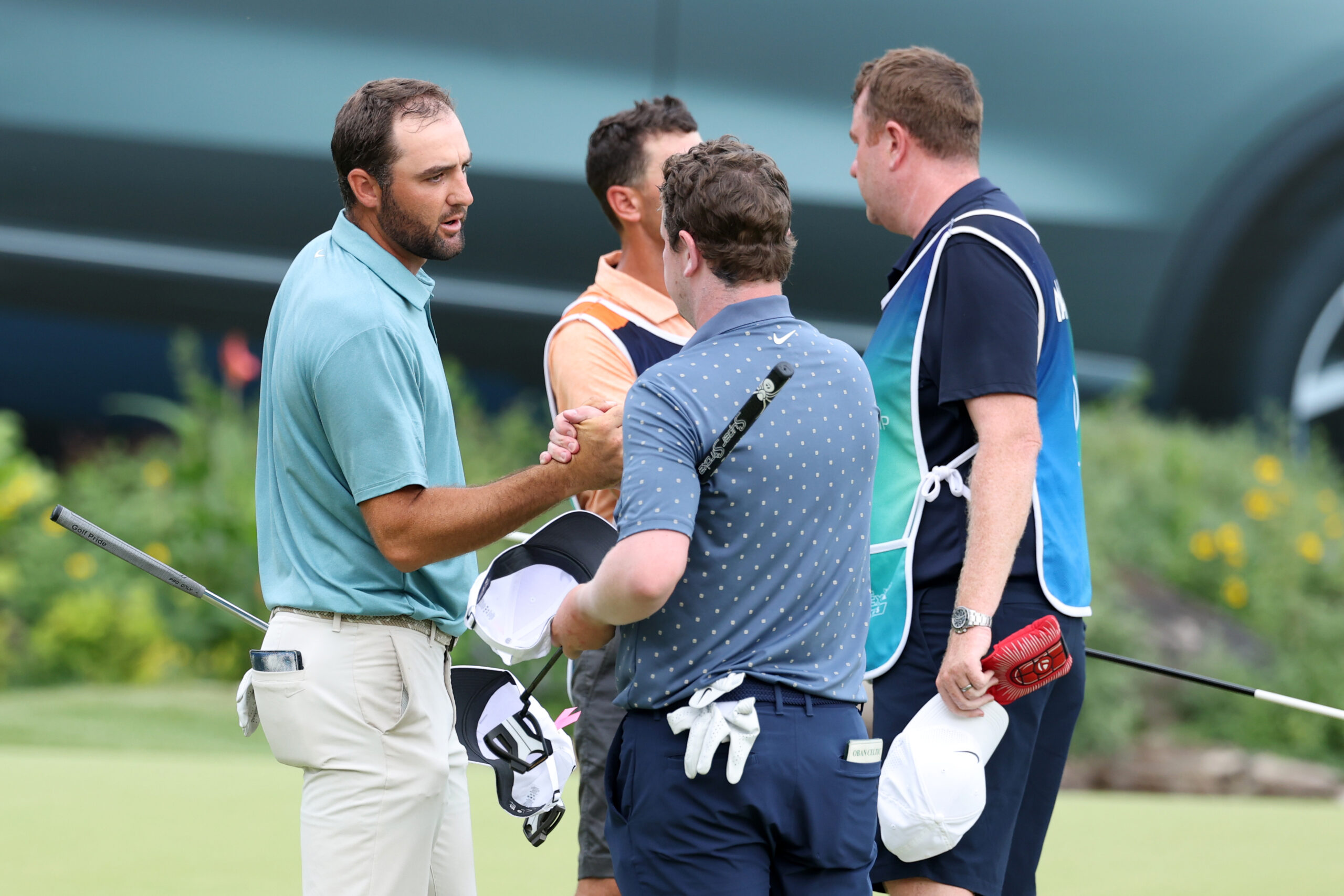
A victorious Scottie Scheffler shakes hands with Robert MacIntyre at the BMW Championship 2025 at Caves Valley Golf Club. (Photo: Kevin C Cox/Getty Images)
This translates to a pre-shot checklist that includes a deliberate assessment of risk vs reward. This ensures the chosen shot aligns with a pre-determined strategy rather than emotional impulse.
Overconfidence bias is the tendency to overestimate one’s abilities, knowledge, and the accuracy of one’s predictions. In golf, this often manifests as the infamous “hero shot” syndrome. Picture a golfer, slightly out of position after a wayward drive, facing a daunting carry over water or a dense thicket of trees to reach the green. A more prudent strategy might involve laying up, accepting a bogey or par. However, the overconfident golfer, convinced of their exceptional skill or believing this is their moment of glory, attempts the low-percentage, high-risk shot. The result is often disastrous: a ball splashed into the water, lost in the woods, or a double bogey that unravels a promising round.
Three-time major champion Pádraig Harrington has openly confessed that overconfidence cost him dearly at the 2025 Senior PGA Championship, particularly on a crucial 15th hole. Despite his vast experience, he felt his confidence and arrogance led him to an ill-advised approach shot, costing him a crucial hole. This mirrors countless amateur golfers who, after a few good shots, attempt to carry a 200-yard water hazard with a 3-wood, only to find their ball sinking to the bottom, convinced their recent success grants them an infallible touch. The allure of the ‘hero shot’ often blinds players to the higher probability of failure, driven by an inflated sense of their current capability.
Correction strategy: objective risk assessment and pre-shot routines
To counteract overconfidence, golfers must:
My investor checklists include a mandatory step for a ‘devil’s advocate’ review of high-conviction trades, forcing a re-evaluation of assumptions. This translates to a ‘reality check’ step in their pre-shot routine, where they explicitly consider the worst-case scenario and whether the reward truly justifies the risk. This step prevents the overconfident ‘hero shot’.
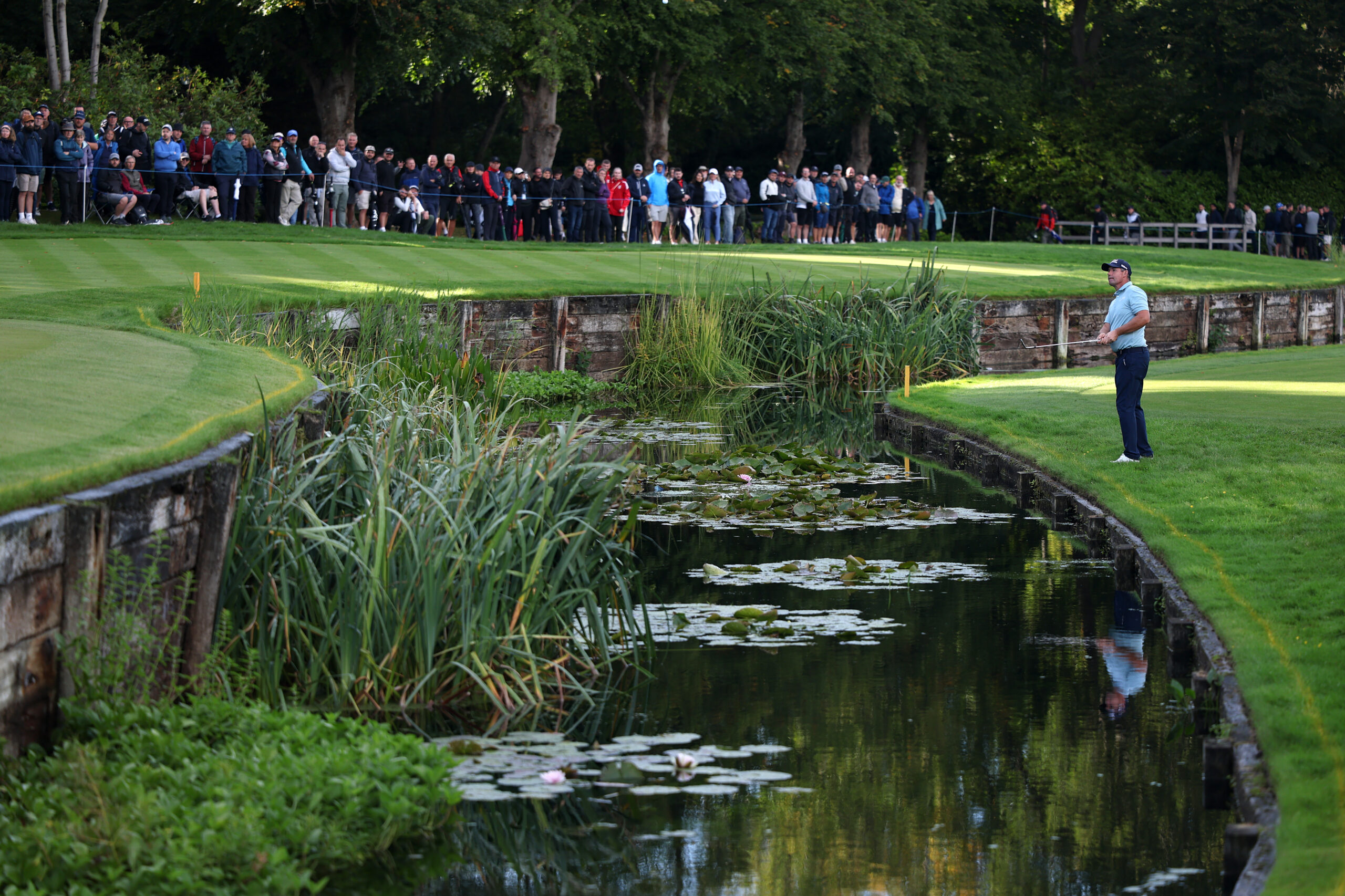
Pádraig Harrington at the 2025 BMW PGA Championship. (Photo: Andrew Redington/Getty Images)
Confirmation bias is the tendency to seek out, interpret, and remember information in a way that confirms one’s pre-existing beliefs or hypotheses. On the golf course, this can lead to flawed self-assessment and persistent errors.
A golfer might believe their slice is due to an ‘outside-in’ swing path, and subsequently only notice instances where their swing appears to confirm this, ignoring other potential causes like an open clubface. This selective attention prevents them from accurately diagnosing and correcting the root cause of their swing fault. Similarly, a player might attribute a good shot to their skill and a bad shot to external factors (a bad bounce, a gust of wind), reinforcing a biased self-perception that hinders genuine improvement.
Correction strategy: objective data and external feedback
To address confirmation bias, golfers should:
My investor checklists mandate seeking out and documenting opposing viewpoints before making a significant investment.
This means a ‘feedback loop’ step where they actively solicit input from their caddy or playing partners on their swing or strategy, or review objective data from launch monitors, rather than relying solely on their internal, potentially biased, assessment.
Anchoring bias occurs when individuals rely too heavily on an initial piece of information (the “anchor”) when making decisions, even if that information is irrelevant. In golf, this can lead to rigid decision-making that fails to adapt to changing conditions.
A common scenario involves a golfer fixating on the yardage provided by a sprinkler head or a course guide at the start of a hole. This initial yardage becomes an anchor, making it difficult to adjust for dynamic factors like wind changes, elevation shifts, or a different pin position that emerges during the round. A player might stubbornly stick to a club choice based on the initial anchor, even when conditions clearly dictate a different approach, leading to shots that are consistently long or short.
Correction strategy: dynamic assessment and multiple data points
Counteracting anchoring requires:
My investor checklists include a mandatory ‘re-anchor’ step, where all previous price points are deliberately ignored, and decisions are made solely on current fundamentals and future projections.
For golfers, this translates to a ‘situational awareness’ step in their routine, where they consciously disregard previous hole outcomes or initial yardage markers, and instead focus on a fresh, comprehensive assessment of all current variables before committing to a shot.

Robert MacIntyre at the 2025 BMW PGA Championship. (Photo: Jasper Wax/Getty Images)
Conclusion: cultivating mental discipline for peak performance
Behavioural biases are an inherent part of human cognition, but their impact on the golf course need not be detrimental.
By understanding how overconfidence, loss aversion, confirmation bias, and anchoring manifest, and by implementing structured strategies to counteract them, golfers can significantly enhance their decision-making capabilities. The journey to mastering the mental game of golf is one of continuous self-awareness, discipline, and a commitment to process over outcome.
Just as my work helps investors reduce the incidence of “bad decisions” to incrementally improve returns, applying these behavioural finance principles to golf can directly lead to saving shots and elevating performance. The critical insight is that overcoming biases is extremely difficult; our innate cognitive architecture makes us highly susceptible.
Therefore, the optimal path to mitigation is not to fight the bias directly, but to create a step in the process that prevents us from succumbing to it. This methodology, evolving from investment to the golf course, empowers athletes of all abilities to make optimal choices when it matters most.
For sports leaders, fostering an environment that encourages objective self-assessment, embraces data-driven insights, and champions structured routines will be key to developing athletes who not only possess exceptional physical talent but also the mental fortitude to make optimal decisions when it matters most.
This approach not only leads to more consistent performance but also a deeper, more rational engagement with the beautiful, challenging game of golf.
Dr Benjamin Kelly advises investors and professional athletes on decision making strategies in high stakes environments. If you would like to speak to Benjamin about his work, please contact a member of the Leaders Performance Institute team.
