Alignment, the question of performance outcome vs performance growth, learning and adaptive leadership were all on the agenda of the Leaders Performance Institute in May.
Take the club’s 2-1 home defeat to Bournemouth in early April, which was widely perceived as one of the team’s worst performances of the campaign.
The team looked and felt exhausted, which was not necessarily helped by their Manager Mikel Arteta’s ferocious work ethic and increasing demands on the training pitch. It was a period when injuries mounted too.
But as reported in the Independent, Arsenal attacking midfielder Eberechi Eze, approached his boss and told him in so many words: ‘we can do this, but we need a bit of space’.
To his credit, Arteta listened and though they lost at rivals Manchester City the following weekend, there were shoots of promise in that performance. Arsenal would win their remaining five matches and clinch the title by seven points from City.
They then came within a penalty shootout of winning the Champions League in Budapest.
Arteta swore in the aftermath that Arsenal will be back; and one suspects he might listen to his players a little more readily in the future.
Which brings us on to happenings at the Leaders Performance Institute in May, where a consistent theme has been the prioritisation of athlete needs, hopes and expectations.
Let’s dig into it.
Quote of the month:
A lot of coaches are either overdoing the teaching so there’s not any learning taking place or there are too many missed opportunities for the teaching and learning. It’s also changing the perception of the teacher; I’m doing it to you versus facilitating learning.
So said the head of coaching at a British university. He then raised the question of timing. “Do you jump in straight away? Do you wait till the end of the session and reflect? Do you wait till the next day and do some teaching and learning?”
It was an important consideration for a Leaders Virtual Roundtable that focused on what it takes to create an impactful and effective learning environment.
Read the breakdown here.
Insight of the month:
We’ve actually had our coaches start to record 10 to 15 minute videos, send them to players beforehand, and then the actual talk becomes them being able to reflect and digest the information.
So said a player development manager from Major League Baseball at a Leaders Virtual Roundtable where members discussed working with younger people.
Younger generations of athletes (as well as coaches and other staff members) are digital natives and teams would do well to lean into this.
Another voice from MLB, a sports scientist, told the table:
I think there’s definitely a difference in terms of how I have had to learn to communicate with them and include them in various decisions and thoughts along the way — and I’ll be the first to say I fumbled royally multiple times at first.
Read the full session summary here.
Good to know I:
But not everything is collaborative. I think we oftentimes confuse it, but we don’t want collaboration all the time.
So says Teena Murray, the Senior Vice President of Integrated Performance Support at US Soccer. She made the point that when a team has a shared mental model, individuals understand their domain, they know where there’s overlap and where there’s room for collaboration.
She wants her staff to be able to ask themselves “when am I the leader? When am I working in collaboration with another area, whether it’s nutrition, mental performance or sports science with strength & conditioning?” The answers provide “a clear understanding of who owns what but ultimately knowing what it is that we’re trying to deliver upon and what are the target outcomes that we’re really trying to reverse-engineer with all of our processes.”
We caught up with Murray as US Soccer prepared to make its new National Training Center in Fayetteville, Atlanta operational.
She explained why US Soccer aims to be ‘radically aligned and seamlessly integrated‘.
Good to know II:
Jeff Pagliano of Management Futures hosted a virtual roundtable where he gave members some tools to help them become better adaptive leaders.
In part, it means recognising issues when they emerge and tackling them in a calm and methodical manner.
He shared with the table the two types of problem that tend to exist in high performance and what makes each distinct: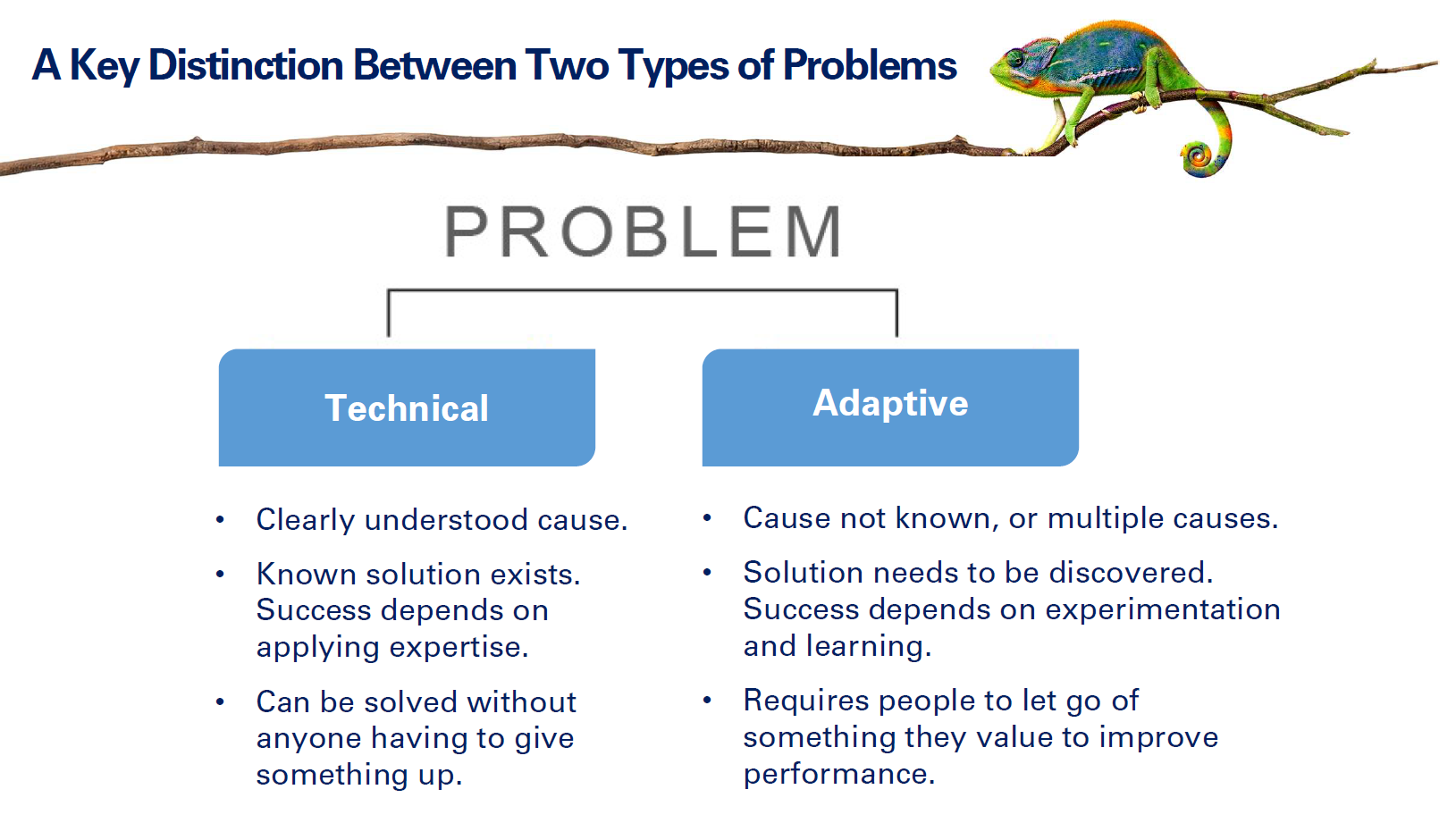
Pagliano then gave the table a series of hypothetical performance problems and asked them to decide if their nature was technical or adaptive. They were:
“These are the kinds of exercises I find to be really insightful because it helps me as a facilitator get a sense of where they’re coming from when they’re approaching leadership and change management,” said Pagliano.
Read more here.
Finally…
Paul Downes, the GM of Basketball New Zealand, described his approach to his first hundred says on the job. He argues that the idea that a new or transitioning leader can transform an organisation in the first 90 (or 100) days is unrealistic.
Read the first instalment of Downes’ miniseries here.

Image used courtesy of Basketball New Zealand.
Coming up for Leaders Performance Institute members:
At a recent Leaders virtual roundtable, Jeff Pagliano of Management Futures gave members the tools to become better adaptive leaders.
“The challenge is how to get buy-in from management and decision-makers,” Jeff Pagliano, who works with leadership consultants Management Futures, tells the Leaders Performance Institute. “How do you make the case, then build-in time to innovate so that you can adapt?”
That ability to spot the need for change and then respond effectively formed the basis for Pagliano’s presentation at a recent Leaders virtual roundtable during which he shared Management Futures’ model of adaptive leadership.
We caught up with him post-session to hear it for ourselves.
Pagliano begins by outlining the four skills of Management Futures’ model of adaptive leadership and their corresponding traps: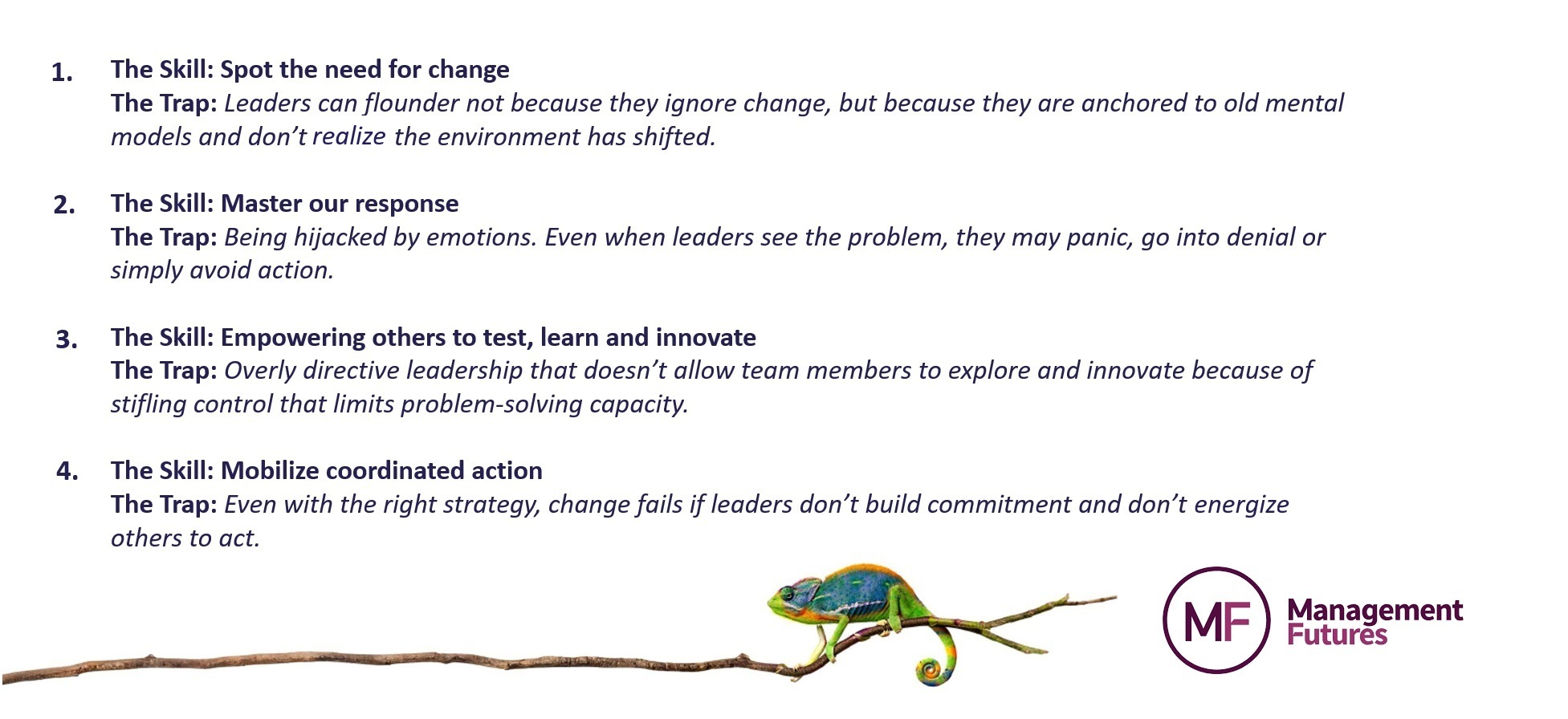
Pagliano acknowledges that these can be difficult to discuss in the abstract and invited participants to undertake a seemingly straightforward task to help illustrate both the skills required and the traps to avoid.
First, he asked them to draw two five-point stars on a piece of paper. The stars had to look like this:

Then Pagliano challenged each member of the group to draw a line in the narrow space between both stars while only using a reflection (provided by the screen of their mobile device) to guide them. It is, as anyone who has tried this exercise can tell you, difficult to do.
He says: “At this point I’ll ask, ‘okay, so talk me through what that process looks like’ and usually folks will say ‘I had to stop and think about how my pencil was moving in relation to where I was seeing it on the reflection of the phone’. And I say, ‘well, great. That’s actually what we’re going to focus on because that’s a key skill for adaptive leadership. We take what we call a ‘STOP moment’.”
A STOP moment is a deliberate pause that allows a leader to step back, assess the situation from a higher perspective, explore available options, and return with a more effective response: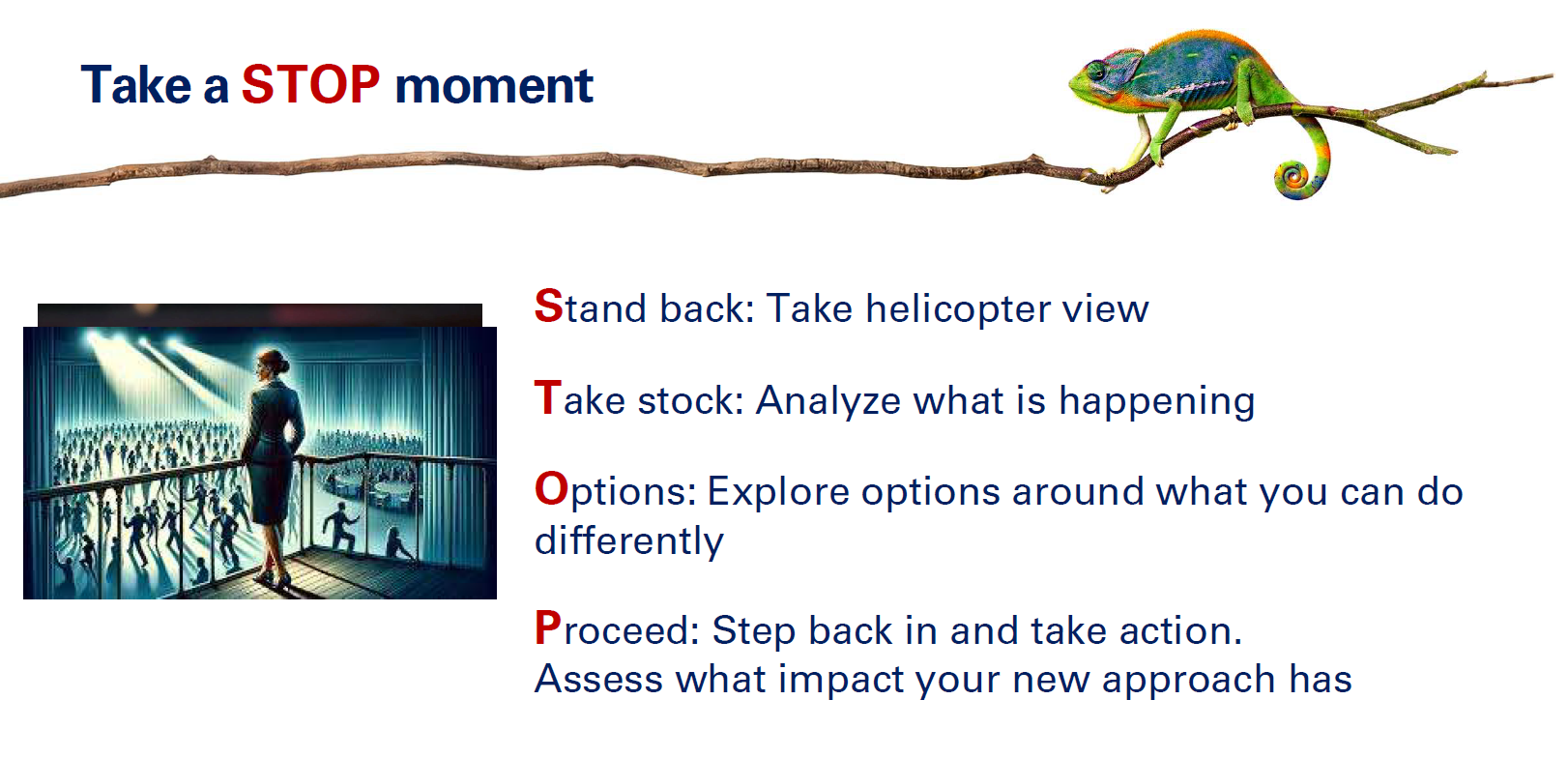
There is also the question of what you’re actually seeing when you step back. Pagliano outlined two types of problem for the table:
He then gave the table a series of hypothetical performance problems and asked them to decide if their nature was technical or adaptive. They were:
“These are the kinds of exercises I find to be really insightful because it helps me as a facilitator get a sense of where they’re coming from when they’re approaching leadership and change management,” says Pagliano.
For the final part of his presentation, Pagliano outlined three approaches to spotting the need for change:
Sometimes a once successful strategy becomes less effective; sometimes we need to acknowledge our approach has never worked. When trying hard, our scan becomes tunnel visioned – beware of this common trap.
Questions to ask yourselves:
Look for shifts which could have a significant impact on performance, both threats and opportunities.
Questions to ask yourselves:
When something unexpected happens, consider if it’s an example of an emerging pattern.
Challenge your strategy in a hypothetical setting (free of the consequences of ‘real’ failure).
Questions to ask yourselves:
“I think sport, like any other industry, has to be adaptable and flexible, says Pagliano as we wrap things up, “but it’s difficult for any organisation to adapt when there is a legacy way of doing business and achieving success. I don’t think sport is immune from that.”
What to read next
How the British Red Cross Continuously Adapts While Staying True to its Values
In the first of a new miniseries, Basketball New Zealand GM Paul Downes explains how his organisation uses the Acumen-Allocation-Action model to ‘connect understanding to investment, and investment to execution’.
Main Image: Basketball New Zealand
In practice, leaders need more time than that to learn the system they have inherited, build credibility, and make impactful decisions that endure.
Evidence from McKinsey (1) supports this, with many new senior leaders reporting it takes at least six months before they are truly effective (62 percent of external hires and 25 percent of internal hires). This reality sits in stark contrast to the popular ‘first 90 days’ (2) narrative that often dominates thinking about leadership transitions.
That gap between expectation and reality creates a specific problem for an incoming General Manager. When I joined Basketball New Zealand (BBNZ) in early 2023 to lead the High Performance (HP) team, I was aware of that there could be an expectation by some stakeholders to ‘land’ quickly. Origins of such expectations might include being the new leader who is perceived to have all the ‘answers’, declare priorities, and show early wins.
Yet the work in front of me was not a simple strategy task. I was entering a living system already in motion, with history, relationships, power dynamics, competing performance horizons, and constraints that were not always visible from the outside. Acting too fast could have made me look decisive, but it also would have increased the risk of misdiagnosing the real issues, spending political capital on the wrong battles, and locking the organisation into choices that are hard to unwind.
Having held leadership roles across various professional sports teams, I had confidence in my ability to lead, to make sense of complexity, and to learn quickly. However, confidence did not (and does not) remove the need for context. At BBNZ, that meant understanding the high-volume of HP environments spanning multiple national teams, both 5×5 and 3×3 programmes, and associated competition demands. The only credible way to do that was through listening carefully to stakeholders across the system before drawing conclusions about what needed to change, what needed to be protected, and where the organisation could become more aligned and effective.
This article offers practical insight for leaders transitioning into complex, senior roles particularly those entering HP sport systems such as the General Manager of High Performance or High Performance Director (HPD) position within a National Sporting Organisation (NSO). It is grounded in the simple proposition that strategic capability is not something leaders simply arrive with; it is something we develop as we learn to interpret our environment accurately, make disciplined trade-offs, and translate intent into consistent behaviour over time.
As a possible solution to the ‘90-day’ illusion, I introduce the Acumen–Allocation–Action (A-A-A) model (3) as a practical way to connect understanding to investment, and investment to execution. While the primary focus is on A-A-A, I also reference Michael D Watkins’ six disciplines of strategic thinking (4) to situate these ideas within broader leadership and strategy literature. Reflections draw directly from my experience in the HPD role at BBNZ.
The Basketball New Zealand performance context
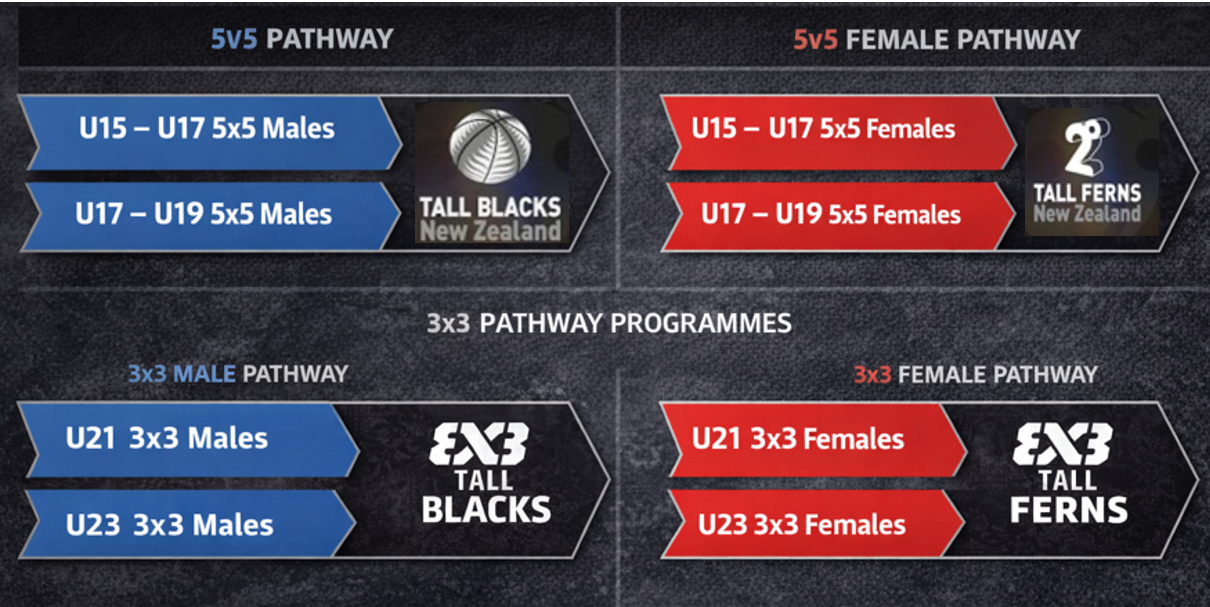
Basketball New Zealand operates across a wide and demanding performance landscape. The organisation has eight national teams spanning 5×5 and 3×3 formats, across male and female programmes, beginning at Under‑15 FIBA competition and extending through to senior international campaigns. BBNZ pathways look like this:
Across a calendar year, the FIBA competition schedule frequently involves multiple national teams participating in overlapping tournaments and qualification events, interspersed with domestic programmes, assembly camps, and select team activity. For example, in 2026 BBNZ teams were involved in a combination of Oceania Cups, World Cups, Asia Cups, qualification windows, international tournaments such as the Albert Schweitzer Tournament, Nations League series in 3×3, and senior global events including World Cups and the Commonwealth Games. You can see a snapshot here:
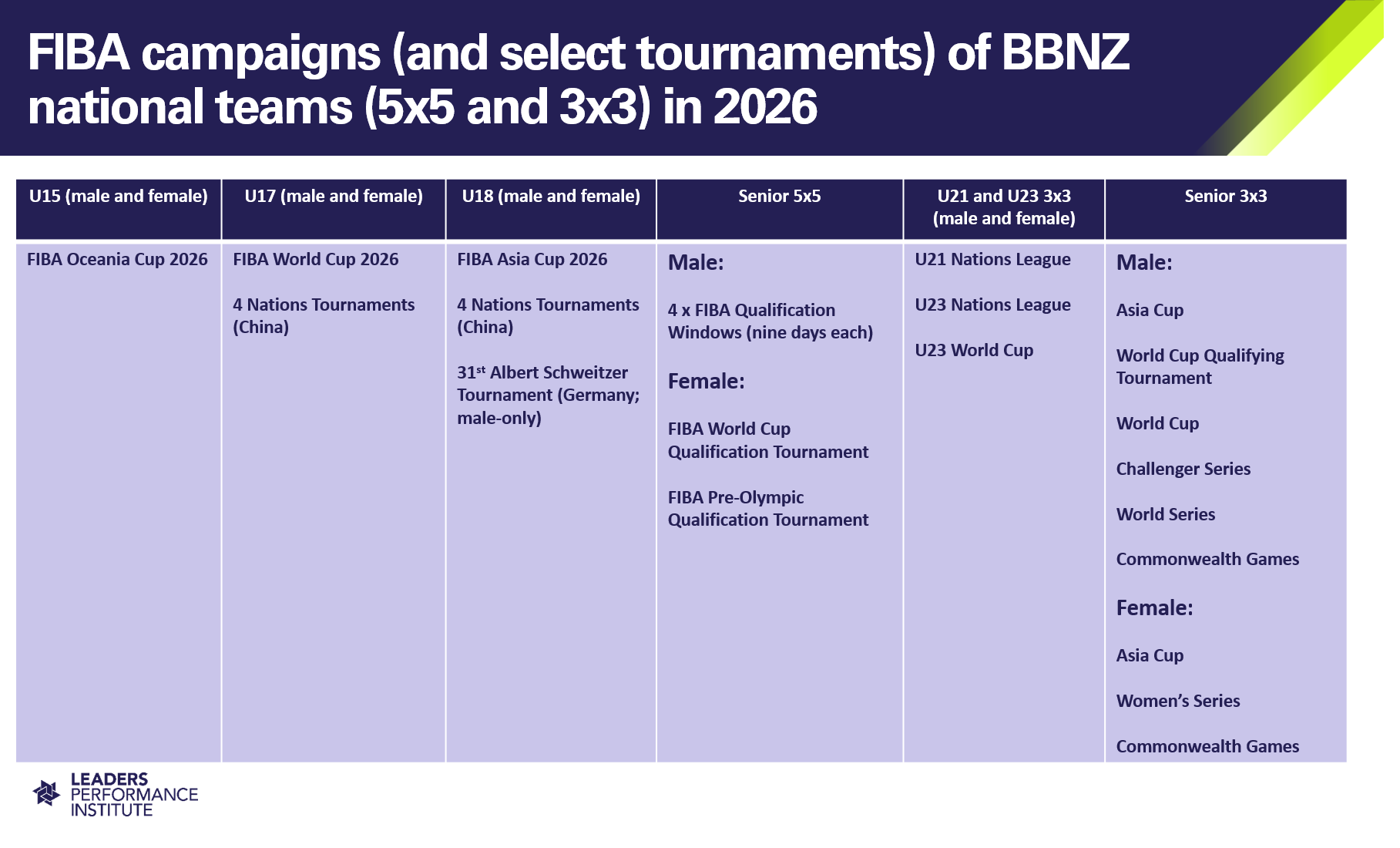
This density of competition creates continual pressure on people, financial resources, and decision‑making capacity, while also amplifying the need for clarity of purpose across different performance horizons.
The transitioning leader: what is inherited?
A useful starting point for leaders entering new roles is to recognise that they rarely inherit a blank slate or a simple ‘strategy problem’. More often, they step into systems that are already active, shaped by history, cultural norms, power dynamics, and existing narratives about success and failure.
Research on leadership transition highlights that how leaders learn, listen, and position themselves early in their tenure can have disproportionate and lasting effects on credibility, expectations, and influence. Transitions are also periods of heightened vulnerability, where early actions, particularly premature action, can create consequences that are difficult to unwind.
There is therefore substantial value in organisations approaching onboarding for senior leaders as a deliberate and extended process, rather than a brief initiation. For new leaders, this includes being supported to understand what questions to ask, who to listen to, and where critical knowledge sits within the system. Tools such as stakeholder maps can help leaders remain attentive to where influence, information, and informal authority reside. Importantly, these early stages reward leaders who resist the urge to act quickly in favour of those who prioritise listening, observing, and reflecting. Time spent collecting data, connecting perspectives, and building relational foundations creates conditions for more effective decision‑making later.
The A-A-A framework
When I stepped into the HPD role at BBNZ, and particularly as someone coming from outside the sport, it was essential to first understand both current and historical operating contexts before attempting to drive change. Gaining clarity about the experiences our people carried, the pressures they perceived and faced, formal and informal power structures, cultural norms, and the strategic direction already in motion helped define what was possible. This emphasis on context shaped not only early decisions, but also how the leadership team approached longer‑term system development.
To support this work, we deliberately adopted the Acumen–Allocation–Action (A‑A‑A) framework (3), developed and popularised by Rich Horwath, as a discipline for thinking and operating. The framework helped us slow down decision‑making where needed, prioritise deliberately, and execute in a way that was aligned with our resource constraints and competitive environment. Rather than treating strategy as a document to be written and implemented, the A‑A‑A model encouraged us to build a living system that connected insight to investment, and investment to behaviour and performance. I will explore each in turn.
Acumen
Acumen can be understood as the capacity to gather insights, make sense of complexity, and identify what truly matters. Research on sensemaking (5) and strategic cognition suggests that effective action is closely linked to how leaders interpret cues, construct meaning, and reduce ambiguity. From this perspective, acumen sits at the bridge between uncertainty and purposeful action.
For leaders in transition, value is initially created not through visible action but through disciplined sensemaking. This requires intentional collaboration with a range of individuals and groups to develop a grounded understanding of the operating environment before decisions are made. Acumen, in this sense, goes well beyond raw intelligence. It is a disciplined and patient process supported by humility, curiosity, and authenticity. Leaders who fail to invest sufficient time and attention at this stage risk developing incomplete or distorted views of their environment, which increases the likelihood of misdirected resources and weaker execution downstream.
In practice, developing acumen involves gathering insights from multiple directions: inwardly from the HP team, outwardly from external stakeholders, upwardly from CEOs and boards, and downwardly from national team staff and programme leaders. Active listening, coupled with deliberate efforts to surface and test assumptions, enables evidence‑informed discussion about shared purpose, language, and expectations across the HP ecosystem. In complex, decentralised HP systems, this process is essential for aligning understanding across diverse programmes and contexts.
At BBNZ, this meant engaging in honest introspection about our core competencies, our constraints, and where New Zealand could be genuinely competitive in both the short and long term. Rather than relying on a single generic performance model, we adopted a layered, evidence‑informed approach to defining What It Takes To Win (WITTW) at different levels of the pathway. Practically, this involved structured feedback processes, including small‑group and one‑to‑one conversations supported by scaling questions designed to surface confidence, alignment, and perceived gaps. Beyond generating data, these processes also supported relationship building, trust, and psychological safety – critical enablers in HP environments.
Three of Watkins’ six strategic disciplines (4) align particularly well with the Acumen phase: pattern recognition, systems perspective, and mental agility. Applied practically, these disciplines prompt leaders to ask whether they have identified emerging trends and risks, developed mental models that acknowledge interdependencies rather than linear causality, and maintained the ability to shift perspective across different levels of the system. At BBNZ, this translated into challenging conversations framed by questions such as: What are we genuinely good at? Where are we exposed? If resources doubled, or halved, what would change? Where does international comparison add value, and where does it distract? This discipline supported a more shared and objective understanding of our performance realities and laid the foundation for disciplined decision‑making.
Allocation
Insight without trade‑offs has limited value. Allocation represents the shift from sensemaking to commitment. For leaders new to a system, allocation decisions are often the first moments where intent becomes visible through choices about time, money, people, and attention. Good strategy demands saying no as often as saying yes, and allocation decisions therefore require clarity about performance expectations, risk tolerance, and long‑term sustainability.
Within the BBNZ HP team, we approached allocation with explicit discipline. Tools such as pre‑mortems were used to test assumptions before committing resources. For example, prior to appointing a HP Wellbeing Advisor, we imagined a scenario six months into the future where the role had not been filled and explored the likely consequences. This enabled us to surface risks, classify them, and evaluate decisions based on consequence rather than intention.
We also made use of impact‑versus‑effort matrices to test proposed initiatives, categorising activities as quick wins, major projects, fill‑ins, or low‑value work. These assessments were repeatedly challenged through diverse perspectives to reduce bias and over‑optimism. In this phase, two further strategic disciplines described by Watkins become particularly relevant: structured problem‑solving and visioning (4). Structured problem‑solving helps ensure assumptions are tested and options assessed rigorously, while visioning keeps allocation decisions anchored in longer‑term direction rather than short‑term optimisation.
Ultimately, allocation is where strategy becomes tangible. Across sectors, performance outcomes are strongly shaped by how leaders allocate scarce resources (6, 7). Misalignment between stated priorities and budgets, cultural inertia, and political capture of resources can all result in systemic underperformance. Research beyond sport has consistently shown that what leaders allocate attention to is what ultimately gets resourced. In this sense, acumen and allocation are inseparable.
Action
Deliberate investment in acumen and allocation reduces the risk of misdiagnosis, a common challenge for HP leaders entering complex systems. At BBNZ, action within the HP strategy (HP Plan 2028+) has been treated as intentional experimentation rather than blind execution. Clear communication and expectation‑setting have been central, acknowledging that while not all initiatives will generate immediate performance outcomes, every action must produce learning.
Projects have been designed to be scalable, testable, and directly linked back to insights generated through Acumen and priorities set during Allocation. Campaign planning, assembly camps, and tournament objectives are structured around multiple performance horizons, with review processes embedded as part of normal operations. Importantly, action is never separated from reflection. Learning loops ensure that outcomes from each campaign inform future decisions, shifts in resource allocation, and capability development.
Bringing existing stakeholders into feedback and review processes has required a deliberate shift from compliance to contribution. This aligns closely with the strategic discipline of political savvy (4). In practice, this has meant investing time in building coalitions, navigating pathways of influence, and generating commitment rather than relying on authority alone. Feedback is framed as a developmental tool linked explicitly to shared understanding of WITTW, not as a judgement mechanism.
At BBNZ, we often describe feedback using the metaphor of a bank account: consistent positive deposits are required before more challenging withdrawals can be made. Leaders are expected to model humility, curiosity, and self‑awareness, naming what they observe and asking better questions before rushing to solutions. By prioritising transparency, fairness, and accuracy, we have worked to create conditions where feedback is experienced as enabling both performance and wellbeing rather than provoking defensiveness.
Reflection: how strategic thinking is developed
Strategic thinking within the BBNZ HP team has evolved through repeated cycles of listening, testing, and recalibrating. Over time, a developmental arc has emerged: reducing contextual blindness through acumen, building shared understanding around trade‑offs through allocation, and arriving at aligned, disciplined action. Seen through this lens, the first 90 -100 days (1, 2) of a new leadership role are most valuable not as a period for decisive intervention, but as a critical window for sensemaking, relationship building, and establishing credibility.
Strategy does not emerge at a milestone. It develops through repeated iterations of Acumen, Allocation, and Action over extended timeframes. Leaders do not arrive fully formed as strategic thinkers; they become strategic through sustained effort to interpret their systems accurately, make disciplined trade‑offs, and translate intent into consistent behaviour.
The A‑A‑A model now operates as a repeating loop in the BBNZ HP team. Attention is directed to what matters most, shaping how resources are allocated, which in turn determines what actually happens. Reflection on those actions then reshapes understanding of the system and informs the next cycle. Through this approach, we are continuing to develop a coherent, adaptive HP system capable of sustained improvement across performance pathways.
References
Chris Davies, the BRC’s Head of Emergency Planning & Response, explains that his organisation has adopted a ‘when not if’ approach to the increasingly complex world of humanitarian crises.
Main Image: The British Red Cross / YouTube
In the early hours of 14 June 2017, a fire at the residential tower in the North Kensington area of west London killed 72 residents, injured a further 70, and left many more homeless and bereaved.
In the aftermath, the British Red Cross worked to support the survivors but as Chris Davies, their Head of Emergency Planning & Response, said, “one of the challenges we had is there were an awful lot of people in the community who didn’t trust us and didn’t necessarily want the Red Cross in the room”.
Davies, a former infantry officer in the British Army who joined the British Red Cross in 2022, was speaking at the 2025 Leaders Sport Performance Summit in London. He explained during his presentation that this mistrust was born of their lack of local understanding.
Three months after the fire, in September 2017, the organisation’s then CEO, Mike Adamson, wrote: ‘it took us too long to reach out to the real grassroots groups and that cost us in terms of trust through the process. We are still trying to address this.’
While noting his pride in some elements of their response, Adamson acknowledged that ‘there is a real lesson here about how we engage with a community that we do not know. We need to add people with different skills to our response and recovery teams. We also need to explore the extent to which our scale and brand give us convening power to help bring organisations together and respond dynamically to need.’
It was a chastening experience, but one that has not been repeated as the organisation adapted. “In the past, there has always been a sense of organisations like ours knowing what’s best and that’s wrong. We don’t,” said Davies onstage. “That humility is really important.”

Chris Davies, the Head of Emergency Planning and Response at the British Red Cross, onstage at the 2025 Leaders Sport Performance Summit.
Here, we explore how the British Red Cross, as part of a wider international movement that is more than 160 years old, adapts as the character of crisis response changes.
Spot the need for change
“The mission is critical in our world,” said Davies, “but the mission is only as good as the individual’s understanding.”
He shared the British Red Cross’ mission with the room:
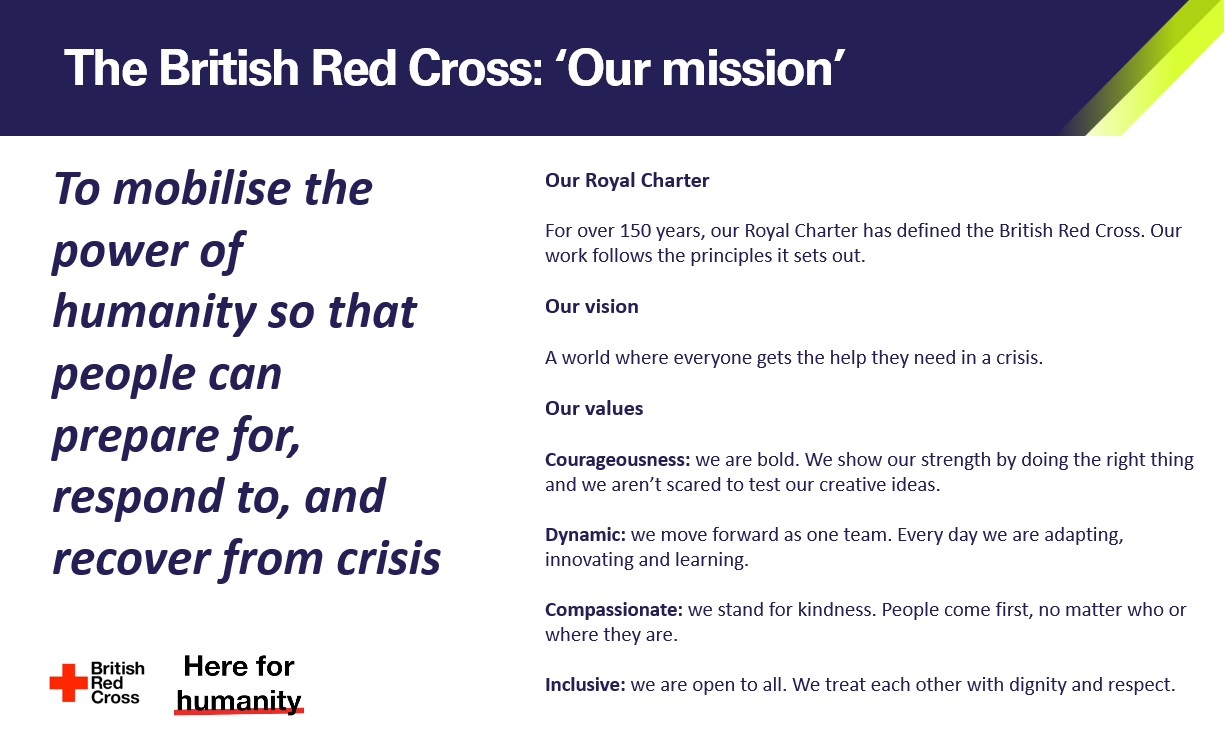
Their mission is simple but powerful; their vision and values provide scope for interpretation. Combined, they enable the organisation’s leaders to spot the need for change when something is off and then do something about it, as happened in the aftermath of the Grenfell response.
“The nature of humanitarian work is unchanging,” said Davies, specifically referencing the core human need for connection and support. “However, the character of that work is constantly shifting.”
That character had been misunderstood at Grenfell, but they fared better when severe flooding hit the town of Brechin in eastern Scotland in October 2023.
“The team I deployed were a local team who had to self‑mobilise and respond alongside the local authority,” said Davies. “We had essentially taken it to that point of how you build the mission into teams so they can respond and have the right response. I didn’t need to phone them up and tell them to do that; they operated independently with the right resources at the right time because they had already won the trust of that community in Brechin because they were from that community and they knew there was a high risk of flood.”
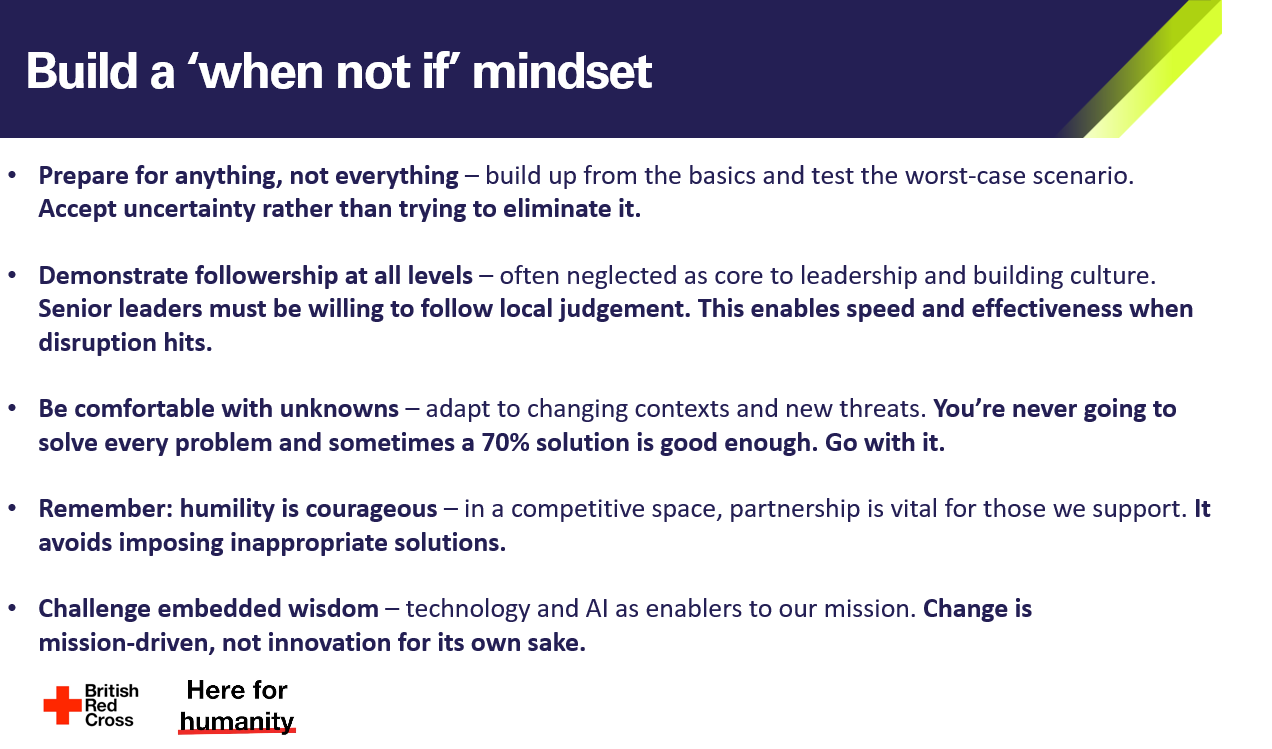
Adopt a ‘when, not if’ mindset
In Britain, climate change is currently the biggest humanitarian threat. “One in four homes by 2050 will be impacted by climate change, according to the UK government,” said Davies. “Are we ready for that? No. We’re not as an organisation, but also as a country, we’re not ready for that scale and impact is coming down the road due to climate change.”
That work is already underway, with the British Red Cross, as an auxiliary to government (“we’re not an NGO”), trying to build its readiness through community connections, by liaising with the relevant authorities, and using technology such as AI where suitable (e.g. a flood monitoring app is in the pipeline).
On top of this, crises and disasters grow ever more complex, which necessitates sending junior leaders into the fray ever earlier.
It is not a decision taken lightly given the gravity of the work and the blend of paid staff and volunteers. It can be a tricky dynamic to manage and there often isn’t time for adequate training. “We are putting immense expectations on them because of the changing environment; the world in which we operate.” It’s a challenge they haven’t yet nailed.
A key leadership skill in that regard is the ability to sustain a ‘when not if’ mindset. Davies illustrated this with a slide:
Trust is critical to mobilising people in complex environments
Davies described the UK as “one of the most complex environments in the world”. To make his point, he spoke of Britain’s “increasingly polarised society” and high poverty rates, which help explain why “trust in the UK Government is the lowest it’s been for decades.” He quoted the British Office of National Statistics, which put the figure at less than 25% of respondents in late 2025.
This has implications for institutions of all hues. “An organisation like ours, which is a large institution, your brand is globally recognised, you also have to work hard to earn that trust.”
They understand that adaptation requires leaders to let their people in the field act, adjust and learn in real time from the people whom they are supporting.
To help illustrate that point, Davies presented the British Red Cross’ ‘Trust Model’:
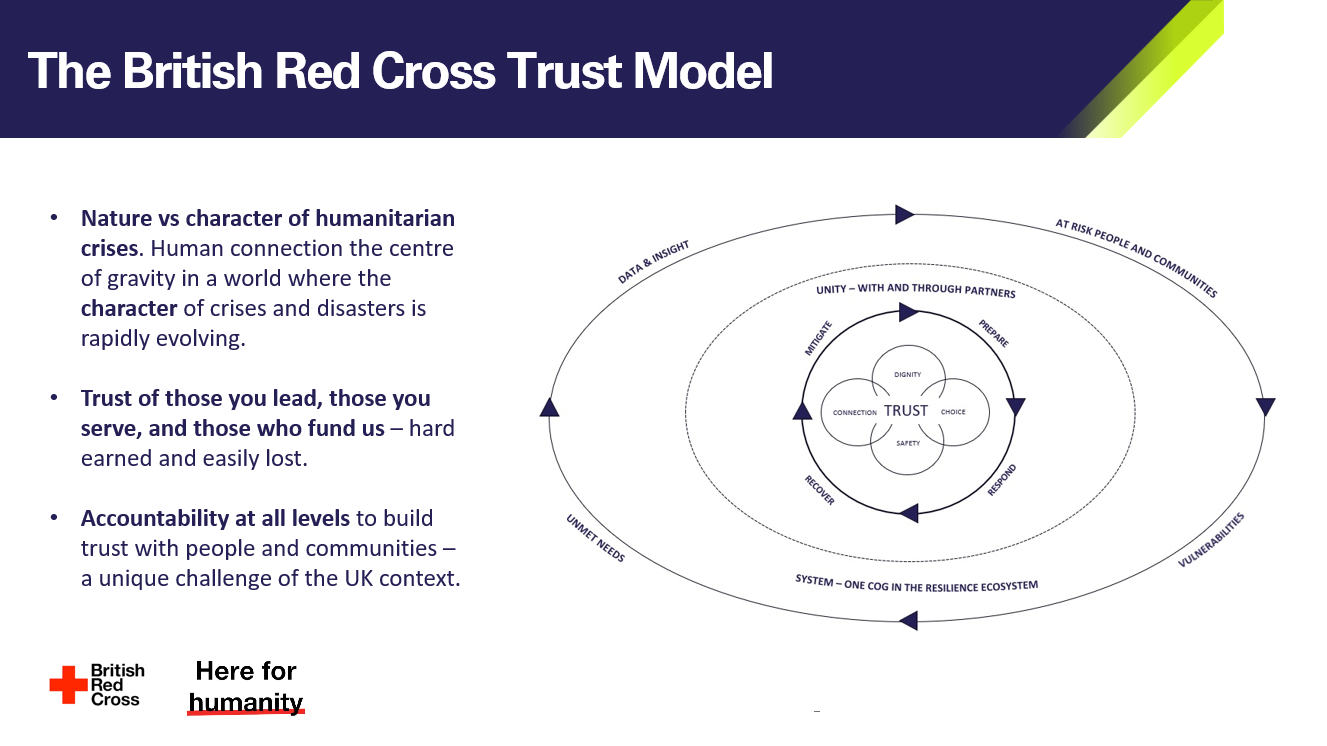
Essentially, as the graph above aims to explain, they treat complexity as a given and trust (built on dignity, choice, safety and connection) as a requisite that enables the kind of decentralised decision-making and coherent action witnessed in Brechin.
“Ultimately a model like this puts the dignity and choice of those communities at the centre and ensures that we’re supporting them in the way that they need as those demands evolve over time.”
What to read next
Adaptability: ‘Change Is Everywhere and Leaders Must Respond All the Time. It’s No Small Ask’
Strategy, skill acquisition and change management were just some of the topics on the agenda at the Leaders Performance Institute in April.
“I joked last week that this place feels like my home course,” he said. “I haven’t played anywhere else in the last two or three weeks really. I felt prepared in that way. I felt prepared that wherever I hit it on the golf course, I sort of know what to do. I know where to miss. I’m pretty comfortable with all the shots around the greens.”
McIlroy, a six-time major winner, disregarded other PGA Tour events and even chose to ignore a back injury that had been hampering his performance. At one point he even carded a score of 29 on the front nine at Augusta.
“It’s a good blueprint,” he continued. “I’m not going to take three weeks off before every major, but to get to the major venues early, do your preparation, play. And not just play and look at things, but actually play. Go out there with one ball, shoot a score and try to do it that way.”
McIlroy’s successful strategy came not long after our Leaders Meet: the Art of Strategy event at Lord’s Cricket Ground, where a range of guests, including Olympic gold medallist Tabby Stoecker and Lawn Tennis Association Performance Director Michael Bourne discussed how to build, stress-test and execute an effective performance strategy.
We know McIlroy wasn’t there because he was in Georgia, but he, much like yourselves, can check out the chief insights here.
And now on to other happenings at the Leaders Performance Institute in April.
Quote of the month:
Personally, I don’t believe in skills coaches.
These are the words of Rory Teague, who notably spent a year and a half between 2016 and 2017 working as a skills coach under then England men’s rugby union Head Coach Eddie Jones.
A decade on, Teague serves as the Head Coach of French Pro D2 club AS Béziers Hérault and, as he tells the Leaders Performance Institute, would not copy Jones’ appointment in southern France.
“I wouldn’t myself employ a skills coach,” he says. “I think every coach who coaches an area of the game should be able to coach the skill of their area. ‘Skills coach’ as a term has become archaic as coaching has moved along.”
Read the full story here.
We also addressed some of the common tensions, challenges and opportunities in skill acquisition here.
Insight of the month:
British military operations are primed to perform when personnel do not have even 60% of the desired information at hand.
As Aneaka Reay-Kemp, the Lead Military Intelligence Specialist at the UK Ministry of Defence, told the audience at Leaders Meet: the Art of Strategy, they are trained, as she said, to be “comfortable being uncomfortable”.
Rank, she argued, has limited bearing. In fact, the British military has taken steps to reduce the influence of its own hierarchies in moments of uncertainty. She said:
It doesn’t matter what’s on that person’s chest, it doesn’t matter their background, they still bring value no matter how junior they are. So for me, I find that when you’re operating in an environment where you don’t have all the information, understanding your people, understanding their capability, what they bring to the party can help save someone’s life.
Reay-Kemp was one of six guests who brought the day’s proceedings to life.
Shock of the month:
We often hear informally of ‘bad’ environments, but we don’t necessarily expect them to be amongst those considered the very best.
Yet that was the experience of Alexander Campbell, the former principal dancer at the Royal Ballet and Birmingham Royal Ballet when he attended the Royal Ballet School in the early 2000s.
“I struggled so much that I wasn’t sure whether I wanted to continue pursuing a career in ballet,” he said.
He had arrived from his native Sydney mid-term, which didn’t help him to settle, but it was also down to the type of prescriptive teaching that routinely irks younger generations today.
“We weren’t really encouraged to step out of our lane. It was like, ‘you know the steps, you focus on this, and we’ll worry about everything else,’” he added.
When reflecting on that time for Leaders members, he said it was “such a missed opportunity.”
His turn-of-the-century experience as a ballet student shows that the need for teachers to meet their students halfway is not new. Two decades later, talent environments in performing arts, and in sport, must be designed to engage a cohort that wants to know ‘why?’
Campbell, now the Artistic Director of the Royal Academy of Dance, shared his full story here.
Good to know:
What’s the difference between a ‘change’ and a ‘transition’?
A ‘change’ is simply that, but a ‘transition’ refers to the human adaptation required in the face of change.
That is according to John Bull, the Head of High Performance at Management Futures, who posed this question at a virtual roundtable for members of the Leaders Performance Institute where the topic of the day was ‘what makes change stick?’
In simple terms, as Bull explained, change initiatives fail not because the change itself is wrong but because the human transition is misunderstood, ignored or rushed.
“The object of change is quite straightforward; transition can be super complicated,” he said, “and what we tend to do in organisations is not pay nearly enough attention to managing transition. We forget about that.”
To help the virtual room in this regard, he introduced attendees the three phases of transition:
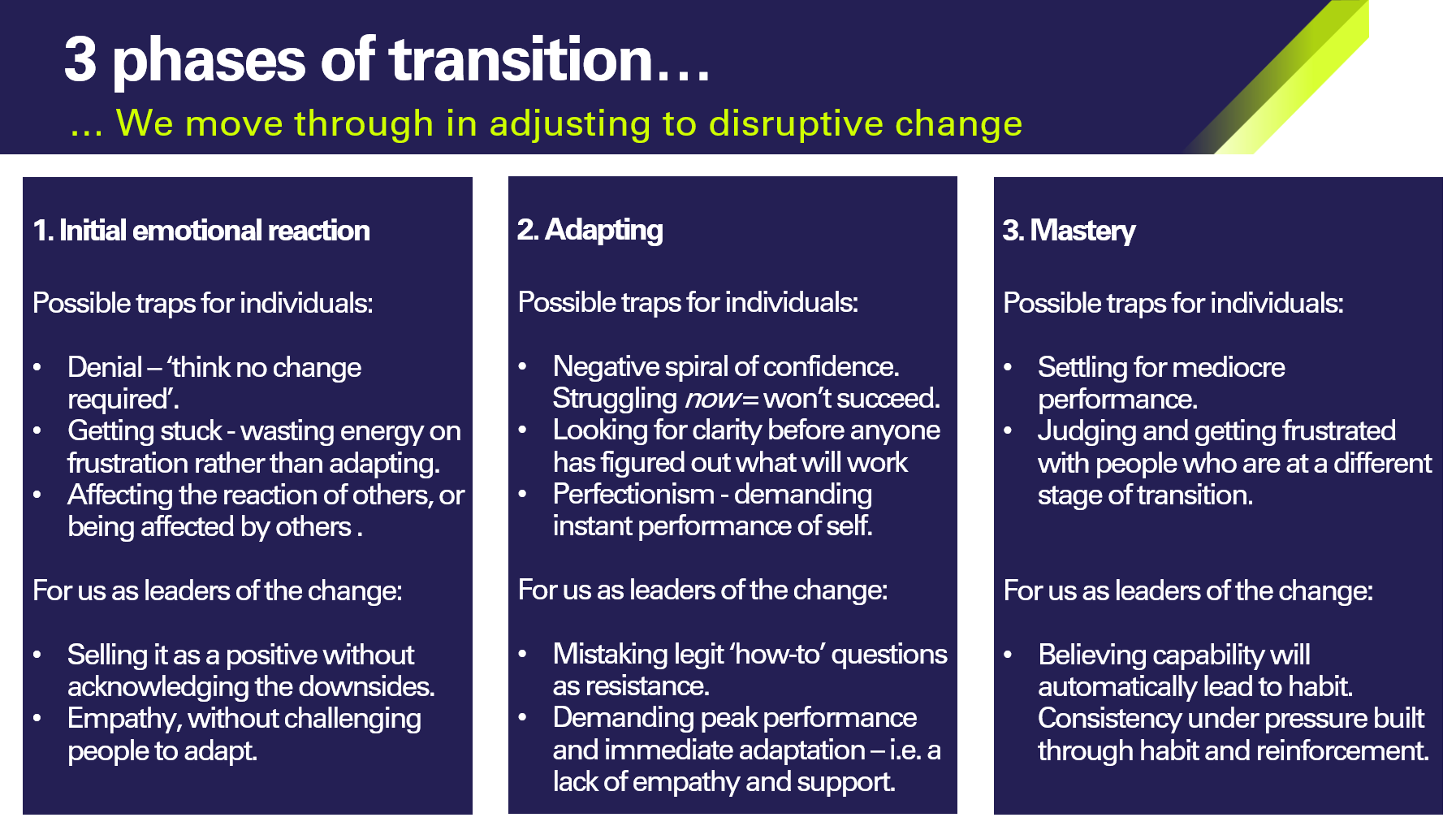
Bull brought these three phases of transition to life by describing how he went through each in response to a postponed work project:
The key thing about stage one is I am still really frustrated and annoyed with certain individuals that have led to that happening. Now, I would say on one level, that’s really understandable. It’s a significant project that we were really excited about; but here’s the key point: it is useless and doesn’t help me one bit. So all the energy that I’m investing in the frustration is not going into the adapting; and what I should be spending much more time on is focusing on what do we need to do to adapt now that change has happened.
Finally…
Four common causes of tension between business and performance… and four opportunities for increased collaboration.
Coming up for Leaders Performance Institute members
World Rugby’s Brett Robinson describes the treacherous path he navigated when delivering the global federation’s Impact Beyond 25 strategy.
Robinson, a former Wallabies international-turned-sports scientist and C-suite executive, beat France’s Abdelatif Benazzi by 27 votes to 25 in the second round of the election held by World Rugby’s Executive Council.
His narrow majority meant he succeeded Sir Bill Beaumont without a honeymoon period. Yet his achievements thus far, chiefly the implementation of World Rugby’s Impact Beyond 25 programme and building consensus around new laws of the game, have been commendable.
“I’m really proud of where we’ve got to as a game because, when I came into the role, we were fractured and divided,” he told an audience at Leaders Meet: Australia in Brisbane in February.
There were factions within the World Rugby Council that could be divided into England and the Celtic nations on one side with the French and Latin nations on the other. Robinson, as an Australian, said he was “coming into a gunfight between the Celts, the English and the French.”
For all that, in September 2025, the 17th World Rugby General Assembly had endorsed Impact Beyond 25, its five-to-seven-year strategy for developing and promoting the world game heading into the men’s Rugby World Cup in 2027 and Women’s Rugby World Cup in 2029 (both to be hosted in Australia) with the 2028 Olympic Games in LA sandwiched in between.
So what changed? Below, we explore Robinson’s approach to calming rugby’s internal strife.
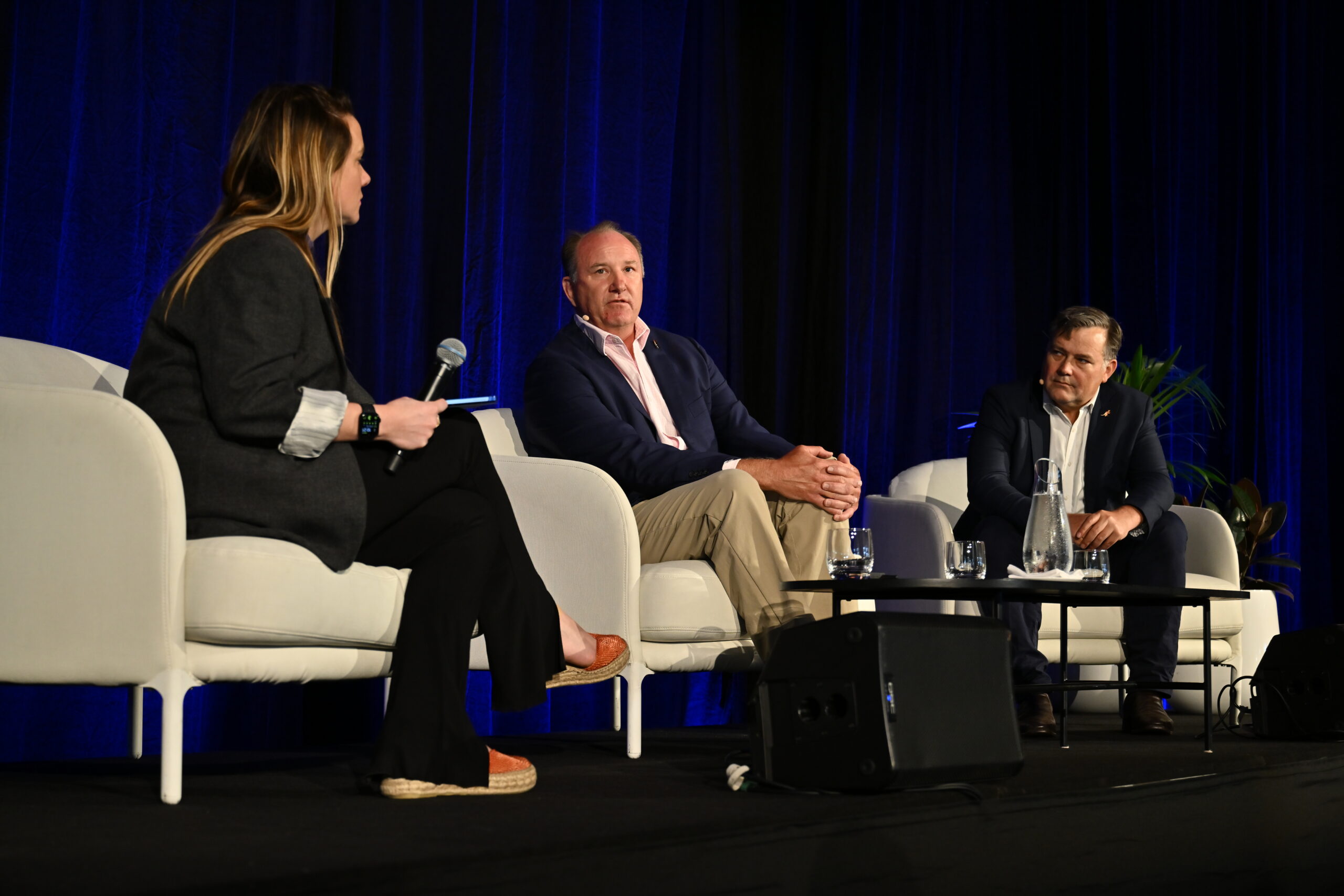
Brett Robinson (centre) onstage at Leaders Meet: Australia with Rugby Australia’s Director of High Performance Peter Horne and Leaders’ Managing Director Laura McQueen. (Photo: Albert Perez / The Leaders Performance Institute.)
Firstly, he didn’t shy away from the problem
As Robinson explained, “some countries were incredibly frustrated; they wanted to revolt and blow everything up.” Others were about “organisationally working with the change and not being too destructive”.
Almost half of the 52 members of the World Rugby Council voted for Benazzi as Chair. Robinson, who will serve a four-year term, did not shy away from that fact. “We’ve got differences of opinion, we’ve got some challenges, and there’ll be some people that were disappointed after the election,” he said in the aftermath.
In December 2025, he expanded on his thoughts as a guest on the Rugby Unity Podcast. “The system upon which World Rugby is built has been in place for 30 years,” he said. “We have systems that simply don’t work and prevent us from reacting with the necessary speed.” It is worth remembering that he made those observations after Impact Beyond 25 had been launched.
Onstage in Brisbane, he further outlined an enduring sticking point: that France and England account for approximately 70% of the revenue generated in rugby union. This had led to political as well as economic tensions across the different factions; and the question was how World Rugby could engage and incentivise the other unions to align in pursuit of a more equitable distribution.
He ensured World Rugby’s new strategy was a collective endeavour
The Impact Beyond 25 strategy was unanimously ratified just days before the 2025 Women’s Rugby World Cup final, which saw a crowd of 82,957 watch England beat Canada 33-13 at Twickenham.
The timing could not have been better. England 2025 was the most well-attended Women’s World Cup ever. World Rugby’s unions gave their blessing to a global impact plan that, in the international governing body’s own words, ‘is built around three core themes of profile and participation, careers and gender equity, and capability and expertise with the mission of inspiring more women and girls to get into rugby on and off the field of play.’
Most importantly, it bore the fingerprints of all those involved in its creation.
“It’s really important that, in my role, I bring the game together and we agree on what shared success looks like and we pursue it together,” Robinson told Rugby Unity.
He expanded on those comments in Brisbane. “We’ve built a collective plan where we’re all engaged, we’re all incentivised, and we’re all a part of that journey,” he said, adding that the plan includes taking All Blacks and Wallabies Test matches to the United States. Such moves “will help build the fandom that ultimately will drive the commercial outcomes and [increase rugby union’s] market share”.
He accounted for local complexity
“We are not going to do everything from Dublin,” he told the Brisbane audience, name-checking World Rugby’s base and then pointing to the man sat beside him onstage, his former World Rugby colleague Peter Horne, who now serves as Director of High Performance at Rugby Australia.
“What we do is only as good as what he [Horne] can deliver and vice versa.”
In some places, such as Australia and England, Robinson said, “we have an Anglo-Saxon way of governing; we’ve got strong boundaries around the role of the chair, the board, the CEO, the executive. In other parts of the world, they have very different ideas of the president or the chair being an executive authority.”
He cited the example of Argentine Gus Pichot, the former Vice-Chair of World Rugby. “He’s not the chair and he’s not on the board of the Argentine Rugby Union, but he is making every decision coming out of it; and so I have to work with that, acknowledging that I need to keep his chair informed and his CEO informed; but if Gus doesn’t agree with it, it doesn’t happen. And I could say, ‘well, that’s just a crazy way of governing’, but I can’t change it, so I have to work with it. The French are the same; Florian Grill is their president. He’s not the CEO, but he operates as an executive chair.”
On that last note, Robinson said: “I spent a lot of time before Christmas with the French in Paris. I’m going back there in a couple of weeks’ time.” These meetings have proven invaluable. “You have to work really hard to genuinely display that you’re listening and supporting, and they don’t necessarily say ‘yes, yes, yes’, but actually they can see the ‘why’.”
World Rugby is now reaping the rewards of his efforts. “Having the French and the Argentinians now with us, and rebuilding the relationship with the Celts and the English, was probably the biggest challenge that I faced; and now we’re there, we need to push on and deliver.”
He won’t rest on his laurels
“You’ve got to be systematic; from my experience, if you go randomly into anything like this, you are more likely to fail than not,” said Robinson. “You have to set up a proper process.”
He listed the necessary personal qualities of a chairperson: trustworthiness, empathy, and emotional intelligence. He balanced these against an ability to act and make tough decisions. All are essential in a world where alignment is predicated on retaining the trust of the individuals involved in the process.
Robinson then explained that the executive board of World Rugby had just undergone a review. He said: “I’ve been running a process over Christmas where we have a 360 on our behaviours; I’m getting a 360 on me. We’re having a discussion about board effectiveness; how that relates to the implementation of our strategy. We have some blind spots and weaknesses on our board, and we have succession plans that are coming. So those things are really important because it all rots from the head.”
What to read next
Why Change Only Sticks when you Lead your People Through the Transition
As John Bull of Management Futures explains, change initiatives fail not because the change itself is wrong but because the human transition is misunderstood, ignored or rushed.
John Bull, the Head of High Performance at Management Futures, poses this question at a virtual roundtable for members of the Leaders Performance Institute where the topic of the day was ‘what makes change stick?’
To set up the conversation, he looked at the twin elements that enable sustained change (people taking ownership of the change and the idea of change itself as a habit) before identifying some of the common sources of resistance.
“There are times where we will resist change, we’ll engage less quickly in it, even when we have to; or we waste energy in how we’re responding to change,” said Bull. “But we also have to understand resistance from others and what that requires of us as leaders.”
People, he explained, resist change for two primary reasons: loss (what they perceive they are losing) and uncertainty or ambiguity. It is not enough for a leader to merely sell the change.
He continued: “If we’re just pushing change and we haven’t understood what people perceive they’re losing, then we run the danger of increasing the resistance rather than decreasing it. By understanding where the resistance is coming from and being able to address that, we’re in a much better position to be able to lead it.”
A ‘change’ or a ‘transition’?
In simple terms, as Bull explained, change initiatives fail not because the change itself is wrong but because the human transition is misunderstood, ignored or rushed.
He illustrated this distinction between ‘change’ and ‘transition’ with a slide:
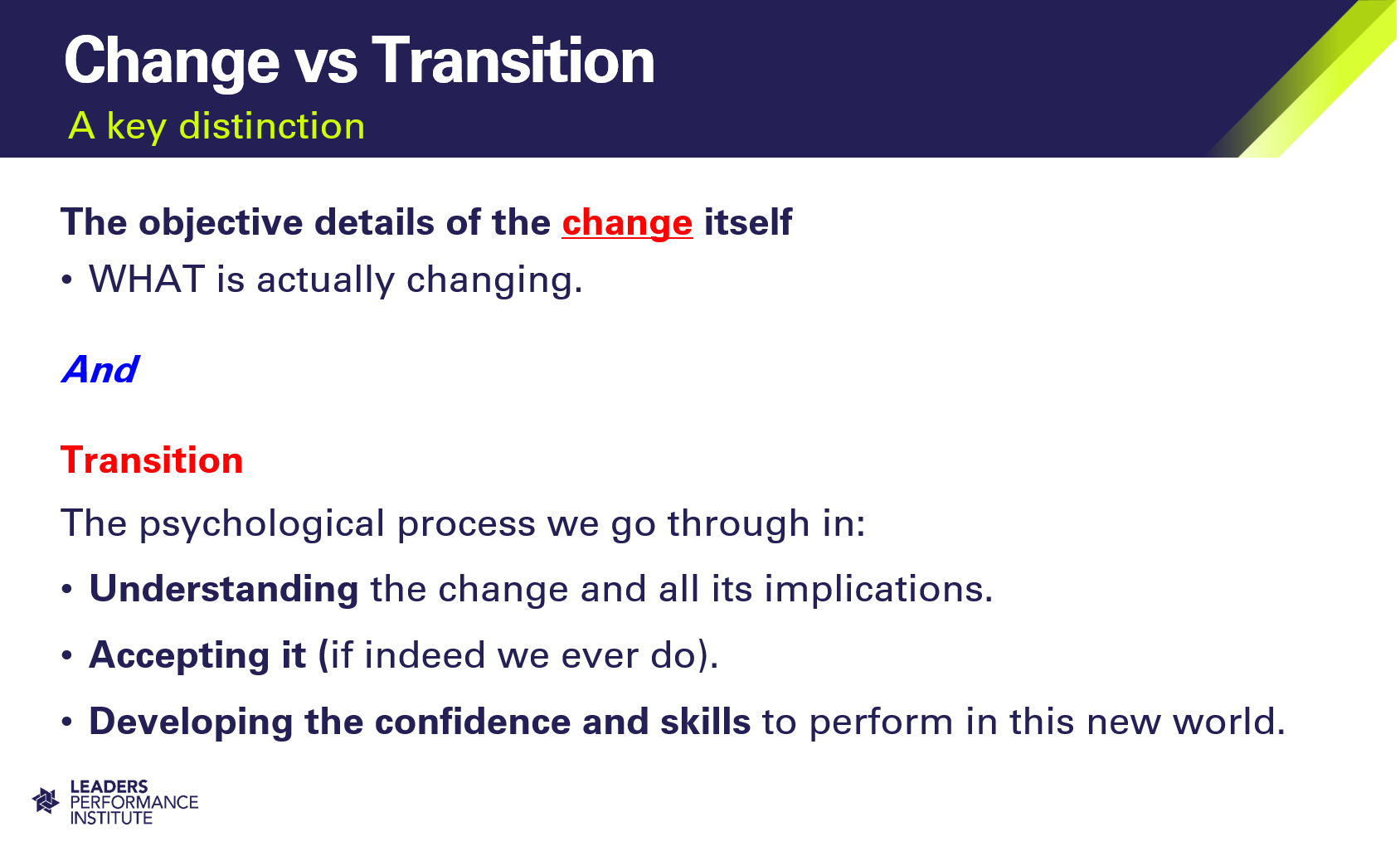
“The object of change is quite straightforward; transition can be super complicated,” he said, “and what we tend to do in organisations is not pay nearly enough attention to managing transition. We forget about that.”
To help the virtual room in this regard, he introduced attendees the three phases of transition:
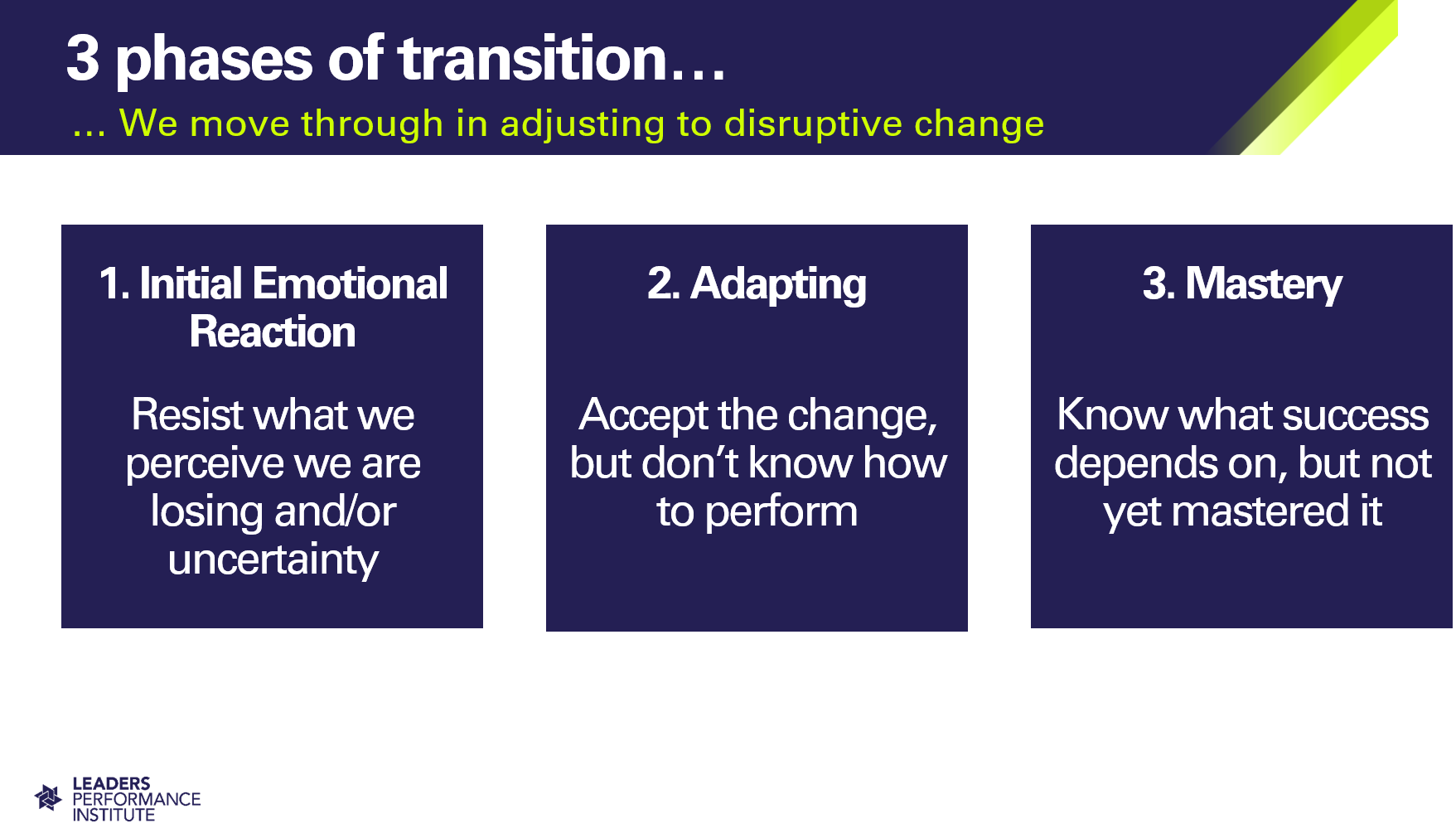
These are an adaptation of the ‘unfreeze-change-refreeze’ model of German-American psychologist Kurt Lewin, who drew attention to the emotional and behavioural elements of change. Modern scholars, including William Bridges (whom Bull also namechecks), place an emphasis on the personal dynamic.
Bull brought these three phases of transition to life by describing how he went through each in response to a postponed work project:
The key thing about stage one is I am still really frustrated and annoyed with certain individuals that have led to that happening. Now, I would say on one level, that’s really understandable. It’s a significant project that we were really excited about; but here’s the key point: it is useless and doesn’t help me one bit. So all the energy that I’m investing in the frustration is not going into the adapting; and what I should be spending much more time on is focusing on what do we need to do to adapt now that change has happened.
With the behavioural elements of transition established, Bull then set out what neuroscience tell us about human resistance to change, with reference to the SCARF model.
This framework, devised by neuroscientist David Rock, sets out five domains that influence human social behaviour and motivation. ‘SCARF’ stands for ‘Status-Certainty-Autonomy-Relatedness (Relationships)-Fairness’. Bull explained each in turn:
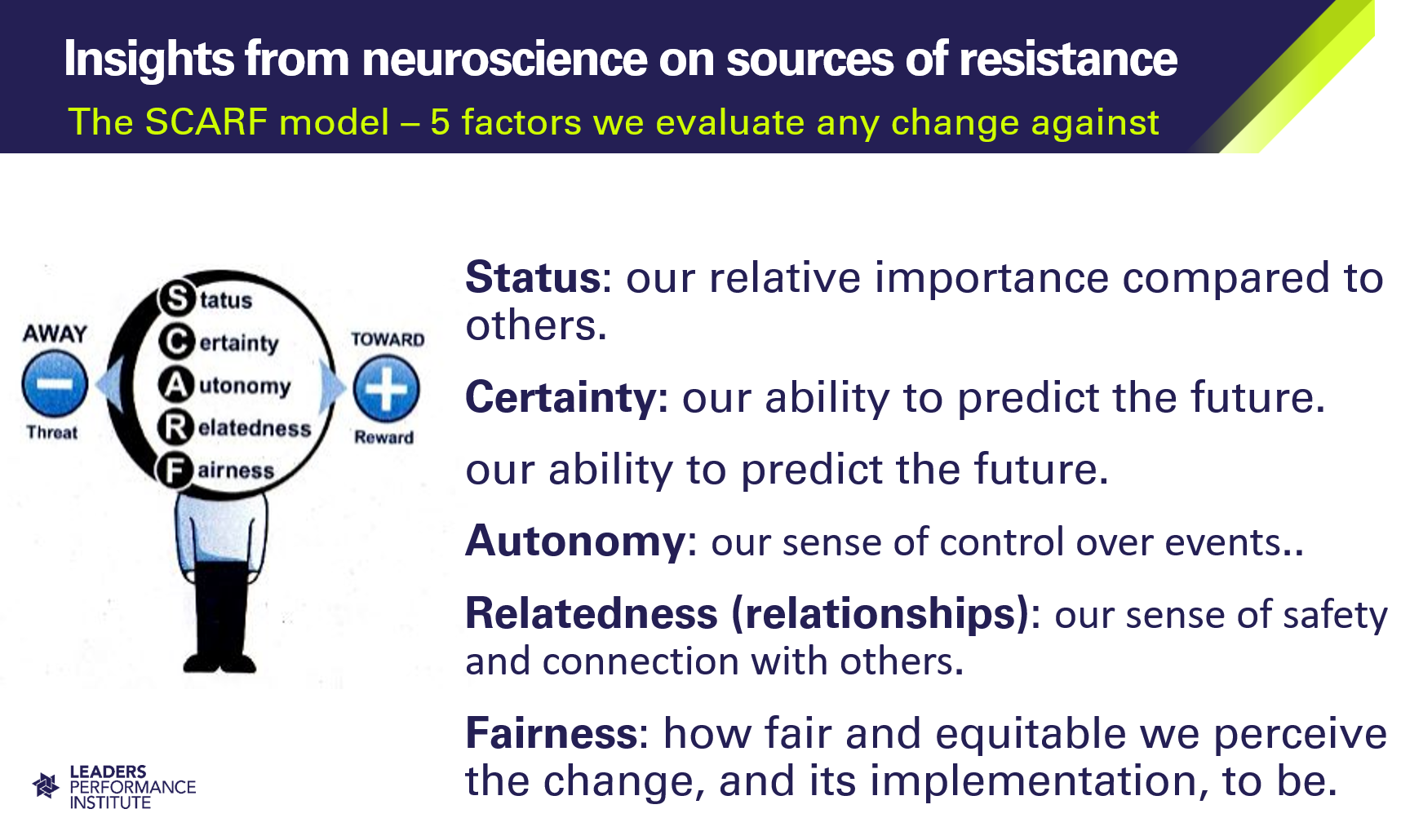
Depending on their circumstances, people can either feel threatened or rewarded in each of these domains.
“I’m not constantly thinking about the SCARF model,” said Bull. “I use it when I get a response from a client that surprises me; then I’ll go back to the SCARF model and go ‘what might I be missing?’ But it’s also a really good model when you’re thinking about how to frame and communicate the change. Because each of these can give a negative hit, but you can also think about ‘how do I promote this change? How do I sell this change in a way that it highlights how it might increase status? How might it increase autonomy?’
He then returned to the three phases of transition and set out the possible traps to be avoided for both individuals and leaders:
Bull emphasised that these traps reflect predictable human responses when transition is not adroitly led rather than poor intent or capability; and, if anything, leaders often respond with the wrong behaviour at the wrong stage.
He then pivoted towards organisational psychology, specifically the idea of change-curves.
People can respond both positively and negatively to change and these reactions can be plotted on a ‘change curve’. First, he showed the virtual table an example of a negative response to change:
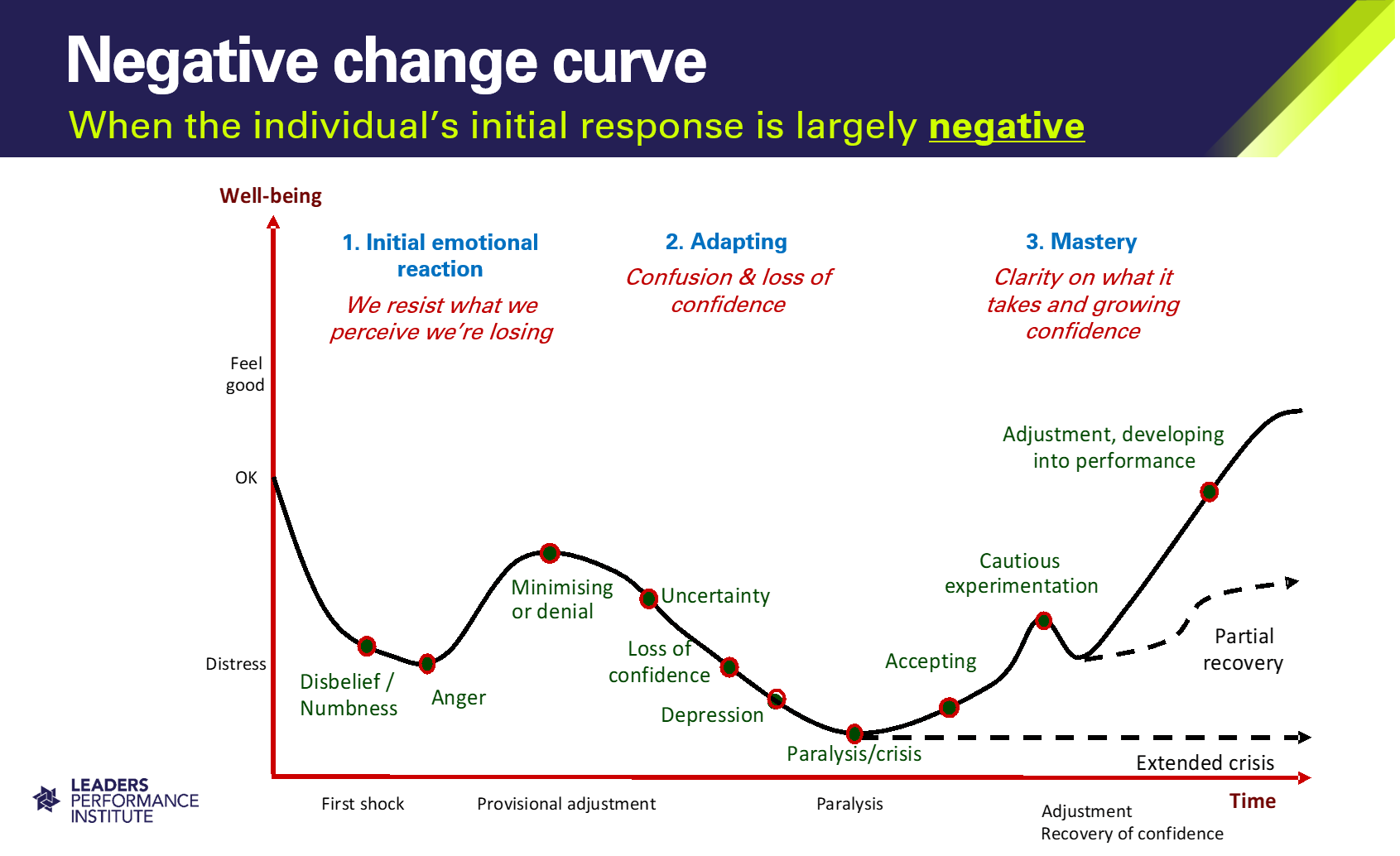
Bull explained the line of trajectory through his own negative experience of discovering that a restaurant in Bath had stopped serving his favourite pizza.
He added: “I just want to make the point: you don’t move linearly through each stage. I think of it more as water sloshing through a container. You will be partly in stage one, partly in stage two. So even though I’m intellectually trying to figure out what am I going to have on the menu, I’m still partly in frustration.”
Bull then shares an example of a positive change curve:
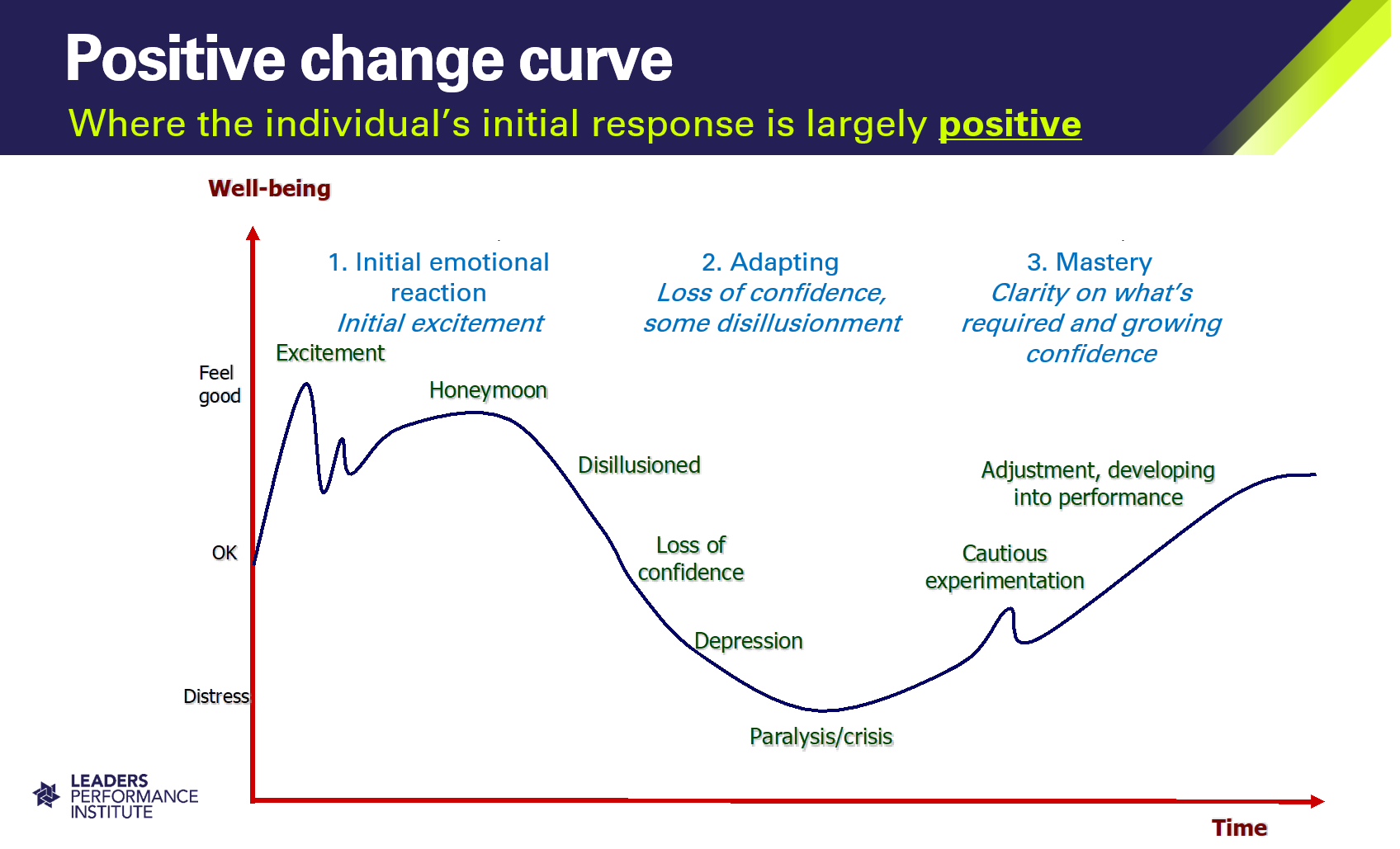
He noted that positive change:
Next, Bull summarised what people need from their leaders at each phase of transition:
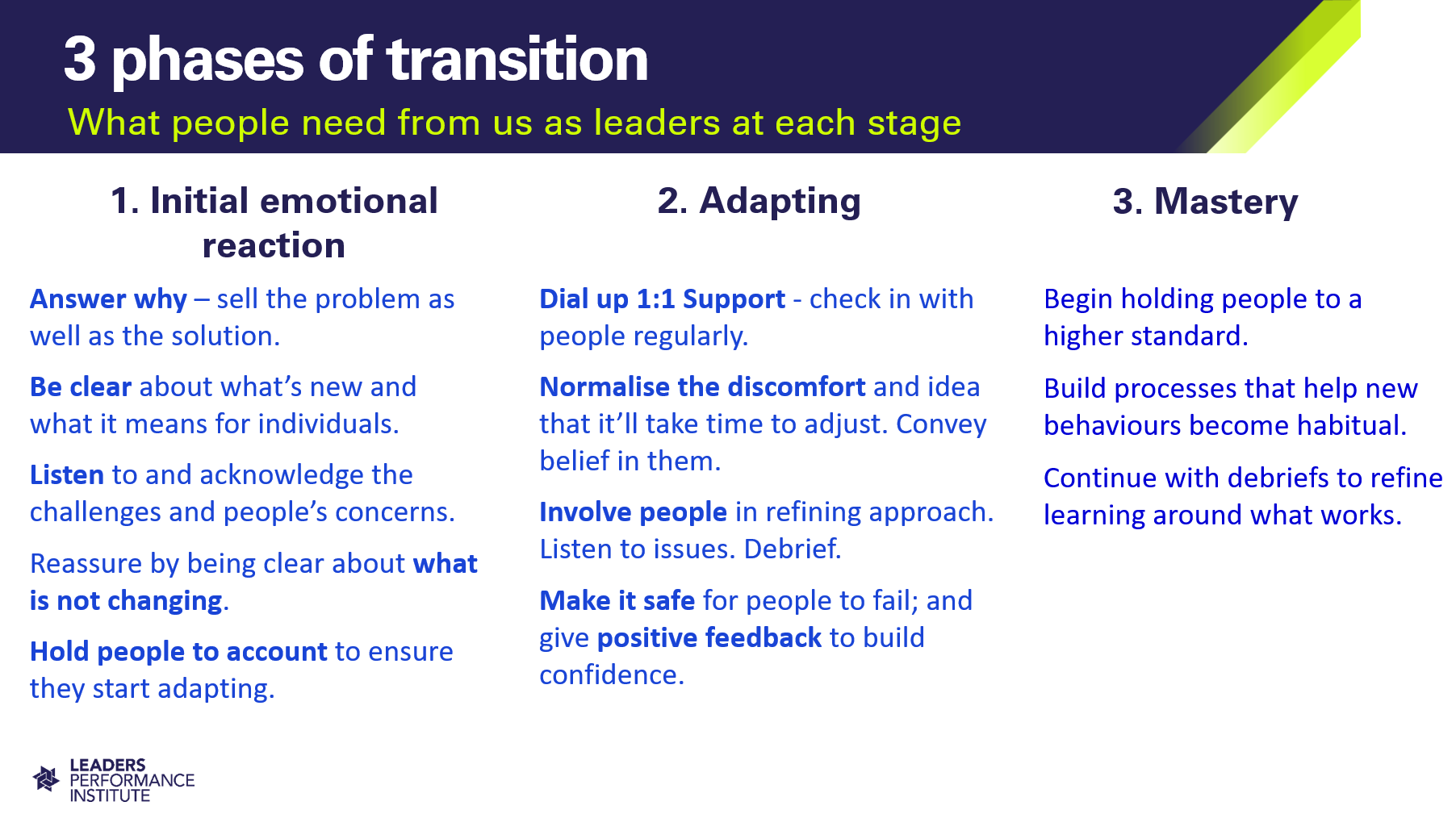
To wrap up his presentation, Bull suggested the ‘Four Ps’ model as a communications tool for members to use in their teams when leading change. It can help hold the process together and ease the psychological demands of transition:
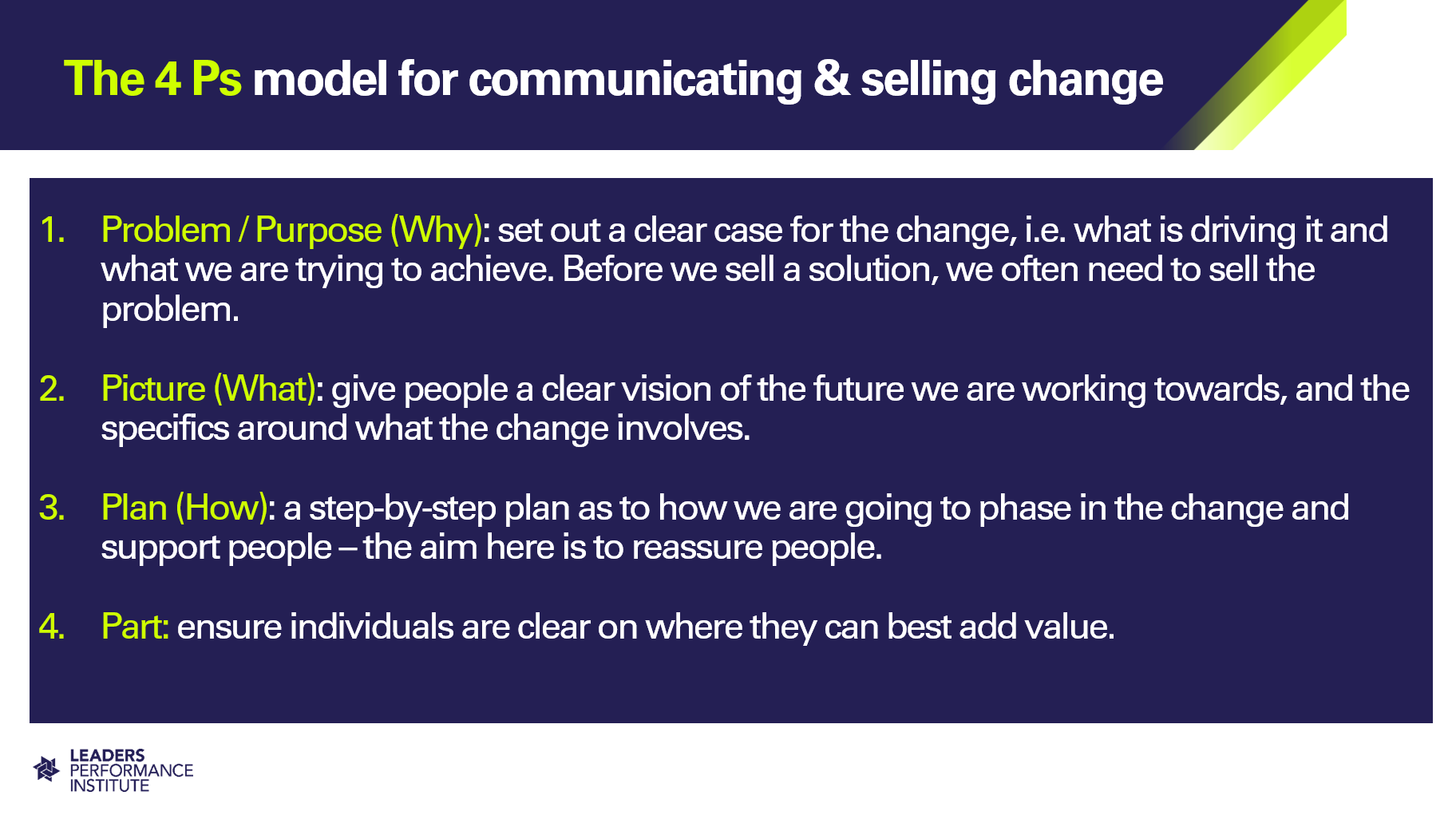
He said: “This isn’t new content, but it’s a new way of presenting it; it tends to be one of the things people remember six months, 12 months later.”
What to read next
Rec Revolution: Does Transformational Leadership Theory Explain Bath Rugby’s Resurgence?
As the performance specialist highlights, the solutions lie in structures before people.
With these words Dr Robin Thorpe, who has worked across multiple elite high-performance environments, kicked off his recent virtual roundtable for Leaders Performance Institute members. The theme of the day was how teams and organisations can overcome silos born of structural issues with fresh skills and a new mindset.
“We tend to think of the human factors first,” Thorpe tells the Leaders Performance Institute off the back of his presentation, “but once you start to analyse the situation more deeply and begin to reflect, there are likely to be structural factors within an organisation.”
“Across my roles,” he continues, “the most effective environments weren’t necessarily those with the most expertise, but those where systems were deliberately designed to integrate that expertise.”
In rare high-performance environments where excellence is paired with humility, collaboration emerges naturally, as individuals are both confident in their expertise and open to the perspectives of others. This reflects principles from social psychology where low ego threat and high psychological safety enable collective intelligence to outperform individual capability.
So a leader in sport may encounter defensive or withdrawing behaviours, but their roots are often linked to underlying structural factors.
Below, aided by Thorpe’s reflections from a career spanning nearly two decades in both European and North American sport, we run through three of the most common structural factors behind the formation of silos and some of the steps that organisations can take before they become damaging.
Outcome:
In the late 2000s, as Thorpe explains, there was an acceleration across the world of sport in the emergence of different performance departments, from sports science and physiotherapy to medical and psychology. In numerous settings, “it led to dichotomy-type frameworks, such as ‘performance and training’, ‘medical and rehab’ or ‘injured and non-injured’. These were structural in nature and encouraged departments to each add their own KPIs, language and processes.” It ultimately led to misaligned and fragmented outcomes, which were often in competition.
Insight:
Specialisation improves expertise but also increases the need for deliberate integration. Therefore, it is important to be clear on the shared outcomes/priorities. How do you ‘nest’ short‑term priorities within longer‑term objectives ? Thorpe says: “We have to be clear on our objective and purpose. What are we here to do? For example, are we here to improve athlete education around certain topics? Is there a more psychological outcome? Is there a technical skill priority? And it doesn’t mean that these priorities are isolated, it just means that maybe a certain member of the team takes more of a lead in ensuring that everything fits together and the greater team work toward a shared outcome.” When done well, this doesn’t just improve collaboration, it directly enhances decision-making quality and performance outcomes.
In practice, this requires leaders to actively design how disciplines connect, rather than assuming collaboration will occur naturally.
This can lead to a much more nuanced (but outcome-focused) approach. Thorpe cites a hypothetical example: if a high-performance team is looking to stimulate quad hypertrophy in an athlete, it will certainly involve the S&C specialist and dietitian, but if the athlete is experiencing challenges with their eating behaviours, there will be opportunity for the psychologist or a mental performance/health specialist to integrate, considering the success of the outcome is heavily influenced by increasing certain nutrient intake. Shared outcomes enable that interdisciplinary conversation. “It can influence outcomes in ways not immediately apparent when viewing the performance challenge in isolation.”
Review your setbacks. “It’s really important to regularly review situations where outcomes weren’t aligned or why an outcome wasn’t achieved or there might have been a communication issue.” The first port of call should not be the human at the foundational layer.
Repeat your purpose. It sounds simple but it is critical to be “very deliberate and very repetitive in a positive, coaching way in reminding staff how to architect collaboration. Consistently discussing purpose, priorities and outcomes for athlete results, whether informally or sometimes more formally in team meetings, can be effective”.
Provide open spaces. “I think we should start to really think about facility architecture and ensuring that we’re creating and positively manipulating traffic footfall and healthy collisions within a space to help reduce silo-forming.” Thorpe admits the best-designed building won’t solve every performance issue, “but it can play a role in minimising some of the downstream effects”
Outcome:
Expertise is present but true influence depends on the hierarchy.
Thorpe recalls an experience from earlier in his career. “It was a highly coach-led, centralised structure,” he says. “We could put in place strong systems and processes, but ultimately, they needed to align with the direction and philosophy of the key stakeholder. This is not unique to that environment. In these settings, ensuring that all perspectives are heard and integrated can be challenging, and individuals or departments may naturally gravitate towards protecting their areas of expertise.”
Insight:
Expertise only improves outcomes when structures allow it to influence decisions. Teams should consider establishing…
Clear decision-making rights. Thorpe suggests that a high-performance team creates a mechanism that integrates interdisciplinary input before it reaches the coach or key stakeholders. He speaks of the “decision-making engine” that operates beneath leadership level.
He says: “Do we have clarity on who holds decision-making responsibility? Is information fragmented, or is it presented in a clear and accessible way that enables everyone to operate with a shared, objective understanding?”
When this is happening 24/7, “More information feeds into this decision-making engine,” he continues, using the example of a health and performance leader reporting on an athlete. “It allows them to communicate clearly, concisely and with confidence to key stakeholders.” These clear decision rights reduce upward lobbying and prevent the coach from becoming the bottleneck for every decision. This also prevents people competing for the attention of the leader. When this is embedded effectively, leaders are no longer the bottleneck, they are enabled by the system.
The role of leadership is not to centralise decisions, but to ensure the system consistently produces high-quality decisions.
Outcome:
Departments optimise locally rather than collectively.
This often creates more problems. “Increasing volumes of data, when not clearly aligned to purpose, can unintentionally contribute to siloed thinking.” says Thorpe, adding that it can lead to opinion-selected data points that increases the risk of emotions trumping objectivity.
The highest-performing environments align incentives in a way that balances risk, performance, and availability, rather than allowing one metric to dominate.
It reminds him of Charles Goodhart’s Law: “When a measure becomes a target, it ceases to be a good measure”. The renowned English economist may not have had sports science in mind when he uttered those words, but they resonated with the virtual roundtable when Thorpe shared them.
When incentives are misaligned, collaboration becomes negotiation. The solution lies in…
Shared KPIs. This is linked to the shared outcomes discussed above. Thorpe cites a hypothetical example of a medical team delivering on player availability. He says: “If the team availability percentage is the North Star then it risks bringing about a more conservative approach to solely keeping players available.”
It raises both a moral quandary and a performance issue. “Performance departments tend to want to push players and to maximise human performance. In doing so, you acknowledge that there may be some potential collateral damage and injuries along the way. Medical teams often use player availability as a key indicator of success, while performance teams focus on driving adaptation and physical development, highlighting the importance of aligning these perspectives around shared outcomes specific to the collective objectives of the team or players.”
Intentional system design. It comes back to the ‘decision-making engine’ and clear decision-making rights. “It creates a shared language using correct, up-to-date, appropriate objectivity. Using appropriate data collection measures often reduces the influence of opinions and subjective inputs.”
Ultimately, organisations that address these structural barriers see improvements not just in collaboration, but in decision speed, clarity, and performance outcomes.
As high-performance environments continue to evolve, the challenge is not removing silos, but designing systems that integrate expertise to consistently deliver performance.
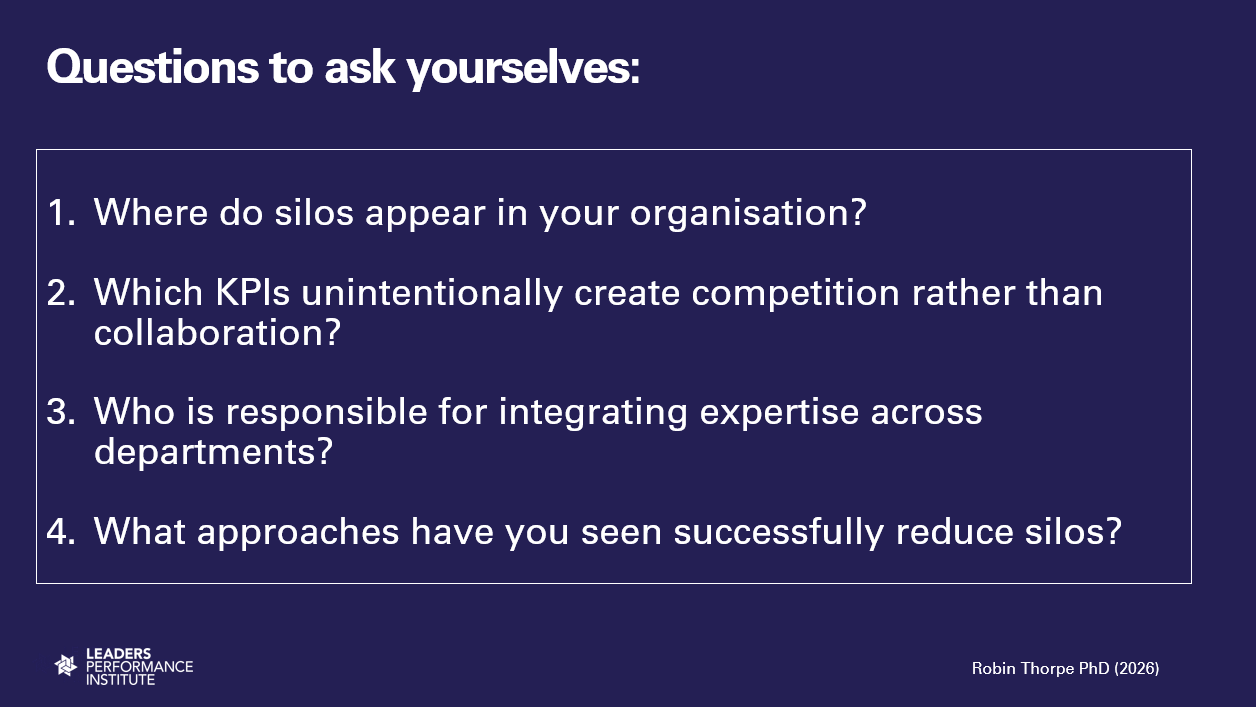
To wrap up proceedings, Thorpe posed four questions that practitioners can ask themselves:
What to read next
Breaking Silos: Why the Answer Lies in Creating a Sense of Shared Ownership in Performance